Croatia
a land of thousand islands
An overview of its history, culture and
natural beauty
CROATIA IS
On the crossroads
between
Central Europe
and the
Mediterranean
GENERAL FACTS
Official name:
THE
REPUBLIC
OF CROATIA
Official
language:
CROATIAN
Alphabet:
http://education.yahoo.com/reference/factbook/hr/map.html
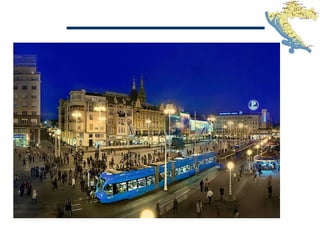
CAPITAL - ZAGREB
Church of St. MarkOld town and Cathedral
ECONOMY - TOURISM
ECONOMY - SHIPBUILDING
Made in Split, Croatia
ECONOMY - AGRICULTURE
SOUTH
CROATIA
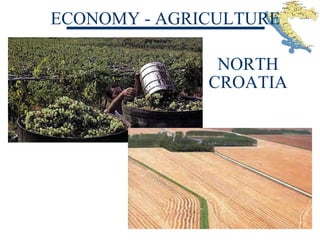
ECONOMY - AGRICULTURE
NORTH
CROATIA
ARCHIPELAGO
1,185 islands and rocks
66 inhabited
One of 10 nations in the
world with more than
1000 islands
Total Coastline length 5,835 km
(Islands 70% - Mainland 30 %)
BEACHES
BEACHES
LIGHTHOUSES
66 big stone lighthouses from 19 ct.
WHAT WE ARE PROUD
OF…
Interesting facts about
Croatia
SPORT - GORAN IVANISEVIC
..and welcome in his
hometown - Split
Winner
WIMBLEDON CHAMPION 2001
NBA PLAYERS FROM CROATIA
Drazen
Petrovic
Radja vs.
Rodman
Toni
Kukoc
Zan
Tabak
Basketball team from Split - several times
European champions.
NATIONAL SOCCER TEAM
C R O A T I A
The Third Best Team in the World
Davor Suker won the
Golden Boot for scoring the
most goals (France 1998)
DALMATIAN DOG–NATIVE CROATIAN
101 DALMATIAN
Dalmatia - the coastal part of Croatia
Recognized as Croatian
autochthonous breed (FCI-153)
Croatian Mascot - 2000
Olympic games Sydney
CROATIA - HOMELAND OF CRAVATS
Every day worn by the 600
million men around the world.
CROATIA
A tradition introduced by
Croatian soldiers who wore a
small neckerchief of silk or
cloth, tied in a knot around
their necks.
Accepted in Europe during
1618-1648 when two
regiments of Croatian
soldiers were serving Luis
XIV. After “la Cravate”
become popular at French
court, fashion spread fast
further.
HOMELAND OF CRAVATS
INVENTORS - PARASHUTE
Faust Vrancic (1551-1617) from
Sibenik invented and constructed a
parashute and also performed a first
jumps in order to test it.
.
The smallest cathedral
in the world is said to
be located in Nin, near
Zadar
The city of Zadar is
home to the world's first
Sea Organ that creates
its music only by the
action of the wind and
waves
Although it has a population of
only 23 people, Hum in Istria,
Croatia is officially a town and
the Guinness World Record
holder for the smallest town in
the world
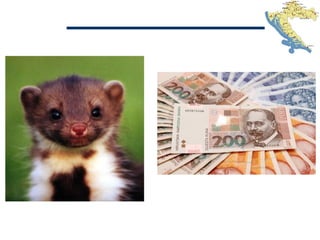
Croatia's currency, kuna, was
named after a small agile
animal with brown fur, marten
in English, based on the use of
marten pelts as units of value in
medieval trading. Heads of the
larger coins feature a running
marten
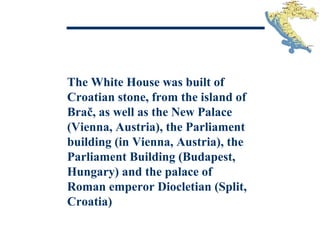
The White House was built of
Croatian stone, from the island of
Brač, as well as the New Palace
(Vienna, Austria), the Parliament
building (in Vienna, Austria), the
Parliament Building (Budapest,
Hungary) and the palace of
Roman emperor Diocletian (Split,
Croatia)
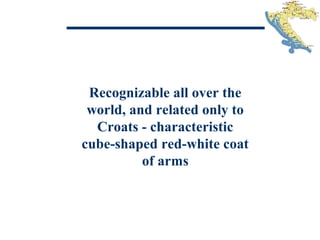
Recognizable all over the
world, and related only to
Croats - characteristic
cube-shaped red-white coat
of arms
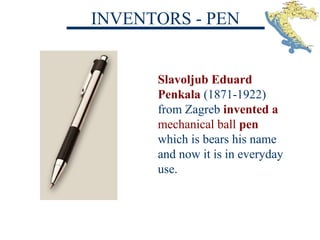
INVENTORS - PEN
Slavoljub Eduard
Penkala (1871-1922)
from Zagreb invented a
mechanical ball pen
which is bears his name
and now it is in everyday
use.
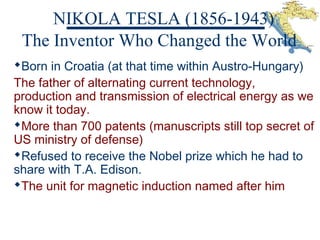
NIKOLA TESLA (1856-1943)
Born in Croatia (at that time within Austro-Hungary)
The father of alternating current technology,
production and transmission of electrical energy as we
know it today.
More than 700 patents (manuscripts still top secret of
US ministry of defense)
Refused to receive the Nobel prize which he had to
share with T.A. Edison.
The unit for magnetic induction named after him
The Inventor Who Changed the World
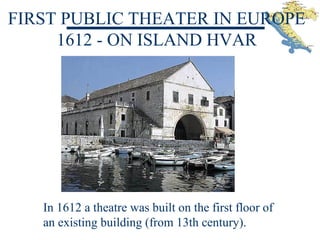
FIRST PUBLIC THEATER IN EUROPE
In 1612 a theatre was built on the first floor of
an existing building (from 13th century).
1612 - ON ISLAND HVAR
ROMAN HERITAGE – ARENA IN PULA
built in the 1st century AD during the reign of the Emperor
Vespasian, at the same time as the Colosseum in Rome
the Amphitheatre could seat 20.000 spectators.
In the Middle Ages it was the site of knight tournaments and fairs.
ROMAN HERITAGE
DIOCLETIAN PALACE IN SPLIT
Peristyle – main square
Diocletians Aquaduct
Still in use after 1700 years
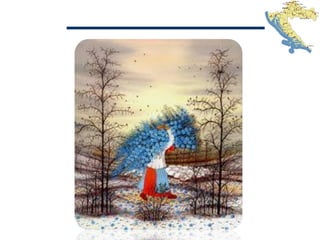
CROATIAN NAIVE ART
Ivan Lackovic Croata
“WINTER”
Ivan Rabuzin
“FULLNESS OF THE
EARTH”
Today quite widespread and highly esteemed.
First introduced by Croatian painter
Krsto Hegedusic (1901-1971).
CROATIAN NAIVE ART
Ivica Fister
“OUR ETERNAL LIGHT”
Ivan Rabuzin
“DAWN”
LACE – ISLAND PAG
LACE - LEPOGLAVA
Another lace, from island
Hvar, is unique as made of
threads of Aloe Vera leaf
quickly while thread is still
wet and flexible
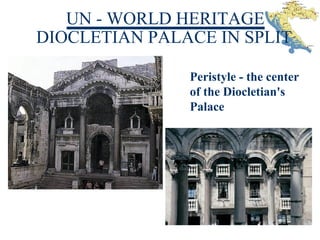
UN - WORLD HERITAGE
DIOCLETIAN PALACE IN SPLIT
Peristyle - the center
of the Diocletian's
Palace
UN - WORLD HERITAGE
GAIUS AURELIUS VALERIUS DIOCLETANIUS (c 243-316) -
born near the Salona, then capital of the Roman province of
Dalmatia. He was pronounced emperor on November 20, 284 AD.
DIOCLETIAN PALACE IN SPLIT
CATHEDRAL IN SPLIT
THE OLDEST IN THE WORLD
UN - WORLD HERITAGE
OLD CITY OF DUBROVNIK
Bernard Shaw:
Those who seek
paradise on Earth
should come to
Dubrovnik
and see Dubrovnik.
City walls
8-16 ct.
OLD CITY OF DUBROVNIK
UN - WORLD HERITAGE
NATIONAL PARK PLITVICE LAKES
The living process of
formation and growth
of travertine cascade
barriers
UN - WORLD HERITAGE
NATIONAL PARK PLITVICE LAKES
The brown bear - the
largest mammal in this
part of the world
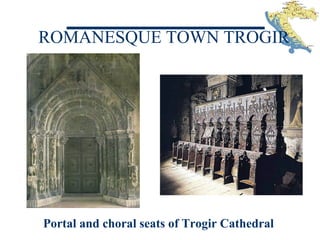
ROMANESQUE TOWN TROGIR
Portal and choral seats of Trogir Cathedral
UN - WORLD HERITAGE
Euphrasius Basilica in Porec, Istria, built in the 6th century.
Very important remain of Byzantine art in Croatia
BASILICA OF EUPHRASIUS IN POREC
UN - WORLD HERITAGE
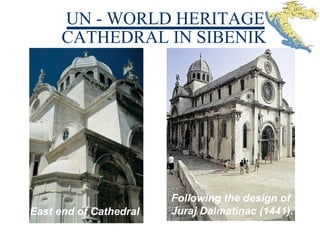
Following the design of
Juraj Dalmatinac (1441).East end of Cathedral
CATHEDRAL IN SIBENIK
Baptistery
UN - WORLD HERITAGE
CATHEDRAL IN SIBENIK
CITIES
CROATIA IS A
LITTLE COUNTRY
WITH A BIG HEART

Presenting Croatia

  • 1.
    Croatia a land ofthousand islands An overview of its history, culture and natural beauty
  • 2.
    CROATIA IS On thecrossroads between Central Europe and the Mediterranean
  • 3.
    GENERAL FACTS Official name: THE REPUBLIC OFCROATIA Official language: CROATIAN Alphabet: http://education.yahoo.com/reference/factbook/hr/map.html
  • 4.
    CAPITAL - ZAGREB Churchof St. MarkOld town and Cathedral
  • 6.
  • 7.
    ECONOMY - SHIPBUILDING Madein Split, Croatia
  • 8.
  • 9.
  • 10.
    ARCHIPELAGO 1,185 islands androcks 66 inhabited One of 10 nations in the world with more than 1000 islands Total Coastline length 5,835 km (Islands 70% - Mainland 30 %)
  • 11.
  • 12.
  • 13.
    LIGHTHOUSES 66 big stonelighthouses from 19 ct.
  • 14.
    WHAT WE AREPROUD OF… Interesting facts about Croatia
  • 15.
    SPORT - GORANIVANISEVIC ..and welcome in his hometown - Split Winner WIMBLEDON CHAMPION 2001
  • 16.
    NBA PLAYERS FROMCROATIA Drazen Petrovic Radja vs. Rodman Toni Kukoc Zan Tabak Basketball team from Split - several times European champions.
  • 17.
    NATIONAL SOCCER TEAM CR O A T I A The Third Best Team in the World Davor Suker won the Golden Boot for scoring the most goals (France 1998)
  • 18.
    DALMATIAN DOG–NATIVE CROATIAN 101DALMATIAN Dalmatia - the coastal part of Croatia Recognized as Croatian autochthonous breed (FCI-153) Croatian Mascot - 2000 Olympic games Sydney
  • 19.
    CROATIA - HOMELANDOF CRAVATS Every day worn by the 600 million men around the world.
  • 20.
    CROATIA A tradition introducedby Croatian soldiers who wore a small neckerchief of silk or cloth, tied in a knot around their necks. Accepted in Europe during 1618-1648 when two regiments of Croatian soldiers were serving Luis XIV. After “la Cravate” become popular at French court, fashion spread fast further. HOMELAND OF CRAVATS
  • 21.
    INVENTORS - PARASHUTE FaustVrancic (1551-1617) from Sibenik invented and constructed a parashute and also performed a first jumps in order to test it. .
  • 22.
    The smallest cathedral inthe world is said to be located in Nin, near Zadar
  • 24.
    The city ofZadar is home to the world's first Sea Organ that creates its music only by the action of the wind and waves
  • 26.
    Although it hasa population of only 23 people, Hum in Istria, Croatia is officially a town and the Guinness World Record holder for the smallest town in the world
  • 28.
    Croatia's currency, kuna,was named after a small agile animal with brown fur, marten in English, based on the use of marten pelts as units of value in medieval trading. Heads of the larger coins feature a running marten
  • 30.
    The White Housewas built of Croatian stone, from the island of Brač, as well as the New Palace (Vienna, Austria), the Parliament building (in Vienna, Austria), the Parliament Building (Budapest, Hungary) and the palace of Roman emperor Diocletian (Split, Croatia)
  • 32.
    Recognizable all overthe world, and related only to Croats - characteristic cube-shaped red-white coat of arms
  • 34.
    INVENTORS - PEN SlavoljubEduard Penkala (1871-1922) from Zagreb invented a mechanical ball pen which is bears his name and now it is in everyday use.
  • 35.
    NIKOLA TESLA (1856-1943) Bornin Croatia (at that time within Austro-Hungary) The father of alternating current technology, production and transmission of electrical energy as we know it today. More than 700 patents (manuscripts still top secret of US ministry of defense) Refused to receive the Nobel prize which he had to share with T.A. Edison. The unit for magnetic induction named after him The Inventor Who Changed the World
  • 37.
    FIRST PUBLIC THEATERIN EUROPE In 1612 a theatre was built on the first floor of an existing building (from 13th century). 1612 - ON ISLAND HVAR
  • 38.
    ROMAN HERITAGE –ARENA IN PULA built in the 1st century AD during the reign of the Emperor Vespasian, at the same time as the Colosseum in Rome the Amphitheatre could seat 20.000 spectators. In the Middle Ages it was the site of knight tournaments and fairs.
  • 39.
    ROMAN HERITAGE DIOCLETIAN PALACEIN SPLIT Peristyle – main square Diocletians Aquaduct Still in use after 1700 years
  • 40.
    CROATIAN NAIVE ART IvanLackovic Croata “WINTER” Ivan Rabuzin “FULLNESS OF THE EARTH” Today quite widespread and highly esteemed. First introduced by Croatian painter Krsto Hegedusic (1901-1971).
  • 41.
    CROATIAN NAIVE ART IvicaFister “OUR ETERNAL LIGHT” Ivan Rabuzin “DAWN”
  • 43.
  • 44.
    LACE - LEPOGLAVA Anotherlace, from island Hvar, is unique as made of threads of Aloe Vera leaf quickly while thread is still wet and flexible
  • 45.
    UN - WORLDHERITAGE DIOCLETIAN PALACE IN SPLIT Peristyle - the center of the Diocletian's Palace
  • 46.
    UN - WORLDHERITAGE GAIUS AURELIUS VALERIUS DIOCLETANIUS (c 243-316) - born near the Salona, then capital of the Roman province of Dalmatia. He was pronounced emperor on November 20, 284 AD. DIOCLETIAN PALACE IN SPLIT
  • 47.
    CATHEDRAL IN SPLIT THEOLDEST IN THE WORLD
  • 48.
    UN - WORLDHERITAGE OLD CITY OF DUBROVNIK Bernard Shaw: Those who seek paradise on Earth should come to Dubrovnik and see Dubrovnik.
  • 49.
    City walls 8-16 ct. OLDCITY OF DUBROVNIK
  • 50.
    UN - WORLDHERITAGE NATIONAL PARK PLITVICE LAKES The living process of formation and growth of travertine cascade barriers
  • 51.
    UN - WORLDHERITAGE NATIONAL PARK PLITVICE LAKES The brown bear - the largest mammal in this part of the world
  • 52.
  • 53.
    ROMANESQUE TOWN TROGIR Portaland choral seats of Trogir Cathedral
  • 54.
    UN - WORLDHERITAGE Euphrasius Basilica in Porec, Istria, built in the 6th century. Very important remain of Byzantine art in Croatia BASILICA OF EUPHRASIUS IN POREC
  • 55.
    UN - WORLDHERITAGE Following the design of Juraj Dalmatinac (1441).East end of Cathedral CATHEDRAL IN SIBENIK
  • 56.
    Baptistery UN - WORLDHERITAGE CATHEDRAL IN SIBENIK
  • 57.
  • 65.
    CROATIA IS A LITTLECOUNTRY WITH A BIG HEART

Editor's Notes

  • #19 We know about organized breeding of this dog in the Djakovo bishopric already in the 14th century! The name was given in the USA in the 19th century, previously also known as the Dubrovnik hunter. Recognized as Croatian autochthonous breed in 1994 (FCI-153). We know about organized breeding of this dog in Croatia already in the 14th century! (the Djakovo bishopric) Can be taught as watchdog and hunter.
  • #21 Many events in the history of mankind eventually fade into oblivion, but others, leave their indelible marks for the entire world to see. More than 350 years ago, the Croats initiated one such influential occurrence. Although started in the 17th century in a small region on the Adriatic coast, the consequences of this event are still very much evident the world over. 600 million people now wear the ubiquitous symbol of Croatia around their necks, close to their hearts. Did you know that Croatia is the mother country of the necktie? In his book, La Grande Histoire de la Cravate (Flamarion, Paris, 1994), François Chaille tells us about the appearance of this article of clothing and how it became fashionable. "… Around the year 1635, some six thousand soldiers and knights came to Paris to give their support to King Louis XlV and Cardinal Richelieu. Among them were a great number of Croatian mercenaries led by a ban, or Croatian viceroy. The traditional outfit of these Croats aroused interest on account of the unusual and picturesque scarves distinctively tied about their necks. The scarves were made of various cloths, ranging from coarse material for common soldiers, to fine cotton and silk for officers. This elegant "Croatian style" immediately enamoured the French, who were delighted by the new article of clothing, which had been previously unknown in Europe. For the gallant French officers in the thirty-year war, the advantage of the Croatian neck scarf was its enviable practicality. In contrast to the lace collar that had to be kept white and carefully starched, the scarf was simply and loosely tied around the neck without need for any additional care. Just as elegant as the stiff, high collars, the new scarves were less awkward, easier to wear and remained visible beneath the soldiers’ thick, long hair. Around the year 1650, during the reign of Louis XIV, the Croatian scarf was accepted in France, above all in court, where military ornaments were much admired. The fashionable expression, ’a la croate’, soon evolved into a new French word, which still exists today: la cravate. This innovation symbolized the height of culture and elegance. On his return to England from exile, Charles II brought with him this new word in fashion. Over the next ten years, this fashion novelty spread across Europe, as well as across the colonies on the American continent..." Since that time in the 17th century, derivatives of the word croata have been present in many languages, (i.e., English, German, French, Portuguese, Italian), meaning cravat or tie. It follows then that Croatia is the mother country of the necktie, as France is the mother country of high fashion, Brazil of coffee, Switzerland of cheese and watches, Portugal of port… How much do you know about the Croatian orign of the tie? The tie (cravat) is a Croatian contribution to the the general development of clothing and fashion. The etymology of the word cravat indicates its Croatian origin. In the mid-17th century the French introduced the word cravate into their language, to describe a piece of cloth worn round the neck. It was, probably, derived from the word Krawatte from a German dialect (the German literary standard language word was Kroate - Croat). The Oxford dictionary of Modern English Language has several different entries for the word cravat: crabbat, crabat, cravett, crevet. The word soon was introduced into other languages; the Italian variant was croatta or cravatta, the Spanish variant was known as corbata and the Flemish as krawaat. One of the popular background explanations to why cravat got its name after the Croats, is as follows: In the 17th century, during the Thirty Years' War (1618 - 1648) in which France and Sweden had united forces against the German Empire, Croatian soldiers served as mercenaries in the light cavalries of both armies. They first gained a reputation of being exceptionally courageous and well trained within the German ranks. After the victories they won over the French troops, Cardinal Richelieu himself insisted on including Croatian mercenaries in the Franch army. In 1633 the first French troop made up of Croatian cavalry was formed. One of the 24 cavalry regiments formed in France in 1643, was the Croatian regiment "Royal-Cravattes". It was an elitist regiment which fought many battles for the kings Louis XIII and Louis XIV. Its soldiers differed from other French troops in their warring strategies, arms and uniforms. A particular detail of their uniform was a kerchief knotted round the neck. Not only did the French soldiers adopt the fashion of wearing the neck kerchief, but it soon grew very popular among the civilians too. Even the French ladies members of the French court and the French nobility, wore cravats, and in the years to come, they could be seen knotted round the necks of gentlemen in other European and overseas countries. In the course of time the cravat has appeared in a variety of shapes, colours and materials, ranging from the simple knotted kerchive to more sophisticated, sometimes uncomfortable, stiff, high collars. In the l9th and 20th centuries the bow tie grew very popular. The modern tie is a narrow, long piece of silk or woolen fabric worn under a shirt collar and tied in a knot at the front. There are many varieties of patterns and colours designed to match the gentlemen's suits. Tiepins can be used to fasten the ties to the shirt. A tie could be a sign of affiliation - membership to an artistic elitist group (the style a la Byron or Baudelaire), or belonging to the middle class, to the class of farmers and even revolutionaries (thus, the common feature of the 1789 Franch revolutionaries was a black kerchief tied around their necks). Source: The Croatian Post and Telecommunications, 1995