NEPAL
YOUR TOUR GUIDE: MAHANANDA
KNOW YOUR COMMUNITY
KNOW YOUR WORLD
A PROGRAM OF GLOBAL TIES AKRON
COUNTRY
MAP
Quick facts
● Full name: Nepal
● Population: 30,896,590
● Capital: Kathmandu
● Largest city: Kathmandu
● Area: 56,956 sq mi; 147,516 km2
● Major language: Nepali is spoken by 78% of the
population. There are 121 recognized national languages.
Maithili is the second most spoken language.
● Major religion: Hinduism, Buddhism, Islam, Kirat, and
Christianity
● Life expectancy: 66 yrs (men), 70 yrs(women)
● Monetary unit: Nepalese Rupee
History
● A family called the Malla ruled from the AD 900s to the 1700s
● In 1769 the Malla were defeated by Prithvi Narayan Shah, who was
king of the nearby state of Gurkha
● In 1846 the Shah rulers lost control of the country to the Rana noble
family
● A revolution overthrew the Rana government in 1951. Power was
returned to the Shah family.
● In 1972 Birendra Shah became king.
● The king made some attempts to establish a democratic system of
government
● In 1990 there were violent strikes and protests over the king’s power.
● As a result the king appointed a government that wrote a new
constitution. The constitution allowed political parties and
established a two-house legislature
History cont.
● A group of rebels began fighting the government in 1996
● The rebels wanted to establish a one-party communist republic
● In 2001 King Birendra’s son shot and killed the king, other members of the
royal family, and himself
● King Birendra’s brother Gyanendra then became king
● He tried to take control of the government to stop the ongoing fighting by the
rebels.
● This led to more protests.
● In 2006 Gyanendra gave up control, and the rebels signed a peace agreement
with the government
● In 2008 the new government then voted to declare Nepal a democratic republic
● In 2017 Nepal held successful nationwide elections
● On April 25, 2015, Nepal suffered one of the most severe earthquakes in its
history
Government
● Officially the Federal Democratic Republic of
Nepal
● Government type: Federal Parliamentary
Republic
● Chief of State: President Ram Chandra
Poudel
● Head of Government: Prime Minister Pushpa
Kamal Dahal
Economy
● One of the poorest countries in the world
● Most people work in farming
● Rice, corn and wheat are major crops
● Also potatoes, tobacco, sugarcane, and cotton
● They raise cattle, goats, buffalo, pigs, and sheep
● Factories: Clothing, carpets, and pashmina (a
fabric of fine wool and silk).
● Tourism and information technology
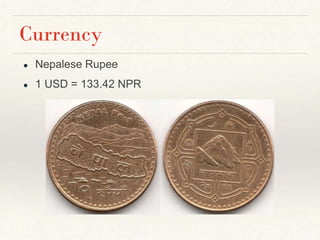
Currency
● Nepalese Rupee
● 1 USD = 133.42 NPR
Key Issues
● Child labor
● Bonded labor (debt slavery)
● Corruption in politics and government
● Gender based violence
● Underage marriage
● Adequate health care and education in
rural areas
Religion
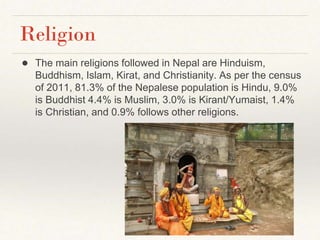
● The main religions followed in Nepal are Hinduism,
Buddhism, Islam, Kirat, and Christianity. As per the census
of 2011, 81.3% of the Nepalese population is Hindu, 9.0%
is Buddhist 4.4% is Muslim, 3.0% is Kirant/Yumaist, 1.4%
is Christian, and 0.9% follows other religions.
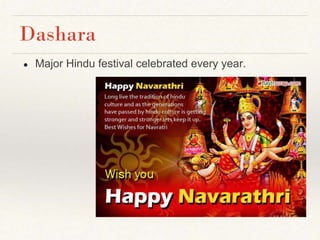
● Major Hindu festival celebrated every year.
Dashara
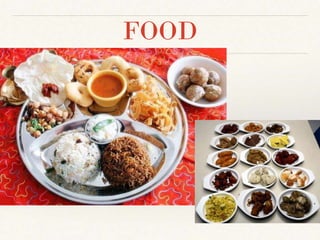
FOOD
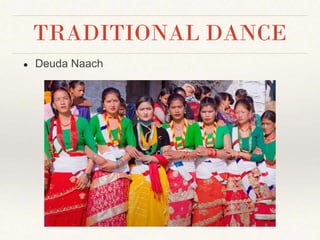
TRADITIONAL DANCE
● Deuda Naach
 Updated 2023-Nepal.pptx

Updated 2023-Nepal.pptx

  • 1.
    NEPAL YOUR TOUR GUIDE:MAHANANDA KNOW YOUR COMMUNITY KNOW YOUR WORLD A PROGRAM OF GLOBAL TIES AKRON
  • 2.
  • 3.
    Quick facts ● Fullname: Nepal ● Population: 30,896,590 ● Capital: Kathmandu ● Largest city: Kathmandu ● Area: 56,956 sq mi; 147,516 km2 ● Major language: Nepali is spoken by 78% of the population. There are 121 recognized national languages. Maithili is the second most spoken language. ● Major religion: Hinduism, Buddhism, Islam, Kirat, and Christianity ● Life expectancy: 66 yrs (men), 70 yrs(women) ● Monetary unit: Nepalese Rupee
  • 4.
    History ● A familycalled the Malla ruled from the AD 900s to the 1700s ● In 1769 the Malla were defeated by Prithvi Narayan Shah, who was king of the nearby state of Gurkha ● In 1846 the Shah rulers lost control of the country to the Rana noble family ● A revolution overthrew the Rana government in 1951. Power was returned to the Shah family. ● In 1972 Birendra Shah became king. ● The king made some attempts to establish a democratic system of government ● In 1990 there were violent strikes and protests over the king’s power. ● As a result the king appointed a government that wrote a new constitution. The constitution allowed political parties and established a two-house legislature
  • 5.
    History cont. ● Agroup of rebels began fighting the government in 1996 ● The rebels wanted to establish a one-party communist republic ● In 2001 King Birendra’s son shot and killed the king, other members of the royal family, and himself ● King Birendra’s brother Gyanendra then became king ● He tried to take control of the government to stop the ongoing fighting by the rebels. ● This led to more protests. ● In 2006 Gyanendra gave up control, and the rebels signed a peace agreement with the government ● In 2008 the new government then voted to declare Nepal a democratic republic ● In 2017 Nepal held successful nationwide elections ● On April 25, 2015, Nepal suffered one of the most severe earthquakes in its history
  • 6.
    Government ● Officially theFederal Democratic Republic of Nepal ● Government type: Federal Parliamentary Republic ● Chief of State: President Ram Chandra Poudel ● Head of Government: Prime Minister Pushpa Kamal Dahal
  • 7.
    Economy ● One ofthe poorest countries in the world ● Most people work in farming ● Rice, corn and wheat are major crops ● Also potatoes, tobacco, sugarcane, and cotton ● They raise cattle, goats, buffalo, pigs, and sheep ● Factories: Clothing, carpets, and pashmina (a fabric of fine wool and silk). ● Tourism and information technology
  • 8.
  • 9.
    Key Issues ● Childlabor ● Bonded labor (debt slavery) ● Corruption in politics and government ● Gender based violence ● Underage marriage ● Adequate health care and education in rural areas
  • 10.
    Religion ● The mainreligions followed in Nepal are Hinduism, Buddhism, Islam, Kirat, and Christianity. As per the census of 2011, 81.3% of the Nepalese population is Hindu, 9.0% is Buddhist 4.4% is Muslim, 3.0% is Kirant/Yumaist, 1.4% is Christian, and 0.9% follows other religions.
  • 11.
    ● Major Hindufestival celebrated every year. Dashara
  • 12.
  • 13.