Toward Moral CapitalismReconciling private interest with the public goodCauxRound TableJohn Friedman – Sustainable Business Network of WashingtonBUSINESS LAW 5175 -- Business, Law &Ethics in Modern Society
	The Caux Round Table (CRT) is an international network of principled business leaders working to promote a moral capitalism. 	The CRT advocates implementation of the CRT Principles for Business through which principled capitalism can flourish and sustainable and socially responsible prosperity can become the foundation for a fair, free, and transparent global society.The Caux Round TableSteve Youngwww.cauxroundtable.orgtwitter: @CauxRoundTable
Co-founding board member of the Sustainable Business Network of Washington (SB NOW); a partner organization with CRT	20 years+ career including corporate communications/organizational development, public/community relations, sustainability and CSRAbout Myselfwww.sbnow.orgtwitter:  @SustBusNOW	@JohnFriedman
BackgroundHistory and theory Global financial crisisWhat happenedWhat can/should we learn from itMoral Capitalism Determining ‘true’ valueThe Caux Round Table principles in actionOverview
Capitalism is an economic, not a political modelCulture (nationality, faith, etc.) define how capitalism is implementedIndividual wealth creation – the ability to earn and retain capital – is a tremendous force for changeShort-term thinking is inconsistent with long-term best interestsAt the outset …
15th/16th Century	Venetian accounting system and argosy 			voyages - entrepreneurs began to 				combine capital and labor in discrete 				projects. Evolved into going concerns called 			corporations1600 – 1750		Capitalism grows prosperous in 				Holland, England and Scotland1776			An Inquiry into the Nature and 	Causes of the Wealth of Nations 							- Adam Smith1830 – 1870		Abuses of capitalism			(mills of Manchester; Ebenezer Scrooge) 				Communist Manifesto – Marx, Engels				Das Kapital- Karl MarxA Brief History of Capitalism
1880 – 1980 		Non-communist response:				welfare state capitalismBismarck’s reforms					Free trade unions					John Maynard Keynes / New Deal					Japan, Inc.					Austrian school of economics1989 – 2004		Collapse of communism				Rise of CSR				CRT Principles for Business (1994)United Nation’s Global Compact (2000)Moral Capitalism - Stephen B. YoungA Brief History of Capitalism
Adam Smith Observed economic reality - people act in their own interest. Self-interest not always good but alternative is worse:
"By pursuing his own self interest he frequently promotes that of society more effectually than when he really intends to promote it. I have never known much good done by those who affected to trade for the public good.” (p. 456).In free/open markets, how does a nation keep its capitalists from moving their capital out of the nation and into other countries where labor could be bought more cheaply? “(By) preferring the support of domestic to that of foreign industry," the capitalist will in a sense be "led by an invisible hand to promote an end which was no part of his intention."On the Wealth of Nations
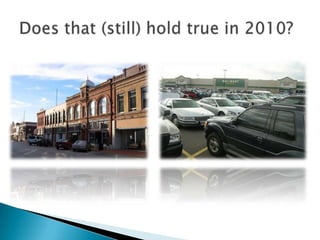
Does that (still) hold true in 2010?
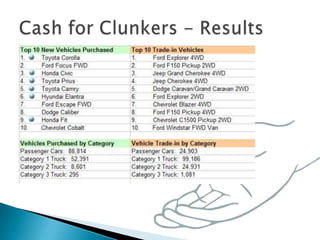
Cash for Clunkers - Results
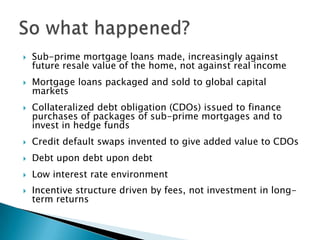
Sub-prime mortgage loans made, increasingly against future resale value of the home, not against real incomeMortgage loans packaged and sold to global capital marketsCollateralized debt obligation (CDOs) issued to finance purchases of packages of sub-prime mortgages and to invest in hedge fundsCredit default swaps invented to give added value to CDOsDebt upon debt upon debtLow interest rate environmentIncentive structure driven by fees, not investment in long-term returnsSo what happened?
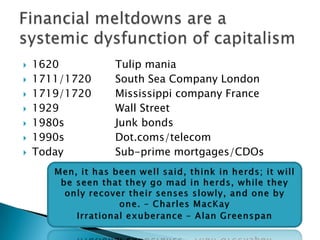
1620		Tulip mania1711/1720	South Sea Company London1719/1720	Mississippi company France1929		Wall Street1980s		Junk bonds1990s		Dot.coms/telecomToday		Sub-prime mortgages/CDOsFinancial meltdowns are a systemic dysfunction of capitalismMen, it has been well said, think in herds; it will be seen that they go mad in herds, while they only recover their senses slowly, and one by one. – Charles MacKayIrrational exuberance – Alan Greenspan
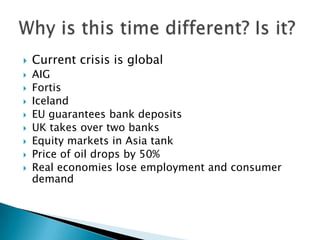
Current crisis is globalAIGFortisIcelandEU guarantees bank depositsUK takes over two banksEquity markets in Asia tankPrice of oil drops by 50%Real economies lose employment and consumer demandWhy is this time different? Is it?
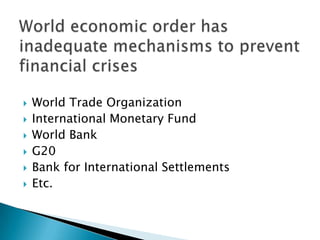
World economic order has inadequate mechanisms to prevent financial crisesWorld Trade OrganizationInternational Monetary FundWorld BankG20Bank for International SettlementsEtc.
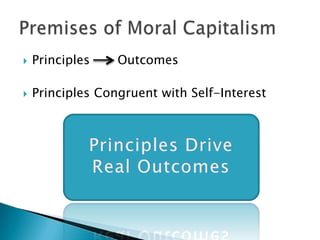
Principles       OutcomesPrinciples Congruent with Self-InterestPremises of Moral CapitalismPrinciples Drive Real Outcomes
Whenever a system produces a consistent result, the inevitable conclusion is that that system was designed to produce that result, regardless of whether or not the outcome matches the intended outcome.What are the principles that are driving outcomes?When short term shareholder returns are elevated to a core value, corruption is inevitable. – Noel Purcell, CRT Chair
When financial markets implode, markets lose liquidity, exchanges of goods and services fall, output is reduced, employment is cutDebt must be taken out of the financial systemAsset values have to be reset at lower levelsAsset owners lose wealthWhat happens when bubbles burst?
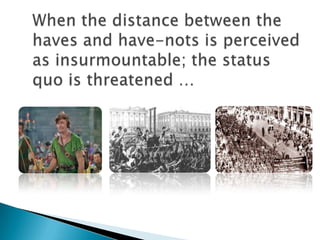
When the distance between the haves and have-nots is perceived as insurmountable; the status quo is threatened …
How do you determine ‘real’ value of assets? It is the INTANGIBLES that define valueBear Stearns (2008)March 14 - $80/share book value March 17 - $2/shareMay 10 – sold at $10/share after shareholder outcry and assistance from Federal Reserve BankLehman BrothersDespite billions in assets, management liquidated the company as no buyers emerged with confidence in it as a going concern
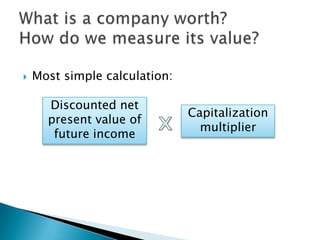
Most simple calculation:What is a company worth?How do we measure its value?Discounted net present value of future incomeCapitalization multiplierx
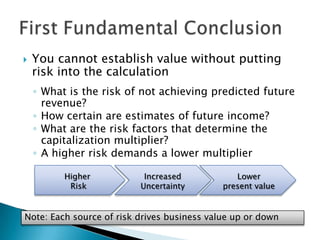
You cannot establish value without putting risk into the calculationWhat is the risk of not achieving predicted future revenue?  How certain are estimates of future income?What are the risk factors that determine the capitalization multiplier?  A higher risk demands a lower multiplierFirst Fundamental Conclusion	Higher Increased	Lower	Risk	Uncertainty	present valueNote: Each source of risk drives business value up or down
Management of risk enhances enterprise valueRisk management leads to more certain income
Risk reduction leads to higher valuationSecond Fundamental Conclusion
Stakeholder relationships entail risk   - customers   - investors   - government regulators   - employeesEach relationship is an intangible asset of the business (assets can appreciate or depreciate)Lowering risk for each relationship enhances the quality of intangible assets and increases business valuationStrategies for Managing Risk
The GoodThe BadThe UglyHow do companies create value?
Risk Assessment/continuous Risk ReductionOptimize Stakeholder Benefits Moral CapitalismThe Good
Feed Shareholders, Abuse StakeholdersCommodity pricing/ compete on pricing/low costsRent seeking (market power)Take the money and run: short-term thinkingUnsustainable Valuations =Eventual FailureThe Bad
No net wealth creation; speculation in trading  (Rob Peter to pay Paul)Irrational Exuberance(Market traders/short termism)False Valuations(Enron: Ponzi Schemes; sub-prime mortgages, CDOs…)Encourage unsustainable pricing  	   (of securities CDOs, CDSs)INEVITABLE FINANCIAL MELTDOWNThe Ugly
Intangible Assets = CSR Stakeholder RelationshipsCustomersEmployeesOwners/InvestorsSuppliersCompetition StrategiesCommunity SupportCSR and Valuation
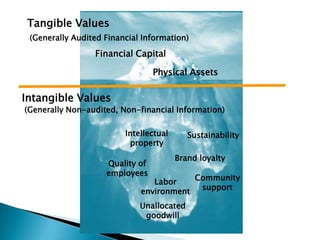
Financial CapitalPhysical AssetsIntellectual propertySustainabilityBrand loyaltyQuality of employeesCommunity supportLabor environmentUnallocated goodwillTangible Values(Generally Audited Financial Information)Intangible Values(Generally Non-audited, Non-financial Information)
To improve company valuation,Improve CSR relationships!Good CSR Relationships Lead to The Sustainable CorporationConclusion:
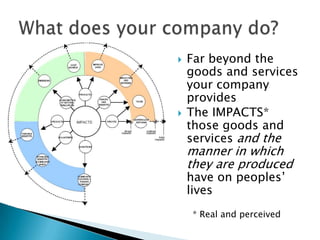
Far beyond the goods and services your company providesThe IMPACTS* those goods and services and the manner in which they are produced have on peoples’ livesWhat does your company do?* Real and perceived
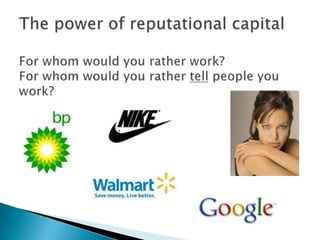
Needed for quality incomeNecessary to get low cost of capital Critical to hire/retain the best employeesGets you through rough timesAvoids commodity pricing/builds value addedReputational Capital(brand equity; goodwill)
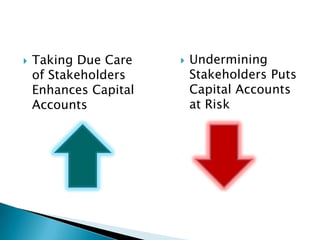
Undermining Stakeholders Puts Capital Accounts at RiskTaking Due Care of Stakeholders Enhances Capital Accounts
The power of reputational capitalFor whom would you rather work?For whom would you rather tell people you work?
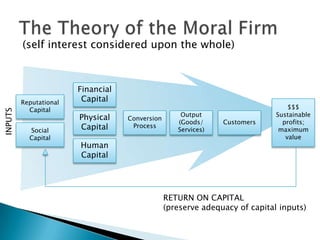
The Theory of the Moral Firm(self interest considered upon the whole)FinancialCapitalReputationalCapital$$$Sustainable profits; maximum valuePhysicalCapitalConversionProcessOutput(Goods/Services)CustomersINPUTSSocialCapitalHumanCapitalRETURN ON CAPITAL(preserve adequacy of capital inputs)
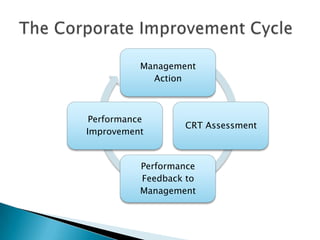
The Corporate Improvement Cycle
 Board of directors CEO  Senior management Division heads and group managers Unit managers EmployeesWho participates?
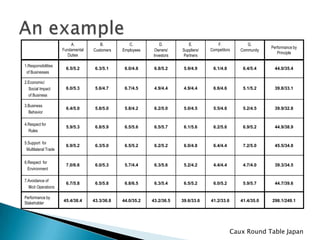
An exampleCaux Round Table Japan
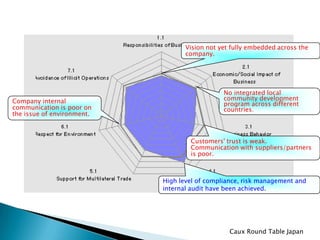
Vision not yet fully embedded across the company.No integrated local community development program across different countries.Company internal communication is poor on the issue of environment.Customers' trust is weak. Communication with suppliers/partners is poor.High level of compliance, risk management and internal audit have been achieved.Caux Round Table Japan

Toward Moral Capitalism

  • 1.
    Toward Moral CapitalismReconcilingprivate interest with the public goodCauxRound TableJohn Friedman – Sustainable Business Network of WashingtonBUSINESS LAW 5175 -- Business, Law &Ethics in Modern Society
  • 2.
    The Caux RoundTable (CRT) is an international network of principled business leaders working to promote a moral capitalism. The CRT advocates implementation of the CRT Principles for Business through which principled capitalism can flourish and sustainable and socially responsible prosperity can become the foundation for a fair, free, and transparent global society.The Caux Round TableSteve Youngwww.cauxroundtable.orgtwitter: @CauxRoundTable
  • 3.
    Co-founding board memberof the Sustainable Business Network of Washington (SB NOW); a partner organization with CRT 20 years+ career including corporate communications/organizational development, public/community relations, sustainability and CSRAbout Myselfwww.sbnow.orgtwitter: @SustBusNOW @JohnFriedman
  • 4.
    BackgroundHistory and theoryGlobal financial crisisWhat happenedWhat can/should we learn from itMoral Capitalism Determining ‘true’ valueThe Caux Round Table principles in actionOverview
  • 5.
    Capitalism is aneconomic, not a political modelCulture (nationality, faith, etc.) define how capitalism is implementedIndividual wealth creation – the ability to earn and retain capital – is a tremendous force for changeShort-term thinking is inconsistent with long-term best interestsAt the outset …
  • 6.
    15th/16th Century Venetian accountingsystem and argosy voyages - entrepreneurs began to combine capital and labor in discrete projects. Evolved into going concerns called corporations1600 – 1750 Capitalism grows prosperous in Holland, England and Scotland1776 An Inquiry into the Nature and Causes of the Wealth of Nations - Adam Smith1830 – 1870 Abuses of capitalism (mills of Manchester; Ebenezer Scrooge) Communist Manifesto – Marx, Engels Das Kapital- Karl MarxA Brief History of Capitalism
  • 7.
    1880 – 1980 Non-communist response: welfare state capitalismBismarck’s reforms Free trade unions John Maynard Keynes / New Deal Japan, Inc. Austrian school of economics1989 – 2004 Collapse of communism Rise of CSR CRT Principles for Business (1994)United Nation’s Global Compact (2000)Moral Capitalism - Stephen B. YoungA Brief History of Capitalism
  • 8.
    Adam Smith Observedeconomic reality - people act in their own interest. Self-interest not always good but alternative is worse:
  • 9.
    "By pursuing hisown self interest he frequently promotes that of society more effectually than when he really intends to promote it. I have never known much good done by those who affected to trade for the public good.” (p. 456).In free/open markets, how does a nation keep its capitalists from moving their capital out of the nation and into other countries where labor could be bought more cheaply? “(By) preferring the support of domestic to that of foreign industry," the capitalist will in a sense be "led by an invisible hand to promote an end which was no part of his intention."On the Wealth of Nations
  • 10.
    Does that (still)hold true in 2010?
  • 11.
  • 12.
    Sub-prime mortgage loansmade, increasingly against future resale value of the home, not against real incomeMortgage loans packaged and sold to global capital marketsCollateralized debt obligation (CDOs) issued to finance purchases of packages of sub-prime mortgages and to invest in hedge fundsCredit default swaps invented to give added value to CDOsDebt upon debt upon debtLow interest rate environmentIncentive structure driven by fees, not investment in long-term returnsSo what happened?
  • 13.
    1620 Tulip mania1711/1720 South SeaCompany London1719/1720 Mississippi company France1929 Wall Street1980s Junk bonds1990s Dot.coms/telecomToday Sub-prime mortgages/CDOsFinancial meltdowns are a systemic dysfunction of capitalismMen, it has been well said, think in herds; it will be seen that they go mad in herds, while they only recover their senses slowly, and one by one. – Charles MacKayIrrational exuberance – Alan Greenspan
  • 14.
    Current crisis isglobalAIGFortisIcelandEU guarantees bank depositsUK takes over two banksEquity markets in Asia tankPrice of oil drops by 50%Real economies lose employment and consumer demandWhy is this time different? Is it?
  • 15.
    World economic orderhas inadequate mechanisms to prevent financial crisesWorld Trade OrganizationInternational Monetary FundWorld BankG20Bank for International SettlementsEtc.
  • 16.
    Principles OutcomesPrinciples Congruent with Self-InterestPremises of Moral CapitalismPrinciples Drive Real Outcomes
  • 17.
    Whenever a systemproduces a consistent result, the inevitable conclusion is that that system was designed to produce that result, regardless of whether or not the outcome matches the intended outcome.What are the principles that are driving outcomes?When short term shareholder returns are elevated to a core value, corruption is inevitable. – Noel Purcell, CRT Chair
  • 18.
    When financial marketsimplode, markets lose liquidity, exchanges of goods and services fall, output is reduced, employment is cutDebt must be taken out of the financial systemAsset values have to be reset at lower levelsAsset owners lose wealthWhat happens when bubbles burst?
  • 19.
    When the distancebetween the haves and have-nots is perceived as insurmountable; the status quo is threatened …
  • 20.
    How do youdetermine ‘real’ value of assets? It is the INTANGIBLES that define valueBear Stearns (2008)March 14 - $80/share book value March 17 - $2/shareMay 10 – sold at $10/share after shareholder outcry and assistance from Federal Reserve BankLehman BrothersDespite billions in assets, management liquidated the company as no buyers emerged with confidence in it as a going concern
  • 21.
    Most simple calculation:Whatis a company worth?How do we measure its value?Discounted net present value of future incomeCapitalization multiplierx
  • 22.
    You cannot establishvalue without putting risk into the calculationWhat is the risk of not achieving predicted future revenue? How certain are estimates of future income?What are the risk factors that determine the capitalization multiplier? A higher risk demands a lower multiplierFirst Fundamental Conclusion Higher Increased Lower Risk Uncertainty present valueNote: Each source of risk drives business value up or down
  • 23.
    Management of riskenhances enterprise valueRisk management leads to more certain income
  • 24.
    Risk reduction leadsto higher valuationSecond Fundamental Conclusion
  • 25.
    Stakeholder relationships entailrisk - customers - investors - government regulators - employeesEach relationship is an intangible asset of the business (assets can appreciate or depreciate)Lowering risk for each relationship enhances the quality of intangible assets and increases business valuationStrategies for Managing Risk
  • 26.
    The GoodThe BadTheUglyHow do companies create value?
  • 27.
    Risk Assessment/continuous RiskReductionOptimize Stakeholder Benefits Moral CapitalismThe Good
  • 28.
    Feed Shareholders, AbuseStakeholdersCommodity pricing/ compete on pricing/low costsRent seeking (market power)Take the money and run: short-term thinkingUnsustainable Valuations =Eventual FailureThe Bad
  • 29.
    No net wealthcreation; speculation in trading (Rob Peter to pay Paul)Irrational Exuberance(Market traders/short termism)False Valuations(Enron: Ponzi Schemes; sub-prime mortgages, CDOs…)Encourage unsustainable pricing (of securities CDOs, CDSs)INEVITABLE FINANCIAL MELTDOWNThe Ugly
  • 30.
    Intangible Assets =CSR Stakeholder RelationshipsCustomersEmployeesOwners/InvestorsSuppliersCompetition StrategiesCommunity SupportCSR and Valuation
  • 31.
    Financial CapitalPhysical AssetsIntellectualpropertySustainabilityBrand loyaltyQuality of employeesCommunity supportLabor environmentUnallocated goodwillTangible Values(Generally Audited Financial Information)Intangible Values(Generally Non-audited, Non-financial Information)
  • 32.
    To improve companyvaluation,Improve CSR relationships!Good CSR Relationships Lead to The Sustainable CorporationConclusion:
  • 33.
    Far beyond thegoods and services your company providesThe IMPACTS* those goods and services and the manner in which they are produced have on peoples’ livesWhat does your company do?* Real and perceived
  • 34.
    Needed for qualityincomeNecessary to get low cost of capital Critical to hire/retain the best employeesGets you through rough timesAvoids commodity pricing/builds value addedReputational Capital(brand equity; goodwill)
  • 35.
    Undermining Stakeholders PutsCapital Accounts at RiskTaking Due Care of Stakeholders Enhances Capital Accounts
  • 36.
    The power ofreputational capitalFor whom would you rather work?For whom would you rather tell people you work?
  • 37.
    The Theory ofthe Moral Firm(self interest considered upon the whole)FinancialCapitalReputationalCapital$$$Sustainable profits; maximum valuePhysicalCapitalConversionProcessOutput(Goods/Services)CustomersINPUTSSocialCapitalHumanCapitalRETURN ON CAPITAL(preserve adequacy of capital inputs)
  • 38.
  • 39.
    Board ofdirectors CEO Senior management Division heads and group managers Unit managers EmployeesWho participates?
  • 40.
  • 41.
    Vision not yetfully embedded across the company.No integrated local community development program across different countries.Company internal communication is poor on the issue of environment.Customers' trust is weak. Communication with suppliers/partners is poor.High level of compliance, risk management and internal audit have been achieved.Caux Round Table Japan