PIONEER QUESTIONING PHASES
PJC Professional Development Committee 2013
Generate any eight favourite questions
that you usually asked during lessons.
Why questioning?
Check students' learning.
The primary tool at stimulating and directing
thinking.
Creating awareness, understanding and
developing complex learning processes.
Shaping perspectives and values.
Doing well for examination!
How can questioning be a
practical classroom tool?
Clarifying misconceptions.
Teaching students the processes required for
tackling A Level question-types.
Scaffolding and formative developmental tool.
Phases of questioning
Phase 1 (Basic - Clarification)
Phase 2 (Intermediate - Processing)
Phase 3 (Advanced - Application /
Internalisation)
Basic - clarification
The foundation for higher order questioning.
Most underrated stage of questioning.
Should encompass at least 60% of the
questions asked.
Good way to warm the class up.
Basic - clarification
Defining concepts
Describing facts
Organising content
Chronological / sequential arrangement
Dispelling misconception
Generating facts as evidences
Examples of clarification
questioning...
What is the definition of...?
When...where...who...?
How do you classify...?
Give evidence for...
Describe your observation...
Intermediate - processing
Cognitive development begins.
Management and assessment of knowledge.
Involving skills of varying styles and intensities.
Most challenging questioning phase.
Intermediate - processing
Compare and contrast
Change and continuity
Seeking causal relationship
Assessment and evaluation
Questioning assumption
Prioritisation of importance
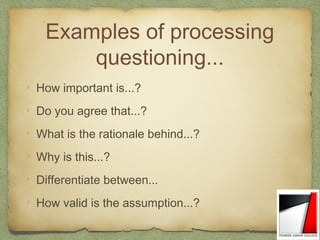
Examples of processing
questioning...
How important is...?
Do you agree that...?
What is the rationale behind...?
Why is this...?
Differentiate between...
How valid is the assumption...?
Advanced - application /
internalisation
Mastery becomes apparent.
Values and perspectives are transformed.
Creativity and innovation.
Intelligence translated into actions / products.
Advanced - application /
internalisation
Objective facts and the highly analytical
examination of which have become useful
personalised living principles.
The ability to apply familiar thinking processes
in unfamiliar circumstances is developed and
assessed.
Examples of questioning for
application and internalisation...
•
How do you feel about...?
•
What is the possibility of...?
•
What can you deduce from...?
•
What if...?
•
What can be suggested to improve...?
•
How useful is...?
Why Pioneer Questioning
Phases?
Simple and easy to refer to.
Inculcate instructional awareness.
Promote reflective learning through visible
thinking.
Locate inadequacies for troubleshooting.
Why Pioneer Questioning
Phases?
It is an amalgamation of different questioning
systems and theories of critical thinking.
Handy for beginning teachers; broad enough for
even the expert educators.
Pioneer Questioning PhasesPioneer Questioning Phases Bloom's TaxonomyBloom's Taxonomy
Clarification
Remember
Understand
Processing
Analyse
Evaluate
Application / Internationalisation Create
What are your questioning
phases?
Categorise the questions that you have
generated at the beginning of this workshop
under each of the aforesaid questioning phases.
Which questioning phase do most of your
questions fall under?
Which is the least hit questioning phase?
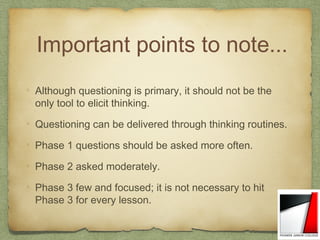
Important points to note...
Although questioning is primary, it should not be the
only tool to elicit thinking.
Questioning can be delivered through thinking routines.
Phase 1 questions should be asked more often.
Phase 2 asked moderately.
Phase 3 few and focused; it is not necessary to hit
Phase 3 for every lesson.
Important points to note...
Questioning does not work miracles; the teacher
has to model thinking processes for the
students.
Questioning phases need not be progressive.
Questioning intensity vary with the abilities and
needs of the class.
Wait time is important.
Important points to note...
Questioning must be conducted with purpose.
Use Never Work Harder Than Your Students /
The Skillful Teacher as your guiding principles in
questioning.
Students ought to reply in full sentence /
sentences, as they would in written
assessments.
Important points to note...
Questioning sequencing could also be
predesigned to condition students to a fixed
order of thinking processes.
Be prepared to operate in teaching for
understanding rather than coverage mode, as
questioning would reveal numerous learning
gaps that require immediate remediation.
IP demonstration 1
China Studies in English
What questions would you
ask in response to the
following narrative from a
student?
China Studies in English
"I think that the authoritarian rule of the Chinese
Communist Party has been beneficial for China.
Without the Party, various aspects of
modernisation would not have taken place.
China will continue to be a backward country in
mindset and behaviour. No one will take China
seriously."
More ideas...
The phases of questioning need not be in order.
Consider this question, "do you agree that the
market reforms of China is more bold than
cautious?".
Or "suggest how the government can overcome
economic challenges and prioritise your
solutions."
Do you agree that the market reforms
of China is more bold than cautious?
How would you sequence the following
questioning steps to help students address the
above question?
Can you identify which of the questioning
phases does each of the leading questions fall
under?
Arrange and identify the
leading questions...
How to classify these factual evidences to support
either bold or cautious reforms?
How are the major steps taken in the reform?Can
they be considered bold or cautious?
Compare and contrast between the two sets of
evidences, what criteria can you deduce to to
address the question?
Arrange and identify the
leading questions...
What do boldness and cautiousness in economic
policies mean? Relate them to the context of China
today.
What are the factual evidences that you can give to
support either bold or cautious reform?
How to structure an argumentative narrative that
could most persuasively defend your stand?
ApplicationApplication ApplicationApplication
RecallingRecalling
ProcessingProcessingProcessingProcessing
Non-IP demonstration
Learning Journey to China
What questions would you
ask in response to the
following narrative from a
student?
Learning Journey to China
“The lesson I observed in the classroom is really
boring. The teacher read from the book and yet
the students continued to pay attention. I also
realised that the students responded actively to
questions asked. My China friends told us about
their long study hours into the night. I am glad
lessons back in the college are more interesting
and less demanding."
Thank you for your attention!
PJC Professional Development Committee 2013

Critical Questioning Scheme

  • 1.
    PIONEER QUESTIONING PHASES PJCProfessional Development Committee 2013
  • 2.
    Generate any eightfavourite questions that you usually asked during lessons.
  • 3.
    Why questioning? Check students'learning. The primary tool at stimulating and directing thinking. Creating awareness, understanding and developing complex learning processes. Shaping perspectives and values. Doing well for examination!
  • 4.
    How can questioningbe a practical classroom tool? Clarifying misconceptions. Teaching students the processes required for tackling A Level question-types. Scaffolding and formative developmental tool.
  • 5.
    Phases of questioning Phase1 (Basic - Clarification) Phase 2 (Intermediate - Processing) Phase 3 (Advanced - Application / Internalisation)
  • 6.
    Basic - clarification Thefoundation for higher order questioning. Most underrated stage of questioning. Should encompass at least 60% of the questions asked. Good way to warm the class up.
  • 7.
    Basic - clarification Definingconcepts Describing facts Organising content Chronological / sequential arrangement Dispelling misconception Generating facts as evidences
  • 8.
    Examples of clarification questioning... Whatis the definition of...? When...where...who...? How do you classify...? Give evidence for... Describe your observation...
  • 9.
    Intermediate - processing Cognitivedevelopment begins. Management and assessment of knowledge. Involving skills of varying styles and intensities. Most challenging questioning phase.
  • 10.
    Intermediate - processing Compareand contrast Change and continuity Seeking causal relationship Assessment and evaluation Questioning assumption Prioritisation of importance
  • 11.
    Examples of processing questioning... Howimportant is...? Do you agree that...? What is the rationale behind...? Why is this...? Differentiate between... How valid is the assumption...?
  • 12.
    Advanced - application/ internalisation Mastery becomes apparent. Values and perspectives are transformed. Creativity and innovation. Intelligence translated into actions / products.
  • 13.
    Advanced - application/ internalisation Objective facts and the highly analytical examination of which have become useful personalised living principles. The ability to apply familiar thinking processes in unfamiliar circumstances is developed and assessed.
  • 14.
    Examples of questioningfor application and internalisation... • How do you feel about...? • What is the possibility of...? • What can you deduce from...? • What if...? • What can be suggested to improve...? • How useful is...?
  • 15.
    Why Pioneer Questioning Phases? Simpleand easy to refer to. Inculcate instructional awareness. Promote reflective learning through visible thinking. Locate inadequacies for troubleshooting.
  • 16.
    Why Pioneer Questioning Phases? Itis an amalgamation of different questioning systems and theories of critical thinking. Handy for beginning teachers; broad enough for even the expert educators.
  • 17.
    Pioneer Questioning PhasesPioneerQuestioning Phases Bloom's TaxonomyBloom's Taxonomy Clarification Remember Understand Processing Analyse Evaluate Application / Internationalisation Create
  • 18.
    What are yourquestioning phases? Categorise the questions that you have generated at the beginning of this workshop under each of the aforesaid questioning phases. Which questioning phase do most of your questions fall under? Which is the least hit questioning phase?
  • 19.
    Important points tonote... Although questioning is primary, it should not be the only tool to elicit thinking. Questioning can be delivered through thinking routines. Phase 1 questions should be asked more often. Phase 2 asked moderately. Phase 3 few and focused; it is not necessary to hit Phase 3 for every lesson.
  • 20.
    Important points tonote... Questioning does not work miracles; the teacher has to model thinking processes for the students. Questioning phases need not be progressive. Questioning intensity vary with the abilities and needs of the class. Wait time is important.
  • 21.
    Important points tonote... Questioning must be conducted with purpose. Use Never Work Harder Than Your Students / The Skillful Teacher as your guiding principles in questioning. Students ought to reply in full sentence / sentences, as they would in written assessments.
  • 22.
    Important points tonote... Questioning sequencing could also be predesigned to condition students to a fixed order of thinking processes. Be prepared to operate in teaching for understanding rather than coverage mode, as questioning would reveal numerous learning gaps that require immediate remediation.
  • 23.
    IP demonstration 1 ChinaStudies in English
  • 24.
    China Studies inEnglish What questions would you ask in response to the following narrative from a student?
  • 25.
    China Studies inEnglish "I think that the authoritarian rule of the Chinese Communist Party has been beneficial for China. Without the Party, various aspects of modernisation would not have taken place. China will continue to be a backward country in mindset and behaviour. No one will take China seriously."
  • 26.
    More ideas... The phasesof questioning need not be in order. Consider this question, "do you agree that the market reforms of China is more bold than cautious?". Or "suggest how the government can overcome economic challenges and prioritise your solutions."
  • 27.
    Do you agreethat the market reforms of China is more bold than cautious? How would you sequence the following questioning steps to help students address the above question? Can you identify which of the questioning phases does each of the leading questions fall under?
  • 28.
    Arrange and identifythe leading questions... How to classify these factual evidences to support either bold or cautious reforms? How are the major steps taken in the reform?Can they be considered bold or cautious? Compare and contrast between the two sets of evidences, what criteria can you deduce to to address the question?
  • 29.
    Arrange and identifythe leading questions... What do boldness and cautiousness in economic policies mean? Relate them to the context of China today. What are the factual evidences that you can give to support either bold or cautious reform? How to structure an argumentative narrative that could most persuasively defend your stand?
  • 30.
  • 31.
  • 32.
    Learning Journey toChina What questions would you ask in response to the following narrative from a student?
  • 33.
    Learning Journey toChina “The lesson I observed in the classroom is really boring. The teacher read from the book and yet the students continued to pay attention. I also realised that the students responded actively to questions asked. My China friends told us about their long study hours into the night. I am glad lessons back in the college are more interesting and less demanding."
  • 34.
    Thank you foryour attention! PJC Professional Development Committee 2013