Critical Theory
Critical Theory Axioms
• Human nature is not a constant but a variable
• Human nature depends on social conditions
• Historical struggles between different social forces
generate world politics
• People can group together to further their common
interests
• All human beings prefer emancipation
• Positivism: problem-solving theory (knowledge)
• Critical Theory: knowledge leading to emancipation
• Genuine communication is necessary for a dialogue
toward emancipation
• Some research questions: how can state, and state
systems lead to human emancipation?
• How boundaries of communities change over time?
• How do exclusionary and inclusionary binaries come to
life and persist like «me/other», «me/foreigner»,
«man/woman», etc..
• Instead of concentrating on supposed «objective» threats
to state that are out there in the real world, concentrate on
processes through individuals, groups, and construct
social facts
• Origins of critical theory in IR lie in thought associated
with the ‘Frankfurt School’
• Frankfurt School: an intersection of Marx and Freud
• Inspired by Marx and Western Marxists but revisions of
this strand were made through interest in formation of
political consciousness
• Marcuse, Adorno, Horkheimer, Fromm
• Horkheimer: traditional and critical theory. Founder of
the theory (1937); Frankfurt School of sociology. A
radical, emancipatory form of Marxism as opposed to
authoritarian, positivistic orthodox Marxism
• Adorno: culture industry
• Habermas: second generation Frankfurt schooler
• Habermas: dialogical ethics, related to communicative
rationality: empathy, listen to each opinion to form
values, do not silence others
• Hermeneutics:
• 1) Knowledge via interpretation to understand the
meaning of human texts
• 2) Knowledge via interpretation to understand symbolic
expressions including the interpretation of texts which in
turn interpret other texts
• Frankfurt School develops Marx’s analyses further by
concentrating on communicative reason, linguistic
intersubjectivity and by pointing out limits of positivism
and determinism
• Early phase: critique of science and objectivity in IR
theories; critiques of state-centrism; for pluralism of
perspectives and postpositivism
• Cox, Ashley, Lapid
• Later phase: dialogue, political community, dialogical
ethics, recognition, political economy
• Linklater, Wyn Jones
• Habermas is a key thinker. His dialogical ethics constitute
an important provocation for critical IR theory
• See for example discussion by Risse and critics on
dialogue in IR.
• Debate and exploration of Habermas’s ideas have
resulted in key efforts to build a critical IR theory of
international politics.
• Habermas versus Marx:
• Marx stresses the importance of social organization
forms, inherently social nature of human beings, and
sociability as a form of production and class struggle
• Habermas stresses the importance of communication,
inherently social nature of human beings, and sociability
as expressed through language
• Habermas claim that human beings construct
intersubjective knowledge about the world through
language and communication
• Meaning is established through interaction or dialogue
between conscious subjects
• Critical IR theory can focus attention on key forces
shaping Arab Spring:
- the political identity and consciousness of the
Arab peoples
- the failure of neoliberal policies
- the political will to instantiate the rule of law
- role of social media
• Traditional security studies remains an applied research
tool rooted in instrumental reason
• Challenges narrowness of positivist perspectives and
offers theoretical horizons for critical theory of IR.
Habermas’s role is crucial in motivating such research.
• Role of globalisation important as context: initiates
questions of global civil society and empowerment.
• Emphasizes open-ended and imaginative dimensions of
emancipatory project in world politics.
• Definition: a theory is critical if it seeks to liberate human
beings from circumstances that enslave them
• Ideology is the prime obstacle to human emancipation,
liberation
• Critical social theory: a form of self-reflective
knowledge. It involves understanding and also
explanation. Aim: reduce entrapment in systems of
dependence and domination
• Modern Critical Theory: investigates forms of injustice
and authority that are generated by the evolution of
industrial and corporate capitalism in a political-
economic system.
• Postmodern Critical Theory: Now the attention turns to
texts. Make political relations of domination and power
apparent through historical and cultural contexts, collect
and analyze texts, data. It is more empirical than the
modern version summarized above.
• Being a critical theorist means that one stands in the
intersection of language, symbolism, and communication
• Being a critical theorist means that one analyzes the role
of ideas, culture, communication, intersubjective
dialogue and negotiation
• Structuralism versus Critical Theory:
• Structuralism: social classes, capitalist system’s working
rules, structure of the system, reproduction of unequal
relations between social classes and states: MATERIAL
• Critical Theory (Gramsci): importance of culture and
ideology, the role of culture and ideology in the
reproduction of unequal social relations: NON-
MATERIAL
• Gramsci: central importance of ideology in maintaining
class rule and in bringing about social change
• Ruling class persuades people and legitimizes its
supremacy, dominance through ideological tools.
• These tools imply, make the ruling class as just and fair
• Orthodox Marxism: Society can be scientifically
explained and understood through objective measurement
of observed money flows
• Post Marxism (Critical Theory): ALL knowledge is
ideological. Theories must be evaluated given the
configuration of societal forces and the historical
background
• Theories and observations are interlocked to the extent that it
is impossible to dissect, disentangle them from each other
• When we make senses of the world given our knowledge, our
actions confirm theories we create: self-fulfilling prophecies
• Get emancipated and get rid of oppressive forms of social
relations, and IR theories. Forget IR Theory: Roland Bleiker
• Alternatives: Global, Local, Political
• Vol. 22, No. 1 (Jan.-Mar. 1997), pp. 57-85
• There is no deterministic relationship between economic
and social systems
• The dynamic of historical change is not deterministic
• Do not get obsessed with class, class struggle: it is not the
only domination and oppression form
• Everybody is responsible for dominance relations
• Knowledge is political and social
Realism/Critical Theory
• States are the main actors/states are NOT the main actors
• Economic and politics can be separated/No
• No interest in whether current institutions help to
emancipate humans/ interest in whether current
institutions help to emancipate humans
• States are given/states are problematic: what is state?
• States’ primary position in IR is accepted as given/
States’ primary position in IR is problematic: «why states
are the main actors?»
• Anarchy is constant; the future will not be different from
today/anarchy is not constant. It is a questionable
construct. The current order can change and take
alternative future paths
• Hegemony is the dominance of certain states
• Dominant state creates order
• States reflect interest of capital and counter-hegemonic
groups whose influence varies over time
• World politics is nothing but consisting of clashes
between hegemonic and counter-hegemonic forces (like
Green Peace, Amnesty International) about prevailing
over international institutions and political arrangements
Some claims from Robert Cox (1981) «Social
Forces, States, and World Orders: Beyond IR
Theory» Millenium 10(2): 128-137
• Theories are always for someone and for some purpose
• All theories have perspectives stemming from a position in
time and space in which they are proposed
• Theories must change as social problems change
• Definition: «problem-solving theory» answers a specific
question using ceteris paribus (everything else being held
constant) assumption.
• It is ahistorical
• It posits a continuing relation of power
• It provides a guide to tactical actions (intended or not)
sustaining the existing order
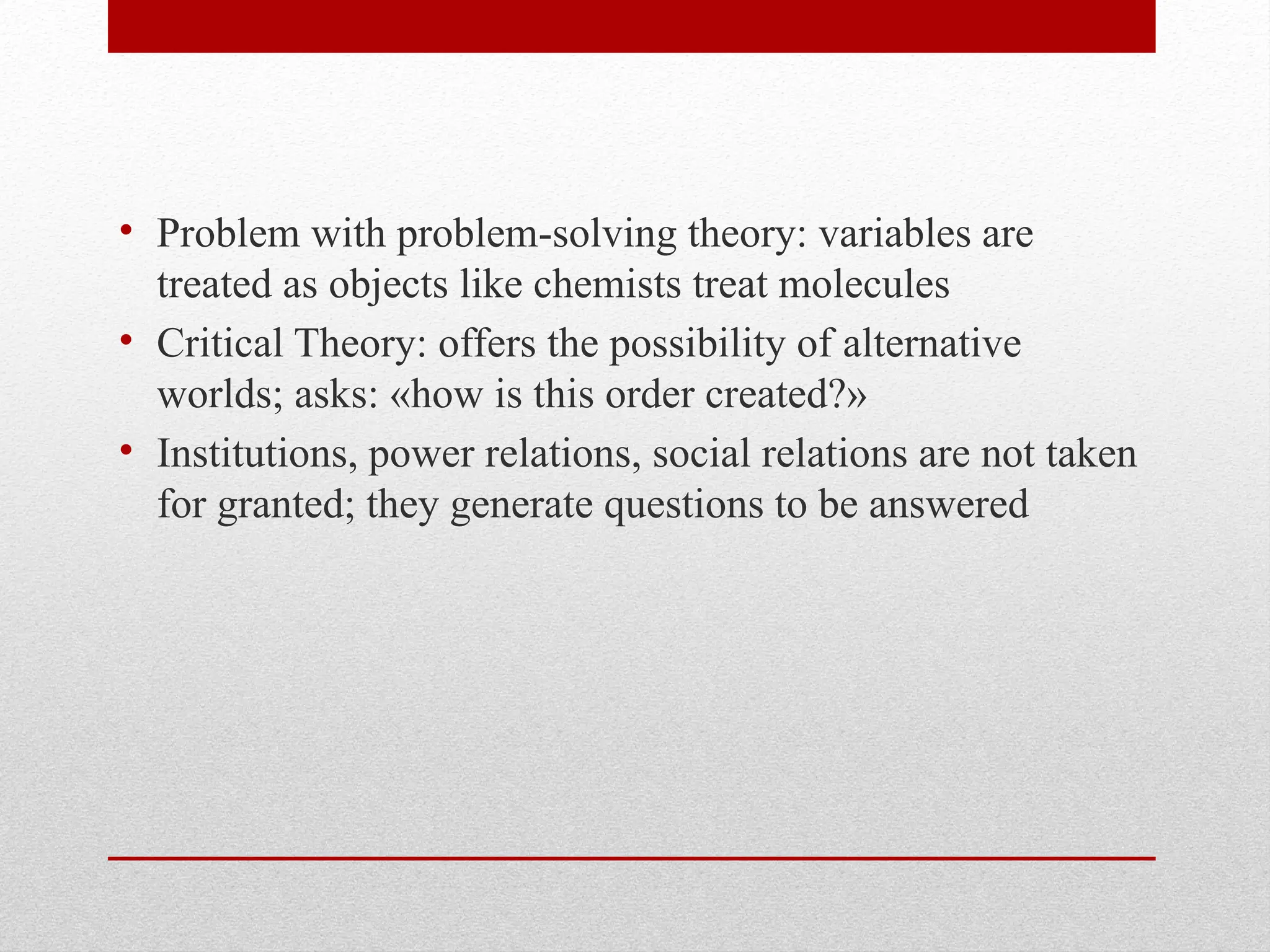
• Problem with problem-solving theory: variables are
treated as objects like chemists treat molecules
• Critical Theory: offers the possibility of alternative
worlds; asks: «how is this order created?»
• Institutions, power relations, social relations are not taken
for granted; they generate questions to be answered
• Social-political complex is taken as a whole, not as
separate parts
• It constructs a larger picture and seeks to understand
processes of change concerning both parts and the whole
• It is a theory of history as well. Past and future prospects
constitute issues
• It provides a guide to strategic actions to bring about
alternative world orders
Realism according to Cox (Cox’s
reading of realism)
• Sources in Meinecke, Friedrich in their study of «raison
d’état», traced through Machiavelli and later to Carr and
Dehio.
• Delinates particular configurations of forces, fixes the
framework, and tries to explain events within fixed
environments
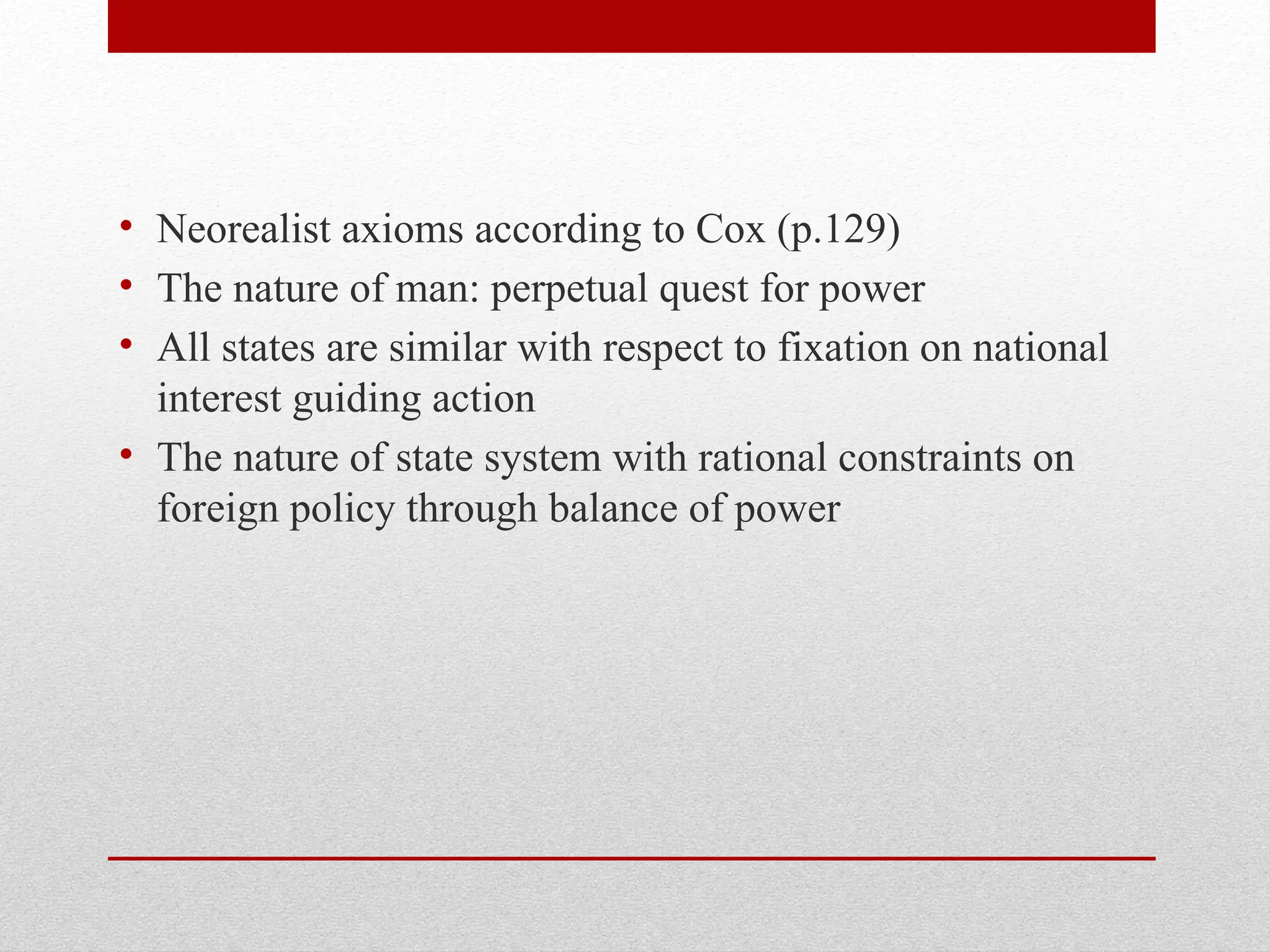
• Neorealist axioms according to Cox (p.129)
• The nature of man: perpetual quest for power
• All states are similar with respect to fixation on national
interest guiding action
• The nature of state system with rational constraints on
foreign policy through balance of power
• The axioms imply history as becoming a repetitive
process completely alienated (independent of) history
• A non-historical (ahistorical) thinking mode, a value-free
approach
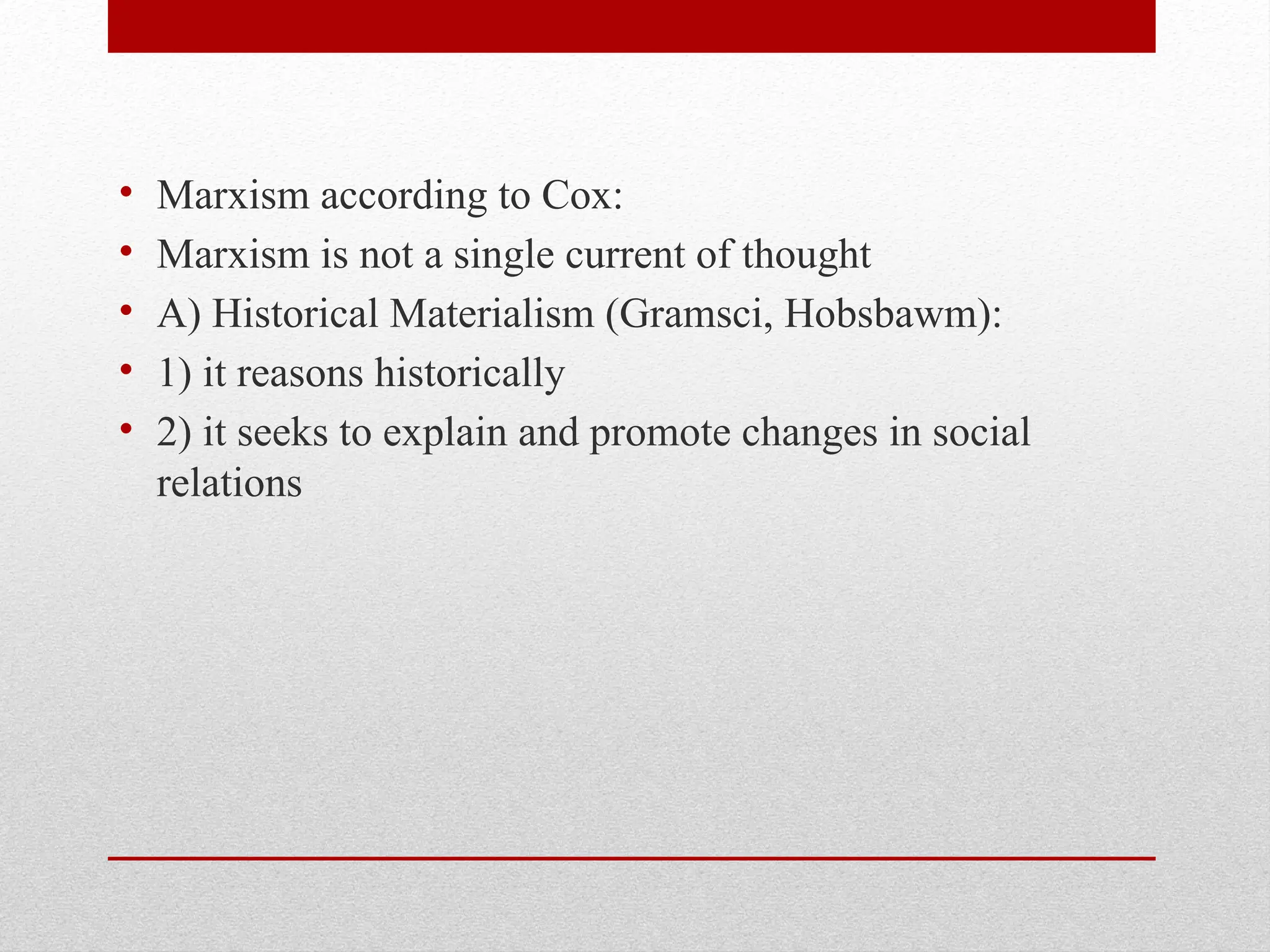
• Marxism according to Cox:
• Marxism is not a single current of thought
• A) Historical Materialism (Gramsci, Hobsbawm):
• 1) it reasons historically
• 2) it seeks to explain and promote changes in social
relations
• B) Structural Marxism (Althusser, Poulantzas):
• 1) It does not reason historically but through abstract
concepts, conceptualization of modes of production
• 2) It is designed as a framework for the analysis of
capitalist state and society
• Hence, structural marxism is similar to structural
realism: both are ahistorical, they have essentialist
epistemology (few variables), practical applicability is
lesser than its level of abstraction
• Claim: historical materialism corrects structural realism
in 4 important aspects
• 1) Structural realism sees conflict as a recurrent
consequence of a continuing structure, whereas historical
materialism sees conflict as a possible cause of change—
continual confrontation of concepts with reality and their
adjustment to ever changing reality. Each assertion
contains its opposite but they are not mutually disjoint.
Opposites intersect where truth changes continually
• Truth is not a constant, fixed pattern
• 2) Historical materialism studies vertical dimension of
power as opposed to structural realism’s concern with
horizontal great-power competition
• 3) State-civil relations bracketed (eliminated, ignored) by
structural realism but they are important
• 4) Structural realism ignores production processes.
wealth, production of wealth,
• Structural realism ignores ability to mobilize power
behind actions, power relationship between those who
control and those who execute production tasks
• Historical materialism deals with all these aspects. It is
sensitive to changes in sphere of production and the
reflection of changes upon state foreign policy and the
world order
A triangular relationship exists in all societies
• Material Capabilities
• Institutions Ideas
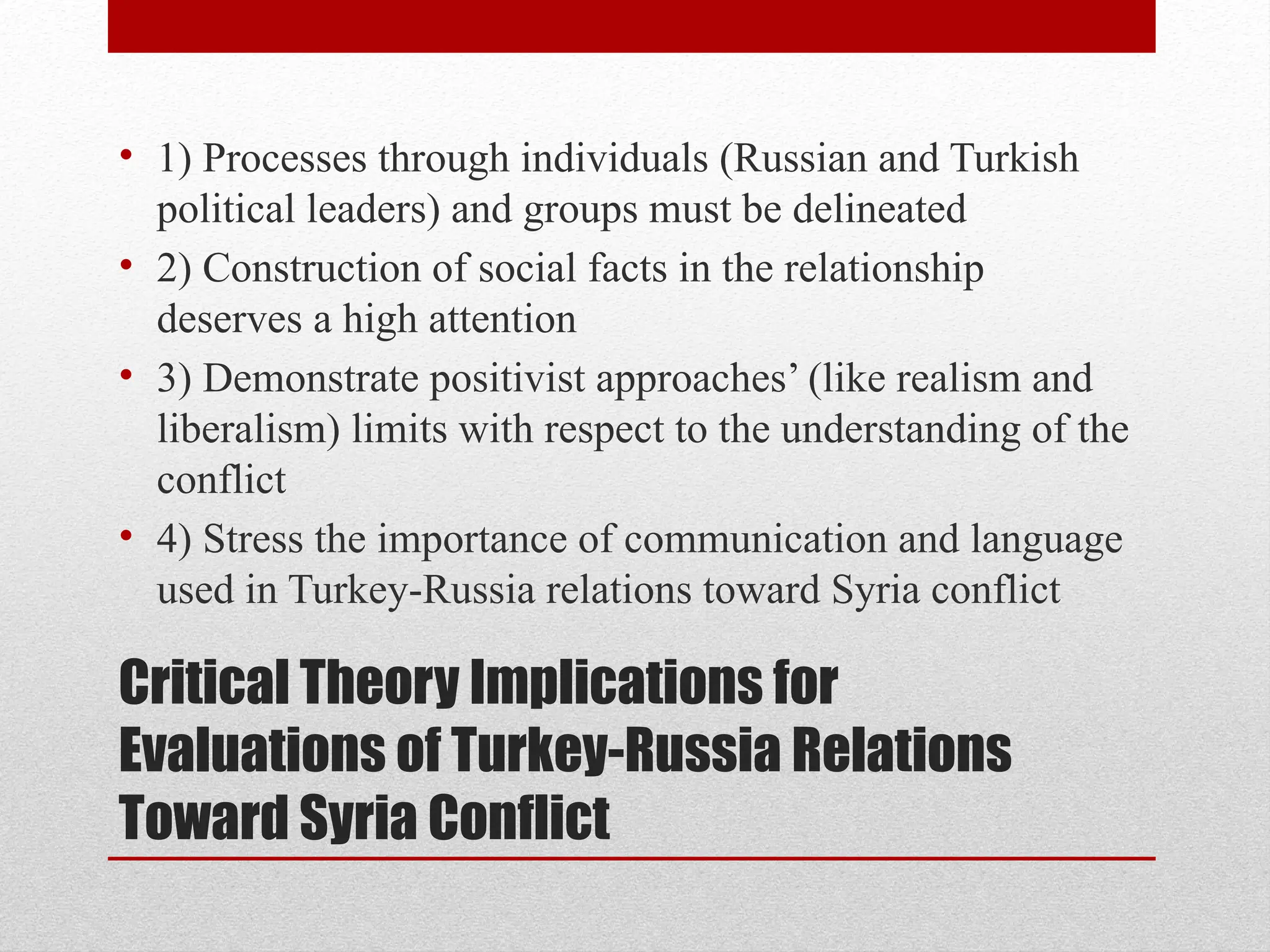
Critical Theory Implications for
Evaluations of Turkey-Russia Relations
Toward Syria Conflict
• 1) Processes through individuals (Russian and Turkish
political leaders) and groups must be delineated
• 2) Construction of social facts in the relationship
deserves a high attention
• 3) Demonstrate positivist approaches’ (like realism and
liberalism) limits with respect to the understanding of the
conflict
• 4) Stress the importance of communication and language
used in Turkey-Russia relations toward Syria conflict
• Indicate how language and communication between the
two states signal intersubjectivity toward the conflict
• Work out the generation of meaning through dialogue
between political leaders
• Expose how Turkey and Russia are entrapped in a
mutually destructive rivalry
• Use language, symbolism, the role of ideas and
communication, culture instead power, rationality, gain
and costs, exogenously given preferences
• Ask: how does culture and ideology exacerbate Turkey-
Russia opposition toward Syria?
• Ask: What is Turkey? What is Russia?
• Ask: How is the conflictive interaction/order created
between Turkey and Russia?
Turkey-Russia Rapprochement
from Critical Theory Perspectives
• One cannot approach the rapprochement between the two
countries as if it constitutes a problem to solve
• This is does not constitute a problem where one can
handle variables as exogenously given (like molecules,
atoms, relations between them)
• The mutual harm positivist and especially rational-choice
theories uses as an explanatory tool does not constitute
and objective reality
• Instead of the «real existence» of costs Russia and Turkey
suffered we should focus on «costly worlds» both
countries’ FP makers create
• How are the social constructions emerge?
• The answer to the question above: through language and
communication among respective leaders
• Social constructions correspond to the «meaning» of
relations between the two countries
• The meanings signal subjectivities and intersubjectivities
for the relationship
• To conclude, we can can assert that language and
communication producing social constructions and
meaning intersect language, symbolism, and
communication among respective countries’ leaders

IR.335.Critical Theory presentation on organisation

  • 1.
  • 2.
    Critical Theory Axioms •Human nature is not a constant but a variable • Human nature depends on social conditions • Historical struggles between different social forces generate world politics • People can group together to further their common interests • All human beings prefer emancipation • Positivism: problem-solving theory (knowledge)
  • 3.
    • Critical Theory:knowledge leading to emancipation • Genuine communication is necessary for a dialogue toward emancipation • Some research questions: how can state, and state systems lead to human emancipation? • How boundaries of communities change over time?
  • 4.
    • How doexclusionary and inclusionary binaries come to life and persist like «me/other», «me/foreigner», «man/woman», etc.. • Instead of concentrating on supposed «objective» threats to state that are out there in the real world, concentrate on processes through individuals, groups, and construct social facts
  • 5.
    • Origins ofcritical theory in IR lie in thought associated with the ‘Frankfurt School’ • Frankfurt School: an intersection of Marx and Freud • Inspired by Marx and Western Marxists but revisions of this strand were made through interest in formation of political consciousness
  • 6.
    • Marcuse, Adorno,Horkheimer, Fromm • Horkheimer: traditional and critical theory. Founder of the theory (1937); Frankfurt School of sociology. A radical, emancipatory form of Marxism as opposed to authoritarian, positivistic orthodox Marxism • Adorno: culture industry • Habermas: second generation Frankfurt schooler
  • 7.
    • Habermas: dialogicalethics, related to communicative rationality: empathy, listen to each opinion to form values, do not silence others • Hermeneutics: • 1) Knowledge via interpretation to understand the meaning of human texts • 2) Knowledge via interpretation to understand symbolic expressions including the interpretation of texts which in turn interpret other texts
  • 8.
    • Frankfurt Schooldevelops Marx’s analyses further by concentrating on communicative reason, linguistic intersubjectivity and by pointing out limits of positivism and determinism
  • 9.
    • Early phase:critique of science and objectivity in IR theories; critiques of state-centrism; for pluralism of perspectives and postpositivism • Cox, Ashley, Lapid • Later phase: dialogue, political community, dialogical ethics, recognition, political economy • Linklater, Wyn Jones
  • 10.
    • Habermas isa key thinker. His dialogical ethics constitute an important provocation for critical IR theory • See for example discussion by Risse and critics on dialogue in IR. • Debate and exploration of Habermas’s ideas have resulted in key efforts to build a critical IR theory of international politics.
  • 11.
    • Habermas versusMarx: • Marx stresses the importance of social organization forms, inherently social nature of human beings, and sociability as a form of production and class struggle • Habermas stresses the importance of communication, inherently social nature of human beings, and sociability as expressed through language
  • 12.
    • Habermas claimthat human beings construct intersubjective knowledge about the world through language and communication • Meaning is established through interaction or dialogue between conscious subjects
  • 13.
    • Critical IRtheory can focus attention on key forces shaping Arab Spring: - the political identity and consciousness of the Arab peoples - the failure of neoliberal policies - the political will to instantiate the rule of law - role of social media
  • 14.
    • Traditional securitystudies remains an applied research tool rooted in instrumental reason
  • 15.
    • Challenges narrownessof positivist perspectives and offers theoretical horizons for critical theory of IR. Habermas’s role is crucial in motivating such research. • Role of globalisation important as context: initiates questions of global civil society and empowerment. • Emphasizes open-ended and imaginative dimensions of emancipatory project in world politics.
  • 16.
    • Definition: atheory is critical if it seeks to liberate human beings from circumstances that enslave them • Ideology is the prime obstacle to human emancipation, liberation • Critical social theory: a form of self-reflective knowledge. It involves understanding and also explanation. Aim: reduce entrapment in systems of dependence and domination
  • 17.
    • Modern CriticalTheory: investigates forms of injustice and authority that are generated by the evolution of industrial and corporate capitalism in a political- economic system. • Postmodern Critical Theory: Now the attention turns to texts. Make political relations of domination and power apparent through historical and cultural contexts, collect and analyze texts, data. It is more empirical than the modern version summarized above.
  • 18.
    • Being acritical theorist means that one stands in the intersection of language, symbolism, and communication • Being a critical theorist means that one analyzes the role of ideas, culture, communication, intersubjective dialogue and negotiation
  • 19.
    • Structuralism versusCritical Theory: • Structuralism: social classes, capitalist system’s working rules, structure of the system, reproduction of unequal relations between social classes and states: MATERIAL • Critical Theory (Gramsci): importance of culture and ideology, the role of culture and ideology in the reproduction of unequal social relations: NON- MATERIAL
  • 20.
    • Gramsci: centralimportance of ideology in maintaining class rule and in bringing about social change • Ruling class persuades people and legitimizes its supremacy, dominance through ideological tools. • These tools imply, make the ruling class as just and fair
  • 21.
    • Orthodox Marxism:Society can be scientifically explained and understood through objective measurement of observed money flows • Post Marxism (Critical Theory): ALL knowledge is ideological. Theories must be evaluated given the configuration of societal forces and the historical background
  • 22.
    • Theories andobservations are interlocked to the extent that it is impossible to dissect, disentangle them from each other • When we make senses of the world given our knowledge, our actions confirm theories we create: self-fulfilling prophecies • Get emancipated and get rid of oppressive forms of social relations, and IR theories. Forget IR Theory: Roland Bleiker • Alternatives: Global, Local, Political • Vol. 22, No. 1 (Jan.-Mar. 1997), pp. 57-85
  • 23.
    • There isno deterministic relationship between economic and social systems • The dynamic of historical change is not deterministic • Do not get obsessed with class, class struggle: it is not the only domination and oppression form • Everybody is responsible for dominance relations • Knowledge is political and social
  • 24.
    Realism/Critical Theory • Statesare the main actors/states are NOT the main actors • Economic and politics can be separated/No • No interest in whether current institutions help to emancipate humans/ interest in whether current institutions help to emancipate humans • States are given/states are problematic: what is state?
  • 25.
    • States’ primaryposition in IR is accepted as given/ States’ primary position in IR is problematic: «why states are the main actors?» • Anarchy is constant; the future will not be different from today/anarchy is not constant. It is a questionable construct. The current order can change and take alternative future paths
  • 26.
    • Hegemony isthe dominance of certain states • Dominant state creates order • States reflect interest of capital and counter-hegemonic groups whose influence varies over time • World politics is nothing but consisting of clashes between hegemonic and counter-hegemonic forces (like Green Peace, Amnesty International) about prevailing over international institutions and political arrangements
  • 27.
    Some claims fromRobert Cox (1981) «Social Forces, States, and World Orders: Beyond IR Theory» Millenium 10(2): 128-137 • Theories are always for someone and for some purpose • All theories have perspectives stemming from a position in time and space in which they are proposed • Theories must change as social problems change
  • 28.
    • Definition: «problem-solvingtheory» answers a specific question using ceteris paribus (everything else being held constant) assumption. • It is ahistorical • It posits a continuing relation of power • It provides a guide to tactical actions (intended or not) sustaining the existing order
  • 29.
    • Problem withproblem-solving theory: variables are treated as objects like chemists treat molecules • Critical Theory: offers the possibility of alternative worlds; asks: «how is this order created?» • Institutions, power relations, social relations are not taken for granted; they generate questions to be answered
  • 30.
    • Social-political complexis taken as a whole, not as separate parts • It constructs a larger picture and seeks to understand processes of change concerning both parts and the whole • It is a theory of history as well. Past and future prospects constitute issues • It provides a guide to strategic actions to bring about alternative world orders
  • 31.
    Realism according toCox (Cox’s reading of realism) • Sources in Meinecke, Friedrich in their study of «raison d’état», traced through Machiavelli and later to Carr and Dehio. • Delinates particular configurations of forces, fixes the framework, and tries to explain events within fixed environments
  • 32.
    • Neorealist axiomsaccording to Cox (p.129) • The nature of man: perpetual quest for power • All states are similar with respect to fixation on national interest guiding action • The nature of state system with rational constraints on foreign policy through balance of power
  • 33.
    • The axiomsimply history as becoming a repetitive process completely alienated (independent of) history • A non-historical (ahistorical) thinking mode, a value-free approach
  • 34.
    • Marxism accordingto Cox: • Marxism is not a single current of thought • A) Historical Materialism (Gramsci, Hobsbawm): • 1) it reasons historically • 2) it seeks to explain and promote changes in social relations
  • 35.
    • B) StructuralMarxism (Althusser, Poulantzas): • 1) It does not reason historically but through abstract concepts, conceptualization of modes of production • 2) It is designed as a framework for the analysis of capitalist state and society
  • 36.
    • Hence, structuralmarxism is similar to structural realism: both are ahistorical, they have essentialist epistemology (few variables), practical applicability is lesser than its level of abstraction • Claim: historical materialism corrects structural realism in 4 important aspects
  • 37.
    • 1) Structuralrealism sees conflict as a recurrent consequence of a continuing structure, whereas historical materialism sees conflict as a possible cause of change— continual confrontation of concepts with reality and their adjustment to ever changing reality. Each assertion contains its opposite but they are not mutually disjoint. Opposites intersect where truth changes continually
  • 38.
    • Truth isnot a constant, fixed pattern • 2) Historical materialism studies vertical dimension of power as opposed to structural realism’s concern with horizontal great-power competition • 3) State-civil relations bracketed (eliminated, ignored) by structural realism but they are important • 4) Structural realism ignores production processes. wealth, production of wealth,
  • 39.
    • Structural realismignores ability to mobilize power behind actions, power relationship between those who control and those who execute production tasks • Historical materialism deals with all these aspects. It is sensitive to changes in sphere of production and the reflection of changes upon state foreign policy and the world order
  • 40.
    A triangular relationshipexists in all societies • Material Capabilities • Institutions Ideas
  • 41.
    Critical Theory Implicationsfor Evaluations of Turkey-Russia Relations Toward Syria Conflict • 1) Processes through individuals (Russian and Turkish political leaders) and groups must be delineated • 2) Construction of social facts in the relationship deserves a high attention • 3) Demonstrate positivist approaches’ (like realism and liberalism) limits with respect to the understanding of the conflict • 4) Stress the importance of communication and language used in Turkey-Russia relations toward Syria conflict
  • 42.
    • Indicate howlanguage and communication between the two states signal intersubjectivity toward the conflict • Work out the generation of meaning through dialogue between political leaders • Expose how Turkey and Russia are entrapped in a mutually destructive rivalry • Use language, symbolism, the role of ideas and communication, culture instead power, rationality, gain and costs, exogenously given preferences
  • 43.
    • Ask: howdoes culture and ideology exacerbate Turkey- Russia opposition toward Syria? • Ask: What is Turkey? What is Russia? • Ask: How is the conflictive interaction/order created between Turkey and Russia?
  • 44.
    Turkey-Russia Rapprochement from CriticalTheory Perspectives • One cannot approach the rapprochement between the two countries as if it constitutes a problem to solve
  • 45.
    • This isdoes not constitute a problem where one can handle variables as exogenously given (like molecules, atoms, relations between them) • The mutual harm positivist and especially rational-choice theories uses as an explanatory tool does not constitute and objective reality • Instead of the «real existence» of costs Russia and Turkey suffered we should focus on «costly worlds» both countries’ FP makers create
  • 46.
    • How arethe social constructions emerge? • The answer to the question above: through language and communication among respective leaders • Social constructions correspond to the «meaning» of relations between the two countries • The meanings signal subjectivities and intersubjectivities for the relationship
  • 47.
    • To conclude,we can can assert that language and communication producing social constructions and meaning intersect language, symbolism, and communication among respective countries’ leaders