CEBU TECHNOLOGICAL UNIVERISTY
Danao Campus
ORAL NOTES in LITERATURE OF THE PHILIPPINES
Region VII - Central Visayas
BARRY B. EUBANK
Instructor
JESCILLE PRESCILLAS
MARY GRACE M. MANLIQUEZ
CATHY M. PUZON
JLJ
Student
7/30/2016
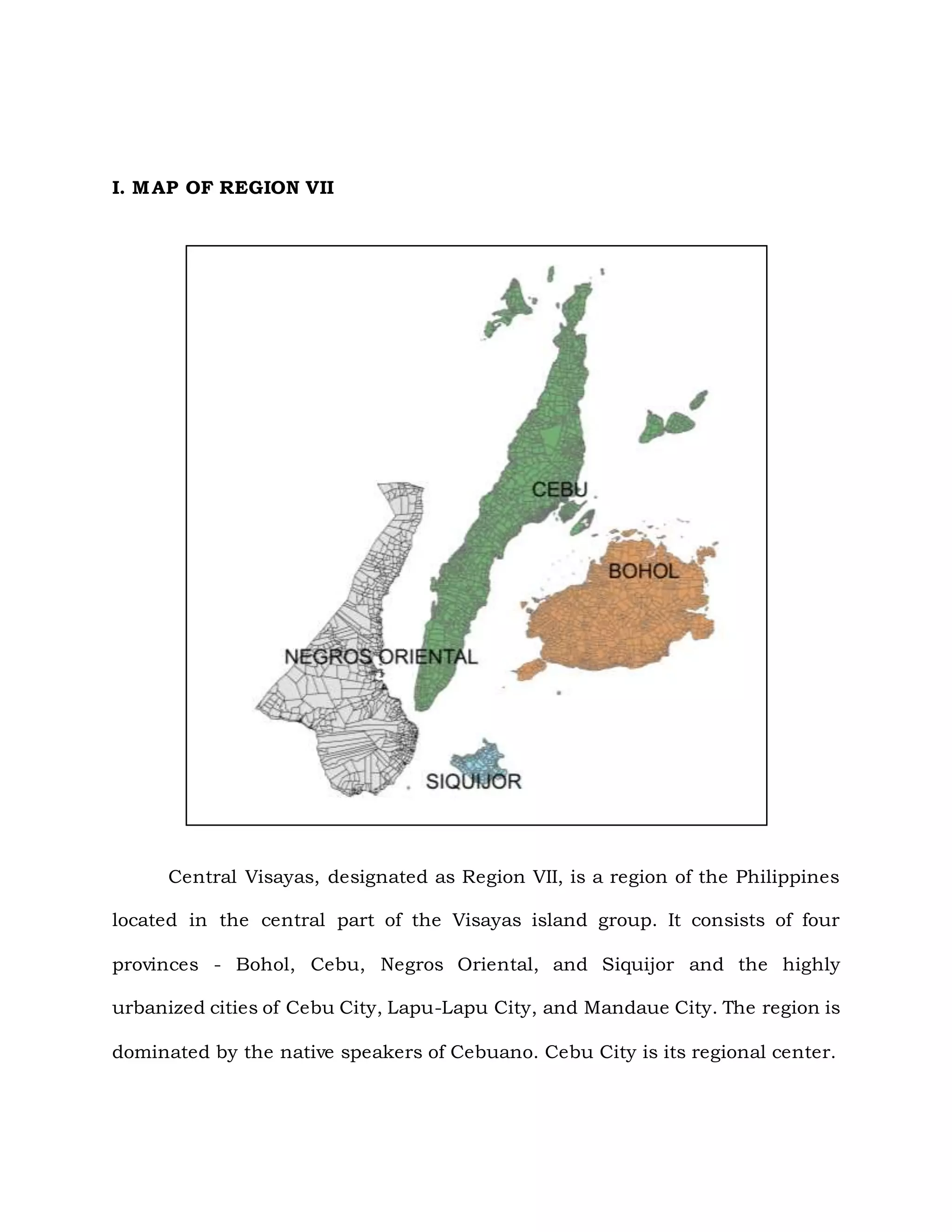
I. MAP OF REGION VII
Central Visayas, designated as Region VII, is a region of the Philippines
located in the central part of the Visayas island group. It consists of four
provinces - Bohol, Cebu, Negros Oriental, and Siquijor and the highly
urbanized cities of Cebu City, Lapu-Lapu City, and Mandaue City. The region is
dominated by the native speakers of Cebuano. Cebu City is its regional center.
II. PROVINCES AND CAPITAL
A. POVINCE CAPITAL CITIES
1. Bohol - Tagbilaran City
2. Cebu - Cebu City
3. Negros Oriental - Dumaguete City
4. Siquijor - Siquijor
B. HISTORICAL SITES and TOURIST SPOTS
1. Bohol
a. Chocolate Hills - The little mountains “burol” a.k.a. the Chocolate
Hills are one of the best wonders in the Philippines. They are
located in Carmen, Bohol.
b. Blood Compact Monument - “Datu Sikatuna, who was the Datu
(lord) in the island of Bohol in the Philippines, made a blood
compact (“Sanduguan”) and alliance with the Spanish explorer
Miguel López de Legazpi on March 16, 1565
c. Sandugo Festival - This festival commemorates the Treaty of
Friendship between Datu Sikatuna, a chieftain in Bohol, and
Spanish conquistador Miguel López de Legazpi.
2. Cebu
a. Magellan’s Cross - Magellan's Cross is a Christian cross planted
by Portuguese and Spanish upon arriving in Cebu
b. Basilica Menore del Santo Niño - is a minor basilica in Cebu City
in the Philippines that was founded in the 1565.
c. Sinulog Festival - is an annual cultural and religious festival held
on the third Sunday of January in Cebu City, and is the center of
the Santo Niño Catholic celebrations in the Philippines.
3. Negros Oriental
a. Kanlaon Volcano - also spelled as Kanla-on or sometimes
Canlaon, is an active stratovolcano on the island of Negros in the
Visayas section of the Philippines.
b. Buglasan Festival - is an annual week-long festival a celebration
of the island's history and diversity of cultural riches
4. Siquijor
a. Solili Festival - The celebration is to reminisce the courtship
period between Tukmo and Punay, and as a tribute to the
newlyweds, merrymakers dance the Solili, capping the festivity
with shouts of "Solili Binalaye".
III. MAJOR AND MINOR LANGUAGES
Major Language
A.Cebuano - Language mostly spoken in Central Visayas by most of
its speakers as Bisaya or Binisaya. Second-most-spoken
language in the Philippines next to Tagalog
Sample:
usa one (adj.); before (adv.); deer (n.)
siya chair (n.); set of three consecutive mahjong tiles (n.); he
(pron.); she (pron.)
sila they (pron.)
kini this [nominative/near you and me] (adv.); this (pron.)
anak child (n.); offspring (n.); progeny (n.)
dili nay (adv.); no (adv.); not (adv.)
ako I (pron.); mine (pron.)
niini this [possesive/near you and me] (adv.); thus (adv.)
gikan from (prep.); depart (v.); emanate (v.); leave (v.)
alang for (prep.)
apan but (adv.); yet (adv.); defect (n.); demerit (n.); fault (n.); flaw
(n.); handicap (n.); liability (n.); obstacle (n.)
diha there [near] (adv.); upon (adv.)
aron in order to (adv.)
kaniya hers (pron.); him (pron.)
tawo character (n.); human (n.); individual (n.); man (n.); mortal
(n.); person (n.)
Minor Languages
B.Boholano - variant of the Cebuano spoken in the province of Bohol
in the Philippines and eastern parts of Southern Leyte.
C.Hiligaynon - often referred to as Ilonggo. Almost 5% in Negros
Oriental speaks Hiligaynon (2011 survey).
IV. ETHNIC GROUP
A. Visayan - an ethnic group native to the Visayan islands, to the
southernmost islands of Luzon and to the northern and eastern parts
of Mindanao. They are speakers of one or more Visayan languages,
the most widely spoken being Cebuano, Hiligaynon and Waray-Waray.
V. LITERARY PIECES
A. Sicalac & Sicavay (A Visayan Creation Myth)
Summary
Once there were two gods, Captan and Maguayan.One day, Captan
planted a bamboo in a garden. It grew and split into two sections, and
stepped out a man who was named Sicalac and woman named Sicavay.
Sicalac asked Sicavay's hand for marriage because there were no
other people on earth. She refused because they were brother and sister,
having been conceived out of the same reed. Sicalac persistently pleaded
with her and finally they decided to consult the tunas of the sea, the
doves of the air and the earthquake, who agreed that they should marry
so that the world will be populated. Finally, they decided to go ahead and
got married and had a son named Sibo. Then they had a daughter
named Samar. Sibo and Samar had a daughter named Luplupan who
grew up and married Pandaguan, who was also a son of Sicalac and
Sicavay. Lupluban and Pandaguan had a son named Anoranor.
Pandaguan invented the fishing net and he caught a shark when
he used it but the shark did not survive for long out of the water. He
cried loudly to the Gods.
The god Captan, sent the flies to find out why Pandaguan was
making such a loud lamentation but the flies refused to obey so they
were condemned to scavenge among filthy and rotten things from then
on. Then, the god sent the weevils and he discovered about Pandaguan’s
grief and he struck him dead by a thunderbolt. Pandaguan stayed in the
infernal regions but the gods took pity on him and brought him back to
the world.
Pandaguan discovered that his wife Luplupan became the
concubine of Maracoyrun. Pandaguan got angry and went back to
infernal regions, vowing never to return to the world.
Theme
The Story is about how the first people appeared on earth. It tells a
story of equal birthing of man and woman throughout the archipelago
that assert a woman equal position with a man within the tribal system
Moral Lesson
We should only do things or decision if necessary. We should
always accept that everything in world has its own reason. We should
obey the authority and only those that with moral policies or rules. We
should not to love or marry somebody else other that the one we married
and we have promised to love forever.
B. Legend of Dumaguete (Legend)
The story dates back at the distant past. It was the glorious and
chivalrous time of Spanish Señors and the Moros. The Moros were
plundering the neighboring islands, abducting the women and the
children who were being ground and minted into money and gold by the
Moros.
Terrible rumors spread that Moros were coming to Dumaguete. The
people then prayed hard for protection. Families gathered at night to
pray to the Neustra Señora and Santa Catalina who had special
patronage and affection for these people. She was swift in giving them
her protection.
Every time the Moros intended invading the island, she would send
a swarm of bees to protect the place so that it would look like a big cloud
from afar, and that the Moros could not find the island.
Moros could not go near to the island because of fear the bees
could attack them and because of that, they were not able to daguit
(meaning to abduct). In other words, the people were "dili-na-daguit"
(meaning not abducted). Years passed by, the island was known as
Dumaguete.
Theme:
It is a story of the faith and hope of the people of Dumaguete
during the times when their land is in trouble.
Moral Lesson:
Have faith and trust in God and no harm will come.
C. FOLK SONGS
Usahay
English Translation
Usahay nagadamago ako
Nga ikaw ug ako nagkahigugmay
Nganong damhugon ko ikaw
Damhugon sa kanunay sa akong
Kamingaw
Usahay nagamahay ako
Nganong nabuhi pa ning kalibutan
Nganog giti-awti-aman
Ang gugma ko kanimo, kanimo dae.
Sometimes I do find that I dream
That you and I are indeed in love,
Why do I keep dreaming of you
I keep dreaming of you
In my loneliness.
Sometimes I really do regret,
That I should ever be
Born into this world.
Why do you keep on belittling
The great love that I have for you,
For you alone
Theme:
Usahay’s theme is loneliness, pain and suffering is a universal
feeling too strong to bear. But because these are attainable odds, joy and
happiness and triumph are inevitable and couldn’t be far behind
Moral Lesson:
We should always remember that the one we love may not be
always be the one for us.
Matud Nila
Matud nila, ako dili angay
Nga magmanggad sa among gugma
Matud nila, ikaw dili malipay
Kay wa ako’y bahandi
Nga kanimo igasa
Gugmang putli, mao day pasalig
Mao’y bahandi labaw sa bulawan
Matud nila, kaanugon lamang
Sa imong gugma ug parayeg.
Dili molubad kining pagsalig
Bisan sa unsa nga katargan
Kay unsa may bili ning Kanauji
Kung sa gugma mo hinikawan
Ingna ko nga dilimo Kawagoe
Damgo ug pasalig sa gugma mo.
English Translation
They say I am not capable
To crave your love
They say you are not happy
Because I have nothing to offer
you.
Love that is unrequited
Is more precious than gold,
But they say it is only a waste
Of love and caring.
Never will my love for you fade,
As long as life shall last
Never will I forget you
Without you there is no love.
If you do not believe
I am possessed by love,
At least have pity
I dream and hope for your love.
Theme:
Its lyrics depict a romantic love, usually portraying the hopeless
pleadings of a lover willing to sacrifice everything on behalf of his
beloved. It is a mournful wail of the rejected lover or the broken-hearted.
It is a story of unrequited love.
Moral Lesson:
Love is not all about money. It is sometimes the acceptance and
faith.
D. RIDDLES (TIGMO in Cebuano/Binisaya)
English Translation
1. Gipalit ko bisan ug mahal,
Apan magpulos lamang ug
magbitay.
I bought it and it's costly,
But I use it for hanging only
2. Na-ay kaban sa pari,
Ukbon dili mauli.
There's a priest's trunk,
But when opened, it could not be
closed.
3. Ako, apan dili ko magamit,
Laing tao ang mogamit.
I own it, but I don't use it.
4. Mohilak, apan walay mata,
Molakaw, apan walay tiil.
It cries without eyes,
it walks without feet.
5. Ang dahon na-a sa bunga,
Ang bunga na-a sa dahon.
The leaves are on the fruit,
The fruits is on the leaves.
6. May ligon nga balay,
Ang haligi atua sa taas,
Ang atop atua sa ubos,
Ang ulan gikan usab sa ubos?
What house has post on top,
A roof at the bottom,
While the rain comes from below?
7. Hikit-an sa tanang adlaw,
Apan dili nimo makamkam.
You can see it everyday,
But cannot touch it at will.
8. May baba apan dili makasulti. It has a mouth, but cannot talk.
9. Didto ang buno,
Dinhi ang dugo.
The murder happened there,
But the blood flowed here.
10. Dili mananap, ug dili tao,
Walay tiil, apan makalakaw;
Walay baba, apan maka sulti.
Neither an animal nor a person;
It has no feet, but can walk;
It has no mouth, but can talk.
Answers:
1.) earrings 2.) an egg 3.) your name 4.) a pen 5.) a pineapple
6.) a boat 7.) the sky 8.) a cave 9.) a flood 10.) a letter
E. ANG AMONG KABANTANG (POEM)
ni Fernando Buyser-Aquino
Kami mapaubsanon sa mga mapaubsanon,
Apan dili muduko sa atubangan sa manlulupig;
Alang kanamo ang tanang tawo managsoon,
Magsama ang mga lungsod ug ang magpuyo sa bukid.
Kining hunahuna-a dili kay pagbalabilabi,
Nga sa daghang mga tawo maoy nakaala-ut;
Kon dunay magpaka-adlaw, kami magpakagabi-I,
Apan sa pagpanaugdaug dili gayud kami motugot.
Ang gugma ug kagawasan mao ang among dalan,
Padulong sa kinatumyan sa among mga ginguha;
Sa way lipudlipud itug-an namo ang among ngalan,
Aron kami hikaplagan madtong danamo mangita.
Kon Kanhi maoy nagaduko ang mga matarong,
Samtang ang dautan maoy nagapata-as sa ilang agtang;
Dili na kini mahitabo kanamong mapaubsanon,
Kay dili namo ika-ulaw kabus naming kahimtang
Kami wala manguta sa himaya ng kabantugan
Ang gitinguha namo mao ra ang kaayuhan sa lungson;
Ngano man nga dili managsama kita nga tanan
Nga magtupong man unta ang atong mga katungkod?
Ang among hunahuna kanamo magapasalig,
Nga ang kawad-on ug kakabus dili kanamo maka-ugtas;
Ang among mga kabantang malig-on pa kay sa bukid,
Bisan kami hamubo pa kay sa mga masitas.
OUR PRIDE
translated by Juliet B. Samonte
We are humble among the humble
But to the tyrant we bow not
Brothers we are all
Equal are the city folks and the country folks.
This thought is not arrogance
That led people to failure
If they want to shrine like the sun we will be
dark like the night
But tyranny we tolerate not.
Love and freedom are our pathways
Our guide in our aspirations
Without hesitation our name we reveal
To those who wish our name to know.
If the good bow their heads
And the bad hold their heads high
No difference will it make to the humble
For what we are no shame we feel.
We seek not fortune nor fame
Our country’s welfare is our only desire
Why can’t we all unite as one
When we all have the same goals and right?
We have faith in our ideals
Misfortune and poverty our enemies
More formidable than the mountain
Though like a little plant
defeated we’ll never be.
Theme:
It is about courage from cruel ruler or dictator. People are equal
and must unite against the ruler to attain freedom.
Moral Lesson:
Don’t be afraid. Stand for your right.
F. LETTER TO PEDRO, U.S. Citizen, Also Called Pete (POEM)
by Rene Estella Amper
Pete, old friend;
there isn't really much change
in our hometown since you left.
This morning I couldn't find anymore
the grave of Simeona, the cat we buried
at the foot of Miguel's mango tree,
when we were in grade four,
after she was hit by a truck while crossing
the street. The bulldozer has messed it up
while making the feeder road into the mountains
to reach the hearts of the farmers.
The farmers come down every Sunday
to sell their agony and their sweat for
a few pesos, lose in the cockpit or get
drunk on the way home.
A steel bridge named after the congressman's wife
now spans the gray river where Tasyo, the old
goat, had split the skin of our young lizards
to make us a man many years ago.
The long blue hills where we
used to shoot birds with slingshot or spend
the summer afternoons we loved so much doing
nothing in the tall grass have been bought
by the mayor's son. Now there's a barbed wire
fence about them; the birds have gone away.
The mayor owns a big sugar plantation, three
new cars, and a mansion with the gate overhung
with sampaguita. Inside the gate
are guys who carry a rifle and a pistol.
We still go to Konga's store for rice
and sardines and sugar and nails for the coffin.
Still only a handful go to mass on Sundays.
In the church the men talk, sleep; the children play.
The priest is sad.
Last night the storm came and blew away
the cornflowers. The cornfields are full of cries.
Your cousin, Julia, has just become a whore.
She liked good clothes, good food, big money.
That's why she became a whore.
Now our hometown has seven whores.
Pete, old friend,
every time we have good reason to get drunk
and be carried home in a wheelbarrow
we always remember you. Oh, we miss
both Pete and Pedro.
Remember us to your American wife,
you lucky bastard. Islaw, your cock-eyed
uncle, now calls himself Stanley
after he began wearing the clothes you sent
him last Christmas.
P.S. Tasyo, the old goat,
Sends your lizard his warmest congratulations.
Theme:
The poem is very funny though it doesn’t sound bad as it was. The
poem displays the closeness of the persona and Pedro. He summarizes
there childhood memories before the road and bridge was made. The
creation of road gives the farmers access to the market and many other
things. The rich becomes richer, poor becomes poorer, and women are
left to become whores.
Moral Lesson:
Never forget the past, learn from it. Stop colonial mentality if not
minimize.
G. THE CLAY PIPE (SHORT STORY)
by Marcel M. Navarra
translated from Cebuano by Teresita Gimmenez-Maceda
Characters:
Malta – the main character of the story. Wife of Imok
Imok – husband of Malta
Tura and Talino – children of Malta and Imok
Lieutenance Minggoy – guerilla officer
Sepa – residents of Lipata, neighbors of Malta.
Teroy – husband of Sepa
Teban – one of the soldier
Guerilla Soldiers
Setting:
Set during the Japanese - Filipino War at Barangay Lipata,
Municpality of Carcar, Province of Cebu
Summary:
Malta built a fire, but instead of cooking for breakfast, he sat
cross-legged with a clay pipe in her mouth. While holding her clay pipe
she also thinks how they survive with less food, eating only twice or once
a day. She also thinking about the seven soldiers guarding the cliff and
she remembered that today was their turn, together with six of other
neighbors to provide breakfast. Malta went to the house of Teroy-Sepa to
ask for a bowl of cornmeal for one soldier as additional supply. Then she
runs to Peli to barter her two chickens for corn.
After she has done cooking, she carried a fishing creel (basket) to
the soldier’s camp site that contained two small pots, one is the cornmeal
and the other is vegetable soup. She also brings a roll of young tobacco
leaf.
While waiting for the other volunteers to arrive, Malta twisting
around to find a comfortable position and took a chip from the burning
wood and putting it in her clay pipe and went back to squat. Her eyes
wandered to the soldiers inside the hut. The soldier who had requested
the roll of tobacco was playing dama with the other soldier.
Suddenly, Malta is alarm with sudden firing of a gun. When she
turned her back she saw that it came from the soldier and aiming it
towards the sea. Malta wanted to protest the firing but was afraid for the
sailboat.
After a while when the tension was gone, the other soldier asks
Malta about a beautiful, charming and friendly girl. He is very interested
and says she’s in love with that girl. Their conversation was interrupted
by the arrival of the three volunteers carrying heavy baskets. The soldiers
began to eat and the volunteer are ask to join with them but they refuse
because they already eaten. Malta was about to say something but she
just remained silent. There were times when one could afford to forget
hunger but that moment when Malta stared at the abundance of food.
When the soldiers finished eating, Malta ask if they are going to
throw away the left-overs and begged as if she will feed them to her dogs.
The soldiers let Malta bring the left over while in her mouth was the clay
pipe which had nothing within except ashes.
Theme:
The Clay Pipe’s theme was about a family who didn't have much
and demonstrates the kindness and courtesy to their guests. Providing
food for the guest even though they have no food on their plate is not
good. They often help their fellow Filipinos soldier find food and shelter,
opening up their own homes to provide a temporary home whenever
necessary. This exhibits the natural hospitality of Filipinos.
Moral Lesson:
Filipinos receive guests, even strangers, in a warm and pleasant
way, often going out of their way to make the visitor comfortable. Being
hospitable is not confined to the upper class and can be found among
the poorest members of society. Too hospitable isn’t good at all.
H. TRACKS OF BABYLON (POEM)
by Edith L. Tiempo
Bodily decrepitude is wisdom; young
We love each other and were ignorant.
The hand grown tentative fumbles the pen.
He had been lost on the runic slopes and peaks,
He had whittled at the wedges strung out fence-like,
He had tangled with the hoods and whorls
Whipped into mysteries involuted
And potent as any coied up in the grass.
Bull and plowman, sandaled queen and lion,
Brooding of eyes, all set in profiled
Stance and all dichotomized,
Lift from the crackling sheet their possibility.
In the leaning fixed bodies
Clammy-hand fumbles for the furnace-
Hot heart for the kinetic core
Yellow burning.
Outside, the wind-blown rice harvest strains
For this old man nursing a cold limb.
The slavering maggots of this memory assault him:
And pain left a curious token unaware,
A scab for wisdom to pick over.
If this hand seared and seared by terrible beauty,
That bared the buried Babylon to his eyes,
Could menace the coiled destroyer in the rice,
If it could swing in hooks and whorls
Despising (or missing) the dull stance of protection,
Then he might wear shiny both switch and pen
Large sun-shapes sprawl across the grains,
But it’s his dark and titled vision
Shuts him in, man fumbling the dropped pen,
Peering, tessellating a much-tracked Babylon

Literature 1 Central Visayas Oral Notes

  • 1.
    CEBU TECHNOLOGICAL UNIVERISTY DanaoCampus ORAL NOTES in LITERATURE OF THE PHILIPPINES Region VII - Central Visayas BARRY B. EUBANK Instructor JESCILLE PRESCILLAS MARY GRACE M. MANLIQUEZ CATHY M. PUZON JLJ Student 7/30/2016
  • 2.
    I. MAP OFREGION VII Central Visayas, designated as Region VII, is a region of the Philippines located in the central part of the Visayas island group. It consists of four provinces - Bohol, Cebu, Negros Oriental, and Siquijor and the highly urbanized cities of Cebu City, Lapu-Lapu City, and Mandaue City. The region is dominated by the native speakers of Cebuano. Cebu City is its regional center.
  • 3.
    II. PROVINCES ANDCAPITAL A. POVINCE CAPITAL CITIES 1. Bohol - Tagbilaran City 2. Cebu - Cebu City 3. Negros Oriental - Dumaguete City 4. Siquijor - Siquijor B. HISTORICAL SITES and TOURIST SPOTS 1. Bohol a. Chocolate Hills - The little mountains “burol” a.k.a. the Chocolate Hills are one of the best wonders in the Philippines. They are located in Carmen, Bohol. b. Blood Compact Monument - “Datu Sikatuna, who was the Datu (lord) in the island of Bohol in the Philippines, made a blood compact (“Sanduguan”) and alliance with the Spanish explorer Miguel López de Legazpi on March 16, 1565 c. Sandugo Festival - This festival commemorates the Treaty of Friendship between Datu Sikatuna, a chieftain in Bohol, and Spanish conquistador Miguel López de Legazpi. 2. Cebu a. Magellan’s Cross - Magellan's Cross is a Christian cross planted by Portuguese and Spanish upon arriving in Cebu b. Basilica Menore del Santo Niño - is a minor basilica in Cebu City in the Philippines that was founded in the 1565. c. Sinulog Festival - is an annual cultural and religious festival held on the third Sunday of January in Cebu City, and is the center of the Santo Niño Catholic celebrations in the Philippines. 3. Negros Oriental a. Kanlaon Volcano - also spelled as Kanla-on or sometimes Canlaon, is an active stratovolcano on the island of Negros in the Visayas section of the Philippines. b. Buglasan Festival - is an annual week-long festival a celebration of the island's history and diversity of cultural riches 4. Siquijor a. Solili Festival - The celebration is to reminisce the courtship period between Tukmo and Punay, and as a tribute to the newlyweds, merrymakers dance the Solili, capping the festivity with shouts of "Solili Binalaye".
  • 4.
    III. MAJOR ANDMINOR LANGUAGES Major Language A.Cebuano - Language mostly spoken in Central Visayas by most of its speakers as Bisaya or Binisaya. Second-most-spoken language in the Philippines next to Tagalog Sample: usa one (adj.); before (adv.); deer (n.) siya chair (n.); set of three consecutive mahjong tiles (n.); he (pron.); she (pron.) sila they (pron.) kini this [nominative/near you and me] (adv.); this (pron.) anak child (n.); offspring (n.); progeny (n.) dili nay (adv.); no (adv.); not (adv.) ako I (pron.); mine (pron.) niini this [possesive/near you and me] (adv.); thus (adv.) gikan from (prep.); depart (v.); emanate (v.); leave (v.) alang for (prep.) apan but (adv.); yet (adv.); defect (n.); demerit (n.); fault (n.); flaw (n.); handicap (n.); liability (n.); obstacle (n.) diha there [near] (adv.); upon (adv.) aron in order to (adv.) kaniya hers (pron.); him (pron.) tawo character (n.); human (n.); individual (n.); man (n.); mortal (n.); person (n.) Minor Languages B.Boholano - variant of the Cebuano spoken in the province of Bohol in the Philippines and eastern parts of Southern Leyte. C.Hiligaynon - often referred to as Ilonggo. Almost 5% in Negros Oriental speaks Hiligaynon (2011 survey). IV. ETHNIC GROUP A. Visayan - an ethnic group native to the Visayan islands, to the southernmost islands of Luzon and to the northern and eastern parts of Mindanao. They are speakers of one or more Visayan languages, the most widely spoken being Cebuano, Hiligaynon and Waray-Waray.
  • 5.
    V. LITERARY PIECES A.Sicalac & Sicavay (A Visayan Creation Myth) Summary Once there were two gods, Captan and Maguayan.One day, Captan planted a bamboo in a garden. It grew and split into two sections, and stepped out a man who was named Sicalac and woman named Sicavay. Sicalac asked Sicavay's hand for marriage because there were no other people on earth. She refused because they were brother and sister, having been conceived out of the same reed. Sicalac persistently pleaded with her and finally they decided to consult the tunas of the sea, the doves of the air and the earthquake, who agreed that they should marry so that the world will be populated. Finally, they decided to go ahead and got married and had a son named Sibo. Then they had a daughter named Samar. Sibo and Samar had a daughter named Luplupan who grew up and married Pandaguan, who was also a son of Sicalac and Sicavay. Lupluban and Pandaguan had a son named Anoranor. Pandaguan invented the fishing net and he caught a shark when he used it but the shark did not survive for long out of the water. He cried loudly to the Gods. The god Captan, sent the flies to find out why Pandaguan was making such a loud lamentation but the flies refused to obey so they were condemned to scavenge among filthy and rotten things from then on. Then, the god sent the weevils and he discovered about Pandaguan’s grief and he struck him dead by a thunderbolt. Pandaguan stayed in the infernal regions but the gods took pity on him and brought him back to the world. Pandaguan discovered that his wife Luplupan became the concubine of Maracoyrun. Pandaguan got angry and went back to infernal regions, vowing never to return to the world. Theme The Story is about how the first people appeared on earth. It tells a story of equal birthing of man and woman throughout the archipelago that assert a woman equal position with a man within the tribal system Moral Lesson We should only do things or decision if necessary. We should always accept that everything in world has its own reason. We should obey the authority and only those that with moral policies or rules. We should not to love or marry somebody else other that the one we married and we have promised to love forever.
  • 6.
    B. Legend ofDumaguete (Legend) The story dates back at the distant past. It was the glorious and chivalrous time of Spanish Señors and the Moros. The Moros were plundering the neighboring islands, abducting the women and the children who were being ground and minted into money and gold by the Moros. Terrible rumors spread that Moros were coming to Dumaguete. The people then prayed hard for protection. Families gathered at night to pray to the Neustra Señora and Santa Catalina who had special patronage and affection for these people. She was swift in giving them her protection. Every time the Moros intended invading the island, she would send a swarm of bees to protect the place so that it would look like a big cloud from afar, and that the Moros could not find the island. Moros could not go near to the island because of fear the bees could attack them and because of that, they were not able to daguit (meaning to abduct). In other words, the people were "dili-na-daguit" (meaning not abducted). Years passed by, the island was known as Dumaguete. Theme: It is a story of the faith and hope of the people of Dumaguete during the times when their land is in trouble. Moral Lesson: Have faith and trust in God and no harm will come.
  • 7.
    C. FOLK SONGS Usahay EnglishTranslation Usahay nagadamago ako Nga ikaw ug ako nagkahigugmay Nganong damhugon ko ikaw Damhugon sa kanunay sa akong Kamingaw Usahay nagamahay ako Nganong nabuhi pa ning kalibutan Nganog giti-awti-aman Ang gugma ko kanimo, kanimo dae. Sometimes I do find that I dream That you and I are indeed in love, Why do I keep dreaming of you I keep dreaming of you In my loneliness. Sometimes I really do regret, That I should ever be Born into this world. Why do you keep on belittling The great love that I have for you, For you alone Theme: Usahay’s theme is loneliness, pain and suffering is a universal feeling too strong to bear. But because these are attainable odds, joy and happiness and triumph are inevitable and couldn’t be far behind Moral Lesson: We should always remember that the one we love may not be always be the one for us.
  • 8.
    Matud Nila Matud nila,ako dili angay Nga magmanggad sa among gugma Matud nila, ikaw dili malipay Kay wa ako’y bahandi Nga kanimo igasa Gugmang putli, mao day pasalig Mao’y bahandi labaw sa bulawan Matud nila, kaanugon lamang Sa imong gugma ug parayeg. Dili molubad kining pagsalig Bisan sa unsa nga katargan Kay unsa may bili ning Kanauji Kung sa gugma mo hinikawan Ingna ko nga dilimo Kawagoe Damgo ug pasalig sa gugma mo. English Translation They say I am not capable To crave your love They say you are not happy Because I have nothing to offer you. Love that is unrequited Is more precious than gold, But they say it is only a waste Of love and caring. Never will my love for you fade, As long as life shall last Never will I forget you Without you there is no love. If you do not believe I am possessed by love, At least have pity I dream and hope for your love. Theme: Its lyrics depict a romantic love, usually portraying the hopeless pleadings of a lover willing to sacrifice everything on behalf of his beloved. It is a mournful wail of the rejected lover or the broken-hearted. It is a story of unrequited love. Moral Lesson: Love is not all about money. It is sometimes the acceptance and faith.
  • 9.
    D. RIDDLES (TIGMOin Cebuano/Binisaya) English Translation 1. Gipalit ko bisan ug mahal, Apan magpulos lamang ug magbitay. I bought it and it's costly, But I use it for hanging only 2. Na-ay kaban sa pari, Ukbon dili mauli. There's a priest's trunk, But when opened, it could not be closed. 3. Ako, apan dili ko magamit, Laing tao ang mogamit. I own it, but I don't use it. 4. Mohilak, apan walay mata, Molakaw, apan walay tiil. It cries without eyes, it walks without feet. 5. Ang dahon na-a sa bunga, Ang bunga na-a sa dahon. The leaves are on the fruit, The fruits is on the leaves. 6. May ligon nga balay, Ang haligi atua sa taas, Ang atop atua sa ubos, Ang ulan gikan usab sa ubos? What house has post on top, A roof at the bottom, While the rain comes from below? 7. Hikit-an sa tanang adlaw, Apan dili nimo makamkam. You can see it everyday, But cannot touch it at will. 8. May baba apan dili makasulti. It has a mouth, but cannot talk. 9. Didto ang buno, Dinhi ang dugo. The murder happened there, But the blood flowed here. 10. Dili mananap, ug dili tao, Walay tiil, apan makalakaw; Walay baba, apan maka sulti. Neither an animal nor a person; It has no feet, but can walk; It has no mouth, but can talk. Answers: 1.) earrings 2.) an egg 3.) your name 4.) a pen 5.) a pineapple 6.) a boat 7.) the sky 8.) a cave 9.) a flood 10.) a letter
  • 10.
    E. ANG AMONGKABANTANG (POEM) ni Fernando Buyser-Aquino Kami mapaubsanon sa mga mapaubsanon, Apan dili muduko sa atubangan sa manlulupig; Alang kanamo ang tanang tawo managsoon, Magsama ang mga lungsod ug ang magpuyo sa bukid. Kining hunahuna-a dili kay pagbalabilabi, Nga sa daghang mga tawo maoy nakaala-ut; Kon dunay magpaka-adlaw, kami magpakagabi-I, Apan sa pagpanaugdaug dili gayud kami motugot. Ang gugma ug kagawasan mao ang among dalan, Padulong sa kinatumyan sa among mga ginguha; Sa way lipudlipud itug-an namo ang among ngalan, Aron kami hikaplagan madtong danamo mangita. Kon Kanhi maoy nagaduko ang mga matarong, Samtang ang dautan maoy nagapata-as sa ilang agtang; Dili na kini mahitabo kanamong mapaubsanon, Kay dili namo ika-ulaw kabus naming kahimtang Kami wala manguta sa himaya ng kabantugan Ang gitinguha namo mao ra ang kaayuhan sa lungson; Ngano man nga dili managsama kita nga tanan Nga magtupong man unta ang atong mga katungkod? Ang among hunahuna kanamo magapasalig, Nga ang kawad-on ug kakabus dili kanamo maka-ugtas; Ang among mga kabantang malig-on pa kay sa bukid, Bisan kami hamubo pa kay sa mga masitas.
  • 11.
    OUR PRIDE translated byJuliet B. Samonte We are humble among the humble But to the tyrant we bow not Brothers we are all Equal are the city folks and the country folks. This thought is not arrogance That led people to failure If they want to shrine like the sun we will be dark like the night But tyranny we tolerate not. Love and freedom are our pathways Our guide in our aspirations Without hesitation our name we reveal To those who wish our name to know. If the good bow their heads And the bad hold their heads high No difference will it make to the humble For what we are no shame we feel. We seek not fortune nor fame Our country’s welfare is our only desire Why can’t we all unite as one When we all have the same goals and right? We have faith in our ideals Misfortune and poverty our enemies More formidable than the mountain Though like a little plant defeated we’ll never be. Theme: It is about courage from cruel ruler or dictator. People are equal and must unite against the ruler to attain freedom. Moral Lesson: Don’t be afraid. Stand for your right.
  • 12.
    F. LETTER TOPEDRO, U.S. Citizen, Also Called Pete (POEM) by Rene Estella Amper Pete, old friend; there isn't really much change in our hometown since you left. This morning I couldn't find anymore the grave of Simeona, the cat we buried at the foot of Miguel's mango tree, when we were in grade four, after she was hit by a truck while crossing the street. The bulldozer has messed it up while making the feeder road into the mountains to reach the hearts of the farmers. The farmers come down every Sunday to sell their agony and their sweat for a few pesos, lose in the cockpit or get drunk on the way home. A steel bridge named after the congressman's wife now spans the gray river where Tasyo, the old goat, had split the skin of our young lizards to make us a man many years ago. The long blue hills where we used to shoot birds with slingshot or spend the summer afternoons we loved so much doing nothing in the tall grass have been bought by the mayor's son. Now there's a barbed wire fence about them; the birds have gone away. The mayor owns a big sugar plantation, three new cars, and a mansion with the gate overhung with sampaguita. Inside the gate are guys who carry a rifle and a pistol. We still go to Konga's store for rice and sardines and sugar and nails for the coffin. Still only a handful go to mass on Sundays. In the church the men talk, sleep; the children play. The priest is sad. Last night the storm came and blew away the cornflowers. The cornfields are full of cries.
  • 13.
    Your cousin, Julia,has just become a whore. She liked good clothes, good food, big money. That's why she became a whore. Now our hometown has seven whores. Pete, old friend, every time we have good reason to get drunk and be carried home in a wheelbarrow we always remember you. Oh, we miss both Pete and Pedro. Remember us to your American wife, you lucky bastard. Islaw, your cock-eyed uncle, now calls himself Stanley after he began wearing the clothes you sent him last Christmas. P.S. Tasyo, the old goat, Sends your lizard his warmest congratulations. Theme: The poem is very funny though it doesn’t sound bad as it was. The poem displays the closeness of the persona and Pedro. He summarizes there childhood memories before the road and bridge was made. The creation of road gives the farmers access to the market and many other things. The rich becomes richer, poor becomes poorer, and women are left to become whores. Moral Lesson: Never forget the past, learn from it. Stop colonial mentality if not minimize.
  • 14.
    G. THE CLAYPIPE (SHORT STORY) by Marcel M. Navarra translated from Cebuano by Teresita Gimmenez-Maceda Characters: Malta – the main character of the story. Wife of Imok Imok – husband of Malta Tura and Talino – children of Malta and Imok Lieutenance Minggoy – guerilla officer Sepa – residents of Lipata, neighbors of Malta. Teroy – husband of Sepa Teban – one of the soldier Guerilla Soldiers Setting: Set during the Japanese - Filipino War at Barangay Lipata, Municpality of Carcar, Province of Cebu Summary: Malta built a fire, but instead of cooking for breakfast, he sat cross-legged with a clay pipe in her mouth. While holding her clay pipe she also thinks how they survive with less food, eating only twice or once a day. She also thinking about the seven soldiers guarding the cliff and she remembered that today was their turn, together with six of other neighbors to provide breakfast. Malta went to the house of Teroy-Sepa to ask for a bowl of cornmeal for one soldier as additional supply. Then she runs to Peli to barter her two chickens for corn. After she has done cooking, she carried a fishing creel (basket) to the soldier’s camp site that contained two small pots, one is the cornmeal and the other is vegetable soup. She also brings a roll of young tobacco leaf. While waiting for the other volunteers to arrive, Malta twisting around to find a comfortable position and took a chip from the burning wood and putting it in her clay pipe and went back to squat. Her eyes wandered to the soldiers inside the hut. The soldier who had requested the roll of tobacco was playing dama with the other soldier.
  • 15.
    Suddenly, Malta isalarm with sudden firing of a gun. When she turned her back she saw that it came from the soldier and aiming it towards the sea. Malta wanted to protest the firing but was afraid for the sailboat. After a while when the tension was gone, the other soldier asks Malta about a beautiful, charming and friendly girl. He is very interested and says she’s in love with that girl. Their conversation was interrupted by the arrival of the three volunteers carrying heavy baskets. The soldiers began to eat and the volunteer are ask to join with them but they refuse because they already eaten. Malta was about to say something but she just remained silent. There were times when one could afford to forget hunger but that moment when Malta stared at the abundance of food. When the soldiers finished eating, Malta ask if they are going to throw away the left-overs and begged as if she will feed them to her dogs. The soldiers let Malta bring the left over while in her mouth was the clay pipe which had nothing within except ashes. Theme: The Clay Pipe’s theme was about a family who didn't have much and demonstrates the kindness and courtesy to their guests. Providing food for the guest even though they have no food on their plate is not good. They often help their fellow Filipinos soldier find food and shelter, opening up their own homes to provide a temporary home whenever necessary. This exhibits the natural hospitality of Filipinos. Moral Lesson: Filipinos receive guests, even strangers, in a warm and pleasant way, often going out of their way to make the visitor comfortable. Being hospitable is not confined to the upper class and can be found among the poorest members of society. Too hospitable isn’t good at all.
  • 16.
    H. TRACKS OFBABYLON (POEM) by Edith L. Tiempo Bodily decrepitude is wisdom; young We love each other and were ignorant. The hand grown tentative fumbles the pen. He had been lost on the runic slopes and peaks, He had whittled at the wedges strung out fence-like, He had tangled with the hoods and whorls Whipped into mysteries involuted And potent as any coied up in the grass. Bull and plowman, sandaled queen and lion, Brooding of eyes, all set in profiled Stance and all dichotomized, Lift from the crackling sheet their possibility. In the leaning fixed bodies Clammy-hand fumbles for the furnace- Hot heart for the kinetic core Yellow burning. Outside, the wind-blown rice harvest strains For this old man nursing a cold limb. The slavering maggots of this memory assault him: And pain left a curious token unaware, A scab for wisdom to pick over. If this hand seared and seared by terrible beauty, That bared the buried Babylon to his eyes, Could menace the coiled destroyer in the rice, If it could swing in hooks and whorls Despising (or missing) the dull stance of protection, Then he might wear shiny both switch and pen Large sun-shapes sprawl across the grains, But it’s his dark and titled vision Shuts him in, man fumbling the dropped pen, Peering, tessellating a much-tracked Babylon