


Life and Works
Bienvenido N. Santos
Prepared by: Joalex Nillo, BSE - English
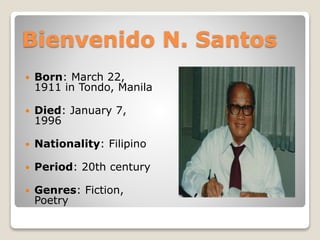
Bienvenido N. Santos


Born: March 22,
1911 in Tondo, Manila



Died: January 7,
1996



Nationality: Filipino



Period: 20th century



Genres: Fiction,
Poetry
Biography


Bienvenido N. Santos (1911–1996)
◦a
Filipino-American
nonfiction writer.

fiction,

poetry

and

◦ He was born and raised in Tondo, Manila.
◦ His family roots are originally from Lubao,
Pampanga, Philippines.
Biography


In his early attempts at creative writing, Santos
developed an ear for three kinds of
communication:
◦ Pampango in the songs his mother sang at home;
◦ English in the poems and stories his teacher read at
school; and
◦ Tagalog in the street life of the Tondo slums.



He lived in the United States for many years
where he is widely credited as a pioneering
Asian-American writer.
Biography


He was born a menopausal baby.



Dr. Santos, at 83:
◦ has authored 14 books;
◦ has won numerous prestigious literary awards;
◦ is widely anthologized and is required reading
in schools – both in the Philippines and in
numbers of the United States.
Biography


Before he graduated from high school, at 16
years old, he was already an orphan.
◦ His mother, Vicenta, who doted on him, died of
cancer when he was 13. His father, after whom he
named his only son Tomas, died of tuberculosis
when he was 15



Although the thought of being a writer first
came to him after he published his first stories
in two national magazines and after he had
already published some poems, it was
teaching that occupied his time and effort.
Biography


It was in teaching where he met his future
wife, Beatriz Nidea, and won her hand in
Marriage despite a sputtering star when he
bungled the first line he threw at her due to
nervousness.



They made their home in Daraga, Albay, in
the home province of his wife.



There, on the combined income as public
school teachers, they raised three daughters:
Arme, Lina, and Lily. Tom came much later.
Biography


Santos was also a distinguished academic.
Since, 1932, when he earned his Bachelor
in Science degree in Education, major in
English, at the University of the
Philippines, he had been teaching at
various institutions such as:
◦
◦
◦
◦
◦

Ohio State University of Iowa
Ateneo de Manila University
Metropolitan State College
Parkland College
Wichita State University
Biography


Santos left for America in September
1941 as a pensionado (scholar) of the
Philippine Commonwealth government.



Thirty years old and an established short
story writer in English at home, he
enrolled at the University of Illinois in the
master's program in English.
Biography


When war broke out in December, he
found himself an exile in America, cut off
from his homeland and his wife and three
daughters he left behind. The heartbreak
of this separation during his first sojourn
in America is crucial to Santos's
development as a writer.



Exile defined the central theme of his
fiction from then on.
Biography


After earning a Master of Arts degree in
English at University of Illinois in 1942,
and doing a postgraduate work in English
at Columbia University in 1942, and at
Harvard University in 1945-46, he served
as President of Legaspi College (now
Aquinas University).



Creative writing fellowships awarded by
the Rockefeller Foundation Guggenheim
Foundation, and Iowa Industries brought
him back to the United States.
Biography


After three years as fellow in the University of
Iowa Writers’ Workshop, he came home in
1961 and was appointed Dean of the College
of Arts and Sciences, Dean of the Graduate
School, and Vice President for Academic
Affairs at the University of Nueva Caceres.



He returned to America in 1966 as Fulbright
Exchange Professor at the University of Iowa.
Biography


Santos received an honorary doctorate
degrees in humanities and letters from
the University of the Philippines, and Bicol
University (Legazpi City, Albay) in 1981.



He was also a Professor of Creative Writing
and Distinguished Writer in Residence at
the Wichita State University from 1973 to
1982, at which time the university awarded
him an honorary doctorate degree in humane
letters. After his retirement, Santos became
Visiting Writer and Artist at De La Salle
University in Manila; the university honored
Santos by renaming its creative writing center
after him.
Biography


Bienvenido Santos was one of the
privileged few to whom success has been
very kind. He has spent most of his
lifetime in writing the different literary
genres and in teaching his craft to wouldbe writers.



The recognition he has received has been
much more compared to that of any
others Filipino writer during his time.
Awards, honors and
prizes


Rockefeller Foundation Fellowship at
the University of Iowa



Guggenheim Fellowship



Republic Cultural Heritage Award



Carlos Palanca Memorial Awards for short
fiction (1956, 1961 and 1965)



Fulbright Program Exchange Professorship
Awards, honors and
prizes


American Book Award from Before Columbus
Foundation



Honorary Doctorate in Humanities and
Letters, University of the Philippines



Honorary Doctorate in Humanities and
Letters, Bicol University (Legazpi
City, Albay, Philippines)



Honorary Doctorate in Humane Letters, Wichita
State University (Kansas, U.S.A.)
Works
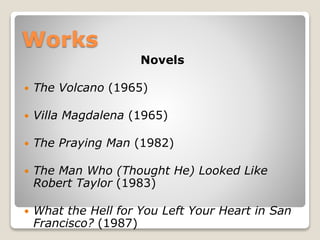
Novels


The Volcano (1965)



Villa Magdalena (1965)



The Praying Man (1982)



The Man Who (Thought He) Looked Like
Robert Taylor (1983)



What the Hell for You Left Your Heart in San
Francisco? (1987)
Works
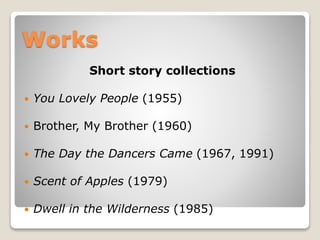
Short story collections


You Lovely People (1955)



Brother, My Brother (1960)



The Day the Dancers Came (1967, 1991)



Scent of Apples (1979)



Dwell in the Wilderness (1985)
Works
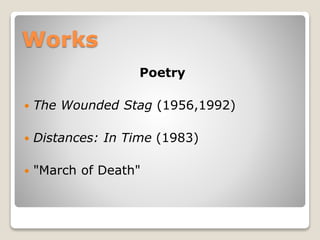
Poetry


The Wounded Stag (1956,1992)



Distances: In Time (1983)



"March of Death"
Works
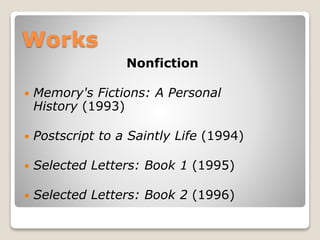
Nonfiction


Memory's Fictions: A Personal
History (1993)



Postscript to a Saintly Life (1994)



Selected Letters: Book 1 (1995)



Selected Letters: Book 2 (1996)
Works


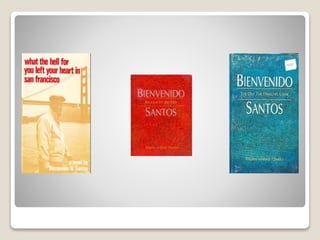
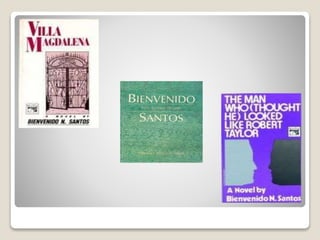
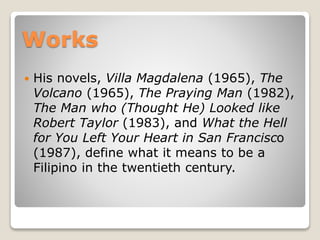
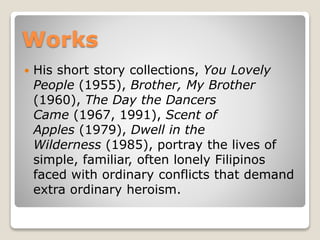
His novels, Villa Magdalena (1965), The
Volcano (1965), The Praying Man (1982),
The Man who (Thought He) Looked like
Robert Taylor (1983), and What the Hell
for You Left Your Heart in San Francisco
(1987), define what it means to be a
Filipino in the twentieth century.
Works


His short story collections, You Lovely
People (1955), Brother, My Brother
(1960), The Day the Dancers
Came (1967, 1991), Scent of
Apples (1979), Dwell in the
Wilderness (1985), portray the lives of
simple, familiar, often lonely Filipinos
faced with ordinary conflicts that demand
extra ordinary heroism.
Works


His poetry collections, The Wounded
Stag (1956,1992), and Distances: In
Time (1983) display the same sensitivity
to language and the depth of insight that
give power to his prose.
Works
His works have been translated into several
languages such as:






Chinese
French
German
Malay
Russian
Moreover, he is included in all the major
anthologies of the Philippine writing
published both in the Philippines and in other
countries.
Works


Santos's stories can be grouped into three
literary periods.
◦ The first period, the prewar years in the
Philippines (1930-1940) are set in the fictive
Sulucan slums of his Tondo childhood and the
rural towns and villages in the foothills of
Mayon volcano in Albay, where Santos married
Beatriz Nidea, started his family, and built his
house. These stories are in the collections
Brother, My Brother and Dwell in the
Wilderness.
Works


Santos's stories can be grouped into three
literary periods.
◦ Santos's exile in America during the war years
produced stories set in Chicago, Washington,
New York, and other cities, where he lectured
extensively for the Philippine Commonwealth
government in exile. You, Lovely People, The
Day the Dancers Came, and Scent of Apples
belong to this period.
Works


Santos's stories can be grouped into three
literary periods.
◦ In the postwar years Santos set his stories in
different places as he commuted between the
Philippines and America. These years mark a
period of maturation and experimentation, and
a shifting away from the short story to the
novel form.
THE END
It’s

THE END
that counts. . .
THANK YOU!
GOD BLESS!


BN Santos' Life and Works

  • 1.
    Life and Works BienvenidoN. Santos Prepared by: Joalex Nillo, BSE - English
  • 2.
    Bienvenido N. Santos  Born:March 22, 1911 in Tondo, Manila  Died: January 7, 1996  Nationality: Filipino  Period: 20th century  Genres: Fiction, Poetry
  • 3.
    Biography  Bienvenido N. Santos(1911–1996) ◦a Filipino-American nonfiction writer. fiction, poetry and ◦ He was born and raised in Tondo, Manila. ◦ His family roots are originally from Lubao, Pampanga, Philippines.
  • 4.
    Biography  In his earlyattempts at creative writing, Santos developed an ear for three kinds of communication: ◦ Pampango in the songs his mother sang at home; ◦ English in the poems and stories his teacher read at school; and ◦ Tagalog in the street life of the Tondo slums.  He lived in the United States for many years where he is widely credited as a pioneering Asian-American writer.
  • 5.
    Biography  He was borna menopausal baby.  Dr. Santos, at 83: ◦ has authored 14 books; ◦ has won numerous prestigious literary awards; ◦ is widely anthologized and is required reading in schools – both in the Philippines and in numbers of the United States.
  • 6.
    Biography  Before he graduatedfrom high school, at 16 years old, he was already an orphan. ◦ His mother, Vicenta, who doted on him, died of cancer when he was 13. His father, after whom he named his only son Tomas, died of tuberculosis when he was 15  Although the thought of being a writer first came to him after he published his first stories in two national magazines and after he had already published some poems, it was teaching that occupied his time and effort.
  • 7.
    Biography  It was inteaching where he met his future wife, Beatriz Nidea, and won her hand in Marriage despite a sputtering star when he bungled the first line he threw at her due to nervousness.  They made their home in Daraga, Albay, in the home province of his wife.  There, on the combined income as public school teachers, they raised three daughters: Arme, Lina, and Lily. Tom came much later.
  • 8.
    Biography  Santos was alsoa distinguished academic. Since, 1932, when he earned his Bachelor in Science degree in Education, major in English, at the University of the Philippines, he had been teaching at various institutions such as: ◦ ◦ ◦ ◦ ◦ Ohio State University of Iowa Ateneo de Manila University Metropolitan State College Parkland College Wichita State University
  • 9.
    Biography  Santos left forAmerica in September 1941 as a pensionado (scholar) of the Philippine Commonwealth government.  Thirty years old and an established short story writer in English at home, he enrolled at the University of Illinois in the master's program in English.
  • 10.
    Biography  When war brokeout in December, he found himself an exile in America, cut off from his homeland and his wife and three daughters he left behind. The heartbreak of this separation during his first sojourn in America is crucial to Santos's development as a writer.  Exile defined the central theme of his fiction from then on.
  • 11.
    Biography  After earning aMaster of Arts degree in English at University of Illinois in 1942, and doing a postgraduate work in English at Columbia University in 1942, and at Harvard University in 1945-46, he served as President of Legaspi College (now Aquinas University).  Creative writing fellowships awarded by the Rockefeller Foundation Guggenheim Foundation, and Iowa Industries brought him back to the United States.
  • 12.
    Biography  After three yearsas fellow in the University of Iowa Writers’ Workshop, he came home in 1961 and was appointed Dean of the College of Arts and Sciences, Dean of the Graduate School, and Vice President for Academic Affairs at the University of Nueva Caceres.  He returned to America in 1966 as Fulbright Exchange Professor at the University of Iowa.
  • 13.
    Biography  Santos received anhonorary doctorate degrees in humanities and letters from the University of the Philippines, and Bicol University (Legazpi City, Albay) in 1981.  He was also a Professor of Creative Writing and Distinguished Writer in Residence at the Wichita State University from 1973 to 1982, at which time the university awarded him an honorary doctorate degree in humane letters. After his retirement, Santos became Visiting Writer and Artist at De La Salle University in Manila; the university honored Santos by renaming its creative writing center after him.
  • 14.
    Biography  Bienvenido Santos wasone of the privileged few to whom success has been very kind. He has spent most of his lifetime in writing the different literary genres and in teaching his craft to wouldbe writers.  The recognition he has received has been much more compared to that of any others Filipino writer during his time.
  • 15.
    Awards, honors and prizes  RockefellerFoundation Fellowship at the University of Iowa  Guggenheim Fellowship  Republic Cultural Heritage Award  Carlos Palanca Memorial Awards for short fiction (1956, 1961 and 1965)  Fulbright Program Exchange Professorship
  • 16.
    Awards, honors and prizes  AmericanBook Award from Before Columbus Foundation  Honorary Doctorate in Humanities and Letters, University of the Philippines  Honorary Doctorate in Humanities and Letters, Bicol University (Legazpi City, Albay, Philippines)  Honorary Doctorate in Humane Letters, Wichita State University (Kansas, U.S.A.)
  • 17.
    Works Novels  The Volcano (1965)  VillaMagdalena (1965)  The Praying Man (1982)  The Man Who (Thought He) Looked Like Robert Taylor (1983)  What the Hell for You Left Your Heart in San Francisco? (1987)
  • 18.
    Works Short story collections  YouLovely People (1955)  Brother, My Brother (1960)  The Day the Dancers Came (1967, 1991)  Scent of Apples (1979)  Dwell in the Wilderness (1985)
  • 19.
    Works Poetry  The Wounded Stag(1956,1992)  Distances: In Time (1983)  "March of Death"
  • 20.
    Works Nonfiction  Memory's Fictions: APersonal History (1993)  Postscript to a Saintly Life (1994)  Selected Letters: Book 1 (1995)  Selected Letters: Book 2 (1996)
  • 24.
    Works  His novels, VillaMagdalena (1965), The Volcano (1965), The Praying Man (1982), The Man who (Thought He) Looked like Robert Taylor (1983), and What the Hell for You Left Your Heart in San Francisco (1987), define what it means to be a Filipino in the twentieth century.
  • 25.
    Works  His short storycollections, You Lovely People (1955), Brother, My Brother (1960), The Day the Dancers Came (1967, 1991), Scent of Apples (1979), Dwell in the Wilderness (1985), portray the lives of simple, familiar, often lonely Filipinos faced with ordinary conflicts that demand extra ordinary heroism.
  • 26.
    Works  His poetry collections,The Wounded Stag (1956,1992), and Distances: In Time (1983) display the same sensitivity to language and the depth of insight that give power to his prose.
  • 27.
    Works His works havebeen translated into several languages such as:      Chinese French German Malay Russian Moreover, he is included in all the major anthologies of the Philippine writing published both in the Philippines and in other countries.
  • 28.
    Works  Santos's stories canbe grouped into three literary periods. ◦ The first period, the prewar years in the Philippines (1930-1940) are set in the fictive Sulucan slums of his Tondo childhood and the rural towns and villages in the foothills of Mayon volcano in Albay, where Santos married Beatriz Nidea, started his family, and built his house. These stories are in the collections Brother, My Brother and Dwell in the Wilderness.
  • 29.
    Works  Santos's stories canbe grouped into three literary periods. ◦ Santos's exile in America during the war years produced stories set in Chicago, Washington, New York, and other cities, where he lectured extensively for the Philippine Commonwealth government in exile. You, Lovely People, The Day the Dancers Came, and Scent of Apples belong to this period.
  • 30.
    Works  Santos's stories canbe grouped into three literary periods. ◦ In the postwar years Santos set his stories in different places as he commuted between the Philippines and America. These years mark a period of maturation and experimentation, and a shifting away from the short story to the novel form.
  • 31.
  • 32.
  • 33.