EN
Horizon 2020
Work Programme 2018-2020
12. Climate action, environment, resource efficiency and raw
materials
IMPORTANT NOTICE ON THIS WORK PROGRAMME
This Work Programme covers 2018, 2019 and 2020. The parts of the Work Programme that
relate to 2020 (topics, dates, budget) have, with this revised version, been updated. The
changes relating to this revised part are explained on the Funding & Tenders Portal.
(European Commission Decision C(2019)4575 of 2 July 2019)
Horizon 2020 - Work Programme 2018-2020
Climate action, environment, resource efficiency and raw materials
Part 12 - Page 2 of 162
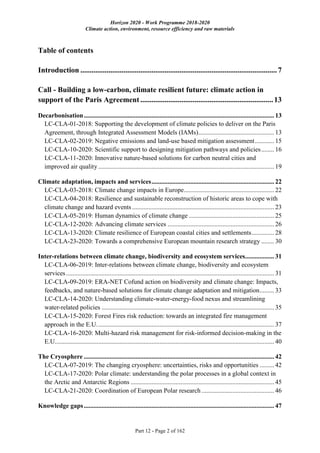
Table of contents
Introduction .........................................................................................................7
Call - Building a low-carbon, climate resilient future: climate action in
support of the Paris Agreement.......................................................................13
Decarbonisation...................................................................................................................... 13
LC-CLA-01-2018: Supporting the development of climate policies to deliver on the Paris
Agreement, through Integrated Assessment Models (IAMs)............................................... 13
LC-CLA-02-2019: Negative emissions and land-use based mitigation assessment............ 15
LC-CLA-10-2020: Scientific support to designing mitigation pathways and policies........ 16
LC-CLA-11-2020: Innovative nature-based solutions for carbon neutral cities and
improved air quality ............................................................................................................. 19
Climate adaptation, impacts and services............................................................................ 22
LC-CLA-03-2018: Climate change impacts in Europe........................................................ 22
LC-CLA-04-2018: Resilience and sustainable reconstruction of historic areas to cope with
climate change and hazard events ........................................................................................ 23
LC-CLA-05-2019: Human dynamics of climate change ..................................................... 25
LC-CLA-12-2020: Advancing climate services .................................................................. 26
LC-CLA-13-2020: Climate resilience of European coastal cities and settlements.............. 28
LC-CLA-23-2020: Towards a comprehensive European mountain research strategy ........ 30
Inter-relations between climate change, biodiversity and ecosystem services.................. 31
LC-CLA-06-2019: Inter-relations between climate change, biodiversity and ecosystem
services................................................................................................................................. 31
LC-CLA-09-2019: ERA-NET Cofund action on biodiversity and climate change: Impacts,
feedbacks, and nature-based solutions for climate change adaptation and mitigation......... 33
LC-CLA-14-2020: Understanding climate-water-energy-food nexus and streamlining
water-related policies ........................................................................................................... 35
LC-CLA-15-2020: Forest Fires risk reduction: towards an integrated fire management
approach in the E.U.............................................................................................................. 37
LC-CLA-16-2020: Multi-hazard risk management for risk-informed decision-making in the
E.U........................................................................................................................................ 40
The Cryosphere ...................................................................................................................... 42
LC-CLA-07-2019: The changing cryosphere: uncertainties, risks and opportunities ......... 42
LC-CLA-17-2020: Polar climate: understanding the polar processes in a global context in
the Arctic and Antarctic Regions ......................................................................................... 45
LC-CLA-21-2020: Coordination of European Polar research ............................................. 46
Knowledge gaps...................................................................................................................... 47
Horizon 2020 - Work Programme 2018-2020
Climate action, environment, resource efficiency and raw materials
Part 12 - Page 3 of 162
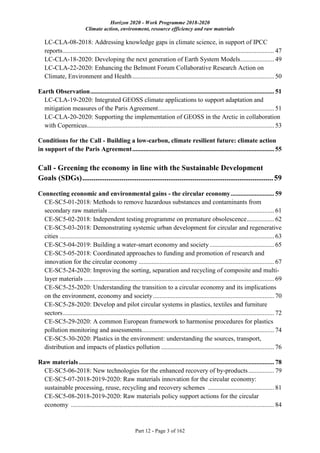
LC-CLA-08-2018: Addressing knowledge gaps in climate science, in support of IPCC
reports................................................................................................................................... 47
LC-CLA-18-2020: Developing the next generation of Earth System Models..................... 49
LC-CLA-22-2020: Enhancing the Belmont Forum Collaborative Research Action on
Climate, Environment and Health........................................................................................ 50
Earth Observation.................................................................................................................. 51
LC-CLA-19-2020: Integrated GEOSS climate applications to support adaptation and
mitigation measures of the Paris Agreement........................................................................ 51
LC-CLA-20-2020: Supporting the implementation of GEOSS in the Arctic in collaboration
with Copernicus.................................................................................................................... 53
Conditions for the Call - Building a low-carbon, climate resilient future: climate action
in support of the Paris Agreement........................................................................................ 55
Call - Greening the economy in line with the Sustainable Development
Goals (SDGs)......................................................................................................59
Connecting economic and environmental gains - the circular economy........................... 59
CE-SC5-01-2018: Methods to remove hazardous substances and contaminants from
secondary raw materials....................................................................................................... 61
CE-SC5-02-2018: Independent testing programme on premature obsolescence................. 62
CE-SC5-03-2018: Demonstrating systemic urban development for circular and regenerative
cities ..................................................................................................................................... 63
CE-SC5-04-2019: Building a water-smart economy and society........................................ 65
CE-SC5-05-2018: Coordinated approaches to funding and promotion of research and
innovation for the circular economy .................................................................................... 67
CE-SC5-24-2020: Improving the sorting, separation and recycling of composite and multi-
layer materials ...................................................................................................................... 69
CE-SC5-25-2020: Understanding the transition to a circular economy and its implications
on the environment, economy and society........................................................................... 70
CE-SC5-28-2020: Develop and pilot circular systems in plastics, textiles and furniture
sectors................................................................................................................................... 72
CE-SC5-29-2020: A common European framework to harmonise procedures for plastics
pollution monitoring and assessments.................................................................................. 74
CE-SC5-30-2020: Plastics in the environment: understanding the sources, transport,
distribution and impacts of plastics pollution ...................................................................... 76
Raw materials ......................................................................................................................... 78
CE-SC5-06-2018: New technologies for the enhanced recovery of by-products................ 79
CE-SC5-07-2018-2019-2020: Raw materials innovation for the circular economy:
sustainable processing, reuse, recycling and recovery schemes ......................................... 81
CE-SC5-08-2018-2019-2020: Raw materials policy support actions for the circular
economy .............................................................................................................................. 84
Horizon 2020 - Work Programme 2018-2020
Climate action, environment, resource efficiency and raw materials
Part 12 - Page 4 of 162
SC5-09-2018-2019: New solutions for the sustainable production of raw materials .......... 88
SC5-10-2019-2020: Raw materials innovation actions: exploration and Earth observation in
support of sustainable mining .............................................................................................. 90
SC5-26-2020: Sustainable management in extractive industries......................................... 94
Water for our environment, economy and society.............................................................. 95
SC5-11-2018: Digital solutions for water: linking the physical and digital world for water
solutions ............................................................................................................................... 96
SC5-12-2018: EU-India water co-operation ........................................................................ 97
Innovating cities for sustainability and resilience ............................................................. 100
SC5-13-2018-2019: Strengthening international cooperation on sustainable urbanisation:
nature-based solutions for restoration and rehabilitation of urban ecosystems ................. 100
SC5-14-2019: Visionary and integrated solutions to improve well-being and health in cities
............................................................................................................................................ 103
SC5-27-2020: Strengthening international collaboration: enhanced natural treatment
solutions for water security and ecological quality in cities .............................................. 105
Protecting and leveraging the value of our natural and cultural assets: Earth
observation............................................................................................................................ 107
SC5-15-2018: Strengthening the benefits for Europe of the Global Earth Observation
System of Systems (GEOSS) - establishing 'EuroGEOSS'................................................ 108
SC5-16-2019: Development of commercial activities and services through the use of
GEOSS and Copernicus data.............................................................................................. 110
Protecting and leveraging the value of our natural and cultural assets: Nature-based
solutions, disaster risk reduction and natural capital accounting................................... 111
SC5-17-2018: Towards operational forecasting of earthquakes and early warning capacity
for more resilient societies ................................................................................................. 112
SC5-18-2018: Valuing nature: mainstreaming natural capital in policies and in business
decision-making ................................................................................................................. 113
SC5-23-2019: Multi-stakeholder dialogue platform to promote nature-based solutions to
societal challenges: follow-up project ............................................................................... 116
SC5-32-2020: Addressing wild pollinators decline and its effects on biodiversity and
ecosystem services ............................................................................................................. 118
SC5-33-2020: Monitoring ecosystems through research, innovation and technology ...... 120
Protecting and leveraging the value of our natural and cultural assets: Heritage alive 122
SC5-19-2018: International network to promote cultural heritage innovation and diplomacy
............................................................................................................................................ 122
SC5-20-2019: Transforming historic urban areas and/or cultural landscapes into hubs of
entrepreneurship and social and cultural integration.......................................................... 124
Specific support and implementation aspects.................................................................... 126
Horizon 2020 - Work Programme 2018-2020
Climate action, environment, resource efficiency and raw materials
Part 12 - Page 5 of 162
SC5-21-2019-2020: ERA-NET Cofund action for climate action, environment, resource
efficiency and raw materials .............................................................................................. 126
SC5-22-2019: Assessing and fostering the impacts of Research and Innovation Actions
(RIA) and Innovation Actions (IA) granted by Societal Challenge 5 in 2014-2015 ......... 128
SC5-34-2020: ERA-NET Cofund action on conservation and restoration of degraded
ecosystems and their biodiversity, including a focus on aquatic systems.......................... 129
SC5-35-2020: ERA-NET Cofund action on enhancing urban transformation capacities.. 131
SC5-36-2020: ERA-NET Cofund action on raw materials................................................ 133
Conditions for the Call - Greening the economy in line with the Sustainable
Development Goals (SDGs) ................................................................................................. 134
Contribution to the call 'Competitive, Low Carbon and Circular Industries'
...........................................................................................................................140
Other actions....................................................................................................142
1. External expertise for the monitoring of actions............................................................ 142
2. High Level Expert Group for SRIA on innovating cities............................................... 142
3. GEO subscription ........................................................................................................... 143
4. Support actions for raw materials policy........................................................................ 144
5. Educational innovation around nature-based solutions.................................................. 144
6. 'Heritage Alive' outreach actions related to the European Year of Cultural Heritage 2018
............................................................................................................................................ 145
7. Support actions for raw materials policy (JRC) ............................................................ 145
8. IPBES secretariat ........................................................................................................... 146
9. Arctic Science Ministerial – Germany, October 2018 .................................................. 147
10. Multi-stakeholder design platforms and public-private-people partnerships for
sustainable cities................................................................................................................. 148
11. External expertise to advise on EU research and innovation policy............................ 149
12. Presidency event (conference): 'Europe's Transformation: Where People Matter' –
Austria, November 2018 .................................................................................................... 150
13. Presidency event (conference): 'Sustainable development at the Black Sea' – Romania,
first half of 2019................................................................................................................. 152
14. Presidency event (conference): 'The sustainable transition to a low carbon, climate-
resilient circular economy: Creating the knowledge base' – Helsinki, September 2019 ... 153
15. IPCC secretariat ........................................................................................................... 154
16. Presidency event (conference): 'Climate action, environment, resource efficiency and
raw materials' – Germany, 2020......................................................................................... 155
17. International Resource Panel (IRP) Secretariat ........................................................... 156
18. Presidency event (conference): ''Climate action, environment, resource efficiency and
raw materials' – Portugal, 2021 ....................................................................................... 157
19. Support actions for raw materials policy (JRC) ........................................................ 158
Horizon 2020 - Work Programme 2018-2020
Climate action, environment, resource efficiency and raw materials
Part 12 - Page 6 of 162
20. Mainstreaming GEOSS data sharing and management principles in support of Europe's
environment........................................................................................................................ 159
Budget...............................................................................................................161
Horizon 2020 - Work Programme 2018-2020
Climate action, environment, resource efficiency and raw materials
Part 12 - Page 7 of 162
Introduction
The Societal Challenge 5 Work Programme for 2018-2020 focuses on moving to a greener,
more resource efficient and climate-resilient economy in sync with the natural environment,
demonstrating a strong commitment to supporting the UN's Sustainable Development Goals
(SDGs) and the targets of the COP21 Paris Agreement. This Work Programme is therefore
structured around two calls: 'Building a low-carbon, climate resilient future: climate action in
support of the Paris Agreement' and 'Greening the economy in line with the SDGs'. Overall,
the Work Programme contributes strongly to the focus areas 'Building a low-carbon, climate
resilient future' and 'Connecting economic and environmental gains - the circular economy'.
Sustainable development is at the heart of Societal Challenge 5, and this Work Programme
contributes to many of the 17 Sustainable Development Goals, including sustained, inclusive
and sustainable economic growth; climate action; responsible consumption and production;
industry, innovation and infrastructure; sustainable cities and communities; clean water and
sanitation; and sustainable use of terrestrial ecosystems.
Guided by the political drivers of increased investment in sustainable development and
climate related research and innovation (R&I), integrating digitisation, strengthening
international R&I cooperation, societal resilience and market-creating innovation, this Work
Programme focuses on six priorities:
 Climate action in support of the Paris Agreement
 Circular economy
 Raw materials
 Water for our environment, economy and society
 Innovating cities for sustainability and resilience
 Protecting and leveraging the value of our natural and cultural assets (which includes
Earth observation, nature-based solutions, disaster risk reduction and natural capital
accounting, and heritage alive).
Tackling these priorities requires a systemic approach to innovation, i.e. innovation that aims
for a system-wide transformation by affecting the system's economic, social and
environmental dimensions as well as their interconnections. This implies a challenge-driven,
solutions-oriented, trans-disciplinary perspective that integrates technology, business models
and economic organisation, finance, governance and regulation as well as skills and social
innovation, and involves co-creation of knowledge and co-delivery of outcomes with
economic, industrial and research actors, public authorities and/or civil society.
Within this Work Programme, actions support R&I which aims to both improve our
understanding of the causes of climate change and to pave the way for pathways and solutions
Horizon 2020 - Work Programme 2018-2020
Climate action, environment, resource efficiency and raw materials
Part 12 - Page 8 of 162
to address them, underpinning European and global efforts to achieve the targets of the Paris
Agreement. Beyond the general focus on Europe (including its outermost regions), specific
attention will be paid to climate change hot-spots as well as to cooperation with key
international partners.
At the same time, actions in this Work Programme aim to help build societies that are resilient
to the impacts of climate change, extreme events and natural disasters. Cities are the home of
complex, inter-dependent challenges related to resource depletion, climate change impacts,
environmental degradation, pollution, health issues and social exclusion. Actions therefore
aim to develop, deploy and validate approaches – based on nature-based solutions – that can
simultaneously address these challenges. Under the current EU research and innovation policy
framework nature-based solutions are defined as: “Living solutions inspired and supported by
nature that simultaneously provide environmental, social and economic benefits and help to
build resilience. These solutions bring more nature and natural features and processes into
cities, landscapes and seascapes, through locally adapted, resource-efficient and systemic
interventions.” Ultimately actions will support both the global Urban Agenda adopted in
Quito and the Sendai framework for Disaster Risk Reduction.
Living within the limits of the planet means ultimately decoupling economic growth from
resource use, which demands a fundamental shift in technology, economics, finance and
society as a whole. The transition to a more circular economic model can strongly contribute,
with products, processes and business models that are designed to maximise the value and
utility of resources while at the same time reducing adverse health and environmental
impacts. This will also contribute to climate action, since improving the efficiency and
effectiveness of resource use (both primary and secondary) will help boost energy efficiency
while also leading to a reduction in greenhouse gas emissions. The circular economy is also of
utmost importance for a sustainable regional development (including remote territories such
as islands and outermost regions). Actions in this Work Programme are expected to improve
the efficiency and effectiveness of resource use (including water), substantially reduce the
generation of residual waste and thus reduce adverse environmental/climate effects, while
also providing new business opportunities, including for SMEs.
Raw materials are crucial for a strong European industrial base, an essential building block of
the EU's growth and competitiveness. Future global resource use could double between 2010
and 20301
. R&I for sustainable access to and use of primary and secondary raw materials will
continue to play a fundamental role in maintaining the competitiveness of industry,
facilitating the transition to a circular economy and developing low carbon technologies.
However, the EU is confronted with a number of challenges along the entire raw materials
value chain to secure a sustainable access to non-energy non-agricultural raw materials used
for industrial purposes, including an increasing number of Critical Raw Materials (CRM).
1
Decoupling natural resource use and environmental impacts from economic growth. A Report of the
Working Group on Decoupling to the International Resource Panel. UNEP.
Horizon 2020 - Work Programme 2018-2020
Climate action, environment, resource efficiency and raw materials
Part 12 - Page 9 of 162
The actions on raw materials are expected to contribute to the implementation of the Raw
Materials policy2
, the Strategic Implementation Plan3
of the European Innovation Partnership
(EIP) on Raw Materials, the Circular Economy package and the Blue Growth Strategy. The
actions complement and are in synergy with those of the Knowledge and Innovation
Community on Raw materials4
, selected under the Horizon 2020 call of the European Institute
of Technology (EIT) in support of the objectives of the EIP on Raw Materials.
Actions in this Work Programme with a focus on water will support and accelerate the
implementation of EU water, resource efficiency and water-dependent industrial policies and
initiatives, including the European Innovation Partnership Water (EIP Water). They will also
contribute to the EU's policies on the Energy Union, climate action and the digital economy,
while strengthening international collaboration and partnerships on water-smart solutions,
technologies and governance, and thereby also supporting Europe in achieving relevant
commitments under the UN's 2030 Strategy for Sustainable Development. During the period
2018-2020, Societal Challenge 5 also supports the PRIMA initiative (Partnership for Research
and Innovation in the Mediterranean Area).
Finally, actions in this Work Programme aim to both protect and develop natural and cultural
assets, such as biodiversity, ecosystems and tangible cultural heritage, and to leverage their
value for the economy and society. Actions will also aim to harness the wealth of existing
Earth observation data and information to support the objectives of the Sustainable
Development Goals, whether in the areas of climate action, water management,
environmental protection, business competitiveness, or others.
This Work Programme implements several overall recommendations expressed in the
Horizon 2020 interim evaluation. Moreover, the Societal Challenge 5 thematic assessment of
the interim evaluation identified further specific areas for improvement:
 the involvement of pertinent stakeholders in the Horizon 2020 Societal Challenge 5
fields, such as NGOs and Civil Society Organisations (CSOs), remains low;
 oversubscription and low success rates;
 the participation of Third countries has decreased when compared with the Environment
theme in the 7th
Framework Programme. The topics with most participation from third
countries are those with a strong international dimension;
 and stakeholders noted the programme is too complex and recommended in particular a
more strategic use of ERA-NET Cofund actions for Societal Challenge 5.
The Commission is implementing specific measures to tackle overall and thematic specific
issues in this last Work Programme for 2018-2020:
2
Communication on the Raw Materials Initiative "Meeting our critical needs for growth and jobs in
Europe" - COM(2008) 699 final, and Communication on commodity markets and raw materials -
COM(2011) 25 final
3
https://ec.europa.eu/eip/raw-materials/en/content/strategic-implementation-plan-sip-0
4
http://eit.europa.eu/eit-community/eit-raw-materials
Horizon 2020 - Work Programme 2018-2020
Climate action, environment, resource efficiency and raw materials
Part 12 - Page 10 of 162
 a reduced number of topics with higher budgets and extended use of two-stage proposals
to mitigate oversubscription and to simplify and shorten the Work Programme. More
bottom-up topics, together with reinforced systemic and multidisciplinary approaches,
should ensure a wider range of stakeholder and end-user involvement;
 reinforcement of international cooperation across both calls and topics with a strong
international dimension, especially to ensure the follow-up and implementation of the
COP21 Paris Agreement; and
 a reduced number of ERA-NET Cofund actions, on issues which have been developed
via a more strategic approach with Member States, Associated Countries and relevant
JPIs.
Within the overall framework of contributing to smart, sustainable and inclusive growth, the
priorities of this Work Programme help implement other high-level EU policies including the
7th Environmental Action Programme to 2020, and policies on the Circular Economy, the
Energy Union (including the Communication 'Accelerating Clean Energy Innovation') and the
Arctic. All of these put special emphasis on science and innovation as critical drivers for
achieving long-term goals and targets. Ultimately, activities will contribute to the
Commission's priorities of 'Jobs, Growth and Investment', 'Energy Union and Climate',
'Digital Single Market' and 'Stronger Global Actor', through a process underpinned by open
science and open innovation, and which is open to the world. These priorities are also in
coherence and synergy with actions at national, regional or local levels, via the ESIF and links
to EU Presidencies, and with other initiatives such as Joint Programming Initiatives (JPIs)5
and the European Institute for Innovation and Technology’s (EIT) Knowledge and Innovation
Communities (KICs).
In line with the strategic coordination needed to implement the cross-cutting nature of Blue
Growth and the Activities 2.3 and 2.5 of the Horizon 2020 Specific Programme, some actions
in this Work Programme will specifically contribute to marine and maritime research and
innovation, the blue economy, and ocean governance.
Furthermore, the activities in this Work Programme should be in line with Responsible
Research and Innovation, a cross-cutting issue that engages society, promotes gender equality
including by integrating the gender dimension of research and innovation content, promotes
high ethical standards, ensures access to research outcomes, and encourages formal and
informal science education. This will help ensure that the outcomes of the work align with the
values, needs and expectations of society.
Project proposers should consider and actively seek synergies with, and where appropriate
possibilities for further funding from, other relevant EU, national or regional research and
innovation programmes (including ERDF/ESF+ or the Instrument for Pre-accession
Assistance [IPA II]), private funds or financial instruments (including EFSI). Examples of
5
in particular the JPIs 'Connecting Climate Knowledge for Europe', 'Water challenges for a changing
world', 'Cultural Heritage and Global Change' and 'Urban Europe'
Horizon 2020 - Work Programme 2018-2020
Climate action, environment, resource efficiency and raw materials
Part 12 - Page 11 of 162
synergies are actions that build the research and innovation capacities of actors; mutually
supportive funding from different Union instruments to achieve greater impact and efficiency;
national/regional authorities actions that capitalise on on-going or completed Horizon 2020
actions aimed at market up-take/commercialisation.
In order to explore options for synergies, project proposers could seek contact with
national/regional managing authorities and the authorities who developed the Research and
Innovation Smart Specialisation Strategies (RIS3)6
. For this purpose the 'Guide on Enabling
synergies between ESIF, H2020 and other research and innovation related Union
programmes' 7
may be useful. Horizon 2020 project proposals should outline the scope for
synergies and/or additional funding, in particular where this makes the projects more
ambitious or increases their impact and expected results. Please note, however, that while the
increase in the impact may lead to a higher score in the evaluation of the proposal, the
reference to such additional or follow-up funding will not influence it automatically.
Open research data
Grant beneficiaries under this work programme part will engage in research data sharing by
default, as stipulated under Article 29.3 of the Horizon 2020 Model Grant Agreement
(including the creation of a Data Management Plan). Participants may however opt out of
these arrangements, both before and after the signature of the grant agreement. More
information can be found under General Annex L of the work programme.
All activities funded under this work programme part are encouraged – wherever applicable –
to use data resulting from or made available through different initiatives of the European
Commission. In particular, the utilisation of GEOSS (Global Earth Observation System of
Systems)8
and Copernicus (the European Earth Observation Programme)9
data, products and
information should be privileged10
, as well as the geo-localization services and data provided
by EGNOS and Galileo (the EU GNSS programmes), standalone or in synergy with
Copernicus11
. Applicants are also encouraged to make use of GALILEO services that are
progressively becoming available. Likewise, in line with EU cooperation with the European
Space Agency (ESA), activities should use ESA Earth Science data as far as possible. The
data, both from ESA missions or third party missions, are for the vast majority of cases
6
http://s3platform.jrc.ec.europa.eu/map
7
http://ec.europa.eu/regional_policy/sources/docgener/guides/synergy/synergies_en.pdf
8
http://www.geoportal.org
9
www.copernicus.eu
10
Copernicus data and products, where available, should be used by the research and innovation
community following the free, full and open access approach approved in the Commission Delegated
Regulation (EU) No 1159/2013 of 12 July 2013. This would include the data from the Copernicus space
infrastructure (Sentinels missions) and where affordable, the Copernicus Contribution mission data,
when the latter can be of use for Horizon projects developing new Copernicus Services. Applicants are
advised to consult information on the availability of Copernicus Sentinel Data and access to Copernicus
Contributing Mission data on the Commission’s website:
http://ec.europa.eu/growth/sectors/space/research/index_en.htm. Where possible, proposers are also
encouraged to use the Earth Observation Data Warehouse:
http://copernicusdata.esa.int/web/cscda/home.
11
Several combined GNSS/Earth Observation applications have been identified, many of them in the area
of land, forestry and farm management.
Horizon 2020 - Work Programme 2018-2020
Climate action, environment, resource efficiency and raw materials
Part 12 - Page 12 of 162
available for free web download (further details are available at http://eopi.esa.int). All
activities related to Earth observation data and other spatial data should comply at best with
and build upon the existing Infrastructure for Spatial Information in the European Community
(INSPIRE)12
.
Beneficiaries are invited to follow the GEOSS Data Sharing Principles and to register in
GEOSS the geospatial data, metadata and information generated as foreground of the project.
Further information on GEOSS can be found from: http://www.earthobservations.org.
Beneficiaries are also encouraged to use FIWARE for some or all of their platform
developments, when relevant. FIWARE enablers are available at www.fiware.org under open
source licence for business use. Free online training, a sand-box environment and technical
support are available; equally, proposers may contribute to the evolution of FIWARE.
Where appropriate, projects should support the implementation and evaluation of technology
verification schemes, including the EU Environmental Technology Verification Pilot (ETV)
programme13
.
Transfer of the implementation of ongoing H2020 SC5 projects to EASME
For actions in WP2014-2015 under topics: DRS-09-2014, BG-15-2014, SC5-19a-2014, SC5-
10c-2015 and Other Action 5 - Intergovernmental Panel on Climate Change (IPCC), as well
as actions in WP2016-2017 under topics: SC5-10-2016, SC5-11-2016, SC5-07-2017 and
Other Action IBA-SC5-GEOSS-2017, grant management activities, initially expected to be
wholly implemented by the Commission services, will be delegated to EASME. When
originally launched, these actions were directly aimed at policy needs of the Commission.
They are now in a stage of implementation where the majority of their policy objectives have
already been achieved.
Contribution to focus area(s)
Focus Area 'Building a low-carbon, climate resilient future' (LC): EUR 433.50 million
Focus Area 'Connecting economic and environmental gains - the Circular Economy' (CE):
EUR 277.00 million
12
http://inspire.ec.europa.eu/
13
https://ec.europa.eu/environment/ecoap/etv_en
Horizon 2020 - Work Programme 2018-2020
Climate action, environment, resource efficiency and raw materials
Part 12 - Page 13 of 162
Call - Building a low-carbon, climate resilient future: climate action in
support of the Paris Agreement
H2020-LC-CLA-2018-2019-2020
The COP21 Paris Agreement14
(PA) marked the beginning of a new era in the fight against
climate change. Governments agreed to limit global temperature rise to well below 2°C and to
make efforts to limit this to 1.5°C, as well as to enhance adaptive capacity, strengthening
resilience and reducing vulnerabilities. This call contributes in its entirety to the Focus Area
"Building a low-carbon climate-resilient future", which brings together funding to support the
goals of the PA.
Actions in this call aim to produce solutions for the achievement of the PA's mitigation and
adaptation goals, and to further relevant scientific knowledge for the implementation of the
Nationally Determined Contributions (NDCs) and in advance of key PA-related milestones,
such as the publication of national mid-century strategies (2020), the 6th
IPCC assessment
cycle (2018-2022) and the first global stocktake in 2023. Actions also support relevant EU
policies and objectives, such as the Energy Union, Arctic policy, EU Adaptation Strategy and
EU climate diplomacy efforts. Special consideration will be given to cooperation with
strategic partner countries/regions. Specific efforts have to be paid to communicating
research results to a broader audience, including the larger public. Ultimately, the actions
are expected to support Europe's endeavours to implement not only the PA but also the
Sustainable Development Goals (SDGs), particularly SDG 13 'Climate action', SDG 6
'Ensure availability and sustainable management of water and sanitation for all', SDG 11
'Sustainable cities and communities', SDG 14 'Life below water' and SDG 15 'Life on land'.
Decarbonisation
Proposals are invited against the following topic(s):
LC-CLA-01-2018: Supporting the development of climate policies to deliver on the Paris
Agreement, through Integrated Assessment Models (IAMs)
Specific Challenge: Under the Paris Agreement (PA), Parties of the UNFCCC have to submit
and periodically update Nationally Determined Contributions (NDCs), which represent their
undertaking to pursue the objectives the Agreement. Parties have also committed to formulate
and communicate their mid-century low greenhouse gas emission development strategies by
2020. The collective progress towards achieving the objectives of the PA will be periodically
assessed, with the first ‘global stocktake’ envisaged to take place in 2023. These critical
processes for global climate action must be underpinned by authoritative scientific results at
national, regional and global level and supported by knowledge co-created through adequate
frameworks that enhance legitimacy, inclusion, effectiveness and sustainability. Science
should provide the necessary tools and knowledge-base in order to support the above
14
http://unfccc.int/paris_agreement/items/9485.php
Horizon 2020 - Work Programme 2018-2020
Climate action, environment, resource efficiency and raw materials
Part 12 - Page 14 of 162
mentioned processes, and contribute to the high impact and quality of the major emitters’
submissions.
Scope: Actions should address only one of the following sub-topics:
a) Supporting the design and assessment of climate policies: Actions should provide new
and more comprehensive scientific knowledge on the design, requirements, governance and
impacts of climate action at national, European and global level, for the effective
implementation of NDCs, the preparation of future action pledges, the development of 2050
decarbonisation strategies in major emitting countries and for supporting the 2023 global
stocktake under the UNFCCC. The potential and feasibility for dynamically increasing
decarbonisation ambition over time should be considered, together with related socio-
economic impacts and co-benefits (for example those related to water, air pollution or avoided
impacts of climate change), also taking into consideration market-driven actions. This action
should be based on the use of ensembles of Integrated Assessment Models (IAMs), covering
the entire economy, all greenhouse gases, and the wide range of climate, air
quality/environment, energy and other sectoral policies contributing to decarbonisation, and
should provide useful information at global and national level. Beyond the EU, proposals
should extend their analysis to some major emitters outside Europe and to selected less
developed countries.
b) Improving Integrated Assessment Models (IAMs): Actions should further improve the
state-of-the-art of IAMs, in order to provide robust and transparent assessments to support the
design and evaluation of all mitigation policies – including those on energy efficiency and
renewables – in the short to mid-term, as well as to address the challenges and opportunities
related to long term decarbonisation with a time horizon beyond 2050. Improvements in one
or more of the following areas should be addressed: sectoral coverage across the entire
economy (including more accurate representation of bunker fuels and land-based
emissions/sinks), inclusion of all greenhouse gases, representation of issues such as structural
and behavioural change and uncertainty, inequality, interaction with other relevant
development goals, negative emission technologies, co-benefits of actions due to avoided
impacts and reduced adaptation needs. Furthermore, actions should also improve the
geographical coverage of global models including through in-country development of national
modelling capacity.
Under both a) and b) subtopics and in line with the strategy for EU international cooperation
in research and innovation (COM(2012)497), international cooperation is encouraged with
major emitters and with less developed countries requiring support for the design and
implementation of current and future NDCs.
The Commission considers that proposals requesting a contribution from the EU of between
EUR 5 million and EUR 7 million would allow this specific challenge to be addressed
appropriately. Nonetheless, this does not preclude submission and selection of proposals
requesting other amounts.
Expected Impact: The project results are expected to contribute to:
Horizon 2020 - Work Programme 2018-2020
Climate action, environment, resource efficiency and raw materials
Part 12 - Page 15 of 162
 supporting EU climate policy and the preparation of EU submissions to the UNFCCC
and the 2023 global stocktake exercise under the UNFCCC;
 major international scientific assessments such as the IPCC reports;
 enhanced international cooperation
 fostering innovative policy-making through robust methodologies and tools and
reduction of uncertainties;
 improved legitimacy of models, methods and tools through greater transparency.
Type of Action: Research and Innovation action
The conditions related to this topic are provided at the end of this call and in the General
Annexes.
LC-CLA-02-2019: Negative emissions and land-use based mitigation assessment
Specific Challenge: Most low-carbon pathways leading to well below 2°C (or 1.5°C)
stabilisation of the global temperature – in line with the Paris Agreement goals – include
negative emissions to compensate for residual emissions and/or temperature overshoot and
highlight the critical role of land-use based mitigation. There is therefore a need to
quantitatively assess the potential, effectiveness and impacts of negative emission
technologies/practices and of land-use mitigation options, in achieving the long-term goals of
the Paris Agreement, as well as linking these to what it would mean for concrete policy
challenges.
Scope: Actions should address only one of the following sub-topics:
a) Feasibility of negative emissions for climate stabilisation: Actions should assess the
potential, effectiveness, efficiency, risks and costs of existing and emerging negative emission
technologies and practices for climate stabilisation and their impact on: land, subsurface,
water, oceans and other resources, bio-diversity, human safety, food security, ecosystems and
their ability to deliver services to society, including implications for resilience, sustainability,
feedbacks on climate and the global carbon cycle, and other relevant issues. Actions should
also cover the issue of public acceptance and explore the international governance
requirements associated with large-scale deployment of negative emission technologies and
practices.
b) Land-based mitigation: Actions should provide a comprehensive analysis of various
land-use based mitigation options at the global and regional level, assessing their potential
and effectiveness in providing large-scale reductions of greenhouse gases, in the context of
trade-offs and/or co-benefits in relation to other pressures and goals (e.g. food, energy and
water security, biodiversity, air quality) and should analyse feedbacks between land-use based
mitigation and climate change impacts. Actions should also improve current methodologies to
Horizon 2020 - Work Programme 2018-2020
Climate action, environment, resource efficiency and raw materials
Part 12 - Page 16 of 162
estimate emissions and removals associated with land use measures, also by leveraging
observations from GEOSS and in particular the Copernicus programme.
For both of the sub-topics, in line with the strategy for EU international cooperation in
research and innovation (COM(2012)497), international cooperation is encouraged.
Actions should envisage clustering activities with other relevant selected projects for cross-
projects co-operation, consultations and joint activities on cross-cutting issues and share of
results as well as participating in joint meetings and communication events. To this end,
proposals should foresee a dedicated work package and/or task, and earmark the appropriate
resources accordingly.
The Commission considers that proposals requesting a contribution from the EU of between
EUR 5 million and EUR 7 million would allow this specific challenge to be addressed
appropriately. Nonetheless, this does not preclude submission and selection of proposals
requesting other amounts.
Expected Impact: The project results are expected to contribute to:
 major international scientific assessments such as the IPCC reports and the IPBES, as
well as to national and EU impact assessments of possible mitigation options;
 developing a comprehensive medium-to-long term vision and analytical framework on
pathways to achieve climate neutrality15
in the perspective of reaching the PA goals;
 improved ex-post, spatially explicit monitoring of the mitigation performance of the land
sector;
 enhanced international cooperation.
Type of Action: Research and Innovation action
The conditions related to this topic are provided at the end of this call and in the General
Annexes.
LC-CLA-10-2020: Scientific support to designing mitigation pathways and policies
Specific Challenge: The early 2020s will be an important period for EU climate action. In the
context of the Paris Agreement, all Parties including the EU were invited to submit by 2020
both an update of the Nationally Determined Contributions (NDCs) regarding short term
actions up to 2030 as well as long-term greenhouse gas emission development strategies up to
2050. These strategies are expected to underpin the EU’s commitment to the Paris Agreement
to limit global warming to well below 2°C and to pursue efforts to keep it below 1.5°C. They
will also address the need to reach carbon neutrality by mid-century, as highlighted by the
recent IPCC Special Report on 1.5°C. Achieving the Paris climate goals and EU
15
i.e. the balance between anthropogenic emissions by sources and removals by sinks of greenhouse
gases, as mentioned in the Paris Agreement.
Horizon 2020 - Work Programme 2018-2020
Climate action, environment, resource efficiency and raw materials
Part 12 - Page 17 of 162
commitments will also depend on individuals, households and communities, who should
systematically choose low-carbon options in their daily consumption, lifestyle and investment
decisions. Effective communication on climate change and demand-side measures will be
instrumental for active engagement of citizens. A reliable policy framework is needed for
business and consumers enabling low-carbon consumption, lifestyle and investment decisions.
Furthermore, the EU does not act in isolation and cannot achieve the Paris Agreement goals
by its own mitigation efforts. Also other countries will be preparing for their next steps related
to the development of new NDCs. Achieving the goals of the Paris Agreement will require a
very significant increase of ambition and swift implementation at the global scale. Actions
under this topic should provide scientific evidence, analysis and support for these processes
and reinforce the link between the latest climate science, mitigation pathways and underlying
policies.
Scope: Actions should address only one of the following sub-topics:
a) Assessing and designing climate policies for the coming decade:
Actions should analyse what contributed to the delivery on the 2020 energy and climate
policy targets, based on available European and national data and outcomes, with special
regard to, inter alia, policy implementation, low-carbon investment flows, industrial
innovation, the energy- land-use nexus, economic and environmental impact, and technology
development and diffusion, as well as consequences for the post-2020 period. In the context
of the EU's 2030 energy and climate targets and in view of providing scientific support to the
design of post-2030 climate policies, actions should also analyse the needed evolution of the
mitigation, adaptation and innovation policy mix at all relevant scales, including their
innovative financing, the associated macro-economic and sector-level impact, including on
productivity, competitiveness, environment, health and employment; the required investment
flows for zero carbon solutions; the relevant socio-technical transition processes, as well as
the interaction between near- to mid-term action, and long-term mitigation pathways. Finally,
actions should involve relevant (private and public) stakeholders to enhance further their
policy-relevance.
b) Decarbonisation and lifestyle changes:
Citizen engagement in climate action will be indispensable for delivering on the Paris
Agreement goals, therefore identifying critical areas of individual level action, relevant
structural changes and means to incentivise them are key. Accordingly, actions should
identify and analyse the role of individuals (including gender aspects), households and
communities in the socio-technical transition, critical areas of lifestyle change, and associated
social innovation processes that are needed globally and in Europe to be in phase with low-
carbon emission pathways. The analysis should consider, inter alia, the economic and climate
impact of shifting lifestyle and consumption patterns, and the health co-benefits of action, as
well as the risks of unintended consequences (e.g. rebound effects). Actions should also
explore how citizen and household level changes can be incentivised and analyse enablers for
and barriers to public engagement and acceptance. Actions may also explore possible policies
and communication strategies on climate action where appropriate in conjunction with health
Horizon 2020 - Work Programme 2018-2020
Climate action, environment, resource efficiency and raw materials
Part 12 - Page 18 of 162
co-benefits in order to engage citizens and stakeholders from relevant economic sectors and
develop concrete recommendations. Already existing low-carbon lifestyles within intentional
communities like eco villages, transition towns, slow food, slow city movements or car-free
living maybe investigated in terms of what hampers their action despite high motivation and
what can be learned for up-scaling or duplicating low-carbon practices. Finally, actions may
explore citizen science activities as a way to engage and educate citizens on climate action.
c) Science underpinning the preparations of NDCs after the 2023 Global Stocktake at a
global scale:
Following the 2018 Talanoa Dialogue which examined countries collective progress in global
climate action, the next milestones of global climate governance will be the 2023 Global
Stocktake and the preparation of new NDCs for the period beyond 2030, which for most
countries have to be submitted by 2025. The need for adequate scientific capacities at national
and subnational levels – and going beyond major economies – remains considerable. Actions
should provide state-of-the-art evidence to policymakers during this crucial time. In
particular, they should: contribute to the evidence base supporting countries efforts to finalise
NDCs in 2024 following the Global Stocktake at the end of 2023 by i) reviewing the process
of the development of existing NDCs including if and how policies were implemented by
2023 to achieve these NDCs, ii) providing scientific information on the options available for
preparing post-2030 NDCs compatible with the goals of the Paris Agreement (mid- and long-
term action) and latest climate science, within the context of multiple economic and
sustainable development priorities and iii) demonstrating through quantitative modelling
techniques how scientific findings such as those assessed in the IPCC can be translated into
viable policies and long-term decarbonisation pathways at regional and national levels.
Furthermore, actions should provide insights concerning the risks related to stranded assets, as
well as possible interactions with policies targeting the achievement of the Sustainable
Development Goals. Actions should also assess to what extent, next to national action in the
context of NDCs, international bunker fuels can contribute to achieve the Paris Agreement's
mitigation goals, and what the risks are for double counting efforts between sectors.
Proposals for all sub-topics are encouraged to extend their analysis to some major emitters
outside Europe and to selected less-developed countries.
The Commission considers that proposals requesting a contribution from the EU in the range
of EUR 3-5 million would allow this specific challenge to be addressed appropriately.
Nonetheless, this does not preclude submission and selection of proposals requesting other
amounts.
Expected Impact: The project results are expected to contribute to:
 providing measurable support to the EU's long term strategy on greenhouse gas emission
reductions;
 providing national and global pathways towards the Paris Agreement’s global
temperature goal and insights into how these can inform countries’ next NDCs.
Horizon 2020 - Work Programme 2018-2020
Climate action, environment, resource efficiency and raw materials
Part 12 - Page 19 of 162
 supporting the Stocktake Exercise by taking stock of collective progress towards the
Paris Agreement goals and investigating how progress can be accelerated;
 demonstrating how the latest climate science (including the 6th Assessment Report of
the IPCC) can be converted into practical advice for national mitigation action;
Type of Action: Research and Innovation action
The conditions related to this topic are provided at the end of this call and in the General
Annexes.
LC-CLA-11-2020: Innovative nature-based solutions for carbon neutral cities and
improved air quality
Specific Challenge: Emissions of pollutants in air are a major concern worldwide, due to its
direct consequence on human health, as well as its additional impacts on climate. In the EU,
air pollution is estimated to cause 400 000 premature deaths per year, with cities producing
more than 70% of greenhouse gases world-wide. Urban citizens, due to the concentration of
population and sources of pollution in densely populated areas, are particularly vulnerable.
Actions aimed at air quality improvement contribute, in many cases, also to reduction of GHG
and other airborne pollutants emissions. Nature-based solutions based on the creation,
enhancement, or restoration of ecosystems, including soils and green infrastructure, in cities
can improve air quality and regulate GHG in the atmosphere, both directly through the
removal of air pollutants and carbon storage and sequestration and indirectly by reducing
energy needs and pollutants emissions through natural cooling and active mobility. In doing
so, they also deliver multiple benefits related to different policy targets, for instance, health
and wellbeing, biodiversity, urban regeneration, water, storm water and/or wastewater
management and climate adaptation/mitigation. However, the opportunities offered by nature-
based solutions to tackling air quality and GHG mitigation in cities depend on complex,
highly context dependent processes and interlinkages. Furthermore, the contribution of these
solutions in addressing the air and carbon challenge in cities, in tandem with other urban
challenges as a result from their multiple services, is neither well understood, nor measured
and assessed. Filling these knowledge and evidence gaps will make a strong case for wide
deployment of such solutions.
Scope: Actions should assess the direct and indirect contribution of nature-based solutions in
diverse structures and configurations (e.g. mix of vegetation and trees, species, shape, spatial
distribution of public green space and vegetation coverage) to combatting air pollution,
reducing allergy potential of urban environment and mitigating GHG and other airborne
pollutants emissions in cities including under future climate change scenarios.
Actions should recommend optimal solutions and appropriate typologies fitting to different
contexts in terms of different climatic, environmental and socio-economic conditions and
different urban designs. Benefits and co-benefits (including citizens' health and well-being,
biodiversity and climate change adaptation), synergies (including impacts on social
inequalities) and trade-off delivered by the deployed solutions must be evaluated. Tools,
Horizon 2020 - Work Programme 2018-2020
Climate action, environment, resource efficiency and raw materials
Part 12 - Page 20 of 162
models, design guidelines, standards and protocols to integrate these solutions into local
decision making and socio-economic transition pathways, including in spatial planning should
be developed and validated.
Actions should enable the continuous monitoring of air pollution and atmospheric carbon
concentration and thus contribute to improvement of relevant modelling capacity , deploying
indicators enabling easy assessment, communication, comparison and sharing of best practice
on the ground as well as digital solutions comprising networks of sensors, big data, geo-
localisation, observational programmes such as Copernicus (and in particular the Copernicus
Atmosphere Monitoring Service and the Climate Change Service with their value-added
products and information) and GEOSS, satellite navigation and positioning services offered
by EGNOS/Galileo, and citizens’ observatories.
Actions should test innovative governance, business and finance models promoting
participatory co-creation processes in developing, implementing and assessing impact of these
solutions and taking into account interdependency with the city’s hinterland and with others
air quality mitigation measures
Furthermore, to secure the widest possible accessibility of the generated data and knowledge
for effective communication, public consultation, and exchange of experiences, the funded
projects must upload their final data on established networks and information sharing
mechanisms at European scale such as Oppla, the European Environment Agency (EEA) air
pollution data centre and Climate-ADAPT.
An interdisciplinary approach, including citizen science and the participation of applied
natural sciences, social sciences, data science and humanities disciplines (such as behavioural
economics, gender studies, urban planning, design and governance) is considered crucial to
properly address the complex challenges of this topic.
To enhance the impact and promote upscaling and replication of these solutions, actions
should account for conditions and mechanisms for how the intervention, as part of the project
proposed, works in delivering the desired outcomes to enhance our knowledge about the
causal factors for how interventions work in context.
Furthermore, actions should engage in substantial networking and training activities to
disseminate and exchange their experience, knowledge and deployment practices to cities that
are planning to design and implement similar solutions in a successive phase beyond the
duration of the project.
To enhance impact, cooperation and synergies with the activities undertaken within the
Global Covenant of Mayors for Climate and Energy initiative, and in particular the regional
Covenant of Mayors - Europe (supported by the EC) should be sought where appropriate.
Actions should envisage clustering activities with other relevant ongoing and future nature-
based solutions and relevant citizen observatories projects funded under previous and current
H2020 Work Programmes for cross-project co-operation, consultations and joint activities on
cross-cutting issues and share of results as well as participating in joint meetings and
Horizon 2020 - Work Programme 2018-2020
Climate action, environment, resource efficiency and raw materials
Part 12 - Page 21 of 162
communication events. To this end, proposals should foresee a dedicated work package and
/or task and earmark the appropriate resources accordingly. They should make use and
contribute to knowledge exchange and networking European platforms (e.g. Climate-ADAPT,
ThinkNature, OPPLA). Action should take advantage of data and information provided by the
Copernicus programme.
Proposals should pay attention to the special call conditions for this topic. In grants awarded
under this topic, costs for construction and installation of “infrastructure-targeted”
interventions shall not constitute more than 20% of the total eligible costs. Beneficiaries’ own
resources and/or mobilisation and leverage of additional investments beyond Horizon 2020,
whether private or public, should make up the remaining investment costs and should secure
economic and financial sustainability for the execution of the project.
The Commission considers that proposals requesting a contribution from the EU in the range
of EUR 10 million would allow this specific challenge to be addressed appropriately.
Nonetheless, this does not preclude submission and selection of proposals requesting other
amounts.
Expected Impact: The project results are expected to contribute to:
 in the mid-term, the creation of an European reference framework and the establishment
of EU leadership in a new global market (supply and demand) for nature-based
solutions, new economic opportunities, new products, services, protocols and standards,
planning approaches and methods, leverage of investments, reduced regulative and
administrative barriers, and new local green jobs;
 increased evidence and awareness of the benefits of re-naturing cities for combatting air
pollution and mitigating climate change and for improving health, well-being and
resilience to the impacts of climate change;
 creation of 'communities of practice', more effective policy making and better informed
decision making across Europe, based on an EU-wide evidence base regarding efficacy,
efficiency, cost-benefiting and comparative advantages of a range of tested, well
documented, up-scalable and marketable nature-based solutions;
 enhanced stakeholder and citizen ownership of the solutions through their effective and
systematic involvement in co-creation processes for the development, implementation,
monitoring and testing of the solutions and their integration in sustainable urban
planning and design;
 enhanced implementation of relevant EU air quality regulations16
and environmental
policies and programmes, such as the EU Water Framework Directive, the 7th
Environment Action Programme, the Urban Agenda for the EU, the Clean Air
16
Such as Directives 2008/50/EC on ambient air quality and cleaner air for Europe and Directive
2004/107/EC relating to arsenic, cadmium, mercury, nickel and polycyclic aromatic hydrocarbons in
ambient air
Horizon 2020 - Work Programme 2018-2020
Climate action, environment, resource efficiency and raw materials
Part 12 - Page 22 of 162
Programme, the EU Biodiversity Strategy, the EU Climate Change Adaptation Strategy
and the conclusions of the COP21 Paris Agreement, and the 'Communication on Green
Infrastructures', and of the Sustainable Development Goals (SDGs) – in particular SDG
11 'Make cities and human settlements inclusive, safe, resilient and sustainable'.
Type of Action: Innovation action
The conditions related to this topic are provided at the end of this call and in the General
Annexes.
Climate adaptation, impacts and services
Proposals are invited against the following topic(s):
LC-CLA-03-2018: Climate change impacts in Europe
Specific Challenge: Climate change is likely to make it harder to address inter alia poverty,
disease, food and water insecurity in Europe. Rising temperatures and changing precipitation
will affect the availability of food, energy and water, leading to likely increased volatility in
food prices, and heightened regional tensions, affecting international stability and security. An
increased frequency and/or intensity of extreme weather events may adversely affect human,
animal and plant health, disrupt the flow of natural resources and commodities, and threaten
infrastructure globally. Moreover, the inherent uncertainty of climate impacts is likely to
increase risks for the business and financial sectors.
Scope: Actions should address only one of the following sub-topics:
a) Climate change impacts on health in Europe: Actions should review, report and progress
on the current state-of-the art knowledge on the links between climate change and impacts on
human health in Europe that have thus far been poorly addressed or understood. Actions
should also identify associated costs and suggest effective adaptation strategies, quantify
health co-benefits from mitigation and early adaptation, target research actions to address key
issues and identified research gaps17
and prioritise those that are of significance for Europe.
Actions may, where appropriate, cluster with activities of global collaborative research
actions (e.g. Belmont Forum) on climate change and health. Applicants are encouraged to
seek synergies with relevant actions under Societal Challenge 1.
b) Global climate change impacts from a European perspective: Actions should consider
how direct and indirect impacts beyond European borders will affect supply and value chains
of relevance for the European economy and society, and related sectors such as finance,
business, infrastructure, resources and commodities. Actions should also consider how these
impacts will affect relevant European policies, such as those on climate change, foreign
affairs, security, agriculture and/or others, and analyse how perceived associated risks may
further impact on Europe. Actions should consider different climate (including high-end)
17
e.g. see the 2016 USGCRP scientific report for the White House on "Climate Impacts on Human
Health", https://health2016.globalchange.gov/
Horizon 2020 - Work Programme 2018-2020
Climate action, environment, resource efficiency and raw materials
Part 12 - Page 23 of 162
scenarios and undertake a risk analysis for Europe at the most appropriate geographic and
time scales.
The Commission considers that proposals requesting a contribution from the EU of between
EUR 5 million and EUR 7 million would allow this specific challenge to be addressed
appropriately. Nonetheless, this does not preclude submission and selection of proposals
requesting other amounts.
Expected Impact: The project results are expected to contribute to:
 improved capability in assessing impacts of climate change;
 enabling evidence-based decision making through better understanding of mitigation and
adaptation costs and co-benefits, and of potential new climate-related pressures on the
EU;
 enhanced information base relevant for the 2023 global stocktake exercise under the
UNFCCC;
 informing major international scientific assessments such as the IPCC reports and the
IPBES, as well as to EU and national adaptation strategies and plans;
 cohesive European resilience to climate change.
Type of Action: Research and Innovation action
The conditions related to this topic are provided at the end of this call and in the General
Annexes.
LC-CLA-04-2018: Resilience and sustainable reconstruction of historic areas to cope
with climate change and hazard events
Specific Challenge: European historic areas18
and their surroundings, both in urban and rural
environments, are increasingly affected by climate-change and various natural hazard events.
Increasing their resilience through ‘preparedness’ interventions and securing their sustainable
reconstruction in case of damage or destruction is essential to preserve their identity and
economic, social and environmental functionality and to seamlessly transmit their historic
value to new generations. However, interventions in historic areas are quite difficult and
hence costly due to specific characteristics associated with heritage sites (such as artistic
values, denser urban fabric, material compatibility requirements, higher vulnerability of
materials and structures, difficulty in accessing the damaged areas, high symbolic values for
communities involved, traditional lifestyles, etc.). Knowledge- and evidence-based
approaches to resilience enhancement and reconstruction approaches are needed to increase
the cost-effectiveness of these activities from the whole life cycle perspective.
18
For the definition of historic areas please see UNESCO Recommendation concerning the Safeguarding
and Contemporary Role of Historic Areas (1976) http://portal.unesco.org/en/ev.php-
URL_ID=13133&URL_DO=DO_TOPIC&URL_SECTION=201.html '
Horizon 2020 - Work Programme 2018-2020
Climate action, environment, resource efficiency and raw materials
Part 12 - Page 24 of 162
Scope: Actions should establish how to implement the principle of building back better19
and
safer in carrying out sustainable reconstruction and recovery interventions of historic areas
where damage has occurred, thus rendering them more socially, economically and
environmentally resilient, and/or should establish how to proactively enhance the resilience of
these areas so that they will better cope with future disasters. Furthermore, actions should:
 develop, deploy and validate tools, information models, strategies and plans for
enhancing the resilience of historic areas to cope with disaster events, vulnerability
assessment and integrated reconstruction;
 test and pilot novel cost-effective solutions to enhance the resilience of buildings and
whole historic areas to natural hazards, including climate change related events, while at
the same time fully respecting the historic value of the places;
 provide science- and evidence-based guidelines and models to local authorities for
carrying out sustainable reconstruction within a participatory and community–based
context, while adopting new governance and finance models;
 improve and further develop models to predict direct and indirect impacts of climate,
global and environmental change and related risks on historic areas;
 review, map and systematically characterize existing experiences and good practices in
Europe and globally, through evidence and common metrics to evaluate and establish
their replicability conditions, and recommend how historic areas can be rendered more
resilient and better prepared to face future disaster events.
The participation of social sciences and humanities disciplines such as gender studies,
architecture, archaeology, cultural anthropology, law, economics, governance, planning,
cultural and historical studies, is considered essential to properly address the complex
challenges of this topic. Consortia should also include societal stakeholders and community-
based partners to find practical and durable solutions.
Actions should take into account activities addressed by other initiatives such as the EU
Copernicus Climate Change Service and Copernicus Emergency Management Service, and
provide added value.
Actions should envisage resources for clustering with other projects relevant to cultural
heritage funded under previous, current and future Horizon 2020 calls within Societal
Challenge 5. Proposals should also pay attention to the special call conditions for this topic.
The Commission considers that proposals requesting a contribution from the EU of between
EUR 5 million and EUR 6 million would allow this specific challenge to be addressed
appropriately. Nonetheless, this does not preclude submission and selection of proposals
requesting other amounts.
19
See 2015 Sendai Framework for Disaster Risk Reduction, Priority 4 on “build back better in recovery,
rehabilitation and reconstruction”.
Horizon 2020 - Work Programme 2018-2020
Climate action, environment, resource efficiency and raw materials
Part 12 - Page 25 of 162
Expected Impact: The project results are expected to contribute to:
 enhanced resilience and reduced vulnerability of historic areas to climate change and
other natural hazards, also accounting for their synergistic impact;
 improved reconstruction and economic and social recovery of historic areas by local
authorities and communities through the use of new knowledge and tools.
Type of Action: Research and Innovation action
The conditions related to this topic are provided at the end of this call and in the General
Annexes.
LC-CLA-05-2019: Human dynamics of climate change
Specific Challenge: As climatic changes increasingly place populations under pressure,
human beings are already adapting. However, less developed countries – particularly in
Africa – are often less resilient to climate change and require the deployment of appropriate
support to adaptation, including in the form of bespoke climate services tailored to users'
needs. There is some evidence that climate change may already be playing a role in shaping
population migration patterns around the world (e.g. Africa to Europe). It is important to
make use of the wealth of available socio-economic and geophysical data to better understand
these patterns in order to develop appropriate policy responses.
Scope: Actions should address only one of the following sub-topics:
a) Climate services for Africa: Actions should exploit new, relevant climate data made
available by Copernicus and other relevant sources (such as GEOSS) and create dedicated
climate services for Africa for at least two of the following sectors: water, energy, food
security, land use 20
, health and infrastructure. Actions should develop and deliver
tools/applications which demonstrate clear end-user engagement, consultation and
participation, and which enhance planning and implementation of climate adaptation
strategies in Africa. Actions should consider activities addressed by other initiatives such as
the Global Framework for Climate Services (GFCS), Copernicus, and development
cooperation activities, and provide added value. Actions should further consider the EU-
Africa Research and Innovation Partnership on Climate Change and Sustainable Energy21
.
b) Climate and human migration: Actions should identify and analyse drivers relating to
climate change that may affect human migration and displacement patterns. Actions should –
using a multidisciplinary approach – identify and describe climate parameters, develop
analytical methodologies, and demonstrate how these relate to human migration patterns,
including the probability of migration/forced displacement and design adaptation solutions
20
Links may be established with the project(s) resulting from topic SFS-43-2017: Earth observation
services for the monitoring of agricultural production in Africa.
21
COM (2017) 17 final: Joint Communication to the European Parliament and the Council for a renewed
impetus of the Africa-EU Partnership: see http://eur-lex.europa.eu/legal-
content/EN/TXT/PDF/?uri=CELEX:52017JC0017&from=EN
Horizon 2020 - Work Programme 2018-2020
Climate action, environment, resource efficiency and raw materials
Part 12 - Page 26 of 162
that may help in alleviating migration pressures at the source. They should also provide
guidelines and policy recommendations for the European Agenda on Migration. Actions may
also harness local knowledge and information by engaging with civil society organisations
and citizen groups.
For both of the sub-topics, in line with the strategy for EU international cooperation in
research and innovation (COM(2012)497), international cooperation is encouraged22
.
The participation of social sciences and humanities disciplines is encouraged to address the
complex challenges of this topic, including challenges associated with relevant gender issues.
The Commission considers that proposals requesting a contribution from the EU of between
EUR 5 million and EUR 7 million would allow this specific challenge to be addressed
appropriately. Nonetheless, this does not preclude submission and selection of proposals
requesting other amounts.
Expected Impact: The project results are expected to contribute to:
 better policy making for climate adaptation in partner countries and Europe;
 supporting international scientific assessments such as the IPCC Assessment Reports;
 stronger adaptive capacity and climate resilience.
Type of Action: Research and Innovation action
The conditions related to this topic are provided at the end of this call and in the General
Annexes.
LC-CLA-12-2020: Advancing climate services
Specific Challenge: Under the Paris Agreement it was agreed to enhance adaptive capacity,
strengthening resilience and reducing vulnerability to climate change, with a view to
contributing to sustainable development and ensuring an adequate adaptation response. It was
also recognised that there is a need to enhance action on adaptation with regard to
strengthening scientific knowledge on climate, including research, systematic observation of
the climate system and early warning systems, in a manner that informs climate services and
supports decision-making, including the socio-economic analysis of adaptation options for
key impact areas. Recent advances have led to the creation of very large amounts of climate
data. It is important that we are able to use said data (in particular data provided by the
Copernicus programme) and create services that communicate and deliver bespoke critical
climate information to better inform risk-aware decision making and adaptation strategies.
Scope: The proposed action should address only one of the following sub-topics:
a) Mapping European coastal infrastructure at risk from sea-level rise:
22
Proposals should pay attention to the special call conditions for this topic.
Horizon 2020 - Work Programme 2018-2020
Climate action, environment, resource efficiency and raw materials
Part 12 - Page 27 of 162
Actions should undertake a new high-resolution mapping of predictions of future sea levels
against European coastal elevation and identify risks to relevant coastal infrastructure.
Actions should deliver an engaging, interactive and authoritative map of the European coastal
zone perceived to be at risk of inundation due to future predicted changes in relative sea
levels. Actions should also include low-probability high-impact scenarios and account for
local, regional and global processes driving changes in coastal elevation. Actions may further
consider the impact of adaptation measures (e.g. barriers) that are already in place and
projected impacts on population displacements. Cooperation with projects under topic LC-
CLA-13-2020 and other relevant on-going Horizon 2020 projects is encouraged.
b) Detection and attribution of extreme events using Artificial Intelligence:
Actions should explore novel approaches for detection and localisation of extreme events,
including tropical cyclones and heat waves, and for quantifying extreme events trends in
current day and future climate change scenarios. Actions should develop artificial intelligence
techniques (e.g., deep learning) to detect spatial and temporal patterns and evolutions of
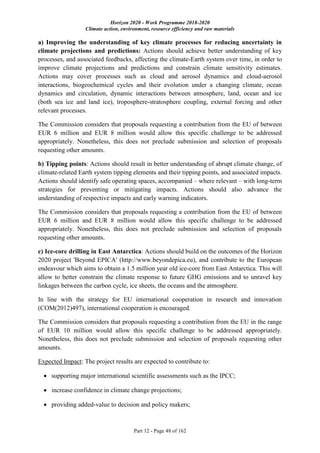
climatological fields (e.g., temperature) associated with extreme events. These techniques
should be capable of discriminating between different variables based on the event type and
capable of handling events at various spatial scales. Particular consideration should also be
given to associated impacts and attribution to climate change. Where appropriate, actions
should take advantage of data provided by the Copernicus programme.
c) Impacts of overshooting:
Understanding how rising global temperature translates to impacts for society and natural
ecosystems is critical in order to prepare for, and strive to reduce, the magnitude of climate
change. While global temperature is a good indicator of global change, local impacts can be
much more pronounced. Actions should assess and report on the impacts associated with
overshooting temperature goals set by the Paris Agreement. Actions should highlight regional
differences in associated impacts and identify possible adaptation measures and solutions.
The Commission considers that proposals requesting a contribution from the EU in the range
of EUR 4-6 million would allow this specific challenge to be addressed appropriately.
Nonetheless, this does not preclude submission and selection of proposals requesting other
amounts. For the evaluation procedure, the following provision applies: at least one proposal
per sub-topic will be funded, provided it passed all thresholds.
Expected Impact: The project results are expected to contribute to:
 enhanced adaptive capacity;
 reduced vulnerability to climate change;
 enhanced action on adaptation;
 strengthened scientific knowledge on climate;
 better informed climate services and decision-making.
Horizon 2020 - Work Programme 2018-2020
Climate action, environment, resource efficiency and raw materials
Part 12 - Page 28 of 162
Type of Action: Research and Innovation action
The conditions related to this topic are provided at the end of this call and in the General
Annexes.
LC-CLA-13-2020: Climate resilience of European coastal cities and settlements
Specific Challenge: Extreme high coastal water levels have increased at most locations along
the European coastline. This increase appears to be predominantly due to increases in baseline
mean local sea level rather than to changes in storm activity (IPCC 5th Assessment Report).
According to recent studies, a 30 cm sea level rise by the end of the 21st century, in the
absence of adaptation measures, would more than triple annual damages from coastal floods
in the EU, from EUR 5 to 17 billion. Robust adaptation measures need to be undertaken in
coastal and low-lying areas to protect them from increasing climate and sea level rise risks,
including coastal erosion. Uncertainty of regional and local projections and lack of sustainable
finance, public-private cooperation and knowledge and evidence-base have prevented
authorities to take appropriate actions to prevent or mitigate coastal disasters. Filling these
knowledge and innovation gaps will allow for the design and implementation of long term
adaptation planning and cost-effective measures within an integrated coastal zone
management (ICZM) framework to enhance the overall resilience of coastal cities23
and
settlements.
Scope: Actions should capitalise on past and current initiatives and knowledge including
associated uncertainty, to improve the integrated spatial planning, management and adaptation
of Europe's coastal cities and settlements. They should provide scientific insight, tools,
methodologies and innovative solutions to assist European coastal cities in developing their
own coastal resilience plans and management and dynamic adaptation pathways (i.e. protect,
accommodate, or retreat options), at spatial and temporal scales most relevant to their specific
needs and context, to address the risks associated to climate change with emphasis to
exposure to sea-level rise, while understanding the cascading effects and impacts on other
sectors (e.g. water, energy, food, land use, etc.). Actions should use state-of-the-art
predictions of the rate and extent of sea-level changes on time scales of years to decades to
identify urban coastal areas at risk of flooding and erosion. The assessment and mapping of
coastal exposure and vulnerability to sea-level rise should also consider low probability high
impact scenarios (H++). Proposals should make use of existing Coastal Risk Assessment
Frameworks, including socio-economic considerations, and informative tools for multi-hazard
assessment.
As part of the proposed work, actions should develop a methodology for a thorough
assessment of the robustness and effectiveness of protective structures measures and
governance structures. They should come up with sound methodologies and guidance for the
elaboration of resilience plans for vulnerable urban areas implementing, as appropriate,
23
For the purposes of this topic, the definition of a 'city' is to be understood according to the harmonised
definition of a city established by the OECD and the European Commission, which can be found at:
http://ec.europa.eu/regional_policy/sources/docgener/focus/2012_01_city.pdf
Horizon 2020 - Work Programme 2018-2020
Climate action, environment, resource efficiency and raw materials
Part 12 - Page 29 of 162
ecosystem-based approaches (e.g., Nature-Based Solutions, landscape planning) along with
hybrid and traditional engineering approaches as part of a broader strategy. This includes the
design of monitoring plans to detect signals for implementation and/or reassessment of the
coastal plan. On the basis of an in-depth literature review and additional studies as
appropriate, comparison of economic, social, cultural and environmental impacts (e.g. costs
and benefits) of ecosystem-based approaches with the ones of traditional technical approaches
should be undertaken, considering security aspects, cost-effectiveness, adaptability to changes
and avoidance of undesirable lock-in effects. Actions should develop tools, methodologies
and guidelines to assist decision making in selecting optimal mix of protection measures
(ecosystem-based, hybrid, and traditional engineering) enhancing resilience for the diverse
coastal contexts in Europe.
Action may include pilot studies comprising "front-runner" cities and territories advanced in
the elaboration and implementation of coastal adaptation and resilience plans mentoring
"follower" cities not so advanced in this process to enhance the potential for replication and
up-taking of the outcomes and hence impact of the action.
Actions should envisage clustering activities with other relevant ongoing and future actions
(e.g., LC-CLA-12-2020), relevant projects funded under previous and current H2020 Work
Programmes for cross-projects co-operation, consultations and joint activities on cross-cutting
issues and share of results as well as participating in joint meetings and communication
events. To this end, proposals should foresee a dedicated work package and /or task and
earmark the appropriate resources accordingly. They should make use and contribute to
knowledge exchange and networking European platforms (e.g. Climate-ADAPT,
ThinkNature, OPPLA).
The Commission considers that proposals requesting a contribution from the EU in the range
of EUR 10 million would allow this specific challenge to be addressed appropriately.
Nonetheless, this does not preclude submission and selection of proposals requesting other
amounts.
Expected Impact: The project results are expected to contribute to:
 improved decision-making on suitable adaptation options and coastal management
strategies, in view of demographic, water supply, climate and land use changes on the
basis of adaptation measures for specific local vulnerabilities, urban contexts and sectors
in Europe and an assessment of coastal ecosystem services, adaptation costs and
benefits,;
 strengthened coastal adaptation network between scientists, engineers, policy-makers,
stakeholders and the general public;
 improved integrated spatial management and adaptation of Europe's coastlines;
Horizon 2020 - Work Programme 2018-2020
Climate action, environment, resource efficiency and raw materials
Part 12 - Page 30 of 162
 the implementation of the Marine Strategy Framework Directive, the Water Framework
Directive, the Flood Directive, the Natura and Habitats Directives and the Biodiversity
Strategy, and EU Climate Change Adaptation Strategy;
 underpinning of Integrated Coastal Zone Management and multi-level governance.
Type of Action: Research and Innovation action
The conditions related to this topic are provided at the end of this call and in the General
Annexes.
LC-CLA-23-2020: Towards a comprehensive European mountain research strategy
Specific Challenge: European mountain regions play a central role for the well-being of many
highly populated European regions for instance for water and energy supply, weather regimes,
recreation and tourism. European mountain regions are home to a high degree of biodiversity,
including many endemic species that occur nowhere else. However, mountain regions are
expected to react far more sensitively to global change than other parts of the world.
Therefore, research on sustainability of these regions is important not only for the population
living there and the many tourists visiting them (e.g. 150 Millions/year for the Alps) but for a
significant part of Europe’s population. European countries operate excellent research
infrastructures in mountain regions and are leading in many fields concerning climate,
ecosystems, life in extreme environments, pollution monitoring and other aspects. Making the
most efficient use of these resources and the latest scientific developments for addressing the
abovementioned challenges, while contributing to climate change mitigation efforts targeted
at this specific ecosystem, requires a high degree of coordination within Europe and beyond.
Hence, a prominent challenge for this topic is to support and coordinate research and
innovation to advance the understanding of current changes in mountain areas derived from
climate changes, the synergies with other human–related forcing, the prediction of potential
changes in these regions, and to foster observations for a sound monitoring of the regions.
Scope: The action should coordinate and support mountain regions research in Europe and
develop a comprehensive European Mountain Research Strategy building on existing
European activities. This strategy should aim to support the development of services
necessary for the adaption to climate change and the improvement and extension of
observations, in particular in-situ ones, for the monitoring of the mountain regions. In line
with Responsible Research and Innovation (RRI), citizens, civil society organisations and
other relevant stakeholders should be involved in the co-design of the research strategy. This
initiative strives for enhanced coordination with international research organisations and
programmes related to mountain regions research (e.g. WMO, ESA, GEO, NEMOR and JPI
'Climate') as well as with relevant operational services including Copernicus. This action
should support the implementation of the EU Strategy for the Alpine Region – EUSALP
(https://www.alpine-region.eu/) and the GEO global Network for Observation and
information in Mountain Environment – GEO-GNOME
(http://earthobservations.org/geoss_wp.php), and take advantage of other regional and
thematic networks initiatives that are being developed in Europe.
Horizon 2020 - Work Programme 2018-2020
Climate action, environment, resource efficiency and raw materials
Part 12 - Page 31 of 162
In line with the strategy for EU international cooperation in research and innovation
(COM(2012)497), international cooperation is encouraged, in particular with countries such
as Canada, China, India, Russia, United States, and Latin American countries.
The Commission considers that proposals requesting a contribution from the EU in the range
of EUR 1.5 million would allow this specific challenge to be addressed appropriately.
Nonetheless, this does not preclude submission and selection of proposals requesting other
amounts.
Expected Impact: The project results are expected to contribute to:
 substantially raising the scale and ambition of inter-disciplinary mountain regions
research policy in Europe;
 improved coherent and efficient use of European resources for mountain research;
 significant extension of the Copernicus and EuroGEOSS services and products to the
mountain regions;
 step change in the domain of open data access, quality control and interoperability for
mountain region monitoring and adapting to climate change.
Type of Action: Coordination and support action
The conditions related to this topic are provided at the end of this call and in the General
Annexes.
Inter-relations between climate change, biodiversity and ecosystem services
Proposals are invited against the following topic(s):
LC-CLA-06-2019: Inter-relations between climate change, biodiversity and ecosystem
services
Specific Challenge: The Paris Agreement notes the importance of taking action to ensure the
integrity of all ecosystems and the protection of biodiversity in the context of combatting
climate change and adapting to its impacts. An improved understanding of the interactions
and feedbacks between ecological processes and climate change, together with evidence-
based guidance, is crucial for the development of appropriate solution-oriented strategies and
measures for biodiversity conservation and cost-effective ecosystems-based climate change
adaptation and mitigation. Furthermore, there are opportunities to let biodiversity and
ecosystems benefit multidimensionally from climate change adaptation and mitigation,
because intelligent climate policy can simultaneously reduce other environmental stresses,
such as air pollution.
Scope: Actions should investigate at all relevant spatial and temporal scales the way that
ecological processes, biodiversity (including terrestrial and/or marine ecosystems as
appropriate) and ecosystem services are impacted, both directly and indirectly, by climate
Horizon 2020 - Work Programme 2018-2020
Climate action, environment, resource efficiency and raw materials
Part 12 - Page 32 of 162
change. Actions should consider the interactions and feedbacks between climate change and
biodiversity, ecosystem functions and services. The vulnerability of biodiversity and
ecosystems functions and services to climate change should be investigated and modelled
across a range of European (including other European territories) climatic and ecological
regions; this includes human activities with relevance to climate change. They should account
for social, ecological and economic aspects and climate change relevant stressors and sources
of uncertainty. These should include tipping points and safe operating spaces. The role of
nature-based solutions24
in enhancing the efficiency and effectiveness of climate change
adaptation and mitigation strategies should be assessed and synergies with other pollution-
reducing environmental policies be explored. Work should build, as appropriate, on existing
knowledge and activities such as relevant FP7/Horizon 2020 and LIFE projects, European
climate adaptation platforms and Copernicus Services, in particular on climate change, land
monitoring and marine environmental monitoring, and contribute to long-term monitoring
initiatives.
Actions should envisage clustering activities with other relevant selected projects for cross-
projects co-operation, consultations and joint activities on cross-cutting issues and share of
results as well as participating in joint meetings and communication events. To this end,
proposals should foresee a dedicated work package and/or task, and earmark the appropriate
resources accordingly.
In line with the strategy for EU international cooperation in research and innovation
(COM(2012)497), international cooperation is encouraged, in particular with CELAC 25
countries.
The Commission considers that proposals requesting a contribution from the EU in the range
of EUR 5 million to 7 million would allow this specific challenge to be addressed
appropriately. Nonetheless, this does not preclude submission and selection of proposals
requesting other amounts.
Expected Impact: The project results are expected to contribute to:
 more effective, integrated and evidence-based biodiversity conservation strategies and
ecosystem management in the face of climate change;
 pushing the EU to the forefront in climate-change predictive capacity through models
better accounting for the interactions and feedbacks between biodiversity, ecosystems
and the climate system;
 more effective ecosystem-based adaptation and mitigation, through evidence-based
design and implementation of systemic nature-based solutions ;
 enhanced ecosystem integrity, functionality, resilience and delivery of services;
24
A definition is provided in the introductory text of this Work Programme
25
Community of Latin American and Caribbean States
Horizon 2020 - Work Programme 2018-2020
Climate action, environment, resource efficiency and raw materials
Part 12 - Page 33 of 162
 increased investment in nature-based solutions, and ecosystem conservation, restoration
and management, to support climate change adaptation and mitigation strategies;
 providing evidence on the impacts of biodiversity on climate mitigation and adaptation,
including indicators/quantitative data;
 underpinning the EU Nature Directives, EU Biodiversity Strategy, 7th Environment
Action Programme, and the EU Strategy on adaptation to climate change;
 informing major international scientific assessments such as the IPCC reports and the
IPBES;
 the protection, restoration and enhancement of natural capital in line with the work of the
Convention on Biological Diversity (CBD), the Intergovernmental science-policy
Platform on Biodiversity and Ecosystem Services (IPBES), the Intergovernmental Panel
on Climate Change (IPCC) and further relevant global processes and organisations.
Type of Action: Research and Innovation action
The conditions related to this topic are provided at the end of this call and in the General
Annexes.
LC-CLA-09-2019: ERA-NET Cofund action on biodiversity and climate change:
Impacts, feedbacks, and nature-based solutions for climate change adaptation and
mitigation
Specific Challenge: Climate change is predicted to pose the greatest long-term threat to
biodiversity in many regions. It is affecting the habitats of many species, which must either
adapt or migrate to areas with more favourable conditions. Biodiversity changes can have
knock-on effects upon a range of ecosystem functions and services, including food and
biomass production and capacity to mitigate and adapt to climate change. Feedback processes
may amplify or diminish the effect of climate forcing, and so play an important part in
determining the climate sensitivity to human activities and the future climate state.
Addressing the impact of climate change requires the mobilisation of all relevant actors:
academia, research institutes, public authorities at various levels, manufacturing industry and
business at large, finance and insurance, non-governmental organisations and civil society. A
properly aligned European Research Area, which is also open to the world, can make an
essential difference in enabling a transformative, climate-resilient sustainability agenda to
take shape. The alignment of research and innovation agendas is therefore crucial in bringing
about the necessary transformations.
Scope: The Cofund action should examine: the impact of climate change on all levels of
biodiversity, ecosystem functioning and ecosystem services; feedback processes; the potential
of nature-based solutions for enhancing climate change adaptation, mitigation, including
negative emissions; and synergies and trade-offs between different policies, including those
on biodiversity, climate action and air quality. The action should capitalize on major strands
Horizon 2020 - Work Programme 2018-2020
Climate action, environment, resource efficiency and raw materials
Part 12 - Page 34 of 162
of knowledge and on the results of relevant projects funded under past EU Framework
Programmes. The Cofund action will target all types of terrestrial, freshwater and marine
environments, which may also include the impact of climate change on biodiversity and
ecosystem functioning and services in agricultural areas and taking agricultural and forestry
policies into account.
The Cofund action should be implemented through close cooperation between the Member
States and Associated Countries grouped around the BiodivERsA network and in
collaboration with the FACCE JPI. The Cofund action should envisage clustering activities
with other relevant selected projects for cross-projects co-operation, consultations and joint
activities on cross-cutting issues and share of results as well as participating in joint meetings
and communication events. To this end, proposals should foresee a dedicated work package
and/or task, and earmark the appropriate resources accordingly. The Cofund action should
also take into account data and information from the Copernicus programme, as the European
Union's Earth Observation Programme.
Proposals should pool the necessary financial resources from the participating national (or
regional) research programmes with a view to implementing a joint call for proposals
resulting in grants to third parties with EU co-funding in this area. Proposers are requested to
include at least one additional joint call without EU co-funding as well as other activities such
as the establishment or consolidation of a pan-European network of funding agencies and
other key players in Europe, building on previous experience and avoiding overlaps with
existing initiatives, support to mutual learning and training, exchange of good practice,
researcher mobility and equal opportunities (e.g. through EURAXESS) and better careers in
the field. Wherever relevant, actions should involve social sciences and humanities.
Participation of legal entities from third countries, and/or regions including those not
automatically eligible for funding in accordance with General Annex A, is encouraged in the
joint call as well as in other joint activities including additional joint calls without EU co-
funding. Participants from countries not listed in General Annex A are eligible for EU funding
under this topic and may request a Union contribution (on the basis of the ERA-NET unit
cost) only for the coordination costs of additional activities. The proposal should demonstrate
that these co-funded other activities exclude any overlaps with related on-going actions co-
funded by the EU under Horizon 2020.
The Commission considers that proposals requesting a contribution from the EU in the range
of EUR 5 million would allow this specific challenge to be addressed appropriately.
Nonetheless, this does not preclude submission and selection of proposals requesting other
amounts.
Expected Impact: The project results are expected to contribute to:
 effective trans-national, pan-European research networking and synergies among
national/regional and EU research programmes in the areas addressed;
Horizon 2020 - Work Programme 2018-2020
Climate action, environment, resource efficiency and raw materials
Part 12 - Page 35 of 162
 improved evidence-based policy through the interdisciplinary and trans-disciplinary
science-policy interface and links with international efforts and fora on the areas
addressed;
 underpinning the EU Nature Directives, EU Water and Marine Strategy Framework
Directive, EU Biodiversity Strategy, 7th Environment Action Programme, and the EU
Strategy on adaptation to climate change;
 informing major international scientific assessments such as the Intergovernmental
science-policy Platform on Biodiversity and Ecosystem Services (IPBES) and the
Intergovernmental Panel on Climate Change (IPCC) reports and contributing to the goals
of the Paris Agreement;
 the protection, restoration and enhancement of natural capital in line with the work of the
Convention on Biological Diversity (CBD), the IPBES, the IPCC and further relevant
global processes and organisations.
Type of Action: ERA-NET Cofund
The conditions related to this topic are provided at the end of this call and in the General
Annexes.
LC-CLA-14-2020: Understanding climate-water-energy-food nexus and streamlining
water-related policies
Specific Challenge: Water, energy and food are essential for human well-being, poverty
reduction and sustainable development. Projections suggest that the demand for freshwater,
energy and food will be on the rise due to, amongst other factors, demographic changes,
economic development, and international trade. This puts in jeopardy the availability of these
resources for different uses. Climate change exacerbates water demands, putting additional
pressures on water availability and quality, including biodiversity, while at the same time
causing extreme events (floods /droughts) that have severe socioeconomic and environmental
consequences. Actions to mitigate and adapt to climate change and variability can have strong
implications for the surface and ground water system and its users, for example, when fossil
fuels are replaced by hydropower or biofuels. Moreover, changes in energy usage and types of
energy production affect water usage and impact agricultural production. All these pressures
result in conflicts in allocation of water and between the water – energy – food sectors, which
causes additional concerns for the sustainable management of surface and ground water
bodies, especially the transboundary ones, where a very large proportion of world's population
is living. However, despite this, the strong linkages between water, climate, energy and food
are seldom understood and rarely incorporated in the development of national and regional
water, food and energy security policies or climate policies. Therefore there is a need to better
align water-related or water-dependent policies looking in a systemic way from the natural
climate-water-energy-food nexus perspective at various geographical scales, and taking into
account economic, political and societal aspects.
Horizon 2020 - Work Programme 2018-2020
Climate action, environment, resource efficiency and raw materials
Part 12 - Page 36 of 162
Scope: The objective of this action is to develop and test innovative solutions, improved
operations and integrated management and planning for achieving water, energy and food
security and safety within the planetary boundaries and resolve conflicts between upstream
and downstream water users and citizens. Proposals should assess the interlinkages and
interdependencies of water, food and energy sectors and ecosystems in different water bodies,
in particular transboundary ones. Climatic, environmental, land-use, social and economic
trends and governance regimes in the water and these interlinked sectors should be also
considered.
Proposals should also identify, develop, demonstrate and test innovative, multi-beneficial
solutions that can best deliver good water status, in terms of quantity and quality, sustainable
food and energy security, enhance human wellbeing and resolve conflicts between different
users and different sectors. New integrated policies, governance mechanisms, learning and
communication tools that can deliver good water status, sustainable food and energy security,
taking into consideration the trade-offs between the 3 sectors, should be also developed.
Sustainability criteria to be considered include full climate-change mitigation effects based on
full carbon accounts, impacts on biodiversity and ecosystems, conservation of fertile soils and
other biophysical impacts along with socioeconomic equity and justice criteria.
Mechanisms and tools that support common evidence, build and enhance trust between the
different stakeholders and allow them to jointly address the trade-offs and identify win-win
strategies, should be also addressed. This could include innovative monitoring schemes,
demand forecasting, socio-economic assessments, scenario planning, behavioural change
(including a gender analysis, when relevant), using social science approaches and financial
levers to implement a real water- energy-food nexus approach and increase efficiencies,
equity and sustainability.
This action should also address climate impacts on integrated water management, that is,
implications for drought risk, water scarcity, drinking water availability and quality, food
production and security and energy production and how the vulnerability of water resources
can be reduced. Case studies over different geographical regions and challenges to facilitate
tailored analyses and test the developed solutions should be considered. Actions to generate
and analyse the relevant data required to assess the nexus interlinkages and trade-offs and
ensure their long-term availability in the context of relevant EU data infrastructures should be
also considered.
Participation of a broad range of different stakeholders around water, energy and food
security strategies, including policy makers will be essential.
In line with the strategy for EU international cooperation in research and innovation
(COM(2012)497), international cooperation is encouraged. Proposals should avoid
duplication with ongoing EU funded research and innovation actions, while strengthening
potential synergies. Activities are expected to achieve TLR 5 by the end of the project.
The Commission considers that proposals requesting a contribution from the EU in the range
of EUR 4-5 million would allow this specific challenge to be addressed appropriately.
Horizon 2020 - Work Programme 2018-2020
Climate action, environment, resource efficiency and raw materials
Part 12 - Page 37 of 162
Nonetheless, this does not preclude submission and selection of proposals requesting other
amounts.
Expected Impact: The project results are expected to contribute to:
 more accurate evaluations of future demands for water, energy, food and related
infrastructures at both local and global scales, taking also into consideration the
ecosystem needs
 enhance sharing knowledge and best practices in climate-water-energy-food nexus
assessment and management and help create critical mass on capacity to innovate;
 improve integrated water resources management and increase resilience to climate
change, considering the value of water for ecosystems and their services and ensuring
good quantitative and qualitative status of water, sustainable agriculture, food and
energy production, as well as water, food and energy security;
 help linking EU water policy objectives with the sustainable objectives of greening the
CAP and ensuring sustainability and quality of water resources and resource and energy
efficiency policy objectives, achieving for instance, zero energy and minimal water use
for renewable energy extraction from water, and net zero carbon emissions by 2050 to
hit a 1.5-degree warming target, enabling the combination of water and energy
efficiency;
 assess the impacts of EU regulatory framework (e.g. Renewable Energy Directive) on a
sustainable water-energy-food nexus;
 reduce institutional fragmentation whilst increase cross water, energy, food collaboration
and inclusive multi-stakeholder engagement;
 reduce the water risks for the energy sector and optimise market and trade solutions
across the nexus;
 strengthen EU role in international water issues, and become a leading actor on water
diplomacy.
Type of Action: Research and Innovation action
The conditions related to this topic are provided at the end of this call and in the General
Annexes.
LC-CLA-15-2020: Forest Fires risk reduction: towards an integrated fire management
approach in the E.U.
Specific Challenge: Forest fires are a major hazard in Mediterranean Europe and increasingly
so in Central, Eastern and Northern European countries. There is a limit in our capacity to
deter fires, particularly mega-fires when conditions are most severe. This is the result of
unbalanced management strategies and policies that can be effective in fire suppression under
Horizon 2020 - Work Programme 2018-2020
Climate action, environment, resource efficiency and raw materials
Part 12 - Page 38 of 162
normal weather conditions but are insufficient to deal with extreme events such as mega-fires.
Areas at risk from forest fires are projected to increase by 200% in Europe by the end of the
21st century, in particular due to climate change. Moreover, the development of urban areas in
the vicinity of forest areas combined with a lack of risk awareness will increase the exposure
and vulnerability of local communities. This new context calls for more effective science-
based fire management and risk-informed decision-making, which takes into account the
socio-economic, climate and environmental roots of forest fires. Improving fire management
and governance therefore implies shifting the focus from fire suppression to fire prevention,
increasing the awareness and preparedness of people at risk, and developing more balanced
and long term forest management strategies that integrate fire prevention with forestry and
land management (including conservation of habitats structures, resources and diversity),
rural development, urban development, climate and energy policy objectives. An integrated
fire management strategy is necessary to ensure that wildfires risks are managed in such a
way that people and housing safety, economic growth, well-being, carbon sinks, biodiversity
and ecosystem services are maintained or increased.
Scope: Actions should generate the knowledge, tools, capacity and guidance to underpin an
Integrated Fire Management strategy that promotes holistic landscape, land use, and forest
management and considers the interaction among all phases of the wildfire management
process (i.e. fire prevention and preparedness, fire detection and response, post-fire restoration
and adaptation).
Proposals should assess the changes in fire regimes under various climate, vegetation and land
use change scenarios, including settlement/housing development/infrastructure and rural-
urban interface, with particular focus on ignition and fuel patterns, spatial and temporal
dimensions of fire activity, including the expansion of the fire-prone area in Europe.
Understanding extreme wildfire events, their structural causes, various impacts including on
air quality, water quality, soil carbon and nitrogen stocks and greenhouse gas emissions, and
the human, biological and physical processes at play is a prerequisite. The trade-offs and
synergies between the various socio-economic, climate, and environmental elements
influencing forest fires risk management and conditions of enhanced risk should be explored
and analysed, particularly in wildland/rural interface areas. Methods to assess and mitigate
vulnerability of societies to wildfires should also be developed. In addition, the relation of
forest fires with other hazards that may trigger or result from fire (e.g., droughts, floods,
debris flows, landslides, heatwaves and storms) should be investigated within a multi-hazard
risk assessment framework.
Proposals should capitalise on the existing and develop new scientific knowledge (e.g. fire
ecology, soil and water science, landscape restoration, social sciences), enhance
understanding of the resistance, resilience and habitat suitability of mixtures of plant species,
as well as the human factors (considering human behaviour, gender, economics and socio-
demographic issues) affecting fire occurrence and develop strategic guidance for improved
forest fire risk management and risk-informed decision-making.
Horizon 2020 - Work Programme 2018-2020
Climate action, environment, resource efficiency and raw materials
Part 12 - Page 39 of 162
Participatory approaches with national agencies and competent institutional bodies dealing
with wildfire management and protection and land management are required. Actions should
also promote increased interaction and strengthened cooperation between scientists,
practitioners, forest and land owners and other key stakeholders. To ensure wide accessibility
and use, they should also facilitate an inclusive approach in developing land management
strategies through involving local communities in the design and planning of innovative fire
prevention measures, strengthening the forest sector and promoting bio-economy and nature
based solutions as well as in the co-design and co-production of research and corresponding
outcomes.
In this context, actions are sought to develop and implement effective communication and
societal outreach strategies to increase the awareness and preparedness of populations at risk
towards a common culture of risk and more disaster-resilient communities. The outcomes
should be made available through open access platforms (i.e. the Disaster Risk Management
Centre, the European Forest Fires Information System). Actions should take advantage of data
and information provided by the Copernicus programme, in particular the Copernicus
Emergency Service.
Possibilities for clustering with actions supported under topic LC-CLA-12b-2020, LC-CLA-
16b-2020, SC7 DRS-02 and other relevant ongoing and future nature-based solutions, LIFE
and Civil Protection relevant projects should be envisaged, as appropriate, for cross-project
co-operation, consultations and joint activities on cross-cutting issues and knowledge
exchange as well as participating in joint meetings and communication events. To this end,
proposals should foresee a dedicated work package and /or task and earmark the appropriate
resources accordingly.
Collaboration with leading research institutions with experience in extreme wildfires
management such as in Australia, Canada, South Africa, the United States and other non-EU
countries is highly encouraged.
The Commission considers that proposals requesting a contribution from the EU in the range
of EUR 10 million would allow this specific challenge to be addressed appropriately.
Nonetheless, this does not preclude submission and selection of proposals requesting other
amounts.
Expected Impact: The project results are expected to contribute to:
 National Forest Fires Risk reduction strategies and risk-informed decision-making
emerging from collaboration with key stakeholders, in compliance with the policy
objectives set out in the EU Forest Strategy and relevant EU policies;
 improved coherence between EU policies’ objectives and national legislative
frameworks defining the structural measures and operational activities regarding forest
and communities protection from fire;
 more disaster-resilient communities through increased awareness and preparedness of
populations at risk and a common culture of risk;
Horizon 2020 - Work Programme 2018-2020
Climate action, environment, resource efficiency and raw materials
Part 12 - Page 40 of 162
 increased knowledge exchange, sharing and access through the Disaster Risk
Management Knowledge Centre, the European Forest Fires Information System and
other open access platforms;
 innovation, harmonisation and exchange on methods of consistently recording and
measuring wildfires and coherent collection of data;
 common framework for forest fire (wildfire) firefighting modules, training, exercises,
incident management and command.
Type of Action: Research and Innovation action
The conditions related to this topic are provided at the end of this call and in the General
Annexes.
LC-CLA-16-2020: Multi-hazard risk management for risk-informed decision-making in
the E.U.
Specific Challenge: Risks due to natural hazards have increased dramatically in Europe, due
to deep changes in climate, land use and socio-economic evolution since the 20th century.
Improved disaster risk management and reduction requires an integrated approach to better
forecast, prevent and adapt to multiple hazards, their interactions and impacts. Innovative and
comprehensive methodologies, models and tools that assess multi-hazard risks and associated
cascading effects and take due account of future drivers (such as climate change), have the
potential to represent the leverage to help risk managers and decision-makers prioritise
mitigation/adaptation actions, resilient preparedness and response, and develop sustainable
and resilient development pathways.
Scope: Actions are encouraged to capitalise on and assess existing methodologies, models and
tools for disaster risk management available at EU and national levels in order to define a
common framework for risk and vulnerability assessments for areas exposed to multiple
natural hazards. Based on the diagnosis of multi-hazards and multi-risk assessments,
innovative decision-making tools that help planners to make effective and future proofed risk
management choices need to be developed (e.g., dynamic adaptation pathways to address
future and emerging threats). Sustainable adaptation options including ecosystem-based
approaches such as Nature-Based Solutions – that are cost-effective and provide multiple co-
benefits should be prioritised where appropriate.
Research actions should aim to develop a harmonized and standardised multi-hazard risk
management approach in order to compare the threats and combined effects posed by several
natural hazards (geological, hydrological, meteorological and biological), including hazards
from compounded events, and evaluate the risks related to their interactions and
cascade/simultaneous effects on the socio-ecological systems. A forward looking perspective,
paying due attention to future trends and drivers (such as climate change) should be ensured.
In this perspective, quantitative scenarios on present and future risks, on potential direct and
indirect effects, in a multi risk environment need further developments. In order to be more
Horizon 2020 - Work Programme 2018-2020
Climate action, environment, resource efficiency and raw materials
Part 12 - Page 41 of 162
operational, such a framework should be developed in close cooperation and dialogue
between science and practice with the key actors and end-users to take into account their
needs in the scientific development of multi hazard/multi risk assessment methods and enable
feasible solutions for more practical use.
In light of the above, actions should also seek to develop mapping tools and user-friendly ICT
open interfaces to better understand the model scenarios and outputs. Emphasis on systemic
vulnerability of different sectors exposed to multi-hazard risk (e.g. agriculture, forests and
other economic sectors, land use, infrastructure, ecosystems) will require particular attention
in building the risk analysis. Similarly, uncertainty should be more consistently addressed to
provide reliable estimates of vulnerability and risks. Action should take advantage of data and
information provided by the Copernicus programme, in particular the Copernicus Emergency
Service, and the European Research Infrastructure Consortiums (ERIC) such as the European
Plate Observing System (EPOS) and the European Multidisciplinary Seafloor and Water
Column Observatory (EMSO). Actions should also build upon and seek collaboration with
the projects funded under the relevant SC7 DRS topics.
The Commission considers that proposals requesting a contribution from the EU in the range
of EUR 3-5 million would allow this specific challenge to be addressed appropriately.
Nonetheless, this does not preclude submission and selection of proposals requesting other
amounts.
Expected Impact: The project results are expected to contribute to:
 a consensus in better definitions, indicators and functions to characterise multi-hazard
risk through enhanced inter-disciplinary collaboration between the different science and
practice communities addressing various types of hazards, disaster risk and sustainable
development;
 prioritisation of investments and pertinent selection of effective risk reduction
management options;
 enhanced capacity for identification of vulnerable, threatened areas and infrastructures
most at risk from multi hazards in Europe;
 better informed forward-looking national risk assessments that also take into account
long-term drivers such as climate change, and enhanced implementation of existing
legislation and streamlining of policies;
 enhanced risk-informed decisions on land-use planning addressing trade-offs between
differing prioritized adaptation options and competing policy goals;
 enhanced understanding of the relationships and interactions of multiple hazard,
including compound events and cascading risks and risk related processes driven by
environmental and societal changes on different time and spatial scales;
Horizon 2020 - Work Programme 2018-2020
Climate action, environment, resource efficiency and raw materials
Part 12 - Page 42 of 162
 better knowledge exchange through platforms such as Disaster Risk Management
Knowledge Centre, and stakeholder networks on emergent risks and extreme events
(e.g., Community of Users, Risk Knowledge-Action Network).
Type of Action: Research and Innovation action
The conditions related to this topic are provided at the end of this call and in the General
Annexes.
The Cryosphere
Proposals are invited against the following topic(s):
LC-CLA-07-2019: The changing cryosphere: uncertainties, risks and opportunities
Specific Challenge: Globally, glaciers and the large ice sheets of Antarctica and Greenland
are particularly vulnerable to climate change, risking a significant future contribution to
changes in sea levels. At present, there are significant uncertainties, e.g. relating to their
stability, which prevent an accurate assessment of their vulnerability. The 'Arctic
amplification' of global warming is putting pressure on the ecosystems and communities of
the region and having an impact at global level as well. The Arctic's fragile natural
ecosystems and societies are under serious threat, and additional human activities, linked to
the new economic opportunities that are made possible by climate change, are putting
additional pressure on them.
Scope: Actions should aim at developing innovative approaches to address only one of the
following sub-topics:
a) Sea-level changes (Research and Innovation action): Actions should assess the
processes controlling changes to global ice mass balance - including ice dynamics - such as
ice shelf-ocean and sea-ice interactions, surface components, effects of crustal de-loading
(Glacial Isostatic Adjustments) on relative sea-level changes and/or gravitational effects of ice
mass changes on the spatial patterns of sea-level changes. Actions should assess the status of
ice sheets and glaciers, report on how their changes are likely to affect future sea-levels, and
increase confidence in predicting changes in the cryosphere including through better
representation of poorly represented processes. Actions should also analyse low-probability
high-impact scenarios including those associated with the collapse of ice sheets (sea-level
fingerprints). Actions may be focused on specific issues which substantially contribute to sea-
level changes and to the assessment of the associated major risks to and impacts on coastal
communities, coastal ecosystems and critical infrastructure across the globe. Clustering with
relevant projects funded by the ESA Earth Observation Programme is encouraged.
The Commission considers that proposals requesting a contribution from the EU in the range
of EUR 8 to EUR 10 million would allow this specific challenge to be addressed
appropriately. Nonetheless, this does not preclude submission and selection of proposals
requesting other amounts.
Horizon 2020 - Work Programme 2018-2020
Climate action, environment, resource efficiency and raw materials
Part 12 - Page 43 of 162
b) Changes in Arctic biodiversity (Research and Innovation action): Actions should
identify and analyse major drivers and implications of changing biodiversity in the Arctic,
such as the role of invasive species, and how vulnerable land and/or marine ecosystems are
with respect to combined human and natural influences. Actions should assess the
ecosystems' responses to both external and internal factors and how these responses are
impacting on indigenous populations and local communities at socio-economic level. Actions
should also identify adaptation strategies in relation to the changes in Arctic ecosystems.
The participation of social sciences and humanities disciplines is important for addressing the
complex challenges of this topic.
The Commission considers that proposals requesting a contribution from the EU in the range
of EUR 5 to EUR 6 million would allow this specific challenge to be addressed appropriately.
Nonetheless, this does not preclude submission and selection of proposals requesting other
amounts.
c) Sustainable opportunities in a changing Arctic (Research and Innovation action):
Actions should assess the viability of new economic activities – such as resource exploitation,
shipping and tourism – and their ecological and socio-economic impacts and feedbacks at
various scales, and their impact on the provision of ecosystem services. Actions should
investigate key processes with high societal and economic impacts and provide appropriate,
solution-oriented adaptation and mitigation responses, as well as capacity building for
sustainable livelihoods while considering – in a co-design approach – the needs, priorities and
perspectives of indigenous populations, local communities and economic actors operating in
the region.
The participation of social sciences and humanities disciplines is essential for addressing the
complex challenges of this topic.
The Commission considers that proposals requesting a contribution from the EU in the range
of EUR 5 to EUR 6 million would allow this specific challenge to be addressed appropriately.
Nonetheless, this does not preclude submission and selection of proposals requesting other
amounts.
d) Arctic standards (Coordination and Support action): The action should propose
guidelines and protocols to develop ‘Arctic standards’, also including the legal framework,
based on the translation of research outcomes into cold-climate technologies and services with
commercial potential and the assessment of the sustainability of associated processes and
technologies. The action should cover a wide range of technologies and services that have the
potential to bring broad social and economic benefits within and beyond the Arctic region.
The action should also provide requirements on how to design, build, install, and operate
equipment and services to safely perform activities in the Arctic and to respond to
emergencies.
The participation of standardisation organisations is encouraged.
Horizon 2020 - Work Programme 2018-2020
Climate action, environment, resource efficiency and raw materials
Part 12 - Page 44 of 162
The Commission considers that proposals requesting a contribution from the EU in the range
of EUR 2 million would allow this specific challenge to be addressed appropriately.
Nonetheless, this does not preclude submission and selection of proposals requesting other
amounts.
For all of the above sub-topics, in line with the strategy for EU international cooperation in
research and innovation (COM(2012)497), international cooperation is encouraged 26
, in
particular with countries – beyond the EU Member States and countries associated to Horizon
2020 – that took part in the first Arctic Science Ministerial of 28 September 201627
.
Expected Impact: For projects addressing parts a), b) or c), the project results are expected to
contribute to:
 the implementation of the new integrated EU policy for the Arctic28
;
 the IPCC assessments and other major regional and global initiatives;
 enhanced engagement of and the interaction with residents from local communities and
indigenous societies.
 support the EU Arctic Research Cluster29
For projects addressing part d), the project results are expected to contribute to:
 enhanced stakeholder capability to operate in cold climate environments;
 better servicing of the economic sectors that operate in the Arctic (e.g. shipping,
tourism);
 promoting sustainable Arctic opportunities arising from climate change and supporting
the leverage of regional (EU) funds into these opportunities;
 supporting the competitiveness of European industry, particularly SMEs, engaging in
sustainable development of the Arctic.
Type of Action: Coordination and support action, Research and Innovation action
The conditions related to this topic are provided at the end of this call and in the General
Annexes.
26
Proposals should pay attention to the special call conditions for this topic.
27
i.e. the United States of America, Canada, the People’s Republic of China, Japan, the Russian
Federation, South Korea, New Zealand, India, Singapore, and Greenland; see
https://www.arctic.gov/publications/other/supporting_arctic_science.html
28
JOIN(2016) 21 final
29
http://www.eu-polarnet.eu/eu-arctic-cluster/
Horizon 2020 - Work Programme 2018-2020
Climate action, environment, resource efficiency and raw materials
Part 12 - Page 45 of 162
LC-CLA-17-2020: Polar climate: understanding the polar processes in a global context
in the Arctic and Antarctic Regions
Specific Challenge: Many of the natural physical processes occurring in the polar atmosphere
and oceans are potentially of profound significance in controlling conditions across the globe
and affecting lives and livelihoods across the world, in the Polar, sub-Polar, temperate, and
tropical regions. Understanding the interacting nature and feedback of polar processes and
addressing their consequences in a global context will benefit the people, policy and
businesses well beyond the Polar Regions.
Scope: Proposals should aim at developing innovative approaches, building on existing data
resources and infrastructures, the latest observational products (including in-situ
observations), and state-of-the-art climate models, to assess the key physical and chemical
processes in the ocean and atmosphere and the key ocean-atmosphere-ice interactions.
Proposals should cooperate with relevant projects funded by the ESA Earth Observation
Programme. In addition, they are encouraged to join the EU Arctic Cluster in order to build
synergies and maximise the complementarity of the different actions in the Cluster. Proposals
should build upon previous actions funded under Horizon 2020 and avoid duplication or
overlap.
In line with the strategy for EU international cooperation in research and innovation
(COM(2012)497), international cooperation is encouraged, in particular with countries –
beyond the EU Member States and countries associated to Horizon 2020 – that took part in
the Arctic Science Ministerial meetings of 28 September 2016 and 25-26 October 201830
.
The Commission considers that proposals requesting a contribution from the EU in the range
of EUR 7-8 million would allow this specific challenge to be addressed appropriately.
Nonetheless, this does not preclude submission and selection of proposals requesting other
amounts.
Expected Impact: The project results are expected to contribute to:
 improved understanding of how the changing polar climate systems affect and are
affected by lower latitudes through ocean and atmospheric circulation;
 improved understanding of the key ocean-atmosphere-ice interactions;
 improved understanding of the fully coupled physical climate system (atmosphere-
ocean-ice) on diverse space and time scales;
 improved understanding of the key physical and chemical processes in the ocean and in
the atmosphere;
30
i.e. the United States of America, Canada, the People’s Republic of China, Japan, the Russian
Federation, South Korea, New Zealand, India, Singapore, and Greenland; see
https://www.arcticscienceministerial.org/en/
Horizon 2020 - Work Programme 2018-2020
Climate action, environment, resource efficiency and raw materials
Part 12 - Page 46 of 162
 improved projections of future polar and global climate, including feedbacks and
impacts
 improved capability to respond to the impact of climatic change on the environment and
human activities in the Polar Regions (with a focus on the Arctic), both in the short and
longer term;
 the IPCC scientific assessments, the consolidation phase of the Year Of Polar Prediction
(YOPP) and to the Copernicus Climate Change (C3S) services.
 supporting the assessment of regional climate impacts.
Type of Action: Research and Innovation action
The conditions related to this topic are provided at the end of this call and in the General
Annexes.
LC-CLA-21-2020: Coordination of European Polar research
Specific Challenge: The EU is a major investor and player in Polar research. The EU also
supports the development and the international access to research infrastructures (terrestrial
research stations, remote and in-situ observing systems, research aircrafts and vessels, etc.)
throughout the Polar Regions, with relevant international scientific cooperation activities with
non-EU countries. Previous actions proved to be instrumental in providing the needed support
and the high degree of coordination within the European landscape and beyond.
Scope: Proposals should provide a platform to co-develop the strategies to advance and
further coordinate the European Polar Research action and its contribution to the policy-
making processes. This should include the prioritisation of research areas during
transdisciplinary workshops, strategies for capacity building related to meaningful stakeholder
involvement, allocation of seed money for the preparation of pre-studies and interaction with
national funding agencies on ways of building synergies and optimising the use of resources.
Proposals should cooperate with the relevant services of the European Commission and
provide evidence-based policy advice. A special focus should be placed on supporting the
implementation of sustained observation systems in the Arctic and Antarctic by setting up a
European coordination office and by identifying measures to sustain it beyond the termination
of the project. The office should also coordinate and support the contributions of the EU and
the Associated Countries to International Arctic Science Committee (IASC), Sustaining
Arctic Observing Networks (SAON), Scientific Committee on Antarctic Research (SCAR)
and Southern Ocean Observing System (SOOS). Proposals should coordinate the EU Arctic
Research Cluster ensuring a good cooperation between the projects in areas such as
communication, dissemination, and stakeholder engagement. Proposals should build upon the
previous action funded under Horizon 2020 and avoid duplications or overlaps.
The Commission considers that proposals requesting a contribution from the EU in the range
of EUR 3 million would allow this specific challenge to be addressed appropriately.
Horizon 2020 - Work Programme 2018-2020
Climate action, environment, resource efficiency and raw materials
Part 12 - Page 47 of 162
Nonetheless, this does not preclude submission and selection of proposals requesting other
amounts.
Expected Impact: The project results are expected to contribute to:
 substantially advance Polar research cooperation in Europe by creating a Polar European
Research Area;
 a more synergetic use of European resources;
 the policy advice at regional, national and EU level and to the support of the EU's
international commitments with respect to the Arctic Council, the Montreal protocol, the
UNFCCC and others related to polar sciences, such as the Antarctic Treaty System
(ATS);
 improved cooperation of international polar research programmes and create the basis
for the development of future large-scale joint international polar initiatives;
 the support of international scientific cooperation initiatives of the European
Commission such as the G7 Future of the Seas and Oceans initiative, Galway Statement,
the Belèm Statement and of the Administrative Arrangement on marine research
between the European Commission and Argentina.
Type of Action: Coordination and support action
The conditions related to this topic are provided at the end of this call and in the General
Annexes.
Knowledge gaps
Proposals are invited against the following topic(s):
LC-CLA-08-2018: Addressing knowledge gaps in climate science, in support of IPCC
reports
Specific Challenge: Better understanding of the key processes controlling the climate-Earth
system is fundamental in order to further improve climate projections, reduce uncertainty in
climate sensitivity calculations, enhance understanding of frequency and strength of extreme
weather events, and assess more accurately the impacts of climate change related to the
proximity, rate, reversibility and tipping points of abrupt climate change, and the
identification of safe operating spaces. Furthermore, future climate scenarios strongly benefit
from the combined use of models and paleo-reconstructions conducted in Polar Regions as
they allow a better understanding of how the climate system worked, both regionally and
globally, during abrupt climatic transitions and under warmer or colder than present day
conditions.
Scope: Actions should address only one of the following sub-topics:
Horizon 2020 - Work Programme 2018-2020
Climate action, environment, resource efficiency and raw materials
Part 12 - Page 48 of 162
a) Improving the understanding of key climate processes for reducing uncertainty in
climate projections and predictions: Actions should achieve better understanding of key
processes, and associated feedbacks, affecting the climate-Earth system over time, in order to
improve climate projections and predictions and constrain climate sensitivity estimates.
Actions may cover processes such as cloud and aerosol dynamics and cloud-aerosol
interactions, biogeochemical cycles and their evolution under a changing climate, ocean
dynamics and circulation, dynamic interactions between atmosphere, land, ocean and ice
(both sea ice and land ice), troposphere-stratosphere coupling, external forcing and other
relevant processes.
The Commission considers that proposals requesting a contribution from the EU of between
EUR 6 million and EUR 8 million would allow this specific challenge to be addressed
appropriately. Nonetheless, this does not preclude submission and selection of proposals
requesting other amounts.
b) Tipping points: Actions should result in better understanding of abrupt climate change, of
climate-related Earth system tipping elements and their tipping points, and associated impacts.
Actions should identify safe operating spaces, accompanied – where relevant – with long-term
strategies for preventing or mitigating impacts. Actions should also advance the
understanding of respective impacts and early warning indicators.
The Commission considers that proposals requesting a contribution from the EU of between
EUR 6 million and EUR 8 million would allow this specific challenge to be addressed
appropriately. Nonetheless, this does not preclude submission and selection of proposals
requesting other amounts.
c) Ice-core drilling in East Antarctica: Actions should build on the outcomes of the Horizon
2020 project 'Beyond EPICA' (http://www.beyondepica.eu), and contribute to the European
endeavour which aims to obtain a 1.5 million year old ice-core from East Antarctica. This will
allow to better constrain the climate response to future GHG emissions and to unravel key
linkages between the carbon cycle, ice sheets, the oceans and the atmosphere.
In line with the strategy for EU international cooperation in research and innovation
(COM(2012)497), international cooperation is encouraged.
The Commission considers that proposals requesting a contribution from the EU in the range
of EUR 10 million would allow this specific challenge to be addressed appropriately.
Nonetheless, this does not preclude submission and selection of proposals requesting other
amounts.
Expected Impact: The project results are expected to contribute to:
 supporting major international scientific assessments such as the IPCC;
 increase confidence in climate change projections;
 providing added-value to decision and policy makers;
Horizon 2020 - Work Programme 2018-2020
Climate action, environment, resource efficiency and raw materials
Part 12 - Page 49 of 162
 sustaining Europe's leadership in climate science.
Type of Action: Research and Innovation action
The conditions related to this topic are provided at the end of this call and in the General
Annexes.
LC-CLA-18-2020: Developing the next generation of Earth System Models
Specific Challenge: Earth System Models (ESMs) are essential tools for supporting climate
policy-making and the Paris Agreement implementation. Ensembles of scenario-based runs
are widely used for designing and evaluating mitigation pathways and goals. However,
notwithstanding the increase in their performance, ESMs still have several areas of
improvement around predicting capability, process realism, capacity of resolving epistemic
uncertainty, needs of parametrisation, reduction in systematic biases, time and resolution.
Following-up a long-lasting tradition of various EU Framework Programmes to provide
substantial support for ESM development, it is time to re-launch the challenge to address the
competing demands around the development of ESMs.
Scope: Actions should address in a novel way one or more of the competing demands that
surround the advancement of ESMs (e.g., improved process realism, large ensemble of
predictions, improved model resolution, etc.). Actions should aim to develop innovative and
effective approaches that add to or better represent Earth system processes linked to climate
change. Actions should further explore novel ways of coupling existing models (e.g., ice-
sheet dynamics) with ESMs and where appropriate, improve synergies with reduced
complexity carbon-cycle, atmospheric composition and climate models. Actions are
encouraged to explore linkages with relevant integrated assessment models. Actions may also
devise new data assimilation methods that will demonstrably improve ESMs.
The Commission considers that proposals requesting a contribution from the EU in the range
of EUR 10-12 million would allow this specific challenge to be addressed appropriately.
Nonetheless, this does not preclude submission and selection of proposals requesting other
amounts.
Please note that this topic is part of the lump sum funding pilot scheme. Funding for grants
awarded under this topic will take the form of lump sums as defined in Commission Decision
C(2017)7151 of 27 October 201731
. Details of the lump sum funding pilot scheme are
published on the Funding and Tender Portal 32
together with the specific Model Grant
Agreement for Lump Sums33
applicable.
Expected Impact: The project results are expected to contribute to:
31
http://ec.europa.eu/research/participants/data/ref/h2020/other/legal/lump_sum/lumpsumdecision-2017-
7151_en.pdf
32
http://ec.europa.eu/research/participants/docs/h2020-funding-guide/grants/applying-for-funding/find-a-
call/what-you-need-to-know_en.htm
33
http://ec.europa.eu/research/participants/data/ref/h2020/mga/lumpsum/h2020-mga-lumpsum-pilot-
multi_en.pdf
Horizon 2020 - Work Programme 2018-2020
Climate action, environment, resource efficiency and raw materials
Part 12 - Page 50 of 162
 improved models for the provision of climate services;
 increased confidence in climate projections;
 sustaining European leadership in climate science and Earth System Modelling;
 supporting the operationalisation of the Paris Agreement with a view to delivering
effective climate action;
 informing major international scientific assessment reports (e.g. IPCC).
Type of Action: Research and Innovation action Lump Sum
The conditions related to this topic are provided at the end of this call and in the General
Annexes.
LC-CLA-22-2020: Enhancing the Belmont Forum Collaborative Research Action on
Climate, Environment and Health
Specific Challenge: The EU is a major investor and player in both climate change and health
research. The EU also supports global research and innovation collaboration, including that
done by the Belmont Forum - a partnership of funding organisations, international science
councils, and consortia committed to the advancement of interdisciplinary and
transdisciplinary science. Bringing together climate change and health research has been a
particular challenge in Europe that requires coordination and support. Previous similar actions
proved to be instrumental in providing the necessary support and the high degree of
coordination within the European landscape and beyond.
Scope: Actions should develop and provide support mechanisms to advance and further boost
the global added value of the Belmont Forum’s Collaborative Research Action (CRA) on
Climate, Environment and Health and its inputs to the relevant EU policy-making processes.
This should include the promotion and prioritisation of research and innovation areas during
transdisciplinary conferences, meetings and workshops, capacity building related to relevant
stakeholder involvement, cross-fertilisation activities amongst Belmont Forum, EU- funded
and relevant nationally funded projects, synthesis of their results, with a particular focus on
policy making, such as knowledge based policy briefs, dissemination, communication and
outreach.
Cooperation with relevant existing projects under Societal Challenge 1 and 5 of Horizon
2020, including relevant ongoing Coordination and Support Actions, is encouraged.
Actions should also provide support to a knowledge management platform of EU funded
research and innovation on the linkages between health and climate, support the Belmont
Forum Members, partners and secretariat, in relation to this CRA and support the organisation
of an international conference on climate change and health.
Cooperation with the relevant services, expert groups and mechanisms of the European
Commission will be required to provide evidence-based policy advice, and report on the CRA
Horizon 2020 - Work Programme 2018-2020
Climate action, environment, resource efficiency and raw materials
Part 12 - Page 51 of 162
results and synthesis of their findings. Actions should also build upon EU research and
innovation framework programmes and avoid duplication and overlaps.
The Commission considers that proposals requesting a contribution from the EU in the range
of EUR 3 million would allow this specific challenge to be addressed appropriately.
Nonetheless, this does not preclude submission and selection of proposals requesting other
amounts.
Expected Impact: The project results are expected to:
 contribute to policy advice on climate change and health at international and EU level
and supporting the EU's international commitments with respect to the Paris Agreement,
UNFCCC and others related to climate change and health sciences;
 bolstering a network of projects funded under the CRA call with relevant EU-funded
projects addressing climate, environment and health;
 better flow of information and knowledge dissemination on climate change, environment
and health to low and medium income countries;
 raising global awareness of climate impacts on human, plant and animal health.
Type of Action: Coordination and support action
The conditions related to this topic are provided at the end of this call and in the General
Annexes.
Earth Observation
Proposals are invited against the following topic(s):
LC-CLA-19-2020: Integrated GEOSS climate applications to support adaptation and
mitigation measures of the Paris Agreement
Specific Challenge: Timely and reliable Earth observation data and information on the state of
our changing climate and environment are indispensable to support the EU in its international
commitment on climate change. In particular, the Paris Agreement accentuates the need for
new, transparent, integrated solutions to better understand the Earth system, minimise and
address climate change contributors and impacts, support accountability towards long-term
goals and inform climate services and decision making. Developing integrated solutions
tailored to needs in Europe will depend on the European capability to combine multiple Earth
observation (EO) data sets - including GEOSS and Copernicus data sets - with ensemble
modelling, socio-economic and in-situ data at the spatial and temporal scales at which
interactions in the land, marine and atmosphere ecosystems operate.
Scope: Actions should focus on developing applications in support of users involved in the
implementation of climate adaptation and mitigation actions in line with the Paris Agreement,
by integrating a whole range of Earth Observation data including those recorded through in-
Horizon 2020 - Work Programme 2018-2020
Climate action, environment, resource efficiency and raw materials
Part 12 - Page 52 of 162
situ observing systems, and Essential Climate Variables (ECVs). The actions will seek to use
higher spatial and/or temporal data sets while also taking advantage of a broader open data
access and new data mining technologies. In addition, the actions should advance
methodologies for integrating resulting data flows with multiple GEOSS data sets (from EO
satellites to in-situ data including citizen data where appropriate), numerical model outputs
and other relevant statistical and socio-economic data. Ultimately, integrated applications
should concentrate on climate adaptation applications with estimated societal impact, on
impact of GHG emissions or related indicators (such as land cover changes), or feed new
indicators for the monitoring of progress towards the Sustainable Development Goals (SDGs)
in an EU context. Special attention should be given to multi-scale approaches with abilities to
scale up and down from European to local scales.
The actions should make use of, contribute to and feedback on the GEOSS platform which
provides international user communities with tools for discovery, visualisation and access to
GEOSS data. The actions should actively contribute to relevant GEO Tasks of the GEO Work
Programme. It should contribute to the development of user-driven climate applications to be
delivered through the EuroGEOSS initiative. They should promote open science and underpin
the work of the IPCC through the enlarged provision of in-situ data and of further analyses of
ECVs. Applications resulting from the actions should complement relevant Copernicus core
services (e.g. Climate Change Service - C3S, Land Monitoring, etc.) and address well
identified end user needs in Europe. When relevant, actions should align with the European
Space Agency (ESA) programmes34
.
The Commission considers that proposals requesting a contribution from the EU in the range
of EUR 4-5 million would allow this specific challenge to be addressed appropriately.
Nonetheless, this does not preclude submission and selection of proposals requesting other
amounts.
Expected Impact: The project results are expected to contribute to:
 the direct support of the adaptation and mitigation measures of the Paris Agreement, as
well as the other GEO engagement priorities such as the Agenda for Sustainable
Development, and the Sendai Framework for Disaster Risk Reduction 2015-2030;
 the European input to the GEO Work Programme post-2019 to address the climate
change challenge cross-cutting all GEO Societal Benefit Areas (SBA) (e.g. for improved
land use management);
 increasing European capability to combine multiple EO data sets with models, socio-
economic and in-situ data, based on a systematic exploitation of the GEOSS Platform ;
34
https://www.esa.int/Our_Activities/Observing_the_Earth/The_Living_Planet_Programme/ES
A_s_Living_Planet_Programme ;
https://eo4society.esa.int/
Horizon 2020 - Work Programme 2018-2020
Climate action, environment, resource efficiency and raw materials
Part 12 - Page 53 of 162
 reinforcing in-situ component of European observing systems for the monitoring of
internationally recognised Essential Climate Variables (ECVs);
 the new EuroGEOSS pilot applications to better understand climate change contributors
and impacts, and minimise the degradation of the Earth system, support accountability
towards long-term goals and inform climate services and decision making.
Type of Action: Research and Innovation action
The conditions related to this topic are provided at the end of this call and in the General
Annexes.
LC-CLA-20-2020: Supporting the implementation of GEOSS in the Arctic in
collaboration with Copernicus
Specific Challenge: In order to gain more insight in the fast rate of climate, ecological and
environmental change taking place in the Arctic and to facilitate well-informed decisions,
there is a need to develop coordinated Earth observations and information services
specifically targeting this region, also building on the essential contribution of indigenous
knowledge and community-based monitoring systems. These observations and services need
to be delivered in order to support a sustainable development in the Arctic, particularly for
responding to the needs of the people who live there. Observations and services are also
necessary to improve the monitoring and predicting capabilities on changes that may affect
other parts of the planet, and in particular the Northern hemisphere. The challenge and
suitable actions to alleviate adverse consequences were identified in the 2nd
Arctic Science
Ministerial Joint Statement of Ministers.35
Scope: The action should aim at: (i) advancing the operationalisation of an integrated pan-
Arctic Observing System in preparation for a possible future ArcticGEOSS initiative; (ii)
improving and extending the terrestrial, marine and cryospheric in-situ measurements and the
community-based monitoring systems necessary for the monitoring of the Arctic; (iii) setting
up pilot services and implementing the coordinated network of those services necessary for
the adaptation to climate change in the region; (iv) contributing to the interoperability of
Arctic Data systems; and (v) to make a positive contribution to national, regional and
international decision-making processes and science strategies.
The action should help to build an Arctic “window”36
of Copernicus by bringing together all
Arctic relevant observations deriving from different Copernicus services and promoting
access to relevant Copernicus datasets.
The action should coordinate with projects stemming from the NSFs Arctic portfolio, such as
the "Navigating the New Arctic" programme, and other actions of the Transatlantic Ocean
Research Alliance, by establishing joint operational activities, in order to support the mission
35
Joint Statement of Ministers, 2nd
Arctic Science Ministerial, Berlin 2018,
https://www.arcticscienceministerial.org/files/ASM2_Joint_Statement.pdf
36
https://www.copernicus.eu/en/copernicus-services-information-and-sentinel-products-arctic-region
Horizon 2020 - Work Programme 2018-2020
Climate action, environment, resource efficiency and raw materials
Part 12 - Page 54 of 162
and objectives of the international initiative on Arctic observations brought forward by the
Sustaining Arctic Observing Networks (SAON).
In line with the strategy for EU international cooperation in research and innovation
(COM(2012)497), international cooperation is encouraged, in particular with the countries
and Indigenous Peoples organisations participating in the 2nd Arctic Science Ministerial37
.
The action should build on the outcomes of previous EU-funded projects in the framework of
GEO and Copernicus, create synergies and avoiding un-necessary duplications also by joining
the EU Arctic Research Cluster. Likewise, the action should cooperate with relevant projects
funded by the ESA Earth Observation Programme. To this end, proposals should foresee a
dedicated work package and /or task and earmark the appropriate resources accordingly.
The pilot services should fall into the scope of EuroGEOSS and follow the direction of the
EuroGEOSS initiative. Data and services produced through the projects should be registered
in the GEOSS Common Infrastructure (GCI).
The Commission considers that proposals requesting a contribution from the EU in the range
of EUR 15 million would allow this specific challenge to be addressed appropriately.
Nonetheless, this does not preclude submission and selection of proposals requesting other
amounts.
Expected Impact: The project results are expected to contribute to:
 the implementations the GEO-Cold Region Initiative with a specific emphasis on the
Arctic, and the initiating of an ArcticGEOSS initiative;
 sound and effective decision-making by policy makers in the Arctic regions through the
use of reliable and science-based Earth observation and information;
 supporting of the 2030 Agenda for Sustainable Development, the Paris Agreement and
Sendai Framework for Disaster Risk Reduction 2015-2030;
 strengthening Earth observation capacity focused on the European region;
 delivering EuroGEOSS services for the Arctic;
 improved handling, archiving and interoperability of environmental data in polar
regions;
 a coherent data management, through the use of GEOSS Data Management Principles
and best practices (aligning with INSPIRE).
Type of Action: Research and Innovation action
37
i.e. the United States of America, Canada, the People’s Republic of China, Japan, the Russian
Federation, South Korea, New Zealand, India, Singapore, and Greenland; see
https://www.arcticscienceministerial.org/en/
Horizon 2020 - Work Programme 2018-2020
Climate action, environment, resource efficiency and raw materials
Part 12 - Page 55 of 162
The conditions related to this topic are provided at the end of this call and in the General
Annexes.
Conditions for the Call - Building a low-carbon, climate resilient future: climate action
in support of the Paris Agreement
Opening date(s), deadline(s), indicative budget(s):38
Topics (Type of Action) Budgets (EUR million) Deadlines
2018 2019 2020
Opening: 07 Nov 2017
LC-CLA-01-2018 (RIA) 25.00 27 Feb 2018 (First Stage)
04 Sep 2018 (Second
Stage)
LC-CLA-03-2018 (RIA) 20.00
LC-CLA-04-2018 (RIA) 18.00
LC-CLA-08-2018 (RIA) 60.00
Opening: 14 Nov 2018
LC-CLA-07-2019 (CSA) 2.00 19 Feb 2019
LC-CLA-09-2019 (ERA-NET-
Cofund)
5.00
LC-CLA-02-2019 (RIA) 22.00 19 Feb 2019 (First Stage)
04 Sep 2019 (Second
Stage)
LC-CLA-05-2019 (RIA) 23.00
LC-CLA-06-2019 (RIA) 25.00
LC-CLA-07-2019 (RIA) 39.00
Opening: 12 Nov 2019
LC-CLA-21-2020 (CSA) 3.00 13 Feb 2020
LC-CLA-22-2020 (CSA) 3.00
LC-CLA-23-2020 (CSA) 1.50
38
The Director-General responsible for the call may decide to open the call up to one month prior to or
after the envisaged date(s) of opening.
The Director-General responsible may delay the deadline(s) by up to two months.
All deadlines are at 17.00.00 Brussels local time.
The budget amounts for the 2020 budget are subject to the availability of the appropriations provided
for in the draft budget for 2020 after the adoption of the budget 2020 by the budgetary authority or, if
the budget is not adopted, as provided for in the system of provisional twelfths.
Horizon 2020 - Work Programme 2018-2020
Climate action, environment, resource efficiency and raw materials
Part 12 - Page 56 of 162
LC-CLA-10-2020 (RIA) 25.00 13 Feb 2020 (First Stage)
03 Sep 2020 (Second
Stage)
LC-CLA-11-2020 (IA) 30.00
LC-CLA-12-2020 (RIA) 22.00
LC-CLA-13-2020 (RIA) 15.00
LC-CLA-14-2020 (RIA) 13.00
LC-CLA-15-2020 (RIA) 10.00
LC-CLA-16-2020 (RIA) 5.00
LC-CLA-17-2020 (RIA) 15.00
LC-CLA-18-2020 (RIA-LS) 22.00
LC-CLA-19-2020 (RIA) 10.00
LC-CLA-20-2020 (RIA) 15.00
Overall indicative budget 123.00 116.00 189.50
Indicative timetable for evaluation and grant agreement signature:
For single stage procedure:
 Information on the outcome of the evaluation: Maximum 5 months from the final date
for submission; and
 Indicative date for the signing of grant agreements: Maximum 8 months from the final
date for submission.
For two stage procedure:
 Information on the outcome of the evaluation: Maximum 3 months from the final date
for submission for the first stage and maximum 5 months from the final date for
submission for the second stage; and
 Indicative date for the signing of grant agreements: Maximum 8 months from the final
date for submission of the second stage.
Exceptional funding rates:
LC-CLA-11-2020 In grants awarded under this topic, costs for construction and
installation of “infrastructure-targeted” interventions shall not
constitute more than 20% of the total eligible costs.
Beneficiaries’ own resources and/or mobilisation and leverage of
additional investments beyond Horizon 2020, whether private or
Horizon 2020 - Work Programme 2018-2020
Climate action, environment, resource efficiency and raw materials
Part 12 - Page 57 of 162
public, should make up the remaining investment costs and
should secure economic and financial sustainability for the
execution of the project39
.
Eligibility and admissibility conditions: The conditions are described in General Annexes B
and C of the work programme. The following exceptions apply:
LC-CLA-04-2018 Proposals must cover at least 3 historic areas from different
Member States or Associated Countries and cover natural and
climate change related hazards of relevance to different regions
of Europe.
LC-CLA-05-2019 Due to the specific challenge of this topic, in addition to the
minimum number of participants set out in the General Annexes,
proposals addressing sub-topic a) shall include at least three
participants from at least two different African countries.
LC-CLA-07-2019 Due to the specific challenge of this topic, in addition to the
minimum number of participants set out in the General Annexes,
proposals should include at least two participants from third
countries.
LC-CLA-11-2020 To ensure coverage of environmental, geographic, socio-
economic and cultural diversity across the EU, consortia must
comprise at least 4 cities situated in different Member States or
Associated Countries that are committed to implement the
proposed innovative actions/schemes during the project and to
assess their impacts and cost-efficiency in addressing air
pollution and climate change mitigation
Evaluation criteria, scoring and threshold: The criteria, scoring and threshold are described in
General Annex H of the work programme.
Evaluation Procedure: The procedure for setting a priority order for proposals with the same
score is given in General Annex H of the work programme.
The full evaluation procedure is described in the relevant guide published on the Funding &
Tenders Portal.
Grant Conditions:
LC-CLA-11-2020 Grants awarded under this topic will be subject to the following
39
Additional information on "infrastructure-targeted" costs is available at the "Frequently Asked
Questions" section of the Funding & Tenders Portal (https://ec.europa.eu/info/funding-
tenders/opportunities/portal/screen/support/faq).
Horizon 2020 - Work Programme 2018-2020
Climate action, environment, resource efficiency and raw materials
Part 12 - Page 58 of 162
additional dissemination obligations: the funded projects must
upload their final data on established networks and information
sharing mechanisms at European scale such as Oppla, the
European Environment Agency (EEA) air pollution data centre
and Climate-ADAPT. Applicants must acknowledge and
integrate these obligations in their proposal. The respective
option of Article 29.1 of the Model Grant Agreement will be
applied.
LC-CLA-18-2020 For grants awarded under this topic, funding will take the form
of lump sums as defined in Commission Decision C(2017)7151
of 27 October 2017. Details of the lump sum funding pilot
scheme are published on the Funding and Tender Portal together
with the specific Model Grant Agreement for Lump Sums
applicable.
Consortium agreement:
LC-CLA-01-2018, LC-
CLA-02-2019, LC-
CLA-03-2018, LC-
CLA-04-2018, LC-
CLA-05-2019, LC-
CLA-06-2019, LC-
CLA-07-2019, LC-
CLA-08-2018, LC-
CLA-10-2020, LC-
CLA-11-2020, LC-
CLA-12-2020, LC-
CLA-13-2020, LC-
CLA-14-2020, LC-
CLA-15-2020, LC-
CLA-16-2020, LC-
CLA-17-2020, LC-
CLA-18-2020, LC-
CLA-19-2020, LC-
CLA-20-2020, LC-
CLA-21-2020, LC-
CLA-22-2020, LC-
CLA-23-2020
Members of consortium are required to conclude a consortium
agreement, in principle prior to the signature of the grant
agreement.
Horizon 2020 - Work Programme 2018-2020
Climate action, environment, resource efficiency and raw materials
Part 12 - Page 59 of 162
Call - Greening the economy in line with the Sustainable Development
Goals (SDGs)
H2020-SC5-2018-2019-2020
This call focuses on moving to a greener, more resource efficient and climate-resilient
economy in sync with the natural environment, demonstrating a strong commitment to
supporting the UN's Sustainable Development Goals (SDGs).
Connecting economic and environmental gains - the circular economy
Further development of a sustainable, resource efficient and competitive economy will require
a transition to a more circular economic model with products, processes, services and business
models that are designed to maintain the value and utility of materials and resources in the
economy for as long as possible. The circular economy solutions should combine a strong
environmental rationale with a convincing business logic.
Actions in this part of the call aim in the medium term to substantially improve the efficiency
of resource use (including energy and water), to minimise the production of waste and
increase the use of resources originating from secondary sources – while avoiding adverse
health effects – and to reduce pollution and greenhouse gas emissions. They intend to
elucidate the role of design in product durability, enhance the capacity of cities to embrace
circular economy approaches and support the transition to systemic, integrated solutions
closing the cycles of resource use in the water sector. They will contribute to implementing
the Circular Economy Action Plan 40
and key high-level EU priorities, including those
addressing jobs, growth and investment, climate and energy, and a strengthened industrial
base. Ultimately, they are expected to support Europe's endeavours to implement the
Sustainable Development Goals (SDGs), particularly SDG 12 'Responsible consumption and
production', SDG 6 'Ensure availability and sustainable management of water and sanitation
for all', SDG 11 'Sustainable cities and communities' and SDG 13 'Take urgent action to
combat climate change and its impacts' (and the goals of the Paris Agreement on climate
change), together with the Habitat III New Urban Agenda.
The topics in this part of the call contribute to the focus area 'Connecting economic and
environmental gains - the circular economy'.
It should be noted that a number of topics (with "CE-" in the topic identifier) in the 'Raw
Materials' section of this call also contribute to the circular economy.
One of the priorities of the Work Programme 2020 will be to support the implementation of
some of the research aspects identified in the European Strategy for Plastics in a Circular
Economy41
], the Bioeconomy Strategy42
, the Integrated Maritime Policy43
, and the European
40
COM(2015) 614 final
41
https://eur-lex.europa.eu/legal-content/EN/TXT/?qid=1516265440535&uri=COM:2018:28:FIN
42
https://ec.europa.eu/research/bioeconomy/index.cfm?pg=policy&lib=strategy
Horizon 2020 - Work Programme 2018-2020
Climate action, environment, resource efficiency and raw materials
Part 12 - Page 60 of 162
Strategy for Marine and Maritime Research44
. This priority will be implemented through
several topics covered by different Societal Challenges and the Leadership in Enabling and
Industrial Technologies (LEIT) pillar45
.
These topics promote a multi-disciplinary approach involving various research fields, such as
environmental technology and sciences, ocean sciences, bio-medical sciences, materials
science and nanotechnologies, exposure science, analytical chemistry, biotechnology, food
sciences, business model and product design, systems thinking and behavioural sciences.
They aim to enhance the understanding of the drivers and impact of plastic pollution,
including pathways and fate of macro-, micro- and nanoplastics in the marine and terrestrial
environments, to strengthen the means to reduce the plastic burden in the environment and to
improve the design, production, use and reuse of materials and products. Taking a multi-
faceted approach to address an issue crossing many regulatory boundaries and being of
interest to the general public, this priority intends to strengthen the area of plastics research
as a bridge to future activities.
Selected projects under these topics supporting the Plastics Strategy are strongly encouraged
to participate in joint activities as appropriate, as indicated under the relevant topic text.
Contribution to the call ‘Competitive, Low Carbon and Circular Industries’
In 2020, the Societal Challenge 5 contributes the following circular economy topic to the call
‘Competitive, Low Carbon and Circular Industries’ (call identifier H2020-LOW-CARBON-
CIRCULAR-INDUSTRIES-2020), included in the work programme Annex ‘Cross-cutting
activities’:
CE-SC5-31-2020 - Develop, implement and assess a circular economy oriented product
information management system for complex products from cradle to cradle (IA)
Proposals are invited against the following topic(s):
43
https://ec.europa.eu/maritimeaffairs/policy_en; and http://ec.europa.eu/environment/marine/good-
environmental-status/index_en.htm
44
https://eur-lex.europa.eu/legal-content/EN/TXT/?uri=LEGISSUM%3Ari0008
45
SC1-BHC-36-2020 - Micro- and nano-plastics in our environment: Understanding exposures and
impacts on human health (Health, Demographic Change and Wellbeing, SC1); Emerging challenges for
soil management (Food Security, Sustainable Agriculture and Forestry, Marine and Maritime and
Inland Water Research, and The Bioeconomy, SC2), BG-07 C: Technologies for ocean observations,
observations for marine litter and microlitter (SC2); Oceans Innovation Pilot for the Blue Economy
(SC2); Towards healthy and plastics free oceans, seas and rivers (SC2); FNR-06-2020: Supporting the
food safety systems of the future (SC2); CE-SC5-24-2020: Improving the sorting, separation and
recycling of composite and multi-layer materials (Climate Action, Environment, Resource Efficiency
and Raw Materials, SC5); CE-SC5-28-2020: Develop and pilot circular systems in plastics, textiles and
furniture sectors (SC 5); CE-SC5-25-2020: Understanding the transition to a circular economy and its
implications on the environment, economy and society (SC 5); CE-SC5-29-2020: A common European
framework to harmonise procedures for plastics monitoring and assessments (SC5); CE-SC5-30-2020:
Plastics in the environment: understanding the sources, transport and distribution of plastics pollution
(SC5); CE-BIOTEC-09-2020: Upcycling bio plastics of food and drinks packaging (LEIT).
Horizon 2020 - Work Programme 2018-2020
Climate action, environment, resource efficiency and raw materials
Part 12 - Page 61 of 162
CE-SC5-01-2018: Methods to remove hazardous substances and contaminants from
secondary raw materials
Specific Challenge: Reuse and recycling of many secondary raw materials continues to be low
in the EU, while landfill and incineration rates remain high. The uptake and recyclability of
secondary raw materials can be hampered by the presence of undesirable contaminants,
additives and even substances of concern. The removal of such undesirable substances could
improve the purity of the resulting secondary raw material and mitigate potential health and
environmental concerns. In addition, the removal of these substances could increase the range
of potential recycling and reuse applications for the secondary raw materials.
Scope: Actions should develop innovative solutions for removing undesirable substances
from secondary raw materials. The substances in question could be those posing health or
environmental risks and/or those whose presence could adversely affect the quality of the
secondary raw material. The safe utilisation or disposal of substances thus removed should be
addressed as well. Proposals are expected to provide evidence of the potential market impact
that the proposed solutions could bring, including quantitative information on the size of the
targeted market. The economic feasibility and overall environmental performance of the
proposed solution should also be considered. The work should also produce recommendations
on the design and manufacturing of materials for recyclability and for standardisation. Actions
should be tackled by a multidisciplinary consortium, with significant participation of industry
partners and recyclers. Participation of SMEs is desirable. Activities are expected to achieve
TRL 5-6 by the end of the project.
The Commission considers that proposals requesting a contribution from the EU of between
EUR 3 million and EUR 5 million would allow this specific challenge to be addressed
appropriately. Nonetheless, this does not preclude submission and selection of proposals
requesting other amounts.
Expected Impact: The project results are expected to contribute to:
 increased purity and/or desirable quality of secondary raw materials;
 an increased recycling rate for, and reduced landfill and incineration of, secondary raw
materials;
 reduced risk of retaining hazardous substances in recycled materials, where relevant;
 the implementation of the EU Circular Economy Action Plan and the 7th Environment
Action Programme;
 the Commission Strategy on Plastics in a Circular Economy46
and to the implementation
of the SPIRE PPP Roadmap, where relevant.
Type of Action: Research and Innovation action
46
Communication (COM2018) 28 final:A European Strategy for Plastics in a Circular Economy
Horizon 2020 - Work Programme 2018-2020
Climate action, environment, resource efficiency and raw materials
Part 12 - Page 62 of 162
The conditions related to this topic are provided at the end of this call and in the General
Annexes.
CE-SC5-02-2018: Independent testing programme on premature obsolescence
Specific Challenge: Given resource constrains, lengthening the lifetime of products can play a
major role in moving towards a circular economy. However, products may be designed in a
way that adversely affects their lifetime or prevents upgradability. Identification of the factors
that cause such premature obsolescence is also important because making products more
durable and easier to repair, upgrade or remanufacture can represent a key factor of
competitiveness. A longer lifetime for products has the potential to generate new economic
activities and offer societal and environmental benefits, while at the same time spurring on
innovation in existing business models. An action under Horizon 2020 to prepare an
independent testing programme addressing product durability is included in the EU Action
Plan for the Circular Economy47
.
Scope: The objective is to prepare an independent testing programme to help identify issues
related to premature obsolescence. The programme could be used by relevant stakeholders,
such as, for instance, testing bodies, consumer organisations or product designers. It should
focus on a group of consumer products for which the issue of obsolescence, including aspects
such as the possibility of repair, upgrade and reuse, is important from the resource efficiency
point of view. The methodology used to select this group of products should be convincingly
explained. Where the issue of product durability encompasses interoperability and software
support aspects, these should be addressed as well; however, the lifetime of software should
not be the sole focus of the actions. A research component should be included to identify key
aspects to be tested and to validate the testing programme in several case studies. An
arrangement should be made that would enable inputs (e.g. examples of premature
obsolescence or of testing methods) from a variety of stakeholders throughout the course of
the project. Possible implications for standardisation should be addressed. The actions should
be tackled by a multi-disciplinary consortium, including representatives of relevant
stakeholders such as researchers, consumer organisations, testing bodies, manufacturers and
repair service providers. Participation of representatives from the retail sector is encouraged.
The Commission considers that proposals requesting a contribution from the EU of between
EUR 3 million and EUR 5 million would allow this specific challenge to be addressed
appropriately. Nonetheless, this does not preclude submission and selection of proposals
requesting other amounts.
Expected Impact: The project results are expected to contribute to:
 development of products designed for durability, interoperability, repair and reuse;
 development of markets based on durability;
 reduced materials consumption and waste generation;
47
http://eur-lex.europa.eu/legal-content/EN/TXT/?uri=CELEX%3A52015DC0614
Horizon 2020 - Work Programme 2018-2020
Climate action, environment, resource efficiency and raw materials
Part 12 - Page 63 of 162
 reduced information asymmetry between producers and consumers regarding product
durability;
 increased awareness and understanding of the types of design that may lead to premature
obsolescence;
 the implementation of the EU Circular Economy Action Plan.
Type of Action: Research and Innovation action
The conditions related to this topic are provided at the end of this call and in the General
Annexes.
CE-SC5-03-2018: Demonstrating systemic urban development for circular and
regenerative cities
Specific Challenge: Cities struggle in their transition to implement a full circular economy
model incorporating regenerative practices. There is a clear need for cities to become circular
in order to alter urban consumption patterns and value chains, and to stimulate innovation,
business opportunities, and job creation in both established and newly created sectors. New,
more flexible systemic urban planning instruments enabling the design and implementation of
circular urban processes would make urban and peri-urban areas regenerative and facilitate
their adaptation to emerging economic, social and environmental challenges.
Scope: Actions should demonstrate how cities48
can be transformed into centres of circular
innovation and stimulate regenerative practices in both urban and peri-urban areas (including
the surrounding industrial areas and commercial ports).
Actions should develop and implement innovative urban planning approaches and instruments
(e.g. dynamic and semantic 3D real time flexible geospatial data and planning tools,
innovative governance and legislation enabling new practices, design approaches, business
models, etc.) to support and guide the transition towards circular and regenerative cities in
terms of their built environment, public space, urban spatial use and programming. They
should demonstrate innovative solutions for closing the loop of urban material and resource
flows within the nexus of water, energy, food, air, ecosystem services, soil, biomass,
waste/wastewater, recyclables and materials and for supporting an increase in the regenerative
capacity of the city while limiting pollution of the environment, for example by reducing the
emissions of air pollutants. At the same time, these solutions should ensure sound
management of trade-offs and synergies among and across sectors. They should include ways
of sustainably reusing and (mixed-use) reprogramming of existing buildings, open spaces and
(infra)structures. The action should actively involve public authorities, societal stakeholders
and community-based partners such as city-makers, urban (fab-) labs, urban planners, (urban)
48
For the purposes of this topic, the definition of a 'city' is to be understood according to the harmonised
definition of a city established by the OECD and the European Commission, which can be found at:
http://ec.europa.eu/regional_policy/sources/docgener/focus/2012_01_city.pdf
Horizon 2020 - Work Programme 2018-2020
Climate action, environment, resource efficiency and raw materials
Part 12 - Page 64 of 162
designers, cultural & creative organisations, and start-ups in close collaboration with the cities
to find practical and durable solutions.
In addition actions should develop and implement innovative local governance structures and
networks to enhance circular economy innovation in the urban fabric and help prioritise
flexible implementation of urban space programming for circular initiatives. Actions should
enable the continuous monitoring and optimisation of “urban metabolic” processes and rapid
management interventions, where needed, deploying new indicators enabling easy
assessment, comparison and sharing of best practice on the ground as well as digital solutions
comprising networks of sensors, big data, geo-localisation, observational programmes such as
Copernicus and GEOSS, satellite navigation and positioning services offered by
EGNOS/Galileo, and citizens’ observatories.
Actions are expected to establish long-term sustainable data platforms securing open,
consistent data on the impacts of the deployed approaches, and to ensure interoperability of
relevant data infrastructures for effective communication, public consultation, and exchange
of experiences.
An interdisciplinary approach, including the participation of applied natural sciences, social
sciences and humanities disciplines (such as behavioural economics, gender studies, urban
planning and governance) is considered crucial to properly address the complex challenges of
this topic.
Proposals should pay attention to the special call conditions for this topic. In grants awarded
under this topic, costs for construction and installation of “infrastructure-targeted”
interventions shall not constitute more than 20% of the total eligible costs. Beneficiaries’ own
resources and/or mobilisation and leverage of additional investments beyond Horizon 2020,
whether private or public, should make up the remaining investment costs and should secure
economic and financial sustainability for the execution of the project.
To enhance the impact and promote upscaling and replication of these solutions, actions
should engage in substantial networking and training activities to disseminate their
experience, knowledge and deployment practices to cities that are planning to design and
implement similar solutions in a successive phase beyond the duration of the project. To
enhance impact, cooperation and synergies with the activities undertaken within the Global
Covenant of Mayors for Climate and Energy initiative, and in particular the regional
component for Europe49
(supported by the EC) should be sought where appropriate.
Furthermore, actions should envisage resources for clustering with other ongoing and future
projects on sustainable cities through nature-based solutions funded under the 'Smart and
Sustainable Cities' call in part 17 of the 2016-2017 Work Programme as well as under the
topics SC5-20-2019 and SC5-14-2019 of this Work Programme. They should also ensure that
there will be no duplication with work undertaken by relevant projects funded under the topic
49
www.covenantofmayors.eu
Horizon 2020 - Work Programme 2018-2020
Climate action, environment, resource efficiency and raw materials
Part 12 - Page 65 of 162
'CO-CREATION-02-2016 - User-driven innovation: value creation through design-enabled
innovation'.
The Commission considers that proposals requesting a contribution from the EU in the range
of EUR 10 million would allow this specific challenge to be addressed appropriately.
Nonetheless, this does not preclude submission and selection of proposals requesting other
amounts.
Expected Impact: The project results are expected to contribute to:
 measurable reduction of materials, natural resource consumption and environmental
footprint in urban and peri-urban areas;
 measurable increase of the regenerative capacity of urban and peri-urban areas due to a
measurable increase in material and natural resource creation in cities, as well as
increased productivity through maximisation of (multi)-functional use and programming
of urban spaces;
 set of social behavioural, economic, environmental performance and geospatial
indicators to monitor and assess the urban and peri-urban circularity and regenerative
capacity;
 local governance innovation in response to the needs and concerns of stakeholders and
the affected public as well as boosted creativity and entrepreneurship related to
circularity and regenerative processes;
 the implementation of the EU Circular Economy Action Plan with a direct link to the
urban fabric (built and public space), and the Habitat III New Urban Agenda's
commitment to transition to a circular economy.
Type of Action: Innovation action
The conditions related to this topic are provided at the end of this call and in the General
Annexes.
CE-SC5-04-2019: Building a water-smart economy and society
Specific Challenge: There is a growing demand for water from various economic activities
and increasing stress on natural water sources. To secure water for our society, there is
therefore a need to make available alternative water resources of various qualities and which
are appropriate for different functions and multiple users, and to better exploit water resources
and all the valuable substances that could be obtained through the wastewater treatment and
reuse process. However, innovations in this domain remain fragmented and/or only
experimented at small scales; testing and deployment in operational environments and at
scales suitable for encouraging wider uptake is still missing.
Scope: Actions should demonstrate the feasibility of a 'water smart' economy and society in
which all available water resources, including surface, groundwater, waste water, and process
Horizon 2020 - Work Programme 2018-2020
Climate action, environment, resource efficiency and raw materials
Part 12 - Page 66 of 162
water, are managed in such a way as to avoid water scarcity and pollution, increase resilience
to climate change, appropriately manage water-related risks, and ensure that all valuable
substances that could be obtained from waste water treatment processes, or are embedded in
used water streams, are recovered.
Actions should address only one of the following sub-topics:
a) Symbiosis between industry and water utilities: Actions should demonstrate resource-
efficient solutions derived from the systemic exploitation of symbiotic inter-linkages between
wastewater treatment in industry and by water utilities. These might address, for instance, the
reuse of treated wastewater, the use of substances or energy derived from wastewater
treatment, or might demonstrate the concept of dynamic allocation of the right quality of
water for the right purpose, while ensuring health and safety. Innovative solutions do not need
to be only technological, but may also encompass other types of innovation such as innovative
governance and stakeholder engagement or business models in industrial environments.
b) Large scale applications with multiple water users at various relevant scales: Actions
should test and demonstrate systemic innovation in real life, large scale operational
environments. Actions should address multiple water users (urban, industrial, rural and
agricultural) and various relevant scales (regional/national/international) for:
 stimulating efficient and multiple use, recycling and reuse of water; recovery of energy
and materials (such as nutrients, minerals, chemicals and metals) from water;
 managing water demand and efficient allocation;
 exploiting alternative water sources;
 prevention of water pollution and degradation of the aquatic environment and soil; and
 cost-effective and smart management of the water system and infrastructure.
As far as possible, the innovative solutions should include all of the above-mentioned
activities. Actions should also consider: new marketing and financing concepts and strategies
to maximise the multiple values of water and increase the attractiveness of the water sector for
investors; new governance approaches and decision-making instruments for water managers;
water systems vulnerability approaches and other sustainability assessments (e.g. footprint,
Life Cycle Assessment).
The participation of social sciences and humanities, also addressing the gender dimension, is
considered crucial to properly address the complex challenges of this topic, especially those
related to human behaviour and attitudes towards water, the inter-linkages between policy and
implementation, and acceptance of the solutions developed by both the public and other water
users.
For both sub-topics, deployment of enabling digital solutions for the monitoring, control and
optimisation of data and processes is also encouraged. Where appropriate, related regulatory
and institutional barriers which prevent the wide application of developed innovative
Horizon 2020 - Work Programme 2018-2020
Climate action, environment, resource efficiency and raw materials
Part 12 - Page 67 of 162
solutions should be addressed. Where technological innovation is concerned, TRL 5-7 should
be achieved. To assure applicability and wide deployment of the innovative water
technologies in different conditions (including different water resources, economic, social and
regulatory settings) involvement of market take-up partners and/or end users from a wide
range of different European regions is strongly encouraged, as well as SME participation.
The Commission considers that proposals requesting a contribution from the EU of between
EUR 10 million and EUR 15 million would allow this specific challenge to be addressed
appropriately. Nonetheless, this does not preclude submission and selection of proposals
requesting other amounts.
Expected Impact: The project results are expected to contribute to:
 significantly reduced use of water from freshwater sources;
 improved recovery and use of resources (materials and water itself), including energy;
 mobilisation of water-related investments and synergies with other funding instruments.
 the creation of new business opportunities and increased competiveness of EU
industries;
 supporting, as appropriate, the implementation of EU water policies, the transition to a
more circular economy at different scales and economic and social conditions50
, water
security, water use efficiency, enhanced resilience to climate change and achievement of
the relevant Sustainable Development Goals;
 the implementation of the objectives of the EIP Water and, where appropriate,
supporting the implementation and evaluation of technology verification schemes,
including the EU Environmental Technology Verification Pilot (ETV) programme.
Type of Action: Innovation action
The conditions related to this topic are provided at the end of this call and in the General
Annexes.
CE-SC5-05-2018: Coordinated approaches to funding and promotion of research and
innovation for the circular economy
Specific Challenge: Authorities throughout the EU continue to fund research and innovation
in the field of circular economy at a national or regional level. Programme owners do so on
the basis of their own mandates, though doubtlessly to a large extent in accordance with
national and European priorities. Nevertheless, fragmentation of scarce resources, difficulties
in implementing international synergies without a joint platform and lack of institutionalized
outreach throughout Europe all hamper progress towards achieving common EU objectives.
50
part of this topic contributes to the roadmap of the SPIRE cPPP.
Horizon 2020 - Work Programme 2018-2020
Climate action, environment, resource efficiency and raw materials
Part 12 - Page 68 of 162
Moreover, the progress made in research and innovation underpinning circular economy
varies throughout the EU.
This calls for a strategic approach to the coordination of objectives and programming of the
regional, national and European funding programmes throughout the area of research and
innovation for a circular economy. A strategic approach would help build international
synergies among programme owners (in order to overcome and avoid fragmentation), and
strengthen dissemination of lessons learned and new solutions for the circular economy
resulting from currently isolated national programmes and funding.
Scope: The action should establish a joint platform which will formulate, based on a thorough
understanding of the state-of-the-art, the research and innovation needs and priorities for
circular economy development in the EU. To this end, this action should bring together
national and regional programme owners which will adequately represent the diversity of
conditions and approaches from around the EU. The action should encompass joint
development of objectives, priority setting, impact assessment, and programme and project
organisation. It should produce a Strategic Research and Innovation Agenda, summarising
recommendations for research priorities and coordinated programming and funding
mechanisms. Innovation involving SMEs should be explicitly addressed. The action should
disseminate best practices and promote multinational research and innovation actions within
national and regional programmes. It should also include a mechanism whereby it could draw
from the expertise and experience of leading research organisations as well as industry and
civil society organisations. It should seek cooperation and synergies with relevant initiatives
addressing the circular economy, including those funded by the EU.
The Commission considers that proposals requesting a contribution from the EU of up to
EUR 2 million would allow this specific challenge to be addressed appropriately.
Nonetheless, this does not preclude submission and selection of proposals requesting other
amounts.
Expected Impact: The project results are expected to contribute to:
 alignment and coordination of regional, national and European programming of R&I in
the area of the circular economy and associated environmental impacts;
 effective regional, national and European R&I funding in the field of the circular
economy, with special attention to SMEs;
 accelerated diffusion of state-of-the-art circular economy solutions and best practices in
circular economy R&I throughout Europe;
 implementation of national and EU-level action plans including the Circular Economy
Action Plan51
, the Green Action Plan for SMEs52
, and Eco-Innovation Action Plan53
.
51
COM(2015) 614 final
52
COM(2014) 440 final
53
COM(2011) 899 final
Horizon 2020 - Work Programme 2018-2020
Climate action, environment, resource efficiency and raw materials
Part 12 - Page 69 of 162
Type of Action: Coordination and support action
The conditions related to this topic are provided at the end of this call and in the General
Annexes.
CE-SC5-24-2020: Improving the sorting, separation and recycling of composite and
multi-layer materials
Specific Challenge: Composite or multi-layer materials are increasingly used in different
applications. Products and materials are getting more and more complex, which affects the
ability to retain the value of materials in successive uses. While the combination of different
materials may provide unique and desirable properties to products, it also brings challenges
for the sorting, separation, recycling or composting of the materials that constitute the
products, whether in a compound form or separately. It also complicates their re-introduction
into manufacturing processes. A better understanding of these challenges should inform the
design of composites and multi-layer materials.
Scope: Proposals are expected to develop new or improve existing innovative processes for
the sorting, disassembly/separation, recycling and/or the introduction into manufacturing
process of materials from products made of composite and/or multi-layer materials and assess
the potential barriers for their implementation. They can deal with used products, production
rejects or existing stocks such us material recovered from industrial and municipal landfills.
Proposals should aim to optimise value retention in the economy, rather than downgrading the
composite or multi-layer materials for applications with low quality requirements, as
compared to the value of the initial separate materials, especially for applications with high
performance requirements. Proposals should also provide recommendations for the design of
these applications, products or related materials, based on the lessons learned in the
development of these processes, to enable an increase in volume and quality of reuse and
recycling of these products. In addition, these recommendations should cover requirements
for product information to enable effective identification and management after use (including
consumer targeted labelling, where appropriate). The environmental impact (e.g. substitution
of virgin plastics, water saving, impact on water quality), social impact (e.g. related to health
and safety legislation) and cost of the innovative processes implemented (e.g. recycling
processes) should be assessed in a holistic way, taking the entire lifecycle into account. The
proposals are expected to provide evidence of the potential market impact that the proposed
solutions could bring, including impacts on current economic actors in the chain and
anticipated consumer acceptance and changes of consumer attitude (taking into account
gender issues, when relevant). To this end, quantitative information on the size of the targeted
market is expected. Participation of relevant industrial partners (technology providers, end-
users etc.) is considered important. Activities are expected to achieve TRL 5-6 by the end of
the project.
This topic is in support of the European Strategy for Plastics in a Circular Economy. Selected
projects under this topic as well as projects selected under other topics in H2020 supporting
the Plastics Strategy are strongly encouraged to participate in joint activities as appropriate.
Horizon 2020 - Work Programme 2018-2020
Climate action, environment, resource efficiency and raw materials
Part 12 - Page 70 of 162
These joint activities could take the form of clustering of projects, participation in workshops,
common exploitation and dissemination etc. The proposals are expected to demonstrate
support to common coordination and dissemination activities. Applicants should plan the
necessary budget to cover those activities without the prerequisite to define concrete common
actions at this stage.
The Commission considers that proposals requesting a contribution from the EU in the range
of EUR 4-5 million would allow this specific challenge to be addressed appropriately.
Nonetheless, this does not preclude submission and selection of proposals requesting other
amounts.
Expected Impact: The project results are expected to contribute to:
 increased yield and quality of sorting of products made of composite or multi-layer
materials;
 increased recycling of raw materials from products made of composite or multi-layer
materials, in terms of volume and/or quality;
 reduced use of virgin raw materials;
 increased knowledge on how to design for reuse and recycling (“circular design”) of
products currently made of composite or multi-layer materials;
 increased knowledge on the process environmental footprint, including the net effects on
greenhouse gas emissions, of improved sorting, separation and recycling of composite
and multi-layer materials.
Type of Action: Research and Innovation action
The conditions related to this topic are provided at the end of this call and in the General
Annexes.
CE-SC5-25-2020: Understanding the transition to a circular economy and its
implications on the environment, economy and society
Specific Challenge: The transition to a circular economy entails a systemic transformation of
entire value chains, covering design, production and consumption phases, so that the value of
products, materials and resources can be maintained in the economy for as long as possible,
while reducing environmental impact. It also aims at increasing material productivity,
including de-materialisation, and exploring new representations and practices of property for
individuals and collectives. Such a deep transformation is unlikely to happen suddenly and
would rather follow some transition processes and pathways. Understanding, in critical and
thoughtful way, the transition to a circular economy and its positive and negative implications
on the environment, economy and society (including human health), will be important for the
development and adoption of circular economy approaches, including the design of well-
targeted transitional policy measures. Moreover, the identification and analysis of best
Horizon 2020 - Work Programme 2018-2020
Climate action, environment, resource efficiency and raw materials
Part 12 - Page 71 of 162
practices of the transition to a circular economy in- or outside Europe, on a citizen, business
sectorial and macroeconomic level, possibly covering different cooperation models (including
B2B, B2C, P2P, etc.) will serve as an inspiration for specific projects. They also can inform
new and adapted policies and policy tools including regulation, taxation and financing,
incentives, strategic governance mechanisms and soft tools (e.g. communication and
awareness raising tools) to further disseminating the concept of circularity.
Scope: The research will assess the current state of transition towards the circular economy in
relevant economic sectors (public, private and non-profit) and analyse possible transition
scenarios, as well as their outcomes and impacts. It will identify the key factors (regulatory,
governance-based, market, technological, cultural, societal, gender, etc.) that can stimulate or
hinder this transition. The selected sectors should be among the ones identified in the EU
Circular Economy Action Plan. Additional sectors could also be selected, considering criteria
such as environmental footprint, health issues, complexities of value-chain, dependency on
imported materials and relevance for European economy. Implications of the transition, both
positive and negative, for the economy, the environment and the society will be assessed
qualitatively and as much as possible quantified. For that reason, appropriate models for
analysing and quantifying the various implications and trade-offs and assessing the
sustainability of circular economy should be developed. The implications considered should
include social, economic and environmental aspects, such as trade flows, value-chains, labour
demand, European industry competitiveness, regulatory frameworks, policy and governance
mechanisms, public and occupational health, greenhouse gas emissions, use of energy, land,
water, minerals and other resources), flows of resources at all relevant geographical scales,
human health, social and territorial cohesion, and value distribution across society. The role of
public awareness and acceptance and other social aspects, including gender issues, need to be
considered. Where relevant, particular attention should be paid to the issue of hazardous
materials in a circular economy. Policy recommendations for policy-makers at the local,
national, European and global levels, including recommendations on governance issues, will
be derived from the research. Involvement of relevant social sciences and humanities
disciplines and expertise in behavioural economics and gender issues, is deemed important.
In line with the strategy for EU international cooperation in research and innovation
(COM(2012)497), international cooperation is encouraged, in particular with Africa.
This topic is in support of the European Strategy for Plastics in a Circular Economy. Selected
projects under this topic as well as projects selected under other topics in H2020 supporting
the Plastics Strategy are strongly encouraged to participate in joint activities as appropriate.
These joint activities could take the form of clustering of projects, participation in workshops,
common exploitation and dissemination etc. The proposals are expected to demonstrate
support to common coordination and dissemination activities. Applicants should plan the
necessary budget to cover those activities without the prerequisite to define concrete common
actions at this stage.
The Commission considers that proposals requesting a contribution from the EU in the range
of EUR 3-4 million would allow this specific challenge to be addressed appropriately.
Horizon 2020 - Work Programme 2018-2020
Climate action, environment, resource efficiency and raw materials
Part 12 - Page 72 of 162
Nonetheless, this does not preclude submission and selection of proposals requesting other
amounts.
Expected Impact: The project results are expected to contribute to:
 more systemic policy decisions to further facilitate the transition to a safe,
environmentally friendly, efficient and effective circular economy in selected sectors;
 efficient and effective use of both primary and secondary resources in Europe, reducing
waste generation, negative health impacts, environmental pollution and greenhouse gas
emissions;
 new business opportunities for European industries and SMEs;
 creating new tools and methodologies oriented to companies, to consider social,
environmental and economic aspects when they design circular business models;
 creating incentives and support the development of strategic governance mechanisms
that enable the transition to a Circular Economy and contribute to the effective
implementation of the Sustainable Development Goals in Europe;
 supporting the achievement of climate commitments and specific quantitative targets on
resources efficiency, recycling rates or waste disposal quotas.
Type of Action: Research and Innovation action
The conditions related to this topic are provided at the end of this call and in the General
Annexes.
CE-SC5-28-2020: Develop and pilot circular systems in plastics, textiles and furniture
sectors
Specific Challenge: Innovation is an indispensable part of the systemic transition towards a
circular economy. In the past, innovation in sectors like plastics, textiles and furniture, often
took place in silos, optimising for a specific aspect of the product or material. While these
innovations have delivered improvements in one domain, they often weakened value creation
or retention in other steps in the value chain, mostly downstream. An example can be found in
the plastic packaging area, as combining multiple layers of different materials into one
packaging item could deliver benefits for food preservation or transportation, but hinder cost-
effective recycling. Systemic innovation should create value for the innovator actor and for
the system as a whole. However, this potential has been explored only to a limited extent
only. Hence, there is a need for designing and piloting circular systems, including business
models, products and materials, and covering the entire value chain in scope, to test and
demonstrate systemic innovation towards a circular economy in practice. Due to their mostly
take-make-dispose products and business models, the plastics, textiles and furniture industries
offer a clear potential for the design and piloting of circular systems.
Horizon 2020 - Work Programme 2018-2020
Climate action, environment, resource efficiency and raw materials
Part 12 - Page 73 of 162
Scope: The objective of this action is to develop and pilot systemic circular economy
innovations in plastics, textiles and furniture sectors that take into account value retention
throughout the lifecycle of the product or service. Proposals are expected to bring together all
relevant actors from across the value chain – from design and production, down to collection,
sorting and reuse/repair/recycling – to rethink how to address the user’s need through a
circular economy lens. Proposals should explore, develop and pilot systemic innovations that
take into account value retention throughout the lifecycle of the product or service. Such
innovations could cover design of business models, products and materials, industrial
symbiosis, assuming the interdependencies and connections to the overall system in which the
product/service is offered, are considered and acted upon. For example, designing office
furniture to be easily upgraded/repaired requires the availability of spare parts, or designing
plastic packaging to be composted requires the collection and transportation to a composting
facility. The sectors in scope are one of the following three: plastics, textiles and furniture.
Proposals are expected to provide quantitative information on the size of the targeted market,
how that would evolve as a result of the proposed solution. Environmental and other societal
benefits should be assessed from a lifecycle perspective and quantified. Participation of
stakeholders across the value chain (e.g. material/product producers, end-users,
collection/sorting/recycling organisations, etc.) is considered important. Data and information
exchange across the different actors should be deployed, tested and evaluated to ensure value
retention throughout the life cycle. The aim of this is to avoid silos of information and obtain
a better understanding of the mutual dependencies between the several actors in the system
and the changes on all technical and behavioural levels required to fulfil the full potential of
systemic innovation. Activities are expected to achieve TLR 6-7 by the end of the project.
This topic is in support of the European Strategy for Plastics in a Circular Economy. Selected
projects under this topic as well as projects selected under other topics in H2020 supporting
the Plastics Strategy are strongly encouraged to participate in joint activities as appropriate.
These joint activities could take the form of clustering of projects, participation in workshops,
common exploitation and dissemination etc. The proposals are expected to demonstrate
support to common coordination and dissemination activities. Applicants should plan the
necessary budget to cover those activities without the prerequisite to define concrete common
actions at this stage.
The Commission considers that proposals requesting a contribution from the EU in the range
of EUR 7-8 million would allow this specific challenge to be addressed appropriately.
Nonetheless, this does not preclude submission and selection of proposals requesting other
amounts.
Expected Impact: The project results are expected to contribute to:
 effective use of both primary and secondary resources in Europe, reducing waste
generation, environmental pollution and greenhouse gas emissions, through innovative
systems;
Horizon 2020 - Work Programme 2018-2020
Climate action, environment, resource efficiency and raw materials
Part 12 - Page 74 of 162
 first-hand insights on how to develop and support systemic innovation towards a circular
economy, starting from selected sectors;
 evidence to inform more systemic policy decisions to further facilitate the transition to
an effective circular economy in selected sectors;
 systemic knowledge of product service systems and circular design management
systems, to facilitate their systematic application;
 new business opportunities for European industries and SMEs;
 the achievement of climate commitments and specific quantitative targets on resources
efficiency, recycling rates or waste disposal quota and gather more information on
related greenhouse gas emissions;
 long-term value creation and positive impacts on the environment, health and quality of
life of users.
Type of Action: Innovation action
The conditions related to this topic are provided at the end of this call and in the General
Annexes.
CE-SC5-29-2020: A common European framework to harmonise procedures for plastics
pollution monitoring and assessments
Specific Challenge: To develop long-term solutions to reduce plastic pollution, a thorough
understanding of the emission problem is important, including consistent monitoring and
mapping of plastic litter. These activities are indeed necessary in order to enable a
comprehensive inventory to be carried out to classify the occurrence, to identify pollution
priorities and to determine changes in the occurrence by means of subsequent investigations.
At present, there are no harmonised EU-wide methods for determining the composition and
occurrence of plastics in various relevant environmental compartments (e.g. marine waters,
marine sediments, freshwater, soil, air). A commonly accepted terminology is the prerequisite
for data comparability, collaboration, meta-level analysis and assessment. Rather than
continuing to have different organisations and bodies at international, European and Member
State level proposing their own definitions, a coordinated approach needs to be promoted.
With research on the scale of the problem rapidly evolving, a systematic collection of
available data and a critical assessment is missing.
Scope: The aim of this action is to develop a common European framework to harmonise
procedures for plastics pollution monitoring and assessments. This action should do so by
bringing together the main national research groups in the field of physicochemical analysis
of plastics in the environment, covering nano-, micro- and macro-plastics, to present jointly
designed process proposals for the determination of plastics in different environmental
matrices. A critical mass of actors and increased synergies between all relevant research areas
(e.g. marine, surface, groundwater, drinking and waste water, soil, air), industry, regulators,
Horizon 2020 - Work Programme 2018-2020
Climate action, environment, resource efficiency and raw materials
Part 12 - Page 75 of 162
associations and relevant EU services and standardisation bodies will be a key element to
address the challenge. It is expected that different sampling, extraction and analysis methods
are evaluated for their suitability and feasibility (availability, cost-effectiveness, quality of
data generated) for use within future monitoring activities.
This action should ensure adequate flexibility for taking into account all relevant aspects prior
to formal standardisation procedures and provide:
a) harmonised methods for sampling, sample preparation and analytical detection of different
kind of plastics in different environmental compartments and connected matrices, including
realistic matrix reference materials;
b) methods for monitoring to enable a comprehensive inventory to be carried out to classify
the occurrence, to identify emission and pollution priorities and to determine changes in the
occurrence by means of subsequent investigations;
c) methods for identification and analysis of plastics in the environment;
d) proposals as a basis for international and European standards (ISO / CEN);
e) recommendations for future relevant EU policy and legislation;;
f) increased knowledge on the occurrence of plastics in the environment with respect to
related questions, such as physical and chemical adverse effects on biota.
In addition, this action should deliver guidance on data management, including the need for
relevant infrastructures, cooperation on sharing data, creation of joint databases and the
promotion of meta-analysis of existing data. This action does not involve data collection. It
should also inform future strategic programming for research and innovation for plastics by
identifying knowledge gaps and needs.
This topic is in support of the European Strategy for Plastics in a Circular Economy. Selected
projects under this topic as well as projects selected under other topics in H2020 supporting
the Plastics Strategy are strongly encouraged to participate in joint activities as appropriate.
These joint activities could take the form of clustering of projects, participation in workshops,
common exploitation and dissemination etc. The projects should describe how they will be
complementary with already existing relevant national activities or other multilateral activities
funded by the EU or funded jointly by several Member States. The proposals are expected to
demonstrate support to common coordination and dissemination activities. Applicants should
plan the necessary budget to cover those activities without the prerequisite to define concrete
common actions at this stage.
The Commission considers that proposals requesting a contribution from the EU in the range
of EUR 2 million would allow this specific challenge to be addressed appropriately.
Nonetheless, this does not preclude submission and selection of proposals requesting other
amounts.
Expected Impact: The project results are expected to contribute to:
Horizon 2020 - Work Programme 2018-2020
Climate action, environment, resource efficiency and raw materials
Part 12 - Page 76 of 162
 achieving the objectives of the EU Plastics Strategy, in particular with regard to the
possibilities for future prioritisation of measures in Europe and to the possibilities of
reviewing their effectiveness in terms of reducing emissions, and contributing to the
implementation of Strategic Research and Innovation Agenda foreseen in that strategy;
 fostering innovative policymaking through robust methodologies and uniformed tools
and reduction of analytical uncertainties;
 bringing the EU to the forefront of international discussion and collaboration in the field
of plastic pollution monitoring and assessing through the know-how generated (planned
publications and templates for standardisation procedures);
 improving the economic viability of analytical instrument manufacturers;
 establishing a framework and foundation for the implementation of European and global
level monitoring programmes for nano-, micro- and macro-plastic.
Type of Action: Coordination and support action
The conditions related to this topic are provided at the end of this call and in the General
Annexes.
CE-SC5-30-2020: Plastics in the environment: understanding the sources, transport,
distribution and impacts of plastics pollution
Specific Challenge: To date, efforts to understand the sources, transport and distribution of
plastic pollution have mainly focused on the marine environmental compartment. However, it
is widely acknowledged that the majority of marine plastic litter originates from land-based
sources and that plastic litter of all sizes is prevalent in all environmental compartments
(freshwater, marine, terrestrial, biological and atmospheric). To develop long-term mitigation
solutions, a thorough understanding of the main sources and transport mechanisms of plastics
into and through the environment is needed. This needs to be combined with determination of
the quantity and composition, an understanding of plastic degradation processes in different
environmental compartments and an assessment of plastics impacts on key species and
ecosystems. In order to better support the identification of exposed ecosystems and to help
decision-makers in reducing exposures, a wider effort bringing together experiences from
different disciplines, such as hydrology, oceanography, limnology, monitoring, modelling,
chemistry, toxicology, and risk assessments, and from relevant stakeholders, is needed.
Scope: The aim of this action is to gain a better understanding on the sources, transport,
distribution and impact of plastic pollution. The main areas for research activities should
include:
a) Sources of plastic pollution to different environmental compartments;
b) Transport and pathways of plastics into and through different environmental compartments;
c) Occurrence and distribution of plastic across all environmental compartments;
Horizon 2020 - Work Programme 2018-2020
Climate action, environment, resource efficiency and raw materials
Part 12 - Page 77 of 162
d) Accumulation, including in soil and the food chain;
e) Degradation mechanisms for different plastic materials under range of environmentally
conditions;
f) Physical and chemical effects of plastic pollution on different biotic and abiotic
environments.
This action should aim to determine of the main entry routes of plastics into the different
environmental compartments (e.g. marine, surface and groundwaters, soils and air, as well as
potential transfers between these compartments. Furthermore, it should investigate the fate
and transport behaviour of plastics with the goal of improving our current understanding of
exposure within biotic and abiotic compartments. This should include determination of the
spatial distribution and variability of plastics from its sources into rivers, lakes, estuaries and
coastal areas and the open oceans. The research should contribute to the identification of the
entry pathways, transport and accumulation within the ecosystems, including the potential for
actual accumulations in the food chain (beyond presence in digestive systems).
Proposals should address different ecosystems, geographical areas and spatial scales,
including the main environmental media such as marine, surface and ground-water, soils, air
and biota. This would require case studies in selected areas, across Europe considering the
marine water column and the seabed as well as surface water and terrestrial ecosystems, and
comparative data on the contribution of point and diffuse sources and transport pathways to
the scale of plastic pollution. To enhance understanding of the processes that drive the
transport and fate of plastics in different ecosystems and on different temporal-spatial scales,
computational models validated with empirical data, that predict hotspots and sinks of plastics
would be also needed. Proposals should also enhance the current understanding of plastic
degradation in the environment, including the characterisation of leaching chemicals and
plastic degradation products. When the degradation of plastics under environmental
conditions cannot readily be predicted based on information available from material sciences,
degradation experiments simulating realistic weathering of plastics will inform about the
fragmenting process of plastic debris as well as the release of chemicals. Research could
cover nano-, micro-, or macro-plastics.
Cooperation with existing national and EU funded activities, such as the JPI Oceans initiative,
is encouraged.
This topic is in support of the European Strategy for Plastics in a Circular Economy. Selected
projects under this topic as well as projects selected under other topics in H2020 supporting
the Plastics Strategy are strongly encouraged to participate in joint activities as appropriate.
These joint activities could take the form of clustering of projects, participation in workshops,
common exploitation and dissemination etc. The proposals are expected to demonstrate
support to common coordination and dissemination activities. Applicants should plan the
necessary budget to cover those activities without the prerequisite to define concrete common
actions at this stage.
Horizon 2020 - Work Programme 2018-2020
Climate action, environment, resource efficiency and raw materials
Part 12 - Page 78 of 162
The Commission considers that proposals requesting a contribution from the EU in the range
of EUR 5 million would allow this specific challenge to be addressed appropriately.
Nonetheless, this does not preclude submission and selection of proposals requesting other
amounts.
Expected Impact: The project results are expected to contribute to:
 achieving the objectives of the Plastics Strategy, in particular with regard to the
possibilities for future prioritisation of measures in Europe (prioritisation);
 providing a foundation for the development of mitigation solutions, based on improved
and new knowledge on plastics pollution;
 identifying promising intervention points and targeted actions for fighting plastics
pollution, in line with of the CE Action Plan and Plastics Strategy;
 establishing the EU as a scientific leader in the area of understanding and solving plastic
pollution.
Type of Action: Research and Innovation action
The conditions related to this topic are provided at the end of this call and in the General
Annexes.
Raw materials
The EU is highly dependent on raw materials that are crucial for a strong European industrial
base, an essential building block of the EU's growth and competitiveness. The main aim of
this part of the call will be on achieving the objectives and meeting the targets of the EIP on
Raw Materials. A wide range of actions will cover the entire EU raw materials value chain,
from sustainable exploration, extraction, processing to recycling. Actors from the whole EU
raw materials innovation chain will be involved, including researchers, industry, end-users,
public authorities and civil society.
In the short to medium term, innovation actions are expected to deliver pilot actions
demonstrating sustainable production of primary and secondary raw materials, particularly
CRM or other scarce high-tech metals. Breakthrough research concepts, as the basis of
tomorrow's innovations, are also tackled through smaller, lower-TRL actions. Actions will
also contribute to building the EU knowledge base of primary and secondary raw materials
for solid decision making, and particularly to the further development of the EC Raw
Materials Information System – RMIS54
, responding to the Circular Economy Action Plan
and the objectives of the Strategic Implementation Plan of the EIP on Raw Materials. Policy-
related actions aim at improving framework conditions for the sustainable development of
and investment in innovative solutions in the EU. In the long term, actions should positively
impact on: downstream industries' access to raw materials; employment in and
competitiveness of the EU raw materials and related manufacturing industries, including
54
https://ec.europa.eu/jrc/en/scientific-tool/raw-materials-information-system
Horizon 2020 - Work Programme 2018-2020
Climate action, environment, resource efficiency and raw materials
Part 12 - Page 79 of 162
SMEs; the environmental and social performance of the raw materials sector; and improved
public awareness, acceptance and trust. International co-operation is encouraged in all
actions. Ultimately, the actions on raw materials are expected to support Europe's
endeavours to implement the Sustainable Development Goals (SDGs), notably SDG 12
'Responsible Consumption and Production'.
Topics relevant to bio-based materials (e.g. wood) and the bio-economy can be also found in
Societal Challenge 2 'Food security, sustainable agriculture and forestry, marine, maritime
and inland water research, and the bio-economy'55
and the Joint Undertaking for Bio-Based
Industries (BBI). Innovation actions with relevance to raw materials can be found in the calls
under the SPIRE PPP56
.
Topics in this part of the call that contribute to the focus area 'Connecting economic and
environmental gains - the circular economy' (prefix 'CE') will contribute to the
implementation of the EU Circular Economy Action Plan.
Contribution to the call ‘Competitive, Low Carbon and Circular Industries’
In 2020, the Societal Challenge 5 contributes the following two topics on raw materials to the
call ‘Competitive, Low Carbon and Circular Industries’ (call identifier H2020-LOW-
CARBON-CIRCULAR-INDUSTRIES-2020), included in the work programme Annex
‘Cross-cutting activities’:
1. CE-SC5-07-2020 - Raw materials innovation for the circular economy: sustainable
processing, reuse, recycling and recovery schemes (IA);
2. CE-SC5-08-2020 - Raw materials policy support actions for the circular economy -
Expert network on Critical Raw Materials (CSA).
Proposals are invited against the following topic(s):
CE-SC5-06-2018: New technologies for the enhanced recovery of by-products
Specific Challenge: Securing the sustainable access to raw materials, including metals,
industrial minerals and construction raw materials, and particularly Critical Raw Materials
(CRM), is of high importance for the EU economy. There is a need for innovative and
sustainable raw materials production solutions at lower TRLs to increase the range and quality
of raw materials recovered from primary and secondary resources.
This specific challenge is identified in the Priority Area 'Technologies for primary and
secondary raw materials production' of the European Innovation Partnership (EIP) on Raw
Materials.
55
Topic LC-RUR-11-2019-2020 'Sustainable wood value chains' and several topics relevant to the bio-
economy under the Call "Rural Renaissance"
56
Topics CE-SPIRE-03-2018 'Energy and resource flexibility in highly energy intensive industries' and
CE-SPIRE-04-2019 'Efficient integrated downstream processes'
Horizon 2020 - Work Programme 2018-2020
Climate action, environment, resource efficiency and raw materials
Part 12 - Page 80 of 162
Scope: Actions should develop sustainable systemic solutions through industrially- and user-
driven multidisciplinary consortia covering the relevant value chain of non-energy, non-
agricultural raw materials.
Actions should develop sustainable solutions finishing at the level of Technology Readiness
Levels (TRL) 3-5.
Actions should evaluate the potential by-products57
existing in primary or secondary raw
materials and should develop energy-, material- and cost-efficient new sustainable mineral
processing and/or metallurgical technologies and processes to increase the selectivity and the
recovery rates of valuable by-products, particularly critical raw materials. The importance of
the targeted sources of by-products for the EU economy should be duly demonstrated in the
proposal. Recycling of end-of-life products is excluded from this topic.
All actions should contribute to achieving the objectives of the EIP on Raw Materials and to
building the EU knowledge base of primary and secondary raw materials by feeding into the
EC Raw Materials Information System – RMIS 58
. Actions should also contribute to
improving the awareness of relevant external stakeholders and the general public across the
EU about the importance of raw materials for society, the challenges related to their supply
within the EU and about proposed solutions which could help to improve society's acceptance
of and trust in sustainable raw materials production in the EU.
Actions should include a task to cluster with other projects financed under this topic and – if
possible – with other relevant projects in the field funded by Horizon 2020, in support of the
EIP on Raw Materials.
In line with the strategy for EU international cooperation in research and innovation
(COM(2012)497), international cooperation is encouraged.
The Commission considers that proposals requesting a contribution from the EU of between
EUR 3 million and EUR 7 million would allow this specific challenge to be addressed
appropriately. Nonetheless, this does not preclude submission and selection of proposals
requesting other amounts.
Expected Impact: The project results are expected to contribute to:
 pushing the EU to the forefront in the area of raw materials processing technologies and
solutions through generated know-how (planned patents, publications in high impact
journals and joint public-private publications etc.);
 significantly increased process selectivity, broader range and higher recovery rates of
valuable raw materials, particularly critical raw materials, thereby unlocking substantial
reserves of new or currently unexploited/underexploited resources within the EU;
57
The term "by-products" should be interpreted here as the constituents usually accompanying the major
component(s) of a raw material at low concentrations.
58
https://ec.europa.eu/jrc/en/scientific-tool/raw-materials-information-system
Horizon 2020 - Work Programme 2018-2020
Climate action, environment, resource efficiency and raw materials
Part 12 - Page 81 of 162
 significantly increased economic performance in terms of higher material-, water-,
energy- and cost-efficiency and flexibility in minerals processing, metallurgical or
recycling processes;
 in the longer term, improving the competitiveness of and creating added value and new
jobs in raw materials processing, refining, equipment manufacturing and downstream
industries;
 improving significantly the health, safety and environmental performance of the
operations throughout the whole life cycle which is considered, including a reduction in
waste, wastewater and emissions generation and a better recovery of resources from
generated waste.
Type of Action: Research and Innovation action
The conditions related to this topic are provided at the end of this call and in the General
Annexes.
CE-SC5-07-2018-2019-2020: Raw materials innovation for the circular economy:
sustainable processing, reuse, recycling and recovery schemes 59
Specific Challenge: Securing the sustainable access to raw materials, including metals,
industrial minerals, wood- and rubber-based, construction and forest-based raw materials, and
particularly Critical Raw Materials (CRM), is of high importance for the EU economy.
Complex primary and secondary resources contain many different raw materials. Their
processing, reuse, recycling and recovery schemes are complex and imply different steps,
ranging from collection, logistics, sorting and separation to cleaning, refining and purification
of materials.
The challenge for industry is to scale up promising raw materials production technologies and
to demonstrate that raw materials can be produced in an innovative and sustainable way in
order to make sure that research and innovation end up on the market, to strengthen the
competitiveness of the European raw materials industries, meet ambitious energy and climate
targets for 2030, minimise environmental impacts and risks, and gain the trust of EU citizens
in the raw materials sector.
This specific challenge addresses the development of "innovative pilot actions"60
, which is
one of the major targets of the European Innovation Partnership (EIP) on Raw Materials.
Scope: Actions should develop and demonstrate innovative pilots for the clean and
sustainable production of non-energy, non-agricultural raw materials in the EU from primary
and/or secondary sources finishing at Technology Readiness Levels (TRL) 6-7.
59
In 2020, this topic will be implemented through the call "Competitive, Low Carbon And Circular
Industries", included in the work programme Annex "Cross-cutting activities".
60
https://ec.europa.eu/eip/raw-materials/en/content/strategic-implementation-plan-sip-0#Targets
Horizon 2020 - Work Programme 2018-2020
Climate action, environment, resource efficiency and raw materials
Part 12 - Page 82 of 162
All actions should contribute to achieving the targets of the EIP on Raw Materials,
particularly in terms of innovative pilot actions on processing and/or recycling for the
innovative production of raw materials, and to building the EU knowledge base of primary
and secondary raw materials by feeding into the EC Raw Materials Information System –
RMIS61
. Actions should also contribute to improving the awareness of relevant external
stakeholders and the general public across the EU about the importance of raw materials for
society, the challenges related to their supply within the EU and about proposed solutions
which could help to improve society's acceptance of and trust in sustainable raw materials
production in the EU.
All actions should facilitate the market uptake of solutions developed through industrially-
and user-driven multidisciplinary consortia covering the relevant value chain and should
consider standardisation aspects when relevant.
All actions should justify the relevance of selected pilot demonstrations in different locations
within the EU (and also outside if there is a clear added value for the EU economy, industry
and society).
All actions should include an outline of the initial exploitation and business plans (with
indicated CAPEX, OPEX, IRR and NPV62
) with clarified management of intellectual property
rights, and commitment to the first exploitation.
In support of the EIP on Raw Materials actions should envisage clustering activities with
other relevant selected projects for cross-projects co-operation, consultations and joint
activities on cross-cutting issues and share of results as well as participating in joint meetings
and communication events. To this end proposals should foresee a dedicated work package
and/or task, and earmark the appropriate resources accordingly.
In line with the strategy for EU international cooperation in research and innovation
(COM(2012)497), international cooperation is encouraged.
The Commission considers that proposals requesting a contribution from the EU of between
EUR 8 million and EUR 13 million would allow this specific challenge to be addressed
appropriately. Nonetheless, this does not preclude submission and selection of proposals
requesting other amounts.
Applying a circular economy approach throughout the entire value chain, actions for this
multi-annual topic should address only one of the following sub-topics:
a) Sustainable processing and refining of primary and/or secondary raw materials
(2018, 2019): Actions should demonstrate new or improved systems integrating relevant
processing and refining technologies for better recovery of minerals and metals at increased
efficiency in terms of better yield and process selectivity as well as better utilisation of
resources (hence reducing wastes). This would include processing of and recovery from low
61
https://ec.europa.eu/jrc/en/scientific-tool/raw-materials-information-system
62
Capital expenditures (CAPEX), operational expenditure (OPEX), internal rate of return (IRR), and net
present value (NPV)
Horizon 2020 - Work Programme 2018-2020
Climate action, environment, resource efficiency and raw materials
Part 12 - Page 83 of 162
grade and/or complex ores and/or from industrial or mining wastes, and/or the reduction of
the content of toxic elements or compounds in the resulting materials. The importance of the
targeted raw materials and their sources for the EU should be demonstrated in the proposal.
The solution proposed should be flexible enough to adapt to different or variable
ore/secondary raw material grades and should be supported by efficient and robust process
control. Where relevant, any solution proposed for the reduction of the content of toxic
elements or compounds in the resulting materials should also include the appropriate
management of the hazardous substances removed. Recycling of end-of-life products is
excluded from this option.
b) Recycling of raw materials from end-of-life products (2018, 2019): Actions should
develop and demonstrate novel and environmentally sound solutions for a higher recycling
and recovery of secondary raw materials from end-of-life products such as waste electrical
and electronic equipment (WEEE), batteries, wood-based panels, multi-material paper
packaging, end-of-life tyres, etc. These products can contain a multitude of minerals, metals,
wood and wood-fibre, rubber, etc. (including critical raw materials and other technology
metals).
c) Recycling of raw materials from buildings (2018, 2019): Actions should develop and
demonstrate novel solutions for a high-value recovery of raw materials from buildings.
Actions should also benchmark against a series of comparative case studies of construction
and demolition waste (C&DW) management in deconstruction of buildings of representative
size categories in countries with different types of end-of-life building stocks, showcasing the
appropriate use of the following: the EU C&DW Management Protocol63
, pre-demolition
audit, smart demolition practices, using appropriate technical equipment, and
sorting/processing and quality management of waste fractions such as metals, aggregates,
concrete, bricks, plasterboard, glass, polymers and plastics and wood.
d) Advanced sorting systems for high-performance recycling of complex end-of-life
products (2018, 2019): Actions should develop and demonstrate innovative dismantling and
sorting systems enabling functional recycling of critical raw materials, or other types of
highly efficient recovery of metals, minerals or construction materials, from complex end-of-
life products and scrap thereof. The advanced sorting systems should achieve very high
throughput rates in order to allow their economically viable operation on the European
market.
Expected Impact: The project results are expected to contribute to:
 pushing the EU to the forefront in the area of raw materials processing and/or recycling
technologies and solutions through generated know-how (planned patents, publications
in high impact journals and joint public-private publications etc.);
 improving significantly the economic viability and market potential that will be gained
through the pilot, leading to expanding the business across the EU after the project is
63
http://ec.europa.eu/DocsRoom/documents/20509/attachments/1/translations/en/renditions/native
Horizon 2020 - Work Programme 2018-2020
Climate action, environment, resource efficiency and raw materials
Part 12 - Page 84 of 162
finished, as well as creating added value and new jobs in raw materials producing,
equipment manufacturing and/or downstream industries;
 unlocking a significant volume of various primary/secondary raw materials currently
unexploited/underexploited within the EU, hence improving their 'circularity' in the
economy;
 improving significantly the health, safety and environmental performance throughout the
whole life cycle considered, including better energy and water efficiency, a reduction in
waste generation and wastewater and a better recovery of resources from generated
waste or a better recovery and recycling of resources from complex end-of-life products;
 additionally, only for sub-topic b) 'Recycling of raw materials from end-of-life products',
in the shorter term, increasing measurably the efficiency and effectiveness (range, yield,
quality and selectivity of recovered materials) of the exploitation of complex and
heterogeneous secondary raw materials deposits ('urban mines') when compared to the
state of the art;
 additionally, only for sub-topic c) 'Recycling of raw materials from buildings', lead to
wider application of smart demolition techniques, C&DW processing, quality assurance
practices, traceability and standardization for secondary raw materials in the construction
sector, thus improving the material and value recovery rate.
Type of Action: Innovation action
The conditions related to this topic are provided at the end of this call and in the General
Annexes.
CE-SC5-08-2018-2019-2020: Raw materials policy support actions for the circular
economy 64
Specific Challenge: In order to secure the sustainable access to primary and secondary raw
materials, including metals, industrial minerals, construction raw materials, wood, and
particularly Critical Raw Materials (CRMs) for the EU economy, there is a need to tackle a
number of specific non-technological challenges at local, regional, national, EU and global
levels.
Illegal shipments of waste, both within the EU and to non-EU countries, and poor recycling
have adverse effects on human health and the environment, create unfair competition for law
abiding operators and give rise to the loss of valuable resources in the case of poor or no
treatment. However, port authorities and enforcement authorities have limited resources to
control the ever increasing amount of material shipped and this without blocking normal
traffic. In addition, at the moment there is no distinction in customs codes between “new
64
In 2020, this topic will be implemented through the call "Competitive, Low Carbon And Circular
Industries", included in the work programme Annex "Cross-cutting activities".
Horizon 2020 - Work Programme 2018-2020
Climate action, environment, resource efficiency and raw materials
Part 12 - Page 85 of 162
goods” and “second hand goods” which implies that illegal waste shipments are often
disguised as “second hand goods”.
Currently, at most only one third of waste wood is recycled, the rest being landfilled or
incinerated and there are great differences between Member States in wood recycling
performance. Increasing production costs combined with stagnating product prices in recent
years have put pressure on the profit margins of the EU woodworking industries, mostly
dominated by SMEs. There is a need for higher resource efficiency and increased use of
recycled wood in wood processing that can provide measurable improvements in company
profitability.
Requirements for responsible sourcing in the raw materials value chain have recently been
strengthened in one aspect by the new EU Conflict Minerals legislation. However, the need
for the industry to engage in responsible sourcing and responsible business conduct and to
perform relevant due diligence goes beyond legislative obligations – it is rooted in the
growing expectations of consumers, civil society, governments and procurement managers
(buyers). While it is very difficult for individual operators to meet such expectations due to
the limited availability of the necessary information, downstream industries increasingly
require all operators in their supply chain to address risks by performing due diligence.
Responsible sourcing of raw materials is becoming a new business reality; in the short term it
may offer a competitive advantage to frontrunners and in the long term, it could become a
necessary "license to operate" and, given the global character of today's supply chains, it is
also a way to be integrated in global supply chains.
Scope: All actions should contribute to building the EU knowledge base of primary and
secondary raw materials (EC Raw Materials Information System – RMIS65
).
In support of the EIP on Raw Materials actions should envisage clustering activities with
other relevant selected projects for cross-projects co-operation, consultations and joint
activities on cross-cutting issues and share of results as well as participating in joint meetings
and communication events. To this end proposals should foresee a dedicated work package
and/or task, and earmark the appropriate resources accordingly.
Actions should address only one of the following sub-topics66
:
a) Voluntary scheme for certification of treatment facilities for key types of wastes
(2018): Actions should develop and launch a voluntary scheme for certification – including
verification – of treatment facilities for key types of waste/recyclates containing significant
amounts of critical raw materials (e.g. electronic waste and/or waste batteries). The scheme
should integrate measurable and verifiable minimum quality standards and a verification
procedure based on traceability through the supply chain from collection to end-processing.
Participation of relevant stakeholders – including waste holders, dealers, brokers and
operators of treatment facilities – from the conception phase of the scheme should be ensured.
Full compliance with applicable WTO rules and with the rules and principles of the Basel
65
https://ec.europa.eu/jrc/en/scientific-tool/raw-materials-information-system
66
Proposals should pay attention to the specific call conditions for this topic
Horizon 2020 - Work Programme 2018-2020
Climate action, environment, resource efficiency and raw materials
Part 12 - Page 86 of 162
Convention should be ensured, and existing certification schemes for waste should be taken
into account.
In line with the strategy for EU international cooperation in research and innovation
(COM(2012)497), international cooperation is encouraged.
The Commission considers that for this sub-topic, proposals requesting a contribution from
the EU of up to EUR 2 million would allow this specific challenge to be addressed
appropriately. Nonetheless, this does not preclude submission and selection of proposals
requesting other amounts.
b) Resource efficiency in wood processing, recovery and recycling (2018): Actions should
identify, assess and document existing practices in a representative set of EU Member
States/Associated Countries and possibly third countries, and create a network to widely
disseminate and transfer good practices covering both issues: resource-efficient wood
processing and wood waste recycling. Resource-efficient wood processing in the
woodworking sector should improve companies' operational performance and hence the EU
sector's overall competitiveness. Quality-oriented and cost-efficient wood waste collection
systems, sorting and recycling, and design solutions should facilitate increased wood
recycling together with increased product quality and market acceptance of recovered wood in
new products. Involvement of relevant stakeholders across value chains is necessary,
including wood processing industries, research & innovation institutes, woodworking
products end-users, municipalities and other parties dealing with wood waste collection,
sorting and recycling. Actions should also assess trade-offs between wood waste use for
material and energy. This assessment should be based on life cycle analysis and all
sustainability pillars, and consider impacts on sustainable forest operations and ecosystems
integrity (for all major EU forest regions) and impacts of intra-EU trade67
. Proposals should
include the participation of industrial SMEs, as far as possible.
The Commission considers that for this sub-topic, proposals requesting a contribution from
the EU of up to EUR 3 million would allow this specific challenge to be addressed
appropriately. Nonetheless, this does not preclude submission and selection of proposals
requesting other amounts.
c) Responsible sourcing of raw materials in global value chains (2019): Actions should
create a global business and stakeholder platform for exchange of information and the
promotion of responsible sourcing and responsible business conduct involving a network of
key international experts and stakeholders. The aim is to engage governmental and corporate
partners from the EU/Associated Countries and third countries in developing a globally
acceptable concept of a responsible sourcing in minerals and metals value chains.
The platform should develop ideas for creating incentives for responsible sourcing in raw
materials value chains, strengthen EU outreach to third countries to promote the concept in
intergovernmental forums and to establish responsible sourcing in EU business practice.
67
For example, country grouping applied by Forest Europe or other equivalent methodology
Horizon 2020 - Work Programme 2018-2020
Climate action, environment, resource efficiency and raw materials
Part 12 - Page 87 of 162
Interaction with other related existing platforms, networks and initiatives is encouraged.
Actions should consider the relevant aspects related to environmental sustainability.
In line with the strategy for EU international cooperation in research and innovation
(COM(2012)497), international cooperation is encouraged, particularly with partners from
advanced countries using raw materials68
.
The Commission considers that for this sub-topic, proposals requesting a contribution from
the EU of up to EUR 3 million would allow this specific challenge to be addressed
appropriately. Nonetheless, this does not preclude submission and selection of proposals
requesting other amounts.
Expected Impact: The project results are expected to contribute to:
sub-topic a)
 achieving the objectives and the implementation of both the Raw Materials Initiative69
and the EIP on Raw Materials, in particular in terms of strengthening the enforcement of
the Waste Shipment Regulation and improving access to critical raw materials (CRMs);
 increased recovery rates in the EU as regards key types of waste/recyclates containing
significant amounts of CRMs;
 in the longer term, reduced EU dependency on imports of CRMs;
 creating added value and new jobs in metallurgy, equipment manufacturing and/or
downstream industries;
 improving the environmental (control of emissions, residues, effluents), health and
safety performance of operations throughout the whole life cycle;
sub-topic b)
 achieving the objectives and the implementation of the EU Forest Strategy70
, Circular
Economy Action Plan and the EIP on Raw Materials on resource-efficient use of
resources;
 improving knowledge and conditions for efficient wood processing when compared to
the state of the art, resulting in increased competitiveness of the EU woodworking
industries;
 increased wood waste recycling across the EU (including from furniture, construction
and demolition, packaging, household) and increased acceptance in the use of secondary
wood;
68
Proposals should pay attention to the specific call conditions for this topic
69
http://ec.europa.eu/growth/sectors/raw-materials/policy-strategy/index_en.htm
70
COM(2013)659
Horizon 2020 - Work Programme 2018-2020
Climate action, environment, resource efficiency and raw materials
Part 12 - Page 88 of 162
 better informed decision-making at EU, national and local levels in the private and
public sectors on wood recycling and resource efficiency; and improved knowledge of
EU stakeholders about proposed solutions, including authorities involved in wood
recycling;
 in the medium and long term, creating added value and new jobs and increasing the
overall competitiveness of the EU woodworking industries and related value-chains
through an uptake of resource-, water- and energy-efficient solutions;
sub-topic c)
 achieving the objectives of both the Raw Materials Initiative71
and the EIP on Raw
Materials in terms of the access and responsible sourcing of raw materials;
 improved awareness of consumers/corporates and improved perception of responsible
sourcing as a source of competitive advantage through more responsible sourcing and
responsible business conduct initiatives with regards to raw materials;
 increased visibility of responsible sourcing in global political agenda-setting and
emergence of a globally accepted definition of responsible sourcing.
Type of Action: Coordination and support action
The conditions related to this topic are provided at the end of this call and in the General
Annexes.
SC5-09-2018-2019: New solutions for the sustainable production of raw materials
Specific Challenge: Securing sustainable access to raw materials, including metals, industrial
minerals and construction raw materials, and particularly Critical Raw Materials (CRM), is of
high importance for the EU economy. However, the EU is confronted with a number of
technological and environmental challenges along the entire production value chain of
primary and secondary raw materials. There is also a need for very innovative and sustainable
raw materials production solutions at lower TRLs to bring the next 'digital generation' to the
raw materials field.
This specific challenge is identified in the Priority Area 'Technologies for primary and
secondary raw materials production' of the European Innovation Partnership (EIP) on Raw
Materials.
Scope: All actions should develop sustainable and resource-efficient solutions through
industrially- and user-driven multidisciplinary consortia covering the relevant value chain of
non-energy non-agricultural raw materials.
Actions should develop technological solutions finishing at the level of Technology Readiness
Levels (TRL) 3-5.
71
http://ec.europa.eu/growth/sectors/raw-materials/policy-strategy/index_en.htm
Horizon 2020 - Work Programme 2018-2020
Climate action, environment, resource efficiency and raw materials
Part 12 - Page 89 of 162
All actions should contribute to achieving the objectives of the EIP on Raw Materials and to
building the EU knowledge base of primary and secondary raw materials by feeding into the
EC Raw Materials Information System – RMIS 72
. Actions should also contribute to
improving the awareness of relevant external stakeholders and the general public across the
EU about the importance of raw materials for society, the challenges related to their supply
within the EU and about proposed solutions which could help to improve society's acceptance
of and trust in sustainable raw materials production in the EU.
In support of the EIP on Raw Materials actions should envisage clustering activities with
other relevant selected projects for cross-projects co-operation, consultations and joint
activities on cross-cutting issues and share of results as well as participating in joint meetings
and communication events. To this end proposals should foresee a dedicated work package
and/or task, and earmark the appropriate resources accordingly.
In line with the strategy for EU international cooperation in research and innovation
(COM(2012)497), international cooperation is encouraged.
Actions should address only one of the following sub-topics:
a) Breakthrough concepts and solutions for sustainable exploration, mining and/or
processing (2018): Actions should develop ground-breaking concepts and solutions for
exploration, mining and/or raw materials processing to secure the sustainable access to abiotic
raw materials for the EU in the long term and to gain the trust of society in clean and safe
production of raw materials. Recycling of end-of-life products is excluded from this topic.
Solutions for marine mineral resources are also excluded from this sub-topic.
b) Digital mine (2019): Actions should develop an Industrial Internet of Things (IIoT)
platform to significantly enhance the efficiency of mining operations by connecting cyber and
physical systems and devices to extract valuable insights from their data, in order to improve
the decision-making process, better address customer requirements, and to address health and
safety aspects, environmental performance, increased automation, predictive maintenance,
resource efficiency and real-time coordination of operations. Usage scenarios for mining
operations should be presented to demonstrate the viability of the proposed IIoT approach.
Actions should promote the adoption of IIoT platforms in the mining sector at EU level.
c) Recovery of metals and minerals from sea resources (2019): Actions should develop
new technological solutions for the processing of minerals and metals from sea resources,
including seawater brines, and/or the seabed in a sustainable way addressing the challenges of
industrial viability of the whole process and accessibility, and responsibly addressing the
environmental impacts. In the case of minerals and metals dissolved in sea water, actions
should demonstrate the technological feasibility and cost-effectiveness of highly efficient and
effective recovery processes.
The Commission considers that proposals requesting a contribution from the EU of between
EUR 3 million and EUR 7 million would allow this specific challenge to be addressed
72
https://ec.europa.eu/jrc/en/scientific-tool/raw-materials-information-system
Horizon 2020 - Work Programme 2018-2020
Climate action, environment, resource efficiency and raw materials
Part 12 - Page 90 of 162
appropriately. Nonetheless, this does not preclude submission and selection of proposals
requesting other amounts.
Expected Impact: The project results are expected to contribute to:
 pushing the EU to the forefront in the relevant areas through generated know how
(planned patents, publications in high impact journals and joint public-private
publications etc.);
 safeguarding environmental sustainability (including better energy and water efficiency
and a reduction in waste, wastewater and emissions) and improving significantly the
health and safety performance of the solutions provided throughout the whole life cycle
considered;
 creating a lower TRL technology base for radical innovations within the next decades in
the sectors concerned that would help unlock substantial reserves of new or currently
unexploited resources within the EU;
 in the longer term, improving the economic viability of operations and enhancing the
competitiveness of, and creating added value and new jobs in raw materials producing,
equipment manufacturing, information and communication technologies and/or
downstream industries.
Type of Action: Research and Innovation action
The conditions related to this topic are provided at the end of this call and in the General
Annexes.
SC5-10-2019-2020: Raw materials innovation actions: exploration and Earth
observation in support of sustainable mining
Specific Challenge: Securing the sustainable access to raw materials, including metals,
industrial minerals and construction raw materials, and particularly Critical Raw Materials
(CRM), is of high importance for the EU economy. Substitution provides an alternative
approach to reduce the EU’s consumption of CRMs and decrease the relative dependence
upon imports as well as related adverse environmental impact, and therefore ensures the
sustainable supply of critical raw materials to the EU.
The challenge for industry is to scale up promising technologies raw materials production or
substitution of critical raw materials, and to demonstrate that raw materials can be produced in
an innovative and sustainable way in order to ensure that research and innovation end up on
the market, to strengthen the competitiveness of the European raw materials industries, to
meet the ambitious energy and climate targets for 2030, to minimise environmental impacts
and risks and to gain the trust of EU citizens in the raw materials sector.
Horizon 2020 - Work Programme 2018-2020
Climate action, environment, resource efficiency and raw materials
Part 12 - Page 91 of 162
This specific challenge addresses two major targets of the European Innovation Partnership
(EIP) on Raw Materials: the development of "innovative pilot actions"73
(subtopic c)) and finding substitutes for at least 3 applications of critical and scarce raw
materials (subtopic d)).
Scope: Actions should develop innovative pilots demonstrating clean and sustainable
production or substitution of non-energy non-agricultural raw materials in the EU, finishing at
Technology Readiness Levels (TRL) 6-7.
All actions should contribute to achieving the objectives and targets of the EIP on Raw
Materials and to building the EU knowledge base of primary and secondary raw materials by
feeding into the EC Raw Materials Information System – RMIS74
. Actions should also contribute to improving the awareness of relevant external stakeholders
and the general public across the EU about the importance of raw materials for society, the
challenges related to their supply within the EU and about proposed solutions which could
help to improve society's acceptance of and trust in sustainable raw materials production in
the EU, duly taking into account the applicable EU environmental legislation.
All actions should facilitate the market uptake of solutions developed through industrially-
and user-driven multidisciplinary consortia covering the relevant value chain, and consider
standardisation aspects when relevant.
All proposals should justify the relevance of the selected pilot demonstrations in different
locations within the EU (and also outside if there is a clear added value for the EU economy,
industry and society).
All proposals should include an outline of the initial exploitation and business plans (with
indicated CAPEX, OPEX, IRR and NPV75
) with clarified management of intellectual property rights, and commitment to the first
exploitation.
In support of the EIP on Raw Materials actions should envisage clustering activities with
other relevant selected projects for cross-projects co-operation, consultations and joint
activities on cross-cutting issues and share of results as well as participating in joint meetings
and communication events. To this end proposals should foresee a dedicated work package
and/or task, and earmark the appropriate resources accordingly.
In line with the strategy for EU international cooperation in research and innovation
(COM(2012)497), international cooperation is encouraged.
Actions should address only one of the following sub-topics:
73
https://ec.europa.eu/eip/raw-materials/en/content/strategic-implementation-plan-sip-0#Targets
74
https://ec.europa.eu/jrc/en/scientific-tool/raw-materials-information-system
75
Capital expenditures (CAPEX), operational expenditure (OPEX), internal rate of return (IRR), and net
present value (NPV)
Horizon 2020 - Work Programme 2018-2020
Climate action, environment, resource efficiency and raw materials
Part 12 - Page 92 of 162
a) Integrated exploration solutions (2019): Actions should develop and demonstrate
integrated exploration solutions focused on finding new deep land deposits. They could
benefit from any of the advanced geological-geochemical-geophysical-remote sensing
integrated (and multi-method) approaches, 3D and 4D modelling, automation and
robotisation. Solutions should cover and be tested in both green and brown field mining sites.
b) Services and products for the extractive industries life cycle (2019): Actions should
develop services and products based on Earth observation data and techniques and GNSS
services for the extractive industries life cycle. The services and products should be built upon
information and data made available by the Copernicus Programme, and other relevant Earth
observation and proximal sensing data. Use of data made available by EGNOS (and in the
long term, Galileo) or other relevant Earth GNSS data should be considered where relevant.
Services should be developed and tested for any of the different phases of the mining life
cycle: exploration, extraction, closure or post closure. Particular attention should be given to
services for environmental monitoring (including metals dispersion) and safety and security
monitoring associated with open pits (slopes stability/landslides risk), underground mining
(e.g. subsidence) and mining waste disposal (e.g. tailings dams and dumps). Services to be
developed should include the design and testing of early warning systems and associated
monitoring plans to prevent and mitigate risks associated with extraction and mining waste
disposal76
.
c) Mining pilots (2020): Actions should develop and demonstrate innovative mining systems
to avoid exposure of workers in dangerous operations, to increase efficiency, selectivity and
profitability of the mining operations, to minimise environmental impacts during the mining
life cycle, to improve social acceptance and trust in the innovative solutions, The actions
should develop a plan to communicate to policy makers on alignment of public policies with
emerging innovative mining systems. Any of the metallic, industrials and/or construction
minerals could be targeted. However, the importance of the targeted raw materials for the EU
economy has to be duly demonstrated in the proposal.
d) Pilots on substitution of critical and scarce raw materials (2020): Actions should
develop and demonstrate innovative and sustainable solutions for the appropriate substitution
of critical and/or scarce raw materials use in applications related to any of the high tech
sectors, such as the low-carbon renewable energy, electric and electronic, mobility sectors,
etc. Actions should build on existing research and aim at scaling-up and market uptake of the
most promising solutions.
The Commission considers that proposals requesting a contribution from the EU of between
EUR 8 million and EUR 13 million would allow this specific challenge to be addressed
appropriately. Nonetheless, this does not preclude submission and selection of proposals
requesting other amounts.
Expected Impact: The project results are expected to contribute to:
76
SWD(2016) 205 final/2 Action Plan on the Sendai Framework for Disaster Risk Reduction 2015-2030.
A disaster risk-informed approach for all EU policies, as well as Directive 2006/21/EC on the
management of waste resulting from extractive industries
Horizon 2020 - Work Programme 2018-2020
Climate action, environment, resource efficiency and raw materials
Part 12 - Page 93 of 162
sub-topics a), b)
 pushing the EU to the forefront in the area of sustainable raw materials production
technologies and solutions through generated know how (planned patents, publications
in high impact journals and joint public-private publications etc.);
 increasing the reserves of various primary raw materials within the EU;
 where relevant, reducing the exploration costs for the industry through new cost-
effective exploration technologies, while safeguarding long- and short-term
environmental sustainability;
 improving the resolution and interoperability of existing raw materials digital maps;
 in the longer term, improving the competitiveness of and creating added value and new
jobs in raw materials producing, equipment manufacturing, information and
communication technologies and/or downstream industries;
 additionally, only for b) 'Services and products for the extractive industries life cycle',
improved validation of global Copernicus land use and land cover products, enhancing
the market uptake of the Copernicus based services and products for mining lifecycle, as
well as its synergetic use with GNSS.
sub-topic c)
 achieving the targets of the EIP on Raw Materials, particularly in terms of innovative
pilot actions on mining for innovative production of raw materials;
 demonstrate a market potential and the competitive technology advantage that will be
gained through the pilot leading to expanding the EU business and to be implemented
across the EU after the project is finished;
 push the EU to the forefront in the area of mining technologies and solutions through
generated know how (planned patents, publications in high impact journals and joint
public-private publications etc.);
 lead to unlocking substantial reserves of new or today unexploited resources within the
EU;
 create added value and new jobs in raw materials producing, equipment manufacturing,
information and communication technologies and/or downstream industries;
 lead to improving the environmental (including reduction of emissions), health and
safety performance of the mining operations.
sub-topic d)
 achieving the targets of the EIP on Raw Materials to find substitutes for at least three
applications of critical or scarce raw materials;
Horizon 2020 - Work Programme 2018-2020
Climate action, environment, resource efficiency and raw materials
Part 12 - Page 94 of 162
 have a market potential and the competitive technology advantage that will be gained
through the pilot leading to expanding the EU business and to be implemented across the
EU after the project is finished;
 speeding-up industrial exploitation and take up of results of substitution's projects.
Type of Action: Innovation action
The conditions related to this topic are provided at the end of this call and in the General
Annexes.
SC5-26-2020: Sustainable management in extractive industries
Specific Challenge: The EU is highly dependent on raw materials that are crucial for a strong
European industrial base, an essential building block of the EU's growth and competitiveness.
In order to secure the sustainable access to primary raw materials, including metals, industrial
minerals, construction raw materials, and particularly Critical Raw Materials for the EU
economy, there is a need to tackle a number of specific non-technology challenges related to
the raw materials policy framework including access to mineral deposits, land use planning
and permitting procedures.
Scope: The actions should strengthen raw materials policy framework and foster mineral
production in the EU. They should ensure cross-sectoral policy coordination and integration
aspects covering economic, environmental and social aspects in the value chain of the
extractive life cycle from finding and access to deposits to closure and rehabilitation, while
focusing on access to deposits and permitting process. Actions should take into account
various external stakeholder interests and the general public, address circular economy and
sustainable development aspects.
The actions should develop a toolkit applicable across the EU Member States for assessing
socio-economic and environmental impacts, land-use planning, health and safety issues, and
reporting official statistics to support transparent permitting process of mining projects. Based
on the toolkit, actions should develop training materials and organise capacity-building
workshops for competent authorities, industry and civil society in different Member States in
different regions the EU and at the EU level.
The actions should avoid duplication and build up on the results of the previous actions on the
raw materials policy and legislative framework, mineral deposits of public importance, land
use planning. engaging relevant authorities of different EU regions.
All actions should contribute to improving EU official statistics and building the EU
knowledge base of primary and secondary raw materials (EC Raw Materials Information
System – RMIS).
In support of the EIP on Raw Materials actions should envisage clustering activities with
other relevant selected projects for cross-projects co-operation, consultations and joint
activities on cross-cutting issues and share of results as well as participating in joint meetings
Horizon 2020 - Work Programme 2018-2020
Climate action, environment, resource efficiency and raw materials
Part 12 - Page 95 of 162
and communication events. To this end proposals should foresee a dedicated work package
and/or task, and earmark the appropriate resources accordingly.
The Commission considers that proposals requesting a contribution from the EU of up to
EUR 2 million would allow this specific challenge to be addressed appropriately.
Nonetheless, this does not preclude submission and selection of proposals requesting other
amounts.
Expected Impact: The project results are expected to contribute to:
 achieving the objectives and the implementation of both the Raw Materials Initiative and
the EIP on Raw Materials, in particular in terms of the improving framework conditions
for primary raw materials production in the EU;
 better informed and more efficient decision-making by the EU and Member States policy
makers and the producers and users of raw materials regarding the supply of raw
materials;
 improving the awareness of relevant external stakeholders and the general public across
the EU about the importance of raw materials for society, the challenges related to their
supply within the EU and about proposed solutions, duly taking into account the
applicable EU environmental legislation;
 facilitating more integrative and coordinated raw materials policy frameworks in the EU
and at the Member States level.
Type of Action: Coordination and support action
The conditions related to this topic are provided at the end of this call and in the General
Annexes.
Water for our environment, economy and society
Changes in water availability, the frequency of floods and droughts due to climate and other
environmental changes, pollution trends, increased competition in water use including for
industry, energy, agriculture and food production, land-use changes and increasing
urbanisation all require the development and implementation of robust, smart, effective and
tailored water management systems, solutions and multi-sectoral governance models in
Europe and globally. The transformative potential of digital technologies can play an
important role in doing so.
This part of the call supports and aims to accelerate the implementation of EU policies77
and
initiatives78
relating to water, resource efficiency and water-dependent industries, while also
contributing to policy relating to the Energy Union, climate action and the digital economy.
Overall, actions are expected to lead in the medium term to: digital solutions for improved
77
http://ec.europa.eu/environment/water/index_en.htm
78
e.g. EIP Water, http://ec.europa.eu/environment/water/innovationpartnership/
Horizon 2020 - Work Programme 2018-2020
Climate action, environment, resource efficiency and raw materials
Part 12 - Page 96 of 162
public- and private-sector decision-making on water-related risks, efficiency and resilience;
substantial reductions in water and energy consumption; and the development of new markets
for water-smart technologies and services. A further action focuses on EU-India cooperation
to improve wastewater efficiency and quality of and access to drinking water in India.
Ultimately, actions are expected to support Europe's endeavours to implement the Sustainable
Development Goals (SDGs), particularly SDG 6 'Clean water and sanitation' and SDG 13
'Climate action'.
It should be noted that topic CE-SC5-04-2019 'Building a water-smart economy and society'
in this call, as well as topics in the call 'Building a low-carbon, climate resilient future:
climate action in support of the Paris Agreement' also contribute to this priority. Relevant
actions are also called for under the SPIRE cPPP in the LEIT-NMBP part of this Work
Programme.
Proposals are invited against the following topic(s):
SC5-11-2018: Digital solutions for water: linking the physical and digital world for
water solutions
Specific Challenge: Modern information and communication technologies (ICT) have
provided today’s society with a vast array of innovative capabilities to solve several
challenges related to resource efficiency, climate change and sustainable development.
Harnessing this technology within the water sector creates a more intelligent means of
managing and protecting the planet’s water resources and lays the foundation of a water-smart
society. However, several challenges related to interoperability and standardisation,
collection, protection and sharing of data between users, services and infrastructures,
intelligent smart metering, integration with other systems, ICT governance and public
awareness and acceptance, are hampering the potential of those technologies.
Scope: Actions should develop and test new, robust and cybersecure systems, linking the
physical and digital world to ensure tailored, water-smart solutions, to exploit the value of
data for the water sector and to foster higher information transparency and accountability.
They should cover various water management areas, cycles and value chains, based on an
integrated approach of all water resources and water bodies. Actions should combine different
types of advanced data and digital technologies in a multidisciplinary environment, including
mobile technology, clouds, artificial intelligence, sensors, open source software and analytics.
Aspects such as optimisation, prediction, diagnosis, microsystems, micro-/nano-sensors,
modelling and visualisation tools, data management plans, assessment and real time
monitoring for water quality and quantity, integrated water management, open data policies,
enabling institutional frameworks, health issues, vulnerability to changing water conditions
and disaster warnings and risk management should also be considered. Actions should
capitalise on knowledge acquired through previous FP7/Horizon 2020 projects.
Actions should seek to bring together research and innovation players from the digital and
physical spheres to address jointly challenges and opportunities, including regulatory and
legislative barriers, data protection issues and opportunities for investments in different
Horizon 2020 - Work Programme 2018-2020
Climate action, environment, resource efficiency and raw materials
Part 12 - Page 97 of 162
application sectors. Activities are expected to focus on Technology Readiness Levels (TRLs)
5-7. The participation of social sciences and humanities disciplines is crucial to properly
address the complex challenges of this topic. To assure applicability and wide deployment of
the innovative water technologies in different conditions (including different water resources,
economic, social and regulatory settings) involvement of market take-up partners and/or end
users from a wide range of different European regions is strongly encouraged.
The Commission considers that proposals requesting a contribution from the EU in the range
of EUR 5 million would allow this specific challenge to be addressed appropriately.
Nonetheless, this does not preclude submission and selection of proposals requesting other
amounts.
Expected Impact: The project results are expected to contribute to:
 the interoperability of decision support systems through the identification and use of
ICT/water vocabularies and ontologies in view of developing or improving ICT/water
standards;
 improved decision making on water management, related risks and resource efficiency
through increased real-time accuracy of knowledge;
 maximising return on investments through reduced operational costs for water utilities,
including reduced costs for water monitoring, improved performance of water
infrastructures, and enhanced access to and interoperability of data;
 enhanced public awareness on water consumption and usage savings;
 market development of integrated and cyber-resilient ICT solutions and systems for
smart water management, and opening up of a digital single market for water services.
 the implementation of the objectives of the EIP Water, especially, reducing the
environmental footprint of the main water-dependant activities and improve their
resilience to climate changes and other environmental changes.
Type of Action: Innovation action
The conditions related to this topic are provided at the end of this call and in the General
Annexes.
SC5-12-2018: EU-India water co-operation
Specific Challenge: In recent years, India and Europe have collaborated extensively to
enhance and enrich each other's technological and scientific knowledge and management
capacities to cope with increasing stress on water resources. Increasing heterogeneity in the
uneven distribution of water resources triggered by climate change, extreme water-related
events (floods and droughts) and increasing demand due to population growth and economic
development add additional stress to water, environment and food security and to the national
economy. Many of these water challenges are common to India and some of the EU Member
Horizon 2020 - Work Programme 2018-2020
Climate action, environment, resource efficiency and raw materials
Part 12 - Page 98 of 162
States. Therefore there is a need for a concerted effort of India and EU to address these issues.
This will also help in achieving the Sustainable Development Goals' (SDGs) agenda on water.
Scope: This action should develop new and/or adapt the most suitable existing innovative and
affordable solutions for Indian conditions, both in urban and rural areas, addressing one or
more of the following broad challenges:
 drinking water purification with a focus on emerging pollutants;
 waste water treatment, with scope for resource/energy recovery, reuse, recycle and
rainwater harvesting, including bioremediation technologies;
 real time monitoring and control systems in distribution and treatment systems.
Actions should therefore take into account India's water challenges both with regard to
quantity and quality. In doing so, allocation of water should be facilitated and the supply
should become more competitive or lead to an optimisation of costs; it should also lead to
better water management and quality by finding solutions to the treatment of widely varying
pollution loads including those from emerging pollutants. The impact of extreme climate and
hydrological conditions (monsoon floods) also need to be taken into consideration.
Actions addressing wastewater treatment should focus on sustainable use/reuse of water in
rapidly expanding urban areas, as well as smaller cities lacking any type of suitable
wastewater treatment. Actions may also address the development of appropriate decentralised
water treatment and wastewater treatment and recycling systems, including the improvement
of sewage collection and urban drainage systems. Water and energy efficient and cost-
effective processes, optimising use and maximising energy and materials recovery from
wastewater treatment, reliable monitoring schemes to ensure safe water use and reuse, and
simple and affordable operation and maintenance methods also need to be considered.
Actions focusing on drinking water purification should address multiple contaminants or
focus on the identification and removal of specific classes of pollutants (e.g. pesticides,
fertilisers, geogenic contaminants, etc.).
In actions on wastewater treatment and drinking water purification, the design, development
and deployment of sensors and decision support systems for real time monitoring and control
of water quantity and quality, should be considered.
In all cases, the involvement of relevant stakeholders, including industry partners, local
authorities, water users, research centres and social communities, and consideration of
possible gender differences in the use and need of water, is essential in order to enable a
strong demonstration component involving transfer of European knowledge, expertise and
technology to facilitate future in-house replication. Understanding and assessing the impacts
of the developed innovative solutions to the society, in particular for the vulnerable societal
groups, should be duly considered. Moreover, in addressing water allocation, the governance
of water management and the efficiency of water use, especially for irrigation which is the
largest water consumer, should be considered. Actions may also choose to address a
Horizon 2020 - Work Programme 2018-2020
Climate action, environment, resource efficiency and raw materials
Part 12 - Page 99 of 162
combination of the above challenges at river basin scale and should capitalise on knowledge
acquired in the projects supported by the joint coordinated EU-India call on water under FP7.
Activities are expected to focus on Technology Readiness Levels (TRL) 3 to 6.
In line with the strategy for EU international cooperation in research and innovation
(COM(2012) 497), international cooperation is encouraged, in particular with the EU's
strategic partners – which India is, as confirmed at the EU-India Summit on 30 March 2016.
Actions should include Indian partners in a balanced way. This call should also contribute to
the objective stated in the Memorandum of Understanding on water cooperation between
India and the EU adopted on 7 October 201679
aiming at strengthening the technological,
scientific and management capabilities of India and the EU in the field of water.
Proposals should pay attention to the special call conditions for this topic. Both the Indian
Department of Science and Technology (DST) and the Department of Biotechnology (DBT)
within Indian Ministry of Science and Technology, are committed to co-fund the Indian
entities and thus Indian participants will not be eligible for EU funding. This call text will also
be available on the websites of DST and DBT respectively and it will refer to the agreed Co-
Funding Mechanism (CFM)80
between the EC and DST and DBT. Proposals are to be
developed jointly with the Indian entities. For funding purposes, the Indian entities must
submit the proposal to DST and/or DBT. Evaluation will be done jointly according to the
conditions specified in the CFM and respecting the EC peer review rules.
The Commission considers that proposals requesting an overall contribution (including both
EU and India funding) of between EUR 3 million and EUR 5 million would allow this
specific challenge to be addressed appropriately. Nonetheless, this does not preclude
submission and selection of proposals requesting other amounts. The funding support for the
Indian entities will be according to the DST and/or DBT funding guidelines.
Expected Impact: The project results are expected to contribute to:
 improved and efficient wastewater treatment systems, combined with recovery and reuse
of energy, substances and treated water;
 improved novel drinking water purification technologies for safe drinking water with
easy access at affordable cost both in rural and urban regions;
 improved smart and comprehensive solutions for both quality and quantity monitoring
and management of water resources;
 strengthening the Sustainable Development Goals' ( SDGs) agenda on water;
79
https://ec.europa.eu/commission/commissioners/2014-2019/vella/announcements/memorandum-
understanding-between-republic-india-and-european-union-water-cooperation_en
80
http://ec.europa.eu/research/participants/data/ref/h2020/other/hi/h2020_localsupp_india_en.pdf
Horizon 2020 - Work Programme 2018-2020
Climate action, environment, resource efficiency and raw materials
Part 12 - Page 100 of 162
 boosting initiatives like the Ganga Rejuvenation Initiative81
, fostering the emergence of
quick–win business, affordable, innovative solutions based on integrated Indian and EU
best practices;
 creating a level playing field for European and Indian industries and SMEs working in
this area, paving the way for a potential joint venture for manufacturing of water
treatment technologies and systems.
Type of Action: Research and Innovation action
The conditions related to this topic are provided at the end of this call and in the General
Annexes.
Innovating cities for sustainability and resilience
Most of the challenges Europe is facing today, such as climate change, water and waste
management, health, social cohesion and immigration, have a strong urban dimension.
However cities are also hubs of technological and social innovation, the places where capital
investments, high productivity and high-skilled jobs are located. In this sense, cities not only
contribute and are exposed to global challenges but they are also key players in providing
solutions.
Actions in this part of the call have the medium-term objective of enabling cities to design and
implement transition pathways to becoming inclusive, resilient, sustainable, low-carbon and
resource efficient by enhancing their innovation capacity and enabling them to act as hubs of
innovation. Further actions aim to strengthen the sustainability of urban areas globally, and
particularly in China and CELAC countries. Ultimately, they are expected to support
Europe's endeavours to implement the Sustainable Development Goals (SDGs), particularly
SDG 11 'Sustainable cities and communities' and SDG 3 'Ensure healthy lives and promote
well-being for all at all ages', together with the Habitat III New Urban Agenda, and the EU
Urban Agenda82
. Actions in this part are also expected to contribute to the IPCC Research
and Action Agenda on climate change and cities.
It should be noted that topic CE-SC5-03-2018 'Demonstrating systemic urban development
for circular and regenerative cities' in this call also contributes to this priority.
Proposals are invited against the following topic(s):
SC5-13-2018-2019: Strengthening international cooperation on sustainable
urbanisation: nature-based solutions for restoration and rehabilitation of urban
ecosystems
Specific Challenge: Unsustainable, non-resilient urbanisation patterns, the expansion or
neglect of urban areas have caused the fragmentation, depletion and destruction of habitats,
biodiversity loss and the degradation of ecosystems and their services. Increasing connectivity
81
http://nmcg.nic.in/
82
https://ec.europa.eu/futurium/en/urban-agenda
Horizon 2020 - Work Programme 2018-2020
Climate action, environment, resource efficiency and raw materials
Part 12 - Page 101 of 162
between existing, modified and new ecosystems and restoring and rehabilitating them within
cities and at the urban-rural interface through nature-based solutions83
, is necessary to
enhance ecosystem resilience and adaptive capacity to cope with the effects of climate and
global changes and to enable ecosystems to deliver their services for more liveable, healthier
and resilient cities.
Scope: Actions should develop models, tools, decision support systems, methodologies,
strategies, guidelines, standards and approaches for the design, construction, deployment and
monitoring of nature-based solutions and restoration, prevention of further degradation,
rehabilitation and maintenance measures for urban and peri-urban ecosystems and the
ecological coherence and integrity of cities. Actions should review and capitalise upon
existing experiences and good practices in Europe and (for option a) China or (for option b)
CELAC. The strategies and tools should be part of an integrated and ecologically coherent
urban planning and city-making process that would secure a fair and equitable distribution of
benefits from the restored urban ecology and limit its exposure to environmental stresses.
Methodologies, schemes and indicators should be developed to allow for the assessment of
the cost-effectiveness of the restoration measures, also accounting for their possible negative
effects. They should account for the totality of the benefits delivered by the restored
ecosystems in terms of, for example, enhancing cities’ climate-proofing and resilience,
enhancing mitigation options, improving human health and well-being, reducing inequalities
and reducing cities’ environmental footprint. Actions should also dedicate efforts to
awareness raising, outreach activities and education of citizens, including school children
about the benefits of nature for their social, economic and cultural well-being.
Actions should bring together European and – depending on the option chosen – Chinese or
CELAC research partners, government agencies and urban authorities, private sector and civil
society with relevant expertise and competence and foster participatory engagement in urban
ecological restoration actions. Further to the eligibility and admissibility conditions applicable
to this topic, proposals are encouraged to ensure, to the extent possible, an appropriate balance
in terms of effort and/or number of partners between the EU and the international partners,
which would correspond to their respective ambition, objectives and envisaged work. This
would enhance the impact of the actions and the mutual benefits for both the EU and the
international partners.
In line with the strategy for EU international cooperation in research and innovation
(COM(2012)497), international cooperation is encouraged. Proposals should pay attention to
the special call conditions for this topic.
To ensure that knowledge, evidence and capacity developed within the framework of this
topic covers an as broad range of conditions and urban contexts as possible across Europe,
urban and peri-urban areas and ecosystems funded through projects under sub-topic a) are not
invited to sub-topic b). Exceptions may be made on a case-by-case basis, provided that
applicants can duly and convincingly justify the added value – in terms of additional
knowledge, evidence and capacity regarding nature-based solutions for restoration and
83
A definition is provided in the introductory text of this Work Programme
Horizon 2020 - Work Programme 2018-2020
Climate action, environment, resource efficiency and raw materials
Part 12 - Page 102 of 162
rehabilitation of urban ecosystems – of addressing the same area(s) under sub-topic b) in
addition to them being covered through a project funded under sub-topic a). The appropriate
use of Horizon 2020 resources in funding such cases will be assessed during the evaluations
and the potential granting process.
The participation of social sciences and humanities disciplines, addressing also the gender
dimension, is crucial to properly address this topic. Cooperation and synergies with the
activities undertaken within the Covenant of Mayors initiative for Climate and Energy84
initiative (supported by the EC) should be sought where appropriate.
Actions should address only one of the following sub-topics:
a) Strengthening EU-China collaboration (2018)
This topic is part of the EU-China flagship initiative on Environment and Sustainable
Urbanisation which aims at promoting substantial coordinated and balanced research and
innovation cooperation between the EU and China.
China-based participants have the possibility to apply for funding under the Chinese co-
funding mechanism and other Chinese sources85
.
b) Strengthening EU-CELAC collaboration (2019)
The possibility for participants from some CELAC countries to apply for funding under
national co-funding mechanism should be explored86
.
The Commission considers that proposals requesting a contribution from the EU in the range
of EUR 5 million would allow this specific challenge to be addressed appropriately.
Nonetheless, this does not preclude submission and selection of proposals requesting other
amounts.
Expected Impact: The project results are expected to contribute to:
 restored and functioning urban ecosystems with an enhanced capacity to deliver their
services;
 making a business and investment case for nature-based solutions on the basis of
increased evidence about the positive and negative impacts from restored urban
ecosystems with regards to urban liveability, climate change resilience, social inclusion,
urban regeneration, public health and well-being;
 guidelines for cost effective urban ecosystem restoration and ecological rehabilitation
measures and new planning approaches and methods.
84
www.covenantofmayors.eu
85
See http://ec.europa.eu/research/participants/docs/h2020-funding-guide/cross-cutting-
issues/international-cooperation_en.htm#support-non-eu-countries
86
See http://ec.europa.eu/research/participants/docs/h2020-funding-guide/cross-cutting-
issues/international-cooperation_en.htm#support-non-eu-countries
Horizon 2020 - Work Programme 2018-2020
Climate action, environment, resource efficiency and raw materials
Part 12 - Page 103 of 162
Type of Action: Research and Innovation action
The conditions related to this topic are provided at the end of this call and in the General
Annexes.
SC5-14-2019: Visionary and integrated solutions to improve well-being and health in
cities
Specific Challenge: It is estimated that by 2050 up to 70% of the world’s population will be
living in urban areas. Urbanisation affects human health and well-being through factors such
as exposure to pollutants, including noise, disasters, stressors and diseases, urban density, lack
of physical activity, degraded ecosystems and erosion of natural capital, which can be
exacerbated by climate change. As acknowledge by the Habitat III New Urban Agenda,
public spaces play a crucial role in urban interaction and systemic urban innovation and they
need to be designed and managed sustainably and equitably to ensure that the way citizens
produce, consume, commute and interact within the urban fabric has a positive impact on
their health and quality of life, enhances resilience to disasters and climate change and
reduces the environmental footprint of the cities. The systemic integration of social, cultural,
digital and nature-based innovation in the design, development and governance of public
space has a tremendous potential to transform these spaces into diverse, accessible, safe,
inclusive and high quality green areas that increase well-being and health and deliver a fair
and equitable distribution of the associated benefits.
Scope: Actions should deliver visionary and integrated solutions (e.g. therapy gardens, urban
living rooms, creative streets, city farms) at the intersection of social, cultural, digital and
nature-based innovation to increase citizens' health and well-being in cities87
. These solutions
should address social, cultural, economic and environmental determinants of health and well-
being and support urban communities in reducing their exposure to climate-related risks,
pollution (including noise), environmental stress and social tensions, including the negative
effects of gentrification.
Actions should also demonstrate how the integration of these solutions into innovative land-
use management, urban design and planning could reduce health-related environmental
burdens in socially deprived neighbourhoods, foster equitable access for all to public spaces,
enhance their quality and use and promote sustainable urban mobility patterns.
Actions should test new transition management approaches, governance models, legal
frameworks and financing mechanisms to re-design public spaces and urban commons and
assess their contribution to improving health and well-being. They should promote multi-
stakeholder initiatives, citizens' engagement, co-creation and co-ownership of public spaces.
Optimal and cost-effective use of behavioural games, networks of sensors, GIS-mapping, big
data, observational programmes such as Copernicus and GEOSS, and citizens' observatories
87
For the purposes of this topic, the definition of a 'city' is to be understood according to the harmonised
definition of a city established by the OECD and the European Commission, which can be found at:
http://ec.europa.eu/regional_policy/sources/docgener/focus/2012_01_city.pdf
Horizon 2020 - Work Programme 2018-2020
Climate action, environment, resource efficiency and raw materials
Part 12 - Page 104 of 162
should be made as appropriate to enable the integration and visualisation of data for more
effective monitoring of the transition towards healthier and happier cities.
The involvement of social sciences and humanities disciplines such as psychology,
behavioural science, economics, law, anthropology, sociology, architecture, or design studies,
is considered essential to enhance social learning and promote the role of social and cultural
innovation in transforming public spaces, with particular attention devoted to gender
dynamics and diversity.
To enhance the impact and promote upscaling and replication of these solutions, projects
should engage in substantial networking and training actions to disseminate their experience,
knowledge and deployment practices to other cities beyond the consortium. To enhance
impact cooperation and synergies with the activities undertaken within the Global Covenant
of Mayors for Climate and Energy initiative and its regional components88
(supported by the
EC) should be sought where appropriate.
Actions should envisage clustering activities with other relevant selected projects89
for cross-
projects co-operation, consultations and joint activities on cross-cutting issues and share of
results as well as participating in joint meetings and communication events. To this end
proposals should foresee a dedicated work package and/or task, and earmark the appropriate
resources accordingly.
Funded projects are expected to establish long-term sustainable data platforms securing open,
consistent data about the impacts of the deployed approaches and ensure interoperability with
other relevant data infrastructures for effective communication, public consultation, exchange
of practices, and sharing of experiences.
Proposals should pay attention to the special call conditions for this topic. In grants awarded
under this topic, costs for construction and installation of “infrastructure-targeted”
interventions shall not constitute more than 20% of the total eligible costs. Beneficiaries’ own
resources and/or mobilisation and leverage of additional investments beyond Horizon 2020,
whether private or public, should make up the remaining investment costs and should secure
economic and financial sustainability for the execution of the project.
The Commission considers that proposals requesting a contribution from the EU in the range
of EUR 10 million would allow this specific challenge to be addressed appropriately.
Nonetheless, this does not preclude submission and selection of proposals requesting other
amounts.
Expected Impact: The project results are expected to contribute to:
88
EU Covenant of Mayors for Climate and Energy: www.covenantofmayors.eu; Global Covenant of
Mayors for Climate and Energy: www.globalcovenantofmayors.org
89
Projects funded under the 'Smart and Sustainable Cities' call in part 17 of the 2016-2017 Work
Programme as well as relevant projects to be funded under topics SC5-20-2019 and CE-SC5-03-2018
of this Work Programme. Cooperation with relevant actions funded under the Horizon 2020 Societal
challenge 6 topic 'TRANSFORMATIONS-03-2018-2019: Innovative solutions for inclusive and
sustainable urban environments' should also be sought as appropriate.
Horizon 2020 - Work Programme 2018-2020
Climate action, environment, resource efficiency and raw materials
Part 12 - Page 105 of 162
 high quality, multifunctional, public spaces able to integrate digital, social, cultural and
nature-based innovation to enhance health and well-being, while ensuring 'the right to
the city' as specified in the Habitat III New Urban Agenda;
 European cities being world ambassadors of sustainable lifestyles, providing universal
access to greener, safe, inclusive and accessible public spaces, also accounting for the
gender dimension;
 participatory approaches in re-designing and transforming public spaces to increase
health and well-being in cities through innovative public-private-people partnerships
(PPPPs);
 more comprehensive assessment of the sustainability and resilience of cities through the
development of health and well-being indicators;
 establishing innovative monitoring systems to measure effects (both positive and
negative) and capture the multiple co-benefits created by nature-based solutions in terms
of health and well-being.
Type of Action: Innovation action
The conditions related to this topic are provided at the end of this call and in the General
Annexes.
SC5-27-2020: Strengthening international collaboration: enhanced natural treatment
solutions for water security and ecological quality in cities
Specific Challenge: It is expected that, by 2050, half of the human population will live in
cities90
and possibly half of them will live in informal settlements without appropriate waste
water collection infrastructure and treatment facilities. In view of the increasing pressure on
water resources world-wide, collection, recycling and safe reuse of polluted water is
considered to be an essential component for sustainable water resources management. Surface
and groundwater in cities and downstream urban areas may suffer serious pollution from point
and diffuse sources from upstream and in-catchment which might have a negative impact on
the ecology, quality of life and land values in the city. Furthermore, urban run‐off, storm
water and waste water represents a threat for water quality because of the pollutant load it
conveys. Enhanced nature-based treatment solutions (such as artificial wetlands and lakes,
bio-filtration, etc.) have the potential to remove pollutants from water (e.g. storm water, urban
run‐off, river water, wastewater) that will lead to improved water quality and water use
efficiency. Such natural treatment measures, when well planned and integrated into the
overall urban planning and design, can also contribute to climate adaptation by reducing flood
risk and heat island effects and constitute attractive components of the urban landscape. The
innovation challenge is therefore how to design enhanced natural treatment systems that will
90
For the purposes of this topic, the definition of a 'city' is to be understood according to the harmonised
definition of a city established by the OECD and the European Commission, which can be found at:
http://ec.europa.eu/regional_policy/sources/docgener/focus/2012_01_city.pdf
Horizon 2020 - Work Programme 2018-2020
Climate action, environment, resource efficiency and raw materials
Part 12 - Page 106 of 162
provide effective ecological services of water purification and storage, as well as valuable
habitats, constitute integral part of the overall urban water cycle and attractive components of
the urban landscape and ensure that in closing the water cycle challenges associated with
chemical and biological hazards are properly addressed through well-defined and validated
risk assessment methodologies and implemented in relation to the final water use.
Scope: Actions should identify and review examples of innovative natural water treatment
systems in Europe and beyond to develop understanding of their functioning, the ecological
processes involved and their capacity and performance in treating pollution under diverse and
uncertain conditions, such as maximum/minimum loads, uncertainties on composition of the
pollution entering the system, necessary time for the treatment, capacity to cope with temporal
variation in rainfall, etc. They should develop methodologies and guidance for the design and
implementation of urban enhanced natural treatment systems and their integration into the
urban water cycle, the urban landscape and the receiving waters to enhance the circularity and
hence sustainability of the overall system. They should develop new business models for their
construction, operation and long-term management and maintenance and standards for the
treatment processes and the different uses for which the effluent may be used within different
regulatory frameworks.
Actions should include pilots/demonstrations for testing innovative approaches or the use of
established solutions under new conditions and monitoring from baseline through
construction and for a period of time, to establish the functionality of the system and assess
the physical, social and economic benefits of the deployed solutions. Appropriate
methodologies for public/social engagement in the implementation of such solutions should
be developed.
Actions should envisage clustering activities with other relevant ongoing and future nature-
based solutions relevant projects funded under previous and current H2020 Work
Programmes for cross-projects co-operation, consultations and joint activities on cross-cutting
issues and share of results as well as participating in joint meetings and communication
events. To this end, proposals should foresee a dedicated work package and /or task and
earmark the appropriate resources accordingly.
In line with the strategy for EU international cooperation in research and innovation
(COM(2012)497), international cooperation is strongly encouraged. International participants
should explore the possibility to apply for co-funding under their national governments91
.
To ensure coverage of geographic, socio-economic and cultural diversity (including possible
gender differences in the use/management of water) as well as sharing innovative solutions
across the EU, pilot actions/demonstrations must be implemented in at least 3 cities situated in
different Member States or Associated Countries that are committed to implement the
proposed innovative actions/schemes during the project and assess their impacts and cost-
efficiency.
91
See http://ec.europa.eu/research/participants/docs/h2020-funding-guide/cross-cutting-
issues/international-cooperation_en.htm#support-non-eu-countries
Horizon 2020 - Work Programme 2018-2020
Climate action, environment, resource efficiency and raw materials
Part 12 - Page 107 of 162
The Commission considers that proposals requesting a contribution from the EU in the range
of EUR 5 million would allow this specific challenge to be addressed appropriately.
Nonetheless, this does not preclude submission and selection of proposals requesting other
amounts.
Expected Impact: The project results are expected to contribute to:
 increased use of innovative natural water treatment measures as Nature-based solutions,
integrated into the overall urban water cycle and constituting attractive components of
the urban landscape for more sustainable urban water management that enhance the
overall urban metabolic processes and mitigate impact on receiving waters;
 enhanced water availability with reduced pressure on existing freshwater resources
through treatment, remediation, reclamation and re-use of polluted water and wastewater
steams;
 increased investments into natural water treatment solutions from urban authorities,
water companies or property developers through evidence of the benefits for deploying
such "systemic" approaches as opposed to alternative water treatment systems;
 sharing and cross-fertilization of capacity, expertise and know-how among European and
international partners on new innovative natural water treatment concepts and solutions
for enhanced opportunities for up-taking, upscaling and business in the European and
global markets;
 increased business opportunities for the design, development and installation of natural
water treatment measures in cities.
Type of Action: Research and Innovation action
The conditions related to this topic are provided at the end of this call and in the General
Annexes.
Protecting and leveraging the value of our natural and cultural assets: Earth
observation
The Commission, together with the European GEO nations, is committed to implementing
GEOSS in line with the new GEO Strategic Plan 2016-2025 and to developing an approach
towards GEOSS for the European region (supporting the EuroGEOSS initiative of the
European GEO caucus92
) that facilitates and steers national contributions while accelerating
the use of GEOSS resources. At the same time, the capacity to observe the planet is evolving
rapidly, leading to higher volumes of and more diverse data flows produced at European and
national level by private and public operators (including from citizens).
92
For information on the European GEO caucus, please see the GEO High-Level Working Group at:
http://ec.europa.eu/transparency/regexpert/index.cfm?do=groupDetail.groupDetail&groupID=1781&ne
ws=1&mod_groups=1&month=09&year=2017
Horizon 2020 - Work Programme 2018-2020
Climate action, environment, resource efficiency and raw materials
Part 12 - Page 108 of 162
Actions in this part of the call aim to capitalise on these trends, in collaboration with the
Copernicus programme, to develop new mass-market applications for businesses, citizens and
public authorities. Overall, actions are expected in the medium term to stimulate growth and
jobs in Europe in the context of the digital economy (through open innovation) and to lead to
better informed decision-making in environmental policy and management and in disaster
management. Actions will also contribute to implementing EU space policy and to
international agreements such as the 2030 Agenda for Sustainable Development, particularly
Sustainable Development Goals (SDGs) 9 'Industry, innovation and infrastructure, 11
'Sustainable cities and communities', 13 'Climate action, 14 'Life below water' and 15 'Life on
land'.
It should be noted that topics addressing Earth observation can also be found in other parts of
the Horizon 2020 Work Programme 2018-2020, notably:
 in a dedicated part of the call 'Space 2018-2020' (H2020-SPACE-2018-2020) in the
Work Programme part 'Leadership in Enabling and Industrial Technologies - Space'
 certain topics in the call 'Blue Growth' (H2020-BG-2018-2020) in the Work Programme
part 'Food security, sustainable agriculture and forestry, marine, maritime and inland
water research and the bioeconomy'
 the EIC Prize 'Early Warning for Epidemics' in the Work Programme part 'Towards the
next EU Framework Programme for Research and Innovation: European Innovation
Council (EIC) Pilot'.
Proposals are invited against the following topic(s):
SC5-15-2018: Strengthening the benefits for Europe of the Global Earth Observation
System of Systems (GEOSS) - establishing 'EuroGEOSS'
Specific Challenge: In order to accelerate users' uptake of open Earth observation (EO) data
and information for the benefit of Europe, there is a need to develop a coordinated and
comprehensive EO data exploitation initiative within the larger GEOSS landscape. The
challenge is to demonstrate the effective use of European EO resources (including space,
airborne, in-situ measurements and citizen observations) to prepare for operational
environmental forecasting, and for mitigation and adaptation actions through building on
Copernicus services and GEOSS initiatives and flagships.
Scope: This action should be an application-oriented initiative, aimed at showcasing and
promoting existing European 'GEOSS' actions and scaling them up to deliver services relying
on existing strengths in Europe. The focus should be on a coordinated approach to promote
collaboration amongst the GEO members and participating organisations within the European
region. Based on the core use of a variety of data available within GEOSS, actions should
scale up and develop a comprehensive suite of products, services or solutions delivering
economic, social and policy value to European citizens, making use of state-of-the-art data
integration and fusion techniques. This work should be performed in close collaboration with
Horizon 2020 - Work Programme 2018-2020
Climate action, environment, resource efficiency and raw materials
Part 12 - Page 109 of 162
the European EO programme Copernicus and be in compliance with the INSPIRE Directive,
and build on the European GEOSS Data Hub currently developed through the Horizon 2020
project NextGEOSS..
'EuroGEOSS' should also facilitate the access to and integration of untapped national in-situ
Earth observation data with research-based data and different sources such as Copernicus, the
European research infrastructures, citizen science initiatives and others, into user oriented
applications. EuroGEOSS should focus on delivering information for the achievement of the
2030 Agenda for Sustainable Development and other GEO engagement priorities in a
European context. 'EuroGEOSS' should further advance the GEOSS data sharing and Data
Management Principles across Europe.
A plan for longer term sustainability (beyond the life of the project) of the applications
developed through the 'EuroGEOSS' action should be elaborated in close coordination with
the EuroGEOSS initiative of the European GEO caucus.
The Commission considers that proposals requesting a contribution from the EU in the range
of EUR 15 million would allow this specific challenge to be addressed appropriately.
Nonetheless, this does not preclude submission and selection of proposals requesting other
amounts.
Expected Impact: The project results are expected to contribute to:
 delivering economic, social and policy value to European citizens through a
comprehensive and coordinated suite of services;
 a strengthened Earth observation capacity focused on the European region;
 the strengthening and promotion of links between GEOSS and Copernicus, showcasing
mutual benefits. This also includes European national contributions to and benefits from
GEOSS;
 the coordinated downstream data exploitation of European EO datasets available through
the GEOSS (such as Copernicus data sets, data sets from the different European research
infrastructures, citizen science initiatives, and national databases of in-situ observations).
 coherent data management, through the use of GEOSS Data Management Principles and
best practices (INSPIRE-compliant);
 significant advances in Earth System Science modelling and downstream product
development;
 capacity building among current and potential users.
Type of Action: Innovation action
The conditions related to this topic are provided at the end of this call and in the General
Annexes.
Horizon 2020 - Work Programme 2018-2020
Climate action, environment, resource efficiency and raw materials
Part 12 - Page 110 of 162
SC5-16-2019: Development of commercial activities and services through the use of
GEOSS and Copernicus data
Specific Challenge: Both GEOSS (Global Earth Observation System of Systems) and its key
European contributor, Copernicus, offer a tremendous innovation opportunity for the EU in
the domain of Earth Observation (EO) as these initiatives enable long term access to a broad
range of EO datasets, opening new avenues for the delivery of innovative environmental
products and services. These data sources provide new opportunities for business sectors in
Europe to deliver information and products that are vital inputs to help policy makers,
industry and citizens to adapt to changes occurring at different paces and affecting the Earth
systems. The challenge faced today is to move from stand-alone observation data supply
activities to more downstream integrated information services addressing citizens' needs
directly within the context of their day-to-day lives.
However, those opportunities for the development of a new market of EO services and
products cannot be fully exploited without a stronger involvement of commercial sector actors
in both the GEO and Copernicus initiatives.
Scope: Actions should address only one of the following sub-topics:
a) Coordination of European innovators in the domain of Earth observation
(Coordination and Support Action): Actions should foster the development and
implementation of a collaborative and integrated European research and innovation strategy
for mass market applications based on space and non-space EO. The action will support an
industry-led stakeholder research and innovation forum in the domain of EO in close
coordination with GEO –its European component EuroGEOSS93
and Copernicus, driving for
innovation, knowledge transfer and European competitiveness.
The Commission considers that proposals requesting a contribution from the EU in the range
of EUR 1 million would allow this specific challenge to be addressed appropriately.
Nonetheless, this does not preclude submission and selection of proposals requesting other
amounts.
b) Designing Earth observation services and products of the future, building on GEOSS
and Copernicus assets (Innovation Action): Actions should deliver solutions addressing
citizens' needs and contributing to the development of new markets of products and services
through integrating EO data and information, e.g. from GEOSS and Copernicus, with other
data sources. These products and services should incorporate assimilation techniques and
interoperability best practices, automation, systemization and integrated web-based services,
and be brought – at least – into pre-operational service provision, going beyond the
demonstration phase. Activities are expected to focus on Technology Readiness Levels
(TRLs) 5 to 7 and to be developed in close coordination with EuroGEOSS.
The Commission considers that proposals requesting a contribution from the EU from
between EUR 2 million and EUR 3 million would allow this specific challenge to be
93
http://ec.europa.eu/research/eurogeoss
Horizon 2020 - Work Programme 2018-2020
Climate action, environment, resource efficiency and raw materials
Part 12 - Page 111 of 162
addressed appropriately. Nonetheless, this does not preclude submission and selection of
proposals requesting other amounts.
Expected Impact: The project results are expected to contribute to:
 effective engagement of the European commercial sector within EuroGEOSS;
 new commercial products and services using GEOSS and Copernicus data and services;
 capacity building among current and potential developers of commercial products;
 demonstrated capability and reliability of novel EO products and services through the
whole value chain;
 mobilising the most dynamic actors of the European commercial sector, developing new
EO-derived mass markets and increasing cross-domain exploitation of EO data.
Type of Action: Innovation action, Coordination and support action
The conditions related to this topic are provided at the end of this call and in the General
Annexes.
Protecting and leveraging the value of our natural and cultural assets: Nature-based
solutions, disaster risk reduction and natural capital accounting
Predicting earthquakes reliably and enhancing early warning capacity prior to an earthquake
would enable the timely rolling out of emergency plans and actions and prevent the loss of
human lives. Similarly, mainstreaming the actual value of nature into our economic
transactions would fostered a wiser use and management of our natural capital and sustained
biodiversity and ecosystems’ productive capacity for our benefit but also for the benefit of the
future generations. Actions under this section will help create economic, social and
environmental resilience in our societies.
Actions under this section of the call aim to improve decision making, early warning,
preparedness and communication among relevant actors to better cope with earthquakes
through enhanced forecasting capacity. Furthermore, they aim to enhance the capacity of
authorities and the private sector to better assess and value biodiversity, ecosystems and their
services to enable them to incorporate and mainstream these values into their accounting and
decision making frameworks. Ultimately, they are expected to support Europe's endeavours to
implement the Sustainable Development Goals (SDGs), particularly SDG 3 'Ensure healthy
lives and promote well-being for all at all ages', SDG 6 'Ensure availability and sustainable
management of water and sanitation for all', SDG 8 'Promote sustained, inclusive and
sustainable economic growth, full and productive employment and decent work for all', SDG
11 'Make cities and human settlements inclusive, safe, resilient and sustainable', SDG 13
'Take urgent action to combat climate change and its impacts' and SDG 15 'Protect, restore
and promote sustainable use of terrestrial ecosystems, sustainably manage forests, combat
desertification, and halt and reverse land degradation and halt biodiversity loss'.
Horizon 2020 - Work Programme 2018-2020
Climate action, environment, resource efficiency and raw materials
Part 12 - Page 112 of 162
It should be noted that topic LC-CLA-06-2019 ''Inter-relations between climate change,
biodiversity and ecosystem services' in the call 'Building a low-carbon, climate resilient
future: climate action in support of the Paris Agreement' also contributes to this priority.
Proposals are invited against the following topic(s):
SC5-17-2018: Towards operational forecasting of earthquakes and early warning
capacity for more resilient societies
Specific Challenge: To help mitigate the risks related to earthquakes, citizens need additional
protection that goes beyond building codes and retrofitting actions. Early warning approaches
and operational earthquake forecasting, which are under development, need to be seen in a
Europe-wide perspective, building on improved, dense, robust and high quality seismic
networks and new processing tools and activities. The practical applications and use of short-
term forecasting, early warning methods, time dependent physical and systemic vulnerability
estimates and rapid loss assessment for earthquake risk reduction are still far from being
operational. Strong European and international scientific collaboration is needed to make
substantial progress in the domain.
Scope: Actions should enable an effective, real time seismic risk reduction capacity, and the
improvement of current observational capabilities, present forecasting modelling and testing-
validation capabilities, also accounting for their uncertainties. They should also enable the
designing of clear procedures and improved decision making schemes to respond to
stakeholders' needs. Actions should also suggest how to move from a single, probabilistic
hazard forecasting model to complex, short-term risk forecasting models. Research should
focus on better understanding which conditions may lead to an increased likelihood of
earthquakes and/or which transient geophysical properties should be monitored as precursors
before a large magnitude and damaging earthquake.
Building on multi-disciplinary research, actions should develop a new generation of early
warning systems to mitigate the impact of earthquakes on societies and infrastructures,
integrating innovative concepts and technologies, such as low-cost wireless seismic sensors
and big data, for more accurate and reliable quantification of ground shaking (during or soon
after the earthquake occurrence). These new early warning systems should also include
decisional expert systems and should combine local and regional information, including social
and economic data. They should have the capacity to trigger automatic safety actions or reach
people before ground shaking occurs to mitigate the human and economic impact of
earthquakes. They should also contribute to the development of future multi-hazard early
warning systems.
Furthermore, actions should develop effective methods and communication systems and
structures to improve dialogue between science and relevant users within the decision making
chain. Actions should capitalise on knowledge acquired in previous and ongoing initiatives
such as GEO Supersites/observational network, EPOS (European Plate Observing System),
ARISTOTLE (All Risk Integrated System TOwards Trans-boundary hoListic Early-warning)
Horizon 2020 - Work Programme 2018-2020
Climate action, environment, resource efficiency and raw materials
Part 12 - Page 113 of 162
and the Copernicus Emergency Management Service, and ensure compatibility and
appropriate liaising with these initiatives.
In line with the strategy for EU international cooperation in research and innovation
(COM(2012)497), international cooperation is encouraged94
.
The Commission considers that proposals requesting a contribution from the EU of between
EUR 6 million and EUR 8 million would allow this specific challenge to be addressed
appropriately. Nonetheless, this does not preclude submission and selection of proposals
requesting other amounts.
Expected Impact: The project results are expected to contribute to:
 improved real time seismology and seismic risk reduction capacity;
 improved short-term forecasting, real-time operational forecasting and fast, reliable
alerts and information;
 development of sound and rational risk reduction plans to manage low-probability/high-
impact events;
 improved preparedness due to more effective two-way communication on forecasts,
early warning and uncertainties for users and the public;
 improved capacity to tangibly reduce human and economic losses.
Type of Action: Research and Innovation action
The conditions related to this topic are provided at the end of this call and in the General
Annexes.
SC5-18-2018: Valuing nature: mainstreaming natural capital in policies and in business
decision-making95
Specific Challenge: A broad range of economic activities are dependent upon natural capital,
but natural assets are not unlimited. However, many ecosystem services and benefits to
society and business, such as food provision, air and water filtration, disaster risk reduction,
pollination, or climate regulation, are not visible because they are not priced on markets and
hence not currently accounted for in socio-economic decision-making. Incorporating natural
capital – and especially ecosystems – into national accounting systems as well as policy and
business practices is needed to promote more resource efficient and sustainable choices, and
to support smart, sustainable and inclusive growth.
Further to the work and progress at international level, important results have been achieved
at European level under the initiative on Mapping and Assessment of Ecosystems and
94
e.g. with USA, New Zealand, Japan, Chile, Mexico
95
This activity initially expected to be wholly implemented by the Commission services is delegated to
EASME for the grant agreement preparation and the grant management.
Horizon 2020 - Work Programme 2018-2020
Climate action, environment, resource efficiency and raw materials
Part 12 - Page 114 of 162
Services (MAES)96
, as well as on categorising ecosystem services through the Common
International Classification of Ecosystem Services (CICES). In addition, the KIP-INCA
project97
aims to design and implement an integrated accounting system for ecosystems and
their services in the EU. KIP-INCA aims to develop a comprehensive set of European-level
natural capital accounts.
In addition, all businesses impact and depend on natural capital to some extent. The Natural
Capital Protocol (NCP)98
has been published as a framework to help generate robust and
actionable information for business managers to inform decisions. National and corporate
accounting is still in early phases of development and long-term coherence between these two
strands of work is needed.
Scope: Actions should address only one of the following sub-topics:
a) Valuing nature: developing and implementing natural capital and ecosystem accounts
in EU Member States and Associated Countries: Actions should develop and implement
natural capital and ecosystem accounts in Member States/Associated Countries, according to
the SEEA-EEA recommendations99
and the methodological work and guidance of KIP-
INCA100
.
Actions should further refine and implement in practice European/international guidance
standards in European countries, leading to their replicability.
Actions should exploit available large scale data and link them to the EU layer for more
detailed analysis, and experiment with different solutions for biophysical accounts and their
valuation and monetisation. The natural capital and ecosystem services accounts developed
should be published for use by different stakeholders and for different policy and business
applications. Actions should promote the inclusion of natural capital and ecosystems services
accounting in national statistics.
Actions should involve organisations both from Member States/Associated Countries that are
more advanced with natural capital and ecosystem services accounts and from those that are
only just starting to deal with such accounts. More experienced participants should primarily
share their experience with, provide advice to and mentor less experienced participants, to
enable them to rapidly implement and mainstream the methodologies. In addition, more
experienced participants may choose to also develop further their own natural capital and
ecosystem accounts (for instance, testing new valuation approaches and methods).
Participation and strong commitment from public authorities in charge of natural capital and
ecosystem services accounts (for example, Ministries or Environment Agencies), as well as
96
http://ec.europa.eu/environment/nature/knowledge/ecosystem_assessment/index_en.htm
97
http://ec.europa.eu/environment/nature/capital_accounting/index_en.htm
98
http://naturalcapitalcoalition.org/protocol/
99
https://unstats.un.org/UNSD/envaccounting/eea_project/default.asp
100
In particular, the report on Phase 1 of KIP-INCA:
http://ec.europa.eu/environment/nature/capital_accounting/pdf/KIP_INCA_final_report_phase-1.pdf.
For an up-to-date list of KIP-INCA methodological and guidance documents please refer to:
http://ec.europa.eu/environment/nature/capital_accounting/index_en.htm.
Horizon 2020 - Work Programme 2018-2020
Climate action, environment, resource efficiency and raw materials
Part 12 - Page 115 of 162
National Statistical Offices or other statistical authorities101
, is strongly encouraged for the
success of this action.
Actions should exploit the experience of KIP-INCA partners102
and the ongoing work of
MAES.
The Commission considers that proposals requesting a contribution from the EU in the range
of EUR 3 million would allow this specific challenge to be addressed appropriately.
Nonetheless, this does not preclude submission and selection of proposals requesting other
amounts.
b) Operationalisation of natural capital accounting in business decisions: Actions should
facilitate the implementation of the Natural Capital Protocol at corporate level. They should
therefore take stock of the work undertaken by ongoing initiatives, such as European and
national platforms on business and biodiversity and the Natural Capital Protocol and should
establish a “Valuing Nature Programme and Network”. The network should bring together
work being undertaken by business in relation to natural capital and come up with optimal
scientifically rigorous solutions for operationalising and mainstreaming natural capital,
including nature-based solutions, green infrastructures and biodiversity, in companies'
decision making frameworks and business models. It should aim to build a community of
practice through an EU network of networks of businesses, administrations and academia,
engaging key stakeholders from business, government, the knowledge and research
community and civil society in open source collaboration. Together they should shape the
business perception of the value of nature as a business opportunity and as a means of
reducing economic risks and fostering sustainable businesses. This will also incentivise
business investments in nature-based solutions. There is a need to stimulate early adoption,
since potential first-movers may be risk-averse. This can be mitigated through life-long
learning, training and guidance, and by demonstrating the benefits at corporate level.
The Commission considers that proposals requesting a contribution from the EU in the range
of EUR 2 million would allow this specific challenge to be addressed appropriately.
Nonetheless, this does not preclude submission and selection of proposals requesting other
amounts.
Expected Impact: The project results are expected to contribute to:
 mainstreaming natural capital and ecosystem services accounts at appropriate
administrative or corporate levels;
101
http://ec.europa.eu/eurostat/documents/747709/753176/List_ONAs_FR_14092016/4b8becf5-5923-
46c3-a208-4423830aaf87
102
The European Environment Agency (EEA) that has piloted land and water accounts; the JRC and its
experience on modelling ecosystem services; FP7 and Horizon 2020 projects, such as OPERAs
(http://operas-project.eu), OpenNESS (http://www.openness-project.eu/),
ESMERALDA(http://esmeralda-project.eu/); SWOS (http://swos-service.eu/) or ECOPOTENTIAL
(www.ecopotential-project.eu); and DG Environment (DG ENV) on policy orientations, implications
and take-up
Horizon 2020 - Work Programme 2018-2020
Climate action, environment, resource efficiency and raw materials
Part 12 - Page 116 of 162
 decision-makers acknowledging the macro-economic and the micro-economic
perspective of natural capital;
 recognition of the value of natural capital and ecosystem services accounts, attracting
private and public funding for further adoption;
 the acknowledgment, operationalising and mainstreaming of, and accounting for, natural
capital, including nature-based solutions, and its wider value in public authorities and
companies' decision making frameworks and business models.
Type of Action: Coordination and support action
The conditions related to this topic are provided at the end of this call and in the General
Annexes.
SC5-23-2019: Multi-stakeholder dialogue platform to promote nature-based solutions to
societal challenges: follow-up project 103
Specific Challenge: Nature-based solutions (NBS) have a high – but largely untapped –
potential for delivering multiple ecosystem services (such as carbon sequestration, soil and
water retention and purification, pollination, increased human well-being… ) to address
diverse societal challenges with a systemic and innovative approach. An effective and self-
sustainable multi-stakeholder platform that fosters dialogue, interactions, knowledge and
information sharing, collaboration and think-and-do-tanks among relevant stakeholders is
necessary to support the understanding and promote the use of nature-based solutions and
speed up market up-take. Stakeholders include science, policy, administration, business
(including SMEs), society (including NGOs, CSOs, and citizens as appropriate), public and
private investors.
The establishment of such platform is currently being undertaken by ThinkNature104
, with
support from Oppla105
and Biodiversa106
. ThinkNature is an ongoing CSA funded under SC5
WP 2016 that is due to terminate end 2019. The Oppla portal is developing as the EU NBS
knowledge repository, supporting access, sharing and marketing of nature-based solutions
knowledge, including from NBS EU-funded projects.
Scope: The action should aim to build upon the achievements of ThinkNature and further
develop and consolidate an effective and self-sustainable EU community of innovators and
practitioners and think-and-do-tanks to promote the design, development, replication and
upscaling of nature-based solutions at the European and global scale.
103
This activity initially expected to be wholly implemented by the Commission services is delegated to
EASME for the evaluation of proposals, grant agreement preparation and the grant management.
104
https://www.think-nature.eu/
105
https://oppla.eu/ Developed by FP7-funded projects OPERAs and OpenNESS forknowledge on
ecosystem services, natural capital and nature-based solutions;
106
http://www.biodiversa.org/ Funded under the Horizon 2020 ERA-NET COFUND scheme
Horizon 2020 - Work Programme 2018-2020
Climate action, environment, resource efficiency and raw materials
Part 12 - Page 117 of 162
The action should, on the basis of continuous and strategically driven stakeholder dialogue,
exchanges of practices and experiences and sharing of expertise related to the various social,
economic, financial, environmental, educational, institutional, regulatory and cultural NBS-
relevant aspects, across multiple scales (local, regional, national and EU):
 further develop and maintain an online open source stakeholders platform that would
facilitate the interactions;
 develop a business plan to make such a platform financially self-sustainable;
 identify specific domains and priorities where further research and innovation is needed
for marketable nature-based solutions;
 establish NBS hubs and organize communication and outreach campaigns and regular
events in all Member States, involving, as appropriate, international networks and
environmental communicators and targeting all relevant stakeholders involved, including
the scientific community, in the overall NBS value chain;
 facilitate the clustering of current and upcoming EU-funded nature-based solutions
relevant research and innovation projects and other EU or national initiatives;
 assist the European Commission in organizing science-policy workshops and drafting
briefings and contributions to EU policies related to nature, environment, climate, water,
etc. Appropriate links with other relevant policy platforms such as Climate-ADAPT107
and BISE108
should be ensured;
 develop guidelines for practitioners with state-of-the-art NBS design practices, protocols
and standards;
 facilitate the development and mainstreaming of NBS-related professional training and
the inclusion of NBS in high-education curricula (as, for example, NBS for architects
and urban planners; ecosystem services for engineers, etc.), and Masters;
 promote international cooperation with key strategic international partners109
;
 proposals shall address all of the above points. The platform must ensure that all
evidence, data and information will be accessible through the Oppla portal.
The Commission considers that proposals requesting a contribution from the EU of up to
EUR 2 million for a period of up to 4 years would allow this specific challenge to be
addressed appropriately. Nonetheless, this does not preclude submission and selection of
proposals requesting other amounts.
Expected Impact: Actions are expected to lead to:
107
http://climate-adapt.eea.europa.eu/
108
https://biodiversity.europa.eu/
109
Such as CELAC countries, China, Belmont Forum, South East Asia
Horizon 2020 - Work Programme 2018-2020
Climate action, environment, resource efficiency and raw materials
Part 12 - Page 118 of 162
 effective and self-sustainable EU community of innovators, practitioners and think-and-
do-tanks; identification of knowledge gaps and user needs; assessment of market
potential for NBS;
 enhanced awareness among public authorities, the private sector and society at large
about the advantages and any risks of NBS and therefore a wider use of these solutions
as opposed to or in combination with grey infrastructure;
 improved cooperation and synergies with key strategic international partners and the
emergence of a global market for nature-based solutions.
Type of Action: Coordination and support action
The conditions related to this topic are provided at the end of this call and in the General
Annexes.
SC5-32-2020: Addressing wild pollinators decline and its effects on biodiversity and
ecosystem services
Specific Challenge: Wild pollinators are declining in occurrence and diversity in the EU and
numerous species are threatened with extinction. This is a serious cause for concern because
pollinators are an integral part of healthy ecosystems, where they play a central role in the
maintenance of ecosystem functioning. Without them, many plant species would decline and
eventually disappear, along with the organisms that depend on them. Since the majority of
European flowering plants (78 %) are pollinated by animals and around 84 % of European
crop species benefit to various extents from insect pollination, the decline of pollinators will
have far-reaching consequences on terrestrial ecosystems, their services and many plant
species and can lead to their collapse in the long term. This would inevitably hinder the EU’s
path to sustainable development and threaten economy and human wellbeing. Besides
pollination services, pollinators can enhance, especially at landscape scale, other ecosystem
services, such as pest control, soil and water quality, landscape aesthetics. This also
contributes towards biodiversity conservation and diversity of crops underpinning a diverse,
healthy human diet and nutritional security. In addition to the IPBES report on Pollinators,
Pollination and Food Production (2016), valuable knowledge has been generated through past
EU-funded projects and the European Red List of pollinators. While these clearly demonstrate
an alarming decline of wild pollinators and warrant immediate action, the knowledge gaps are
still considerable to assess the full extent of the decline and its repercussions on human
society and the economy.
Scope: Building on the results of previous and/or currently ongoing EU-funded research
projects, taking account the follow-up of the IPBES assessment on pollinators, pollination and
food production, and in line with the EU Pollinators Initiative, actions should develop tools,
guidelines and methodologies to better understand, analyse, assess and possibly predict the
trends and causes of the wild pollinators decline, in particular their interaction and cumulative
effects, the links between pollinator, plant, biodiversity, under farming and other land
management practices, and ecosystem functioning. They should assess and valuate the wild
Horizon 2020 - Work Programme 2018-2020
Climate action, environment, resource efficiency and raw materials
Part 12 - Page 119 of 162
pollinators ecosystem services and their impacts on nature, society, human wellbeing and the
economy at different spatial scales. Actions should address the relations between plant
diversity and pollinator diversity, competition for floral resources and interchangeability, as
well as factors determining spatio-temporal variation of pollinator communities, including
ecological and human factors such as land use change, agricultural land management and
climate change. Actions should bring further insight on how the composition and
configuration of the landscape affects plant-pollinator interactions, what influences the pattern
of movement of pollinators across landscapes and how changes in species mobility and
foraging behaviour impact the reproduction of plants.
Actions should take advantage of data and information provided by the Copernicus
programme, in particular from the Copernicus Land Monitoring and Climate Change Service.
A systemic approach should be favoured considering all factors influencing plant - pollinator
diversity and distribution. They should mobilise wider public engagement through, for
example, citizen science initiatives and should undertake extensive knowledge dissemination
and communication activities towards policy makers and other stakeholders, such as bee-
keeping and farmers associations, civil society organisations such as NGOs, and the food
industry and inform relevant science-policy processes and relevant policy actions at EU,
Member State and regional levels.
The Commission considers that proposals requesting a contribution from the EU in the range
of EUR 5 million would allow this specific challenge to be addressed appropriately.
Nonetheless, this does not preclude submission and selection of proposals requesting other
amounts.
Expected Impact: The project results are expected to contribute to:
 mitigation of causes and consequences and reverse trends in wild pollinators decline;
 better informed EU-wide and global pollinators relevant policy and decision-making
through timely dissemination of research outcomes to UN conventions, IPCC, IPBES
and SBSTTA;
 more accurate assessment, predictions, valuation and mapping of the multiple ecosystem
services linked to wild pollinators, enabling their mainstreaming into natural capital
accounts;
 enabling adequate policy responses in the areas of the environment, agriculture and
health, and allow tracking EU progress towards the UN Sustainable Development Goals
2 (‘Zero hunger’) and 15 (‘Life on land’);
 delivering key knowledge for the preparation of key indicators and methodologies for
monitoring pollinators;
 an integrated assessment framework to address pollinators decline and its impacts on
nature, society, human wellbeing and the economy.
Horizon 2020 - Work Programme 2018-2020
Climate action, environment, resource efficiency and raw materials
Part 12 - Page 120 of 162
Type of Action: Research and Innovation action
The conditions related to this topic are provided at the end of this call and in the General
Annexes.
SC5-33-2020: Monitoring ecosystems through research, innovation and technology
Specific Challenge: Biodiversity continues to decline in every region of the world,
significantly affecting ecosystem services as well. More than ever, there is a need to enhance
the capacity to monitor changes in natural capital, to better understand links between
biodiversity loss and the drivers of change and the impact of the former on our society.
Ongoing monitoring efforts are spatially and temporally fragmented and taxonomically
biased. Key data sets are either not updated or are updated irregularly, so that long-term
information is limited. On the other hand, many EU policies, action plans, programmes and
initiatives (such as the Common Agricultural Policy, the EU Biodiversity Strategy, or the 7th
EAP) increasingly rely on the supply of harmonised and regularly updated biodiversity data,
but EU initiatives to support the monitoring of components of EU biodiversity lack a
comprehensive approach. As a result, the actual uptake and use of monitored biodiversity data
in policy design, implementation and evaluation is still far too low.
The challenge is therefore to harness scientific advances and bring together various actors to
strengthen current efforts and devise a structured and cost-effective EU-level approach to
ecosystem monitoring combining in-situ, space and air-born monitoring.
Scope: The action should design an EU-wide framework for monitoring biodiversity and
ecosystem services, which
 integrates different reporting streams, data sources and monitoring activities at
international, EU, national and regional level (including remote sensing, citizen science
and citizens observatories);
 is cost effective;
 links to policy targets, indicators and assessments;
 builds on best practices in EU Member States;
 delivers timely data, which is comparable over time and across the EU Member States.
The action should provide scientific advice and practical analysis on the best EU-level
monitoring approaches related to measuring the implementation of key EU ecosystem and
biodiversity targets. This includes:
- an analysis of which parts of ecosystems and biodiversity are covered by established
monitoring programmes or current initiatives (such as the Pollinators Initiative, the
Bioeconomy strategy, etc) and what are the most important gaps;
Horizon 2020 - Work Programme 2018-2020
Climate action, environment, resource efficiency and raw materials
Part 12 - Page 121 of 162
- designing accurate and cost-effective techniques for establishing regular and comprehensive
monitoring systems to fill these gaps (e.g. in-situ surveys, integration of satellite & ground
observation data, use of new technologies, etc), and estimating their cost.
The action should play a coordination role, facilitating exchange and discussion between
relevant actors, including national and EU level bodies, as well as organisations such as the
EEA. It should contribute to a more comprehensive and long-term monitoring of EU
ecosystems and biodiversity, building also on existing data collection programmes110
.
This work could also support/benefit from the EU’s contribution to international biodiversity
agreements and initiatives, such as IPBES, GEO/GEOSS and the Global Biodiversity
Information Facility.
The action should also facilitate the work at Member State level to build the national data
foundations needed for ecosystem assessment and accounting, by supporting the exchange of
experience and by providing capacity building, technical support and workshops. The action
is expected to work with KIP INCA partners, as well the EEA, to ensure long-term
implementation of biodiversity and ecosystem services monitoring and support the data-
related work of relevant EU-funded projects to facilitate the coherence and compatibility of
their data and their integration into existing EU-level data bases. Proposals should explore
potential synergies with previous and future actions funded under the EU research and
innovation framework programmes and avoid duplication and overlaps.
The Commission considers that proposals requesting a contribution from the EU in the range
of EUR 3 million would allow this specific challenge to be addressed appropriately.
Nonetheless, this does not preclude submission and selection of proposals requesting other
amounts.
Expected Impact: The project results are expected to contribute to:
 the implementation of the Bioeconomy Strategy, including the better use of Copernicus
through calibrating with ground data;
 the implementation of ecosystem-related EU policies, action plans, programmes and
initiatives; in particular via the MAES and INCA processes;
 scenarios, assessments and data in the context of initiatives, such as IPBES,
GEO/GEOSS, the Global Biodiversity Information Facility or IPCC; and in EU
initiatives on Nature-based Solutions or sustainable agriculture.
 proposing EU-level monitoring approaches of key EU ecosystem and biodiversity targets
(including recommendations on the most accurate and cost-effective techniques);
110
EU data collection programmes, such as Copernicus or LUCAS; pilot or less regular biodiversity data
collection exercises, such as NGO bird surveys or the EMBAL project.
Horizon 2020 - Work Programme 2018-2020
Climate action, environment, resource efficiency and raw materials
Part 12 - Page 122 of 162
 the integration of citizen-science data (e.g. bird and butterfly records) and research data
depositories (e.g. the European vegetation archive) into publically accessible EU-level
data bases.
Type of Action: Coordination and support action
The conditions related to this topic are provided at the end of this call and in the General
Annexes.
Protecting and leveraging the value of our natural and cultural assets: Heritage alive
Cultural heritage is a non-renewable, irreplaceable resource and a common good, but is
frequently under threat from environmental challenges and climate change, disaster risks,
neglect, decay and under-funding. It can play a crucial and catalytic role in well-being,
cultural diversity, sustainable development and social cohesion and as such it needs to be
protected and preserved through leveraging its innovation potential.
Actions in this part of the call have the medium-term objective of positioning cultural heritage
at the centre of sustainable development and unlocking its potential as a strategic living
resource and driver for economic growth and job creation, social cohesion and
environmental sustainability. By doing so, they will also contribute to the protection and
preservation of cultural and historic heritage in Europe and beyond and will mobilise
investments in the sector leading to the emergence of a global market for heritage-led
innovative solutions and services. Ultimately, they are expected to support Europe's
endeavours to implement the Sustainable Development Goals (SDGs), particularly SDG 11
'Sustainable cities and communities' and its target of strengthening efforts to protect and
safeguard the world’s cultural and natural heritage.
It should be noted that topic 'LC-CLA-04-2018: Resilience and sustainable reconstruction of
historic areas to cope with climate change and hazard events' in the call 'Building a low-
carbon, climate resilient future: climate action in support of the Paris Agreement' also
contributes to this priority.
Proposals are invited against the following topic(s):
SC5-19-2018: International network to promote cultural heritage innovation and
diplomacy111
Specific Challenge: Over the years, Europe has developed world-renowned knowledge,
expertise, practices, skills and technologies to protect, conserve, manage, enhance and
leverage value from its rich and diverse cultural heritage. Cultural heritage not only provides
people with a sense of identity and belonging, it also brings a large innovation potential to a
number of economic sectors such as tourism, cultural industries, urban planning, regional
planning, arts and design. It can also contribute to improving the EU’s relations with other
111
This activity initially expected to be wholly implemented by the Commission services is delegated to
EASME for the grant agreement preparation and the grant management..
Horizon 2020 - Work Programme 2018-2020
Climate action, environment, resource efficiency and raw materials
Part 12 - Page 123 of 162
regions. Nevertheless, in some countries cultural heritage is still an underestimated resource
and/or is at risk or under threat for various reasons (e.g. lack of awareness, economic crisis,
conflicts, natural and anthropogenic hazards, mass tourism, etc.).
Scope: Actions should establish an international network that will capitalise on EU expertise
to leverage the value of European cultural heritage assets, promote heritage-led innovation for
sustainable development and provide expertise and assistance, particularly where cultural
heritage is at risk. The network should include researchers, policy-makers, businesses
(including SMEs), societal and cultural institutions, including NGOs and CSOs, public and
private organisations, investors, experts, innovators and citizens. Through a process of
continuous dialogue, interaction and sharing of experiences, including with appropriate UN
agencies, the network should:
 identify, review, document and promote successful heritage-led initiatives, knowledge,
innovative solutions, new governance, finance and business models, innovative
regulative frameworks, tools, technologies (e.g. Earth observation data – EU Copernicus,
drones, satellite navigation and positioning, nanomaterials, ICT etc.) and approaches for
monitoring, protecting, preserving and managing cultural heritage, and promoting its
innovation potential for sustainable development, especially where cultural heritage is at
risk; to further capitalize on the works of the 2018 European Year of Cultural Heritage,
the network should explore possibilities for further pursuance of the innovation relevant
outcomes generated during this year;
 identify specific domains and priorities where further research and innovation is needed,
accounting also for the gender dimension;
 analyse potential regulatory, economic, social and technical barriers and propose
concrete ways to overcome them at the EU and international levels;
 develop guidelines, tools and methodologies to leverage cultural heritage potential for
diplomacy to improve EU relations with other parts of the world;
 conduct capacity building to foster collective management, responsibility and ownership
of heritage and awareness raising activities among public authorities, stakeholders and
society, particularly in countries where heritage is at risk, about the potential of cultural
heritage as an investment opportunity with multiple benefits for the economy, society
and the environment, rather than as a cost factor.
The network should involve institutions, organisations and relevant stakeholders from a broad
range of EU Member States and Associated countries. In line with the strategy for EU
international cooperation in research and innovation (COM(2012)497), international
cooperation is encouraged, in particular with EU Neighbourhood countries and with countries
in which cultural heritage assets are under threat.
The network should envisage resources for clustering with other projects relevant to cultural
heritage funded under previous, current and future Horizon 2020 calls within Societal
Horizon 2020 - Work Programme 2018-2020
Climate action, environment, resource efficiency and raw materials
Part 12 - Page 124 of 162
Challenge 5 in order to take due account of their outcomes. It should also create synergies
with other relevant ongoing initiatives such as the JPI Cultural Heritage.
The Commission considers that proposals requesting a contribution from the EU in the range
of EUR 2.5 million to EUR 3 million would allow this specific challenge to be addressed
appropriately. Nonetheless, this does not preclude submission and selection of proposals
requesting other amounts.
Expected Impact: The project results are expected to contribute to:
 more extensive protection and preservation of cultural heritage, and optimal use of its
innovation potential for sustainable development;
 the emergence of a global market for heritage-led sustainable innovation, through EU-
wide evidence and increased awareness among investors, practitioners and the public;
 enhanced capacity of third countries to manage, enhance and safeguard cultural heritage,
particularly where it is at risk, through provision of EU knowhow and assistance;
 improved cross-fertilisation between the corresponding EU and UN policies and actions
relevant to cultural heritage;
 increased support to the new EU Strategy for International Cultural Relations and more
effective EU external relations through cultural heritage diplomacy.
Type of Action: Coordination and support action
The conditions related to this topic are provided at the end of this call and in the General
Annexes.
SC5-20-2019: Transforming historic urban areas and/or cultural landscapes into hubs of
entrepreneurship and social and cultural integration
Specific Challenge: Over the past decades, abandonment and decay of urban, industrial and
rural heritage has occurred in many historic urban areas112
and cultural landscapes113
due to
reduction of economic activities and closing down of industries. This has led to
unemployment, disengagement and economic stagnation. Other areas, in contrast, have
implemented regeneration processes, yet these have not always been successful as they were
based on top-down decision making and implementation without engaging the local
population. This has led to breaking up of traditional social structures, gentrification and over-
reliance on volatile sectors, such as tourism.
112
For a definition, see http://portal.unesco.org/en/ev.php-
URL_ID=48857&URL_DO=DO_TOPIC&URL_SECTION=201.html
113
For a definition, see the European Landscape Convention - ELC (2001),
http://www.coe.int/en/web/landscape
Horizon 2020 - Work Programme 2018-2020
Climate action, environment, resource efficiency and raw materials
Part 12 - Page 125 of 162
Thanks to their symbolic and cultural value, and to their specific urban fabric, historic areas
have the potential to be transformed into hubs of entrepreneurship, creativity114
, innovation,
new lifestyles, and social and cultural integration reaping the opportunities offered by, for
instance, emerging creative sectors, digital technologies, the sharing and 'maker' economy,
and social innovation. Evidence-based intelligent leveraging of the value of historic and
cultural assets can transform challenges into economic, social and cultural opportunities,
while fully respecting the identity of the historic urban areas and cultural landscapes.
Scope: Actions should develop, demonstrate and document strategies, approaches and
solutions to re-activate and re-generate historic urban areas115
and/or cultural landscapes116
.
They should foster innovation by relevant start-ups, cultural and creative industries, including
from the digital technologies sector, small scale advanced manufacturing producers and local
'makers', craft workshops, etc. for adaptive re-use and leverage of heritage assets and social
integration. Solutions should be co-created, co-managed and co-implemented at the
appropriate scale (e.g. for districts, buildings, public spaces etc.) within the broader context of
urban and regional development, and involving local populations, research centres,
appropriate authorities, innovators, universities, city-makers movements and, where relevant,
new population groups. Systemic approaches and methodologies to identify the latent
capacities of historic urban areas and to activate them may be developed. They should assess
cultural and heritage values, respect the identity of the places and promote social innovation,
also accounting for the gender dimension, economic sustainability, inclusiveness, social
cohesion and integration in the long term. Innovation in its various forms (e.g. regulatory,
governance, business, finance) should be considered. Synergies with other ongoing relevant
projects, such as the European Creative Hubs Network 117
, should be sought where
appropriate.
Proposals should pay attention to the special call conditions for this topic.
Actions should envisage clustering activities with other relevant selected projects118
for cross-
projects co-operation, consultations and joint activities on cross-cutting issues and share of
results as well as participating in joint meetings and communication events. To this end
proposals should foresee a dedicated work package and/or task, and earmark the appropriate
resources accordingly.
The Commission considers that proposals requesting a contribution from the EU of between
EUR 7 million and EUR 8 million would allow this specific challenge to be addressed
appropriately. Nonetheless, this does not preclude submission and selection of proposals
requesting other amounts.
114
Building on the EU-funded European Creative Hubs Network: http://creativehubs.eu/
115
For a definition, see http://portal.unesco.org/en/ev.php-
URL_ID=48857&URL_DO=DO_TOPIC&URL_SECTION=201.html
116
For a definition, see the European Landscape Convention - ELC (2001),
http://www.coe.int/en/web/landscape
117
http://creativehubs.eu/about-european-creative-hubs-network/
118
Cultural heritage funded projects under previous, current and future Horizon 2020 calls within Societal
Challenge 5 as well as relevant projects to be funded under topics CE-SC5-03-2018 and SC5-14-2019.
Horizon 2020 - Work Programme 2018-2020
Climate action, environment, resource efficiency and raw materials
Part 12 - Page 126 of 162
Expected Impact: The project results are expected to contribute to:
 reversing trends of abandonment and neglect of historic heritage in urban areas and
landscapes;
 new and tested blueprints for the socially and economically viable regeneration of
European historic urban areas and cultural landscapes, with enhanced well-being and
quality of life, social cohesion and integration;
 boosting heritage and culture-relevant innovation, creativity, entrepreneurship and light
'reindustrialisation' of historic urban areas and cultural landscapes;
 cross-sector collaboration, creation of job opportunities and skills in cultural and creative
sectors and innovative manufacturing linked to historic heritage.
Type of Action: Innovation action
The conditions related to this topic are provided at the end of this call and in the General
Annexes.
Specific support and implementation aspects
Proposals are invited against the following topic(s):
SC5-21-2019-2020: ERA-NET Cofund action for climate action, environment, resource
efficiency and raw materials119
Specific Challenge: Millions of Europeans receive high quality drinking water every day.
However, the provision of safe water for drinking purposes is threatened by, amongst other
factors, new and emerging pollutants. Many of them are used and released continuously in the
aquatic environments (freshwaters, groundwater, marine) where they impact organisms,
ecosystems and may end up in the human food chain.
Key knowledge gaps remain around the environmental behaviour of new and emerging
pollutants, both in water resources and in the marine environment, and their impacts on
ecosystem and human health. Moreover, most emerging pollutants are not properly regulated.
Hence there is an urgent need to fill related knowledge gaps and strengthen our capacities to
improve water, food and health security.
Research needs to be deployed in a number of scientific fields to improve the knowledge base
on water resources availability and use and must be systematically combined with a socio-
economic approach investigating the questions of adaptation strategies, participation,
behaviour and commitment of stakeholders. To be more effective and increase the added
value of related investments, the efforts and strategic research agendas of the many European
funding networks and organisations need to be integrated to establish transnational and trans-
disciplinary research and innovation actions.
119
This topic will not continue in 2020.
Horizon 2020 - Work Programme 2018-2020
Climate action, environment, resource efficiency and raw materials
Part 12 - Page 127 of 162
Scope: Risks posed to human health and the environment by pollutants and pathogens
present in water resources (2019): Actions should support delivering on the priorities
identified in the Strategic Research and Innovation Agendas (SRIAs) of the Joint
Programming Initiatives (JPIs) on Water, Anti-Microbial Resistance, and Healthy and
Productive Seas and Oceans, in particular the thematic areas 'Developing Safe Water Systems
for Citizens' of the Water JPI SRIA (specifically the subtheme 'Understanding and predicting
the environmental behaviour and effects of by-products, pollutants and pathogens, including
their environmental effects'), and 'Interdisciplinary Research for Good Environmental Status'
of the JPI Oceans SRIA. They should also support the implementation of EU water policy.
Proposals should pool the necessary financial resources from the participating national (or
regional) research programmes with a view to implementing a joint call for proposals
resulting in grants to third parties with EU co-funding in this area. Proposers are requested to
include additional joint calls without EU co-funding as well as other activities such as the
establishment or consolidation of a pan-European network of funding agencies and other key
players in Europe, building on previous experience and avoiding overlaps with other
initiatives, support to mutual learning and training, exchange of good practice, researcher
mobility and equal opportunities (e.g. through EURAXESS) and better careers in the field.
Wherever relevant, actions should involve social sciences and humanities.
Participation of legal entities from third countries, and/or regions including those not
automatically eligible for funding in accordance with General Annex A, is encouraged in the
joint call as well as in other joint activities including additional joint calls without EU co-
funding. Participants from countries not listed in General Annex A are eligible for EU funding
under this topic and may request a Union contribution (on the basis of the ERA-NET unit
cost) only for the coordination costs of additional activities. The proposal should demonstrate
that these co-funded other activities exclude any overlaps with related on-going actions co-
funded by the EU under Horizon 2020.
The Commission considers that proposals requesting a contribution from the EU in the range
of EUR 4.5 million would allow this specific challenge to be addressed appropriately.
Nonetheless, this does not preclude submission and selection of proposals requesting other
amounts.
Expected Impact: The project results are expected to contribute to:
 effective trans-national, pan-European research networking, exchange of good practices,
synergy, coordination and coherence among national/regional and EU research
programmes in the areas addressed;
 improved evidence-based policy through the interdisciplinary and trans-disciplinary
science-policy interface and links with international efforts and fora on the areas
addressed;
Horizon 2020 - Work Programme 2018-2020
Climate action, environment, resource efficiency and raw materials
Part 12 - Page 128 of 162
 strengthened international leadership of European research in this area making the
relevant JPIs, in collaboration with the European Commission, a privileged and
attractive partner for global cooperation in research and innovation;
 the implementation of the objectives of the JPIs on Water, AMR and Oceans;
 reduced risks posed by emerging pollutants to waterbodies and related ecosystems and
food chain, and reduced risks to human health via these ecosystems;
 increased protection of human health through the provision of safe water;
 alleviation of water challenges within and beyond Europe, particularly in urban areas.
Type of Action: ERA-NET Cofund
The conditions related to this topic are provided at the end of this call and in the General
Annexes.
SC5-22-2019: Assessing and fostering the impacts of Research and Innovation Actions
(RIA) and Innovation Actions (IA) granted by Societal Challenge 5 in 2014-2015120
Specific Challenge: Impact is one of the keywords of Horizon 2020. The Horizon 2020
Regulation121
establishes performance indicators aimed to facilitate and measure the overall
impacts of the funded actions. The Work Programme 2014-2015 listed the expected impacts
of each specific topic, which were used as criteria to evaluate proposals and select the projects
to be funded. Nevertheless, despite this emphasis on impact, the overall performance
indicators defined in Horizon 2020 are not sufficient to fully capture and assess the outcomes
and impacts of projects; in particular in relation to innovation performance and its effects on
resource efficiency, environment and climate change. In a context of tighter budgets and more
public attention on the effectiveness of public funding and EU-funded research, there is a
need to assess the performance, impact and effectiveness of actions funded by Horizon 2020.
Scope: The action should assess the impacts of all the Research and Innovation Action (RIA)
and Innovation Action (IA) projects funded by Societal Challenge 5 under the 2014-2015
Work Program through in-depth quantitative and qualitative analysis (87 projects in total).
The action should apply an existing methodology, or develop a more suitable one, to measure
and better understand the progress made by and achievements of these projects. The projects'
impacts should then be compared with the expected impact statements in the Work Program
for each of the relevant topics. Among others, the impacts assessed should include: state-of-
the-art, knowledge creation, scientific progress and filling knowledge gaps,; impacts on
environmental and climate objectives; support and contribution to the European policy
targets; improving resource and energy efficiency; better air, soil and water quality; creation,
120
This activity initially expected to be wholly implemented by the Commission services is delegated to
EASME for the grant agreement preparation and the grant management.
121
Horizon 2020 - Regulation of the European Parliament and of the Council (no.1291/2013),
http://ec.europa.eu/research/participants/data/ref/h2020/legal_basis/fp/h2020-eu-establact_en.pdf
Horizon 2020 - Work Programme 2018-2020
Climate action, environment, resource efficiency and raw materials
Part 12 - Page 129 of 162
implementation and deployment of technological and social innovative solutions; creation of
new market opportunities; market and social up-take, replicability of innovative and
sustainable technological and non-technological solutions; enhanced competitiveness;
leverage of additional investment in research and innovation in green solutions; and
contribution to the SDGs.
The assessed projects could achieve relevant impacts not explicitly mentioned in call text. For
these cases the action shall identify and assess the additional impacts.
The proposals should identify the actions needed to achieve the impacts planned in the grants
agreements of funded projects, as well as any barriers to their achievement. Best practices and
recommendations for effectively and realistically enhancing the potential impact of actions
funded by future work programmes should also be proposed.
The action should engage in active communication and promotion of its results, including a
final dissemination workshop.
The Commission considers that proposals requesting a contribution from the EU in the range
of EUR 0.6 million and with a duration of 12 months would allow this specific challenge to
be addressed appropriately. Nonetheless, this does not preclude submission and selection of
proposals requesting other amounts or duration.
Expected Impact: the action is expected to contribute to:
 maximising the impact of Societal Challenge 5 projects on environmental (including
climate), social and economic objectives;
 enhancing the outcomes of future Work Programmes, through a better understanding of
the relationship between the Work Programmes and project impacts;
 demonstrating and improving the performance of projects funded by Societal Challenge
5;
 preparing the Societal Challenge 5 part of the future ex-post evaluation of Horizon 2020.
Type of Action: Coordination and support action
The conditions related to this topic are provided at the end of this call and in the General
Annexes.
SC5-34-2020: ERA-NET Cofund action on conservation and restoration of degraded
ecosystems and their biodiversity, including a focus on aquatic systems
Specific Challenge: Many of the world's ecosystems have undergone significant degradation
with negative impacts on biological diversity and people’s livelihoods. There is a growing
realization that we will not be able to conserve the earth's biological diversity and meet the
United Nation Sustainable Development Goals (UN SDGs) through the protection of critical
areas alone. Restoration and conservation of degraded ecosystems in terrestrial, freshwater as
Horizon 2020 - Work Programme 2018-2020
Climate action, environment, resource efficiency and raw materials
Part 12 - Page 130 of 162
well marine environments are essential to ensure that they can continue to deliver their
services and the livelihoods of people depending on these degraded ecosystems can be
sustained. Further research and innovation at the European level is needed to fill the
knowledge and evidence gaps to ensure the protection and/or restoration of water bodies and
ecosystems and their biodiversity whilst meeting the socio-economic, political and cultural
needs of current and future generations.
Scope: Based on priorities identified in the Strategic Research and Innovation Agendas of the
Water Joint Programming Initiative (Water JPI) and of the BiodivERsA Partnership,
proposals should pool together the necessary financial resources from the participating
national (or regional) research programmes with a view to implementing a joint call for
proposals resulting in grants to third parties with EU co-funding to improve the conservation
and restoration of degraded ecosystems and their biodiversity, including a specific focus on
freshwater aquatic systems. Research & innovation (R&I) supported through grants to third
parties with EU co-funding under the joint call should cover all environments (i.e. terrestrial,
freshwater and marine) and include a specific focus on freshwater aquatic systems. In
addition, research under this joint call will support the implementation of relevant EU policies
and objectives, and international endeavours. This will allow preparing a sustainable
cooperation and coordination between Water JPI and BiodivERsA to increase synergies on
cross-cutting issues, where appropriate. Participation of legal entities from international
partner countries and/or regions including those not automatically eligible for funding in
accordance with General Annex A is encouraged in the joint call as well as in other joint
activities including additional joint calls without EU co-funding. Participants from countries
not listed in General Annex A are eligible for funding under this topic and may request a
Union contribution (on the basis of the ERA-NET unit cost) only for the coordination costs of
additional activities.
The Cofund action should envisage clustering activities with other relevant selected projects
for cross-projects co-operation, consultations and joint activities on cross-cutting issues and
share of results as well as participating in joint meetings and communication events. To this
end, proposals should foresee a dedicated work package and/or task, and earmark the
appropriate resources accordingly. The Cofund action should also take into account data and
information from the Copernicus programme, as well as the European Union's Earth
Observation Programme.
Proposers are requested to include at least one additional joint call without EU co-funding as
well as other activities such as the establishment or consolidation of a pan-European network
of funding agencies and other key players in Europe. Wherever relevant, actions should
involve social sciences and humanities.
The proposals should demonstrate that these co-funded other activities exclude any overlaps
with related on-going actions co-funded by the EU under Horizon 2020.
The Commission considers that proposals requesting a contribution from the EU in the range
of EUR 5 million would allow this specific challenge to be addressed appropriately.
Horizon 2020 - Work Programme 2018-2020
Climate action, environment, resource efficiency and raw materials
Part 12 - Page 131 of 162
Nonetheless, this does not preclude submission and selection of proposals requesting other
amounts.
Expected Impact: The project results are expected to contribute to:
 better management, conservation and restoration of biodiversity and ecosystems through
science-based evidence and the deployment of on-the-ground actions;
 the implementation of a relatively wide range of European policy initiatives including
the 7th Environment Action Programme (EAP); the EU Biodiversity Strategy; the Water
Framework Directive; and the Marine Strategy Framework Directive, the EU Nature
Directives and the EU Floods Directive;
 Underpinning Europe’s endeavours to implement the UN SDGs, especially SDG 6
(‘Ensure availability and sustainable management of water and sanitation for all’), SDG
14 (‘Life below water’), and SDG 15 (‘Life on land’);
 Strengthening international leadership of European research in R&I on restoration and
ecological engineering through transnational collaboration and enhanced synergy,
coordination and coherence between national and EU funding in the relevant research
fields.
 Contribute to the European Commission’s Long-Term Strategy on GHG Emissions
Reduction.
Type of Action: ERA-NET Cofund
The conditions related to this topic are provided at the end of this call and in the General
Annexes.
SC5-35-2020: ERA-NET Cofund action on enhancing urban transformation capacities
Specific Challenge: The transition towards a sustainable economy and society will happen in
cities. Implementing Research and Innovation in line with the New Urban Agenda and the
Urban Agenda for the EU is crucial to reach Sustainable Development Goal 11 to make cities
and human settlements inclusive, safe, healthy, resilient and sustainable. A key challenge is to
overcome the implementation gap and to enhance urban transformation capacities through
integrated approaches and by utilising new technologies and tools, co-creation of knowledge,
joint validation and creation of communities of practice involving all relevant stakeholders
and urban actors, including researchers, industry, end-users (e.g. city networks, urban think
tanks, etc.), public authorities and civil society.
Scope: Co-funded actions should build on the strategic agenda of the JPI Urban Europe and
pool the necessary financial resources from the participating national (or regional) research
programmes with a view to implementing joint calls for proposals resulting in grants to third
parties with EU co-funding in this area.
Horizon 2020 - Work Programme 2018-2020
Climate action, environment, resource efficiency and raw materials
Part 12 - Page 132 of 162
They should underpin urban transition pathways by addressing issues related to urban circular
economies and resilience, community-based developments towards integrative urban
innovation ecosystems and urban infrastructure and built environment transformations. In
enhancing sustainable urban transformation capacities, special attention should be paid to
underpinning progress of public sector innovation and the relevant governance dimensions.
Supported actions should promote urban experimental approaches such as urban living labs,
city labs, fab-labs, urban policy labs, third spaces, urban (design) think thanks, prototyping
and real-life trials that engage a diverse set of stakeholders in open innovation and co-design
to support new urban economy transition pathway approaches and integrated urban
sustainable transformations.
Proposers are requested to include at least one additional joint call without EU co-funding as
well as other activities, such as the establishment or consolidation of a pan-European network
of funding agencies and other key players in Europe. Wherever relevant, actions should
involve social sciences (including gender studies) and humanities.
The proposals should demonstrate that these co-funded other activities exclude any overlaps
with related on-going actions co-funded by the EU under Horizon 2020.
Proposals should build upon successful European research and innovation investments in
sustainable urbanisation, capitalize on established capacity within and by the EU institutions
such as the EU Science Hub (JRC) Knowledge Centre on Cities and EU Policy Lab and
establish synergies with relevant EIT KIC’s and JPIs.
The Commission considers that proposals requesting a contribution from the EU in the range
of EUR 5 million would allow this specific challenge to be addressed appropriately.
Nonetheless, this does not preclude submission and selection of proposals requesting other
amounts.
Expected Impact: The project results are expected to contribute to:
 ensuring effective trans-national, pan-European research networking and synergies
among national/regional and EU research programmes in the areas addressed to ensure
delivery of integrated approaches that support urban economic transitions in a
sustainable and applicable fashion;
 clear progress to reaching targets of the New Urban Agenda, SDG 11 and the Urban
Agenda for the EU through enhanced urban transformation capacities of the competent
urban authorities in the key areas such as integrated pathways and solutions, urban
design and planning, circular economy and resilience;
 improved evidence-based policy through the interdisciplinary and trans-disciplinary
science-policy interface and links with international efforts and fora on the areas
addressed.
Type of Action: ERA-NET Cofund
Horizon 2020 - Work Programme 2018-2020
Climate action, environment, resource efficiency and raw materials
Part 12 - Page 133 of 162
The conditions related to this topic are provided at the end of this call and in the General
Annexes.
SC5-36-2020: ERA-NET Cofund action on raw materials
Specific Challenge: In order to secure sustainable supply of raw materials to the EU society,
the raw materials sector needs to strengthen its performance and competitiveness through
research and innovation. Stronger integration of national and regional R&I programmes
across the whole EU is needed to tap the potential of available funding and to reach the
critical mass pushing the EU raw materials sector to the forefront in the sustainable
production of primary and secondary raw materials and substitution of critical or scarce raw
materials.
Scope: The objective of the ERA-NET is to strengthen co-ordination of national and regional
research programmes in the field of non-energy non-agricultural raw materials, while building
on the experience of previous ERA-NETs ERA-MIN and ERA-MIN 2. This should be
achieved in line with the integrated strategy proposed in the EU Raw Materials Initiative
(RMI) and the Strategic Implementation Plan of the European Innovation Partnership (EIP)
on Raw Materials. The ERA-NET should cover the whole raw materials value chain including
exploration, extraction and processing technologies and recycling, as well as substitution.
Proposals should pool the necessary financial resources from the participating national (or
regional) research programmes with a view to implementing a joint call for proposals
resulting in grants to third parties with EU co-funding in this area.
Proposers are requested to include other joint activities including additional joint calls without
EU co-funding.
The proposal should demonstrate that these co-funded other activities exclude any overlaps
with related on-going actions co-funded by the EU under Horizon 2020 SC5.
The Commission considers that for this topic, proposals requesting a contribution from the
EU of up to EUR 5 million would allow this specific challenge to be addressed appropriately.
Nonetheless, this does not preclude submission and selection of proposals requesting other
amounts.
Expected Impact: The project results are expected to contribute to:
 achieving the objectives of the EIP Raw Materials, particularly in the area of research
and innovation co-ordination maximising impact of other actions in the Technology
pillar of the Strategic Implementation Plan of the EIP on Raw Materials;
 reduced fragmentation of raw materials research and innovation efforts across Europe;
 improved synergy, co-ordination and coherence between regional, national and EU
funding in the relevant research fields through transnational collaboration, and where
appropriate international collaboration;
Horizon 2020 - Work Programme 2018-2020
Climate action, environment, resource efficiency and raw materials
Part 12 - Page 134 of 162
 improved use of human and financial resources in the area of raw materials research and
innovation;
 improving the competitiveness and the environmental, health and safety performance of
raw-materials operations.
Type of Action: ERA-NET Cofund
The conditions related to this topic are provided at the end of this call and in the General
Annexes.
Conditions for the Call - Greening the economy in line with the Sustainable
Development Goals (SDGs)
Opening date(s), deadline(s), indicative budget(s):122
Topics (Type of Action) Budgets (EUR million) Deadlines
2018 2019 2020
Opening: 07 Nov 2017
CE-SC5-05-2018 (CSA) 2.00 27 Feb 2018
CE-SC5-08-2018-2019-2020 (CSA) 5.00
SC5-12-2018 (RIA) 15.00
SC5-18-2018 (CSA)
SC5-19-2018 (CSA)
7.70
CE-SC5-01-2018 (RIA) 34.00 27 Feb 2018 (First Stage)
04 Sep 2018 (Second
Stage)
CE-SC5-02-2018 (RIA) 5.00
CE-SC5-03-2018 (IA) 39.00
CE-SC5-06-2018 (RIA) 15.00
CE-SC5-07-2018-2019-2020 (IA) 20.00
SC5-09-2018-2019 (RIA) 20.00
SC5-11-2018 (IA) 14.00
122
The Director-General responsible for the call may decide to open the call up to one month prior to or
after the envisaged date(s) of opening.
The Director-General responsible may delay the deadline(s) by up to two months.
All deadlines are at 17.00.00 Brussels local time.
The budget amounts for the 2020 budget are subject to the availability of the appropriations provided
for in the draft budget for 2020 after the adoption of the budget 2020 by the budgetary authority or, if
the budget is not adopted, as provided for in the system of provisional twelfths.
Horizon 2020 - Work Programme 2018-2020
Climate action, environment, resource efficiency and raw materials
Part 12 - Page 135 of 162
SC5-13-2018-2019 (RIA) 10.00
SC5-15-2018 (IA) 15.00
SC5-17-2018 (RIA) 18.00
Opening: 14 Nov 2018
CE-SC5-04-2019 (IA) 72.00 19 Feb 2019 (First Stage)
04 Sep 2019 (Second
Stage)
CE-SC5-07-2018-2019-2020 (IA) 30.00
SC5-09-2018-2019 (RIA) 30.00
SC5-10-2019-2020 (IA) 20.00
SC5-13-2018-2019 (RIA) 10.00
SC5-14-2019 (IA) 43.00
SC5-16-2019 (IA) 15.00
SC5-20-2019 (IA) 25.00
CE-SC5-08-2018-2019-2020 (CSA) 3.00 19 Feb 2019
SC5-16-2019 (CSA) 1.00
SC5-21-2019-2020 (ERA-NET-
Cofund)
4.50
SC5-22-2019 (CSA) 0.60
SC5-23-2019 (CSA) 2.00 04 Sep 2019
Opening: 12 Nov 2019
CE-SC5-29-2020 (CSA) 2.00 13 Feb 2020
SC5-26-2020 (CSA) 2.00
SC5-33-2020 (CSA) 3.00
SC5-34-2020 (ERA-NET-Cofund) 5.00
SC5-35-2020 (ERA-NET-Cofund) 5.00
SC5-36-2020 (ERA-NET-Cofund) 5.00
CE-SC5-24-2020 (RIA) 20.00 13 Feb 2020 (First Stage)
03 Sep 2020 (SecondCE-SC5-25-2020 (RIA) 10.00
Horizon 2020 - Work Programme 2018-2020
Climate action, environment, resource efficiency and raw materials
Part 12 - Page 136 of 162
CE-SC5-28-2020 (IA) 15.00 Stage)
CE-SC5-30-2020 (RIA) 5.00
SC5-10-2019-2020 (IA) 41.86
SC5-27-2020 (RIA) 10.00
SC5-32-2020 (RIA) 5.00
Overall indicative budget 219.70 256.10 128.86
Indicative timetable for evaluation and grant agreement signature:
For single stage procedure:
 Information on the outcome of the evaluation: Maximum 5 months from the final date
for submission; and
 Indicative date for the signing of grant agreements: Maximum 8 months from the final
date for submission.
For two stage procedure:
 Information on the outcome of the evaluation: Maximum 3 months from the final date
for submission for the first stage and maximum 5 months from the final date for
submission for the second stage; and
 Indicative date for the signing of grant agreements: Maximum 8 months from the final
date for submission of the second stage.
Eligibility and admissibility conditions: The conditions are described in General Annexes B
and C of the work programme. The following exceptions apply:
CE-SC5-03-2018 To ensure coverage of geographic, socio-economic and cultural
diversity across the EU, consortia must comprise at least 4 cities
from different Member States or Associated Countries that are
committed to implement the proposed innovative
actions/schemes during the project and to assess their impacts
and cost-efficiency in enhancing the circular and regenerative
capacity of the cities.
CE-SC5-08-2018-
2019-2020
In addition to the minimum number of participants set out in the
General Annexes, proposals addressing sub-topic c) shall include
at least one participant from third countries.
SC5-12-2018 Due to the specific challenge of this topic, in addition to the
minimum number of participants set out in the General Annexes,
Horizon 2020 - Work Programme 2018-2020
Climate action, environment, resource efficiency and raw materials
Part 12 - Page 137 of 162
proposals shall include at least three participants from India.
SC5-13-2018-2019 In addition to the minimum number of participants set out in the
General Annexes, proposals addressing sub-topic a) shall include
at least three participants from China and proposals addressing
sub-topic b) shall include at least three participants from CELAC
(Community of Latin American and Caribbean States) countries.
SC5-14-2019 To ensure coverage of geographic, socio-economic and cultural
diversity across the EU, consortia must comprise at least 4 cities
from different Member States or Associated Countries that are
committed to implement the proposed innovative solutions
during the project and to assess their impacts and cost-efficiency
in improving health and well-being in the cities.
SC5-20-2019 To ensure geographic, socio-economic and cultural diversity
coverage across Europe, consortia must include at least 4 historic
areas and/or cultural landscapes from different Member States or
Associated Countries that are committed to implement and
assess the proposed schemes during the project for transforming
them into hubs of entrepreneurship and social and cultural
integration.
SC5-27-2020 To ensure coverage of geographic, socio-economic and cultural
diversity (including possible gender differences in the
use/management of water) as well as sharing innovative
solutions across the EU, pilot actions/demonstrations must be
implemented in at least 3 cities situated in different Member
States or Associated Countries that are committed to implement
the proposed innovative actions/schemes during the project and
assess their impacts and cost-efficiency.
Evaluation criteria, scoring and threshold: The criteria, scoring and threshold are described in
General Annex H of the work programme.
Evaluation Procedure: The procedure for setting a priority order for proposals with the same
score is given in General Annex H of the work programme. The following exceptions apply:
CE-SC5-08-2018-
2019-2020
Grants will be awarded to proposals according to the ranking
list. However, in order to ensure a balanced portfolio of
supported actions, at least the highest-ranked proposal per sub-
topic will be funded provided that it attains all thresholds.
SC5-18-2018, SC5-19- Grants will be awarded to proposals according to the ranking
Horizon 2020 - Work Programme 2018-2020
Climate action, environment, resource efficiency and raw materials
Part 12 - Page 138 of 162
2018 list. However, in order to ensure a balanced portfolio of
supported actions, at least the highest-ranked proposal per (sub-
)topic will be funded provided that it attains all thresholds.
The full evaluation procedure is described in the relevant guide published on the Funding &
Tenders Portal.
Grant Conditions:
CE-SC5-03-2018 In grants awarded under this topic, costs for construction and
installation of “infrastructure-targeted” interventions shall not
constitute more than 20% of the total eligible costs.
Beneficiaries’ own resources and/or mobilisation and leverage of
additional investments beyond Horizon 2020, whether private or
public, should make up the remaining investment costs and
should secure economic and financial sustainability for the
execution of the project123
.
SC5-14-2019 In grants awarded under this topic, costs for construction and
installation of “infrastructure-targeted” interventions shall not
constitute more than 20% of the total eligible costs.
Beneficiaries’ own resources and/or mobilisation and leverage of
additional investments beyond Horizon 2020, whether private or
public, should make up the remaining investment costs and
should secure economic and financial sustainability for the
execution of the project124
.
Consortium agreement:
CE-SC5-01-2018, CE-
SC5-02-2018, CE-
SC5-03-2018, CE-
SC5-04-2019, CE-
SC5-05-2018, CE-
SC5-06-2018, CE-
SC5-07-2018-2019-
2020, CE-SC5-08-
2018-2019-2020, CE-
SC5-24-2020, CE-
Members of consortium are required to conclude a consortium
agreement, in principle prior to the signature of the grant
agreement.
123
Additional information on "infrastructure-targeted" costs is available at the "Frequently Asked
Questions" section of the Participant Portal
(http://ec.europa.eu/research/participants/portal4/desktop/en/support/faqs/faq-8660.html).
124
Additional information on "infrastructure-targeted" costs is available at the "Frequently Asked
Questions" section of the Participant Portal
(http://ec.europa.eu/research/participants/portal4/desktop/en/support/faqs/faq-8660.html).
Horizon 2020 - Work Programme 2018-2020
Climate action, environment, resource efficiency and raw materials
Part 12 - Page 139 of 162
SC5-25-2020, CE-
SC5-28-2020, CE-
SC5-29-2020, CE-
SC5-30-2020, SC5-09-
2018-2019, SC5-10-
2019-2020, SC5-11-
2018, SC5-12-2018,
SC5-13-2018-2019,
SC5-14-2019, SC5-15-
2018, SC5-16-2019,
SC5-17-2018, SC5-18-
2018, SC5-19-2018,
SC5-20-2019, SC5-21-
2019-2020, SC5-22-
2019, SC5-23-2019,
SC5-26-2020, SC5-27-
2020, SC5-32-2020,
SC5-33-2020
Horizon 2020 - Work Programme 2018-2020
Climate action, environment, resource efficiency and raw materials
Part 12 - Page 140 of 162
Contribution to the call 'Competitive, Low Carbon and Circular Industries'
The Societal Challenge 5 contributes the following topics to the call 'Competitive, Low
Carbon and Circular Industries' (call identifier H2020-LOW-CARBON-CIRCULAR-
INDUSTRIES-2020), included in the work programme Annex 'Cross-cutting activities':
1. CE-SC5-07-2020 - Raw materials innovation for the circular economy: sustainable
processing, reuse, recycling and recovery schemes (IA);
2. CE-SC5-08-2020 - Raw materials policy support actions for the circular economy -
Expert network on Critical Raw Materials (CSA);
3. CE-SC5-31-2020 - Develop, implement and assess a circular economy oriented product
information management system for complex products from cradle to cradle (IA).
Horizon 2020 - Work Programme 2018-2020
Climate action, environment, resource efficiency and raw materials
Part 12 - Page 141 of 162
SME instrument & Fast-Track-to-Innovation
The respective calls for the EIC-SME instrument (H2020-EIC-SMEInst-2018-2020) and EIC-
Fast-Track-to-Innovation (H2020-EIC-FTI-2018-2020) are found under the Horizon 2020
Work Programme Part – Towards the next EU Framework Programme for Research and
Innovation: European Innovation Council (EIC) Pilot (part 17 of this work programme).
Horizon 2020 - Work Programme 2018-2020
Climate action, environment, resource efficiency and raw materials
Part 12 - Page 142 of 162
Other actions125
1. External expertise for the monitoring of actions
This action will support the use of appointed independent experts for the monitoring of
actions (grant agreement, grant decision, procurements, financial instruments) and where
appropriate include ethics checks.
Type of Action: Expert Contracts
Indicative budget: EUR 0.68 million from the 2018 budget and EUR 0.72 million from the
2019 budget and EUR 0.72 million from the 2020 budget
2. High Level Expert Group for SRIA on innovating cities126
Cities are the home of complex, inter-dependent challenges related to resource depletion,
climate change impacts, environmental degradation, pollution, health issues and social
exclusion. The role of cities as key actors and incubators for innovative solutions that tackle
these challenges has been acknowledged by many international policy for a such as the
COP21 Paris Agreement, the UN's Sustainable Development Goals (SDGs), the Sendai
framework for Disaster Risk Reduction, the Energy Union Strategy 2030 and the new Urban
Agendas worldwide and for the EU.
Research and innovation has been recognized as a crucial to enable cities to design and
implement their transition pathways to become inclusive, resilient, sustainable, low-carbon
and resource efficient and contribute to meeting the targets set out by the above mentioned
policy fora.
Building on the success and momentum created by the first calls (2017-2018) on “Smart and
Sustainable Cities” and in the light of the new political frameworks, a high level experts
group will be set up to assist the Commission in the formulation of a new, forward-looking
and visionary strategic R&I agenda (SRIA) that would enhance the innovation capacity of the
cities and foster a more systemic and cross-sectorial ‘urban ecosystem’ framework to address
the urban challenges.
The SRIA should provide scope, ambition and opportunities for mobilizing the scientific
community, urban authorities, the private sector, relevant stakeholders, investors, NGOs and
the society at large and aligning them towards the development of systemic, integrated and
cross-sectorial approaches and solutions encapsulating technological, social (also including
the gender dimension), digital and nature-based innovation.
125
The budget amounts for the 2020 budget are subject to the availability of the appropriations provided
for in the draft budget for 2020 after the adoption of the budget 2020 by the budgetary authority or, if
the budget is not adopted, as provided for in the system of provisional twelfths.
126
This activity directly aiming at supporting the development and implementation of evidence base for
R&I policies and supporting various groups of stakeholders is excluded from the delegation to EASME
and will be implemented by the Commission services.
Horizon 2020 - Work Programme 2018-2020
Climate action, environment, resource efficiency and raw materials
Part 12 - Page 143 of 162
The SRIA should focus on resilience, foster new and disruptive technologies and business
models that break sectoral (e.g. energy, transport, ICT, environment, institutional,
governance, economic and cultural) silos, facilitate social innovation, participatory decision
making and engagement, collaborative practices (also from a gender perspective) and
equitable distribution of costs and benefits likely to incur during the transition and necessary
for the adaptation to current and evolving challenges. Developments and findings from the
R&I actions should make a quantifiable impact regarding the promotion of green and low-
carbon economic development, better regulations, enhance resilience, sustainability, health
and well-being, more inclusive and cohesive societies, safety, equity and easier access to
infrastructures and better services for all.
The Commission will use the final output of this panel as one of the sources of inspiration for
setting up priorities for the next Framework Programme.
The activities carried out by the group will be essential to the development and monitoring of
the Union policy on Research, technological development and demonstration.
The experts will be highly qualified and specialised, selected on the basis of objective criteria,
following a call for applications published in accordance with Article 10 of Decision
C(2016)3301. A special allowance of EUR 450/day for each full working day spent assisting
the Commission in terms of Article 21 of Decision C(2016)3301 will be paid to the experts
appointed in their personal capacity who act independently and in the public interest. This
amount is considered to be proportionate to the specific tasks to be assigned to the experts,
including the number of meetings to be attended and possible preparatory work.
Type of Action: Expert Contracts
Indicative timetable: 1st Quarter of 2018
Indicative budget: EUR 0.15 million from the 2018 budget
3. GEO subscription127
An annual contribution to the 2018, 2019 and 2020 activities of the GEO Secretariat, as
subscription to a body of which they are a member, according to Article 180(3) of the
Financial Regulation applicable to the general budget of the European Communities.
As a full member of GEO the Commission will pay a contribution on behalf of the EU to the
GEO Trust Fund, which is the budgetary structure agreed by the GEO members to fund the
GEO secretariat (hosted by the World Meteorological Organisation in Geneva, Switzerland),
to ensure the implementation of the Global Earth Observation System of Systems (GEOSS)
according to its annual work plan and the continuity of the leadership and participation of the
EU in GEO.
127
This activity directly aiming at supporting the development and implementation of evidence base for
R&I policies and supporting various groups of stakeholders is excluded from the delegation to EASME
and will be implemented by the Commission services.
Horizon 2020 - Work Programme 2018-2020
Climate action, environment, resource efficiency and raw materials
Part 12 - Page 144 of 162
Type of Action: Subscription
Indicative timetable: Second Quarter of 2018, second Quarter of 2019 and second Quarter of
2020
Indicative budget: EUR 1.00 million from the 2018 budget and EUR 1.00 million from the
2019 budget and EUR 1.00 million from the 2020 budget
4. Support actions for raw materials policy128
The secretariat supporting the implementation of the European Innovation Partnership (EIP)
on Raw Materials.
This action will ensure constant and high quality support to the European Innovation
Partnership (EIP) on Raw Materials. Particularly, it will provide secretariat services to handle
the different EIP groups (i.e. High-level Steering Group and Sherpa Group and the meetings
of Operational Groups) by ensuring EIP daily logistics, logistics of the EIP meetings and
conferences and preparing communication activities and material.
The secretariat will be the contact point for stakeholders.
In 2020, the action will also ensure organisation of the annual Raw Materials Week (including
the annual EIP High Level Conference).
Number of contracts: one
Indicative duration of the contracts: 12 months, with possibility of renewal for a further 12-
month period
Type of Action: Public Procurement - use of an existing framework contract
Indicative timetable: 4th Quarter 2018, 4th Quarter 2019 and 4th Quarter 2020
Indicative budget: EUR 0.60 million from the 2018 budget and EUR 0.60 million from the
2019 budget and EUR 0.60 million from the 2020 budget
5. Educational innovation around nature-based solutions129
Better awareness of the benefits and limitations of nature-based solutions (NBS) has been
identified by citizens and experts as one of the main factors that could facilitate the transition
to more sustainable cities and territories. However, the educational potential of NBS remains
largely unexplored, whilst innovative programmes and resources around NBS are currently
missing from formal and informal education programmes for children and families.
128
This activity directly aiming at supporting the development and implementation of evidence base for
R&I policies and supporting various types of stakeholders is excluded from the delegation to EASME
and will be implemented by the Commission services.
129
This activity is directly aimed at supporting the development and implementation of evidence base for
R&I policies and supporting various groups of stakeholders is excluded from the delegation to EASME
and will be implemented by the Commission services.
Horizon 2020 - Work Programme 2018-2020
Climate action, environment, resource efficiency and raw materials
Part 12 - Page 145 of 162
Actions should develop innovative educational programmes and materials to raise awareness
on nature-based solutions (NBS) and their social, economic and environmental benefits
among children, young people and their families in an interdisciplinary (including the gender
dimension), problem-based learning approach, combining the use of ICT, audio-visual
productions and social media with real-life experiences with local NBS.
Number of contracts: up to 4
Duration of the contracts: up to 24 months
Type of Action: Public Procurement - use of an existing framework contract
Indicative timetable: Second Quarter of 2018
Indicative budget: EUR 0.50 million from the 2018 budget
6. 'Heritage Alive' outreach actions related to the European Year of Cultural Heritage
2018130
This procurement will support the Horizon 2020 "Heritage Alive" policy and programme by
supplementing several projects and initiatives related to the European Year of Cultural
Heritage (EYCH) 2018.
The action will design, launch and implement Heritage Alive outreach activities and
accompanying events and actions foreseen for the European Year of Cultural Heritage in 2018
and beyond.
Number of contracts: up to two
Duration of the contracts: up to 36 months
Type of Action: Public Procurement - use of an existing framework contract
Indicative timetable: 1st Quarter of 2018
Indicative budget: EUR 0.30 million from the 2018 budget
7. Support actions for raw materials policy (JRC) 131
Scientific and technical assistance supporting the implementation, monitoring and evaluation
of the European Innovation Partnership (EIP) on Raw Materials and the implementation of
raw materials-related actions included in the Circular Economy Action Plan of the European
Commission (COM(2015) 614).
130
This activity directly aiming at supporting the development and implementation of evidence base for
R&I policies and supporting various types of stakeholders is excluded from the delegation to EASME
and will be implemented by the Commission services.
131
This activity directly aiming at supporting the development and implementation of evidence base for
R&I policies and supporting various types of stakeholders is excluded from the delegation to EASME
and will be implemented by the Commission services.
Horizon 2020 - Work Programme 2018-2020
Climate action, environment, resource efficiency and raw materials
Part 12 - Page 146 of 162
This action will cover the delivery of the following items:
 the EIP Annual Monitoring Report on "Raw Materials Commitments";
 the preparatory work and the finalisation of the EIP Strategic Implementation Plan
Implementation Document (SIPID) 2017 (e.g. involving stakeholder
consultation/meetings, via a Europe-wide questionnaire);
 the preparatory work (e.g. data extraction, development of new indicators) and the
finalisation of the Raw Materials Scoreboard 2017 (e.g. involving stakeholder
consultation/meetings);
 the completion of the third EIP Call for commitments (preparation of the call and
analysis of proposals);
 integrating and developing the elements of the EU Raw materials Knowledge base in the
Raw materials Information System;
 raw materials-related actions included in the Circular Economy Action Plan;
 technical assistance on critical raw materials.
Indicative number of direct service contracts: one in 2018
Indicative duration: 36 months
Type of Action: Provision of technical/scientific services by the Joint Research Centre
Indicative timetable: Second Quarter of 2018
Indicative budget: EUR 2.20 million from the 2018 budget
8. IPBES secretariat 132
The Intergovernmental Science-Policy Platform on Biodiversity and Ecosystem Services
(IPBES) is a science-policy interface on biodiversity and ecosystem services that aims to
build capacity for and strengthen the use of science in policymaking.
The European Union is now actively participating in the setup and implementation of the
work programme of the Platform. The European Union has an enhanced observer status at the
UN and may exercise the following procedural rights at IPBES Sessions: the right to speak in
turn; the right to reply; the right to introduce proposals; the right to provide views; and the
ability to support the implementation of the work programme of the Platform through
132
This activity initially expected to be wholly implemented by the Commission services is delegated to
EASME for the grant management.
This grant will be awarded without call for proposals in line with Article 190(1)(e) of the Rules of
applications of Regulation (EU, Euratom) 966/2012, Regulation No 1268/2012 and Article 11(2) of the
Rules for participation and dissemination in "Horizon 2020 - the Framework Programme for Research
and Innovation (2014-2020)", Regulation (EU) No 1290/2013.
Horizon 2020 - Work Programme 2018-2020
Climate action, environment, resource efficiency and raw materials
Part 12 - Page 147 of 162
financial support, among other means. The Commission will pay a contribution on behalf of
the EU to the IPBES secretariat with the aim of supporting the IPBES mechanism to further
develop work on capacity and knowledge foundations, to communicate and evaluate the
Platform's activities, deliverables and findings, including policy tools, and to synthesize,
review, assess and critically evaluate relevant information and knowledge on biodiversity and
ecosystem services, generated by governments, academia, scientific organizations, non-
governmental organizations and indigenous and local communities from the EU and
worldwide.
Legal entities:
IPBES (Intergovernmental Science-Policy Platform on Biodiversity and Ecosystem Services)
secretariat, hosted by United Nations Environment Programme (UNEP) and with seat located
in UN Campus, Platz der Vereinten Nationen 1, D-53113 Bonn, Germany
Type of Action: Grant to identified beneficiary - Coordination and support actions
Indicative timetable: First Quarter 2018
Indicative budget: EUR 4.00 million from the 2018 budget
9. Arctic Science Ministerial – Germany, October 2018 133
The White House hosted the first-ever Arctic Science Ministerial in 2016. Science Ministers
from 25 governments, the European Union, and representatives from Arctic Indigenous
peoples’ organizations gathered to discuss collective efforts to increase the pace of
international scientific collaboration in the Arctic. The format of the Arctic Science
Ministerial proved to be very appropriate to advance in sustaining research and observation
programmes, with the required support from governments. The European Commission will
support the organisation of the Second Arctic Science Ministerial in 2018, in cooperation with
the German Government. The 2018 Arctic Science Ministerial will be the first edition to be
held in the EU and will be preceded by a scientific session on the latest achievements in
relation with the thematic areas that will be the subject of the Ministerial discussion, where
also advances on the flagship projects presented at the 2016 Arctic Science Ministerial will be
presented. The release of a new Joint Statement will be one of the main objectives of the
Ministerial meeting. The EC contribution will also support the participation of representatives
from Arctic Indigenous peoples’ organizations. Co-funding from the German Government
and from other sponsors should be detailed in the proposal.
Legal entities:
133
This activity directly aiming at supporting the development and implementation of evidence base for
R&I policies, supporting various types of stakeholders and the promotion of coherent and effective
cooperation with third countries is excluded from the delegation to EASME and will be implemented by
the Commission services.
This grant will be awarded without call for proposals in line with Article 190(1)(e) of the Rules of
applications of Regulation (EU, Euratom) 966/2012, Regulation No 1268/2012 and Article 11(2) of the
Rules for participation and dissemination in "Horizon 2020 - the Framework Programme for Research
and Innovation (2014-2020)", Regulation (EU) No 1290/2013.
Horizon 2020 - Work Programme 2018-2020
Climate action, environment, resource efficiency and raw materials
Part 12 - Page 148 of 162
The German Federal Ministry of Education and Research (BMBF), Heinemannstraβe 2,
53175 Bonn-Bad Godesberg, Germany
Type of Action: Grant to identified beneficiary - Coordination and support actions
Indicative timetable: Fourth Quarter of 2017
Indicative budget: EUR 0.30 million from the 2018 budget
10. Multi-stakeholder design platforms and public-private-people partnerships for
sustainable cities134
This action should:
 map and assess existing initiatives and knowledge and come up with guidelines about
innovative ways of implementing urban spatial quality through multi-stakeholder design
platforms, also accounting for the gender dimension;
 organise face-to-face multi-stakeholder workshops in order to connect all relevant
players in the field and stimulate the development of a pan-European sustainable
network of active urban design labs in Europe and beyond;
 stimulate the establishment of a European reference framework on innovative urban
spatial policy through the network of urban design labs in European cities;
 assess innovative public-private-people partnerships to finance sustainable cities, create
a living repository on existing financing instruments such as green bonds, social impact
bonds, land-value capture and revolving loan funds, and test such financing instruments
against innovative bottom-up, citizen-led business models and financing tools. They
should also assess the adequacy of current finance landscape to meet needs of
sustainable cities and recommend innovative solutions for covering possible gaps;
 capitalize, as appropriate, on the networking capacity and expertize of the JPI Urban
Europe;
 where appropriate, connect with and capitalize upon relevant experience and knowledge
generated and tested through activities undertaken within the EU Urban Agenda
framework.
Legal entities:
UN Habitat (United Nations Human Settlements Programme), UN Habitat, P.O. Box 30030,
GPO, Nairobi, 00100, Kenya
134
This activity, initially expected to be implemented by the Commission services, is delegated to EASME
and will be implemented by the agency as from February 2018.
This grant will be awarded without call for proposals in line with Article 190(1)(e) of the Rules of
applications of Regulation (EU, Euratom) 966/2012, Regulation No 1268/2012 and Article 11(2) of the
Rules for participation and dissemination in "Horizon 2020 - the Framework Programme for Research
and Innovation (2014-2020)", Regulation (EU) No 1290/2013.
Horizon 2020 - Work Programme 2018-2020
Climate action, environment, resource efficiency and raw materials
Part 12 - Page 149 of 162
Type of Action: Grant to identified beneficiary - Coordination and support actions
Indicative timetable: 1st Quarter of 2018
Indicative budget: EUR 1.00 million from the 2018 budget
11. External expertise to advise on EU research and innovation policy135
This action will support the provision of independent expertise for advising and assisting the
Commission services with the implementation, evaluation and design of EU research and
innovation policies. Individual experts will work in the following policy areas:
in 2018 and 2019:
 Integrated water management
 Relevant contributions to the Plastics strategy
 Environmental performance of products
 Circular economy
 Biodiversity, ecosystems
 Nature based solutions, natural capital
 Innovating cities
 Cultural heritage
 Climate adaptation impacts
 Soil, nutrients
In 2020:
 Sustainable Development Goals
 Climate action in support of the Paris Agreement
 Circular economy
 Water for our environment, economy and society
 Innovating cities for sustainability and resilience
135
This activity directly aiming at supporting the development and implementation of evidence base for
R&I policies and supporting various types of stakeholders is excluded from the delegation to EASME
and will be implemented by the Commission services.
Horizon 2020 - Work Programme 2018-2020
Climate action, environment, resource efficiency and raw materials
Part 12 - Page 150 of 162
 Protecting and leveraging the value of our natural and cultural assets (which includes
Earth observation, nature-based solutions, disaster risk reduction and natural capital
accounting, and heritage alive).
The tasks of individual experts would include:
Analysis of the contribution of a portfolio of projects funded under H2020 or previous
research programmes to the relevant EU policy objectives; analysis of the state-of-the-art at
international level; investigation of deployment options for the developed knowledge and
innovation; assisting for setting-up a research and innovation strategy for selected domains;
advise the Commission on outstanding knowledge creation and promising technologies
covered by European funded projects and propose policy recommendations and options with a
view to reinforce the Commission capacity to elaborate evidence-based and science-proof
policy proposals.
The advice provided by each individual expert will focus on specific areas and policy relevant
projects' results and how the outcome could be used for policy making and policy follow-up
initiatives. Those activities do not duplicate past or ongoing Commission work and will be
essential to enable RTD services to support the policy making process in the above-mentioned
policy areas, as part of the "Research and Innovation Projects for Policy (P4P)" initiative.
The individual experts' tasks will include attending bilateral meetings with Commission
services and remote drafting and possible preparatory work. The experts will be highly
qualified and specialised, and will be selected on the basis of objective criteria, following an
open call for expressions of interest. A special allowance of EUR 450/day will be paid to the
expert appointed in its personal capacity who acts independently and in the public interest.
Type of Action: Expert Contracts
Indicative timetable: Along 2018, 2019 and 2020
Indicative budget: EUR 0.50 million from the 2018 budget and EUR 0.80 million from the
2019 budget and EUR 0.80 million from the 2020 budget
12. Presidency event (conference): 'Europe's Transformation: Where People Matter' –
Austria, November 2018136
Events of major strategic nature, well focused and with the participation of a broad spectrum
of stakeholders are of outmost importance for assessing past activities, identifying policy
options and priorities, and planning future actions.
136
This grant will be awarded without call for proposals in line with Article 190(1)(e) of the Rules of
applications of Regulation (EU, Euratom) 966/2012, Regulation No 1268/2012 and Article 11(2) of the
Rules for participation and dissemination in "Horizon 2020 - the Framework Programme for Research
and Innovation (2014-2020)", Regulation (EU) No 1290/2013.
Horizon 2020 - Work Programme 2018-2020
Climate action, environment, resource efficiency and raw materials
Part 12 - Page 151 of 162
The European Commission will support the organisation of the conference 'Europe's
Transformation: Where People Matter' in the November 2018, in cooperation with the
Austrian government, holding the EU Presidency of the European Union at the time.
The conference, the fourth international conference on 'Growth in Transition', will be part of
the Trio-Presidency programme on Eco-Innovation in the EU. In exploring alternative
economic pathways towards a sustainable way of life, the conference will address an issue of
major relevance to Societal Challenge 5, with innovation and transformation at the core of the
event.
The event will also aim to create better synergy between initiatives launched by the
Commission and by the Member States, to the benefit of the overall coherence of actions
within the field of research and innovation in the areas covered by Societal Challenge 5. The
action should present an appropriate balance between environmental, economic and social
elements and points of view, also in the wider context of the UN's Sustainable Development
Goals.
Participation of non-EU actors is possible. Outreach activities may be included, such as a
press programme or events dedicated to the wider public or schools. To avoid limiting the
impact of this kind of event, the subject should not overlap with that of other Presidency
events already undertaken or foreseen during the period 2016-2020.
The commitment of the national authorities to support the event both from a political point of
view and with resources is a pre-requisite to submit a proposal. Proposals should be supported
by the competent Minister, evidenced in a letter included in the proposal. In order to ensure
high political and strategic relevance, the active involvement of the competent national
authority/authorities will be positively reflected in the evaluation.
In agreement with the Commission services, the project should ensure appropriate flexibility
so as to respond in real time to potentially fast-changing policy scenarios.
The event is expected to result in: improved visibility, in particular in Austria, of the areas
covered by Societal Challenge 5, especially with regards to transformation to sustainability;
identification of policy options and priorities via review and assessment of developments, and
sharing of information and comparison of points of views; and efficient networking of various
stakeholders and support to their activities, e.g. natural scientists, social scientists, businesses,
investors, local authorities, politicians, administration, non-governmental organisations,
environmental organisations, museums and schools.
Legal entities:
Umweltbundesamt GmbH, Spittelauer Lände 5, A-1090 Wien, Austria
Type of Action: Grant to identified beneficiary - Coordination and support actions
Indicative timetable: First Quarter of 2018
Indicative budget: EUR 0.20 million from the 2018 budget
Horizon 2020 - Work Programme 2018-2020
Climate action, environment, resource efficiency and raw materials
Part 12 - Page 152 of 162
13. Presidency event (conference): 'Sustainable development at the Black Sea' –
Romania, first half of 2019137
Events of major strategic nature, well focused and with the participation of a broad spectrum
of stakeholders are of outmost importance for assessing past activities, identifying policy
options and priorities, and planning future actions.
The European Commission will support the organisation of the event (conference)
'Sustainable development at the Black Sea' in the first half of 2019, in cooperation with the
Romanian government, holding the EU Presidency of the European Union at the time.
In exploring sustainable development in the Black Sea region, the conference will address
issues of major relevance to Societal Challenge 5, with innovation at the core of the event. It
should aim to create better synergy between initiatives launched by the Commission and by
the Member States, to the benefit of the overall coherence of actions within the field of
research and innovation in the areas covered by Societal Challenge 5. The action should
present an appropriate balance between environmental, economic and social elements and
points of view.
Participation of non-EU actors is possible. Outreach activities may be included, such as a
press programme or events dedicated to the wider public or schools. To avoid limiting the
impact of this kind of event, the subject should not overlap with that of other Presidency
events already undertaken or foreseen during the period 2016-2020.
The commitment of the national authorities to support the event both from a political point of
view and with resources is a pre-requisite to submit a proposal. Proposals should be supported
by the competent Minister, evidenced in a letter included in the proposal. In order to ensure
high political and strategic relevance, the active involvement of the competent national
authority/authorities will be positively reflected in the evaluation.
In agreement with the Commission services, projects should ensure appropriate flexibility so
as to respond in real time to potentially fast-changing policy scenarios.
The event is expected to result in: improved visibility, in particular in Romania, of the areas
covered by Societal Challenge 5; identification of policy options and priorities via review and
assessment of developments, and sharing of information and comparison of points of views;
and efficient networking of various stakeholders and support to their activities, e.g. natural
scientists, social scientists, businesses, investors, local authorities, environmental
organisations, museums and schools.
Legal entities:
137
This grant will be awarded without call for proposals in line with Article 190(1)(e) of the Rules of
applications of Regulation (EU, Euratom) 966/2012, Regulation No 1268/2012 and Article 11(2) of the
Rules for participation and dissemination in "Horizon 2020 - the Framework Programme for Research
and Innovation (2014-2020)", Regulation (EU) No 1290/2013.
Horizon 2020 - Work Programme 2018-2020
Climate action, environment, resource efficiency and raw materials
Part 12 - Page 153 of 162
National Institute for Research and Development of Marine Geology and Geoecology -
GeoEcoMar, Str. Dimitrie Onciul, Nr. 23-25, Bucuresti, RO-024053
Type of Action: Grant to identified beneficiary - Coordination and support actions
Indicative timetable: Second Quarter of 2018
Indicative budget: EUR 0.10 million from the 2018 budget
14. Presidency event (conference): 'The sustainable transition to a low carbon, climate-
resilient circular economy: Creating the knowledge base' – Helsinki, September 2019138
Events of major strategic nature, well focused and with the participation of a broad spectrum
of stakeholders are of outmost importance for assessing past activities, identifying policy
options and priorities, and planning future actions.
The European Commission will support the organisation of the event (conference) 'The
sustainable transition to a low carbon, climate-resilient circular economy: Creating the
knowledge base' in Helsinki in September 2019, in cooperation with the Finnish government,
which holds the EU Presidency of the European Union in the second half of 2019.
In exploring the knowledge base for the sustainable transition to a low carbon, climate-
resilient circular economy, the conference will address an issue of major relevance to Societal
Challenge 5, with innovation at its core. It will aim to create better synergy between initiatives
launched by the Commission and by the Member States, to the benefit of the overall
coherence of actions within the field of research and innovation in the areas covered by
Societal Challenge 5. The action should present an appropriate balance between
environmental, economic and social elements and points of view.
Participation of non-EU actors is possible. Outreach activities may be included, such as a
press programme or events dedicated to the wider public or schools. To avoid limiting the
impact of this kind of event, the subject should not overlap with that of other Presidency
events already undertaken or foreseen during the period 2016-2020.
The commitment of the national authorities to support the event both from a political point of
view and with resources is a pre-requisite to submit a proposal. Proposals should be supported
by the competent Minister, evidenced in a letter included in the proposal. In order to ensure
high political and strategic relevance, the active involvement of the competent national
authority/authorities will be positively reflected in the evaluation.
In agreement with the Commission services, the project should ensure appropriate flexibility
so as to respond in real time to potentially fast-changing policy scenarios.
138
This grant will be awarded without call for proposals in line with Article 190(1)(e) of the Rules of
applications of Regulation (EU, Euratom) 966/2012, Regulation No 1268/2012 and Article 11(2) of the
Rules for participation and dissemination in "Horizon 2020 - the Framework Programme for Research
and Innovation (2014-2020)", Regulation (EU) No 1290/2013.
Horizon 2020 - Work Programme 2018-2020
Climate action, environment, resource efficiency and raw materials
Part 12 - Page 154 of 162
The event is expected to result in: improved visibility, in particular in Finland, of the areas
covered by Societal Challenge 5; identification of policy options and priorities via review and
assessment of developments, and sharing of information and comparison of points of views;
and efficient networking of various stakeholders and support to their activities, e.g. natural
scientists, social scientists, businesses, investors, local authorities, environmental
organisations, museums and schools.
Legal entities:
Finnish Ministry of the Environment, P.O.Box 35, 00023 Government, Finland
Type of Action: Grant to identified beneficiary - Coordination and support actions
Indicative timetable: Fourth Quarter of 2018
Indicative budget: EUR 0.10 million from the 2018 budget
15. IPCC secretariat 139
The Intergovernmental Panel on Climate Change (IPCC) is the key global climate science-
policy interface, underpinning European and international climate policy making and is the
leading body responsible for the scientific assessment of climate change. The European Union
has an enhanced observer status at the UN and may exercise the following procedural rights at
IPCC Sessions: the right to speak in turn, the right to reply and the right to introduce
proposals.
The Commission will contribute on behalf of the EU to the IPCC secretariat (hosted by the
World Meteorological Organisation in Geneva, Switzerland) with the aim of supporting the
preparation of the next IPCC Assessment Report and facilitating the participation of scientists
from the EU and from developing countries in this process. The action will also support the
organisation of IPCC high-level dissemination events in Europe, targeting policy makers and
other relevant stakeholders, in order to provide timely, high-quality and policy-relevant
information and strengthen the science-policy dialogue on climate change.
Legal entities:
IPCC secretariat, hosted by the World Meteorological Organisation, WMO, Geneva,
Switzerland
Type of Action: Grant to identified beneficiary - Coordination and support actions
Indicative timetable: Third Quarter 2019
Indicative budget: EUR 5.00 million from the 2019 budget
139
This grant will be awarded without call for proposals in line with Article 190(1)(e) of the Rules of
applications of Regulation (EU, Euratom) 966/2012, Regulation No 1268/2012 and Article 11(2) of the
Rules for participation and dissemination in "Horizon 2020 - the Framework Programme for Research
and Innovation (2014-2020)", Regulation (EU) No 1290/2013.
Horizon 2020 - Work Programme 2018-2020
Climate action, environment, resource efficiency and raw materials
Part 12 - Page 155 of 162
16. Presidency event (conference): 'Climate action, environment, resource efficiency and
raw materials' – Germany, 2020140
Events of major strategic nature, well focused and with the participation of a broad spectrum
of stakeholders are of outmost importance for assessing past activities, identifying policy
options and priorities, and planning future actions.
The European Commission will support the organisation of the event (conference) 'Climate
action, environment, resource efficiency and raw materials', in cooperation with the German
government, which holds the EU Presidency of the European Union in the second half of
2020.
In exploring the knowledge base for the sustainable transition to a low carbon, climate-
resilient circular economy, the conference will address an issue of major relevance to Societal
Challenge 5, with innovation at its core. It will aim to create better synergy between initiatives
launched by the Commission and by the Member States, to the benefit of the overall
coherence of actions within the field of research and innovation in the areas covered by
Societal Challenge 5. The action should present an appropriate balance between
environmental, economic and social elements and points of view.
Participation of non-EU actors is possible. Outreach activities may be included, such as a
press programme or events dedicated to the wider public or schools. To avoid limiting the
impact of this kind of event, the subject should not overlap with that of other Presidency
events already undertaken or foreseen during the period 2016-2020.
The commitment of the national authorities to support the event both from a political point of
view and with resources is a pre-requisite to submit a proposal. Proposals should be supported
by the competent Minister, evidenced in a letter included in the proposal. In order to ensure
high political and strategic relevance, the active involvement of the competent national
authority/authorities will be positively reflected in the evaluation.
In agreement with the Commission services, the project should ensure appropriate flexibility
so as to respond in real time to potentially fast-changing policy scenarios.
The event is expected to result in: improved visibility, in particular in Germany, of the areas
covered by Societal Challenge 5; identification of policy options and priorities via review and
assessment of developments, and sharing of information and comparison of points of views;
and efficient networking of various stakeholders and support to their activities, e.g. natural
scientists, social scientists, businesses, investors, local authorities, environmental
organisations, museums and schools.
Legal entities:
140
This grant will be awarded without call for proposals in line with Article 190(1)(e) of the Rules of
applications of Regulation (EU, Euratom) 966/2012, Regulation No 1268/2012 and Article 11(2) of the
Rules for participation and dissemination in "Horizon 2020 - the Framework Programme for Research
and Innovation (2014-2020)", Regulation (EU) No 1290/2013.
Horizon 2020 - Work Programme 2018-2020
Climate action, environment, resource efficiency and raw materials
Part 12 - Page 156 of 162
Bundesministerium für Bildung und Forschung, Heinemannstraße 2, 53175 Bonn, Germany
Type of Action: Grant to identified beneficiary - Coordination and support actions
Indicative timetable: 3 Quarter of 2019
Indicative budget: EUR 0.10 million from the 2019 budget
17. International Resource Panel (IRP) Secretariat 141
The International Resource Panel (IRP) is a science-policy interface which aims to build and
share the knowledge needed to improve the use of resources worldwide. The IRP was
launched by the European Commission (COM(2005) 670) and set up in cooperation with the
United Nations Environment Programme (UNEP). The Commission co-chairs the IRP’s
Steering Committee, which guides its strategic direction, ensures policy relevance, helps
setting the work programme, oversees budgets and provides advice on the scientific make-up
of the Panel.
The EU will provide a financial contribution to the IRP to, inter alia, supporting the
preparation and dissemination of IRP reports; facilitating the participation of scientists from
the EU, Associated and Third countries in this process; communicating about IRP
deliverables and findings; and to strength the synergies between Horizon 2020 outcomes and
IRP publications. EU financial support to the IRP aims also at providing evidence to policy
makers and other relevant stakeholders for timely, high-quality and policy-relevant
information and strengthen the science-policy dialogue on sustainable use of resources.
Legal entities:
IRP Secretariat, hosted by the United Nations Environment Programme (UNEP) and with seat
located at UNEP’s Economy Division, 1 Rue Miollis, Building VII, 75015, Paris, France
Type of Action: Grant to identified beneficiary - Coordination and support actions
Indicative timetable: 1st Quarter 2020
Indicative budget: EUR 1.00 million from the 2020 budget
141
This grant will be awarded without call for proposals in line with Article 195(e) of the Financial
Regulation (EU, Euratom) No 1046/2018 and Article 11(2) of the Rules for participation and
dissemination in "Horizon 2020 - the Framework Programme for Research and Innovation (2014-
2020)", Regulation (EU) No 1290/2013
Horizon 2020 - Work Programme 2018-2020
Climate action, environment, resource efficiency and raw materials
Part 12 - Page 157 of 162
18. Presidency event (conference): ''Climate action, environment, resource efficiency
and raw materials' – Portugal, 2021 142
Events of major strategic nature, well focused and with the participation of a broad spectrum
of stakeholders, are of outmost importance for assessing past activities, identifying policy
options and priorities, and planning future actions.
The European Commission will support the organisation of the event (conference) 'Climate
action, environment, resource efficiency and raw materials', in cooperation with the
Portuguese government, which holds the EU Presidency of the European Union in the first
half of 2021.
In exploring the knowledge base for the sustainable transition to a low carbon, climate-
resilient circular economy, the conference will address an issue of major relevance to Societal
Challenge 5, with innovation at its core. It will aim to create better synergy between initiatives
launched by the Commission and by the Member States, to the benefit of the overall
coherence of actions within the field of research and innovation in the areas covered by
Societal Challenge 5. The action should present an appropriate balance between
environmental, economic and social elements and points of view.
Participation of non-EU actors is possible. Outreach activities may be included, such as a
press programme or events dedicated to the wider public or schools. To avoid limiting the
impact of this kind of event, the subject should not overlap with that of other Presidency
events already undertaken or foreseen during the period 2016-2020.
The commitment of the national authorities to support the event both from a political point of
view and with resources is a pre-requisite to submit a proposal. Proposals should be supported
by the competent Minister, evidenced in a letter included in the proposal. In order to ensure
high political and strategic relevance, the active involvement of the competent national
authority/authorities will be positively reflected in the evaluation.
In agreement with the Commission services, the project should ensure appropriate flexibility
so as to respond in real time to potentially fast-changing policy scenarios.
The event is expected to result in: improved visibility, in particular in Portugal, of the areas
covered by Societal Challenge 5; identification of policy options and priorities via review and
assessment of developments, and sharing of information and comparison of points of views;
and efficient networking of various stakeholders and support to their activities, e.g. natural
scientists, social scientists, businesses, investors, local authorities, environmental
organisations, museums and schools.
Legal entities:
142
This grant will be awarded without call for proposals in line with Article 195(e) of the Financial
Regulation (EU, Euratom) No 1046/2018 and Article 11(2) of the Rules for participation and
dissemination in "Horizon 2020 - the Framework Programme for Research and Innovation (2014-
2020)", Regulation (EU) No 1290/2013
Horizon 2020 - Work Programme 2018-2020
Climate action, environment, resource efficiency and raw materials
Part 12 - Page 158 of 162
Ministério da Ciência, Tecnologia e Ensino Superior (MCTES), Palácio das Laranjeiras,
Estrada das Laranjeiras, 205 - 1649-018 Lisboa, Portugal
Type of Action: Grant to identified beneficiary - Coordination and support actions
Indicative timetable: 1st Quarter 2020
Indicative budget: EUR 0.10 million from the 2020 budget
19. Support actions for raw materials policy (JRC) 143
Scientific and technical assistance supporting the implementation, monitoring and evaluation
of the European Innovation Partnership (EIP) on Raw Materials and the implementation of
raw materials-related actions included in the Circular Economy Action Plan of the European
Commission (COM(2015) 614) and addressing the vision 2050 “A Clean Planet for all”
(COM(2018) 773 final).
This action will cover the delivery of the following items:
1. the EIP Monitoring
2. the work (e.g. data extraction, development of new indicators) and the update of the Raw
Materials Scoreboard(e.g. involving stakeholder consultation/meetings);
3. raw materials-related actions included in the Circular Economy Action Plan;
4. technical assistance on material flows and critical raw materials.
5. technical assistance for the follow up of an EU strategic long-term vision for a
prosperous, modern, competitive and climate neutral economy by 2050 – “A Clean
Planet for all” for the energy intensive sectors
Indicative number of direct service contracts: one in 2020
Indicative duration: 36 months
Type of Action: Provision of technical/scientific services by the Joint Research Centre
Indicative timetable: end of 2020
Type of Action: Provision of technical/scientific services by the Joint Research Centre
Indicative timetable: End of 2020
Indicative budget: EUR 2.00 million from the 2020 budget
143
This activity directly aiming at supporting the development and implementation of evidence base for
R&I policies and supporting various types of stakeholders is excluded from the delegation to EASME
and will be implemented by the Commission services.
Horizon 2020 - Work Programme 2018-2020
Climate action, environment, resource efficiency and raw materials
Part 12 - Page 159 of 162
20. Mainstreaming GEOSS data sharing and management principles in support of
Europe's environment144
The success of GEOSS largely depends on data and information providers accepting and
implementing a set of interoperability arrangements, including technical specifications for
collecting, processing, storing, and sharing data, metadata, and products.
A contribution for three years (2019-2021) to the European Environment Agency (EEA) will
aim to strengthen the implementation in Europe of the GEO data sharing and management
principles .
The GEO management principles aim to improving open data sharing and licensing and
enhancing comparability, accessibility and traceability of data and information of different
origins. The challenge is to widen and accelerate implementation of those management
principles by key data owners in Europe, and to align with FAIR guiding principles for the
benefit of a broad spectrum of users (namely governments, citizens, industry, and research
sectors).
The action will have a specific focus on strengthening the use of GEOSS data and information
in support of EU environmental policy and decision-making where EEA has a unique role in
Europe. The action should take into account information and data made available by the
Copernicus Programme, as the European Union's contribution to GEOSS.
The action should be implemented through a Service Level Agreement with the EEA and
would cover the cost of:
 improving the value of sharing GEOSS data for European environmental legislation and
SDG's by promoting, facilitating and monitoring the implementation GEOSS and FAIR
data management principles by identified data providers and owners in Europe;
 addressing selected data interoperability and quality requirements arising from the
EuroGEOSS initiative and its pilot applications;
 based on GEOSS and FAIR data management principles, developing standard processes
to facilitate reuse of data (Such as Horizon 2020 and citizen-generated data) across the
science policy interface to connect with the MDIAK framework.
 Representing the European Caucus in the GEO Programme Board as far as
implementation of GEOSS data management principles in Europe and related activities
are concerned, strengthening the work of the GEO Programme Board, and contributing
to the GEOSS mid-term evaluation.
Type of Action: Service Level Agreement
144
This activity directly aiming at supporting the development and implementation of evidence base for
R&I policies and supporting various types of stakeholders is excluded from the delegation to EASME
and will be implemented by the Commission services.
A Service Level Agreement (SLA) will be used to implement this action, as foreseen under Article 59.2
of the Financial Regulation.
Horizon 2020 - Work Programme 2018-2020
Climate action, environment, resource efficiency and raw materials
Part 12 - Page 160 of 162
Indicative budget: EUR 1.50 million from the 2020 budget
Horizon 2020 - Work Programme 2018-2020
Climate action, environment, resource efficiency and raw materials
Part 12 - Page 161 of 162
Budget145
Budget
line(s)
2018
Budget (EUR
million)
2019
Budget (EUR
million)
2020
Budget (EUR
million)
Calls
H2020-LC-CLA-2018-
2019-2020
123.00 116.00 189.50
from
08.020305
123.00 116.00 189.50
H2020-SC5-2018-2019-
2020
219.70 256.10 128.86
from
02.040301
60.00 83.00 48.86
from
08.020305
159.70 173.10 80.00
Contribution from this part
to call H2020-EIC-FTI-
2018-2020 under Part 17 of
the work programme
7.10 7.10 7.10
from
02.040301
1.46 1.46 1.46
from
08.020305
5.63 5.63 5.63
Contribution from this part
to call H2020-LOW-
CARBON-CIRCULAR-
INDUSTRIES-2020 under
Part 20 of the work
programme
58.00
from
02.040301
43.00
from
08.020305
15.00
Other actions
Expert Contracts 1.33 1.52 1.52
from
02.040301
0.08 0.12 0.12
from 1.25 1.40 1.40
145
The budget figures given in this table are rounded to two decimal places.
The budget amounts for the 2020 budget are subject to the availability of the appropriations provided
for in the draft budget for 2020 after the adoption of the budget 2020 by the budgetary authority or, if
the budget is not adopted, as provided for in the system of provisional twelfths.
Horizon 2020 - Work Programme 2018-2020
Climate action, environment, resource efficiency and raw materials
Part 12 - Page 162 of 162
08.020305
Subscription 1.00 1.00 1.00
from
08.020305
1.00 1.00 1.00
Public Procurement 1.40 0.60 0.60
from
02.040301
0.60 0.60 0.60
from
08.020305
0.80
Provision of
technical/scientific services
by the Joint Research
Centre
2.20 2.00
from
02.040301
2.20 2.00
Grant to Identified
beneficiary
5.70 5.10 1.10
from
08.020305
5.62 5.08 1.10
from
02.040301
0.08 0.02
Service Level Agreement 1.50
from
08.020305
1.50
Estimated total budget 361.43 387.42 391.18

H2020 Work Programme 2018-2020 for Climate Action, Environment, Resource Efficiency and Raw Materials

  • 1.
    EN Horizon 2020 Work Programme2018-2020 12. Climate action, environment, resource efficiency and raw materials IMPORTANT NOTICE ON THIS WORK PROGRAMME This Work Programme covers 2018, 2019 and 2020. The parts of the Work Programme that relate to 2020 (topics, dates, budget) have, with this revised version, been updated. The changes relating to this revised part are explained on the Funding & Tenders Portal. (European Commission Decision C(2019)4575 of 2 July 2019)
  • 2.
    Horizon 2020 -Work Programme 2018-2020 Climate action, environment, resource efficiency and raw materials Part 12 - Page 2 of 162 Table of contents Introduction .........................................................................................................7 Call - Building a low-carbon, climate resilient future: climate action in support of the Paris Agreement.......................................................................13 Decarbonisation...................................................................................................................... 13 LC-CLA-01-2018: Supporting the development of climate policies to deliver on the Paris Agreement, through Integrated Assessment Models (IAMs)............................................... 13 LC-CLA-02-2019: Negative emissions and land-use based mitigation assessment............ 15 LC-CLA-10-2020: Scientific support to designing mitigation pathways and policies........ 16 LC-CLA-11-2020: Innovative nature-based solutions for carbon neutral cities and improved air quality ............................................................................................................. 19 Climate adaptation, impacts and services............................................................................ 22 LC-CLA-03-2018: Climate change impacts in Europe........................................................ 22 LC-CLA-04-2018: Resilience and sustainable reconstruction of historic areas to cope with climate change and hazard events ........................................................................................ 23 LC-CLA-05-2019: Human dynamics of climate change ..................................................... 25 LC-CLA-12-2020: Advancing climate services .................................................................. 26 LC-CLA-13-2020: Climate resilience of European coastal cities and settlements.............. 28 LC-CLA-23-2020: Towards a comprehensive European mountain research strategy ........ 30 Inter-relations between climate change, biodiversity and ecosystem services.................. 31 LC-CLA-06-2019: Inter-relations between climate change, biodiversity and ecosystem services................................................................................................................................. 31 LC-CLA-09-2019: ERA-NET Cofund action on biodiversity and climate change: Impacts, feedbacks, and nature-based solutions for climate change adaptation and mitigation......... 33 LC-CLA-14-2020: Understanding climate-water-energy-food nexus and streamlining water-related policies ........................................................................................................... 35 LC-CLA-15-2020: Forest Fires risk reduction: towards an integrated fire management approach in the E.U.............................................................................................................. 37 LC-CLA-16-2020: Multi-hazard risk management for risk-informed decision-making in the E.U........................................................................................................................................ 40 The Cryosphere ...................................................................................................................... 42 LC-CLA-07-2019: The changing cryosphere: uncertainties, risks and opportunities ......... 42 LC-CLA-17-2020: Polar climate: understanding the polar processes in a global context in the Arctic and Antarctic Regions ......................................................................................... 45 LC-CLA-21-2020: Coordination of European Polar research ............................................. 46 Knowledge gaps...................................................................................................................... 47
  • 3.
    Horizon 2020 -Work Programme 2018-2020 Climate action, environment, resource efficiency and raw materials Part 12 - Page 3 of 162 LC-CLA-08-2018: Addressing knowledge gaps in climate science, in support of IPCC reports................................................................................................................................... 47 LC-CLA-18-2020: Developing the next generation of Earth System Models..................... 49 LC-CLA-22-2020: Enhancing the Belmont Forum Collaborative Research Action on Climate, Environment and Health........................................................................................ 50 Earth Observation.................................................................................................................. 51 LC-CLA-19-2020: Integrated GEOSS climate applications to support adaptation and mitigation measures of the Paris Agreement........................................................................ 51 LC-CLA-20-2020: Supporting the implementation of GEOSS in the Arctic in collaboration with Copernicus.................................................................................................................... 53 Conditions for the Call - Building a low-carbon, climate resilient future: climate action in support of the Paris Agreement........................................................................................ 55 Call - Greening the economy in line with the Sustainable Development Goals (SDGs)......................................................................................................59 Connecting economic and environmental gains - the circular economy........................... 59 CE-SC5-01-2018: Methods to remove hazardous substances and contaminants from secondary raw materials....................................................................................................... 61 CE-SC5-02-2018: Independent testing programme on premature obsolescence................. 62 CE-SC5-03-2018: Demonstrating systemic urban development for circular and regenerative cities ..................................................................................................................................... 63 CE-SC5-04-2019: Building a water-smart economy and society........................................ 65 CE-SC5-05-2018: Coordinated approaches to funding and promotion of research and innovation for the circular economy .................................................................................... 67 CE-SC5-24-2020: Improving the sorting, separation and recycling of composite and multi- layer materials ...................................................................................................................... 69 CE-SC5-25-2020: Understanding the transition to a circular economy and its implications on the environment, economy and society........................................................................... 70 CE-SC5-28-2020: Develop and pilot circular systems in plastics, textiles and furniture sectors................................................................................................................................... 72 CE-SC5-29-2020: A common European framework to harmonise procedures for plastics pollution monitoring and assessments.................................................................................. 74 CE-SC5-30-2020: Plastics in the environment: understanding the sources, transport, distribution and impacts of plastics pollution ...................................................................... 76 Raw materials ......................................................................................................................... 78 CE-SC5-06-2018: New technologies for the enhanced recovery of by-products................ 79 CE-SC5-07-2018-2019-2020: Raw materials innovation for the circular economy: sustainable processing, reuse, recycling and recovery schemes ......................................... 81 CE-SC5-08-2018-2019-2020: Raw materials policy support actions for the circular economy .............................................................................................................................. 84
  • 4.
    Horizon 2020 -Work Programme 2018-2020 Climate action, environment, resource efficiency and raw materials Part 12 - Page 4 of 162 SC5-09-2018-2019: New solutions for the sustainable production of raw materials .......... 88 SC5-10-2019-2020: Raw materials innovation actions: exploration and Earth observation in support of sustainable mining .............................................................................................. 90 SC5-26-2020: Sustainable management in extractive industries......................................... 94 Water for our environment, economy and society.............................................................. 95 SC5-11-2018: Digital solutions for water: linking the physical and digital world for water solutions ............................................................................................................................... 96 SC5-12-2018: EU-India water co-operation ........................................................................ 97 Innovating cities for sustainability and resilience ............................................................. 100 SC5-13-2018-2019: Strengthening international cooperation on sustainable urbanisation: nature-based solutions for restoration and rehabilitation of urban ecosystems ................. 100 SC5-14-2019: Visionary and integrated solutions to improve well-being and health in cities ............................................................................................................................................ 103 SC5-27-2020: Strengthening international collaboration: enhanced natural treatment solutions for water security and ecological quality in cities .............................................. 105 Protecting and leveraging the value of our natural and cultural assets: Earth observation............................................................................................................................ 107 SC5-15-2018: Strengthening the benefits for Europe of the Global Earth Observation System of Systems (GEOSS) - establishing 'EuroGEOSS'................................................ 108 SC5-16-2019: Development of commercial activities and services through the use of GEOSS and Copernicus data.............................................................................................. 110 Protecting and leveraging the value of our natural and cultural assets: Nature-based solutions, disaster risk reduction and natural capital accounting................................... 111 SC5-17-2018: Towards operational forecasting of earthquakes and early warning capacity for more resilient societies ................................................................................................. 112 SC5-18-2018: Valuing nature: mainstreaming natural capital in policies and in business decision-making ................................................................................................................. 113 SC5-23-2019: Multi-stakeholder dialogue platform to promote nature-based solutions to societal challenges: follow-up project ............................................................................... 116 SC5-32-2020: Addressing wild pollinators decline and its effects on biodiversity and ecosystem services ............................................................................................................. 118 SC5-33-2020: Monitoring ecosystems through research, innovation and technology ...... 120 Protecting and leveraging the value of our natural and cultural assets: Heritage alive 122 SC5-19-2018: International network to promote cultural heritage innovation and diplomacy ............................................................................................................................................ 122 SC5-20-2019: Transforming historic urban areas and/or cultural landscapes into hubs of entrepreneurship and social and cultural integration.......................................................... 124 Specific support and implementation aspects.................................................................... 126
  • 5.
    Horizon 2020 -Work Programme 2018-2020 Climate action, environment, resource efficiency and raw materials Part 12 - Page 5 of 162 SC5-21-2019-2020: ERA-NET Cofund action for climate action, environment, resource efficiency and raw materials .............................................................................................. 126 SC5-22-2019: Assessing and fostering the impacts of Research and Innovation Actions (RIA) and Innovation Actions (IA) granted by Societal Challenge 5 in 2014-2015 ......... 128 SC5-34-2020: ERA-NET Cofund action on conservation and restoration of degraded ecosystems and their biodiversity, including a focus on aquatic systems.......................... 129 SC5-35-2020: ERA-NET Cofund action on enhancing urban transformation capacities.. 131 SC5-36-2020: ERA-NET Cofund action on raw materials................................................ 133 Conditions for the Call - Greening the economy in line with the Sustainable Development Goals (SDGs) ................................................................................................. 134 Contribution to the call 'Competitive, Low Carbon and Circular Industries' ...........................................................................................................................140 Other actions....................................................................................................142 1. External expertise for the monitoring of actions............................................................ 142 2. High Level Expert Group for SRIA on innovating cities............................................... 142 3. GEO subscription ........................................................................................................... 143 4. Support actions for raw materials policy........................................................................ 144 5. Educational innovation around nature-based solutions.................................................. 144 6. 'Heritage Alive' outreach actions related to the European Year of Cultural Heritage 2018 ............................................................................................................................................ 145 7. Support actions for raw materials policy (JRC) ............................................................ 145 8. IPBES secretariat ........................................................................................................... 146 9. Arctic Science Ministerial – Germany, October 2018 .................................................. 147 10. Multi-stakeholder design platforms and public-private-people partnerships for sustainable cities................................................................................................................. 148 11. External expertise to advise on EU research and innovation policy............................ 149 12. Presidency event (conference): 'Europe's Transformation: Where People Matter' – Austria, November 2018 .................................................................................................... 150 13. Presidency event (conference): 'Sustainable development at the Black Sea' – Romania, first half of 2019................................................................................................................. 152 14. Presidency event (conference): 'The sustainable transition to a low carbon, climate- resilient circular economy: Creating the knowledge base' – Helsinki, September 2019 ... 153 15. IPCC secretariat ........................................................................................................... 154 16. Presidency event (conference): 'Climate action, environment, resource efficiency and raw materials' – Germany, 2020......................................................................................... 155 17. International Resource Panel (IRP) Secretariat ........................................................... 156 18. Presidency event (conference): ''Climate action, environment, resource efficiency and raw materials' – Portugal, 2021 ....................................................................................... 157 19. Support actions for raw materials policy (JRC) ........................................................ 158
  • 6.
    Horizon 2020 -Work Programme 2018-2020 Climate action, environment, resource efficiency and raw materials Part 12 - Page 6 of 162 20. Mainstreaming GEOSS data sharing and management principles in support of Europe's environment........................................................................................................................ 159 Budget...............................................................................................................161
  • 7.
    Horizon 2020 -Work Programme 2018-2020 Climate action, environment, resource efficiency and raw materials Part 12 - Page 7 of 162 Introduction The Societal Challenge 5 Work Programme for 2018-2020 focuses on moving to a greener, more resource efficient and climate-resilient economy in sync with the natural environment, demonstrating a strong commitment to supporting the UN's Sustainable Development Goals (SDGs) and the targets of the COP21 Paris Agreement. This Work Programme is therefore structured around two calls: 'Building a low-carbon, climate resilient future: climate action in support of the Paris Agreement' and 'Greening the economy in line with the SDGs'. Overall, the Work Programme contributes strongly to the focus areas 'Building a low-carbon, climate resilient future' and 'Connecting economic and environmental gains - the circular economy'. Sustainable development is at the heart of Societal Challenge 5, and this Work Programme contributes to many of the 17 Sustainable Development Goals, including sustained, inclusive and sustainable economic growth; climate action; responsible consumption and production; industry, innovation and infrastructure; sustainable cities and communities; clean water and sanitation; and sustainable use of terrestrial ecosystems. Guided by the political drivers of increased investment in sustainable development and climate related research and innovation (R&I), integrating digitisation, strengthening international R&I cooperation, societal resilience and market-creating innovation, this Work Programme focuses on six priorities:  Climate action in support of the Paris Agreement  Circular economy  Raw materials  Water for our environment, economy and society  Innovating cities for sustainability and resilience  Protecting and leveraging the value of our natural and cultural assets (which includes Earth observation, nature-based solutions, disaster risk reduction and natural capital accounting, and heritage alive). Tackling these priorities requires a systemic approach to innovation, i.e. innovation that aims for a system-wide transformation by affecting the system's economic, social and environmental dimensions as well as their interconnections. This implies a challenge-driven, solutions-oriented, trans-disciplinary perspective that integrates technology, business models and economic organisation, finance, governance and regulation as well as skills and social innovation, and involves co-creation of knowledge and co-delivery of outcomes with economic, industrial and research actors, public authorities and/or civil society. Within this Work Programme, actions support R&I which aims to both improve our understanding of the causes of climate change and to pave the way for pathways and solutions
  • 8.
    Horizon 2020 -Work Programme 2018-2020 Climate action, environment, resource efficiency and raw materials Part 12 - Page 8 of 162 to address them, underpinning European and global efforts to achieve the targets of the Paris Agreement. Beyond the general focus on Europe (including its outermost regions), specific attention will be paid to climate change hot-spots as well as to cooperation with key international partners. At the same time, actions in this Work Programme aim to help build societies that are resilient to the impacts of climate change, extreme events and natural disasters. Cities are the home of complex, inter-dependent challenges related to resource depletion, climate change impacts, environmental degradation, pollution, health issues and social exclusion. Actions therefore aim to develop, deploy and validate approaches – based on nature-based solutions – that can simultaneously address these challenges. Under the current EU research and innovation policy framework nature-based solutions are defined as: “Living solutions inspired and supported by nature that simultaneously provide environmental, social and economic benefits and help to build resilience. These solutions bring more nature and natural features and processes into cities, landscapes and seascapes, through locally adapted, resource-efficient and systemic interventions.” Ultimately actions will support both the global Urban Agenda adopted in Quito and the Sendai framework for Disaster Risk Reduction. Living within the limits of the planet means ultimately decoupling economic growth from resource use, which demands a fundamental shift in technology, economics, finance and society as a whole. The transition to a more circular economic model can strongly contribute, with products, processes and business models that are designed to maximise the value and utility of resources while at the same time reducing adverse health and environmental impacts. This will also contribute to climate action, since improving the efficiency and effectiveness of resource use (both primary and secondary) will help boost energy efficiency while also leading to a reduction in greenhouse gas emissions. The circular economy is also of utmost importance for a sustainable regional development (including remote territories such as islands and outermost regions). Actions in this Work Programme are expected to improve the efficiency and effectiveness of resource use (including water), substantially reduce the generation of residual waste and thus reduce adverse environmental/climate effects, while also providing new business opportunities, including for SMEs. Raw materials are crucial for a strong European industrial base, an essential building block of the EU's growth and competitiveness. Future global resource use could double between 2010 and 20301 . R&I for sustainable access to and use of primary and secondary raw materials will continue to play a fundamental role in maintaining the competitiveness of industry, facilitating the transition to a circular economy and developing low carbon technologies. However, the EU is confronted with a number of challenges along the entire raw materials value chain to secure a sustainable access to non-energy non-agricultural raw materials used for industrial purposes, including an increasing number of Critical Raw Materials (CRM). 1 Decoupling natural resource use and environmental impacts from economic growth. A Report of the Working Group on Decoupling to the International Resource Panel. UNEP.
  • 9.
    Horizon 2020 -Work Programme 2018-2020 Climate action, environment, resource efficiency and raw materials Part 12 - Page 9 of 162 The actions on raw materials are expected to contribute to the implementation of the Raw Materials policy2 , the Strategic Implementation Plan3 of the European Innovation Partnership (EIP) on Raw Materials, the Circular Economy package and the Blue Growth Strategy. The actions complement and are in synergy with those of the Knowledge and Innovation Community on Raw materials4 , selected under the Horizon 2020 call of the European Institute of Technology (EIT) in support of the objectives of the EIP on Raw Materials. Actions in this Work Programme with a focus on water will support and accelerate the implementation of EU water, resource efficiency and water-dependent industrial policies and initiatives, including the European Innovation Partnership Water (EIP Water). They will also contribute to the EU's policies on the Energy Union, climate action and the digital economy, while strengthening international collaboration and partnerships on water-smart solutions, technologies and governance, and thereby also supporting Europe in achieving relevant commitments under the UN's 2030 Strategy for Sustainable Development. During the period 2018-2020, Societal Challenge 5 also supports the PRIMA initiative (Partnership for Research and Innovation in the Mediterranean Area). Finally, actions in this Work Programme aim to both protect and develop natural and cultural assets, such as biodiversity, ecosystems and tangible cultural heritage, and to leverage their value for the economy and society. Actions will also aim to harness the wealth of existing Earth observation data and information to support the objectives of the Sustainable Development Goals, whether in the areas of climate action, water management, environmental protection, business competitiveness, or others. This Work Programme implements several overall recommendations expressed in the Horizon 2020 interim evaluation. Moreover, the Societal Challenge 5 thematic assessment of the interim evaluation identified further specific areas for improvement:  the involvement of pertinent stakeholders in the Horizon 2020 Societal Challenge 5 fields, such as NGOs and Civil Society Organisations (CSOs), remains low;  oversubscription and low success rates;  the participation of Third countries has decreased when compared with the Environment theme in the 7th Framework Programme. The topics with most participation from third countries are those with a strong international dimension;  and stakeholders noted the programme is too complex and recommended in particular a more strategic use of ERA-NET Cofund actions for Societal Challenge 5. The Commission is implementing specific measures to tackle overall and thematic specific issues in this last Work Programme for 2018-2020: 2 Communication on the Raw Materials Initiative "Meeting our critical needs for growth and jobs in Europe" - COM(2008) 699 final, and Communication on commodity markets and raw materials - COM(2011) 25 final 3 https://ec.europa.eu/eip/raw-materials/en/content/strategic-implementation-plan-sip-0 4 http://eit.europa.eu/eit-community/eit-raw-materials
  • 10.
    Horizon 2020 -Work Programme 2018-2020 Climate action, environment, resource efficiency and raw materials Part 12 - Page 10 of 162  a reduced number of topics with higher budgets and extended use of two-stage proposals to mitigate oversubscription and to simplify and shorten the Work Programme. More bottom-up topics, together with reinforced systemic and multidisciplinary approaches, should ensure a wider range of stakeholder and end-user involvement;  reinforcement of international cooperation across both calls and topics with a strong international dimension, especially to ensure the follow-up and implementation of the COP21 Paris Agreement; and  a reduced number of ERA-NET Cofund actions, on issues which have been developed via a more strategic approach with Member States, Associated Countries and relevant JPIs. Within the overall framework of contributing to smart, sustainable and inclusive growth, the priorities of this Work Programme help implement other high-level EU policies including the 7th Environmental Action Programme to 2020, and policies on the Circular Economy, the Energy Union (including the Communication 'Accelerating Clean Energy Innovation') and the Arctic. All of these put special emphasis on science and innovation as critical drivers for achieving long-term goals and targets. Ultimately, activities will contribute to the Commission's priorities of 'Jobs, Growth and Investment', 'Energy Union and Climate', 'Digital Single Market' and 'Stronger Global Actor', through a process underpinned by open science and open innovation, and which is open to the world. These priorities are also in coherence and synergy with actions at national, regional or local levels, via the ESIF and links to EU Presidencies, and with other initiatives such as Joint Programming Initiatives (JPIs)5 and the European Institute for Innovation and Technology’s (EIT) Knowledge and Innovation Communities (KICs). In line with the strategic coordination needed to implement the cross-cutting nature of Blue Growth and the Activities 2.3 and 2.5 of the Horizon 2020 Specific Programme, some actions in this Work Programme will specifically contribute to marine and maritime research and innovation, the blue economy, and ocean governance. Furthermore, the activities in this Work Programme should be in line with Responsible Research and Innovation, a cross-cutting issue that engages society, promotes gender equality including by integrating the gender dimension of research and innovation content, promotes high ethical standards, ensures access to research outcomes, and encourages formal and informal science education. This will help ensure that the outcomes of the work align with the values, needs and expectations of society. Project proposers should consider and actively seek synergies with, and where appropriate possibilities for further funding from, other relevant EU, national or regional research and innovation programmes (including ERDF/ESF+ or the Instrument for Pre-accession Assistance [IPA II]), private funds or financial instruments (including EFSI). Examples of 5 in particular the JPIs 'Connecting Climate Knowledge for Europe', 'Water challenges for a changing world', 'Cultural Heritage and Global Change' and 'Urban Europe'
  • 11.
    Horizon 2020 -Work Programme 2018-2020 Climate action, environment, resource efficiency and raw materials Part 12 - Page 11 of 162 synergies are actions that build the research and innovation capacities of actors; mutually supportive funding from different Union instruments to achieve greater impact and efficiency; national/regional authorities actions that capitalise on on-going or completed Horizon 2020 actions aimed at market up-take/commercialisation. In order to explore options for synergies, project proposers could seek contact with national/regional managing authorities and the authorities who developed the Research and Innovation Smart Specialisation Strategies (RIS3)6 . For this purpose the 'Guide on Enabling synergies between ESIF, H2020 and other research and innovation related Union programmes' 7 may be useful. Horizon 2020 project proposals should outline the scope for synergies and/or additional funding, in particular where this makes the projects more ambitious or increases their impact and expected results. Please note, however, that while the increase in the impact may lead to a higher score in the evaluation of the proposal, the reference to such additional or follow-up funding will not influence it automatically. Open research data Grant beneficiaries under this work programme part will engage in research data sharing by default, as stipulated under Article 29.3 of the Horizon 2020 Model Grant Agreement (including the creation of a Data Management Plan). Participants may however opt out of these arrangements, both before and after the signature of the grant agreement. More information can be found under General Annex L of the work programme. All activities funded under this work programme part are encouraged – wherever applicable – to use data resulting from or made available through different initiatives of the European Commission. In particular, the utilisation of GEOSS (Global Earth Observation System of Systems)8 and Copernicus (the European Earth Observation Programme)9 data, products and information should be privileged10 , as well as the geo-localization services and data provided by EGNOS and Galileo (the EU GNSS programmes), standalone or in synergy with Copernicus11 . Applicants are also encouraged to make use of GALILEO services that are progressively becoming available. Likewise, in line with EU cooperation with the European Space Agency (ESA), activities should use ESA Earth Science data as far as possible. The data, both from ESA missions or third party missions, are for the vast majority of cases 6 http://s3platform.jrc.ec.europa.eu/map 7 http://ec.europa.eu/regional_policy/sources/docgener/guides/synergy/synergies_en.pdf 8 http://www.geoportal.org 9 www.copernicus.eu 10 Copernicus data and products, where available, should be used by the research and innovation community following the free, full and open access approach approved in the Commission Delegated Regulation (EU) No 1159/2013 of 12 July 2013. This would include the data from the Copernicus space infrastructure (Sentinels missions) and where affordable, the Copernicus Contribution mission data, when the latter can be of use for Horizon projects developing new Copernicus Services. Applicants are advised to consult information on the availability of Copernicus Sentinel Data and access to Copernicus Contributing Mission data on the Commission’s website: http://ec.europa.eu/growth/sectors/space/research/index_en.htm. Where possible, proposers are also encouraged to use the Earth Observation Data Warehouse: http://copernicusdata.esa.int/web/cscda/home. 11 Several combined GNSS/Earth Observation applications have been identified, many of them in the area of land, forestry and farm management.
  • 12.
    Horizon 2020 -Work Programme 2018-2020 Climate action, environment, resource efficiency and raw materials Part 12 - Page 12 of 162 available for free web download (further details are available at http://eopi.esa.int). All activities related to Earth observation data and other spatial data should comply at best with and build upon the existing Infrastructure for Spatial Information in the European Community (INSPIRE)12 . Beneficiaries are invited to follow the GEOSS Data Sharing Principles and to register in GEOSS the geospatial data, metadata and information generated as foreground of the project. Further information on GEOSS can be found from: http://www.earthobservations.org. Beneficiaries are also encouraged to use FIWARE for some or all of their platform developments, when relevant. FIWARE enablers are available at www.fiware.org under open source licence for business use. Free online training, a sand-box environment and technical support are available; equally, proposers may contribute to the evolution of FIWARE. Where appropriate, projects should support the implementation and evaluation of technology verification schemes, including the EU Environmental Technology Verification Pilot (ETV) programme13 . Transfer of the implementation of ongoing H2020 SC5 projects to EASME For actions in WP2014-2015 under topics: DRS-09-2014, BG-15-2014, SC5-19a-2014, SC5- 10c-2015 and Other Action 5 - Intergovernmental Panel on Climate Change (IPCC), as well as actions in WP2016-2017 under topics: SC5-10-2016, SC5-11-2016, SC5-07-2017 and Other Action IBA-SC5-GEOSS-2017, grant management activities, initially expected to be wholly implemented by the Commission services, will be delegated to EASME. When originally launched, these actions were directly aimed at policy needs of the Commission. They are now in a stage of implementation where the majority of their policy objectives have already been achieved. Contribution to focus area(s) Focus Area 'Building a low-carbon, climate resilient future' (LC): EUR 433.50 million Focus Area 'Connecting economic and environmental gains - the Circular Economy' (CE): EUR 277.00 million 12 http://inspire.ec.europa.eu/ 13 https://ec.europa.eu/environment/ecoap/etv_en
  • 13.
    Horizon 2020 -Work Programme 2018-2020 Climate action, environment, resource efficiency and raw materials Part 12 - Page 13 of 162 Call - Building a low-carbon, climate resilient future: climate action in support of the Paris Agreement H2020-LC-CLA-2018-2019-2020 The COP21 Paris Agreement14 (PA) marked the beginning of a new era in the fight against climate change. Governments agreed to limit global temperature rise to well below 2°C and to make efforts to limit this to 1.5°C, as well as to enhance adaptive capacity, strengthening resilience and reducing vulnerabilities. This call contributes in its entirety to the Focus Area "Building a low-carbon climate-resilient future", which brings together funding to support the goals of the PA. Actions in this call aim to produce solutions for the achievement of the PA's mitigation and adaptation goals, and to further relevant scientific knowledge for the implementation of the Nationally Determined Contributions (NDCs) and in advance of key PA-related milestones, such as the publication of national mid-century strategies (2020), the 6th IPCC assessment cycle (2018-2022) and the first global stocktake in 2023. Actions also support relevant EU policies and objectives, such as the Energy Union, Arctic policy, EU Adaptation Strategy and EU climate diplomacy efforts. Special consideration will be given to cooperation with strategic partner countries/regions. Specific efforts have to be paid to communicating research results to a broader audience, including the larger public. Ultimately, the actions are expected to support Europe's endeavours to implement not only the PA but also the Sustainable Development Goals (SDGs), particularly SDG 13 'Climate action', SDG 6 'Ensure availability and sustainable management of water and sanitation for all', SDG 11 'Sustainable cities and communities', SDG 14 'Life below water' and SDG 15 'Life on land'. Decarbonisation Proposals are invited against the following topic(s): LC-CLA-01-2018: Supporting the development of climate policies to deliver on the Paris Agreement, through Integrated Assessment Models (IAMs) Specific Challenge: Under the Paris Agreement (PA), Parties of the UNFCCC have to submit and periodically update Nationally Determined Contributions (NDCs), which represent their undertaking to pursue the objectives the Agreement. Parties have also committed to formulate and communicate their mid-century low greenhouse gas emission development strategies by 2020. The collective progress towards achieving the objectives of the PA will be periodically assessed, with the first ‘global stocktake’ envisaged to take place in 2023. These critical processes for global climate action must be underpinned by authoritative scientific results at national, regional and global level and supported by knowledge co-created through adequate frameworks that enhance legitimacy, inclusion, effectiveness and sustainability. Science should provide the necessary tools and knowledge-base in order to support the above 14 http://unfccc.int/paris_agreement/items/9485.php
  • 14.
    Horizon 2020 -Work Programme 2018-2020 Climate action, environment, resource efficiency and raw materials Part 12 - Page 14 of 162 mentioned processes, and contribute to the high impact and quality of the major emitters’ submissions. Scope: Actions should address only one of the following sub-topics: a) Supporting the design and assessment of climate policies: Actions should provide new and more comprehensive scientific knowledge on the design, requirements, governance and impacts of climate action at national, European and global level, for the effective implementation of NDCs, the preparation of future action pledges, the development of 2050 decarbonisation strategies in major emitting countries and for supporting the 2023 global stocktake under the UNFCCC. The potential and feasibility for dynamically increasing decarbonisation ambition over time should be considered, together with related socio- economic impacts and co-benefits (for example those related to water, air pollution or avoided impacts of climate change), also taking into consideration market-driven actions. This action should be based on the use of ensembles of Integrated Assessment Models (IAMs), covering the entire economy, all greenhouse gases, and the wide range of climate, air quality/environment, energy and other sectoral policies contributing to decarbonisation, and should provide useful information at global and national level. Beyond the EU, proposals should extend their analysis to some major emitters outside Europe and to selected less developed countries. b) Improving Integrated Assessment Models (IAMs): Actions should further improve the state-of-the-art of IAMs, in order to provide robust and transparent assessments to support the design and evaluation of all mitigation policies – including those on energy efficiency and renewables – in the short to mid-term, as well as to address the challenges and opportunities related to long term decarbonisation with a time horizon beyond 2050. Improvements in one or more of the following areas should be addressed: sectoral coverage across the entire economy (including more accurate representation of bunker fuels and land-based emissions/sinks), inclusion of all greenhouse gases, representation of issues such as structural and behavioural change and uncertainty, inequality, interaction with other relevant development goals, negative emission technologies, co-benefits of actions due to avoided impacts and reduced adaptation needs. Furthermore, actions should also improve the geographical coverage of global models including through in-country development of national modelling capacity. Under both a) and b) subtopics and in line with the strategy for EU international cooperation in research and innovation (COM(2012)497), international cooperation is encouraged with major emitters and with less developed countries requiring support for the design and implementation of current and future NDCs. The Commission considers that proposals requesting a contribution from the EU of between EUR 5 million and EUR 7 million would allow this specific challenge to be addressed appropriately. Nonetheless, this does not preclude submission and selection of proposals requesting other amounts. Expected Impact: The project results are expected to contribute to:
  • 15.
    Horizon 2020 -Work Programme 2018-2020 Climate action, environment, resource efficiency and raw materials Part 12 - Page 15 of 162  supporting EU climate policy and the preparation of EU submissions to the UNFCCC and the 2023 global stocktake exercise under the UNFCCC;  major international scientific assessments such as the IPCC reports;  enhanced international cooperation  fostering innovative policy-making through robust methodologies and tools and reduction of uncertainties;  improved legitimacy of models, methods and tools through greater transparency. Type of Action: Research and Innovation action The conditions related to this topic are provided at the end of this call and in the General Annexes. LC-CLA-02-2019: Negative emissions and land-use based mitigation assessment Specific Challenge: Most low-carbon pathways leading to well below 2°C (or 1.5°C) stabilisation of the global temperature – in line with the Paris Agreement goals – include negative emissions to compensate for residual emissions and/or temperature overshoot and highlight the critical role of land-use based mitigation. There is therefore a need to quantitatively assess the potential, effectiveness and impacts of negative emission technologies/practices and of land-use mitigation options, in achieving the long-term goals of the Paris Agreement, as well as linking these to what it would mean for concrete policy challenges. Scope: Actions should address only one of the following sub-topics: a) Feasibility of negative emissions for climate stabilisation: Actions should assess the potential, effectiveness, efficiency, risks and costs of existing and emerging negative emission technologies and practices for climate stabilisation and their impact on: land, subsurface, water, oceans and other resources, bio-diversity, human safety, food security, ecosystems and their ability to deliver services to society, including implications for resilience, sustainability, feedbacks on climate and the global carbon cycle, and other relevant issues. Actions should also cover the issue of public acceptance and explore the international governance requirements associated with large-scale deployment of negative emission technologies and practices. b) Land-based mitigation: Actions should provide a comprehensive analysis of various land-use based mitigation options at the global and regional level, assessing their potential and effectiveness in providing large-scale reductions of greenhouse gases, in the context of trade-offs and/or co-benefits in relation to other pressures and goals (e.g. food, energy and water security, biodiversity, air quality) and should analyse feedbacks between land-use based mitigation and climate change impacts. Actions should also improve current methodologies to
  • 16.
    Horizon 2020 -Work Programme 2018-2020 Climate action, environment, resource efficiency and raw materials Part 12 - Page 16 of 162 estimate emissions and removals associated with land use measures, also by leveraging observations from GEOSS and in particular the Copernicus programme. For both of the sub-topics, in line with the strategy for EU international cooperation in research and innovation (COM(2012)497), international cooperation is encouraged. Actions should envisage clustering activities with other relevant selected projects for cross- projects co-operation, consultations and joint activities on cross-cutting issues and share of results as well as participating in joint meetings and communication events. To this end, proposals should foresee a dedicated work package and/or task, and earmark the appropriate resources accordingly. The Commission considers that proposals requesting a contribution from the EU of between EUR 5 million and EUR 7 million would allow this specific challenge to be addressed appropriately. Nonetheless, this does not preclude submission and selection of proposals requesting other amounts. Expected Impact: The project results are expected to contribute to:  major international scientific assessments such as the IPCC reports and the IPBES, as well as to national and EU impact assessments of possible mitigation options;  developing a comprehensive medium-to-long term vision and analytical framework on pathways to achieve climate neutrality15 in the perspective of reaching the PA goals;  improved ex-post, spatially explicit monitoring of the mitigation performance of the land sector;  enhanced international cooperation. Type of Action: Research and Innovation action The conditions related to this topic are provided at the end of this call and in the General Annexes. LC-CLA-10-2020: Scientific support to designing mitigation pathways and policies Specific Challenge: The early 2020s will be an important period for EU climate action. In the context of the Paris Agreement, all Parties including the EU were invited to submit by 2020 both an update of the Nationally Determined Contributions (NDCs) regarding short term actions up to 2030 as well as long-term greenhouse gas emission development strategies up to 2050. These strategies are expected to underpin the EU’s commitment to the Paris Agreement to limit global warming to well below 2°C and to pursue efforts to keep it below 1.5°C. They will also address the need to reach carbon neutrality by mid-century, as highlighted by the recent IPCC Special Report on 1.5°C. Achieving the Paris climate goals and EU 15 i.e. the balance between anthropogenic emissions by sources and removals by sinks of greenhouse gases, as mentioned in the Paris Agreement.
  • 17.
    Horizon 2020 -Work Programme 2018-2020 Climate action, environment, resource efficiency and raw materials Part 12 - Page 17 of 162 commitments will also depend on individuals, households and communities, who should systematically choose low-carbon options in their daily consumption, lifestyle and investment decisions. Effective communication on climate change and demand-side measures will be instrumental for active engagement of citizens. A reliable policy framework is needed for business and consumers enabling low-carbon consumption, lifestyle and investment decisions. Furthermore, the EU does not act in isolation and cannot achieve the Paris Agreement goals by its own mitigation efforts. Also other countries will be preparing for their next steps related to the development of new NDCs. Achieving the goals of the Paris Agreement will require a very significant increase of ambition and swift implementation at the global scale. Actions under this topic should provide scientific evidence, analysis and support for these processes and reinforce the link between the latest climate science, mitigation pathways and underlying policies. Scope: Actions should address only one of the following sub-topics: a) Assessing and designing climate policies for the coming decade: Actions should analyse what contributed to the delivery on the 2020 energy and climate policy targets, based on available European and national data and outcomes, with special regard to, inter alia, policy implementation, low-carbon investment flows, industrial innovation, the energy- land-use nexus, economic and environmental impact, and technology development and diffusion, as well as consequences for the post-2020 period. In the context of the EU's 2030 energy and climate targets and in view of providing scientific support to the design of post-2030 climate policies, actions should also analyse the needed evolution of the mitigation, adaptation and innovation policy mix at all relevant scales, including their innovative financing, the associated macro-economic and sector-level impact, including on productivity, competitiveness, environment, health and employment; the required investment flows for zero carbon solutions; the relevant socio-technical transition processes, as well as the interaction between near- to mid-term action, and long-term mitigation pathways. Finally, actions should involve relevant (private and public) stakeholders to enhance further their policy-relevance. b) Decarbonisation and lifestyle changes: Citizen engagement in climate action will be indispensable for delivering on the Paris Agreement goals, therefore identifying critical areas of individual level action, relevant structural changes and means to incentivise them are key. Accordingly, actions should identify and analyse the role of individuals (including gender aspects), households and communities in the socio-technical transition, critical areas of lifestyle change, and associated social innovation processes that are needed globally and in Europe to be in phase with low- carbon emission pathways. The analysis should consider, inter alia, the economic and climate impact of shifting lifestyle and consumption patterns, and the health co-benefits of action, as well as the risks of unintended consequences (e.g. rebound effects). Actions should also explore how citizen and household level changes can be incentivised and analyse enablers for and barriers to public engagement and acceptance. Actions may also explore possible policies and communication strategies on climate action where appropriate in conjunction with health
  • 18.
    Horizon 2020 -Work Programme 2018-2020 Climate action, environment, resource efficiency and raw materials Part 12 - Page 18 of 162 co-benefits in order to engage citizens and stakeholders from relevant economic sectors and develop concrete recommendations. Already existing low-carbon lifestyles within intentional communities like eco villages, transition towns, slow food, slow city movements or car-free living maybe investigated in terms of what hampers their action despite high motivation and what can be learned for up-scaling or duplicating low-carbon practices. Finally, actions may explore citizen science activities as a way to engage and educate citizens on climate action. c) Science underpinning the preparations of NDCs after the 2023 Global Stocktake at a global scale: Following the 2018 Talanoa Dialogue which examined countries collective progress in global climate action, the next milestones of global climate governance will be the 2023 Global Stocktake and the preparation of new NDCs for the period beyond 2030, which for most countries have to be submitted by 2025. The need for adequate scientific capacities at national and subnational levels – and going beyond major economies – remains considerable. Actions should provide state-of-the-art evidence to policymakers during this crucial time. In particular, they should: contribute to the evidence base supporting countries efforts to finalise NDCs in 2024 following the Global Stocktake at the end of 2023 by i) reviewing the process of the development of existing NDCs including if and how policies were implemented by 2023 to achieve these NDCs, ii) providing scientific information on the options available for preparing post-2030 NDCs compatible with the goals of the Paris Agreement (mid- and long- term action) and latest climate science, within the context of multiple economic and sustainable development priorities and iii) demonstrating through quantitative modelling techniques how scientific findings such as those assessed in the IPCC can be translated into viable policies and long-term decarbonisation pathways at regional and national levels. Furthermore, actions should provide insights concerning the risks related to stranded assets, as well as possible interactions with policies targeting the achievement of the Sustainable Development Goals. Actions should also assess to what extent, next to national action in the context of NDCs, international bunker fuels can contribute to achieve the Paris Agreement's mitigation goals, and what the risks are for double counting efforts between sectors. Proposals for all sub-topics are encouraged to extend their analysis to some major emitters outside Europe and to selected less-developed countries. The Commission considers that proposals requesting a contribution from the EU in the range of EUR 3-5 million would allow this specific challenge to be addressed appropriately. Nonetheless, this does not preclude submission and selection of proposals requesting other amounts. Expected Impact: The project results are expected to contribute to:  providing measurable support to the EU's long term strategy on greenhouse gas emission reductions;  providing national and global pathways towards the Paris Agreement’s global temperature goal and insights into how these can inform countries’ next NDCs.
  • 19.
    Horizon 2020 -Work Programme 2018-2020 Climate action, environment, resource efficiency and raw materials Part 12 - Page 19 of 162  supporting the Stocktake Exercise by taking stock of collective progress towards the Paris Agreement goals and investigating how progress can be accelerated;  demonstrating how the latest climate science (including the 6th Assessment Report of the IPCC) can be converted into practical advice for national mitigation action; Type of Action: Research and Innovation action The conditions related to this topic are provided at the end of this call and in the General Annexes. LC-CLA-11-2020: Innovative nature-based solutions for carbon neutral cities and improved air quality Specific Challenge: Emissions of pollutants in air are a major concern worldwide, due to its direct consequence on human health, as well as its additional impacts on climate. In the EU, air pollution is estimated to cause 400 000 premature deaths per year, with cities producing more than 70% of greenhouse gases world-wide. Urban citizens, due to the concentration of population and sources of pollution in densely populated areas, are particularly vulnerable. Actions aimed at air quality improvement contribute, in many cases, also to reduction of GHG and other airborne pollutants emissions. Nature-based solutions based on the creation, enhancement, or restoration of ecosystems, including soils and green infrastructure, in cities can improve air quality and regulate GHG in the atmosphere, both directly through the removal of air pollutants and carbon storage and sequestration and indirectly by reducing energy needs and pollutants emissions through natural cooling and active mobility. In doing so, they also deliver multiple benefits related to different policy targets, for instance, health and wellbeing, biodiversity, urban regeneration, water, storm water and/or wastewater management and climate adaptation/mitigation. However, the opportunities offered by nature- based solutions to tackling air quality and GHG mitigation in cities depend on complex, highly context dependent processes and interlinkages. Furthermore, the contribution of these solutions in addressing the air and carbon challenge in cities, in tandem with other urban challenges as a result from their multiple services, is neither well understood, nor measured and assessed. Filling these knowledge and evidence gaps will make a strong case for wide deployment of such solutions. Scope: Actions should assess the direct and indirect contribution of nature-based solutions in diverse structures and configurations (e.g. mix of vegetation and trees, species, shape, spatial distribution of public green space and vegetation coverage) to combatting air pollution, reducing allergy potential of urban environment and mitigating GHG and other airborne pollutants emissions in cities including under future climate change scenarios. Actions should recommend optimal solutions and appropriate typologies fitting to different contexts in terms of different climatic, environmental and socio-economic conditions and different urban designs. Benefits and co-benefits (including citizens' health and well-being, biodiversity and climate change adaptation), synergies (including impacts on social inequalities) and trade-off delivered by the deployed solutions must be evaluated. Tools,
  • 20.
    Horizon 2020 -Work Programme 2018-2020 Climate action, environment, resource efficiency and raw materials Part 12 - Page 20 of 162 models, design guidelines, standards and protocols to integrate these solutions into local decision making and socio-economic transition pathways, including in spatial planning should be developed and validated. Actions should enable the continuous monitoring of air pollution and atmospheric carbon concentration and thus contribute to improvement of relevant modelling capacity , deploying indicators enabling easy assessment, communication, comparison and sharing of best practice on the ground as well as digital solutions comprising networks of sensors, big data, geo- localisation, observational programmes such as Copernicus (and in particular the Copernicus Atmosphere Monitoring Service and the Climate Change Service with their value-added products and information) and GEOSS, satellite navigation and positioning services offered by EGNOS/Galileo, and citizens’ observatories. Actions should test innovative governance, business and finance models promoting participatory co-creation processes in developing, implementing and assessing impact of these solutions and taking into account interdependency with the city’s hinterland and with others air quality mitigation measures Furthermore, to secure the widest possible accessibility of the generated data and knowledge for effective communication, public consultation, and exchange of experiences, the funded projects must upload their final data on established networks and information sharing mechanisms at European scale such as Oppla, the European Environment Agency (EEA) air pollution data centre and Climate-ADAPT. An interdisciplinary approach, including citizen science and the participation of applied natural sciences, social sciences, data science and humanities disciplines (such as behavioural economics, gender studies, urban planning, design and governance) is considered crucial to properly address the complex challenges of this topic. To enhance the impact and promote upscaling and replication of these solutions, actions should account for conditions and mechanisms for how the intervention, as part of the project proposed, works in delivering the desired outcomes to enhance our knowledge about the causal factors for how interventions work in context. Furthermore, actions should engage in substantial networking and training activities to disseminate and exchange their experience, knowledge and deployment practices to cities that are planning to design and implement similar solutions in a successive phase beyond the duration of the project. To enhance impact, cooperation and synergies with the activities undertaken within the Global Covenant of Mayors for Climate and Energy initiative, and in particular the regional Covenant of Mayors - Europe (supported by the EC) should be sought where appropriate. Actions should envisage clustering activities with other relevant ongoing and future nature- based solutions and relevant citizen observatories projects funded under previous and current H2020 Work Programmes for cross-project co-operation, consultations and joint activities on cross-cutting issues and share of results as well as participating in joint meetings and
  • 21.
    Horizon 2020 -Work Programme 2018-2020 Climate action, environment, resource efficiency and raw materials Part 12 - Page 21 of 162 communication events. To this end, proposals should foresee a dedicated work package and /or task and earmark the appropriate resources accordingly. They should make use and contribute to knowledge exchange and networking European platforms (e.g. Climate-ADAPT, ThinkNature, OPPLA). Action should take advantage of data and information provided by the Copernicus programme. Proposals should pay attention to the special call conditions for this topic. In grants awarded under this topic, costs for construction and installation of “infrastructure-targeted” interventions shall not constitute more than 20% of the total eligible costs. Beneficiaries’ own resources and/or mobilisation and leverage of additional investments beyond Horizon 2020, whether private or public, should make up the remaining investment costs and should secure economic and financial sustainability for the execution of the project. The Commission considers that proposals requesting a contribution from the EU in the range of EUR 10 million would allow this specific challenge to be addressed appropriately. Nonetheless, this does not preclude submission and selection of proposals requesting other amounts. Expected Impact: The project results are expected to contribute to:  in the mid-term, the creation of an European reference framework and the establishment of EU leadership in a new global market (supply and demand) for nature-based solutions, new economic opportunities, new products, services, protocols and standards, planning approaches and methods, leverage of investments, reduced regulative and administrative barriers, and new local green jobs;  increased evidence and awareness of the benefits of re-naturing cities for combatting air pollution and mitigating climate change and for improving health, well-being and resilience to the impacts of climate change;  creation of 'communities of practice', more effective policy making and better informed decision making across Europe, based on an EU-wide evidence base regarding efficacy, efficiency, cost-benefiting and comparative advantages of a range of tested, well documented, up-scalable and marketable nature-based solutions;  enhanced stakeholder and citizen ownership of the solutions through their effective and systematic involvement in co-creation processes for the development, implementation, monitoring and testing of the solutions and their integration in sustainable urban planning and design;  enhanced implementation of relevant EU air quality regulations16 and environmental policies and programmes, such as the EU Water Framework Directive, the 7th Environment Action Programme, the Urban Agenda for the EU, the Clean Air 16 Such as Directives 2008/50/EC on ambient air quality and cleaner air for Europe and Directive 2004/107/EC relating to arsenic, cadmium, mercury, nickel and polycyclic aromatic hydrocarbons in ambient air
  • 22.
    Horizon 2020 -Work Programme 2018-2020 Climate action, environment, resource efficiency and raw materials Part 12 - Page 22 of 162 Programme, the EU Biodiversity Strategy, the EU Climate Change Adaptation Strategy and the conclusions of the COP21 Paris Agreement, and the 'Communication on Green Infrastructures', and of the Sustainable Development Goals (SDGs) – in particular SDG 11 'Make cities and human settlements inclusive, safe, resilient and sustainable'. Type of Action: Innovation action The conditions related to this topic are provided at the end of this call and in the General Annexes. Climate adaptation, impacts and services Proposals are invited against the following topic(s): LC-CLA-03-2018: Climate change impacts in Europe Specific Challenge: Climate change is likely to make it harder to address inter alia poverty, disease, food and water insecurity in Europe. Rising temperatures and changing precipitation will affect the availability of food, energy and water, leading to likely increased volatility in food prices, and heightened regional tensions, affecting international stability and security. An increased frequency and/or intensity of extreme weather events may adversely affect human, animal and plant health, disrupt the flow of natural resources and commodities, and threaten infrastructure globally. Moreover, the inherent uncertainty of climate impacts is likely to increase risks for the business and financial sectors. Scope: Actions should address only one of the following sub-topics: a) Climate change impacts on health in Europe: Actions should review, report and progress on the current state-of-the art knowledge on the links between climate change and impacts on human health in Europe that have thus far been poorly addressed or understood. Actions should also identify associated costs and suggest effective adaptation strategies, quantify health co-benefits from mitigation and early adaptation, target research actions to address key issues and identified research gaps17 and prioritise those that are of significance for Europe. Actions may, where appropriate, cluster with activities of global collaborative research actions (e.g. Belmont Forum) on climate change and health. Applicants are encouraged to seek synergies with relevant actions under Societal Challenge 1. b) Global climate change impacts from a European perspective: Actions should consider how direct and indirect impacts beyond European borders will affect supply and value chains of relevance for the European economy and society, and related sectors such as finance, business, infrastructure, resources and commodities. Actions should also consider how these impacts will affect relevant European policies, such as those on climate change, foreign affairs, security, agriculture and/or others, and analyse how perceived associated risks may further impact on Europe. Actions should consider different climate (including high-end) 17 e.g. see the 2016 USGCRP scientific report for the White House on "Climate Impacts on Human Health", https://health2016.globalchange.gov/
  • 23.
    Horizon 2020 -Work Programme 2018-2020 Climate action, environment, resource efficiency and raw materials Part 12 - Page 23 of 162 scenarios and undertake a risk analysis for Europe at the most appropriate geographic and time scales. The Commission considers that proposals requesting a contribution from the EU of between EUR 5 million and EUR 7 million would allow this specific challenge to be addressed appropriately. Nonetheless, this does not preclude submission and selection of proposals requesting other amounts. Expected Impact: The project results are expected to contribute to:  improved capability in assessing impacts of climate change;  enabling evidence-based decision making through better understanding of mitigation and adaptation costs and co-benefits, and of potential new climate-related pressures on the EU;  enhanced information base relevant for the 2023 global stocktake exercise under the UNFCCC;  informing major international scientific assessments such as the IPCC reports and the IPBES, as well as to EU and national adaptation strategies and plans;  cohesive European resilience to climate change. Type of Action: Research and Innovation action The conditions related to this topic are provided at the end of this call and in the General Annexes. LC-CLA-04-2018: Resilience and sustainable reconstruction of historic areas to cope with climate change and hazard events Specific Challenge: European historic areas18 and their surroundings, both in urban and rural environments, are increasingly affected by climate-change and various natural hazard events. Increasing their resilience through ‘preparedness’ interventions and securing their sustainable reconstruction in case of damage or destruction is essential to preserve their identity and economic, social and environmental functionality and to seamlessly transmit their historic value to new generations. However, interventions in historic areas are quite difficult and hence costly due to specific characteristics associated with heritage sites (such as artistic values, denser urban fabric, material compatibility requirements, higher vulnerability of materials and structures, difficulty in accessing the damaged areas, high symbolic values for communities involved, traditional lifestyles, etc.). Knowledge- and evidence-based approaches to resilience enhancement and reconstruction approaches are needed to increase the cost-effectiveness of these activities from the whole life cycle perspective. 18 For the definition of historic areas please see UNESCO Recommendation concerning the Safeguarding and Contemporary Role of Historic Areas (1976) http://portal.unesco.org/en/ev.php- URL_ID=13133&URL_DO=DO_TOPIC&URL_SECTION=201.html '
  • 24.
    Horizon 2020 -Work Programme 2018-2020 Climate action, environment, resource efficiency and raw materials Part 12 - Page 24 of 162 Scope: Actions should establish how to implement the principle of building back better19 and safer in carrying out sustainable reconstruction and recovery interventions of historic areas where damage has occurred, thus rendering them more socially, economically and environmentally resilient, and/or should establish how to proactively enhance the resilience of these areas so that they will better cope with future disasters. Furthermore, actions should:  develop, deploy and validate tools, information models, strategies and plans for enhancing the resilience of historic areas to cope with disaster events, vulnerability assessment and integrated reconstruction;  test and pilot novel cost-effective solutions to enhance the resilience of buildings and whole historic areas to natural hazards, including climate change related events, while at the same time fully respecting the historic value of the places;  provide science- and evidence-based guidelines and models to local authorities for carrying out sustainable reconstruction within a participatory and community–based context, while adopting new governance and finance models;  improve and further develop models to predict direct and indirect impacts of climate, global and environmental change and related risks on historic areas;  review, map and systematically characterize existing experiences and good practices in Europe and globally, through evidence and common metrics to evaluate and establish their replicability conditions, and recommend how historic areas can be rendered more resilient and better prepared to face future disaster events. The participation of social sciences and humanities disciplines such as gender studies, architecture, archaeology, cultural anthropology, law, economics, governance, planning, cultural and historical studies, is considered essential to properly address the complex challenges of this topic. Consortia should also include societal stakeholders and community- based partners to find practical and durable solutions. Actions should take into account activities addressed by other initiatives such as the EU Copernicus Climate Change Service and Copernicus Emergency Management Service, and provide added value. Actions should envisage resources for clustering with other projects relevant to cultural heritage funded under previous, current and future Horizon 2020 calls within Societal Challenge 5. Proposals should also pay attention to the special call conditions for this topic. The Commission considers that proposals requesting a contribution from the EU of between EUR 5 million and EUR 6 million would allow this specific challenge to be addressed appropriately. Nonetheless, this does not preclude submission and selection of proposals requesting other amounts. 19 See 2015 Sendai Framework for Disaster Risk Reduction, Priority 4 on “build back better in recovery, rehabilitation and reconstruction”.
  • 25.
    Horizon 2020 -Work Programme 2018-2020 Climate action, environment, resource efficiency and raw materials Part 12 - Page 25 of 162 Expected Impact: The project results are expected to contribute to:  enhanced resilience and reduced vulnerability of historic areas to climate change and other natural hazards, also accounting for their synergistic impact;  improved reconstruction and economic and social recovery of historic areas by local authorities and communities through the use of new knowledge and tools. Type of Action: Research and Innovation action The conditions related to this topic are provided at the end of this call and in the General Annexes. LC-CLA-05-2019: Human dynamics of climate change Specific Challenge: As climatic changes increasingly place populations under pressure, human beings are already adapting. However, less developed countries – particularly in Africa – are often less resilient to climate change and require the deployment of appropriate support to adaptation, including in the form of bespoke climate services tailored to users' needs. There is some evidence that climate change may already be playing a role in shaping population migration patterns around the world (e.g. Africa to Europe). It is important to make use of the wealth of available socio-economic and geophysical data to better understand these patterns in order to develop appropriate policy responses. Scope: Actions should address only one of the following sub-topics: a) Climate services for Africa: Actions should exploit new, relevant climate data made available by Copernicus and other relevant sources (such as GEOSS) and create dedicated climate services for Africa for at least two of the following sectors: water, energy, food security, land use 20 , health and infrastructure. Actions should develop and deliver tools/applications which demonstrate clear end-user engagement, consultation and participation, and which enhance planning and implementation of climate adaptation strategies in Africa. Actions should consider activities addressed by other initiatives such as the Global Framework for Climate Services (GFCS), Copernicus, and development cooperation activities, and provide added value. Actions should further consider the EU- Africa Research and Innovation Partnership on Climate Change and Sustainable Energy21 . b) Climate and human migration: Actions should identify and analyse drivers relating to climate change that may affect human migration and displacement patterns. Actions should – using a multidisciplinary approach – identify and describe climate parameters, develop analytical methodologies, and demonstrate how these relate to human migration patterns, including the probability of migration/forced displacement and design adaptation solutions 20 Links may be established with the project(s) resulting from topic SFS-43-2017: Earth observation services for the monitoring of agricultural production in Africa. 21 COM (2017) 17 final: Joint Communication to the European Parliament and the Council for a renewed impetus of the Africa-EU Partnership: see http://eur-lex.europa.eu/legal- content/EN/TXT/PDF/?uri=CELEX:52017JC0017&from=EN
  • 26.
    Horizon 2020 -Work Programme 2018-2020 Climate action, environment, resource efficiency and raw materials Part 12 - Page 26 of 162 that may help in alleviating migration pressures at the source. They should also provide guidelines and policy recommendations for the European Agenda on Migration. Actions may also harness local knowledge and information by engaging with civil society organisations and citizen groups. For both of the sub-topics, in line with the strategy for EU international cooperation in research and innovation (COM(2012)497), international cooperation is encouraged22 . The participation of social sciences and humanities disciplines is encouraged to address the complex challenges of this topic, including challenges associated with relevant gender issues. The Commission considers that proposals requesting a contribution from the EU of between EUR 5 million and EUR 7 million would allow this specific challenge to be addressed appropriately. Nonetheless, this does not preclude submission and selection of proposals requesting other amounts. Expected Impact: The project results are expected to contribute to:  better policy making for climate adaptation in partner countries and Europe;  supporting international scientific assessments such as the IPCC Assessment Reports;  stronger adaptive capacity and climate resilience. Type of Action: Research and Innovation action The conditions related to this topic are provided at the end of this call and in the General Annexes. LC-CLA-12-2020: Advancing climate services Specific Challenge: Under the Paris Agreement it was agreed to enhance adaptive capacity, strengthening resilience and reducing vulnerability to climate change, with a view to contributing to sustainable development and ensuring an adequate adaptation response. It was also recognised that there is a need to enhance action on adaptation with regard to strengthening scientific knowledge on climate, including research, systematic observation of the climate system and early warning systems, in a manner that informs climate services and supports decision-making, including the socio-economic analysis of adaptation options for key impact areas. Recent advances have led to the creation of very large amounts of climate data. It is important that we are able to use said data (in particular data provided by the Copernicus programme) and create services that communicate and deliver bespoke critical climate information to better inform risk-aware decision making and adaptation strategies. Scope: The proposed action should address only one of the following sub-topics: a) Mapping European coastal infrastructure at risk from sea-level rise: 22 Proposals should pay attention to the special call conditions for this topic.
  • 27.
    Horizon 2020 -Work Programme 2018-2020 Climate action, environment, resource efficiency and raw materials Part 12 - Page 27 of 162 Actions should undertake a new high-resolution mapping of predictions of future sea levels against European coastal elevation and identify risks to relevant coastal infrastructure. Actions should deliver an engaging, interactive and authoritative map of the European coastal zone perceived to be at risk of inundation due to future predicted changes in relative sea levels. Actions should also include low-probability high-impact scenarios and account for local, regional and global processes driving changes in coastal elevation. Actions may further consider the impact of adaptation measures (e.g. barriers) that are already in place and projected impacts on population displacements. Cooperation with projects under topic LC- CLA-13-2020 and other relevant on-going Horizon 2020 projects is encouraged. b) Detection and attribution of extreme events using Artificial Intelligence: Actions should explore novel approaches for detection and localisation of extreme events, including tropical cyclones and heat waves, and for quantifying extreme events trends in current day and future climate change scenarios. Actions should develop artificial intelligence techniques (e.g., deep learning) to detect spatial and temporal patterns and evolutions of climatological fields (e.g., temperature) associated with extreme events. These techniques should be capable of discriminating between different variables based on the event type and capable of handling events at various spatial scales. Particular consideration should also be given to associated impacts and attribution to climate change. Where appropriate, actions should take advantage of data provided by the Copernicus programme. c) Impacts of overshooting: Understanding how rising global temperature translates to impacts for society and natural ecosystems is critical in order to prepare for, and strive to reduce, the magnitude of climate change. While global temperature is a good indicator of global change, local impacts can be much more pronounced. Actions should assess and report on the impacts associated with overshooting temperature goals set by the Paris Agreement. Actions should highlight regional differences in associated impacts and identify possible adaptation measures and solutions. The Commission considers that proposals requesting a contribution from the EU in the range of EUR 4-6 million would allow this specific challenge to be addressed appropriately. Nonetheless, this does not preclude submission and selection of proposals requesting other amounts. For the evaluation procedure, the following provision applies: at least one proposal per sub-topic will be funded, provided it passed all thresholds. Expected Impact: The project results are expected to contribute to:  enhanced adaptive capacity;  reduced vulnerability to climate change;  enhanced action on adaptation;  strengthened scientific knowledge on climate;  better informed climate services and decision-making.
  • 28.
    Horizon 2020 -Work Programme 2018-2020 Climate action, environment, resource efficiency and raw materials Part 12 - Page 28 of 162 Type of Action: Research and Innovation action The conditions related to this topic are provided at the end of this call and in the General Annexes. LC-CLA-13-2020: Climate resilience of European coastal cities and settlements Specific Challenge: Extreme high coastal water levels have increased at most locations along the European coastline. This increase appears to be predominantly due to increases in baseline mean local sea level rather than to changes in storm activity (IPCC 5th Assessment Report). According to recent studies, a 30 cm sea level rise by the end of the 21st century, in the absence of adaptation measures, would more than triple annual damages from coastal floods in the EU, from EUR 5 to 17 billion. Robust adaptation measures need to be undertaken in coastal and low-lying areas to protect them from increasing climate and sea level rise risks, including coastal erosion. Uncertainty of regional and local projections and lack of sustainable finance, public-private cooperation and knowledge and evidence-base have prevented authorities to take appropriate actions to prevent or mitigate coastal disasters. Filling these knowledge and innovation gaps will allow for the design and implementation of long term adaptation planning and cost-effective measures within an integrated coastal zone management (ICZM) framework to enhance the overall resilience of coastal cities23 and settlements. Scope: Actions should capitalise on past and current initiatives and knowledge including associated uncertainty, to improve the integrated spatial planning, management and adaptation of Europe's coastal cities and settlements. They should provide scientific insight, tools, methodologies and innovative solutions to assist European coastal cities in developing their own coastal resilience plans and management and dynamic adaptation pathways (i.e. protect, accommodate, or retreat options), at spatial and temporal scales most relevant to their specific needs and context, to address the risks associated to climate change with emphasis to exposure to sea-level rise, while understanding the cascading effects and impacts on other sectors (e.g. water, energy, food, land use, etc.). Actions should use state-of-the-art predictions of the rate and extent of sea-level changes on time scales of years to decades to identify urban coastal areas at risk of flooding and erosion. The assessment and mapping of coastal exposure and vulnerability to sea-level rise should also consider low probability high impact scenarios (H++). Proposals should make use of existing Coastal Risk Assessment Frameworks, including socio-economic considerations, and informative tools for multi-hazard assessment. As part of the proposed work, actions should develop a methodology for a thorough assessment of the robustness and effectiveness of protective structures measures and governance structures. They should come up with sound methodologies and guidance for the elaboration of resilience plans for vulnerable urban areas implementing, as appropriate, 23 For the purposes of this topic, the definition of a 'city' is to be understood according to the harmonised definition of a city established by the OECD and the European Commission, which can be found at: http://ec.europa.eu/regional_policy/sources/docgener/focus/2012_01_city.pdf
  • 29.
    Horizon 2020 -Work Programme 2018-2020 Climate action, environment, resource efficiency and raw materials Part 12 - Page 29 of 162 ecosystem-based approaches (e.g., Nature-Based Solutions, landscape planning) along with hybrid and traditional engineering approaches as part of a broader strategy. This includes the design of monitoring plans to detect signals for implementation and/or reassessment of the coastal plan. On the basis of an in-depth literature review and additional studies as appropriate, comparison of economic, social, cultural and environmental impacts (e.g. costs and benefits) of ecosystem-based approaches with the ones of traditional technical approaches should be undertaken, considering security aspects, cost-effectiveness, adaptability to changes and avoidance of undesirable lock-in effects. Actions should develop tools, methodologies and guidelines to assist decision making in selecting optimal mix of protection measures (ecosystem-based, hybrid, and traditional engineering) enhancing resilience for the diverse coastal contexts in Europe. Action may include pilot studies comprising "front-runner" cities and territories advanced in the elaboration and implementation of coastal adaptation and resilience plans mentoring "follower" cities not so advanced in this process to enhance the potential for replication and up-taking of the outcomes and hence impact of the action. Actions should envisage clustering activities with other relevant ongoing and future actions (e.g., LC-CLA-12-2020), relevant projects funded under previous and current H2020 Work Programmes for cross-projects co-operation, consultations and joint activities on cross-cutting issues and share of results as well as participating in joint meetings and communication events. To this end, proposals should foresee a dedicated work package and /or task and earmark the appropriate resources accordingly. They should make use and contribute to knowledge exchange and networking European platforms (e.g. Climate-ADAPT, ThinkNature, OPPLA). The Commission considers that proposals requesting a contribution from the EU in the range of EUR 10 million would allow this specific challenge to be addressed appropriately. Nonetheless, this does not preclude submission and selection of proposals requesting other amounts. Expected Impact: The project results are expected to contribute to:  improved decision-making on suitable adaptation options and coastal management strategies, in view of demographic, water supply, climate and land use changes on the basis of adaptation measures for specific local vulnerabilities, urban contexts and sectors in Europe and an assessment of coastal ecosystem services, adaptation costs and benefits,;  strengthened coastal adaptation network between scientists, engineers, policy-makers, stakeholders and the general public;  improved integrated spatial management and adaptation of Europe's coastlines;
  • 30.
    Horizon 2020 -Work Programme 2018-2020 Climate action, environment, resource efficiency and raw materials Part 12 - Page 30 of 162  the implementation of the Marine Strategy Framework Directive, the Water Framework Directive, the Flood Directive, the Natura and Habitats Directives and the Biodiversity Strategy, and EU Climate Change Adaptation Strategy;  underpinning of Integrated Coastal Zone Management and multi-level governance. Type of Action: Research and Innovation action The conditions related to this topic are provided at the end of this call and in the General Annexes. LC-CLA-23-2020: Towards a comprehensive European mountain research strategy Specific Challenge: European mountain regions play a central role for the well-being of many highly populated European regions for instance for water and energy supply, weather regimes, recreation and tourism. European mountain regions are home to a high degree of biodiversity, including many endemic species that occur nowhere else. However, mountain regions are expected to react far more sensitively to global change than other parts of the world. Therefore, research on sustainability of these regions is important not only for the population living there and the many tourists visiting them (e.g. 150 Millions/year for the Alps) but for a significant part of Europe’s population. European countries operate excellent research infrastructures in mountain regions and are leading in many fields concerning climate, ecosystems, life in extreme environments, pollution monitoring and other aspects. Making the most efficient use of these resources and the latest scientific developments for addressing the abovementioned challenges, while contributing to climate change mitigation efforts targeted at this specific ecosystem, requires a high degree of coordination within Europe and beyond. Hence, a prominent challenge for this topic is to support and coordinate research and innovation to advance the understanding of current changes in mountain areas derived from climate changes, the synergies with other human–related forcing, the prediction of potential changes in these regions, and to foster observations for a sound monitoring of the regions. Scope: The action should coordinate and support mountain regions research in Europe and develop a comprehensive European Mountain Research Strategy building on existing European activities. This strategy should aim to support the development of services necessary for the adaption to climate change and the improvement and extension of observations, in particular in-situ ones, for the monitoring of the mountain regions. In line with Responsible Research and Innovation (RRI), citizens, civil society organisations and other relevant stakeholders should be involved in the co-design of the research strategy. This initiative strives for enhanced coordination with international research organisations and programmes related to mountain regions research (e.g. WMO, ESA, GEO, NEMOR and JPI 'Climate') as well as with relevant operational services including Copernicus. This action should support the implementation of the EU Strategy for the Alpine Region – EUSALP (https://www.alpine-region.eu/) and the GEO global Network for Observation and information in Mountain Environment – GEO-GNOME (http://earthobservations.org/geoss_wp.php), and take advantage of other regional and thematic networks initiatives that are being developed in Europe.
  • 31.
    Horizon 2020 -Work Programme 2018-2020 Climate action, environment, resource efficiency and raw materials Part 12 - Page 31 of 162 In line with the strategy for EU international cooperation in research and innovation (COM(2012)497), international cooperation is encouraged, in particular with countries such as Canada, China, India, Russia, United States, and Latin American countries. The Commission considers that proposals requesting a contribution from the EU in the range of EUR 1.5 million would allow this specific challenge to be addressed appropriately. Nonetheless, this does not preclude submission and selection of proposals requesting other amounts. Expected Impact: The project results are expected to contribute to:  substantially raising the scale and ambition of inter-disciplinary mountain regions research policy in Europe;  improved coherent and efficient use of European resources for mountain research;  significant extension of the Copernicus and EuroGEOSS services and products to the mountain regions;  step change in the domain of open data access, quality control and interoperability for mountain region monitoring and adapting to climate change. Type of Action: Coordination and support action The conditions related to this topic are provided at the end of this call and in the General Annexes. Inter-relations between climate change, biodiversity and ecosystem services Proposals are invited against the following topic(s): LC-CLA-06-2019: Inter-relations between climate change, biodiversity and ecosystem services Specific Challenge: The Paris Agreement notes the importance of taking action to ensure the integrity of all ecosystems and the protection of biodiversity in the context of combatting climate change and adapting to its impacts. An improved understanding of the interactions and feedbacks between ecological processes and climate change, together with evidence- based guidance, is crucial for the development of appropriate solution-oriented strategies and measures for biodiversity conservation and cost-effective ecosystems-based climate change adaptation and mitigation. Furthermore, there are opportunities to let biodiversity and ecosystems benefit multidimensionally from climate change adaptation and mitigation, because intelligent climate policy can simultaneously reduce other environmental stresses, such as air pollution. Scope: Actions should investigate at all relevant spatial and temporal scales the way that ecological processes, biodiversity (including terrestrial and/or marine ecosystems as appropriate) and ecosystem services are impacted, both directly and indirectly, by climate
  • 32.
    Horizon 2020 -Work Programme 2018-2020 Climate action, environment, resource efficiency and raw materials Part 12 - Page 32 of 162 change. Actions should consider the interactions and feedbacks between climate change and biodiversity, ecosystem functions and services. The vulnerability of biodiversity and ecosystems functions and services to climate change should be investigated and modelled across a range of European (including other European territories) climatic and ecological regions; this includes human activities with relevance to climate change. They should account for social, ecological and economic aspects and climate change relevant stressors and sources of uncertainty. These should include tipping points and safe operating spaces. The role of nature-based solutions24 in enhancing the efficiency and effectiveness of climate change adaptation and mitigation strategies should be assessed and synergies with other pollution- reducing environmental policies be explored. Work should build, as appropriate, on existing knowledge and activities such as relevant FP7/Horizon 2020 and LIFE projects, European climate adaptation platforms and Copernicus Services, in particular on climate change, land monitoring and marine environmental monitoring, and contribute to long-term monitoring initiatives. Actions should envisage clustering activities with other relevant selected projects for cross- projects co-operation, consultations and joint activities on cross-cutting issues and share of results as well as participating in joint meetings and communication events. To this end, proposals should foresee a dedicated work package and/or task, and earmark the appropriate resources accordingly. In line with the strategy for EU international cooperation in research and innovation (COM(2012)497), international cooperation is encouraged, in particular with CELAC 25 countries. The Commission considers that proposals requesting a contribution from the EU in the range of EUR 5 million to 7 million would allow this specific challenge to be addressed appropriately. Nonetheless, this does not preclude submission and selection of proposals requesting other amounts. Expected Impact: The project results are expected to contribute to:  more effective, integrated and evidence-based biodiversity conservation strategies and ecosystem management in the face of climate change;  pushing the EU to the forefront in climate-change predictive capacity through models better accounting for the interactions and feedbacks between biodiversity, ecosystems and the climate system;  more effective ecosystem-based adaptation and mitigation, through evidence-based design and implementation of systemic nature-based solutions ;  enhanced ecosystem integrity, functionality, resilience and delivery of services; 24 A definition is provided in the introductory text of this Work Programme 25 Community of Latin American and Caribbean States
  • 33.
    Horizon 2020 -Work Programme 2018-2020 Climate action, environment, resource efficiency and raw materials Part 12 - Page 33 of 162  increased investment in nature-based solutions, and ecosystem conservation, restoration and management, to support climate change adaptation and mitigation strategies;  providing evidence on the impacts of biodiversity on climate mitigation and adaptation, including indicators/quantitative data;  underpinning the EU Nature Directives, EU Biodiversity Strategy, 7th Environment Action Programme, and the EU Strategy on adaptation to climate change;  informing major international scientific assessments such as the IPCC reports and the IPBES;  the protection, restoration and enhancement of natural capital in line with the work of the Convention on Biological Diversity (CBD), the Intergovernmental science-policy Platform on Biodiversity and Ecosystem Services (IPBES), the Intergovernmental Panel on Climate Change (IPCC) and further relevant global processes and organisations. Type of Action: Research and Innovation action The conditions related to this topic are provided at the end of this call and in the General Annexes. LC-CLA-09-2019: ERA-NET Cofund action on biodiversity and climate change: Impacts, feedbacks, and nature-based solutions for climate change adaptation and mitigation Specific Challenge: Climate change is predicted to pose the greatest long-term threat to biodiversity in many regions. It is affecting the habitats of many species, which must either adapt or migrate to areas with more favourable conditions. Biodiversity changes can have knock-on effects upon a range of ecosystem functions and services, including food and biomass production and capacity to mitigate and adapt to climate change. Feedback processes may amplify or diminish the effect of climate forcing, and so play an important part in determining the climate sensitivity to human activities and the future climate state. Addressing the impact of climate change requires the mobilisation of all relevant actors: academia, research institutes, public authorities at various levels, manufacturing industry and business at large, finance and insurance, non-governmental organisations and civil society. A properly aligned European Research Area, which is also open to the world, can make an essential difference in enabling a transformative, climate-resilient sustainability agenda to take shape. The alignment of research and innovation agendas is therefore crucial in bringing about the necessary transformations. Scope: The Cofund action should examine: the impact of climate change on all levels of biodiversity, ecosystem functioning and ecosystem services; feedback processes; the potential of nature-based solutions for enhancing climate change adaptation, mitigation, including negative emissions; and synergies and trade-offs between different policies, including those on biodiversity, climate action and air quality. The action should capitalize on major strands
  • 34.
    Horizon 2020 -Work Programme 2018-2020 Climate action, environment, resource efficiency and raw materials Part 12 - Page 34 of 162 of knowledge and on the results of relevant projects funded under past EU Framework Programmes. The Cofund action will target all types of terrestrial, freshwater and marine environments, which may also include the impact of climate change on biodiversity and ecosystem functioning and services in agricultural areas and taking agricultural and forestry policies into account. The Cofund action should be implemented through close cooperation between the Member States and Associated Countries grouped around the BiodivERsA network and in collaboration with the FACCE JPI. The Cofund action should envisage clustering activities with other relevant selected projects for cross-projects co-operation, consultations and joint activities on cross-cutting issues and share of results as well as participating in joint meetings and communication events. To this end, proposals should foresee a dedicated work package and/or task, and earmark the appropriate resources accordingly. The Cofund action should also take into account data and information from the Copernicus programme, as the European Union's Earth Observation Programme. Proposals should pool the necessary financial resources from the participating national (or regional) research programmes with a view to implementing a joint call for proposals resulting in grants to third parties with EU co-funding in this area. Proposers are requested to include at least one additional joint call without EU co-funding as well as other activities such as the establishment or consolidation of a pan-European network of funding agencies and other key players in Europe, building on previous experience and avoiding overlaps with existing initiatives, support to mutual learning and training, exchange of good practice, researcher mobility and equal opportunities (e.g. through EURAXESS) and better careers in the field. Wherever relevant, actions should involve social sciences and humanities. Participation of legal entities from third countries, and/or regions including those not automatically eligible for funding in accordance with General Annex A, is encouraged in the joint call as well as in other joint activities including additional joint calls without EU co- funding. Participants from countries not listed in General Annex A are eligible for EU funding under this topic and may request a Union contribution (on the basis of the ERA-NET unit cost) only for the coordination costs of additional activities. The proposal should demonstrate that these co-funded other activities exclude any overlaps with related on-going actions co- funded by the EU under Horizon 2020. The Commission considers that proposals requesting a contribution from the EU in the range of EUR 5 million would allow this specific challenge to be addressed appropriately. Nonetheless, this does not preclude submission and selection of proposals requesting other amounts. Expected Impact: The project results are expected to contribute to:  effective trans-national, pan-European research networking and synergies among national/regional and EU research programmes in the areas addressed;
  • 35.
    Horizon 2020 -Work Programme 2018-2020 Climate action, environment, resource efficiency and raw materials Part 12 - Page 35 of 162  improved evidence-based policy through the interdisciplinary and trans-disciplinary science-policy interface and links with international efforts and fora on the areas addressed;  underpinning the EU Nature Directives, EU Water and Marine Strategy Framework Directive, EU Biodiversity Strategy, 7th Environment Action Programme, and the EU Strategy on adaptation to climate change;  informing major international scientific assessments such as the Intergovernmental science-policy Platform on Biodiversity and Ecosystem Services (IPBES) and the Intergovernmental Panel on Climate Change (IPCC) reports and contributing to the goals of the Paris Agreement;  the protection, restoration and enhancement of natural capital in line with the work of the Convention on Biological Diversity (CBD), the IPBES, the IPCC and further relevant global processes and organisations. Type of Action: ERA-NET Cofund The conditions related to this topic are provided at the end of this call and in the General Annexes. LC-CLA-14-2020: Understanding climate-water-energy-food nexus and streamlining water-related policies Specific Challenge: Water, energy and food are essential for human well-being, poverty reduction and sustainable development. Projections suggest that the demand for freshwater, energy and food will be on the rise due to, amongst other factors, demographic changes, economic development, and international trade. This puts in jeopardy the availability of these resources for different uses. Climate change exacerbates water demands, putting additional pressures on water availability and quality, including biodiversity, while at the same time causing extreme events (floods /droughts) that have severe socioeconomic and environmental consequences. Actions to mitigate and adapt to climate change and variability can have strong implications for the surface and ground water system and its users, for example, when fossil fuels are replaced by hydropower or biofuels. Moreover, changes in energy usage and types of energy production affect water usage and impact agricultural production. All these pressures result in conflicts in allocation of water and between the water – energy – food sectors, which causes additional concerns for the sustainable management of surface and ground water bodies, especially the transboundary ones, where a very large proportion of world's population is living. However, despite this, the strong linkages between water, climate, energy and food are seldom understood and rarely incorporated in the development of national and regional water, food and energy security policies or climate policies. Therefore there is a need to better align water-related or water-dependent policies looking in a systemic way from the natural climate-water-energy-food nexus perspective at various geographical scales, and taking into account economic, political and societal aspects.
  • 36.
    Horizon 2020 -Work Programme 2018-2020 Climate action, environment, resource efficiency and raw materials Part 12 - Page 36 of 162 Scope: The objective of this action is to develop and test innovative solutions, improved operations and integrated management and planning for achieving water, energy and food security and safety within the planetary boundaries and resolve conflicts between upstream and downstream water users and citizens. Proposals should assess the interlinkages and interdependencies of water, food and energy sectors and ecosystems in different water bodies, in particular transboundary ones. Climatic, environmental, land-use, social and economic trends and governance regimes in the water and these interlinked sectors should be also considered. Proposals should also identify, develop, demonstrate and test innovative, multi-beneficial solutions that can best deliver good water status, in terms of quantity and quality, sustainable food and energy security, enhance human wellbeing and resolve conflicts between different users and different sectors. New integrated policies, governance mechanisms, learning and communication tools that can deliver good water status, sustainable food and energy security, taking into consideration the trade-offs between the 3 sectors, should be also developed. Sustainability criteria to be considered include full climate-change mitigation effects based on full carbon accounts, impacts on biodiversity and ecosystems, conservation of fertile soils and other biophysical impacts along with socioeconomic equity and justice criteria. Mechanisms and tools that support common evidence, build and enhance trust between the different stakeholders and allow them to jointly address the trade-offs and identify win-win strategies, should be also addressed. This could include innovative monitoring schemes, demand forecasting, socio-economic assessments, scenario planning, behavioural change (including a gender analysis, when relevant), using social science approaches and financial levers to implement a real water- energy-food nexus approach and increase efficiencies, equity and sustainability. This action should also address climate impacts on integrated water management, that is, implications for drought risk, water scarcity, drinking water availability and quality, food production and security and energy production and how the vulnerability of water resources can be reduced. Case studies over different geographical regions and challenges to facilitate tailored analyses and test the developed solutions should be considered. Actions to generate and analyse the relevant data required to assess the nexus interlinkages and trade-offs and ensure their long-term availability in the context of relevant EU data infrastructures should be also considered. Participation of a broad range of different stakeholders around water, energy and food security strategies, including policy makers will be essential. In line with the strategy for EU international cooperation in research and innovation (COM(2012)497), international cooperation is encouraged. Proposals should avoid duplication with ongoing EU funded research and innovation actions, while strengthening potential synergies. Activities are expected to achieve TLR 5 by the end of the project. The Commission considers that proposals requesting a contribution from the EU in the range of EUR 4-5 million would allow this specific challenge to be addressed appropriately.
  • 37.
    Horizon 2020 -Work Programme 2018-2020 Climate action, environment, resource efficiency and raw materials Part 12 - Page 37 of 162 Nonetheless, this does not preclude submission and selection of proposals requesting other amounts. Expected Impact: The project results are expected to contribute to:  more accurate evaluations of future demands for water, energy, food and related infrastructures at both local and global scales, taking also into consideration the ecosystem needs  enhance sharing knowledge and best practices in climate-water-energy-food nexus assessment and management and help create critical mass on capacity to innovate;  improve integrated water resources management and increase resilience to climate change, considering the value of water for ecosystems and their services and ensuring good quantitative and qualitative status of water, sustainable agriculture, food and energy production, as well as water, food and energy security;  help linking EU water policy objectives with the sustainable objectives of greening the CAP and ensuring sustainability and quality of water resources and resource and energy efficiency policy objectives, achieving for instance, zero energy and minimal water use for renewable energy extraction from water, and net zero carbon emissions by 2050 to hit a 1.5-degree warming target, enabling the combination of water and energy efficiency;  assess the impacts of EU regulatory framework (e.g. Renewable Energy Directive) on a sustainable water-energy-food nexus;  reduce institutional fragmentation whilst increase cross water, energy, food collaboration and inclusive multi-stakeholder engagement;  reduce the water risks for the energy sector and optimise market and trade solutions across the nexus;  strengthen EU role in international water issues, and become a leading actor on water diplomacy. Type of Action: Research and Innovation action The conditions related to this topic are provided at the end of this call and in the General Annexes. LC-CLA-15-2020: Forest Fires risk reduction: towards an integrated fire management approach in the E.U. Specific Challenge: Forest fires are a major hazard in Mediterranean Europe and increasingly so in Central, Eastern and Northern European countries. There is a limit in our capacity to deter fires, particularly mega-fires when conditions are most severe. This is the result of unbalanced management strategies and policies that can be effective in fire suppression under
  • 38.
    Horizon 2020 -Work Programme 2018-2020 Climate action, environment, resource efficiency and raw materials Part 12 - Page 38 of 162 normal weather conditions but are insufficient to deal with extreme events such as mega-fires. Areas at risk from forest fires are projected to increase by 200% in Europe by the end of the 21st century, in particular due to climate change. Moreover, the development of urban areas in the vicinity of forest areas combined with a lack of risk awareness will increase the exposure and vulnerability of local communities. This new context calls for more effective science- based fire management and risk-informed decision-making, which takes into account the socio-economic, climate and environmental roots of forest fires. Improving fire management and governance therefore implies shifting the focus from fire suppression to fire prevention, increasing the awareness and preparedness of people at risk, and developing more balanced and long term forest management strategies that integrate fire prevention with forestry and land management (including conservation of habitats structures, resources and diversity), rural development, urban development, climate and energy policy objectives. An integrated fire management strategy is necessary to ensure that wildfires risks are managed in such a way that people and housing safety, economic growth, well-being, carbon sinks, biodiversity and ecosystem services are maintained or increased. Scope: Actions should generate the knowledge, tools, capacity and guidance to underpin an Integrated Fire Management strategy that promotes holistic landscape, land use, and forest management and considers the interaction among all phases of the wildfire management process (i.e. fire prevention and preparedness, fire detection and response, post-fire restoration and adaptation). Proposals should assess the changes in fire regimes under various climate, vegetation and land use change scenarios, including settlement/housing development/infrastructure and rural- urban interface, with particular focus on ignition and fuel patterns, spatial and temporal dimensions of fire activity, including the expansion of the fire-prone area in Europe. Understanding extreme wildfire events, their structural causes, various impacts including on air quality, water quality, soil carbon and nitrogen stocks and greenhouse gas emissions, and the human, biological and physical processes at play is a prerequisite. The trade-offs and synergies between the various socio-economic, climate, and environmental elements influencing forest fires risk management and conditions of enhanced risk should be explored and analysed, particularly in wildland/rural interface areas. Methods to assess and mitigate vulnerability of societies to wildfires should also be developed. In addition, the relation of forest fires with other hazards that may trigger or result from fire (e.g., droughts, floods, debris flows, landslides, heatwaves and storms) should be investigated within a multi-hazard risk assessment framework. Proposals should capitalise on the existing and develop new scientific knowledge (e.g. fire ecology, soil and water science, landscape restoration, social sciences), enhance understanding of the resistance, resilience and habitat suitability of mixtures of plant species, as well as the human factors (considering human behaviour, gender, economics and socio- demographic issues) affecting fire occurrence and develop strategic guidance for improved forest fire risk management and risk-informed decision-making.
  • 39.
    Horizon 2020 -Work Programme 2018-2020 Climate action, environment, resource efficiency and raw materials Part 12 - Page 39 of 162 Participatory approaches with national agencies and competent institutional bodies dealing with wildfire management and protection and land management are required. Actions should also promote increased interaction and strengthened cooperation between scientists, practitioners, forest and land owners and other key stakeholders. To ensure wide accessibility and use, they should also facilitate an inclusive approach in developing land management strategies through involving local communities in the design and planning of innovative fire prevention measures, strengthening the forest sector and promoting bio-economy and nature based solutions as well as in the co-design and co-production of research and corresponding outcomes. In this context, actions are sought to develop and implement effective communication and societal outreach strategies to increase the awareness and preparedness of populations at risk towards a common culture of risk and more disaster-resilient communities. The outcomes should be made available through open access platforms (i.e. the Disaster Risk Management Centre, the European Forest Fires Information System). Actions should take advantage of data and information provided by the Copernicus programme, in particular the Copernicus Emergency Service. Possibilities for clustering with actions supported under topic LC-CLA-12b-2020, LC-CLA- 16b-2020, SC7 DRS-02 and other relevant ongoing and future nature-based solutions, LIFE and Civil Protection relevant projects should be envisaged, as appropriate, for cross-project co-operation, consultations and joint activities on cross-cutting issues and knowledge exchange as well as participating in joint meetings and communication events. To this end, proposals should foresee a dedicated work package and /or task and earmark the appropriate resources accordingly. Collaboration with leading research institutions with experience in extreme wildfires management such as in Australia, Canada, South Africa, the United States and other non-EU countries is highly encouraged. The Commission considers that proposals requesting a contribution from the EU in the range of EUR 10 million would allow this specific challenge to be addressed appropriately. Nonetheless, this does not preclude submission and selection of proposals requesting other amounts. Expected Impact: The project results are expected to contribute to:  National Forest Fires Risk reduction strategies and risk-informed decision-making emerging from collaboration with key stakeholders, in compliance with the policy objectives set out in the EU Forest Strategy and relevant EU policies;  improved coherence between EU policies’ objectives and national legislative frameworks defining the structural measures and operational activities regarding forest and communities protection from fire;  more disaster-resilient communities through increased awareness and preparedness of populations at risk and a common culture of risk;
  • 40.
    Horizon 2020 -Work Programme 2018-2020 Climate action, environment, resource efficiency and raw materials Part 12 - Page 40 of 162  increased knowledge exchange, sharing and access through the Disaster Risk Management Knowledge Centre, the European Forest Fires Information System and other open access platforms;  innovation, harmonisation and exchange on methods of consistently recording and measuring wildfires and coherent collection of data;  common framework for forest fire (wildfire) firefighting modules, training, exercises, incident management and command. Type of Action: Research and Innovation action The conditions related to this topic are provided at the end of this call and in the General Annexes. LC-CLA-16-2020: Multi-hazard risk management for risk-informed decision-making in the E.U. Specific Challenge: Risks due to natural hazards have increased dramatically in Europe, due to deep changes in climate, land use and socio-economic evolution since the 20th century. Improved disaster risk management and reduction requires an integrated approach to better forecast, prevent and adapt to multiple hazards, their interactions and impacts. Innovative and comprehensive methodologies, models and tools that assess multi-hazard risks and associated cascading effects and take due account of future drivers (such as climate change), have the potential to represent the leverage to help risk managers and decision-makers prioritise mitigation/adaptation actions, resilient preparedness and response, and develop sustainable and resilient development pathways. Scope: Actions are encouraged to capitalise on and assess existing methodologies, models and tools for disaster risk management available at EU and national levels in order to define a common framework for risk and vulnerability assessments for areas exposed to multiple natural hazards. Based on the diagnosis of multi-hazards and multi-risk assessments, innovative decision-making tools that help planners to make effective and future proofed risk management choices need to be developed (e.g., dynamic adaptation pathways to address future and emerging threats). Sustainable adaptation options including ecosystem-based approaches such as Nature-Based Solutions – that are cost-effective and provide multiple co- benefits should be prioritised where appropriate. Research actions should aim to develop a harmonized and standardised multi-hazard risk management approach in order to compare the threats and combined effects posed by several natural hazards (geological, hydrological, meteorological and biological), including hazards from compounded events, and evaluate the risks related to their interactions and cascade/simultaneous effects on the socio-ecological systems. A forward looking perspective, paying due attention to future trends and drivers (such as climate change) should be ensured. In this perspective, quantitative scenarios on present and future risks, on potential direct and indirect effects, in a multi risk environment need further developments. In order to be more
  • 41.
    Horizon 2020 -Work Programme 2018-2020 Climate action, environment, resource efficiency and raw materials Part 12 - Page 41 of 162 operational, such a framework should be developed in close cooperation and dialogue between science and practice with the key actors and end-users to take into account their needs in the scientific development of multi hazard/multi risk assessment methods and enable feasible solutions for more practical use. In light of the above, actions should also seek to develop mapping tools and user-friendly ICT open interfaces to better understand the model scenarios and outputs. Emphasis on systemic vulnerability of different sectors exposed to multi-hazard risk (e.g. agriculture, forests and other economic sectors, land use, infrastructure, ecosystems) will require particular attention in building the risk analysis. Similarly, uncertainty should be more consistently addressed to provide reliable estimates of vulnerability and risks. Action should take advantage of data and information provided by the Copernicus programme, in particular the Copernicus Emergency Service, and the European Research Infrastructure Consortiums (ERIC) such as the European Plate Observing System (EPOS) and the European Multidisciplinary Seafloor and Water Column Observatory (EMSO). Actions should also build upon and seek collaboration with the projects funded under the relevant SC7 DRS topics. The Commission considers that proposals requesting a contribution from the EU in the range of EUR 3-5 million would allow this specific challenge to be addressed appropriately. Nonetheless, this does not preclude submission and selection of proposals requesting other amounts. Expected Impact: The project results are expected to contribute to:  a consensus in better definitions, indicators and functions to characterise multi-hazard risk through enhanced inter-disciplinary collaboration between the different science and practice communities addressing various types of hazards, disaster risk and sustainable development;  prioritisation of investments and pertinent selection of effective risk reduction management options;  enhanced capacity for identification of vulnerable, threatened areas and infrastructures most at risk from multi hazards in Europe;  better informed forward-looking national risk assessments that also take into account long-term drivers such as climate change, and enhanced implementation of existing legislation and streamlining of policies;  enhanced risk-informed decisions on land-use planning addressing trade-offs between differing prioritized adaptation options and competing policy goals;  enhanced understanding of the relationships and interactions of multiple hazard, including compound events and cascading risks and risk related processes driven by environmental and societal changes on different time and spatial scales;
  • 42.
    Horizon 2020 -Work Programme 2018-2020 Climate action, environment, resource efficiency and raw materials Part 12 - Page 42 of 162  better knowledge exchange through platforms such as Disaster Risk Management Knowledge Centre, and stakeholder networks on emergent risks and extreme events (e.g., Community of Users, Risk Knowledge-Action Network). Type of Action: Research and Innovation action The conditions related to this topic are provided at the end of this call and in the General Annexes. The Cryosphere Proposals are invited against the following topic(s): LC-CLA-07-2019: The changing cryosphere: uncertainties, risks and opportunities Specific Challenge: Globally, glaciers and the large ice sheets of Antarctica and Greenland are particularly vulnerable to climate change, risking a significant future contribution to changes in sea levels. At present, there are significant uncertainties, e.g. relating to their stability, which prevent an accurate assessment of their vulnerability. The 'Arctic amplification' of global warming is putting pressure on the ecosystems and communities of the region and having an impact at global level as well. The Arctic's fragile natural ecosystems and societies are under serious threat, and additional human activities, linked to the new economic opportunities that are made possible by climate change, are putting additional pressure on them. Scope: Actions should aim at developing innovative approaches to address only one of the following sub-topics: a) Sea-level changes (Research and Innovation action): Actions should assess the processes controlling changes to global ice mass balance - including ice dynamics - such as ice shelf-ocean and sea-ice interactions, surface components, effects of crustal de-loading (Glacial Isostatic Adjustments) on relative sea-level changes and/or gravitational effects of ice mass changes on the spatial patterns of sea-level changes. Actions should assess the status of ice sheets and glaciers, report on how their changes are likely to affect future sea-levels, and increase confidence in predicting changes in the cryosphere including through better representation of poorly represented processes. Actions should also analyse low-probability high-impact scenarios including those associated with the collapse of ice sheets (sea-level fingerprints). Actions may be focused on specific issues which substantially contribute to sea- level changes and to the assessment of the associated major risks to and impacts on coastal communities, coastal ecosystems and critical infrastructure across the globe. Clustering with relevant projects funded by the ESA Earth Observation Programme is encouraged. The Commission considers that proposals requesting a contribution from the EU in the range of EUR 8 to EUR 10 million would allow this specific challenge to be addressed appropriately. Nonetheless, this does not preclude submission and selection of proposals requesting other amounts.
  • 43.
    Horizon 2020 -Work Programme 2018-2020 Climate action, environment, resource efficiency and raw materials Part 12 - Page 43 of 162 b) Changes in Arctic biodiversity (Research and Innovation action): Actions should identify and analyse major drivers and implications of changing biodiversity in the Arctic, such as the role of invasive species, and how vulnerable land and/or marine ecosystems are with respect to combined human and natural influences. Actions should assess the ecosystems' responses to both external and internal factors and how these responses are impacting on indigenous populations and local communities at socio-economic level. Actions should also identify adaptation strategies in relation to the changes in Arctic ecosystems. The participation of social sciences and humanities disciplines is important for addressing the complex challenges of this topic. The Commission considers that proposals requesting a contribution from the EU in the range of EUR 5 to EUR 6 million would allow this specific challenge to be addressed appropriately. Nonetheless, this does not preclude submission and selection of proposals requesting other amounts. c) Sustainable opportunities in a changing Arctic (Research and Innovation action): Actions should assess the viability of new economic activities – such as resource exploitation, shipping and tourism – and their ecological and socio-economic impacts and feedbacks at various scales, and their impact on the provision of ecosystem services. Actions should investigate key processes with high societal and economic impacts and provide appropriate, solution-oriented adaptation and mitigation responses, as well as capacity building for sustainable livelihoods while considering – in a co-design approach – the needs, priorities and perspectives of indigenous populations, local communities and economic actors operating in the region. The participation of social sciences and humanities disciplines is essential for addressing the complex challenges of this topic. The Commission considers that proposals requesting a contribution from the EU in the range of EUR 5 to EUR 6 million would allow this specific challenge to be addressed appropriately. Nonetheless, this does not preclude submission and selection of proposals requesting other amounts. d) Arctic standards (Coordination and Support action): The action should propose guidelines and protocols to develop ‘Arctic standards’, also including the legal framework, based on the translation of research outcomes into cold-climate technologies and services with commercial potential and the assessment of the sustainability of associated processes and technologies. The action should cover a wide range of technologies and services that have the potential to bring broad social and economic benefits within and beyond the Arctic region. The action should also provide requirements on how to design, build, install, and operate equipment and services to safely perform activities in the Arctic and to respond to emergencies. The participation of standardisation organisations is encouraged.
  • 44.
    Horizon 2020 -Work Programme 2018-2020 Climate action, environment, resource efficiency and raw materials Part 12 - Page 44 of 162 The Commission considers that proposals requesting a contribution from the EU in the range of EUR 2 million would allow this specific challenge to be addressed appropriately. Nonetheless, this does not preclude submission and selection of proposals requesting other amounts. For all of the above sub-topics, in line with the strategy for EU international cooperation in research and innovation (COM(2012)497), international cooperation is encouraged 26 , in particular with countries – beyond the EU Member States and countries associated to Horizon 2020 – that took part in the first Arctic Science Ministerial of 28 September 201627 . Expected Impact: For projects addressing parts a), b) or c), the project results are expected to contribute to:  the implementation of the new integrated EU policy for the Arctic28 ;  the IPCC assessments and other major regional and global initiatives;  enhanced engagement of and the interaction with residents from local communities and indigenous societies.  support the EU Arctic Research Cluster29 For projects addressing part d), the project results are expected to contribute to:  enhanced stakeholder capability to operate in cold climate environments;  better servicing of the economic sectors that operate in the Arctic (e.g. shipping, tourism);  promoting sustainable Arctic opportunities arising from climate change and supporting the leverage of regional (EU) funds into these opportunities;  supporting the competitiveness of European industry, particularly SMEs, engaging in sustainable development of the Arctic. Type of Action: Coordination and support action, Research and Innovation action The conditions related to this topic are provided at the end of this call and in the General Annexes. 26 Proposals should pay attention to the special call conditions for this topic. 27 i.e. the United States of America, Canada, the People’s Republic of China, Japan, the Russian Federation, South Korea, New Zealand, India, Singapore, and Greenland; see https://www.arctic.gov/publications/other/supporting_arctic_science.html 28 JOIN(2016) 21 final 29 http://www.eu-polarnet.eu/eu-arctic-cluster/
  • 45.
    Horizon 2020 -Work Programme 2018-2020 Climate action, environment, resource efficiency and raw materials Part 12 - Page 45 of 162 LC-CLA-17-2020: Polar climate: understanding the polar processes in a global context in the Arctic and Antarctic Regions Specific Challenge: Many of the natural physical processes occurring in the polar atmosphere and oceans are potentially of profound significance in controlling conditions across the globe and affecting lives and livelihoods across the world, in the Polar, sub-Polar, temperate, and tropical regions. Understanding the interacting nature and feedback of polar processes and addressing their consequences in a global context will benefit the people, policy and businesses well beyond the Polar Regions. Scope: Proposals should aim at developing innovative approaches, building on existing data resources and infrastructures, the latest observational products (including in-situ observations), and state-of-the-art climate models, to assess the key physical and chemical processes in the ocean and atmosphere and the key ocean-atmosphere-ice interactions. Proposals should cooperate with relevant projects funded by the ESA Earth Observation Programme. In addition, they are encouraged to join the EU Arctic Cluster in order to build synergies and maximise the complementarity of the different actions in the Cluster. Proposals should build upon previous actions funded under Horizon 2020 and avoid duplication or overlap. In line with the strategy for EU international cooperation in research and innovation (COM(2012)497), international cooperation is encouraged, in particular with countries – beyond the EU Member States and countries associated to Horizon 2020 – that took part in the Arctic Science Ministerial meetings of 28 September 2016 and 25-26 October 201830 . The Commission considers that proposals requesting a contribution from the EU in the range of EUR 7-8 million would allow this specific challenge to be addressed appropriately. Nonetheless, this does not preclude submission and selection of proposals requesting other amounts. Expected Impact: The project results are expected to contribute to:  improved understanding of how the changing polar climate systems affect and are affected by lower latitudes through ocean and atmospheric circulation;  improved understanding of the key ocean-atmosphere-ice interactions;  improved understanding of the fully coupled physical climate system (atmosphere- ocean-ice) on diverse space and time scales;  improved understanding of the key physical and chemical processes in the ocean and in the atmosphere; 30 i.e. the United States of America, Canada, the People’s Republic of China, Japan, the Russian Federation, South Korea, New Zealand, India, Singapore, and Greenland; see https://www.arcticscienceministerial.org/en/
  • 46.
    Horizon 2020 -Work Programme 2018-2020 Climate action, environment, resource efficiency and raw materials Part 12 - Page 46 of 162  improved projections of future polar and global climate, including feedbacks and impacts  improved capability to respond to the impact of climatic change on the environment and human activities in the Polar Regions (with a focus on the Arctic), both in the short and longer term;  the IPCC scientific assessments, the consolidation phase of the Year Of Polar Prediction (YOPP) and to the Copernicus Climate Change (C3S) services.  supporting the assessment of regional climate impacts. Type of Action: Research and Innovation action The conditions related to this topic are provided at the end of this call and in the General Annexes. LC-CLA-21-2020: Coordination of European Polar research Specific Challenge: The EU is a major investor and player in Polar research. The EU also supports the development and the international access to research infrastructures (terrestrial research stations, remote and in-situ observing systems, research aircrafts and vessels, etc.) throughout the Polar Regions, with relevant international scientific cooperation activities with non-EU countries. Previous actions proved to be instrumental in providing the needed support and the high degree of coordination within the European landscape and beyond. Scope: Proposals should provide a platform to co-develop the strategies to advance and further coordinate the European Polar Research action and its contribution to the policy- making processes. This should include the prioritisation of research areas during transdisciplinary workshops, strategies for capacity building related to meaningful stakeholder involvement, allocation of seed money for the preparation of pre-studies and interaction with national funding agencies on ways of building synergies and optimising the use of resources. Proposals should cooperate with the relevant services of the European Commission and provide evidence-based policy advice. A special focus should be placed on supporting the implementation of sustained observation systems in the Arctic and Antarctic by setting up a European coordination office and by identifying measures to sustain it beyond the termination of the project. The office should also coordinate and support the contributions of the EU and the Associated Countries to International Arctic Science Committee (IASC), Sustaining Arctic Observing Networks (SAON), Scientific Committee on Antarctic Research (SCAR) and Southern Ocean Observing System (SOOS). Proposals should coordinate the EU Arctic Research Cluster ensuring a good cooperation between the projects in areas such as communication, dissemination, and stakeholder engagement. Proposals should build upon the previous action funded under Horizon 2020 and avoid duplications or overlaps. The Commission considers that proposals requesting a contribution from the EU in the range of EUR 3 million would allow this specific challenge to be addressed appropriately.
  • 47.
    Horizon 2020 -Work Programme 2018-2020 Climate action, environment, resource efficiency and raw materials Part 12 - Page 47 of 162 Nonetheless, this does not preclude submission and selection of proposals requesting other amounts. Expected Impact: The project results are expected to contribute to:  substantially advance Polar research cooperation in Europe by creating a Polar European Research Area;  a more synergetic use of European resources;  the policy advice at regional, national and EU level and to the support of the EU's international commitments with respect to the Arctic Council, the Montreal protocol, the UNFCCC and others related to polar sciences, such as the Antarctic Treaty System (ATS);  improved cooperation of international polar research programmes and create the basis for the development of future large-scale joint international polar initiatives;  the support of international scientific cooperation initiatives of the European Commission such as the G7 Future of the Seas and Oceans initiative, Galway Statement, the Belèm Statement and of the Administrative Arrangement on marine research between the European Commission and Argentina. Type of Action: Coordination and support action The conditions related to this topic are provided at the end of this call and in the General Annexes. Knowledge gaps Proposals are invited against the following topic(s): LC-CLA-08-2018: Addressing knowledge gaps in climate science, in support of IPCC reports Specific Challenge: Better understanding of the key processes controlling the climate-Earth system is fundamental in order to further improve climate projections, reduce uncertainty in climate sensitivity calculations, enhance understanding of frequency and strength of extreme weather events, and assess more accurately the impacts of climate change related to the proximity, rate, reversibility and tipping points of abrupt climate change, and the identification of safe operating spaces. Furthermore, future climate scenarios strongly benefit from the combined use of models and paleo-reconstructions conducted in Polar Regions as they allow a better understanding of how the climate system worked, both regionally and globally, during abrupt climatic transitions and under warmer or colder than present day conditions. Scope: Actions should address only one of the following sub-topics:
  • 48.
    Horizon 2020 -Work Programme 2018-2020 Climate action, environment, resource efficiency and raw materials Part 12 - Page 48 of 162 a) Improving the understanding of key climate processes for reducing uncertainty in climate projections and predictions: Actions should achieve better understanding of key processes, and associated feedbacks, affecting the climate-Earth system over time, in order to improve climate projections and predictions and constrain climate sensitivity estimates. Actions may cover processes such as cloud and aerosol dynamics and cloud-aerosol interactions, biogeochemical cycles and their evolution under a changing climate, ocean dynamics and circulation, dynamic interactions between atmosphere, land, ocean and ice (both sea ice and land ice), troposphere-stratosphere coupling, external forcing and other relevant processes. The Commission considers that proposals requesting a contribution from the EU of between EUR 6 million and EUR 8 million would allow this specific challenge to be addressed appropriately. Nonetheless, this does not preclude submission and selection of proposals requesting other amounts. b) Tipping points: Actions should result in better understanding of abrupt climate change, of climate-related Earth system tipping elements and their tipping points, and associated impacts. Actions should identify safe operating spaces, accompanied – where relevant – with long-term strategies for preventing or mitigating impacts. Actions should also advance the understanding of respective impacts and early warning indicators. The Commission considers that proposals requesting a contribution from the EU of between EUR 6 million and EUR 8 million would allow this specific challenge to be addressed appropriately. Nonetheless, this does not preclude submission and selection of proposals requesting other amounts. c) Ice-core drilling in East Antarctica: Actions should build on the outcomes of the Horizon 2020 project 'Beyond EPICA' (http://www.beyondepica.eu), and contribute to the European endeavour which aims to obtain a 1.5 million year old ice-core from East Antarctica. This will allow to better constrain the climate response to future GHG emissions and to unravel key linkages between the carbon cycle, ice sheets, the oceans and the atmosphere. In line with the strategy for EU international cooperation in research and innovation (COM(2012)497), international cooperation is encouraged. The Commission considers that proposals requesting a contribution from the EU in the range of EUR 10 million would allow this specific challenge to be addressed appropriately. Nonetheless, this does not preclude submission and selection of proposals requesting other amounts. Expected Impact: The project results are expected to contribute to:  supporting major international scientific assessments such as the IPCC;  increase confidence in climate change projections;  providing added-value to decision and policy makers;
  • 49.
    Horizon 2020 -Work Programme 2018-2020 Climate action, environment, resource efficiency and raw materials Part 12 - Page 49 of 162  sustaining Europe's leadership in climate science. Type of Action: Research and Innovation action The conditions related to this topic are provided at the end of this call and in the General Annexes. LC-CLA-18-2020: Developing the next generation of Earth System Models Specific Challenge: Earth System Models (ESMs) are essential tools for supporting climate policy-making and the Paris Agreement implementation. Ensembles of scenario-based runs are widely used for designing and evaluating mitigation pathways and goals. However, notwithstanding the increase in their performance, ESMs still have several areas of improvement around predicting capability, process realism, capacity of resolving epistemic uncertainty, needs of parametrisation, reduction in systematic biases, time and resolution. Following-up a long-lasting tradition of various EU Framework Programmes to provide substantial support for ESM development, it is time to re-launch the challenge to address the competing demands around the development of ESMs. Scope: Actions should address in a novel way one or more of the competing demands that surround the advancement of ESMs (e.g., improved process realism, large ensemble of predictions, improved model resolution, etc.). Actions should aim to develop innovative and effective approaches that add to or better represent Earth system processes linked to climate change. Actions should further explore novel ways of coupling existing models (e.g., ice- sheet dynamics) with ESMs and where appropriate, improve synergies with reduced complexity carbon-cycle, atmospheric composition and climate models. Actions are encouraged to explore linkages with relevant integrated assessment models. Actions may also devise new data assimilation methods that will demonstrably improve ESMs. The Commission considers that proposals requesting a contribution from the EU in the range of EUR 10-12 million would allow this specific challenge to be addressed appropriately. Nonetheless, this does not preclude submission and selection of proposals requesting other amounts. Please note that this topic is part of the lump sum funding pilot scheme. Funding for grants awarded under this topic will take the form of lump sums as defined in Commission Decision C(2017)7151 of 27 October 201731 . Details of the lump sum funding pilot scheme are published on the Funding and Tender Portal 32 together with the specific Model Grant Agreement for Lump Sums33 applicable. Expected Impact: The project results are expected to contribute to: 31 http://ec.europa.eu/research/participants/data/ref/h2020/other/legal/lump_sum/lumpsumdecision-2017- 7151_en.pdf 32 http://ec.europa.eu/research/participants/docs/h2020-funding-guide/grants/applying-for-funding/find-a- call/what-you-need-to-know_en.htm 33 http://ec.europa.eu/research/participants/data/ref/h2020/mga/lumpsum/h2020-mga-lumpsum-pilot- multi_en.pdf
  • 50.
    Horizon 2020 -Work Programme 2018-2020 Climate action, environment, resource efficiency and raw materials Part 12 - Page 50 of 162  improved models for the provision of climate services;  increased confidence in climate projections;  sustaining European leadership in climate science and Earth System Modelling;  supporting the operationalisation of the Paris Agreement with a view to delivering effective climate action;  informing major international scientific assessment reports (e.g. IPCC). Type of Action: Research and Innovation action Lump Sum The conditions related to this topic are provided at the end of this call and in the General Annexes. LC-CLA-22-2020: Enhancing the Belmont Forum Collaborative Research Action on Climate, Environment and Health Specific Challenge: The EU is a major investor and player in both climate change and health research. The EU also supports global research and innovation collaboration, including that done by the Belmont Forum - a partnership of funding organisations, international science councils, and consortia committed to the advancement of interdisciplinary and transdisciplinary science. Bringing together climate change and health research has been a particular challenge in Europe that requires coordination and support. Previous similar actions proved to be instrumental in providing the necessary support and the high degree of coordination within the European landscape and beyond. Scope: Actions should develop and provide support mechanisms to advance and further boost the global added value of the Belmont Forum’s Collaborative Research Action (CRA) on Climate, Environment and Health and its inputs to the relevant EU policy-making processes. This should include the promotion and prioritisation of research and innovation areas during transdisciplinary conferences, meetings and workshops, capacity building related to relevant stakeholder involvement, cross-fertilisation activities amongst Belmont Forum, EU- funded and relevant nationally funded projects, synthesis of their results, with a particular focus on policy making, such as knowledge based policy briefs, dissemination, communication and outreach. Cooperation with relevant existing projects under Societal Challenge 1 and 5 of Horizon 2020, including relevant ongoing Coordination and Support Actions, is encouraged. Actions should also provide support to a knowledge management platform of EU funded research and innovation on the linkages between health and climate, support the Belmont Forum Members, partners and secretariat, in relation to this CRA and support the organisation of an international conference on climate change and health. Cooperation with the relevant services, expert groups and mechanisms of the European Commission will be required to provide evidence-based policy advice, and report on the CRA
  • 51.
    Horizon 2020 -Work Programme 2018-2020 Climate action, environment, resource efficiency and raw materials Part 12 - Page 51 of 162 results and synthesis of their findings. Actions should also build upon EU research and innovation framework programmes and avoid duplication and overlaps. The Commission considers that proposals requesting a contribution from the EU in the range of EUR 3 million would allow this specific challenge to be addressed appropriately. Nonetheless, this does not preclude submission and selection of proposals requesting other amounts. Expected Impact: The project results are expected to:  contribute to policy advice on climate change and health at international and EU level and supporting the EU's international commitments with respect to the Paris Agreement, UNFCCC and others related to climate change and health sciences;  bolstering a network of projects funded under the CRA call with relevant EU-funded projects addressing climate, environment and health;  better flow of information and knowledge dissemination on climate change, environment and health to low and medium income countries;  raising global awareness of climate impacts on human, plant and animal health. Type of Action: Coordination and support action The conditions related to this topic are provided at the end of this call and in the General Annexes. Earth Observation Proposals are invited against the following topic(s): LC-CLA-19-2020: Integrated GEOSS climate applications to support adaptation and mitigation measures of the Paris Agreement Specific Challenge: Timely and reliable Earth observation data and information on the state of our changing climate and environment are indispensable to support the EU in its international commitment on climate change. In particular, the Paris Agreement accentuates the need for new, transparent, integrated solutions to better understand the Earth system, minimise and address climate change contributors and impacts, support accountability towards long-term goals and inform climate services and decision making. Developing integrated solutions tailored to needs in Europe will depend on the European capability to combine multiple Earth observation (EO) data sets - including GEOSS and Copernicus data sets - with ensemble modelling, socio-economic and in-situ data at the spatial and temporal scales at which interactions in the land, marine and atmosphere ecosystems operate. Scope: Actions should focus on developing applications in support of users involved in the implementation of climate adaptation and mitigation actions in line with the Paris Agreement, by integrating a whole range of Earth Observation data including those recorded through in-
  • 52.
    Horizon 2020 -Work Programme 2018-2020 Climate action, environment, resource efficiency and raw materials Part 12 - Page 52 of 162 situ observing systems, and Essential Climate Variables (ECVs). The actions will seek to use higher spatial and/or temporal data sets while also taking advantage of a broader open data access and new data mining technologies. In addition, the actions should advance methodologies for integrating resulting data flows with multiple GEOSS data sets (from EO satellites to in-situ data including citizen data where appropriate), numerical model outputs and other relevant statistical and socio-economic data. Ultimately, integrated applications should concentrate on climate adaptation applications with estimated societal impact, on impact of GHG emissions or related indicators (such as land cover changes), or feed new indicators for the monitoring of progress towards the Sustainable Development Goals (SDGs) in an EU context. Special attention should be given to multi-scale approaches with abilities to scale up and down from European to local scales. The actions should make use of, contribute to and feedback on the GEOSS platform which provides international user communities with tools for discovery, visualisation and access to GEOSS data. The actions should actively contribute to relevant GEO Tasks of the GEO Work Programme. It should contribute to the development of user-driven climate applications to be delivered through the EuroGEOSS initiative. They should promote open science and underpin the work of the IPCC through the enlarged provision of in-situ data and of further analyses of ECVs. Applications resulting from the actions should complement relevant Copernicus core services (e.g. Climate Change Service - C3S, Land Monitoring, etc.) and address well identified end user needs in Europe. When relevant, actions should align with the European Space Agency (ESA) programmes34 . The Commission considers that proposals requesting a contribution from the EU in the range of EUR 4-5 million would allow this specific challenge to be addressed appropriately. Nonetheless, this does not preclude submission and selection of proposals requesting other amounts. Expected Impact: The project results are expected to contribute to:  the direct support of the adaptation and mitigation measures of the Paris Agreement, as well as the other GEO engagement priorities such as the Agenda for Sustainable Development, and the Sendai Framework for Disaster Risk Reduction 2015-2030;  the European input to the GEO Work Programme post-2019 to address the climate change challenge cross-cutting all GEO Societal Benefit Areas (SBA) (e.g. for improved land use management);  increasing European capability to combine multiple EO data sets with models, socio- economic and in-situ data, based on a systematic exploitation of the GEOSS Platform ; 34 https://www.esa.int/Our_Activities/Observing_the_Earth/The_Living_Planet_Programme/ES A_s_Living_Planet_Programme ; https://eo4society.esa.int/
  • 53.
    Horizon 2020 -Work Programme 2018-2020 Climate action, environment, resource efficiency and raw materials Part 12 - Page 53 of 162  reinforcing in-situ component of European observing systems for the monitoring of internationally recognised Essential Climate Variables (ECVs);  the new EuroGEOSS pilot applications to better understand climate change contributors and impacts, and minimise the degradation of the Earth system, support accountability towards long-term goals and inform climate services and decision making. Type of Action: Research and Innovation action The conditions related to this topic are provided at the end of this call and in the General Annexes. LC-CLA-20-2020: Supporting the implementation of GEOSS in the Arctic in collaboration with Copernicus Specific Challenge: In order to gain more insight in the fast rate of climate, ecological and environmental change taking place in the Arctic and to facilitate well-informed decisions, there is a need to develop coordinated Earth observations and information services specifically targeting this region, also building on the essential contribution of indigenous knowledge and community-based monitoring systems. These observations and services need to be delivered in order to support a sustainable development in the Arctic, particularly for responding to the needs of the people who live there. Observations and services are also necessary to improve the monitoring and predicting capabilities on changes that may affect other parts of the planet, and in particular the Northern hemisphere. The challenge and suitable actions to alleviate adverse consequences were identified in the 2nd Arctic Science Ministerial Joint Statement of Ministers.35 Scope: The action should aim at: (i) advancing the operationalisation of an integrated pan- Arctic Observing System in preparation for a possible future ArcticGEOSS initiative; (ii) improving and extending the terrestrial, marine and cryospheric in-situ measurements and the community-based monitoring systems necessary for the monitoring of the Arctic; (iii) setting up pilot services and implementing the coordinated network of those services necessary for the adaptation to climate change in the region; (iv) contributing to the interoperability of Arctic Data systems; and (v) to make a positive contribution to national, regional and international decision-making processes and science strategies. The action should help to build an Arctic “window”36 of Copernicus by bringing together all Arctic relevant observations deriving from different Copernicus services and promoting access to relevant Copernicus datasets. The action should coordinate with projects stemming from the NSFs Arctic portfolio, such as the "Navigating the New Arctic" programme, and other actions of the Transatlantic Ocean Research Alliance, by establishing joint operational activities, in order to support the mission 35 Joint Statement of Ministers, 2nd Arctic Science Ministerial, Berlin 2018, https://www.arcticscienceministerial.org/files/ASM2_Joint_Statement.pdf 36 https://www.copernicus.eu/en/copernicus-services-information-and-sentinel-products-arctic-region
  • 54.
    Horizon 2020 -Work Programme 2018-2020 Climate action, environment, resource efficiency and raw materials Part 12 - Page 54 of 162 and objectives of the international initiative on Arctic observations brought forward by the Sustaining Arctic Observing Networks (SAON). In line with the strategy for EU international cooperation in research and innovation (COM(2012)497), international cooperation is encouraged, in particular with the countries and Indigenous Peoples organisations participating in the 2nd Arctic Science Ministerial37 . The action should build on the outcomes of previous EU-funded projects in the framework of GEO and Copernicus, create synergies and avoiding un-necessary duplications also by joining the EU Arctic Research Cluster. Likewise, the action should cooperate with relevant projects funded by the ESA Earth Observation Programme. To this end, proposals should foresee a dedicated work package and /or task and earmark the appropriate resources accordingly. The pilot services should fall into the scope of EuroGEOSS and follow the direction of the EuroGEOSS initiative. Data and services produced through the projects should be registered in the GEOSS Common Infrastructure (GCI). The Commission considers that proposals requesting a contribution from the EU in the range of EUR 15 million would allow this specific challenge to be addressed appropriately. Nonetheless, this does not preclude submission and selection of proposals requesting other amounts. Expected Impact: The project results are expected to contribute to:  the implementations the GEO-Cold Region Initiative with a specific emphasis on the Arctic, and the initiating of an ArcticGEOSS initiative;  sound and effective decision-making by policy makers in the Arctic regions through the use of reliable and science-based Earth observation and information;  supporting of the 2030 Agenda for Sustainable Development, the Paris Agreement and Sendai Framework for Disaster Risk Reduction 2015-2030;  strengthening Earth observation capacity focused on the European region;  delivering EuroGEOSS services for the Arctic;  improved handling, archiving and interoperability of environmental data in polar regions;  a coherent data management, through the use of GEOSS Data Management Principles and best practices (aligning with INSPIRE). Type of Action: Research and Innovation action 37 i.e. the United States of America, Canada, the People’s Republic of China, Japan, the Russian Federation, South Korea, New Zealand, India, Singapore, and Greenland; see https://www.arcticscienceministerial.org/en/
  • 55.
    Horizon 2020 -Work Programme 2018-2020 Climate action, environment, resource efficiency and raw materials Part 12 - Page 55 of 162 The conditions related to this topic are provided at the end of this call and in the General Annexes. Conditions for the Call - Building a low-carbon, climate resilient future: climate action in support of the Paris Agreement Opening date(s), deadline(s), indicative budget(s):38 Topics (Type of Action) Budgets (EUR million) Deadlines 2018 2019 2020 Opening: 07 Nov 2017 LC-CLA-01-2018 (RIA) 25.00 27 Feb 2018 (First Stage) 04 Sep 2018 (Second Stage) LC-CLA-03-2018 (RIA) 20.00 LC-CLA-04-2018 (RIA) 18.00 LC-CLA-08-2018 (RIA) 60.00 Opening: 14 Nov 2018 LC-CLA-07-2019 (CSA) 2.00 19 Feb 2019 LC-CLA-09-2019 (ERA-NET- Cofund) 5.00 LC-CLA-02-2019 (RIA) 22.00 19 Feb 2019 (First Stage) 04 Sep 2019 (Second Stage) LC-CLA-05-2019 (RIA) 23.00 LC-CLA-06-2019 (RIA) 25.00 LC-CLA-07-2019 (RIA) 39.00 Opening: 12 Nov 2019 LC-CLA-21-2020 (CSA) 3.00 13 Feb 2020 LC-CLA-22-2020 (CSA) 3.00 LC-CLA-23-2020 (CSA) 1.50 38 The Director-General responsible for the call may decide to open the call up to one month prior to or after the envisaged date(s) of opening. The Director-General responsible may delay the deadline(s) by up to two months. All deadlines are at 17.00.00 Brussels local time. The budget amounts for the 2020 budget are subject to the availability of the appropriations provided for in the draft budget for 2020 after the adoption of the budget 2020 by the budgetary authority or, if the budget is not adopted, as provided for in the system of provisional twelfths.
  • 56.
    Horizon 2020 -Work Programme 2018-2020 Climate action, environment, resource efficiency and raw materials Part 12 - Page 56 of 162 LC-CLA-10-2020 (RIA) 25.00 13 Feb 2020 (First Stage) 03 Sep 2020 (Second Stage) LC-CLA-11-2020 (IA) 30.00 LC-CLA-12-2020 (RIA) 22.00 LC-CLA-13-2020 (RIA) 15.00 LC-CLA-14-2020 (RIA) 13.00 LC-CLA-15-2020 (RIA) 10.00 LC-CLA-16-2020 (RIA) 5.00 LC-CLA-17-2020 (RIA) 15.00 LC-CLA-18-2020 (RIA-LS) 22.00 LC-CLA-19-2020 (RIA) 10.00 LC-CLA-20-2020 (RIA) 15.00 Overall indicative budget 123.00 116.00 189.50 Indicative timetable for evaluation and grant agreement signature: For single stage procedure:  Information on the outcome of the evaluation: Maximum 5 months from the final date for submission; and  Indicative date for the signing of grant agreements: Maximum 8 months from the final date for submission. For two stage procedure:  Information on the outcome of the evaluation: Maximum 3 months from the final date for submission for the first stage and maximum 5 months from the final date for submission for the second stage; and  Indicative date for the signing of grant agreements: Maximum 8 months from the final date for submission of the second stage. Exceptional funding rates: LC-CLA-11-2020 In grants awarded under this topic, costs for construction and installation of “infrastructure-targeted” interventions shall not constitute more than 20% of the total eligible costs. Beneficiaries’ own resources and/or mobilisation and leverage of additional investments beyond Horizon 2020, whether private or
  • 57.
    Horizon 2020 -Work Programme 2018-2020 Climate action, environment, resource efficiency and raw materials Part 12 - Page 57 of 162 public, should make up the remaining investment costs and should secure economic and financial sustainability for the execution of the project39 . Eligibility and admissibility conditions: The conditions are described in General Annexes B and C of the work programme. The following exceptions apply: LC-CLA-04-2018 Proposals must cover at least 3 historic areas from different Member States or Associated Countries and cover natural and climate change related hazards of relevance to different regions of Europe. LC-CLA-05-2019 Due to the specific challenge of this topic, in addition to the minimum number of participants set out in the General Annexes, proposals addressing sub-topic a) shall include at least three participants from at least two different African countries. LC-CLA-07-2019 Due to the specific challenge of this topic, in addition to the minimum number of participants set out in the General Annexes, proposals should include at least two participants from third countries. LC-CLA-11-2020 To ensure coverage of environmental, geographic, socio- economic and cultural diversity across the EU, consortia must comprise at least 4 cities situated in different Member States or Associated Countries that are committed to implement the proposed innovative actions/schemes during the project and to assess their impacts and cost-efficiency in addressing air pollution and climate change mitigation Evaluation criteria, scoring and threshold: The criteria, scoring and threshold are described in General Annex H of the work programme. Evaluation Procedure: The procedure for setting a priority order for proposals with the same score is given in General Annex H of the work programme. The full evaluation procedure is described in the relevant guide published on the Funding & Tenders Portal. Grant Conditions: LC-CLA-11-2020 Grants awarded under this topic will be subject to the following 39 Additional information on "infrastructure-targeted" costs is available at the "Frequently Asked Questions" section of the Funding & Tenders Portal (https://ec.europa.eu/info/funding- tenders/opportunities/portal/screen/support/faq).
  • 58.
    Horizon 2020 -Work Programme 2018-2020 Climate action, environment, resource efficiency and raw materials Part 12 - Page 58 of 162 additional dissemination obligations: the funded projects must upload their final data on established networks and information sharing mechanisms at European scale such as Oppla, the European Environment Agency (EEA) air pollution data centre and Climate-ADAPT. Applicants must acknowledge and integrate these obligations in their proposal. The respective option of Article 29.1 of the Model Grant Agreement will be applied. LC-CLA-18-2020 For grants awarded under this topic, funding will take the form of lump sums as defined in Commission Decision C(2017)7151 of 27 October 2017. Details of the lump sum funding pilot scheme are published on the Funding and Tender Portal together with the specific Model Grant Agreement for Lump Sums applicable. Consortium agreement: LC-CLA-01-2018, LC- CLA-02-2019, LC- CLA-03-2018, LC- CLA-04-2018, LC- CLA-05-2019, LC- CLA-06-2019, LC- CLA-07-2019, LC- CLA-08-2018, LC- CLA-10-2020, LC- CLA-11-2020, LC- CLA-12-2020, LC- CLA-13-2020, LC- CLA-14-2020, LC- CLA-15-2020, LC- CLA-16-2020, LC- CLA-17-2020, LC- CLA-18-2020, LC- CLA-19-2020, LC- CLA-20-2020, LC- CLA-21-2020, LC- CLA-22-2020, LC- CLA-23-2020 Members of consortium are required to conclude a consortium agreement, in principle prior to the signature of the grant agreement.
  • 59.
    Horizon 2020 -Work Programme 2018-2020 Climate action, environment, resource efficiency and raw materials Part 12 - Page 59 of 162 Call - Greening the economy in line with the Sustainable Development Goals (SDGs) H2020-SC5-2018-2019-2020 This call focuses on moving to a greener, more resource efficient and climate-resilient economy in sync with the natural environment, demonstrating a strong commitment to supporting the UN's Sustainable Development Goals (SDGs). Connecting economic and environmental gains - the circular economy Further development of a sustainable, resource efficient and competitive economy will require a transition to a more circular economic model with products, processes, services and business models that are designed to maintain the value and utility of materials and resources in the economy for as long as possible. The circular economy solutions should combine a strong environmental rationale with a convincing business logic. Actions in this part of the call aim in the medium term to substantially improve the efficiency of resource use (including energy and water), to minimise the production of waste and increase the use of resources originating from secondary sources – while avoiding adverse health effects – and to reduce pollution and greenhouse gas emissions. They intend to elucidate the role of design in product durability, enhance the capacity of cities to embrace circular economy approaches and support the transition to systemic, integrated solutions closing the cycles of resource use in the water sector. They will contribute to implementing the Circular Economy Action Plan 40 and key high-level EU priorities, including those addressing jobs, growth and investment, climate and energy, and a strengthened industrial base. Ultimately, they are expected to support Europe's endeavours to implement the Sustainable Development Goals (SDGs), particularly SDG 12 'Responsible consumption and production', SDG 6 'Ensure availability and sustainable management of water and sanitation for all', SDG 11 'Sustainable cities and communities' and SDG 13 'Take urgent action to combat climate change and its impacts' (and the goals of the Paris Agreement on climate change), together with the Habitat III New Urban Agenda. The topics in this part of the call contribute to the focus area 'Connecting economic and environmental gains - the circular economy'. It should be noted that a number of topics (with "CE-" in the topic identifier) in the 'Raw Materials' section of this call also contribute to the circular economy. One of the priorities of the Work Programme 2020 will be to support the implementation of some of the research aspects identified in the European Strategy for Plastics in a Circular Economy41 ], the Bioeconomy Strategy42 , the Integrated Maritime Policy43 , and the European 40 COM(2015) 614 final 41 https://eur-lex.europa.eu/legal-content/EN/TXT/?qid=1516265440535&uri=COM:2018:28:FIN 42 https://ec.europa.eu/research/bioeconomy/index.cfm?pg=policy&lib=strategy
  • 60.
    Horizon 2020 -Work Programme 2018-2020 Climate action, environment, resource efficiency and raw materials Part 12 - Page 60 of 162 Strategy for Marine and Maritime Research44 . This priority will be implemented through several topics covered by different Societal Challenges and the Leadership in Enabling and Industrial Technologies (LEIT) pillar45 . These topics promote a multi-disciplinary approach involving various research fields, such as environmental technology and sciences, ocean sciences, bio-medical sciences, materials science and nanotechnologies, exposure science, analytical chemistry, biotechnology, food sciences, business model and product design, systems thinking and behavioural sciences. They aim to enhance the understanding of the drivers and impact of plastic pollution, including pathways and fate of macro-, micro- and nanoplastics in the marine and terrestrial environments, to strengthen the means to reduce the plastic burden in the environment and to improve the design, production, use and reuse of materials and products. Taking a multi- faceted approach to address an issue crossing many regulatory boundaries and being of interest to the general public, this priority intends to strengthen the area of plastics research as a bridge to future activities. Selected projects under these topics supporting the Plastics Strategy are strongly encouraged to participate in joint activities as appropriate, as indicated under the relevant topic text. Contribution to the call ‘Competitive, Low Carbon and Circular Industries’ In 2020, the Societal Challenge 5 contributes the following circular economy topic to the call ‘Competitive, Low Carbon and Circular Industries’ (call identifier H2020-LOW-CARBON- CIRCULAR-INDUSTRIES-2020), included in the work programme Annex ‘Cross-cutting activities’: CE-SC5-31-2020 - Develop, implement and assess a circular economy oriented product information management system for complex products from cradle to cradle (IA) Proposals are invited against the following topic(s): 43 https://ec.europa.eu/maritimeaffairs/policy_en; and http://ec.europa.eu/environment/marine/good- environmental-status/index_en.htm 44 https://eur-lex.europa.eu/legal-content/EN/TXT/?uri=LEGISSUM%3Ari0008 45 SC1-BHC-36-2020 - Micro- and nano-plastics in our environment: Understanding exposures and impacts on human health (Health, Demographic Change and Wellbeing, SC1); Emerging challenges for soil management (Food Security, Sustainable Agriculture and Forestry, Marine and Maritime and Inland Water Research, and The Bioeconomy, SC2), BG-07 C: Technologies for ocean observations, observations for marine litter and microlitter (SC2); Oceans Innovation Pilot for the Blue Economy (SC2); Towards healthy and plastics free oceans, seas and rivers (SC2); FNR-06-2020: Supporting the food safety systems of the future (SC2); CE-SC5-24-2020: Improving the sorting, separation and recycling of composite and multi-layer materials (Climate Action, Environment, Resource Efficiency and Raw Materials, SC5); CE-SC5-28-2020: Develop and pilot circular systems in plastics, textiles and furniture sectors (SC 5); CE-SC5-25-2020: Understanding the transition to a circular economy and its implications on the environment, economy and society (SC 5); CE-SC5-29-2020: A common European framework to harmonise procedures for plastics monitoring and assessments (SC5); CE-SC5-30-2020: Plastics in the environment: understanding the sources, transport and distribution of plastics pollution (SC5); CE-BIOTEC-09-2020: Upcycling bio plastics of food and drinks packaging (LEIT).
  • 61.
    Horizon 2020 -Work Programme 2018-2020 Climate action, environment, resource efficiency and raw materials Part 12 - Page 61 of 162 CE-SC5-01-2018: Methods to remove hazardous substances and contaminants from secondary raw materials Specific Challenge: Reuse and recycling of many secondary raw materials continues to be low in the EU, while landfill and incineration rates remain high. The uptake and recyclability of secondary raw materials can be hampered by the presence of undesirable contaminants, additives and even substances of concern. The removal of such undesirable substances could improve the purity of the resulting secondary raw material and mitigate potential health and environmental concerns. In addition, the removal of these substances could increase the range of potential recycling and reuse applications for the secondary raw materials. Scope: Actions should develop innovative solutions for removing undesirable substances from secondary raw materials. The substances in question could be those posing health or environmental risks and/or those whose presence could adversely affect the quality of the secondary raw material. The safe utilisation or disposal of substances thus removed should be addressed as well. Proposals are expected to provide evidence of the potential market impact that the proposed solutions could bring, including quantitative information on the size of the targeted market. The economic feasibility and overall environmental performance of the proposed solution should also be considered. The work should also produce recommendations on the design and manufacturing of materials for recyclability and for standardisation. Actions should be tackled by a multidisciplinary consortium, with significant participation of industry partners and recyclers. Participation of SMEs is desirable. Activities are expected to achieve TRL 5-6 by the end of the project. The Commission considers that proposals requesting a contribution from the EU of between EUR 3 million and EUR 5 million would allow this specific challenge to be addressed appropriately. Nonetheless, this does not preclude submission and selection of proposals requesting other amounts. Expected Impact: The project results are expected to contribute to:  increased purity and/or desirable quality of secondary raw materials;  an increased recycling rate for, and reduced landfill and incineration of, secondary raw materials;  reduced risk of retaining hazardous substances in recycled materials, where relevant;  the implementation of the EU Circular Economy Action Plan and the 7th Environment Action Programme;  the Commission Strategy on Plastics in a Circular Economy46 and to the implementation of the SPIRE PPP Roadmap, where relevant. Type of Action: Research and Innovation action 46 Communication (COM2018) 28 final:A European Strategy for Plastics in a Circular Economy
  • 62.
    Horizon 2020 -Work Programme 2018-2020 Climate action, environment, resource efficiency and raw materials Part 12 - Page 62 of 162 The conditions related to this topic are provided at the end of this call and in the General Annexes. CE-SC5-02-2018: Independent testing programme on premature obsolescence Specific Challenge: Given resource constrains, lengthening the lifetime of products can play a major role in moving towards a circular economy. However, products may be designed in a way that adversely affects their lifetime or prevents upgradability. Identification of the factors that cause such premature obsolescence is also important because making products more durable and easier to repair, upgrade or remanufacture can represent a key factor of competitiveness. A longer lifetime for products has the potential to generate new economic activities and offer societal and environmental benefits, while at the same time spurring on innovation in existing business models. An action under Horizon 2020 to prepare an independent testing programme addressing product durability is included in the EU Action Plan for the Circular Economy47 . Scope: The objective is to prepare an independent testing programme to help identify issues related to premature obsolescence. The programme could be used by relevant stakeholders, such as, for instance, testing bodies, consumer organisations or product designers. It should focus on a group of consumer products for which the issue of obsolescence, including aspects such as the possibility of repair, upgrade and reuse, is important from the resource efficiency point of view. The methodology used to select this group of products should be convincingly explained. Where the issue of product durability encompasses interoperability and software support aspects, these should be addressed as well; however, the lifetime of software should not be the sole focus of the actions. A research component should be included to identify key aspects to be tested and to validate the testing programme in several case studies. An arrangement should be made that would enable inputs (e.g. examples of premature obsolescence or of testing methods) from a variety of stakeholders throughout the course of the project. Possible implications for standardisation should be addressed. The actions should be tackled by a multi-disciplinary consortium, including representatives of relevant stakeholders such as researchers, consumer organisations, testing bodies, manufacturers and repair service providers. Participation of representatives from the retail sector is encouraged. The Commission considers that proposals requesting a contribution from the EU of between EUR 3 million and EUR 5 million would allow this specific challenge to be addressed appropriately. Nonetheless, this does not preclude submission and selection of proposals requesting other amounts. Expected Impact: The project results are expected to contribute to:  development of products designed for durability, interoperability, repair and reuse;  development of markets based on durability;  reduced materials consumption and waste generation; 47 http://eur-lex.europa.eu/legal-content/EN/TXT/?uri=CELEX%3A52015DC0614
  • 63.
    Horizon 2020 -Work Programme 2018-2020 Climate action, environment, resource efficiency and raw materials Part 12 - Page 63 of 162  reduced information asymmetry between producers and consumers regarding product durability;  increased awareness and understanding of the types of design that may lead to premature obsolescence;  the implementation of the EU Circular Economy Action Plan. Type of Action: Research and Innovation action The conditions related to this topic are provided at the end of this call and in the General Annexes. CE-SC5-03-2018: Demonstrating systemic urban development for circular and regenerative cities Specific Challenge: Cities struggle in their transition to implement a full circular economy model incorporating regenerative practices. There is a clear need for cities to become circular in order to alter urban consumption patterns and value chains, and to stimulate innovation, business opportunities, and job creation in both established and newly created sectors. New, more flexible systemic urban planning instruments enabling the design and implementation of circular urban processes would make urban and peri-urban areas regenerative and facilitate their adaptation to emerging economic, social and environmental challenges. Scope: Actions should demonstrate how cities48 can be transformed into centres of circular innovation and stimulate regenerative practices in both urban and peri-urban areas (including the surrounding industrial areas and commercial ports). Actions should develop and implement innovative urban planning approaches and instruments (e.g. dynamic and semantic 3D real time flexible geospatial data and planning tools, innovative governance and legislation enabling new practices, design approaches, business models, etc.) to support and guide the transition towards circular and regenerative cities in terms of their built environment, public space, urban spatial use and programming. They should demonstrate innovative solutions for closing the loop of urban material and resource flows within the nexus of water, energy, food, air, ecosystem services, soil, biomass, waste/wastewater, recyclables and materials and for supporting an increase in the regenerative capacity of the city while limiting pollution of the environment, for example by reducing the emissions of air pollutants. At the same time, these solutions should ensure sound management of trade-offs and synergies among and across sectors. They should include ways of sustainably reusing and (mixed-use) reprogramming of existing buildings, open spaces and (infra)structures. The action should actively involve public authorities, societal stakeholders and community-based partners such as city-makers, urban (fab-) labs, urban planners, (urban) 48 For the purposes of this topic, the definition of a 'city' is to be understood according to the harmonised definition of a city established by the OECD and the European Commission, which can be found at: http://ec.europa.eu/regional_policy/sources/docgener/focus/2012_01_city.pdf
  • 64.
    Horizon 2020 -Work Programme 2018-2020 Climate action, environment, resource efficiency and raw materials Part 12 - Page 64 of 162 designers, cultural & creative organisations, and start-ups in close collaboration with the cities to find practical and durable solutions. In addition actions should develop and implement innovative local governance structures and networks to enhance circular economy innovation in the urban fabric and help prioritise flexible implementation of urban space programming for circular initiatives. Actions should enable the continuous monitoring and optimisation of “urban metabolic” processes and rapid management interventions, where needed, deploying new indicators enabling easy assessment, comparison and sharing of best practice on the ground as well as digital solutions comprising networks of sensors, big data, geo-localisation, observational programmes such as Copernicus and GEOSS, satellite navigation and positioning services offered by EGNOS/Galileo, and citizens’ observatories. Actions are expected to establish long-term sustainable data platforms securing open, consistent data on the impacts of the deployed approaches, and to ensure interoperability of relevant data infrastructures for effective communication, public consultation, and exchange of experiences. An interdisciplinary approach, including the participation of applied natural sciences, social sciences and humanities disciplines (such as behavioural economics, gender studies, urban planning and governance) is considered crucial to properly address the complex challenges of this topic. Proposals should pay attention to the special call conditions for this topic. In grants awarded under this topic, costs for construction and installation of “infrastructure-targeted” interventions shall not constitute more than 20% of the total eligible costs. Beneficiaries’ own resources and/or mobilisation and leverage of additional investments beyond Horizon 2020, whether private or public, should make up the remaining investment costs and should secure economic and financial sustainability for the execution of the project. To enhance the impact and promote upscaling and replication of these solutions, actions should engage in substantial networking and training activities to disseminate their experience, knowledge and deployment practices to cities that are planning to design and implement similar solutions in a successive phase beyond the duration of the project. To enhance impact, cooperation and synergies with the activities undertaken within the Global Covenant of Mayors for Climate and Energy initiative, and in particular the regional component for Europe49 (supported by the EC) should be sought where appropriate. Furthermore, actions should envisage resources for clustering with other ongoing and future projects on sustainable cities through nature-based solutions funded under the 'Smart and Sustainable Cities' call in part 17 of the 2016-2017 Work Programme as well as under the topics SC5-20-2019 and SC5-14-2019 of this Work Programme. They should also ensure that there will be no duplication with work undertaken by relevant projects funded under the topic 49 www.covenantofmayors.eu
  • 65.
    Horizon 2020 -Work Programme 2018-2020 Climate action, environment, resource efficiency and raw materials Part 12 - Page 65 of 162 'CO-CREATION-02-2016 - User-driven innovation: value creation through design-enabled innovation'. The Commission considers that proposals requesting a contribution from the EU in the range of EUR 10 million would allow this specific challenge to be addressed appropriately. Nonetheless, this does not preclude submission and selection of proposals requesting other amounts. Expected Impact: The project results are expected to contribute to:  measurable reduction of materials, natural resource consumption and environmental footprint in urban and peri-urban areas;  measurable increase of the regenerative capacity of urban and peri-urban areas due to a measurable increase in material and natural resource creation in cities, as well as increased productivity through maximisation of (multi)-functional use and programming of urban spaces;  set of social behavioural, economic, environmental performance and geospatial indicators to monitor and assess the urban and peri-urban circularity and regenerative capacity;  local governance innovation in response to the needs and concerns of stakeholders and the affected public as well as boosted creativity and entrepreneurship related to circularity and regenerative processes;  the implementation of the EU Circular Economy Action Plan with a direct link to the urban fabric (built and public space), and the Habitat III New Urban Agenda's commitment to transition to a circular economy. Type of Action: Innovation action The conditions related to this topic are provided at the end of this call and in the General Annexes. CE-SC5-04-2019: Building a water-smart economy and society Specific Challenge: There is a growing demand for water from various economic activities and increasing stress on natural water sources. To secure water for our society, there is therefore a need to make available alternative water resources of various qualities and which are appropriate for different functions and multiple users, and to better exploit water resources and all the valuable substances that could be obtained through the wastewater treatment and reuse process. However, innovations in this domain remain fragmented and/or only experimented at small scales; testing and deployment in operational environments and at scales suitable for encouraging wider uptake is still missing. Scope: Actions should demonstrate the feasibility of a 'water smart' economy and society in which all available water resources, including surface, groundwater, waste water, and process
  • 66.
    Horizon 2020 -Work Programme 2018-2020 Climate action, environment, resource efficiency and raw materials Part 12 - Page 66 of 162 water, are managed in such a way as to avoid water scarcity and pollution, increase resilience to climate change, appropriately manage water-related risks, and ensure that all valuable substances that could be obtained from waste water treatment processes, or are embedded in used water streams, are recovered. Actions should address only one of the following sub-topics: a) Symbiosis between industry and water utilities: Actions should demonstrate resource- efficient solutions derived from the systemic exploitation of symbiotic inter-linkages between wastewater treatment in industry and by water utilities. These might address, for instance, the reuse of treated wastewater, the use of substances or energy derived from wastewater treatment, or might demonstrate the concept of dynamic allocation of the right quality of water for the right purpose, while ensuring health and safety. Innovative solutions do not need to be only technological, but may also encompass other types of innovation such as innovative governance and stakeholder engagement or business models in industrial environments. b) Large scale applications with multiple water users at various relevant scales: Actions should test and demonstrate systemic innovation in real life, large scale operational environments. Actions should address multiple water users (urban, industrial, rural and agricultural) and various relevant scales (regional/national/international) for:  stimulating efficient and multiple use, recycling and reuse of water; recovery of energy and materials (such as nutrients, minerals, chemicals and metals) from water;  managing water demand and efficient allocation;  exploiting alternative water sources;  prevention of water pollution and degradation of the aquatic environment and soil; and  cost-effective and smart management of the water system and infrastructure. As far as possible, the innovative solutions should include all of the above-mentioned activities. Actions should also consider: new marketing and financing concepts and strategies to maximise the multiple values of water and increase the attractiveness of the water sector for investors; new governance approaches and decision-making instruments for water managers; water systems vulnerability approaches and other sustainability assessments (e.g. footprint, Life Cycle Assessment). The participation of social sciences and humanities, also addressing the gender dimension, is considered crucial to properly address the complex challenges of this topic, especially those related to human behaviour and attitudes towards water, the inter-linkages between policy and implementation, and acceptance of the solutions developed by both the public and other water users. For both sub-topics, deployment of enabling digital solutions for the monitoring, control and optimisation of data and processes is also encouraged. Where appropriate, related regulatory and institutional barriers which prevent the wide application of developed innovative
  • 67.
    Horizon 2020 -Work Programme 2018-2020 Climate action, environment, resource efficiency and raw materials Part 12 - Page 67 of 162 solutions should be addressed. Where technological innovation is concerned, TRL 5-7 should be achieved. To assure applicability and wide deployment of the innovative water technologies in different conditions (including different water resources, economic, social and regulatory settings) involvement of market take-up partners and/or end users from a wide range of different European regions is strongly encouraged, as well as SME participation. The Commission considers that proposals requesting a contribution from the EU of between EUR 10 million and EUR 15 million would allow this specific challenge to be addressed appropriately. Nonetheless, this does not preclude submission and selection of proposals requesting other amounts. Expected Impact: The project results are expected to contribute to:  significantly reduced use of water from freshwater sources;  improved recovery and use of resources (materials and water itself), including energy;  mobilisation of water-related investments and synergies with other funding instruments.  the creation of new business opportunities and increased competiveness of EU industries;  supporting, as appropriate, the implementation of EU water policies, the transition to a more circular economy at different scales and economic and social conditions50 , water security, water use efficiency, enhanced resilience to climate change and achievement of the relevant Sustainable Development Goals;  the implementation of the objectives of the EIP Water and, where appropriate, supporting the implementation and evaluation of technology verification schemes, including the EU Environmental Technology Verification Pilot (ETV) programme. Type of Action: Innovation action The conditions related to this topic are provided at the end of this call and in the General Annexes. CE-SC5-05-2018: Coordinated approaches to funding and promotion of research and innovation for the circular economy Specific Challenge: Authorities throughout the EU continue to fund research and innovation in the field of circular economy at a national or regional level. Programme owners do so on the basis of their own mandates, though doubtlessly to a large extent in accordance with national and European priorities. Nevertheless, fragmentation of scarce resources, difficulties in implementing international synergies without a joint platform and lack of institutionalized outreach throughout Europe all hamper progress towards achieving common EU objectives. 50 part of this topic contributes to the roadmap of the SPIRE cPPP.
  • 68.
    Horizon 2020 -Work Programme 2018-2020 Climate action, environment, resource efficiency and raw materials Part 12 - Page 68 of 162 Moreover, the progress made in research and innovation underpinning circular economy varies throughout the EU. This calls for a strategic approach to the coordination of objectives and programming of the regional, national and European funding programmes throughout the area of research and innovation for a circular economy. A strategic approach would help build international synergies among programme owners (in order to overcome and avoid fragmentation), and strengthen dissemination of lessons learned and new solutions for the circular economy resulting from currently isolated national programmes and funding. Scope: The action should establish a joint platform which will formulate, based on a thorough understanding of the state-of-the-art, the research and innovation needs and priorities for circular economy development in the EU. To this end, this action should bring together national and regional programme owners which will adequately represent the diversity of conditions and approaches from around the EU. The action should encompass joint development of objectives, priority setting, impact assessment, and programme and project organisation. It should produce a Strategic Research and Innovation Agenda, summarising recommendations for research priorities and coordinated programming and funding mechanisms. Innovation involving SMEs should be explicitly addressed. The action should disseminate best practices and promote multinational research and innovation actions within national and regional programmes. It should also include a mechanism whereby it could draw from the expertise and experience of leading research organisations as well as industry and civil society organisations. It should seek cooperation and synergies with relevant initiatives addressing the circular economy, including those funded by the EU. The Commission considers that proposals requesting a contribution from the EU of up to EUR 2 million would allow this specific challenge to be addressed appropriately. Nonetheless, this does not preclude submission and selection of proposals requesting other amounts. Expected Impact: The project results are expected to contribute to:  alignment and coordination of regional, national and European programming of R&I in the area of the circular economy and associated environmental impacts;  effective regional, national and European R&I funding in the field of the circular economy, with special attention to SMEs;  accelerated diffusion of state-of-the-art circular economy solutions and best practices in circular economy R&I throughout Europe;  implementation of national and EU-level action plans including the Circular Economy Action Plan51 , the Green Action Plan for SMEs52 , and Eco-Innovation Action Plan53 . 51 COM(2015) 614 final 52 COM(2014) 440 final 53 COM(2011) 899 final
  • 69.
    Horizon 2020 -Work Programme 2018-2020 Climate action, environment, resource efficiency and raw materials Part 12 - Page 69 of 162 Type of Action: Coordination and support action The conditions related to this topic are provided at the end of this call and in the General Annexes. CE-SC5-24-2020: Improving the sorting, separation and recycling of composite and multi-layer materials Specific Challenge: Composite or multi-layer materials are increasingly used in different applications. Products and materials are getting more and more complex, which affects the ability to retain the value of materials in successive uses. While the combination of different materials may provide unique and desirable properties to products, it also brings challenges for the sorting, separation, recycling or composting of the materials that constitute the products, whether in a compound form or separately. It also complicates their re-introduction into manufacturing processes. A better understanding of these challenges should inform the design of composites and multi-layer materials. Scope: Proposals are expected to develop new or improve existing innovative processes for the sorting, disassembly/separation, recycling and/or the introduction into manufacturing process of materials from products made of composite and/or multi-layer materials and assess the potential barriers for their implementation. They can deal with used products, production rejects or existing stocks such us material recovered from industrial and municipal landfills. Proposals should aim to optimise value retention in the economy, rather than downgrading the composite or multi-layer materials for applications with low quality requirements, as compared to the value of the initial separate materials, especially for applications with high performance requirements. Proposals should also provide recommendations for the design of these applications, products or related materials, based on the lessons learned in the development of these processes, to enable an increase in volume and quality of reuse and recycling of these products. In addition, these recommendations should cover requirements for product information to enable effective identification and management after use (including consumer targeted labelling, where appropriate). The environmental impact (e.g. substitution of virgin plastics, water saving, impact on water quality), social impact (e.g. related to health and safety legislation) and cost of the innovative processes implemented (e.g. recycling processes) should be assessed in a holistic way, taking the entire lifecycle into account. The proposals are expected to provide evidence of the potential market impact that the proposed solutions could bring, including impacts on current economic actors in the chain and anticipated consumer acceptance and changes of consumer attitude (taking into account gender issues, when relevant). To this end, quantitative information on the size of the targeted market is expected. Participation of relevant industrial partners (technology providers, end- users etc.) is considered important. Activities are expected to achieve TRL 5-6 by the end of the project. This topic is in support of the European Strategy for Plastics in a Circular Economy. Selected projects under this topic as well as projects selected under other topics in H2020 supporting the Plastics Strategy are strongly encouraged to participate in joint activities as appropriate.
  • 70.
    Horizon 2020 -Work Programme 2018-2020 Climate action, environment, resource efficiency and raw materials Part 12 - Page 70 of 162 These joint activities could take the form of clustering of projects, participation in workshops, common exploitation and dissemination etc. The proposals are expected to demonstrate support to common coordination and dissemination activities. Applicants should plan the necessary budget to cover those activities without the prerequisite to define concrete common actions at this stage. The Commission considers that proposals requesting a contribution from the EU in the range of EUR 4-5 million would allow this specific challenge to be addressed appropriately. Nonetheless, this does not preclude submission and selection of proposals requesting other amounts. Expected Impact: The project results are expected to contribute to:  increased yield and quality of sorting of products made of composite or multi-layer materials;  increased recycling of raw materials from products made of composite or multi-layer materials, in terms of volume and/or quality;  reduced use of virgin raw materials;  increased knowledge on how to design for reuse and recycling (“circular design”) of products currently made of composite or multi-layer materials;  increased knowledge on the process environmental footprint, including the net effects on greenhouse gas emissions, of improved sorting, separation and recycling of composite and multi-layer materials. Type of Action: Research and Innovation action The conditions related to this topic are provided at the end of this call and in the General Annexes. CE-SC5-25-2020: Understanding the transition to a circular economy and its implications on the environment, economy and society Specific Challenge: The transition to a circular economy entails a systemic transformation of entire value chains, covering design, production and consumption phases, so that the value of products, materials and resources can be maintained in the economy for as long as possible, while reducing environmental impact. It also aims at increasing material productivity, including de-materialisation, and exploring new representations and practices of property for individuals and collectives. Such a deep transformation is unlikely to happen suddenly and would rather follow some transition processes and pathways. Understanding, in critical and thoughtful way, the transition to a circular economy and its positive and negative implications on the environment, economy and society (including human health), will be important for the development and adoption of circular economy approaches, including the design of well- targeted transitional policy measures. Moreover, the identification and analysis of best
  • 71.
    Horizon 2020 -Work Programme 2018-2020 Climate action, environment, resource efficiency and raw materials Part 12 - Page 71 of 162 practices of the transition to a circular economy in- or outside Europe, on a citizen, business sectorial and macroeconomic level, possibly covering different cooperation models (including B2B, B2C, P2P, etc.) will serve as an inspiration for specific projects. They also can inform new and adapted policies and policy tools including regulation, taxation and financing, incentives, strategic governance mechanisms and soft tools (e.g. communication and awareness raising tools) to further disseminating the concept of circularity. Scope: The research will assess the current state of transition towards the circular economy in relevant economic sectors (public, private and non-profit) and analyse possible transition scenarios, as well as their outcomes and impacts. It will identify the key factors (regulatory, governance-based, market, technological, cultural, societal, gender, etc.) that can stimulate or hinder this transition. The selected sectors should be among the ones identified in the EU Circular Economy Action Plan. Additional sectors could also be selected, considering criteria such as environmental footprint, health issues, complexities of value-chain, dependency on imported materials and relevance for European economy. Implications of the transition, both positive and negative, for the economy, the environment and the society will be assessed qualitatively and as much as possible quantified. For that reason, appropriate models for analysing and quantifying the various implications and trade-offs and assessing the sustainability of circular economy should be developed. The implications considered should include social, economic and environmental aspects, such as trade flows, value-chains, labour demand, European industry competitiveness, regulatory frameworks, policy and governance mechanisms, public and occupational health, greenhouse gas emissions, use of energy, land, water, minerals and other resources), flows of resources at all relevant geographical scales, human health, social and territorial cohesion, and value distribution across society. The role of public awareness and acceptance and other social aspects, including gender issues, need to be considered. Where relevant, particular attention should be paid to the issue of hazardous materials in a circular economy. Policy recommendations for policy-makers at the local, national, European and global levels, including recommendations on governance issues, will be derived from the research. Involvement of relevant social sciences and humanities disciplines and expertise in behavioural economics and gender issues, is deemed important. In line with the strategy for EU international cooperation in research and innovation (COM(2012)497), international cooperation is encouraged, in particular with Africa. This topic is in support of the European Strategy for Plastics in a Circular Economy. Selected projects under this topic as well as projects selected under other topics in H2020 supporting the Plastics Strategy are strongly encouraged to participate in joint activities as appropriate. These joint activities could take the form of clustering of projects, participation in workshops, common exploitation and dissemination etc. The proposals are expected to demonstrate support to common coordination and dissemination activities. Applicants should plan the necessary budget to cover those activities without the prerequisite to define concrete common actions at this stage. The Commission considers that proposals requesting a contribution from the EU in the range of EUR 3-4 million would allow this specific challenge to be addressed appropriately.
  • 72.
    Horizon 2020 -Work Programme 2018-2020 Climate action, environment, resource efficiency and raw materials Part 12 - Page 72 of 162 Nonetheless, this does not preclude submission and selection of proposals requesting other amounts. Expected Impact: The project results are expected to contribute to:  more systemic policy decisions to further facilitate the transition to a safe, environmentally friendly, efficient and effective circular economy in selected sectors;  efficient and effective use of both primary and secondary resources in Europe, reducing waste generation, negative health impacts, environmental pollution and greenhouse gas emissions;  new business opportunities for European industries and SMEs;  creating new tools and methodologies oriented to companies, to consider social, environmental and economic aspects when they design circular business models;  creating incentives and support the development of strategic governance mechanisms that enable the transition to a Circular Economy and contribute to the effective implementation of the Sustainable Development Goals in Europe;  supporting the achievement of climate commitments and specific quantitative targets on resources efficiency, recycling rates or waste disposal quotas. Type of Action: Research and Innovation action The conditions related to this topic are provided at the end of this call and in the General Annexes. CE-SC5-28-2020: Develop and pilot circular systems in plastics, textiles and furniture sectors Specific Challenge: Innovation is an indispensable part of the systemic transition towards a circular economy. In the past, innovation in sectors like plastics, textiles and furniture, often took place in silos, optimising for a specific aspect of the product or material. While these innovations have delivered improvements in one domain, they often weakened value creation or retention in other steps in the value chain, mostly downstream. An example can be found in the plastic packaging area, as combining multiple layers of different materials into one packaging item could deliver benefits for food preservation or transportation, but hinder cost- effective recycling. Systemic innovation should create value for the innovator actor and for the system as a whole. However, this potential has been explored only to a limited extent only. Hence, there is a need for designing and piloting circular systems, including business models, products and materials, and covering the entire value chain in scope, to test and demonstrate systemic innovation towards a circular economy in practice. Due to their mostly take-make-dispose products and business models, the plastics, textiles and furniture industries offer a clear potential for the design and piloting of circular systems.
  • 73.
    Horizon 2020 -Work Programme 2018-2020 Climate action, environment, resource efficiency and raw materials Part 12 - Page 73 of 162 Scope: The objective of this action is to develop and pilot systemic circular economy innovations in plastics, textiles and furniture sectors that take into account value retention throughout the lifecycle of the product or service. Proposals are expected to bring together all relevant actors from across the value chain – from design and production, down to collection, sorting and reuse/repair/recycling – to rethink how to address the user’s need through a circular economy lens. Proposals should explore, develop and pilot systemic innovations that take into account value retention throughout the lifecycle of the product or service. Such innovations could cover design of business models, products and materials, industrial symbiosis, assuming the interdependencies and connections to the overall system in which the product/service is offered, are considered and acted upon. For example, designing office furniture to be easily upgraded/repaired requires the availability of spare parts, or designing plastic packaging to be composted requires the collection and transportation to a composting facility. The sectors in scope are one of the following three: plastics, textiles and furniture. Proposals are expected to provide quantitative information on the size of the targeted market, how that would evolve as a result of the proposed solution. Environmental and other societal benefits should be assessed from a lifecycle perspective and quantified. Participation of stakeholders across the value chain (e.g. material/product producers, end-users, collection/sorting/recycling organisations, etc.) is considered important. Data and information exchange across the different actors should be deployed, tested and evaluated to ensure value retention throughout the life cycle. The aim of this is to avoid silos of information and obtain a better understanding of the mutual dependencies between the several actors in the system and the changes on all technical and behavioural levels required to fulfil the full potential of systemic innovation. Activities are expected to achieve TLR 6-7 by the end of the project. This topic is in support of the European Strategy for Plastics in a Circular Economy. Selected projects under this topic as well as projects selected under other topics in H2020 supporting the Plastics Strategy are strongly encouraged to participate in joint activities as appropriate. These joint activities could take the form of clustering of projects, participation in workshops, common exploitation and dissemination etc. The proposals are expected to demonstrate support to common coordination and dissemination activities. Applicants should plan the necessary budget to cover those activities without the prerequisite to define concrete common actions at this stage. The Commission considers that proposals requesting a contribution from the EU in the range of EUR 7-8 million would allow this specific challenge to be addressed appropriately. Nonetheless, this does not preclude submission and selection of proposals requesting other amounts. Expected Impact: The project results are expected to contribute to:  effective use of both primary and secondary resources in Europe, reducing waste generation, environmental pollution and greenhouse gas emissions, through innovative systems;
  • 74.
    Horizon 2020 -Work Programme 2018-2020 Climate action, environment, resource efficiency and raw materials Part 12 - Page 74 of 162  first-hand insights on how to develop and support systemic innovation towards a circular economy, starting from selected sectors;  evidence to inform more systemic policy decisions to further facilitate the transition to an effective circular economy in selected sectors;  systemic knowledge of product service systems and circular design management systems, to facilitate their systematic application;  new business opportunities for European industries and SMEs;  the achievement of climate commitments and specific quantitative targets on resources efficiency, recycling rates or waste disposal quota and gather more information on related greenhouse gas emissions;  long-term value creation and positive impacts on the environment, health and quality of life of users. Type of Action: Innovation action The conditions related to this topic are provided at the end of this call and in the General Annexes. CE-SC5-29-2020: A common European framework to harmonise procedures for plastics pollution monitoring and assessments Specific Challenge: To develop long-term solutions to reduce plastic pollution, a thorough understanding of the emission problem is important, including consistent monitoring and mapping of plastic litter. These activities are indeed necessary in order to enable a comprehensive inventory to be carried out to classify the occurrence, to identify pollution priorities and to determine changes in the occurrence by means of subsequent investigations. At present, there are no harmonised EU-wide methods for determining the composition and occurrence of plastics in various relevant environmental compartments (e.g. marine waters, marine sediments, freshwater, soil, air). A commonly accepted terminology is the prerequisite for data comparability, collaboration, meta-level analysis and assessment. Rather than continuing to have different organisations and bodies at international, European and Member State level proposing their own definitions, a coordinated approach needs to be promoted. With research on the scale of the problem rapidly evolving, a systematic collection of available data and a critical assessment is missing. Scope: The aim of this action is to develop a common European framework to harmonise procedures for plastics pollution monitoring and assessments. This action should do so by bringing together the main national research groups in the field of physicochemical analysis of plastics in the environment, covering nano-, micro- and macro-plastics, to present jointly designed process proposals for the determination of plastics in different environmental matrices. A critical mass of actors and increased synergies between all relevant research areas (e.g. marine, surface, groundwater, drinking and waste water, soil, air), industry, regulators,
  • 75.
    Horizon 2020 -Work Programme 2018-2020 Climate action, environment, resource efficiency and raw materials Part 12 - Page 75 of 162 associations and relevant EU services and standardisation bodies will be a key element to address the challenge. It is expected that different sampling, extraction and analysis methods are evaluated for their suitability and feasibility (availability, cost-effectiveness, quality of data generated) for use within future monitoring activities. This action should ensure adequate flexibility for taking into account all relevant aspects prior to formal standardisation procedures and provide: a) harmonised methods for sampling, sample preparation and analytical detection of different kind of plastics in different environmental compartments and connected matrices, including realistic matrix reference materials; b) methods for monitoring to enable a comprehensive inventory to be carried out to classify the occurrence, to identify emission and pollution priorities and to determine changes in the occurrence by means of subsequent investigations; c) methods for identification and analysis of plastics in the environment; d) proposals as a basis for international and European standards (ISO / CEN); e) recommendations for future relevant EU policy and legislation;; f) increased knowledge on the occurrence of plastics in the environment with respect to related questions, such as physical and chemical adverse effects on biota. In addition, this action should deliver guidance on data management, including the need for relevant infrastructures, cooperation on sharing data, creation of joint databases and the promotion of meta-analysis of existing data. This action does not involve data collection. It should also inform future strategic programming for research and innovation for plastics by identifying knowledge gaps and needs. This topic is in support of the European Strategy for Plastics in a Circular Economy. Selected projects under this topic as well as projects selected under other topics in H2020 supporting the Plastics Strategy are strongly encouraged to participate in joint activities as appropriate. These joint activities could take the form of clustering of projects, participation in workshops, common exploitation and dissemination etc. The projects should describe how they will be complementary with already existing relevant national activities or other multilateral activities funded by the EU or funded jointly by several Member States. The proposals are expected to demonstrate support to common coordination and dissemination activities. Applicants should plan the necessary budget to cover those activities without the prerequisite to define concrete common actions at this stage. The Commission considers that proposals requesting a contribution from the EU in the range of EUR 2 million would allow this specific challenge to be addressed appropriately. Nonetheless, this does not preclude submission and selection of proposals requesting other amounts. Expected Impact: The project results are expected to contribute to:
  • 76.
    Horizon 2020 -Work Programme 2018-2020 Climate action, environment, resource efficiency and raw materials Part 12 - Page 76 of 162  achieving the objectives of the EU Plastics Strategy, in particular with regard to the possibilities for future prioritisation of measures in Europe and to the possibilities of reviewing their effectiveness in terms of reducing emissions, and contributing to the implementation of Strategic Research and Innovation Agenda foreseen in that strategy;  fostering innovative policymaking through robust methodologies and uniformed tools and reduction of analytical uncertainties;  bringing the EU to the forefront of international discussion and collaboration in the field of plastic pollution monitoring and assessing through the know-how generated (planned publications and templates for standardisation procedures);  improving the economic viability of analytical instrument manufacturers;  establishing a framework and foundation for the implementation of European and global level monitoring programmes for nano-, micro- and macro-plastic. Type of Action: Coordination and support action The conditions related to this topic are provided at the end of this call and in the General Annexes. CE-SC5-30-2020: Plastics in the environment: understanding the sources, transport, distribution and impacts of plastics pollution Specific Challenge: To date, efforts to understand the sources, transport and distribution of plastic pollution have mainly focused on the marine environmental compartment. However, it is widely acknowledged that the majority of marine plastic litter originates from land-based sources and that plastic litter of all sizes is prevalent in all environmental compartments (freshwater, marine, terrestrial, biological and atmospheric). To develop long-term mitigation solutions, a thorough understanding of the main sources and transport mechanisms of plastics into and through the environment is needed. This needs to be combined with determination of the quantity and composition, an understanding of plastic degradation processes in different environmental compartments and an assessment of plastics impacts on key species and ecosystems. In order to better support the identification of exposed ecosystems and to help decision-makers in reducing exposures, a wider effort bringing together experiences from different disciplines, such as hydrology, oceanography, limnology, monitoring, modelling, chemistry, toxicology, and risk assessments, and from relevant stakeholders, is needed. Scope: The aim of this action is to gain a better understanding on the sources, transport, distribution and impact of plastic pollution. The main areas for research activities should include: a) Sources of plastic pollution to different environmental compartments; b) Transport and pathways of plastics into and through different environmental compartments; c) Occurrence and distribution of plastic across all environmental compartments;
  • 77.
    Horizon 2020 -Work Programme 2018-2020 Climate action, environment, resource efficiency and raw materials Part 12 - Page 77 of 162 d) Accumulation, including in soil and the food chain; e) Degradation mechanisms for different plastic materials under range of environmentally conditions; f) Physical and chemical effects of plastic pollution on different biotic and abiotic environments. This action should aim to determine of the main entry routes of plastics into the different environmental compartments (e.g. marine, surface and groundwaters, soils and air, as well as potential transfers between these compartments. Furthermore, it should investigate the fate and transport behaviour of plastics with the goal of improving our current understanding of exposure within biotic and abiotic compartments. This should include determination of the spatial distribution and variability of plastics from its sources into rivers, lakes, estuaries and coastal areas and the open oceans. The research should contribute to the identification of the entry pathways, transport and accumulation within the ecosystems, including the potential for actual accumulations in the food chain (beyond presence in digestive systems). Proposals should address different ecosystems, geographical areas and spatial scales, including the main environmental media such as marine, surface and ground-water, soils, air and biota. This would require case studies in selected areas, across Europe considering the marine water column and the seabed as well as surface water and terrestrial ecosystems, and comparative data on the contribution of point and diffuse sources and transport pathways to the scale of plastic pollution. To enhance understanding of the processes that drive the transport and fate of plastics in different ecosystems and on different temporal-spatial scales, computational models validated with empirical data, that predict hotspots and sinks of plastics would be also needed. Proposals should also enhance the current understanding of plastic degradation in the environment, including the characterisation of leaching chemicals and plastic degradation products. When the degradation of plastics under environmental conditions cannot readily be predicted based on information available from material sciences, degradation experiments simulating realistic weathering of plastics will inform about the fragmenting process of plastic debris as well as the release of chemicals. Research could cover nano-, micro-, or macro-plastics. Cooperation with existing national and EU funded activities, such as the JPI Oceans initiative, is encouraged. This topic is in support of the European Strategy for Plastics in a Circular Economy. Selected projects under this topic as well as projects selected under other topics in H2020 supporting the Plastics Strategy are strongly encouraged to participate in joint activities as appropriate. These joint activities could take the form of clustering of projects, participation in workshops, common exploitation and dissemination etc. The proposals are expected to demonstrate support to common coordination and dissemination activities. Applicants should plan the necessary budget to cover those activities without the prerequisite to define concrete common actions at this stage.
  • 78.
    Horizon 2020 -Work Programme 2018-2020 Climate action, environment, resource efficiency and raw materials Part 12 - Page 78 of 162 The Commission considers that proposals requesting a contribution from the EU in the range of EUR 5 million would allow this specific challenge to be addressed appropriately. Nonetheless, this does not preclude submission and selection of proposals requesting other amounts. Expected Impact: The project results are expected to contribute to:  achieving the objectives of the Plastics Strategy, in particular with regard to the possibilities for future prioritisation of measures in Europe (prioritisation);  providing a foundation for the development of mitigation solutions, based on improved and new knowledge on plastics pollution;  identifying promising intervention points and targeted actions for fighting plastics pollution, in line with of the CE Action Plan and Plastics Strategy;  establishing the EU as a scientific leader in the area of understanding and solving plastic pollution. Type of Action: Research and Innovation action The conditions related to this topic are provided at the end of this call and in the General Annexes. Raw materials The EU is highly dependent on raw materials that are crucial for a strong European industrial base, an essential building block of the EU's growth and competitiveness. The main aim of this part of the call will be on achieving the objectives and meeting the targets of the EIP on Raw Materials. A wide range of actions will cover the entire EU raw materials value chain, from sustainable exploration, extraction, processing to recycling. Actors from the whole EU raw materials innovation chain will be involved, including researchers, industry, end-users, public authorities and civil society. In the short to medium term, innovation actions are expected to deliver pilot actions demonstrating sustainable production of primary and secondary raw materials, particularly CRM or other scarce high-tech metals. Breakthrough research concepts, as the basis of tomorrow's innovations, are also tackled through smaller, lower-TRL actions. Actions will also contribute to building the EU knowledge base of primary and secondary raw materials for solid decision making, and particularly to the further development of the EC Raw Materials Information System – RMIS54 , responding to the Circular Economy Action Plan and the objectives of the Strategic Implementation Plan of the EIP on Raw Materials. Policy- related actions aim at improving framework conditions for the sustainable development of and investment in innovative solutions in the EU. In the long term, actions should positively impact on: downstream industries' access to raw materials; employment in and competitiveness of the EU raw materials and related manufacturing industries, including 54 https://ec.europa.eu/jrc/en/scientific-tool/raw-materials-information-system
  • 79.
    Horizon 2020 -Work Programme 2018-2020 Climate action, environment, resource efficiency and raw materials Part 12 - Page 79 of 162 SMEs; the environmental and social performance of the raw materials sector; and improved public awareness, acceptance and trust. International co-operation is encouraged in all actions. Ultimately, the actions on raw materials are expected to support Europe's endeavours to implement the Sustainable Development Goals (SDGs), notably SDG 12 'Responsible Consumption and Production'. Topics relevant to bio-based materials (e.g. wood) and the bio-economy can be also found in Societal Challenge 2 'Food security, sustainable agriculture and forestry, marine, maritime and inland water research, and the bio-economy'55 and the Joint Undertaking for Bio-Based Industries (BBI). Innovation actions with relevance to raw materials can be found in the calls under the SPIRE PPP56 . Topics in this part of the call that contribute to the focus area 'Connecting economic and environmental gains - the circular economy' (prefix 'CE') will contribute to the implementation of the EU Circular Economy Action Plan. Contribution to the call ‘Competitive, Low Carbon and Circular Industries’ In 2020, the Societal Challenge 5 contributes the following two topics on raw materials to the call ‘Competitive, Low Carbon and Circular Industries’ (call identifier H2020-LOW- CARBON-CIRCULAR-INDUSTRIES-2020), included in the work programme Annex ‘Cross-cutting activities’: 1. CE-SC5-07-2020 - Raw materials innovation for the circular economy: sustainable processing, reuse, recycling and recovery schemes (IA); 2. CE-SC5-08-2020 - Raw materials policy support actions for the circular economy - Expert network on Critical Raw Materials (CSA). Proposals are invited against the following topic(s): CE-SC5-06-2018: New technologies for the enhanced recovery of by-products Specific Challenge: Securing the sustainable access to raw materials, including metals, industrial minerals and construction raw materials, and particularly Critical Raw Materials (CRM), is of high importance for the EU economy. There is a need for innovative and sustainable raw materials production solutions at lower TRLs to increase the range and quality of raw materials recovered from primary and secondary resources. This specific challenge is identified in the Priority Area 'Technologies for primary and secondary raw materials production' of the European Innovation Partnership (EIP) on Raw Materials. 55 Topic LC-RUR-11-2019-2020 'Sustainable wood value chains' and several topics relevant to the bio- economy under the Call "Rural Renaissance" 56 Topics CE-SPIRE-03-2018 'Energy and resource flexibility in highly energy intensive industries' and CE-SPIRE-04-2019 'Efficient integrated downstream processes'
  • 80.
    Horizon 2020 -Work Programme 2018-2020 Climate action, environment, resource efficiency and raw materials Part 12 - Page 80 of 162 Scope: Actions should develop sustainable systemic solutions through industrially- and user- driven multidisciplinary consortia covering the relevant value chain of non-energy, non- agricultural raw materials. Actions should develop sustainable solutions finishing at the level of Technology Readiness Levels (TRL) 3-5. Actions should evaluate the potential by-products57 existing in primary or secondary raw materials and should develop energy-, material- and cost-efficient new sustainable mineral processing and/or metallurgical technologies and processes to increase the selectivity and the recovery rates of valuable by-products, particularly critical raw materials. The importance of the targeted sources of by-products for the EU economy should be duly demonstrated in the proposal. Recycling of end-of-life products is excluded from this topic. All actions should contribute to achieving the objectives of the EIP on Raw Materials and to building the EU knowledge base of primary and secondary raw materials by feeding into the EC Raw Materials Information System – RMIS 58 . Actions should also contribute to improving the awareness of relevant external stakeholders and the general public across the EU about the importance of raw materials for society, the challenges related to their supply within the EU and about proposed solutions which could help to improve society's acceptance of and trust in sustainable raw materials production in the EU. Actions should include a task to cluster with other projects financed under this topic and – if possible – with other relevant projects in the field funded by Horizon 2020, in support of the EIP on Raw Materials. In line with the strategy for EU international cooperation in research and innovation (COM(2012)497), international cooperation is encouraged. The Commission considers that proposals requesting a contribution from the EU of between EUR 3 million and EUR 7 million would allow this specific challenge to be addressed appropriately. Nonetheless, this does not preclude submission and selection of proposals requesting other amounts. Expected Impact: The project results are expected to contribute to:  pushing the EU to the forefront in the area of raw materials processing technologies and solutions through generated know-how (planned patents, publications in high impact journals and joint public-private publications etc.);  significantly increased process selectivity, broader range and higher recovery rates of valuable raw materials, particularly critical raw materials, thereby unlocking substantial reserves of new or currently unexploited/underexploited resources within the EU; 57 The term "by-products" should be interpreted here as the constituents usually accompanying the major component(s) of a raw material at low concentrations. 58 https://ec.europa.eu/jrc/en/scientific-tool/raw-materials-information-system
  • 81.
    Horizon 2020 -Work Programme 2018-2020 Climate action, environment, resource efficiency and raw materials Part 12 - Page 81 of 162  significantly increased economic performance in terms of higher material-, water-, energy- and cost-efficiency and flexibility in minerals processing, metallurgical or recycling processes;  in the longer term, improving the competitiveness of and creating added value and new jobs in raw materials processing, refining, equipment manufacturing and downstream industries;  improving significantly the health, safety and environmental performance of the operations throughout the whole life cycle which is considered, including a reduction in waste, wastewater and emissions generation and a better recovery of resources from generated waste. Type of Action: Research and Innovation action The conditions related to this topic are provided at the end of this call and in the General Annexes. CE-SC5-07-2018-2019-2020: Raw materials innovation for the circular economy: sustainable processing, reuse, recycling and recovery schemes 59 Specific Challenge: Securing the sustainable access to raw materials, including metals, industrial minerals, wood- and rubber-based, construction and forest-based raw materials, and particularly Critical Raw Materials (CRM), is of high importance for the EU economy. Complex primary and secondary resources contain many different raw materials. Their processing, reuse, recycling and recovery schemes are complex and imply different steps, ranging from collection, logistics, sorting and separation to cleaning, refining and purification of materials. The challenge for industry is to scale up promising raw materials production technologies and to demonstrate that raw materials can be produced in an innovative and sustainable way in order to make sure that research and innovation end up on the market, to strengthen the competitiveness of the European raw materials industries, meet ambitious energy and climate targets for 2030, minimise environmental impacts and risks, and gain the trust of EU citizens in the raw materials sector. This specific challenge addresses the development of "innovative pilot actions"60 , which is one of the major targets of the European Innovation Partnership (EIP) on Raw Materials. Scope: Actions should develop and demonstrate innovative pilots for the clean and sustainable production of non-energy, non-agricultural raw materials in the EU from primary and/or secondary sources finishing at Technology Readiness Levels (TRL) 6-7. 59 In 2020, this topic will be implemented through the call "Competitive, Low Carbon And Circular Industries", included in the work programme Annex "Cross-cutting activities". 60 https://ec.europa.eu/eip/raw-materials/en/content/strategic-implementation-plan-sip-0#Targets
  • 82.
    Horizon 2020 -Work Programme 2018-2020 Climate action, environment, resource efficiency and raw materials Part 12 - Page 82 of 162 All actions should contribute to achieving the targets of the EIP on Raw Materials, particularly in terms of innovative pilot actions on processing and/or recycling for the innovative production of raw materials, and to building the EU knowledge base of primary and secondary raw materials by feeding into the EC Raw Materials Information System – RMIS61 . Actions should also contribute to improving the awareness of relevant external stakeholders and the general public across the EU about the importance of raw materials for society, the challenges related to their supply within the EU and about proposed solutions which could help to improve society's acceptance of and trust in sustainable raw materials production in the EU. All actions should facilitate the market uptake of solutions developed through industrially- and user-driven multidisciplinary consortia covering the relevant value chain and should consider standardisation aspects when relevant. All actions should justify the relevance of selected pilot demonstrations in different locations within the EU (and also outside if there is a clear added value for the EU economy, industry and society). All actions should include an outline of the initial exploitation and business plans (with indicated CAPEX, OPEX, IRR and NPV62 ) with clarified management of intellectual property rights, and commitment to the first exploitation. In support of the EIP on Raw Materials actions should envisage clustering activities with other relevant selected projects for cross-projects co-operation, consultations and joint activities on cross-cutting issues and share of results as well as participating in joint meetings and communication events. To this end proposals should foresee a dedicated work package and/or task, and earmark the appropriate resources accordingly. In line with the strategy for EU international cooperation in research and innovation (COM(2012)497), international cooperation is encouraged. The Commission considers that proposals requesting a contribution from the EU of between EUR 8 million and EUR 13 million would allow this specific challenge to be addressed appropriately. Nonetheless, this does not preclude submission and selection of proposals requesting other amounts. Applying a circular economy approach throughout the entire value chain, actions for this multi-annual topic should address only one of the following sub-topics: a) Sustainable processing and refining of primary and/or secondary raw materials (2018, 2019): Actions should demonstrate new or improved systems integrating relevant processing and refining technologies for better recovery of minerals and metals at increased efficiency in terms of better yield and process selectivity as well as better utilisation of resources (hence reducing wastes). This would include processing of and recovery from low 61 https://ec.europa.eu/jrc/en/scientific-tool/raw-materials-information-system 62 Capital expenditures (CAPEX), operational expenditure (OPEX), internal rate of return (IRR), and net present value (NPV)
  • 83.
    Horizon 2020 -Work Programme 2018-2020 Climate action, environment, resource efficiency and raw materials Part 12 - Page 83 of 162 grade and/or complex ores and/or from industrial or mining wastes, and/or the reduction of the content of toxic elements or compounds in the resulting materials. The importance of the targeted raw materials and their sources for the EU should be demonstrated in the proposal. The solution proposed should be flexible enough to adapt to different or variable ore/secondary raw material grades and should be supported by efficient and robust process control. Where relevant, any solution proposed for the reduction of the content of toxic elements or compounds in the resulting materials should also include the appropriate management of the hazardous substances removed. Recycling of end-of-life products is excluded from this option. b) Recycling of raw materials from end-of-life products (2018, 2019): Actions should develop and demonstrate novel and environmentally sound solutions for a higher recycling and recovery of secondary raw materials from end-of-life products such as waste electrical and electronic equipment (WEEE), batteries, wood-based panels, multi-material paper packaging, end-of-life tyres, etc. These products can contain a multitude of minerals, metals, wood and wood-fibre, rubber, etc. (including critical raw materials and other technology metals). c) Recycling of raw materials from buildings (2018, 2019): Actions should develop and demonstrate novel solutions for a high-value recovery of raw materials from buildings. Actions should also benchmark against a series of comparative case studies of construction and demolition waste (C&DW) management in deconstruction of buildings of representative size categories in countries with different types of end-of-life building stocks, showcasing the appropriate use of the following: the EU C&DW Management Protocol63 , pre-demolition audit, smart demolition practices, using appropriate technical equipment, and sorting/processing and quality management of waste fractions such as metals, aggregates, concrete, bricks, plasterboard, glass, polymers and plastics and wood. d) Advanced sorting systems for high-performance recycling of complex end-of-life products (2018, 2019): Actions should develop and demonstrate innovative dismantling and sorting systems enabling functional recycling of critical raw materials, or other types of highly efficient recovery of metals, minerals or construction materials, from complex end-of- life products and scrap thereof. The advanced sorting systems should achieve very high throughput rates in order to allow their economically viable operation on the European market. Expected Impact: The project results are expected to contribute to:  pushing the EU to the forefront in the area of raw materials processing and/or recycling technologies and solutions through generated know-how (planned patents, publications in high impact journals and joint public-private publications etc.);  improving significantly the economic viability and market potential that will be gained through the pilot, leading to expanding the business across the EU after the project is 63 http://ec.europa.eu/DocsRoom/documents/20509/attachments/1/translations/en/renditions/native
  • 84.
    Horizon 2020 -Work Programme 2018-2020 Climate action, environment, resource efficiency and raw materials Part 12 - Page 84 of 162 finished, as well as creating added value and new jobs in raw materials producing, equipment manufacturing and/or downstream industries;  unlocking a significant volume of various primary/secondary raw materials currently unexploited/underexploited within the EU, hence improving their 'circularity' in the economy;  improving significantly the health, safety and environmental performance throughout the whole life cycle considered, including better energy and water efficiency, a reduction in waste generation and wastewater and a better recovery of resources from generated waste or a better recovery and recycling of resources from complex end-of-life products;  additionally, only for sub-topic b) 'Recycling of raw materials from end-of-life products', in the shorter term, increasing measurably the efficiency and effectiveness (range, yield, quality and selectivity of recovered materials) of the exploitation of complex and heterogeneous secondary raw materials deposits ('urban mines') when compared to the state of the art;  additionally, only for sub-topic c) 'Recycling of raw materials from buildings', lead to wider application of smart demolition techniques, C&DW processing, quality assurance practices, traceability and standardization for secondary raw materials in the construction sector, thus improving the material and value recovery rate. Type of Action: Innovation action The conditions related to this topic are provided at the end of this call and in the General Annexes. CE-SC5-08-2018-2019-2020: Raw materials policy support actions for the circular economy 64 Specific Challenge: In order to secure the sustainable access to primary and secondary raw materials, including metals, industrial minerals, construction raw materials, wood, and particularly Critical Raw Materials (CRMs) for the EU economy, there is a need to tackle a number of specific non-technological challenges at local, regional, national, EU and global levels. Illegal shipments of waste, both within the EU and to non-EU countries, and poor recycling have adverse effects on human health and the environment, create unfair competition for law abiding operators and give rise to the loss of valuable resources in the case of poor or no treatment. However, port authorities and enforcement authorities have limited resources to control the ever increasing amount of material shipped and this without blocking normal traffic. In addition, at the moment there is no distinction in customs codes between “new 64 In 2020, this topic will be implemented through the call "Competitive, Low Carbon And Circular Industries", included in the work programme Annex "Cross-cutting activities".
  • 85.
    Horizon 2020 -Work Programme 2018-2020 Climate action, environment, resource efficiency and raw materials Part 12 - Page 85 of 162 goods” and “second hand goods” which implies that illegal waste shipments are often disguised as “second hand goods”. Currently, at most only one third of waste wood is recycled, the rest being landfilled or incinerated and there are great differences between Member States in wood recycling performance. Increasing production costs combined with stagnating product prices in recent years have put pressure on the profit margins of the EU woodworking industries, mostly dominated by SMEs. There is a need for higher resource efficiency and increased use of recycled wood in wood processing that can provide measurable improvements in company profitability. Requirements for responsible sourcing in the raw materials value chain have recently been strengthened in one aspect by the new EU Conflict Minerals legislation. However, the need for the industry to engage in responsible sourcing and responsible business conduct and to perform relevant due diligence goes beyond legislative obligations – it is rooted in the growing expectations of consumers, civil society, governments and procurement managers (buyers). While it is very difficult for individual operators to meet such expectations due to the limited availability of the necessary information, downstream industries increasingly require all operators in their supply chain to address risks by performing due diligence. Responsible sourcing of raw materials is becoming a new business reality; in the short term it may offer a competitive advantage to frontrunners and in the long term, it could become a necessary "license to operate" and, given the global character of today's supply chains, it is also a way to be integrated in global supply chains. Scope: All actions should contribute to building the EU knowledge base of primary and secondary raw materials (EC Raw Materials Information System – RMIS65 ). In support of the EIP on Raw Materials actions should envisage clustering activities with other relevant selected projects for cross-projects co-operation, consultations and joint activities on cross-cutting issues and share of results as well as participating in joint meetings and communication events. To this end proposals should foresee a dedicated work package and/or task, and earmark the appropriate resources accordingly. Actions should address only one of the following sub-topics66 : a) Voluntary scheme for certification of treatment facilities for key types of wastes (2018): Actions should develop and launch a voluntary scheme for certification – including verification – of treatment facilities for key types of waste/recyclates containing significant amounts of critical raw materials (e.g. electronic waste and/or waste batteries). The scheme should integrate measurable and verifiable minimum quality standards and a verification procedure based on traceability through the supply chain from collection to end-processing. Participation of relevant stakeholders – including waste holders, dealers, brokers and operators of treatment facilities – from the conception phase of the scheme should be ensured. Full compliance with applicable WTO rules and with the rules and principles of the Basel 65 https://ec.europa.eu/jrc/en/scientific-tool/raw-materials-information-system 66 Proposals should pay attention to the specific call conditions for this topic
  • 86.
    Horizon 2020 -Work Programme 2018-2020 Climate action, environment, resource efficiency and raw materials Part 12 - Page 86 of 162 Convention should be ensured, and existing certification schemes for waste should be taken into account. In line with the strategy for EU international cooperation in research and innovation (COM(2012)497), international cooperation is encouraged. The Commission considers that for this sub-topic, proposals requesting a contribution from the EU of up to EUR 2 million would allow this specific challenge to be addressed appropriately. Nonetheless, this does not preclude submission and selection of proposals requesting other amounts. b) Resource efficiency in wood processing, recovery and recycling (2018): Actions should identify, assess and document existing practices in a representative set of EU Member States/Associated Countries and possibly third countries, and create a network to widely disseminate and transfer good practices covering both issues: resource-efficient wood processing and wood waste recycling. Resource-efficient wood processing in the woodworking sector should improve companies' operational performance and hence the EU sector's overall competitiveness. Quality-oriented and cost-efficient wood waste collection systems, sorting and recycling, and design solutions should facilitate increased wood recycling together with increased product quality and market acceptance of recovered wood in new products. Involvement of relevant stakeholders across value chains is necessary, including wood processing industries, research & innovation institutes, woodworking products end-users, municipalities and other parties dealing with wood waste collection, sorting and recycling. Actions should also assess trade-offs between wood waste use for material and energy. This assessment should be based on life cycle analysis and all sustainability pillars, and consider impacts on sustainable forest operations and ecosystems integrity (for all major EU forest regions) and impacts of intra-EU trade67 . Proposals should include the participation of industrial SMEs, as far as possible. The Commission considers that for this sub-topic, proposals requesting a contribution from the EU of up to EUR 3 million would allow this specific challenge to be addressed appropriately. Nonetheless, this does not preclude submission and selection of proposals requesting other amounts. c) Responsible sourcing of raw materials in global value chains (2019): Actions should create a global business and stakeholder platform for exchange of information and the promotion of responsible sourcing and responsible business conduct involving a network of key international experts and stakeholders. The aim is to engage governmental and corporate partners from the EU/Associated Countries and third countries in developing a globally acceptable concept of a responsible sourcing in minerals and metals value chains. The platform should develop ideas for creating incentives for responsible sourcing in raw materials value chains, strengthen EU outreach to third countries to promote the concept in intergovernmental forums and to establish responsible sourcing in EU business practice. 67 For example, country grouping applied by Forest Europe or other equivalent methodology
  • 87.
    Horizon 2020 -Work Programme 2018-2020 Climate action, environment, resource efficiency and raw materials Part 12 - Page 87 of 162 Interaction with other related existing platforms, networks and initiatives is encouraged. Actions should consider the relevant aspects related to environmental sustainability. In line with the strategy for EU international cooperation in research and innovation (COM(2012)497), international cooperation is encouraged, particularly with partners from advanced countries using raw materials68 . The Commission considers that for this sub-topic, proposals requesting a contribution from the EU of up to EUR 3 million would allow this specific challenge to be addressed appropriately. Nonetheless, this does not preclude submission and selection of proposals requesting other amounts. Expected Impact: The project results are expected to contribute to: sub-topic a)  achieving the objectives and the implementation of both the Raw Materials Initiative69 and the EIP on Raw Materials, in particular in terms of strengthening the enforcement of the Waste Shipment Regulation and improving access to critical raw materials (CRMs);  increased recovery rates in the EU as regards key types of waste/recyclates containing significant amounts of CRMs;  in the longer term, reduced EU dependency on imports of CRMs;  creating added value and new jobs in metallurgy, equipment manufacturing and/or downstream industries;  improving the environmental (control of emissions, residues, effluents), health and safety performance of operations throughout the whole life cycle; sub-topic b)  achieving the objectives and the implementation of the EU Forest Strategy70 , Circular Economy Action Plan and the EIP on Raw Materials on resource-efficient use of resources;  improving knowledge and conditions for efficient wood processing when compared to the state of the art, resulting in increased competitiveness of the EU woodworking industries;  increased wood waste recycling across the EU (including from furniture, construction and demolition, packaging, household) and increased acceptance in the use of secondary wood; 68 Proposals should pay attention to the specific call conditions for this topic 69 http://ec.europa.eu/growth/sectors/raw-materials/policy-strategy/index_en.htm 70 COM(2013)659
  • 88.
    Horizon 2020 -Work Programme 2018-2020 Climate action, environment, resource efficiency and raw materials Part 12 - Page 88 of 162  better informed decision-making at EU, national and local levels in the private and public sectors on wood recycling and resource efficiency; and improved knowledge of EU stakeholders about proposed solutions, including authorities involved in wood recycling;  in the medium and long term, creating added value and new jobs and increasing the overall competitiveness of the EU woodworking industries and related value-chains through an uptake of resource-, water- and energy-efficient solutions; sub-topic c)  achieving the objectives of both the Raw Materials Initiative71 and the EIP on Raw Materials in terms of the access and responsible sourcing of raw materials;  improved awareness of consumers/corporates and improved perception of responsible sourcing as a source of competitive advantage through more responsible sourcing and responsible business conduct initiatives with regards to raw materials;  increased visibility of responsible sourcing in global political agenda-setting and emergence of a globally accepted definition of responsible sourcing. Type of Action: Coordination and support action The conditions related to this topic are provided at the end of this call and in the General Annexes. SC5-09-2018-2019: New solutions for the sustainable production of raw materials Specific Challenge: Securing sustainable access to raw materials, including metals, industrial minerals and construction raw materials, and particularly Critical Raw Materials (CRM), is of high importance for the EU economy. However, the EU is confronted with a number of technological and environmental challenges along the entire production value chain of primary and secondary raw materials. There is also a need for very innovative and sustainable raw materials production solutions at lower TRLs to bring the next 'digital generation' to the raw materials field. This specific challenge is identified in the Priority Area 'Technologies for primary and secondary raw materials production' of the European Innovation Partnership (EIP) on Raw Materials. Scope: All actions should develop sustainable and resource-efficient solutions through industrially- and user-driven multidisciplinary consortia covering the relevant value chain of non-energy non-agricultural raw materials. Actions should develop technological solutions finishing at the level of Technology Readiness Levels (TRL) 3-5. 71 http://ec.europa.eu/growth/sectors/raw-materials/policy-strategy/index_en.htm
  • 89.
    Horizon 2020 -Work Programme 2018-2020 Climate action, environment, resource efficiency and raw materials Part 12 - Page 89 of 162 All actions should contribute to achieving the objectives of the EIP on Raw Materials and to building the EU knowledge base of primary and secondary raw materials by feeding into the EC Raw Materials Information System – RMIS 72 . Actions should also contribute to improving the awareness of relevant external stakeholders and the general public across the EU about the importance of raw materials for society, the challenges related to their supply within the EU and about proposed solutions which could help to improve society's acceptance of and trust in sustainable raw materials production in the EU. In support of the EIP on Raw Materials actions should envisage clustering activities with other relevant selected projects for cross-projects co-operation, consultations and joint activities on cross-cutting issues and share of results as well as participating in joint meetings and communication events. To this end proposals should foresee a dedicated work package and/or task, and earmark the appropriate resources accordingly. In line with the strategy for EU international cooperation in research and innovation (COM(2012)497), international cooperation is encouraged. Actions should address only one of the following sub-topics: a) Breakthrough concepts and solutions for sustainable exploration, mining and/or processing (2018): Actions should develop ground-breaking concepts and solutions for exploration, mining and/or raw materials processing to secure the sustainable access to abiotic raw materials for the EU in the long term and to gain the trust of society in clean and safe production of raw materials. Recycling of end-of-life products is excluded from this topic. Solutions for marine mineral resources are also excluded from this sub-topic. b) Digital mine (2019): Actions should develop an Industrial Internet of Things (IIoT) platform to significantly enhance the efficiency of mining operations by connecting cyber and physical systems and devices to extract valuable insights from their data, in order to improve the decision-making process, better address customer requirements, and to address health and safety aspects, environmental performance, increased automation, predictive maintenance, resource efficiency and real-time coordination of operations. Usage scenarios for mining operations should be presented to demonstrate the viability of the proposed IIoT approach. Actions should promote the adoption of IIoT platforms in the mining sector at EU level. c) Recovery of metals and minerals from sea resources (2019): Actions should develop new technological solutions for the processing of minerals and metals from sea resources, including seawater brines, and/or the seabed in a sustainable way addressing the challenges of industrial viability of the whole process and accessibility, and responsibly addressing the environmental impacts. In the case of minerals and metals dissolved in sea water, actions should demonstrate the technological feasibility and cost-effectiveness of highly efficient and effective recovery processes. The Commission considers that proposals requesting a contribution from the EU of between EUR 3 million and EUR 7 million would allow this specific challenge to be addressed 72 https://ec.europa.eu/jrc/en/scientific-tool/raw-materials-information-system
  • 90.
    Horizon 2020 -Work Programme 2018-2020 Climate action, environment, resource efficiency and raw materials Part 12 - Page 90 of 162 appropriately. Nonetheless, this does not preclude submission and selection of proposals requesting other amounts. Expected Impact: The project results are expected to contribute to:  pushing the EU to the forefront in the relevant areas through generated know how (planned patents, publications in high impact journals and joint public-private publications etc.);  safeguarding environmental sustainability (including better energy and water efficiency and a reduction in waste, wastewater and emissions) and improving significantly the health and safety performance of the solutions provided throughout the whole life cycle considered;  creating a lower TRL technology base for radical innovations within the next decades in the sectors concerned that would help unlock substantial reserves of new or currently unexploited resources within the EU;  in the longer term, improving the economic viability of operations and enhancing the competitiveness of, and creating added value and new jobs in raw materials producing, equipment manufacturing, information and communication technologies and/or downstream industries. Type of Action: Research and Innovation action The conditions related to this topic are provided at the end of this call and in the General Annexes. SC5-10-2019-2020: Raw materials innovation actions: exploration and Earth observation in support of sustainable mining Specific Challenge: Securing the sustainable access to raw materials, including metals, industrial minerals and construction raw materials, and particularly Critical Raw Materials (CRM), is of high importance for the EU economy. Substitution provides an alternative approach to reduce the EU’s consumption of CRMs and decrease the relative dependence upon imports as well as related adverse environmental impact, and therefore ensures the sustainable supply of critical raw materials to the EU. The challenge for industry is to scale up promising technologies raw materials production or substitution of critical raw materials, and to demonstrate that raw materials can be produced in an innovative and sustainable way in order to ensure that research and innovation end up on the market, to strengthen the competitiveness of the European raw materials industries, to meet the ambitious energy and climate targets for 2030, to minimise environmental impacts and risks and to gain the trust of EU citizens in the raw materials sector.
  • 91.
    Horizon 2020 -Work Programme 2018-2020 Climate action, environment, resource efficiency and raw materials Part 12 - Page 91 of 162 This specific challenge addresses two major targets of the European Innovation Partnership (EIP) on Raw Materials: the development of "innovative pilot actions"73 (subtopic c)) and finding substitutes for at least 3 applications of critical and scarce raw materials (subtopic d)). Scope: Actions should develop innovative pilots demonstrating clean and sustainable production or substitution of non-energy non-agricultural raw materials in the EU, finishing at Technology Readiness Levels (TRL) 6-7. All actions should contribute to achieving the objectives and targets of the EIP on Raw Materials and to building the EU knowledge base of primary and secondary raw materials by feeding into the EC Raw Materials Information System – RMIS74 . Actions should also contribute to improving the awareness of relevant external stakeholders and the general public across the EU about the importance of raw materials for society, the challenges related to their supply within the EU and about proposed solutions which could help to improve society's acceptance of and trust in sustainable raw materials production in the EU, duly taking into account the applicable EU environmental legislation. All actions should facilitate the market uptake of solutions developed through industrially- and user-driven multidisciplinary consortia covering the relevant value chain, and consider standardisation aspects when relevant. All proposals should justify the relevance of the selected pilot demonstrations in different locations within the EU (and also outside if there is a clear added value for the EU economy, industry and society). All proposals should include an outline of the initial exploitation and business plans (with indicated CAPEX, OPEX, IRR and NPV75 ) with clarified management of intellectual property rights, and commitment to the first exploitation. In support of the EIP on Raw Materials actions should envisage clustering activities with other relevant selected projects for cross-projects co-operation, consultations and joint activities on cross-cutting issues and share of results as well as participating in joint meetings and communication events. To this end proposals should foresee a dedicated work package and/or task, and earmark the appropriate resources accordingly. In line with the strategy for EU international cooperation in research and innovation (COM(2012)497), international cooperation is encouraged. Actions should address only one of the following sub-topics: 73 https://ec.europa.eu/eip/raw-materials/en/content/strategic-implementation-plan-sip-0#Targets 74 https://ec.europa.eu/jrc/en/scientific-tool/raw-materials-information-system 75 Capital expenditures (CAPEX), operational expenditure (OPEX), internal rate of return (IRR), and net present value (NPV)
  • 92.
    Horizon 2020 -Work Programme 2018-2020 Climate action, environment, resource efficiency and raw materials Part 12 - Page 92 of 162 a) Integrated exploration solutions (2019): Actions should develop and demonstrate integrated exploration solutions focused on finding new deep land deposits. They could benefit from any of the advanced geological-geochemical-geophysical-remote sensing integrated (and multi-method) approaches, 3D and 4D modelling, automation and robotisation. Solutions should cover and be tested in both green and brown field mining sites. b) Services and products for the extractive industries life cycle (2019): Actions should develop services and products based on Earth observation data and techniques and GNSS services for the extractive industries life cycle. The services and products should be built upon information and data made available by the Copernicus Programme, and other relevant Earth observation and proximal sensing data. Use of data made available by EGNOS (and in the long term, Galileo) or other relevant Earth GNSS data should be considered where relevant. Services should be developed and tested for any of the different phases of the mining life cycle: exploration, extraction, closure or post closure. Particular attention should be given to services for environmental monitoring (including metals dispersion) and safety and security monitoring associated with open pits (slopes stability/landslides risk), underground mining (e.g. subsidence) and mining waste disposal (e.g. tailings dams and dumps). Services to be developed should include the design and testing of early warning systems and associated monitoring plans to prevent and mitigate risks associated with extraction and mining waste disposal76 . c) Mining pilots (2020): Actions should develop and demonstrate innovative mining systems to avoid exposure of workers in dangerous operations, to increase efficiency, selectivity and profitability of the mining operations, to minimise environmental impacts during the mining life cycle, to improve social acceptance and trust in the innovative solutions, The actions should develop a plan to communicate to policy makers on alignment of public policies with emerging innovative mining systems. Any of the metallic, industrials and/or construction minerals could be targeted. However, the importance of the targeted raw materials for the EU economy has to be duly demonstrated in the proposal. d) Pilots on substitution of critical and scarce raw materials (2020): Actions should develop and demonstrate innovative and sustainable solutions for the appropriate substitution of critical and/or scarce raw materials use in applications related to any of the high tech sectors, such as the low-carbon renewable energy, electric and electronic, mobility sectors, etc. Actions should build on existing research and aim at scaling-up and market uptake of the most promising solutions. The Commission considers that proposals requesting a contribution from the EU of between EUR 8 million and EUR 13 million would allow this specific challenge to be addressed appropriately. Nonetheless, this does not preclude submission and selection of proposals requesting other amounts. Expected Impact: The project results are expected to contribute to: 76 SWD(2016) 205 final/2 Action Plan on the Sendai Framework for Disaster Risk Reduction 2015-2030. A disaster risk-informed approach for all EU policies, as well as Directive 2006/21/EC on the management of waste resulting from extractive industries
  • 93.
    Horizon 2020 -Work Programme 2018-2020 Climate action, environment, resource efficiency and raw materials Part 12 - Page 93 of 162 sub-topics a), b)  pushing the EU to the forefront in the area of sustainable raw materials production technologies and solutions through generated know how (planned patents, publications in high impact journals and joint public-private publications etc.);  increasing the reserves of various primary raw materials within the EU;  where relevant, reducing the exploration costs for the industry through new cost- effective exploration technologies, while safeguarding long- and short-term environmental sustainability;  improving the resolution and interoperability of existing raw materials digital maps;  in the longer term, improving the competitiveness of and creating added value and new jobs in raw materials producing, equipment manufacturing, information and communication technologies and/or downstream industries;  additionally, only for b) 'Services and products for the extractive industries life cycle', improved validation of global Copernicus land use and land cover products, enhancing the market uptake of the Copernicus based services and products for mining lifecycle, as well as its synergetic use with GNSS. sub-topic c)  achieving the targets of the EIP on Raw Materials, particularly in terms of innovative pilot actions on mining for innovative production of raw materials;  demonstrate a market potential and the competitive technology advantage that will be gained through the pilot leading to expanding the EU business and to be implemented across the EU after the project is finished;  push the EU to the forefront in the area of mining technologies and solutions through generated know how (planned patents, publications in high impact journals and joint public-private publications etc.);  lead to unlocking substantial reserves of new or today unexploited resources within the EU;  create added value and new jobs in raw materials producing, equipment manufacturing, information and communication technologies and/or downstream industries;  lead to improving the environmental (including reduction of emissions), health and safety performance of the mining operations. sub-topic d)  achieving the targets of the EIP on Raw Materials to find substitutes for at least three applications of critical or scarce raw materials;
  • 94.
    Horizon 2020 -Work Programme 2018-2020 Climate action, environment, resource efficiency and raw materials Part 12 - Page 94 of 162  have a market potential and the competitive technology advantage that will be gained through the pilot leading to expanding the EU business and to be implemented across the EU after the project is finished;  speeding-up industrial exploitation and take up of results of substitution's projects. Type of Action: Innovation action The conditions related to this topic are provided at the end of this call and in the General Annexes. SC5-26-2020: Sustainable management in extractive industries Specific Challenge: The EU is highly dependent on raw materials that are crucial for a strong European industrial base, an essential building block of the EU's growth and competitiveness. In order to secure the sustainable access to primary raw materials, including metals, industrial minerals, construction raw materials, and particularly Critical Raw Materials for the EU economy, there is a need to tackle a number of specific non-technology challenges related to the raw materials policy framework including access to mineral deposits, land use planning and permitting procedures. Scope: The actions should strengthen raw materials policy framework and foster mineral production in the EU. They should ensure cross-sectoral policy coordination and integration aspects covering economic, environmental and social aspects in the value chain of the extractive life cycle from finding and access to deposits to closure and rehabilitation, while focusing on access to deposits and permitting process. Actions should take into account various external stakeholder interests and the general public, address circular economy and sustainable development aspects. The actions should develop a toolkit applicable across the EU Member States for assessing socio-economic and environmental impacts, land-use planning, health and safety issues, and reporting official statistics to support transparent permitting process of mining projects. Based on the toolkit, actions should develop training materials and organise capacity-building workshops for competent authorities, industry and civil society in different Member States in different regions the EU and at the EU level. The actions should avoid duplication and build up on the results of the previous actions on the raw materials policy and legislative framework, mineral deposits of public importance, land use planning. engaging relevant authorities of different EU regions. All actions should contribute to improving EU official statistics and building the EU knowledge base of primary and secondary raw materials (EC Raw Materials Information System – RMIS). In support of the EIP on Raw Materials actions should envisage clustering activities with other relevant selected projects for cross-projects co-operation, consultations and joint activities on cross-cutting issues and share of results as well as participating in joint meetings
  • 95.
    Horizon 2020 -Work Programme 2018-2020 Climate action, environment, resource efficiency and raw materials Part 12 - Page 95 of 162 and communication events. To this end proposals should foresee a dedicated work package and/or task, and earmark the appropriate resources accordingly. The Commission considers that proposals requesting a contribution from the EU of up to EUR 2 million would allow this specific challenge to be addressed appropriately. Nonetheless, this does not preclude submission and selection of proposals requesting other amounts. Expected Impact: The project results are expected to contribute to:  achieving the objectives and the implementation of both the Raw Materials Initiative and the EIP on Raw Materials, in particular in terms of the improving framework conditions for primary raw materials production in the EU;  better informed and more efficient decision-making by the EU and Member States policy makers and the producers and users of raw materials regarding the supply of raw materials;  improving the awareness of relevant external stakeholders and the general public across the EU about the importance of raw materials for society, the challenges related to their supply within the EU and about proposed solutions, duly taking into account the applicable EU environmental legislation;  facilitating more integrative and coordinated raw materials policy frameworks in the EU and at the Member States level. Type of Action: Coordination and support action The conditions related to this topic are provided at the end of this call and in the General Annexes. Water for our environment, economy and society Changes in water availability, the frequency of floods and droughts due to climate and other environmental changes, pollution trends, increased competition in water use including for industry, energy, agriculture and food production, land-use changes and increasing urbanisation all require the development and implementation of robust, smart, effective and tailored water management systems, solutions and multi-sectoral governance models in Europe and globally. The transformative potential of digital technologies can play an important role in doing so. This part of the call supports and aims to accelerate the implementation of EU policies77 and initiatives78 relating to water, resource efficiency and water-dependent industries, while also contributing to policy relating to the Energy Union, climate action and the digital economy. Overall, actions are expected to lead in the medium term to: digital solutions for improved 77 http://ec.europa.eu/environment/water/index_en.htm 78 e.g. EIP Water, http://ec.europa.eu/environment/water/innovationpartnership/
  • 96.
    Horizon 2020 -Work Programme 2018-2020 Climate action, environment, resource efficiency and raw materials Part 12 - Page 96 of 162 public- and private-sector decision-making on water-related risks, efficiency and resilience; substantial reductions in water and energy consumption; and the development of new markets for water-smart technologies and services. A further action focuses on EU-India cooperation to improve wastewater efficiency and quality of and access to drinking water in India. Ultimately, actions are expected to support Europe's endeavours to implement the Sustainable Development Goals (SDGs), particularly SDG 6 'Clean water and sanitation' and SDG 13 'Climate action'. It should be noted that topic CE-SC5-04-2019 'Building a water-smart economy and society' in this call, as well as topics in the call 'Building a low-carbon, climate resilient future: climate action in support of the Paris Agreement' also contribute to this priority. Relevant actions are also called for under the SPIRE cPPP in the LEIT-NMBP part of this Work Programme. Proposals are invited against the following topic(s): SC5-11-2018: Digital solutions for water: linking the physical and digital world for water solutions Specific Challenge: Modern information and communication technologies (ICT) have provided today’s society with a vast array of innovative capabilities to solve several challenges related to resource efficiency, climate change and sustainable development. Harnessing this technology within the water sector creates a more intelligent means of managing and protecting the planet’s water resources and lays the foundation of a water-smart society. However, several challenges related to interoperability and standardisation, collection, protection and sharing of data between users, services and infrastructures, intelligent smart metering, integration with other systems, ICT governance and public awareness and acceptance, are hampering the potential of those technologies. Scope: Actions should develop and test new, robust and cybersecure systems, linking the physical and digital world to ensure tailored, water-smart solutions, to exploit the value of data for the water sector and to foster higher information transparency and accountability. They should cover various water management areas, cycles and value chains, based on an integrated approach of all water resources and water bodies. Actions should combine different types of advanced data and digital technologies in a multidisciplinary environment, including mobile technology, clouds, artificial intelligence, sensors, open source software and analytics. Aspects such as optimisation, prediction, diagnosis, microsystems, micro-/nano-sensors, modelling and visualisation tools, data management plans, assessment and real time monitoring for water quality and quantity, integrated water management, open data policies, enabling institutional frameworks, health issues, vulnerability to changing water conditions and disaster warnings and risk management should also be considered. Actions should capitalise on knowledge acquired through previous FP7/Horizon 2020 projects. Actions should seek to bring together research and innovation players from the digital and physical spheres to address jointly challenges and opportunities, including regulatory and legislative barriers, data protection issues and opportunities for investments in different
  • 97.
    Horizon 2020 -Work Programme 2018-2020 Climate action, environment, resource efficiency and raw materials Part 12 - Page 97 of 162 application sectors. Activities are expected to focus on Technology Readiness Levels (TRLs) 5-7. The participation of social sciences and humanities disciplines is crucial to properly address the complex challenges of this topic. To assure applicability and wide deployment of the innovative water technologies in different conditions (including different water resources, economic, social and regulatory settings) involvement of market take-up partners and/or end users from a wide range of different European regions is strongly encouraged. The Commission considers that proposals requesting a contribution from the EU in the range of EUR 5 million would allow this specific challenge to be addressed appropriately. Nonetheless, this does not preclude submission and selection of proposals requesting other amounts. Expected Impact: The project results are expected to contribute to:  the interoperability of decision support systems through the identification and use of ICT/water vocabularies and ontologies in view of developing or improving ICT/water standards;  improved decision making on water management, related risks and resource efficiency through increased real-time accuracy of knowledge;  maximising return on investments through reduced operational costs for water utilities, including reduced costs for water monitoring, improved performance of water infrastructures, and enhanced access to and interoperability of data;  enhanced public awareness on water consumption and usage savings;  market development of integrated and cyber-resilient ICT solutions and systems for smart water management, and opening up of a digital single market for water services.  the implementation of the objectives of the EIP Water, especially, reducing the environmental footprint of the main water-dependant activities and improve their resilience to climate changes and other environmental changes. Type of Action: Innovation action The conditions related to this topic are provided at the end of this call and in the General Annexes. SC5-12-2018: EU-India water co-operation Specific Challenge: In recent years, India and Europe have collaborated extensively to enhance and enrich each other's technological and scientific knowledge and management capacities to cope with increasing stress on water resources. Increasing heterogeneity in the uneven distribution of water resources triggered by climate change, extreme water-related events (floods and droughts) and increasing demand due to population growth and economic development add additional stress to water, environment and food security and to the national economy. Many of these water challenges are common to India and some of the EU Member
  • 98.
    Horizon 2020 -Work Programme 2018-2020 Climate action, environment, resource efficiency and raw materials Part 12 - Page 98 of 162 States. Therefore there is a need for a concerted effort of India and EU to address these issues. This will also help in achieving the Sustainable Development Goals' (SDGs) agenda on water. Scope: This action should develop new and/or adapt the most suitable existing innovative and affordable solutions for Indian conditions, both in urban and rural areas, addressing one or more of the following broad challenges:  drinking water purification with a focus on emerging pollutants;  waste water treatment, with scope for resource/energy recovery, reuse, recycle and rainwater harvesting, including bioremediation technologies;  real time monitoring and control systems in distribution and treatment systems. Actions should therefore take into account India's water challenges both with regard to quantity and quality. In doing so, allocation of water should be facilitated and the supply should become more competitive or lead to an optimisation of costs; it should also lead to better water management and quality by finding solutions to the treatment of widely varying pollution loads including those from emerging pollutants. The impact of extreme climate and hydrological conditions (monsoon floods) also need to be taken into consideration. Actions addressing wastewater treatment should focus on sustainable use/reuse of water in rapidly expanding urban areas, as well as smaller cities lacking any type of suitable wastewater treatment. Actions may also address the development of appropriate decentralised water treatment and wastewater treatment and recycling systems, including the improvement of sewage collection and urban drainage systems. Water and energy efficient and cost- effective processes, optimising use and maximising energy and materials recovery from wastewater treatment, reliable monitoring schemes to ensure safe water use and reuse, and simple and affordable operation and maintenance methods also need to be considered. Actions focusing on drinking water purification should address multiple contaminants or focus on the identification and removal of specific classes of pollutants (e.g. pesticides, fertilisers, geogenic contaminants, etc.). In actions on wastewater treatment and drinking water purification, the design, development and deployment of sensors and decision support systems for real time monitoring and control of water quantity and quality, should be considered. In all cases, the involvement of relevant stakeholders, including industry partners, local authorities, water users, research centres and social communities, and consideration of possible gender differences in the use and need of water, is essential in order to enable a strong demonstration component involving transfer of European knowledge, expertise and technology to facilitate future in-house replication. Understanding and assessing the impacts of the developed innovative solutions to the society, in particular for the vulnerable societal groups, should be duly considered. Moreover, in addressing water allocation, the governance of water management and the efficiency of water use, especially for irrigation which is the largest water consumer, should be considered. Actions may also choose to address a
  • 99.
    Horizon 2020 -Work Programme 2018-2020 Climate action, environment, resource efficiency and raw materials Part 12 - Page 99 of 162 combination of the above challenges at river basin scale and should capitalise on knowledge acquired in the projects supported by the joint coordinated EU-India call on water under FP7. Activities are expected to focus on Technology Readiness Levels (TRL) 3 to 6. In line with the strategy for EU international cooperation in research and innovation (COM(2012) 497), international cooperation is encouraged, in particular with the EU's strategic partners – which India is, as confirmed at the EU-India Summit on 30 March 2016. Actions should include Indian partners in a balanced way. This call should also contribute to the objective stated in the Memorandum of Understanding on water cooperation between India and the EU adopted on 7 October 201679 aiming at strengthening the technological, scientific and management capabilities of India and the EU in the field of water. Proposals should pay attention to the special call conditions for this topic. Both the Indian Department of Science and Technology (DST) and the Department of Biotechnology (DBT) within Indian Ministry of Science and Technology, are committed to co-fund the Indian entities and thus Indian participants will not be eligible for EU funding. This call text will also be available on the websites of DST and DBT respectively and it will refer to the agreed Co- Funding Mechanism (CFM)80 between the EC and DST and DBT. Proposals are to be developed jointly with the Indian entities. For funding purposes, the Indian entities must submit the proposal to DST and/or DBT. Evaluation will be done jointly according to the conditions specified in the CFM and respecting the EC peer review rules. The Commission considers that proposals requesting an overall contribution (including both EU and India funding) of between EUR 3 million and EUR 5 million would allow this specific challenge to be addressed appropriately. Nonetheless, this does not preclude submission and selection of proposals requesting other amounts. The funding support for the Indian entities will be according to the DST and/or DBT funding guidelines. Expected Impact: The project results are expected to contribute to:  improved and efficient wastewater treatment systems, combined with recovery and reuse of energy, substances and treated water;  improved novel drinking water purification technologies for safe drinking water with easy access at affordable cost both in rural and urban regions;  improved smart and comprehensive solutions for both quality and quantity monitoring and management of water resources;  strengthening the Sustainable Development Goals' ( SDGs) agenda on water; 79 https://ec.europa.eu/commission/commissioners/2014-2019/vella/announcements/memorandum- understanding-between-republic-india-and-european-union-water-cooperation_en 80 http://ec.europa.eu/research/participants/data/ref/h2020/other/hi/h2020_localsupp_india_en.pdf
  • 100.
    Horizon 2020 -Work Programme 2018-2020 Climate action, environment, resource efficiency and raw materials Part 12 - Page 100 of 162  boosting initiatives like the Ganga Rejuvenation Initiative81 , fostering the emergence of quick–win business, affordable, innovative solutions based on integrated Indian and EU best practices;  creating a level playing field for European and Indian industries and SMEs working in this area, paving the way for a potential joint venture for manufacturing of water treatment technologies and systems. Type of Action: Research and Innovation action The conditions related to this topic are provided at the end of this call and in the General Annexes. Innovating cities for sustainability and resilience Most of the challenges Europe is facing today, such as climate change, water and waste management, health, social cohesion and immigration, have a strong urban dimension. However cities are also hubs of technological and social innovation, the places where capital investments, high productivity and high-skilled jobs are located. In this sense, cities not only contribute and are exposed to global challenges but they are also key players in providing solutions. Actions in this part of the call have the medium-term objective of enabling cities to design and implement transition pathways to becoming inclusive, resilient, sustainable, low-carbon and resource efficient by enhancing their innovation capacity and enabling them to act as hubs of innovation. Further actions aim to strengthen the sustainability of urban areas globally, and particularly in China and CELAC countries. Ultimately, they are expected to support Europe's endeavours to implement the Sustainable Development Goals (SDGs), particularly SDG 11 'Sustainable cities and communities' and SDG 3 'Ensure healthy lives and promote well-being for all at all ages', together with the Habitat III New Urban Agenda, and the EU Urban Agenda82 . Actions in this part are also expected to contribute to the IPCC Research and Action Agenda on climate change and cities. It should be noted that topic CE-SC5-03-2018 'Demonstrating systemic urban development for circular and regenerative cities' in this call also contributes to this priority. Proposals are invited against the following topic(s): SC5-13-2018-2019: Strengthening international cooperation on sustainable urbanisation: nature-based solutions for restoration and rehabilitation of urban ecosystems Specific Challenge: Unsustainable, non-resilient urbanisation patterns, the expansion or neglect of urban areas have caused the fragmentation, depletion and destruction of habitats, biodiversity loss and the degradation of ecosystems and their services. Increasing connectivity 81 http://nmcg.nic.in/ 82 https://ec.europa.eu/futurium/en/urban-agenda
  • 101.
    Horizon 2020 -Work Programme 2018-2020 Climate action, environment, resource efficiency and raw materials Part 12 - Page 101 of 162 between existing, modified and new ecosystems and restoring and rehabilitating them within cities and at the urban-rural interface through nature-based solutions83 , is necessary to enhance ecosystem resilience and adaptive capacity to cope with the effects of climate and global changes and to enable ecosystems to deliver their services for more liveable, healthier and resilient cities. Scope: Actions should develop models, tools, decision support systems, methodologies, strategies, guidelines, standards and approaches for the design, construction, deployment and monitoring of nature-based solutions and restoration, prevention of further degradation, rehabilitation and maintenance measures for urban and peri-urban ecosystems and the ecological coherence and integrity of cities. Actions should review and capitalise upon existing experiences and good practices in Europe and (for option a) China or (for option b) CELAC. The strategies and tools should be part of an integrated and ecologically coherent urban planning and city-making process that would secure a fair and equitable distribution of benefits from the restored urban ecology and limit its exposure to environmental stresses. Methodologies, schemes and indicators should be developed to allow for the assessment of the cost-effectiveness of the restoration measures, also accounting for their possible negative effects. They should account for the totality of the benefits delivered by the restored ecosystems in terms of, for example, enhancing cities’ climate-proofing and resilience, enhancing mitigation options, improving human health and well-being, reducing inequalities and reducing cities’ environmental footprint. Actions should also dedicate efforts to awareness raising, outreach activities and education of citizens, including school children about the benefits of nature for their social, economic and cultural well-being. Actions should bring together European and – depending on the option chosen – Chinese or CELAC research partners, government agencies and urban authorities, private sector and civil society with relevant expertise and competence and foster participatory engagement in urban ecological restoration actions. Further to the eligibility and admissibility conditions applicable to this topic, proposals are encouraged to ensure, to the extent possible, an appropriate balance in terms of effort and/or number of partners between the EU and the international partners, which would correspond to their respective ambition, objectives and envisaged work. This would enhance the impact of the actions and the mutual benefits for both the EU and the international partners. In line with the strategy for EU international cooperation in research and innovation (COM(2012)497), international cooperation is encouraged. Proposals should pay attention to the special call conditions for this topic. To ensure that knowledge, evidence and capacity developed within the framework of this topic covers an as broad range of conditions and urban contexts as possible across Europe, urban and peri-urban areas and ecosystems funded through projects under sub-topic a) are not invited to sub-topic b). Exceptions may be made on a case-by-case basis, provided that applicants can duly and convincingly justify the added value – in terms of additional knowledge, evidence and capacity regarding nature-based solutions for restoration and 83 A definition is provided in the introductory text of this Work Programme
  • 102.
    Horizon 2020 -Work Programme 2018-2020 Climate action, environment, resource efficiency and raw materials Part 12 - Page 102 of 162 rehabilitation of urban ecosystems – of addressing the same area(s) under sub-topic b) in addition to them being covered through a project funded under sub-topic a). The appropriate use of Horizon 2020 resources in funding such cases will be assessed during the evaluations and the potential granting process. The participation of social sciences and humanities disciplines, addressing also the gender dimension, is crucial to properly address this topic. Cooperation and synergies with the activities undertaken within the Covenant of Mayors initiative for Climate and Energy84 initiative (supported by the EC) should be sought where appropriate. Actions should address only one of the following sub-topics: a) Strengthening EU-China collaboration (2018) This topic is part of the EU-China flagship initiative on Environment and Sustainable Urbanisation which aims at promoting substantial coordinated and balanced research and innovation cooperation between the EU and China. China-based participants have the possibility to apply for funding under the Chinese co- funding mechanism and other Chinese sources85 . b) Strengthening EU-CELAC collaboration (2019) The possibility for participants from some CELAC countries to apply for funding under national co-funding mechanism should be explored86 . The Commission considers that proposals requesting a contribution from the EU in the range of EUR 5 million would allow this specific challenge to be addressed appropriately. Nonetheless, this does not preclude submission and selection of proposals requesting other amounts. Expected Impact: The project results are expected to contribute to:  restored and functioning urban ecosystems with an enhanced capacity to deliver their services;  making a business and investment case for nature-based solutions on the basis of increased evidence about the positive and negative impacts from restored urban ecosystems with regards to urban liveability, climate change resilience, social inclusion, urban regeneration, public health and well-being;  guidelines for cost effective urban ecosystem restoration and ecological rehabilitation measures and new planning approaches and methods. 84 www.covenantofmayors.eu 85 See http://ec.europa.eu/research/participants/docs/h2020-funding-guide/cross-cutting- issues/international-cooperation_en.htm#support-non-eu-countries 86 See http://ec.europa.eu/research/participants/docs/h2020-funding-guide/cross-cutting- issues/international-cooperation_en.htm#support-non-eu-countries
  • 103.
    Horizon 2020 -Work Programme 2018-2020 Climate action, environment, resource efficiency and raw materials Part 12 - Page 103 of 162 Type of Action: Research and Innovation action The conditions related to this topic are provided at the end of this call and in the General Annexes. SC5-14-2019: Visionary and integrated solutions to improve well-being and health in cities Specific Challenge: It is estimated that by 2050 up to 70% of the world’s population will be living in urban areas. Urbanisation affects human health and well-being through factors such as exposure to pollutants, including noise, disasters, stressors and diseases, urban density, lack of physical activity, degraded ecosystems and erosion of natural capital, which can be exacerbated by climate change. As acknowledge by the Habitat III New Urban Agenda, public spaces play a crucial role in urban interaction and systemic urban innovation and they need to be designed and managed sustainably and equitably to ensure that the way citizens produce, consume, commute and interact within the urban fabric has a positive impact on their health and quality of life, enhances resilience to disasters and climate change and reduces the environmental footprint of the cities. The systemic integration of social, cultural, digital and nature-based innovation in the design, development and governance of public space has a tremendous potential to transform these spaces into diverse, accessible, safe, inclusive and high quality green areas that increase well-being and health and deliver a fair and equitable distribution of the associated benefits. Scope: Actions should deliver visionary and integrated solutions (e.g. therapy gardens, urban living rooms, creative streets, city farms) at the intersection of social, cultural, digital and nature-based innovation to increase citizens' health and well-being in cities87 . These solutions should address social, cultural, economic and environmental determinants of health and well- being and support urban communities in reducing their exposure to climate-related risks, pollution (including noise), environmental stress and social tensions, including the negative effects of gentrification. Actions should also demonstrate how the integration of these solutions into innovative land- use management, urban design and planning could reduce health-related environmental burdens in socially deprived neighbourhoods, foster equitable access for all to public spaces, enhance their quality and use and promote sustainable urban mobility patterns. Actions should test new transition management approaches, governance models, legal frameworks and financing mechanisms to re-design public spaces and urban commons and assess their contribution to improving health and well-being. They should promote multi- stakeholder initiatives, citizens' engagement, co-creation and co-ownership of public spaces. Optimal and cost-effective use of behavioural games, networks of sensors, GIS-mapping, big data, observational programmes such as Copernicus and GEOSS, and citizens' observatories 87 For the purposes of this topic, the definition of a 'city' is to be understood according to the harmonised definition of a city established by the OECD and the European Commission, which can be found at: http://ec.europa.eu/regional_policy/sources/docgener/focus/2012_01_city.pdf
  • 104.
    Horizon 2020 -Work Programme 2018-2020 Climate action, environment, resource efficiency and raw materials Part 12 - Page 104 of 162 should be made as appropriate to enable the integration and visualisation of data for more effective monitoring of the transition towards healthier and happier cities. The involvement of social sciences and humanities disciplines such as psychology, behavioural science, economics, law, anthropology, sociology, architecture, or design studies, is considered essential to enhance social learning and promote the role of social and cultural innovation in transforming public spaces, with particular attention devoted to gender dynamics and diversity. To enhance the impact and promote upscaling and replication of these solutions, projects should engage in substantial networking and training actions to disseminate their experience, knowledge and deployment practices to other cities beyond the consortium. To enhance impact cooperation and synergies with the activities undertaken within the Global Covenant of Mayors for Climate and Energy initiative and its regional components88 (supported by the EC) should be sought where appropriate. Actions should envisage clustering activities with other relevant selected projects89 for cross- projects co-operation, consultations and joint activities on cross-cutting issues and share of results as well as participating in joint meetings and communication events. To this end proposals should foresee a dedicated work package and/or task, and earmark the appropriate resources accordingly. Funded projects are expected to establish long-term sustainable data platforms securing open, consistent data about the impacts of the deployed approaches and ensure interoperability with other relevant data infrastructures for effective communication, public consultation, exchange of practices, and sharing of experiences. Proposals should pay attention to the special call conditions for this topic. In grants awarded under this topic, costs for construction and installation of “infrastructure-targeted” interventions shall not constitute more than 20% of the total eligible costs. Beneficiaries’ own resources and/or mobilisation and leverage of additional investments beyond Horizon 2020, whether private or public, should make up the remaining investment costs and should secure economic and financial sustainability for the execution of the project. The Commission considers that proposals requesting a contribution from the EU in the range of EUR 10 million would allow this specific challenge to be addressed appropriately. Nonetheless, this does not preclude submission and selection of proposals requesting other amounts. Expected Impact: The project results are expected to contribute to: 88 EU Covenant of Mayors for Climate and Energy: www.covenantofmayors.eu; Global Covenant of Mayors for Climate and Energy: www.globalcovenantofmayors.org 89 Projects funded under the 'Smart and Sustainable Cities' call in part 17 of the 2016-2017 Work Programme as well as relevant projects to be funded under topics SC5-20-2019 and CE-SC5-03-2018 of this Work Programme. Cooperation with relevant actions funded under the Horizon 2020 Societal challenge 6 topic 'TRANSFORMATIONS-03-2018-2019: Innovative solutions for inclusive and sustainable urban environments' should also be sought as appropriate.
  • 105.
    Horizon 2020 -Work Programme 2018-2020 Climate action, environment, resource efficiency and raw materials Part 12 - Page 105 of 162  high quality, multifunctional, public spaces able to integrate digital, social, cultural and nature-based innovation to enhance health and well-being, while ensuring 'the right to the city' as specified in the Habitat III New Urban Agenda;  European cities being world ambassadors of sustainable lifestyles, providing universal access to greener, safe, inclusive and accessible public spaces, also accounting for the gender dimension;  participatory approaches in re-designing and transforming public spaces to increase health and well-being in cities through innovative public-private-people partnerships (PPPPs);  more comprehensive assessment of the sustainability and resilience of cities through the development of health and well-being indicators;  establishing innovative monitoring systems to measure effects (both positive and negative) and capture the multiple co-benefits created by nature-based solutions in terms of health and well-being. Type of Action: Innovation action The conditions related to this topic are provided at the end of this call and in the General Annexes. SC5-27-2020: Strengthening international collaboration: enhanced natural treatment solutions for water security and ecological quality in cities Specific Challenge: It is expected that, by 2050, half of the human population will live in cities90 and possibly half of them will live in informal settlements without appropriate waste water collection infrastructure and treatment facilities. In view of the increasing pressure on water resources world-wide, collection, recycling and safe reuse of polluted water is considered to be an essential component for sustainable water resources management. Surface and groundwater in cities and downstream urban areas may suffer serious pollution from point and diffuse sources from upstream and in-catchment which might have a negative impact on the ecology, quality of life and land values in the city. Furthermore, urban run‐off, storm water and waste water represents a threat for water quality because of the pollutant load it conveys. Enhanced nature-based treatment solutions (such as artificial wetlands and lakes, bio-filtration, etc.) have the potential to remove pollutants from water (e.g. storm water, urban run‐off, river water, wastewater) that will lead to improved water quality and water use efficiency. Such natural treatment measures, when well planned and integrated into the overall urban planning and design, can also contribute to climate adaptation by reducing flood risk and heat island effects and constitute attractive components of the urban landscape. The innovation challenge is therefore how to design enhanced natural treatment systems that will 90 For the purposes of this topic, the definition of a 'city' is to be understood according to the harmonised definition of a city established by the OECD and the European Commission, which can be found at: http://ec.europa.eu/regional_policy/sources/docgener/focus/2012_01_city.pdf
  • 106.
    Horizon 2020 -Work Programme 2018-2020 Climate action, environment, resource efficiency and raw materials Part 12 - Page 106 of 162 provide effective ecological services of water purification and storage, as well as valuable habitats, constitute integral part of the overall urban water cycle and attractive components of the urban landscape and ensure that in closing the water cycle challenges associated with chemical and biological hazards are properly addressed through well-defined and validated risk assessment methodologies and implemented in relation to the final water use. Scope: Actions should identify and review examples of innovative natural water treatment systems in Europe and beyond to develop understanding of their functioning, the ecological processes involved and their capacity and performance in treating pollution under diverse and uncertain conditions, such as maximum/minimum loads, uncertainties on composition of the pollution entering the system, necessary time for the treatment, capacity to cope with temporal variation in rainfall, etc. They should develop methodologies and guidance for the design and implementation of urban enhanced natural treatment systems and their integration into the urban water cycle, the urban landscape and the receiving waters to enhance the circularity and hence sustainability of the overall system. They should develop new business models for their construction, operation and long-term management and maintenance and standards for the treatment processes and the different uses for which the effluent may be used within different regulatory frameworks. Actions should include pilots/demonstrations for testing innovative approaches or the use of established solutions under new conditions and monitoring from baseline through construction and for a period of time, to establish the functionality of the system and assess the physical, social and economic benefits of the deployed solutions. Appropriate methodologies for public/social engagement in the implementation of such solutions should be developed. Actions should envisage clustering activities with other relevant ongoing and future nature- based solutions relevant projects funded under previous and current H2020 Work Programmes for cross-projects co-operation, consultations and joint activities on cross-cutting issues and share of results as well as participating in joint meetings and communication events. To this end, proposals should foresee a dedicated work package and /or task and earmark the appropriate resources accordingly. In line with the strategy for EU international cooperation in research and innovation (COM(2012)497), international cooperation is strongly encouraged. International participants should explore the possibility to apply for co-funding under their national governments91 . To ensure coverage of geographic, socio-economic and cultural diversity (including possible gender differences in the use/management of water) as well as sharing innovative solutions across the EU, pilot actions/demonstrations must be implemented in at least 3 cities situated in different Member States or Associated Countries that are committed to implement the proposed innovative actions/schemes during the project and assess their impacts and cost- efficiency. 91 See http://ec.europa.eu/research/participants/docs/h2020-funding-guide/cross-cutting- issues/international-cooperation_en.htm#support-non-eu-countries
  • 107.
    Horizon 2020 -Work Programme 2018-2020 Climate action, environment, resource efficiency and raw materials Part 12 - Page 107 of 162 The Commission considers that proposals requesting a contribution from the EU in the range of EUR 5 million would allow this specific challenge to be addressed appropriately. Nonetheless, this does not preclude submission and selection of proposals requesting other amounts. Expected Impact: The project results are expected to contribute to:  increased use of innovative natural water treatment measures as Nature-based solutions, integrated into the overall urban water cycle and constituting attractive components of the urban landscape for more sustainable urban water management that enhance the overall urban metabolic processes and mitigate impact on receiving waters;  enhanced water availability with reduced pressure on existing freshwater resources through treatment, remediation, reclamation and re-use of polluted water and wastewater steams;  increased investments into natural water treatment solutions from urban authorities, water companies or property developers through evidence of the benefits for deploying such "systemic" approaches as opposed to alternative water treatment systems;  sharing and cross-fertilization of capacity, expertise and know-how among European and international partners on new innovative natural water treatment concepts and solutions for enhanced opportunities for up-taking, upscaling and business in the European and global markets;  increased business opportunities for the design, development and installation of natural water treatment measures in cities. Type of Action: Research and Innovation action The conditions related to this topic are provided at the end of this call and in the General Annexes. Protecting and leveraging the value of our natural and cultural assets: Earth observation The Commission, together with the European GEO nations, is committed to implementing GEOSS in line with the new GEO Strategic Plan 2016-2025 and to developing an approach towards GEOSS for the European region (supporting the EuroGEOSS initiative of the European GEO caucus92 ) that facilitates and steers national contributions while accelerating the use of GEOSS resources. At the same time, the capacity to observe the planet is evolving rapidly, leading to higher volumes of and more diverse data flows produced at European and national level by private and public operators (including from citizens). 92 For information on the European GEO caucus, please see the GEO High-Level Working Group at: http://ec.europa.eu/transparency/regexpert/index.cfm?do=groupDetail.groupDetail&groupID=1781&ne ws=1&mod_groups=1&month=09&year=2017
  • 108.
    Horizon 2020 -Work Programme 2018-2020 Climate action, environment, resource efficiency and raw materials Part 12 - Page 108 of 162 Actions in this part of the call aim to capitalise on these trends, in collaboration with the Copernicus programme, to develop new mass-market applications for businesses, citizens and public authorities. Overall, actions are expected in the medium term to stimulate growth and jobs in Europe in the context of the digital economy (through open innovation) and to lead to better informed decision-making in environmental policy and management and in disaster management. Actions will also contribute to implementing EU space policy and to international agreements such as the 2030 Agenda for Sustainable Development, particularly Sustainable Development Goals (SDGs) 9 'Industry, innovation and infrastructure, 11 'Sustainable cities and communities', 13 'Climate action, 14 'Life below water' and 15 'Life on land'. It should be noted that topics addressing Earth observation can also be found in other parts of the Horizon 2020 Work Programme 2018-2020, notably:  in a dedicated part of the call 'Space 2018-2020' (H2020-SPACE-2018-2020) in the Work Programme part 'Leadership in Enabling and Industrial Technologies - Space'  certain topics in the call 'Blue Growth' (H2020-BG-2018-2020) in the Work Programme part 'Food security, sustainable agriculture and forestry, marine, maritime and inland water research and the bioeconomy'  the EIC Prize 'Early Warning for Epidemics' in the Work Programme part 'Towards the next EU Framework Programme for Research and Innovation: European Innovation Council (EIC) Pilot'. Proposals are invited against the following topic(s): SC5-15-2018: Strengthening the benefits for Europe of the Global Earth Observation System of Systems (GEOSS) - establishing 'EuroGEOSS' Specific Challenge: In order to accelerate users' uptake of open Earth observation (EO) data and information for the benefit of Europe, there is a need to develop a coordinated and comprehensive EO data exploitation initiative within the larger GEOSS landscape. The challenge is to demonstrate the effective use of European EO resources (including space, airborne, in-situ measurements and citizen observations) to prepare for operational environmental forecasting, and for mitigation and adaptation actions through building on Copernicus services and GEOSS initiatives and flagships. Scope: This action should be an application-oriented initiative, aimed at showcasing and promoting existing European 'GEOSS' actions and scaling them up to deliver services relying on existing strengths in Europe. The focus should be on a coordinated approach to promote collaboration amongst the GEO members and participating organisations within the European region. Based on the core use of a variety of data available within GEOSS, actions should scale up and develop a comprehensive suite of products, services or solutions delivering economic, social and policy value to European citizens, making use of state-of-the-art data integration and fusion techniques. This work should be performed in close collaboration with
  • 109.
    Horizon 2020 -Work Programme 2018-2020 Climate action, environment, resource efficiency and raw materials Part 12 - Page 109 of 162 the European EO programme Copernicus and be in compliance with the INSPIRE Directive, and build on the European GEOSS Data Hub currently developed through the Horizon 2020 project NextGEOSS.. 'EuroGEOSS' should also facilitate the access to and integration of untapped national in-situ Earth observation data with research-based data and different sources such as Copernicus, the European research infrastructures, citizen science initiatives and others, into user oriented applications. EuroGEOSS should focus on delivering information for the achievement of the 2030 Agenda for Sustainable Development and other GEO engagement priorities in a European context. 'EuroGEOSS' should further advance the GEOSS data sharing and Data Management Principles across Europe. A plan for longer term sustainability (beyond the life of the project) of the applications developed through the 'EuroGEOSS' action should be elaborated in close coordination with the EuroGEOSS initiative of the European GEO caucus. The Commission considers that proposals requesting a contribution from the EU in the range of EUR 15 million would allow this specific challenge to be addressed appropriately. Nonetheless, this does not preclude submission and selection of proposals requesting other amounts. Expected Impact: The project results are expected to contribute to:  delivering economic, social and policy value to European citizens through a comprehensive and coordinated suite of services;  a strengthened Earth observation capacity focused on the European region;  the strengthening and promotion of links between GEOSS and Copernicus, showcasing mutual benefits. This also includes European national contributions to and benefits from GEOSS;  the coordinated downstream data exploitation of European EO datasets available through the GEOSS (such as Copernicus data sets, data sets from the different European research infrastructures, citizen science initiatives, and national databases of in-situ observations).  coherent data management, through the use of GEOSS Data Management Principles and best practices (INSPIRE-compliant);  significant advances in Earth System Science modelling and downstream product development;  capacity building among current and potential users. Type of Action: Innovation action The conditions related to this topic are provided at the end of this call and in the General Annexes.
  • 110.
    Horizon 2020 -Work Programme 2018-2020 Climate action, environment, resource efficiency and raw materials Part 12 - Page 110 of 162 SC5-16-2019: Development of commercial activities and services through the use of GEOSS and Copernicus data Specific Challenge: Both GEOSS (Global Earth Observation System of Systems) and its key European contributor, Copernicus, offer a tremendous innovation opportunity for the EU in the domain of Earth Observation (EO) as these initiatives enable long term access to a broad range of EO datasets, opening new avenues for the delivery of innovative environmental products and services. These data sources provide new opportunities for business sectors in Europe to deliver information and products that are vital inputs to help policy makers, industry and citizens to adapt to changes occurring at different paces and affecting the Earth systems. The challenge faced today is to move from stand-alone observation data supply activities to more downstream integrated information services addressing citizens' needs directly within the context of their day-to-day lives. However, those opportunities for the development of a new market of EO services and products cannot be fully exploited without a stronger involvement of commercial sector actors in both the GEO and Copernicus initiatives. Scope: Actions should address only one of the following sub-topics: a) Coordination of European innovators in the domain of Earth observation (Coordination and Support Action): Actions should foster the development and implementation of a collaborative and integrated European research and innovation strategy for mass market applications based on space and non-space EO. The action will support an industry-led stakeholder research and innovation forum in the domain of EO in close coordination with GEO –its European component EuroGEOSS93 and Copernicus, driving for innovation, knowledge transfer and European competitiveness. The Commission considers that proposals requesting a contribution from the EU in the range of EUR 1 million would allow this specific challenge to be addressed appropriately. Nonetheless, this does not preclude submission and selection of proposals requesting other amounts. b) Designing Earth observation services and products of the future, building on GEOSS and Copernicus assets (Innovation Action): Actions should deliver solutions addressing citizens' needs and contributing to the development of new markets of products and services through integrating EO data and information, e.g. from GEOSS and Copernicus, with other data sources. These products and services should incorporate assimilation techniques and interoperability best practices, automation, systemization and integrated web-based services, and be brought – at least – into pre-operational service provision, going beyond the demonstration phase. Activities are expected to focus on Technology Readiness Levels (TRLs) 5 to 7 and to be developed in close coordination with EuroGEOSS. The Commission considers that proposals requesting a contribution from the EU from between EUR 2 million and EUR 3 million would allow this specific challenge to be 93 http://ec.europa.eu/research/eurogeoss
  • 111.
    Horizon 2020 -Work Programme 2018-2020 Climate action, environment, resource efficiency and raw materials Part 12 - Page 111 of 162 addressed appropriately. Nonetheless, this does not preclude submission and selection of proposals requesting other amounts. Expected Impact: The project results are expected to contribute to:  effective engagement of the European commercial sector within EuroGEOSS;  new commercial products and services using GEOSS and Copernicus data and services;  capacity building among current and potential developers of commercial products;  demonstrated capability and reliability of novel EO products and services through the whole value chain;  mobilising the most dynamic actors of the European commercial sector, developing new EO-derived mass markets and increasing cross-domain exploitation of EO data. Type of Action: Innovation action, Coordination and support action The conditions related to this topic are provided at the end of this call and in the General Annexes. Protecting and leveraging the value of our natural and cultural assets: Nature-based solutions, disaster risk reduction and natural capital accounting Predicting earthquakes reliably and enhancing early warning capacity prior to an earthquake would enable the timely rolling out of emergency plans and actions and prevent the loss of human lives. Similarly, mainstreaming the actual value of nature into our economic transactions would fostered a wiser use and management of our natural capital and sustained biodiversity and ecosystems’ productive capacity for our benefit but also for the benefit of the future generations. Actions under this section will help create economic, social and environmental resilience in our societies. Actions under this section of the call aim to improve decision making, early warning, preparedness and communication among relevant actors to better cope with earthquakes through enhanced forecasting capacity. Furthermore, they aim to enhance the capacity of authorities and the private sector to better assess and value biodiversity, ecosystems and their services to enable them to incorporate and mainstream these values into their accounting and decision making frameworks. Ultimately, they are expected to support Europe's endeavours to implement the Sustainable Development Goals (SDGs), particularly SDG 3 'Ensure healthy lives and promote well-being for all at all ages', SDG 6 'Ensure availability and sustainable management of water and sanitation for all', SDG 8 'Promote sustained, inclusive and sustainable economic growth, full and productive employment and decent work for all', SDG 11 'Make cities and human settlements inclusive, safe, resilient and sustainable', SDG 13 'Take urgent action to combat climate change and its impacts' and SDG 15 'Protect, restore and promote sustainable use of terrestrial ecosystems, sustainably manage forests, combat desertification, and halt and reverse land degradation and halt biodiversity loss'.
  • 112.
    Horizon 2020 -Work Programme 2018-2020 Climate action, environment, resource efficiency and raw materials Part 12 - Page 112 of 162 It should be noted that topic LC-CLA-06-2019 ''Inter-relations between climate change, biodiversity and ecosystem services' in the call 'Building a low-carbon, climate resilient future: climate action in support of the Paris Agreement' also contributes to this priority. Proposals are invited against the following topic(s): SC5-17-2018: Towards operational forecasting of earthquakes and early warning capacity for more resilient societies Specific Challenge: To help mitigate the risks related to earthquakes, citizens need additional protection that goes beyond building codes and retrofitting actions. Early warning approaches and operational earthquake forecasting, which are under development, need to be seen in a Europe-wide perspective, building on improved, dense, robust and high quality seismic networks and new processing tools and activities. The practical applications and use of short- term forecasting, early warning methods, time dependent physical and systemic vulnerability estimates and rapid loss assessment for earthquake risk reduction are still far from being operational. Strong European and international scientific collaboration is needed to make substantial progress in the domain. Scope: Actions should enable an effective, real time seismic risk reduction capacity, and the improvement of current observational capabilities, present forecasting modelling and testing- validation capabilities, also accounting for their uncertainties. They should also enable the designing of clear procedures and improved decision making schemes to respond to stakeholders' needs. Actions should also suggest how to move from a single, probabilistic hazard forecasting model to complex, short-term risk forecasting models. Research should focus on better understanding which conditions may lead to an increased likelihood of earthquakes and/or which transient geophysical properties should be monitored as precursors before a large magnitude and damaging earthquake. Building on multi-disciplinary research, actions should develop a new generation of early warning systems to mitigate the impact of earthquakes on societies and infrastructures, integrating innovative concepts and technologies, such as low-cost wireless seismic sensors and big data, for more accurate and reliable quantification of ground shaking (during or soon after the earthquake occurrence). These new early warning systems should also include decisional expert systems and should combine local and regional information, including social and economic data. They should have the capacity to trigger automatic safety actions or reach people before ground shaking occurs to mitigate the human and economic impact of earthquakes. They should also contribute to the development of future multi-hazard early warning systems. Furthermore, actions should develop effective methods and communication systems and structures to improve dialogue between science and relevant users within the decision making chain. Actions should capitalise on knowledge acquired in previous and ongoing initiatives such as GEO Supersites/observational network, EPOS (European Plate Observing System), ARISTOTLE (All Risk Integrated System TOwards Trans-boundary hoListic Early-warning)
  • 113.
    Horizon 2020 -Work Programme 2018-2020 Climate action, environment, resource efficiency and raw materials Part 12 - Page 113 of 162 and the Copernicus Emergency Management Service, and ensure compatibility and appropriate liaising with these initiatives. In line with the strategy for EU international cooperation in research and innovation (COM(2012)497), international cooperation is encouraged94 . The Commission considers that proposals requesting a contribution from the EU of between EUR 6 million and EUR 8 million would allow this specific challenge to be addressed appropriately. Nonetheless, this does not preclude submission and selection of proposals requesting other amounts. Expected Impact: The project results are expected to contribute to:  improved real time seismology and seismic risk reduction capacity;  improved short-term forecasting, real-time operational forecasting and fast, reliable alerts and information;  development of sound and rational risk reduction plans to manage low-probability/high- impact events;  improved preparedness due to more effective two-way communication on forecasts, early warning and uncertainties for users and the public;  improved capacity to tangibly reduce human and economic losses. Type of Action: Research and Innovation action The conditions related to this topic are provided at the end of this call and in the General Annexes. SC5-18-2018: Valuing nature: mainstreaming natural capital in policies and in business decision-making95 Specific Challenge: A broad range of economic activities are dependent upon natural capital, but natural assets are not unlimited. However, many ecosystem services and benefits to society and business, such as food provision, air and water filtration, disaster risk reduction, pollination, or climate regulation, are not visible because they are not priced on markets and hence not currently accounted for in socio-economic decision-making. Incorporating natural capital – and especially ecosystems – into national accounting systems as well as policy and business practices is needed to promote more resource efficient and sustainable choices, and to support smart, sustainable and inclusive growth. Further to the work and progress at international level, important results have been achieved at European level under the initiative on Mapping and Assessment of Ecosystems and 94 e.g. with USA, New Zealand, Japan, Chile, Mexico 95 This activity initially expected to be wholly implemented by the Commission services is delegated to EASME for the grant agreement preparation and the grant management.
  • 114.
    Horizon 2020 -Work Programme 2018-2020 Climate action, environment, resource efficiency and raw materials Part 12 - Page 114 of 162 Services (MAES)96 , as well as on categorising ecosystem services through the Common International Classification of Ecosystem Services (CICES). In addition, the KIP-INCA project97 aims to design and implement an integrated accounting system for ecosystems and their services in the EU. KIP-INCA aims to develop a comprehensive set of European-level natural capital accounts. In addition, all businesses impact and depend on natural capital to some extent. The Natural Capital Protocol (NCP)98 has been published as a framework to help generate robust and actionable information for business managers to inform decisions. National and corporate accounting is still in early phases of development and long-term coherence between these two strands of work is needed. Scope: Actions should address only one of the following sub-topics: a) Valuing nature: developing and implementing natural capital and ecosystem accounts in EU Member States and Associated Countries: Actions should develop and implement natural capital and ecosystem accounts in Member States/Associated Countries, according to the SEEA-EEA recommendations99 and the methodological work and guidance of KIP- INCA100 . Actions should further refine and implement in practice European/international guidance standards in European countries, leading to their replicability. Actions should exploit available large scale data and link them to the EU layer for more detailed analysis, and experiment with different solutions for biophysical accounts and their valuation and monetisation. The natural capital and ecosystem services accounts developed should be published for use by different stakeholders and for different policy and business applications. Actions should promote the inclusion of natural capital and ecosystems services accounting in national statistics. Actions should involve organisations both from Member States/Associated Countries that are more advanced with natural capital and ecosystem services accounts and from those that are only just starting to deal with such accounts. More experienced participants should primarily share their experience with, provide advice to and mentor less experienced participants, to enable them to rapidly implement and mainstream the methodologies. In addition, more experienced participants may choose to also develop further their own natural capital and ecosystem accounts (for instance, testing new valuation approaches and methods). Participation and strong commitment from public authorities in charge of natural capital and ecosystem services accounts (for example, Ministries or Environment Agencies), as well as 96 http://ec.europa.eu/environment/nature/knowledge/ecosystem_assessment/index_en.htm 97 http://ec.europa.eu/environment/nature/capital_accounting/index_en.htm 98 http://naturalcapitalcoalition.org/protocol/ 99 https://unstats.un.org/UNSD/envaccounting/eea_project/default.asp 100 In particular, the report on Phase 1 of KIP-INCA: http://ec.europa.eu/environment/nature/capital_accounting/pdf/KIP_INCA_final_report_phase-1.pdf. For an up-to-date list of KIP-INCA methodological and guidance documents please refer to: http://ec.europa.eu/environment/nature/capital_accounting/index_en.htm.
  • 115.
    Horizon 2020 -Work Programme 2018-2020 Climate action, environment, resource efficiency and raw materials Part 12 - Page 115 of 162 National Statistical Offices or other statistical authorities101 , is strongly encouraged for the success of this action. Actions should exploit the experience of KIP-INCA partners102 and the ongoing work of MAES. The Commission considers that proposals requesting a contribution from the EU in the range of EUR 3 million would allow this specific challenge to be addressed appropriately. Nonetheless, this does not preclude submission and selection of proposals requesting other amounts. b) Operationalisation of natural capital accounting in business decisions: Actions should facilitate the implementation of the Natural Capital Protocol at corporate level. They should therefore take stock of the work undertaken by ongoing initiatives, such as European and national platforms on business and biodiversity and the Natural Capital Protocol and should establish a “Valuing Nature Programme and Network”. The network should bring together work being undertaken by business in relation to natural capital and come up with optimal scientifically rigorous solutions for operationalising and mainstreaming natural capital, including nature-based solutions, green infrastructures and biodiversity, in companies' decision making frameworks and business models. It should aim to build a community of practice through an EU network of networks of businesses, administrations and academia, engaging key stakeholders from business, government, the knowledge and research community and civil society in open source collaboration. Together they should shape the business perception of the value of nature as a business opportunity and as a means of reducing economic risks and fostering sustainable businesses. This will also incentivise business investments in nature-based solutions. There is a need to stimulate early adoption, since potential first-movers may be risk-averse. This can be mitigated through life-long learning, training and guidance, and by demonstrating the benefits at corporate level. The Commission considers that proposals requesting a contribution from the EU in the range of EUR 2 million would allow this specific challenge to be addressed appropriately. Nonetheless, this does not preclude submission and selection of proposals requesting other amounts. Expected Impact: The project results are expected to contribute to:  mainstreaming natural capital and ecosystem services accounts at appropriate administrative or corporate levels; 101 http://ec.europa.eu/eurostat/documents/747709/753176/List_ONAs_FR_14092016/4b8becf5-5923- 46c3-a208-4423830aaf87 102 The European Environment Agency (EEA) that has piloted land and water accounts; the JRC and its experience on modelling ecosystem services; FP7 and Horizon 2020 projects, such as OPERAs (http://operas-project.eu), OpenNESS (http://www.openness-project.eu/), ESMERALDA(http://esmeralda-project.eu/); SWOS (http://swos-service.eu/) or ECOPOTENTIAL (www.ecopotential-project.eu); and DG Environment (DG ENV) on policy orientations, implications and take-up
  • 116.
    Horizon 2020 -Work Programme 2018-2020 Climate action, environment, resource efficiency and raw materials Part 12 - Page 116 of 162  decision-makers acknowledging the macro-economic and the micro-economic perspective of natural capital;  recognition of the value of natural capital and ecosystem services accounts, attracting private and public funding for further adoption;  the acknowledgment, operationalising and mainstreaming of, and accounting for, natural capital, including nature-based solutions, and its wider value in public authorities and companies' decision making frameworks and business models. Type of Action: Coordination and support action The conditions related to this topic are provided at the end of this call and in the General Annexes. SC5-23-2019: Multi-stakeholder dialogue platform to promote nature-based solutions to societal challenges: follow-up project 103 Specific Challenge: Nature-based solutions (NBS) have a high – but largely untapped – potential for delivering multiple ecosystem services (such as carbon sequestration, soil and water retention and purification, pollination, increased human well-being… ) to address diverse societal challenges with a systemic and innovative approach. An effective and self- sustainable multi-stakeholder platform that fosters dialogue, interactions, knowledge and information sharing, collaboration and think-and-do-tanks among relevant stakeholders is necessary to support the understanding and promote the use of nature-based solutions and speed up market up-take. Stakeholders include science, policy, administration, business (including SMEs), society (including NGOs, CSOs, and citizens as appropriate), public and private investors. The establishment of such platform is currently being undertaken by ThinkNature104 , with support from Oppla105 and Biodiversa106 . ThinkNature is an ongoing CSA funded under SC5 WP 2016 that is due to terminate end 2019. The Oppla portal is developing as the EU NBS knowledge repository, supporting access, sharing and marketing of nature-based solutions knowledge, including from NBS EU-funded projects. Scope: The action should aim to build upon the achievements of ThinkNature and further develop and consolidate an effective and self-sustainable EU community of innovators and practitioners and think-and-do-tanks to promote the design, development, replication and upscaling of nature-based solutions at the European and global scale. 103 This activity initially expected to be wholly implemented by the Commission services is delegated to EASME for the evaluation of proposals, grant agreement preparation and the grant management. 104 https://www.think-nature.eu/ 105 https://oppla.eu/ Developed by FP7-funded projects OPERAs and OpenNESS forknowledge on ecosystem services, natural capital and nature-based solutions; 106 http://www.biodiversa.org/ Funded under the Horizon 2020 ERA-NET COFUND scheme
  • 117.
    Horizon 2020 -Work Programme 2018-2020 Climate action, environment, resource efficiency and raw materials Part 12 - Page 117 of 162 The action should, on the basis of continuous and strategically driven stakeholder dialogue, exchanges of practices and experiences and sharing of expertise related to the various social, economic, financial, environmental, educational, institutional, regulatory and cultural NBS- relevant aspects, across multiple scales (local, regional, national and EU):  further develop and maintain an online open source stakeholders platform that would facilitate the interactions;  develop a business plan to make such a platform financially self-sustainable;  identify specific domains and priorities where further research and innovation is needed for marketable nature-based solutions;  establish NBS hubs and organize communication and outreach campaigns and regular events in all Member States, involving, as appropriate, international networks and environmental communicators and targeting all relevant stakeholders involved, including the scientific community, in the overall NBS value chain;  facilitate the clustering of current and upcoming EU-funded nature-based solutions relevant research and innovation projects and other EU or national initiatives;  assist the European Commission in organizing science-policy workshops and drafting briefings and contributions to EU policies related to nature, environment, climate, water, etc. Appropriate links with other relevant policy platforms such as Climate-ADAPT107 and BISE108 should be ensured;  develop guidelines for practitioners with state-of-the-art NBS design practices, protocols and standards;  facilitate the development and mainstreaming of NBS-related professional training and the inclusion of NBS in high-education curricula (as, for example, NBS for architects and urban planners; ecosystem services for engineers, etc.), and Masters;  promote international cooperation with key strategic international partners109 ;  proposals shall address all of the above points. The platform must ensure that all evidence, data and information will be accessible through the Oppla portal. The Commission considers that proposals requesting a contribution from the EU of up to EUR 2 million for a period of up to 4 years would allow this specific challenge to be addressed appropriately. Nonetheless, this does not preclude submission and selection of proposals requesting other amounts. Expected Impact: Actions are expected to lead to: 107 http://climate-adapt.eea.europa.eu/ 108 https://biodiversity.europa.eu/ 109 Such as CELAC countries, China, Belmont Forum, South East Asia
  • 118.
    Horizon 2020 -Work Programme 2018-2020 Climate action, environment, resource efficiency and raw materials Part 12 - Page 118 of 162  effective and self-sustainable EU community of innovators, practitioners and think-and- do-tanks; identification of knowledge gaps and user needs; assessment of market potential for NBS;  enhanced awareness among public authorities, the private sector and society at large about the advantages and any risks of NBS and therefore a wider use of these solutions as opposed to or in combination with grey infrastructure;  improved cooperation and synergies with key strategic international partners and the emergence of a global market for nature-based solutions. Type of Action: Coordination and support action The conditions related to this topic are provided at the end of this call and in the General Annexes. SC5-32-2020: Addressing wild pollinators decline and its effects on biodiversity and ecosystem services Specific Challenge: Wild pollinators are declining in occurrence and diversity in the EU and numerous species are threatened with extinction. This is a serious cause for concern because pollinators are an integral part of healthy ecosystems, where they play a central role in the maintenance of ecosystem functioning. Without them, many plant species would decline and eventually disappear, along with the organisms that depend on them. Since the majority of European flowering plants (78 %) are pollinated by animals and around 84 % of European crop species benefit to various extents from insect pollination, the decline of pollinators will have far-reaching consequences on terrestrial ecosystems, their services and many plant species and can lead to their collapse in the long term. This would inevitably hinder the EU’s path to sustainable development and threaten economy and human wellbeing. Besides pollination services, pollinators can enhance, especially at landscape scale, other ecosystem services, such as pest control, soil and water quality, landscape aesthetics. This also contributes towards biodiversity conservation and diversity of crops underpinning a diverse, healthy human diet and nutritional security. In addition to the IPBES report on Pollinators, Pollination and Food Production (2016), valuable knowledge has been generated through past EU-funded projects and the European Red List of pollinators. While these clearly demonstrate an alarming decline of wild pollinators and warrant immediate action, the knowledge gaps are still considerable to assess the full extent of the decline and its repercussions on human society and the economy. Scope: Building on the results of previous and/or currently ongoing EU-funded research projects, taking account the follow-up of the IPBES assessment on pollinators, pollination and food production, and in line with the EU Pollinators Initiative, actions should develop tools, guidelines and methodologies to better understand, analyse, assess and possibly predict the trends and causes of the wild pollinators decline, in particular their interaction and cumulative effects, the links between pollinator, plant, biodiversity, under farming and other land management practices, and ecosystem functioning. They should assess and valuate the wild
  • 119.
    Horizon 2020 -Work Programme 2018-2020 Climate action, environment, resource efficiency and raw materials Part 12 - Page 119 of 162 pollinators ecosystem services and their impacts on nature, society, human wellbeing and the economy at different spatial scales. Actions should address the relations between plant diversity and pollinator diversity, competition for floral resources and interchangeability, as well as factors determining spatio-temporal variation of pollinator communities, including ecological and human factors such as land use change, agricultural land management and climate change. Actions should bring further insight on how the composition and configuration of the landscape affects plant-pollinator interactions, what influences the pattern of movement of pollinators across landscapes and how changes in species mobility and foraging behaviour impact the reproduction of plants. Actions should take advantage of data and information provided by the Copernicus programme, in particular from the Copernicus Land Monitoring and Climate Change Service. A systemic approach should be favoured considering all factors influencing plant - pollinator diversity and distribution. They should mobilise wider public engagement through, for example, citizen science initiatives and should undertake extensive knowledge dissemination and communication activities towards policy makers and other stakeholders, such as bee- keeping and farmers associations, civil society organisations such as NGOs, and the food industry and inform relevant science-policy processes and relevant policy actions at EU, Member State and regional levels. The Commission considers that proposals requesting a contribution from the EU in the range of EUR 5 million would allow this specific challenge to be addressed appropriately. Nonetheless, this does not preclude submission and selection of proposals requesting other amounts. Expected Impact: The project results are expected to contribute to:  mitigation of causes and consequences and reverse trends in wild pollinators decline;  better informed EU-wide and global pollinators relevant policy and decision-making through timely dissemination of research outcomes to UN conventions, IPCC, IPBES and SBSTTA;  more accurate assessment, predictions, valuation and mapping of the multiple ecosystem services linked to wild pollinators, enabling their mainstreaming into natural capital accounts;  enabling adequate policy responses in the areas of the environment, agriculture and health, and allow tracking EU progress towards the UN Sustainable Development Goals 2 (‘Zero hunger’) and 15 (‘Life on land’);  delivering key knowledge for the preparation of key indicators and methodologies for monitoring pollinators;  an integrated assessment framework to address pollinators decline and its impacts on nature, society, human wellbeing and the economy.
  • 120.
    Horizon 2020 -Work Programme 2018-2020 Climate action, environment, resource efficiency and raw materials Part 12 - Page 120 of 162 Type of Action: Research and Innovation action The conditions related to this topic are provided at the end of this call and in the General Annexes. SC5-33-2020: Monitoring ecosystems through research, innovation and technology Specific Challenge: Biodiversity continues to decline in every region of the world, significantly affecting ecosystem services as well. More than ever, there is a need to enhance the capacity to monitor changes in natural capital, to better understand links between biodiversity loss and the drivers of change and the impact of the former on our society. Ongoing monitoring efforts are spatially and temporally fragmented and taxonomically biased. Key data sets are either not updated or are updated irregularly, so that long-term information is limited. On the other hand, many EU policies, action plans, programmes and initiatives (such as the Common Agricultural Policy, the EU Biodiversity Strategy, or the 7th EAP) increasingly rely on the supply of harmonised and regularly updated biodiversity data, but EU initiatives to support the monitoring of components of EU biodiversity lack a comprehensive approach. As a result, the actual uptake and use of monitored biodiversity data in policy design, implementation and evaluation is still far too low. The challenge is therefore to harness scientific advances and bring together various actors to strengthen current efforts and devise a structured and cost-effective EU-level approach to ecosystem monitoring combining in-situ, space and air-born monitoring. Scope: The action should design an EU-wide framework for monitoring biodiversity and ecosystem services, which  integrates different reporting streams, data sources and monitoring activities at international, EU, national and regional level (including remote sensing, citizen science and citizens observatories);  is cost effective;  links to policy targets, indicators and assessments;  builds on best practices in EU Member States;  delivers timely data, which is comparable over time and across the EU Member States. The action should provide scientific advice and practical analysis on the best EU-level monitoring approaches related to measuring the implementation of key EU ecosystem and biodiversity targets. This includes: - an analysis of which parts of ecosystems and biodiversity are covered by established monitoring programmes or current initiatives (such as the Pollinators Initiative, the Bioeconomy strategy, etc) and what are the most important gaps;
  • 121.
    Horizon 2020 -Work Programme 2018-2020 Climate action, environment, resource efficiency and raw materials Part 12 - Page 121 of 162 - designing accurate and cost-effective techniques for establishing regular and comprehensive monitoring systems to fill these gaps (e.g. in-situ surveys, integration of satellite & ground observation data, use of new technologies, etc), and estimating their cost. The action should play a coordination role, facilitating exchange and discussion between relevant actors, including national and EU level bodies, as well as organisations such as the EEA. It should contribute to a more comprehensive and long-term monitoring of EU ecosystems and biodiversity, building also on existing data collection programmes110 . This work could also support/benefit from the EU’s contribution to international biodiversity agreements and initiatives, such as IPBES, GEO/GEOSS and the Global Biodiversity Information Facility. The action should also facilitate the work at Member State level to build the national data foundations needed for ecosystem assessment and accounting, by supporting the exchange of experience and by providing capacity building, technical support and workshops. The action is expected to work with KIP INCA partners, as well the EEA, to ensure long-term implementation of biodiversity and ecosystem services monitoring and support the data- related work of relevant EU-funded projects to facilitate the coherence and compatibility of their data and their integration into existing EU-level data bases. Proposals should explore potential synergies with previous and future actions funded under the EU research and innovation framework programmes and avoid duplication and overlaps. The Commission considers that proposals requesting a contribution from the EU in the range of EUR 3 million would allow this specific challenge to be addressed appropriately. Nonetheless, this does not preclude submission and selection of proposals requesting other amounts. Expected Impact: The project results are expected to contribute to:  the implementation of the Bioeconomy Strategy, including the better use of Copernicus through calibrating with ground data;  the implementation of ecosystem-related EU policies, action plans, programmes and initiatives; in particular via the MAES and INCA processes;  scenarios, assessments and data in the context of initiatives, such as IPBES, GEO/GEOSS, the Global Biodiversity Information Facility or IPCC; and in EU initiatives on Nature-based Solutions or sustainable agriculture.  proposing EU-level monitoring approaches of key EU ecosystem and biodiversity targets (including recommendations on the most accurate and cost-effective techniques); 110 EU data collection programmes, such as Copernicus or LUCAS; pilot or less regular biodiversity data collection exercises, such as NGO bird surveys or the EMBAL project.
  • 122.
    Horizon 2020 -Work Programme 2018-2020 Climate action, environment, resource efficiency and raw materials Part 12 - Page 122 of 162  the integration of citizen-science data (e.g. bird and butterfly records) and research data depositories (e.g. the European vegetation archive) into publically accessible EU-level data bases. Type of Action: Coordination and support action The conditions related to this topic are provided at the end of this call and in the General Annexes. Protecting and leveraging the value of our natural and cultural assets: Heritage alive Cultural heritage is a non-renewable, irreplaceable resource and a common good, but is frequently under threat from environmental challenges and climate change, disaster risks, neglect, decay and under-funding. It can play a crucial and catalytic role in well-being, cultural diversity, sustainable development and social cohesion and as such it needs to be protected and preserved through leveraging its innovation potential. Actions in this part of the call have the medium-term objective of positioning cultural heritage at the centre of sustainable development and unlocking its potential as a strategic living resource and driver for economic growth and job creation, social cohesion and environmental sustainability. By doing so, they will also contribute to the protection and preservation of cultural and historic heritage in Europe and beyond and will mobilise investments in the sector leading to the emergence of a global market for heritage-led innovative solutions and services. Ultimately, they are expected to support Europe's endeavours to implement the Sustainable Development Goals (SDGs), particularly SDG 11 'Sustainable cities and communities' and its target of strengthening efforts to protect and safeguard the world’s cultural and natural heritage. It should be noted that topic 'LC-CLA-04-2018: Resilience and sustainable reconstruction of historic areas to cope with climate change and hazard events' in the call 'Building a low- carbon, climate resilient future: climate action in support of the Paris Agreement' also contributes to this priority. Proposals are invited against the following topic(s): SC5-19-2018: International network to promote cultural heritage innovation and diplomacy111 Specific Challenge: Over the years, Europe has developed world-renowned knowledge, expertise, practices, skills and technologies to protect, conserve, manage, enhance and leverage value from its rich and diverse cultural heritage. Cultural heritage not only provides people with a sense of identity and belonging, it also brings a large innovation potential to a number of economic sectors such as tourism, cultural industries, urban planning, regional planning, arts and design. It can also contribute to improving the EU’s relations with other 111 This activity initially expected to be wholly implemented by the Commission services is delegated to EASME for the grant agreement preparation and the grant management..
  • 123.
    Horizon 2020 -Work Programme 2018-2020 Climate action, environment, resource efficiency and raw materials Part 12 - Page 123 of 162 regions. Nevertheless, in some countries cultural heritage is still an underestimated resource and/or is at risk or under threat for various reasons (e.g. lack of awareness, economic crisis, conflicts, natural and anthropogenic hazards, mass tourism, etc.). Scope: Actions should establish an international network that will capitalise on EU expertise to leverage the value of European cultural heritage assets, promote heritage-led innovation for sustainable development and provide expertise and assistance, particularly where cultural heritage is at risk. The network should include researchers, policy-makers, businesses (including SMEs), societal and cultural institutions, including NGOs and CSOs, public and private organisations, investors, experts, innovators and citizens. Through a process of continuous dialogue, interaction and sharing of experiences, including with appropriate UN agencies, the network should:  identify, review, document and promote successful heritage-led initiatives, knowledge, innovative solutions, new governance, finance and business models, innovative regulative frameworks, tools, technologies (e.g. Earth observation data – EU Copernicus, drones, satellite navigation and positioning, nanomaterials, ICT etc.) and approaches for monitoring, protecting, preserving and managing cultural heritage, and promoting its innovation potential for sustainable development, especially where cultural heritage is at risk; to further capitalize on the works of the 2018 European Year of Cultural Heritage, the network should explore possibilities for further pursuance of the innovation relevant outcomes generated during this year;  identify specific domains and priorities where further research and innovation is needed, accounting also for the gender dimension;  analyse potential regulatory, economic, social and technical barriers and propose concrete ways to overcome them at the EU and international levels;  develop guidelines, tools and methodologies to leverage cultural heritage potential for diplomacy to improve EU relations with other parts of the world;  conduct capacity building to foster collective management, responsibility and ownership of heritage and awareness raising activities among public authorities, stakeholders and society, particularly in countries where heritage is at risk, about the potential of cultural heritage as an investment opportunity with multiple benefits for the economy, society and the environment, rather than as a cost factor. The network should involve institutions, organisations and relevant stakeholders from a broad range of EU Member States and Associated countries. In line with the strategy for EU international cooperation in research and innovation (COM(2012)497), international cooperation is encouraged, in particular with EU Neighbourhood countries and with countries in which cultural heritage assets are under threat. The network should envisage resources for clustering with other projects relevant to cultural heritage funded under previous, current and future Horizon 2020 calls within Societal
  • 124.
    Horizon 2020 -Work Programme 2018-2020 Climate action, environment, resource efficiency and raw materials Part 12 - Page 124 of 162 Challenge 5 in order to take due account of their outcomes. It should also create synergies with other relevant ongoing initiatives such as the JPI Cultural Heritage. The Commission considers that proposals requesting a contribution from the EU in the range of EUR 2.5 million to EUR 3 million would allow this specific challenge to be addressed appropriately. Nonetheless, this does not preclude submission and selection of proposals requesting other amounts. Expected Impact: The project results are expected to contribute to:  more extensive protection and preservation of cultural heritage, and optimal use of its innovation potential for sustainable development;  the emergence of a global market for heritage-led sustainable innovation, through EU- wide evidence and increased awareness among investors, practitioners and the public;  enhanced capacity of third countries to manage, enhance and safeguard cultural heritage, particularly where it is at risk, through provision of EU knowhow and assistance;  improved cross-fertilisation between the corresponding EU and UN policies and actions relevant to cultural heritage;  increased support to the new EU Strategy for International Cultural Relations and more effective EU external relations through cultural heritage diplomacy. Type of Action: Coordination and support action The conditions related to this topic are provided at the end of this call and in the General Annexes. SC5-20-2019: Transforming historic urban areas and/or cultural landscapes into hubs of entrepreneurship and social and cultural integration Specific Challenge: Over the past decades, abandonment and decay of urban, industrial and rural heritage has occurred in many historic urban areas112 and cultural landscapes113 due to reduction of economic activities and closing down of industries. This has led to unemployment, disengagement and economic stagnation. Other areas, in contrast, have implemented regeneration processes, yet these have not always been successful as they were based on top-down decision making and implementation without engaging the local population. This has led to breaking up of traditional social structures, gentrification and over- reliance on volatile sectors, such as tourism. 112 For a definition, see http://portal.unesco.org/en/ev.php- URL_ID=48857&URL_DO=DO_TOPIC&URL_SECTION=201.html 113 For a definition, see the European Landscape Convention - ELC (2001), http://www.coe.int/en/web/landscape
  • 125.
    Horizon 2020 -Work Programme 2018-2020 Climate action, environment, resource efficiency and raw materials Part 12 - Page 125 of 162 Thanks to their symbolic and cultural value, and to their specific urban fabric, historic areas have the potential to be transformed into hubs of entrepreneurship, creativity114 , innovation, new lifestyles, and social and cultural integration reaping the opportunities offered by, for instance, emerging creative sectors, digital technologies, the sharing and 'maker' economy, and social innovation. Evidence-based intelligent leveraging of the value of historic and cultural assets can transform challenges into economic, social and cultural opportunities, while fully respecting the identity of the historic urban areas and cultural landscapes. Scope: Actions should develop, demonstrate and document strategies, approaches and solutions to re-activate and re-generate historic urban areas115 and/or cultural landscapes116 . They should foster innovation by relevant start-ups, cultural and creative industries, including from the digital technologies sector, small scale advanced manufacturing producers and local 'makers', craft workshops, etc. for adaptive re-use and leverage of heritage assets and social integration. Solutions should be co-created, co-managed and co-implemented at the appropriate scale (e.g. for districts, buildings, public spaces etc.) within the broader context of urban and regional development, and involving local populations, research centres, appropriate authorities, innovators, universities, city-makers movements and, where relevant, new population groups. Systemic approaches and methodologies to identify the latent capacities of historic urban areas and to activate them may be developed. They should assess cultural and heritage values, respect the identity of the places and promote social innovation, also accounting for the gender dimension, economic sustainability, inclusiveness, social cohesion and integration in the long term. Innovation in its various forms (e.g. regulatory, governance, business, finance) should be considered. Synergies with other ongoing relevant projects, such as the European Creative Hubs Network 117 , should be sought where appropriate. Proposals should pay attention to the special call conditions for this topic. Actions should envisage clustering activities with other relevant selected projects118 for cross- projects co-operation, consultations and joint activities on cross-cutting issues and share of results as well as participating in joint meetings and communication events. To this end proposals should foresee a dedicated work package and/or task, and earmark the appropriate resources accordingly. The Commission considers that proposals requesting a contribution from the EU of between EUR 7 million and EUR 8 million would allow this specific challenge to be addressed appropriately. Nonetheless, this does not preclude submission and selection of proposals requesting other amounts. 114 Building on the EU-funded European Creative Hubs Network: http://creativehubs.eu/ 115 For a definition, see http://portal.unesco.org/en/ev.php- URL_ID=48857&URL_DO=DO_TOPIC&URL_SECTION=201.html 116 For a definition, see the European Landscape Convention - ELC (2001), http://www.coe.int/en/web/landscape 117 http://creativehubs.eu/about-european-creative-hubs-network/ 118 Cultural heritage funded projects under previous, current and future Horizon 2020 calls within Societal Challenge 5 as well as relevant projects to be funded under topics CE-SC5-03-2018 and SC5-14-2019.
  • 126.
    Horizon 2020 -Work Programme 2018-2020 Climate action, environment, resource efficiency and raw materials Part 12 - Page 126 of 162 Expected Impact: The project results are expected to contribute to:  reversing trends of abandonment and neglect of historic heritage in urban areas and landscapes;  new and tested blueprints for the socially and economically viable regeneration of European historic urban areas and cultural landscapes, with enhanced well-being and quality of life, social cohesion and integration;  boosting heritage and culture-relevant innovation, creativity, entrepreneurship and light 'reindustrialisation' of historic urban areas and cultural landscapes;  cross-sector collaboration, creation of job opportunities and skills in cultural and creative sectors and innovative manufacturing linked to historic heritage. Type of Action: Innovation action The conditions related to this topic are provided at the end of this call and in the General Annexes. Specific support and implementation aspects Proposals are invited against the following topic(s): SC5-21-2019-2020: ERA-NET Cofund action for climate action, environment, resource efficiency and raw materials119 Specific Challenge: Millions of Europeans receive high quality drinking water every day. However, the provision of safe water for drinking purposes is threatened by, amongst other factors, new and emerging pollutants. Many of them are used and released continuously in the aquatic environments (freshwaters, groundwater, marine) where they impact organisms, ecosystems and may end up in the human food chain. Key knowledge gaps remain around the environmental behaviour of new and emerging pollutants, both in water resources and in the marine environment, and their impacts on ecosystem and human health. Moreover, most emerging pollutants are not properly regulated. Hence there is an urgent need to fill related knowledge gaps and strengthen our capacities to improve water, food and health security. Research needs to be deployed in a number of scientific fields to improve the knowledge base on water resources availability and use and must be systematically combined with a socio- economic approach investigating the questions of adaptation strategies, participation, behaviour and commitment of stakeholders. To be more effective and increase the added value of related investments, the efforts and strategic research agendas of the many European funding networks and organisations need to be integrated to establish transnational and trans- disciplinary research and innovation actions. 119 This topic will not continue in 2020.
  • 127.
    Horizon 2020 -Work Programme 2018-2020 Climate action, environment, resource efficiency and raw materials Part 12 - Page 127 of 162 Scope: Risks posed to human health and the environment by pollutants and pathogens present in water resources (2019): Actions should support delivering on the priorities identified in the Strategic Research and Innovation Agendas (SRIAs) of the Joint Programming Initiatives (JPIs) on Water, Anti-Microbial Resistance, and Healthy and Productive Seas and Oceans, in particular the thematic areas 'Developing Safe Water Systems for Citizens' of the Water JPI SRIA (specifically the subtheme 'Understanding and predicting the environmental behaviour and effects of by-products, pollutants and pathogens, including their environmental effects'), and 'Interdisciplinary Research for Good Environmental Status' of the JPI Oceans SRIA. They should also support the implementation of EU water policy. Proposals should pool the necessary financial resources from the participating national (or regional) research programmes with a view to implementing a joint call for proposals resulting in grants to third parties with EU co-funding in this area. Proposers are requested to include additional joint calls without EU co-funding as well as other activities such as the establishment or consolidation of a pan-European network of funding agencies and other key players in Europe, building on previous experience and avoiding overlaps with other initiatives, support to mutual learning and training, exchange of good practice, researcher mobility and equal opportunities (e.g. through EURAXESS) and better careers in the field. Wherever relevant, actions should involve social sciences and humanities. Participation of legal entities from third countries, and/or regions including those not automatically eligible for funding in accordance with General Annex A, is encouraged in the joint call as well as in other joint activities including additional joint calls without EU co- funding. Participants from countries not listed in General Annex A are eligible for EU funding under this topic and may request a Union contribution (on the basis of the ERA-NET unit cost) only for the coordination costs of additional activities. The proposal should demonstrate that these co-funded other activities exclude any overlaps with related on-going actions co- funded by the EU under Horizon 2020. The Commission considers that proposals requesting a contribution from the EU in the range of EUR 4.5 million would allow this specific challenge to be addressed appropriately. Nonetheless, this does not preclude submission and selection of proposals requesting other amounts. Expected Impact: The project results are expected to contribute to:  effective trans-national, pan-European research networking, exchange of good practices, synergy, coordination and coherence among national/regional and EU research programmes in the areas addressed;  improved evidence-based policy through the interdisciplinary and trans-disciplinary science-policy interface and links with international efforts and fora on the areas addressed;
  • 128.
    Horizon 2020 -Work Programme 2018-2020 Climate action, environment, resource efficiency and raw materials Part 12 - Page 128 of 162  strengthened international leadership of European research in this area making the relevant JPIs, in collaboration with the European Commission, a privileged and attractive partner for global cooperation in research and innovation;  the implementation of the objectives of the JPIs on Water, AMR and Oceans;  reduced risks posed by emerging pollutants to waterbodies and related ecosystems and food chain, and reduced risks to human health via these ecosystems;  increased protection of human health through the provision of safe water;  alleviation of water challenges within and beyond Europe, particularly in urban areas. Type of Action: ERA-NET Cofund The conditions related to this topic are provided at the end of this call and in the General Annexes. SC5-22-2019: Assessing and fostering the impacts of Research and Innovation Actions (RIA) and Innovation Actions (IA) granted by Societal Challenge 5 in 2014-2015120 Specific Challenge: Impact is one of the keywords of Horizon 2020. The Horizon 2020 Regulation121 establishes performance indicators aimed to facilitate and measure the overall impacts of the funded actions. The Work Programme 2014-2015 listed the expected impacts of each specific topic, which were used as criteria to evaluate proposals and select the projects to be funded. Nevertheless, despite this emphasis on impact, the overall performance indicators defined in Horizon 2020 are not sufficient to fully capture and assess the outcomes and impacts of projects; in particular in relation to innovation performance and its effects on resource efficiency, environment and climate change. In a context of tighter budgets and more public attention on the effectiveness of public funding and EU-funded research, there is a need to assess the performance, impact and effectiveness of actions funded by Horizon 2020. Scope: The action should assess the impacts of all the Research and Innovation Action (RIA) and Innovation Action (IA) projects funded by Societal Challenge 5 under the 2014-2015 Work Program through in-depth quantitative and qualitative analysis (87 projects in total). The action should apply an existing methodology, or develop a more suitable one, to measure and better understand the progress made by and achievements of these projects. The projects' impacts should then be compared with the expected impact statements in the Work Program for each of the relevant topics. Among others, the impacts assessed should include: state-of- the-art, knowledge creation, scientific progress and filling knowledge gaps,; impacts on environmental and climate objectives; support and contribution to the European policy targets; improving resource and energy efficiency; better air, soil and water quality; creation, 120 This activity initially expected to be wholly implemented by the Commission services is delegated to EASME for the grant agreement preparation and the grant management. 121 Horizon 2020 - Regulation of the European Parliament and of the Council (no.1291/2013), http://ec.europa.eu/research/participants/data/ref/h2020/legal_basis/fp/h2020-eu-establact_en.pdf
  • 129.
    Horizon 2020 -Work Programme 2018-2020 Climate action, environment, resource efficiency and raw materials Part 12 - Page 129 of 162 implementation and deployment of technological and social innovative solutions; creation of new market opportunities; market and social up-take, replicability of innovative and sustainable technological and non-technological solutions; enhanced competitiveness; leverage of additional investment in research and innovation in green solutions; and contribution to the SDGs. The assessed projects could achieve relevant impacts not explicitly mentioned in call text. For these cases the action shall identify and assess the additional impacts. The proposals should identify the actions needed to achieve the impacts planned in the grants agreements of funded projects, as well as any barriers to their achievement. Best practices and recommendations for effectively and realistically enhancing the potential impact of actions funded by future work programmes should also be proposed. The action should engage in active communication and promotion of its results, including a final dissemination workshop. The Commission considers that proposals requesting a contribution from the EU in the range of EUR 0.6 million and with a duration of 12 months would allow this specific challenge to be addressed appropriately. Nonetheless, this does not preclude submission and selection of proposals requesting other amounts or duration. Expected Impact: the action is expected to contribute to:  maximising the impact of Societal Challenge 5 projects on environmental (including climate), social and economic objectives;  enhancing the outcomes of future Work Programmes, through a better understanding of the relationship between the Work Programmes and project impacts;  demonstrating and improving the performance of projects funded by Societal Challenge 5;  preparing the Societal Challenge 5 part of the future ex-post evaluation of Horizon 2020. Type of Action: Coordination and support action The conditions related to this topic are provided at the end of this call and in the General Annexes. SC5-34-2020: ERA-NET Cofund action on conservation and restoration of degraded ecosystems and their biodiversity, including a focus on aquatic systems Specific Challenge: Many of the world's ecosystems have undergone significant degradation with negative impacts on biological diversity and people’s livelihoods. There is a growing realization that we will not be able to conserve the earth's biological diversity and meet the United Nation Sustainable Development Goals (UN SDGs) through the protection of critical areas alone. Restoration and conservation of degraded ecosystems in terrestrial, freshwater as
  • 130.
    Horizon 2020 -Work Programme 2018-2020 Climate action, environment, resource efficiency and raw materials Part 12 - Page 130 of 162 well marine environments are essential to ensure that they can continue to deliver their services and the livelihoods of people depending on these degraded ecosystems can be sustained. Further research and innovation at the European level is needed to fill the knowledge and evidence gaps to ensure the protection and/or restoration of water bodies and ecosystems and their biodiversity whilst meeting the socio-economic, political and cultural needs of current and future generations. Scope: Based on priorities identified in the Strategic Research and Innovation Agendas of the Water Joint Programming Initiative (Water JPI) and of the BiodivERsA Partnership, proposals should pool together the necessary financial resources from the participating national (or regional) research programmes with a view to implementing a joint call for proposals resulting in grants to third parties with EU co-funding to improve the conservation and restoration of degraded ecosystems and their biodiversity, including a specific focus on freshwater aquatic systems. Research & innovation (R&I) supported through grants to third parties with EU co-funding under the joint call should cover all environments (i.e. terrestrial, freshwater and marine) and include a specific focus on freshwater aquatic systems. In addition, research under this joint call will support the implementation of relevant EU policies and objectives, and international endeavours. This will allow preparing a sustainable cooperation and coordination between Water JPI and BiodivERsA to increase synergies on cross-cutting issues, where appropriate. Participation of legal entities from international partner countries and/or regions including those not automatically eligible for funding in accordance with General Annex A is encouraged in the joint call as well as in other joint activities including additional joint calls without EU co-funding. Participants from countries not listed in General Annex A are eligible for funding under this topic and may request a Union contribution (on the basis of the ERA-NET unit cost) only for the coordination costs of additional activities. The Cofund action should envisage clustering activities with other relevant selected projects for cross-projects co-operation, consultations and joint activities on cross-cutting issues and share of results as well as participating in joint meetings and communication events. To this end, proposals should foresee a dedicated work package and/or task, and earmark the appropriate resources accordingly. The Cofund action should also take into account data and information from the Copernicus programme, as well as the European Union's Earth Observation Programme. Proposers are requested to include at least one additional joint call without EU co-funding as well as other activities such as the establishment or consolidation of a pan-European network of funding agencies and other key players in Europe. Wherever relevant, actions should involve social sciences and humanities. The proposals should demonstrate that these co-funded other activities exclude any overlaps with related on-going actions co-funded by the EU under Horizon 2020. The Commission considers that proposals requesting a contribution from the EU in the range of EUR 5 million would allow this specific challenge to be addressed appropriately.
  • 131.
    Horizon 2020 -Work Programme 2018-2020 Climate action, environment, resource efficiency and raw materials Part 12 - Page 131 of 162 Nonetheless, this does not preclude submission and selection of proposals requesting other amounts. Expected Impact: The project results are expected to contribute to:  better management, conservation and restoration of biodiversity and ecosystems through science-based evidence and the deployment of on-the-ground actions;  the implementation of a relatively wide range of European policy initiatives including the 7th Environment Action Programme (EAP); the EU Biodiversity Strategy; the Water Framework Directive; and the Marine Strategy Framework Directive, the EU Nature Directives and the EU Floods Directive;  Underpinning Europe’s endeavours to implement the UN SDGs, especially SDG 6 (‘Ensure availability and sustainable management of water and sanitation for all’), SDG 14 (‘Life below water’), and SDG 15 (‘Life on land’);  Strengthening international leadership of European research in R&I on restoration and ecological engineering through transnational collaboration and enhanced synergy, coordination and coherence between national and EU funding in the relevant research fields.  Contribute to the European Commission’s Long-Term Strategy on GHG Emissions Reduction. Type of Action: ERA-NET Cofund The conditions related to this topic are provided at the end of this call and in the General Annexes. SC5-35-2020: ERA-NET Cofund action on enhancing urban transformation capacities Specific Challenge: The transition towards a sustainable economy and society will happen in cities. Implementing Research and Innovation in line with the New Urban Agenda and the Urban Agenda for the EU is crucial to reach Sustainable Development Goal 11 to make cities and human settlements inclusive, safe, healthy, resilient and sustainable. A key challenge is to overcome the implementation gap and to enhance urban transformation capacities through integrated approaches and by utilising new technologies and tools, co-creation of knowledge, joint validation and creation of communities of practice involving all relevant stakeholders and urban actors, including researchers, industry, end-users (e.g. city networks, urban think tanks, etc.), public authorities and civil society. Scope: Co-funded actions should build on the strategic agenda of the JPI Urban Europe and pool the necessary financial resources from the participating national (or regional) research programmes with a view to implementing joint calls for proposals resulting in grants to third parties with EU co-funding in this area.
  • 132.
    Horizon 2020 -Work Programme 2018-2020 Climate action, environment, resource efficiency and raw materials Part 12 - Page 132 of 162 They should underpin urban transition pathways by addressing issues related to urban circular economies and resilience, community-based developments towards integrative urban innovation ecosystems and urban infrastructure and built environment transformations. In enhancing sustainable urban transformation capacities, special attention should be paid to underpinning progress of public sector innovation and the relevant governance dimensions. Supported actions should promote urban experimental approaches such as urban living labs, city labs, fab-labs, urban policy labs, third spaces, urban (design) think thanks, prototyping and real-life trials that engage a diverse set of stakeholders in open innovation and co-design to support new urban economy transition pathway approaches and integrated urban sustainable transformations. Proposers are requested to include at least one additional joint call without EU co-funding as well as other activities, such as the establishment or consolidation of a pan-European network of funding agencies and other key players in Europe. Wherever relevant, actions should involve social sciences (including gender studies) and humanities. The proposals should demonstrate that these co-funded other activities exclude any overlaps with related on-going actions co-funded by the EU under Horizon 2020. Proposals should build upon successful European research and innovation investments in sustainable urbanisation, capitalize on established capacity within and by the EU institutions such as the EU Science Hub (JRC) Knowledge Centre on Cities and EU Policy Lab and establish synergies with relevant EIT KIC’s and JPIs. The Commission considers that proposals requesting a contribution from the EU in the range of EUR 5 million would allow this specific challenge to be addressed appropriately. Nonetheless, this does not preclude submission and selection of proposals requesting other amounts. Expected Impact: The project results are expected to contribute to:  ensuring effective trans-national, pan-European research networking and synergies among national/regional and EU research programmes in the areas addressed to ensure delivery of integrated approaches that support urban economic transitions in a sustainable and applicable fashion;  clear progress to reaching targets of the New Urban Agenda, SDG 11 and the Urban Agenda for the EU through enhanced urban transformation capacities of the competent urban authorities in the key areas such as integrated pathways and solutions, urban design and planning, circular economy and resilience;  improved evidence-based policy through the interdisciplinary and trans-disciplinary science-policy interface and links with international efforts and fora on the areas addressed. Type of Action: ERA-NET Cofund
  • 133.
    Horizon 2020 -Work Programme 2018-2020 Climate action, environment, resource efficiency and raw materials Part 12 - Page 133 of 162 The conditions related to this topic are provided at the end of this call and in the General Annexes. SC5-36-2020: ERA-NET Cofund action on raw materials Specific Challenge: In order to secure sustainable supply of raw materials to the EU society, the raw materials sector needs to strengthen its performance and competitiveness through research and innovation. Stronger integration of national and regional R&I programmes across the whole EU is needed to tap the potential of available funding and to reach the critical mass pushing the EU raw materials sector to the forefront in the sustainable production of primary and secondary raw materials and substitution of critical or scarce raw materials. Scope: The objective of the ERA-NET is to strengthen co-ordination of national and regional research programmes in the field of non-energy non-agricultural raw materials, while building on the experience of previous ERA-NETs ERA-MIN and ERA-MIN 2. This should be achieved in line with the integrated strategy proposed in the EU Raw Materials Initiative (RMI) and the Strategic Implementation Plan of the European Innovation Partnership (EIP) on Raw Materials. The ERA-NET should cover the whole raw materials value chain including exploration, extraction and processing technologies and recycling, as well as substitution. Proposals should pool the necessary financial resources from the participating national (or regional) research programmes with a view to implementing a joint call for proposals resulting in grants to third parties with EU co-funding in this area. Proposers are requested to include other joint activities including additional joint calls without EU co-funding. The proposal should demonstrate that these co-funded other activities exclude any overlaps with related on-going actions co-funded by the EU under Horizon 2020 SC5. The Commission considers that for this topic, proposals requesting a contribution from the EU of up to EUR 5 million would allow this specific challenge to be addressed appropriately. Nonetheless, this does not preclude submission and selection of proposals requesting other amounts. Expected Impact: The project results are expected to contribute to:  achieving the objectives of the EIP Raw Materials, particularly in the area of research and innovation co-ordination maximising impact of other actions in the Technology pillar of the Strategic Implementation Plan of the EIP on Raw Materials;  reduced fragmentation of raw materials research and innovation efforts across Europe;  improved synergy, co-ordination and coherence between regional, national and EU funding in the relevant research fields through transnational collaboration, and where appropriate international collaboration;
  • 134.
    Horizon 2020 -Work Programme 2018-2020 Climate action, environment, resource efficiency and raw materials Part 12 - Page 134 of 162  improved use of human and financial resources in the area of raw materials research and innovation;  improving the competitiveness and the environmental, health and safety performance of raw-materials operations. Type of Action: ERA-NET Cofund The conditions related to this topic are provided at the end of this call and in the General Annexes. Conditions for the Call - Greening the economy in line with the Sustainable Development Goals (SDGs) Opening date(s), deadline(s), indicative budget(s):122 Topics (Type of Action) Budgets (EUR million) Deadlines 2018 2019 2020 Opening: 07 Nov 2017 CE-SC5-05-2018 (CSA) 2.00 27 Feb 2018 CE-SC5-08-2018-2019-2020 (CSA) 5.00 SC5-12-2018 (RIA) 15.00 SC5-18-2018 (CSA) SC5-19-2018 (CSA) 7.70 CE-SC5-01-2018 (RIA) 34.00 27 Feb 2018 (First Stage) 04 Sep 2018 (Second Stage) CE-SC5-02-2018 (RIA) 5.00 CE-SC5-03-2018 (IA) 39.00 CE-SC5-06-2018 (RIA) 15.00 CE-SC5-07-2018-2019-2020 (IA) 20.00 SC5-09-2018-2019 (RIA) 20.00 SC5-11-2018 (IA) 14.00 122 The Director-General responsible for the call may decide to open the call up to one month prior to or after the envisaged date(s) of opening. The Director-General responsible may delay the deadline(s) by up to two months. All deadlines are at 17.00.00 Brussels local time. The budget amounts for the 2020 budget are subject to the availability of the appropriations provided for in the draft budget for 2020 after the adoption of the budget 2020 by the budgetary authority or, if the budget is not adopted, as provided for in the system of provisional twelfths.
  • 135.
    Horizon 2020 -Work Programme 2018-2020 Climate action, environment, resource efficiency and raw materials Part 12 - Page 135 of 162 SC5-13-2018-2019 (RIA) 10.00 SC5-15-2018 (IA) 15.00 SC5-17-2018 (RIA) 18.00 Opening: 14 Nov 2018 CE-SC5-04-2019 (IA) 72.00 19 Feb 2019 (First Stage) 04 Sep 2019 (Second Stage) CE-SC5-07-2018-2019-2020 (IA) 30.00 SC5-09-2018-2019 (RIA) 30.00 SC5-10-2019-2020 (IA) 20.00 SC5-13-2018-2019 (RIA) 10.00 SC5-14-2019 (IA) 43.00 SC5-16-2019 (IA) 15.00 SC5-20-2019 (IA) 25.00 CE-SC5-08-2018-2019-2020 (CSA) 3.00 19 Feb 2019 SC5-16-2019 (CSA) 1.00 SC5-21-2019-2020 (ERA-NET- Cofund) 4.50 SC5-22-2019 (CSA) 0.60 SC5-23-2019 (CSA) 2.00 04 Sep 2019 Opening: 12 Nov 2019 CE-SC5-29-2020 (CSA) 2.00 13 Feb 2020 SC5-26-2020 (CSA) 2.00 SC5-33-2020 (CSA) 3.00 SC5-34-2020 (ERA-NET-Cofund) 5.00 SC5-35-2020 (ERA-NET-Cofund) 5.00 SC5-36-2020 (ERA-NET-Cofund) 5.00 CE-SC5-24-2020 (RIA) 20.00 13 Feb 2020 (First Stage) 03 Sep 2020 (SecondCE-SC5-25-2020 (RIA) 10.00
  • 136.
    Horizon 2020 -Work Programme 2018-2020 Climate action, environment, resource efficiency and raw materials Part 12 - Page 136 of 162 CE-SC5-28-2020 (IA) 15.00 Stage) CE-SC5-30-2020 (RIA) 5.00 SC5-10-2019-2020 (IA) 41.86 SC5-27-2020 (RIA) 10.00 SC5-32-2020 (RIA) 5.00 Overall indicative budget 219.70 256.10 128.86 Indicative timetable for evaluation and grant agreement signature: For single stage procedure:  Information on the outcome of the evaluation: Maximum 5 months from the final date for submission; and  Indicative date for the signing of grant agreements: Maximum 8 months from the final date for submission. For two stage procedure:  Information on the outcome of the evaluation: Maximum 3 months from the final date for submission for the first stage and maximum 5 months from the final date for submission for the second stage; and  Indicative date for the signing of grant agreements: Maximum 8 months from the final date for submission of the second stage. Eligibility and admissibility conditions: The conditions are described in General Annexes B and C of the work programme. The following exceptions apply: CE-SC5-03-2018 To ensure coverage of geographic, socio-economic and cultural diversity across the EU, consortia must comprise at least 4 cities from different Member States or Associated Countries that are committed to implement the proposed innovative actions/schemes during the project and to assess their impacts and cost-efficiency in enhancing the circular and regenerative capacity of the cities. CE-SC5-08-2018- 2019-2020 In addition to the minimum number of participants set out in the General Annexes, proposals addressing sub-topic c) shall include at least one participant from third countries. SC5-12-2018 Due to the specific challenge of this topic, in addition to the minimum number of participants set out in the General Annexes,
  • 137.
    Horizon 2020 -Work Programme 2018-2020 Climate action, environment, resource efficiency and raw materials Part 12 - Page 137 of 162 proposals shall include at least three participants from India. SC5-13-2018-2019 In addition to the minimum number of participants set out in the General Annexes, proposals addressing sub-topic a) shall include at least three participants from China and proposals addressing sub-topic b) shall include at least three participants from CELAC (Community of Latin American and Caribbean States) countries. SC5-14-2019 To ensure coverage of geographic, socio-economic and cultural diversity across the EU, consortia must comprise at least 4 cities from different Member States or Associated Countries that are committed to implement the proposed innovative solutions during the project and to assess their impacts and cost-efficiency in improving health and well-being in the cities. SC5-20-2019 To ensure geographic, socio-economic and cultural diversity coverage across Europe, consortia must include at least 4 historic areas and/or cultural landscapes from different Member States or Associated Countries that are committed to implement and assess the proposed schemes during the project for transforming them into hubs of entrepreneurship and social and cultural integration. SC5-27-2020 To ensure coverage of geographic, socio-economic and cultural diversity (including possible gender differences in the use/management of water) as well as sharing innovative solutions across the EU, pilot actions/demonstrations must be implemented in at least 3 cities situated in different Member States or Associated Countries that are committed to implement the proposed innovative actions/schemes during the project and assess their impacts and cost-efficiency. Evaluation criteria, scoring and threshold: The criteria, scoring and threshold are described in General Annex H of the work programme. Evaluation Procedure: The procedure for setting a priority order for proposals with the same score is given in General Annex H of the work programme. The following exceptions apply: CE-SC5-08-2018- 2019-2020 Grants will be awarded to proposals according to the ranking list. However, in order to ensure a balanced portfolio of supported actions, at least the highest-ranked proposal per sub- topic will be funded provided that it attains all thresholds. SC5-18-2018, SC5-19- Grants will be awarded to proposals according to the ranking
  • 138.
    Horizon 2020 -Work Programme 2018-2020 Climate action, environment, resource efficiency and raw materials Part 12 - Page 138 of 162 2018 list. However, in order to ensure a balanced portfolio of supported actions, at least the highest-ranked proposal per (sub- )topic will be funded provided that it attains all thresholds. The full evaluation procedure is described in the relevant guide published on the Funding & Tenders Portal. Grant Conditions: CE-SC5-03-2018 In grants awarded under this topic, costs for construction and installation of “infrastructure-targeted” interventions shall not constitute more than 20% of the total eligible costs. Beneficiaries’ own resources and/or mobilisation and leverage of additional investments beyond Horizon 2020, whether private or public, should make up the remaining investment costs and should secure economic and financial sustainability for the execution of the project123 . SC5-14-2019 In grants awarded under this topic, costs for construction and installation of “infrastructure-targeted” interventions shall not constitute more than 20% of the total eligible costs. Beneficiaries’ own resources and/or mobilisation and leverage of additional investments beyond Horizon 2020, whether private or public, should make up the remaining investment costs and should secure economic and financial sustainability for the execution of the project124 . Consortium agreement: CE-SC5-01-2018, CE- SC5-02-2018, CE- SC5-03-2018, CE- SC5-04-2019, CE- SC5-05-2018, CE- SC5-06-2018, CE- SC5-07-2018-2019- 2020, CE-SC5-08- 2018-2019-2020, CE- SC5-24-2020, CE- Members of consortium are required to conclude a consortium agreement, in principle prior to the signature of the grant agreement. 123 Additional information on "infrastructure-targeted" costs is available at the "Frequently Asked Questions" section of the Participant Portal (http://ec.europa.eu/research/participants/portal4/desktop/en/support/faqs/faq-8660.html). 124 Additional information on "infrastructure-targeted" costs is available at the "Frequently Asked Questions" section of the Participant Portal (http://ec.europa.eu/research/participants/portal4/desktop/en/support/faqs/faq-8660.html).
  • 139.
    Horizon 2020 -Work Programme 2018-2020 Climate action, environment, resource efficiency and raw materials Part 12 - Page 139 of 162 SC5-25-2020, CE- SC5-28-2020, CE- SC5-29-2020, CE- SC5-30-2020, SC5-09- 2018-2019, SC5-10- 2019-2020, SC5-11- 2018, SC5-12-2018, SC5-13-2018-2019, SC5-14-2019, SC5-15- 2018, SC5-16-2019, SC5-17-2018, SC5-18- 2018, SC5-19-2018, SC5-20-2019, SC5-21- 2019-2020, SC5-22- 2019, SC5-23-2019, SC5-26-2020, SC5-27- 2020, SC5-32-2020, SC5-33-2020
  • 140.
    Horizon 2020 -Work Programme 2018-2020 Climate action, environment, resource efficiency and raw materials Part 12 - Page 140 of 162 Contribution to the call 'Competitive, Low Carbon and Circular Industries' The Societal Challenge 5 contributes the following topics to the call 'Competitive, Low Carbon and Circular Industries' (call identifier H2020-LOW-CARBON-CIRCULAR- INDUSTRIES-2020), included in the work programme Annex 'Cross-cutting activities': 1. CE-SC5-07-2020 - Raw materials innovation for the circular economy: sustainable processing, reuse, recycling and recovery schemes (IA); 2. CE-SC5-08-2020 - Raw materials policy support actions for the circular economy - Expert network on Critical Raw Materials (CSA); 3. CE-SC5-31-2020 - Develop, implement and assess a circular economy oriented product information management system for complex products from cradle to cradle (IA).
  • 141.
    Horizon 2020 -Work Programme 2018-2020 Climate action, environment, resource efficiency and raw materials Part 12 - Page 141 of 162 SME instrument & Fast-Track-to-Innovation The respective calls for the EIC-SME instrument (H2020-EIC-SMEInst-2018-2020) and EIC- Fast-Track-to-Innovation (H2020-EIC-FTI-2018-2020) are found under the Horizon 2020 Work Programme Part – Towards the next EU Framework Programme for Research and Innovation: European Innovation Council (EIC) Pilot (part 17 of this work programme).
  • 142.
    Horizon 2020 -Work Programme 2018-2020 Climate action, environment, resource efficiency and raw materials Part 12 - Page 142 of 162 Other actions125 1. External expertise for the monitoring of actions This action will support the use of appointed independent experts for the monitoring of actions (grant agreement, grant decision, procurements, financial instruments) and where appropriate include ethics checks. Type of Action: Expert Contracts Indicative budget: EUR 0.68 million from the 2018 budget and EUR 0.72 million from the 2019 budget and EUR 0.72 million from the 2020 budget 2. High Level Expert Group for SRIA on innovating cities126 Cities are the home of complex, inter-dependent challenges related to resource depletion, climate change impacts, environmental degradation, pollution, health issues and social exclusion. The role of cities as key actors and incubators for innovative solutions that tackle these challenges has been acknowledged by many international policy for a such as the COP21 Paris Agreement, the UN's Sustainable Development Goals (SDGs), the Sendai framework for Disaster Risk Reduction, the Energy Union Strategy 2030 and the new Urban Agendas worldwide and for the EU. Research and innovation has been recognized as a crucial to enable cities to design and implement their transition pathways to become inclusive, resilient, sustainable, low-carbon and resource efficient and contribute to meeting the targets set out by the above mentioned policy fora. Building on the success and momentum created by the first calls (2017-2018) on “Smart and Sustainable Cities” and in the light of the new political frameworks, a high level experts group will be set up to assist the Commission in the formulation of a new, forward-looking and visionary strategic R&I agenda (SRIA) that would enhance the innovation capacity of the cities and foster a more systemic and cross-sectorial ‘urban ecosystem’ framework to address the urban challenges. The SRIA should provide scope, ambition and opportunities for mobilizing the scientific community, urban authorities, the private sector, relevant stakeholders, investors, NGOs and the society at large and aligning them towards the development of systemic, integrated and cross-sectorial approaches and solutions encapsulating technological, social (also including the gender dimension), digital and nature-based innovation. 125 The budget amounts for the 2020 budget are subject to the availability of the appropriations provided for in the draft budget for 2020 after the adoption of the budget 2020 by the budgetary authority or, if the budget is not adopted, as provided for in the system of provisional twelfths. 126 This activity directly aiming at supporting the development and implementation of evidence base for R&I policies and supporting various groups of stakeholders is excluded from the delegation to EASME and will be implemented by the Commission services.
  • 143.
    Horizon 2020 -Work Programme 2018-2020 Climate action, environment, resource efficiency and raw materials Part 12 - Page 143 of 162 The SRIA should focus on resilience, foster new and disruptive technologies and business models that break sectoral (e.g. energy, transport, ICT, environment, institutional, governance, economic and cultural) silos, facilitate social innovation, participatory decision making and engagement, collaborative practices (also from a gender perspective) and equitable distribution of costs and benefits likely to incur during the transition and necessary for the adaptation to current and evolving challenges. Developments and findings from the R&I actions should make a quantifiable impact regarding the promotion of green and low- carbon economic development, better regulations, enhance resilience, sustainability, health and well-being, more inclusive and cohesive societies, safety, equity and easier access to infrastructures and better services for all. The Commission will use the final output of this panel as one of the sources of inspiration for setting up priorities for the next Framework Programme. The activities carried out by the group will be essential to the development and monitoring of the Union policy on Research, technological development and demonstration. The experts will be highly qualified and specialised, selected on the basis of objective criteria, following a call for applications published in accordance with Article 10 of Decision C(2016)3301. A special allowance of EUR 450/day for each full working day spent assisting the Commission in terms of Article 21 of Decision C(2016)3301 will be paid to the experts appointed in their personal capacity who act independently and in the public interest. This amount is considered to be proportionate to the specific tasks to be assigned to the experts, including the number of meetings to be attended and possible preparatory work. Type of Action: Expert Contracts Indicative timetable: 1st Quarter of 2018 Indicative budget: EUR 0.15 million from the 2018 budget 3. GEO subscription127 An annual contribution to the 2018, 2019 and 2020 activities of the GEO Secretariat, as subscription to a body of which they are a member, according to Article 180(3) of the Financial Regulation applicable to the general budget of the European Communities. As a full member of GEO the Commission will pay a contribution on behalf of the EU to the GEO Trust Fund, which is the budgetary structure agreed by the GEO members to fund the GEO secretariat (hosted by the World Meteorological Organisation in Geneva, Switzerland), to ensure the implementation of the Global Earth Observation System of Systems (GEOSS) according to its annual work plan and the continuity of the leadership and participation of the EU in GEO. 127 This activity directly aiming at supporting the development and implementation of evidence base for R&I policies and supporting various groups of stakeholders is excluded from the delegation to EASME and will be implemented by the Commission services.
  • 144.
    Horizon 2020 -Work Programme 2018-2020 Climate action, environment, resource efficiency and raw materials Part 12 - Page 144 of 162 Type of Action: Subscription Indicative timetable: Second Quarter of 2018, second Quarter of 2019 and second Quarter of 2020 Indicative budget: EUR 1.00 million from the 2018 budget and EUR 1.00 million from the 2019 budget and EUR 1.00 million from the 2020 budget 4. Support actions for raw materials policy128 The secretariat supporting the implementation of the European Innovation Partnership (EIP) on Raw Materials. This action will ensure constant and high quality support to the European Innovation Partnership (EIP) on Raw Materials. Particularly, it will provide secretariat services to handle the different EIP groups (i.e. High-level Steering Group and Sherpa Group and the meetings of Operational Groups) by ensuring EIP daily logistics, logistics of the EIP meetings and conferences and preparing communication activities and material. The secretariat will be the contact point for stakeholders. In 2020, the action will also ensure organisation of the annual Raw Materials Week (including the annual EIP High Level Conference). Number of contracts: one Indicative duration of the contracts: 12 months, with possibility of renewal for a further 12- month period Type of Action: Public Procurement - use of an existing framework contract Indicative timetable: 4th Quarter 2018, 4th Quarter 2019 and 4th Quarter 2020 Indicative budget: EUR 0.60 million from the 2018 budget and EUR 0.60 million from the 2019 budget and EUR 0.60 million from the 2020 budget 5. Educational innovation around nature-based solutions129 Better awareness of the benefits and limitations of nature-based solutions (NBS) has been identified by citizens and experts as one of the main factors that could facilitate the transition to more sustainable cities and territories. However, the educational potential of NBS remains largely unexplored, whilst innovative programmes and resources around NBS are currently missing from formal and informal education programmes for children and families. 128 This activity directly aiming at supporting the development and implementation of evidence base for R&I policies and supporting various types of stakeholders is excluded from the delegation to EASME and will be implemented by the Commission services. 129 This activity is directly aimed at supporting the development and implementation of evidence base for R&I policies and supporting various groups of stakeholders is excluded from the delegation to EASME and will be implemented by the Commission services.
  • 145.
    Horizon 2020 -Work Programme 2018-2020 Climate action, environment, resource efficiency and raw materials Part 12 - Page 145 of 162 Actions should develop innovative educational programmes and materials to raise awareness on nature-based solutions (NBS) and their social, economic and environmental benefits among children, young people and their families in an interdisciplinary (including the gender dimension), problem-based learning approach, combining the use of ICT, audio-visual productions and social media with real-life experiences with local NBS. Number of contracts: up to 4 Duration of the contracts: up to 24 months Type of Action: Public Procurement - use of an existing framework contract Indicative timetable: Second Quarter of 2018 Indicative budget: EUR 0.50 million from the 2018 budget 6. 'Heritage Alive' outreach actions related to the European Year of Cultural Heritage 2018130 This procurement will support the Horizon 2020 "Heritage Alive" policy and programme by supplementing several projects and initiatives related to the European Year of Cultural Heritage (EYCH) 2018. The action will design, launch and implement Heritage Alive outreach activities and accompanying events and actions foreseen for the European Year of Cultural Heritage in 2018 and beyond. Number of contracts: up to two Duration of the contracts: up to 36 months Type of Action: Public Procurement - use of an existing framework contract Indicative timetable: 1st Quarter of 2018 Indicative budget: EUR 0.30 million from the 2018 budget 7. Support actions for raw materials policy (JRC) 131 Scientific and technical assistance supporting the implementation, monitoring and evaluation of the European Innovation Partnership (EIP) on Raw Materials and the implementation of raw materials-related actions included in the Circular Economy Action Plan of the European Commission (COM(2015) 614). 130 This activity directly aiming at supporting the development and implementation of evidence base for R&I policies and supporting various types of stakeholders is excluded from the delegation to EASME and will be implemented by the Commission services. 131 This activity directly aiming at supporting the development and implementation of evidence base for R&I policies and supporting various types of stakeholders is excluded from the delegation to EASME and will be implemented by the Commission services.
  • 146.
    Horizon 2020 -Work Programme 2018-2020 Climate action, environment, resource efficiency and raw materials Part 12 - Page 146 of 162 This action will cover the delivery of the following items:  the EIP Annual Monitoring Report on "Raw Materials Commitments";  the preparatory work and the finalisation of the EIP Strategic Implementation Plan Implementation Document (SIPID) 2017 (e.g. involving stakeholder consultation/meetings, via a Europe-wide questionnaire);  the preparatory work (e.g. data extraction, development of new indicators) and the finalisation of the Raw Materials Scoreboard 2017 (e.g. involving stakeholder consultation/meetings);  the completion of the third EIP Call for commitments (preparation of the call and analysis of proposals);  integrating and developing the elements of the EU Raw materials Knowledge base in the Raw materials Information System;  raw materials-related actions included in the Circular Economy Action Plan;  technical assistance on critical raw materials. Indicative number of direct service contracts: one in 2018 Indicative duration: 36 months Type of Action: Provision of technical/scientific services by the Joint Research Centre Indicative timetable: Second Quarter of 2018 Indicative budget: EUR 2.20 million from the 2018 budget 8. IPBES secretariat 132 The Intergovernmental Science-Policy Platform on Biodiversity and Ecosystem Services (IPBES) is a science-policy interface on biodiversity and ecosystem services that aims to build capacity for and strengthen the use of science in policymaking. The European Union is now actively participating in the setup and implementation of the work programme of the Platform. The European Union has an enhanced observer status at the UN and may exercise the following procedural rights at IPBES Sessions: the right to speak in turn; the right to reply; the right to introduce proposals; the right to provide views; and the ability to support the implementation of the work programme of the Platform through 132 This activity initially expected to be wholly implemented by the Commission services is delegated to EASME for the grant management. This grant will be awarded without call for proposals in line with Article 190(1)(e) of the Rules of applications of Regulation (EU, Euratom) 966/2012, Regulation No 1268/2012 and Article 11(2) of the Rules for participation and dissemination in "Horizon 2020 - the Framework Programme for Research and Innovation (2014-2020)", Regulation (EU) No 1290/2013.
  • 147.
    Horizon 2020 -Work Programme 2018-2020 Climate action, environment, resource efficiency and raw materials Part 12 - Page 147 of 162 financial support, among other means. The Commission will pay a contribution on behalf of the EU to the IPBES secretariat with the aim of supporting the IPBES mechanism to further develop work on capacity and knowledge foundations, to communicate and evaluate the Platform's activities, deliverables and findings, including policy tools, and to synthesize, review, assess and critically evaluate relevant information and knowledge on biodiversity and ecosystem services, generated by governments, academia, scientific organizations, non- governmental organizations and indigenous and local communities from the EU and worldwide. Legal entities: IPBES (Intergovernmental Science-Policy Platform on Biodiversity and Ecosystem Services) secretariat, hosted by United Nations Environment Programme (UNEP) and with seat located in UN Campus, Platz der Vereinten Nationen 1, D-53113 Bonn, Germany Type of Action: Grant to identified beneficiary - Coordination and support actions Indicative timetable: First Quarter 2018 Indicative budget: EUR 4.00 million from the 2018 budget 9. Arctic Science Ministerial – Germany, October 2018 133 The White House hosted the first-ever Arctic Science Ministerial in 2016. Science Ministers from 25 governments, the European Union, and representatives from Arctic Indigenous peoples’ organizations gathered to discuss collective efforts to increase the pace of international scientific collaboration in the Arctic. The format of the Arctic Science Ministerial proved to be very appropriate to advance in sustaining research and observation programmes, with the required support from governments. The European Commission will support the organisation of the Second Arctic Science Ministerial in 2018, in cooperation with the German Government. The 2018 Arctic Science Ministerial will be the first edition to be held in the EU and will be preceded by a scientific session on the latest achievements in relation with the thematic areas that will be the subject of the Ministerial discussion, where also advances on the flagship projects presented at the 2016 Arctic Science Ministerial will be presented. The release of a new Joint Statement will be one of the main objectives of the Ministerial meeting. The EC contribution will also support the participation of representatives from Arctic Indigenous peoples’ organizations. Co-funding from the German Government and from other sponsors should be detailed in the proposal. Legal entities: 133 This activity directly aiming at supporting the development and implementation of evidence base for R&I policies, supporting various types of stakeholders and the promotion of coherent and effective cooperation with third countries is excluded from the delegation to EASME and will be implemented by the Commission services. This grant will be awarded without call for proposals in line with Article 190(1)(e) of the Rules of applications of Regulation (EU, Euratom) 966/2012, Regulation No 1268/2012 and Article 11(2) of the Rules for participation and dissemination in "Horizon 2020 - the Framework Programme for Research and Innovation (2014-2020)", Regulation (EU) No 1290/2013.
  • 148.
    Horizon 2020 -Work Programme 2018-2020 Climate action, environment, resource efficiency and raw materials Part 12 - Page 148 of 162 The German Federal Ministry of Education and Research (BMBF), Heinemannstraβe 2, 53175 Bonn-Bad Godesberg, Germany Type of Action: Grant to identified beneficiary - Coordination and support actions Indicative timetable: Fourth Quarter of 2017 Indicative budget: EUR 0.30 million from the 2018 budget 10. Multi-stakeholder design platforms and public-private-people partnerships for sustainable cities134 This action should:  map and assess existing initiatives and knowledge and come up with guidelines about innovative ways of implementing urban spatial quality through multi-stakeholder design platforms, also accounting for the gender dimension;  organise face-to-face multi-stakeholder workshops in order to connect all relevant players in the field and stimulate the development of a pan-European sustainable network of active urban design labs in Europe and beyond;  stimulate the establishment of a European reference framework on innovative urban spatial policy through the network of urban design labs in European cities;  assess innovative public-private-people partnerships to finance sustainable cities, create a living repository on existing financing instruments such as green bonds, social impact bonds, land-value capture and revolving loan funds, and test such financing instruments against innovative bottom-up, citizen-led business models and financing tools. They should also assess the adequacy of current finance landscape to meet needs of sustainable cities and recommend innovative solutions for covering possible gaps;  capitalize, as appropriate, on the networking capacity and expertize of the JPI Urban Europe;  where appropriate, connect with and capitalize upon relevant experience and knowledge generated and tested through activities undertaken within the EU Urban Agenda framework. Legal entities: UN Habitat (United Nations Human Settlements Programme), UN Habitat, P.O. Box 30030, GPO, Nairobi, 00100, Kenya 134 This activity, initially expected to be implemented by the Commission services, is delegated to EASME and will be implemented by the agency as from February 2018. This grant will be awarded without call for proposals in line with Article 190(1)(e) of the Rules of applications of Regulation (EU, Euratom) 966/2012, Regulation No 1268/2012 and Article 11(2) of the Rules for participation and dissemination in "Horizon 2020 - the Framework Programme for Research and Innovation (2014-2020)", Regulation (EU) No 1290/2013.
  • 149.
    Horizon 2020 -Work Programme 2018-2020 Climate action, environment, resource efficiency and raw materials Part 12 - Page 149 of 162 Type of Action: Grant to identified beneficiary - Coordination and support actions Indicative timetable: 1st Quarter of 2018 Indicative budget: EUR 1.00 million from the 2018 budget 11. External expertise to advise on EU research and innovation policy135 This action will support the provision of independent expertise for advising and assisting the Commission services with the implementation, evaluation and design of EU research and innovation policies. Individual experts will work in the following policy areas: in 2018 and 2019:  Integrated water management  Relevant contributions to the Plastics strategy  Environmental performance of products  Circular economy  Biodiversity, ecosystems  Nature based solutions, natural capital  Innovating cities  Cultural heritage  Climate adaptation impacts  Soil, nutrients In 2020:  Sustainable Development Goals  Climate action in support of the Paris Agreement  Circular economy  Water for our environment, economy and society  Innovating cities for sustainability and resilience 135 This activity directly aiming at supporting the development and implementation of evidence base for R&I policies and supporting various types of stakeholders is excluded from the delegation to EASME and will be implemented by the Commission services.
  • 150.
    Horizon 2020 -Work Programme 2018-2020 Climate action, environment, resource efficiency and raw materials Part 12 - Page 150 of 162  Protecting and leveraging the value of our natural and cultural assets (which includes Earth observation, nature-based solutions, disaster risk reduction and natural capital accounting, and heritage alive). The tasks of individual experts would include: Analysis of the contribution of a portfolio of projects funded under H2020 or previous research programmes to the relevant EU policy objectives; analysis of the state-of-the-art at international level; investigation of deployment options for the developed knowledge and innovation; assisting for setting-up a research and innovation strategy for selected domains; advise the Commission on outstanding knowledge creation and promising technologies covered by European funded projects and propose policy recommendations and options with a view to reinforce the Commission capacity to elaborate evidence-based and science-proof policy proposals. The advice provided by each individual expert will focus on specific areas and policy relevant projects' results and how the outcome could be used for policy making and policy follow-up initiatives. Those activities do not duplicate past or ongoing Commission work and will be essential to enable RTD services to support the policy making process in the above-mentioned policy areas, as part of the "Research and Innovation Projects for Policy (P4P)" initiative. The individual experts' tasks will include attending bilateral meetings with Commission services and remote drafting and possible preparatory work. The experts will be highly qualified and specialised, and will be selected on the basis of objective criteria, following an open call for expressions of interest. A special allowance of EUR 450/day will be paid to the expert appointed in its personal capacity who acts independently and in the public interest. Type of Action: Expert Contracts Indicative timetable: Along 2018, 2019 and 2020 Indicative budget: EUR 0.50 million from the 2018 budget and EUR 0.80 million from the 2019 budget and EUR 0.80 million from the 2020 budget 12. Presidency event (conference): 'Europe's Transformation: Where People Matter' – Austria, November 2018136 Events of major strategic nature, well focused and with the participation of a broad spectrum of stakeholders are of outmost importance for assessing past activities, identifying policy options and priorities, and planning future actions. 136 This grant will be awarded without call for proposals in line with Article 190(1)(e) of the Rules of applications of Regulation (EU, Euratom) 966/2012, Regulation No 1268/2012 and Article 11(2) of the Rules for participation and dissemination in "Horizon 2020 - the Framework Programme for Research and Innovation (2014-2020)", Regulation (EU) No 1290/2013.
  • 151.
    Horizon 2020 -Work Programme 2018-2020 Climate action, environment, resource efficiency and raw materials Part 12 - Page 151 of 162 The European Commission will support the organisation of the conference 'Europe's Transformation: Where People Matter' in the November 2018, in cooperation with the Austrian government, holding the EU Presidency of the European Union at the time. The conference, the fourth international conference on 'Growth in Transition', will be part of the Trio-Presidency programme on Eco-Innovation in the EU. In exploring alternative economic pathways towards a sustainable way of life, the conference will address an issue of major relevance to Societal Challenge 5, with innovation and transformation at the core of the event. The event will also aim to create better synergy between initiatives launched by the Commission and by the Member States, to the benefit of the overall coherence of actions within the field of research and innovation in the areas covered by Societal Challenge 5. The action should present an appropriate balance between environmental, economic and social elements and points of view, also in the wider context of the UN's Sustainable Development Goals. Participation of non-EU actors is possible. Outreach activities may be included, such as a press programme or events dedicated to the wider public or schools. To avoid limiting the impact of this kind of event, the subject should not overlap with that of other Presidency events already undertaken or foreseen during the period 2016-2020. The commitment of the national authorities to support the event both from a political point of view and with resources is a pre-requisite to submit a proposal. Proposals should be supported by the competent Minister, evidenced in a letter included in the proposal. In order to ensure high political and strategic relevance, the active involvement of the competent national authority/authorities will be positively reflected in the evaluation. In agreement with the Commission services, the project should ensure appropriate flexibility so as to respond in real time to potentially fast-changing policy scenarios. The event is expected to result in: improved visibility, in particular in Austria, of the areas covered by Societal Challenge 5, especially with regards to transformation to sustainability; identification of policy options and priorities via review and assessment of developments, and sharing of information and comparison of points of views; and efficient networking of various stakeholders and support to their activities, e.g. natural scientists, social scientists, businesses, investors, local authorities, politicians, administration, non-governmental organisations, environmental organisations, museums and schools. Legal entities: Umweltbundesamt GmbH, Spittelauer Lände 5, A-1090 Wien, Austria Type of Action: Grant to identified beneficiary - Coordination and support actions Indicative timetable: First Quarter of 2018 Indicative budget: EUR 0.20 million from the 2018 budget
  • 152.
    Horizon 2020 -Work Programme 2018-2020 Climate action, environment, resource efficiency and raw materials Part 12 - Page 152 of 162 13. Presidency event (conference): 'Sustainable development at the Black Sea' – Romania, first half of 2019137 Events of major strategic nature, well focused and with the participation of a broad spectrum of stakeholders are of outmost importance for assessing past activities, identifying policy options and priorities, and planning future actions. The European Commission will support the organisation of the event (conference) 'Sustainable development at the Black Sea' in the first half of 2019, in cooperation with the Romanian government, holding the EU Presidency of the European Union at the time. In exploring sustainable development in the Black Sea region, the conference will address issues of major relevance to Societal Challenge 5, with innovation at the core of the event. It should aim to create better synergy between initiatives launched by the Commission and by the Member States, to the benefit of the overall coherence of actions within the field of research and innovation in the areas covered by Societal Challenge 5. The action should present an appropriate balance between environmental, economic and social elements and points of view. Participation of non-EU actors is possible. Outreach activities may be included, such as a press programme or events dedicated to the wider public or schools. To avoid limiting the impact of this kind of event, the subject should not overlap with that of other Presidency events already undertaken or foreseen during the period 2016-2020. The commitment of the national authorities to support the event both from a political point of view and with resources is a pre-requisite to submit a proposal. Proposals should be supported by the competent Minister, evidenced in a letter included in the proposal. In order to ensure high political and strategic relevance, the active involvement of the competent national authority/authorities will be positively reflected in the evaluation. In agreement with the Commission services, projects should ensure appropriate flexibility so as to respond in real time to potentially fast-changing policy scenarios. The event is expected to result in: improved visibility, in particular in Romania, of the areas covered by Societal Challenge 5; identification of policy options and priorities via review and assessment of developments, and sharing of information and comparison of points of views; and efficient networking of various stakeholders and support to their activities, e.g. natural scientists, social scientists, businesses, investors, local authorities, environmental organisations, museums and schools. Legal entities: 137 This grant will be awarded without call for proposals in line with Article 190(1)(e) of the Rules of applications of Regulation (EU, Euratom) 966/2012, Regulation No 1268/2012 and Article 11(2) of the Rules for participation and dissemination in "Horizon 2020 - the Framework Programme for Research and Innovation (2014-2020)", Regulation (EU) No 1290/2013.
  • 153.
    Horizon 2020 -Work Programme 2018-2020 Climate action, environment, resource efficiency and raw materials Part 12 - Page 153 of 162 National Institute for Research and Development of Marine Geology and Geoecology - GeoEcoMar, Str. Dimitrie Onciul, Nr. 23-25, Bucuresti, RO-024053 Type of Action: Grant to identified beneficiary - Coordination and support actions Indicative timetable: Second Quarter of 2018 Indicative budget: EUR 0.10 million from the 2018 budget 14. Presidency event (conference): 'The sustainable transition to a low carbon, climate- resilient circular economy: Creating the knowledge base' – Helsinki, September 2019138 Events of major strategic nature, well focused and with the participation of a broad spectrum of stakeholders are of outmost importance for assessing past activities, identifying policy options and priorities, and planning future actions. The European Commission will support the organisation of the event (conference) 'The sustainable transition to a low carbon, climate-resilient circular economy: Creating the knowledge base' in Helsinki in September 2019, in cooperation with the Finnish government, which holds the EU Presidency of the European Union in the second half of 2019. In exploring the knowledge base for the sustainable transition to a low carbon, climate- resilient circular economy, the conference will address an issue of major relevance to Societal Challenge 5, with innovation at its core. It will aim to create better synergy between initiatives launched by the Commission and by the Member States, to the benefit of the overall coherence of actions within the field of research and innovation in the areas covered by Societal Challenge 5. The action should present an appropriate balance between environmental, economic and social elements and points of view. Participation of non-EU actors is possible. Outreach activities may be included, such as a press programme or events dedicated to the wider public or schools. To avoid limiting the impact of this kind of event, the subject should not overlap with that of other Presidency events already undertaken or foreseen during the period 2016-2020. The commitment of the national authorities to support the event both from a political point of view and with resources is a pre-requisite to submit a proposal. Proposals should be supported by the competent Minister, evidenced in a letter included in the proposal. In order to ensure high political and strategic relevance, the active involvement of the competent national authority/authorities will be positively reflected in the evaluation. In agreement with the Commission services, the project should ensure appropriate flexibility so as to respond in real time to potentially fast-changing policy scenarios. 138 This grant will be awarded without call for proposals in line with Article 190(1)(e) of the Rules of applications of Regulation (EU, Euratom) 966/2012, Regulation No 1268/2012 and Article 11(2) of the Rules for participation and dissemination in "Horizon 2020 - the Framework Programme for Research and Innovation (2014-2020)", Regulation (EU) No 1290/2013.
  • 154.
    Horizon 2020 -Work Programme 2018-2020 Climate action, environment, resource efficiency and raw materials Part 12 - Page 154 of 162 The event is expected to result in: improved visibility, in particular in Finland, of the areas covered by Societal Challenge 5; identification of policy options and priorities via review and assessment of developments, and sharing of information and comparison of points of views; and efficient networking of various stakeholders and support to their activities, e.g. natural scientists, social scientists, businesses, investors, local authorities, environmental organisations, museums and schools. Legal entities: Finnish Ministry of the Environment, P.O.Box 35, 00023 Government, Finland Type of Action: Grant to identified beneficiary - Coordination and support actions Indicative timetable: Fourth Quarter of 2018 Indicative budget: EUR 0.10 million from the 2018 budget 15. IPCC secretariat 139 The Intergovernmental Panel on Climate Change (IPCC) is the key global climate science- policy interface, underpinning European and international climate policy making and is the leading body responsible for the scientific assessment of climate change. The European Union has an enhanced observer status at the UN and may exercise the following procedural rights at IPCC Sessions: the right to speak in turn, the right to reply and the right to introduce proposals. The Commission will contribute on behalf of the EU to the IPCC secretariat (hosted by the World Meteorological Organisation in Geneva, Switzerland) with the aim of supporting the preparation of the next IPCC Assessment Report and facilitating the participation of scientists from the EU and from developing countries in this process. The action will also support the organisation of IPCC high-level dissemination events in Europe, targeting policy makers and other relevant stakeholders, in order to provide timely, high-quality and policy-relevant information and strengthen the science-policy dialogue on climate change. Legal entities: IPCC secretariat, hosted by the World Meteorological Organisation, WMO, Geneva, Switzerland Type of Action: Grant to identified beneficiary - Coordination and support actions Indicative timetable: Third Quarter 2019 Indicative budget: EUR 5.00 million from the 2019 budget 139 This grant will be awarded without call for proposals in line with Article 190(1)(e) of the Rules of applications of Regulation (EU, Euratom) 966/2012, Regulation No 1268/2012 and Article 11(2) of the Rules for participation and dissemination in "Horizon 2020 - the Framework Programme for Research and Innovation (2014-2020)", Regulation (EU) No 1290/2013.
  • 155.
    Horizon 2020 -Work Programme 2018-2020 Climate action, environment, resource efficiency and raw materials Part 12 - Page 155 of 162 16. Presidency event (conference): 'Climate action, environment, resource efficiency and raw materials' – Germany, 2020140 Events of major strategic nature, well focused and with the participation of a broad spectrum of stakeholders are of outmost importance for assessing past activities, identifying policy options and priorities, and planning future actions. The European Commission will support the organisation of the event (conference) 'Climate action, environment, resource efficiency and raw materials', in cooperation with the German government, which holds the EU Presidency of the European Union in the second half of 2020. In exploring the knowledge base for the sustainable transition to a low carbon, climate- resilient circular economy, the conference will address an issue of major relevance to Societal Challenge 5, with innovation at its core. It will aim to create better synergy between initiatives launched by the Commission and by the Member States, to the benefit of the overall coherence of actions within the field of research and innovation in the areas covered by Societal Challenge 5. The action should present an appropriate balance between environmental, economic and social elements and points of view. Participation of non-EU actors is possible. Outreach activities may be included, such as a press programme or events dedicated to the wider public or schools. To avoid limiting the impact of this kind of event, the subject should not overlap with that of other Presidency events already undertaken or foreseen during the period 2016-2020. The commitment of the national authorities to support the event both from a political point of view and with resources is a pre-requisite to submit a proposal. Proposals should be supported by the competent Minister, evidenced in a letter included in the proposal. In order to ensure high political and strategic relevance, the active involvement of the competent national authority/authorities will be positively reflected in the evaluation. In agreement with the Commission services, the project should ensure appropriate flexibility so as to respond in real time to potentially fast-changing policy scenarios. The event is expected to result in: improved visibility, in particular in Germany, of the areas covered by Societal Challenge 5; identification of policy options and priorities via review and assessment of developments, and sharing of information and comparison of points of views; and efficient networking of various stakeholders and support to their activities, e.g. natural scientists, social scientists, businesses, investors, local authorities, environmental organisations, museums and schools. Legal entities: 140 This grant will be awarded without call for proposals in line with Article 190(1)(e) of the Rules of applications of Regulation (EU, Euratom) 966/2012, Regulation No 1268/2012 and Article 11(2) of the Rules for participation and dissemination in "Horizon 2020 - the Framework Programme for Research and Innovation (2014-2020)", Regulation (EU) No 1290/2013.
  • 156.
    Horizon 2020 -Work Programme 2018-2020 Climate action, environment, resource efficiency and raw materials Part 12 - Page 156 of 162 Bundesministerium für Bildung und Forschung, Heinemannstraße 2, 53175 Bonn, Germany Type of Action: Grant to identified beneficiary - Coordination and support actions Indicative timetable: 3 Quarter of 2019 Indicative budget: EUR 0.10 million from the 2019 budget 17. International Resource Panel (IRP) Secretariat 141 The International Resource Panel (IRP) is a science-policy interface which aims to build and share the knowledge needed to improve the use of resources worldwide. The IRP was launched by the European Commission (COM(2005) 670) and set up in cooperation with the United Nations Environment Programme (UNEP). The Commission co-chairs the IRP’s Steering Committee, which guides its strategic direction, ensures policy relevance, helps setting the work programme, oversees budgets and provides advice on the scientific make-up of the Panel. The EU will provide a financial contribution to the IRP to, inter alia, supporting the preparation and dissemination of IRP reports; facilitating the participation of scientists from the EU, Associated and Third countries in this process; communicating about IRP deliverables and findings; and to strength the synergies between Horizon 2020 outcomes and IRP publications. EU financial support to the IRP aims also at providing evidence to policy makers and other relevant stakeholders for timely, high-quality and policy-relevant information and strengthen the science-policy dialogue on sustainable use of resources. Legal entities: IRP Secretariat, hosted by the United Nations Environment Programme (UNEP) and with seat located at UNEP’s Economy Division, 1 Rue Miollis, Building VII, 75015, Paris, France Type of Action: Grant to identified beneficiary - Coordination and support actions Indicative timetable: 1st Quarter 2020 Indicative budget: EUR 1.00 million from the 2020 budget 141 This grant will be awarded without call for proposals in line with Article 195(e) of the Financial Regulation (EU, Euratom) No 1046/2018 and Article 11(2) of the Rules for participation and dissemination in "Horizon 2020 - the Framework Programme for Research and Innovation (2014- 2020)", Regulation (EU) No 1290/2013
  • 157.
    Horizon 2020 -Work Programme 2018-2020 Climate action, environment, resource efficiency and raw materials Part 12 - Page 157 of 162 18. Presidency event (conference): ''Climate action, environment, resource efficiency and raw materials' – Portugal, 2021 142 Events of major strategic nature, well focused and with the participation of a broad spectrum of stakeholders, are of outmost importance for assessing past activities, identifying policy options and priorities, and planning future actions. The European Commission will support the organisation of the event (conference) 'Climate action, environment, resource efficiency and raw materials', in cooperation with the Portuguese government, which holds the EU Presidency of the European Union in the first half of 2021. In exploring the knowledge base for the sustainable transition to a low carbon, climate- resilient circular economy, the conference will address an issue of major relevance to Societal Challenge 5, with innovation at its core. It will aim to create better synergy between initiatives launched by the Commission and by the Member States, to the benefit of the overall coherence of actions within the field of research and innovation in the areas covered by Societal Challenge 5. The action should present an appropriate balance between environmental, economic and social elements and points of view. Participation of non-EU actors is possible. Outreach activities may be included, such as a press programme or events dedicated to the wider public or schools. To avoid limiting the impact of this kind of event, the subject should not overlap with that of other Presidency events already undertaken or foreseen during the period 2016-2020. The commitment of the national authorities to support the event both from a political point of view and with resources is a pre-requisite to submit a proposal. Proposals should be supported by the competent Minister, evidenced in a letter included in the proposal. In order to ensure high political and strategic relevance, the active involvement of the competent national authority/authorities will be positively reflected in the evaluation. In agreement with the Commission services, the project should ensure appropriate flexibility so as to respond in real time to potentially fast-changing policy scenarios. The event is expected to result in: improved visibility, in particular in Portugal, of the areas covered by Societal Challenge 5; identification of policy options and priorities via review and assessment of developments, and sharing of information and comparison of points of views; and efficient networking of various stakeholders and support to their activities, e.g. natural scientists, social scientists, businesses, investors, local authorities, environmental organisations, museums and schools. Legal entities: 142 This grant will be awarded without call for proposals in line with Article 195(e) of the Financial Regulation (EU, Euratom) No 1046/2018 and Article 11(2) of the Rules for participation and dissemination in "Horizon 2020 - the Framework Programme for Research and Innovation (2014- 2020)", Regulation (EU) No 1290/2013
  • 158.
    Horizon 2020 -Work Programme 2018-2020 Climate action, environment, resource efficiency and raw materials Part 12 - Page 158 of 162 Ministério da Ciência, Tecnologia e Ensino Superior (MCTES), Palácio das Laranjeiras, Estrada das Laranjeiras, 205 - 1649-018 Lisboa, Portugal Type of Action: Grant to identified beneficiary - Coordination and support actions Indicative timetable: 1st Quarter 2020 Indicative budget: EUR 0.10 million from the 2020 budget 19. Support actions for raw materials policy (JRC) 143 Scientific and technical assistance supporting the implementation, monitoring and evaluation of the European Innovation Partnership (EIP) on Raw Materials and the implementation of raw materials-related actions included in the Circular Economy Action Plan of the European Commission (COM(2015) 614) and addressing the vision 2050 “A Clean Planet for all” (COM(2018) 773 final). This action will cover the delivery of the following items: 1. the EIP Monitoring 2. the work (e.g. data extraction, development of new indicators) and the update of the Raw Materials Scoreboard(e.g. involving stakeholder consultation/meetings); 3. raw materials-related actions included in the Circular Economy Action Plan; 4. technical assistance on material flows and critical raw materials. 5. technical assistance for the follow up of an EU strategic long-term vision for a prosperous, modern, competitive and climate neutral economy by 2050 – “A Clean Planet for all” for the energy intensive sectors Indicative number of direct service contracts: one in 2020 Indicative duration: 36 months Type of Action: Provision of technical/scientific services by the Joint Research Centre Indicative timetable: end of 2020 Type of Action: Provision of technical/scientific services by the Joint Research Centre Indicative timetable: End of 2020 Indicative budget: EUR 2.00 million from the 2020 budget 143 This activity directly aiming at supporting the development and implementation of evidence base for R&I policies and supporting various types of stakeholders is excluded from the delegation to EASME and will be implemented by the Commission services.
  • 159.
    Horizon 2020 -Work Programme 2018-2020 Climate action, environment, resource efficiency and raw materials Part 12 - Page 159 of 162 20. Mainstreaming GEOSS data sharing and management principles in support of Europe's environment144 The success of GEOSS largely depends on data and information providers accepting and implementing a set of interoperability arrangements, including technical specifications for collecting, processing, storing, and sharing data, metadata, and products. A contribution for three years (2019-2021) to the European Environment Agency (EEA) will aim to strengthen the implementation in Europe of the GEO data sharing and management principles . The GEO management principles aim to improving open data sharing and licensing and enhancing comparability, accessibility and traceability of data and information of different origins. The challenge is to widen and accelerate implementation of those management principles by key data owners in Europe, and to align with FAIR guiding principles for the benefit of a broad spectrum of users (namely governments, citizens, industry, and research sectors). The action will have a specific focus on strengthening the use of GEOSS data and information in support of EU environmental policy and decision-making where EEA has a unique role in Europe. The action should take into account information and data made available by the Copernicus Programme, as the European Union's contribution to GEOSS. The action should be implemented through a Service Level Agreement with the EEA and would cover the cost of:  improving the value of sharing GEOSS data for European environmental legislation and SDG's by promoting, facilitating and monitoring the implementation GEOSS and FAIR data management principles by identified data providers and owners in Europe;  addressing selected data interoperability and quality requirements arising from the EuroGEOSS initiative and its pilot applications;  based on GEOSS and FAIR data management principles, developing standard processes to facilitate reuse of data (Such as Horizon 2020 and citizen-generated data) across the science policy interface to connect with the MDIAK framework.  Representing the European Caucus in the GEO Programme Board as far as implementation of GEOSS data management principles in Europe and related activities are concerned, strengthening the work of the GEO Programme Board, and contributing to the GEOSS mid-term evaluation. Type of Action: Service Level Agreement 144 This activity directly aiming at supporting the development and implementation of evidence base for R&I policies and supporting various types of stakeholders is excluded from the delegation to EASME and will be implemented by the Commission services. A Service Level Agreement (SLA) will be used to implement this action, as foreseen under Article 59.2 of the Financial Regulation.
  • 160.
    Horizon 2020 -Work Programme 2018-2020 Climate action, environment, resource efficiency and raw materials Part 12 - Page 160 of 162 Indicative budget: EUR 1.50 million from the 2020 budget
  • 161.
    Horizon 2020 -Work Programme 2018-2020 Climate action, environment, resource efficiency and raw materials Part 12 - Page 161 of 162 Budget145 Budget line(s) 2018 Budget (EUR million) 2019 Budget (EUR million) 2020 Budget (EUR million) Calls H2020-LC-CLA-2018- 2019-2020 123.00 116.00 189.50 from 08.020305 123.00 116.00 189.50 H2020-SC5-2018-2019- 2020 219.70 256.10 128.86 from 02.040301 60.00 83.00 48.86 from 08.020305 159.70 173.10 80.00 Contribution from this part to call H2020-EIC-FTI- 2018-2020 under Part 17 of the work programme 7.10 7.10 7.10 from 02.040301 1.46 1.46 1.46 from 08.020305 5.63 5.63 5.63 Contribution from this part to call H2020-LOW- CARBON-CIRCULAR- INDUSTRIES-2020 under Part 20 of the work programme 58.00 from 02.040301 43.00 from 08.020305 15.00 Other actions Expert Contracts 1.33 1.52 1.52 from 02.040301 0.08 0.12 0.12 from 1.25 1.40 1.40 145 The budget figures given in this table are rounded to two decimal places. The budget amounts for the 2020 budget are subject to the availability of the appropriations provided for in the draft budget for 2020 after the adoption of the budget 2020 by the budgetary authority or, if the budget is not adopted, as provided for in the system of provisional twelfths.
  • 162.
    Horizon 2020 -Work Programme 2018-2020 Climate action, environment, resource efficiency and raw materials Part 12 - Page 162 of 162 08.020305 Subscription 1.00 1.00 1.00 from 08.020305 1.00 1.00 1.00 Public Procurement 1.40 0.60 0.60 from 02.040301 0.60 0.60 0.60 from 08.020305 0.80 Provision of technical/scientific services by the Joint Research Centre 2.20 2.00 from 02.040301 2.20 2.00 Grant to Identified beneficiary 5.70 5.10 1.10 from 08.020305 5.62 5.08 1.10 from 02.040301 0.08 0.02 Service Level Agreement 1.50 from 08.020305 1.50 Estimated total budget 361.43 387.42 391.18