CREST syndrome
Fateme Ameri,Dentistry student,SEMums
CASE REPORT
A 42-year-old female patient presented to the Department of Periodontics and Oral
Medicine, with a main complaint of labial gingival recession on tooth 41. A comprehensive
periodontal examination was performed with no findings of periodontitis. Gingival recession
was found on teeth. Clinical examination of the intra-oral mucosa and peri-oral facial skin
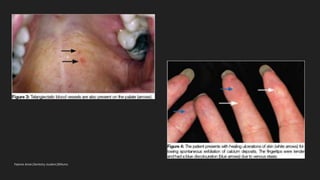
showed multifocal asymptomatic telangiectases (The patient disclosed a chronic history of
Raynaud's phenomenon which was initially diagnosed in her early teens. In addition, there
was evidence of sclerodactyly and focal areas of calcinosis cutis (calcinosis of the skin) ().
The patient complained of mild dysphagia and gastric reflux
Fateme Ameri,Dentistry student,SEMums
CASE REPORT
The severity and pain associated with her Raynaud's phenomenon, particularly on exposure to cold,
had prompted the patient to consult a physician many years previously. At that time, laboratory testing
had shown increased antinuclear antibody (ANA) titres. Some years later she consulted a
rheumatologist, who diagnosed CREST syndrome on the basis of her clinical features and the
presence of anti-centromeric antibodies on laboratory testing.
The patient was on antidepressant medication and occasionally took non-steroidal anti-inflammatory
drugs for digital and joint pain.
Fateme Ameri,Dentistry student,SEMums
 A 42-year-old female patient
 a main complaint of labial gingival recession on tooth
 with no findings of periodontitis
 . Gingival recession
 intra-oral mucosa and peri-oral facial skin showed multifocal asymptomatic telangiectases
(The patient disclosed a chronic history of Raynaud's phenomenon
 evidence of sclerodactyly
 focal areas of calcinosis cutis (calcinosis of the skin) The patient complained of mild
dysphagia and gastric reflux
CREST: Calcinosis of the skin, Raynaud's phenomenon,
Esophageal dysmotility, Sclerodactyly and Telangiectasia
The slowly progressive cutaneous form of systemic sclerosis (scleroderma)
is termed CREST syndrome. The acronym CREST is derived from the
clinical symptoms of Calcinosis of the skin, Raynaud's phenomenon,
Esophageal dysmotility, Sclerodactyly and Telangiectasia.1 The oral
manifestations of CREST syndrome are poorly documented. This case
presentation aims to discuss a fairly rare clinical entity and the implications
for dental management.
Fateme Ameri,Dentistry student,SEMums
Calcinosis:
Soft tissue deposition of calcium in CREST in CREST syndrome are a late
manifestation of the disease process and are unrelated to disorders of
calcium metabolism.1,4 Calcium deposits are noted within the extremities
and occur superficially within the dermal connective tissue. They rarely
interfere with patient function and seldom require additional therapy.
Fateme Ameri,Dentistry student,SEMums
Raynaud's phenomenon
Raynaud's phenomenon is usually the earliest manifestation of CREST syndrome and
represents a vasomotor disorder affecting the extremities. Patients suffer from vascular
spasms of the acral arteries which are induced by exposure to cold. The vascular spasm
results in decreased peripheral perfusion which may last several minutes followed by
painful re-perfusion. Vasoactive medication in the form of calcium channel blockers can be
used to alleviate these symptoms in only the most severe cases.5 Generalised gingival
overgrowth may result from administration of this medication and further complicate
plaque control and periodontal involvement.
Fateme Ameri,Dentistry student,SEMums
Esophageal dysmotility
Esophageal involvement in CREST syndrome is due to smooth muscle
atrophy and fibrosis which results in uncoordinated contraction, dysphagia
and gastroesophageal reflux disease (GERD).2,6 Severe chemical erosion of
tooth enamel may result from chronic GERD
Fateme Ameri,Dentistry student,SEMums
Sclerodactyly:
The tightening of the skin with tapering of the fingers and toes is termed
sclerodactyly. The most severely affected digits may show clinical features
of contracture. Initial clinical changes include oedema followed by atrophy
and thinning of the skin. The fingers become progressively rigid which may
result in a loss of dexterity which may interfere with the patient's ability to
manually perform plaque control measures.1
Fateme Ameri,Dentistry student,SEMums
Telangiectases:
Telangiectatic lesions in CREST syndrome are usually noted to involve the
oral and gastro-intestinal mucosa as well as the skin of the trunk and
extremities. Unlike the hereditary telangiectatic lesions seen in Rendu-Osler
Weber disease, there is no association with haemorrhagic episodes in
CREST syndrome. Lesions appear to increase in number as patients' age
but are largely asymptomatic.
Fateme Ameri,Dentistry student,SEMums
CREST syndrome is a rare form of auto-immune disease. An
interesting example of a patient with this disorder is presented here
to highlight the oral manifestations as well the importance of
optimal plaque control in these patients. Appropriate referral of
patients to specialist physicians and rheumatologists may be
necessary for systemic immunosuppressive therapy.
Fateme Ameri,Dentistry student,SEMums
Thanks for your attention

Crest syndrome

  • 1.
  • 2.
  • 3.
    CASE REPORT A 42-year-oldfemale patient presented to the Department of Periodontics and Oral Medicine, with a main complaint of labial gingival recession on tooth 41. A comprehensive periodontal examination was performed with no findings of periodontitis. Gingival recession was found on teeth. Clinical examination of the intra-oral mucosa and peri-oral facial skin showed multifocal asymptomatic telangiectases (The patient disclosed a chronic history of Raynaud's phenomenon which was initially diagnosed in her early teens. In addition, there was evidence of sclerodactyly and focal areas of calcinosis cutis (calcinosis of the skin) (). The patient complained of mild dysphagia and gastric reflux Fateme Ameri,Dentistry student,SEMums
  • 4.
    CASE REPORT The severityand pain associated with her Raynaud's phenomenon, particularly on exposure to cold, had prompted the patient to consult a physician many years previously. At that time, laboratory testing had shown increased antinuclear antibody (ANA) titres. Some years later she consulted a rheumatologist, who diagnosed CREST syndrome on the basis of her clinical features and the presence of anti-centromeric antibodies on laboratory testing. The patient was on antidepressant medication and occasionally took non-steroidal anti-inflammatory drugs for digital and joint pain. Fateme Ameri,Dentistry student,SEMums
  • 5.
  • 6.
  • 7.
    Fateme Ameri,Dentistry student,SEMums A 42-year-old female patient  a main complaint of labial gingival recession on tooth  with no findings of periodontitis  . Gingival recession  intra-oral mucosa and peri-oral facial skin showed multifocal asymptomatic telangiectases (The patient disclosed a chronic history of Raynaud's phenomenon  evidence of sclerodactyly  focal areas of calcinosis cutis (calcinosis of the skin) The patient complained of mild dysphagia and gastric reflux
  • 8.
    CREST: Calcinosis ofthe skin, Raynaud's phenomenon, Esophageal dysmotility, Sclerodactyly and Telangiectasia The slowly progressive cutaneous form of systemic sclerosis (scleroderma) is termed CREST syndrome. The acronym CREST is derived from the clinical symptoms of Calcinosis of the skin, Raynaud's phenomenon, Esophageal dysmotility, Sclerodactyly and Telangiectasia.1 The oral manifestations of CREST syndrome are poorly documented. This case presentation aims to discuss a fairly rare clinical entity and the implications for dental management. Fateme Ameri,Dentistry student,SEMums
  • 9.
    Calcinosis: Soft tissue depositionof calcium in CREST in CREST syndrome are a late manifestation of the disease process and are unrelated to disorders of calcium metabolism.1,4 Calcium deposits are noted within the extremities and occur superficially within the dermal connective tissue. They rarely interfere with patient function and seldom require additional therapy. Fateme Ameri,Dentistry student,SEMums
  • 10.
    Raynaud's phenomenon Raynaud's phenomenonis usually the earliest manifestation of CREST syndrome and represents a vasomotor disorder affecting the extremities. Patients suffer from vascular spasms of the acral arteries which are induced by exposure to cold. The vascular spasm results in decreased peripheral perfusion which may last several minutes followed by painful re-perfusion. Vasoactive medication in the form of calcium channel blockers can be used to alleviate these symptoms in only the most severe cases.5 Generalised gingival overgrowth may result from administration of this medication and further complicate plaque control and periodontal involvement. Fateme Ameri,Dentistry student,SEMums
  • 11.
  • 12.
    Esophageal dysmotility Esophageal involvementin CREST syndrome is due to smooth muscle atrophy and fibrosis which results in uncoordinated contraction, dysphagia and gastroesophageal reflux disease (GERD).2,6 Severe chemical erosion of tooth enamel may result from chronic GERD Fateme Ameri,Dentistry student,SEMums
  • 13.
    Sclerodactyly: The tightening ofthe skin with tapering of the fingers and toes is termed sclerodactyly. The most severely affected digits may show clinical features of contracture. Initial clinical changes include oedema followed by atrophy and thinning of the skin. The fingers become progressively rigid which may result in a loss of dexterity which may interfere with the patient's ability to manually perform plaque control measures.1 Fateme Ameri,Dentistry student,SEMums
  • 14.
  • 15.
    Telangiectases: Telangiectatic lesions inCREST syndrome are usually noted to involve the oral and gastro-intestinal mucosa as well as the skin of the trunk and extremities. Unlike the hereditary telangiectatic lesions seen in Rendu-Osler Weber disease, there is no association with haemorrhagic episodes in CREST syndrome. Lesions appear to increase in number as patients' age but are largely asymptomatic. Fateme Ameri,Dentistry student,SEMums
  • 16.
  • 17.
    Fateme Ameri,Dentistry student,SEMums CRESTsyndrome is a rare form of auto-immune disease. An interesting example of a patient with this disorder is presented here to highlight the oral manifestations as well the importance of optimal plaque control in these patients. Appropriate referral of patients to specialist physicians and rheumatologists may be necessary for systemic immunosuppressive therapy.
  • 18.