Credit Rating Agency
(CRA)
Agenda
1. What is a credit rating agency
2. The history
3. Why we need ratings
4. What are they rating
5. Rating process
6. Impact of rating
7. The market
8. Critic
9. References
Fatih Aydogdu – Cengizhan Bolat
Government/Company InvestorsSafe
Financial System
1
Fatih Aydogdu – Cengizhan Bolat
What is a credit rating agency ?
• A Credit Rating Agency (CRA) is a company that assigns credit ratings for
issuers. The CRA rates a debtor's ability to pay back debt
How they do this ?
by making timely interest payments and the likelihood of default
The independence and professional approach of the agency ensure
reliable, consistent and unbiased ratings=
2
Fatih Aydogdu – Cengizhan Bolat
The History
– Businesses were close to the customer and those who purchased
– Trading distances increased
– Everybody knews their customers personally
– Merchants no longer personally knew their customers
– Business owners hesitate to extend credit to new customers
The birth of the credit reporting industry
3
Fatih Aydogdu – Cengizhan Bolat
The History
–The today's rating agencies were established in the wake of the financial crisis
of 1837
– These agencies rated the ability of merchants to pay their debts and
consolidated these ratings in published guides
– Financial analyst John Moody issued the first publication in 1909
– Few years later the Big three CRA established
S & P in 1922 and Fitch in 1924
4
Fatih Aydogdu – Cengizhan Bolat
Why we need ratings ?
- Security of the international financial system
- Security of the lender / investor
- Security of the customers of a financial institution
A credit rating facilitates the trading of securities on a secondary
market. It affects the interest rate that a security pays out, with
higher ratings leading to lower interest rates.
5
Fatih Aydogdu – Cengizhan Bolat
For whom ?
Investors:
• Low cost information
• Quick investment decision
• Independent investment decision
• Investor protection
• Forewarns risk
Borrowers:
• Sources of additional certification
• Increase the investor population
• Rating as a marketing tool
• Low cost of borrowing
• Foreign collaborations made easy
6
Fatih Aydogdu – Cengizhan Bolat
What are they rating ?
The rating agency offers its rating services to a wide range of issuers including:
– Companies – State and local goverments
– Special purpose entities – Non-profit organizations
– Banks and financial institutions
The debt instruments rated by CRAs include:
– Government bonds – CDOs
– Corporate bonds – Mortgage-backed securities
– Preferred stock – Collateralized securities
The rating is based on an objective analysis of the information and clarifications
obtained from the business entity 7
Fatih Aydogdu – Cengizhan Bolat
Rating Process
Start
•Start with the request of the prospective issuer
•Receipt of information as may be available with such issuer
•A team of analysts takes up the work of collection of data and information
from the books and records of the concern
•Search for other information from in-house research and database and
other secondary sources which considered as reliable by the rating agency.
•Process data and analyze
End
•Present a rating report of key rating issues
Strict
secret of the
information
8
Fatih Aydogdu – Cengizhan Bolat
Methodology
Credit Rating
Methodology
Business Risk
Profile Analysis
Financial Risk
Profile Analysis
9
Fatih Aydogdu – Cengizhan Bolat
Business Risk
Business
Risk
Industry
Factors
Country
Risk
Company
Position
Profit-
ability
Country Risk:
• Political
• Economic
• Industry – Specific factors
• Foreign exchange
Profitability:
• Trends
• Quality of Earnings
• Analytical adjustments
• Peer Group Comparisons
Company Position:
• Market position
• Keys to Success
• Size
• Diversification
• Management
Industry Factors:
• Industry Trends
• Industry Structure
• Market Size
• Growth Potential
• Competition
10
Fatih Aydogdu – Cengizhan Bolat
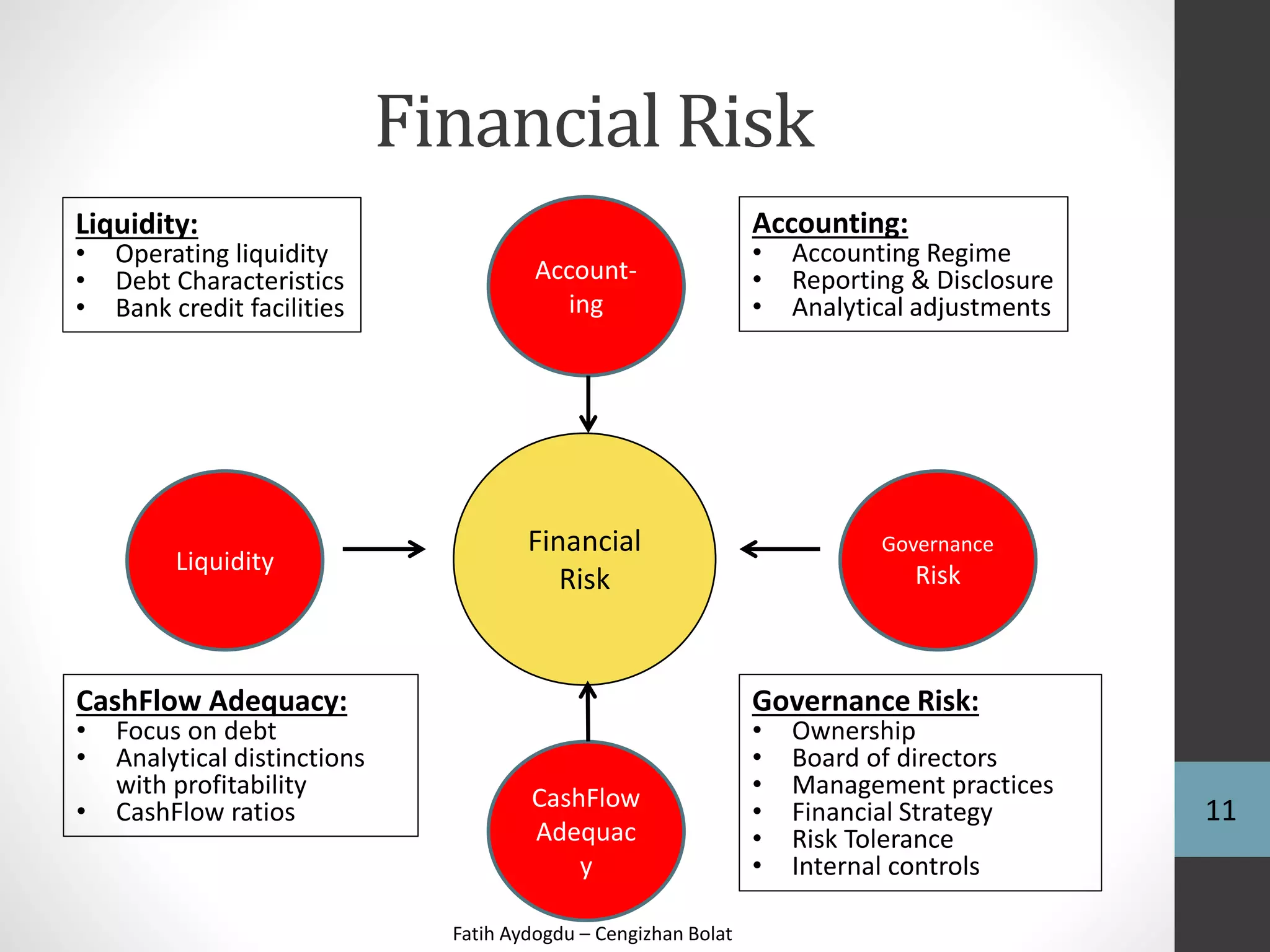
Financial Risk
Financial
Risk
Governance
Risk
Account-
ing
CashFlow
Adequac
y
Liquidity
Accounting:
• Accounting Regime
• Reporting & Disclosure
• Analytical adjustments
Liquidity:
• Operating liquidity
• Debt Characteristics
• Bank credit facilities
CashFlow Adequacy:
• Focus on debt
• Analytical distinctions
with profitability
• CashFlow ratios
Governance Risk:
• Ownership
• Board of directors
• Management practices
• Financial Strategy
• Risk Tolerance
• Internal controls
11
Fatih Aydogdu – Cengizhan Bolat
Impact of Rating
• Increase/Decrease risk of Company
• Reduce/Raise cost of money
• Access to Investors/Markets
• Possibility to invest/fund in Countries
• Strengthens/weakens of the image
12
Fatih Aydogdu – Cengizhan Bolat
The Market
The market for credit rating is a highly concentrated
industry
The two main actors in this business are Moody`s and
Standard & Poor`s (S&P) which controlling approximately
80% of the rating business
13
Fatih Aydogdu – Cengizhan Bolat
Big Three
40% 40% 15%
95% market
shares
14
Fatih Aydogdu – Cengizhan Bolat
Big Three
1. Standard & Poor`s
• Revenue: $2.61 billion
• 1.2 million outstanding ratings
• 1,416 analysts and supervisors
2. Moody`s
• Revenue: $2.1 billion
• 1 million outstanding ratings
• 1,252 analysts and supervisors
3. Fitch
• Revenue: $732.5 Million
• 350,000 outstanding ratings
• 480 analysts and supervisors
15
Fatih Aydogdu – Cengizhan Bolat
Rating – Scale
Prime S & P Moody`s Fitch
High grade
A A A
A A +
A A
A A -
A a a
A a 1
A a 2
A a 3
A A A
A A +
A A
A A -
Upper medium grade
A +
A
A -
A 1
A 2
A 3
A +
A
A -
Lower medium grade
B B B +
B B B
B B B -
B a a 1
B a a 2
B a a 3
B B B +
B B B
B B B -
Non-investment grade speculative
B B +
B B
B B -
B a 1
B a 2
B a 3
B B +
B B
B B -
Highly speculative
B +
B
B -
B 1
B 2
B 3
B +
B
B -
Substantial risk C C C + C a a 1 C C C
Extremely speculative C C C C a a 2 C C C
In default with little prospect
for recovery
C C C -
C C
C
C a a 3
C a
C a
C C C
C C C
C C C
In default
D
D
D
C
/
/
D D D
D D
D
16
Critic on credit rating agencies ?
The decisions are made by rating committees, not individual analysts, and that
analysts are not compensated based on their ratings.
Investors might pressure rating agencies for lower ratings because the
securities, if deemed riskier, would pay higher yields.
Issuers needed certain ratings in order to sell their bonds to regulated financial
institutions
Raters found issuers more willing to pay for the ratings than investors
17
Fatih Aydogdu – Cengizhan Bolat
Thank you for your attention !
Fatih Aydogdu – Cengizhan Bolat
References
• http://lexicon.ft.com/Term?term=rating-agencies
• http://en.wikipedia.org/wiki/Credit_rating_agency
• http://www.standardandpoors.com/en_US/web/guest/home
• http://bpb.de/
• https://www.fitchratings.com
• http://www.investopedia.com/financial-edge/0911/why-you-
shouldnt-trust-ratings-from-rating-agencies.aspx
• https://www.moodys.com

Credit Rating Agency (CRA)

  • 1.
  • 2.
    Agenda 1. What isa credit rating agency 2. The history 3. Why we need ratings 4. What are they rating 5. Rating process 6. Impact of rating 7. The market 8. Critic 9. References Fatih Aydogdu – Cengizhan Bolat
  • 3.
  • 4.
    What is acredit rating agency ? • A Credit Rating Agency (CRA) is a company that assigns credit ratings for issuers. The CRA rates a debtor's ability to pay back debt How they do this ? by making timely interest payments and the likelihood of default The independence and professional approach of the agency ensure reliable, consistent and unbiased ratings= 2 Fatih Aydogdu – Cengizhan Bolat
  • 5.
    The History – Businesseswere close to the customer and those who purchased – Trading distances increased – Everybody knews their customers personally – Merchants no longer personally knew their customers – Business owners hesitate to extend credit to new customers The birth of the credit reporting industry 3 Fatih Aydogdu – Cengizhan Bolat
  • 6.
    The History –The today'srating agencies were established in the wake of the financial crisis of 1837 – These agencies rated the ability of merchants to pay their debts and consolidated these ratings in published guides – Financial analyst John Moody issued the first publication in 1909 – Few years later the Big three CRA established S & P in 1922 and Fitch in 1924 4 Fatih Aydogdu – Cengizhan Bolat
  • 7.
    Why we needratings ? - Security of the international financial system - Security of the lender / investor - Security of the customers of a financial institution A credit rating facilitates the trading of securities on a secondary market. It affects the interest rate that a security pays out, with higher ratings leading to lower interest rates. 5 Fatih Aydogdu – Cengizhan Bolat
  • 8.
    For whom ? Investors: •Low cost information • Quick investment decision • Independent investment decision • Investor protection • Forewarns risk Borrowers: • Sources of additional certification • Increase the investor population • Rating as a marketing tool • Low cost of borrowing • Foreign collaborations made easy 6 Fatih Aydogdu – Cengizhan Bolat
  • 9.
    What are theyrating ? The rating agency offers its rating services to a wide range of issuers including: – Companies – State and local goverments – Special purpose entities – Non-profit organizations – Banks and financial institutions The debt instruments rated by CRAs include: – Government bonds – CDOs – Corporate bonds – Mortgage-backed securities – Preferred stock – Collateralized securities The rating is based on an objective analysis of the information and clarifications obtained from the business entity 7 Fatih Aydogdu – Cengizhan Bolat
  • 10.
    Rating Process Start •Start withthe request of the prospective issuer •Receipt of information as may be available with such issuer •A team of analysts takes up the work of collection of data and information from the books and records of the concern •Search for other information from in-house research and database and other secondary sources which considered as reliable by the rating agency. •Process data and analyze End •Present a rating report of key rating issues Strict secret of the information 8 Fatih Aydogdu – Cengizhan Bolat
  • 11.
    Methodology Credit Rating Methodology Business Risk ProfileAnalysis Financial Risk Profile Analysis 9 Fatih Aydogdu – Cengizhan Bolat
  • 12.
    Business Risk Business Risk Industry Factors Country Risk Company Position Profit- ability Country Risk: •Political • Economic • Industry – Specific factors • Foreign exchange Profitability: • Trends • Quality of Earnings • Analytical adjustments • Peer Group Comparisons Company Position: • Market position • Keys to Success • Size • Diversification • Management Industry Factors: • Industry Trends • Industry Structure • Market Size • Growth Potential • Competition 10 Fatih Aydogdu – Cengizhan Bolat
  • 13.
    Financial Risk Financial Risk Governance Risk Account- ing CashFlow Adequac y Liquidity Accounting: • AccountingRegime • Reporting & Disclosure • Analytical adjustments Liquidity: • Operating liquidity • Debt Characteristics • Bank credit facilities CashFlow Adequacy: • Focus on debt • Analytical distinctions with profitability • CashFlow ratios Governance Risk: • Ownership • Board of directors • Management practices • Financial Strategy • Risk Tolerance • Internal controls 11 Fatih Aydogdu – Cengizhan Bolat
  • 14.
    Impact of Rating •Increase/Decrease risk of Company • Reduce/Raise cost of money • Access to Investors/Markets • Possibility to invest/fund in Countries • Strengthens/weakens of the image 12 Fatih Aydogdu – Cengizhan Bolat
  • 15.
    The Market The marketfor credit rating is a highly concentrated industry The two main actors in this business are Moody`s and Standard & Poor`s (S&P) which controlling approximately 80% of the rating business 13 Fatih Aydogdu – Cengizhan Bolat
  • 16.
    Big Three 40% 40%15% 95% market shares 14 Fatih Aydogdu – Cengizhan Bolat
  • 17.
    Big Three 1. Standard& Poor`s • Revenue: $2.61 billion • 1.2 million outstanding ratings • 1,416 analysts and supervisors 2. Moody`s • Revenue: $2.1 billion • 1 million outstanding ratings • 1,252 analysts and supervisors 3. Fitch • Revenue: $732.5 Million • 350,000 outstanding ratings • 480 analysts and supervisors 15 Fatih Aydogdu – Cengizhan Bolat
  • 18.
    Rating – Scale PrimeS & P Moody`s Fitch High grade A A A A A + A A A A - A a a A a 1 A a 2 A a 3 A A A A A + A A A A - Upper medium grade A + A A - A 1 A 2 A 3 A + A A - Lower medium grade B B B + B B B B B B - B a a 1 B a a 2 B a a 3 B B B + B B B B B B - Non-investment grade speculative B B + B B B B - B a 1 B a 2 B a 3 B B + B B B B - Highly speculative B + B B - B 1 B 2 B 3 B + B B - Substantial risk C C C + C a a 1 C C C Extremely speculative C C C C a a 2 C C C In default with little prospect for recovery C C C - C C C C a a 3 C a C a C C C C C C C C C In default D D D C / / D D D D D D 16
  • 19.
    Critic on creditrating agencies ? The decisions are made by rating committees, not individual analysts, and that analysts are not compensated based on their ratings. Investors might pressure rating agencies for lower ratings because the securities, if deemed riskier, would pay higher yields. Issuers needed certain ratings in order to sell their bonds to regulated financial institutions Raters found issuers more willing to pay for the ratings than investors 17 Fatih Aydogdu – Cengizhan Bolat
  • 20.
    Thank you foryour attention ! Fatih Aydogdu – Cengizhan Bolat
  • 21.
    References • http://lexicon.ft.com/Term?term=rating-agencies • http://en.wikipedia.org/wiki/Credit_rating_agency •http://www.standardandpoors.com/en_US/web/guest/home • http://bpb.de/ • https://www.fitchratings.com • http://www.investopedia.com/financial-edge/0911/why-you- shouldnt-trust-ratings-from-rating-agencies.aspx • https://www.moodys.com

Editor's Notes

  • #5 Introduction to Credit Rating A credit rating assesses the credit worthiness of an individual, corporation, or even a country. Credit ratings are calculated from financial history and current assets and liabilities. A credit rating tells a lender or investor the probability of the subject being able to pay back a loan. A poor credit rating indicates a high risk of defaulting on a loan, and thus leads to high interest rates. Introduction to Credit Rating An assessment of the credit worthiness of individuals and corporations. It is based upon the history of borrowing and repayment, as well as the availability of assets and extent of liabilities. Credit is important since individuals and corporations with poor credit will have difficulty finding financing, and will most likely have to pay more due to the risk of default. CRA are not auditors Credit rating changes with time
  • #6 the distance of businesses to their customers When businesses were close to the customer and those who purchased goods or services from them, it was easy for the merchants to extend credit to them, due to their proximity and the fact that merchants knew their customers personally and knew whether or not they would be able to pay them back. 2. As trading distances increased, merchants no longer personally knew their customers and became leery of extending credit to people who they did not know in fear of them not being able to pay them back. Business owners' hesitation to extend credit to new customers led to the birth of the credit reporting industry.[7]
  • #7 1.Mercantile credit agencies—the precursors of today's rating agencies—were established in the wake of the financial crisis of 1837. 2.These agencies rated the ability of merchants to pay their debts and consolidated these ratings in published guides.[8] 3. Credit rating agencies originated in the United States in the early 1900s, when ratings began to be applied to securities, specifically those related to the railroad bond market.[8] 4. In 1909, financial analyst John Moody issued a publication focused solely on railroad bonds.[12][13][14] His ratings became the first to be published widely in an accessible format,[10][12][15] and his company was the first to charge subscription fees to investors.[14] 5. In the next few years, antecedents of the "Big Three" credit rating agencies were established. Poor's Publishing Company began issuing ratings in 1916, Standard Statistics Company in 1922,[12] and the Fitch Publishing Company in 1924.[13]
  • #8 Benefits of Credit Rating: Low cost information Quick investment decision Independent investment decision Investor protection Benefits to rated companies: Sources of additional certification Increase the investor population Forewarns risk Encourages financial Discipline Merchant bankers job made easy Foreign collaborations made easy Benefits the industry as a whole Low cost of borrowing Rating as a marketing tool
  • #11 The rating process commences at the request of the prospective issuer and on receipt of information as may be available with such issuer. A team of analysts takes up the work of collection of data and information from the books and records of the concern and interacts with its executives. The team also relies on the in-house research and database and other secondary sources considered reliable by the rating agency. On completion of the analysis, a RATING REPORT is submitted to the rating committee followed by presentation of key rating issues by the rating team. The ratings are assigned by the rating committee. The rating agency ensures strict confidentiality of the information collected from the issuers during the rating process.
  • #18 As of December 2012 and Fitch is the smallest, with approximately 350,000 outstanding ratings, and is sometimes used as an alternative to S&P and Moody’s
  • #19 The ratings are expressed in code numbers which can be easily comprehended by the lay investors
  • #20 have been under intense scrutiny since the 2007–2009 global financial crisis. They were initially criticized for their favorable pre-crisis ratings of insolvent financial institutions like Lehman Brothers, as well as risky mortgage-related securities that contributed to the collapse of the U.S. housing market. The Big Three argued that rating decisions were made by rating committees, not individual analysts, and that analysts were not compensated based on their ratings. Investors might pressure rating agencies for lower ratings because the securities, if deemed riskier, would pay higher yields. Credit rating agencies are meant to provide global investors with an informed analysis of the risk associated with debt securities. The riskiness of investing in these securities is determined by the likelihood that the debt issuer—will fail to make timely interest payments on the debt. because raters found issuers more willing to pay for these services than investors, since the issuers needed certain ratings in order to sell their bonds to regulated financial institutions