CONFIDENTIAL: The information in this document belongs to Boston Institute of Analytics LLC. Any unauthorized sharing of this
material is prohibited and subject to legal action under breach of IP and confidentiality clauses.
Credit Card Usage Segmentation
CONFIDENTIAL: The information in this document belongs to Boston Institute of Analytics LLC. Any unauthorized sharing of this
material is prohibited and subject to legal action under breach of IP and confidentiality clauses.
Agenda
Introduction
Steps Involved
Data Overview and Preprocessing
EDA
 Clustering
 Cluster Evaluation
Applications and Benefits
Conclusion
Q&A
CONFIDENTIAL: The information in this document belongs to Boston Institute of Analytics LLC. Any unauthorized sharing of this
material is prohibited and subject to legal action under breach of IP and confidentiality clauses.
Credit Card Usage Segmentation
This project focuses on developing
unsupervised learning Models for customer
segmentation based on credit card usage data. The
models aim to provide insights into distinct
customer segments, improve credit risk
assessment, and optimize marketing strategies.
Deliverables include segmentation models,
comprehensive data visualizations, and a
comparative analysis of various algorithms.
CONFIDENTIAL: The information in this document belongs to Boston Institute of Analytics LLC. Any unauthorized sharing of this
material is prohibited and subject to legal action under breach of IP and confidentiality clauses.
Steps Involved
in Developing
“Credit Card
Usage
Segmentation”
CONFIDENTIAL: The information in this document belongs to Boston Institute of Analytics LLC. Any unauthorized sharing of this
material is prohibited and subject to legal action under breach of IP and confidentiality clauses.
Data Overview and Preprocessing
1 Dataset Features
The dataset contains 18 variables
related to credit card usage and
customer behavior.
2 Data Cleaning
Missing values in CREDIT_LIMIT
and MINIMUM_PAYMENTS
were imputed using median values.
3 Outlier Detection
IQR method identified 695
outliers in the BALANCE
variable.
CONFIDENTIAL: The information in this document belongs to Boston Institute of Analytics LLC. Any unauthorized sharing of this
material is prohibited and subject to legal action under breach of IP and confidentiality clauses.
Click to edit
Master title style
EXPLORATORY DATA ANALYSIS (EDA)
Exploratory Data Analysis (EDA) is a critical step in
understanding the dataset and uncovering patterns,
relationships, and insights that will inform the segmentation
process. In the case of credit card usage segmentation, EDA helps
to understand how customers' purchases and demographics
relate to each other, identifying trends that can aid in customer
segmentation.
The EDA process for Credit Card Usage Segmentation:
1. Understand the Structure of the Data
2. Summary Statistics
3. Handling Missing Data
4. Analysing the Data
5. Filling missing values
.
CONFIDENTIAL: The information in this document belongs to Boston Institute of Analytics LLC. Any unauthorized sharing of this
material is prohibited and subject to legal action under breach of IP and confidentiality clauses.
Univariate Analysis
Balance Distribution
The BALANCE variable shows a right-
skewed distribution, indicating most customers
have lower balances.
Purchase Outliers
The PURCHASES variable contains significant outliers,
suggesting some customers make very large purchases.
CONFIDENTIAL: The information in this document belongs to Boston Institute of Analytics LLC. Any unauthorized sharing of this
material is prohibited and subject to legal action under breach of IP and confidentiality clauses.
Bivariate Analysis
Balance vs Purchases
Scatter plot reveals a positive correlation between
balance and purchases.
Balance by Purchase Frequency
Box plot shows higher balances associated with
more frequent purchases.
CONFIDENTIAL: The information in this document belongs to Boston Institute of Analytics LLC. Any unauthorized sharing of this
material is prohibited and subject to legal action under breach of IP and confidentiality clauses.
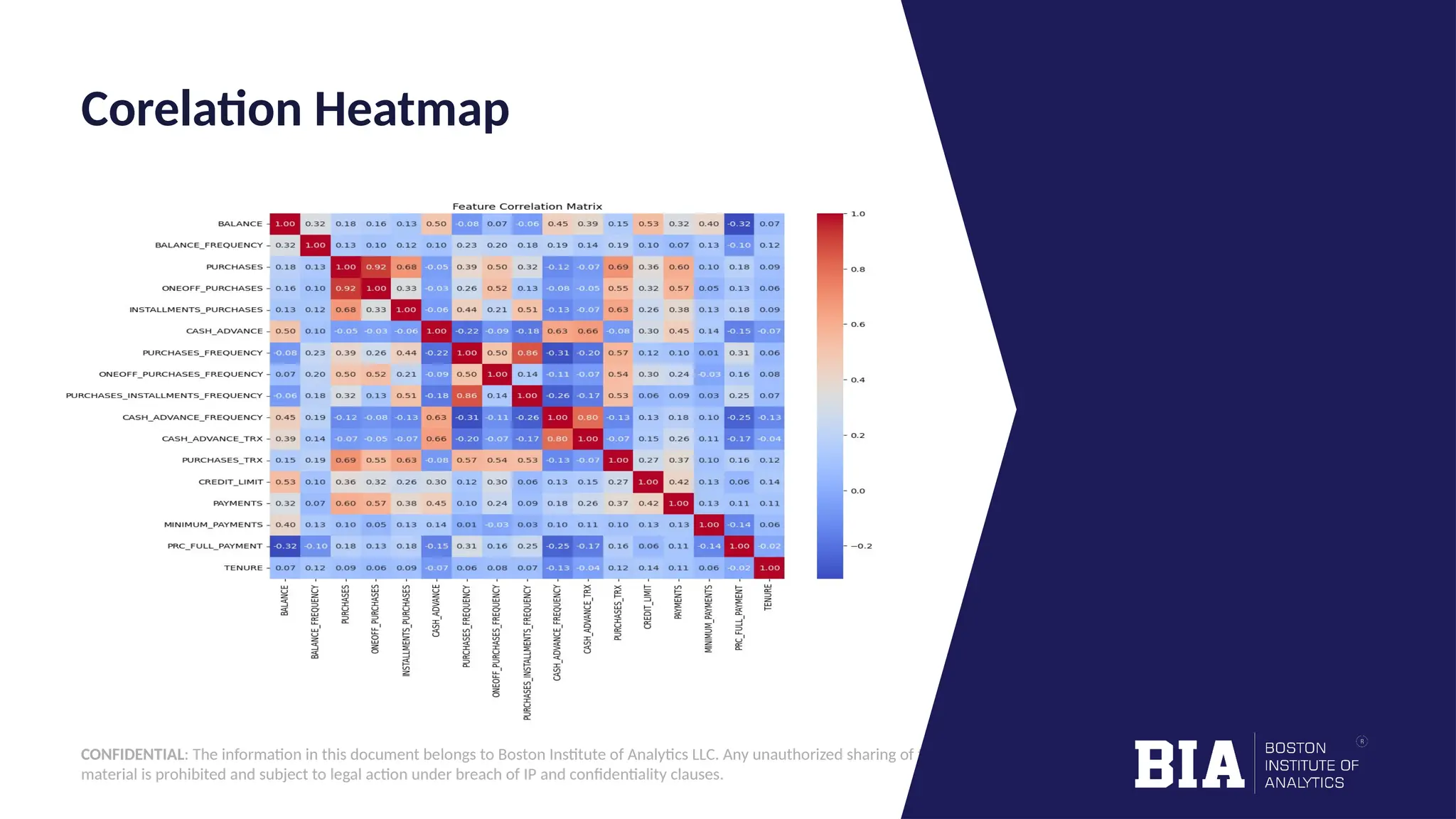
Multivariate
Analysis
CONFIDENTIAL: The information in this document belongs to Boston Institute of Analytics LLC. Any unauthorized sharing of this
material is prohibited and subject to legal action under breach of IP and confidentiality clauses.
Click to edit
Master title style
Corelation Heatmap
CONFIDENTIAL: The information in this document belongs to Boston Institute of Analytics LLC. Any unauthorized sharing of this
material is prohibited and subject to legal action under breach of IP and confidentiality clauses.
Clustering
1 K-Means Algorithm
2 Elbow Method
3 Silhouette Score
CONFIDENTIAL: The information in this document belongs to Boston Institute of Analytics LLC. Any unauthorized sharing of this
material is prohibited and subject to legal action under breach of IP and confidentiality clauses.
Cluster Evaluation
Metric Value
Optimal Clusters 2
Max Silhouette Score 0.4647
CONFIDENTIAL: The information in this document belongs to Boston Institute of Analytics LLC. Any unauthorized sharing of this
material is prohibited and subject to legal action under breach of IP and confidentiality clauses.
Applications
and Benefits
• Targeted Marketing: Enables personalized marketing strategies
for different customer segments, leading to higher engagement
and conversion rates.
• Risk Management: Identifies high-risk customer segments for
proactive credit monitoring and risk mitigation, reducing
potential defaults.
• Customer Retention: Offers insights to develop loyalty programs
and personalized rewards, increasing customer satisfaction and
retention.
• Product Development: Supports data-driven decisions for
designing credit card products and services tailored to specific
customer needs.
• Operational Efficiency: Streamlines resources by focusing on
high-value or high-risk segments, optimizing resource allocation.
CONFIDENTIAL: The information in this document belongs to Boston Institute of Analytics LLC. Any unauthorized sharing of this
material is prohibited and subject to legal action under breach of IP and confidentiality clauses.
Click to edit
Master title
style
Conclusion
• Successful Customer
Segmentation: Identified
distinct customer groups
based on usage patterns,
providing deeper insights.
• Targeted Marketing
Opportunities: Enabled
personalized marketing
strategies to improve
engagement and response
rates.
• Enhanced Risk Management:
Identified high-risk segments
for proactive credit risk
management.
• Improved Customer Retention:
Potential for tailored rewards
and services to increase
customer loyalty.
• Algorithm Performance
Analysis: Evaluated multiple
algorithms to select the most
effective segmentation
approach.
• Future Scope: Possibilities for
further insights by
incorporating transaction-level
data and exploring supervised
models.
CONFIDENTIAL: The information in this document belongs to Boston Institute of Analytics LLC. Any unauthorized sharing of this
material is prohibited and subject to legal action under breach of IP and confidentiality clauses.
Questions ?
CONFIDENTIAL: The information in this document belongs to Boston Institute of Analytics LLC. Any unauthorized sharing of this
material is prohibited and subject to legal action under breach of IP and confidentiality clauses.
Thank You!

Credit Card Usage Segmentation: A Data-Driven Approach to Customer Insights

  • 1.
    CONFIDENTIAL: The informationin this document belongs to Boston Institute of Analytics LLC. Any unauthorized sharing of this material is prohibited and subject to legal action under breach of IP and confidentiality clauses. Credit Card Usage Segmentation
  • 2.
    CONFIDENTIAL: The informationin this document belongs to Boston Institute of Analytics LLC. Any unauthorized sharing of this material is prohibited and subject to legal action under breach of IP and confidentiality clauses. Agenda Introduction Steps Involved Data Overview and Preprocessing EDA  Clustering  Cluster Evaluation Applications and Benefits Conclusion Q&A
  • 3.
    CONFIDENTIAL: The informationin this document belongs to Boston Institute of Analytics LLC. Any unauthorized sharing of this material is prohibited and subject to legal action under breach of IP and confidentiality clauses. Credit Card Usage Segmentation This project focuses on developing unsupervised learning Models for customer segmentation based on credit card usage data. The models aim to provide insights into distinct customer segments, improve credit risk assessment, and optimize marketing strategies. Deliverables include segmentation models, comprehensive data visualizations, and a comparative analysis of various algorithms.
  • 4.
    CONFIDENTIAL: The informationin this document belongs to Boston Institute of Analytics LLC. Any unauthorized sharing of this material is prohibited and subject to legal action under breach of IP and confidentiality clauses. Steps Involved in Developing “Credit Card Usage Segmentation”
  • 5.
    CONFIDENTIAL: The informationin this document belongs to Boston Institute of Analytics LLC. Any unauthorized sharing of this material is prohibited and subject to legal action under breach of IP and confidentiality clauses. Data Overview and Preprocessing 1 Dataset Features The dataset contains 18 variables related to credit card usage and customer behavior. 2 Data Cleaning Missing values in CREDIT_LIMIT and MINIMUM_PAYMENTS were imputed using median values. 3 Outlier Detection IQR method identified 695 outliers in the BALANCE variable.
  • 6.
    CONFIDENTIAL: The informationin this document belongs to Boston Institute of Analytics LLC. Any unauthorized sharing of this material is prohibited and subject to legal action under breach of IP and confidentiality clauses. Click to edit Master title style EXPLORATORY DATA ANALYSIS (EDA) Exploratory Data Analysis (EDA) is a critical step in understanding the dataset and uncovering patterns, relationships, and insights that will inform the segmentation process. In the case of credit card usage segmentation, EDA helps to understand how customers' purchases and demographics relate to each other, identifying trends that can aid in customer segmentation. The EDA process for Credit Card Usage Segmentation: 1. Understand the Structure of the Data 2. Summary Statistics 3. Handling Missing Data 4. Analysing the Data 5. Filling missing values .
  • 7.
    CONFIDENTIAL: The informationin this document belongs to Boston Institute of Analytics LLC. Any unauthorized sharing of this material is prohibited and subject to legal action under breach of IP and confidentiality clauses. Univariate Analysis Balance Distribution The BALANCE variable shows a right- skewed distribution, indicating most customers have lower balances. Purchase Outliers The PURCHASES variable contains significant outliers, suggesting some customers make very large purchases.
  • 8.
    CONFIDENTIAL: The informationin this document belongs to Boston Institute of Analytics LLC. Any unauthorized sharing of this material is prohibited and subject to legal action under breach of IP and confidentiality clauses. Bivariate Analysis Balance vs Purchases Scatter plot reveals a positive correlation between balance and purchases. Balance by Purchase Frequency Box plot shows higher balances associated with more frequent purchases.
  • 9.
    CONFIDENTIAL: The informationin this document belongs to Boston Institute of Analytics LLC. Any unauthorized sharing of this material is prohibited and subject to legal action under breach of IP and confidentiality clauses. Multivariate Analysis
  • 10.
    CONFIDENTIAL: The informationin this document belongs to Boston Institute of Analytics LLC. Any unauthorized sharing of this material is prohibited and subject to legal action under breach of IP and confidentiality clauses. Click to edit Master title style Corelation Heatmap
  • 11.
    CONFIDENTIAL: The informationin this document belongs to Boston Institute of Analytics LLC. Any unauthorized sharing of this material is prohibited and subject to legal action under breach of IP and confidentiality clauses. Clustering 1 K-Means Algorithm 2 Elbow Method 3 Silhouette Score
  • 12.
    CONFIDENTIAL: The informationin this document belongs to Boston Institute of Analytics LLC. Any unauthorized sharing of this material is prohibited and subject to legal action under breach of IP and confidentiality clauses. Cluster Evaluation Metric Value Optimal Clusters 2 Max Silhouette Score 0.4647
  • 13.
    CONFIDENTIAL: The informationin this document belongs to Boston Institute of Analytics LLC. Any unauthorized sharing of this material is prohibited and subject to legal action under breach of IP and confidentiality clauses. Applications and Benefits • Targeted Marketing: Enables personalized marketing strategies for different customer segments, leading to higher engagement and conversion rates. • Risk Management: Identifies high-risk customer segments for proactive credit monitoring and risk mitigation, reducing potential defaults. • Customer Retention: Offers insights to develop loyalty programs and personalized rewards, increasing customer satisfaction and retention. • Product Development: Supports data-driven decisions for designing credit card products and services tailored to specific customer needs. • Operational Efficiency: Streamlines resources by focusing on high-value or high-risk segments, optimizing resource allocation.
  • 14.
    CONFIDENTIAL: The informationin this document belongs to Boston Institute of Analytics LLC. Any unauthorized sharing of this material is prohibited and subject to legal action under breach of IP and confidentiality clauses. Click to edit Master title style Conclusion • Successful Customer Segmentation: Identified distinct customer groups based on usage patterns, providing deeper insights. • Targeted Marketing Opportunities: Enabled personalized marketing strategies to improve engagement and response rates. • Enhanced Risk Management: Identified high-risk segments for proactive credit risk management. • Improved Customer Retention: Potential for tailored rewards and services to increase customer loyalty. • Algorithm Performance Analysis: Evaluated multiple algorithms to select the most effective segmentation approach. • Future Scope: Possibilities for further insights by incorporating transaction-level data and exploring supervised models.
  • 15.
    CONFIDENTIAL: The informationin this document belongs to Boston Institute of Analytics LLC. Any unauthorized sharing of this material is prohibited and subject to legal action under breach of IP and confidentiality clauses. Questions ?
  • 16.
    CONFIDENTIAL: The informationin this document belongs to Boston Institute of Analytics LLC. Any unauthorized sharing of this material is prohibited and subject to legal action under breach of IP and confidentiality clauses. Thank You!