Big Data Analytics
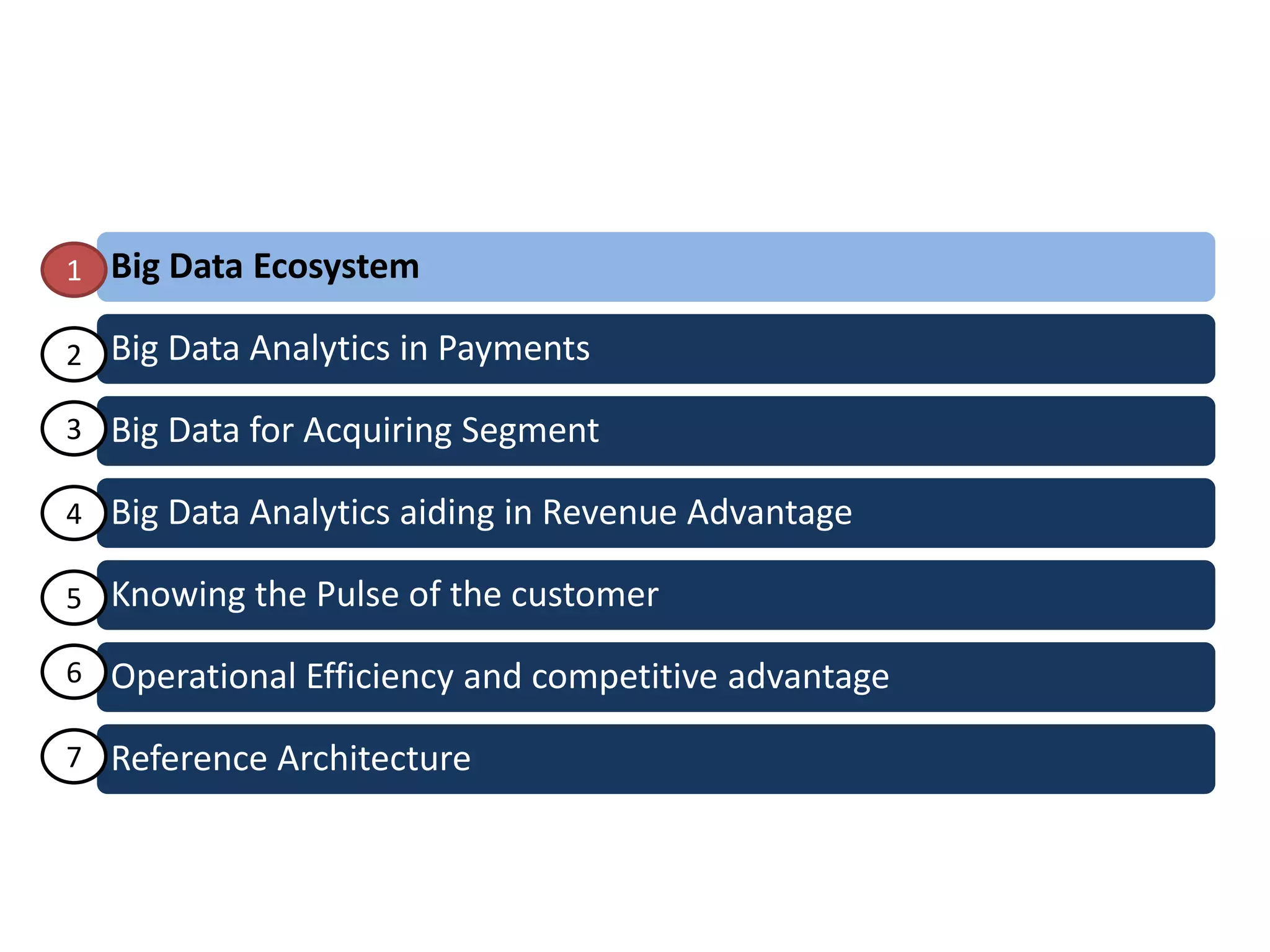
Big Data Ecosystem
Big Data Analytics in Payments
Big Data for Acquiring Segment
Big Data Analytics aiding in Revenue Advantage
Knowing the Pulse of the customer
Operational Efficiency and competitive advantage
Reference Architecture
1
2
3
4
5
6
7
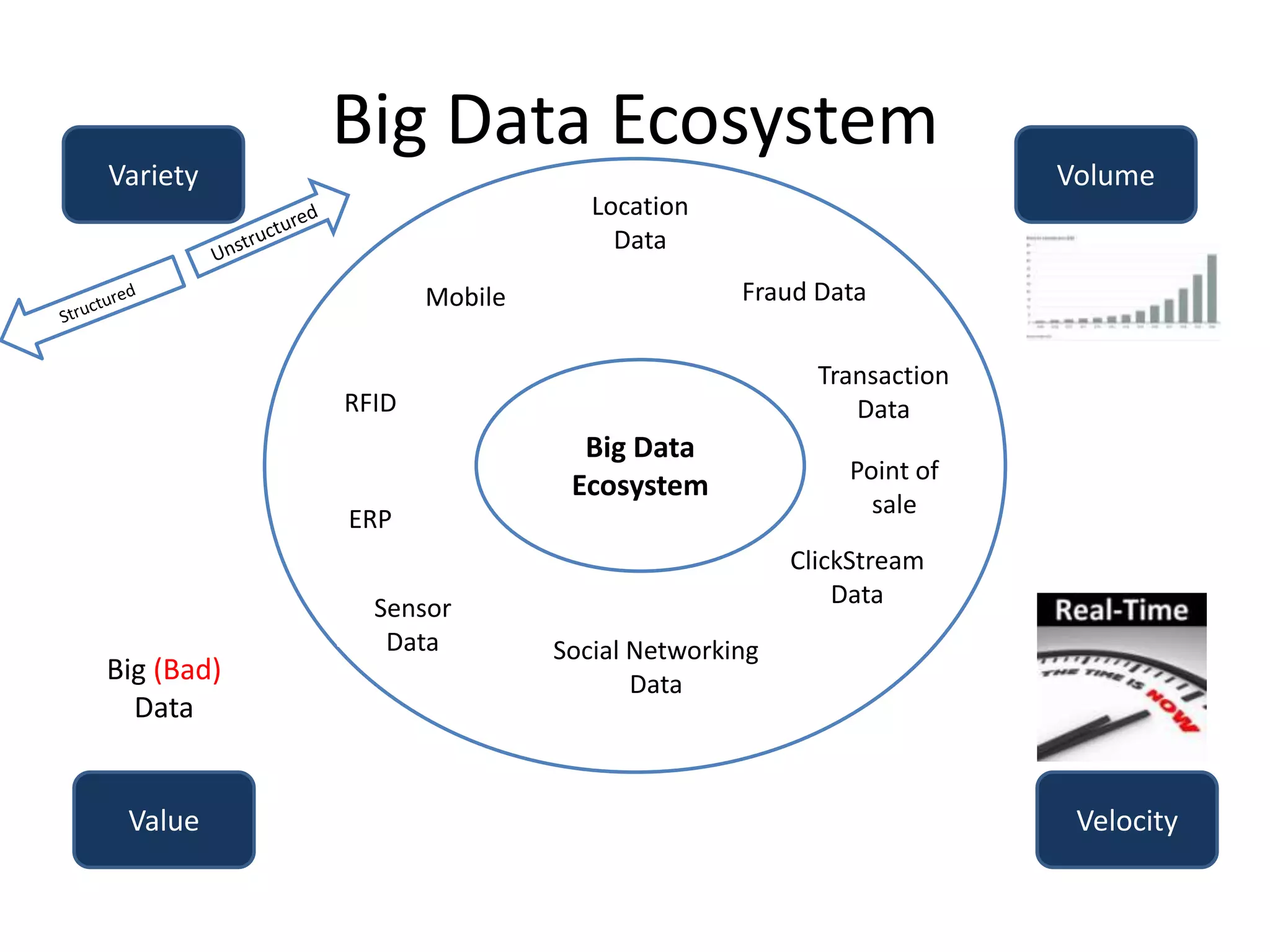
Big Data Ecosystem
Variety Volume
Value Velocity
Big Data
Ecosystem
Location
Data
Mobile Fraud Data
RFID
ERP
Sensor
Data Social Networking
Data
ClickStream
Data
Point of
sale
Transaction
Data
Big (Bad)
Data
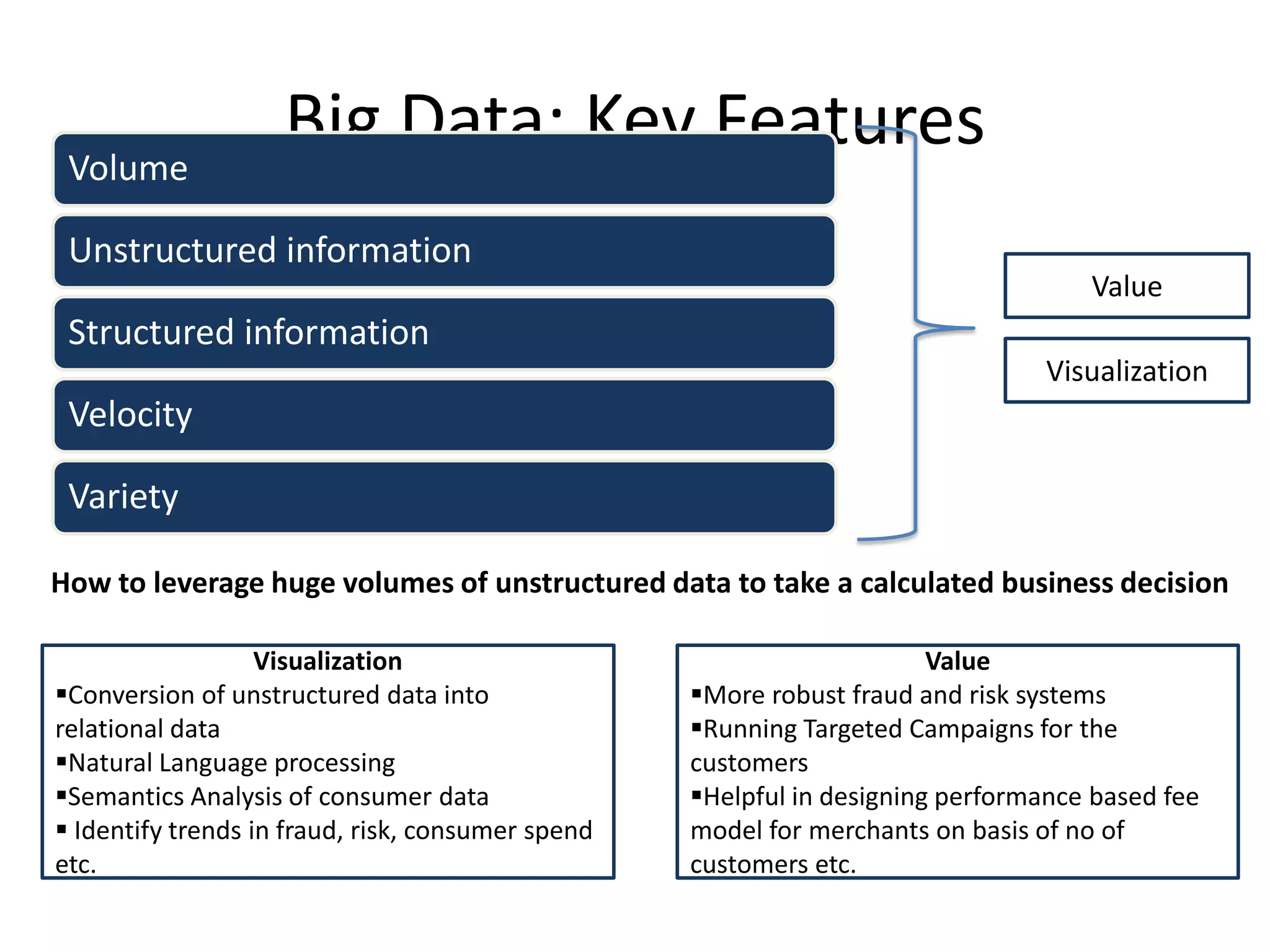
Big Data: Key FeaturesVolume
Unstructured information
Structured information
Velocity
Variety
Value
Visualization
How to leverage huge volumes of unstructured data to take a calculated business decision
Value
More robust fraud and risk systems
Running Targeted Campaigns for the
customers
Helpful in designing performance based fee
model for merchants on basis of no of
customers etc.
Visualization
Conversion of unstructured data into
relational data
Natural Language processing
Semantics Analysis of consumer data
 Identify trends in fraud, risk, consumer spend
etc.
Action Time
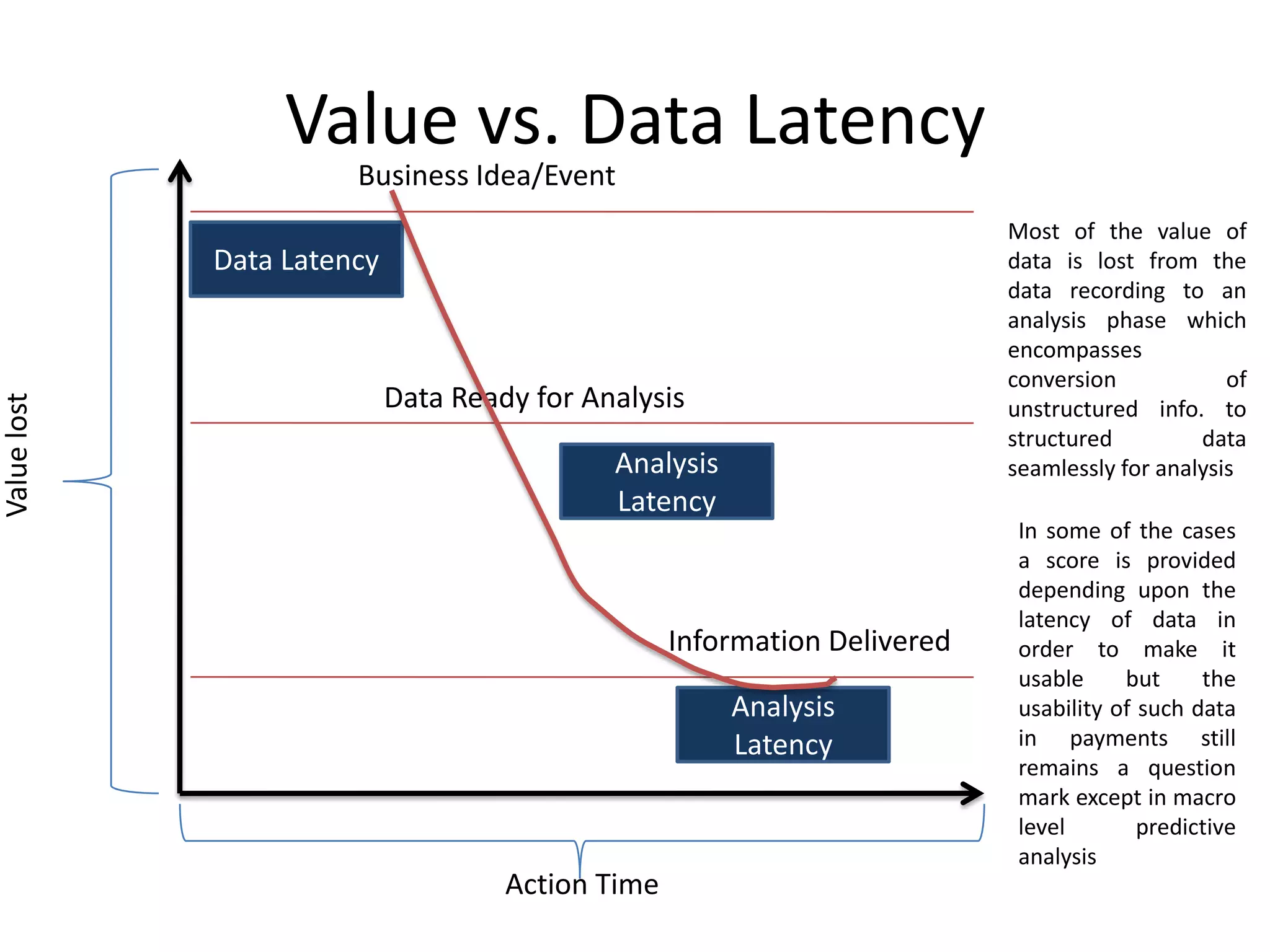
Value vs. Data Latency
Business Idea/Event
Data Ready for Analysis
Information Delivered
Valuelost
Data Latency
Analysis
Latency
Analysis
Latency
Most of the value of
data is lost from the
data recording to an
analysis phase which
encompasses
conversion of
unstructured info. to
structured data
seamlessly for analysis
In some of the cases
a score is provided
depending upon the
latency of data in
order to make it
usable but the
usability of such data
in payments still
remains a question
mark except in macro
level predictive
analysis
As per Forrester Research Most banks indicated that the main hindrance to their big
data adoption plan was cost. Integration costs are not insignificant; for starters, one
needs to integrate their analytics platforms to more data sources and invest in more
hardware to increase compute power and storage capacity. As per the report some of
the One of the leading issuing banks and ISO’s in US said that the price tag of big data
would not provide an ROI from incremental savings for at least another two years.
Big Data Ergonomics
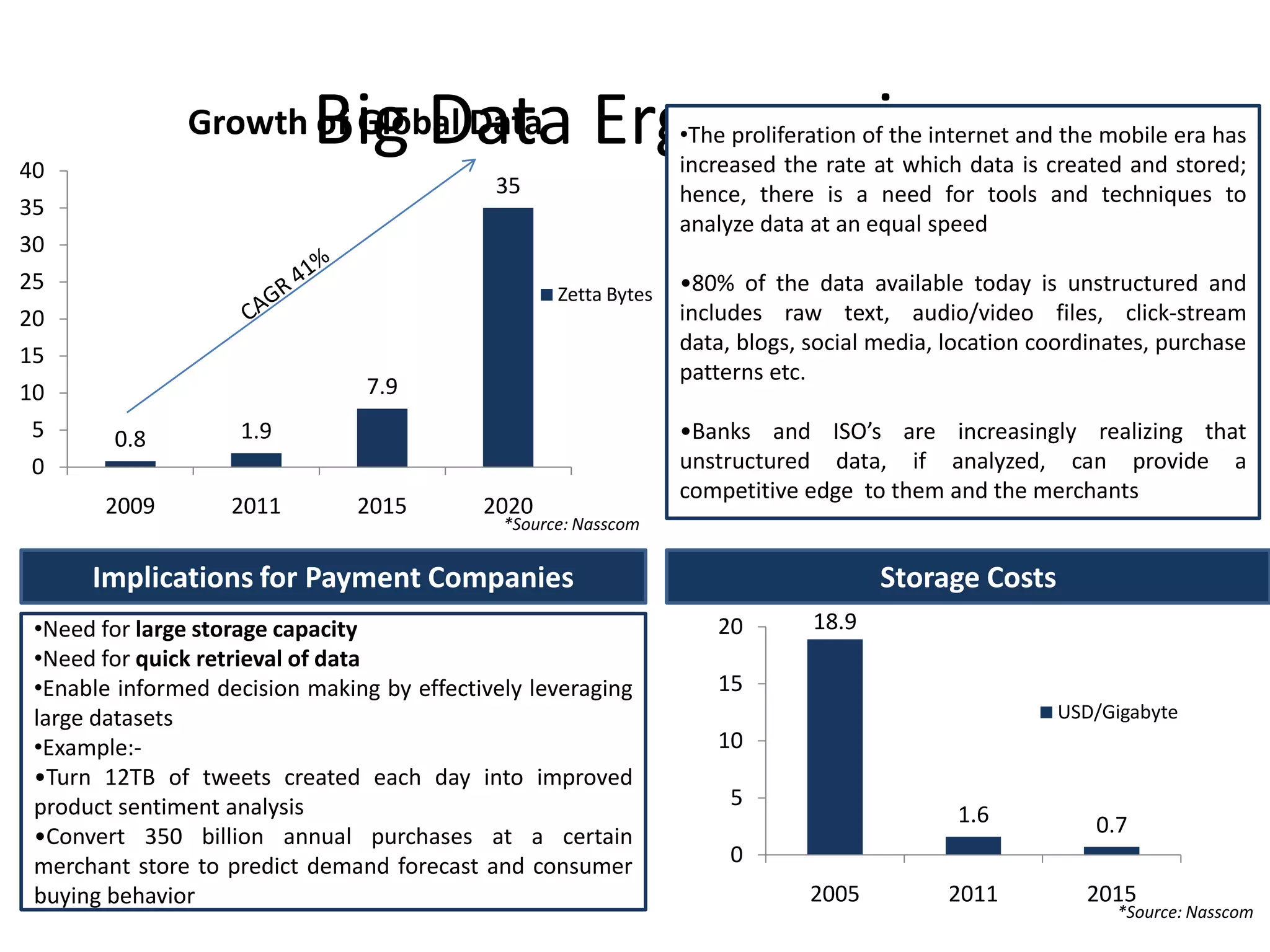
0.8 1.9
7.9
35
0
5
10
15
20
25
30
35
40
2009 2011 2015 2020
Growth of Global Data
Zetta Bytes
•The proliferation of the internet and the mobile era has
increased the rate at which data is created and stored;
hence, there is a need for tools and techniques to
analyze data at an equal speed
•80% of the data available today is unstructured and
includes raw text, audio/video files, click-stream
data, blogs, social media, location coordinates, purchase
patterns etc.
•Banks and ISO’s are increasingly realizing that
unstructured data, if analyzed, can provide a
competitive edge to them and the merchants
Implications for Payment Companies
•Need for large storage capacity
•Need for quick retrieval of data
•Enable informed decision making by effectively leveraging
large datasets
•Example:-
•Turn 12TB of tweets created each day into improved
product sentiment analysis
•Convert 350 billion annual purchases at a certain
merchant store to predict demand forecast and consumer
buying behavior
Storage Costs
*Source: Nasscom
18.9
1.6 0.7
0
5
10
15
20
2005 2011 2015
USD/Gigabyte
*Source: Nasscom
Big Data Ecosystem
Big Data Analytics in Payments
Big Data for Acquiring Segment
Big Data Analytics aiding in Revenue Advantage
Knowing the Pulse of the customer
Operational Efficiency and competitive advantage
Reference Architecture
1
2
3
4
5
6
7
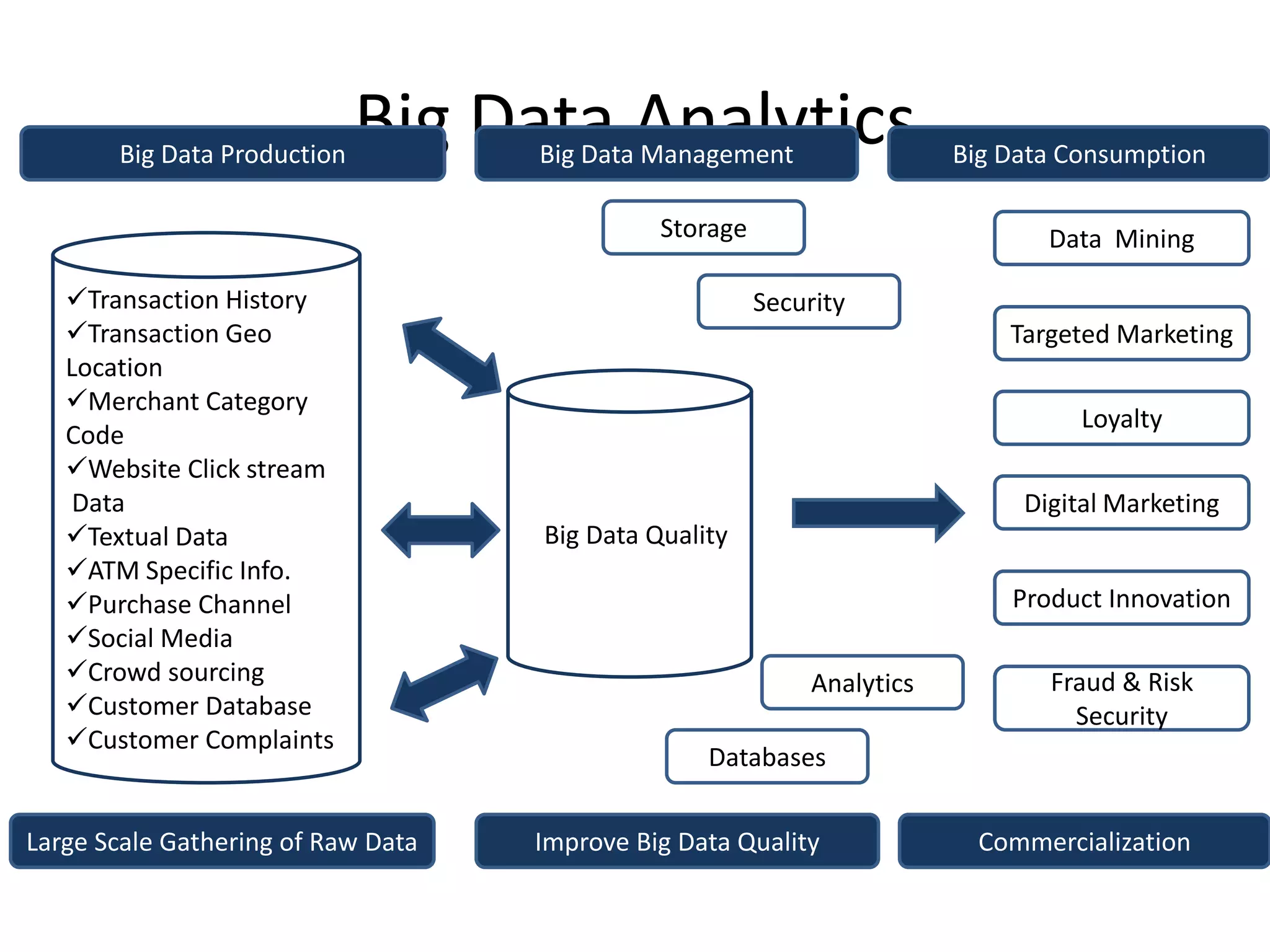
Big Data AnalyticsBig Data Production Big Data Management Big Data Consumption
Transaction History
Transaction Geo
Location
Merchant Category
Code
Website Click stream
Data
Textual Data
ATM Specific Info.
Purchase Channel
Social Media
Crowd sourcing
Customer Database
Customer Complaints
Big Data Quality
Large Scale Gathering of Raw Data
Storage
Security
Analytics
Databases
Improve Big Data Quality
Data Mining
Targeted Marketing
Loyalty
Digital Marketing
Product Innovation
Fraud & Risk
Security
Commercialization
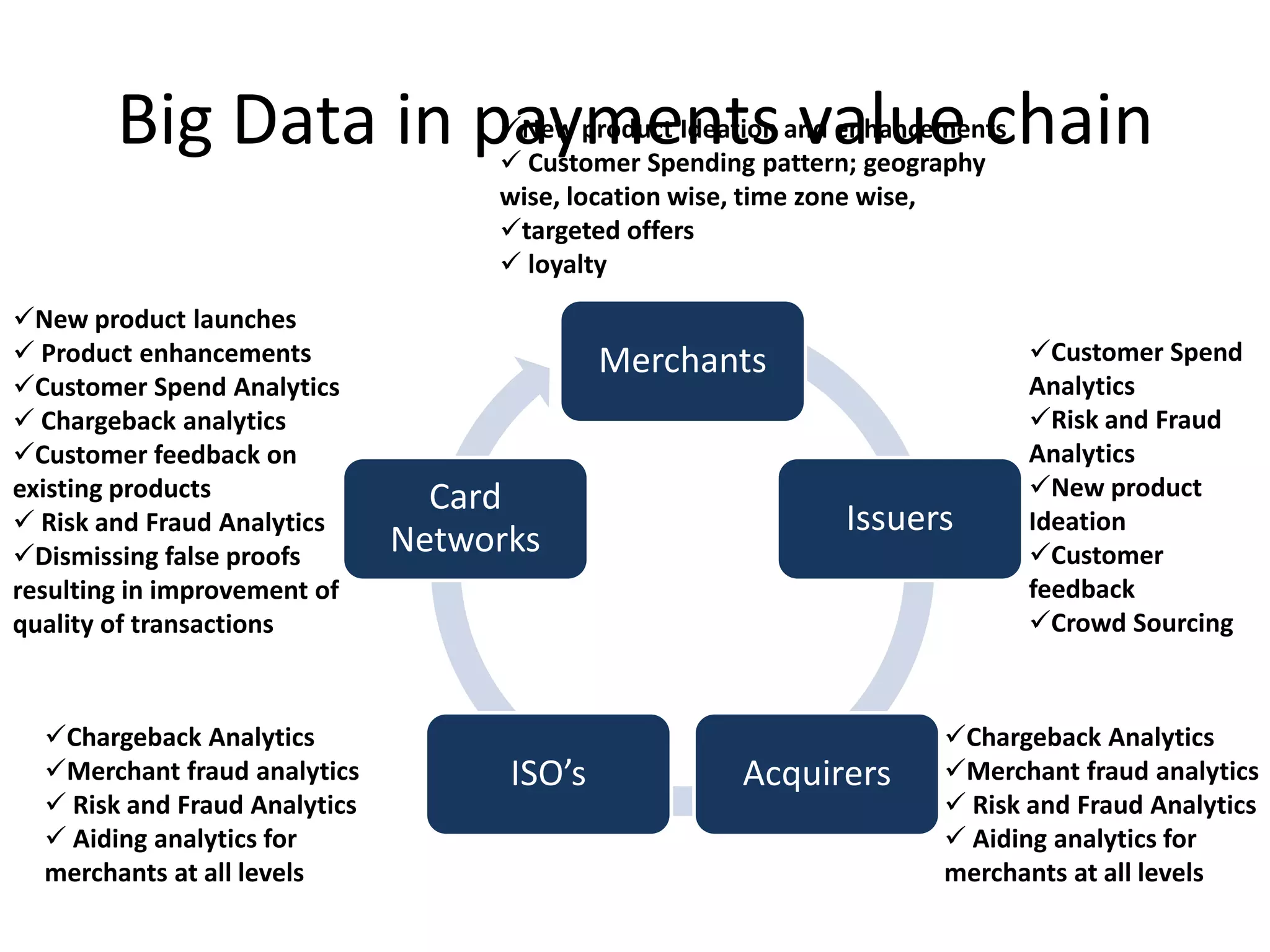
Big Data in payments value chain
Merchants
Issuers
AcquirersISO’s
Card
Networks
New product Ideation and enhancements
 Customer Spending pattern; geography
wise, location wise, time zone wise,
targeted offers
 loyalty
New product launches
 Product enhancements
Customer Spend Analytics
 Chargeback analytics
Customer feedback on
existing products
 Risk and Fraud Analytics
Dismissing false proofs
resulting in improvement of
quality of transactions
Customer Spend
Analytics
Risk and Fraud
Analytics
New product
Ideation
Customer
feedback
Crowd Sourcing
Chargeback Analytics
Merchant fraud analytics
 Risk and Fraud Analytics
 Aiding analytics for
merchants at all levels
Chargeback Analytics
Merchant fraud analytics
 Risk and Fraud Analytics
 Aiding analytics for
merchants at all levels
Big Data Ecosystem
Big Data Analytics in Payments
Big Data for Acquiring Segment
Big Data Analytics aiding in Revenue Advantage
Knowing the Pulse of the customer
Operational Efficiency and competitive advantage
Reference Architecture
1
2
3
4
5
6
7
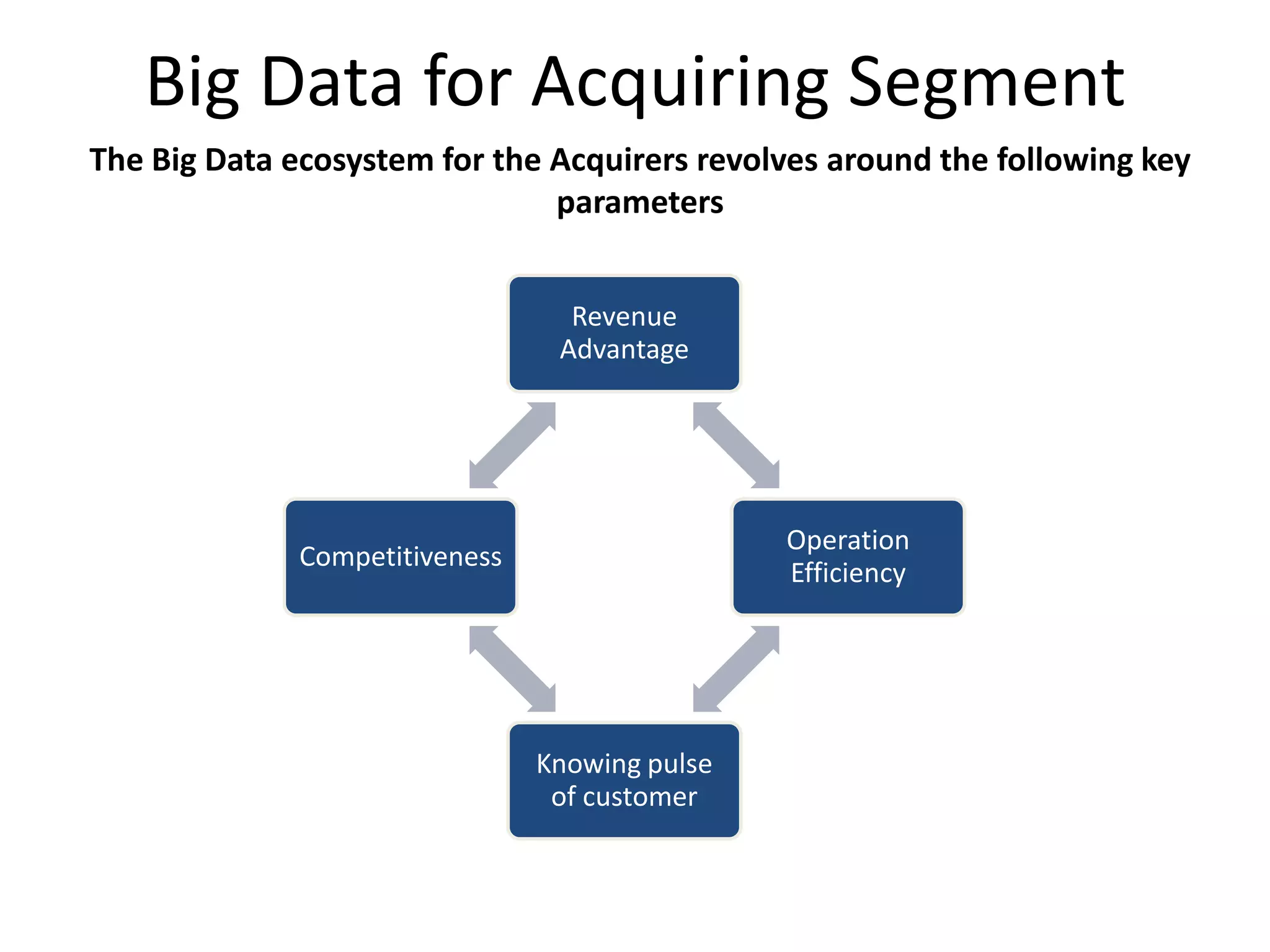
Big Data for Acquiring Segment
The Big Data ecosystem for the Acquirers revolves around the following key
parameters
Revenue
Advantage
Operation
Efficiency
Knowing pulse
of customer
Competitiveness
Big Data Ecosystem
Big Data Analytics in Payments
Big Data for Acquiring Segment
Big Data Analytics aiding in Revenue Advantage
Knowing the Pulse of the customer
Operational Efficiency and competitive advantage
Reference Architecture
1
2
3
4
5
6
7
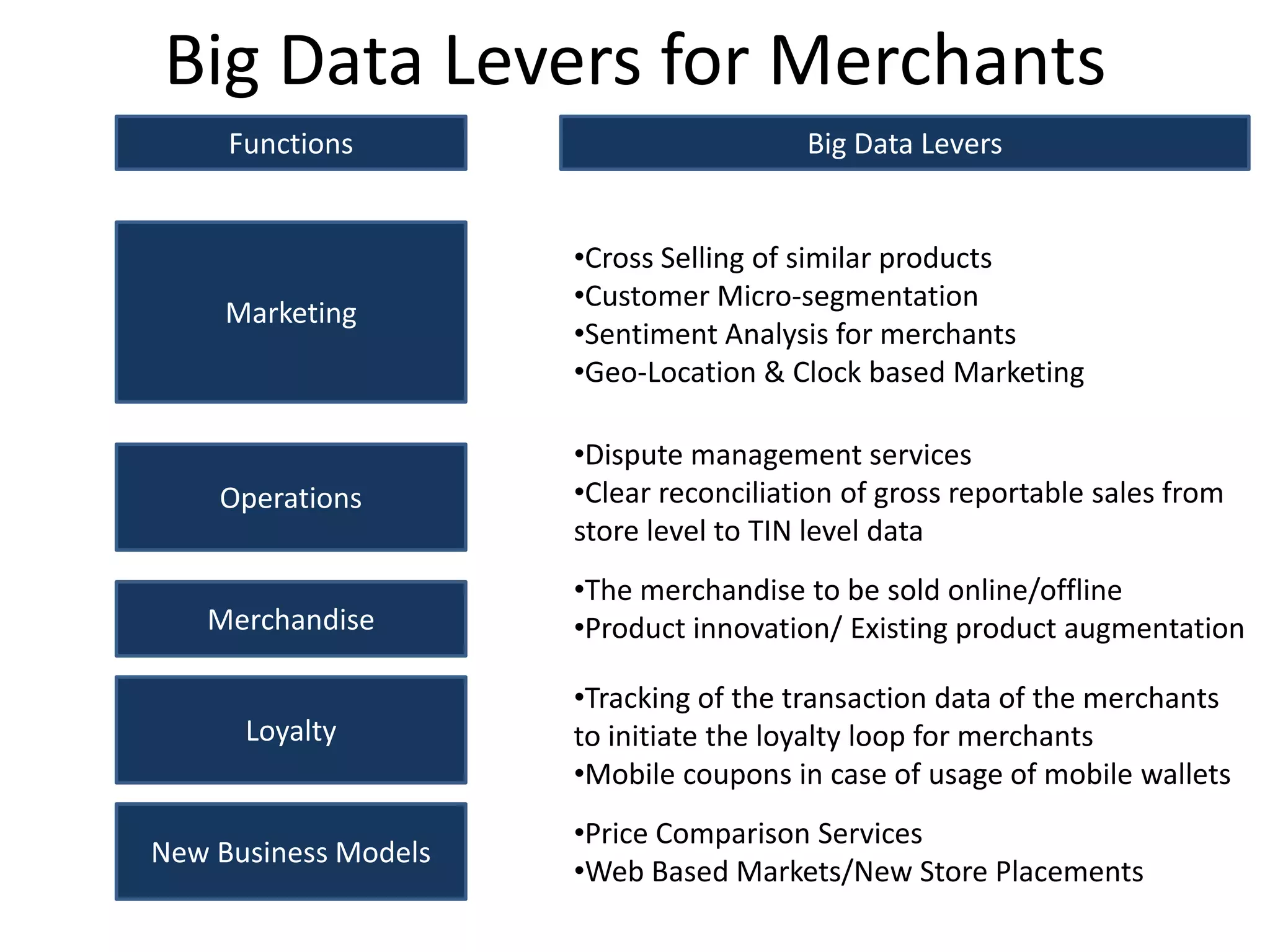
Big Data Levers for Merchants
Functions Big Data Levers
Marketing
Operations
Merchandise
Loyalty
New Business Models
•Cross Selling of similar products
•Customer Micro-segmentation
•Sentiment Analysis for merchants
•Geo-Location & Clock based Marketing
•Price Comparison Services
•Web Based Markets/New Store Placements
•Dispute management services
•Clear reconciliation of gross reportable sales from
store level to TIN level data
•Tracking of the transaction data of the merchants
to initiate the loyalty loop for merchants
•Mobile coupons in case of usage of mobile wallets
•The merchandise to be sold online/offline
•Product innovation/ Existing product augmentation
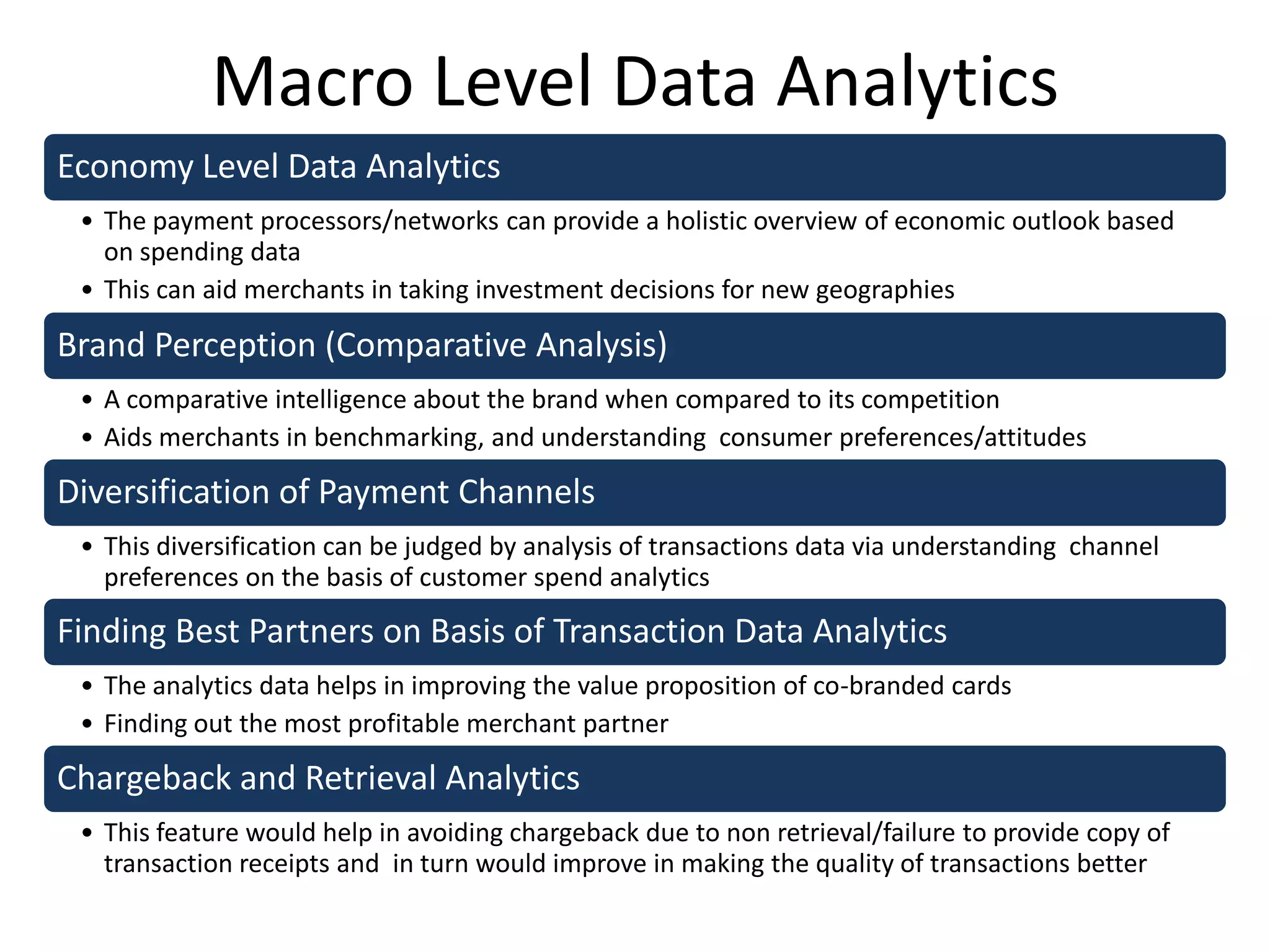
Macro Level Data Analytics
Economy Level Data Analytics
• The payment processors/networks can provide a holistic overview of economic outlook based
on spending data
• This can aid merchants in taking investment decisions for new geographies
Brand Perception (Comparative Analysis)
• A comparative intelligence about the brand when compared to its competition
• Aids merchants in benchmarking, and understanding consumer preferences/attitudes
Diversification of Payment Channels
• This diversification can be judged by analysis of transactions data via understanding channel
preferences on the basis of customer spend analytics
Finding Best Partners on Basis of Transaction Data Analytics
• The analytics data helps in improving the value proposition of co-branded cards
• Finding out the most profitable merchant partner
Chargeback and Retrieval Analytics
• This feature would help in avoiding chargeback due to non retrieval/failure to provide copy of
transaction receipts and in turn would improve in making the quality of transactions better
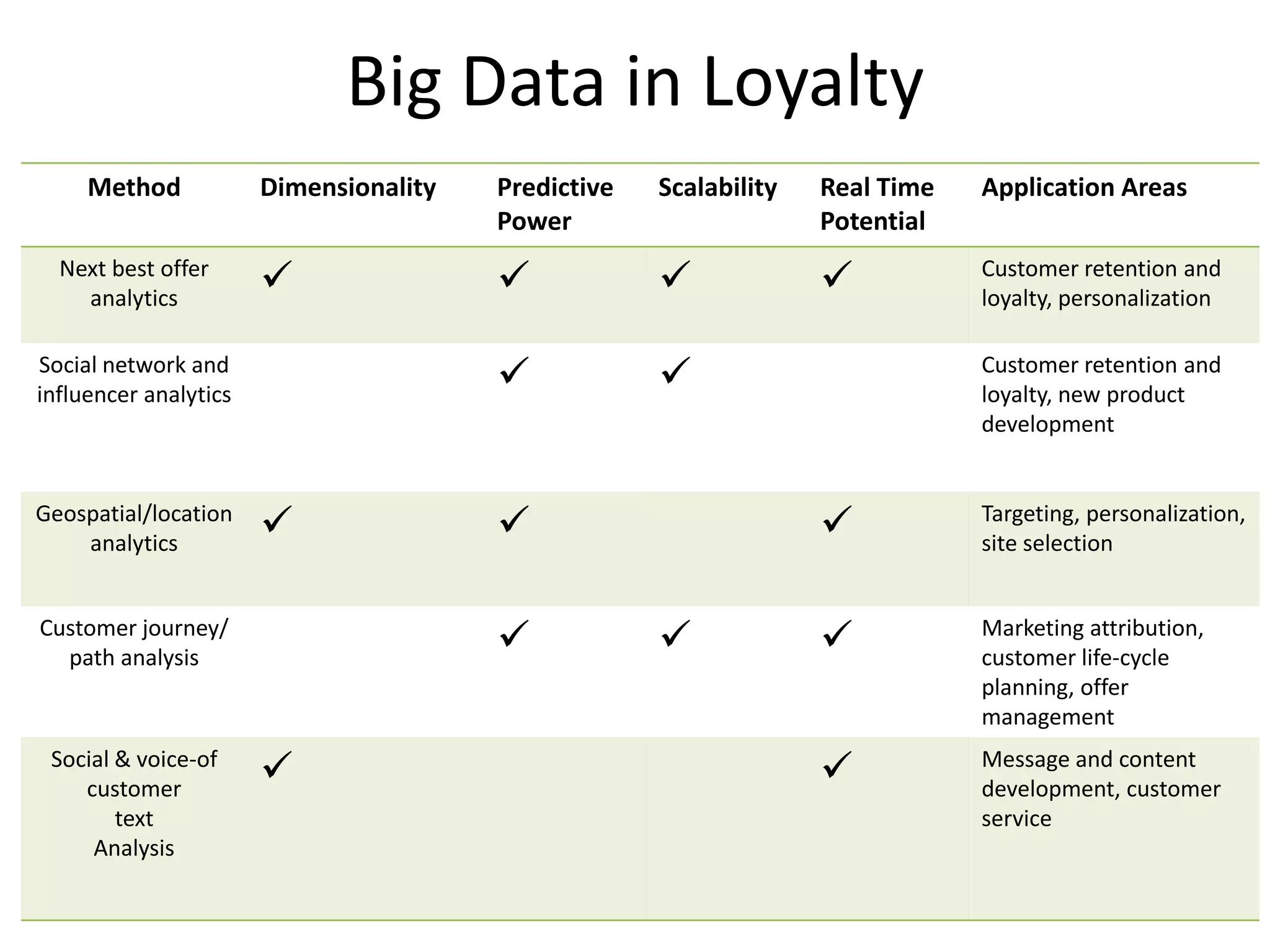
Big Data in Loyalty
Method Dimensionality Predictive
Power
Scalability Real Time
Potential
Application Areas
Next best offer
analytics
    Customer retention and
loyalty, personalization
Social network and
influencer analytics
  Customer retention and
loyalty, new product
development
Geospatial/location
analytics
   Targeting, personalization,
site selection
Customer journey/
path analysis
   Marketing attribution,
customer life-cycle
planning, offer
management
Social & voice-of
customer
text
Analysis
  Message and content
development, customer
service
Big Data Ecosystem
Big Data Analytics in Payments
Big Data for Acquiring Segment
Big Data Analytics aiding in Revenue Advantage
Knowing the Pulse of the customer
Operational Efficiency and competitive advantage
Reference Architecture
1
2
3
4
5
6
7
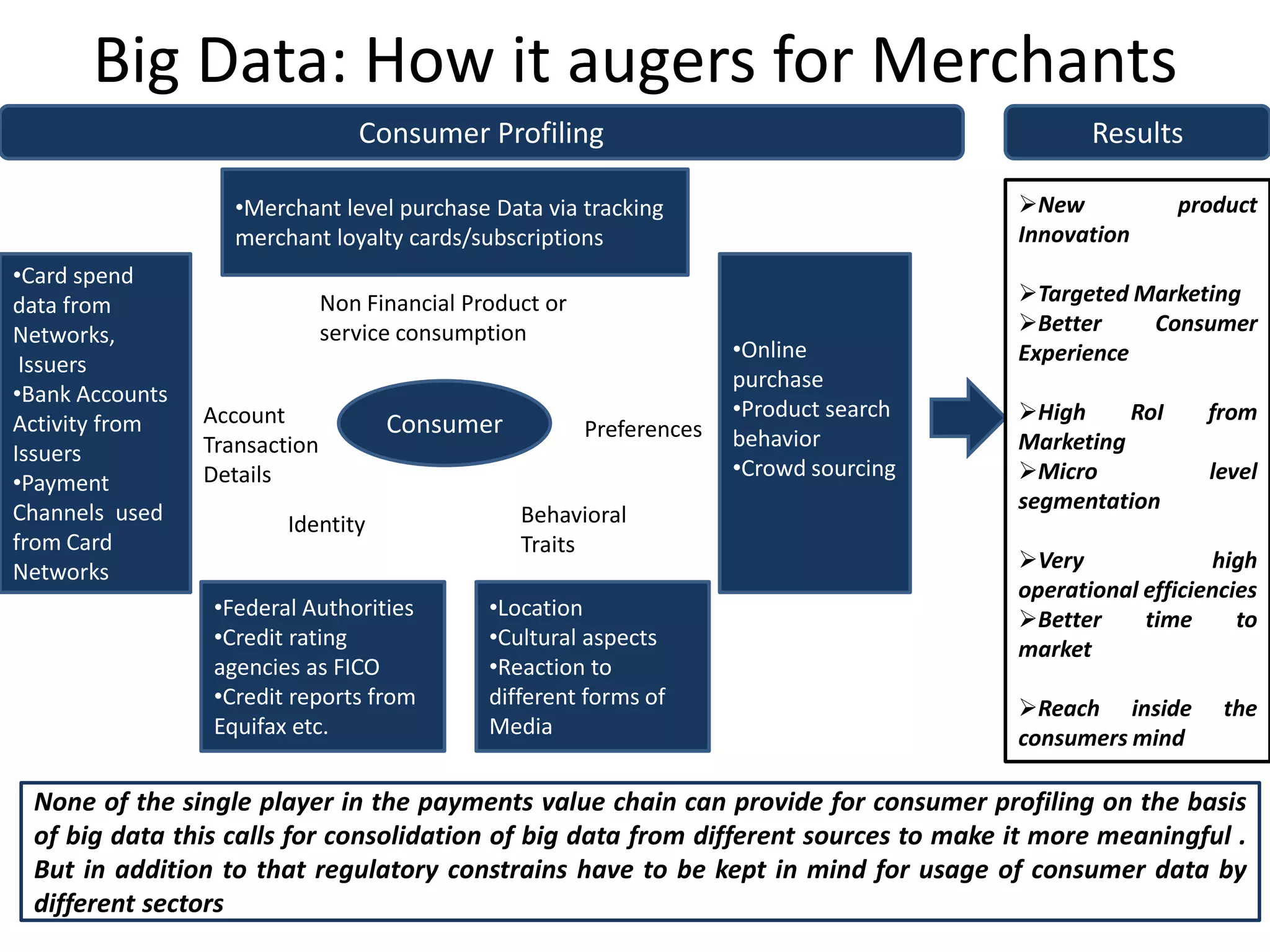
Big Data: How it augers for Merchants
Consumer Profiling
None of the single player in the payments value chain can provide for consumer profiling on the basis
of big data this calls for consolidation of big data from different sources to make it more meaningful .
But in addition to that regulatory constrains have to be kept in mind for usage of consumer data by
different sectors
Consumer
Non Financial Product or
service consumption
Account
Transaction
Details
Identity Behavioral
Traits
Preferences
•Card spend
data from
Networks,
Issuers
•Bank Accounts
Activity from
Issuers
•Payment
Channels used
from Card
Networks
•Federal Authorities
•Credit rating
agencies as FICO
•Credit reports from
Equifax etc.
•Merchant level purchase Data via tracking
merchant loyalty cards/subscriptions
•Location
•Cultural aspects
•Reaction to
different forms of
Media
•Online
purchase
•Product search
behavior
•Crowd sourcing
New product
Innovation
Targeted Marketing
Better Consumer
Experience
High RoI from
Marketing
Micro level
segmentation
Very high
operational efficiencies
Better time to
market
Reach inside the
consumers mind
Results
Big Data Ecosystem
Big Data Analytics in Payments
Big Data for Acquiring Segment
Big Data Analytics aiding in Revenue Advantage
Knowing the Pulse of the customer
Operational Efficiency and competitive advantage
Reference Architecture
1
2
3
4
5
6
7
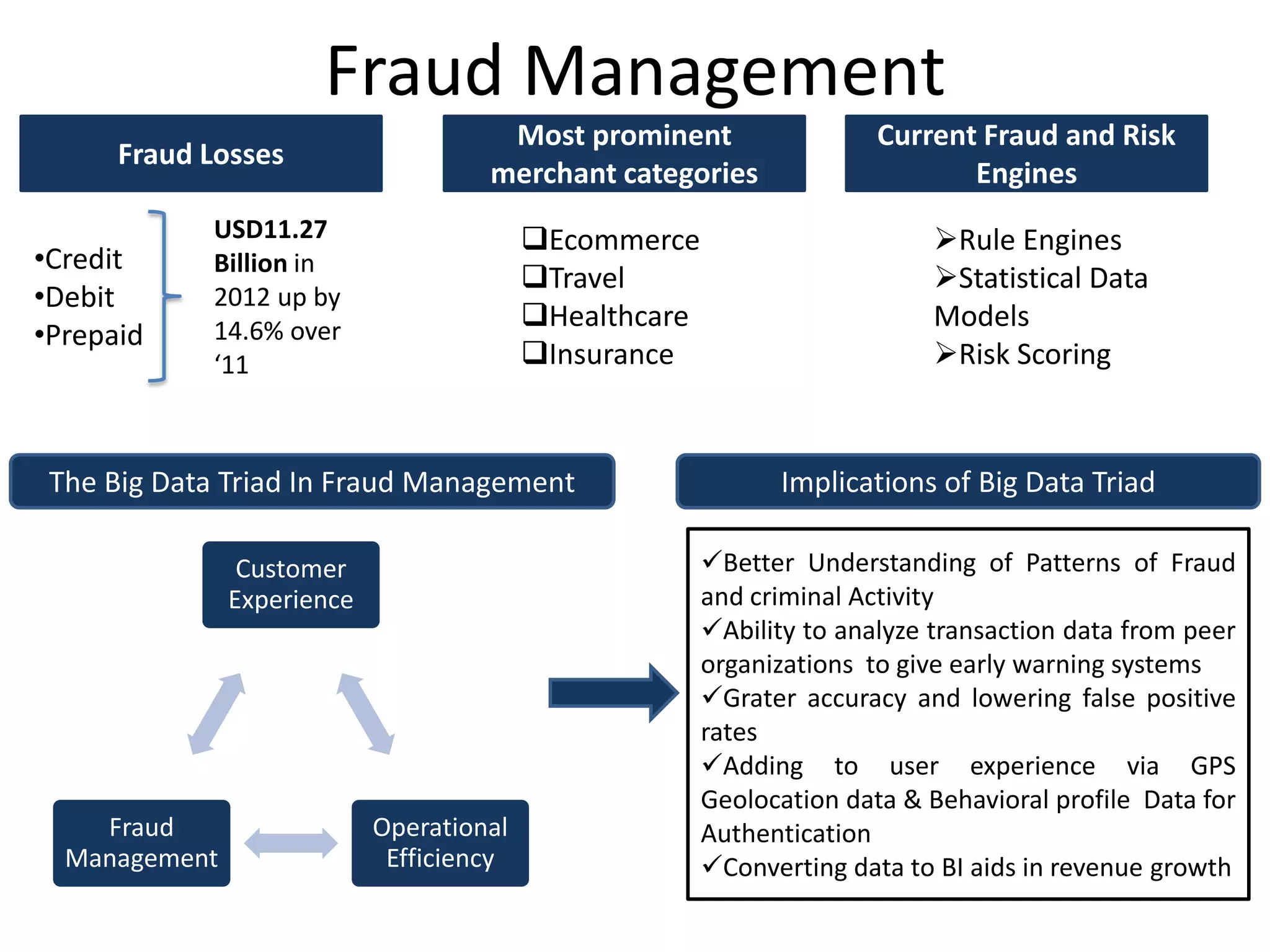
Fraud Management
Fraud Losses
•Credit
•Debit
•Prepaid
USD11.27
Billion in
2012 up by
14.6% over
‘11
Most prominent
merchant categories
Ecommerce
Travel
Healthcare
Insurance
Customer
Experience
Operational
Efficiency
Fraud
Management
The Big Data Triad In Fraud Management
Better Understanding of Patterns of Fraud
and criminal Activity
Ability to analyze transaction data from peer
organizations to give early warning systems
Grater accuracy and lowering false positive
rates
Adding to user experience via GPS
Geolocation data & Behavioral profile Data for
Authentication
Converting data to BI aids in revenue growth
Implications of Big Data Triad
Current Fraud and Risk
Engines
Rule Engines
Statistical Data
Models
Risk Scoring
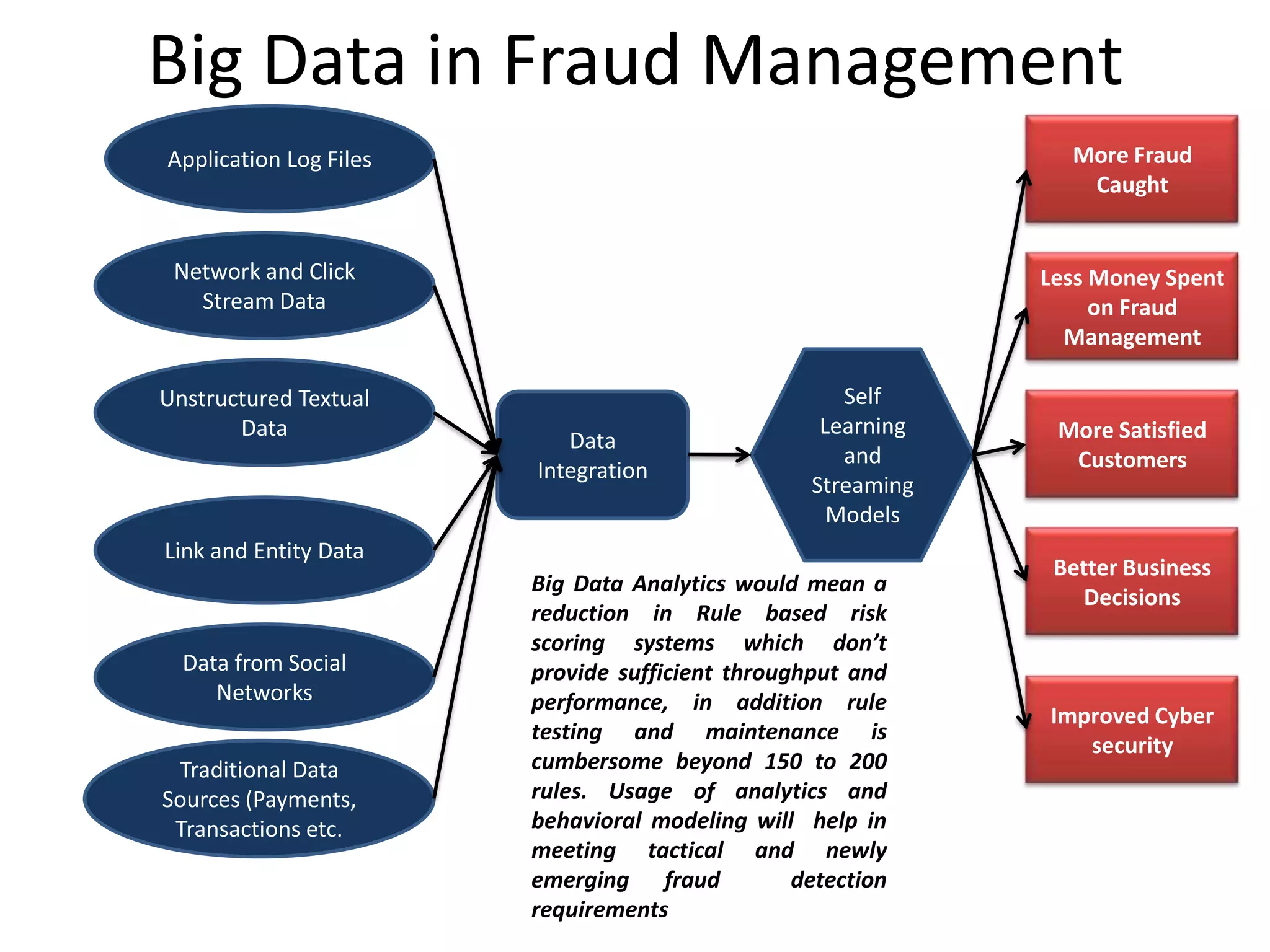
Big Data in Fraud Management
Application Log Files
Network and Click
Stream Data
Data from Social
Networks
Link and Entity Data
Unstructured Textual
Data
Traditional Data
Sources (Payments,
Transactions etc.
Data
Integration
Self
Learning
and
Streaming
Models
More Fraud
Caught
Less Money Spent
on Fraud
Management
More Satisfied
Customers
Better Business
Decisions
Improved Cyber
security
Big Data Analytics would mean a
reduction in Rule based risk
scoring systems which don’t
provide sufficient throughput and
performance, in addition rule
testing and maintenance is
cumbersome beyond 150 to 200
rules. Usage of analytics and
behavioral modeling will help in
meeting tactical and newly
emerging fraud detection
requirements
Big Data Ecosystem
Big Data Analytics in Payments
Big Data for Acquiring Segment
Big Data Analytics aiding in Revenue Advantage
Knowing the Pulse of the customer
Operational Efficiency and competitive advantage
Reference Architecture
1
2
3
4
5
6
7
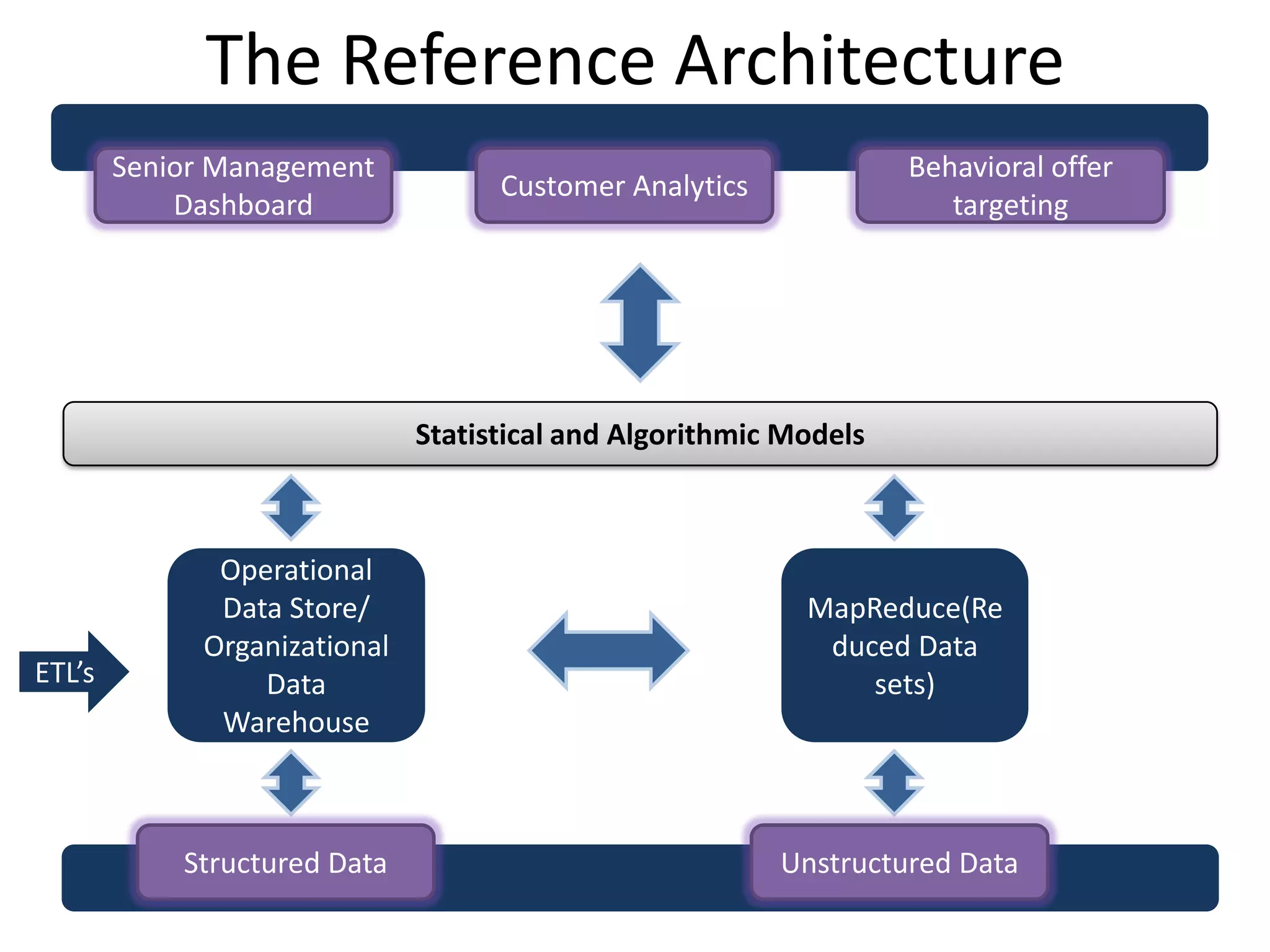
The Reference Architecture
Senior Management
Dashboard
Customer Analytics
Behavioral offer
targeting
Statistical and Algorithmic Models
Operational
Data Store/
Organizational
Data
Warehouse
MapReduce(Re
duced Data
sets)
Structured Data Unstructured Data
ETL’s

Big data analytics in payments

  • 1.
  • 2.
    Big Data Ecosystem BigData Analytics in Payments Big Data for Acquiring Segment Big Data Analytics aiding in Revenue Advantage Knowing the Pulse of the customer Operational Efficiency and competitive advantage Reference Architecture 1 2 3 4 5 6 7
  • 3.
    Big Data Ecosystem VarietyVolume Value Velocity Big Data Ecosystem Location Data Mobile Fraud Data RFID ERP Sensor Data Social Networking Data ClickStream Data Point of sale Transaction Data Big (Bad) Data
  • 4.
    Big Data: KeyFeaturesVolume Unstructured information Structured information Velocity Variety Value Visualization How to leverage huge volumes of unstructured data to take a calculated business decision Value More robust fraud and risk systems Running Targeted Campaigns for the customers Helpful in designing performance based fee model for merchants on basis of no of customers etc. Visualization Conversion of unstructured data into relational data Natural Language processing Semantics Analysis of consumer data  Identify trends in fraud, risk, consumer spend etc.
  • 5.
    Action Time Value vs.Data Latency Business Idea/Event Data Ready for Analysis Information Delivered Valuelost Data Latency Analysis Latency Analysis Latency Most of the value of data is lost from the data recording to an analysis phase which encompasses conversion of unstructured info. to structured data seamlessly for analysis In some of the cases a score is provided depending upon the latency of data in order to make it usable but the usability of such data in payments still remains a question mark except in macro level predictive analysis
  • 6.
    As per ForresterResearch Most banks indicated that the main hindrance to their big data adoption plan was cost. Integration costs are not insignificant; for starters, one needs to integrate their analytics platforms to more data sources and invest in more hardware to increase compute power and storage capacity. As per the report some of the One of the leading issuing banks and ISO’s in US said that the price tag of big data would not provide an ROI from incremental savings for at least another two years.
  • 7.
    Big Data Ergonomics 0.81.9 7.9 35 0 5 10 15 20 25 30 35 40 2009 2011 2015 2020 Growth of Global Data Zetta Bytes •The proliferation of the internet and the mobile era has increased the rate at which data is created and stored; hence, there is a need for tools and techniques to analyze data at an equal speed •80% of the data available today is unstructured and includes raw text, audio/video files, click-stream data, blogs, social media, location coordinates, purchase patterns etc. •Banks and ISO’s are increasingly realizing that unstructured data, if analyzed, can provide a competitive edge to them and the merchants Implications for Payment Companies •Need for large storage capacity •Need for quick retrieval of data •Enable informed decision making by effectively leveraging large datasets •Example:- •Turn 12TB of tweets created each day into improved product sentiment analysis •Convert 350 billion annual purchases at a certain merchant store to predict demand forecast and consumer buying behavior Storage Costs *Source: Nasscom 18.9 1.6 0.7 0 5 10 15 20 2005 2011 2015 USD/Gigabyte *Source: Nasscom
  • 8.
    Big Data Ecosystem BigData Analytics in Payments Big Data for Acquiring Segment Big Data Analytics aiding in Revenue Advantage Knowing the Pulse of the customer Operational Efficiency and competitive advantage Reference Architecture 1 2 3 4 5 6 7
  • 9.
    Big Data AnalyticsBigData Production Big Data Management Big Data Consumption Transaction History Transaction Geo Location Merchant Category Code Website Click stream Data Textual Data ATM Specific Info. Purchase Channel Social Media Crowd sourcing Customer Database Customer Complaints Big Data Quality Large Scale Gathering of Raw Data Storage Security Analytics Databases Improve Big Data Quality Data Mining Targeted Marketing Loyalty Digital Marketing Product Innovation Fraud & Risk Security Commercialization
  • 10.
    Big Data inpayments value chain Merchants Issuers AcquirersISO’s Card Networks New product Ideation and enhancements  Customer Spending pattern; geography wise, location wise, time zone wise, targeted offers  loyalty New product launches  Product enhancements Customer Spend Analytics  Chargeback analytics Customer feedback on existing products  Risk and Fraud Analytics Dismissing false proofs resulting in improvement of quality of transactions Customer Spend Analytics Risk and Fraud Analytics New product Ideation Customer feedback Crowd Sourcing Chargeback Analytics Merchant fraud analytics  Risk and Fraud Analytics  Aiding analytics for merchants at all levels Chargeback Analytics Merchant fraud analytics  Risk and Fraud Analytics  Aiding analytics for merchants at all levels
  • 11.
    Big Data Ecosystem BigData Analytics in Payments Big Data for Acquiring Segment Big Data Analytics aiding in Revenue Advantage Knowing the Pulse of the customer Operational Efficiency and competitive advantage Reference Architecture 1 2 3 4 5 6 7
  • 12.
    Big Data forAcquiring Segment The Big Data ecosystem for the Acquirers revolves around the following key parameters Revenue Advantage Operation Efficiency Knowing pulse of customer Competitiveness
  • 13.
    Big Data Ecosystem BigData Analytics in Payments Big Data for Acquiring Segment Big Data Analytics aiding in Revenue Advantage Knowing the Pulse of the customer Operational Efficiency and competitive advantage Reference Architecture 1 2 3 4 5 6 7
  • 14.
    Big Data Leversfor Merchants Functions Big Data Levers Marketing Operations Merchandise Loyalty New Business Models •Cross Selling of similar products •Customer Micro-segmentation •Sentiment Analysis for merchants •Geo-Location & Clock based Marketing •Price Comparison Services •Web Based Markets/New Store Placements •Dispute management services •Clear reconciliation of gross reportable sales from store level to TIN level data •Tracking of the transaction data of the merchants to initiate the loyalty loop for merchants •Mobile coupons in case of usage of mobile wallets •The merchandise to be sold online/offline •Product innovation/ Existing product augmentation
  • 15.
    Macro Level DataAnalytics Economy Level Data Analytics • The payment processors/networks can provide a holistic overview of economic outlook based on spending data • This can aid merchants in taking investment decisions for new geographies Brand Perception (Comparative Analysis) • A comparative intelligence about the brand when compared to its competition • Aids merchants in benchmarking, and understanding consumer preferences/attitudes Diversification of Payment Channels • This diversification can be judged by analysis of transactions data via understanding channel preferences on the basis of customer spend analytics Finding Best Partners on Basis of Transaction Data Analytics • The analytics data helps in improving the value proposition of co-branded cards • Finding out the most profitable merchant partner Chargeback and Retrieval Analytics • This feature would help in avoiding chargeback due to non retrieval/failure to provide copy of transaction receipts and in turn would improve in making the quality of transactions better
  • 16.
    Big Data inLoyalty Method Dimensionality Predictive Power Scalability Real Time Potential Application Areas Next best offer analytics     Customer retention and loyalty, personalization Social network and influencer analytics   Customer retention and loyalty, new product development Geospatial/location analytics    Targeting, personalization, site selection Customer journey/ path analysis    Marketing attribution, customer life-cycle planning, offer management Social & voice-of customer text Analysis   Message and content development, customer service
  • 17.
    Big Data Ecosystem BigData Analytics in Payments Big Data for Acquiring Segment Big Data Analytics aiding in Revenue Advantage Knowing the Pulse of the customer Operational Efficiency and competitive advantage Reference Architecture 1 2 3 4 5 6 7
  • 18.
    Big Data: Howit augers for Merchants Consumer Profiling None of the single player in the payments value chain can provide for consumer profiling on the basis of big data this calls for consolidation of big data from different sources to make it more meaningful . But in addition to that regulatory constrains have to be kept in mind for usage of consumer data by different sectors Consumer Non Financial Product or service consumption Account Transaction Details Identity Behavioral Traits Preferences •Card spend data from Networks, Issuers •Bank Accounts Activity from Issuers •Payment Channels used from Card Networks •Federal Authorities •Credit rating agencies as FICO •Credit reports from Equifax etc. •Merchant level purchase Data via tracking merchant loyalty cards/subscriptions •Location •Cultural aspects •Reaction to different forms of Media •Online purchase •Product search behavior •Crowd sourcing New product Innovation Targeted Marketing Better Consumer Experience High RoI from Marketing Micro level segmentation Very high operational efficiencies Better time to market Reach inside the consumers mind Results
  • 19.
    Big Data Ecosystem BigData Analytics in Payments Big Data for Acquiring Segment Big Data Analytics aiding in Revenue Advantage Knowing the Pulse of the customer Operational Efficiency and competitive advantage Reference Architecture 1 2 3 4 5 6 7
  • 20.
    Fraud Management Fraud Losses •Credit •Debit •Prepaid USD11.27 Billionin 2012 up by 14.6% over ‘11 Most prominent merchant categories Ecommerce Travel Healthcare Insurance Customer Experience Operational Efficiency Fraud Management The Big Data Triad In Fraud Management Better Understanding of Patterns of Fraud and criminal Activity Ability to analyze transaction data from peer organizations to give early warning systems Grater accuracy and lowering false positive rates Adding to user experience via GPS Geolocation data & Behavioral profile Data for Authentication Converting data to BI aids in revenue growth Implications of Big Data Triad Current Fraud and Risk Engines Rule Engines Statistical Data Models Risk Scoring
  • 21.
    Big Data inFraud Management Application Log Files Network and Click Stream Data Data from Social Networks Link and Entity Data Unstructured Textual Data Traditional Data Sources (Payments, Transactions etc. Data Integration Self Learning and Streaming Models More Fraud Caught Less Money Spent on Fraud Management More Satisfied Customers Better Business Decisions Improved Cyber security Big Data Analytics would mean a reduction in Rule based risk scoring systems which don’t provide sufficient throughput and performance, in addition rule testing and maintenance is cumbersome beyond 150 to 200 rules. Usage of analytics and behavioral modeling will help in meeting tactical and newly emerging fraud detection requirements
  • 22.
    Big Data Ecosystem BigData Analytics in Payments Big Data for Acquiring Segment Big Data Analytics aiding in Revenue Advantage Knowing the Pulse of the customer Operational Efficiency and competitive advantage Reference Architecture 1 2 3 4 5 6 7
  • 23.
    The Reference Architecture SeniorManagement Dashboard Customer Analytics Behavioral offer targeting Statistical and Algorithmic Models Operational Data Store/ Organizational Data Warehouse MapReduce(Re duced Data sets) Structured Data Unstructured Data ETL’s

Editor's Notes

  • #22 Higher fraud detection rates. The ability to process significantly more information, store it forlonger periods of time, and incorporate shared information about transactions will give S&R prosa much better understanding of the patterns of fraud and criminal activity in their environmentand the ability to respond to any new threats more quickly. The ability to incorporate and analyzemore transaction data about users from peer organizations and consortiums, such as EarlyWarning System, will allow for even greater accuracy and lowering of false positive rates. Forexample, ATM transactions in the vicinity of high-crime areas, fraudulent credit cardtransactions at other online eCommerce sites, credit card applications coming from a computeror mobile device with prior fraud reputation, should all be subject to greater scrutiny. In thefuture, Forrester expects false positive rates to improve from 5:1 today to 3:1.■ Less money spent on fraud management. Using faster algorithms to process more data allowsfor faster, even real-time, integration of data across multiple channels such as phone, web, andmobile and yields a faster cross-channel analytics system. Now, fraud analysts can view a muchricher context of transactions in real time. As a result, they can evaluate referred transactionsFor Security & Risk ProfessionalsBig Data In Fraud Management: Variety Leads To Value And Improved Customer Experience more quickly and accurately. Big data will allow vendors to provide self-learning models thatthey will not have to retrain as frequently, resulting in less frequent model updates. In the future,Forrester expects model updates to occur every 12 to 18 months, a major improvement from sixto nine months today.■ More-satisfied customers. Higher fraud detection rates, coupled with higher accuracy, meansthat analysts will not decline or flag for review the legitimate transactions of good customers.It also will help to reduce the friction of conducting transactions. Rather than inundate userswith multiple screens and security questions for authentication, using and correlating datafrom more information sources, such as GPS geolocation data and behavioral profile data,the organization can authenticate the user. This can be particularly helpful when users areconducting online banking transactions from a mobile phone.3 A North American bank toldForrester that it plans to ask users to switch on their mobile phones with an online bankingapplication in foreign, high-fraud-rate countries during the time they conduct an ATMwithdrawal transaction — and thus lower false fraud alerts and fraud losses as well.■ Better business decisions. The availability of richer data sets will make the process of turningdata into information, then knowledge, and then action much faster and will require fewerhuman interactions. This will lead to better conversion of fraud management data, such aspayments for certain SKU information on an e-Commerce site, into better business intelligenceinformation, such as how to arrange goods on an electronic storefront. The organizationcan use this business intelligence not just for fraud detection but for better targeting of userswith special offers, more-effective ad campaigns for cross-sell and upsell, and better strategicorganization of the company.■ Improved cybersecurity. Security breaches or attacks against a site or set of channels oftenfollow fraud. Looking at more and greater variety of data (e.g., logs, social media, socialnetworks, link analytics, etc.) not only improves early fraud detection but can also help toidentify security breaches and shorten response times to new and emerging threats. Forexample, a device fingerprint for a machine making fraudulent purchases or submittingfraudulent loan applications may also be implicated in exfiltrating sensitive information.