International Journal of Trend in Scientific Research and Development (IJTSRD)
Volume 7 Issue 6, November-December 2023 Available Online: www.ijtsrd.com e-ISSN: 2456 – 6470
@ IJTSRD | Unique Paper ID – IJTSRD60102 | Volume – 7 | Issue – 6 | Nov-Dec 2023 Page 274
Credit Card Fraud Detection Using
Hybrid Machine Learning Algorithm
Tripti Gautam1, Ghanshyam Sahu2, Lalit Kumar P. Bhiaya3
1
M Tech Scholar, CSE Department, BCET, Durg, Chhattisgarh, India
2
Professor, CSE Department, BCET, Durg, Chhattisgarh, India
3
Associate Professor, Bharti University, Durg, Chhattisgarh, India
ABSTRACT
As we know and living in the era of digital world, Credit card fraud is
increasing rapidly by transactions of unauthorized or any fraudulent
use of someone else information of credit card to purchase and obtain
benefits of financial. The victims of credit card fraud may have
severe repercussions. Financial losses, harm to credit scores, and the
trouble of dealing with unauthorized transactions can all arise from it.
Secure your card information, keep a close eye on your account
activity, and alert your card issuer right away to any odd transactions
if you want to prevent credit card theft. To help combat fraud, many
financial institutions additionally provide extra security features like
two-factor authentication and fraud detection systems. To resolve
these problem we developed a system of Credit Card Fraud detection
by hybrid techniques of machine learning which combines supervised
and unsupervised methods to improve the system of fraud detection.
In this paper we are using machine learning algorithms like K
Nearest Neighbor, Logistic Regression and XGBoost model and we
had made a comparison of accuracy score with other different models
by using the data of European Cardholders 2013, by that data we had
make comparison and decided that which model is best for defining
the fraud system of credit card.
KEYWORDS: Credit Card, Fraud Detection, Fraud Detection
Framework, Supervised and Unsupervised Techniques
How to cite this paper: Tripti Gautam |
Ghanshyam Sahu | Lalit Kumar P.
Bhiaya "Credit Card Fraud Detection
Using Hybrid Machine Learning
Algorithm" Published in International
Journal of Trend in
Scientific Research
and Development
(ijtsrd), ISSN:
2456-6470,
Volume-7 | Issue-6,
December 2023,
pp.274-279, URL:
www.ijtsrd.com/papers/ijtsrd60102.pdf
Copyright © 2023 by author (s) and
International Journal of Trend in
Scientific Research and Development
Journal. This is an
Open Access article
distributed under the
terms of the Creative Commons
Attribution License (CC BY 4.0)
(http://creativecommons.org/licenses/by/4.0)
INTRODUCTION
We are advancing into the digital age, and
cybersecurity is playing an increasingly important
role in our daily lives. The primary problem when
discussing digital life security is identifying unusual
behaviour. Credit cards are often preferred by many
people when they transact online or buy something.
Credit card credit limits occasionally enable us to
make purchases even when we don't have the money
on hand. On the other hand, online criminals abuse
these features.
Credit card fraud can be done in various ways like
Phishing: where deceive people into entering their
credit card information on phoney websites, emails or
text. To win trust and obtain sensitive information,
these scam pose as reliable institutions.
Data Breaching: online, it means if any company's
systems are breached, hackers may able to access any
credit card data of its customers. The stolen
information may be utilised in fraudulent transactions
or sold on the black market for their use
Card skimming: it is when a card is swiped or
inserted at an ATM, a payment terminal or a petrol
pump, fraudsters employ tools called skimmers to
record credit card information. The stolen information
is then used to build fake cards or buy things online.
The examination of a card's spending patterns and
classification of its transactions into fraudulent and
lawful transactions form the basis for the detection of
credit card fraud. There are many challenges in
detecting credit card fraud:
Due to privacy and security considerations, credit
card transaction datasets are rarely available, and the
ones that are are greatly skewed. Fraudulent
behaviour patterns are dynamic in nature, meaning
that fraudulent transactions typically look legitimate.
IJTSRD60102
International Journal of Trend in Scientific Research and Development @ www.ijtsrd.com eISSN: 2456-6470
@ IJTSRD | Unique Paper ID – IJTSRD60102 | Volume – 7 | Issue – 6 | Nov-Dec 2023 Page 275
Related Work
In this paper we are defining and analyzing many
machine learning algorithms that can help us classify
abnormal transactions. The only requirement is the
past data and the suitable algorithm that can fit our
data in a better form. It helps you in the complete
end-to-end model training process and finally, we will
get the best model that can classify the transaction
into normal and abnormal types.
First, we describe what is supervised and
unsupervised modes and algorithms which we
approached for our model. Secondly, the algorithms
which we used to researched and analyzed over credit
card fraud detection
1. Supervised and Unsupervised
A. Supervised Learning-A type of machine learning
called supervised learning uses labelled data to
teach the algorithm new things. Labelled data is a
term used to describe input samples that come
with the required output labels. The purpose of
supervised learning is to build a model that
generalises and can correctly classify or predict
unknown or upcoming data.The training data
serves as a teacher in supervised learning,
instructing the algorithm on how to learn the
correspondence between input features and their
related labels. When given new, unlabeled
examples, the algorithm looks for patterns,
correlations, or decision boundaries in the data to
create predictions.
B. Unsupervised Learning- As the name implies,
unsupervised learning entails learning from
unlabeled data. Without any predefined labels or
goal outcomes, the algorithm in unsupervised
learning investigates the data to discover innate
patterns, structures, or relationships. Finding
hidden patterns or clusters in the data is the goal.
In unsupervised learning, the algorithm attempts
to cluster or group together related data points
based on their shared characteristics. It seeks to
discover the data's underlying distribution or to
isolate important features for future investigation
or decision-making.
2. Algorithms
In this paper we used some supervised and
unsupervised algorithm for the comparison and dis
A. Linear Regression- It is a simple and frequently
used algorithm, by fitting and observing data in
the model through connecting a dependent and
independent variables. Finding the best-fitting
line that reduces the discrepancy between the
anticipated and actual values of the dependent
variable is the aim of linear regression. The
equation below represents the line:
y= mx + b
where
y is the dependent variable/ response / goal variable
x is independent variable/feature/predictor variable,
The slope of the line, m, shows how much the change
in y changes when the x value changes by a unit.The
value of y when x is 0 is represented by the y-
intercept, or b.
B. Logistic Regression- the objective is to predict a
binary outcome (e.g., true/false, yes/no, 0/1)
based on a set of independent variables or
features, logistic regression is a popular
supervised learning approach. Contrary to its
name, logistic regression is typically employed to
solve classification issues as opposed to
regression issues. The logistic function, also
referred to as the sigmoid function, is used by the
logistic regression model to translate the linear
combination of independent variables to the
interval [0, 1].
p = 1 / (1 + e^(-z))
Where:
The positive class's anticipated probability is denoted
by the letter p.
The independent variables are combined linearly to
form the variable z.
The feature vector (x), learning weights (coefficients)
of the model, and an intercept term (b) are used to
create the linear combination (z).
C. Naive Bayes -The Bayes theorem of probability
serves as its foundation, and it makes the
assumption that the features are conditionally
independent given the class. Naive Bayes is a
well-liked option for text categorization tasks like
spam filtering and sentiment analysis due to its
popularity and computational efficiency despite
its simplicity and "naive" premise. Naïve Bayes
works on Data Preparation, Calculating Class
Priors, Calculating Feature Likelihoods,
Calculating Posterior Probability, Class
Prediction
D. K-Nearest Neighbors (KNN) -Machine learning
commonly uses the K-Nearest Neighbors (KNN)
algorithm for both classification and regression
problems. It is a non-parametric and instance-
based learning method, which means it depends
on the training data alone to produce predictions
rather than making firm assumptions about the
distribution of the underlying data. KNN works as
follows, Data Preparation, Choosing K,
Calculating Distances, Finding K Neighbors,
International Journal of Trend in Scientific Research and Development @ www.ijtsrd.com eISSN: 2456-6470
@ IJTSRD | Unique Paper ID – IJTSRD60102 | Volume – 7 | Issue – 6 | Nov-Dec 2023 Page 276
Class Prediction (Classification), Value
Prediction (Regression)
E. Random Forest - An effective and popular
ensemble learning algorithm in machine learning
is Random Forest. It is well-liked for both
classification and regression tasks and is a
member of the family of decision tree-based
techniques. For more precise and reliable
forecasts, Random Forest aggregates the
predictions of various separate decision trees.
Basically it works on Data Preparation, Random
Sampling, Growing Decision Trees, Ensemble
Prediction.
Because of its reliability, adaptability, and strong
generalisation skills, Random Forest has gained
popularity across many fields. Compared to
individual decision trees, it is less prone to overfitting
and is successful with complicated datasets. However,
compared to simpler models, it can be more difficult
to read the results and comprehend how Random
Forest makes decisions.
F. Gradient Boosting Algorithms : A group of
machine learning techniques known as gradient
boosting algorithms combine a collection of weak
prediction models, often decision trees, to
produce a powerful predictive model. Gradient
boosting's main principle is to iteratively create new
models that fix the errors created by the prior models,
enhancing the performance of prediction as a whole.
It works on Gradient Boosting Machine (GBM),
XGBoost: XGBoost (Extreme Gradient Boosting),
LightGBM, CatBoost, Ensemble of Weak Learners,
Loss Function Optimization, Regularization
Working Performances
A. Parameters for Analysis
We use a number of parameters to assess the
performance of a specific model. The number of
correct predictions versus the number of incorrect
guesses is plotted in a confusion matrix, a summary
table that demonstrates how accurate the model is at
making predictions. Four categories make up it:
True Positive (TP), where the actual value and the
projected value agree. The model anticipated a
positive value, and the actual result was positive.
True Negative (TN), where the actual value and the
projected value are identical.
False Positive (FP) means that the predicted value in
this case was incorrectly predicted. Although the
model had projected a positive result, the actual value
was negative.
False Negative (FN) describes a situation in which
the model incorrectly predicted a result that was
actually positive when it should have been negative.
Accuarcy: The number of accurate predictions your
model made is a measure of accuracy. It is a solid
fundamental metric to gauge a model's performance,
but a simple accuracy metric has the drawback of
being better in balanced datasets and worse in
unbalanced datasets.
= ( + ) / + + +
Out of all the positives in the dataset, recall measures
how many real positives are anticipated. A high recall
indicates that the majority of positive cases were
classified as such. There are a lot of false negatives
when recall is low.
= /( + N)
Precision is the degree to which a positive forecast is
accurate is measured by precision. This phrase asks
how certain you may be that a result is actually
positive if it is projected to be positive.
= / +
F1, or their harmonic mean, combines precision and
memory. When maintaining the proper balance
between recall and precision, it is necessary.
1 = 2 ( ∗ )/ ( + )
B. DATA SET
We had taken a data set of the actual bank
transactions that European cardholders conducted in
2018 are included in this dataset. The original
variables have been changed PCA versions since
sharing them would compromise security. Thus, there
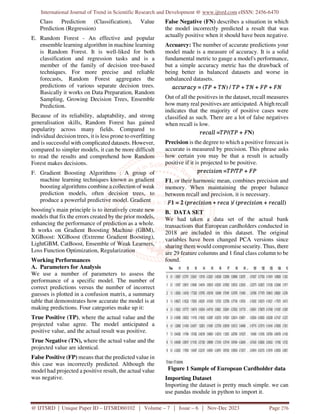
are 29 feature columns and 1 final class column to be
found.
Figure 1 Sample of European Cardholder data
Importing Dataset
Importing the dataset is pretty much simple. we can
use pandas module in python to import it.
International Journal of Trend in Scientific Research and Development @ www.ijtsrd.com eISSN: 2456-6470
@ IJTSRD | Unique Paper ID – IJTSRD60102 | Volume – 7 | Issue – 6 | Nov-Dec 2023 Page 277
Data Processing
The dataset is imbalanced towards a feature. Which
seems pretty valid for such kind of data. Because
today many banks have adopted different security
mechanisms — so it is harder for hackers to make
such moves.
Still, sometimes when there is some vulnerability in
the system — the chance of such activities can
increase.
That’s why we can see the majority of transactions
belongs to our datasets are normal and only a few
percentages of transactions are fraudulent. can also
check for null values
Figure 2 Sample of data types
Result Analysis
The experiment's dataset was obtained from the
Cardholders of 2018 in website. It includes credit
card transactions from 2013. The dataset has 492 out
of the 284,807 total transactions that are marked as
fake. Due to the 0.173% fraud cases, the data is
therefore deemed to be imbalanced. The distribution
of the dataset is shown in Figure 1. Without the
column labels, there are 30 columns. A PCA
projection was applied to all columns with the
exception of the time and amount features in order to
preserve privacy. All columns are therefore numerical
variables. The two classes are broken down in the
labels columns, where a genuine transaction is
represented by a value of 0 and a fraudulent
transaction by a value of 1
Figure 3 Distribution of Data Sets
Figure 4 Collection of Customer profile data’s in
30 rows
In figure 2 We can make a quick check that the
generated transactions follow the customer profile
properties:
 The terminal IDs are indeed those in the list of
available terminals (0, 1, 2 and 3)
 The transaction amounts seem to follow the
amount parameters of the customer
(mean_amount=62.26 and std_amount=31.13)
 The number of transactions per day varies
according to the transaction frequency parameters
of the customer (mean_nb_tx_per_day=2.18).
Now produce the transactions for each and every
customer. Using the pandas groupby and apply
methods, this is simple:
“transactions_df=customer_profiles_table.
Groupby ('CUSTOMER_ID').
apply (lambda x: generate_transactions_table
(x.iloc[0], nb_days=5)).
reset_index(drop=True)
transactions_df “
International Journal of Trend in Scientific Research and Development @ www.ijtsrd.com eISSN: 2456-6470
@ IJTSRD | Unique Paper ID – IJTSRD60102 | Volume – 7 | Issue – 6 | Nov-Dec 2023 Page 278
Figure 5 Graph of Transaction Table of
Customers
Analysis
MODELS ACCURACY F1 SCORE
DECISION TREE 0.999288 0.776255
K NEAREST
NEIGHBOURS
0.9995066 0.836538462
LOGISTIC
REGRESSION
0.9991148 0.693467337
SUPPORT VECTOR
MACHINES
0.99936154 0.77777777
RANDOM FOREST 0.999361 0.78431372
XG BOOST 0.9995211 0.842105263
Figure 6 Result Analysis
Figure 7 Graph of Accuracy and F Score
Conclusion:
In order to identify fraudulent transactions from a
sizable unbalanced dataset, we have constructed
different supervised models. Accuracy, and F1 score
comparison statistics have been provided, and the
percentage of properly recognising fraudulent
transactions is the comparison parameter. In
situations where it misrepresents a machine learning
technique, accuracy can actually be deceptive. For
instance, the local outlier factor performs poorly
based on accuracy and F1 values while having a
99.67% accuracy rate. So, when choosing the
optimum algorithm for fraud detection, precision,
recall, and F1 score values are important
considerations. The most effective supervised
learning algorithm is the XGboost algorithm, and
support vector machine outperforms all other
algorithms.
References:
[1] Abhinav Srivastava, Amlan Kundu, Shamik
Sural, Arun K. Majumdar, “Credit Card Fraud
Detection using Hidden Markov Model,” IEEE
Transactions On Dependable And Secure
Computing, vol. 5, Issue no. 1, pp.37-48,
January-March 2008
[2] Schneider, Gary (2010). Electronic Commerce.
Cambridge: Course Technology.
p. 497. ISBN 978-0-538-46924-1.
[3] S. Benson Edwin Raj, A. Annie Portia,
“Analysis on Credit Card Fraud Detection
Methods”, International Conference on
Computer, Communication and Electrical
Technology – ICCCET2011, 18th & 19th
March, 2011
[4] Seeja, K. R., and Zareapoor, M., (2014).
FraudMiner: A Novel Credit Card Fraud
Detection Model Based on Frequent Itemset
Mining, The Scientific World Journal, Hindawi
Publishing Corporation, Volume 2014, Article
ID 252797, pp. 1 – 10,
http://dx.doi.org/10.1155/2014/252797
[5] The Nilson Report. (2015). U.S. Credit & Debit
Cards 2015. David Robertson
[6] Bolton, R. J. and Hand, D. J., (2001).
Unsupervised profiling methods for fraud
detection, Conference on Credit Scoring and
Credit Control, Edinburgh.
[7] Kou, Y., Lu, C-T., Sinvongwattana, S. and
Huang, Y-P., (2004). Survey of Fraud
Detection Techniques, In Proceedings of the
2004 IEEE International Conference on
Networking, Sensing & Control, Taipei,
Taiwan, March 21-23.
[8] Bhattacharyya, S., Jha, S., Tharakunnel, K.,
Westland, J.C.: Data mining for credit card
fraud: a comparative study. Decis. Support
Syst. 50(3), 602–613 (2011)
[9] Padvekar SA, Kangane PM, Jadhav KV (2016)
Credit card fraud detection system. Int J Eng
Comput Sci 5(4):16183–16186
International Journal of Trend in Scientific Research and Development @ www.ijtsrd.com eISSN: 2456-6470
@ IJTSRD | Unique Paper ID – IJTSRD60102 | Volume – 7 | Issue – 6 | Nov-Dec 2023 Page 279
[10] Xuan S, Liu G, Li Z, Zheng L, Wang S, Jiang C
(2018) Random forest for credit card fraud
detection. In: ICNSC 2018—15th IEEE
International conference on networking,
sensing and control, pp 1–6
[11] Fernandes, E. R., & de Carvalho, A. C.
“Evolutionary inversion of class distribution in
overlapping areas for multi-class imbalanced
learning”. Information Sciences, 2019, 494,
141–154
[12] Das, S., Datta, S., & Chaudhuri, B. B.,
“Handling data irregularities in classification:
Foundations, trends, and future challenges.
Pattern Recognition”, 2018, 81, 674–693.
[13] Lee, H. K., & Kim, S. B. “An overlap-sensitive
margin classifier for imbalanced and
overlapping data. Expert Systems with
Applications”,2018, 98, 72–83.
[14] Zhou, C., & Paffenroth, R. C. “Anomaly
detection with robust deep autoencoders”, In
Proceedings of the 23rd ACM SIGKDD
International Conference on Knowledge
Discovery and Data Mining, 2017(pp. 665–
668)

Credit Card Fraud Detection Using Hybrid Machine Learning Algorithm

  • 1.
    International Journal ofTrend in Scientific Research and Development (IJTSRD) Volume 7 Issue 6, November-December 2023 Available Online: www.ijtsrd.com e-ISSN: 2456 – 6470 @ IJTSRD | Unique Paper ID – IJTSRD60102 | Volume – 7 | Issue – 6 | Nov-Dec 2023 Page 274 Credit Card Fraud Detection Using Hybrid Machine Learning Algorithm Tripti Gautam1, Ghanshyam Sahu2, Lalit Kumar P. Bhiaya3 1 M Tech Scholar, CSE Department, BCET, Durg, Chhattisgarh, India 2 Professor, CSE Department, BCET, Durg, Chhattisgarh, India 3 Associate Professor, Bharti University, Durg, Chhattisgarh, India ABSTRACT As we know and living in the era of digital world, Credit card fraud is increasing rapidly by transactions of unauthorized or any fraudulent use of someone else information of credit card to purchase and obtain benefits of financial. The victims of credit card fraud may have severe repercussions. Financial losses, harm to credit scores, and the trouble of dealing with unauthorized transactions can all arise from it. Secure your card information, keep a close eye on your account activity, and alert your card issuer right away to any odd transactions if you want to prevent credit card theft. To help combat fraud, many financial institutions additionally provide extra security features like two-factor authentication and fraud detection systems. To resolve these problem we developed a system of Credit Card Fraud detection by hybrid techniques of machine learning which combines supervised and unsupervised methods to improve the system of fraud detection. In this paper we are using machine learning algorithms like K Nearest Neighbor, Logistic Regression and XGBoost model and we had made a comparison of accuracy score with other different models by using the data of European Cardholders 2013, by that data we had make comparison and decided that which model is best for defining the fraud system of credit card. KEYWORDS: Credit Card, Fraud Detection, Fraud Detection Framework, Supervised and Unsupervised Techniques How to cite this paper: Tripti Gautam | Ghanshyam Sahu | Lalit Kumar P. Bhiaya "Credit Card Fraud Detection Using Hybrid Machine Learning Algorithm" Published in International Journal of Trend in Scientific Research and Development (ijtsrd), ISSN: 2456-6470, Volume-7 | Issue-6, December 2023, pp.274-279, URL: www.ijtsrd.com/papers/ijtsrd60102.pdf Copyright © 2023 by author (s) and International Journal of Trend in Scientific Research and Development Journal. This is an Open Access article distributed under the terms of the Creative Commons Attribution License (CC BY 4.0) (http://creativecommons.org/licenses/by/4.0) INTRODUCTION We are advancing into the digital age, and cybersecurity is playing an increasingly important role in our daily lives. The primary problem when discussing digital life security is identifying unusual behaviour. Credit cards are often preferred by many people when they transact online or buy something. Credit card credit limits occasionally enable us to make purchases even when we don't have the money on hand. On the other hand, online criminals abuse these features. Credit card fraud can be done in various ways like Phishing: where deceive people into entering their credit card information on phoney websites, emails or text. To win trust and obtain sensitive information, these scam pose as reliable institutions. Data Breaching: online, it means if any company's systems are breached, hackers may able to access any credit card data of its customers. The stolen information may be utilised in fraudulent transactions or sold on the black market for their use Card skimming: it is when a card is swiped or inserted at an ATM, a payment terminal or a petrol pump, fraudsters employ tools called skimmers to record credit card information. The stolen information is then used to build fake cards or buy things online. The examination of a card's spending patterns and classification of its transactions into fraudulent and lawful transactions form the basis for the detection of credit card fraud. There are many challenges in detecting credit card fraud: Due to privacy and security considerations, credit card transaction datasets are rarely available, and the ones that are are greatly skewed. Fraudulent behaviour patterns are dynamic in nature, meaning that fraudulent transactions typically look legitimate. IJTSRD60102
  • 2.
    International Journal ofTrend in Scientific Research and Development @ www.ijtsrd.com eISSN: 2456-6470 @ IJTSRD | Unique Paper ID – IJTSRD60102 | Volume – 7 | Issue – 6 | Nov-Dec 2023 Page 275 Related Work In this paper we are defining and analyzing many machine learning algorithms that can help us classify abnormal transactions. The only requirement is the past data and the suitable algorithm that can fit our data in a better form. It helps you in the complete end-to-end model training process and finally, we will get the best model that can classify the transaction into normal and abnormal types. First, we describe what is supervised and unsupervised modes and algorithms which we approached for our model. Secondly, the algorithms which we used to researched and analyzed over credit card fraud detection 1. Supervised and Unsupervised A. Supervised Learning-A type of machine learning called supervised learning uses labelled data to teach the algorithm new things. Labelled data is a term used to describe input samples that come with the required output labels. The purpose of supervised learning is to build a model that generalises and can correctly classify or predict unknown or upcoming data.The training data serves as a teacher in supervised learning, instructing the algorithm on how to learn the correspondence between input features and their related labels. When given new, unlabeled examples, the algorithm looks for patterns, correlations, or decision boundaries in the data to create predictions. B. Unsupervised Learning- As the name implies, unsupervised learning entails learning from unlabeled data. Without any predefined labels or goal outcomes, the algorithm in unsupervised learning investigates the data to discover innate patterns, structures, or relationships. Finding hidden patterns or clusters in the data is the goal. In unsupervised learning, the algorithm attempts to cluster or group together related data points based on their shared characteristics. It seeks to discover the data's underlying distribution or to isolate important features for future investigation or decision-making. 2. Algorithms In this paper we used some supervised and unsupervised algorithm for the comparison and dis A. Linear Regression- It is a simple and frequently used algorithm, by fitting and observing data in the model through connecting a dependent and independent variables. Finding the best-fitting line that reduces the discrepancy between the anticipated and actual values of the dependent variable is the aim of linear regression. The equation below represents the line: y= mx + b where y is the dependent variable/ response / goal variable x is independent variable/feature/predictor variable, The slope of the line, m, shows how much the change in y changes when the x value changes by a unit.The value of y when x is 0 is represented by the y- intercept, or b. B. Logistic Regression- the objective is to predict a binary outcome (e.g., true/false, yes/no, 0/1) based on a set of independent variables or features, logistic regression is a popular supervised learning approach. Contrary to its name, logistic regression is typically employed to solve classification issues as opposed to regression issues. The logistic function, also referred to as the sigmoid function, is used by the logistic regression model to translate the linear combination of independent variables to the interval [0, 1]. p = 1 / (1 + e^(-z)) Where: The positive class's anticipated probability is denoted by the letter p. The independent variables are combined linearly to form the variable z. The feature vector (x), learning weights (coefficients) of the model, and an intercept term (b) are used to create the linear combination (z). C. Naive Bayes -The Bayes theorem of probability serves as its foundation, and it makes the assumption that the features are conditionally independent given the class. Naive Bayes is a well-liked option for text categorization tasks like spam filtering and sentiment analysis due to its popularity and computational efficiency despite its simplicity and "naive" premise. Naïve Bayes works on Data Preparation, Calculating Class Priors, Calculating Feature Likelihoods, Calculating Posterior Probability, Class Prediction D. K-Nearest Neighbors (KNN) -Machine learning commonly uses the K-Nearest Neighbors (KNN) algorithm for both classification and regression problems. It is a non-parametric and instance- based learning method, which means it depends on the training data alone to produce predictions rather than making firm assumptions about the distribution of the underlying data. KNN works as follows, Data Preparation, Choosing K, Calculating Distances, Finding K Neighbors,
  • 3.
    International Journal ofTrend in Scientific Research and Development @ www.ijtsrd.com eISSN: 2456-6470 @ IJTSRD | Unique Paper ID – IJTSRD60102 | Volume – 7 | Issue – 6 | Nov-Dec 2023 Page 276 Class Prediction (Classification), Value Prediction (Regression) E. Random Forest - An effective and popular ensemble learning algorithm in machine learning is Random Forest. It is well-liked for both classification and regression tasks and is a member of the family of decision tree-based techniques. For more precise and reliable forecasts, Random Forest aggregates the predictions of various separate decision trees. Basically it works on Data Preparation, Random Sampling, Growing Decision Trees, Ensemble Prediction. Because of its reliability, adaptability, and strong generalisation skills, Random Forest has gained popularity across many fields. Compared to individual decision trees, it is less prone to overfitting and is successful with complicated datasets. However, compared to simpler models, it can be more difficult to read the results and comprehend how Random Forest makes decisions. F. Gradient Boosting Algorithms : A group of machine learning techniques known as gradient boosting algorithms combine a collection of weak prediction models, often decision trees, to produce a powerful predictive model. Gradient boosting's main principle is to iteratively create new models that fix the errors created by the prior models, enhancing the performance of prediction as a whole. It works on Gradient Boosting Machine (GBM), XGBoost: XGBoost (Extreme Gradient Boosting), LightGBM, CatBoost, Ensemble of Weak Learners, Loss Function Optimization, Regularization Working Performances A. Parameters for Analysis We use a number of parameters to assess the performance of a specific model. The number of correct predictions versus the number of incorrect guesses is plotted in a confusion matrix, a summary table that demonstrates how accurate the model is at making predictions. Four categories make up it: True Positive (TP), where the actual value and the projected value agree. The model anticipated a positive value, and the actual result was positive. True Negative (TN), where the actual value and the projected value are identical. False Positive (FP) means that the predicted value in this case was incorrectly predicted. Although the model had projected a positive result, the actual value was negative. False Negative (FN) describes a situation in which the model incorrectly predicted a result that was actually positive when it should have been negative. Accuarcy: The number of accurate predictions your model made is a measure of accuracy. It is a solid fundamental metric to gauge a model's performance, but a simple accuracy metric has the drawback of being better in balanced datasets and worse in unbalanced datasets. = ( + ) / + + + Out of all the positives in the dataset, recall measures how many real positives are anticipated. A high recall indicates that the majority of positive cases were classified as such. There are a lot of false negatives when recall is low. = /( + N) Precision is the degree to which a positive forecast is accurate is measured by precision. This phrase asks how certain you may be that a result is actually positive if it is projected to be positive. = / + F1, or their harmonic mean, combines precision and memory. When maintaining the proper balance between recall and precision, it is necessary. 1 = 2 ( ∗ )/ ( + ) B. DATA SET We had taken a data set of the actual bank transactions that European cardholders conducted in 2018 are included in this dataset. The original variables have been changed PCA versions since sharing them would compromise security. Thus, there are 29 feature columns and 1 final class column to be found. Figure 1 Sample of European Cardholder data Importing Dataset Importing the dataset is pretty much simple. we can use pandas module in python to import it.
  • 4.
    International Journal ofTrend in Scientific Research and Development @ www.ijtsrd.com eISSN: 2456-6470 @ IJTSRD | Unique Paper ID – IJTSRD60102 | Volume – 7 | Issue – 6 | Nov-Dec 2023 Page 277 Data Processing The dataset is imbalanced towards a feature. Which seems pretty valid for such kind of data. Because today many banks have adopted different security mechanisms — so it is harder for hackers to make such moves. Still, sometimes when there is some vulnerability in the system — the chance of such activities can increase. That’s why we can see the majority of transactions belongs to our datasets are normal and only a few percentages of transactions are fraudulent. can also check for null values Figure 2 Sample of data types Result Analysis The experiment's dataset was obtained from the Cardholders of 2018 in website. It includes credit card transactions from 2013. The dataset has 492 out of the 284,807 total transactions that are marked as fake. Due to the 0.173% fraud cases, the data is therefore deemed to be imbalanced. The distribution of the dataset is shown in Figure 1. Without the column labels, there are 30 columns. A PCA projection was applied to all columns with the exception of the time and amount features in order to preserve privacy. All columns are therefore numerical variables. The two classes are broken down in the labels columns, where a genuine transaction is represented by a value of 0 and a fraudulent transaction by a value of 1 Figure 3 Distribution of Data Sets Figure 4 Collection of Customer profile data’s in 30 rows In figure 2 We can make a quick check that the generated transactions follow the customer profile properties:  The terminal IDs are indeed those in the list of available terminals (0, 1, 2 and 3)  The transaction amounts seem to follow the amount parameters of the customer (mean_amount=62.26 and std_amount=31.13)  The number of transactions per day varies according to the transaction frequency parameters of the customer (mean_nb_tx_per_day=2.18). Now produce the transactions for each and every customer. Using the pandas groupby and apply methods, this is simple: “transactions_df=customer_profiles_table. Groupby ('CUSTOMER_ID'). apply (lambda x: generate_transactions_table (x.iloc[0], nb_days=5)). reset_index(drop=True) transactions_df “
  • 5.
    International Journal ofTrend in Scientific Research and Development @ www.ijtsrd.com eISSN: 2456-6470 @ IJTSRD | Unique Paper ID – IJTSRD60102 | Volume – 7 | Issue – 6 | Nov-Dec 2023 Page 278 Figure 5 Graph of Transaction Table of Customers Analysis MODELS ACCURACY F1 SCORE DECISION TREE 0.999288 0.776255 K NEAREST NEIGHBOURS 0.9995066 0.836538462 LOGISTIC REGRESSION 0.9991148 0.693467337 SUPPORT VECTOR MACHINES 0.99936154 0.77777777 RANDOM FOREST 0.999361 0.78431372 XG BOOST 0.9995211 0.842105263 Figure 6 Result Analysis Figure 7 Graph of Accuracy and F Score Conclusion: In order to identify fraudulent transactions from a sizable unbalanced dataset, we have constructed different supervised models. Accuracy, and F1 score comparison statistics have been provided, and the percentage of properly recognising fraudulent transactions is the comparison parameter. In situations where it misrepresents a machine learning technique, accuracy can actually be deceptive. For instance, the local outlier factor performs poorly based on accuracy and F1 values while having a 99.67% accuracy rate. So, when choosing the optimum algorithm for fraud detection, precision, recall, and F1 score values are important considerations. The most effective supervised learning algorithm is the XGboost algorithm, and support vector machine outperforms all other algorithms. References: [1] Abhinav Srivastava, Amlan Kundu, Shamik Sural, Arun K. Majumdar, “Credit Card Fraud Detection using Hidden Markov Model,” IEEE Transactions On Dependable And Secure Computing, vol. 5, Issue no. 1, pp.37-48, January-March 2008 [2] Schneider, Gary (2010). Electronic Commerce. Cambridge: Course Technology. p. 497. ISBN 978-0-538-46924-1. [3] S. Benson Edwin Raj, A. Annie Portia, “Analysis on Credit Card Fraud Detection Methods”, International Conference on Computer, Communication and Electrical Technology – ICCCET2011, 18th & 19th March, 2011 [4] Seeja, K. R., and Zareapoor, M., (2014). FraudMiner: A Novel Credit Card Fraud Detection Model Based on Frequent Itemset Mining, The Scientific World Journal, Hindawi Publishing Corporation, Volume 2014, Article ID 252797, pp. 1 – 10, http://dx.doi.org/10.1155/2014/252797 [5] The Nilson Report. (2015). U.S. Credit & Debit Cards 2015. David Robertson [6] Bolton, R. J. and Hand, D. J., (2001). Unsupervised profiling methods for fraud detection, Conference on Credit Scoring and Credit Control, Edinburgh. [7] Kou, Y., Lu, C-T., Sinvongwattana, S. and Huang, Y-P., (2004). Survey of Fraud Detection Techniques, In Proceedings of the 2004 IEEE International Conference on Networking, Sensing & Control, Taipei, Taiwan, March 21-23. [8] Bhattacharyya, S., Jha, S., Tharakunnel, K., Westland, J.C.: Data mining for credit card fraud: a comparative study. Decis. Support Syst. 50(3), 602–613 (2011) [9] Padvekar SA, Kangane PM, Jadhav KV (2016) Credit card fraud detection system. Int J Eng Comput Sci 5(4):16183–16186
  • 6.
    International Journal ofTrend in Scientific Research and Development @ www.ijtsrd.com eISSN: 2456-6470 @ IJTSRD | Unique Paper ID – IJTSRD60102 | Volume – 7 | Issue – 6 | Nov-Dec 2023 Page 279 [10] Xuan S, Liu G, Li Z, Zheng L, Wang S, Jiang C (2018) Random forest for credit card fraud detection. In: ICNSC 2018—15th IEEE International conference on networking, sensing and control, pp 1–6 [11] Fernandes, E. R., & de Carvalho, A. C. “Evolutionary inversion of class distribution in overlapping areas for multi-class imbalanced learning”. Information Sciences, 2019, 494, 141–154 [12] Das, S., Datta, S., & Chaudhuri, B. B., “Handling data irregularities in classification: Foundations, trends, and future challenges. Pattern Recognition”, 2018, 81, 674–693. [13] Lee, H. K., & Kim, S. B. “An overlap-sensitive margin classifier for imbalanced and overlapping data. Expert Systems with Applications”,2018, 98, 72–83. [14] Zhou, C., & Paffenroth, R. C. “Anomaly detection with robust deep autoencoders”, In Proceedings of the 23rd ACM SIGKDD International Conference on Knowledge Discovery and Data Mining, 2017(pp. 665– 668)