NED University of Engineering & Technology
Bank Cards Fraud
Transaction Detection Using
Machine
Learning Algorithms
Group Members:
Bilal Ghani
Syed Ahmas Nayyer
Arham Ali Khan
Hashir Iqbal
Supervised by Dr.Danish
Introduction
• Global credit card usage reached 2.8 billion in 2019 (Credit
Card Statistics 2021).
• Reports of credit card fraud in the U.S. increased by 44.7% in
2020 (Daly, 2021).
Two types of fraud:
• New Account Fraud: Identity thieves open accounts using
stolen information (+48% in 2020).
• Existing Account Fraud: Identity thieves use stolen details
from existing accounts (+9% in 2020).
Background & Motivation
Rising fraud cases prompted the exploration of machine learning
methods for fraud detection.
Objective: Identify the most effective model for detecting fraudulent
transactions.
Process:
Data selection and preprocessing.
Developed models using KNN (K=3, K=7), Decision Tree, SVM, and
Logistic Regression in VS Code.
Overview
Problem statement: The increasing prevalence of credit card
fraud in the digital era necessitates the development of robust
and efficient fraud detection systems. This project aims to
develop a machine-learning model to detect credit card fraud.
The model will be trained on a dataset of historical credit card
transactions and evaluated on a holdout dataset of unseen
transactions.
Project Goal: The main aim of this project is the detection of
fraudulent credit card transactions, as it is essential to figure
out the fraudulent transactions so that customers do not get
charged for the purchase of products that they did not buy.
Research question: What machine learning model is most
suited for detecting fraudulent credit card transactions?
Literature Review
• The model used by Alenzi and Aljehane to detect Fraud in credit cards was Logis- tic
Regression. Their model scored 97.2% in Accuracy, 97% sensitivity and 2.8% Error Rate.[1]
• Dighe and his team used KNN, Logistic Regression and Neural Networks, multi- layer
perceptron and Decision Tree in their work, then evaluated the results regarding
numerous accuracy metrics. Of all the models created, the best performing one is KNN,
which scored 99.13%, then in second place performing model at 96.40% and in last place is
logistic Regression with 96.27%.[2]
• Sahin and Duman used four Support Vector Machine methods in detecting credit card
fraud. (SVM) Support Vector Machine with RBF, Polynomial, Sigmoid, and Linear
Kernel,all models scored 99.87% in the training model and 83.02% in the test- ing part of
the model.[3]
• Maniraj’s team built a model to recognize if any new transaction is Fraud or non- fraud.
Their goal was to get 100% in detecting fraudulent transactions andtry to minimize the
incorrectly classified fraud instances. Their model has performed well as they got 99.7% of
the fraudulent transactions.[4]
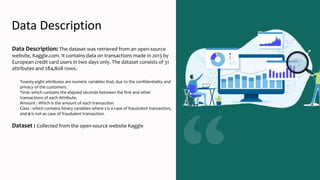
Data Description
Data Description: The dataset was retrieved from an open-source
website, Kaggle.com. It contains data on transactions made in 2013 by
European credit card users in two days only. The dataset consists of 31
attributes and 284,808 rows.
Twenty-eight attributes are numeric variables that, due to the confidentiality and
privacy of the customers.
Time: which contains the elapsed seconds between the first and other
transactions of each Attribute.
Amount : Which is the amount of each transaction
Class : which contains binary variables where 1 is a case of fraudulent transaction,
and 0 is not as case of fraudulent transaction.
Dataset : Collected from the open-source website Kaggle
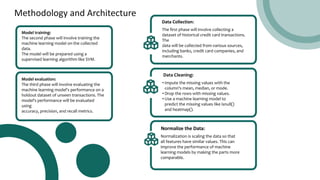
Methodology and Architecture
The first phase will involve collecting a
dataset of historical credit card transactions.
The
data will be collected from various sources,
including banks, credit card companies, and
merchants.
Data Collection:
• Impute the missing values with the
column's mean, median, or mode.
• Drop the rows with missing values.
• Use a machine learning model to
predict the missing values like isnull()
and heatmap().
Data Cleaning:
Normalization is scaling the data so that
all features have similar values. This can
improve the performance of machine
learning models by making the parts more
comparable.
Normalize the Data:
Model training:
The second phase will involve training the
machine learning model on the collected
data.
The model will be prepared using a
supervised learning algorithm like SVM.
Model evaluation:
The third phase will involve evaluating the
machine learning model's performance on a
holdout dataset of unseen transactions. The
model's performance will be evaluated
using
accuracy, precision, and recall metrics.
Data Analysis
This heatmap is used to check for missing
(null) values in the dataset.
Interpretation:
• The dark blue color indicates no missing
data in any of the columns.
• If there were null values, they would
typically be highlighted with a different
color.
Data Analysis
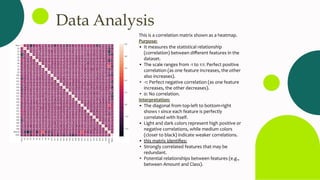
This is a correlation matrix shown as a heatmap.
Purpose:
▪ It measures the statistical relationship
(correlation) between different features in the
dataset.
▪ The scale ranges from -1 to 1:1: Perfect positive
correlation (as one feature increases, the other
also increases).
• -1: Perfect negative correlation (as one feature
increases, the other decreases).
• 0: No correlation.
Interpretation:
▪ The diagonal from top-left to bottom-right
shows 1 since each feature is perfectly
correlated with itself.
▪ Light and dark colors represent high positive or
negative correlations, while medium colors
(closer to black) indicate weaker correlations.
▪ this matrix identifies:
• Strongly correlated features that may be
redundant.
• Potential relationships between features (e.g.,
between Amount and Class).
Continue
The dataset typically exhibits a severe class
imbalance. This means that the number of normal
transactions (class 0) is significantly higher than
the number of fraudulent transactions (class 1).
This imbalance can negatively impact the
performance of machine learning models. Before
Undersampling:
•Class 0 (Normal Transactions): This class has a
significantly larger number of instances,
represented by the taller bar.
•Class 1 (Fraudulent Transactions): This class has a
much smaller number of instances, represented
by the shorter bar.
After Undersampling:
•Class 0: The number of instances in this class has
been reduced through undersampling.
•Class 1: The number of instances in this class
remains the same.
Why Undersampling?
By randomly removing instances from the
majority class. In this case, normal transactions
are reduced to create a more balanced dataset.
This helps the model to learn from a more
representative distribution of both classes,
improving its ability to detect fraudulent
Results
K-Nearest Neighbor (KNN):
Two Ks were used to determine the best KNN
model, K=3 and K =7.
The first figure shows the model created in
Jupiter Notebook; the model scored an
accuracy of 100% and identified 85,443
transactions correctly and missed 131.
There was a slight increasse in the Accuracy of
the model created in Jupiter Note-
book as it scored 100% when K is 7, and the
model miss classified 52 fraudulent
transactions as no fraudulent. As for the
Accuracy is the same as K=3
100% .
Results Continue
Logistic Regression (L.R.):
The another model created using
Jupiter Notebook is Logistic
Regression; the model managed to
score an Accuracy on Training data
of 93.51% , while it scored an
Accuracy score on Test Data of
91.88%, as presented in mentioned
Figure.
Results Continue
Support Vector Machine (SVM):
The model Support Vector Machine, as shown in blew Figure , scored 97.59% for the Accuracy.
Confusion Matrix
Results Continue
Decision Tree (D.T.):
Results Continue
Table of Accuracy
References
[1] . A. N. O. Alenzi, H. Z., “Fraud detection in credit cards using logistic regression.
https://thesai.org/Publications/ViewPaper?Volume=11&Issue=
12&Code=IJACSA&SerialNo=65, 2020
[2]. P. S. . K. S. Dighe, D., “Detection of credit card fraud transactions using machine learning
algorithms and neural networks.”
https://doi.org/10.1109/iccubea.
[3] . D. E. . Sahin, Y., “Detecting credit card fraud by decision trees and support vector
machines,” 2011. Accessed: 23-oct-2023.
[4] . S. A. A. S. . S. S. D. Maniraj, S. P., “Credit card fraud detection using machine learning and
data science.”
https://doi.org/10.17577/ijertv8is090031, 2019. Accessed: 25-oct-2023.
Thank You !

Tools & Technique Project for machine learning

  • 1.
    NED University ofEngineering & Technology Bank Cards Fraud Transaction Detection Using Machine Learning Algorithms Group Members: Bilal Ghani Syed Ahmas Nayyer Arham Ali Khan Hashir Iqbal Supervised by Dr.Danish
  • 2.
    Introduction • Global creditcard usage reached 2.8 billion in 2019 (Credit Card Statistics 2021). • Reports of credit card fraud in the U.S. increased by 44.7% in 2020 (Daly, 2021). Two types of fraud: • New Account Fraud: Identity thieves open accounts using stolen information (+48% in 2020). • Existing Account Fraud: Identity thieves use stolen details from existing accounts (+9% in 2020). Background & Motivation Rising fraud cases prompted the exploration of machine learning methods for fraud detection. Objective: Identify the most effective model for detecting fraudulent transactions. Process: Data selection and preprocessing. Developed models using KNN (K=3, K=7), Decision Tree, SVM, and Logistic Regression in VS Code.
  • 3.
    Overview Problem statement: Theincreasing prevalence of credit card fraud in the digital era necessitates the development of robust and efficient fraud detection systems. This project aims to develop a machine-learning model to detect credit card fraud. The model will be trained on a dataset of historical credit card transactions and evaluated on a holdout dataset of unseen transactions. Project Goal: The main aim of this project is the detection of fraudulent credit card transactions, as it is essential to figure out the fraudulent transactions so that customers do not get charged for the purchase of products that they did not buy. Research question: What machine learning model is most suited for detecting fraudulent credit card transactions?
  • 4.
    Literature Review • Themodel used by Alenzi and Aljehane to detect Fraud in credit cards was Logis- tic Regression. Their model scored 97.2% in Accuracy, 97% sensitivity and 2.8% Error Rate.[1] • Dighe and his team used KNN, Logistic Regression and Neural Networks, multi- layer perceptron and Decision Tree in their work, then evaluated the results regarding numerous accuracy metrics. Of all the models created, the best performing one is KNN, which scored 99.13%, then in second place performing model at 96.40% and in last place is logistic Regression with 96.27%.[2] • Sahin and Duman used four Support Vector Machine methods in detecting credit card fraud. (SVM) Support Vector Machine with RBF, Polynomial, Sigmoid, and Linear Kernel,all models scored 99.87% in the training model and 83.02% in the test- ing part of the model.[3] • Maniraj’s team built a model to recognize if any new transaction is Fraud or non- fraud. Their goal was to get 100% in detecting fraudulent transactions andtry to minimize the incorrectly classified fraud instances. Their model has performed well as they got 99.7% of the fraudulent transactions.[4]
  • 5.
    Data Description Data Description:The dataset was retrieved from an open-source website, Kaggle.com. It contains data on transactions made in 2013 by European credit card users in two days only. The dataset consists of 31 attributes and 284,808 rows. Twenty-eight attributes are numeric variables that, due to the confidentiality and privacy of the customers. Time: which contains the elapsed seconds between the first and other transactions of each Attribute. Amount : Which is the amount of each transaction Class : which contains binary variables where 1 is a case of fraudulent transaction, and 0 is not as case of fraudulent transaction. Dataset : Collected from the open-source website Kaggle
  • 6.
    Methodology and Architecture Thefirst phase will involve collecting a dataset of historical credit card transactions. The data will be collected from various sources, including banks, credit card companies, and merchants. Data Collection: • Impute the missing values with the column's mean, median, or mode. • Drop the rows with missing values. • Use a machine learning model to predict the missing values like isnull() and heatmap(). Data Cleaning: Normalization is scaling the data so that all features have similar values. This can improve the performance of machine learning models by making the parts more comparable. Normalize the Data: Model training: The second phase will involve training the machine learning model on the collected data. The model will be prepared using a supervised learning algorithm like SVM. Model evaluation: The third phase will involve evaluating the machine learning model's performance on a holdout dataset of unseen transactions. The model's performance will be evaluated using accuracy, precision, and recall metrics.
  • 7.
    Data Analysis This heatmapis used to check for missing (null) values in the dataset. Interpretation: • The dark blue color indicates no missing data in any of the columns. • If there were null values, they would typically be highlighted with a different color.
  • 8.
    Data Analysis This isa correlation matrix shown as a heatmap. Purpose: ▪ It measures the statistical relationship (correlation) between different features in the dataset. ▪ The scale ranges from -1 to 1:1: Perfect positive correlation (as one feature increases, the other also increases). • -1: Perfect negative correlation (as one feature increases, the other decreases). • 0: No correlation. Interpretation: ▪ The diagonal from top-left to bottom-right shows 1 since each feature is perfectly correlated with itself. ▪ Light and dark colors represent high positive or negative correlations, while medium colors (closer to black) indicate weaker correlations. ▪ this matrix identifies: • Strongly correlated features that may be redundant. • Potential relationships between features (e.g., between Amount and Class).
  • 9.
    Continue The dataset typicallyexhibits a severe class imbalance. This means that the number of normal transactions (class 0) is significantly higher than the number of fraudulent transactions (class 1). This imbalance can negatively impact the performance of machine learning models. Before Undersampling: •Class 0 (Normal Transactions): This class has a significantly larger number of instances, represented by the taller bar. •Class 1 (Fraudulent Transactions): This class has a much smaller number of instances, represented by the shorter bar. After Undersampling: •Class 0: The number of instances in this class has been reduced through undersampling. •Class 1: The number of instances in this class remains the same. Why Undersampling? By randomly removing instances from the majority class. In this case, normal transactions are reduced to create a more balanced dataset. This helps the model to learn from a more representative distribution of both classes, improving its ability to detect fraudulent
  • 10.
    Results K-Nearest Neighbor (KNN): TwoKs were used to determine the best KNN model, K=3 and K =7. The first figure shows the model created in Jupiter Notebook; the model scored an accuracy of 100% and identified 85,443 transactions correctly and missed 131. There was a slight increasse in the Accuracy of the model created in Jupiter Note- book as it scored 100% when K is 7, and the model miss classified 52 fraudulent transactions as no fraudulent. As for the Accuracy is the same as K=3 100% .
  • 11.
    Results Continue Logistic Regression(L.R.): The another model created using Jupiter Notebook is Logistic Regression; the model managed to score an Accuracy on Training data of 93.51% , while it scored an Accuracy score on Test Data of 91.88%, as presented in mentioned Figure.
  • 12.
    Results Continue Support VectorMachine (SVM): The model Support Vector Machine, as shown in blew Figure , scored 97.59% for the Accuracy. Confusion Matrix
  • 13.
  • 14.
  • 15.
    References [1] . A.N. O. Alenzi, H. Z., “Fraud detection in credit cards using logistic regression. https://thesai.org/Publications/ViewPaper?Volume=11&Issue= 12&Code=IJACSA&SerialNo=65, 2020 [2]. P. S. . K. S. Dighe, D., “Detection of credit card fraud transactions using machine learning algorithms and neural networks.” https://doi.org/10.1109/iccubea. [3] . D. E. . Sahin, Y., “Detecting credit card fraud by decision trees and support vector machines,” 2011. Accessed: 23-oct-2023. [4] . S. A. A. S. . S. S. D. Maniraj, S. P., “Credit card fraud detection using machine learning and data science.” https://doi.org/10.17577/ijertv8is090031, 2019. Accessed: 25-oct-2023.
  • 16.