Using Your Creativity Turn it on! Leslie H. Mattox SPE 522 December 11, 2010
What is  c r e a t i v i t y ? One explanation is: not being afraid to express or act on your ideas and thoughts! You have some great ideas and you can use them to show what you are all about!!
How do creative people express themselves in art? Artists use many ways to express their ideas and feelings. Artists can use  colors, shapes, and words  to show different feelings or ideas through: paintings illustrations sculptures music poetry
Where do you draw the line? Artists have used lines and shapes to express feelings or ideas.  Straight lines with sharp points can express anger,   pressure, frustration, or any type of stressful feeling. Curvy lines can express movement, happiness, or any   type of soothing feeling. Straight horizontal, vertical, or diagonal lines can express    barriers, obstacales, space, and many different types of    feelings depending on how you place them.
What do you feel? Lines and Shapes http://www.ratemydrawings.com/drawings/abstract/&page=1&f=
Let’s turn on some colorful creativity! Red :  Excitement, Lively, Easily Bored, Hasty, Passionate   Pink :  Sensitive, Kind, Sweet Disposition, Romantic   Yellow : Happy, Playful, Optimistic, Spontaneous   Blue :  Calm, Trustworthy, Loyalty, Daydreamer, Serious, Conservative Gray :  Reserved, noncommittal   Green : Safe, Good willed, Generous, Stubborn Brown :  Dependable, Loyal  Purple :  Negotiator, Well Liked, Mysterious   Orange :  Gregarious, Dynamic, Fun  Read more:  http://wiki.answers.com/Q/What_colors_represent_what_emotions#ixzz17f60VJ8p
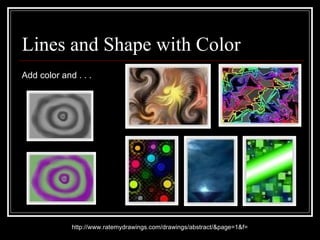
Lines and Shape with Color Add color and . . .   http://www.ratemydrawings.com/drawings/abstract/&page=1&f=
What is poetry? You will use the following links to gather information about poetry.  Read explanations and examples of different types of poetry.  Make a list of interesting ideas you find to share with the class.  Record any emotions you can identify in the poetry you discover. http://www.types-of-poetry.org.uk/ http://www.kathimitchell.com/poemtypes.html
Lesson 1:  Types of Poetry -  Haiku Japanese form of poetry.  Form is 17 syllables in three lines with pattern: first line, 5 syllables; second line 7 syllables; third line, 5 syllables. Usually has nature themes. Raindrops Raindrops falling down On the windowpane making wonderful music. By: Jason
Lesson 1:  Types of Poetry -  Haiku Now it is your turn! Think of your favorite  season. Brainstorm a list of words that  describe  your season and  how you feel  about it. Place the words in haiku format to form your poem.  Be sure to count your syllables carefully!
Types of Poetry -  Cinquain: 5 line Poetry Syllabic verse form.  Gradually increasing number of syllables in each line until the last line, which returns to two syllables. Form for younger students –  Line 1: 2 syllables    One word giving the title. (noun) Line 2: 4-6 syllables   Two words that describe the title. (adjectives) Line 3: 6 syllables   Three words that express action. ( verbs) Line 4: 8 syllables    Four words that express feeling. Line 5: 2-3 syllables    One word that gives the title a different name.  (synonym)
Types of Poetry -  Cinquain:      Bats                                                  Bats           Small, brown                                 Small, black Gliding, landing, feeding          Roosting, gliding, landing  Bugs, fruit, eating                    Flying Fox, fruit-eater         Mammals                                      Nocturnal              By: Kerri                                         By: Tyler
Types of Poetry –  Diamante   Dia  in this use means opposite. A diamante has seven lines.  Lines 1 and 7 state  subjects that are opposites  (puppy/dog). Line 2 - two adjectives describing the subject of line 1. Line 3 – three action words specific to the subject of line 1. Line 4 – four adjectives.  The first two describe the subject in line 1 and the second two describe the subject in line 7. Line 5 – three action words specific to the subject in line 7. Line 6 – two adjectives describing the subject of line 7.
Types of Poetry –  Diamante Example of a diamante poem: Line  Formula   1.   Puppy 2.  Pudgy, Bouncy 3.  Wiggling, Chewing, Squealing 4.  Soft, Fat tummy, Tall, Lean 5.  Sleeping, Barking, Hunting 6.  Loyal, Patient 7.  Dog What line describes the opposite subjects of the poem?
Create your Diamante! 1.  Use this interactive site to create your own diamante poem.  Be sure to print your completed poem.  http://www.readwritethink.org/files/resources/interactives/diamante/ 2.  Print your poem before you exit.  3.  Mount your poem on colored paper to hang with your emotion illustration.
Webliography ttp://wiki.answers.com/Q/What_colors_represent_what_emotions#ixzz17f60VJ8p http://www.ratemydrawings.com/drawings/abstract/&page=1&f = http://www.readwritethink.org/files/resources/interactives/diamante/ http://www.types-of-poetry.org.uk/ http:// www.kathimitchell.com/poemtypes.html

Creativity unit powerpoint

  • 1.
    Using Your CreativityTurn it on! Leslie H. Mattox SPE 522 December 11, 2010
  • 2.
    What is c r e a t i v i t y ? One explanation is: not being afraid to express or act on your ideas and thoughts! You have some great ideas and you can use them to show what you are all about!!
  • 3.
    How do creativepeople express themselves in art? Artists use many ways to express their ideas and feelings. Artists can use colors, shapes, and words to show different feelings or ideas through: paintings illustrations sculptures music poetry
  • 4.
    Where do youdraw the line? Artists have used lines and shapes to express feelings or ideas. Straight lines with sharp points can express anger, pressure, frustration, or any type of stressful feeling. Curvy lines can express movement, happiness, or any type of soothing feeling. Straight horizontal, vertical, or diagonal lines can express barriers, obstacales, space, and many different types of feelings depending on how you place them.
  • 5.
    What do youfeel? Lines and Shapes http://www.ratemydrawings.com/drawings/abstract/&page=1&f=
  • 6.
    Let’s turn onsome colorful creativity! Red : Excitement, Lively, Easily Bored, Hasty, Passionate Pink : Sensitive, Kind, Sweet Disposition, Romantic Yellow : Happy, Playful, Optimistic, Spontaneous Blue : Calm, Trustworthy, Loyalty, Daydreamer, Serious, Conservative Gray : Reserved, noncommittal Green : Safe, Good willed, Generous, Stubborn Brown : Dependable, Loyal Purple : Negotiator, Well Liked, Mysterious Orange : Gregarious, Dynamic, Fun Read more: http://wiki.answers.com/Q/What_colors_represent_what_emotions#ixzz17f60VJ8p
  • 7.
    Lines and Shapewith Color Add color and . . . http://www.ratemydrawings.com/drawings/abstract/&page=1&f=
  • 8.
    What is poetry?You will use the following links to gather information about poetry. Read explanations and examples of different types of poetry. Make a list of interesting ideas you find to share with the class. Record any emotions you can identify in the poetry you discover. http://www.types-of-poetry.org.uk/ http://www.kathimitchell.com/poemtypes.html
  • 9.
    Lesson 1: Types of Poetry - Haiku Japanese form of poetry.  Form is 17 syllables in three lines with pattern: first line, 5 syllables; second line 7 syllables; third line, 5 syllables. Usually has nature themes. Raindrops Raindrops falling down On the windowpane making wonderful music. By: Jason
  • 10.
    Lesson 1: Types of Poetry - Haiku Now it is your turn! Think of your favorite season. Brainstorm a list of words that describe your season and how you feel about it. Place the words in haiku format to form your poem. Be sure to count your syllables carefully!
  • 11.
    Types of Poetry- Cinquain: 5 line Poetry Syllabic verse form. Gradually increasing number of syllables in each line until the last line, which returns to two syllables. Form for younger students – Line 1: 2 syllables    One word giving the title. (noun) Line 2: 4-6 syllables   Two words that describe the title. (adjectives) Line 3: 6 syllables   Three words that express action. ( verbs) Line 4: 8 syllables    Four words that express feeling. Line 5: 2-3 syllables    One word that gives the title a different name. (synonym)
  • 12.
    Types of Poetry- Cinquain:     Bats                                                 Bats         Small, brown                                 Small, black Gliding, landing, feeding          Roosting, gliding, landing  Bugs, fruit, eating                    Flying Fox, fruit-eater        Mammals                                      Nocturnal             By: Kerri                                         By: Tyler
  • 13.
    Types of Poetry– Diamante Dia in this use means opposite. A diamante has seven lines. Lines 1 and 7 state subjects that are opposites (puppy/dog). Line 2 - two adjectives describing the subject of line 1. Line 3 – three action words specific to the subject of line 1. Line 4 – four adjectives. The first two describe the subject in line 1 and the second two describe the subject in line 7. Line 5 – three action words specific to the subject in line 7. Line 6 – two adjectives describing the subject of line 7.
  • 14.
    Types of Poetry– Diamante Example of a diamante poem: Line Formula 1. Puppy 2. Pudgy, Bouncy 3. Wiggling, Chewing, Squealing 4. Soft, Fat tummy, Tall, Lean 5. Sleeping, Barking, Hunting 6. Loyal, Patient 7. Dog What line describes the opposite subjects of the poem?
  • 15.
    Create your Diamante!1. Use this interactive site to create your own diamante poem. Be sure to print your completed poem. http://www.readwritethink.org/files/resources/interactives/diamante/ 2. Print your poem before you exit. 3. Mount your poem on colored paper to hang with your emotion illustration.
  • 16.
    Webliography ttp://wiki.answers.com/Q/What_colors_represent_what_emotions#ixzz17f60VJ8p http://www.ratemydrawings.com/drawings/abstract/&page=1&f= http://www.readwritethink.org/files/resources/interactives/diamante/ http://www.types-of-poetry.org.uk/ http:// www.kathimitchell.com/poemtypes.html