32 Creativity and 
Innovation Leaders 
Explore Applied 
Creativity 
THE CENTER FOR 
CREATIVE EMERGENCE 
Curated by Michelle James 
NAVIGATING 
THE NEW WORK 
PARADIGM
Terms Of Use 
© 2012 The Center for Creative Emergence. All rights reserved. Published by The Center for Creative Emergence 
You are authorized to download one copy of this eBook. 
If you wish to share this material, you may purchase a copy at bizcreativitysummit.com 
INTELLECTUAL PROPERTY; LIMITED LICENSE TO USERS The product you have purchased is protected by United States and International copyright, trademark and/or other intellectual property laws, and any unauthorized use of this product may violate such laws and the Terms of Use. Except as expressly provided herein, The Center for Creative Emergence and its suppliers do not grant any express or implied rights to use this product. You agree not to copy, republish, transmit, modify, rent, lease, loan, sell, assign, distribute, license, sublicense, reverse engineer, or create derivative works based on this product except as expressly authorized herein.
CREATIVITY IN BUSINESS EBOOK ©2012 THE CENTER FOR CREATIVE EMERGENCE HTTP://WWW.CREATIVEEMERGENCE.COM 
1 
Introduction 
Hi! Welcome to an exploration of Creativity in Business through the lens of diverse practitioners, original thinkers and change makers. This book contains a series of 6-question interviews with 32 creativity and innovation thought leaders around the topic of applied creativity in business and the new work paradigm. The same 6 simple, open-ended questions generate a myriad of rich, creative responses from these pioneering minds. 
Each interview ends with a “Making it Real” section with a practical application you can apply right away. Some of the exercises are for you to use within your own work or business, and others are to be used with a group, team or organization. Some are more reflection oriented, while others are more focused on actions. In the language of improv theater, we invite you to “yes-and” what you like – and leave the rest – and create something new from it. There is no one right approach to use or one right way to use an approach. The invitation in these applications is to take what resonates and make them your own. 
The intention of this book is that it generates some food for thought, opens to more possibilities, and inspires you to engage your own amazing creativity in your work…and 
come up with a lot more awesome ideas than we have here. We hope it inspires more opportunities for discovery. 
Have fun as you embrace the juicy aliveness and uncontrolled messiness of the creative process! 
Warmly, 
Michelle James 
CEO, The Center for Creative Emergence Author of the upcoming book, 
Pattern Breaks: A Facilitator’s Guide to Cultivating Creativity
CREATIVITY IN BUSINESS EBOOK ©2012 THE CENTER FOR CREATIVE EMERGENCE HTTP://WWW.CREATIVEEMERGENCE.COM 
2 
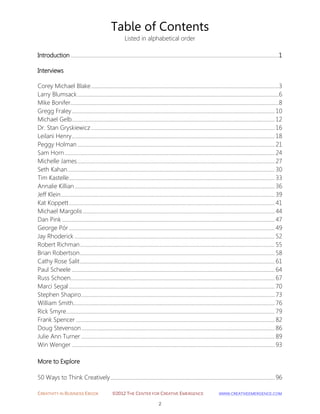
Table of Contents 
Listed in alphabetical order 
Introduction .......................................................................................................................................................1 
Interviews 
Corey Michael Blake ........................................................................................................................................3 
Larry Blumsack ..................................................................................................................................................6 
Mike Bonifer.......................................................................................................................................................8 
Gregg Fraley ................................................................................................................................................... 10 
Michael Gelb ................................................................................................................................................... 12 
Dr. Stan Gryskiewicz ..................................................................................................................................... 16 
Leilani Henry ................................................................................................................................................... 18 
Peggy Holman ............................................................................................................................................... 21 
Sam Horn ........................................................................................................................................................ 24 
Michelle James ............................................................................................................................................... 27 
Seth Kahan ...................................................................................................................................................... 30 
Tim Kastelle ..................................................................................................................................................... 33 
Annalie Killian ................................................................................................................................................. 36 
Jeff Klein ........................................................................................................................................................... 39 
Kat Koppett ..................................................................................................................................................... 41 
Michael Margolis ........................................................................................................................................... 44 
Dan Pink .......................................................................................................................................................... 47 
George Pór ..................................................................................................................................................... 49 
Jay Rhoderick ................................................................................................................................................. 52 
Robert Richman ............................................................................................................................................. 55 
Brian Robertson ............................................................................................................................................. 58 
Cathy Rose Salit ............................................................................................................................................. 61 
Paul Scheele ................................................................................................................................................... 64 
Russ Schoen.................................................................................................................................................... 67 
Marci Segal ..................................................................................................................................................... 70 
Stephen Shapiro ............................................................................................................................................ 73 
William Smith.................................................................................................................................................. 76 
Rick Smyre ....................................................................................................................................................... 79 
Frank Spencer ................................................................................................................................................ 82 
Doug Stevenson ............................................................................................................................................ 86 
Julie Ann Turner ............................................................................................................................................ 89 
Win Wenger ................................................................................................................................................... 93 
More to Explore 
50 Ways to Think Creatively ....................................................................................................................... 96
CREATIVITY IN BUSINESS EBOOK ©2012 THE CENTER FOR CREATIVE EMERGENCE HTTP://WWW.CREATIVEEMERGENCE.COM 
3 
Interview with Corey Michael Blake 
Corey Michael Blake has been communicating creatively for over 15 years, first as the face and voice behind a dozen Fortune 500 and Fortune 100 brands as a commercial and voiceover actor, then as a film producer and director, as an author and publisher, and now as the founder and President of Round Table Companies, packaging and publishing business and memoir titles by new and bestselling authors, such as Chris Anderson (Wired Editor), Tony Hsieh (Zappos CEO) and Marshall Goldsmith, among others, to deliver their best-selling books as graphic novels. Corey’s work has won Addy, Belding, Bronze Lion and London International Advertising awards and has been covered by the New York Times, Wall Street Journal, USA Today, Forbes, Inc. Magazine, Wired Magazine, Barron’s, Publisher’s Weekly, School Library Journal, Fox News, Bloomberg TV, and Investor’s Business Daily and my writing has been published in Writer Magazine, Script Magazine and on StartUp Nation. 
How does your work engage creativity? 
My company and my staff share people's stories for a living. We do so with the written word and also with the graphic novel format. We're actually the first company to publish an entire series of illustrated business books based on the work of best-selling authors, so we're steeped in creativity both in the actualization of our material and also in the process we use to bring our client's visions to life. As a past actor and filmmaker in Hollywood, I brought over the collaborative filmmaking process to book writing and publishing. So instead of forcing authors to hole up in a cave for 6 months writing their book, we surround them with an entire team of creatives that bring their message or mission to life in an experiential product. Creativity is easily one of the most emphasized core values of our team. 
What do you see as the New Paradigm of Work? 
I'm seeing a massive shift in how intellectual property is monetized. Book sales have been greatly impacted by the information revolution taking place and everyone is struggling to figure out how to drive enough revenue to continue to exist. So smart business people are focusing on using intellectual property, such as books, to grow their platform, to build a real community and then they leverage their exposure to drive sales of services, merchandise, workshops, etc. The power of community is becoming so explosive that folks who get in the game thinking that book sales are the end result are completely missing the boat and often disappointed with the results.
CREATIVITY IN BUSINESS EBOOK ©2012 THE CENTER FOR CREATIVE EMERGENCE HTTP://WWW.CREATIVEEMERGENCE.COM 
4 
What do you see as the role of creativity in that paradigm? 
Creativity and innovation are the keys to standing out for a brand and growing platform. You can have great information to deliver, but if you're not being creative with your delivery mechanism, it's too easy to get lost. Creativity generates a legitimate emotional response, which is the catalyst for the word of mouth marketing that supports a growing platform and expands community. In the book world, publishers are actually being forced to be less creative due to budget constraints. That means less time for authors, less time for relationships, less time for the breath that is necessary to create the kind of products that stand out and demand attention. The IP industry as a whole has an opportunity to release the old paradigm and start thinking differently about the end goals and the impact creativity can have on reaching those goals. 
What mindsets do you see as essential for navigating the new work paradigm? 
Certainly, doing great work is still the greatest piece of word of mouth marketing anyone can do for their brand. But you also have to understand how to share the story behind your business, your motivation, your passion and your ability to generate results. Storytelling reaches people emotionally and in this Twitter and Facebook society, you have to reach people at the gut level if you expect them to pay attention. 
What is Creative Leadership to you? 
Creative Leadership is culture based. It focuses on serving employees so they can serve customers. It focuses on collaboration and communication. If focuses on trailblazing new pathways and not being limited by conventional thought. Creative Leadership focuses on growth as a result of transparency, connection, service, and joy.
CREATIVITY IN BUSINESS EBOOK ©2012 THE CENTER FOR CREATIVE EMERGENCE HTTP://WWW.CREATIVEEMERGENCE.COM 
5 
MAKING IT REAL 
What is one practice that people could start applying today to bring more creativity into their work or work place? 
You attract what you're intentional about and what you put out into the world. If you want to attract more creativity, make it a core value and infuse it into your culture. A great way to start the conversation would be to use the following simple survey to generate conversation within your company around the topic of creativity and more specifically the conversation around sharing the real story behind your business: 1. Describe how our customers "experience" our business. How do they feel each step of the way? What inspires them? Where in our process do they tend to get more aggravated? Where in our process or the buying experience do they feel the most joy? 
2. When we sell our company, what is the experience we're selling (not the product or service)? 
3. How does our business change lives or make life easier or better for people? 
4. What gets people most excited about talking about our company? 
5. What gets you out of bed to serve our clients? 
6. What change within our business would inspire you? 
7. What about our existing business impresses you most? 
Once you've completed this survey and an internal dialogue about the responses, see where you can use elements from this exercise within your marketing and sales language as well as your internal documents (company handbook, HR docs, etc).
CREATIVITY IN BUSINESS EBOOK ©2012 THE CENTER FOR CREATIVE EMERGENCE HTTP://WWW.CREATIVEEMERGENCE.COM 
6 
Interview with Larry Blumsack 
Larry Blumsack, founder and director of Zoka Institute, a creativity and innovation consulting, training, and coaching company. Informing his work is over 40 years of parallel careers as a serial entrepreneur/business leader and as a "creative" - he has owned several businesses; worked in marketing, sales and television; is a founding member of the theater department at Northeastern University; and a syndicated critic, columnist and commentator on the arts for American radio, TV and print outlets and more. Having in depth experience with both creative and business cultures, Blumsack teaches business organizations how to build creative cultures within their organizations and individuals how to tap into their own creativity. 
How does your work engage creativity? 
I use arts-for-business based activities to solve business issues, develop strategy and for critical thinking, creative problem solving and collaboration. Using visual and performing arts activities forces people to step out of their comfort zone and requires them to use non- traditional methods to address everything from strategic planning to specific business research, or silo problems. 
America's educational process has strip-mined creativity - the mantras of "no you can't and here's the answer," "mistakes are bad," and "you have to be serious" have permeated both our educational and business environment to the detriment of building and maintaining of any kind innovative and creative culture. 
What do you see as the New Paradigm of Work? 
Looking beyond linear, process-oriented solutions only. We need to encourage failure as a learning step instead of punishing it; provide employees a level of freedom and the environment to explore new ideas; and encourage cross-silo collaboration. In a work culture, everyone needs to feel that they are valued, engaged, and participating. 
What do you see as the role of creativity in that paradigm? 
I call it the "Zoka's 5 Habits for a Competitive Edge" - habits that draw from the visual and performing arts that also utilize tools of spirituality to incorporate a sense of much needed ethics in business. The habits are engaged mindfulness; look and see, listen and hear; yes and; and storytelling. Our lives are built on speed. Companies like Google, General Mills and
CREATIVITY IN BUSINESS EBOOK ©2012 THE CENTER FOR CREATIVE EMERGENCE HTTP://WWW.CREATIVEEMERGENCE.COM 
7 
MAKING IT REAL 
What is one practice that people could start applying today to bring more creativity into their work or work place? 
Understanding the value of managing FOR creativity - like a theater director - instead of trying to manage creativity. Learn how to think like a visual or performing artist. Learn that there is no one solution to anything. One must try and experiment with a number of approaches in all aspect of running a company or problem solving. A creative culture respects all ideas regardless of where they come from. And many great ideas come from places you least expect it if failure is acceptable. 
many others are beginning to realize that speed is not the road to innovation and sustainability as a company. They have instituted mindfulness training which is based on meditation practices into their organizations to step up their creative and innovative thinking. 
Engaged mindfulness is about stopping all the monkey chatter and mental multi-tasking we do throughout our day. Art and sculpture are tools to sharpen one's ability to look and see. 
Music opens up one's ability to really hear all that is coming into the ear. Yes and, the heart of improvisational theater, is the perfect mantra to institute at all meetings and personal. 
It is said the emotion is the fast track to the brain and what better way to connect with someone that through the art of storytelling. The key is to use different art forms because some people are visual, some are auditory and some or kinesthetic - no one form serves all. It is rewarding to see senior executives, management teams and staff release and experiment through the arts to solve real business issues. 
What is Creative Leadership to you? 
The Creative Leader needs to be like the director in the theater who musters a variety of creative and talented actors, musicians, dancers, choreographers, lighting/costume/sound designers, authors, lyricists, etc. That director's job is to tap the creative talents of the team and mold them into an exciting, cohesive production. 
Creative Leadership values employees and realizes that innovative and creative ideas - when encouraged - can come from all levels of the company from the shipper/receiver and receptionist to the highest executive. Creative Leadership understands Thomas Watson's (founder of IBM) answer when asked the secret of success - increase the rate of failure. Creative Leadership understands the collegial, respectful culture that Edison built into his company so he could have 10,000 attempts - not failures - in creating the light bulb and numerous other lasting inventions. And Creative Leadership means one understands and practices "yes and" at all time.
CREATIVITY IN BUSINESS EBOOK ©2012 THE CENTER FOR CREATIVE EMERGENCE HTTP://WWW.CREATIVEEMERGENCE.COM 
8 
Interview with Mike Bonifer 
Mike Bonifer is the co-founder of GameChangers, and author of GameChangers: Improvisation for Business in the Networked World. He writes about and teaches 
Improvisation for business. He's helped clients such as Disney, Universal Studios, Frito-Lay, Merril Lynch, DreamWorks and MBA programs to evolve their processes and brands to better participate in the global economy. 
How does your work engage creativity? 
GameChangers uses the techniques of improvisation to help clients build environments that liberate creativity across their enterprise. We do it in five steps: Listening, Connecting, Collaborating, Adapting and Performing. Each of these steps is vital to the creative process. 
What do you see as the New Paradigm of Work? 
A culture of continuous innovation and the improvised brand narratives of the Networked World replace the hierarchical structures and inflexible scripted narratives of the Industrial Age. Work and play become inextricable. Personal lives and working lives co-habitate. Mobility begets serendipity. Communication leads to learning which results in transformation. 
What do you see as the role of creativity in that paradigm? 
The role of creativity is to inform every cell in the body of work performed by an organization or brand. In particular we focus on disintegrating what we call 'the tyranny of the Creative Class,' which inevitably involves ego, status games and subjective judgments - all toxic to the creative process. We believe that everyone has the potential to be creative, no matter what their role in the organization is, as long as the working environment permits it. If you establish an environment that is receptive to creativity, that invites it, creativity will flow from it. Act on environment, and environment will act on you. 
What mindsets do you see as essential for navigating the new work paradigm? 
For a conscious and disciplined focus on the five steps of the GameChangers methodology 
listed above, the most important attitude is openness. In the Networked World, business opportunities are more abundant than ever, but they are also more fleeting. It takes an open
CREATIVITY IN BUSINESS EBOOK ©2012 THE CENTER FOR CREATIVE EMERGENCE HTTP://WWW.CREATIVEEMERGENCE.COM 
9 
MAKING IT REAL 
What is one practice that people could start applying today to bring more creativity into their work or work place? 
Begin with listening. Don't waste time and money trying to inflict your brand narrative on the market. Instead, listen to what's happening. Hear what your customers are saying (or not saying). Let your brand's themes, and the actions that explore those themes, emerge organically from your skill at listening. When it comes to branding, your story is not your own, it is a narrative you create in collaboration with your audience. The collaboration can only be effective if you listen to, and honor, the realities of the marketplace. 
To practice, go anywhere and listen for what is unfamiliar, what you do not normally hear; what is not part of the normal environment. Close your eyes and listen for what is audible beyond the sphere of what you expect to hear – listen, especially, for the unusual. If you want to think in unusual ways, listen to what is already unusual. Creative thinking requires picking up on what is different - and it’s almost there right in front of you. If you are fully present, you will tune into the “different” things that already exist. 
mind to see and act on these opportunities without pegging them to an existing paradigm, scripting the outcomes before the outcomes manifest themselves, or acting on prior assumptions. The open mind allows for the most productive behaviors in every scenario. 
What is Creative Leadership to you? 
Quickly identifying the 'productive games' and casting the team best suited to play it. Even more quickly identifying and editing the unproductive game. This can mean re-designing the game, re-casting the team, or eliminating the game altogether.
CREATIVITY IN BUSINESS EBOOK ©2012 THE CENTER FOR CREATIVE EMERGENCE HTTP://WWW.CREATIVEEMERGENCE.COM 
10 
Interview with Gregg Fraley 
Gregg Fraley is a seasoned creativity and innovation practitioner and author of Jack’s Notebook, a highly endorsed business novel about creative problem solving; and Partner at The Innovise Guys - bridging innovation with improvisational comedy. He assists organizations with innovation initiatives and new product development, and blogs on innovation topics. Gregg is an in-demand consultant, ideation facilitator and speaker whose ideation sessions have produced previously elusive breakthroughs and market leading products. Among his many roles, he's a leader and speaker at the annual Creative Problem Solving Institute (CPSI), and former board member of the Creative Education Foundation. 
How does your work engage creativity? 
Creativity is what’s required to innovate, so, my job is to inspire and bring out the innate creativity that people have - and focus that thinking to resolve challenges. 
What do you see as the New Paradigm of Work? 
People integrating what they do with what they love. If there isn’t some love, or care, involved in what you do, you’re starting from a very bad place. Even when you are stuck in a job that isn’t your first choice, there are ways to make connections to what you love and what you might wish to do, and it’s your responsibility to do that. Nobody can do it for you. The golden rule of creativity is to do what your heart desires. When you and your team are coming from that place, innovation happens organically. Beyond that, I think people need to be responsible for innovation – it doesn’t matter what your job is – it’s still part of your work to improve things and even invent things. 
What do you see as the role of creativity in that paradigm? 
Creativity is the spring. Innovation is the bottled water. Creativity is continually expressed in balanced people, and that creativity will manifest as innovation if the organization values ideas and makes the systematic effort to take action on them.
CREATIVITY IN BUSINESS EBOOK ©2012 THE CENTER FOR CREATIVE EMERGENCE HTTP://WWW.CREATIVEEMERGENCE.COM 
11 
MAKING IT REAL 
What is one practice that people could start applying today to bring more creativity into their work or work place? 
Well, it’s obvious, but it’s often ignored, and that’s simply keeping track of your ideas. If you are a small business it could be as simple as a notebook, Word document, or a spreadsheet. If we’re talking a larger organization, I’d suggest implementing an idea management system. In my view you’re not doing formal innovation if you don’t have a repository for ideas, and the repository isn’t actively managed. Creativity is like a lot of other behaviors, as soon as you start tracking it or paying closer attention to it, it grows. 
What mindsets do you see as essential for navigating the new work paradigm? 
Openness, respect for others, taking personal responsibility, integrity, and transparency. 
What is Creative Leadership to you? 
Creative Leadership to me is the management of thinking diversity. By this I mean, it’s essential to have thinking diversity, and then, to respect and leverage the wide variety of creative thoughts that come from such a group. I believe in leading by example, and so, a good Creative Leader would generate a lot of ideas, would respect the ideas of others, and would demonstrate openness, curiosity, and affirmative judgment. Finally a Creative Leader is a person of action. Ideas are useless until you do something with them.
CREATIVITY IN BUSINESS EBOOK ©2012 THE CENTER FOR CREATIVE EMERGENCE HTTP://WWW.CREATIVEEMERGENCE.COM 
12 
Interview with Michael Gelb 
Michael Gelb is a leading authority on the application of genius thinking to personal and organizational development. Michael is the author of 12 books on creativity and innovation including the international best seller How to Think Like Leonardo Da Vinci: Seven Steps to Genius Every Day. In 2007 he released Innovate Like Edison: The Five Step System for Breakthrough Business Success, co-authored with Sarah Miller Caldicott, the great grand niece of Thomas Edison. A pioneer in the fields of creative thinking and innovative leadership, he leads seminars for organizations such as DuPont, Merck, Microsoft, Nike, Raytheon and YPO. He just released his new book, Wine Drinking For Inspired Thinking: Uncork Your Creative Juices. 
How does your work engage creativity? 
I use my creativity to transform my passions into books and seminars to inspire others. My passion for the art of juggling, (I'm a former professional juggler who once performed with the Rolling Stones and Bob Dylan), became a program called The 5 Keys to High Performance: Juggling Your Way to Success. My passion for aikido, (I'm a fourth degree black belt), led to the book co-authored with International Grandmaster Raymond Keene, Samurai Chess: Mastering Strategic Thinking Through the Martial Art of the Mind. I trained as a teacher of the Alexander Technique, (the method taught at The Julliard School for cultivating commanding stage presence) which resulted in my book Body Learning: An Introduction to the Alexander Technique; and then Present Yourself! Captivate Your Audience with Great Presentation Skills. My passion for applying genius thinking to personal and organizational development is expressed Discover Your Genius: How To Think Like History’s Ten Most Revolutionary Minds. My love for wine and poetry as a means for bringing teams together is manifest in my latest book, Wine Drinking For Inspired Thinking: Uncork Your Creative Juices. 
What do you see as the New Paradigm of Work? 
When I first began leading seminars in the late 1970s most of my corporate clients were just beginning their efforts to shift from a hierarchical, top down, "command and control" paradigm to a more flexible, agile and team-oriented approach. Although organizational structures have evolved significantly, many individuals still struggle because they haven't incorporated the creative thinking and communication skills that are essential to operating effectively in a dynamic, diverse, matrixed, more open-sourced context.
CREATIVITY IN BUSINESS EBOOK ©2012 THE CENTER FOR CREATIVE EMERGENCE HTTP://WWW.CREATIVEEMERGENCE.COM 
13 
Moreover, accelerating change and complexity has resulted in ever greater demands on the 
individual's time and energy. Most of my clients are being asked to work longer hours, to accomplish more with fewer resources. But, as the pressure to perform continues to rise so has the yearning for a clearer sense of meaning and purpose. 
More than just a shift in thinking skills, a successful adaptation to The New Paradigm requires a leap of consciousness. Specifically, a leap from the win-lose, high-tech/low-touch, left- brained, competitive mind-set to a win-win, high tech-high touch, whole-brained cooperative attitude. The internet has made it easier for people to recognize our essential interconnectedness, and increasing awareness of our ecological and financial interdependence is driving more people to a practical appreciation of the core teaching of the world's great spiritual traditions: As Leonardo da Vinci expressed it: "Everything connects to everything else." This consciousness is alive in the movement for Conscious Capitalism. Conscious Capitalism is based on the idea of organizing businesses around a higher purpose that includes but goes beyond profit. It is focused on fulfilling a higher purpose, which evolves dynamically over time. New Paradigm organizations express this consciousness of interdependence by organizing around a Stakeholder Orientation, i.e., they focus on delivering value to ALL stakeholders, with an unswerving commitment to align the interests of customers, employees, vendors, investors, the community, and the environment to the greatest extent possible. One of the think tanks promoting this new vision is the Conscious Capitalism Institute, where I'm honored to serve as the Director of Creativity and Innovation Leadership. 
What do you see as the role of creativity in that paradigm? 
Thirty years ago most organizations viewed "Creative Thinking" as a luxury item. Now, they understand that it is a necessity. Moreover, the notion that creativity is the province of a few "Creative types" and that everyone else can afford to think in just a linear fashion is falling by the wayside, as is the myth that "Creativity" is a function of the right hemisphere exclusively. Real creativity is a function of an integration of logic and imagination, of the left and right hemisphere working in harmony. 
Thomas Edison noted, "I don't want to invent anything that won't sell." Edison understood that "Sales are proof of utility" and that "Utility is success." In other words, Edison focused his phenomenal creative powers on making things that people wanted and needed like light, recorded sound and the movies! The new paradigm invites us to find the balance between rationality and intuition, between inspiration and application. This balance has always been a feature of great geniuses like Leonardo and Edison but now it must become the standard for all.
CREATIVITY IN BUSINESS EBOOK ©2012 THE CENTER FOR CREATIVE EMERGENCE HTTP://WWW.CREATIVEEMERGENCE.COM 
14 
What mindsets do you see as essential for navigating the new work paradigm? 
The first principle for thinking like Leonardo is "Curiosita'"-- An insatiable quest for knowledge 
and continuous improvement. Curiosity is our birthright and the wellspring of genius. A profound passion to understand, learn and improve is a core attitude for individuals and organizations who wish to thrive with change. It goes hand-in-hand with the first competency for innovating like Edison: Solution-Centered Mindset--Instead of focusing our attention on obstacles and impediments we orient ourselves around finding creative solutions and new paths forward. (The seven principles for thinking like Leonardo da Vinci and the 5 competencies for innovating like Edison are designed to offer a comprehensive curriculum for navigating the new paradigm.) 
What is Creative Leadership to you? 
Creative Leadership involves serving as a catalyst and steward of an organization's deeper purpose and as a champion for all its stakeholders.
CREATIVITY IN BUSINESS EBOOK ©2012 THE CENTER FOR CREATIVE EMERGENCE HTTP://WWW.CREATIVEEMERGENCE.COM 
15 
MAKING IT REAL 
What is one practice that people could start applying today to bring more creativity into their work or work place? 
Mind Mapping! Most of us grew up learning to organize our ideas through outlining. Although valuable as a tool for presenting ideas in a formal, orderly fashion, outlining is useful only after the real thinking has been done. Outlining slows you down, and stifles your freedom of thought. Moreover, outlining is a reflection of the "old paradigm" hierarchical mind-set. The structure of communication in nature is non-linear, non-hierarchical; it works through networks and systems. The ability to read, align, and work creatively with these systems is ultimately the definition of intelligence. Our thinking is a function of a vast network of synaptic patterns. A Mind Map is a graphic expression of these natural patterns. The New Paradigm requires us to develop our ability to understand patterns of change, to see the web of connections that underlie complex systems. As you practice Mind Mapping you cultivate your systems thinking ability and you develop the coordination of your two hemispheres. There are seven basic rules for effective Mind mapping: 
1. Begin your Mind Map with a symbol or a picture at the center of your page. Pictures and symbols are easier to remember than words and enhance your ability to visualize, remember, and think creatively. 
2. Use key words. Key words are the information-rich “nuggets” of recall and creative association. Key words can be generated faster and are easier to remember than sentences or phrases. Moreover, the discipline of generating key words trains the mind to focus on the most essential elements of a subject. 
3. Connect the key words with lines radiating from your central image. By linking words with lines, you’ll show clearly how one key word relates to another. Connect the lines for maximum clarity. 
4. Print your key words. Printing is easier to read and remember than writing. 
5. Print one key word per line. Printing one key word per line frees you to discover the maximum number of creative associations for each key word and trains you to hone in on the most appropriate key word, enhancing the precision of your thought and minimizing clutter. 
6. Print your key words on the lines and make the length of the word and line equal. This maximizes clarity of association and encourages economy of space. 
7. Use colors, pictures, dimension, and codes for vivid association and emphasis. Highlight important points and show relationships between different branches of your map. You might, for instance, prioritize your main points through color-coding. Use pictures and images often as they stimulate visualization and creative association and greatly enhance memory. Codes, such as asterisks, exclamation points, letters, and numbers, show relationship between concepts and further organize your map.
CREATIVITY IN BUSINESS EBOOK ©2012 THE CENTER FOR CREATIVE EMERGENCE HTTP://WWW.CREATIVEEMERGENCE.COM 
16 
Interview with Dr. Stan Gryskiewicz 
Dr. Stan Gryskiewicz is the author of Positive Turbulence: Developing Climates for Creativity, 
Innovation and Renewal; Senior Fellow at the Center for Creative Leadership; and founder and CEO of the pioneering 30-year learning community, Association for Managers of Innovation. 
What do you see as the New Paradigm of Work? 
It is the emergence of learning communities - shared learning - to supplement the technology revolution with real experiences that can be constantly questioned and modified in real time by motivated learners. Learning communities give you an opportunity to have your idea explored and tested, and receive real-time feedback you can then use to enhance, modify or completely change your idea. They allow you to reach beyond the silo of your own thinking, department, company or discipline. You can develop learning communities within one organization or across companies and disciplines. The more diverse perspectives in the learning community, the better. 
What do you see as the role of creativity in that paradigm? 
Creativity is a novel and useful idea. Innovation the successful implementation of that novel and useful idea, usually addressing a problem to be solved. In the new paradigm, we all need a willingness to explore novel ideas and perspectives using complex problem solving and innovation. Establishment of trust is key, especially since much of the work will be done long distance by autonomous teams or individuals. There is no short cut to developing trust - this happens working through problems together over time. There are initial conditions you can set for developing trust more quickly, but it is working together over time that creates and reinforces that your colleagues know what they are doing and are supportive of you - this reinforces the trust conducive for ongoing creativity and innovation. 
What is Creative Leadership to you? 
A Creative Leader communicates a vision for change by focusing resources in a collective process that requires interdependent decision-making. Creative Leaders must set clear goals, and then allow their team members freedom in deciding how to best achieve then - knowing that they share a common vision. Once this has begun, the Creative Leader encourages the
CREATIVITY IN BUSINESS EBOOK ©2012 THE CENTER FOR CREATIVE EMERGENCE HTTP://WWW.CREATIVEEMERGENCE.COM 
17 
MAKING IT REAL 
What is one practice that people could start applying today to bring more creativity into their work or work place? 
First, defer judgment - generate ideas before you evaluate them. "Diverge" into exploration and idea generation before you "converge" into evaluation. And second, step back from the problem as given and offer redefinitions of the original problem before you start to solve it. This is not easy to do for the problem owner, but redefining the problem opens up new perspective in approaching it that he or she you would not have otherwise seen. In exploring the definition of the problem itself, you discover other perspectives, too. This discovery leads to not only more innovative solutions to the problem, but more complex problem solving; you may in fact end up solving multiple issues that you have not thought about. 
collective to take the risks required to perform outside the norm when required to achieve the vision.
CREATIVITY IN BUSINESS EBOOK ©2012 THE CENTER FOR CREATIVE EMERGENCE HTTP://WWW.CREATIVEEMERGENCE.COM 
18 
Interview with Leilani Henry 
Leilani Raashida Henry, M.A., a leader in the field of workplace creativity and work-life balance. A pioneer on bringing innovative whole brain strategies to personal, professional and organization transformation, Leilani is President of Being and Living® Enterprises, and is the creator of Brain Jewels®, a multi-sensory coaching process. She worked for 13 years as an internal productivity/creativity consultant with Honeywell, Lockheed Martin and Jones Intercable. Leilani’s lifetime experience in the performing and visual arts is integrated into her unique approach to leadership, creativity and performance. She is cited in books, national publications and organizations such as Centered on the Edge, Corporate Meetings & Incentives, Fast Company, Fetzer Institute, New Visions in Business and Thrivability. Her clients have included AT&T, Intuit, Time Warner, HBO, University of Colorado Boulder, HP, the EPA, National Coalition for Dialogue & Deliberation and HSBC Bank among others. 
How does your work engage creativity? 
Individual and collective transformation requires engagement of the whole person at work. It brings the group as the "new art form" into being. We can do more as an inspired collective, than we can do alone. Rather than leaving our true thoughts and feelings unexpressed in service of getting the job done, my work makes the invisible more visible. I enable what's not seen, heard, or allowed to surface safely, as a catalyst for better relationships and organizational change. My work also encourages groups to think better collectively by challenging assumptions and uncovering possibilities. Creativity is the opposite of certainty - it allows us to co-create with others what is emerging, for the benefit of ourselves and the larger whole. I also focus on stress management to increase the flow of creativity. 
What do you see as the New Paradigm of Work? 
When you unleash the whole person (body, mind and spirit), you unleash creativity in the work place. Employees become partners and investors in the organization, and are valued for the multiple intelligences they can provide. This new way of working also includes patience with chaos, which is critical because the new paradigm in more non-linear than linear. A respect for the differences in pace and style of working is needed, as well as honoring differences, in general. The new way of working requires the ability and willingness to hear and connect with all stakeholders, in order to increase the bottom line and contribution to society. Work-life
CREATIVITY IN BUSINESS EBOOK ©2012 THE CENTER FOR CREATIVE EMERGENCE HTTP://WWW.CREATIVEEMERGENCE.COM 
19 
balance keeps everything in check, so people can bring their best selves to their projects and take time for regeneration and what they value. It now takes our whole brains to deal with the complexity of the marketplace and the chaos in our lives. The organization is freer to produce extraordinary results when everyone is pulling together, understands their part in the whole and believes that their contribution is essential for the organization to thrive. Increased connection between all parts of the organization encourages the organization to become greater than the sum of it's parts. 
What do you see as the role of creativity in that paradigm? 
Creativity allows us to do things more elegantly, more coherently and have fun in the process because we engage our whole selves. Behind creativity is 'espirit de corp' - the morale -the exuberance needed to fully be present at work. It is the underpinnings of being able to do more with less. If we wish to keep up with accelerated growth of our companies, or with market turbulence, creativity can help us have a more 'possibilities' outlook on that which we have no control. Business can grow more organically. Tapping into the creativity of employees increases positive customer service (both internal and external customers). Each person can see more easily who they are, how they fit and what difference they make. It becomes easier to play a greater role in serving a greater good, partner with the community, and be more profitable. 
What mindsets do you see as essential for navigating the new work paradigm? 
When organizations require unlimited hours and energy to be an employee, work-life balance is not maintained, effective communication is eroded and participation in the larger whole, can decrease. We put our heads down, do our work and don't come up for air until we complete OUR piece of the pie. It becomes more essential to get one's part completed than it is to connect with others around intention of what we are doing, what works best when trying to get things done under pressure and sharing what you/we are learning. Self care is essential. Rather than ignore or put off until later, pay attention to the signals your body gives you regarding stress and rest. Keep in touch with what is emerging, so you are not blind-sighted by external change. Imagine "What if…" and look at alternatives, upside- down scenarios to keep things fresh and alive. A business can also pay attention to and openly acknowledge signs of stress and lack of productivity. This could prevent mistakes, accidents, waste and a climate of discouragement or unnecessary conflict. 
What is Creative Leadership to you? 
Authenticity, boldness, transparency, engagement, appreciation of the uniqueness each 
person and each part of the system brings. When a leader tunes his/her instrument first and ensures that each instrument in the orchestra is tuned, harmony is created and people are
CREATIVITY IN BUSINESS EBOOK ©2012 THE CENTER FOR CREATIVE EMERGENCE HTTP://WWW.CREATIVEEMERGENCE.COM 
20 
MAKING IT REAL 
What is one practice that people could start applying today to bring more creativity into their work or work place? 
"Pay Attention to Signals" Divide into 4 teams or if alone, divide your paper into 4 squares. 1. Ask: What signals (unexpected events) have we seen in the outside world in the last month? Examples: hurricanes, stock market crash, consensus in the European Union. 2. What signals have we seen in our customers, clients, patrons? Examples: more people unsubscribing to our lists, customers downgrading, customers sharing information about how well they like our company. 3. What signals have we seen from internal relationships between depts./business units? Examples: less information sharing, stealing each others employees, collectively problem solving has gone up. 4. What signals have you seen within yourselves? Examples: more feelings of frustrations, 80 hours a week feels normal, I keep stubbing my same toe on the desk, I meditated every day this week. Let your mind wander as you see what messages come up, as you reflect on these signals. What's might be behind the signals? Brainstorm potential meanings for the signals. Find at least one positive outcome from the signals, as well as, one action to start, stop or continue doing. Ask: What might be the meaning of these events, signs or signals for me/us? 
drawn to see and hear what the organization has to offer. The least amount of effort for the most reward and gain is present.
CREATIVITY IN BUSINESS EBOOK ©2012 THE CENTER FOR CREATIVE EMERGENCE HTTP://WWW.CREATIVEEMERGENCE.COM 
21 
Interview with Peggy Holman 
Peggy Holman works with social technologies that engage "whole systems" of people from organizations and communities in creating their own future. She consults on strategies for enabling diverse groups to face complex issues by turning presentation into conversation and passivity into participation. In the second edition of The Change Handbook, she joins with her co-authors to profile sixty-one change processes. Winner of the 2011 gold Nautilus Award for conscious business/leadership, her latest book, Engaging Emergence: Turning Upheaval into Opportunity dives beneath these change methods to share stories that make visible deeper patterns, principles, and practices for change that can guide us through turbulent times. Since 1996, she has worked with a range of organizations, including Microsoft, Biogen Idec, Novartis, Boeing, and the Gates Foundation. 
How does your work engage creativity? 
Much of my work is reminding people of their innate ability to engage with disruption and difference to achieve great outcomes. At the heart of their success is creative engagement – connecting with ideas, each other, the whole system, even themselves. When disturbed, most of us would rather hunker down someplace safe. This attitude kills creativity. Negativity and despair are all around. When you hear them, it’s a great opportunity to creatively engage. Ask a question of possibility. Take a stand for connection in a time of separation. 
What do you see as the New Paradigm of Work? 
I see a shift underway from hierarchies to networks. The implications for what leadership looks like are profound. Not only can it come from anywhere, but if you consider the dynamics of networks, what constitutes leadership varies more. Think about the difference between pack animals, with alpha leaders keeping others in line versus birds, ants, bees, or other animals that seem to function with no one in charge. In hierarchies, a few people make strategic decisions for everyone else. Increasing complexity – a more diverse public, greater access to a broader range of perspectives, technological innovations affecting scale and scope of just about everything – makes this strategy less effective. No longer can a few people with relatively similar backgrounds and perspectives make the best choices for the rest of us.
CREATIVITY IN BUSINESS EBOOK ©2012 THE CENTER FOR CREATIVE EMERGENCE HTTP://WWW.CREATIVEEMERGENCE.COM 
22 
In contrast, leadership in networks is collective and relational, as people form hubs and link with others. From the outside, hubs in a network look a lot like hierarchical organizations: groups of people organized to accomplish something together. That makes it easy to confuse leadership of a hub with hierarchical leadership, thinking the same rules apply. Not! Giving orders, chain of command, top-down decision making doesn’t function when people can choose whether to participate. Hubs form because people are attracted to them. Hubs grow when people are drawn to the purpose and/or the people and believe that they can both give and/or receive something of value. The remarkable communities that maintain the Wikipedia or fill the Open Source software movement are examples of networks producing real-world benefit. More elusive is “link leadership”— connecting people, organizations, and ideas. Why is connecting people or organizations a form of leadership? If you want breakthroughs, interactions among those who don’t usually meet is an essential ingredient. And when hubs connect to hubs, ideas can spread like wildfire. 
What do you see as the role of creativity in that paradigm? 
I think networked organizations are inherently creative, not to mention more responsive, resilient, and fun. Since leadership can come from anywhere, the possibilities are endless. 
What mindsets do you see as essential for navigating the new work paradigm? 
A core skill that makes networks powerful is taking responsibility for what you love as an act of service. That’s a mouthful, so let me unpack it a bit. This game-changing way of operating liberates hearts, minds, and spirits. It calls us to pay attention to what matters most, putting our unique gifts to use. You see, many of us live with an unspoken belief that to belong, we must conform. If we each pursued what we love, it sounds like a recipe for chaos. What a loss! Not only is more of the same the outcome, but by keeping our feelings and ideas bottled up, we become more isolated and the group’s creative potential is diminished. In contrast, networks thrive when we contribute our unique gifts. Since what binds a network together is shared purpose, by pursuing what I love, my distinctiveness rubs up against other’s differences and suddenly we’re playing jazz. Everyone’s part is different and it matters. Not only do I belong, but I do it by being the best me I can be.
CREATIVITY IN BUSINESS EBOOK ©2012 THE CENTER FOR CREATIVE EMERGENCE HTTP://WWW.CREATIVEEMERGENCE.COM 
23 
MAKING IT REAL 
What is one practice that people could start applying today to bring more creativity into their work or work place? 
If I were to pick on practice that is simple to apply and powerful in its affect, I’d say: welcome disturbance by asking questions of possibility. Creativity often shows up in a cloak of disruption. It makes sense when you stop and think about it. If there were no disruption, there’d be no reason for change. And change opens the door to creativity. Great questions help us to find possibilities in any situation, no matter how challenging. Here are some of their characteristics: • They open us to possibilities. • They are bold yet focused. • They are attractive: diverse people can find themselves in them. • They appeal to our head and our heart. • They serve the individual and the collective. Some examples: • What question, if answered, would make a difference in this situation? • What can we do together that none of us could do alone? • What could this team also be? • What is most important in this moment? • Given what has happened, what is possible now? Some tips for asking possibility-oriented questions: 1. Ask questions that increase clarity. Positive images move us toward positive actions. Questions that help us to envision what we want help us to realize it. 2. Practice turning deficit into possibility. In most ordinary conversations, people focus on what they can’t do, what the problems are, what isn’t possible. Such conversations provide an endless source for practicing the art of the question. When someone says, “The problem is x,” ask, “What would it look like if it were working?” If someone says, “I can’t do that,” ask, “What would you like to do?” 3. Recruit others to practice with you. You can have more fun and help each other grow into the habit of asking possibility- oriented questions. But watch out: it can be contagious. You might attract a crowd. 
What is Creative Leadership to you? 
Creative Leadership is engaged, curious, open, focused, and bold. Boldness inspires us to rise 
to the occasion. Focus points the way. Curiosity sparks exploration and pioneering. And engagement brings the diversity of others. Asking possibility-oriented questions as one means of exercising Creative Leadership. So the next time you face a complex issue or disruptive situation, ask a great question. Then jump in with others to discover a creative response.
CREATIVITY IN BUSINESS EBOOK ©2012 THE CENTER FOR CREATIVE EMERGENCE HTTP://WWW.CREATIVEEMERGENCE.COM 
24 
Interview with Sam Horn 
Sam Horn is a prolific author, coach, keynoter, consultant, and creative communication strategist. As the originator of Tongue Fu! and POP! Sam has helped thousands of entrepreneurs and organizations crystallize and communicate innovative, one-of-a-kind ideas, approaches, products and services that helped them break out vs. blend in. Sam has been featured in Washington Post, NY Times, Chicago Tribune and Investors Business Daily; and been interviewed on NPR, MSNBC, and Businessweek. She was a top-ranked speaker (with Tom Peters, Seth Godin and Jim Collins) at INC.’s annual 500/5000 convention. Her client have included Cisco, Hewlett-Packard, NASA, National Governors Association, KPMG, Boeing, IRS and Intel among many others. She is known for focusing on original, real-life ideas that help people create receptivity and rapport and win buy-in from customers and decision-makers. 
How does your work engage creativity? 
My work focuses on how to communicate in creative ways so busy, distracted people are compelled to look up from their Blackberries and give us their valuable attention. For example, a client came to me because he was going to be speaking at a Harvard Medical School conference for physicians and hospital administrators. He told me, “Sam, I’m a specialist in Six Sigma. If I do a good job with this program; it could result in millions of dollars of follow-up business from the decision-makers in the audience. We have to come up with something creative to capture and keep their interest.” I asked him, “Do you have any signature stories, interesting hobbies or relevant experiences we can use to pleasantly surprise your audience from the get go and ‘have ‘em at hello?’” He told me, “I’m on the road constantly. I don’t have time for anything other than work.” I asked, “Do you and your wife do anything with the little spare time you have?” He said, “We watch Law & Order.” Bingo. His presentation, which explained how hospital administrators could identify and fix inefficiencies that were undermining patient care and profits, became Flaw and Order. To make a long story short, he got a standing ovation – at a medical conference! – and was surrounded by participants asking for his card following his presentation. The moral of that story? Content is important; however a creative approach to your content is even more important if you want busy, distracted people to give you their time of day.
CREATIVITY IN BUSINESS EBOOK ©2012 THE CENTER FOR CREATIVE EMERGENCE HTTP://WWW.CREATIVEEMERGENCE.COM 
25 
That’s just one way I help entrepreneurs and organizations figure out innovative ways to capture and keep the favorable attention of their target customers. 
What do you see as the New Paradigm of Work? 
Jerry Garcia said, “It’s not enough to be the best at what you do; you must be perceived to be the only one who does what you do.” I think the old paradigm of work was that we tried to be the best in our industry. That’s not enough these days. The New Paradigm of Work is to break out, not blend in. And to break out, we need to be one-of-a-kind, not one-of-many. A favorite example of that happened here in the Washington DC area. A restaurant was not getting many people to their Happy Hour. Why? There were dozens of restaurants in the area offering Happy Hours. The manager kept looking for a way they could break out instead of blend in. He noticed that one of their loyal patrons tied his dog up outside while he came in for a cold one. Eureka. Why not have a Happy Hour for dog owners? They could put out water bowls and dog biscuits for the poor pooches who’d been cooped up all day so it was a win for everyone. What to call this petworking opportunity? Yappy Hour! The Washington Post did a feature article on the Alexandria, VA Holiday Inn’s Yappy Hour which was picked up by dozens of newspapers around the country. Now, millions of people know about that restaurant and they have a wildly popular and profitable weekly event – all for free (and a little imagination.) That’s the New Paradigm at Work. Be first-to-market – and you own that market. 
What do you see as the role of creativity in that paradigm? 
I believe the role of creativity is to look at everything we do at work and ask, “Has this become common? If so, it’s a prescription for becoming irrelevant and obsolete. How can I make this current and uncommon so we get noticed by busy customers and media?” 
What mindsets do you see as essential for navigating the new work paradigm? 
One of the most important attitudes and behaviors we can use to navigate the new work paradigm is to constantly brainstorm and strategize ORIGINAL solutions to current problems. A few years ago, the scuba industry in Hawaii was tanking. It costs a lot of money to scuba dive. You have to be certified, you have to carry those heavy oxygen tanks on your back, and some people have trouble with the pressure in their ears. A smart business owner kept brainstorming possible solutions by re-thinking the norms: You don’t have to carry the oxygen tanks on your back. Why not leave ‘em on the boat and just run a long air hose to each person in the water? And you don’t have to go down 80 feet and worry about equalizing your ears; you can go down 8 feet and still feel like you’re in an aquarium
CREATIVITY IN BUSINESS EBOOK ©2012 THE CENTER FOR CREATIVE EMERGENCE HTTP://WWW.CREATIVEEMERGENCE.COM 
26 
MAKING IT REAL 
What is one practice that people could start applying today to bring more creativity into their work or work place? 
Ask yourself, “How can we do the opposite, not the obvious?” People are tired of same old, same old. If we introduce something radically different from our customers’ norm, it will get their attention…and business loyalty. For example, when Enterprise wanted to enter the multi-billion dollar car rental business, the question was, “How could they possibly compete with industry giants Hertz and Avis who owned the majority of the market?” They asked themselves, “What do customers want – that no one else offers?” The answer? Drop off and pick up service at your home or hotel. So, Enterprise offered that. “What do all our competitors have in common?” They’re all located at or near airports. So, Enterprise located in neighborhoods. By doing the opposite vs. the obvious and giving customers what they wanted and no one else offered. Enterprise is now the #1 car rental agency in America. What’s this mean for you? Look at your competitors. What do they all have in common? How can you be the exception to their rule? How can you zig where they zag? What do your customers want that they can’t find? How can you be first-to-market so you own your market? How can you turn a norm on its head (much like Heinz catsup did with its innovative sit-on-its-cap bottle?) 
surrounded by colorful tropical fish. Plus, people don’t have to get certified and it’s a third of the cost, so more people can do it. Voila. What do you call this new sport? Well, using a POP! technique called Half & Half, you describe it as half snorkel – half scuba. It's…SNUBA! What’s your business or line of work? What are the current problems? Why is your product or service becoming outdated? Why are customers not coming back? Rethink your norms. Ask yourself, “Do we HAVE to do it this way? What’s a better way? A faster way? Cheaper way? More efficient way? Come up with a creative solution to a current problem and you and your fellow employees can profit. 
What is Creative Leadership to you? 
It’s creating an environment where everyone feels valued and heard; where everyone has an opportunity to use their talents and innovative approaches to do work they love that matters...that benefits all involved.
CREATIVITY IN BUSINESS EBOOK ©2012 THE CENTER FOR CREATIVE EMERGENCE HTTP://WWW.CREATIVEEMERGENCE.COM 
27 
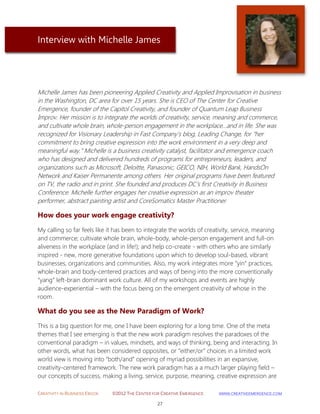
Interview with Michelle James 
Michelle James has been pioneering Applied Creativity and Applied Improvisation in business in the Washington, DC area for over 15 years. She is CEO of The Center for Creative Emergence, founder of the Capitol Creativity, and founder of Quantum Leap Business Improv. Her mission is to integrate the worlds of creativity, service, meaning and commerce, and cultivate whole brain, whole-person engagement in the workplace...and in life. She was recognized for Visionary Leadership in Fast Company’s blog, Leading Change, for “her commitment to bring creative expression into the work environment in a very deep and meaningful way.” Michelle is a business creativity catalyst, facilitator and emergence coach who has designed and delivered hundreds of programs for entrepreneurs, leaders, and organizations such as Microsoft, Deloitte, Panasonic, GEICO, NIH, World Bank, HandsOn Network and Kaiser Permanente among others. Her original programs have been featured on TV, the radio and in print. She founded and produces DC’s first Creativity in Business Conference. Michelle further engages her creative expression as an improv theater performer, abstract painting artist and CoreSomatics Master Practitioner. 
How does your work engage creativity? 
My calling so far feels like it has been to integrate the worlds of creativity, service, meaning and commerce; cultivate whole brain, whole-body, whole-person engagement and full-on aliveness in the workplace (and in life!); and help co-create - with others who are similarly inspired - new, more generative foundations upon which to develop soul-based, vibrant businesses, organizations and communities. Also, my work integrates more “yin” practices, whole-brain and body-centered practices and ways of being into the more conventionally “yang” left-brain dominant work culture. All of my workshops and events are highly audience-experiential – with the focus being on the emergent creativity of whose in the room. 
What do you see as the New Paradigm of Work? 
This is a big question for me, one I have been exploring for a long time. One of the meta themes that I see emerging is that the new work paradigm resolves the paradoxes of the conventional paradigm – in values, mindsets, and ways of thinking, being and interacting. In other words, what has been considered opposites, or “either/or” choices in a limited work world view is moving into “both/and” opening of myriad possibilities in an expansive, creativity-centered framework. The new work paradigm has a a much larger playing field – our concepts of success, making a living, service, purpose, meaning, creative expression are
CREATIVITY IN BUSINESS EBOOK ©2012 THE CENTER FOR CREATIVE EMERGENCE HTTP://WWW.CREATIVEEMERGENCE.COM 
28 
changing. The lines are blurring…these things are not silo-ed and separated as much. Creativity is no longer seen as “woo woo” or something you engage after work on your free time – it’s right in the center of the new work paradigm. 
A creativity-centered paradigm requires new foundational principles of engagement. The same rules that applied for a static, conformity-based, do-as-you-are-told workplace are very different than those of a dynamic, alive, adaptive, resilient, independent-thinking, creative workplace. I believe we have much to learn from the principles of improv theater (yes- anding, makes everyone else look good, serve the good of the whole, mistakes are invitations to create, etc.) to help us both adapt to and co-create the new paradigm. I’d love to see improv theater training as part of the core training curriculum at all organizations – it’s hugely transformative. 
What do you see as the role of creativity in that paradigm? 
I see it as the core. Breaking old patterns, creating new foundations, developing more generative structures, and the expressing richer, fuller, more alive aspects of ourselves require us to actualize deeper levels – and use multiple expression - of our creative potential. 
What mindsets do you see as essential for navigating the new work paradigm? 
A shift in core values and foundational ways of being that are more expansive, generative and inclusive. I see the new mindsets as “Yes Anding” and containing older ones, and adding a new dimension to what was there before - a developmental, emergent process. 
Some of the emerging mindsets I see are moving from either/or thinking to include more yes-anding, generative thinking; moving from valuing conformity and getting it right to valuing more exploration and original thinking; not just tolerating, but actually anticipating mistakes as part of the creative process and allowing for it much more liberally than in the past; moving from seeing “failure” as binary (pass/fail, right/wrong, good/bad) to experiencing it as an iteration - an invitation to learn, grow and evolve; moving from a selling-only mindset to a service mindset; using intuition and resonance as much as logic in decision making; increased comfort in improvising; using more heart, empathy, caring, co- creation in structuring the workplace, establishing the culture and environment, and engaging our work daily; and more focus on empowerment coming from the creativity withIN ourselves to name a few. 
What is Creative Leadership to you? 
A Creative Leader, to me, is a leader who chooses to use more of his or her own creative potential on an ongoing basis – choosing to always learn and evolve personally as well as professionally; one who is dedicated more to exploring possibilities than being right, and more to discovery than maintaining the status quo. Creative Leaders facilitate meaning, creativity, and contribution of those he or she serves – employee, colleague, team member,
CREATIVITY IN BUSINESS EBOOK ©2012 THE CENTER FOR CREATIVE EMERGENCE HTTP://WWW.CREATIVEEMERGENCE.COM 
29 
MAKING IT REAL 
What is one practice that people could start applying today to bring more creativity into their work or work place? 
Transforming uncertainty into discovery. Once uncertainty is no longer something to be avoided, you can use it as a creative resource. It goes form being intimidating to being fun…and can lead to surprising creative breakthroughs. Here is an exercise to get started in making the unknown your BFF. 
Research shows that moving differently creates new neurological pathways that free up the brain to think differently - an essential ingredient for innovation and new solutions. Moving in non-habitual ways requires the brain to be used in non-habitual ways which then leads to novel thinking. (i.e., improv theater groups use movement warm-ups to get out of habitual thought patterns and get fully present to create). 
I created a workshop activity called The Creativity Walk which has many variations. In it, participants walk, move and nonverbally interact in myriad ways, each one designed to have them experience the conceptual framework of a certain states of being related to aspects of the creative process. One is discovery. 
The Discovery Walk 
In this practice, participants are asked to walk around and engage from a place of certainty, a place where they know the answers. Without exception, inevitably chests pop up, walks become linear and directed, bodies straighten up, eyes focus ahead, etc. Not too much interaction as people move around the room in a rapid, straightforward pace. Focus, yes. Newness, no. 
Then they are asked to walk form uncertainty, a place where they do not know the answers. Bodies shrink, movement slows or stops altogether, eyes dart around or look down. Almost no interaction. There is a feeling in the room of fear, trepidation and judgment as they look like deers frozen in headlights. The energy is stagnant. Neither focus nor newness surfaces. 
They are then asked to transform that uncertainty into discovery. They are told they still do not know the answers - still in the unknown - however, they now experience it from a state of discovery. Suddenly, the entire energy of the room shifts and awakens: they look about thoughtfully, they are fluid in their movement, they explore their surroundings with all of their senses, they are content, alert, curious and present. They look at each other. Movement goes back and forth from linear to non-linear as they keep moving ahead. There is a sense of contentment, ease, and a feeling of openness. Connections are made. Newness is possible. 
There is a noticeable visceral difference between openness of the discovering unknown shut-down stuckness of the fear-based unknown. In both cases, we are with the unknown. In the former, we have possibilities open to us. Once felt in the body (embodied), it is much easier to re-access that feeling later when faced with uncertainty in real work and life situations. Discovery is instant empowerment.  
You can do this as a team or group, or by yourself in a room. The key is to really feel the discomfort of static uncertainty in the body, and then let it transform into the dynamic openness of discovery. By consciously practicing transforming that which we do not know into a discovery process, we can more easily move through the fear of not knowing amidst the uncertainty around us on a more consistent basis. 
customer, participant, etc. Creative Leadership is paradoxical: strong and soft; directional and flexible; strategic and emergent; focused and open. The creative leader, to use and improv terms, does what he or she needs to serve the scene…sometimes taking a lead role, other times support role and following what is already happening….stepping up and letting go as the situation dictates. Creative Leaders welcome, inspire, and awaken the Creative Leadership in those they lead.
CREATIVITY IN BUSINESS EBOOK ©2012 THE CENTER FOR CREATIVE EMERGENCE HTTP://WWW.CREATIVEEMERGENCE.COM 
30 
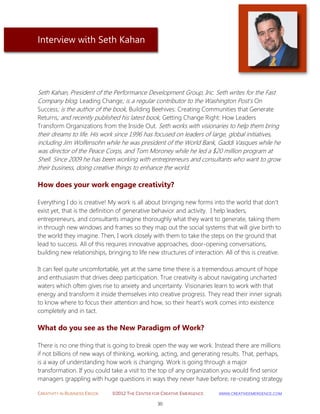
Interview with Seth Kahan 
Seth Kahan, President of the Performance Development Group, Inc. Seth writes for the Fast Company blog, Leading Change; is a regular contributor to the Washington Post's On Success; is the author of the book, Building Beehives: Creating Communities that Generate Returns; and recently published his latest book, Getting Change Right: How Leaders Transform Organizations from the Inside Out. Seth works with visionaries to help them bring their dreams to life. His work since 1996 has focused on leaders of large, global initiatives, including Jim Wolfensohn while he was president of the World Bank, Gaddi Vasques while he was director of the Peace Corps, and Tom Moroney while he led a $20 million program at Shell. Since 2009 he has been working with entrepreneurs and consultants who want to grow their business, doing creative things to enhance the world. 
How does your work engage creativity? 
Everything I do is creative! My work is all about bringing new forms into the world that don't exist yet, that is the definition of generative behavior and activity. I help leaders, entrepreneurs, and consultants imagine thoroughly what they want to generate, taking them in through new windows and frames so they map out the social systems that will give birth to the world they imagine. Then, I work closely with them to take the steps on the ground that lead to success. All of this requires innovative approaches, door-opening conversations, building new relationships, bringing to life new structures of interaction. All of this is creative. It can feel quite uncomfortable, yet at the same time there is a tremendous amount of hope and enthusiasm that drives deep participation. True creativity is about navigating uncharted waters which often gives rise to anxiety and uncertainty. Visionaries learn to work with that energy and transform it inside themselves into creative progress. They read their inner signals to know where to focus their attention and how, so their heart's work comes into existence completely and in tact. 
What do you see as the New Paradigm of Work? 
There is no one thing that is going to break open the way we work. Instead there are millions if not billions of new ways of thinking, working, acting, and generating results. That, perhaps, is a way of understanding how work is changing. Work is going through a major transformation. If you could take a visit to the top of any organization you would find senior managers grappling with huge questions in ways they never have before, re-creating strategy
CREATIVITY IN BUSINESS EBOOK ©2012 THE CENTER FOR CREATIVE EMERGENCE HTTP://WWW.CREATIVEEMERGENCE.COM 
31 
for a constantly moving world. Sooner rather than later, this will show up at every level of the organization. The rate of change has increased dramatically and that is impacting everyone. Organizations that can surf change will stay on top of the waves. Organizations that are sitting it out are going down, even if they don't yet recognize it. 
What do you see as the role of creativity in that paradigm? 
When the rate of change is up, only those who are creative or lucky survive. Those who embrace innovation personally, who take it seriously and make a point of practicing their ability to adopt and adapt will be those who come out on top. So creativity is becoming a necessary competency at the personal level. 
What mindsets do you see as essential for navigating the new work paradigm? 
Taking personal responsibility for your relationship to the ever-shifting, often awkward lurches of organizational structure. Reframing skills, learning to reframe experience so you generate optimism, performance improvement, and dream achievement. Patience, compassion, caring as a compass in the chaos. 
What is Creative Leadership to you? 
Keeping your eye on the horizon and your feet on the ground. Disciplining yourself to dream big, but stay connected to the hard work of today.
CREATIVITY IN BUSINESS EBOOK ©2012 THE CENTER FOR CREATIVE EMERGENCE HTTP://WWW.CREATIVEEMERGENCE.COM 
32 
MAKING IT REAL 
What is one practice that people could start applying today to bring more creativity into their work or work place? 
Eight conversations that you can use to generate the future. For each of these conversations you must establish an atmosphere of genuine exploration. These eight topics are meant to open the doors of perception to new possibilities, creating an environment where half-baked ideas can emerge for examination and development, insights can form, and new possibilities can edge their way into view. 1. What is the best possible thing that can happen as a result of our efforts? a. What performance improvement is possible as a result? b. What could this mean to you, me, and us? 2. How do new ideas successfully take root in our culture? a. Where has success happened in the past? b. What innovations have we operationalized with good results before? 3. Where do the trajectories of our efforts converge? a. What are the possible synergies if we are both successful? b. How can we leverage each other’s results? 4. What motivates you to succeed? a. What is the source of your inspiration, your motivation? b. How can this be leveraged for even greater returns? 5. What would be the consequences if we were both successful? a. Can we describe this world? b. How would individual and organizational work be improved? 6. If we were to generate dramatic results, what partnerships would we rely on? a. Who else must be involved in our achievements? b. How do we provide returns to them? 7. What prerequisites do we both rely on to achieve big wins? a. What can we do to ensure we have what we need? b. Where can we combine efforts to ensure success?
CREATIVITY IN BUSINESS EBOOK ©2012 THE CENTER FOR CREATIVE EMERGENCE HTTP://WWW.CREATIVEEMERGENCE.COM 
33 
Interview with Tim Kastelle 
Tim Kastelle is Senior Lecturer in Innovation Management at the University of Queensland Business School. Tim held in senior positions in a variety of industries where he developed an interest in the role of innovation and firm growth which led to an MBA and PhD. His broad research interests are the impact of innovation on firm and economic growth, and the application of complex network analysis to the study of innovation at the levels of the firm, region, sector and nation. His current projects include the evolution of national innovation systems, how internal structures influence innovation outcomes in project-based firms, and a study of internal networks within an organization and their impact on innovation performance. His corporate research and consulting partners include Brisbane City Council, Ergon Energy Corporation, Fusidium Pty Ltd, Queensland Health, Rio Tinto, GHD Engineering, Teys Australia, Fairfax Digital and Hatch Engineering among others. Tim also runs the UQ Business School’s Innovation Leadership Executive Education and MBA Programs. 
How does your work engage creativity? 
Creativity is a core part of innovation. However, one of the common mistakes that I often see in organizations is that people end up thinking that creativity and innovation are only about generating ideas. When you take this view, then the obvious way to become more creative, and consequently more innovative is to figure out ways to have more ideas. I've done some informal research in my MBA and Executive Education courses, and out of the more than 100 organizations that I've surveyed, only 4 have identified themselves as being ideas-poor. The rest have problems either with selecting the best ideas, executing their ideas, or getting their ideas to spread. To me this is a crucial point - if we are going to improve innovation, we actually need to get better at those other steps, not just at generating ideas. On a personal level, executing ideas is a central part of my creative work as well. I generate ideas all the time - too many probably! But they don't become real until I actually figure out how to communicate them. In my case, that means either writing them out (in a blog post, an academic paper, or even just a note to myself), or teaching them. In both cases I end up trying to use stories to communicate the idea. Once I figure out the right story, then I am more confident in thinking that the idea might be useful. In my research, I look at the impact of knowledge-sharing networks on creativity and innovation. The structure of interpersonal networks, both within and between firms, has a
CREATIVITY IN BUSINESS EBOOK ©2012 THE CENTER FOR CREATIVE EMERGENCE HTTP://WWW.CREATIVEEMERGENCE.COM 
34 
huge influence on how successfully firms can generate and execute new ideas. Because my research is based on networks, I end up seeing network stories in everything, even creativity! 
What do you see as the New Paradigm of Work? 
I think that the new paradigm of work is best represented in the shift from hierarchical forms of control to networked organizations. Interpersonal networks are important even within the most hierarchical organization. However, we are starting to see more instances where the network is the organization. This is particularly true of organized movements that take place outside of the boundaries of a traditional firm, as in open source software development, or open innovation. In order to be successful in this paradigm, we have to proactively think about and manage our personal networks. One of the key features of networks is that people have more autonomy - this provides more opportunity, and it also tends to make work more interesting. 
What do you see as the role of creativity in that paradigm? 
Creativity and innovation are the key outcomes of this form of organization. Trying to improve innovation outcomes has been one of the key drivers in shifting to networks. Creativity and innovation are emergent outcomes from networks. Consequently, we need to try develop network structures within our organizations that support and encourage creativity. In practical terms, this means actively working to build connections across silos. This can be done in a number of ways: making cross-functional teams, using communities of practice, and building internal social networks are three common tools that help with this. In addition to thinking about the structure of internal connections, we also have to consider our external networks. How do we connect up with suppliers, customers, and complementary organizations? Again, the structure of these networks has a big impact on the types of ideas we generate and on our ability to execute these ideas. So creativity is a critical outcome of this form of organizing, and we can also be creative in the way that we build our networks. 
What mindsets do you see as essential for navigating the new work paradigm? 
There are several essential behaviors here. The first is that we have to get better at forming connections with people that have different thinking styles and attitudes. A common trap in networks is that people are most likely to form connections with the people that are most similar to themselves. This is the most comfortable approach, however, this approach leads to low levels of diversity in thinking. Groups are more creative and innovative if they are diverse - not necessarily in terms of gender or race, but more importantly in terms of thinking style, culture, and expertise. These types of connections are harder to build and maintain - which is why skill in this area is one key behavior.
CREATIVITY IN BUSINESS EBOOK ©2012 THE CENTER FOR CREATIVE EMERGENCE HTTP://WWW.CREATIVEEMERGENCE.COM 
35 
MAKING IT REAL 
What is one practice that people could start applying today to bring more creativity into their work or work place? 
I have two tools - one to help with creativity and one to help with networks 1. To improve your creative/innovative outputs, focus on taking action. Pick one great idea you've had that you still haven't executed. Figure out what next steps are needed to test it out, or to make it real. Now here's the hard part - take five minutes right now, and get the first step started. And I really mean right now - don't read the next tip, or the last answer. Take some action, then come back and finish reading. It's only through action that we make our ideas real. 
2. For building your networks, I'm going to recommend something that Tom Peters has been advocating for a long time: think of the freakiest person you know in your organization - someone that just seems weird, or that makes you uncomfortable - and invite them to lunch, or a coffee. When you're with them, ask about what they're working on right now, or what they find interesting. If you do this, you'll probably end up with some ideas that you would never have gotten otherwise, and more importantly, you just added some real diversity to your personal network. 
The attitudes that drive this behavior are curiosity and empathy. Curiosity is obviously a key component of creativity, but it is also important in network building. It is easier to make connections with people with diverse mindsets if you are genuinely curious about how they view things. Empathy then allows you to understand these divergent viewpoints. 
What is Creative Leadership to you? 
Innovation is just as important in leadership and management as it is in any other part of work. People often think that innovation is just about coming up with new products or services, but one of the most important forms of innovation is coming up with new ways of doing things. Creative Leadership is about doing precisely that - developing innovative ways to lead and manage. In more practical terms, Creative Leadership is mainly about two things: inspiration and removing obstacles. Leaders need to show people where the organization might be heading, and they need to inspire people to head in that direction. In order to do this successfully, leaders need to remove obstacles along the path. In a networked organization, the job of the leader is not to tell people what to do, but rather to figure out what might stop them from doing the things that need to get done and addressing those problems. The best leaders are the ones that realize that management is a support role, not a directive one.
CREATIVITY IN BUSINESS EBOOK ©2012 THE CENTER FOR CREATIVE EMERGENCE HTTP://WWW.CREATIVEEMERGENCE.COM 
36 
Interview with Annalie Killian 
Annalie Killian has made a career out of playing the role of "Corporate Maverick." Since 2000, she has been the Catalyst for Magic at AMP, one of Australia’s most eminent Financial Services corporations. In charge of Innovation, Communication and Collaboration, she stirs up employee creativity, cross-functional collaboration and open innovation. She is also the creator of the unique Amplify Festival of Innovation & Thought Leadership where over 3000 of the company’s employees and clients participate with thought leaders and change agents from all over the world to explore and imagine the future in creative ways. She is sought out as a Futurist and for her experience in effecting transformational change in complex systems. In her early career with BHP-Billiton, the world’s largest mining corporation, she pioneered innovation in social responsibility and business/ community partnerships and won numerous international awards for initiatives that helped the South African society transition from apartheid to democracy. Her work at the intersection of business and community laid the foundation for her early adoption of social technologies to harness the power of networked communities and the collective intelligence of the crowd. 
How does your work engage creativity? 
My starting point on creativity is that it already exists in everyone - it may just not be recognized, appreciated or given freedom to be expressed. So, the magic is already there, it just needs a catalyst to kindle it and bring it forth. My work focuses on how the inhibitors to the free-flow of creative energy can be recognized, reframed or removed. Inhibitors can take the form of self-limiting beliefs at the individual level that need to be turned into confidence and courage to take risk, to the organizational beliefs, collective culture and practices that might demand perfection and certainty and discourage experimentation and learning. To catalyze more creativity, we mix things up- a lot! We create safe learning spaces and a “permission to experiment” environment. From an innovation kitty to build and test business innovation ideas to an EXPO where ideas for investment are brought to life via visual metaphors, from teaching creativity through musical jamming, improv theater, story slams, painting, film festivals to social media cafes and Twitter Twaste-ups (tasting nights where people learn Twitter through sharing their food/ wine tasting notes). 
What do you see as the New Paradigm of Work? 
The new paradigm is about Life. One life, and work is part of that life and increasingly these
CREATIVITY IN BUSINESS EBOOK ©2012 THE CENTER FOR CREATIVE EMERGENCE HTTP://WWW.CREATIVEEMERGENCE.COM 
37 
two blend like fluids. Much of this is driven by the exponential rate of technological advances, automation by machines of routine tasks and the unstable and unpredictable business climate (and in part, planetary climate conditions!) The technologies we use for work and for socializing blend; the devices we use at home and at work blend; our networks blend; our hours of work and home-time blend in a ubiquitously connected global economy; our work spaces blend and even the boundaries between our professional personas and our personal reputations blend. Increasingly, our employers blend as many people become self-employed or work on contract terms for multiple organizations, over time our careers will blend from one life stage to another, much like seasonal workers or the way in which actors work. In this new paradigm of work, where work and life are inseparable, happiness will only be possible if work blends with play, if passion blends with purpose, and if creativity is as vigorously cultivated as profitability. 
What do you see as the role of creativity in that paradigm? 
Creativity is essential for the sustainable health and survival of both the employee and the employer in the new paradigm of work. At the organizational level, collective creativity is essential for adaptation and innovating for opportunities and disruptions brought about by rapid changes in the environment. At the level of the individual, the changing nature of work and automation of routine tasks by computers means the ability to differentiate oneself is critical for maintaining a predictable income stream and managing the stress that accompanies uncertainty. In other words, creativity becomes critical to the survival and happiness of the individual. The reality for many people is that every job has its boring bits, and we can become blunt if we’ve done the same job for a long time. By providing avenues for creative experimentation or re-imagining approaches to tasks or projects, we can generate “fresh eyes” all the time. In my work, we do this through our Amplify Festival, our film festivals, our Blossom at Work and IT Makes a Difference projects. These provide many avenues for creative discovery, new skill acquisition, cross-functional collaboration and edge-dwelling. This has a rejuvenating effect and high engagement factor for people and it increases their personal happiness as well as the mood and capability of the whole organization. 
What mindsets do you see as essential for navigating the new work paradigm? 
The role of leaders in changing from commanders and controllers of tasks to coaches and catalysts of lifelong learning is essential to the new paradigm of work. At the individual level, there is also a personal responsibility to remain curious and keep learning, to stay abreast of one’s field, and to connect to the bigger picture.
CREATIVITY IN BUSINESS EBOOK ©2012 THE CENTER FOR CREATIVE EMERGENCE HTTP://WWW.CREATIVEEMERGENCE.COM 
38 
MAKING IT REAL 
What is one practice that people could start applying today to bring more creativity into their work or work place? 
First, a tool: Because I see us moving more and more into a visual communication world, one tool that I think accelerates creativity in multiple dimensions all at once is the Flip Mini High Definition plug and play video camera. It’s simple to use, fits in your pocket and it develops and converges many creative abilities in the production of content- from conceptualizing, perspective-shifting, framing and composition to storytelling, acting, observation; from synthesis and meaning through editing to emotional intelligence via the impact on and feedback loops of viewers; from creative friction and collaboration with others to self-actualization for the creator. Not to mention that it provides hours of largely cost-free fun. Second, an approach: My personal mantra for a DREAM career is a mnemonic that I aspire to every day. I don’t always get it right but it keeps me focused. D - Differentiate yourself, cultivate uniqueness. (Creativity plays a massive role here) R - Relationships matter more than knowledge in a digital networked economy E - Esteem and ethics. These go hand in hand, money can’t buy it and it takes a lifetime to cultivate it A - Amplify yourself, scale to punch above your weight, make a bigger difference, achieve more with the same effort. (This is about leading and inspiring others to contribute to your vision) M - Memorable - make heart-to-heart connections, make people feel good about themselves. 
What is Creative Leadership to you? 
Leadership of others starts with leadership of self. Even if one has reached the highest rung of people leadership, it’s important to keep your own creativity juiced up by continuing to practice creation: CREATE: Create something, change the world, make a difference. This is about applying your unique gifts. It can take the form of a vision, a company, a project, an artifact or an object. 
COLLABORATE: This is about creating with others, experiencing creative friction, collective energy. 
CATALYZE: This is about letting go of self, being open and freeing energy, working through others, leading, teaching, developing. 
CLUTIVATE COURAGE: Fear is the greatest inhibitor to human potential and a bigger limitation than any obstacle the world can put in one’s way. Creative Leadership is about being personally courageous and helping others find courage and supporting their risk- taking.
CREATIVITY IN BUSINESS EBOOK ©2012 THE CENTER FOR CREATIVE EMERGENCE HTTP://WWW.CREATIVEEMERGENCE.COM 
39 
Interview with Jeff Klein 
Jeff Klein, CEO of Cause Alliance Marketing, producers of collaborative, cause-related marketing programs. He also serves as Executive Director for Conscious Capitalism, Inc. (a.k.a. FLOW) through which he facilitates Conscious Business™, Peace Through Commerce®, and Accelerating Women Entrepreneurs™ Alliances, working with Thunderbird School For Global Management, U.S. Special Operations Command, and the Business Roundtable Ethics Institute. Jeff wrote his new book, Working for Good: Making a Difference While Making a Living for innovative entrepreneurs and organizational change agents wanting to thrive by doing good. 
How does your work engage creativity? 
Collaboration, which is at the core of alliances, fosters creativity. Bringing together diverse individuals and organizations with shared vision and compatible interests to create new (often ad hoc) organizations and to formulate and implement programs that serve their individual interests while advancing their shared mission is an exercise in creativity for all involved, and facilitating these alliances demands creativity and many of the elements that foster it – including flexibility, openness, adaptability. 
What do you see as the New Paradigm of Work? 
The new paradigm of work sees work as part of an integrated life, and as a path and platform for expression and cultivation of creativity and potential. A general and increasing concern for businesses, documented in research by Interaction Associates and others, is that of employee engagement – catalyzing the energy, attention, passion, and creativity of employees. On the other side, employees (particularly among the Millennials) are demanding work that reflects their values and engages their passion and sense of purpose. For the swelling ranks of “free agents” – consultants and entrepreneurs, “holistic” work is simply a given. 
What do you see as the role of creativity in that paradigm? 
Creativity is an essential element of the new paradigm of work, part of the process and product. Working and living in ways that are connected to passion and purpose, that engage our full beings catalyze creativity. And, being a free agent requires constant creativity to meet the marketplace and create demand. Entrepreneurship is by definition a creative process. The
CREATIVITY IN BUSINESS EBOOK ©2012 THE CENTER FOR CREATIVE EMERGENCE HTTP://WWW.CREATIVEEMERGENCE.COM 
40 
MAKING IT REAL 
What is one practice that people could start applying today to bring more creativity into their work or work place? 
Awareness practice is the foundational skill for cultivating creativity. Mindfulness meditation is one specific approach to awareness practice or cultivating awareness. By cultivating open, judgment-free observation of our moment-to-moment experience - of what we are experiencing through our senses and how we interpret that experience through thoughts and emotions – we cultivate spaciousness, open-mindedness, freedom to explore and experiment, an inquiring mind. 
A simple way of beginning to practice this is to sit comfortably, and to observe the sensations in your body, as you notice something, name it (in your mind). For example, if you observe tightness in your shoulders, say in your mind “tightness, tightness tightness…” In a relaxed way…what you will notice is that the tightness or your focus on it will eventually shift to something else, then observe that. You can do the same thing for thoughts and you can move between sensations, thoughts and feelings. 
new work paradigm is an emerging new reality that has emergence as one of its essential attributes. We recognize that change and interdependence are fundamental aspects of life and of business and life, and we cultivate the skills to thrive in this context. Creativity of one of the essential skills for thriving in a context of emergence. 
What mindsets do you see as essential for navigating the new work paradigm? 
In addition to creativity, other related attitudes, behaviors, and skill for navigating the new work paradigm include awareness – the ability to reflect and inquire; openness and humility – to recognize the limits of our knowledge and be open to the insights and perspectives of others; flexibility and adaptability – to observe and respond to changing circumstances, move quickly and change course; collaborativeness – to truly work and co-create with others. 
What is Creative Leadership to you? 
Creative Leaders embody the spirit of creativity and cultivate it in others. Creative Leaders practice and model creativity and skills that foster it. True leaders are creative by definition, since they are called to support innovation and risk taking, to forge new ground for their team or organization. So, in some respects, creative is redundant with respect to leadership, at least to good, effective leadership!
CREATIVITY IN BUSINESS EBOOK ©2012 THE CENTER FOR CREATIVE EMERGENCE HTTP://WWW.CREATIVEEMERGENCE.COM 
41 
Interview with Kat Koppett 
Kat Koppett is founder of Koppett + Company, a training and consulting company specializing in the use of theatre and storytelling techniques for individual and organizational performance, and the Co-Director of The Mop & Bucket Company, an improvisational theatre company and school. Her book on how to use improvisational theatre techniques for organizational development, Training to Imagine: Practical Improvisational Theatre Techniques to Enhance Creativity, Teamwork, Leadership and Learning, is used by trainers, teachers and organizational leaders around the world, and will be released in a revised edition by Stylus Publishing this Fall. Kat has designed and delivered training for Chanel, Pepsi, Kaiser-Permanente, NYSID, Glens Falls Hospital, JPMorgan Chase, Eli Lilly, and The Farm Bureau among others in places such as India, Brazil, Paris and Oklahoma. TheatreWeek Magazine named Kat one of the year’s “Unsung Heroes” for her creation of the completely improvised musical format, “Spontaneous Broadway” which is now performed from New York to California to Australia. 
How does your work engage creativity? 
Improvisers make stuff up, collaboratively, on-the-spot, with no script or pre-planning, in front of paying audiences demanding to be entertained, often based on that audience's suggestions. We must take our ideas and passions and intentions and marry them with whatever is happening in the moment to produce work that delights our customers and ourselves. In order to accomplish this rather daunting task, improvisers have developed principles and techniques to guide them. And those approaches seem to apply in helpful ways to any situation in which people are working collaboratively (or individually, actually) to build something. 
What do you see as the New Paradigm of Work? 
There is no longer such a thing as job "security". Whereas there may have been a time when a person could reasonably think to choose between the chaos and risk of life as an entrepreneur (or in the arts) and the steady safety of a job in a "solid" profession, now everyone lives the life of an entrepreneur. Most people will have many jobs. We must all manage our own career paths and financial well-being with less obvious, traditional trajectories to follow. And work is not just an at-the-office, 9-5 endeavor for most of us any more. The marketplace is global, the work-cycle a 24-hour one, personal and professional lives merge, and your colleagues and friends are as likely to live on the next continent as the
CREATIVITY IN BUSINESS EBOOK ©2012 THE CENTER FOR CREATIVE EMERGENCE HTTP://WWW.CREATIVEEMERGENCE.COM 
42 
next block. Work is much more individual, much more intertwined, and much more unpredictable than in the past. 
What do you see as the role of creativity in that paradigm? 
The rules are changing all the time. Although planning remains imperative, most plans are useless, and all of us must be flexible and creative and autonomous and skilled at surfing change. Although there remain unprecedented opportunities and comforts for many of us, times are scary in all sorts of ways. Economically, environmentally, socially. It will take our best selves to develop new ways of interacting with each other to transcend the violence and mistrusts and that continue to plague us. It will take our most creative approaches to develop sustainable practices and keep the global community (and the globe) healthy and thriving. The old ways are failing us, and the stakes are as high as they have ever been. To paraphrase Daniel Pink, the future will belong to those who can flex, adapt, empathize, tell stories, and create. What mindsets do you see as essential for navigating the new work paradigm? 
The most fundamental improv principle is the "yes, and" rule which says, an improviser must accept and build with what her partner offers. (An offer, in improv parlance, is a technical term that means ANYTHING - an idea, an emotion, a gesture, an attribution - that is created in the scene.) Significantly, "accept" does not mean "agree". We do not have to like the offers. They may not be at all what we are expecting or want. But we are obligated to use them, simply because they exist. On stage that means we accept the co-created reality. For example, if my partner says, "Hi, Honey, I'm home!" then I accept that he has a honey and this is his home. 
In real life, accepting offers may mean that I accept that my partner has a different experience of an interaction, or that there is an imposed deadline for a project, or that climate change is happening, or that there is an increasing disparity between the rich and poor in the U.S. I may not like it, but it exists, so I must deal with it. Once I accept the offers that are, then I can move on to the "and" part, which says, I will seek to create with what is already there. Too often we waste time and energy "yes, but-ing" - arguing with or blocking the offers that we don't like, or don't see. When we "yes, and" we are able to build with whatever has come before. Want to get better at "yes, anding"? Start by shifting your internal question when faced with something unexpected or unattractive from "Will I accept and build with this?" to "HOW can I use or build with this?" 
What is Creative Leadership to you? 
The Artistic Director of Freestyle Repertory Theatre, Laura Livingston,
CREATIVITY IN BUSINESS EBOOK ©2012 THE CENTER FOR CREATIVE EMERGENCE HTTP://WWW.CREATIVEEMERGENCE.COM 
43 
MAKING IT REAL 
What is one practice that people could start applying today to bring more creativity into their work or work place? 
Most people respond to the "yes, and" principle above when it is presented. And yet most people also acknowledge that they and those around them tend to "yes, but" more than they "yes, and". There are a number of reasons for this ranging from acquired habits to cultural norms and reward structures. Of course, sometimes "no" is appropriate, courageous, creative and useful. But often we block in ways that are habitual or fear-based rather than productive. Keith Johnstone, improv guru and author of "Impro", sums it up this way, “There are people who prefer to say ‘Yes’, and there are people who prefer to say ‘No’. Those who say ‘Yes’ are rewarded by the adventures they have. Those who say ‘No’ are rewarded by the safety they attain.” In order to encourage positive risk-taking and developmental culture in which "yes, and" is practiced, we and our clients use the "Circus Bow". The Circus Bow: Step 1: Put your hands over your head. Step 2: Say, "I failed!" or "I made a mistake" or "I feel silly!" Step 3: Take a big celebratory bow and accept wild applause from your colleagues. The circus bow is, of course, borrowed from the circus. When the start aerialist misses the quadruple back-flip, he does not slink off muttering that he should have stuck to the triple that he was certain to succeed at. He celebrates the courage and achievement mindset necessary to have stretched himself and tried something new and adventurous. It is only in environments where failure is not only tolerated, but celebrated in this way, that creativity and innovation can truly thrive. (This, by the way, is an idea which is being rediscovered and heralded in business publications right now. Fast Company, Harvard Business Review, TED and others have had great articles and discussions on just this topic in the last few months.) 
once told me that she felt her job was to create the jungle gym so that her improvisers could swing on in. By providing solid structure - clear objectives, rules of engagement, resources, time, functional and delightful spaces - leaders can provide environments in which creativity can grow and thrive. Often that means doing the boring, inside-the-box, behind-the-scenes scut work that gets very little recognition or conscious appreciation. Kinda like being a good parent, I suppose. In short, Creative Leaders model what they want to encourage, provide stimulating environments in which it is safe to experiment and grow, and get out of the way.
CREATIVITY IN BUSINESS EBOOK ©2012 THE CENTER FOR CREATIVE EMERGENCE HTTP://WWW.CREATIVEEMERGENCE.COM 
44 
Interview with Michael Margolis 
Michael Margolis, President of Get Storied and author of Believe Me: a storytelling manifesto for change-makers and innovators - 15 storytelling axioms that will help you re-think how you must communicate your work, especially in this new adaptive age. Michael advises businesses, nonprofits, and entrepreneurs on how to get others to believe in their story. Taking a storied approach has direct impact on the bottom line by turning current and potential customers into true-believers - and then anything becomes possible. 
How does your work engage creativity? 
For most creative people, the “ideas” side of the process often comes easy. Yet getting others to understand and care about your ideas is a different story. There’s a big difference between creating for the pure sake of creation and creating things that others will want and buy. It’s called relevance. And it lives at the intersection of creativity and storytelling. Anytime you’re introducing something new or different, you have to paint a picture that others can actually relate to. Otherwise, your idea is just plain dead on arrival. 
What do you see as the New Paradigm of Work? 
So many people and organizations I know seem to be in the midst of “re-invention”. We’re all somehow recalibrating who we are and how we show up in the work. There’s a huge hunger and thirst for creativity. The old way of communicating is falling on deaf ears. People want a genuine, authentic, responsive connection – whether they’re an employee, a customer, a donor, or a member. It’s a time of major upheaval, as we re-examine and re-define what we mean by “value”. We’re all learning new ways of communicating and relating to one another. And this requires new stories, and new ways of telling them. 
Storytelling has huge business value. It’s really about apply narrative to the strategic conversation –developing a new mindset around the stories we choose to tell, and how those stories shape our world. Every business tells stories. They’re just not always conscious of them. Your brand tells a story. Your strategic vision tells a story. Your cultural norms tell a story. Stories are one of the drive-trains of our economy and our society. Behind every stock price are stories that drive perception of market value. And as individuals, we define our lives and identities through the stories we tell.
CREATIVITY IN BUSINESS EBOOK ©2012 THE CENTER FOR CREATIVE EMERGENCE HTTP://WWW.CREATIVEEMERGENCE.COM 
45 
These are some of the big themes in my new book, Believe Me. My very first axiom says, “People don’t really buy your product, solution, or idea, they buy the stories that are attached to it.” Which means if you want people to believe in what you’re doing, you better look at the characteristics of your story. One of the first questions to ask yourself is whether your story is big enough? 
What do you see as the role of creativity in that paradigm? 
Creativity is about expanding the world of possibilities. Many organizations are faced with increasing constraints and plenty of reasons to be depressed and demoralized. I think that creativity from the perspective of new possibilities is a refreshing attitude. The bigger the story you can tell, the more room there is under the tent for people to locate themselves in it. Which means you want a story that people can identify with as their own. Also by expanding the story, you move beyond old constraints into greater space and freedom. 
What mindsets do you see as essential for navigating the new work paradigm? 
In every business, industry and issue area there’s usually a bigger story just waiting to be told. You have to look at the possibilities, and find the larger universal story that everyone can relate to and accept as truth. 
One example is the organization Charity: Water. There are plenty of nonprofits working on water issues, but Charity: Water is the only one that in just three short years has built a global pop culture movement around the issue of water. It engages both celebrities and the general public in a manner that turns people in true committed evangelists. The various ways Charity Water packages the story makes it so easy to become invested as a true believer. They ask photo journalists to document the stories of how communities transform when they receive access to clean water wells. Google Maps and info-graphics show you where the water wells are built. And there’s creative banner graphics and social media plug-ins for anyone to become a brand ambassador for the cause. Charity: Water is finding a way to crack the code on the water story and get people to feel invested around the issue. 
What is Creative Leadership to you? 
I think back metaphorically to Christopher Columbus and the Age of Exploration. We know there’s something bigger out there, because the current world as we’ve defined it, feels way too constrained. We’ve outgrown the existing container and our systems are clearly strained beyond capacity. Creative Leadership to me is about learning how to travel off the map. 
But what lies out on the horizon? That’s the task of Creative Leadership – to lead people into the creative unknown. This takes a leap of faith and the belief that a more generative future is possible. If not, all you have are the existing stories, which have been over-rationalized to
CREATIVITY IN BUSINESS EBOOK ©2012 THE CENTER FOR CREATIVE EMERGENCE HTTP://WWW.CREATIVEEMERGENCE.COM 
46 
MAKING IT REAL 
What is one practice that people could start applying today to bring more creativity into their work or work place? 
In my journey to become a better storyteller, I’ve had to learn how to become a better story listener. The responsibility is on me to become a better listener by listening to others stories. As I develop a deeper intimate understanding of their world, I can share in a way that better relates to another’s story (i.e. it's not always about me!). 
You can do this too. Channel your inner-anthropologist, and go observe and listen. Here’s one simple idea: 
1. Buy a digital video camera (about $100 now!) – and go around asking a bunch of people the same question. 
2. If you’re in a big company, ask co-workers a question about mission or passion. 
3. If you’re more on your own, go out in public, or better yet where your customers gather, and ask them ONE question about their lives. 
4. In either case, the question has to be something that people will have energy around. If there’s energy, you’ll collect great stories. 
5. Finally, look at the patterns of what you hear. What is the common storyline or variations on a theme? If you can find where people agree, build your own story around that. You can also learn a lot about the status quo story you might be up against. 
death. We’re all thirsty for the bigger story. It’s your job as a Creative Leader to find and tell the bigger story.
CREATIVITY IN BUSINESS EBOOK ©2012 THE CENTER FOR CREATIVE EMERGENCE HTTP://WWW.CREATIVEEMERGENCE.COM 
47 
Interview with Dan Pink 
Dan Pink is the prolific author of several provocative books about the changing world of work, including Drive, A Whole New Mind, The Adventures of Johnny Bunko, and Free Agent Nation. Dan’s latest book, Drive: The Surprising Truth about What Motivates Us has been called “an integral addition to a growing body of literature calling for a radical shift in how businesses operate” (Kircus) and “a new model of motivation that offers tremendous insight into our deepest nature” (Publishers Weekly). A great read for anyone who wants to create or inspire an innovative work culture! 
How does your work engage creativity? 
I like to think that what I do itself requires creativity. But what's probably more important is that the arguments in my books are in some senses arguments for creativity. For instance, in A WHOLE NEW MIND, I argue that routine, rule-based, "left brain" abilities -- such as simple accounting, basic computer programming and so forth -- have become easy to outsource and easy to automate. That makes abilities that are hard to send overseas or reduce to software -- for example, artistry, empathy, and big picture thinking -- more valuable. 
What do you see as the New Paradigm of Work? 
It's non-routine -- that is, you can't reduce it to script, a formula, an algorithm or a series of steps that lead to a correct answer. It's multi-disciplinary. It involves elements of design, empathy, and symphonic thinking. It's self-directed rather than "managed." And it's animated by a sense of purpose. 
What do you see as the role of creativity in that paradigm? 
It's threaded through the entire fabric. If you look at the work and the abilities that are disappearing, or at least becoming less important, they're the antithesis of creativity -- routine, rule-based, single discipline, and managed. The defining work of the 21st century is conceptual, empathic, and big picture.
CREATIVITY IN BUSINESS EBOOK ©2012 THE CENTER FOR CREATIVE EMERGENCE HTTP://WWW.CREATIVEEMERGENCE.COM 
48 
MAKING IT REAL 
What is one practice that people could start applying today to bring more creativity into their work or work place? 
One of my favorites comes from the Australian software company Atlassian. Once a quarter, they say to their software developers: "For the next 24 hours, go work on whatever you want, any way you want, with whomever you want." All the company asks is that people show what they've created to the rest of the company at the end of those 24 hours. They call these things "FedEx Days," because you have to deliver something overnight. It turns out that those one-day bursts of intense, undiluted autonomy have produced more innovation and creativity than just about anything else the company has done. 
What mindsets do you see as essential for navigating the new work paradigm? 
At the heart is a sense of intrinsic motivation -- doing something not for the extrinsic rewards 
it brings, but for the inherent satisfaction of the task itself. Beyond that, it demands a sense of autonomy and self-direction as well as a yearning to get better at something that matters -- all of which are pointed toward a cause larger than one's self. 
What is Creative Leadership to you? 
It's providing the context and environment that allows people to do their best work -- and then getting out of their way.
CREATIVITY IN BUSINESS EBOOK ©2012 THE CENTER FOR CREATIVE EMERGENCE HTTP://WWW.CREATIVEEMERGENCE.COM 
49 
Interview with George Pór 
George Pór is co-founder of CommunityIntelligence Ltd, a London-based transformation agency, the hub of an international network of consultants collaborating on larger projects. George is a pioneer of using social media for developing such strategic organizational capabilities as collaborative work and learning. His specialty is advising leaders about communities of practice as untapped engines of value creation. He brought the concept of "communities of practice" to the European Commission and guided a 3-year project to develop such communities. George’s clients have included Canadian Imperial Bank of Commerce, Copenhagen Institute for the Future, Electric Power Research Institute, European Foundation for Management Development, European Investment Bank, Ford Motor Co., Greenpeace, Intel, H-P, Procter & Gamble, Siemens, Swedish Organizational Learning Association, Unilever, UNDP, and World Wildlife Foundation among others. George held Senior Research Fellow position at INSEAD, and Research Fellowship at London School of Economics. Currently, he serves as Research Fellow at the University of Amsterdam Business School, and on the Editorial Board of the Journal of Knowledge Management. 
How does your work engage creativity? 
My work includes the development of organizational capabilities for generating community- enabled business results. The work may take various forms from executive seminars on “communities of practice” strategy, to training of community hosts, recommending and architecting the virtual environment, and creating client-specific evaluation framework and metrics. Another dimension of what we do at CommunityIntelligence in addition to unleashing collective creativity is executive seminars and briefings about the strategic uses of social media. Typical topics include building and working with online customer communities, the essence of which can be summed up with 6 words: Learn - Listen - Participate - Engage - Measure - Improve. In that area, we do strategy development, community design, social media audit, and collective creativity facilitation. 
What do you see as the New Paradigm of Work? 
For the first time in history work has a chance to become passion manifest in mutually supportive, value-creating relationships among associated free agents. This happens when people organize themselves to accomplish something together that they care about. The
CREATIVITY IN BUSINESS EBOOK ©2012 THE CENTER FOR CREATIVE EMERGENCE HTTP://WWW.CREATIVEEMERGENCE.COM 
50 
new paradigm of work requires balancing the precision of coordination needed to deliver on time/budget with the rank-and-file initiatives and self-organization that is a potent source of creativity. 
What do you see as the role of creativity in that paradigm? 
Creativity IS the new paradigm. Of course, creativity is not new but what makes the paradigm new is that, this time around, socially recognized and rewarded creativity is not the privilege of the few. In fact, if you look at the big sweeps of history, you can notice, when an epoch got eclipsed by the emergent next, it happened because the new way of organizing work succeeded to liberate more creativity from more people than its predecessor. That was the secret of the industrial society’s triumph over the feudal system. Today, we are witnessing an upshift in social creativity, which is even more momentous. Never before had 2 billion people access to the means of creating value by expressing themselves through an ever widening array of tools for tweets, blogs, wikis, and videos. The new tools are enabling and invigorating the emergence of new work systems inside and outside traditional organizations. Those systems are based on mutuality, partnership, and the quadruple bottom line reporting (economic health, co-workers’ well-being, environmental impact, and social equity) that is gaining momentum. 
What mindsets do you see as essential for navigating the new work paradigm? 
They are similar to those qualities that help navigating ships on turbulent waters in any era of transition: mindfulness, hunger to learn, integrity, courage, and community with all on the ship. The last one is particularly important because cooperation trumps selfishness not only in the big game of evolution but also because in the game of business, collaborative advantage is the new competitive advantage. What I’d add to that is the importance of having a Personal Advisory Board (PAB). That’s because there are things that we don’t know that we don’t know them, and they can kill us. A PAB is a handpicked circle of wise woman and men, who carry your highest potential in their heart. When you need the depth of multiple vantage points call your Board. 
What is Creative Leadership to you? 
Liberating the creative urge present in others. The Creative Leader does that by creating open spaces in closed systems and minds - spaces where people can experiment, evolve, and prototype the future. The Creative Leader is also a “healer” of the system in crisis, be it a Learning & Development
CREATIVITY IN BUSINESS EBOOK ©2012 THE CENTER FOR CREATIVE EMERGENCE HTTP://WWW.CREATIVEEMERGENCE.COM 
51 
MAKING IT REAL 
What is one practice that people could start applying today to bring more creativity into their work or work place? 
One practice I developed, inspired by the work of Otto Scharmer and Francisco Varela, is called “Attention Training with Focus.” It works well for those who find themselves in need of creating a radically new approach to a wicked problem because the others didn’t work; or those in need of re-inventing themselves to match their changing life or work conditions. Attention Training with Focus is comprised of the following 5 simple stages. Practice it when you have 20 minutes free of distractions. A relaxed but alert body posture is also recommended. You can do it with eyes open or closed, whichever is more comfortable. 1. Suspend your inner chatter. Pause the continual flow of thoughts, images, and feelings. When you shake off already-formed concepts, you’ll be able to create the opening needed for something new to emerge. Observe your breath - breathing in and out without judging or evaluating it. Don’t be hard on yourself - 3-5 minutes is a good start. 2. Redirect your attention from external things, or thoughts, to its source. In other words, pay attention to attention itself. When the source become the focus, a subtle but powerful shift occurs that enhances your moment-to-moment awareness in the moment. In that split second you see your world anew - from a perspective of the whole. When that happens, just relax into it. This opens to more creative potential. 3. Let go of controlling the result of the exercise. If impatience appears, look at it, then let it go. Even if you think you already got a solution, don’t accept it just yet. This is a time for letting go of any preferred future state of the issue or goal you’re dealing with, temporarily giving it up to the unconscious mind. 4. Hold space for new possibilities to emerge without you pushing them. In that “holding space,” articulate a simple question that is at the heart of your situation. Put it in the focus of your attention but instead of looking for answers, walk around it, and consider it under various angles, in all the contexts in which it has meaning for you. 5. Listen for an answer to what arises from that unhurried space - a space of possibility uncontrolled by your previous attitudes and opinions. First it may appear as a felt sense, for which you don’t yet have words. Don’t force words into it; instead sense its quality and let words come from it. This gives an opportunity for a new and surprising solution to your problem, challenge or situation. 
department of a business or a whole multinational corporation. Living systems tend to be self-healing if the feedback loops with and among its parts are alive. All the leader has to do is creating the conditions for a truly participatory culture, where the collective intelligence and wisdom of the whole can freely manifest and benefit all parts.
CREATIVITY IN BUSINESS EBOOK ©2012 THE CENTER FOR CREATIVE EMERGENCE HTTP://WWW.CREATIVEEMERGENCE.COM 
52 
Interview with Jay Rhoderick 
Jay Rhoderick, Founder and President of Bizprov, Inc., a unique, dynamic corporate training consulting firm that uses the core principles of improvisational theater in business. Jay has taught improvisation to hundreds of managers, executives and professionals at all levels for fifteen years. He has strengthened teams, developed public speaking and collaboration skills, and engendered new modes of creativity at many leading firms and organizations, such as Dow Jones, HSBC, Merck, Citigroup, PriceWaterhouseCoopers, Pearlfisher, and the United States Olympic Committee and athletes among others. A seasoned improviser, Jay is a founder and performer with the legendary long-form improv NYC troupe, Centralia, which was recently recognized as Best Long Form group from Improvisation News. 
How does your work engage creativity? 
Improvisation is about risk-taking and a combination of being open to new ideas and ways of doing things as well exploiting them in a meaningful, useful and connected way. In my work encouraging professionals to create instant alignment and positive “yes-based” collaboration with each other, I see clients making choices in subtle moments to avoid the traps of asking lazy questions and instead give information to make leaps together. Clients make strong intellectual and emotional offers, they actively listen to each other and heighten resonant ideas and relationships when they emerge. A decision must be made each moment: how to respond creatively to interesting ideas and offers. Improvisers are curious to figure out how, to take risks, to celebrate creative errors and audacity, because it is through this courageous curiosity and exploration that we reveal new business opportunities and values. 
What do you see as the New Paradigm of Work? 
For years, technology has connected our society and economy and revolutionized communication and creativity. Connectivity, though, is emerging in more and more complicated and adaptive modes. Only partly as a result of the fractured job market, each of us is developing a personal brand (in online profiles and networks, self-assessment, etc.) and each brand creates custom "app's" to connect outwardly. We customize our engagement styles with tasks and information in increasingly inventive ways. Feedback is 360 degrees with more sensitivity and entry points and thus ever more comprehensive. As workers and bosses see each other in a more holistic, multi-faceted way, it makes possible more moves, often in unexpected directions. The complexity grows more chaotic, but we're also getting, as Lewis Carroll said, "curiouser and curiouser". We are seeking out and discovering unexpected ways
CREATIVITY IN BUSINESS EBOOK ©2012 THE CENTER FOR CREATIVE EMERGENCE HTTP://WWW.CREATIVEEMERGENCE.COM 
53 
and algorithms so as to adapt our personal brands, skills and interests to custom-arrange NEW connection points. We're creating more and more hybrid projects and products, because we are becoming more curious in our connectivity and innovation. It's a recombinant cycle. 
What do you see as the role of creativity in that paradigm? 
Work and commercial resources are more readily available, decentralized and sub- franchised. In this broad tendency toward connectivity, there is a spirit of improvisation-- being open to finding and devising new ways forward that are adaptive rather than reactionary. Navigating connections with curiosity allows us as workers to see more possibilities and open more doors. Being creative in our curiosity helps us develop flexibility, resilience and flow as we make more and more micro-decisions on how to exploit potential connections to people, products, and ideas. We can creatively deal with customers, fearlessly experiment with new competitive strategies, and make connections we hadn’t considered before. 
What mindsets do you see as essential for navigating the new work paradigm? 
The improvisational approach means listening and reacting without pre-planning, being curious, exploring without foreclosing options, and inviting our collaborators to discover exciting and valuable things with us without prejudice or micromanagement. All of these are essential to effectively flow within the world’s matrix of connections. 
What is Creative Leadership to you? 
By using the core principles of improvisation-- collaboration, curiosity, humble openness and exploration – and approaching improvisation diligently and with joy, workers react more flexibly and spontaneously, and they become early adopters and change agents for their firms. They create valuable opportunities and connections for themselves and their firm. They’re leaders. As leaders, we invite more ideas, make confident and creative decisions, defuse conflict and embody openness. Thus we discover synergies, react nimbly to surprises, and are in the moment but also forward-thinking. Creative Leaders make work an intriguing journey.
CREATIVITY IN BUSINESS EBOOK ©2012 THE CENTER FOR CREATIVE EMERGENCE HTTP://WWW.CREATIVEEMERGENCE.COM 
54 
MAKING IT REAL 
What is one practice that people could start applying today to bring more creativity into their work or work place? 
A great entry-point exercise for an individual (or for a group playing in a round-robin format) is Rant/Rave/Dream/Nightmare and it works on 4 poles of point-of-view, pushing them as far as possible in order to search for a clearer truth located in the middle. It's a creative form of overkill and can break us out of stale thought patterns. To do it, you say out loud (or write, or both, but saying aloud is better) in full emotion what you really hate (rant) about something. Make it a fast, shouted brainstormed list! Then you can say what's super- great about a thing (rave), then what's utterly terrifying about it (nightmare--and let out your inner 3- year-old on this), and finally what a thing can do to make the world a wonderful place (dream). The topic can be 1 thing for all for brainstorms, or you can switch randomly, and you shouldn't feel bound to realistic thoughts. This is overkill, and you should give yourself permission to be unreasonable in your feelings and POV. Try playing Devil's Advocate and rant about what you actually love, or have a nightmare about something truly harmless, etc. It's funny, and it breaks down compartmentalized thinking by suggesting new POV extremes.
CREATIVITY IN BUSINESS EBOOK ©2012 THE CENTER FOR CREATIVE EMERGENCE HTTP://WWW.CREATIVEEMERGENCE.COM 
55 
Interview with Robert Richman 
Robert Richman, Product Manager of Zappos Insights. Through service and culture, Zappos built a billion dollar business that Amazon recently acquired. Zappos Insights is the division that teaches other companies how to create great service and culture. Before landing at Zappos, Robert was a successful serial entrepreneur: he was co-founder of the Affinity Lab in Washington, DC, a renowned creative workspace for entrepreneurs; started a print magazine from scratch; and served as the online marketer and leadership coach. 
How does your work engage creativity? 
In general, I'm constantly creating new business ideas and information products. From a marketing standpoint, I take different techniques and put together a collage campaign that works best for the audience or client. 
In my work as a coach, and especially now with Zappos, I realized that business today is almost entirely communications. Everything from managing to presenting to writing up a product specification is an act of communication. So I feel that as a leader I'm constantly creative by choosing the words and language I use to communicate. 
What do you see as the New Paradigm of Work? 
The new paradigm of work will sound crazy to those who are still trapped in our current paradigm. Try this on, and see if you believe it or if it sounds absurd: It is possible to LOVE your Monday morning. And I don't mean just for the CEO. I mean for everyone in the company, even customer service call center representatives. That's the model we are creating and living here at Zappos. 
I believe the new paradigm will not be about faster, better, cheaper. It will be about who has the best ideas and who can really execute on them. In order to do this, we'll have to change the whole paradigm of the 9 to 5 job. That makes it about time rather than results. The current paradigm says we need employees for a full day, five days a week. 
The smart ones will think in terms of their goals and give greater flexibility to employees who really deliver results. They'll also realize that employees come up with great ideas while away 
from the office.
CREATIVITY IN BUSINESS EBOOK ©2012 THE CENTER FOR CREATIVE EMERGENCE HTTP://WWW.CREATIVEEMERGENCE.COM 
56 
What do you see as the role of creativity in that paradigm? 
It's huge. In so many areas, other countries can do what we do faster and cheaper. But we still have an edge in creativity. We can create the new ideas that will solve the world's problems. 
What mindsets do you see as essential for navigating the new work paradigm? 
The first would probably be the ability to adapt and deal with change. We feel the need to control everything. But creativity is often about accessing our deeper impulses and intuition that can guide us to what we need to do. 
The second would be an attitude of service. That's all business really is. Giving something of so much value that someone is willing to part with their hard earned money to get it. How well are you serving your customers? Your employees? Your vendors? Your partners? How do you know for sure? This is where creativity really helps. 
What is Creative Leadership to you? 
Creative Leadership to me is the ability to tap into one's intuition to determine what action to take. I believe when we are very calm, collected, and in touch with our bodies, we have a natural intelligence and leadership that emerges.
CREATIVITY IN BUSINESS EBOOK ©2012 THE CENTER FOR CREATIVE EMERGENCE HTTP://WWW.CREATIVEEMERGENCE.COM 
57 
MAKING IT REAL 
What is one practice that people could start applying today to bring more creativity into their work or work place? 
People are a storehouse of ideas. We all have tons of them if we really let ourselves free. The problem is that often times our ideas are shut down, or people criticize them, or we bring up suggestions and nothing happens. We all can get dismayed by the process of creativity when it's not rewarded. So in that sense, I don't think the problem is a lack of ideas, or creativity. The problem is how do you recognize an amazing idea, and how do you get it to become reality? 
This is the technique I use to bring an idea to life. Every time I've used it, my idea becomes real. First is what's called "the test." An idea must pass this test or it has a strong chance of failing. 
1. If I know it will fail, do I still want to do this? If you answer no, then I'm sorry to say that you probably don't have what it takes to keep working on your idea when times get tough. You'll simply give up. But if you have an idea that would be worth the journey, worth the learning, no matter how it works out, then you have an idea that's worth pursuing. 
2. If I know it will be a huge pain in the butt, is it still worth it? Sometimes ideas sound fun, even if they'll fail. But what if it takes you 10 times longer than you thought it would. What if it breaks all along the way and you need to fix it. What if you need to get a lot of help when you thought you could do it all yourself? Is it still worth it? If it is, then you have the passion to make it real. 
Second, if your idea has passed these two tests, the next thing you have to do is remove your need for permission. I'm not just talking about approval. I'm talking about permission. If you hear yourself saying any of these things: 
I need more time. 
I need an investor. 
People won't give me help. 
I don't have the right partners. 
My spouse won't like it. 
Then you're looking for the permission from someone or something else. You're giving yourself an out if you do this. Instead give yourself permission, and fully commit to it. That's when the answers start coming, because you're looking from a place of commitment and belief, rather than looking for permission.
CREATIVITY IN BUSINESS EBOOK ©2012 THE CENTER FOR CREATIVE EMERGENCE HTTP://WWW.CREATIVEEMERGENCE.COM 
58 
Interview with Brian Robertson 
Brian Robertson, a pioneer of holacracy, a new organizational operating system noted for dramatically increasing agility, transparency, innovation and accountability. Brian's initial development of holacracy took place at an award-winning software company he founded in 2001 and led as CEO through 2007, which served as a test bed for new methods of organizing and working together. The resulting system was named holacracy and made its debut in 2006 in a prominent article in the Wall Street Journal. Holacracy continues to evolve under the stewardship of HolacracyOne, co-founded by Robertson, to further develop the method and bring it to the world. It's now being applied by organizations and organizational consultants all over the world. 
How does your work engage creativity? 
It is a comprehensive practice for governing and running our organizations. With its transformative structure and processes, holacracy integrates the collective wisdom of people throughout the company, while aligning the organization with its broader purpose and a more organic way of operating. The result is dramatically increased agility, transparency, accountability, and innovation – creativity in action. 
Holacracy takes leading-edge ideas and principles about harnessing creativity and instills them in the actual structures and processes of the organization. It grounds them in practice and brings them to life. 
What do you see as the New Paradigm of Work? 
Over the past two decades, dozens of thought leaders have pointed the way to new capacities that organizations must develop to thrive amidst our 21st century challenges. Peter Senge highlights the need for systems thinking and learning organizations. Gary Hamel describes radically new management methods. Meg Wheatley calls for self-organization and a living systems mindset. And Jim Collins shows the impact of leaders who get their ego out of the way. These visionaries and many more have been highlighting the limits of our conventional views of organization and leadership, and offering a glimpse of new possibilities available to us – if we’re able to make the leap. 
The approach holacracy takes to realizing this shift is comprehensive and transformative, yet equally honors conventional fundamentals. It is not enough to simply throw out current
CREATIVITY IN BUSINESS EBOOK ©2012 THE CENTER FOR CREATIVE EMERGENCE HTTP://WWW.CREATIVEEMERGENCE.COM 
59 
methods, however obsolete – we must replace them with new methods which still achieve the value of the conventional, plus much more. 
Static predict-and-control management methods must give way to a more dynamic and adaptable approach. This requires shifting rigid top-down power hierarchies into a more responsive organic structure, and then using that new structure to distribute governance and capture learning throughout the entire organization. That means surfacing a great deal of feedback, so slow meetings and painful decision-making must be replaced with an approach that rapidly integrates key perspectives from multiple people. 
The organization’s operational processes can then take advantage of this newfound agility to harness innovation and deliver superior results. To avoid all of this falling apart in a clash of egos, the organization will need a compelling purpose that invites everyone to serve something larger than themselves, and a purpose-driven board to anchor it. Sustaining this over time will require new language and meaning-making in the culture, to help uproot deeply-entrenched mental models that are limiting in light of the emerging reality such a system offers. 
What do you see as the role of creativity in that paradigm? 
The new paradigm more naturally allows creativity to happen, and allows an organization to be a better instrument for its emergence. Creativity is at the heart of reality, it is a fundamental drive of the universe we live in – where once there were only atoms, molecules emerges; where once only reptiles, some sprouted wings and learned to fly. We live in a naturally evolving, creative universe, one which constantly seeks to express newness, to manifest deeper and higher levels of order and embrace. 
The new work paradigm doesn’t use creativity; it is a deeper expression of creativity in action, and one which itself helps to further express the same fundamental creative impulse that started this 14 billion year journey of ours. 
What mindsets do you see as essential for navigating the new work paradigm? 
Most modern leadership and management techniques are based on a predict-and-control paradigm. This mindset asks those in leadership roles to anticipate and design the best path to achieve pre-defined goals in advance, and then control for any deviations to the prescribed plan. This approach matured through the first half of the twentieth century and worked well enough in the relatively simple and static environments faced by organizations of that era. 
Today, our predict-and-control techniques are struggling to keep up with the agility and
CREATIVITY IN BUSINESS EBOOK ©2012 THE CENTER FOR CREATIVE EMERGENCE HTTP://WWW.CREATIVEEMERGENCE.COM 
60 
MAKING IT REAL 
What is one practice that people could start applying today to bring more creativity into their work or work place? 
Whenever you feel the need to predict-and-control a project or decision, stop and ask yourself how you could enable more dynamic steering. Typically this means establishing tight feedback loops and frequent opportunities to steer down the road. Shift your planning and decision-making processes to focus on quickly reaching a workable decision and then letting reality inform the next step, rather than agonizing about what "might" happen in an effort to conjure up a theoretical "best" decision that still doesn’t quite get it right. 
Move swiftly from discussion and planning to actually testing decisions in reality and learning from the results – plans which start out imperfect will become well-aligned with actual needs through a continual process of facing reality and incorporating feedback. 
In regular operational meetings, you can build your agendas at the start of the meeting, in that moment based on present tensions, rather than bringing a pre-established agenda in advance. Then stay laser focused on just identifying the next action needed to move each issue forward, and move on – get through the entire agenda every meeting. 
When confronted with the need for a decision, resist the urge to compulsively make it; instead ask yourself when you need to make it, and delay to the end of that timebox - delaying decisions to the last responsible moment allows you to collect more data in the meantime. These shifts will help an individual or a team more move towards dynamic steering and the creativity it enables. 
innovation required in a landscape of rapid change and dynamic complexity. They’re also failing to ignite the passion and creativity of a new generation of workers demanding greater meaning and purpose in their work. 
In today’s environment, steering an organization with predict-and-control methods is akin to riding a bicycle by pointing in the right direction, then holding the handlebars rigid and pedaling, eyes closed. Organizations need more dynamic methods for steering their work, to gradually shift from predict-and-control, to experiment-and-adapt, and finally to true sense- and-respond. Like riding a bicycle, dynamic steering involves pursuing a general aim by adapting continuously in light of real data about present reality.
CREATIVITY IN BUSINESS EBOOK ©2012 THE CENTER FOR CREATIVE EMERGENCE HTTP://WWW.CREATIVEEMERGENCE.COM 
61 
Interview with Cathy Rose Salit 
Cathy Rose Salit, CEO of Performance of a Lifetime, a training and consulting company that brings the tools and framework of theater and improvisation to corporate and organizational life. Cathy began her career as an upstart and risk-taker at the age of 13, when she dropped out of eighth grade and, along with some friends and their more open-minded parents, started an alternative school in an abandoned storefront in New York City. This innovative endeavor led to Random House's publication of their book, Starting Your Own High School. Since then, Cathy has spent her life as an onstage performer, educational pioneer and social entrepreneur, launching innovative businesses and organizations designed as centers for change, learning and growth. Her clients include PricewaterhouseCoopers, Microsoft, Mars, Credit Suisse, the US Olympic Committee, Barclays and John Hopkins Hospital, where her recent work includes a ground-breaking resiliency program for oncology nurses. An accomplished singer, actress, director, and improvisational comic, Cathy can be seen performing in improvised musical comedy with The Proverbial Loons at the Castillo Theatre in New York City. 
How does your work engage creativity? 
In my work, I help people in organizations to be creative in response to all kinds of challenges and situations in life and work. This little script and song is my (impromptu) response to your question, an invitation to share/practice/create in real time. I’m very committed to helping people engage in a creative process all the time, which means that it doesn't matter whether the "end product" is brilliant. 
What do you see as the New Paradigm of Work? 
We all need to get much better at handling uncertainty, dealing with the unknown (and perhaps unknowable), and embracing change and the unexpected. Organizations (and their leaders) who are interested in developing their people to be more open-minded and to take risks — and are willing to invest in it — are part of a new paradigm of work. They focus on creating a work environment and culture that supports shaking things up and nurtures new ideas and practices. And part of what makes that possible is helping people to grow and develop emotionally, socially and intellectually.
CREATIVITY IN BUSINESS EBOOK ©2012 THE CENTER FOR CREATIVE EMERGENCE HTTP://WWW.CREATIVEEMERGENCE.COM 
62 
What do you see as the role of creativity in that paradigm? 
It’s essential. It takes creativity to break out of our habitual ways of working, conversing and 
interacting — with colleagues, customers, stakeholders, etc. We get stuck in our “scripts,” comfortable with our “stock characters.” I think that exercising the creativity needed to expand your professional and personal repertoire — to try out different “performances” — is crucial. In my work, theater and improvisation provide the creative venue. 
For example: a colleague and friend of mine, the developmental psychologist Lenora Fulani, has created an amazing program in New York City called “Operation Conversation: Cops and Kids.” She recruits police officers and inner city young people (whose typical relationship is, to put it mildly, estranged), brings them into a room, and directs them in creating improvisational theater together. It’s awe-inspiring. It completely changes how they see each other, and what they can then say and hear. That’s the power of creativity! Or Andy Lansing, the CEO from Chicago recently profiled in the New York Times “Corner Office” column, whose first question to potential hires is “Are you nice?” I love that! What a creative question! It conveys a message about what it takes to succeed at this company (which obviously places a premium on how people relate to each other), it challenges the interviewee to think and talk in a way that they don’t expect (personally), and it breaks the mold of what a CEO (or anyone for that matter) would ask a potential new hire. 
What mindsets do you see as essential for navigating the new work paradigm? 
Improvise. Perform. Relate to every conversation, meeting, and interaction as an improvisational scene in which you are a performer, writer and director. Break rules and make up new ones — not just in coming up with ideas, but in how we organize what we do together and how we do it in the workplace. Become a creative artist whose medium is everyday life. 
What is Creative Leadership to you? 
Creative Leadership is being willing to fail. That school I started at 13? I can’t honestly say that it was an unqualified success. (To this day I still can’t identify a subjunctive clause or multiply past 6). But for me, “success” or no, it changed everything. It taught me the fundamental importance of creatively questioning and creatively building new ways of living and working in our world. Creative Leadership is doing things before we know how (and encouraging others to as well). Our culture, with its insistence on knowing how things are going to turn out (an illusion in any event), inhibits our appetite for and skill at bringing new things into existence.
CREATIVITY IN BUSINESS EBOOK ©2012 THE CENTER FOR CREATIVE EMERGENCE HTTP://WWW.CREATIVEEMERGENCE.COM 
63 
MAKING IT REAL 
What is one practice that people could start applying today to bring more creativity into their work or work place? 
Learn and use the golden rule of improvisers: “Yes, And.” Our natural tendency is to say “Yes, but,” which blocks the flow of conversation — and any chance of creativity. Saying “yes” means that you accept the person and what she or he has said. “And” lets you build on what your colleague has given you, adding your contribution. 
Try this exercise: when you’re in a conversation with a colleague at work, listen extra carefully. Don’t plan what you’re going to say — just listen. When your colleague finishes, say “yes, and” and let that guide what you say next. Even if you don’t agree! 
Start paying attention to all of the “Yes, buts’” that you say and hear. See if you can start to bring this “creative positivity” into the meetings and conversations that you’re part of. 
Creative Leadership means working and playing well with others. Creativity is not a solo act. Everyday creativity is an ensemble performance, in which people build on one another’s contributions to create new possibilities and new understandings of what they are doing together. Creative Leaders model all this in what they do and how they do it, and don’t swerve from their commitment to helping other people take risks — which as often as not means taking the risk with them. You can’t control it! Let things emerge and then take on the creative challenge of figuring out what to do next.
CREATIVITY IN BUSINESS EBOOK ©2012 THE CENTER FOR CREATIVE EMERGENCE HTTP://WWW.CREATIVEEMERGENCE.COM 
64 
Interview with Paul Scheele 
Paul Scheele is the founding partner of Learning Strategies Corporation, chairman of Natural Brilliance Productions, and founding member of the distinguished Transformational Leadership Council, is an accomplished author, speaker, and consultant in the area of human development, the brain, learning and creativity, transformation, and leadership. The following are his thoughts on business creativity, creative leadership, and the emerging business paradigm. 
How does your work engage creativity? 
On a continuum of problem solving approaches, we often place creativity on one end and rational/analytical approaches on the other end, but we really need both ends of that continuum at different stages during the problem solving process. I work with integrating both sides of the brain and both ends of that continuum. 
For example, in my second book, Natural Brilliance, I describe a creative problem solving process I originally created for Honeywell, where I taught for years a course called “Creativity and Problem Solving” as well as a course called “Managing Creativity and Innovation.” My approach uses Neuro-Linguistic Programming in a systematic way to deconstruct a rigid definition of “problem” from a static or stagnant view of a “thing” called “problem” to a more fluid and flexible exploration of internal representations and options. When we do, we permit the brain’s reorganization of parts into effective new arrangements, and freeing the mind to ultimately discover a cohesive whole that achieves “solutions” containing all the desired benefits we seek. 
What do you see as the New Paradigm of Work? 
The new paradigm of work is a focus on a quadruple bottom-line. We are creating economies that practice conscious capitalism and organizations that strive to create enterprise that is socially just, environmentally and economically sustainable, and spiritually fulfilling. Employees and managers in such businesses are finding greater meaning and purpose in what they do. Their gifts are encouraged to come forward. They know that their work actively creates a better world for all. 
It is bringing about conscious capitalism - measuring results by real indicators of human progress, and not merely an economic bottom line that stresses quarterly earnings. The
CREATIVITY IN BUSINESS EBOOK ©2012 THE CENTER FOR CREATIVE EMERGENCE HTTP://WWW.CREATIVEEMERGENCE.COM 
65 
measures of the business also include the social capital that is being returned to the community, and the business practices are sustainable environmentally. More than just consumerism, real value is produced for customers, the employees, the organization, and the community. 
In the past, we were hired based on talent to solve problems and implement solutions to problems that were clear. But in the emerging paradigm, we are faced with extremely challenging problems. We have to do adaptive work - actively learning how to define and attend to emergent solutions in ways that do not grow out of our history. It requires embracing paradox - recognizing that whatever solution we implement can create more problems. Every solution contains problems, and every problem contains solutions - giving up the notion that we can find a lasting solution. It is a continual process of solving, creating, implementing, getting feedback, and refining. 
What do you see as the role of creativity in that paradigm? 
A lot of business activity is devoted to problem solving. And most of our problems exist as the unintended by-products of our current problem solving strategies, all of which have emerged from mental models that emerged out of our social system. Naturally, we have blinders to the fact, and think we are producing something new while we are actually busily creating more of the same. 
The role of creativity is a full-on frontal assault of the mental models that created the messes humanity now needs to clean up. As the brilliant creative thinker and inventor Buckminster Fuller said, “Humanity is in its final exam. And I am confident we can make it if we recognize we are here for each other, that we are here for our minds.” We need to do hospice for the old paradigm of business and begin to “mid-wife” the new. Adaptive work needs to be performed, and creative new approaches need to be birthed every day, if we are to move from the level of consciousness that produced our current malaise, into a new paradigm that creates a world that works for everyone. 
What mindsets do you see as essential for navigating the new work paradigm? 
Improv Principles are a great template for navigating in a more fluid, emergent work environment. Three that are being highlighted in the Creativity In Business Conference are a great starting point: (1)Yes, and… (2) Make everyone else look good, and (3) Seek the good of the whole. In addition, two key internal behaviors that I work to help develop in people are a high tolerance for ambiguity, and the capacity to embrace paradox. 
What is Creative Leadership to you? 
Creative Leadership is leadership that guides a social system to look into its own blind
CREATIVITY IN BUSINESS EBOOK ©2012 THE CENTER FOR CREATIVE EMERGENCE HTTP://WWW.CREATIVEEMERGENCE.COM 
66 
MAKING IT REAL 
What is one practice that people could start applying today to bring more creativity into their work or work place? 
The most essential tool is to pause in the problem solving process. Don’t rush to premature closure. Most people who have a problem want to get rid of it as quickly as possible. One of the first three solutions that come to mind usually get implemented. If we examine time allocation, 20% of the time is spent in problem definition and solution finding, then 80% of the time is devoted to implementation. I can virtually guarantee that the solutions will have emerged from the same problem solving approach that unintentionally put the problem in place to begin with. 
We need to switch that equation around. Take 80% of your problem solving time in problem definition and solution finding. Explore seven, nine, or eleven potential solutions. Challenge each solution by anticipating the ways things could go wrong with implementation and build in creative approaches to maximizing the potential benefits. Then, 20% of your time will be devoted to implementation, which will also move much more smoothly and effortlessly. Spend more time in exploration of the problem – more time in creative exploration, new and unexpected solutions can emerge. 
spots. It creates containers for the emerging future to land. It holds space for rich dialog and deep listening. It encourages an open mind, an open heart, and an open will that can trust the next steps into the fertile unknown will be blessed. Creative Leadership models how to surrender what doesn’t work and gives birth to the next evolutionary step for ourselves as individuals, and the system within which we interact.
CREATIVITY IN BUSINESS EBOOK ©2012 THE CENTER FOR CREATIVE EMERGENCE HTTP://WWW.CREATIVEEMERGENCE.COM 
67 
Interview with Russ Schoen 
Russ Schoen, partner at New and Improved, LLC; adjunct faculty member at the Center for Studies in Creativity; contributing author to innovation-related materials including the Foursight and Ingenious Thinking suite; and improv theater performer. For the past 11 years, Russ has helped entrepreneurs, teams and organizations adopt a mindset, toolset and skillset to unleash creative behavior. He has delivered creativity, innovation and leadership programs worldwide for clients such as Discover, International Fragrance & Flavors, S.C. Johnson and Leo Burnett. In addition, Russ is co-founder of the Creative Youth Leadership Academy. 
What do you see as the New Paradigm of Work? 
There is no stopping change. It is happening faster than ever. Those who can anticipate and deliberately engage in change productively will thrive. In my opinion, the new paradigm of work requires that individuals and teams to work together to identify the right challenges to solve, to generate novel ideas, and to turn the best of those ideas into robust solutions that can be implemented. 
In short: creativity, problem-solving skills, willingness to learn and try - and even fail - and the ability to work collaboratively. The old paradigm is more siloed. In the new paradigm, the boundaries are blurring. Truly novels solutions require crossing boundaries, and the only way for that to happen is for people to learn how to really collaborate, and especially co-create. 
What do you see as the role of creativity in that paradigm? 
The complex challenges that businesses are facing require novel solutions that can be implemented. Businesses can't afford to just wait for people to shower! What I mean by that is that when asked, many people report that they do their best thinking in the shower or driving, or someplace other than work. 
Leaders need to cultivate a psychological climate that encourages all people to share their ideas at work and leaders would be wise to support individuals in developing their personal creativity skills.
CREATIVITY IN BUSINESS EBOOK ©2012 THE CENTER FOR CREATIVE EMERGENCE HTTP://WWW.CREATIVEEMERGENCE.COM 
68 
What mindsets do you see as essential for navigating the new work paradigm? 
Wow! There are so many good ones. But here are four of my top ones: 
1. Individuals need to learn to view problems as opportunities, to look for what is possible as opposed to what is not. 
2. People need to learn how to manage their "gator" brain - the part of their brain that retreats at the first sign of "danger" - and truly learn to defer judgment and seek new ideas. Fear shuts down to the new. If you are aware of how the reptilian brain operates, you can monitor your thinking to say, "I need to be deliberate about looking for the new here." 
3. When evaluating a truly new idea, people need to first look for the value in the idea, the build on the value...and THEN look at how to constructively point out concerns. 
4. People need to take responsible for their own creativity and realize that they can learn to be deliberately more creative. The do this through awareness on how they express their own creativity, and through the learning methods and tools and practicing it. Everyone has access to their creativity, it is just matter of practicing it and unleashing it. 
What is Creative Leadership to you? 
To me, Creative Leadership is the capacity to solve complex challenges that bring about positive change in good times and bad. How? By building trust and creating a work climate that encourages people to be engaged and to put forth new ideas and ways of solving problems. 
Creative Leaders model the way and set the context, for example, telling the story of why they need creativity. And they model being open to new ideas. So, when ideas are floated to them, they react by looking first at what is valuable. They hold a space for, and help facilitate, co-creation. That fully engages the people working in their organization. 
Instead of saying, "Here is what we are doing. You do this," they say, "Here is where we are going. Here is the space we are playing in. What should we do to get there?" That is the engagement. If they help create it, they will drive it.
CREATIVITY IN BUSINESS EBOOK ©2012 THE CENTER FOR CREATIVE EMERGENCE HTTP://WWW.CREATIVEEMERGENCE.COM 
69 
MAKING IT REAL 
What is one practice that people could start applying today to bring more creativity into their work or work place? 
Here's one of my favorites, and don't be fooled by its simplicity. When faced with a problem or challenge, instead of getting frustrated, phrase it as an open ended question starting with the words "How might...?" And then try phrasing it a different way. 
So, for example, lets say you are working on a project and it looks like you are going to be over budget. Instead of just saying, "There is no way we can afford this; we're out of money," try rephrasing it as a question such as: "How might we reduce the cost on the project?" or "How might we get more funding?" 
Notice what happens when you ask an open-ended question: Instead of being stuck, your brain will try to answer it! Now you can use this for yourself, or pose a challenge to the folks you work with and ask them for their ideas. Try it. It is a simple creative habit that can change the way you work and bring positive results.
CREATIVITY IN BUSINESS EBOOK ©2012 THE CENTER FOR CREATIVE EMERGENCE HTTP://WWW.CREATIVEEMERGENCE.COM 
70 
Interview with Marci Segal 
Marci Segal, MS is an author, speaker, consultant and CEO of Creativity, a business creativity and innovation company. Marci is Canada's first accredited Creativity Specialist with a Masters Degree from the International Center for Studies in Creativity in New York. She wrote Creativity and Personality Type: Tools for understanding and inspiring the many voices of creativity; a Quick Guide to the Four Temperaments and Creativity: A psychological understanding of Innovation, and contributed to The 16 Personality Types in Organizations to help dispel this old thinking to bridge to the new work paradigm. Marci co-founded World Creativity and Innovation Week April 15 - 21 nine years ago to encourage and engage people all over the world to use their creativity to make the world a better place and to make their place in the world better too - and do no harm. Now people in over 100 businesses, schools and communities in more than 40 countries are celebrating. She sits on the board of the American Creativity Association and is an active member of the Creative Education Foundation - and recipient of their prestigious Commitment and Service, Distinguished Leader and Inspired Creativity Leader Awards. She also received the Excellence in Innovation Award, India Innovation Summit among others. Marci has been in the creativity business since 1984, with a main focus on leadership enhancement and serving the greater good. 
How does your work engage creativity? 
My work is all about creativity – enlivening the spirit, debunking myths – making the power of creative imagination, new ideas and new decisions easily accessible to people so they can make a difference in their work and lives. Creativity drives the innovation engine, and that involves acknowledging the importance of integrating the human-animal spirit, into the mix. Strategies and language for encouraging contributions are interwoven into modeling behaviors that support people being at their best. Integrated into the work are my interests in futures thinking, psychological type, needs based conversations, and leadership enhancement. 
What do you see as the New Paradigm of Work? 
The new paradigm of work is nimble empathic and resilient – at least that’s the paradigm 
we’re entering. Reorganizations due to shifts in economic, environmental, social, political and technological change in greater frequencies in organizations of all sorts. To avoid the panic and retain assuredness in planning for the future as it is created and as it unfolds, organizations are factoring the importance of interconnectivity into their decision making as
CREATIVITY IN BUSINESS EBOOK ©2012 THE CENTER FOR CREATIVE EMERGENCE HTTP://WWW.CREATIVEEMERGENCE.COM 
71 
well as network collaboration and relationship management of all sorts. Relationship management is fast becoming a new leadership competency for the purpose of leveraging disciplinary synergies; these are adaptively replacing single silo orientations to business, education and healthcare as well as communications among individuals, suppliers, customers, employees, etc. 
What do you see as the role of creativity in that paradigm? 
In the innovation age focus is on producing, doing more with less, considering others and the ecology of the planet where, in earlier years, our worldview was close to the opposite. In the West citizens had been encouraged to consume more so than produce. New ideas and new decisions were considered bad form, inappropriate, challenging authority, bad manners. As a result, creativity has been laying dormant for generations. New and different ideas and decisions are sought moving forward. Creativity plays a major role in helping to shift mindsets away from, "They will provide the answer" to, " I wonder how we can create something new." 
What mindsets do you see as essential for navigating the new work 
paradigm? 
An attitude that everyone has creative capacity and expresses it uniquely; it’s time to leave behind the notion about who has ‘it’ and who does not, or that creativity belongs to the arts alone. We have progressed far beyond that way of thinking in the field and it would be nice for the mainstream to catch up with the creativity discipline (and/or for the discipline to help deliver the message to the mainstream) 
· An attitude that each person can contribute to designing new outcomes and plays a role in creating a better future for the organization, society, etc. 
· An attitude that the new economics are built upon newer versions of the old models and a behaviour that involves measures of the human spirit to define success. (See Ackerloff and Shiller’s Animal Spirits, Rifkin’s The Empathic Civilization and Aneilski’s The Economics of Happiness.) 
· Behaviours - all the one’s naturally associated with creative thinking and building a climate for innovation, including celebrating World Creativity and Innovation Week each year. 
What is Creative Leadership to you? 
Briefly, holding a firm vision of the future that needs to be created that benefits the well being of the planet and its inhabitants, and behaving in ways to help that future to emerge.
CREATIVITY IN BUSINESS EBOOK ©2012 THE CENTER FOR CREATIVE EMERGENCE HTTP://WWW.CREATIVEEMERGENCE.COM 
72 
MAKING IT REAL 
What is one practice that people could start applying today to bring more creativity into their work or work place? 
In the new paradigm, leaders will require ideas and other inputs from their people in even greater frequencies than they do now; that quality will be listed among their relationship management competencies moving forward. Many executives ask me how to get the best thinking from their people and here's my favourite technique. It's called the Angel's Advocate. The Angel's Advocate is an approach focused on how to receive new ideas in ways that affirms the contribution and the contributor simultaneously. The way a new idea is received sends a message regarding a leader's openness to new ideas: criticize it immediately, and generally, the idea giver feels uninvited to contribute more. The Angel's Advocate provides language to work with new ideas (even if the leader doesn't like them) in a way that encourages the idea giver to continue to engage. Upon hearing a new idea, the leader says three things he/she likes about it, striving to find three qualities that demonstrate some value in the contribution. This affirms both the suggestion and the individual who gave it. Next stage is to list concerns; that is, the leader articulates some challenges with the suggestion. Third, the leader asks how one of the challenges might be overcome and requests the individual or team to find ways to eliminate that obstacle. The Angel's Advocate, when practiced, sends the message that new ideas are welcome, it helps develop the new thinking of all and instills a simple behaviour that reinforces the importance of engagement.
CREATIVITY IN BUSINESS EBOOK ©2012 THE CENTER FOR CREATIVE EMERGENCE HTTP://WWW.CREATIVEEMERGENCE.COM 
73 
Interview with Stephen Shapiro 
Stephen Shapiro is one of the foremost authorities on innovation culture, collaboration, and open innovation. Stephen is an author, consultant, speaker, and the Chief Innovation Evangelist for InnoCentive, a pioneer in the burgeoning field of open innovation. Over the years, Stephen has shared his innovative philosophy in books such as 24/7 Innovation, The Little Book of BIG Innovation Ideas and Goal-Free Living - a manifesto on how to increase your creativity by not being so hyper-focused on your goals. Stephen Shapiro’s work has been featured in Newsweek, Investor’s Business Daily, Entrepreneur Magazine, O - The Oprah Magazine, The New York Times, and other prestigious publications. His clients include Staples, GE, BP, Johnson & Johnson, Fidelity Investments, Pearson Education, Nestlé, and Bristol-Myers Squibb. His latest creation Personality Poker, has been used by more than 25,000 people around the world to create high-performing innovation teams. It hits the book stores on October 28th and is a “game” that improves the performance of innovation teams by encouraging divergent thinking. 
How does your work engage creativity? 
My life is about creativity and innovation. I help individuals and organizations connect the dots; that is, make connections between ideas, experiences, people, departments, and companies. For example, in my role as Chief Innovation Evangelist for InnoCentive, I help organizations leverage Open Innovation as a tool for connecting to “solvers” and solutions that exist outside of their organization. My passion is connecting the dots between people by encouraging new collaboration models that might not occur naturally. 
What do you see as the New Paradigm of Work? 
In the past, transactional work was outsourced (e.g., manufacturing or finance). But now even creative endeavors are being sent to external partners. Open Innovation is providing new methods for finding solutions. If you want a solution to a problem you are working on, you are no longer limited to the expertise within your organization. You can now tap into a diverse group of experts who have experience across many disciplines. And the cost associated with some Open Innovation models is driven by the value received, not by the time invested. This ensures higher returns on investment.
CREATIVITY IN BUSINESS EBOOK ©2012 THE CENTER FOR CREATIVE EMERGENCE HTTP://WWW.CREATIVEEMERGENCE.COM 
74 
What do you see as the role of creativity in that paradigm? 
Open Innovation, when done successfully, truly encourages creative thinking. The reason is, it is perfect for helping to connect the dots across disciplines. For example, an oil spill recover problem (from the Exxon Valdez spill) was solved by someone from the construction industry. NASA solved a solar flare prediction challenge by tapping into someone in the cell phone industry. And a potato chip manufacturer found a way to reduce the fat in their chips from a musician. As I like to say, if you are working on an aerospace engineering challenge and you have 100 aerospace engineers working on it, adding the 101st will not make that much of a difference. But if you add a biologist, a chemist, or a musician, you might just find some breakthrough solutions. 
What mindsets do you see as essential for navigating the new work 
paradigm? 
Before you can be open externally, you need to be open internally. This means you need to become more effective at connecting the dots with the people inside your four walls. 
Unfortunately, most organizations suffer from “chronic sameness” – the innovation-restricting disease in where commonality is valued above individuality. Contrary to conventional wisdom, opposites do NOT attract. Organizations are designed to be efficient which means that “fitting the mold” is critical. But this kills creativity. This is why I created Personality Poker - it is the cure for chronic sameness. Innovation only occurs when multiple points of view are encouraged, valued, and utilized. Therefore, it is useful to get people to seek out the person who is their “opposite” – that is the person whose style is different yet complementary to their. For example, creative individuals might seek out planners while analytical people might seek out more emotional, intuitive individuals. 
What is Creative Leadership to you? 
Leadership that encourages creativity. When this happens, leaders inspire others to be leaders. They create an environment where each individual feels and acts like they are an owner of the business. Connecting the dots between individuals, departments and organizations becomes natural. In the end, it is less about new products, new processes, new services, or even new business models. The key is to create an organization that can adapt, evolve, and change repeatedly and rapidly. This is the only sustainable business model.
CREATIVITY IN BUSINESS EBOOK ©2012 THE CENTER FOR CREATIVE EMERGENCE HTTP://WWW.CREATIVEEMERGENCE.COM 
75 
MAKING IT REAL 
What is one practice that people could start applying today to bring more creativity into their work or work place? 
In Personality Poker, we identify four key principles for creating high-performing innovation teams. One is to “Play with a Full Deck.” That is, make sure you have a balance of different innovation styles in your organizations. Here are some principles that can help you create a full deck: 
Hire in Pairs – Build diversity into your hiring process by hiring opposites at the same time. For example, when you hire a good project manager, hire a strong creative individual. 
Ignore the Golden Rule – Don’t treat people the way YOU want to be treated, treat them the way THEY want to be treated. 
Provide Feedback Based on Style – Praise individuals based on their style. For example, praise a creative individual for their new ideas, and praise planners for their “on-time, on-budget attitude.” 
Balance Your Meetings – Meetings have “personalities” too. For every brainstorming session, have status meetings. For every customer data analysis meeting, hold a talent engagement meeting. 
Balance You Leadership – Make sure that your leadership team has multiple points of view. Balance your bottom-line, operationally-driven leader with a creative, innovation-driven leader.
CREATIVITY IN BUSINESS EBOOK ©2012 THE CENTER FOR CREATIVE EMERGENCE HTTP://WWW.CREATIVEEMERGENCE.COM 
76 
Interview with William Smith 
Bill Smith, PhD, is the President of ODII. Bill is an innovative thinker and practitioner in the field of leadership, organization and social development. He's developed new, creative approaches to organization for multinational corporations, governments, and villages all over the world. At Wharton Graduate School of Business, Bill discovered a natural organizing process that links purpose, power and action at any level, from individual to global systems. He calls this AIC - Appreciation, Influence and Control for the three universal powers at its core, whihc he writes about in his latest book, The Creative Power: Transforming Ourselves, Our Organizations and our World. Bill's applied the AIC process to large-scale complex projects, village development, and to the design of national and global system for organizations such as The World Bank, the Unted Nations, Plexus Institute, Monstato Pharmacutical, British Airways, and in the Organizational Sciences Program of George Washington University among others. 
How does your work engage creativity? 
I discovered that organizations are all about power relationships. Exceptional organizations have learned how to manage the three fundamental power relationships that are created by any purpose. a) Control: the resources necessary to achieve the purpose—ideas, people, things; b) Influence: the dynamic relationships between those you cannot control but who have an influence on the achievement of your purpose; c) Appreciation: everything that affects your purpose but which you cannot control or influence. It is this appreciative power—part of every purpose no matter how big or small—that is the source of all creativity. It opens us up to all possibilities beyond our arena of control or influence. 
What do you see as the New Paradigm of Work? 
In the post WWII period we stopped seeing command and control as the best way to organize. Open Systems Thinking brought in the consideration of the environment that we could not control but that we could influence. We have been so successful at building influence that it has become the key problem of our time. We are using influence for control, without consideration for everything else that affects our purpose. That is, we see influence as a way of gaining control without appreciating the consequences for the whole community or world. So the paradigm shift that I see is to add the appreciative level to every level of purpose—for individuals, for organization and for our global institutes.
CREATIVITY IN BUSINESS EBOOK ©2012 THE CENTER FOR CREATIVE EMERGENCE HTTP://WWW.CREATIVEEMERGENCE.COM 
77 
What do you see as the role of creativity in that paradigm? 
The appreciative field is the field of creativity. Its role is to use our intuitive and sensing powers to extend beyond the current boundaries of influence and control that limit our creativity. They help us reinterpret the realities of our past in new ways. By juxtaposing new future possibilities with new interpretations of our realty we are able to release the most creative of all powers—the power to transcend current models, thinking, feeling judgements and structures. 
What mindsets do you see as essential for navigating the new work 
paradigm? 
Our mindset is another way of naming our appreciative field. The key is to enlarge our mindset to use all the power available to us. In practice this means the pursuit of our ideals - our highest possible level of purpose. The behavior required is to be open to new possibilities for the future and to new interpretations of the past. The two are inseparable parts of our most creative power - appreciation. We can’t have one without the other the. The opposition between the two produces the power that moves us to the next level - influence. 
What is Creative Leadership to you? 
Creative Leadership is the relationship that you have to your world when you are using all three powers of appreciation, influence and control equally. You are being a leader in the sense that you are making the maximum possible contribution you can make to yourself, your colleagues and your world. In practice it means coming up with creative ideas; creating new relationships and means of relating to test and spread and augment those ideas; and identifying new resources of ideas, people and things and finding ways to give form to those ideas that are more aesthetic, more harmonious and more economic.
CREATIVITY IN BUSINESS EBOOK ©2012 THE CENTER FOR CREATIVE EMERGENCE HTTP://WWW.CREATIVEEMERGENCE.COM 
78 
MAKING IT REAL 
What is one practice that people could start applying today to bring more creativity into their work or work place? 
The AIC Organizing Process is applicable to any purpose, from 15-minute problem solving to a fifteen-year Global Development Program. It works by ensuring that we use all the power available to us. Take a typical meeting or problem-solving session of, say 90 minuntes: 1. Express the purpose at the highest possible level: We are here to solve problem A or B. We want to do so in a way that will produce the best possible, i.e., an ideal. 
2. Divide the time available into three equal parts of 30 minutes. each: a. Appreciative phase (30 mins): Take a few minutes, individually, to think ideally what you would like to do. i. Each person reports without comments. ii. Ask everyone: If we moved out in the directions these ideals seem to indicate to you, what realities do you believe we would have to face? b. Influence Phase (30 mins): What do you believe are the key priorities that we would have to address in taking account of the possibilities and realities expressed? i. Who would support your priority? ii. Who would oppose the direction? c. Control Phase (30 mins): In your own area of responsibility, given everything you have heard: i. What would you do? ii. How would that contribute to the larger purpose?
CREATIVITY IN BUSINESS EBOOK ©2012 THE CENTER FOR CREATIVE EMERGENCE HTTP://WWW.CREATIVEEMERGENCE.COM 
79 
Interview with Rick Smyre 
Rick Smyre is an internationally recognized futurist and founder of Communities of the Future - a futures-focused collaborative network in forty-six states and seven countries. He's best known for his pioneering work in the emerging field of Community Transformation. Rick is an author, keynoter, consultant and coach. He has presented hundreds of keynotes, seminars and retreats to include sessions at the last sixteen World Future Society Conferences. Widely respected for his radical innovations and creativity related to community transformation, he is published in four countries. Before founding COTF, Rick was president of a textile yarn- manufacturing firm, on staff at the national Economic Development Institute, and Chairman of the American Association of Retirement Communities. 
How does your work engage creativity? 
To prepare for a constantly changing world, leaders of local areas need to learn how to think about emerging issues within a “futures context.” Transformational creativity - the capacity to identify emerging weak signals and to connect different “idea spaces” among different disciplines that challenge traditional principles - is a key. As an example, the mashup of mobile technologies and a new concept called Direct Consensus Democracy leads to Mobile Governance - a creative new system assuring citizens are in control of the most important decisions at the local level. 
What do you see as the New Paradigm of Work? We live in a time when there are “three economies in churn” - last stages of the Industrial Age, a bridge economy called the Knowledge Economy, and the early emergence of a Creative Molecular Economy. A new paradigm of work will focus on global innovation networks, instant manufacturing, genetic engineering, and crowd sourcing of capital worldwide. It will be a time of constant innovation requiring a Future Forward Workforce able to adapt to all three at once. 
What do you see as the role of creativity in that paradigm? 
The ability to connect radically new ideas, diverse people and interlocking networks within parallel systems of transformative thinking and action will be a key foundational principle of continuous innovation. Traditional critical thinking (rationally analyzing existing knowledge) will shift to a new concept called Dynamic Criticality that will focus on imagination, intuition
CREATIVITY IN BUSINESS EBOOK ©2012 THE CENTER FOR CREATIVE EMERGENCE HTTP://WWW.CREATIVEEMERGENCE.COM 
80 
and insight applied to emerging knowledge. The capacity to see connections in everything and the use of interlocking networks will differentiate the 21st century “creative adapter” from the Industrial Age “worker.” 
What mindsets do you see as essential for navigating the new work 
paradigm? 
The characteristics of an Industrial Age, hierarchies, standards outcomes, and predictability, already are morphing to interlocking networks, multiple choices and being comfortable with uncertainty and ambiguity. As a result, an openness to new ideas, a willingness to take expanded risk, a passion for learning and an enhanced spirituality and concern to help others succeed, will be important for success in this new work paradigm, Such attitudes will lead to the ability to adapt to changing conditions, a persistence search for new knowledge and a capacity for deepened collaboration. Throw all of these into a “futures vat” and constant creativity will explode. What is an approach that people could start applying today to bring more creativity into their work or their business organization? What is Creative Leadership to you? 
Creative Leadership helps establish a culture where people become connective thinkers; where failure is eliminated from the vocabulary and redefined as a learning experience; where appropriate questions are asked; where no idea is squelched, and important ideas are identified as they emerge, and then focused; where transformational change is the norm and reforming change seen as a search for short-term efficiency ; and where continuous innovation is not seen as an objective, but as a natural part of what emerges from the interaction of the talents and interests of motivated, future ready people. Most importantly, Creative Leadership is humble, indirect, connective and burns with pride when others are successful. It combines knowledge, heart, intuition, and an understanding of what it means to rethink the future...replacing obsolete principles, values, concepts and methods with a quest for what can be aligned with an emerging world, society and economy that is in a period of historical transformation.
CREATIVITY IN BUSINESS EBOOK ©2012 THE CENTER FOR CREATIVE EMERGENCE HTTP://WWW.CREATIVEEMERGENCE.COM 
81 
MAKING IT REAL 
What is one practice that people could start applying today to bring more creativity into their work or work place? 
One technique is Futures Generative Dialogue: 1. Have any individual develop a 3-5 member "futures generative dialogue" group. 2. Have each member of the group identify two-three new ideas that are emerging "weak signals" from Fast Company, Wired, Business Week or Fortune, and various technology web sites, etc. 3. Have the group interact to answer the question, "What transformative project can be designed connecting two or more of the ideas that will create a new business opportunity?" 4. Design a transformative strategy that uses "start-up funding crowdsourcing" and implement a startup. Of course, the same four principles can be used by any individual without creating a dialogue group and develop a creative approach based on connecting totally disparate ideas.
CREATIVITY IN BUSINESS EBOOK ©2012 THE CENTER FOR CREATIVE EMERGENCE HTTP://WWW.CREATIVEEMERGENCE.COM 
82 
Interview with Frank Spencer 
Frank Spencer is Partner at Kedge, an integrally-oriented foresight consulting firm that collaborates with organizations, social entities, and policy-makers to facilitate the development of adaptive strategies and create new ways of thinking throughout the organization, embedding an innovative foresight capacity that seeks out long-term opportunities and transformational futures. Kedge helps organizations to map out the landscape of their short-range "blue oceans," and create spaces for them to inhabit and realize their long-term "blue skies." Frank spent 15 years as a leadership coach and developer with social communities and networking initiatives, helping to create an online venture community dedicated to the advancement of human development, global innovation, and entrepreneurial collaboration among non-profits and small businesses. He has a Master of Arts in Strategic Foresight, having graduated with top honors from the Regent University School of Global Leadership and Entrepreneurship. He has helped clients such as Marriott, Mars, Kraft, and a collection of knowledge-based economic incubators and creative businesses to establish adaptive and transformational strategy through both rigorous methodology and collaborative creativity. One of his favorite quotes from theorist John Schaar sums up Frank's creative approach quite nicely: “The future is not a result of choices among alternative paths offered by the present, but a place that is created; created first in the mind and will, created next in activity. The future is not some place we are going to, but one we are creating.” 
How does your work engage creativity? 
One of the greatest deficits in our time is an impoverishment of "creativity generators" or cultures of creativity within organizations. By becoming so captive to the 'bottom line' of Wall Street, our organizational and governmental expressions fell prey to extremely linear and mechanistic ways of thinking, and fashioned the pace and values of our society accordingly. 
As a result, our innovation and creativity processes have become stagnant, and a major symptom is that we have suffered from a lack of accepting and implementing new ideas and visionary leadership. Through our work at Kedge, we are attempting to engage organizations, business leaders, and society at-large in creative processes that transform their thinking and actions, freeing them from those linear and mechanistic world-views so that they can think and act in alternative, aspirational, and transformative ways about the future. 
We help clients to uncover internal and external assumptions through engaging inner essence models and imaginative scenario building processes, and teach them how to
CREATIVITY IN BUSINESS EBOOK ©2012 THE CENTER FOR CREATIVE EMERGENCE HTTP://WWW.CREATIVEEMERGENCE.COM 
83 
continually create transformational strategic maps that will reveal critical points of breakthrough for product development, business growth, emerging capacities, unforeseen opportunities, and ongoing innovation. 
What do you see as the New Paradigm of Work? 
Opening up 'imagination incubators' within existing organizations - spaces to unlearn, reframe, de-stress, and open up to new possibilities and aspirations. Making this a routine part of organizational culture also opens groups up to new ways of working - teleworking, new aesthetic spaces, workplace protocols, and the use of “Third Place” such as new coffee shop designs or collaborative work-club spaces within cities. Besides thinking of work in more organic terms that are conducive to human development, social capital, and creative thinking, the new paradigm organizational model promotes internal and external collaboration. We are entering an age of much greater multidisciplinary and transdisciplinary work environments in order to solve 21st Century dilemmas and to expand our creative boundaries. Therefore, models that build atmospheres that are conducive to shared ideas and practices across domains - often creating new products, services and even industries - are vital to our increasingly complex and volatile world of change. We offer one such model that allows organizations to become more generative and to move toward such transdisciplinary learning environments that we call “Holoptic Foresight Dynamics” to position clients to operate at the front edge of the new workplace paradigm. 
What do you see as the role of creativity in that paradigm? 
What we just described would make creativity the key in the emerging new paradigm of work, and the currency for collaboration and leverage in the new work economy. With creativity, organizations have the crucial tool to open up new possibilities via digging deep and envisioning alternative scenarios. Creativity becomes the rudder that can turn organizations around - or in our parlance, it becomes the Kedge that anchors us forward into new territory. Creativity, foresight maturity, and new paradigms of transformational human development are all integrally linked. 
What mindsets do you see as essential for navigating the new work 
paradigm? 
As stated, we need to encourage winsomeness, play and “gaming,” P2P processes, and appreciative inquiry. But so-called “hard” values like vision-logic and visionary leadership are also important. In the shift from “modern” workplaces to “postmodern” or “postmaterial” world-views, some workplaces have lost their raison d'être - while we're big fans of self- organizing, bottom-up, organic workplace collectives, we also find that clear visionary leadership - non-possessively applied - can create rather than limit cultures of creativity in the workplace. “Porous-but-real” boundaries help to fertilize organic growth. In other words,
CREATIVITY IN BUSINESS EBOOK ©2012 THE CENTER FOR CREATIVE EMERGENCE HTTP://WWW.CREATIVEEMERGENCE.COM 
84 
the toolbox is much more expansive, connected, and open-sourced for the new work paradigm, but also more intentional. 
What is Creative Leadership to you? 
Creative Leadership is the ability to think in an aspirational manner - ”big picture thinking” - about short and long-range futures. Yes, Creative Leadership definitely has to do with present activity and "innovation in the now," but the way that we think about our future determines the way we will act in the present. For instance, if we see the future as being a place of increasing uncertainty, and believe that we have no power to direct and design the future - then we will act in the present as overly cautious, with loads of fear, producing very little imaginative creativity, and focusing on risk management and reduction. Now, some of that has its place, but will not stop the future from coming at us full-force. In order for leaders to approach the future with success, they need to have the ability to adaptively and creatively navigate their way into transformational development, purposefully building pathways for human, social, organizational, and governmental emergence. This stretches far beyond simple trend analysis into "generative foresight." As author Ray Bradbury said in his book Beyond 1984: The People Machines, "People ask me to predict the future, when all I want to do is prevent it. Better yet, build it. Predicting the future is much too easy, anyway. You look at the people around you, the street you stand on, the visible air you breathe, and predict more of the same. To hell with more. I want better." Bradbury understood that Creative Leadership could not think and act in a linear fashion; Creative Leadership requires a new mindset for a new world!
CREATIVITY IN BUSINESS EBOOK ©2012 THE CENTER FOR CREATIVE EMERGENCE HTTP://WWW.CREATIVEEMERGENCE.COM 
85 
MAKING IT REAL 
What is one practice that people could start applying today to bring more creativity into their work or work place? 
Applying natural growth dynamics to your work or leadership will make a huge difference, helping you to envision new capabilities, enlarge your present mission, awaken your creativity, and launch into transformative spaces that you never thought possible - thinking in terms of "organic" rather than the "mechanistic" patterns that have dominated modern lifestyles and business practices. Nature isn't linear, but developmental. So, if I expect life, vision, or a product to simply grow without any creative change, I'm headed for some serious disappointment. If I don't prepare for that change ahead of time, I'm going to see a "death" or collapse without transformation. For instance, in the first stage of life, a baby takes in nourishment and grows in size. In the next stage, she grows by replicating the behavior of peers. You can see this in the division of cells, creating literal extensions of themselves. Third, she matures by maximizing differences to create a higher social order in life or business. And, lastly, as with all of nature, she dies - birth, adolescence, maturity, decline. However, a fourth stage exists in nature where a new growth curve encompasses the former curve, and this is what is known as the "Transformation Factor." In other words, nature builds resiliency and "next order creativity" into its processes, and so can we! To begin thinking and acting from a natural growth dynamic, we can build a "T-Factor Map" that helps us to intentionally create transformational potential and breakthroughs in terms of emerging futures: 1. "Gather" - This is the first stage in the mapping process in which you generate creative thinking in order to give birth to a vision, imagine a preferred future, or innovate for a new idea, concept or product. 2. "Repeat" - In this stage, you allow the new vision or idea to grow and "produce after its own kind" by fostering an environment of collaboration and designing pathways for success. 3. "Share" - Next, you move your vision or idea to a higher level of maturity by allowing it to grow in scope through diversity of thought and multidisciplinary involvement. This stage can be a hard transition for many, as we desire see our vision remained unchanged (just as we often wish our precious children would never grow up). 4. "Transform" - Lastly, you purposefully plan for your idea to move into a completely higher order of existence that supersedes the original form. You achieve this by building this stage into your original "map" from the very beginning, allowing you to become adept at knowing when the time of "breakthrough" into a new creative cycle has arrived.
CREATIVITY IN BUSINESS EBOOK ©2012 THE CENTER FOR CREATIVE EMERGENCE HTTP://WWW.CREATIVEEMERGENCE.COM 
86 
Interview with Doug Stevenson 
Doug Stevenson is the founder of All Creation, which provides creative services and content for businesses and organizations; Director of Business Development for Group Delphi, and Partner in The Innovise Guys, who infuse innovation with improvisation in their "Innovisation" (tm) processes. Doug started his career at the Leo Burnett advertising agency and has devoted much of his career in creative problem solving in a variety of industries since - most notably in experiential marketing, as a designer, creator and producer of events and experiences. He has worked as an ideation catalyst, creative process designer, Creative Problem Solving (CPS) facilitator, writer and consultant on projects which include new product development, change management, process improvement, team building, leadership, marketing strategy and developing cultures of creativity in business and non- profits. He leads workshops around the world, including at the Creative Problems Solving Institute, The American Creativity Association, Mindcamp, CREA, and the Applied Improvisation Network among others, and speaks to his passion on creativity in blogs, podcasts and other social media. 
How does your work engage creativity? 
Well, all of life relates to creativity, doesn't it? It is essentially what we do when we live fully - or not even so fully. Funny, we improvise unconsciously everyday in all that we do without thinking about it and then, if we study creativity and improvisation, we become very conscious of it until we get very good at it. At that point, we live much again in a state of creative improvisation at a level of unconscious competency. It is where we are in what experts have called "Flow" and it permeates everything we do, more acutely at some times than others - but it informs everything we do, especially in times of acute immersive engagement in a challenge. 
Specifically, creativity pertains to the work I do in two basic ways: I work for a design & production company that creates experiential events and environments for businesses and organizations, and creative problem solving is at the core of our culture. I also facilitate, create, and ideate on projects that call for creative problem solving/innovation processes in new product development, process improvement, team-building, change management, business culture, marketing, etc. Because I have an formal training in Creative Problem Solving (MS in Creativity) and an improvisation background (Player's Workshop of Second City & Improv Olympics Chicago) - in the work I have done, there has been some deliberate melding of improvisational games and CPS.
CREATIVITY IN BUSINESS EBOOK ©2012 THE CENTER FOR CREATIVE EMERGENCE HTTP://WWW.CREATIVEEMERGENCE.COM 
87 
What do you see as the New Paradigm of Work? 
One might think first of letting go of old paradigms as a prerequisite to embracing new ones. There is hidden profundity in this, because "letting go" in the bigger picture is really the answer, as I see it. I mean this in the context of improvisation. As a creative problem solver and an applied improvisation practitioner, I have seen the profound shifts that individuals and cultures can have by embracing improvisational behavior and thinking as a core ethos. I have seen many people in organizations achieve breakthroughs by letting go, trusting their inner wisdom, finding agreement and moving forward in collaboration to achieve results. In order to achieve significant and robust cultural change in the direction of innovation, the behaviors must be practiced until they become an "unconscious competency". Improvisational organizations are 24/7, on-their-feet innovation-ready and change- optimization-inclined. As the bottom-line is so often a driver of management acceptance, there is ample and growing evidence that companies that embrace improvisational play as a natural way of exploring/collaborating/achieving realize better results for the bottom line and their key objectives. More organizations are embracing the value and reaping the rewards of cultivating this intuitive and increasingly lucrative paradigm. 
What do you see as the role of creativity in that paradigm? 
It's at the core. Improvisation is human-centric, innocent and playful - and by its nature, creative. It is fun. It ignites and sustains passion. It encourages individual choices and exploration - even mistakes - certainly risk-taking. It is something that should pervade a culture and be nurtured as a matter of course. Improvisational and playful organizations encourage these things - and somewhat amazingly - nurture individual fulfillment and collaboration all at once. It is difficult to expect conversion by inserting 1 or 2 playful keepers of the creative flame into an otherwise hostile culture. You may keep the flame lit alright, but find yourself surrounded by folks with fire hoses trained on that flame. One can spend a lot of energy just keeping it lighted, and siphon off energy that would otherwise be spent inspiring a playfully productive paradigm. There needs to be a safe place for the creative change-makers, if they are to survive and bring creativity in a meaningful and permanent way to the larger organization. 
What mindsets do you see as essential for navigating the new work paradigm? 
Commitment, resilience, humor, seeking out others who support a playful involvement in life. Within an organization, it may take some - if not much explanation - to win support.
CREATIVITY IN BUSINESS EBOOK ©2012 THE CENTER FOR CREATIVE EMERGENCE HTTP://WWW.CREATIVEEMERGENCE.COM 
88 
MAKING IT REAL 
What is one practice that people could start applying today to bring more creativity into their work or work place? 
Find ways to be more playful. Begin with what you can control - our own response to life. As Gandhi said, we must "be the change we want to see in the world". So, one can be playful in any one of a number of ways. I would recommend taking a 20 minute comedy break. Watch a funny video. Read some humor. Get a joke book. Try turning the first minor challenge of the day into a game - If you face an obstacle, make a joke of it and write down some possible responses. Exaggerate them - make them ridiculous. This will likely diffuse some fears/tension around the task and might also make your response seem less loathsome of ridiculous. Also, treat the other players on your daily stage as just that - players. Say "yes and" to colleagues and coworkers, even "foes" and see what happens. "Yes and" is such a simple tool that can have astonishing positive impact. It is really great at removing obstacles - and we all face them - because people typically choose to create them. "Yes and" dissolves our consent to disagreement and impasse. 
Unvarnished honesty is always best around the potential of doing things differently, even/especially with senior management. The data is available to speak directly to ROI, but significantly, your language may have to morph a bit to support what you are preaching so that it is better understood in interface with the economic values for which management is responsible. The new behavior is an ethos, for sure - and undoubtedly best when this is primary, but it is also a way of doing things that is more profitable - that greatly assists in the recruitment and retention of top talent and very effective in creating and constantly improving on competitive advantages in the marketplace. An enhanced revenue and profit picture flow from that. When management gets that, they have something they can stand with. 
What is Creative Leadership to you? 
It involves highly evolved "emotional intelligence". Emotional intelligence manifests itself in empathy, interest, earnest engagement, self-deprecating humor, subordination of ego, creativity and possibility thinking. It also includes looking into the white space of life, outside delineations and definition of the challenge - as in Appreciative Inquiry - and asking, "What else is in the picture or what isn't, and how is that already working for us?" People learn by observing your behavior more than they learn when you are "on script". So, the first task of Creative Leadership is to live the paradigm and model the behavior - and work - or should I say "play" - at getting it better and better.
CREATIVITY IN BUSINESS EBOOK ©2012 THE CENTER FOR CREATIVE EMERGENCE HTTP://WWW.CREATIVEEMERGENCE.COM 
89 
Interview with Julie Ann Turner 
Julie Ann Turner is Creator/Founder of CreatorsGuide and of Orbits of Influence, an award- winning global social innovation and leadership dialogue initiative. Julie Ann is Creator/Executive Producer and Co-Host of the lead CONSCIOUSSHIFT Show on Co-Creator Network, and a world authority on creative process and author of the 3-book Series, “A Creator’s Guide: Principles, Process & Power to Transform Your Life, Work & World,” which traces the universal principles and patterns of the Creative Process and reveals them in a system each of us may use to consciously create our lives, work and world. 
How does your work engage creativity? 
I reconnect people with their creative power and singular genius – both of which already lie, often untapped, within each of us - and guide individuals and teams to use creative process more consciously to create their lives, work and world. The truth is, we already are creating our lives, our work and our world – through the choices we make and through our creative expressions - the only question is, are we doing so consciously...or unconsciously? The creative potential we see arising across the planet is for each of us to recognize our creative power, realize our highest potential – and use the creative process consciously, so that we are co-creating the future we most desire to see and experience together. In keeping with this, the core belief behind CreatorsGuide is two-fold: First, that "We are ALL Creators" - we are each here to live fully into our creative potential, and to express our unique gifts and talents in a singular way; and Second, that "We are ALL Creator’s Guides"- once we have discovered our own unique life purpose and singular creative expression, we are each here to guide others in living fully into their own creative potential. 
What do you see as the New Paradigm of Work? 
“Work” typically gets a bad rap – we often view work as a negative concept, something we “must” do or that we’d prefer to avoid. Of course, this is understandable, if we accept that our work is our “job” - or a single function within a job within a department (and so on) – in other words, the limited “box” we’ve accepted as our “work” (hence, the “cubicle nation"). Yet, we are multidimensional creative beings – meant to express a full spectrum of creative contribution in the world … that’s why accepting that our work is limited to a single, linear function feels so restrictive to us – and why we long to break out, rediscover our power and multidimensional creative potential – and enjoy and express our contributions on multiple
CREATIVITY IN BUSINESS EBOOK ©2012 THE CENTER FOR CREATIVE EMERGENCE HTTP://WWW.CREATIVEEMERGENCE.COM 
90 
levels, across the full spectrum of our lives. I am a champion of a new paradigm of work that turns that around, so that our work, or rather, our “works” (plural) – i.e., all of our unique creative expressions and contributions (the multiple ways we share our singular genius and serve the world) – are our “works of art” (in fact, in Latin, the word for “work” is “opus” – the same as that for creative, musical compositions)…and that our lives are meant to be a full-spectrum creative expression of who we are in the world in the most profound creative and co-creative ways. Our lives become our creative expression of identity, our “way of being in the world” - our lives themselves are our ART. 
What do you see as the role of creativity in that paradigm? 
As expressed in the Creative Process Manifesto, “The Creative Process is not A process, it is THE Process. It underlies, informs, and transcends everything that exists, ever has existed or ever will exist. The creative process is the most fundamental and powerful process in the Universe. And it is available to each of us. ”Everything we do is expressed through the creative process – again, either consciously or unconsciously – and so creativity is not simply a small aspect or technique that we merely add to or overlay onto our work (although we may use creative techniques as part of the overall creative process) – instead, it is the generative force out of which all of our works emerge. The Creative Process is always at work – and when we use this creative sequence consciously, either individually or collectively, we instantly leap beyond the bounds of limitation, into the unlimited realm of creation (and co-creation) – and we tap fully into the talents, artistry, wisdom, energy and creative choice that are available to us, at all times, when we choose to imagine “What Can Be.” 
What mindsets do you see as essential for navigating the new work paradigm? 
At the core, what holds us back from our individual and collective creative potential is our limited focus on “What Is” – on what already exists for us and what we already know. As long as we’re focused on a "What Is"-only view or paradigm, we limit ourselves merely to reacting circumstances (what exists) or problem-solving (focusing on the problem – i.e., a constellation of current circumstances that may or may not be valid or relevant) – which is a self-limiting approach. Yet, at present, this is the default worldview for most of us, where we’ve been taught to focus on problems and rarely, if ever, expand our view to ask and imagine what can be. The essential new paradigm mindshift involves first expanding our view from the limited “What Is” realm to the broader view of the unlimited “What Can Be” realm – the realm of what we can create or imagine - which is the realm in which all innovation, value and leadership operate, emerge and expand.
CREATIVITY IN BUSINESS EBOOK ©2012 THE CENTER FOR CREATIVE EMERGENCE HTTP://WWW.CREATIVEEMERGENCE.COM 
91 
What is Creative Leadership to you? 
Leadership involves envisioning new possibilities and breaking new ground – thus, leadership is fundamentally creative.Clearly, we recognize we must learn to create new answers for our world; we consciously acknowledge that the old ways of thinking and operating are no longer adequate, that "if we keep doing what we have been doing, we will keep getting what we've always gotten." It is the creative process that holds the power to shift us into the mode of creative, conscious choice, where we not only learn to adapt to an ever-changing environment, but also, through our proactive, creative choices, to shape the future itself. Across all spheres - business and community, local and global - we have become acutely aware of the need for Creative Leadership, of the value that creators, visionaries, and innovators bring into the world. Creative Leadership means we realize that this new world of ever-accelerating change calls for all of us to assume our creative power, not just a few of us...to realize the transformational change calls for more from us than variations on existing models...it will require conscious co-creation.
CREATIVITY IN BUSINESS EBOOK ©2012 THE CENTER FOR CREATIVE EMERGENCE HTTP://WWW.CREATIVEEMERGENCE.COM 
92 
MAKING IT REAL 
What is one practice that people could start applying today to bring more creativity into their work or work place? 
First, realize that the power to create is yours – it already exists within you. That also means you are responsible for your creative expressions, for your experience – and for co-creating our world. A simple, but powerful, Question will help you make that shift: Every time you (or those around you) are tempted to ask “What should I/we do now?”…. STOP. Instead, ask “What do I/we truly want to create/co-create?” You will instantly see the difference in the level of focus and scope of potential this simple question shift opens for you… and this simple change in focus will shift your work and thinking to an entirely different and higher level of potential. Additionally, 5 steps to shifting your creativity at work include: 1. Discover Your Unique Gifts and Talents - Ask trusted friends, current and former colleagues, fellow community leaders what they see as your greatest strengths. Recall what actions and ideas others often compliment you on. Consider finding a mentor or guide to help you identify and cultivate your purpose and true potential. Consider what you loved to do as child, and what you imagined being when you grew up. Allow yourself to dwell in the creative, miraculous realm of your childlike mind. Recognize what you truly are passionate about - not just what you are good at doing. What activities give you energy the more you spend time engaged in them? What do you find yourself so immersed in that you "lose time"? (This deep engagement is often called "flow" by both creativity experts and by elite athletes). 2. Think Beyond Your Current Position - Imagine your highest desired job or level of business or work success. Imagine the level of power and accomplishment you desire. Vividly imagine what true success looks and feels like for you. How quickly do you want to get there? How can you accelerate your success - and achieve it on your own terms? 3. Seek the Highest - Think beyond just your job or work position, and imagine what singular leadership you might bring to your community. Take time to envision your ultimate life contribution . 4. Map Your Trajectory - Your life and career paths are like a series of ever-rising "Story Arcs" in an expanding spiral of accomplishment and you're writing your own heroic life story (whether you realize it consciously or not). Begin to map your life "Arcs" one or two steps beyond your current career and community contributions, and identify the first few steps that will shift you to those higher trajectories . 5. Take Powerful Action - Take action on the top 1 or 2 initial steps - the highest-potential, immediate impact priorities. Start now to focus your energy and creative power toward reaching your highest vision and full potential.
CREATIVITY IN BUSINESS EBOOK ©2012 THE CENTER FOR CREATIVE EMERGENCE HTTP://WWW.CREATIVEEMERGENCE.COM 
93 
Interview with Win Wenger 
Win Wenger, PhD is a pioneer in the fields of creativity and creative method, accelerated learning, and brain and mind development. Dr. Wenger is an educator, researcher, trainer, musical composer, and widely published author. He is renowned around the world as a trainer and author of 52 books, including the widely popular The Einstein Factor and Discovering the Obvious. He founded Project Renaissance, an organization dedicated to increasing individuals' genius. Only one other living person has invented or discovered, and developed, as many techniques for creative problem-solving as he has. 
What do you see as the New Paradigm of Work? 
Moving toward win/win/win - wins not only for both sides, but also for the greater good as well. We must both raise consciousness AND wield incentives to bring a greater alignment of personal, corporate and general public interests or we’re in line for another major meltdown. The old paradigm was based on perceiving self-interests in the narrowest way. People did not see how their self-interests are mutually dependent with the interests of the greater good of the whole. If your work goes against greater interests, both your work and those greater interests suffer. In the new paradigm, the whole of society is our “rope partner” on the mountain slope. 
What do you see as the role of creativity in that paradigm? 
We have profoundly underestimated the power of understanding and creative capacity in virtually everyone's mind. There probably isn't a problem which more than half of your staff is not capable of solving, given the right creativity techniques and some inducement to use them - including the focus on how to align personal interests with corporate and general public interests. We need to remove the cost of unsolved problems and unresolved but unnecessary difficulties; also the cost of profound positive opportunities lying neglected on all sides of us. Also, we need to fashion substantive economic growth, for ourselves and generally, by creating new “gotta-haves” by innovating or inventing new products and services that relate, in part at least, to our world's actual needs - in terms of energy, the environment, and basic human necessities which help bring billions more people into becoming our trading partners.
CREATIVITY IN BUSINESS EBOOK ©2012 THE CENTER FOR CREATIVE EMERGENCE HTTP://WWW.CREATIVEEMERGENCE.COM 
94 
In this wonderful and ever-changing universe we live in, everything relates to and leads to everything else which means that entire new civilizations-worth of new discoveries, new science, and new practical applications are just a step or so away, just an observation or so away, in all directions. We have not even begun to really utilize any of the many creativity methods which can readily take us many steps further, many observations further, into a limitless positive human future. 
What mindsets do you see as essential for navigating the new work paradigm? 
Look for or develop win/win/win opportunities. Look for incentives whose inducements can replace much or most overt controls, supervision, regulation, laws and governance, within the organization and across the general public. Set up regular practice of specific creative solution-finding methods on the challenges and questions you most care about and need answer to, at all levels of the organization. Set up personal and mutual practice of noticing issues and opportunities, bringing them into focus and resolving them. 
Invest in training new and broader skills, so you and your staff can navigate a changing world with broadband perception. 
What is Creative Leadership to you? 
Look beyond the vision statement and goals of your organization. 
We all have seen things, whether we are consciously aware of them of not, which no one else has seen, and thought thoughts which no one else has thought. Use creative processes to draw on these unique resources to find ways to make unique positive contributions to your organization and your team. And help each of your people to realize that s/he also has seen things, noticed or not, which no one else has seen and thought thoughts which no one else has thought, and that in them are also unique resources to draw upon. Make time for regular frequent practice of creative processes yourself, and support regular practice of such processes by your staff. The methods only serve you well if you practice and use them consistently and often. Even in the core of the creativity movement, it is too easy for people to settle for one or two successful answers and then coast, missing even more significant opportunities. Address your practical challenges part of the time that you practice such creative processes,
CREATIVITY IN BUSINESS EBOOK ©2012 THE CENTER FOR CREATIVE EMERGENCE HTTP://WWW.CREATIVEEMERGENCE.COM 
95 
MAKING IT REAL 
What is one practice that people could start applying today to bring more creativity into their work or work place? 
Our "Windtunnel" process can get a lot of ideas going and ingenious answers found in just about any situation. 
One of the best approaches to creative problem solving is to work on the problem of how to create BETTER problem-solving methods. This simple principle, that of re-investing your best methods into creating even better methods. If you have a good, creative, working, problem-solving method in your firm, use it to invent new and better methods. Also, every day, notice, identify and define at least one major question or problem or challenge-opportunity that is most worthy of solving, then use a specific solution-finding method to find its answer. Pursue and implement at least one of your good answers each week. We need the specific steps of specific methods to walk ourselves past the usual habits, blocks and assumptions to the fresh perceptions and solutions needed. In today's complex and changing world we all need to be decision-makers and to draw upon a much broader range of our own and one-another's resources. The very specificity of steps in most creative methods will help us broaden our own and each other's competencies toward what is truly needed today. 
but once in awhile determine the most profoundly basic questions you can be exploring, thereby getting your perceptions more broadband.
CREATIVITY IN BUSINESS EBOOK ©2012 THE CENTER FOR CREATIVE EMERGENCE HTTP://WWW.CREATIVEEMERGENCE.COM 
96 
50 Ways to Think Creatively By Michelle James 
1. Give your creativity space, time and attention - like any muscle, it needs practice to be strong. 
2. Be curious - wonder about things you don’t normally think about. 
3. Have more questions than answers; don’t rush to answers - explore first. 
4. Use Divergent Thinking as well as Convergent Thinking. 
5. Get clarity about exactly what you are trying to solve or envision and why. 
6. Turn problem statements into vision statements. 
7. Record your thoughts and ideas. 
8. Have brainstorming buddies and a creativity support team. 
9. Break patterns and habits - consciously do something different. 
10. Use the body - walk, dance, move - differently to think differently. 
11. Surround yourself with diverse types of people and ideas. 
12. Use reverse or opposites thinking. 
13. Look for the story behind or about something. 
14. Meditate - cultivate being able to be fully present in any moment. 
15. Live in terms of exploration and discovery, not just solutions or right answers. 
16. See uncertainty as an invitation to discover something new. 
17. See mistakes as an invitation to create something new. 
18. Suspend judgment as you explore and experiment. 
19. Think in terms of "What if?" about seemingly obvious things. 
20. Surround yourself with inspiring people, images and objects. 
21. Justify why something works even before you know why - make it up as you go 
along until you see new patterns emerge. 
22. Tell your own Creativity Story and identify the beliefs you have about yourself as a creative person - develop positive beliefs about creativity and you as a creator. 
23. Experiment without needing it to work - let go of attachment to outcomes. 
24. Use visual, metaphorical and analogical thinking - not just analytical. 
25. Thinking terms of what works rather than the one right way.
CREATIVITY IN BUSINESS EBOOK ©2012 THE CENTER FOR CREATIVE EMERGENCE HTTP://WWW.CREATIVEEMERGENCE.COM 
97 
26. Use “Yes-And” thinking rather than “No-but” thinking. 
27. Expand your view of creativity to be more than just the arts or creative expression - it’s not IF you are creative, it is HOW. 
28. Engage all of the senses - sight, touch, taste, smell, sound. 
29. Use different types of music in the background while thinking. 
30. Think of your vision or challenge in terms of attributes: shape, size, color, texture. 
31. Use the S.C.A.M.P.E.R. technique with your ideas (google it). 
32. Read up on creative thinking techniques and DO them the get practice. 
33. Learn to listen to your intuition to follow hunches and discern ideas. 
34. Be wiling to break rules, and then break them again. 
35. Cultivate your inner “bon vivant” - have fun, laugh, play. 
36. Allow Natural Resistance to be part of the creative process - embrace, rather than avoid, the discomfort of ambiguity as an essential part of process. 
37. Allow time to stay immersed in the question. 
38. Take improv theater classes to feel more comfortable creating in real time. 
39. Animate concepts, ideas and challenges - endow them with human or other characteristics - to discover new solutions. 
40. Write out the unique ways you already are creative. 
41. Use, and value the whole brain - including the visual and kinesthetic. 
42. Draw or paint or act out concepts. 
43. Develop your own creativity rituals. 
44. Adopt alternative views of reality. 
45. Pretend your are someone/thing else while problem solving or creating - wear another “hat” to view the problem. 
46. Embrace being wrong/mistakes as a worthwhile part of the creative process. 
47. Allow discomfort to be an acceptable part of the process. 
48. Think in terms of “Given that this situation has these boundaries, what CAN I do?” instead of, “I can’t because of something I cannot control.” 
49. Value imagination as much as knowledge. 
50. Finally, there is no substitute for passion - find what is alive for you and create from there.
CREATIVITY IN BUSINESS EBOOK ©2012 THE CENTER FOR CREATIVE EMERGENCE HTTP://WWW.CREATIVEEMERGENCE.COM 
98 
The Center for Creative Emergence 
Applied Creativity Coaching, Consulting & Facilitating 
Workshops, Programs, Retreats, Events 
www.creativeemergence.com 
info@creativeemergence.com 
Quantum Leap Business Improv 
www.creativeemergence.com/improv.html 
Capitol Creativity Network Events in DC www.capitolcreativitynetwork.com 
Creativity in Business Conference in DC www.creativity-conference.com 
Creativity in Business Telesummit - Online www.bizcreativitysummit.com

Creativity in-business-ebook-by-michelle-james

  • 1.
    32 Creativity and Innovation Leaders Explore Applied Creativity THE CENTER FOR CREATIVE EMERGENCE Curated by Michelle James NAVIGATING THE NEW WORK PARADIGM
  • 2.
    Terms Of Use © 2012 The Center for Creative Emergence. All rights reserved. Published by The Center for Creative Emergence You are authorized to download one copy of this eBook. If you wish to share this material, you may purchase a copy at bizcreativitysummit.com INTELLECTUAL PROPERTY; LIMITED LICENSE TO USERS The product you have purchased is protected by United States and International copyright, trademark and/or other intellectual property laws, and any unauthorized use of this product may violate such laws and the Terms of Use. Except as expressly provided herein, The Center for Creative Emergence and its suppliers do not grant any express or implied rights to use this product. You agree not to copy, republish, transmit, modify, rent, lease, loan, sell, assign, distribute, license, sublicense, reverse engineer, or create derivative works based on this product except as expressly authorized herein.
  • 3.
    CREATIVITY IN BUSINESSEBOOK ©2012 THE CENTER FOR CREATIVE EMERGENCE HTTP://WWW.CREATIVEEMERGENCE.COM 1 Introduction Hi! Welcome to an exploration of Creativity in Business through the lens of diverse practitioners, original thinkers and change makers. This book contains a series of 6-question interviews with 32 creativity and innovation thought leaders around the topic of applied creativity in business and the new work paradigm. The same 6 simple, open-ended questions generate a myriad of rich, creative responses from these pioneering minds. Each interview ends with a “Making it Real” section with a practical application you can apply right away. Some of the exercises are for you to use within your own work or business, and others are to be used with a group, team or organization. Some are more reflection oriented, while others are more focused on actions. In the language of improv theater, we invite you to “yes-and” what you like – and leave the rest – and create something new from it. There is no one right approach to use or one right way to use an approach. The invitation in these applications is to take what resonates and make them your own. The intention of this book is that it generates some food for thought, opens to more possibilities, and inspires you to engage your own amazing creativity in your work…and come up with a lot more awesome ideas than we have here. We hope it inspires more opportunities for discovery. Have fun as you embrace the juicy aliveness and uncontrolled messiness of the creative process! Warmly, Michelle James CEO, The Center for Creative Emergence Author of the upcoming book, Pattern Breaks: A Facilitator’s Guide to Cultivating Creativity
  • 4.
    CREATIVITY IN BUSINESSEBOOK ©2012 THE CENTER FOR CREATIVE EMERGENCE HTTP://WWW.CREATIVEEMERGENCE.COM 2 Table of Contents Listed in alphabetical order Introduction .......................................................................................................................................................1 Interviews Corey Michael Blake ........................................................................................................................................3 Larry Blumsack ..................................................................................................................................................6 Mike Bonifer.......................................................................................................................................................8 Gregg Fraley ................................................................................................................................................... 10 Michael Gelb ................................................................................................................................................... 12 Dr. Stan Gryskiewicz ..................................................................................................................................... 16 Leilani Henry ................................................................................................................................................... 18 Peggy Holman ............................................................................................................................................... 21 Sam Horn ........................................................................................................................................................ 24 Michelle James ............................................................................................................................................... 27 Seth Kahan ...................................................................................................................................................... 30 Tim Kastelle ..................................................................................................................................................... 33 Annalie Killian ................................................................................................................................................. 36 Jeff Klein ........................................................................................................................................................... 39 Kat Koppett ..................................................................................................................................................... 41 Michael Margolis ........................................................................................................................................... 44 Dan Pink .......................................................................................................................................................... 47 George Pór ..................................................................................................................................................... 49 Jay Rhoderick ................................................................................................................................................. 52 Robert Richman ............................................................................................................................................. 55 Brian Robertson ............................................................................................................................................. 58 Cathy Rose Salit ............................................................................................................................................. 61 Paul Scheele ................................................................................................................................................... 64 Russ Schoen.................................................................................................................................................... 67 Marci Segal ..................................................................................................................................................... 70 Stephen Shapiro ............................................................................................................................................ 73 William Smith.................................................................................................................................................. 76 Rick Smyre ....................................................................................................................................................... 79 Frank Spencer ................................................................................................................................................ 82 Doug Stevenson ............................................................................................................................................ 86 Julie Ann Turner ............................................................................................................................................ 89 Win Wenger ................................................................................................................................................... 93 More to Explore 50 Ways to Think Creatively ....................................................................................................................... 96
  • 5.
    CREATIVITY IN BUSINESSEBOOK ©2012 THE CENTER FOR CREATIVE EMERGENCE HTTP://WWW.CREATIVEEMERGENCE.COM 3 Interview with Corey Michael Blake Corey Michael Blake has been communicating creatively for over 15 years, first as the face and voice behind a dozen Fortune 500 and Fortune 100 brands as a commercial and voiceover actor, then as a film producer and director, as an author and publisher, and now as the founder and President of Round Table Companies, packaging and publishing business and memoir titles by new and bestselling authors, such as Chris Anderson (Wired Editor), Tony Hsieh (Zappos CEO) and Marshall Goldsmith, among others, to deliver their best-selling books as graphic novels. Corey’s work has won Addy, Belding, Bronze Lion and London International Advertising awards and has been covered by the New York Times, Wall Street Journal, USA Today, Forbes, Inc. Magazine, Wired Magazine, Barron’s, Publisher’s Weekly, School Library Journal, Fox News, Bloomberg TV, and Investor’s Business Daily and my writing has been published in Writer Magazine, Script Magazine and on StartUp Nation. How does your work engage creativity? My company and my staff share people's stories for a living. We do so with the written word and also with the graphic novel format. We're actually the first company to publish an entire series of illustrated business books based on the work of best-selling authors, so we're steeped in creativity both in the actualization of our material and also in the process we use to bring our client's visions to life. As a past actor and filmmaker in Hollywood, I brought over the collaborative filmmaking process to book writing and publishing. So instead of forcing authors to hole up in a cave for 6 months writing their book, we surround them with an entire team of creatives that bring their message or mission to life in an experiential product. Creativity is easily one of the most emphasized core values of our team. What do you see as the New Paradigm of Work? I'm seeing a massive shift in how intellectual property is monetized. Book sales have been greatly impacted by the information revolution taking place and everyone is struggling to figure out how to drive enough revenue to continue to exist. So smart business people are focusing on using intellectual property, such as books, to grow their platform, to build a real community and then they leverage their exposure to drive sales of services, merchandise, workshops, etc. The power of community is becoming so explosive that folks who get in the game thinking that book sales are the end result are completely missing the boat and often disappointed with the results.
  • 6.
    CREATIVITY IN BUSINESSEBOOK ©2012 THE CENTER FOR CREATIVE EMERGENCE HTTP://WWW.CREATIVEEMERGENCE.COM 4 What do you see as the role of creativity in that paradigm? Creativity and innovation are the keys to standing out for a brand and growing platform. You can have great information to deliver, but if you're not being creative with your delivery mechanism, it's too easy to get lost. Creativity generates a legitimate emotional response, which is the catalyst for the word of mouth marketing that supports a growing platform and expands community. In the book world, publishers are actually being forced to be less creative due to budget constraints. That means less time for authors, less time for relationships, less time for the breath that is necessary to create the kind of products that stand out and demand attention. The IP industry as a whole has an opportunity to release the old paradigm and start thinking differently about the end goals and the impact creativity can have on reaching those goals. What mindsets do you see as essential for navigating the new work paradigm? Certainly, doing great work is still the greatest piece of word of mouth marketing anyone can do for their brand. But you also have to understand how to share the story behind your business, your motivation, your passion and your ability to generate results. Storytelling reaches people emotionally and in this Twitter and Facebook society, you have to reach people at the gut level if you expect them to pay attention. What is Creative Leadership to you? Creative Leadership is culture based. It focuses on serving employees so they can serve customers. It focuses on collaboration and communication. If focuses on trailblazing new pathways and not being limited by conventional thought. Creative Leadership focuses on growth as a result of transparency, connection, service, and joy.
  • 7.
    CREATIVITY IN BUSINESSEBOOK ©2012 THE CENTER FOR CREATIVE EMERGENCE HTTP://WWW.CREATIVEEMERGENCE.COM 5 MAKING IT REAL What is one practice that people could start applying today to bring more creativity into their work or work place? You attract what you're intentional about and what you put out into the world. If you want to attract more creativity, make it a core value and infuse it into your culture. A great way to start the conversation would be to use the following simple survey to generate conversation within your company around the topic of creativity and more specifically the conversation around sharing the real story behind your business: 1. Describe how our customers "experience" our business. How do they feel each step of the way? What inspires them? Where in our process do they tend to get more aggravated? Where in our process or the buying experience do they feel the most joy? 2. When we sell our company, what is the experience we're selling (not the product or service)? 3. How does our business change lives or make life easier or better for people? 4. What gets people most excited about talking about our company? 5. What gets you out of bed to serve our clients? 6. What change within our business would inspire you? 7. What about our existing business impresses you most? Once you've completed this survey and an internal dialogue about the responses, see where you can use elements from this exercise within your marketing and sales language as well as your internal documents (company handbook, HR docs, etc).
  • 8.
    CREATIVITY IN BUSINESSEBOOK ©2012 THE CENTER FOR CREATIVE EMERGENCE HTTP://WWW.CREATIVEEMERGENCE.COM 6 Interview with Larry Blumsack Larry Blumsack, founder and director of Zoka Institute, a creativity and innovation consulting, training, and coaching company. Informing his work is over 40 years of parallel careers as a serial entrepreneur/business leader and as a "creative" - he has owned several businesses; worked in marketing, sales and television; is a founding member of the theater department at Northeastern University; and a syndicated critic, columnist and commentator on the arts for American radio, TV and print outlets and more. Having in depth experience with both creative and business cultures, Blumsack teaches business organizations how to build creative cultures within their organizations and individuals how to tap into their own creativity. How does your work engage creativity? I use arts-for-business based activities to solve business issues, develop strategy and for critical thinking, creative problem solving and collaboration. Using visual and performing arts activities forces people to step out of their comfort zone and requires them to use non- traditional methods to address everything from strategic planning to specific business research, or silo problems. America's educational process has strip-mined creativity - the mantras of "no you can't and here's the answer," "mistakes are bad," and "you have to be serious" have permeated both our educational and business environment to the detriment of building and maintaining of any kind innovative and creative culture. What do you see as the New Paradigm of Work? Looking beyond linear, process-oriented solutions only. We need to encourage failure as a learning step instead of punishing it; provide employees a level of freedom and the environment to explore new ideas; and encourage cross-silo collaboration. In a work culture, everyone needs to feel that they are valued, engaged, and participating. What do you see as the role of creativity in that paradigm? I call it the "Zoka's 5 Habits for a Competitive Edge" - habits that draw from the visual and performing arts that also utilize tools of spirituality to incorporate a sense of much needed ethics in business. The habits are engaged mindfulness; look and see, listen and hear; yes and; and storytelling. Our lives are built on speed. Companies like Google, General Mills and
  • 9.
    CREATIVITY IN BUSINESSEBOOK ©2012 THE CENTER FOR CREATIVE EMERGENCE HTTP://WWW.CREATIVEEMERGENCE.COM 7 MAKING IT REAL What is one practice that people could start applying today to bring more creativity into their work or work place? Understanding the value of managing FOR creativity - like a theater director - instead of trying to manage creativity. Learn how to think like a visual or performing artist. Learn that there is no one solution to anything. One must try and experiment with a number of approaches in all aspect of running a company or problem solving. A creative culture respects all ideas regardless of where they come from. And many great ideas come from places you least expect it if failure is acceptable. many others are beginning to realize that speed is not the road to innovation and sustainability as a company. They have instituted mindfulness training which is based on meditation practices into their organizations to step up their creative and innovative thinking. Engaged mindfulness is about stopping all the monkey chatter and mental multi-tasking we do throughout our day. Art and sculpture are tools to sharpen one's ability to look and see. Music opens up one's ability to really hear all that is coming into the ear. Yes and, the heart of improvisational theater, is the perfect mantra to institute at all meetings and personal. It is said the emotion is the fast track to the brain and what better way to connect with someone that through the art of storytelling. The key is to use different art forms because some people are visual, some are auditory and some or kinesthetic - no one form serves all. It is rewarding to see senior executives, management teams and staff release and experiment through the arts to solve real business issues. What is Creative Leadership to you? The Creative Leader needs to be like the director in the theater who musters a variety of creative and talented actors, musicians, dancers, choreographers, lighting/costume/sound designers, authors, lyricists, etc. That director's job is to tap the creative talents of the team and mold them into an exciting, cohesive production. Creative Leadership values employees and realizes that innovative and creative ideas - when encouraged - can come from all levels of the company from the shipper/receiver and receptionist to the highest executive. Creative Leadership understands Thomas Watson's (founder of IBM) answer when asked the secret of success - increase the rate of failure. Creative Leadership understands the collegial, respectful culture that Edison built into his company so he could have 10,000 attempts - not failures - in creating the light bulb and numerous other lasting inventions. And Creative Leadership means one understands and practices "yes and" at all time.
  • 10.
    CREATIVITY IN BUSINESSEBOOK ©2012 THE CENTER FOR CREATIVE EMERGENCE HTTP://WWW.CREATIVEEMERGENCE.COM 8 Interview with Mike Bonifer Mike Bonifer is the co-founder of GameChangers, and author of GameChangers: Improvisation for Business in the Networked World. He writes about and teaches Improvisation for business. He's helped clients such as Disney, Universal Studios, Frito-Lay, Merril Lynch, DreamWorks and MBA programs to evolve their processes and brands to better participate in the global economy. How does your work engage creativity? GameChangers uses the techniques of improvisation to help clients build environments that liberate creativity across their enterprise. We do it in five steps: Listening, Connecting, Collaborating, Adapting and Performing. Each of these steps is vital to the creative process. What do you see as the New Paradigm of Work? A culture of continuous innovation and the improvised brand narratives of the Networked World replace the hierarchical structures and inflexible scripted narratives of the Industrial Age. Work and play become inextricable. Personal lives and working lives co-habitate. Mobility begets serendipity. Communication leads to learning which results in transformation. What do you see as the role of creativity in that paradigm? The role of creativity is to inform every cell in the body of work performed by an organization or brand. In particular we focus on disintegrating what we call 'the tyranny of the Creative Class,' which inevitably involves ego, status games and subjective judgments - all toxic to the creative process. We believe that everyone has the potential to be creative, no matter what their role in the organization is, as long as the working environment permits it. If you establish an environment that is receptive to creativity, that invites it, creativity will flow from it. Act on environment, and environment will act on you. What mindsets do you see as essential for navigating the new work paradigm? For a conscious and disciplined focus on the five steps of the GameChangers methodology listed above, the most important attitude is openness. In the Networked World, business opportunities are more abundant than ever, but they are also more fleeting. It takes an open
  • 11.
    CREATIVITY IN BUSINESSEBOOK ©2012 THE CENTER FOR CREATIVE EMERGENCE HTTP://WWW.CREATIVEEMERGENCE.COM 9 MAKING IT REAL What is one practice that people could start applying today to bring more creativity into their work or work place? Begin with listening. Don't waste time and money trying to inflict your brand narrative on the market. Instead, listen to what's happening. Hear what your customers are saying (or not saying). Let your brand's themes, and the actions that explore those themes, emerge organically from your skill at listening. When it comes to branding, your story is not your own, it is a narrative you create in collaboration with your audience. The collaboration can only be effective if you listen to, and honor, the realities of the marketplace. To practice, go anywhere and listen for what is unfamiliar, what you do not normally hear; what is not part of the normal environment. Close your eyes and listen for what is audible beyond the sphere of what you expect to hear – listen, especially, for the unusual. If you want to think in unusual ways, listen to what is already unusual. Creative thinking requires picking up on what is different - and it’s almost there right in front of you. If you are fully present, you will tune into the “different” things that already exist. mind to see and act on these opportunities without pegging them to an existing paradigm, scripting the outcomes before the outcomes manifest themselves, or acting on prior assumptions. The open mind allows for the most productive behaviors in every scenario. What is Creative Leadership to you? Quickly identifying the 'productive games' and casting the team best suited to play it. Even more quickly identifying and editing the unproductive game. This can mean re-designing the game, re-casting the team, or eliminating the game altogether.
  • 12.
    CREATIVITY IN BUSINESSEBOOK ©2012 THE CENTER FOR CREATIVE EMERGENCE HTTP://WWW.CREATIVEEMERGENCE.COM 10 Interview with Gregg Fraley Gregg Fraley is a seasoned creativity and innovation practitioner and author of Jack’s Notebook, a highly endorsed business novel about creative problem solving; and Partner at The Innovise Guys - bridging innovation with improvisational comedy. He assists organizations with innovation initiatives and new product development, and blogs on innovation topics. Gregg is an in-demand consultant, ideation facilitator and speaker whose ideation sessions have produced previously elusive breakthroughs and market leading products. Among his many roles, he's a leader and speaker at the annual Creative Problem Solving Institute (CPSI), and former board member of the Creative Education Foundation. How does your work engage creativity? Creativity is what’s required to innovate, so, my job is to inspire and bring out the innate creativity that people have - and focus that thinking to resolve challenges. What do you see as the New Paradigm of Work? People integrating what they do with what they love. If there isn’t some love, or care, involved in what you do, you’re starting from a very bad place. Even when you are stuck in a job that isn’t your first choice, there are ways to make connections to what you love and what you might wish to do, and it’s your responsibility to do that. Nobody can do it for you. The golden rule of creativity is to do what your heart desires. When you and your team are coming from that place, innovation happens organically. Beyond that, I think people need to be responsible for innovation – it doesn’t matter what your job is – it’s still part of your work to improve things and even invent things. What do you see as the role of creativity in that paradigm? Creativity is the spring. Innovation is the bottled water. Creativity is continually expressed in balanced people, and that creativity will manifest as innovation if the organization values ideas and makes the systematic effort to take action on them.
  • 13.
    CREATIVITY IN BUSINESSEBOOK ©2012 THE CENTER FOR CREATIVE EMERGENCE HTTP://WWW.CREATIVEEMERGENCE.COM 11 MAKING IT REAL What is one practice that people could start applying today to bring more creativity into their work or work place? Well, it’s obvious, but it’s often ignored, and that’s simply keeping track of your ideas. If you are a small business it could be as simple as a notebook, Word document, or a spreadsheet. If we’re talking a larger organization, I’d suggest implementing an idea management system. In my view you’re not doing formal innovation if you don’t have a repository for ideas, and the repository isn’t actively managed. Creativity is like a lot of other behaviors, as soon as you start tracking it or paying closer attention to it, it grows. What mindsets do you see as essential for navigating the new work paradigm? Openness, respect for others, taking personal responsibility, integrity, and transparency. What is Creative Leadership to you? Creative Leadership to me is the management of thinking diversity. By this I mean, it’s essential to have thinking diversity, and then, to respect and leverage the wide variety of creative thoughts that come from such a group. I believe in leading by example, and so, a good Creative Leader would generate a lot of ideas, would respect the ideas of others, and would demonstrate openness, curiosity, and affirmative judgment. Finally a Creative Leader is a person of action. Ideas are useless until you do something with them.
  • 14.
    CREATIVITY IN BUSINESSEBOOK ©2012 THE CENTER FOR CREATIVE EMERGENCE HTTP://WWW.CREATIVEEMERGENCE.COM 12 Interview with Michael Gelb Michael Gelb is a leading authority on the application of genius thinking to personal and organizational development. Michael is the author of 12 books on creativity and innovation including the international best seller How to Think Like Leonardo Da Vinci: Seven Steps to Genius Every Day. In 2007 he released Innovate Like Edison: The Five Step System for Breakthrough Business Success, co-authored with Sarah Miller Caldicott, the great grand niece of Thomas Edison. A pioneer in the fields of creative thinking and innovative leadership, he leads seminars for organizations such as DuPont, Merck, Microsoft, Nike, Raytheon and YPO. He just released his new book, Wine Drinking For Inspired Thinking: Uncork Your Creative Juices. How does your work engage creativity? I use my creativity to transform my passions into books and seminars to inspire others. My passion for the art of juggling, (I'm a former professional juggler who once performed with the Rolling Stones and Bob Dylan), became a program called The 5 Keys to High Performance: Juggling Your Way to Success. My passion for aikido, (I'm a fourth degree black belt), led to the book co-authored with International Grandmaster Raymond Keene, Samurai Chess: Mastering Strategic Thinking Through the Martial Art of the Mind. I trained as a teacher of the Alexander Technique, (the method taught at The Julliard School for cultivating commanding stage presence) which resulted in my book Body Learning: An Introduction to the Alexander Technique; and then Present Yourself! Captivate Your Audience with Great Presentation Skills. My passion for applying genius thinking to personal and organizational development is expressed Discover Your Genius: How To Think Like History’s Ten Most Revolutionary Minds. My love for wine and poetry as a means for bringing teams together is manifest in my latest book, Wine Drinking For Inspired Thinking: Uncork Your Creative Juices. What do you see as the New Paradigm of Work? When I first began leading seminars in the late 1970s most of my corporate clients were just beginning their efforts to shift from a hierarchical, top down, "command and control" paradigm to a more flexible, agile and team-oriented approach. Although organizational structures have evolved significantly, many individuals still struggle because they haven't incorporated the creative thinking and communication skills that are essential to operating effectively in a dynamic, diverse, matrixed, more open-sourced context.
  • 15.
    CREATIVITY IN BUSINESSEBOOK ©2012 THE CENTER FOR CREATIVE EMERGENCE HTTP://WWW.CREATIVEEMERGENCE.COM 13 Moreover, accelerating change and complexity has resulted in ever greater demands on the individual's time and energy. Most of my clients are being asked to work longer hours, to accomplish more with fewer resources. But, as the pressure to perform continues to rise so has the yearning for a clearer sense of meaning and purpose. More than just a shift in thinking skills, a successful adaptation to The New Paradigm requires a leap of consciousness. Specifically, a leap from the win-lose, high-tech/low-touch, left- brained, competitive mind-set to a win-win, high tech-high touch, whole-brained cooperative attitude. The internet has made it easier for people to recognize our essential interconnectedness, and increasing awareness of our ecological and financial interdependence is driving more people to a practical appreciation of the core teaching of the world's great spiritual traditions: As Leonardo da Vinci expressed it: "Everything connects to everything else." This consciousness is alive in the movement for Conscious Capitalism. Conscious Capitalism is based on the idea of organizing businesses around a higher purpose that includes but goes beyond profit. It is focused on fulfilling a higher purpose, which evolves dynamically over time. New Paradigm organizations express this consciousness of interdependence by organizing around a Stakeholder Orientation, i.e., they focus on delivering value to ALL stakeholders, with an unswerving commitment to align the interests of customers, employees, vendors, investors, the community, and the environment to the greatest extent possible. One of the think tanks promoting this new vision is the Conscious Capitalism Institute, where I'm honored to serve as the Director of Creativity and Innovation Leadership. What do you see as the role of creativity in that paradigm? Thirty years ago most organizations viewed "Creative Thinking" as a luxury item. Now, they understand that it is a necessity. Moreover, the notion that creativity is the province of a few "Creative types" and that everyone else can afford to think in just a linear fashion is falling by the wayside, as is the myth that "Creativity" is a function of the right hemisphere exclusively. Real creativity is a function of an integration of logic and imagination, of the left and right hemisphere working in harmony. Thomas Edison noted, "I don't want to invent anything that won't sell." Edison understood that "Sales are proof of utility" and that "Utility is success." In other words, Edison focused his phenomenal creative powers on making things that people wanted and needed like light, recorded sound and the movies! The new paradigm invites us to find the balance between rationality and intuition, between inspiration and application. This balance has always been a feature of great geniuses like Leonardo and Edison but now it must become the standard for all.
  • 16.
    CREATIVITY IN BUSINESSEBOOK ©2012 THE CENTER FOR CREATIVE EMERGENCE HTTP://WWW.CREATIVEEMERGENCE.COM 14 What mindsets do you see as essential for navigating the new work paradigm? The first principle for thinking like Leonardo is "Curiosita'"-- An insatiable quest for knowledge and continuous improvement. Curiosity is our birthright and the wellspring of genius. A profound passion to understand, learn and improve is a core attitude for individuals and organizations who wish to thrive with change. It goes hand-in-hand with the first competency for innovating like Edison: Solution-Centered Mindset--Instead of focusing our attention on obstacles and impediments we orient ourselves around finding creative solutions and new paths forward. (The seven principles for thinking like Leonardo da Vinci and the 5 competencies for innovating like Edison are designed to offer a comprehensive curriculum for navigating the new paradigm.) What is Creative Leadership to you? Creative Leadership involves serving as a catalyst and steward of an organization's deeper purpose and as a champion for all its stakeholders.
  • 17.
    CREATIVITY IN BUSINESSEBOOK ©2012 THE CENTER FOR CREATIVE EMERGENCE HTTP://WWW.CREATIVEEMERGENCE.COM 15 MAKING IT REAL What is one practice that people could start applying today to bring more creativity into their work or work place? Mind Mapping! Most of us grew up learning to organize our ideas through outlining. Although valuable as a tool for presenting ideas in a formal, orderly fashion, outlining is useful only after the real thinking has been done. Outlining slows you down, and stifles your freedom of thought. Moreover, outlining is a reflection of the "old paradigm" hierarchical mind-set. The structure of communication in nature is non-linear, non-hierarchical; it works through networks and systems. The ability to read, align, and work creatively with these systems is ultimately the definition of intelligence. Our thinking is a function of a vast network of synaptic patterns. A Mind Map is a graphic expression of these natural patterns. The New Paradigm requires us to develop our ability to understand patterns of change, to see the web of connections that underlie complex systems. As you practice Mind Mapping you cultivate your systems thinking ability and you develop the coordination of your two hemispheres. There are seven basic rules for effective Mind mapping: 1. Begin your Mind Map with a symbol or a picture at the center of your page. Pictures and symbols are easier to remember than words and enhance your ability to visualize, remember, and think creatively. 2. Use key words. Key words are the information-rich “nuggets” of recall and creative association. Key words can be generated faster and are easier to remember than sentences or phrases. Moreover, the discipline of generating key words trains the mind to focus on the most essential elements of a subject. 3. Connect the key words with lines radiating from your central image. By linking words with lines, you’ll show clearly how one key word relates to another. Connect the lines for maximum clarity. 4. Print your key words. Printing is easier to read and remember than writing. 5. Print one key word per line. Printing one key word per line frees you to discover the maximum number of creative associations for each key word and trains you to hone in on the most appropriate key word, enhancing the precision of your thought and minimizing clutter. 6. Print your key words on the lines and make the length of the word and line equal. This maximizes clarity of association and encourages economy of space. 7. Use colors, pictures, dimension, and codes for vivid association and emphasis. Highlight important points and show relationships between different branches of your map. You might, for instance, prioritize your main points through color-coding. Use pictures and images often as they stimulate visualization and creative association and greatly enhance memory. Codes, such as asterisks, exclamation points, letters, and numbers, show relationship between concepts and further organize your map.
  • 18.
    CREATIVITY IN BUSINESSEBOOK ©2012 THE CENTER FOR CREATIVE EMERGENCE HTTP://WWW.CREATIVEEMERGENCE.COM 16 Interview with Dr. Stan Gryskiewicz Dr. Stan Gryskiewicz is the author of Positive Turbulence: Developing Climates for Creativity, Innovation and Renewal; Senior Fellow at the Center for Creative Leadership; and founder and CEO of the pioneering 30-year learning community, Association for Managers of Innovation. What do you see as the New Paradigm of Work? It is the emergence of learning communities - shared learning - to supplement the technology revolution with real experiences that can be constantly questioned and modified in real time by motivated learners. Learning communities give you an opportunity to have your idea explored and tested, and receive real-time feedback you can then use to enhance, modify or completely change your idea. They allow you to reach beyond the silo of your own thinking, department, company or discipline. You can develop learning communities within one organization or across companies and disciplines. The more diverse perspectives in the learning community, the better. What do you see as the role of creativity in that paradigm? Creativity is a novel and useful idea. Innovation the successful implementation of that novel and useful idea, usually addressing a problem to be solved. In the new paradigm, we all need a willingness to explore novel ideas and perspectives using complex problem solving and innovation. Establishment of trust is key, especially since much of the work will be done long distance by autonomous teams or individuals. There is no short cut to developing trust - this happens working through problems together over time. There are initial conditions you can set for developing trust more quickly, but it is working together over time that creates and reinforces that your colleagues know what they are doing and are supportive of you - this reinforces the trust conducive for ongoing creativity and innovation. What is Creative Leadership to you? A Creative Leader communicates a vision for change by focusing resources in a collective process that requires interdependent decision-making. Creative Leaders must set clear goals, and then allow their team members freedom in deciding how to best achieve then - knowing that they share a common vision. Once this has begun, the Creative Leader encourages the
  • 19.
    CREATIVITY IN BUSINESSEBOOK ©2012 THE CENTER FOR CREATIVE EMERGENCE HTTP://WWW.CREATIVEEMERGENCE.COM 17 MAKING IT REAL What is one practice that people could start applying today to bring more creativity into their work or work place? First, defer judgment - generate ideas before you evaluate them. "Diverge" into exploration and idea generation before you "converge" into evaluation. And second, step back from the problem as given and offer redefinitions of the original problem before you start to solve it. This is not easy to do for the problem owner, but redefining the problem opens up new perspective in approaching it that he or she you would not have otherwise seen. In exploring the definition of the problem itself, you discover other perspectives, too. This discovery leads to not only more innovative solutions to the problem, but more complex problem solving; you may in fact end up solving multiple issues that you have not thought about. collective to take the risks required to perform outside the norm when required to achieve the vision.
  • 20.
    CREATIVITY IN BUSINESSEBOOK ©2012 THE CENTER FOR CREATIVE EMERGENCE HTTP://WWW.CREATIVEEMERGENCE.COM 18 Interview with Leilani Henry Leilani Raashida Henry, M.A., a leader in the field of workplace creativity and work-life balance. A pioneer on bringing innovative whole brain strategies to personal, professional and organization transformation, Leilani is President of Being and Living® Enterprises, and is the creator of Brain Jewels®, a multi-sensory coaching process. She worked for 13 years as an internal productivity/creativity consultant with Honeywell, Lockheed Martin and Jones Intercable. Leilani’s lifetime experience in the performing and visual arts is integrated into her unique approach to leadership, creativity and performance. She is cited in books, national publications and organizations such as Centered on the Edge, Corporate Meetings & Incentives, Fast Company, Fetzer Institute, New Visions in Business and Thrivability. Her clients have included AT&T, Intuit, Time Warner, HBO, University of Colorado Boulder, HP, the EPA, National Coalition for Dialogue & Deliberation and HSBC Bank among others. How does your work engage creativity? Individual and collective transformation requires engagement of the whole person at work. It brings the group as the "new art form" into being. We can do more as an inspired collective, than we can do alone. Rather than leaving our true thoughts and feelings unexpressed in service of getting the job done, my work makes the invisible more visible. I enable what's not seen, heard, or allowed to surface safely, as a catalyst for better relationships and organizational change. My work also encourages groups to think better collectively by challenging assumptions and uncovering possibilities. Creativity is the opposite of certainty - it allows us to co-create with others what is emerging, for the benefit of ourselves and the larger whole. I also focus on stress management to increase the flow of creativity. What do you see as the New Paradigm of Work? When you unleash the whole person (body, mind and spirit), you unleash creativity in the work place. Employees become partners and investors in the organization, and are valued for the multiple intelligences they can provide. This new way of working also includes patience with chaos, which is critical because the new paradigm in more non-linear than linear. A respect for the differences in pace and style of working is needed, as well as honoring differences, in general. The new way of working requires the ability and willingness to hear and connect with all stakeholders, in order to increase the bottom line and contribution to society. Work-life
  • 21.
    CREATIVITY IN BUSINESSEBOOK ©2012 THE CENTER FOR CREATIVE EMERGENCE HTTP://WWW.CREATIVEEMERGENCE.COM 19 balance keeps everything in check, so people can bring their best selves to their projects and take time for regeneration and what they value. It now takes our whole brains to deal with the complexity of the marketplace and the chaos in our lives. The organization is freer to produce extraordinary results when everyone is pulling together, understands their part in the whole and believes that their contribution is essential for the organization to thrive. Increased connection between all parts of the organization encourages the organization to become greater than the sum of it's parts. What do you see as the role of creativity in that paradigm? Creativity allows us to do things more elegantly, more coherently and have fun in the process because we engage our whole selves. Behind creativity is 'espirit de corp' - the morale -the exuberance needed to fully be present at work. It is the underpinnings of being able to do more with less. If we wish to keep up with accelerated growth of our companies, or with market turbulence, creativity can help us have a more 'possibilities' outlook on that which we have no control. Business can grow more organically. Tapping into the creativity of employees increases positive customer service (both internal and external customers). Each person can see more easily who they are, how they fit and what difference they make. It becomes easier to play a greater role in serving a greater good, partner with the community, and be more profitable. What mindsets do you see as essential for navigating the new work paradigm? When organizations require unlimited hours and energy to be an employee, work-life balance is not maintained, effective communication is eroded and participation in the larger whole, can decrease. We put our heads down, do our work and don't come up for air until we complete OUR piece of the pie. It becomes more essential to get one's part completed than it is to connect with others around intention of what we are doing, what works best when trying to get things done under pressure and sharing what you/we are learning. Self care is essential. Rather than ignore or put off until later, pay attention to the signals your body gives you regarding stress and rest. Keep in touch with what is emerging, so you are not blind-sighted by external change. Imagine "What if…" and look at alternatives, upside- down scenarios to keep things fresh and alive. A business can also pay attention to and openly acknowledge signs of stress and lack of productivity. This could prevent mistakes, accidents, waste and a climate of discouragement or unnecessary conflict. What is Creative Leadership to you? Authenticity, boldness, transparency, engagement, appreciation of the uniqueness each person and each part of the system brings. When a leader tunes his/her instrument first and ensures that each instrument in the orchestra is tuned, harmony is created and people are
  • 22.
    CREATIVITY IN BUSINESSEBOOK ©2012 THE CENTER FOR CREATIVE EMERGENCE HTTP://WWW.CREATIVEEMERGENCE.COM 20 MAKING IT REAL What is one practice that people could start applying today to bring more creativity into their work or work place? "Pay Attention to Signals" Divide into 4 teams or if alone, divide your paper into 4 squares. 1. Ask: What signals (unexpected events) have we seen in the outside world in the last month? Examples: hurricanes, stock market crash, consensus in the European Union. 2. What signals have we seen in our customers, clients, patrons? Examples: more people unsubscribing to our lists, customers downgrading, customers sharing information about how well they like our company. 3. What signals have we seen from internal relationships between depts./business units? Examples: less information sharing, stealing each others employees, collectively problem solving has gone up. 4. What signals have you seen within yourselves? Examples: more feelings of frustrations, 80 hours a week feels normal, I keep stubbing my same toe on the desk, I meditated every day this week. Let your mind wander as you see what messages come up, as you reflect on these signals. What's might be behind the signals? Brainstorm potential meanings for the signals. Find at least one positive outcome from the signals, as well as, one action to start, stop or continue doing. Ask: What might be the meaning of these events, signs or signals for me/us? drawn to see and hear what the organization has to offer. The least amount of effort for the most reward and gain is present.
  • 23.
    CREATIVITY IN BUSINESSEBOOK ©2012 THE CENTER FOR CREATIVE EMERGENCE HTTP://WWW.CREATIVEEMERGENCE.COM 21 Interview with Peggy Holman Peggy Holman works with social technologies that engage "whole systems" of people from organizations and communities in creating their own future. She consults on strategies for enabling diverse groups to face complex issues by turning presentation into conversation and passivity into participation. In the second edition of The Change Handbook, she joins with her co-authors to profile sixty-one change processes. Winner of the 2011 gold Nautilus Award for conscious business/leadership, her latest book, Engaging Emergence: Turning Upheaval into Opportunity dives beneath these change methods to share stories that make visible deeper patterns, principles, and practices for change that can guide us through turbulent times. Since 1996, she has worked with a range of organizations, including Microsoft, Biogen Idec, Novartis, Boeing, and the Gates Foundation. How does your work engage creativity? Much of my work is reminding people of their innate ability to engage with disruption and difference to achieve great outcomes. At the heart of their success is creative engagement – connecting with ideas, each other, the whole system, even themselves. When disturbed, most of us would rather hunker down someplace safe. This attitude kills creativity. Negativity and despair are all around. When you hear them, it’s a great opportunity to creatively engage. Ask a question of possibility. Take a stand for connection in a time of separation. What do you see as the New Paradigm of Work? I see a shift underway from hierarchies to networks. The implications for what leadership looks like are profound. Not only can it come from anywhere, but if you consider the dynamics of networks, what constitutes leadership varies more. Think about the difference between pack animals, with alpha leaders keeping others in line versus birds, ants, bees, or other animals that seem to function with no one in charge. In hierarchies, a few people make strategic decisions for everyone else. Increasing complexity – a more diverse public, greater access to a broader range of perspectives, technological innovations affecting scale and scope of just about everything – makes this strategy less effective. No longer can a few people with relatively similar backgrounds and perspectives make the best choices for the rest of us.
  • 24.
    CREATIVITY IN BUSINESSEBOOK ©2012 THE CENTER FOR CREATIVE EMERGENCE HTTP://WWW.CREATIVEEMERGENCE.COM 22 In contrast, leadership in networks is collective and relational, as people form hubs and link with others. From the outside, hubs in a network look a lot like hierarchical organizations: groups of people organized to accomplish something together. That makes it easy to confuse leadership of a hub with hierarchical leadership, thinking the same rules apply. Not! Giving orders, chain of command, top-down decision making doesn’t function when people can choose whether to participate. Hubs form because people are attracted to them. Hubs grow when people are drawn to the purpose and/or the people and believe that they can both give and/or receive something of value. The remarkable communities that maintain the Wikipedia or fill the Open Source software movement are examples of networks producing real-world benefit. More elusive is “link leadership”— connecting people, organizations, and ideas. Why is connecting people or organizations a form of leadership? If you want breakthroughs, interactions among those who don’t usually meet is an essential ingredient. And when hubs connect to hubs, ideas can spread like wildfire. What do you see as the role of creativity in that paradigm? I think networked organizations are inherently creative, not to mention more responsive, resilient, and fun. Since leadership can come from anywhere, the possibilities are endless. What mindsets do you see as essential for navigating the new work paradigm? A core skill that makes networks powerful is taking responsibility for what you love as an act of service. That’s a mouthful, so let me unpack it a bit. This game-changing way of operating liberates hearts, minds, and spirits. It calls us to pay attention to what matters most, putting our unique gifts to use. You see, many of us live with an unspoken belief that to belong, we must conform. If we each pursued what we love, it sounds like a recipe for chaos. What a loss! Not only is more of the same the outcome, but by keeping our feelings and ideas bottled up, we become more isolated and the group’s creative potential is diminished. In contrast, networks thrive when we contribute our unique gifts. Since what binds a network together is shared purpose, by pursuing what I love, my distinctiveness rubs up against other’s differences and suddenly we’re playing jazz. Everyone’s part is different and it matters. Not only do I belong, but I do it by being the best me I can be.
  • 25.
    CREATIVITY IN BUSINESSEBOOK ©2012 THE CENTER FOR CREATIVE EMERGENCE HTTP://WWW.CREATIVEEMERGENCE.COM 23 MAKING IT REAL What is one practice that people could start applying today to bring more creativity into their work or work place? If I were to pick on practice that is simple to apply and powerful in its affect, I’d say: welcome disturbance by asking questions of possibility. Creativity often shows up in a cloak of disruption. It makes sense when you stop and think about it. If there were no disruption, there’d be no reason for change. And change opens the door to creativity. Great questions help us to find possibilities in any situation, no matter how challenging. Here are some of their characteristics: • They open us to possibilities. • They are bold yet focused. • They are attractive: diverse people can find themselves in them. • They appeal to our head and our heart. • They serve the individual and the collective. Some examples: • What question, if answered, would make a difference in this situation? • What can we do together that none of us could do alone? • What could this team also be? • What is most important in this moment? • Given what has happened, what is possible now? Some tips for asking possibility-oriented questions: 1. Ask questions that increase clarity. Positive images move us toward positive actions. Questions that help us to envision what we want help us to realize it. 2. Practice turning deficit into possibility. In most ordinary conversations, people focus on what they can’t do, what the problems are, what isn’t possible. Such conversations provide an endless source for practicing the art of the question. When someone says, “The problem is x,” ask, “What would it look like if it were working?” If someone says, “I can’t do that,” ask, “What would you like to do?” 3. Recruit others to practice with you. You can have more fun and help each other grow into the habit of asking possibility- oriented questions. But watch out: it can be contagious. You might attract a crowd. What is Creative Leadership to you? Creative Leadership is engaged, curious, open, focused, and bold. Boldness inspires us to rise to the occasion. Focus points the way. Curiosity sparks exploration and pioneering. And engagement brings the diversity of others. Asking possibility-oriented questions as one means of exercising Creative Leadership. So the next time you face a complex issue or disruptive situation, ask a great question. Then jump in with others to discover a creative response.
  • 26.
    CREATIVITY IN BUSINESSEBOOK ©2012 THE CENTER FOR CREATIVE EMERGENCE HTTP://WWW.CREATIVEEMERGENCE.COM 24 Interview with Sam Horn Sam Horn is a prolific author, coach, keynoter, consultant, and creative communication strategist. As the originator of Tongue Fu! and POP! Sam has helped thousands of entrepreneurs and organizations crystallize and communicate innovative, one-of-a-kind ideas, approaches, products and services that helped them break out vs. blend in. Sam has been featured in Washington Post, NY Times, Chicago Tribune and Investors Business Daily; and been interviewed on NPR, MSNBC, and Businessweek. She was a top-ranked speaker (with Tom Peters, Seth Godin and Jim Collins) at INC.’s annual 500/5000 convention. Her client have included Cisco, Hewlett-Packard, NASA, National Governors Association, KPMG, Boeing, IRS and Intel among many others. She is known for focusing on original, real-life ideas that help people create receptivity and rapport and win buy-in from customers and decision-makers. How does your work engage creativity? My work focuses on how to communicate in creative ways so busy, distracted people are compelled to look up from their Blackberries and give us their valuable attention. For example, a client came to me because he was going to be speaking at a Harvard Medical School conference for physicians and hospital administrators. He told me, “Sam, I’m a specialist in Six Sigma. If I do a good job with this program; it could result in millions of dollars of follow-up business from the decision-makers in the audience. We have to come up with something creative to capture and keep their interest.” I asked him, “Do you have any signature stories, interesting hobbies or relevant experiences we can use to pleasantly surprise your audience from the get go and ‘have ‘em at hello?’” He told me, “I’m on the road constantly. I don’t have time for anything other than work.” I asked, “Do you and your wife do anything with the little spare time you have?” He said, “We watch Law & Order.” Bingo. His presentation, which explained how hospital administrators could identify and fix inefficiencies that were undermining patient care and profits, became Flaw and Order. To make a long story short, he got a standing ovation – at a medical conference! – and was surrounded by participants asking for his card following his presentation. The moral of that story? Content is important; however a creative approach to your content is even more important if you want busy, distracted people to give you their time of day.
  • 27.
    CREATIVITY IN BUSINESSEBOOK ©2012 THE CENTER FOR CREATIVE EMERGENCE HTTP://WWW.CREATIVEEMERGENCE.COM 25 That’s just one way I help entrepreneurs and organizations figure out innovative ways to capture and keep the favorable attention of their target customers. What do you see as the New Paradigm of Work? Jerry Garcia said, “It’s not enough to be the best at what you do; you must be perceived to be the only one who does what you do.” I think the old paradigm of work was that we tried to be the best in our industry. That’s not enough these days. The New Paradigm of Work is to break out, not blend in. And to break out, we need to be one-of-a-kind, not one-of-many. A favorite example of that happened here in the Washington DC area. A restaurant was not getting many people to their Happy Hour. Why? There were dozens of restaurants in the area offering Happy Hours. The manager kept looking for a way they could break out instead of blend in. He noticed that one of their loyal patrons tied his dog up outside while he came in for a cold one. Eureka. Why not have a Happy Hour for dog owners? They could put out water bowls and dog biscuits for the poor pooches who’d been cooped up all day so it was a win for everyone. What to call this petworking opportunity? Yappy Hour! The Washington Post did a feature article on the Alexandria, VA Holiday Inn’s Yappy Hour which was picked up by dozens of newspapers around the country. Now, millions of people know about that restaurant and they have a wildly popular and profitable weekly event – all for free (and a little imagination.) That’s the New Paradigm at Work. Be first-to-market – and you own that market. What do you see as the role of creativity in that paradigm? I believe the role of creativity is to look at everything we do at work and ask, “Has this become common? If so, it’s a prescription for becoming irrelevant and obsolete. How can I make this current and uncommon so we get noticed by busy customers and media?” What mindsets do you see as essential for navigating the new work paradigm? One of the most important attitudes and behaviors we can use to navigate the new work paradigm is to constantly brainstorm and strategize ORIGINAL solutions to current problems. A few years ago, the scuba industry in Hawaii was tanking. It costs a lot of money to scuba dive. You have to be certified, you have to carry those heavy oxygen tanks on your back, and some people have trouble with the pressure in their ears. A smart business owner kept brainstorming possible solutions by re-thinking the norms: You don’t have to carry the oxygen tanks on your back. Why not leave ‘em on the boat and just run a long air hose to each person in the water? And you don’t have to go down 80 feet and worry about equalizing your ears; you can go down 8 feet and still feel like you’re in an aquarium
  • 28.
    CREATIVITY IN BUSINESSEBOOK ©2012 THE CENTER FOR CREATIVE EMERGENCE HTTP://WWW.CREATIVEEMERGENCE.COM 26 MAKING IT REAL What is one practice that people could start applying today to bring more creativity into their work or work place? Ask yourself, “How can we do the opposite, not the obvious?” People are tired of same old, same old. If we introduce something radically different from our customers’ norm, it will get their attention…and business loyalty. For example, when Enterprise wanted to enter the multi-billion dollar car rental business, the question was, “How could they possibly compete with industry giants Hertz and Avis who owned the majority of the market?” They asked themselves, “What do customers want – that no one else offers?” The answer? Drop off and pick up service at your home or hotel. So, Enterprise offered that. “What do all our competitors have in common?” They’re all located at or near airports. So, Enterprise located in neighborhoods. By doing the opposite vs. the obvious and giving customers what they wanted and no one else offered. Enterprise is now the #1 car rental agency in America. What’s this mean for you? Look at your competitors. What do they all have in common? How can you be the exception to their rule? How can you zig where they zag? What do your customers want that they can’t find? How can you be first-to-market so you own your market? How can you turn a norm on its head (much like Heinz catsup did with its innovative sit-on-its-cap bottle?) surrounded by colorful tropical fish. Plus, people don’t have to get certified and it’s a third of the cost, so more people can do it. Voila. What do you call this new sport? Well, using a POP! technique called Half & Half, you describe it as half snorkel – half scuba. It's…SNUBA! What’s your business or line of work? What are the current problems? Why is your product or service becoming outdated? Why are customers not coming back? Rethink your norms. Ask yourself, “Do we HAVE to do it this way? What’s a better way? A faster way? Cheaper way? More efficient way? Come up with a creative solution to a current problem and you and your fellow employees can profit. What is Creative Leadership to you? It’s creating an environment where everyone feels valued and heard; where everyone has an opportunity to use their talents and innovative approaches to do work they love that matters...that benefits all involved.
  • 29.
    CREATIVITY IN BUSINESSEBOOK ©2012 THE CENTER FOR CREATIVE EMERGENCE HTTP://WWW.CREATIVEEMERGENCE.COM 27 Interview with Michelle James Michelle James has been pioneering Applied Creativity and Applied Improvisation in business in the Washington, DC area for over 15 years. She is CEO of The Center for Creative Emergence, founder of the Capitol Creativity, and founder of Quantum Leap Business Improv. Her mission is to integrate the worlds of creativity, service, meaning and commerce, and cultivate whole brain, whole-person engagement in the workplace...and in life. She was recognized for Visionary Leadership in Fast Company’s blog, Leading Change, for “her commitment to bring creative expression into the work environment in a very deep and meaningful way.” Michelle is a business creativity catalyst, facilitator and emergence coach who has designed and delivered hundreds of programs for entrepreneurs, leaders, and organizations such as Microsoft, Deloitte, Panasonic, GEICO, NIH, World Bank, HandsOn Network and Kaiser Permanente among others. Her original programs have been featured on TV, the radio and in print. She founded and produces DC’s first Creativity in Business Conference. Michelle further engages her creative expression as an improv theater performer, abstract painting artist and CoreSomatics Master Practitioner. How does your work engage creativity? My calling so far feels like it has been to integrate the worlds of creativity, service, meaning and commerce; cultivate whole brain, whole-body, whole-person engagement and full-on aliveness in the workplace (and in life!); and help co-create - with others who are similarly inspired - new, more generative foundations upon which to develop soul-based, vibrant businesses, organizations and communities. Also, my work integrates more “yin” practices, whole-brain and body-centered practices and ways of being into the more conventionally “yang” left-brain dominant work culture. All of my workshops and events are highly audience-experiential – with the focus being on the emergent creativity of whose in the room. What do you see as the New Paradigm of Work? This is a big question for me, one I have been exploring for a long time. One of the meta themes that I see emerging is that the new work paradigm resolves the paradoxes of the conventional paradigm – in values, mindsets, and ways of thinking, being and interacting. In other words, what has been considered opposites, or “either/or” choices in a limited work world view is moving into “both/and” opening of myriad possibilities in an expansive, creativity-centered framework. The new work paradigm has a a much larger playing field – our concepts of success, making a living, service, purpose, meaning, creative expression are
  • 30.
    CREATIVITY IN BUSINESSEBOOK ©2012 THE CENTER FOR CREATIVE EMERGENCE HTTP://WWW.CREATIVEEMERGENCE.COM 28 changing. The lines are blurring…these things are not silo-ed and separated as much. Creativity is no longer seen as “woo woo” or something you engage after work on your free time – it’s right in the center of the new work paradigm. A creativity-centered paradigm requires new foundational principles of engagement. The same rules that applied for a static, conformity-based, do-as-you-are-told workplace are very different than those of a dynamic, alive, adaptive, resilient, independent-thinking, creative workplace. I believe we have much to learn from the principles of improv theater (yes- anding, makes everyone else look good, serve the good of the whole, mistakes are invitations to create, etc.) to help us both adapt to and co-create the new paradigm. I’d love to see improv theater training as part of the core training curriculum at all organizations – it’s hugely transformative. What do you see as the role of creativity in that paradigm? I see it as the core. Breaking old patterns, creating new foundations, developing more generative structures, and the expressing richer, fuller, more alive aspects of ourselves require us to actualize deeper levels – and use multiple expression - of our creative potential. What mindsets do you see as essential for navigating the new work paradigm? A shift in core values and foundational ways of being that are more expansive, generative and inclusive. I see the new mindsets as “Yes Anding” and containing older ones, and adding a new dimension to what was there before - a developmental, emergent process. Some of the emerging mindsets I see are moving from either/or thinking to include more yes-anding, generative thinking; moving from valuing conformity and getting it right to valuing more exploration and original thinking; not just tolerating, but actually anticipating mistakes as part of the creative process and allowing for it much more liberally than in the past; moving from seeing “failure” as binary (pass/fail, right/wrong, good/bad) to experiencing it as an iteration - an invitation to learn, grow and evolve; moving from a selling-only mindset to a service mindset; using intuition and resonance as much as logic in decision making; increased comfort in improvising; using more heart, empathy, caring, co- creation in structuring the workplace, establishing the culture and environment, and engaging our work daily; and more focus on empowerment coming from the creativity withIN ourselves to name a few. What is Creative Leadership to you? A Creative Leader, to me, is a leader who chooses to use more of his or her own creative potential on an ongoing basis – choosing to always learn and evolve personally as well as professionally; one who is dedicated more to exploring possibilities than being right, and more to discovery than maintaining the status quo. Creative Leaders facilitate meaning, creativity, and contribution of those he or she serves – employee, colleague, team member,
  • 31.
    CREATIVITY IN BUSINESSEBOOK ©2012 THE CENTER FOR CREATIVE EMERGENCE HTTP://WWW.CREATIVEEMERGENCE.COM 29 MAKING IT REAL What is one practice that people could start applying today to bring more creativity into their work or work place? Transforming uncertainty into discovery. Once uncertainty is no longer something to be avoided, you can use it as a creative resource. It goes form being intimidating to being fun…and can lead to surprising creative breakthroughs. Here is an exercise to get started in making the unknown your BFF. Research shows that moving differently creates new neurological pathways that free up the brain to think differently - an essential ingredient for innovation and new solutions. Moving in non-habitual ways requires the brain to be used in non-habitual ways which then leads to novel thinking. (i.e., improv theater groups use movement warm-ups to get out of habitual thought patterns and get fully present to create). I created a workshop activity called The Creativity Walk which has many variations. In it, participants walk, move and nonverbally interact in myriad ways, each one designed to have them experience the conceptual framework of a certain states of being related to aspects of the creative process. One is discovery. The Discovery Walk In this practice, participants are asked to walk around and engage from a place of certainty, a place where they know the answers. Without exception, inevitably chests pop up, walks become linear and directed, bodies straighten up, eyes focus ahead, etc. Not too much interaction as people move around the room in a rapid, straightforward pace. Focus, yes. Newness, no. Then they are asked to walk form uncertainty, a place where they do not know the answers. Bodies shrink, movement slows or stops altogether, eyes dart around or look down. Almost no interaction. There is a feeling in the room of fear, trepidation and judgment as they look like deers frozen in headlights. The energy is stagnant. Neither focus nor newness surfaces. They are then asked to transform that uncertainty into discovery. They are told they still do not know the answers - still in the unknown - however, they now experience it from a state of discovery. Suddenly, the entire energy of the room shifts and awakens: they look about thoughtfully, they are fluid in their movement, they explore their surroundings with all of their senses, they are content, alert, curious and present. They look at each other. Movement goes back and forth from linear to non-linear as they keep moving ahead. There is a sense of contentment, ease, and a feeling of openness. Connections are made. Newness is possible. There is a noticeable visceral difference between openness of the discovering unknown shut-down stuckness of the fear-based unknown. In both cases, we are with the unknown. In the former, we have possibilities open to us. Once felt in the body (embodied), it is much easier to re-access that feeling later when faced with uncertainty in real work and life situations. Discovery is instant empowerment.  You can do this as a team or group, or by yourself in a room. The key is to really feel the discomfort of static uncertainty in the body, and then let it transform into the dynamic openness of discovery. By consciously practicing transforming that which we do not know into a discovery process, we can more easily move through the fear of not knowing amidst the uncertainty around us on a more consistent basis. customer, participant, etc. Creative Leadership is paradoxical: strong and soft; directional and flexible; strategic and emergent; focused and open. The creative leader, to use and improv terms, does what he or she needs to serve the scene…sometimes taking a lead role, other times support role and following what is already happening….stepping up and letting go as the situation dictates. Creative Leaders welcome, inspire, and awaken the Creative Leadership in those they lead.
  • 32.
    CREATIVITY IN BUSINESSEBOOK ©2012 THE CENTER FOR CREATIVE EMERGENCE HTTP://WWW.CREATIVEEMERGENCE.COM 30 Interview with Seth Kahan Seth Kahan, President of the Performance Development Group, Inc. Seth writes for the Fast Company blog, Leading Change; is a regular contributor to the Washington Post's On Success; is the author of the book, Building Beehives: Creating Communities that Generate Returns; and recently published his latest book, Getting Change Right: How Leaders Transform Organizations from the Inside Out. Seth works with visionaries to help them bring their dreams to life. His work since 1996 has focused on leaders of large, global initiatives, including Jim Wolfensohn while he was president of the World Bank, Gaddi Vasques while he was director of the Peace Corps, and Tom Moroney while he led a $20 million program at Shell. Since 2009 he has been working with entrepreneurs and consultants who want to grow their business, doing creative things to enhance the world. How does your work engage creativity? Everything I do is creative! My work is all about bringing new forms into the world that don't exist yet, that is the definition of generative behavior and activity. I help leaders, entrepreneurs, and consultants imagine thoroughly what they want to generate, taking them in through new windows and frames so they map out the social systems that will give birth to the world they imagine. Then, I work closely with them to take the steps on the ground that lead to success. All of this requires innovative approaches, door-opening conversations, building new relationships, bringing to life new structures of interaction. All of this is creative. It can feel quite uncomfortable, yet at the same time there is a tremendous amount of hope and enthusiasm that drives deep participation. True creativity is about navigating uncharted waters which often gives rise to anxiety and uncertainty. Visionaries learn to work with that energy and transform it inside themselves into creative progress. They read their inner signals to know where to focus their attention and how, so their heart's work comes into existence completely and in tact. What do you see as the New Paradigm of Work? There is no one thing that is going to break open the way we work. Instead there are millions if not billions of new ways of thinking, working, acting, and generating results. That, perhaps, is a way of understanding how work is changing. Work is going through a major transformation. If you could take a visit to the top of any organization you would find senior managers grappling with huge questions in ways they never have before, re-creating strategy
  • 33.
    CREATIVITY IN BUSINESSEBOOK ©2012 THE CENTER FOR CREATIVE EMERGENCE HTTP://WWW.CREATIVEEMERGENCE.COM 31 for a constantly moving world. Sooner rather than later, this will show up at every level of the organization. The rate of change has increased dramatically and that is impacting everyone. Organizations that can surf change will stay on top of the waves. Organizations that are sitting it out are going down, even if they don't yet recognize it. What do you see as the role of creativity in that paradigm? When the rate of change is up, only those who are creative or lucky survive. Those who embrace innovation personally, who take it seriously and make a point of practicing their ability to adopt and adapt will be those who come out on top. So creativity is becoming a necessary competency at the personal level. What mindsets do you see as essential for navigating the new work paradigm? Taking personal responsibility for your relationship to the ever-shifting, often awkward lurches of organizational structure. Reframing skills, learning to reframe experience so you generate optimism, performance improvement, and dream achievement. Patience, compassion, caring as a compass in the chaos. What is Creative Leadership to you? Keeping your eye on the horizon and your feet on the ground. Disciplining yourself to dream big, but stay connected to the hard work of today.
  • 34.
    CREATIVITY IN BUSINESSEBOOK ©2012 THE CENTER FOR CREATIVE EMERGENCE HTTP://WWW.CREATIVEEMERGENCE.COM 32 MAKING IT REAL What is one practice that people could start applying today to bring more creativity into their work or work place? Eight conversations that you can use to generate the future. For each of these conversations you must establish an atmosphere of genuine exploration. These eight topics are meant to open the doors of perception to new possibilities, creating an environment where half-baked ideas can emerge for examination and development, insights can form, and new possibilities can edge their way into view. 1. What is the best possible thing that can happen as a result of our efforts? a. What performance improvement is possible as a result? b. What could this mean to you, me, and us? 2. How do new ideas successfully take root in our culture? a. Where has success happened in the past? b. What innovations have we operationalized with good results before? 3. Where do the trajectories of our efforts converge? a. What are the possible synergies if we are both successful? b. How can we leverage each other’s results? 4. What motivates you to succeed? a. What is the source of your inspiration, your motivation? b. How can this be leveraged for even greater returns? 5. What would be the consequences if we were both successful? a. Can we describe this world? b. How would individual and organizational work be improved? 6. If we were to generate dramatic results, what partnerships would we rely on? a. Who else must be involved in our achievements? b. How do we provide returns to them? 7. What prerequisites do we both rely on to achieve big wins? a. What can we do to ensure we have what we need? b. Where can we combine efforts to ensure success?
  • 35.
    CREATIVITY IN BUSINESSEBOOK ©2012 THE CENTER FOR CREATIVE EMERGENCE HTTP://WWW.CREATIVEEMERGENCE.COM 33 Interview with Tim Kastelle Tim Kastelle is Senior Lecturer in Innovation Management at the University of Queensland Business School. Tim held in senior positions in a variety of industries where he developed an interest in the role of innovation and firm growth which led to an MBA and PhD. His broad research interests are the impact of innovation on firm and economic growth, and the application of complex network analysis to the study of innovation at the levels of the firm, region, sector and nation. His current projects include the evolution of national innovation systems, how internal structures influence innovation outcomes in project-based firms, and a study of internal networks within an organization and their impact on innovation performance. His corporate research and consulting partners include Brisbane City Council, Ergon Energy Corporation, Fusidium Pty Ltd, Queensland Health, Rio Tinto, GHD Engineering, Teys Australia, Fairfax Digital and Hatch Engineering among others. Tim also runs the UQ Business School’s Innovation Leadership Executive Education and MBA Programs. How does your work engage creativity? Creativity is a core part of innovation. However, one of the common mistakes that I often see in organizations is that people end up thinking that creativity and innovation are only about generating ideas. When you take this view, then the obvious way to become more creative, and consequently more innovative is to figure out ways to have more ideas. I've done some informal research in my MBA and Executive Education courses, and out of the more than 100 organizations that I've surveyed, only 4 have identified themselves as being ideas-poor. The rest have problems either with selecting the best ideas, executing their ideas, or getting their ideas to spread. To me this is a crucial point - if we are going to improve innovation, we actually need to get better at those other steps, not just at generating ideas. On a personal level, executing ideas is a central part of my creative work as well. I generate ideas all the time - too many probably! But they don't become real until I actually figure out how to communicate them. In my case, that means either writing them out (in a blog post, an academic paper, or even just a note to myself), or teaching them. In both cases I end up trying to use stories to communicate the idea. Once I figure out the right story, then I am more confident in thinking that the idea might be useful. In my research, I look at the impact of knowledge-sharing networks on creativity and innovation. The structure of interpersonal networks, both within and between firms, has a
  • 36.
    CREATIVITY IN BUSINESSEBOOK ©2012 THE CENTER FOR CREATIVE EMERGENCE HTTP://WWW.CREATIVEEMERGENCE.COM 34 huge influence on how successfully firms can generate and execute new ideas. Because my research is based on networks, I end up seeing network stories in everything, even creativity! What do you see as the New Paradigm of Work? I think that the new paradigm of work is best represented in the shift from hierarchical forms of control to networked organizations. Interpersonal networks are important even within the most hierarchical organization. However, we are starting to see more instances where the network is the organization. This is particularly true of organized movements that take place outside of the boundaries of a traditional firm, as in open source software development, or open innovation. In order to be successful in this paradigm, we have to proactively think about and manage our personal networks. One of the key features of networks is that people have more autonomy - this provides more opportunity, and it also tends to make work more interesting. What do you see as the role of creativity in that paradigm? Creativity and innovation are the key outcomes of this form of organization. Trying to improve innovation outcomes has been one of the key drivers in shifting to networks. Creativity and innovation are emergent outcomes from networks. Consequently, we need to try develop network structures within our organizations that support and encourage creativity. In practical terms, this means actively working to build connections across silos. This can be done in a number of ways: making cross-functional teams, using communities of practice, and building internal social networks are three common tools that help with this. In addition to thinking about the structure of internal connections, we also have to consider our external networks. How do we connect up with suppliers, customers, and complementary organizations? Again, the structure of these networks has a big impact on the types of ideas we generate and on our ability to execute these ideas. So creativity is a critical outcome of this form of organizing, and we can also be creative in the way that we build our networks. What mindsets do you see as essential for navigating the new work paradigm? There are several essential behaviors here. The first is that we have to get better at forming connections with people that have different thinking styles and attitudes. A common trap in networks is that people are most likely to form connections with the people that are most similar to themselves. This is the most comfortable approach, however, this approach leads to low levels of diversity in thinking. Groups are more creative and innovative if they are diverse - not necessarily in terms of gender or race, but more importantly in terms of thinking style, culture, and expertise. These types of connections are harder to build and maintain - which is why skill in this area is one key behavior.
  • 37.
    CREATIVITY IN BUSINESSEBOOK ©2012 THE CENTER FOR CREATIVE EMERGENCE HTTP://WWW.CREATIVEEMERGENCE.COM 35 MAKING IT REAL What is one practice that people could start applying today to bring more creativity into their work or work place? I have two tools - one to help with creativity and one to help with networks 1. To improve your creative/innovative outputs, focus on taking action. Pick one great idea you've had that you still haven't executed. Figure out what next steps are needed to test it out, or to make it real. Now here's the hard part - take five minutes right now, and get the first step started. And I really mean right now - don't read the next tip, or the last answer. Take some action, then come back and finish reading. It's only through action that we make our ideas real. 2. For building your networks, I'm going to recommend something that Tom Peters has been advocating for a long time: think of the freakiest person you know in your organization - someone that just seems weird, or that makes you uncomfortable - and invite them to lunch, or a coffee. When you're with them, ask about what they're working on right now, or what they find interesting. If you do this, you'll probably end up with some ideas that you would never have gotten otherwise, and more importantly, you just added some real diversity to your personal network. The attitudes that drive this behavior are curiosity and empathy. Curiosity is obviously a key component of creativity, but it is also important in network building. It is easier to make connections with people with diverse mindsets if you are genuinely curious about how they view things. Empathy then allows you to understand these divergent viewpoints. What is Creative Leadership to you? Innovation is just as important in leadership and management as it is in any other part of work. People often think that innovation is just about coming up with new products or services, but one of the most important forms of innovation is coming up with new ways of doing things. Creative Leadership is about doing precisely that - developing innovative ways to lead and manage. In more practical terms, Creative Leadership is mainly about two things: inspiration and removing obstacles. Leaders need to show people where the organization might be heading, and they need to inspire people to head in that direction. In order to do this successfully, leaders need to remove obstacles along the path. In a networked organization, the job of the leader is not to tell people what to do, but rather to figure out what might stop them from doing the things that need to get done and addressing those problems. The best leaders are the ones that realize that management is a support role, not a directive one.
  • 38.
    CREATIVITY IN BUSINESSEBOOK ©2012 THE CENTER FOR CREATIVE EMERGENCE HTTP://WWW.CREATIVEEMERGENCE.COM 36 Interview with Annalie Killian Annalie Killian has made a career out of playing the role of "Corporate Maverick." Since 2000, she has been the Catalyst for Magic at AMP, one of Australia’s most eminent Financial Services corporations. In charge of Innovation, Communication and Collaboration, she stirs up employee creativity, cross-functional collaboration and open innovation. She is also the creator of the unique Amplify Festival of Innovation & Thought Leadership where over 3000 of the company’s employees and clients participate with thought leaders and change agents from all over the world to explore and imagine the future in creative ways. She is sought out as a Futurist and for her experience in effecting transformational change in complex systems. In her early career with BHP-Billiton, the world’s largest mining corporation, she pioneered innovation in social responsibility and business/ community partnerships and won numerous international awards for initiatives that helped the South African society transition from apartheid to democracy. Her work at the intersection of business and community laid the foundation for her early adoption of social technologies to harness the power of networked communities and the collective intelligence of the crowd. How does your work engage creativity? My starting point on creativity is that it already exists in everyone - it may just not be recognized, appreciated or given freedom to be expressed. So, the magic is already there, it just needs a catalyst to kindle it and bring it forth. My work focuses on how the inhibitors to the free-flow of creative energy can be recognized, reframed or removed. Inhibitors can take the form of self-limiting beliefs at the individual level that need to be turned into confidence and courage to take risk, to the organizational beliefs, collective culture and practices that might demand perfection and certainty and discourage experimentation and learning. To catalyze more creativity, we mix things up- a lot! We create safe learning spaces and a “permission to experiment” environment. From an innovation kitty to build and test business innovation ideas to an EXPO where ideas for investment are brought to life via visual metaphors, from teaching creativity through musical jamming, improv theater, story slams, painting, film festivals to social media cafes and Twitter Twaste-ups (tasting nights where people learn Twitter through sharing their food/ wine tasting notes). What do you see as the New Paradigm of Work? The new paradigm is about Life. One life, and work is part of that life and increasingly these
  • 39.
    CREATIVITY IN BUSINESSEBOOK ©2012 THE CENTER FOR CREATIVE EMERGENCE HTTP://WWW.CREATIVEEMERGENCE.COM 37 two blend like fluids. Much of this is driven by the exponential rate of technological advances, automation by machines of routine tasks and the unstable and unpredictable business climate (and in part, planetary climate conditions!) The technologies we use for work and for socializing blend; the devices we use at home and at work blend; our networks blend; our hours of work and home-time blend in a ubiquitously connected global economy; our work spaces blend and even the boundaries between our professional personas and our personal reputations blend. Increasingly, our employers blend as many people become self-employed or work on contract terms for multiple organizations, over time our careers will blend from one life stage to another, much like seasonal workers or the way in which actors work. In this new paradigm of work, where work and life are inseparable, happiness will only be possible if work blends with play, if passion blends with purpose, and if creativity is as vigorously cultivated as profitability. What do you see as the role of creativity in that paradigm? Creativity is essential for the sustainable health and survival of both the employee and the employer in the new paradigm of work. At the organizational level, collective creativity is essential for adaptation and innovating for opportunities and disruptions brought about by rapid changes in the environment. At the level of the individual, the changing nature of work and automation of routine tasks by computers means the ability to differentiate oneself is critical for maintaining a predictable income stream and managing the stress that accompanies uncertainty. In other words, creativity becomes critical to the survival and happiness of the individual. The reality for many people is that every job has its boring bits, and we can become blunt if we’ve done the same job for a long time. By providing avenues for creative experimentation or re-imagining approaches to tasks or projects, we can generate “fresh eyes” all the time. In my work, we do this through our Amplify Festival, our film festivals, our Blossom at Work and IT Makes a Difference projects. These provide many avenues for creative discovery, new skill acquisition, cross-functional collaboration and edge-dwelling. This has a rejuvenating effect and high engagement factor for people and it increases their personal happiness as well as the mood and capability of the whole organization. What mindsets do you see as essential for navigating the new work paradigm? The role of leaders in changing from commanders and controllers of tasks to coaches and catalysts of lifelong learning is essential to the new paradigm of work. At the individual level, there is also a personal responsibility to remain curious and keep learning, to stay abreast of one’s field, and to connect to the bigger picture.
  • 40.
    CREATIVITY IN BUSINESSEBOOK ©2012 THE CENTER FOR CREATIVE EMERGENCE HTTP://WWW.CREATIVEEMERGENCE.COM 38 MAKING IT REAL What is one practice that people could start applying today to bring more creativity into their work or work place? First, a tool: Because I see us moving more and more into a visual communication world, one tool that I think accelerates creativity in multiple dimensions all at once is the Flip Mini High Definition plug and play video camera. It’s simple to use, fits in your pocket and it develops and converges many creative abilities in the production of content- from conceptualizing, perspective-shifting, framing and composition to storytelling, acting, observation; from synthesis and meaning through editing to emotional intelligence via the impact on and feedback loops of viewers; from creative friction and collaboration with others to self-actualization for the creator. Not to mention that it provides hours of largely cost-free fun. Second, an approach: My personal mantra for a DREAM career is a mnemonic that I aspire to every day. I don’t always get it right but it keeps me focused. D - Differentiate yourself, cultivate uniqueness. (Creativity plays a massive role here) R - Relationships matter more than knowledge in a digital networked economy E - Esteem and ethics. These go hand in hand, money can’t buy it and it takes a lifetime to cultivate it A - Amplify yourself, scale to punch above your weight, make a bigger difference, achieve more with the same effort. (This is about leading and inspiring others to contribute to your vision) M - Memorable - make heart-to-heart connections, make people feel good about themselves. What is Creative Leadership to you? Leadership of others starts with leadership of self. Even if one has reached the highest rung of people leadership, it’s important to keep your own creativity juiced up by continuing to practice creation: CREATE: Create something, change the world, make a difference. This is about applying your unique gifts. It can take the form of a vision, a company, a project, an artifact or an object. COLLABORATE: This is about creating with others, experiencing creative friction, collective energy. CATALYZE: This is about letting go of self, being open and freeing energy, working through others, leading, teaching, developing. CLUTIVATE COURAGE: Fear is the greatest inhibitor to human potential and a bigger limitation than any obstacle the world can put in one’s way. Creative Leadership is about being personally courageous and helping others find courage and supporting their risk- taking.
  • 41.
    CREATIVITY IN BUSINESSEBOOK ©2012 THE CENTER FOR CREATIVE EMERGENCE HTTP://WWW.CREATIVEEMERGENCE.COM 39 Interview with Jeff Klein Jeff Klein, CEO of Cause Alliance Marketing, producers of collaborative, cause-related marketing programs. He also serves as Executive Director for Conscious Capitalism, Inc. (a.k.a. FLOW) through which he facilitates Conscious Business™, Peace Through Commerce®, and Accelerating Women Entrepreneurs™ Alliances, working with Thunderbird School For Global Management, U.S. Special Operations Command, and the Business Roundtable Ethics Institute. Jeff wrote his new book, Working for Good: Making a Difference While Making a Living for innovative entrepreneurs and organizational change agents wanting to thrive by doing good. How does your work engage creativity? Collaboration, which is at the core of alliances, fosters creativity. Bringing together diverse individuals and organizations with shared vision and compatible interests to create new (often ad hoc) organizations and to formulate and implement programs that serve their individual interests while advancing their shared mission is an exercise in creativity for all involved, and facilitating these alliances demands creativity and many of the elements that foster it – including flexibility, openness, adaptability. What do you see as the New Paradigm of Work? The new paradigm of work sees work as part of an integrated life, and as a path and platform for expression and cultivation of creativity and potential. A general and increasing concern for businesses, documented in research by Interaction Associates and others, is that of employee engagement – catalyzing the energy, attention, passion, and creativity of employees. On the other side, employees (particularly among the Millennials) are demanding work that reflects their values and engages their passion and sense of purpose. For the swelling ranks of “free agents” – consultants and entrepreneurs, “holistic” work is simply a given. What do you see as the role of creativity in that paradigm? Creativity is an essential element of the new paradigm of work, part of the process and product. Working and living in ways that are connected to passion and purpose, that engage our full beings catalyze creativity. And, being a free agent requires constant creativity to meet the marketplace and create demand. Entrepreneurship is by definition a creative process. The
  • 42.
    CREATIVITY IN BUSINESSEBOOK ©2012 THE CENTER FOR CREATIVE EMERGENCE HTTP://WWW.CREATIVEEMERGENCE.COM 40 MAKING IT REAL What is one practice that people could start applying today to bring more creativity into their work or work place? Awareness practice is the foundational skill for cultivating creativity. Mindfulness meditation is one specific approach to awareness practice or cultivating awareness. By cultivating open, judgment-free observation of our moment-to-moment experience - of what we are experiencing through our senses and how we interpret that experience through thoughts and emotions – we cultivate spaciousness, open-mindedness, freedom to explore and experiment, an inquiring mind. A simple way of beginning to practice this is to sit comfortably, and to observe the sensations in your body, as you notice something, name it (in your mind). For example, if you observe tightness in your shoulders, say in your mind “tightness, tightness tightness…” In a relaxed way…what you will notice is that the tightness or your focus on it will eventually shift to something else, then observe that. You can do the same thing for thoughts and you can move between sensations, thoughts and feelings. new work paradigm is an emerging new reality that has emergence as one of its essential attributes. We recognize that change and interdependence are fundamental aspects of life and of business and life, and we cultivate the skills to thrive in this context. Creativity of one of the essential skills for thriving in a context of emergence. What mindsets do you see as essential for navigating the new work paradigm? In addition to creativity, other related attitudes, behaviors, and skill for navigating the new work paradigm include awareness – the ability to reflect and inquire; openness and humility – to recognize the limits of our knowledge and be open to the insights and perspectives of others; flexibility and adaptability – to observe and respond to changing circumstances, move quickly and change course; collaborativeness – to truly work and co-create with others. What is Creative Leadership to you? Creative Leaders embody the spirit of creativity and cultivate it in others. Creative Leaders practice and model creativity and skills that foster it. True leaders are creative by definition, since they are called to support innovation and risk taking, to forge new ground for their team or organization. So, in some respects, creative is redundant with respect to leadership, at least to good, effective leadership!
  • 43.
    CREATIVITY IN BUSINESSEBOOK ©2012 THE CENTER FOR CREATIVE EMERGENCE HTTP://WWW.CREATIVEEMERGENCE.COM 41 Interview with Kat Koppett Kat Koppett is founder of Koppett + Company, a training and consulting company specializing in the use of theatre and storytelling techniques for individual and organizational performance, and the Co-Director of The Mop & Bucket Company, an improvisational theatre company and school. Her book on how to use improvisational theatre techniques for organizational development, Training to Imagine: Practical Improvisational Theatre Techniques to Enhance Creativity, Teamwork, Leadership and Learning, is used by trainers, teachers and organizational leaders around the world, and will be released in a revised edition by Stylus Publishing this Fall. Kat has designed and delivered training for Chanel, Pepsi, Kaiser-Permanente, NYSID, Glens Falls Hospital, JPMorgan Chase, Eli Lilly, and The Farm Bureau among others in places such as India, Brazil, Paris and Oklahoma. TheatreWeek Magazine named Kat one of the year’s “Unsung Heroes” for her creation of the completely improvised musical format, “Spontaneous Broadway” which is now performed from New York to California to Australia. How does your work engage creativity? Improvisers make stuff up, collaboratively, on-the-spot, with no script or pre-planning, in front of paying audiences demanding to be entertained, often based on that audience's suggestions. We must take our ideas and passions and intentions and marry them with whatever is happening in the moment to produce work that delights our customers and ourselves. In order to accomplish this rather daunting task, improvisers have developed principles and techniques to guide them. And those approaches seem to apply in helpful ways to any situation in which people are working collaboratively (or individually, actually) to build something. What do you see as the New Paradigm of Work? There is no longer such a thing as job "security". Whereas there may have been a time when a person could reasonably think to choose between the chaos and risk of life as an entrepreneur (or in the arts) and the steady safety of a job in a "solid" profession, now everyone lives the life of an entrepreneur. Most people will have many jobs. We must all manage our own career paths and financial well-being with less obvious, traditional trajectories to follow. And work is not just an at-the-office, 9-5 endeavor for most of us any more. The marketplace is global, the work-cycle a 24-hour one, personal and professional lives merge, and your colleagues and friends are as likely to live on the next continent as the
  • 44.
    CREATIVITY IN BUSINESSEBOOK ©2012 THE CENTER FOR CREATIVE EMERGENCE HTTP://WWW.CREATIVEEMERGENCE.COM 42 next block. Work is much more individual, much more intertwined, and much more unpredictable than in the past. What do you see as the role of creativity in that paradigm? The rules are changing all the time. Although planning remains imperative, most plans are useless, and all of us must be flexible and creative and autonomous and skilled at surfing change. Although there remain unprecedented opportunities and comforts for many of us, times are scary in all sorts of ways. Economically, environmentally, socially. It will take our best selves to develop new ways of interacting with each other to transcend the violence and mistrusts and that continue to plague us. It will take our most creative approaches to develop sustainable practices and keep the global community (and the globe) healthy and thriving. The old ways are failing us, and the stakes are as high as they have ever been. To paraphrase Daniel Pink, the future will belong to those who can flex, adapt, empathize, tell stories, and create. What mindsets do you see as essential for navigating the new work paradigm? The most fundamental improv principle is the "yes, and" rule which says, an improviser must accept and build with what her partner offers. (An offer, in improv parlance, is a technical term that means ANYTHING - an idea, an emotion, a gesture, an attribution - that is created in the scene.) Significantly, "accept" does not mean "agree". We do not have to like the offers. They may not be at all what we are expecting or want. But we are obligated to use them, simply because they exist. On stage that means we accept the co-created reality. For example, if my partner says, "Hi, Honey, I'm home!" then I accept that he has a honey and this is his home. In real life, accepting offers may mean that I accept that my partner has a different experience of an interaction, or that there is an imposed deadline for a project, or that climate change is happening, or that there is an increasing disparity between the rich and poor in the U.S. I may not like it, but it exists, so I must deal with it. Once I accept the offers that are, then I can move on to the "and" part, which says, I will seek to create with what is already there. Too often we waste time and energy "yes, but-ing" - arguing with or blocking the offers that we don't like, or don't see. When we "yes, and" we are able to build with whatever has come before. Want to get better at "yes, anding"? Start by shifting your internal question when faced with something unexpected or unattractive from "Will I accept and build with this?" to "HOW can I use or build with this?" What is Creative Leadership to you? The Artistic Director of Freestyle Repertory Theatre, Laura Livingston,
  • 45.
    CREATIVITY IN BUSINESSEBOOK ©2012 THE CENTER FOR CREATIVE EMERGENCE HTTP://WWW.CREATIVEEMERGENCE.COM 43 MAKING IT REAL What is one practice that people could start applying today to bring more creativity into their work or work place? Most people respond to the "yes, and" principle above when it is presented. And yet most people also acknowledge that they and those around them tend to "yes, but" more than they "yes, and". There are a number of reasons for this ranging from acquired habits to cultural norms and reward structures. Of course, sometimes "no" is appropriate, courageous, creative and useful. But often we block in ways that are habitual or fear-based rather than productive. Keith Johnstone, improv guru and author of "Impro", sums it up this way, “There are people who prefer to say ‘Yes’, and there are people who prefer to say ‘No’. Those who say ‘Yes’ are rewarded by the adventures they have. Those who say ‘No’ are rewarded by the safety they attain.” In order to encourage positive risk-taking and developmental culture in which "yes, and" is practiced, we and our clients use the "Circus Bow". The Circus Bow: Step 1: Put your hands over your head. Step 2: Say, "I failed!" or "I made a mistake" or "I feel silly!" Step 3: Take a big celebratory bow and accept wild applause from your colleagues. The circus bow is, of course, borrowed from the circus. When the start aerialist misses the quadruple back-flip, he does not slink off muttering that he should have stuck to the triple that he was certain to succeed at. He celebrates the courage and achievement mindset necessary to have stretched himself and tried something new and adventurous. It is only in environments where failure is not only tolerated, but celebrated in this way, that creativity and innovation can truly thrive. (This, by the way, is an idea which is being rediscovered and heralded in business publications right now. Fast Company, Harvard Business Review, TED and others have had great articles and discussions on just this topic in the last few months.) once told me that she felt her job was to create the jungle gym so that her improvisers could swing on in. By providing solid structure - clear objectives, rules of engagement, resources, time, functional and delightful spaces - leaders can provide environments in which creativity can grow and thrive. Often that means doing the boring, inside-the-box, behind-the-scenes scut work that gets very little recognition or conscious appreciation. Kinda like being a good parent, I suppose. In short, Creative Leaders model what they want to encourage, provide stimulating environments in which it is safe to experiment and grow, and get out of the way.
  • 46.
    CREATIVITY IN BUSINESSEBOOK ©2012 THE CENTER FOR CREATIVE EMERGENCE HTTP://WWW.CREATIVEEMERGENCE.COM 44 Interview with Michael Margolis Michael Margolis, President of Get Storied and author of Believe Me: a storytelling manifesto for change-makers and innovators - 15 storytelling axioms that will help you re-think how you must communicate your work, especially in this new adaptive age. Michael advises businesses, nonprofits, and entrepreneurs on how to get others to believe in their story. Taking a storied approach has direct impact on the bottom line by turning current and potential customers into true-believers - and then anything becomes possible. How does your work engage creativity? For most creative people, the “ideas” side of the process often comes easy. Yet getting others to understand and care about your ideas is a different story. There’s a big difference between creating for the pure sake of creation and creating things that others will want and buy. It’s called relevance. And it lives at the intersection of creativity and storytelling. Anytime you’re introducing something new or different, you have to paint a picture that others can actually relate to. Otherwise, your idea is just plain dead on arrival. What do you see as the New Paradigm of Work? So many people and organizations I know seem to be in the midst of “re-invention”. We’re all somehow recalibrating who we are and how we show up in the work. There’s a huge hunger and thirst for creativity. The old way of communicating is falling on deaf ears. People want a genuine, authentic, responsive connection – whether they’re an employee, a customer, a donor, or a member. It’s a time of major upheaval, as we re-examine and re-define what we mean by “value”. We’re all learning new ways of communicating and relating to one another. And this requires new stories, and new ways of telling them. Storytelling has huge business value. It’s really about apply narrative to the strategic conversation –developing a new mindset around the stories we choose to tell, and how those stories shape our world. Every business tells stories. They’re just not always conscious of them. Your brand tells a story. Your strategic vision tells a story. Your cultural norms tell a story. Stories are one of the drive-trains of our economy and our society. Behind every stock price are stories that drive perception of market value. And as individuals, we define our lives and identities through the stories we tell.
  • 47.
    CREATIVITY IN BUSINESSEBOOK ©2012 THE CENTER FOR CREATIVE EMERGENCE HTTP://WWW.CREATIVEEMERGENCE.COM 45 These are some of the big themes in my new book, Believe Me. My very first axiom says, “People don’t really buy your product, solution, or idea, they buy the stories that are attached to it.” Which means if you want people to believe in what you’re doing, you better look at the characteristics of your story. One of the first questions to ask yourself is whether your story is big enough? What do you see as the role of creativity in that paradigm? Creativity is about expanding the world of possibilities. Many organizations are faced with increasing constraints and plenty of reasons to be depressed and demoralized. I think that creativity from the perspective of new possibilities is a refreshing attitude. The bigger the story you can tell, the more room there is under the tent for people to locate themselves in it. Which means you want a story that people can identify with as their own. Also by expanding the story, you move beyond old constraints into greater space and freedom. What mindsets do you see as essential for navigating the new work paradigm? In every business, industry and issue area there’s usually a bigger story just waiting to be told. You have to look at the possibilities, and find the larger universal story that everyone can relate to and accept as truth. One example is the organization Charity: Water. There are plenty of nonprofits working on water issues, but Charity: Water is the only one that in just three short years has built a global pop culture movement around the issue of water. It engages both celebrities and the general public in a manner that turns people in true committed evangelists. The various ways Charity Water packages the story makes it so easy to become invested as a true believer. They ask photo journalists to document the stories of how communities transform when they receive access to clean water wells. Google Maps and info-graphics show you where the water wells are built. And there’s creative banner graphics and social media plug-ins for anyone to become a brand ambassador for the cause. Charity: Water is finding a way to crack the code on the water story and get people to feel invested around the issue. What is Creative Leadership to you? I think back metaphorically to Christopher Columbus and the Age of Exploration. We know there’s something bigger out there, because the current world as we’ve defined it, feels way too constrained. We’ve outgrown the existing container and our systems are clearly strained beyond capacity. Creative Leadership to me is about learning how to travel off the map. But what lies out on the horizon? That’s the task of Creative Leadership – to lead people into the creative unknown. This takes a leap of faith and the belief that a more generative future is possible. If not, all you have are the existing stories, which have been over-rationalized to
  • 48.
    CREATIVITY IN BUSINESSEBOOK ©2012 THE CENTER FOR CREATIVE EMERGENCE HTTP://WWW.CREATIVEEMERGENCE.COM 46 MAKING IT REAL What is one practice that people could start applying today to bring more creativity into their work or work place? In my journey to become a better storyteller, I’ve had to learn how to become a better story listener. The responsibility is on me to become a better listener by listening to others stories. As I develop a deeper intimate understanding of their world, I can share in a way that better relates to another’s story (i.e. it's not always about me!). You can do this too. Channel your inner-anthropologist, and go observe and listen. Here’s one simple idea: 1. Buy a digital video camera (about $100 now!) – and go around asking a bunch of people the same question. 2. If you’re in a big company, ask co-workers a question about mission or passion. 3. If you’re more on your own, go out in public, or better yet where your customers gather, and ask them ONE question about their lives. 4. In either case, the question has to be something that people will have energy around. If there’s energy, you’ll collect great stories. 5. Finally, look at the patterns of what you hear. What is the common storyline or variations on a theme? If you can find where people agree, build your own story around that. You can also learn a lot about the status quo story you might be up against. death. We’re all thirsty for the bigger story. It’s your job as a Creative Leader to find and tell the bigger story.
  • 49.
    CREATIVITY IN BUSINESSEBOOK ©2012 THE CENTER FOR CREATIVE EMERGENCE HTTP://WWW.CREATIVEEMERGENCE.COM 47 Interview with Dan Pink Dan Pink is the prolific author of several provocative books about the changing world of work, including Drive, A Whole New Mind, The Adventures of Johnny Bunko, and Free Agent Nation. Dan’s latest book, Drive: The Surprising Truth about What Motivates Us has been called “an integral addition to a growing body of literature calling for a radical shift in how businesses operate” (Kircus) and “a new model of motivation that offers tremendous insight into our deepest nature” (Publishers Weekly). A great read for anyone who wants to create or inspire an innovative work culture! How does your work engage creativity? I like to think that what I do itself requires creativity. But what's probably more important is that the arguments in my books are in some senses arguments for creativity. For instance, in A WHOLE NEW MIND, I argue that routine, rule-based, "left brain" abilities -- such as simple accounting, basic computer programming and so forth -- have become easy to outsource and easy to automate. That makes abilities that are hard to send overseas or reduce to software -- for example, artistry, empathy, and big picture thinking -- more valuable. What do you see as the New Paradigm of Work? It's non-routine -- that is, you can't reduce it to script, a formula, an algorithm or a series of steps that lead to a correct answer. It's multi-disciplinary. It involves elements of design, empathy, and symphonic thinking. It's self-directed rather than "managed." And it's animated by a sense of purpose. What do you see as the role of creativity in that paradigm? It's threaded through the entire fabric. If you look at the work and the abilities that are disappearing, or at least becoming less important, they're the antithesis of creativity -- routine, rule-based, single discipline, and managed. The defining work of the 21st century is conceptual, empathic, and big picture.
  • 50.
    CREATIVITY IN BUSINESSEBOOK ©2012 THE CENTER FOR CREATIVE EMERGENCE HTTP://WWW.CREATIVEEMERGENCE.COM 48 MAKING IT REAL What is one practice that people could start applying today to bring more creativity into their work or work place? One of my favorites comes from the Australian software company Atlassian. Once a quarter, they say to their software developers: "For the next 24 hours, go work on whatever you want, any way you want, with whomever you want." All the company asks is that people show what they've created to the rest of the company at the end of those 24 hours. They call these things "FedEx Days," because you have to deliver something overnight. It turns out that those one-day bursts of intense, undiluted autonomy have produced more innovation and creativity than just about anything else the company has done. What mindsets do you see as essential for navigating the new work paradigm? At the heart is a sense of intrinsic motivation -- doing something not for the extrinsic rewards it brings, but for the inherent satisfaction of the task itself. Beyond that, it demands a sense of autonomy and self-direction as well as a yearning to get better at something that matters -- all of which are pointed toward a cause larger than one's self. What is Creative Leadership to you? It's providing the context and environment that allows people to do their best work -- and then getting out of their way.
  • 51.
    CREATIVITY IN BUSINESSEBOOK ©2012 THE CENTER FOR CREATIVE EMERGENCE HTTP://WWW.CREATIVEEMERGENCE.COM 49 Interview with George Pór George Pór is co-founder of CommunityIntelligence Ltd, a London-based transformation agency, the hub of an international network of consultants collaborating on larger projects. George is a pioneer of using social media for developing such strategic organizational capabilities as collaborative work and learning. His specialty is advising leaders about communities of practice as untapped engines of value creation. He brought the concept of "communities of practice" to the European Commission and guided a 3-year project to develop such communities. George’s clients have included Canadian Imperial Bank of Commerce, Copenhagen Institute for the Future, Electric Power Research Institute, European Foundation for Management Development, European Investment Bank, Ford Motor Co., Greenpeace, Intel, H-P, Procter & Gamble, Siemens, Swedish Organizational Learning Association, Unilever, UNDP, and World Wildlife Foundation among others. George held Senior Research Fellow position at INSEAD, and Research Fellowship at London School of Economics. Currently, he serves as Research Fellow at the University of Amsterdam Business School, and on the Editorial Board of the Journal of Knowledge Management. How does your work engage creativity? My work includes the development of organizational capabilities for generating community- enabled business results. The work may take various forms from executive seminars on “communities of practice” strategy, to training of community hosts, recommending and architecting the virtual environment, and creating client-specific evaluation framework and metrics. Another dimension of what we do at CommunityIntelligence in addition to unleashing collective creativity is executive seminars and briefings about the strategic uses of social media. Typical topics include building and working with online customer communities, the essence of which can be summed up with 6 words: Learn - Listen - Participate - Engage - Measure - Improve. In that area, we do strategy development, community design, social media audit, and collective creativity facilitation. What do you see as the New Paradigm of Work? For the first time in history work has a chance to become passion manifest in mutually supportive, value-creating relationships among associated free agents. This happens when people organize themselves to accomplish something together that they care about. The
  • 52.
    CREATIVITY IN BUSINESSEBOOK ©2012 THE CENTER FOR CREATIVE EMERGENCE HTTP://WWW.CREATIVEEMERGENCE.COM 50 new paradigm of work requires balancing the precision of coordination needed to deliver on time/budget with the rank-and-file initiatives and self-organization that is a potent source of creativity. What do you see as the role of creativity in that paradigm? Creativity IS the new paradigm. Of course, creativity is not new but what makes the paradigm new is that, this time around, socially recognized and rewarded creativity is not the privilege of the few. In fact, if you look at the big sweeps of history, you can notice, when an epoch got eclipsed by the emergent next, it happened because the new way of organizing work succeeded to liberate more creativity from more people than its predecessor. That was the secret of the industrial society’s triumph over the feudal system. Today, we are witnessing an upshift in social creativity, which is even more momentous. Never before had 2 billion people access to the means of creating value by expressing themselves through an ever widening array of tools for tweets, blogs, wikis, and videos. The new tools are enabling and invigorating the emergence of new work systems inside and outside traditional organizations. Those systems are based on mutuality, partnership, and the quadruple bottom line reporting (economic health, co-workers’ well-being, environmental impact, and social equity) that is gaining momentum. What mindsets do you see as essential for navigating the new work paradigm? They are similar to those qualities that help navigating ships on turbulent waters in any era of transition: mindfulness, hunger to learn, integrity, courage, and community with all on the ship. The last one is particularly important because cooperation trumps selfishness not only in the big game of evolution but also because in the game of business, collaborative advantage is the new competitive advantage. What I’d add to that is the importance of having a Personal Advisory Board (PAB). That’s because there are things that we don’t know that we don’t know them, and they can kill us. A PAB is a handpicked circle of wise woman and men, who carry your highest potential in their heart. When you need the depth of multiple vantage points call your Board. What is Creative Leadership to you? Liberating the creative urge present in others. The Creative Leader does that by creating open spaces in closed systems and minds - spaces where people can experiment, evolve, and prototype the future. The Creative Leader is also a “healer” of the system in crisis, be it a Learning & Development
  • 53.
    CREATIVITY IN BUSINESSEBOOK ©2012 THE CENTER FOR CREATIVE EMERGENCE HTTP://WWW.CREATIVEEMERGENCE.COM 51 MAKING IT REAL What is one practice that people could start applying today to bring more creativity into their work or work place? One practice I developed, inspired by the work of Otto Scharmer and Francisco Varela, is called “Attention Training with Focus.” It works well for those who find themselves in need of creating a radically new approach to a wicked problem because the others didn’t work; or those in need of re-inventing themselves to match their changing life or work conditions. Attention Training with Focus is comprised of the following 5 simple stages. Practice it when you have 20 minutes free of distractions. A relaxed but alert body posture is also recommended. You can do it with eyes open or closed, whichever is more comfortable. 1. Suspend your inner chatter. Pause the continual flow of thoughts, images, and feelings. When you shake off already-formed concepts, you’ll be able to create the opening needed for something new to emerge. Observe your breath - breathing in and out without judging or evaluating it. Don’t be hard on yourself - 3-5 minutes is a good start. 2. Redirect your attention from external things, or thoughts, to its source. In other words, pay attention to attention itself. When the source become the focus, a subtle but powerful shift occurs that enhances your moment-to-moment awareness in the moment. In that split second you see your world anew - from a perspective of the whole. When that happens, just relax into it. This opens to more creative potential. 3. Let go of controlling the result of the exercise. If impatience appears, look at it, then let it go. Even if you think you already got a solution, don’t accept it just yet. This is a time for letting go of any preferred future state of the issue or goal you’re dealing with, temporarily giving it up to the unconscious mind. 4. Hold space for new possibilities to emerge without you pushing them. In that “holding space,” articulate a simple question that is at the heart of your situation. Put it in the focus of your attention but instead of looking for answers, walk around it, and consider it under various angles, in all the contexts in which it has meaning for you. 5. Listen for an answer to what arises from that unhurried space - a space of possibility uncontrolled by your previous attitudes and opinions. First it may appear as a felt sense, for which you don’t yet have words. Don’t force words into it; instead sense its quality and let words come from it. This gives an opportunity for a new and surprising solution to your problem, challenge or situation. department of a business or a whole multinational corporation. Living systems tend to be self-healing if the feedback loops with and among its parts are alive. All the leader has to do is creating the conditions for a truly participatory culture, where the collective intelligence and wisdom of the whole can freely manifest and benefit all parts.
  • 54.
    CREATIVITY IN BUSINESSEBOOK ©2012 THE CENTER FOR CREATIVE EMERGENCE HTTP://WWW.CREATIVEEMERGENCE.COM 52 Interview with Jay Rhoderick Jay Rhoderick, Founder and President of Bizprov, Inc., a unique, dynamic corporate training consulting firm that uses the core principles of improvisational theater in business. Jay has taught improvisation to hundreds of managers, executives and professionals at all levels for fifteen years. He has strengthened teams, developed public speaking and collaboration skills, and engendered new modes of creativity at many leading firms and organizations, such as Dow Jones, HSBC, Merck, Citigroup, PriceWaterhouseCoopers, Pearlfisher, and the United States Olympic Committee and athletes among others. A seasoned improviser, Jay is a founder and performer with the legendary long-form improv NYC troupe, Centralia, which was recently recognized as Best Long Form group from Improvisation News. How does your work engage creativity? Improvisation is about risk-taking and a combination of being open to new ideas and ways of doing things as well exploiting them in a meaningful, useful and connected way. In my work encouraging professionals to create instant alignment and positive “yes-based” collaboration with each other, I see clients making choices in subtle moments to avoid the traps of asking lazy questions and instead give information to make leaps together. Clients make strong intellectual and emotional offers, they actively listen to each other and heighten resonant ideas and relationships when they emerge. A decision must be made each moment: how to respond creatively to interesting ideas and offers. Improvisers are curious to figure out how, to take risks, to celebrate creative errors and audacity, because it is through this courageous curiosity and exploration that we reveal new business opportunities and values. What do you see as the New Paradigm of Work? For years, technology has connected our society and economy and revolutionized communication and creativity. Connectivity, though, is emerging in more and more complicated and adaptive modes. Only partly as a result of the fractured job market, each of us is developing a personal brand (in online profiles and networks, self-assessment, etc.) and each brand creates custom "app's" to connect outwardly. We customize our engagement styles with tasks and information in increasingly inventive ways. Feedback is 360 degrees with more sensitivity and entry points and thus ever more comprehensive. As workers and bosses see each other in a more holistic, multi-faceted way, it makes possible more moves, often in unexpected directions. The complexity grows more chaotic, but we're also getting, as Lewis Carroll said, "curiouser and curiouser". We are seeking out and discovering unexpected ways
  • 55.
    CREATIVITY IN BUSINESSEBOOK ©2012 THE CENTER FOR CREATIVE EMERGENCE HTTP://WWW.CREATIVEEMERGENCE.COM 53 and algorithms so as to adapt our personal brands, skills and interests to custom-arrange NEW connection points. We're creating more and more hybrid projects and products, because we are becoming more curious in our connectivity and innovation. It's a recombinant cycle. What do you see as the role of creativity in that paradigm? Work and commercial resources are more readily available, decentralized and sub- franchised. In this broad tendency toward connectivity, there is a spirit of improvisation-- being open to finding and devising new ways forward that are adaptive rather than reactionary. Navigating connections with curiosity allows us as workers to see more possibilities and open more doors. Being creative in our curiosity helps us develop flexibility, resilience and flow as we make more and more micro-decisions on how to exploit potential connections to people, products, and ideas. We can creatively deal with customers, fearlessly experiment with new competitive strategies, and make connections we hadn’t considered before. What mindsets do you see as essential for navigating the new work paradigm? The improvisational approach means listening and reacting without pre-planning, being curious, exploring without foreclosing options, and inviting our collaborators to discover exciting and valuable things with us without prejudice or micromanagement. All of these are essential to effectively flow within the world’s matrix of connections. What is Creative Leadership to you? By using the core principles of improvisation-- collaboration, curiosity, humble openness and exploration – and approaching improvisation diligently and with joy, workers react more flexibly and spontaneously, and they become early adopters and change agents for their firms. They create valuable opportunities and connections for themselves and their firm. They’re leaders. As leaders, we invite more ideas, make confident and creative decisions, defuse conflict and embody openness. Thus we discover synergies, react nimbly to surprises, and are in the moment but also forward-thinking. Creative Leaders make work an intriguing journey.
  • 56.
    CREATIVITY IN BUSINESSEBOOK ©2012 THE CENTER FOR CREATIVE EMERGENCE HTTP://WWW.CREATIVEEMERGENCE.COM 54 MAKING IT REAL What is one practice that people could start applying today to bring more creativity into their work or work place? A great entry-point exercise for an individual (or for a group playing in a round-robin format) is Rant/Rave/Dream/Nightmare and it works on 4 poles of point-of-view, pushing them as far as possible in order to search for a clearer truth located in the middle. It's a creative form of overkill and can break us out of stale thought patterns. To do it, you say out loud (or write, or both, but saying aloud is better) in full emotion what you really hate (rant) about something. Make it a fast, shouted brainstormed list! Then you can say what's super- great about a thing (rave), then what's utterly terrifying about it (nightmare--and let out your inner 3- year-old on this), and finally what a thing can do to make the world a wonderful place (dream). The topic can be 1 thing for all for brainstorms, or you can switch randomly, and you shouldn't feel bound to realistic thoughts. This is overkill, and you should give yourself permission to be unreasonable in your feelings and POV. Try playing Devil's Advocate and rant about what you actually love, or have a nightmare about something truly harmless, etc. It's funny, and it breaks down compartmentalized thinking by suggesting new POV extremes.
  • 57.
    CREATIVITY IN BUSINESSEBOOK ©2012 THE CENTER FOR CREATIVE EMERGENCE HTTP://WWW.CREATIVEEMERGENCE.COM 55 Interview with Robert Richman Robert Richman, Product Manager of Zappos Insights. Through service and culture, Zappos built a billion dollar business that Amazon recently acquired. Zappos Insights is the division that teaches other companies how to create great service and culture. Before landing at Zappos, Robert was a successful serial entrepreneur: he was co-founder of the Affinity Lab in Washington, DC, a renowned creative workspace for entrepreneurs; started a print magazine from scratch; and served as the online marketer and leadership coach. How does your work engage creativity? In general, I'm constantly creating new business ideas and information products. From a marketing standpoint, I take different techniques and put together a collage campaign that works best for the audience or client. In my work as a coach, and especially now with Zappos, I realized that business today is almost entirely communications. Everything from managing to presenting to writing up a product specification is an act of communication. So I feel that as a leader I'm constantly creative by choosing the words and language I use to communicate. What do you see as the New Paradigm of Work? The new paradigm of work will sound crazy to those who are still trapped in our current paradigm. Try this on, and see if you believe it or if it sounds absurd: It is possible to LOVE your Monday morning. And I don't mean just for the CEO. I mean for everyone in the company, even customer service call center representatives. That's the model we are creating and living here at Zappos. I believe the new paradigm will not be about faster, better, cheaper. It will be about who has the best ideas and who can really execute on them. In order to do this, we'll have to change the whole paradigm of the 9 to 5 job. That makes it about time rather than results. The current paradigm says we need employees for a full day, five days a week. The smart ones will think in terms of their goals and give greater flexibility to employees who really deliver results. They'll also realize that employees come up with great ideas while away from the office.
  • 58.
    CREATIVITY IN BUSINESSEBOOK ©2012 THE CENTER FOR CREATIVE EMERGENCE HTTP://WWW.CREATIVEEMERGENCE.COM 56 What do you see as the role of creativity in that paradigm? It's huge. In so many areas, other countries can do what we do faster and cheaper. But we still have an edge in creativity. We can create the new ideas that will solve the world's problems. What mindsets do you see as essential for navigating the new work paradigm? The first would probably be the ability to adapt and deal with change. We feel the need to control everything. But creativity is often about accessing our deeper impulses and intuition that can guide us to what we need to do. The second would be an attitude of service. That's all business really is. Giving something of so much value that someone is willing to part with their hard earned money to get it. How well are you serving your customers? Your employees? Your vendors? Your partners? How do you know for sure? This is where creativity really helps. What is Creative Leadership to you? Creative Leadership to me is the ability to tap into one's intuition to determine what action to take. I believe when we are very calm, collected, and in touch with our bodies, we have a natural intelligence and leadership that emerges.
  • 59.
    CREATIVITY IN BUSINESSEBOOK ©2012 THE CENTER FOR CREATIVE EMERGENCE HTTP://WWW.CREATIVEEMERGENCE.COM 57 MAKING IT REAL What is one practice that people could start applying today to bring more creativity into their work or work place? People are a storehouse of ideas. We all have tons of them if we really let ourselves free. The problem is that often times our ideas are shut down, or people criticize them, or we bring up suggestions and nothing happens. We all can get dismayed by the process of creativity when it's not rewarded. So in that sense, I don't think the problem is a lack of ideas, or creativity. The problem is how do you recognize an amazing idea, and how do you get it to become reality? This is the technique I use to bring an idea to life. Every time I've used it, my idea becomes real. First is what's called "the test." An idea must pass this test or it has a strong chance of failing. 1. If I know it will fail, do I still want to do this? If you answer no, then I'm sorry to say that you probably don't have what it takes to keep working on your idea when times get tough. You'll simply give up. But if you have an idea that would be worth the journey, worth the learning, no matter how it works out, then you have an idea that's worth pursuing. 2. If I know it will be a huge pain in the butt, is it still worth it? Sometimes ideas sound fun, even if they'll fail. But what if it takes you 10 times longer than you thought it would. What if it breaks all along the way and you need to fix it. What if you need to get a lot of help when you thought you could do it all yourself? Is it still worth it? If it is, then you have the passion to make it real. Second, if your idea has passed these two tests, the next thing you have to do is remove your need for permission. I'm not just talking about approval. I'm talking about permission. If you hear yourself saying any of these things: I need more time. I need an investor. People won't give me help. I don't have the right partners. My spouse won't like it. Then you're looking for the permission from someone or something else. You're giving yourself an out if you do this. Instead give yourself permission, and fully commit to it. That's when the answers start coming, because you're looking from a place of commitment and belief, rather than looking for permission.
  • 60.
    CREATIVITY IN BUSINESSEBOOK ©2012 THE CENTER FOR CREATIVE EMERGENCE HTTP://WWW.CREATIVEEMERGENCE.COM 58 Interview with Brian Robertson Brian Robertson, a pioneer of holacracy, a new organizational operating system noted for dramatically increasing agility, transparency, innovation and accountability. Brian's initial development of holacracy took place at an award-winning software company he founded in 2001 and led as CEO through 2007, which served as a test bed for new methods of organizing and working together. The resulting system was named holacracy and made its debut in 2006 in a prominent article in the Wall Street Journal. Holacracy continues to evolve under the stewardship of HolacracyOne, co-founded by Robertson, to further develop the method and bring it to the world. It's now being applied by organizations and organizational consultants all over the world. How does your work engage creativity? It is a comprehensive practice for governing and running our organizations. With its transformative structure and processes, holacracy integrates the collective wisdom of people throughout the company, while aligning the organization with its broader purpose and a more organic way of operating. The result is dramatically increased agility, transparency, accountability, and innovation – creativity in action. Holacracy takes leading-edge ideas and principles about harnessing creativity and instills them in the actual structures and processes of the organization. It grounds them in practice and brings them to life. What do you see as the New Paradigm of Work? Over the past two decades, dozens of thought leaders have pointed the way to new capacities that organizations must develop to thrive amidst our 21st century challenges. Peter Senge highlights the need for systems thinking and learning organizations. Gary Hamel describes radically new management methods. Meg Wheatley calls for self-organization and a living systems mindset. And Jim Collins shows the impact of leaders who get their ego out of the way. These visionaries and many more have been highlighting the limits of our conventional views of organization and leadership, and offering a glimpse of new possibilities available to us – if we’re able to make the leap. The approach holacracy takes to realizing this shift is comprehensive and transformative, yet equally honors conventional fundamentals. It is not enough to simply throw out current
  • 61.
    CREATIVITY IN BUSINESSEBOOK ©2012 THE CENTER FOR CREATIVE EMERGENCE HTTP://WWW.CREATIVEEMERGENCE.COM 59 methods, however obsolete – we must replace them with new methods which still achieve the value of the conventional, plus much more. Static predict-and-control management methods must give way to a more dynamic and adaptable approach. This requires shifting rigid top-down power hierarchies into a more responsive organic structure, and then using that new structure to distribute governance and capture learning throughout the entire organization. That means surfacing a great deal of feedback, so slow meetings and painful decision-making must be replaced with an approach that rapidly integrates key perspectives from multiple people. The organization’s operational processes can then take advantage of this newfound agility to harness innovation and deliver superior results. To avoid all of this falling apart in a clash of egos, the organization will need a compelling purpose that invites everyone to serve something larger than themselves, and a purpose-driven board to anchor it. Sustaining this over time will require new language and meaning-making in the culture, to help uproot deeply-entrenched mental models that are limiting in light of the emerging reality such a system offers. What do you see as the role of creativity in that paradigm? The new paradigm more naturally allows creativity to happen, and allows an organization to be a better instrument for its emergence. Creativity is at the heart of reality, it is a fundamental drive of the universe we live in – where once there were only atoms, molecules emerges; where once only reptiles, some sprouted wings and learned to fly. We live in a naturally evolving, creative universe, one which constantly seeks to express newness, to manifest deeper and higher levels of order and embrace. The new work paradigm doesn’t use creativity; it is a deeper expression of creativity in action, and one which itself helps to further express the same fundamental creative impulse that started this 14 billion year journey of ours. What mindsets do you see as essential for navigating the new work paradigm? Most modern leadership and management techniques are based on a predict-and-control paradigm. This mindset asks those in leadership roles to anticipate and design the best path to achieve pre-defined goals in advance, and then control for any deviations to the prescribed plan. This approach matured through the first half of the twentieth century and worked well enough in the relatively simple and static environments faced by organizations of that era. Today, our predict-and-control techniques are struggling to keep up with the agility and
  • 62.
    CREATIVITY IN BUSINESSEBOOK ©2012 THE CENTER FOR CREATIVE EMERGENCE HTTP://WWW.CREATIVEEMERGENCE.COM 60 MAKING IT REAL What is one practice that people could start applying today to bring more creativity into their work or work place? Whenever you feel the need to predict-and-control a project or decision, stop and ask yourself how you could enable more dynamic steering. Typically this means establishing tight feedback loops and frequent opportunities to steer down the road. Shift your planning and decision-making processes to focus on quickly reaching a workable decision and then letting reality inform the next step, rather than agonizing about what "might" happen in an effort to conjure up a theoretical "best" decision that still doesn’t quite get it right. Move swiftly from discussion and planning to actually testing decisions in reality and learning from the results – plans which start out imperfect will become well-aligned with actual needs through a continual process of facing reality and incorporating feedback. In regular operational meetings, you can build your agendas at the start of the meeting, in that moment based on present tensions, rather than bringing a pre-established agenda in advance. Then stay laser focused on just identifying the next action needed to move each issue forward, and move on – get through the entire agenda every meeting. When confronted with the need for a decision, resist the urge to compulsively make it; instead ask yourself when you need to make it, and delay to the end of that timebox - delaying decisions to the last responsible moment allows you to collect more data in the meantime. These shifts will help an individual or a team more move towards dynamic steering and the creativity it enables. innovation required in a landscape of rapid change and dynamic complexity. They’re also failing to ignite the passion and creativity of a new generation of workers demanding greater meaning and purpose in their work. In today’s environment, steering an organization with predict-and-control methods is akin to riding a bicycle by pointing in the right direction, then holding the handlebars rigid and pedaling, eyes closed. Organizations need more dynamic methods for steering their work, to gradually shift from predict-and-control, to experiment-and-adapt, and finally to true sense- and-respond. Like riding a bicycle, dynamic steering involves pursuing a general aim by adapting continuously in light of real data about present reality.
  • 63.
    CREATIVITY IN BUSINESSEBOOK ©2012 THE CENTER FOR CREATIVE EMERGENCE HTTP://WWW.CREATIVEEMERGENCE.COM 61 Interview with Cathy Rose Salit Cathy Rose Salit, CEO of Performance of a Lifetime, a training and consulting company that brings the tools and framework of theater and improvisation to corporate and organizational life. Cathy began her career as an upstart and risk-taker at the age of 13, when she dropped out of eighth grade and, along with some friends and their more open-minded parents, started an alternative school in an abandoned storefront in New York City. This innovative endeavor led to Random House's publication of their book, Starting Your Own High School. Since then, Cathy has spent her life as an onstage performer, educational pioneer and social entrepreneur, launching innovative businesses and organizations designed as centers for change, learning and growth. Her clients include PricewaterhouseCoopers, Microsoft, Mars, Credit Suisse, the US Olympic Committee, Barclays and John Hopkins Hospital, where her recent work includes a ground-breaking resiliency program for oncology nurses. An accomplished singer, actress, director, and improvisational comic, Cathy can be seen performing in improvised musical comedy with The Proverbial Loons at the Castillo Theatre in New York City. How does your work engage creativity? In my work, I help people in organizations to be creative in response to all kinds of challenges and situations in life and work. This little script and song is my (impromptu) response to your question, an invitation to share/practice/create in real time. I’m very committed to helping people engage in a creative process all the time, which means that it doesn't matter whether the "end product" is brilliant. What do you see as the New Paradigm of Work? We all need to get much better at handling uncertainty, dealing with the unknown (and perhaps unknowable), and embracing change and the unexpected. Organizations (and their leaders) who are interested in developing their people to be more open-minded and to take risks — and are willing to invest in it — are part of a new paradigm of work. They focus on creating a work environment and culture that supports shaking things up and nurtures new ideas and practices. And part of what makes that possible is helping people to grow and develop emotionally, socially and intellectually.
  • 64.
    CREATIVITY IN BUSINESSEBOOK ©2012 THE CENTER FOR CREATIVE EMERGENCE HTTP://WWW.CREATIVEEMERGENCE.COM 62 What do you see as the role of creativity in that paradigm? It’s essential. It takes creativity to break out of our habitual ways of working, conversing and interacting — with colleagues, customers, stakeholders, etc. We get stuck in our “scripts,” comfortable with our “stock characters.” I think that exercising the creativity needed to expand your professional and personal repertoire — to try out different “performances” — is crucial. In my work, theater and improvisation provide the creative venue. For example: a colleague and friend of mine, the developmental psychologist Lenora Fulani, has created an amazing program in New York City called “Operation Conversation: Cops and Kids.” She recruits police officers and inner city young people (whose typical relationship is, to put it mildly, estranged), brings them into a room, and directs them in creating improvisational theater together. It’s awe-inspiring. It completely changes how they see each other, and what they can then say and hear. That’s the power of creativity! Or Andy Lansing, the CEO from Chicago recently profiled in the New York Times “Corner Office” column, whose first question to potential hires is “Are you nice?” I love that! What a creative question! It conveys a message about what it takes to succeed at this company (which obviously places a premium on how people relate to each other), it challenges the interviewee to think and talk in a way that they don’t expect (personally), and it breaks the mold of what a CEO (or anyone for that matter) would ask a potential new hire. What mindsets do you see as essential for navigating the new work paradigm? Improvise. Perform. Relate to every conversation, meeting, and interaction as an improvisational scene in which you are a performer, writer and director. Break rules and make up new ones — not just in coming up with ideas, but in how we organize what we do together and how we do it in the workplace. Become a creative artist whose medium is everyday life. What is Creative Leadership to you? Creative Leadership is being willing to fail. That school I started at 13? I can’t honestly say that it was an unqualified success. (To this day I still can’t identify a subjunctive clause or multiply past 6). But for me, “success” or no, it changed everything. It taught me the fundamental importance of creatively questioning and creatively building new ways of living and working in our world. Creative Leadership is doing things before we know how (and encouraging others to as well). Our culture, with its insistence on knowing how things are going to turn out (an illusion in any event), inhibits our appetite for and skill at bringing new things into existence.
  • 65.
    CREATIVITY IN BUSINESSEBOOK ©2012 THE CENTER FOR CREATIVE EMERGENCE HTTP://WWW.CREATIVEEMERGENCE.COM 63 MAKING IT REAL What is one practice that people could start applying today to bring more creativity into their work or work place? Learn and use the golden rule of improvisers: “Yes, And.” Our natural tendency is to say “Yes, but,” which blocks the flow of conversation — and any chance of creativity. Saying “yes” means that you accept the person and what she or he has said. “And” lets you build on what your colleague has given you, adding your contribution. Try this exercise: when you’re in a conversation with a colleague at work, listen extra carefully. Don’t plan what you’re going to say — just listen. When your colleague finishes, say “yes, and” and let that guide what you say next. Even if you don’t agree! Start paying attention to all of the “Yes, buts’” that you say and hear. See if you can start to bring this “creative positivity” into the meetings and conversations that you’re part of. Creative Leadership means working and playing well with others. Creativity is not a solo act. Everyday creativity is an ensemble performance, in which people build on one another’s contributions to create new possibilities and new understandings of what they are doing together. Creative Leaders model all this in what they do and how they do it, and don’t swerve from their commitment to helping other people take risks — which as often as not means taking the risk with them. You can’t control it! Let things emerge and then take on the creative challenge of figuring out what to do next.
  • 66.
    CREATIVITY IN BUSINESSEBOOK ©2012 THE CENTER FOR CREATIVE EMERGENCE HTTP://WWW.CREATIVEEMERGENCE.COM 64 Interview with Paul Scheele Paul Scheele is the founding partner of Learning Strategies Corporation, chairman of Natural Brilliance Productions, and founding member of the distinguished Transformational Leadership Council, is an accomplished author, speaker, and consultant in the area of human development, the brain, learning and creativity, transformation, and leadership. The following are his thoughts on business creativity, creative leadership, and the emerging business paradigm. How does your work engage creativity? On a continuum of problem solving approaches, we often place creativity on one end and rational/analytical approaches on the other end, but we really need both ends of that continuum at different stages during the problem solving process. I work with integrating both sides of the brain and both ends of that continuum. For example, in my second book, Natural Brilliance, I describe a creative problem solving process I originally created for Honeywell, where I taught for years a course called “Creativity and Problem Solving” as well as a course called “Managing Creativity and Innovation.” My approach uses Neuro-Linguistic Programming in a systematic way to deconstruct a rigid definition of “problem” from a static or stagnant view of a “thing” called “problem” to a more fluid and flexible exploration of internal representations and options. When we do, we permit the brain’s reorganization of parts into effective new arrangements, and freeing the mind to ultimately discover a cohesive whole that achieves “solutions” containing all the desired benefits we seek. What do you see as the New Paradigm of Work? The new paradigm of work is a focus on a quadruple bottom-line. We are creating economies that practice conscious capitalism and organizations that strive to create enterprise that is socially just, environmentally and economically sustainable, and spiritually fulfilling. Employees and managers in such businesses are finding greater meaning and purpose in what they do. Their gifts are encouraged to come forward. They know that their work actively creates a better world for all. It is bringing about conscious capitalism - measuring results by real indicators of human progress, and not merely an economic bottom line that stresses quarterly earnings. The
  • 67.
    CREATIVITY IN BUSINESSEBOOK ©2012 THE CENTER FOR CREATIVE EMERGENCE HTTP://WWW.CREATIVEEMERGENCE.COM 65 measures of the business also include the social capital that is being returned to the community, and the business practices are sustainable environmentally. More than just consumerism, real value is produced for customers, the employees, the organization, and the community. In the past, we were hired based on talent to solve problems and implement solutions to problems that were clear. But in the emerging paradigm, we are faced with extremely challenging problems. We have to do adaptive work - actively learning how to define and attend to emergent solutions in ways that do not grow out of our history. It requires embracing paradox - recognizing that whatever solution we implement can create more problems. Every solution contains problems, and every problem contains solutions - giving up the notion that we can find a lasting solution. It is a continual process of solving, creating, implementing, getting feedback, and refining. What do you see as the role of creativity in that paradigm? A lot of business activity is devoted to problem solving. And most of our problems exist as the unintended by-products of our current problem solving strategies, all of which have emerged from mental models that emerged out of our social system. Naturally, we have blinders to the fact, and think we are producing something new while we are actually busily creating more of the same. The role of creativity is a full-on frontal assault of the mental models that created the messes humanity now needs to clean up. As the brilliant creative thinker and inventor Buckminster Fuller said, “Humanity is in its final exam. And I am confident we can make it if we recognize we are here for each other, that we are here for our minds.” We need to do hospice for the old paradigm of business and begin to “mid-wife” the new. Adaptive work needs to be performed, and creative new approaches need to be birthed every day, if we are to move from the level of consciousness that produced our current malaise, into a new paradigm that creates a world that works for everyone. What mindsets do you see as essential for navigating the new work paradigm? Improv Principles are a great template for navigating in a more fluid, emergent work environment. Three that are being highlighted in the Creativity In Business Conference are a great starting point: (1)Yes, and… (2) Make everyone else look good, and (3) Seek the good of the whole. In addition, two key internal behaviors that I work to help develop in people are a high tolerance for ambiguity, and the capacity to embrace paradox. What is Creative Leadership to you? Creative Leadership is leadership that guides a social system to look into its own blind
  • 68.
    CREATIVITY IN BUSINESSEBOOK ©2012 THE CENTER FOR CREATIVE EMERGENCE HTTP://WWW.CREATIVEEMERGENCE.COM 66 MAKING IT REAL What is one practice that people could start applying today to bring more creativity into their work or work place? The most essential tool is to pause in the problem solving process. Don’t rush to premature closure. Most people who have a problem want to get rid of it as quickly as possible. One of the first three solutions that come to mind usually get implemented. If we examine time allocation, 20% of the time is spent in problem definition and solution finding, then 80% of the time is devoted to implementation. I can virtually guarantee that the solutions will have emerged from the same problem solving approach that unintentionally put the problem in place to begin with. We need to switch that equation around. Take 80% of your problem solving time in problem definition and solution finding. Explore seven, nine, or eleven potential solutions. Challenge each solution by anticipating the ways things could go wrong with implementation and build in creative approaches to maximizing the potential benefits. Then, 20% of your time will be devoted to implementation, which will also move much more smoothly and effortlessly. Spend more time in exploration of the problem – more time in creative exploration, new and unexpected solutions can emerge. spots. It creates containers for the emerging future to land. It holds space for rich dialog and deep listening. It encourages an open mind, an open heart, and an open will that can trust the next steps into the fertile unknown will be blessed. Creative Leadership models how to surrender what doesn’t work and gives birth to the next evolutionary step for ourselves as individuals, and the system within which we interact.
  • 69.
    CREATIVITY IN BUSINESSEBOOK ©2012 THE CENTER FOR CREATIVE EMERGENCE HTTP://WWW.CREATIVEEMERGENCE.COM 67 Interview with Russ Schoen Russ Schoen, partner at New and Improved, LLC; adjunct faculty member at the Center for Studies in Creativity; contributing author to innovation-related materials including the Foursight and Ingenious Thinking suite; and improv theater performer. For the past 11 years, Russ has helped entrepreneurs, teams and organizations adopt a mindset, toolset and skillset to unleash creative behavior. He has delivered creativity, innovation and leadership programs worldwide for clients such as Discover, International Fragrance & Flavors, S.C. Johnson and Leo Burnett. In addition, Russ is co-founder of the Creative Youth Leadership Academy. What do you see as the New Paradigm of Work? There is no stopping change. It is happening faster than ever. Those who can anticipate and deliberately engage in change productively will thrive. In my opinion, the new paradigm of work requires that individuals and teams to work together to identify the right challenges to solve, to generate novel ideas, and to turn the best of those ideas into robust solutions that can be implemented. In short: creativity, problem-solving skills, willingness to learn and try - and even fail - and the ability to work collaboratively. The old paradigm is more siloed. In the new paradigm, the boundaries are blurring. Truly novels solutions require crossing boundaries, and the only way for that to happen is for people to learn how to really collaborate, and especially co-create. What do you see as the role of creativity in that paradigm? The complex challenges that businesses are facing require novel solutions that can be implemented. Businesses can't afford to just wait for people to shower! What I mean by that is that when asked, many people report that they do their best thinking in the shower or driving, or someplace other than work. Leaders need to cultivate a psychological climate that encourages all people to share their ideas at work and leaders would be wise to support individuals in developing their personal creativity skills.
  • 70.
    CREATIVITY IN BUSINESSEBOOK ©2012 THE CENTER FOR CREATIVE EMERGENCE HTTP://WWW.CREATIVEEMERGENCE.COM 68 What mindsets do you see as essential for navigating the new work paradigm? Wow! There are so many good ones. But here are four of my top ones: 1. Individuals need to learn to view problems as opportunities, to look for what is possible as opposed to what is not. 2. People need to learn how to manage their "gator" brain - the part of their brain that retreats at the first sign of "danger" - and truly learn to defer judgment and seek new ideas. Fear shuts down to the new. If you are aware of how the reptilian brain operates, you can monitor your thinking to say, "I need to be deliberate about looking for the new here." 3. When evaluating a truly new idea, people need to first look for the value in the idea, the build on the value...and THEN look at how to constructively point out concerns. 4. People need to take responsible for their own creativity and realize that they can learn to be deliberately more creative. The do this through awareness on how they express their own creativity, and through the learning methods and tools and practicing it. Everyone has access to their creativity, it is just matter of practicing it and unleashing it. What is Creative Leadership to you? To me, Creative Leadership is the capacity to solve complex challenges that bring about positive change in good times and bad. How? By building trust and creating a work climate that encourages people to be engaged and to put forth new ideas and ways of solving problems. Creative Leaders model the way and set the context, for example, telling the story of why they need creativity. And they model being open to new ideas. So, when ideas are floated to them, they react by looking first at what is valuable. They hold a space for, and help facilitate, co-creation. That fully engages the people working in their organization. Instead of saying, "Here is what we are doing. You do this," they say, "Here is where we are going. Here is the space we are playing in. What should we do to get there?" That is the engagement. If they help create it, they will drive it.
  • 71.
    CREATIVITY IN BUSINESSEBOOK ©2012 THE CENTER FOR CREATIVE EMERGENCE HTTP://WWW.CREATIVEEMERGENCE.COM 69 MAKING IT REAL What is one practice that people could start applying today to bring more creativity into their work or work place? Here's one of my favorites, and don't be fooled by its simplicity. When faced with a problem or challenge, instead of getting frustrated, phrase it as an open ended question starting with the words "How might...?" And then try phrasing it a different way. So, for example, lets say you are working on a project and it looks like you are going to be over budget. Instead of just saying, "There is no way we can afford this; we're out of money," try rephrasing it as a question such as: "How might we reduce the cost on the project?" or "How might we get more funding?" Notice what happens when you ask an open-ended question: Instead of being stuck, your brain will try to answer it! Now you can use this for yourself, or pose a challenge to the folks you work with and ask them for their ideas. Try it. It is a simple creative habit that can change the way you work and bring positive results.
  • 72.
    CREATIVITY IN BUSINESSEBOOK ©2012 THE CENTER FOR CREATIVE EMERGENCE HTTP://WWW.CREATIVEEMERGENCE.COM 70 Interview with Marci Segal Marci Segal, MS is an author, speaker, consultant and CEO of Creativity, a business creativity and innovation company. Marci is Canada's first accredited Creativity Specialist with a Masters Degree from the International Center for Studies in Creativity in New York. She wrote Creativity and Personality Type: Tools for understanding and inspiring the many voices of creativity; a Quick Guide to the Four Temperaments and Creativity: A psychological understanding of Innovation, and contributed to The 16 Personality Types in Organizations to help dispel this old thinking to bridge to the new work paradigm. Marci co-founded World Creativity and Innovation Week April 15 - 21 nine years ago to encourage and engage people all over the world to use their creativity to make the world a better place and to make their place in the world better too - and do no harm. Now people in over 100 businesses, schools and communities in more than 40 countries are celebrating. She sits on the board of the American Creativity Association and is an active member of the Creative Education Foundation - and recipient of their prestigious Commitment and Service, Distinguished Leader and Inspired Creativity Leader Awards. She also received the Excellence in Innovation Award, India Innovation Summit among others. Marci has been in the creativity business since 1984, with a main focus on leadership enhancement and serving the greater good. How does your work engage creativity? My work is all about creativity – enlivening the spirit, debunking myths – making the power of creative imagination, new ideas and new decisions easily accessible to people so they can make a difference in their work and lives. Creativity drives the innovation engine, and that involves acknowledging the importance of integrating the human-animal spirit, into the mix. Strategies and language for encouraging contributions are interwoven into modeling behaviors that support people being at their best. Integrated into the work are my interests in futures thinking, psychological type, needs based conversations, and leadership enhancement. What do you see as the New Paradigm of Work? The new paradigm of work is nimble empathic and resilient – at least that’s the paradigm we’re entering. Reorganizations due to shifts in economic, environmental, social, political and technological change in greater frequencies in organizations of all sorts. To avoid the panic and retain assuredness in planning for the future as it is created and as it unfolds, organizations are factoring the importance of interconnectivity into their decision making as
  • 73.
    CREATIVITY IN BUSINESSEBOOK ©2012 THE CENTER FOR CREATIVE EMERGENCE HTTP://WWW.CREATIVEEMERGENCE.COM 71 well as network collaboration and relationship management of all sorts. Relationship management is fast becoming a new leadership competency for the purpose of leveraging disciplinary synergies; these are adaptively replacing single silo orientations to business, education and healthcare as well as communications among individuals, suppliers, customers, employees, etc. What do you see as the role of creativity in that paradigm? In the innovation age focus is on producing, doing more with less, considering others and the ecology of the planet where, in earlier years, our worldview was close to the opposite. In the West citizens had been encouraged to consume more so than produce. New ideas and new decisions were considered bad form, inappropriate, challenging authority, bad manners. As a result, creativity has been laying dormant for generations. New and different ideas and decisions are sought moving forward. Creativity plays a major role in helping to shift mindsets away from, "They will provide the answer" to, " I wonder how we can create something new." What mindsets do you see as essential for navigating the new work paradigm? An attitude that everyone has creative capacity and expresses it uniquely; it’s time to leave behind the notion about who has ‘it’ and who does not, or that creativity belongs to the arts alone. We have progressed far beyond that way of thinking in the field and it would be nice for the mainstream to catch up with the creativity discipline (and/or for the discipline to help deliver the message to the mainstream) · An attitude that each person can contribute to designing new outcomes and plays a role in creating a better future for the organization, society, etc. · An attitude that the new economics are built upon newer versions of the old models and a behaviour that involves measures of the human spirit to define success. (See Ackerloff and Shiller’s Animal Spirits, Rifkin’s The Empathic Civilization and Aneilski’s The Economics of Happiness.) · Behaviours - all the one’s naturally associated with creative thinking and building a climate for innovation, including celebrating World Creativity and Innovation Week each year. What is Creative Leadership to you? Briefly, holding a firm vision of the future that needs to be created that benefits the well being of the planet and its inhabitants, and behaving in ways to help that future to emerge.
  • 74.
    CREATIVITY IN BUSINESSEBOOK ©2012 THE CENTER FOR CREATIVE EMERGENCE HTTP://WWW.CREATIVEEMERGENCE.COM 72 MAKING IT REAL What is one practice that people could start applying today to bring more creativity into their work or work place? In the new paradigm, leaders will require ideas and other inputs from their people in even greater frequencies than they do now; that quality will be listed among their relationship management competencies moving forward. Many executives ask me how to get the best thinking from their people and here's my favourite technique. It's called the Angel's Advocate. The Angel's Advocate is an approach focused on how to receive new ideas in ways that affirms the contribution and the contributor simultaneously. The way a new idea is received sends a message regarding a leader's openness to new ideas: criticize it immediately, and generally, the idea giver feels uninvited to contribute more. The Angel's Advocate provides language to work with new ideas (even if the leader doesn't like them) in a way that encourages the idea giver to continue to engage. Upon hearing a new idea, the leader says three things he/she likes about it, striving to find three qualities that demonstrate some value in the contribution. This affirms both the suggestion and the individual who gave it. Next stage is to list concerns; that is, the leader articulates some challenges with the suggestion. Third, the leader asks how one of the challenges might be overcome and requests the individual or team to find ways to eliminate that obstacle. The Angel's Advocate, when practiced, sends the message that new ideas are welcome, it helps develop the new thinking of all and instills a simple behaviour that reinforces the importance of engagement.
  • 75.
    CREATIVITY IN BUSINESSEBOOK ©2012 THE CENTER FOR CREATIVE EMERGENCE HTTP://WWW.CREATIVEEMERGENCE.COM 73 Interview with Stephen Shapiro Stephen Shapiro is one of the foremost authorities on innovation culture, collaboration, and open innovation. Stephen is an author, consultant, speaker, and the Chief Innovation Evangelist for InnoCentive, a pioneer in the burgeoning field of open innovation. Over the years, Stephen has shared his innovative philosophy in books such as 24/7 Innovation, The Little Book of BIG Innovation Ideas and Goal-Free Living - a manifesto on how to increase your creativity by not being so hyper-focused on your goals. Stephen Shapiro’s work has been featured in Newsweek, Investor’s Business Daily, Entrepreneur Magazine, O - The Oprah Magazine, The New York Times, and other prestigious publications. His clients include Staples, GE, BP, Johnson & Johnson, Fidelity Investments, Pearson Education, Nestlé, and Bristol-Myers Squibb. His latest creation Personality Poker, has been used by more than 25,000 people around the world to create high-performing innovation teams. It hits the book stores on October 28th and is a “game” that improves the performance of innovation teams by encouraging divergent thinking. How does your work engage creativity? My life is about creativity and innovation. I help individuals and organizations connect the dots; that is, make connections between ideas, experiences, people, departments, and companies. For example, in my role as Chief Innovation Evangelist for InnoCentive, I help organizations leverage Open Innovation as a tool for connecting to “solvers” and solutions that exist outside of their organization. My passion is connecting the dots between people by encouraging new collaboration models that might not occur naturally. What do you see as the New Paradigm of Work? In the past, transactional work was outsourced (e.g., manufacturing or finance). But now even creative endeavors are being sent to external partners. Open Innovation is providing new methods for finding solutions. If you want a solution to a problem you are working on, you are no longer limited to the expertise within your organization. You can now tap into a diverse group of experts who have experience across many disciplines. And the cost associated with some Open Innovation models is driven by the value received, not by the time invested. This ensures higher returns on investment.
  • 76.
    CREATIVITY IN BUSINESSEBOOK ©2012 THE CENTER FOR CREATIVE EMERGENCE HTTP://WWW.CREATIVEEMERGENCE.COM 74 What do you see as the role of creativity in that paradigm? Open Innovation, when done successfully, truly encourages creative thinking. The reason is, it is perfect for helping to connect the dots across disciplines. For example, an oil spill recover problem (from the Exxon Valdez spill) was solved by someone from the construction industry. NASA solved a solar flare prediction challenge by tapping into someone in the cell phone industry. And a potato chip manufacturer found a way to reduce the fat in their chips from a musician. As I like to say, if you are working on an aerospace engineering challenge and you have 100 aerospace engineers working on it, adding the 101st will not make that much of a difference. But if you add a biologist, a chemist, or a musician, you might just find some breakthrough solutions. What mindsets do you see as essential for navigating the new work paradigm? Before you can be open externally, you need to be open internally. This means you need to become more effective at connecting the dots with the people inside your four walls. Unfortunately, most organizations suffer from “chronic sameness” – the innovation-restricting disease in where commonality is valued above individuality. Contrary to conventional wisdom, opposites do NOT attract. Organizations are designed to be efficient which means that “fitting the mold” is critical. But this kills creativity. This is why I created Personality Poker - it is the cure for chronic sameness. Innovation only occurs when multiple points of view are encouraged, valued, and utilized. Therefore, it is useful to get people to seek out the person who is their “opposite” – that is the person whose style is different yet complementary to their. For example, creative individuals might seek out planners while analytical people might seek out more emotional, intuitive individuals. What is Creative Leadership to you? Leadership that encourages creativity. When this happens, leaders inspire others to be leaders. They create an environment where each individual feels and acts like they are an owner of the business. Connecting the dots between individuals, departments and organizations becomes natural. In the end, it is less about new products, new processes, new services, or even new business models. The key is to create an organization that can adapt, evolve, and change repeatedly and rapidly. This is the only sustainable business model.
  • 77.
    CREATIVITY IN BUSINESSEBOOK ©2012 THE CENTER FOR CREATIVE EMERGENCE HTTP://WWW.CREATIVEEMERGENCE.COM 75 MAKING IT REAL What is one practice that people could start applying today to bring more creativity into their work or work place? In Personality Poker, we identify four key principles for creating high-performing innovation teams. One is to “Play with a Full Deck.” That is, make sure you have a balance of different innovation styles in your organizations. Here are some principles that can help you create a full deck: Hire in Pairs – Build diversity into your hiring process by hiring opposites at the same time. For example, when you hire a good project manager, hire a strong creative individual. Ignore the Golden Rule – Don’t treat people the way YOU want to be treated, treat them the way THEY want to be treated. Provide Feedback Based on Style – Praise individuals based on their style. For example, praise a creative individual for their new ideas, and praise planners for their “on-time, on-budget attitude.” Balance Your Meetings – Meetings have “personalities” too. For every brainstorming session, have status meetings. For every customer data analysis meeting, hold a talent engagement meeting. Balance You Leadership – Make sure that your leadership team has multiple points of view. Balance your bottom-line, operationally-driven leader with a creative, innovation-driven leader.
  • 78.
    CREATIVITY IN BUSINESSEBOOK ©2012 THE CENTER FOR CREATIVE EMERGENCE HTTP://WWW.CREATIVEEMERGENCE.COM 76 Interview with William Smith Bill Smith, PhD, is the President of ODII. Bill is an innovative thinker and practitioner in the field of leadership, organization and social development. He's developed new, creative approaches to organization for multinational corporations, governments, and villages all over the world. At Wharton Graduate School of Business, Bill discovered a natural organizing process that links purpose, power and action at any level, from individual to global systems. He calls this AIC - Appreciation, Influence and Control for the three universal powers at its core, whihc he writes about in his latest book, The Creative Power: Transforming Ourselves, Our Organizations and our World. Bill's applied the AIC process to large-scale complex projects, village development, and to the design of national and global system for organizations such as The World Bank, the Unted Nations, Plexus Institute, Monstato Pharmacutical, British Airways, and in the Organizational Sciences Program of George Washington University among others. How does your work engage creativity? I discovered that organizations are all about power relationships. Exceptional organizations have learned how to manage the three fundamental power relationships that are created by any purpose. a) Control: the resources necessary to achieve the purpose—ideas, people, things; b) Influence: the dynamic relationships between those you cannot control but who have an influence on the achievement of your purpose; c) Appreciation: everything that affects your purpose but which you cannot control or influence. It is this appreciative power—part of every purpose no matter how big or small—that is the source of all creativity. It opens us up to all possibilities beyond our arena of control or influence. What do you see as the New Paradigm of Work? In the post WWII period we stopped seeing command and control as the best way to organize. Open Systems Thinking brought in the consideration of the environment that we could not control but that we could influence. We have been so successful at building influence that it has become the key problem of our time. We are using influence for control, without consideration for everything else that affects our purpose. That is, we see influence as a way of gaining control without appreciating the consequences for the whole community or world. So the paradigm shift that I see is to add the appreciative level to every level of purpose—for individuals, for organization and for our global institutes.
  • 79.
    CREATIVITY IN BUSINESSEBOOK ©2012 THE CENTER FOR CREATIVE EMERGENCE HTTP://WWW.CREATIVEEMERGENCE.COM 77 What do you see as the role of creativity in that paradigm? The appreciative field is the field of creativity. Its role is to use our intuitive and sensing powers to extend beyond the current boundaries of influence and control that limit our creativity. They help us reinterpret the realities of our past in new ways. By juxtaposing new future possibilities with new interpretations of our realty we are able to release the most creative of all powers—the power to transcend current models, thinking, feeling judgements and structures. What mindsets do you see as essential for navigating the new work paradigm? Our mindset is another way of naming our appreciative field. The key is to enlarge our mindset to use all the power available to us. In practice this means the pursuit of our ideals - our highest possible level of purpose. The behavior required is to be open to new possibilities for the future and to new interpretations of the past. The two are inseparable parts of our most creative power - appreciation. We can’t have one without the other the. The opposition between the two produces the power that moves us to the next level - influence. What is Creative Leadership to you? Creative Leadership is the relationship that you have to your world when you are using all three powers of appreciation, influence and control equally. You are being a leader in the sense that you are making the maximum possible contribution you can make to yourself, your colleagues and your world. In practice it means coming up with creative ideas; creating new relationships and means of relating to test and spread and augment those ideas; and identifying new resources of ideas, people and things and finding ways to give form to those ideas that are more aesthetic, more harmonious and more economic.
  • 80.
    CREATIVITY IN BUSINESSEBOOK ©2012 THE CENTER FOR CREATIVE EMERGENCE HTTP://WWW.CREATIVEEMERGENCE.COM 78 MAKING IT REAL What is one practice that people could start applying today to bring more creativity into their work or work place? The AIC Organizing Process is applicable to any purpose, from 15-minute problem solving to a fifteen-year Global Development Program. It works by ensuring that we use all the power available to us. Take a typical meeting or problem-solving session of, say 90 minuntes: 1. Express the purpose at the highest possible level: We are here to solve problem A or B. We want to do so in a way that will produce the best possible, i.e., an ideal. 2. Divide the time available into three equal parts of 30 minutes. each: a. Appreciative phase (30 mins): Take a few minutes, individually, to think ideally what you would like to do. i. Each person reports without comments. ii. Ask everyone: If we moved out in the directions these ideals seem to indicate to you, what realities do you believe we would have to face? b. Influence Phase (30 mins): What do you believe are the key priorities that we would have to address in taking account of the possibilities and realities expressed? i. Who would support your priority? ii. Who would oppose the direction? c. Control Phase (30 mins): In your own area of responsibility, given everything you have heard: i. What would you do? ii. How would that contribute to the larger purpose?
  • 81.
    CREATIVITY IN BUSINESSEBOOK ©2012 THE CENTER FOR CREATIVE EMERGENCE HTTP://WWW.CREATIVEEMERGENCE.COM 79 Interview with Rick Smyre Rick Smyre is an internationally recognized futurist and founder of Communities of the Future - a futures-focused collaborative network in forty-six states and seven countries. He's best known for his pioneering work in the emerging field of Community Transformation. Rick is an author, keynoter, consultant and coach. He has presented hundreds of keynotes, seminars and retreats to include sessions at the last sixteen World Future Society Conferences. Widely respected for his radical innovations and creativity related to community transformation, he is published in four countries. Before founding COTF, Rick was president of a textile yarn- manufacturing firm, on staff at the national Economic Development Institute, and Chairman of the American Association of Retirement Communities. How does your work engage creativity? To prepare for a constantly changing world, leaders of local areas need to learn how to think about emerging issues within a “futures context.” Transformational creativity - the capacity to identify emerging weak signals and to connect different “idea spaces” among different disciplines that challenge traditional principles - is a key. As an example, the mashup of mobile technologies and a new concept called Direct Consensus Democracy leads to Mobile Governance - a creative new system assuring citizens are in control of the most important decisions at the local level. What do you see as the New Paradigm of Work? We live in a time when there are “three economies in churn” - last stages of the Industrial Age, a bridge economy called the Knowledge Economy, and the early emergence of a Creative Molecular Economy. A new paradigm of work will focus on global innovation networks, instant manufacturing, genetic engineering, and crowd sourcing of capital worldwide. It will be a time of constant innovation requiring a Future Forward Workforce able to adapt to all three at once. What do you see as the role of creativity in that paradigm? The ability to connect radically new ideas, diverse people and interlocking networks within parallel systems of transformative thinking and action will be a key foundational principle of continuous innovation. Traditional critical thinking (rationally analyzing existing knowledge) will shift to a new concept called Dynamic Criticality that will focus on imagination, intuition
  • 82.
    CREATIVITY IN BUSINESSEBOOK ©2012 THE CENTER FOR CREATIVE EMERGENCE HTTP://WWW.CREATIVEEMERGENCE.COM 80 and insight applied to emerging knowledge. The capacity to see connections in everything and the use of interlocking networks will differentiate the 21st century “creative adapter” from the Industrial Age “worker.” What mindsets do you see as essential for navigating the new work paradigm? The characteristics of an Industrial Age, hierarchies, standards outcomes, and predictability, already are morphing to interlocking networks, multiple choices and being comfortable with uncertainty and ambiguity. As a result, an openness to new ideas, a willingness to take expanded risk, a passion for learning and an enhanced spirituality and concern to help others succeed, will be important for success in this new work paradigm, Such attitudes will lead to the ability to adapt to changing conditions, a persistence search for new knowledge and a capacity for deepened collaboration. Throw all of these into a “futures vat” and constant creativity will explode. What is an approach that people could start applying today to bring more creativity into their work or their business organization? What is Creative Leadership to you? Creative Leadership helps establish a culture where people become connective thinkers; where failure is eliminated from the vocabulary and redefined as a learning experience; where appropriate questions are asked; where no idea is squelched, and important ideas are identified as they emerge, and then focused; where transformational change is the norm and reforming change seen as a search for short-term efficiency ; and where continuous innovation is not seen as an objective, but as a natural part of what emerges from the interaction of the talents and interests of motivated, future ready people. Most importantly, Creative Leadership is humble, indirect, connective and burns with pride when others are successful. It combines knowledge, heart, intuition, and an understanding of what it means to rethink the future...replacing obsolete principles, values, concepts and methods with a quest for what can be aligned with an emerging world, society and economy that is in a period of historical transformation.
  • 83.
    CREATIVITY IN BUSINESSEBOOK ©2012 THE CENTER FOR CREATIVE EMERGENCE HTTP://WWW.CREATIVEEMERGENCE.COM 81 MAKING IT REAL What is one practice that people could start applying today to bring more creativity into their work or work place? One technique is Futures Generative Dialogue: 1. Have any individual develop a 3-5 member "futures generative dialogue" group. 2. Have each member of the group identify two-three new ideas that are emerging "weak signals" from Fast Company, Wired, Business Week or Fortune, and various technology web sites, etc. 3. Have the group interact to answer the question, "What transformative project can be designed connecting two or more of the ideas that will create a new business opportunity?" 4. Design a transformative strategy that uses "start-up funding crowdsourcing" and implement a startup. Of course, the same four principles can be used by any individual without creating a dialogue group and develop a creative approach based on connecting totally disparate ideas.
  • 84.
    CREATIVITY IN BUSINESSEBOOK ©2012 THE CENTER FOR CREATIVE EMERGENCE HTTP://WWW.CREATIVEEMERGENCE.COM 82 Interview with Frank Spencer Frank Spencer is Partner at Kedge, an integrally-oriented foresight consulting firm that collaborates with organizations, social entities, and policy-makers to facilitate the development of adaptive strategies and create new ways of thinking throughout the organization, embedding an innovative foresight capacity that seeks out long-term opportunities and transformational futures. Kedge helps organizations to map out the landscape of their short-range "blue oceans," and create spaces for them to inhabit and realize their long-term "blue skies." Frank spent 15 years as a leadership coach and developer with social communities and networking initiatives, helping to create an online venture community dedicated to the advancement of human development, global innovation, and entrepreneurial collaboration among non-profits and small businesses. He has a Master of Arts in Strategic Foresight, having graduated with top honors from the Regent University School of Global Leadership and Entrepreneurship. He has helped clients such as Marriott, Mars, Kraft, and a collection of knowledge-based economic incubators and creative businesses to establish adaptive and transformational strategy through both rigorous methodology and collaborative creativity. One of his favorite quotes from theorist John Schaar sums up Frank's creative approach quite nicely: “The future is not a result of choices among alternative paths offered by the present, but a place that is created; created first in the mind and will, created next in activity. The future is not some place we are going to, but one we are creating.” How does your work engage creativity? One of the greatest deficits in our time is an impoverishment of "creativity generators" or cultures of creativity within organizations. By becoming so captive to the 'bottom line' of Wall Street, our organizational and governmental expressions fell prey to extremely linear and mechanistic ways of thinking, and fashioned the pace and values of our society accordingly. As a result, our innovation and creativity processes have become stagnant, and a major symptom is that we have suffered from a lack of accepting and implementing new ideas and visionary leadership. Through our work at Kedge, we are attempting to engage organizations, business leaders, and society at-large in creative processes that transform their thinking and actions, freeing them from those linear and mechanistic world-views so that they can think and act in alternative, aspirational, and transformative ways about the future. We help clients to uncover internal and external assumptions through engaging inner essence models and imaginative scenario building processes, and teach them how to
  • 85.
    CREATIVITY IN BUSINESSEBOOK ©2012 THE CENTER FOR CREATIVE EMERGENCE HTTP://WWW.CREATIVEEMERGENCE.COM 83 continually create transformational strategic maps that will reveal critical points of breakthrough for product development, business growth, emerging capacities, unforeseen opportunities, and ongoing innovation. What do you see as the New Paradigm of Work? Opening up 'imagination incubators' within existing organizations - spaces to unlearn, reframe, de-stress, and open up to new possibilities and aspirations. Making this a routine part of organizational culture also opens groups up to new ways of working - teleworking, new aesthetic spaces, workplace protocols, and the use of “Third Place” such as new coffee shop designs or collaborative work-club spaces within cities. Besides thinking of work in more organic terms that are conducive to human development, social capital, and creative thinking, the new paradigm organizational model promotes internal and external collaboration. We are entering an age of much greater multidisciplinary and transdisciplinary work environments in order to solve 21st Century dilemmas and to expand our creative boundaries. Therefore, models that build atmospheres that are conducive to shared ideas and practices across domains - often creating new products, services and even industries - are vital to our increasingly complex and volatile world of change. We offer one such model that allows organizations to become more generative and to move toward such transdisciplinary learning environments that we call “Holoptic Foresight Dynamics” to position clients to operate at the front edge of the new workplace paradigm. What do you see as the role of creativity in that paradigm? What we just described would make creativity the key in the emerging new paradigm of work, and the currency for collaboration and leverage in the new work economy. With creativity, organizations have the crucial tool to open up new possibilities via digging deep and envisioning alternative scenarios. Creativity becomes the rudder that can turn organizations around - or in our parlance, it becomes the Kedge that anchors us forward into new territory. Creativity, foresight maturity, and new paradigms of transformational human development are all integrally linked. What mindsets do you see as essential for navigating the new work paradigm? As stated, we need to encourage winsomeness, play and “gaming,” P2P processes, and appreciative inquiry. But so-called “hard” values like vision-logic and visionary leadership are also important. In the shift from “modern” workplaces to “postmodern” or “postmaterial” world-views, some workplaces have lost their raison d'être - while we're big fans of self- organizing, bottom-up, organic workplace collectives, we also find that clear visionary leadership - non-possessively applied - can create rather than limit cultures of creativity in the workplace. “Porous-but-real” boundaries help to fertilize organic growth. In other words,
  • 86.
    CREATIVITY IN BUSINESSEBOOK ©2012 THE CENTER FOR CREATIVE EMERGENCE HTTP://WWW.CREATIVEEMERGENCE.COM 84 the toolbox is much more expansive, connected, and open-sourced for the new work paradigm, but also more intentional. What is Creative Leadership to you? Creative Leadership is the ability to think in an aspirational manner - ”big picture thinking” - about short and long-range futures. Yes, Creative Leadership definitely has to do with present activity and "innovation in the now," but the way that we think about our future determines the way we will act in the present. For instance, if we see the future as being a place of increasing uncertainty, and believe that we have no power to direct and design the future - then we will act in the present as overly cautious, with loads of fear, producing very little imaginative creativity, and focusing on risk management and reduction. Now, some of that has its place, but will not stop the future from coming at us full-force. In order for leaders to approach the future with success, they need to have the ability to adaptively and creatively navigate their way into transformational development, purposefully building pathways for human, social, organizational, and governmental emergence. This stretches far beyond simple trend analysis into "generative foresight." As author Ray Bradbury said in his book Beyond 1984: The People Machines, "People ask me to predict the future, when all I want to do is prevent it. Better yet, build it. Predicting the future is much too easy, anyway. You look at the people around you, the street you stand on, the visible air you breathe, and predict more of the same. To hell with more. I want better." Bradbury understood that Creative Leadership could not think and act in a linear fashion; Creative Leadership requires a new mindset for a new world!
  • 87.
    CREATIVITY IN BUSINESSEBOOK ©2012 THE CENTER FOR CREATIVE EMERGENCE HTTP://WWW.CREATIVEEMERGENCE.COM 85 MAKING IT REAL What is one practice that people could start applying today to bring more creativity into their work or work place? Applying natural growth dynamics to your work or leadership will make a huge difference, helping you to envision new capabilities, enlarge your present mission, awaken your creativity, and launch into transformative spaces that you never thought possible - thinking in terms of "organic" rather than the "mechanistic" patterns that have dominated modern lifestyles and business practices. Nature isn't linear, but developmental. So, if I expect life, vision, or a product to simply grow without any creative change, I'm headed for some serious disappointment. If I don't prepare for that change ahead of time, I'm going to see a "death" or collapse without transformation. For instance, in the first stage of life, a baby takes in nourishment and grows in size. In the next stage, she grows by replicating the behavior of peers. You can see this in the division of cells, creating literal extensions of themselves. Third, she matures by maximizing differences to create a higher social order in life or business. And, lastly, as with all of nature, she dies - birth, adolescence, maturity, decline. However, a fourth stage exists in nature where a new growth curve encompasses the former curve, and this is what is known as the "Transformation Factor." In other words, nature builds resiliency and "next order creativity" into its processes, and so can we! To begin thinking and acting from a natural growth dynamic, we can build a "T-Factor Map" that helps us to intentionally create transformational potential and breakthroughs in terms of emerging futures: 1. "Gather" - This is the first stage in the mapping process in which you generate creative thinking in order to give birth to a vision, imagine a preferred future, or innovate for a new idea, concept or product. 2. "Repeat" - In this stage, you allow the new vision or idea to grow and "produce after its own kind" by fostering an environment of collaboration and designing pathways for success. 3. "Share" - Next, you move your vision or idea to a higher level of maturity by allowing it to grow in scope through diversity of thought and multidisciplinary involvement. This stage can be a hard transition for many, as we desire see our vision remained unchanged (just as we often wish our precious children would never grow up). 4. "Transform" - Lastly, you purposefully plan for your idea to move into a completely higher order of existence that supersedes the original form. You achieve this by building this stage into your original "map" from the very beginning, allowing you to become adept at knowing when the time of "breakthrough" into a new creative cycle has arrived.
  • 88.
    CREATIVITY IN BUSINESSEBOOK ©2012 THE CENTER FOR CREATIVE EMERGENCE HTTP://WWW.CREATIVEEMERGENCE.COM 86 Interview with Doug Stevenson Doug Stevenson is the founder of All Creation, which provides creative services and content for businesses and organizations; Director of Business Development for Group Delphi, and Partner in The Innovise Guys, who infuse innovation with improvisation in their "Innovisation" (tm) processes. Doug started his career at the Leo Burnett advertising agency and has devoted much of his career in creative problem solving in a variety of industries since - most notably in experiential marketing, as a designer, creator and producer of events and experiences. He has worked as an ideation catalyst, creative process designer, Creative Problem Solving (CPS) facilitator, writer and consultant on projects which include new product development, change management, process improvement, team building, leadership, marketing strategy and developing cultures of creativity in business and non- profits. He leads workshops around the world, including at the Creative Problems Solving Institute, The American Creativity Association, Mindcamp, CREA, and the Applied Improvisation Network among others, and speaks to his passion on creativity in blogs, podcasts and other social media. How does your work engage creativity? Well, all of life relates to creativity, doesn't it? It is essentially what we do when we live fully - or not even so fully. Funny, we improvise unconsciously everyday in all that we do without thinking about it and then, if we study creativity and improvisation, we become very conscious of it until we get very good at it. At that point, we live much again in a state of creative improvisation at a level of unconscious competency. It is where we are in what experts have called "Flow" and it permeates everything we do, more acutely at some times than others - but it informs everything we do, especially in times of acute immersive engagement in a challenge. Specifically, creativity pertains to the work I do in two basic ways: I work for a design & production company that creates experiential events and environments for businesses and organizations, and creative problem solving is at the core of our culture. I also facilitate, create, and ideate on projects that call for creative problem solving/innovation processes in new product development, process improvement, team-building, change management, business culture, marketing, etc. Because I have an formal training in Creative Problem Solving (MS in Creativity) and an improvisation background (Player's Workshop of Second City & Improv Olympics Chicago) - in the work I have done, there has been some deliberate melding of improvisational games and CPS.
  • 89.
    CREATIVITY IN BUSINESSEBOOK ©2012 THE CENTER FOR CREATIVE EMERGENCE HTTP://WWW.CREATIVEEMERGENCE.COM 87 What do you see as the New Paradigm of Work? One might think first of letting go of old paradigms as a prerequisite to embracing new ones. There is hidden profundity in this, because "letting go" in the bigger picture is really the answer, as I see it. I mean this in the context of improvisation. As a creative problem solver and an applied improvisation practitioner, I have seen the profound shifts that individuals and cultures can have by embracing improvisational behavior and thinking as a core ethos. I have seen many people in organizations achieve breakthroughs by letting go, trusting their inner wisdom, finding agreement and moving forward in collaboration to achieve results. In order to achieve significant and robust cultural change in the direction of innovation, the behaviors must be practiced until they become an "unconscious competency". Improvisational organizations are 24/7, on-their-feet innovation-ready and change- optimization-inclined. As the bottom-line is so often a driver of management acceptance, there is ample and growing evidence that companies that embrace improvisational play as a natural way of exploring/collaborating/achieving realize better results for the bottom line and their key objectives. More organizations are embracing the value and reaping the rewards of cultivating this intuitive and increasingly lucrative paradigm. What do you see as the role of creativity in that paradigm? It's at the core. Improvisation is human-centric, innocent and playful - and by its nature, creative. It is fun. It ignites and sustains passion. It encourages individual choices and exploration - even mistakes - certainly risk-taking. It is something that should pervade a culture and be nurtured as a matter of course. Improvisational and playful organizations encourage these things - and somewhat amazingly - nurture individual fulfillment and collaboration all at once. It is difficult to expect conversion by inserting 1 or 2 playful keepers of the creative flame into an otherwise hostile culture. You may keep the flame lit alright, but find yourself surrounded by folks with fire hoses trained on that flame. One can spend a lot of energy just keeping it lighted, and siphon off energy that would otherwise be spent inspiring a playfully productive paradigm. There needs to be a safe place for the creative change-makers, if they are to survive and bring creativity in a meaningful and permanent way to the larger organization. What mindsets do you see as essential for navigating the new work paradigm? Commitment, resilience, humor, seeking out others who support a playful involvement in life. Within an organization, it may take some - if not much explanation - to win support.
  • 90.
    CREATIVITY IN BUSINESSEBOOK ©2012 THE CENTER FOR CREATIVE EMERGENCE HTTP://WWW.CREATIVEEMERGENCE.COM 88 MAKING IT REAL What is one practice that people could start applying today to bring more creativity into their work or work place? Find ways to be more playful. Begin with what you can control - our own response to life. As Gandhi said, we must "be the change we want to see in the world". So, one can be playful in any one of a number of ways. I would recommend taking a 20 minute comedy break. Watch a funny video. Read some humor. Get a joke book. Try turning the first minor challenge of the day into a game - If you face an obstacle, make a joke of it and write down some possible responses. Exaggerate them - make them ridiculous. This will likely diffuse some fears/tension around the task and might also make your response seem less loathsome of ridiculous. Also, treat the other players on your daily stage as just that - players. Say "yes and" to colleagues and coworkers, even "foes" and see what happens. "Yes and" is such a simple tool that can have astonishing positive impact. It is really great at removing obstacles - and we all face them - because people typically choose to create them. "Yes and" dissolves our consent to disagreement and impasse. Unvarnished honesty is always best around the potential of doing things differently, even/especially with senior management. The data is available to speak directly to ROI, but significantly, your language may have to morph a bit to support what you are preaching so that it is better understood in interface with the economic values for which management is responsible. The new behavior is an ethos, for sure - and undoubtedly best when this is primary, but it is also a way of doing things that is more profitable - that greatly assists in the recruitment and retention of top talent and very effective in creating and constantly improving on competitive advantages in the marketplace. An enhanced revenue and profit picture flow from that. When management gets that, they have something they can stand with. What is Creative Leadership to you? It involves highly evolved "emotional intelligence". Emotional intelligence manifests itself in empathy, interest, earnest engagement, self-deprecating humor, subordination of ego, creativity and possibility thinking. It also includes looking into the white space of life, outside delineations and definition of the challenge - as in Appreciative Inquiry - and asking, "What else is in the picture or what isn't, and how is that already working for us?" People learn by observing your behavior more than they learn when you are "on script". So, the first task of Creative Leadership is to live the paradigm and model the behavior - and work - or should I say "play" - at getting it better and better.
  • 91.
    CREATIVITY IN BUSINESSEBOOK ©2012 THE CENTER FOR CREATIVE EMERGENCE HTTP://WWW.CREATIVEEMERGENCE.COM 89 Interview with Julie Ann Turner Julie Ann Turner is Creator/Founder of CreatorsGuide and of Orbits of Influence, an award- winning global social innovation and leadership dialogue initiative. Julie Ann is Creator/Executive Producer and Co-Host of the lead CONSCIOUSSHIFT Show on Co-Creator Network, and a world authority on creative process and author of the 3-book Series, “A Creator’s Guide: Principles, Process & Power to Transform Your Life, Work & World,” which traces the universal principles and patterns of the Creative Process and reveals them in a system each of us may use to consciously create our lives, work and world. How does your work engage creativity? I reconnect people with their creative power and singular genius – both of which already lie, often untapped, within each of us - and guide individuals and teams to use creative process more consciously to create their lives, work and world. The truth is, we already are creating our lives, our work and our world – through the choices we make and through our creative expressions - the only question is, are we doing so consciously...or unconsciously? The creative potential we see arising across the planet is for each of us to recognize our creative power, realize our highest potential – and use the creative process consciously, so that we are co-creating the future we most desire to see and experience together. In keeping with this, the core belief behind CreatorsGuide is two-fold: First, that "We are ALL Creators" - we are each here to live fully into our creative potential, and to express our unique gifts and talents in a singular way; and Second, that "We are ALL Creator’s Guides"- once we have discovered our own unique life purpose and singular creative expression, we are each here to guide others in living fully into their own creative potential. What do you see as the New Paradigm of Work? “Work” typically gets a bad rap – we often view work as a negative concept, something we “must” do or that we’d prefer to avoid. Of course, this is understandable, if we accept that our work is our “job” - or a single function within a job within a department (and so on) – in other words, the limited “box” we’ve accepted as our “work” (hence, the “cubicle nation"). Yet, we are multidimensional creative beings – meant to express a full spectrum of creative contribution in the world … that’s why accepting that our work is limited to a single, linear function feels so restrictive to us – and why we long to break out, rediscover our power and multidimensional creative potential – and enjoy and express our contributions on multiple
  • 92.
    CREATIVITY IN BUSINESSEBOOK ©2012 THE CENTER FOR CREATIVE EMERGENCE HTTP://WWW.CREATIVEEMERGENCE.COM 90 levels, across the full spectrum of our lives. I am a champion of a new paradigm of work that turns that around, so that our work, or rather, our “works” (plural) – i.e., all of our unique creative expressions and contributions (the multiple ways we share our singular genius and serve the world) – are our “works of art” (in fact, in Latin, the word for “work” is “opus” – the same as that for creative, musical compositions)…and that our lives are meant to be a full-spectrum creative expression of who we are in the world in the most profound creative and co-creative ways. Our lives become our creative expression of identity, our “way of being in the world” - our lives themselves are our ART. What do you see as the role of creativity in that paradigm? As expressed in the Creative Process Manifesto, “The Creative Process is not A process, it is THE Process. It underlies, informs, and transcends everything that exists, ever has existed or ever will exist. The creative process is the most fundamental and powerful process in the Universe. And it is available to each of us. ”Everything we do is expressed through the creative process – again, either consciously or unconsciously – and so creativity is not simply a small aspect or technique that we merely add to or overlay onto our work (although we may use creative techniques as part of the overall creative process) – instead, it is the generative force out of which all of our works emerge. The Creative Process is always at work – and when we use this creative sequence consciously, either individually or collectively, we instantly leap beyond the bounds of limitation, into the unlimited realm of creation (and co-creation) – and we tap fully into the talents, artistry, wisdom, energy and creative choice that are available to us, at all times, when we choose to imagine “What Can Be.” What mindsets do you see as essential for navigating the new work paradigm? At the core, what holds us back from our individual and collective creative potential is our limited focus on “What Is” – on what already exists for us and what we already know. As long as we’re focused on a "What Is"-only view or paradigm, we limit ourselves merely to reacting circumstances (what exists) or problem-solving (focusing on the problem – i.e., a constellation of current circumstances that may or may not be valid or relevant) – which is a self-limiting approach. Yet, at present, this is the default worldview for most of us, where we’ve been taught to focus on problems and rarely, if ever, expand our view to ask and imagine what can be. The essential new paradigm mindshift involves first expanding our view from the limited “What Is” realm to the broader view of the unlimited “What Can Be” realm – the realm of what we can create or imagine - which is the realm in which all innovation, value and leadership operate, emerge and expand.
  • 93.
    CREATIVITY IN BUSINESSEBOOK ©2012 THE CENTER FOR CREATIVE EMERGENCE HTTP://WWW.CREATIVEEMERGENCE.COM 91 What is Creative Leadership to you? Leadership involves envisioning new possibilities and breaking new ground – thus, leadership is fundamentally creative.Clearly, we recognize we must learn to create new answers for our world; we consciously acknowledge that the old ways of thinking and operating are no longer adequate, that "if we keep doing what we have been doing, we will keep getting what we've always gotten." It is the creative process that holds the power to shift us into the mode of creative, conscious choice, where we not only learn to adapt to an ever-changing environment, but also, through our proactive, creative choices, to shape the future itself. Across all spheres - business and community, local and global - we have become acutely aware of the need for Creative Leadership, of the value that creators, visionaries, and innovators bring into the world. Creative Leadership means we realize that this new world of ever-accelerating change calls for all of us to assume our creative power, not just a few of us...to realize the transformational change calls for more from us than variations on existing models...it will require conscious co-creation.
  • 94.
    CREATIVITY IN BUSINESSEBOOK ©2012 THE CENTER FOR CREATIVE EMERGENCE HTTP://WWW.CREATIVEEMERGENCE.COM 92 MAKING IT REAL What is one practice that people could start applying today to bring more creativity into their work or work place? First, realize that the power to create is yours – it already exists within you. That also means you are responsible for your creative expressions, for your experience – and for co-creating our world. A simple, but powerful, Question will help you make that shift: Every time you (or those around you) are tempted to ask “What should I/we do now?”…. STOP. Instead, ask “What do I/we truly want to create/co-create?” You will instantly see the difference in the level of focus and scope of potential this simple question shift opens for you… and this simple change in focus will shift your work and thinking to an entirely different and higher level of potential. Additionally, 5 steps to shifting your creativity at work include: 1. Discover Your Unique Gifts and Talents - Ask trusted friends, current and former colleagues, fellow community leaders what they see as your greatest strengths. Recall what actions and ideas others often compliment you on. Consider finding a mentor or guide to help you identify and cultivate your purpose and true potential. Consider what you loved to do as child, and what you imagined being when you grew up. Allow yourself to dwell in the creative, miraculous realm of your childlike mind. Recognize what you truly are passionate about - not just what you are good at doing. What activities give you energy the more you spend time engaged in them? What do you find yourself so immersed in that you "lose time"? (This deep engagement is often called "flow" by both creativity experts and by elite athletes). 2. Think Beyond Your Current Position - Imagine your highest desired job or level of business or work success. Imagine the level of power and accomplishment you desire. Vividly imagine what true success looks and feels like for you. How quickly do you want to get there? How can you accelerate your success - and achieve it on your own terms? 3. Seek the Highest - Think beyond just your job or work position, and imagine what singular leadership you might bring to your community. Take time to envision your ultimate life contribution . 4. Map Your Trajectory - Your life and career paths are like a series of ever-rising "Story Arcs" in an expanding spiral of accomplishment and you're writing your own heroic life story (whether you realize it consciously or not). Begin to map your life "Arcs" one or two steps beyond your current career and community contributions, and identify the first few steps that will shift you to those higher trajectories . 5. Take Powerful Action - Take action on the top 1 or 2 initial steps - the highest-potential, immediate impact priorities. Start now to focus your energy and creative power toward reaching your highest vision and full potential.
  • 95.
    CREATIVITY IN BUSINESSEBOOK ©2012 THE CENTER FOR CREATIVE EMERGENCE HTTP://WWW.CREATIVEEMERGENCE.COM 93 Interview with Win Wenger Win Wenger, PhD is a pioneer in the fields of creativity and creative method, accelerated learning, and brain and mind development. Dr. Wenger is an educator, researcher, trainer, musical composer, and widely published author. He is renowned around the world as a trainer and author of 52 books, including the widely popular The Einstein Factor and Discovering the Obvious. He founded Project Renaissance, an organization dedicated to increasing individuals' genius. Only one other living person has invented or discovered, and developed, as many techniques for creative problem-solving as he has. What do you see as the New Paradigm of Work? Moving toward win/win/win - wins not only for both sides, but also for the greater good as well. We must both raise consciousness AND wield incentives to bring a greater alignment of personal, corporate and general public interests or we’re in line for another major meltdown. The old paradigm was based on perceiving self-interests in the narrowest way. People did not see how their self-interests are mutually dependent with the interests of the greater good of the whole. If your work goes against greater interests, both your work and those greater interests suffer. In the new paradigm, the whole of society is our “rope partner” on the mountain slope. What do you see as the role of creativity in that paradigm? We have profoundly underestimated the power of understanding and creative capacity in virtually everyone's mind. There probably isn't a problem which more than half of your staff is not capable of solving, given the right creativity techniques and some inducement to use them - including the focus on how to align personal interests with corporate and general public interests. We need to remove the cost of unsolved problems and unresolved but unnecessary difficulties; also the cost of profound positive opportunities lying neglected on all sides of us. Also, we need to fashion substantive economic growth, for ourselves and generally, by creating new “gotta-haves” by innovating or inventing new products and services that relate, in part at least, to our world's actual needs - in terms of energy, the environment, and basic human necessities which help bring billions more people into becoming our trading partners.
  • 96.
    CREATIVITY IN BUSINESSEBOOK ©2012 THE CENTER FOR CREATIVE EMERGENCE HTTP://WWW.CREATIVEEMERGENCE.COM 94 In this wonderful and ever-changing universe we live in, everything relates to and leads to everything else which means that entire new civilizations-worth of new discoveries, new science, and new practical applications are just a step or so away, just an observation or so away, in all directions. We have not even begun to really utilize any of the many creativity methods which can readily take us many steps further, many observations further, into a limitless positive human future. What mindsets do you see as essential for navigating the new work paradigm? Look for or develop win/win/win opportunities. Look for incentives whose inducements can replace much or most overt controls, supervision, regulation, laws and governance, within the organization and across the general public. Set up regular practice of specific creative solution-finding methods on the challenges and questions you most care about and need answer to, at all levels of the organization. Set up personal and mutual practice of noticing issues and opportunities, bringing them into focus and resolving them. Invest in training new and broader skills, so you and your staff can navigate a changing world with broadband perception. What is Creative Leadership to you? Look beyond the vision statement and goals of your organization. We all have seen things, whether we are consciously aware of them of not, which no one else has seen, and thought thoughts which no one else has thought. Use creative processes to draw on these unique resources to find ways to make unique positive contributions to your organization and your team. And help each of your people to realize that s/he also has seen things, noticed or not, which no one else has seen and thought thoughts which no one else has thought, and that in them are also unique resources to draw upon. Make time for regular frequent practice of creative processes yourself, and support regular practice of such processes by your staff. The methods only serve you well if you practice and use them consistently and often. Even in the core of the creativity movement, it is too easy for people to settle for one or two successful answers and then coast, missing even more significant opportunities. Address your practical challenges part of the time that you practice such creative processes,
  • 97.
    CREATIVITY IN BUSINESSEBOOK ©2012 THE CENTER FOR CREATIVE EMERGENCE HTTP://WWW.CREATIVEEMERGENCE.COM 95 MAKING IT REAL What is one practice that people could start applying today to bring more creativity into their work or work place? Our "Windtunnel" process can get a lot of ideas going and ingenious answers found in just about any situation. One of the best approaches to creative problem solving is to work on the problem of how to create BETTER problem-solving methods. This simple principle, that of re-investing your best methods into creating even better methods. If you have a good, creative, working, problem-solving method in your firm, use it to invent new and better methods. Also, every day, notice, identify and define at least one major question or problem or challenge-opportunity that is most worthy of solving, then use a specific solution-finding method to find its answer. Pursue and implement at least one of your good answers each week. We need the specific steps of specific methods to walk ourselves past the usual habits, blocks and assumptions to the fresh perceptions and solutions needed. In today's complex and changing world we all need to be decision-makers and to draw upon a much broader range of our own and one-another's resources. The very specificity of steps in most creative methods will help us broaden our own and each other's competencies toward what is truly needed today. but once in awhile determine the most profoundly basic questions you can be exploring, thereby getting your perceptions more broadband.
  • 98.
    CREATIVITY IN BUSINESSEBOOK ©2012 THE CENTER FOR CREATIVE EMERGENCE HTTP://WWW.CREATIVEEMERGENCE.COM 96 50 Ways to Think Creatively By Michelle James 1. Give your creativity space, time and attention - like any muscle, it needs practice to be strong. 2. Be curious - wonder about things you don’t normally think about. 3. Have more questions than answers; don’t rush to answers - explore first. 4. Use Divergent Thinking as well as Convergent Thinking. 5. Get clarity about exactly what you are trying to solve or envision and why. 6. Turn problem statements into vision statements. 7. Record your thoughts and ideas. 8. Have brainstorming buddies and a creativity support team. 9. Break patterns and habits - consciously do something different. 10. Use the body - walk, dance, move - differently to think differently. 11. Surround yourself with diverse types of people and ideas. 12. Use reverse or opposites thinking. 13. Look for the story behind or about something. 14. Meditate - cultivate being able to be fully present in any moment. 15. Live in terms of exploration and discovery, not just solutions or right answers. 16. See uncertainty as an invitation to discover something new. 17. See mistakes as an invitation to create something new. 18. Suspend judgment as you explore and experiment. 19. Think in terms of "What if?" about seemingly obvious things. 20. Surround yourself with inspiring people, images and objects. 21. Justify why something works even before you know why - make it up as you go along until you see new patterns emerge. 22. Tell your own Creativity Story and identify the beliefs you have about yourself as a creative person - develop positive beliefs about creativity and you as a creator. 23. Experiment without needing it to work - let go of attachment to outcomes. 24. Use visual, metaphorical and analogical thinking - not just analytical. 25. Thinking terms of what works rather than the one right way.
  • 99.
    CREATIVITY IN BUSINESSEBOOK ©2012 THE CENTER FOR CREATIVE EMERGENCE HTTP://WWW.CREATIVEEMERGENCE.COM 97 26. Use “Yes-And” thinking rather than “No-but” thinking. 27. Expand your view of creativity to be more than just the arts or creative expression - it’s not IF you are creative, it is HOW. 28. Engage all of the senses - sight, touch, taste, smell, sound. 29. Use different types of music in the background while thinking. 30. Think of your vision or challenge in terms of attributes: shape, size, color, texture. 31. Use the S.C.A.M.P.E.R. technique with your ideas (google it). 32. Read up on creative thinking techniques and DO them the get practice. 33. Learn to listen to your intuition to follow hunches and discern ideas. 34. Be wiling to break rules, and then break them again. 35. Cultivate your inner “bon vivant” - have fun, laugh, play. 36. Allow Natural Resistance to be part of the creative process - embrace, rather than avoid, the discomfort of ambiguity as an essential part of process. 37. Allow time to stay immersed in the question. 38. Take improv theater classes to feel more comfortable creating in real time. 39. Animate concepts, ideas and challenges - endow them with human or other characteristics - to discover new solutions. 40. Write out the unique ways you already are creative. 41. Use, and value the whole brain - including the visual and kinesthetic. 42. Draw or paint or act out concepts. 43. Develop your own creativity rituals. 44. Adopt alternative views of reality. 45. Pretend your are someone/thing else while problem solving or creating - wear another “hat” to view the problem. 46. Embrace being wrong/mistakes as a worthwhile part of the creative process. 47. Allow discomfort to be an acceptable part of the process. 48. Think in terms of “Given that this situation has these boundaries, what CAN I do?” instead of, “I can’t because of something I cannot control.” 49. Value imagination as much as knowledge. 50. Finally, there is no substitute for passion - find what is alive for you and create from there.
  • 100.
    CREATIVITY IN BUSINESSEBOOK ©2012 THE CENTER FOR CREATIVE EMERGENCE HTTP://WWW.CREATIVEEMERGENCE.COM 98 The Center for Creative Emergence Applied Creativity Coaching, Consulting & Facilitating Workshops, Programs, Retreats, Events www.creativeemergence.com info@creativeemergence.com Quantum Leap Business Improv www.creativeemergence.com/improv.html Capitol Creativity Network Events in DC www.capitolcreativitynetwork.com Creativity in Business Conference in DC www.creativity-conference.com Creativity in Business Telesummit - Online www.bizcreativitysummit.com