Master of International
Business,                   Group Members:
Department of Commerce,       Ajay Singh Duggal
Delhi School of Economics     Prapti Aggarwal
                              S.Jayakar
                              Sachin Kumar
                              Sahil Lohra
First Appearence
• John hawkins,2001
• Two kinds:
  people’s fulfillment as individual and generation of
  product


Our Reference point
• UNCTAD
   It can foster income generation, job creation
    and export earnings while promoting social
    inclusion, cultural diversity and human
    development.
    It embraces economic, cultural and social
    aspects interacting with technology,
    intellectual property and tourism objectives.
    It is a set of knowledge-based economic
    activities with a development dimension
    It is a feasible development option calling
    for innovative, multidisciplinary policy
    responses
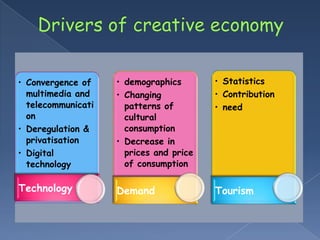
• Convergence of    • demographics       • Statistics
  multimedia and    • Changing           • Contribution
  telecommunicati     patterns of        • need
  on                  cultural
• Deregulation &      consumption
  privatisation     • Decrease in
• Digital             prices and price
  technology          of consumption

Technology          Demand               Tourism
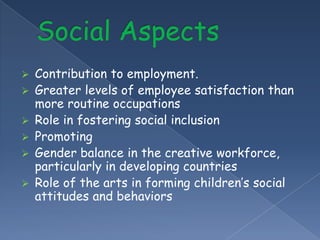
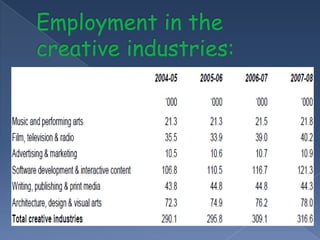
   Contribution to employment.
   Greater levels of employee satisfaction than
    more routine occupations
   Role in fostering social inclusion
   Promoting
   Gender balance in the creative workforce,
    particularly in developing countries
   Role of the arts in forming children’s social
    attitudes and behaviors
   Cultural activities give rise to both
    economic and cultural value
   Cultural diversity is a key dimension for
    sustainable development and peace
   promotes economic diversification, revenues,
    trade and innovation
   helps to revive declining urban areas
   world exports of visual arts doubled in six
    years, reaching $29.7 billion in 2008
   global entertainment and media industry
    alone will be injecting around $2.2 trillion in
    the world economy in 2012
   Generate revenues from trade about US$
    424 billion/year
   The primary input for creative activities is
    creativity
   The creative industries production is usually
    less dependent on heavy industrial
    infrastructure
   Helps in environmental protection and
    preservation
   Focus on innovation, and not only to seek out
    low-cost solutions
   Vast platform to ethical business
 To realize Economies of Scale firms rely
  on Chart Rankings
 Loss Bearing capacity of large firms and
  incompetency of small firms
 Risk Minimization by distributors
  through control of supply chains
 Right Timing and Innovation
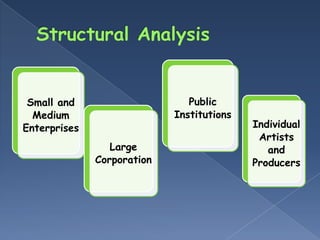
Small and                     Public
  Medium                    Institutions
Enterprises                                Individual
                                            Artists
                 Large                        and
              Corporation                  Producers
 Large number of Individuals and small
  firms
 At the individual level there is a situation
  of “Monopolistic Competition” –
  differentiated talents, which leads to less
  competition and low barriers to entry
 Small firms earn Income from Large firms
  also, through sub contracting
 SMEs suffer from the financing problem
  which causes hurdle in transformation of
  ideas into goods and services
 Lack of support network in developing
  countries
 Lack of Business Skills in small
  enterprises
 Number of talented persons is more
  than gatekeepers
 Largest producer of creative goods and
  services in terms of value
 Have more complex value chains, large
  labor force
 Main motivation is profit driven rather
  than cultural promotion
 In developed economies, the large
  corporations are technologically
  advanced and more service oriented
   Originating end of the value chain –
    dancers, singers, painters, sculptors etc.
   Directly sell their product or provide an
    input for the next stage
   Draw the content for creative goods and
    services from culture of their community,
    country or region
   Due to higher competition, the financial
    rewards are lower
   They satisfy at lower incentives due to
    gatekeepers and distributors have more
    power in the supply chain
 Movable and immovable cultural capital of
  any country held in museums, galleries,
  archives, monasteries, shrines, historic
  buildings, heritage sites etc.
 Tourism potential of the countries with
  rich cultural and heritage sites is very
  high
 Contributing to foreign exchange earnings
  of the country
 Input Output Analysis
 Constraints are : ignorance of the “art”
  under current available I/O tables and
  lack of data for estimation
 Spillovers :
    ›   Knowledge Spillover
    ›   Product Spillover
    ›   Network Spillover
    ›   Training Spillover
    ›   Artistic Spillover
Copyright laws give statutory
expression to the economic and moral
rights of creators in their creations and
the rights of the public in the access to
those creations. In principle, copyright
assures the ownership of a tradable
right that can be used to secure a
financial return on their investment.
The con ce p t of “C op yrig ht an d
Re lat e d Rig ht s ” is d e fin e d in
Nat ion al L e g is lat ion .

The mos t imp ortan t of t he s e i s
t he     Be rn  Con v e n t ion   fo r t he
Prot e ct ion    of       L ite rary   an d
A rt is t ic Works
 Exclusive Rights
 Moral Rights
 Exceptions and Limitations to
  Copyright
 Enforcement of Copyright
Copyright provides exclusivity only over
the form of expression of an idea but
not to the idea itself.

  Copyright law protects the owner of
rights in artistic works against those
who “copy”, i.e., those who take and
use the form in which the original work
was expressed by the author
The right to claim authorship of a work
and the right to oppose changes to it
that could harm the creator’s
reputation.
1.   Free uses
2.   Non-voluntary licences
    The key issue is not only enforcement but
    also the ambiguities of the current IPR
    regime, which deserve to be carefully
    addressed by governments

    In    considering    the    protection    and
    enforcement of copyright and related rights,
    piracy appears as one of the central issue

    Inadequate enforcement of copyright limits
    incentives to develop creative products,
    especially  for  small  and  medium-sized
    enterprises
The creative industries commonly seek to
achieve a number of contradictory
outcomes: access and excellence, social
inclusion and profitability, etc. For this
reason considerable care is needed in the
creation of indicators for comparative
work, evaluation and policymaking.
 Employment
 Time use
 Trade and value added
 Copyright and intellectual property
  rights issues
 Public investment
Why the current data is
inadequate..??
 Primary
  › Consumer survey
  › Rock band members interview
 Secondary
  › Online research
  › UNCTAD creative economy report
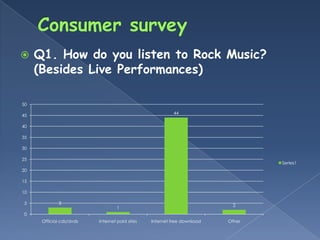
    Q1. How do you listen to Rock Music?
     (Besides Live Performances)

50
                                                         44
45

40

35

30

25
                                                                                 Series1
20

15

10

 5           3                                                             2
                                  1
 0
      Official cds/dvds   Internet paid sites   Internet free download   Other
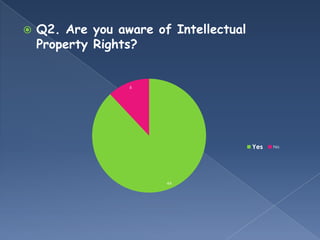
   Q2. Are you aware of Intellectual
    Property Rights?


                  6


                                        Yes   No


                        44
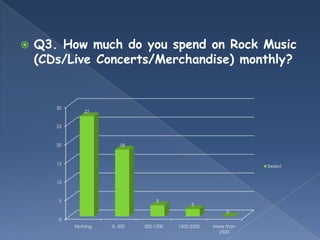
   Q3. How much do you spend on Rock Music
    (CDs/Live Concerts/Merchandise) monthly?


       30
               27


       25


       20                18


       15
                                                                  Series1


       10


        5                           3
                                               2
                                                           0
        0
            Nothing   0- 500   500-1500   1500-2500   More than
                                                        2500
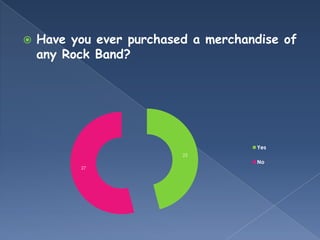
   Have you ever purchased a merchandise of
    any Rock Band?


                                     Yes
                          23
                                     No
          27
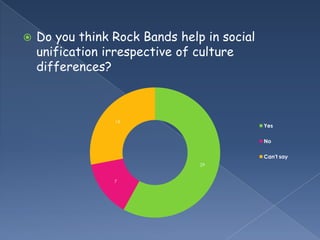
   Do you think Rock Bands help in social
    unification irrespective of culture
    differences?


                 14
                                             Yes

                                             No

                                             Can't say
                                29


                 7
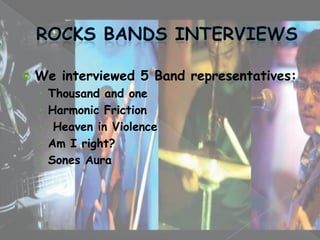
   We interviewed 5 Band representatives:
    › Thousand and one
    › Harmonic Friction
    › Heaven in Violence
    › Am I right?
    › Sones Aura
 Conventional Revenue sources:
 sale of albums(hard copy)
 merchandise-tshirts, posters et al,
 gigs;
 headlining a rock event;
 playing at bars/pubs;
 Songs downloaded from itunes;
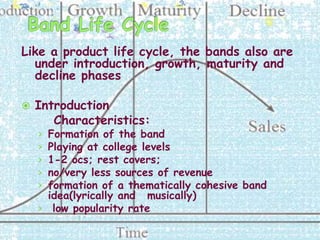
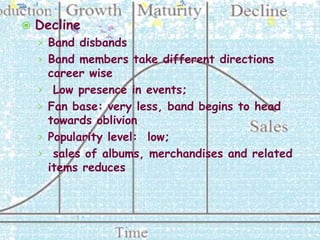
Like a product life cycle, the bands also are
  under introduction, growth, maturity and
  decline phases

   Introduction
       Characteristics:
    › Formation of the band
    › Playing at college levels
    › 1-2 ocs; rest covers;
    › no/very less sources of revenue
    › formation of a thematically cohesive band
      idea(lyrically and musically)
    › low popularity rate
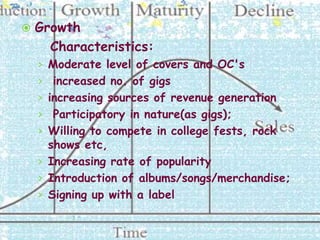
   Growth
      Characteristics:
    › Moderate level of covers and OC's
    › increased no. of gigs
    › increasing sources of revenue generation
    › Participatory in nature(as gigs);
    › Willing to compete in college fests, rock
      shows etc,
    › Increasing rate of popularity
    › Introduction of albums/songs/merchandise;
    › Signing up with a label
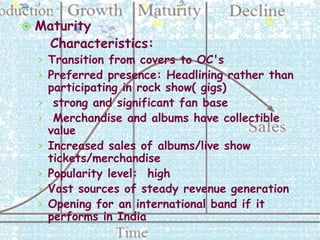
   Maturity
     Characteristics:
    › Transition from covers to OC's
    › Preferred presence: Headlining rather than
        participating in rock show( gigs)
    ›    strong and significant fan base
    ›    Merchandise and albums have collectible
        value
    ›   Increased sales of albums/live show
        tickets/merchandise
    ›   Popularity level: high
    ›   Vast sources of steady revenue generation
    ›   Opening for an international band if it
        performs in India
   Decline
    › Band disbands
    › Band members take different directions
        career wise
    ›    Low presence in events;
    ›   Fan base: very less, band begins to head
        towards oblivion
    ›   Popularity level: low;
    ›    sales of albums, merchandises and related
        items reduces
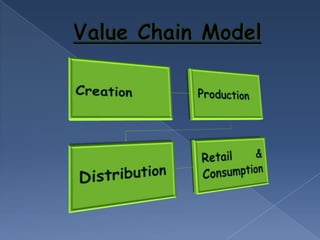
 CREATION:
    The idea of an OC might begin with band
  members writing, recording a songand
  passing it on to a label which puts it into
  tangible form.
 PRODUCTION:
     From there, the idea might be realized
  as a live performance before an
  audience, with the performance
  subsequently being recorded and marketed
  by the record company.
   DISTRIBUTION AND CONSUMPTION

       The record will pass through a sequence
    of wholesale and retail value-adding until
    bought by a consumer or it may be
       uploaded onto the Internet and
    subsequently accessed by
       consumers who pay a price for online
    delivery.
       Thus the overall chain can become quite
    attenuated, one effect of which is to
    diminish the relative share of total revenue
    accruing to the creator of the original idea.
   The object of copyright law is to encourage
    authors, composers, artists and designers to
    create original works by rewarding them with the
    exclusive right for a limited period to exploit the
    work for monetary gain.
   It protects the writer or creator of the original
    work from the unauthorized reproduction or
    exploitation of his materials.
   There is no copyright in ideas. Copyright subsists
    only in the material form in which the ideas are
    expressed. Works protected by copyright are:
    ›   Original, Literary, dramatic, musical and artistic works;
    ›   Cinematographic film; and
    ›   Records
   Musical work- Copyright subsists in original
    musical work and
    › Includes any combination of melody and
      harmony, either of them reduced to writing or
      otherwise graphically produced or reproduced.
    › An original adaptation of a musical work is also
      entitled to copyright.
    › There is no copyright in a song. A song has its
      words written by one man and it’s music by
      another; is words have a literary copyright, and
      so has its music. These two copyrights are
      entirely different and cannot be merged.
    › In cases where the word and music are written
      by the same person, or where they are owned
      by the same person, he would own the copyright
      in the song.
In case of literary, dramatic or musical work, A
  copyright gives the right to do and authorize
  the doing of any of the following
  acts, namely-

   to reproduce the work in any material form;
   to publish the work;
   to perform the work in public;
   to produce ,reproduce ,perform or publish any
    translation of the work;
   to make any cinematographic film or a record
    in respect of work;
   to communicate the work by broadcast or to
    communicate to the public by loud-speaker or
    any other similar instrument the broadcast of
    the work;
   to make any adaptation of work;
 RECORDS
 Record means
    › Any disc, tape, perforated roll or other
      device in which sounds are embodied so as
      to be capable of being reproduced
      therefrom.
    › The sound tract in a cinematography film is
      not a record unless it is separately
      recorded in a disc tape or other device.
    › Where the record is made directly from a
      live performance the owner of the disc or
      tape in which the recording is made will be
      the owner of the copyright.
   In the case of a record, copyright gives
    the right to do or or authorize the
    doing of any of the following acts by
    utilizing the record, namely-
    › to make any other record embodying the
      same recording ;
    › to cause the recording embodied in the
      record to be heard in the public;
    › to communicate the recording embodied in
      the record by broadcast;
 Creative economy report,2010 :UNCTAD
 Live and virtual survey
Thank You!!
    Master of International
    Business,
    Department of Commerce,
    Delhi School of Economics

Creative Economy

  • 1.
    Master of International Business, Group Members: Department of Commerce, Ajay Singh Duggal Delhi School of Economics Prapti Aggarwal S.Jayakar Sachin Kumar Sahil Lohra
  • 3.
    First Appearence • Johnhawkins,2001 • Two kinds: people’s fulfillment as individual and generation of product Our Reference point • UNCTAD
  • 4.
    It can foster income generation, job creation and export earnings while promoting social inclusion, cultural diversity and human development.  It embraces economic, cultural and social aspects interacting with technology, intellectual property and tourism objectives.  It is a set of knowledge-based economic activities with a development dimension  It is a feasible development option calling for innovative, multidisciplinary policy responses
  • 5.
    • Convergence of • demographics • Statistics multimedia and • Changing • Contribution telecommunicati patterns of • need on cultural • Deregulation & consumption privatisation • Decrease in • Digital prices and price technology of consumption Technology Demand Tourism
  • 8.
    Contribution to employment.  Greater levels of employee satisfaction than more routine occupations  Role in fostering social inclusion  Promoting  Gender balance in the creative workforce, particularly in developing countries  Role of the arts in forming children’s social attitudes and behaviors
  • 9.
    Cultural activities give rise to both economic and cultural value  Cultural diversity is a key dimension for sustainable development and peace
  • 10.
    promotes economic diversification, revenues, trade and innovation  helps to revive declining urban areas  world exports of visual arts doubled in six years, reaching $29.7 billion in 2008  global entertainment and media industry alone will be injecting around $2.2 trillion in the world economy in 2012  Generate revenues from trade about US$ 424 billion/year
  • 12.
    The primary input for creative activities is creativity  The creative industries production is usually less dependent on heavy industrial infrastructure  Helps in environmental protection and preservation  Focus on innovation, and not only to seek out low-cost solutions  Vast platform to ethical business
  • 15.
     To realizeEconomies of Scale firms rely on Chart Rankings  Loss Bearing capacity of large firms and incompetency of small firms  Risk Minimization by distributors through control of supply chains  Right Timing and Innovation
  • 16.
    Small and Public Medium Institutions Enterprises Individual Artists Large and Corporation Producers
  • 17.
     Large numberof Individuals and small firms  At the individual level there is a situation of “Monopolistic Competition” – differentiated talents, which leads to less competition and low barriers to entry  Small firms earn Income from Large firms also, through sub contracting  SMEs suffer from the financing problem which causes hurdle in transformation of ideas into goods and services
  • 18.
     Lack ofsupport network in developing countries  Lack of Business Skills in small enterprises  Number of talented persons is more than gatekeepers
  • 19.
     Largest producerof creative goods and services in terms of value  Have more complex value chains, large labor force  Main motivation is profit driven rather than cultural promotion  In developed economies, the large corporations are technologically advanced and more service oriented
  • 20.
    Originating end of the value chain – dancers, singers, painters, sculptors etc.  Directly sell their product or provide an input for the next stage  Draw the content for creative goods and services from culture of their community, country or region  Due to higher competition, the financial rewards are lower  They satisfy at lower incentives due to gatekeepers and distributors have more power in the supply chain
  • 21.
     Movable andimmovable cultural capital of any country held in museums, galleries, archives, monasteries, shrines, historic buildings, heritage sites etc.  Tourism potential of the countries with rich cultural and heritage sites is very high  Contributing to foreign exchange earnings of the country
  • 22.
     Input OutputAnalysis  Constraints are : ignorance of the “art” under current available I/O tables and lack of data for estimation  Spillovers : › Knowledge Spillover › Product Spillover › Network Spillover › Training Spillover › Artistic Spillover
  • 24.
    Copyright laws givestatutory expression to the economic and moral rights of creators in their creations and the rights of the public in the access to those creations. In principle, copyright assures the ownership of a tradable right that can be used to secure a financial return on their investment.
  • 25.
    The con cep t of “C op yrig ht an d Re lat e d Rig ht s ” is d e fin e d in Nat ion al L e g is lat ion . The mos t imp ortan t of t he s e i s t he Be rn Con v e n t ion fo r t he Prot e ct ion of L ite rary an d A rt is t ic Works
  • 26.
     Exclusive Rights Moral Rights  Exceptions and Limitations to Copyright  Enforcement of Copyright
  • 27.
    Copyright provides exclusivityonly over the form of expression of an idea but not to the idea itself. Copyright law protects the owner of rights in artistic works against those who “copy”, i.e., those who take and use the form in which the original work was expressed by the author
  • 28.
    The right toclaim authorship of a work and the right to oppose changes to it that could harm the creator’s reputation.
  • 29.
    1. Free uses 2. Non-voluntary licences
  • 30.
    The key issue is not only enforcement but also the ambiguities of the current IPR regime, which deserve to be carefully addressed by governments  In considering the protection and enforcement of copyright and related rights, piracy appears as one of the central issue  Inadequate enforcement of copyright limits incentives to develop creative products, especially for small and medium-sized enterprises
  • 31.
    The creative industriescommonly seek to achieve a number of contradictory outcomes: access and excellence, social inclusion and profitability, etc. For this reason considerable care is needed in the creation of indicators for comparative work, evaluation and policymaking.
  • 32.
     Employment  Timeuse  Trade and value added  Copyright and intellectual property rights issues  Public investment
  • 33.
    Why the currentdata is inadequate..??
  • 34.
     Primary › Consumer survey › Rock band members interview  Secondary › Online research › UNCTAD creative economy report
  • 35.
    Q1. How do you listen to Rock Music? (Besides Live Performances) 50 44 45 40 35 30 25 Series1 20 15 10 5 3 2 1 0 Official cds/dvds Internet paid sites Internet free download Other
  • 36.
    Q2. Are you aware of Intellectual Property Rights? 6 Yes No 44
  • 37.
    Q3. How much do you spend on Rock Music (CDs/Live Concerts/Merchandise) monthly? 30 27 25 20 18 15 Series1 10 5 3 2 0 0 Nothing 0- 500 500-1500 1500-2500 More than 2500
  • 38.
    Have you ever purchased a merchandise of any Rock Band? Yes 23 No 27
  • 39.
    Do you think Rock Bands help in social unification irrespective of culture differences? 14 Yes No Can't say 29 7
  • 40.
    We interviewed 5 Band representatives: › Thousand and one › Harmonic Friction › Heaven in Violence › Am I right? › Sones Aura
  • 41.
     Conventional Revenuesources:  sale of albums(hard copy)  merchandise-tshirts, posters et al,  gigs;  headlining a rock event;  playing at bars/pubs;  Songs downloaded from itunes;
  • 42.
    Like a productlife cycle, the bands also are under introduction, growth, maturity and decline phases  Introduction Characteristics: › Formation of the band › Playing at college levels › 1-2 ocs; rest covers; › no/very less sources of revenue › formation of a thematically cohesive band idea(lyrically and musically) › low popularity rate
  • 43.
    Growth Characteristics: › Moderate level of covers and OC's › increased no. of gigs › increasing sources of revenue generation › Participatory in nature(as gigs); › Willing to compete in college fests, rock shows etc, › Increasing rate of popularity › Introduction of albums/songs/merchandise; › Signing up with a label
  • 44.
    Maturity Characteristics: › Transition from covers to OC's › Preferred presence: Headlining rather than participating in rock show( gigs) › strong and significant fan base › Merchandise and albums have collectible value › Increased sales of albums/live show tickets/merchandise › Popularity level: high › Vast sources of steady revenue generation › Opening for an international band if it performs in India
  • 45.
    Decline › Band disbands › Band members take different directions career wise › Low presence in events; › Fan base: very less, band begins to head towards oblivion › Popularity level: low; › sales of albums, merchandises and related items reduces
  • 46.
     CREATION: The idea of an OC might begin with band members writing, recording a songand passing it on to a label which puts it into tangible form.  PRODUCTION: From there, the idea might be realized as a live performance before an audience, with the performance subsequently being recorded and marketed by the record company.
  • 47.
    DISTRIBUTION AND CONSUMPTION The record will pass through a sequence of wholesale and retail value-adding until bought by a consumer or it may be uploaded onto the Internet and subsequently accessed by consumers who pay a price for online delivery. Thus the overall chain can become quite attenuated, one effect of which is to diminish the relative share of total revenue accruing to the creator of the original idea.
  • 48.
    The object of copyright law is to encourage authors, composers, artists and designers to create original works by rewarding them with the exclusive right for a limited period to exploit the work for monetary gain.  It protects the writer or creator of the original work from the unauthorized reproduction or exploitation of his materials.  There is no copyright in ideas. Copyright subsists only in the material form in which the ideas are expressed. Works protected by copyright are: › Original, Literary, dramatic, musical and artistic works; › Cinematographic film; and › Records
  • 49.
    Musical work- Copyright subsists in original musical work and › Includes any combination of melody and harmony, either of them reduced to writing or otherwise graphically produced or reproduced. › An original adaptation of a musical work is also entitled to copyright. › There is no copyright in a song. A song has its words written by one man and it’s music by another; is words have a literary copyright, and so has its music. These two copyrights are entirely different and cannot be merged. › In cases where the word and music are written by the same person, or where they are owned by the same person, he would own the copyright in the song.
  • 50.
    In case ofliterary, dramatic or musical work, A copyright gives the right to do and authorize the doing of any of the following acts, namely-  to reproduce the work in any material form;  to publish the work;  to perform the work in public;  to produce ,reproduce ,perform or publish any translation of the work;  to make any cinematographic film or a record in respect of work;  to communicate the work by broadcast or to communicate to the public by loud-speaker or any other similar instrument the broadcast of the work;  to make any adaptation of work;
  • 51.
     RECORDS  Recordmeans › Any disc, tape, perforated roll or other device in which sounds are embodied so as to be capable of being reproduced therefrom. › The sound tract in a cinematography film is not a record unless it is separately recorded in a disc tape or other device. › Where the record is made directly from a live performance the owner of the disc or tape in which the recording is made will be the owner of the copyright.
  • 52.
    In the case of a record, copyright gives the right to do or or authorize the doing of any of the following acts by utilizing the record, namely- › to make any other record embodying the same recording ; › to cause the recording embodied in the record to be heard in the public; › to communicate the recording embodied in the record by broadcast;
  • 53.
     Creative economyreport,2010 :UNCTAD  Live and virtual survey
  • 54.
    Thank You!! Master of International Business, Department of Commerce, Delhi School of Economics

Editor's Notes

  • #3 Definition of the term ‘creative economy’.Creativity-
  • #4 number of countries are building platforms to stimulate innovative projects that involve science and creativity and incorporate open-source technology.