Creating Quality Prompts Please view this PowerPoint before completing the wiki activity.
Creating Quality Prompts Make sure you have downloaded  the necessary documents from “Resources for Topic 2”.
Creating Quality Prompts You will need these three documents: Creating Quality Prompts Bloom’s Taxonomy Writing Prompt Language
This we know… Teachers who believe questions are tools for actively engaging students in learning dedicate time and effort to preparing questions.  They pose purposeful questions that help students make meaning of new concepts and ideas, thus demonstrating the relationship between quality questions and thinking and learning. Walsh, J. & Sattes, B.
This we know… Teachers who believe questions are tools for actively engaging students in learning dedicate  time and effort  to preparing questions.  Thoughtfully planning ahead is imperative.
This we know…   They pose  purposeful  questions… You need to know why you are asking the question.
This we know… … that help students  make meaning  of new concepts and ideas, … The end goal: making students  think , connecting new information to background knowledge.
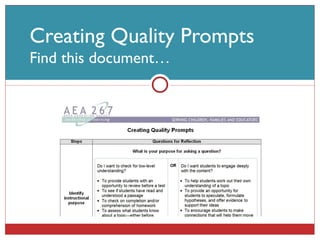
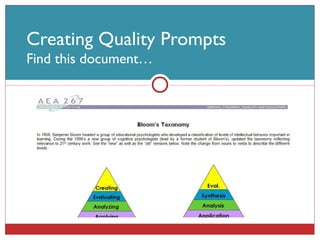
Creating Quality Prompts Find this document…
Step 1:  Purpose of Prompt Look at Step1 and read through the two columns.
Step 1:  Purpose of Prompt Think about: Are both purposes important within your classroom? Which will help students make deep meaning of new content? Which will help you quickly check for basic understanding ?
Step 2: Determine Content Focus  Look at Step 2 and read through the bullet points.
Step 2: Determine Content Focus  Think about: How do clear instructional objectives guide good questioning? How might a questioning sequence be planned to lead students towards enduring understanding?
Step 3: Select Cognitive Level Look at Step 3 and read through the bullet points.
Step 3: Cognitive Level Just because you pose a question at a predetermined cognitive level does not mean students will answer at that level.
Step 3: Select Cognitive Level Think about: If responses are not at the cognitive level you want, what can you do?
Step 4:  Formulate Question(s) Look at Step 4 and read through the bullet points.  Also read the second page.
Creating Quality Prompts Find this document…
Bloom’s Taxonomy Notice: Changes in Bloom’s Taxonomy Supporting verbs, stems, and prompts Examples
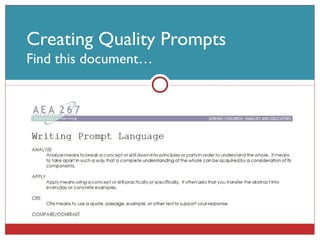
Writing Quality Prompts Think about: How do these line up with Bloom’s Taxonomy? How might you use these in Steps 3 and 4 of creating quality prompts?
Return to Moodle Wiki:  Creating Quality Prompts Use the three documents to complete the wiki activity.

Creating Quality Prompts

  • 1.
    Creating Quality PromptsPlease view this PowerPoint before completing the wiki activity.
  • 2.
    Creating Quality PromptsMake sure you have downloaded the necessary documents from “Resources for Topic 2”.
  • 3.
    Creating Quality PromptsYou will need these three documents: Creating Quality Prompts Bloom’s Taxonomy Writing Prompt Language
  • 4.
    This we know…Teachers who believe questions are tools for actively engaging students in learning dedicate time and effort to preparing questions.  They pose purposeful questions that help students make meaning of new concepts and ideas, thus demonstrating the relationship between quality questions and thinking and learning. Walsh, J. & Sattes, B.
  • 5.
    This we know…Teachers who believe questions are tools for actively engaging students in learning dedicate time and effort to preparing questions. Thoughtfully planning ahead is imperative.
  • 6.
    This we know…  They pose purposeful questions… You need to know why you are asking the question.
  • 7.
    This we know…… that help students make meaning of new concepts and ideas, … The end goal: making students think , connecting new information to background knowledge.
  • 8.
    Creating Quality PromptsFind this document…
  • 9.
    Step 1: Purpose of Prompt Look at Step1 and read through the two columns.
  • 10.
    Step 1: Purpose of Prompt Think about: Are both purposes important within your classroom? Which will help students make deep meaning of new content? Which will help you quickly check for basic understanding ?
  • 11.
    Step 2: DetermineContent Focus Look at Step 2 and read through the bullet points.
  • 12.
    Step 2: DetermineContent Focus Think about: How do clear instructional objectives guide good questioning? How might a questioning sequence be planned to lead students towards enduring understanding?
  • 13.
    Step 3: SelectCognitive Level Look at Step 3 and read through the bullet points.
  • 14.
    Step 3: CognitiveLevel Just because you pose a question at a predetermined cognitive level does not mean students will answer at that level.
  • 15.
    Step 3: SelectCognitive Level Think about: If responses are not at the cognitive level you want, what can you do?
  • 16.
    Step 4: Formulate Question(s) Look at Step 4 and read through the bullet points. Also read the second page.
  • 17.
    Creating Quality PromptsFind this document…
  • 18.
    Creating Quality PromptsFind this document…
  • 19.
    Bloom’s Taxonomy Notice:Changes in Bloom’s Taxonomy Supporting verbs, stems, and prompts Examples
  • 20.
    Writing Quality PromptsThink about: How do these line up with Bloom’s Taxonomy? How might you use these in Steps 3 and 4 of creating quality prompts?
  • 21.
    Return to MoodleWiki: Creating Quality Prompts Use the three documents to complete the wiki activity.

Editor's Notes

  • #14 4. formulate your question.