Formative AssessmentBy: Michelle Osborn
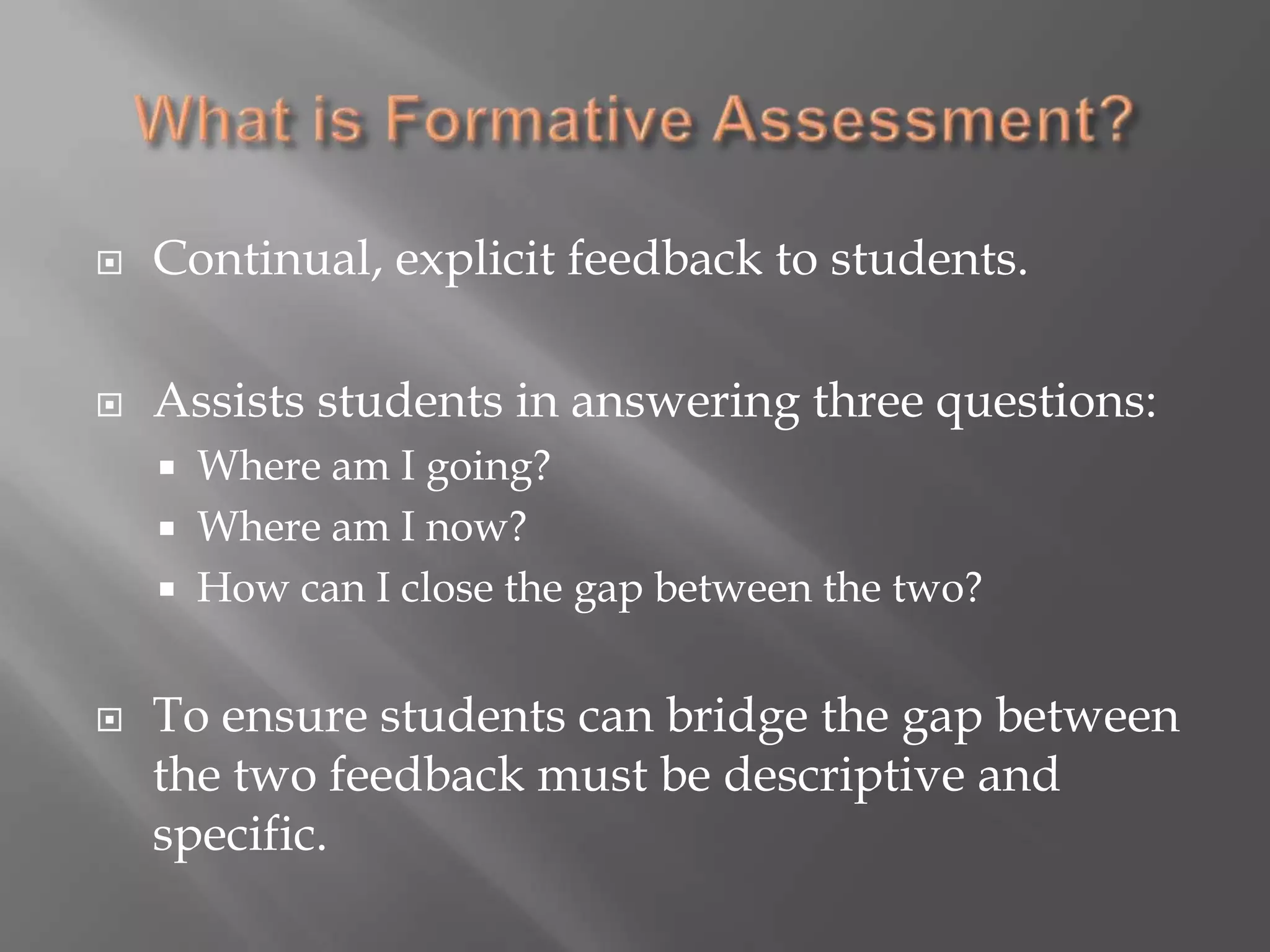
What is Formative Assessment?Continual, explicit feedback to students.Assists students in answering three questions:Where am I going?Where am I now?How can I close the gap between the two?To ensure students can bridge the gap between the two feedback must be descriptive and specific.
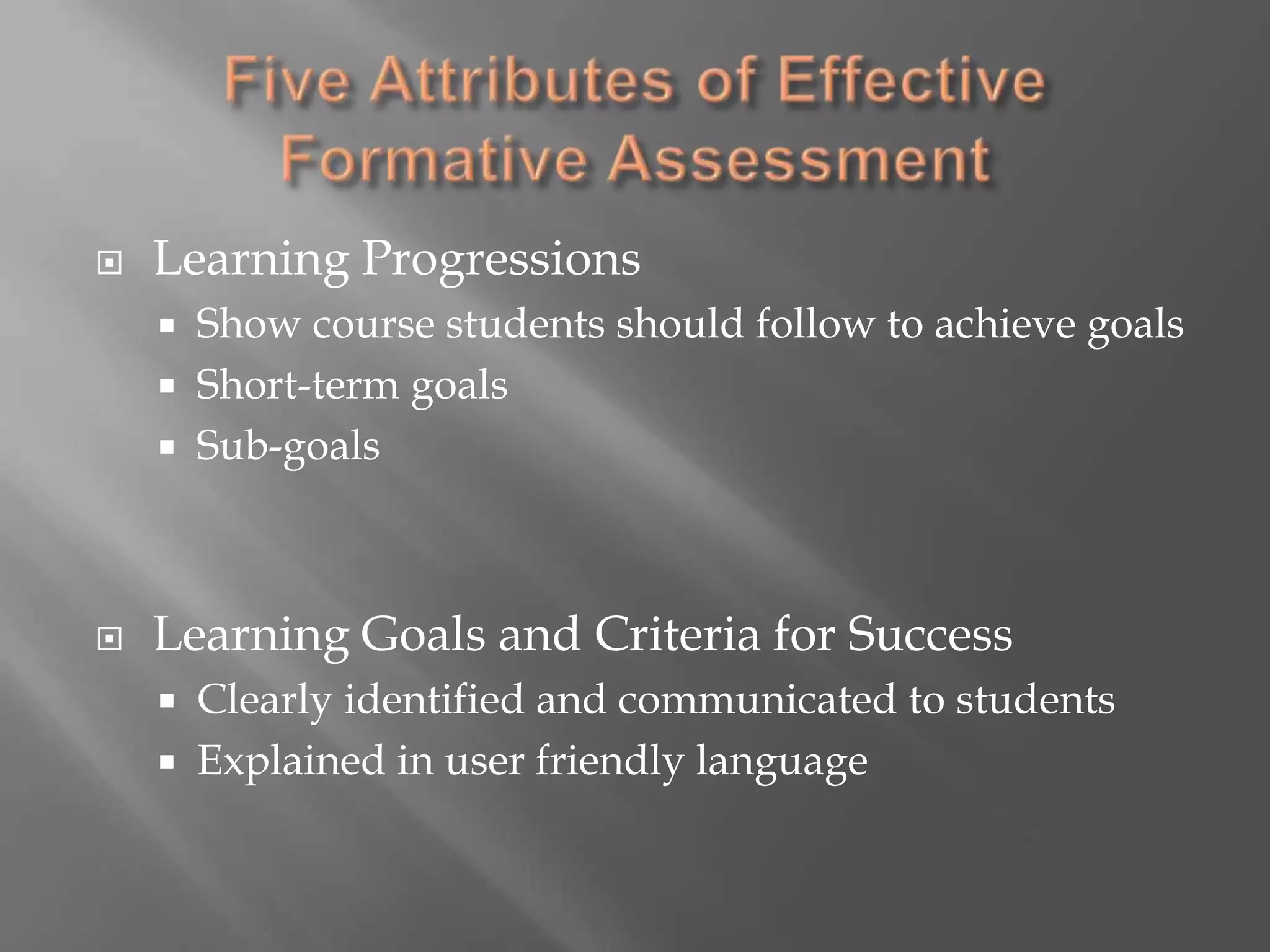
Five Attributes of Effective Formative AssessmentLearning ProgressionsShow course students should follow to achieve goalsShort-term goalsSub-goalsLearning Goals and Criteria for SuccessClearly identified and communicated to studentsExplained in user friendly language
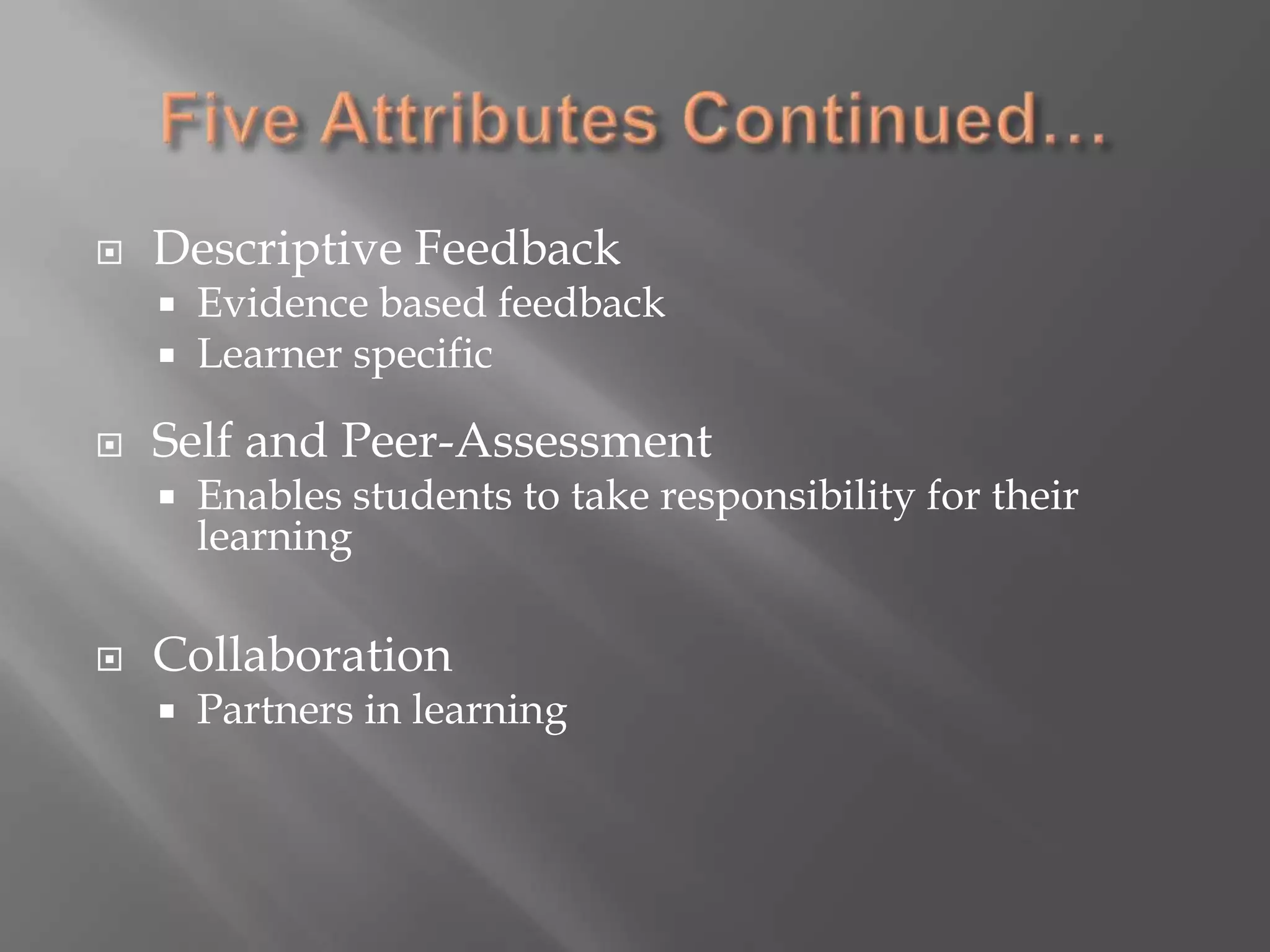
Five Attributes Continued…Descriptive FeedbackEvidence based feedbackLearner specificSelf and Peer-AssessmentEnables students to take responsibility for their learningCollaborationPartners in learning
Strategies for Formative AssessmentThe Clinical Interview – Part 1Asses studentsQuick computational problemshttp://www.learnnc.org/lp/editions/pcmath/1253Analysis: Student had developed number sense
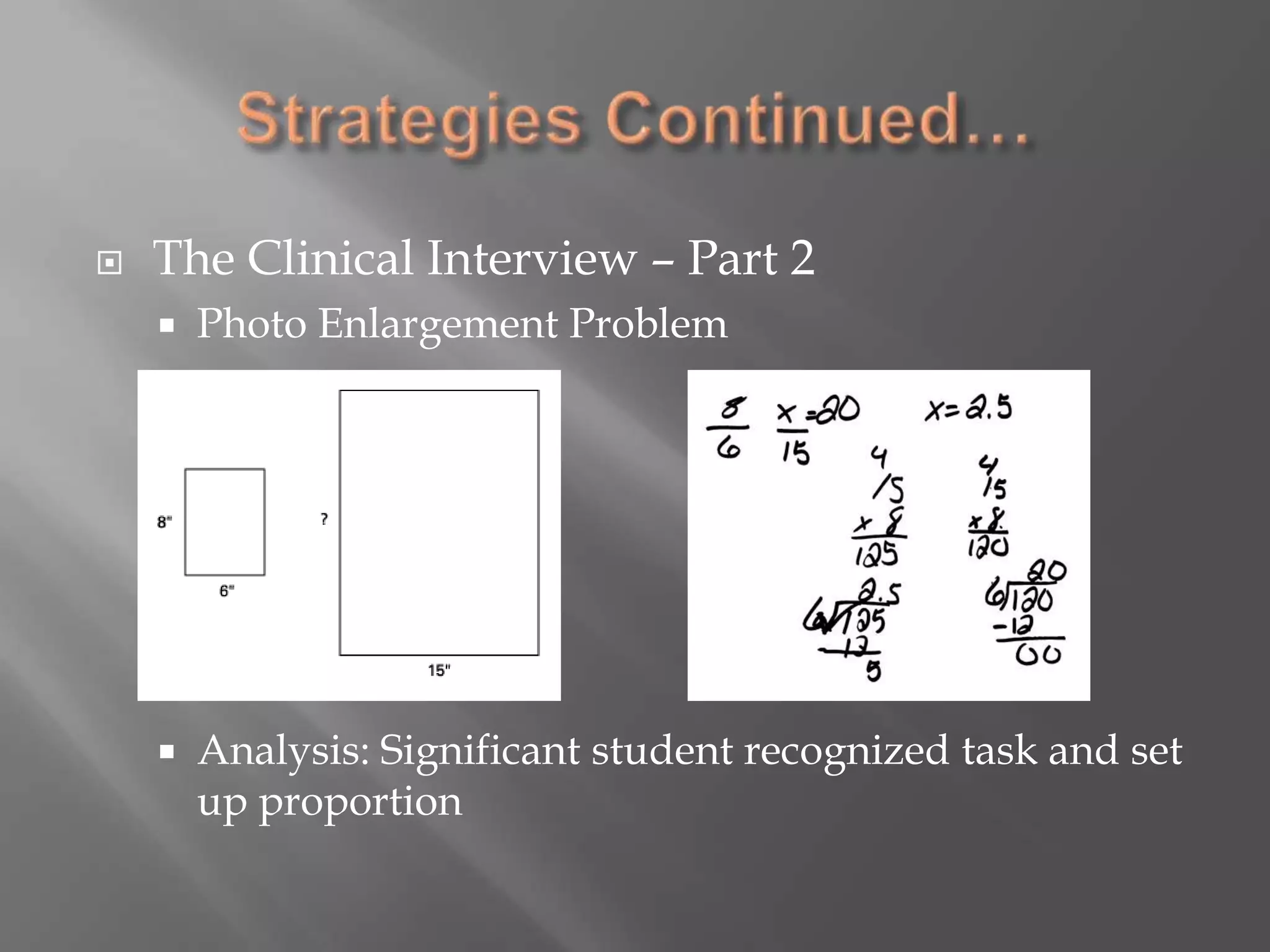
Strategies Continued…The Clinical Interview – Part 2Photo Enlargement ProblemAnalysis: Significant student recognized task and set up proportion
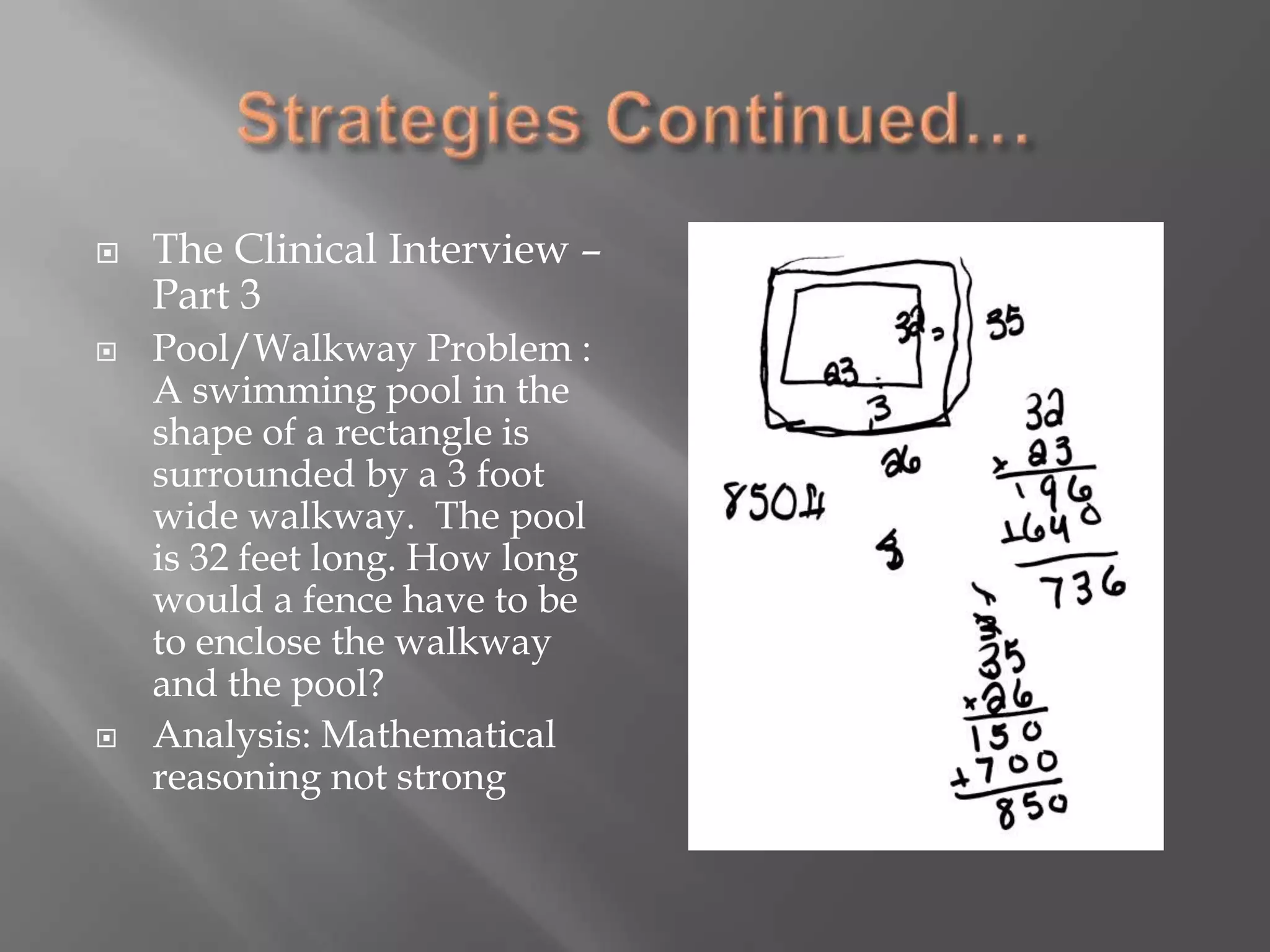
Strategies Continued…The Clinical Interview – Part 3Pool/Walkway Problem : A swimming pool in the shape of a rectangle is surrounded by a 3 foot wide walkway.  The pool is 32 feet long. How long would a fence have to be to enclose the walkway and the pool?
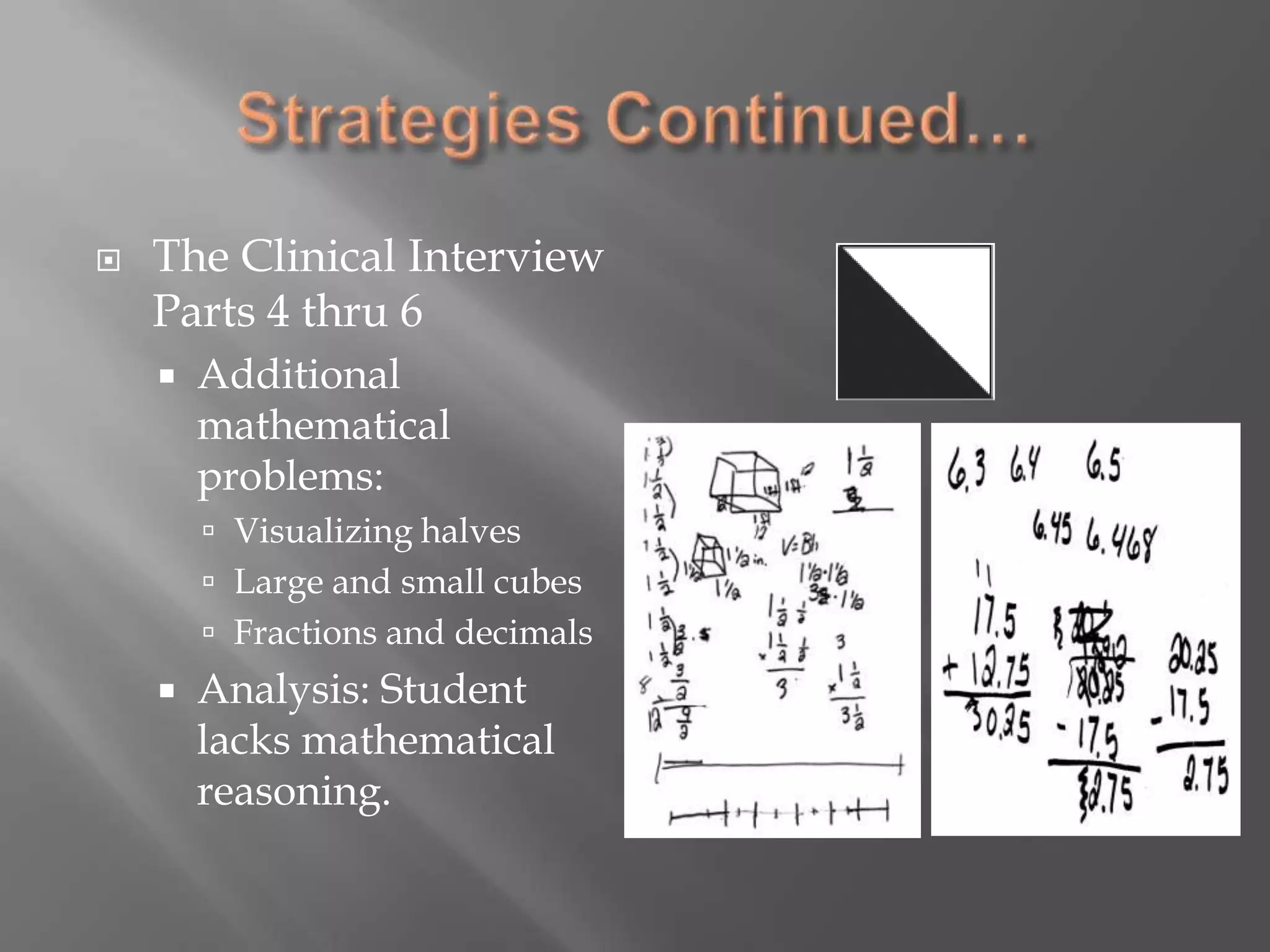
Analysis: Mathematical reasoning not strongStrategies Continued…The Clinical Interview Parts 4 thru 6Additional mathematical problems:Visualizing halvesLarge and small cubesFractions and decimalsAnalysis: Student lacks mathematical reasoning.
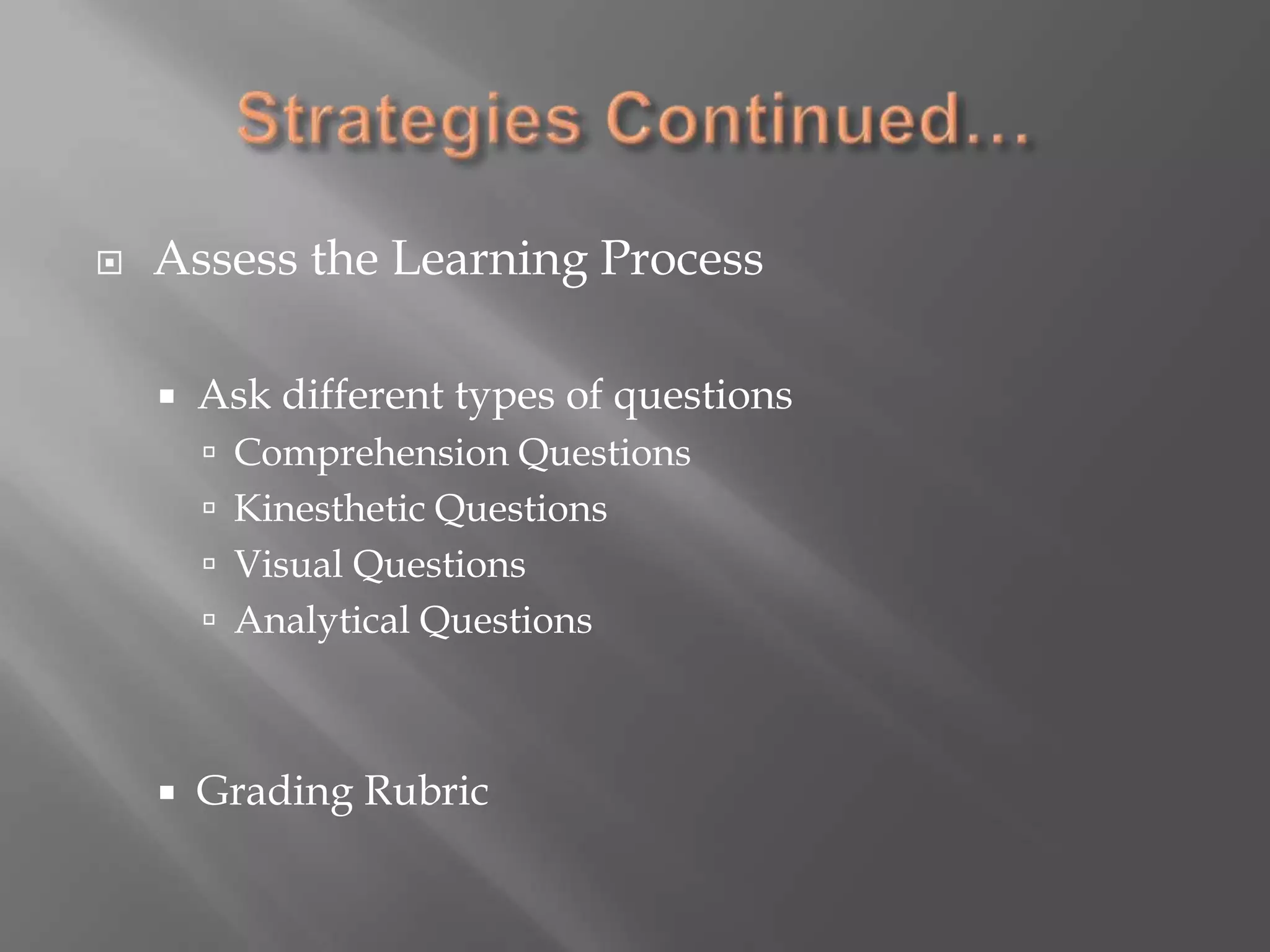
Strategies Continued…Assess the Learning ProcessAsk different types of questionsComprehension QuestionsKinesthetic QuestionsVisual QuestionsAnalytical QuestionsGrading Rubric
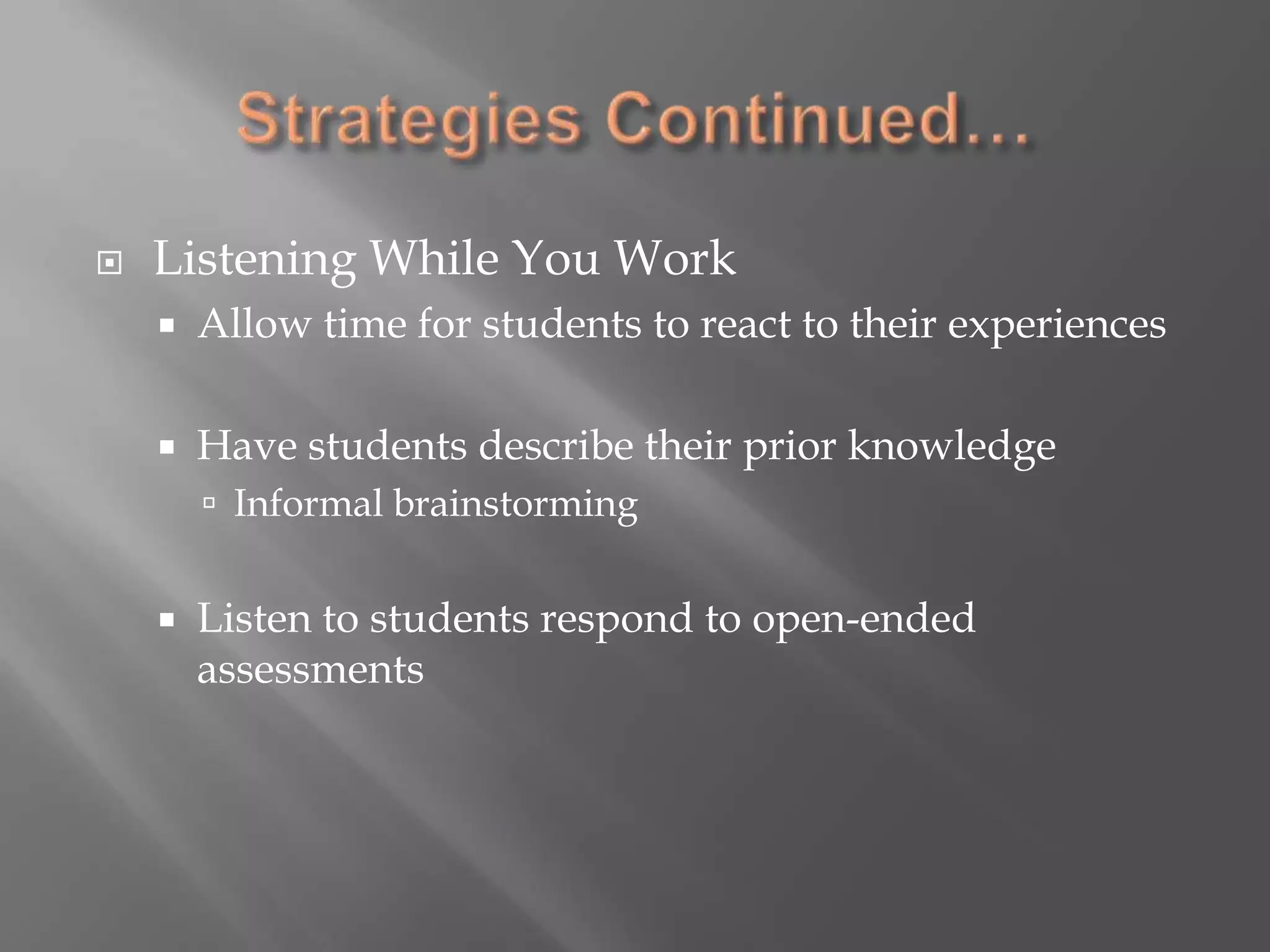
Strategies Continued…Listening While You WorkAllow time for students to react to their experiencesHave students describe their prior knowledgeInformal brainstormingListen to students respond to open-ended assessments
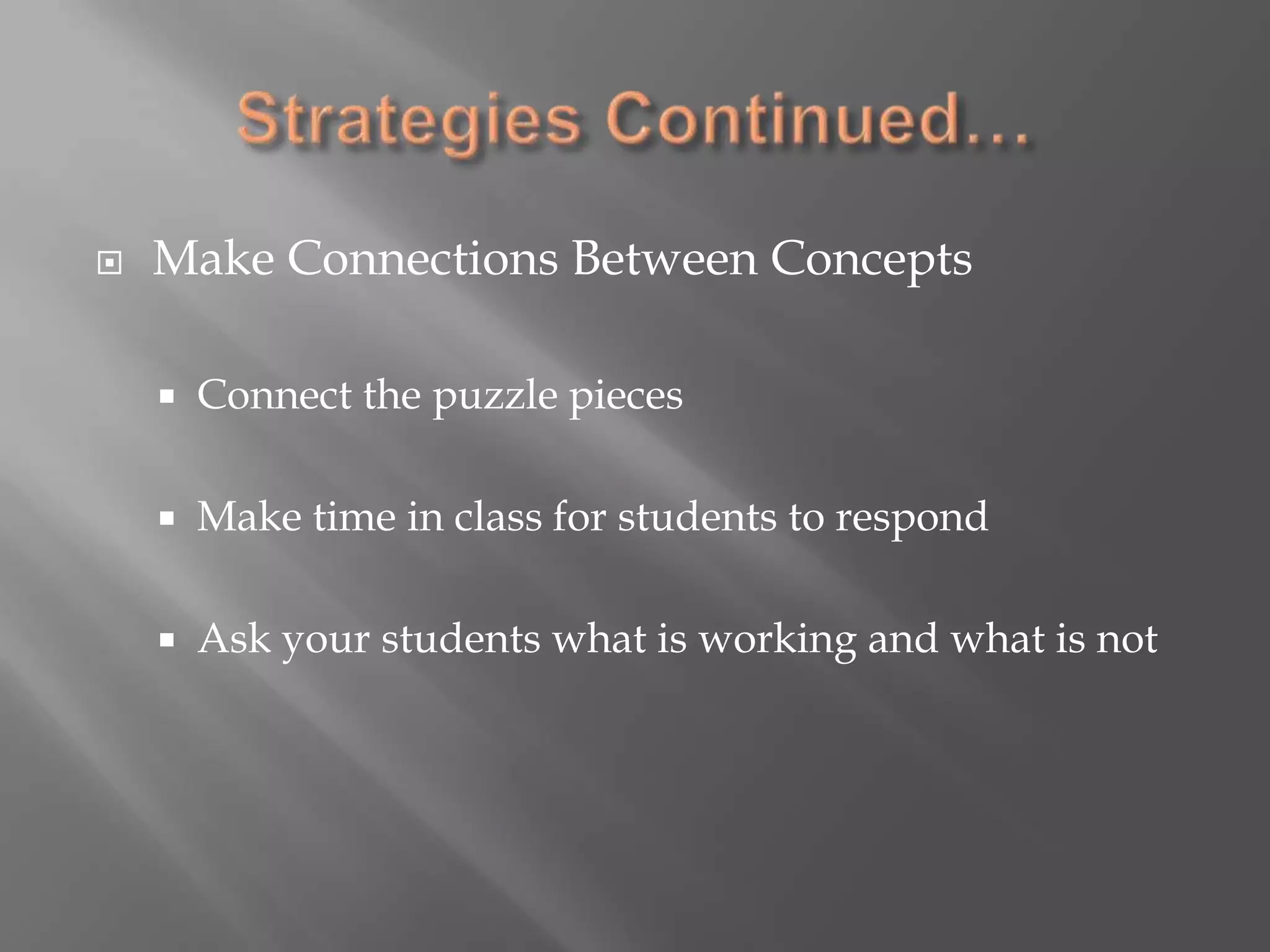
Strategies Continued…Make Connections Between ConceptsConnect the puzzle piecesMake time in class for students to respondAsk your students what is working and what is not
ReferencesBuher, Gretchen & Walbert, David. Assessing The Learning Process. LEARN North Carolina, Available on the web at www.learnnc.org/lp/pages/645. (accessed March 15, 2010)Coffey, Heather. Formative Assessment. LEARN North Carolina, Available on the web at www.learnnc.org/lp/pages/5212. (accessed March 15, 2010)Smith Johnson, Kristi. Listening While You Work: Using informal assessments to inform your instruction. LEARN North Carolina, Available on the web at www.learnnc.org/lp/pages/260. (accessed March 15, 2010)Smith Johnson, Kristi. Making Connections between Concepts. LEARN North Carolina, Available on the web at www.learnnc.org/lp/pages/261. (accessed March 15, 2010)Walbert, David. The Clinical Interview. LEARN North Carolina, Available on the web at www.learnnc.org/lp/pages/786. (accessed March 15, 2010)

Formative assessment

  • 1.
  • 2.
    What is FormativeAssessment?Continual, explicit feedback to students.Assists students in answering three questions:Where am I going?Where am I now?How can I close the gap between the two?To ensure students can bridge the gap between the two feedback must be descriptive and specific.
  • 3.
    Five Attributes ofEffective Formative AssessmentLearning ProgressionsShow course students should follow to achieve goalsShort-term goalsSub-goalsLearning Goals and Criteria for SuccessClearly identified and communicated to studentsExplained in user friendly language
  • 4.
    Five Attributes Continued…DescriptiveFeedbackEvidence based feedbackLearner specificSelf and Peer-AssessmentEnables students to take responsibility for their learningCollaborationPartners in learning
  • 5.
    Strategies for FormativeAssessmentThe Clinical Interview – Part 1Asses studentsQuick computational problemshttp://www.learnnc.org/lp/editions/pcmath/1253Analysis: Student had developed number sense
  • 6.
    Strategies Continued…The ClinicalInterview – Part 2Photo Enlargement ProblemAnalysis: Significant student recognized task and set up proportion
  • 7.
    Strategies Continued…The ClinicalInterview – Part 3Pool/Walkway Problem : A swimming pool in the shape of a rectangle is surrounded by a 3 foot wide walkway. The pool is 32 feet long. How long would a fence have to be to enclose the walkway and the pool?
  • 8.
    Analysis: Mathematical reasoningnot strongStrategies Continued…The Clinical Interview Parts 4 thru 6Additional mathematical problems:Visualizing halvesLarge and small cubesFractions and decimalsAnalysis: Student lacks mathematical reasoning.
  • 9.
    Strategies Continued…Assess theLearning ProcessAsk different types of questionsComprehension QuestionsKinesthetic QuestionsVisual QuestionsAnalytical QuestionsGrading Rubric
  • 10.
    Strategies Continued…Listening WhileYou WorkAllow time for students to react to their experiencesHave students describe their prior knowledgeInformal brainstormingListen to students respond to open-ended assessments
  • 11.
    Strategies Continued…Make ConnectionsBetween ConceptsConnect the puzzle piecesMake time in class for students to respondAsk your students what is working and what is not
  • 12.
    ReferencesBuher, Gretchen &Walbert, David. Assessing The Learning Process. LEARN North Carolina, Available on the web at www.learnnc.org/lp/pages/645. (accessed March 15, 2010)Coffey, Heather. Formative Assessment. LEARN North Carolina, Available on the web at www.learnnc.org/lp/pages/5212. (accessed March 15, 2010)Smith Johnson, Kristi. Listening While You Work: Using informal assessments to inform your instruction. LEARN North Carolina, Available on the web at www.learnnc.org/lp/pages/260. (accessed March 15, 2010)Smith Johnson, Kristi. Making Connections between Concepts. LEARN North Carolina, Available on the web at www.learnnc.org/lp/pages/261. (accessed March 15, 2010)Walbert, David. The Clinical Interview. LEARN North Carolina, Available on the web at www.learnnc.org/lp/pages/786. (accessed March 15, 2010)