“Responsibility to yourself means
refusing to let others do your
thinking, talking, and naming for
you; it means learning to respect
and use your own brains and
instincts; hence, grappling with
hard work.”
Can you think of a time when you did not
have the authority to act in accordance with
your deeply held beliefs?
What does that feel like?
Share with the person next you.
Share with the group.
Autonomy Activator
Definition of Student Autonomy
Review of The Literature
Oak Meadow Scale of Student
Autonomy
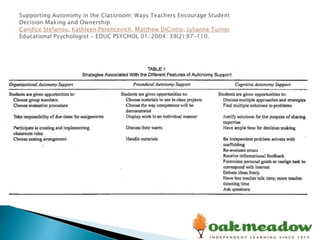
How might we support student
autonomy?
Autonomy used in five different ways in the field.
Benson & Voller, (1997)
situations in which learners study entirely on their own
a set of skills which can be learned and applied in self-
directed learning
an inborn capacity which is suppressed by institutional
education
the exercise of learners' responsibility for their own learning
the right of learners to determine the direction of their own
learning
What is autonomy in education?
Autonomy is a capacity for detachment, critical reflection,
decision-making, and independent action” (Little, 1991, p. 4).
“Autonomy is recognition of the rights of learners within
educational systems” (Benson, 1997).
“Autonomy is the capacity to take control of one's own
learning” (Benson 2001).
Autonomy refers to self-governance or self-regulation and
differs from independence (Ryan & Deci, 2006).
addresses issues of extrinsic and intrinsic
motivation.
psychological need for a sense of both
autonomy and competence.
“Acting in accordance with one's values.”
Related to sense of well-being across
cultures.
Autonomous regulation is a universal
psychological human need.
https://www.youtube.com/watch?v=h11u3vtc
paY&feature=kp
Many demonstrable benefits to promoting learner autonomy.
greater psychological need satisfaction
greater classroom engagement
more positive emotionality
higher mastery motivation
greater intrinsic motivation
a preference for optimal challenge over easy success
higher creativity
enhanced psychological well-being
active and deeper information processing
greater conceptual understanding
higher academic achievement
greater persistence in school versus dropping
Taiwanese 8th graders
Students with greater sense of autonomy are
more emotionally engaged in the work.
Community College - online courses
Demonstrated relationships:
◦ learner autonomy and course success
◦ learner autonomy and final grades
Student scores in classrooms increased as
task autonomy increased
Rural Middle School Science Classrooms
Important factor in the reduction of gender
differences in motivation
Support for student autonomy reduced the
intention to drop out of high school.
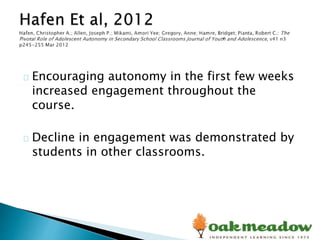
Encouraging autonomy in the first few weeks
increased engagement throughout the
course.
Decline in engagement was demonstrated by
students in other classrooms.
Compared autonomy and structured
expectations.
Equally predictive of success.
Students did best with a combination of both
structure and support for autonomy.
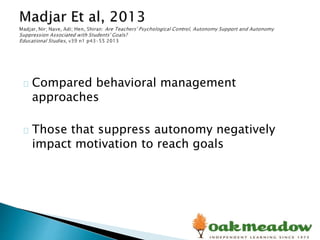
Compared behavioral management
approaches
Those that suppress autonomy negatively
impact motivation to reach goals
Just offering choice in high school Gym
improved levels of in-class physical activity.
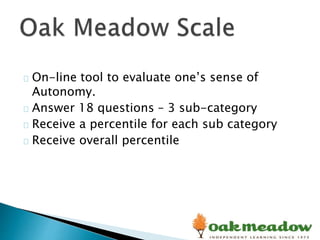
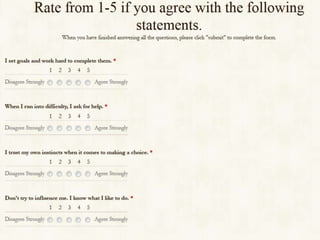
On-line tool to evaluate one’s sense of
Autonomy.
Answer 18 questions – 3 sub-category
Receive a percentile for each sub category
Receive overall percentile
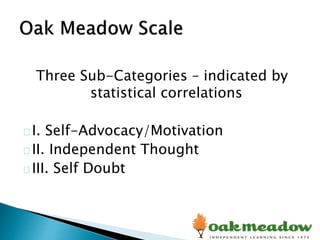
Three Sub-Categories – indicated by
statistical correlations
I. Self-Advocacy/Motivation
II. Independent Thought
III. Self Doubt
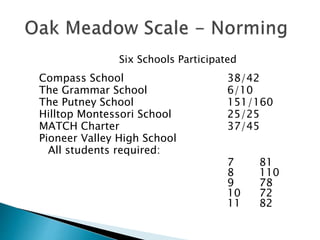
Six Schools Participated
Compass School 38/42
The Grammar School 6/10
The Putney School 151/160
Hilltop Montessori School 25/25
MATCH Charter 37/45
Pioneer Valley High School
All students required:
7 81
8 110
9 78
10 72
11 82
Pioneer Valley Public High 100.394595 Baseline
Match Charter Public High 101.931034 +1.9%
The Compass School 104.157895 +4.1%
Hilltop Montessori 106.28 +6.2%
The Grammar School 107.571429 +7.5%
The Putney School 109.592105 +9.5%
Unschool 109.225806 +9.2%
Average “Total Points” by School
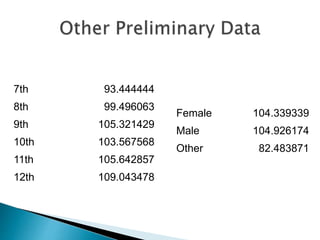
Female 104.339339
Male 104.926174
Other 82.483871
7th 93.444444
8th 99.496063
9th 105.321429
10th 103.567568
11th 105.642857
12th 109.043478
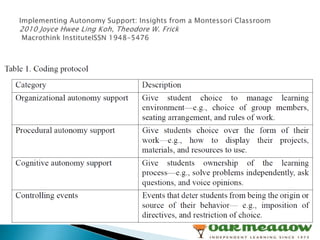
How can we support student
autonomy?
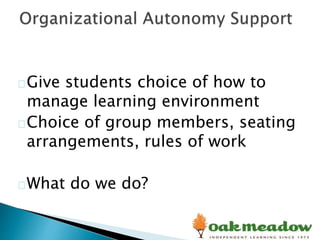
Give students choice of how to
manage learning environment
Choice of group members, seating
arrangements, rules of work
What do we do?
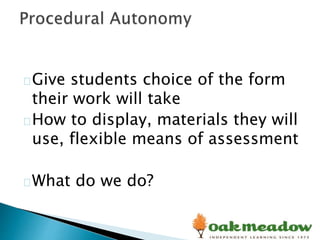
Give students choice of the form
their work will take
How to display, materials they will
use, flexible means of assessment
What do we do?
Give students ownership of the
content
Choice of subject, independent
problem solving, opportunity to voice
opinions
What do we do?
Encouraging Autonomy
By: Katherine Robertson, PhD in Effective Teaching Strategies
asking students to pick a topic from their textbook,
for which they are then responsible to teach to the
rest of the class
soliciting input on the syllabus by allowing the
class to select the topics for a few “students’
choice” lectures
assigning students to write a personal statement
about their experiences in the course in which they
identify their own weaknesses and request
exercises to help them overcome those weaknesses
Identify and nurture what students need and want
Have students’ internal states guide their behavior
Encourage active participation
Encourage students to accept more responsibility for their
learning
Provide structured guidance
Provide optimal challenges
Give positive and constructive feedback
Give emotional support
Acknowledge students’ expressions of negative effect
Give choices
Direct with ‘can, may, could’ instead of ‘must, need, should’
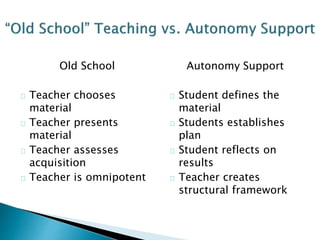
Old School
Teacher chooses
material
Teacher presents
material
Teacher assesses
acquisition
Teacher is omnipotent
Autonomy Support
Student defines the
material
Students establishes
plan
Student reflects on
results
Teacher creates
structural framework
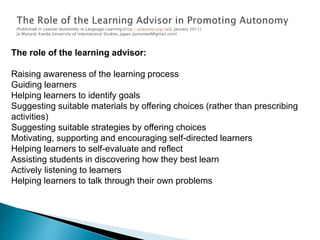
The role of the learning advisor:
Raising awareness of the learning process
Guiding learners
Helping learners to identify goals
Suggesting suitable materials by offering choices (rather than prescribing
activities)
Suggesting suitable strategies by offering choices
Motivating, supporting and encouraging self-directed learners
Helping learners to self-evaluate and reflect
Assisting students in discovering how they best learn
Actively listening to learners
Helping learners to talk through their own problems
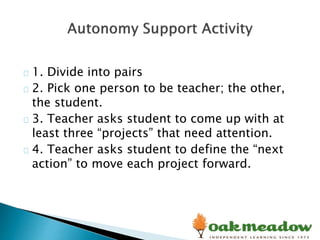
1. Divide into pairs
2. Pick one person to be teacher; the other,
the student.
3. Teacher asks student to come up with at
least three “projects” that need attention.
4. Teacher asks student to define the “next
action” to move each project forward.
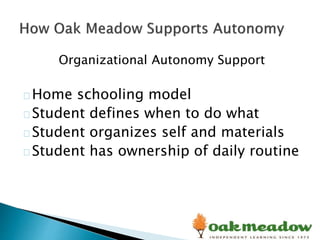
Organizational Autonomy Support
Home schooling model
Student defines when to do what
Student organizes self and materials
Student has ownership of daily routine
“I would like to start off by saying that
homeschooling is not the easy way out of
school. It is required that I be self-
motivated and self-disciplined. I learn out
of books, have to problem solve, and keep
myself well organized. If I don’t keep track
of everything in this manner, I will fall
behind …. You are your own teacher, office
manager, and planner. It is challenging.”
Walt Whitman's "Song of Myself“
Stop this day and night with me and you shall possess the
origin of all poems,
You shall possess the good of the earth and sun, (there are
millions of suns left,)
You shall no longer take things at second or third hand, nor
look through the eyes of the dead, nor feed on the specters
in books,
You shall not look through my eyes either, nor take things
from me,
You shall listen to all sides and filter them from your self.

Free, Online Scale of Student Autonomy

  • 1.
    “Responsibility to yourselfmeans refusing to let others do your thinking, talking, and naming for you; it means learning to respect and use your own brains and instincts; hence, grappling with hard work.”
  • 2.
    Can you thinkof a time when you did not have the authority to act in accordance with your deeply held beliefs? What does that feel like? Share with the person next you. Share with the group. Autonomy Activator
  • 3.
    Definition of StudentAutonomy Review of The Literature Oak Meadow Scale of Student Autonomy How might we support student autonomy?
  • 4.
    Autonomy used infive different ways in the field. Benson & Voller, (1997) situations in which learners study entirely on their own a set of skills which can be learned and applied in self- directed learning an inborn capacity which is suppressed by institutional education the exercise of learners' responsibility for their own learning the right of learners to determine the direction of their own learning What is autonomy in education?
  • 5.
    Autonomy is acapacity for detachment, critical reflection, decision-making, and independent action” (Little, 1991, p. 4). “Autonomy is recognition of the rights of learners within educational systems” (Benson, 1997). “Autonomy is the capacity to take control of one's own learning” (Benson 2001). Autonomy refers to self-governance or self-regulation and differs from independence (Ryan & Deci, 2006).
  • 6.
    addresses issues ofextrinsic and intrinsic motivation. psychological need for a sense of both autonomy and competence.
  • 7.
    “Acting in accordancewith one's values.” Related to sense of well-being across cultures. Autonomous regulation is a universal psychological human need.
  • 8.
  • 9.
    Many demonstrable benefitsto promoting learner autonomy. greater psychological need satisfaction greater classroom engagement more positive emotionality higher mastery motivation greater intrinsic motivation a preference for optimal challenge over easy success higher creativity enhanced psychological well-being active and deeper information processing greater conceptual understanding higher academic achievement greater persistence in school versus dropping
  • 10.
    Taiwanese 8th graders Studentswith greater sense of autonomy are more emotionally engaged in the work.
  • 11.
    Community College -online courses Demonstrated relationships: ◦ learner autonomy and course success ◦ learner autonomy and final grades
  • 12.
    Student scores inclassrooms increased as task autonomy increased Rural Middle School Science Classrooms
  • 13.
    Important factor inthe reduction of gender differences in motivation
  • 14.
    Support for studentautonomy reduced the intention to drop out of high school.
  • 15.
    Encouraging autonomy inthe first few weeks increased engagement throughout the course. Decline in engagement was demonstrated by students in other classrooms.
  • 16.
    Compared autonomy andstructured expectations. Equally predictive of success. Students did best with a combination of both structure and support for autonomy.
  • 17.
    Compared behavioral management approaches Thosethat suppress autonomy negatively impact motivation to reach goals
  • 18.
    Just offering choicein high school Gym improved levels of in-class physical activity.
  • 19.
    On-line tool toevaluate one’s sense of Autonomy. Answer 18 questions – 3 sub-category Receive a percentile for each sub category Receive overall percentile
  • 20.
    Three Sub-Categories –indicated by statistical correlations I. Self-Advocacy/Motivation II. Independent Thought III. Self Doubt
  • 22.
    Six Schools Participated CompassSchool 38/42 The Grammar School 6/10 The Putney School 151/160 Hilltop Montessori School 25/25 MATCH Charter 37/45 Pioneer Valley High School All students required: 7 81 8 110 9 78 10 72 11 82
  • 23.
    Pioneer Valley PublicHigh 100.394595 Baseline Match Charter Public High 101.931034 +1.9% The Compass School 104.157895 +4.1% Hilltop Montessori 106.28 +6.2% The Grammar School 107.571429 +7.5% The Putney School 109.592105 +9.5% Unschool 109.225806 +9.2% Average “Total Points” by School
  • 24.
    Female 104.339339 Male 104.926174 Other82.483871 7th 93.444444 8th 99.496063 9th 105.321429 10th 103.567568 11th 105.642857 12th 109.043478
  • 25.
    How can wesupport student autonomy?
  • 28.
    Give students choiceof how to manage learning environment Choice of group members, seating arrangements, rules of work What do we do?
  • 29.
    Give students choiceof the form their work will take How to display, materials they will use, flexible means of assessment What do we do?
  • 30.
    Give students ownershipof the content Choice of subject, independent problem solving, opportunity to voice opinions What do we do?
  • 31.
    Encouraging Autonomy By: KatherineRobertson, PhD in Effective Teaching Strategies asking students to pick a topic from their textbook, for which they are then responsible to teach to the rest of the class soliciting input on the syllabus by allowing the class to select the topics for a few “students’ choice” lectures assigning students to write a personal statement about their experiences in the course in which they identify their own weaknesses and request exercises to help them overcome those weaknesses
  • 32.
    Identify and nurturewhat students need and want Have students’ internal states guide their behavior Encourage active participation Encourage students to accept more responsibility for their learning Provide structured guidance Provide optimal challenges Give positive and constructive feedback Give emotional support Acknowledge students’ expressions of negative effect Give choices Direct with ‘can, may, could’ instead of ‘must, need, should’
  • 33.
    Old School Teacher chooses material Teacherpresents material Teacher assesses acquisition Teacher is omnipotent Autonomy Support Student defines the material Students establishes plan Student reflects on results Teacher creates structural framework
  • 34.
    The role ofthe learning advisor: Raising awareness of the learning process Guiding learners Helping learners to identify goals Suggesting suitable materials by offering choices (rather than prescribing activities) Suggesting suitable strategies by offering choices Motivating, supporting and encouraging self-directed learners Helping learners to self-evaluate and reflect Assisting students in discovering how they best learn Actively listening to learners Helping learners to talk through their own problems
  • 36.
    1. Divide intopairs 2. Pick one person to be teacher; the other, the student. 3. Teacher asks student to come up with at least three “projects” that need attention. 4. Teacher asks student to define the “next action” to move each project forward.
  • 37.
    Organizational Autonomy Support Homeschooling model Student defines when to do what Student organizes self and materials Student has ownership of daily routine
  • 38.
    “I would liketo start off by saying that homeschooling is not the easy way out of school. It is required that I be self- motivated and self-disciplined. I learn out of books, have to problem solve, and keep myself well organized. If I don’t keep track of everything in this manner, I will fall behind …. You are your own teacher, office manager, and planner. It is challenging.”
  • 39.
    Walt Whitman's "Songof Myself“ Stop this day and night with me and you shall possess the origin of all poems, You shall possess the good of the earth and sun, (there are millions of suns left,) You shall no longer take things at second or third hand, nor look through the eyes of the dead, nor feed on the specters in books, You shall not look through my eyes either, nor take things from me, You shall listen to all sides and filter them from your self.