Salvador Dali (1904-1989)
Family life
Salvador Felipe Jacinto Dalí y
Domenech was born on May 11,
1904, in Figueres, Spain, located 16
miles from the French border in the
foothills of the Pyrenees Mountains.
His father, Salvador Dalí y Cusi, was
a middle class lawyer and notary.
Salvador's father had a strict
disciplinary approach to raising
children—a style of child-rearing
which contrasted sharply with that of
his mother, Felipa Domenech Ferres.
She often indulged young Salvador
in his art and early eccentricities.
It has been said that young Salvador
was a precocious and intelligent
child, prone to fits of anger against
his parents and schoolmates.
Consequently, Dalí was subjected to
furious acts of cruelty by more
dominant students or his father. The
elder Salvador wouldn't tolerate his
son's outbursts or eccentricities, and
punished him severely.
 Their relationship deteriorated when Salvador was still
young, exacerbated by competition between he and his
father for Felipa's affection.
 Dalí had an older brother, born nine months before him, also
named Salvador, who died of gastroenteritis. Later in his life,
Dalí often related the story that when he was 5 years old, his
parents took him to the grave of his older brother and told
him he was his brother's reincarnation. In the metaphysical
prose he frequently used, Dalí recalled, "[we] resembled each
other like two drops of water, but we had different
reflections." He "was probably a first version of myself, but
conceived too much in the absolute."
 Salvador, along with his younger sister Ana Maria and his
parents, often spent time at their summer home in the coastal
village of Cadaques. At an early age, Salvador was
producing highly sophisticated drawings, and both of his
parents strongly supported his artistic talent. It was here that
his parents built him an art studio before he entered art
school.
 Upon recognizing his immense talent, Salvador Dalí's
parents sent him to drawing school at the Colegio de
Hermanos Maristas and the Instituto in Figueres, Spain, in
1916. He was not a serious student, preferring to daydream
in class and stand out as the class eccentric, wearing odd
clothing and long hair. After that first year at art school, he
discovered modern painting in Cadaques while vacationing
with his family. There, he also met Ramon Pichot, a local
artist who frequently visited Paris. The following year, his
father organized an exhibition of Salvador's charcoal
drawings in the family home. By 1919, the young artist had
his first public exhibition, at the Municipal Theatre of
Figueres.
 In 1921, Dalí's mother, Felipa, died of breast cancer. Dalí was
16 years old at the time, and was devastated by the loss. His
father married his deceased wife's sister, which did not
endear the younger Dalí any closer to his father, though he
respected his aunt. Father and son would battle over many
different issues throughout their lives, until the elder Dalí's
death.
 In 1922, Dali enrolled at the Academia de San Fernando in Madrid. He
stayed at the school's student residence and soon brought his eccentricity
to a new level, growing long hair and sideburns, and dressing in the style
of English Aesthetes of the late 19th century. During this time, he was
influenced by several different artistic styles, including Metaphysics and
Cubism, which earned him attention from his fellow students—though he
probably didn't yet understand the Cubist movement entirely.
 In 1923, Dali was suspended from the academy for criticizing his teachers
and allegedly starting a riot among students over the academy's choice of
a professorship. That same year, he was arrested and briefly imprisoned
in Gerona for allegedly supporting the Separatist movement, though Dali
was actually apolitical at the time (and remained so throughout most of
his life). He returned to the academy in 1926, but was permanently
expelled shortly before his final exams for declaring that no member of
the faculty was competent enough to examine him.
 While in school, Dali began exploring many forms of art including
classical painters like Raphael, Bronzino and Diego Velázquez (from
whom he adopted his signature curled moustache). He also dabbled in
avant-garde art movements such as Dada, a post-World War I anti-
establishment movement. While Dali`s apolitical outlook on life
prevented him from becoming a strict follower, the Dada philosophy
influenced his work throughout his life.
Wife and Muse to Salvador Dalí
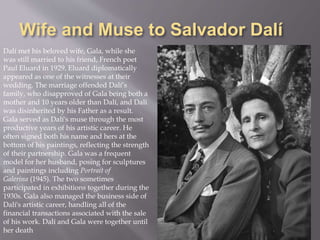
Dalí met his beloved wife, Gala, while she
was still married to his friend, French poet
Paul Eluard in 1929. Eluard diplomatically
appeared as one of the witnesses at their
wedding. The marriage offended Dalí’s
family, who disapproved of Gala being both a
mother and 10 years older than Dalí, and Dalí
was disinherited by his Father as a result.
Gala served as Dalí's muse through the most
productive years of his artistic career. He
often signed both his name and hers at the
bottom of his paintings, reflecting the strength
of their partnership. Gala was a frequent
model for her husband, posing for sculptures
and paintings including Portrait of
Galerina (1945). The two sometimes
participated in exhibitions together during the
1930s. Gala also managed the business side of
Dalí's artistic career, handling all of the
financial transactions associated with the sale
of his work. Dalí and Gala were together until
her death
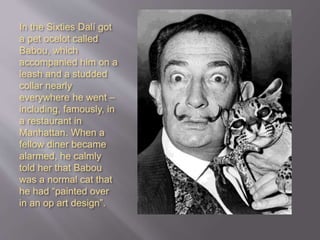
In the Sixties Dalí got
a pet ocelot called
Babou, which
accompanied him on a
leash and a studded
collar nearly
everywhere he went –
including, famously, in
a restaurant in
Manhattan. When a
fellow diner became
alarmed, he calmly
told her that Babou
was a normal cat that
he had “painted over
in an op art design”.
.
.
.
 Salvador also had an
intense fear of
grasshoppers.
 He liked his wife because
she changed her clothes
three times a day.
 He was afraid to expose
his feet.
 When in public, he would
jump up and down to get
atention.
 Dali hated to pay
restaurant bills
 His nick name was Avida
Dollars, which, roughly
translated means "eager
for dollars".
 He was kicked out of the
official surrealist society
in 1934.
 At a posh New York
costume party, Dali and
his wife arrived dressed as
the Lindbergh baby and
the kidnapper. People
were so offended that he
had to issue a public
apology.
 Walt Disney and Salvador
Dali collaborated on a
short animated film called
"Destino."
 Dali designed the Chupa
Chups logo.
 Dali died of heart failure
on 23rd January 1989. He
was 84.
 "P.Halsman: Dalí, what
makes you tick?
Dalí: My hairspring,
of course."

"P.Halsman: Dalí, why
do you wear a
mustache?
Dalí: In order to pass
unobserved."
 "P.Halsman: Dalí, what
is surrealism?
Dalí: Surrealism is
myself."
 "At the age of six I
wanted to be a cook.
At seven I wanted to
be Napoleon. And my
ambition has been
growing steadily ever
since."
 The only difference
between me and a
madman is I'm not mad.
 Intelligence without
ambition is a bird
without wings
 Each morning when I
awake, I experience
again a supreme
pleasure: that of being
Salvador Dali.
 Those who do not want
to imitate anything,
produce nothing.
 People love mystery,
and that is why they
love my paintings.
 Have no fear of
perfection - you'll never
reach it.
 Take me, I am the drug;
take me, I am
hallucinogenic
 I am not strange. I am
just not normal.
 Let my enemies devour
each other.
Project is made by Ana Khvistani
17.12.2014

Crazy or genius

  • 1.
  • 3.
    Family life Salvador FelipeJacinto Dalí y Domenech was born on May 11, 1904, in Figueres, Spain, located 16 miles from the French border in the foothills of the Pyrenees Mountains. His father, Salvador Dalí y Cusi, was a middle class lawyer and notary. Salvador's father had a strict disciplinary approach to raising children—a style of child-rearing which contrasted sharply with that of his mother, Felipa Domenech Ferres. She often indulged young Salvador in his art and early eccentricities. It has been said that young Salvador was a precocious and intelligent child, prone to fits of anger against his parents and schoolmates. Consequently, Dalí was subjected to furious acts of cruelty by more dominant students or his father. The elder Salvador wouldn't tolerate his son's outbursts or eccentricities, and punished him severely.  Their relationship deteriorated when Salvador was still young, exacerbated by competition between he and his father for Felipa's affection.  Dalí had an older brother, born nine months before him, also named Salvador, who died of gastroenteritis. Later in his life, Dalí often related the story that when he was 5 years old, his parents took him to the grave of his older brother and told him he was his brother's reincarnation. In the metaphysical prose he frequently used, Dalí recalled, "[we] resembled each other like two drops of water, but we had different reflections." He "was probably a first version of myself, but conceived too much in the absolute."  Salvador, along with his younger sister Ana Maria and his parents, often spent time at their summer home in the coastal village of Cadaques. At an early age, Salvador was producing highly sophisticated drawings, and both of his parents strongly supported his artistic talent. It was here that his parents built him an art studio before he entered art school.  Upon recognizing his immense talent, Salvador Dalí's parents sent him to drawing school at the Colegio de Hermanos Maristas and the Instituto in Figueres, Spain, in 1916. He was not a serious student, preferring to daydream in class and stand out as the class eccentric, wearing odd clothing and long hair. After that first year at art school, he discovered modern painting in Cadaques while vacationing with his family. There, he also met Ramon Pichot, a local artist who frequently visited Paris. The following year, his father organized an exhibition of Salvador's charcoal drawings in the family home. By 1919, the young artist had his first public exhibition, at the Municipal Theatre of Figueres.  In 1921, Dalí's mother, Felipa, died of breast cancer. Dalí was 16 years old at the time, and was devastated by the loss. His father married his deceased wife's sister, which did not endear the younger Dalí any closer to his father, though he respected his aunt. Father and son would battle over many different issues throughout their lives, until the elder Dalí's death.
  • 4.
     In 1922,Dali enrolled at the Academia de San Fernando in Madrid. He stayed at the school's student residence and soon brought his eccentricity to a new level, growing long hair and sideburns, and dressing in the style of English Aesthetes of the late 19th century. During this time, he was influenced by several different artistic styles, including Metaphysics and Cubism, which earned him attention from his fellow students—though he probably didn't yet understand the Cubist movement entirely.  In 1923, Dali was suspended from the academy for criticizing his teachers and allegedly starting a riot among students over the academy's choice of a professorship. That same year, he was arrested and briefly imprisoned in Gerona for allegedly supporting the Separatist movement, though Dali was actually apolitical at the time (and remained so throughout most of his life). He returned to the academy in 1926, but was permanently expelled shortly before his final exams for declaring that no member of the faculty was competent enough to examine him.  While in school, Dali began exploring many forms of art including classical painters like Raphael, Bronzino and Diego Velázquez (from whom he adopted his signature curled moustache). He also dabbled in avant-garde art movements such as Dada, a post-World War I anti- establishment movement. While Dali`s apolitical outlook on life prevented him from becoming a strict follower, the Dada philosophy influenced his work throughout his life.
  • 5.
    Wife and Museto Salvador Dalí Dalí met his beloved wife, Gala, while she was still married to his friend, French poet Paul Eluard in 1929. Eluard diplomatically appeared as one of the witnesses at their wedding. The marriage offended Dalí’s family, who disapproved of Gala being both a mother and 10 years older than Dalí, and Dalí was disinherited by his Father as a result. Gala served as Dalí's muse through the most productive years of his artistic career. He often signed both his name and hers at the bottom of his paintings, reflecting the strength of their partnership. Gala was a frequent model for her husband, posing for sculptures and paintings including Portrait of Galerina (1945). The two sometimes participated in exhibitions together during the 1930s. Gala also managed the business side of Dalí's artistic career, handling all of the financial transactions associated with the sale of his work. Dalí and Gala were together until her death
  • 6.
    In the SixtiesDalí got a pet ocelot called Babou, which accompanied him on a leash and a studded collar nearly everywhere he went – including, famously, in a restaurant in Manhattan. When a fellow diner became alarmed, he calmly told her that Babou was a normal cat that he had “painted over in an op art design”. .
  • 8.
  • 9.
  • 10.
     Salvador alsohad an intense fear of grasshoppers.  He liked his wife because she changed her clothes three times a day.  He was afraid to expose his feet.  When in public, he would jump up and down to get atention.  Dali hated to pay restaurant bills  His nick name was Avida Dollars, which, roughly translated means "eager for dollars".  He was kicked out of the official surrealist society in 1934.  At a posh New York costume party, Dali and his wife arrived dressed as the Lindbergh baby and the kidnapper. People were so offended that he had to issue a public apology.  Walt Disney and Salvador Dali collaborated on a short animated film called "Destino."  Dali designed the Chupa Chups logo.  Dali died of heart failure on 23rd January 1989. He was 84.
  • 11.
     "P.Halsman: Dalí,what makes you tick? Dalí: My hairspring, of course."  "P.Halsman: Dalí, why do you wear a mustache? Dalí: In order to pass unobserved."  "P.Halsman: Dalí, what is surrealism? Dalí: Surrealism is myself."  "At the age of six I wanted to be a cook. At seven I wanted to be Napoleon. And my ambition has been growing steadily ever since."
  • 12.
     The onlydifference between me and a madman is I'm not mad.  Intelligence without ambition is a bird without wings  Each morning when I awake, I experience again a supreme pleasure: that of being Salvador Dali.  Those who do not want to imitate anything, produce nothing.  People love mystery, and that is why they love my paintings.  Have no fear of perfection - you'll never reach it.  Take me, I am the drug; take me, I am hallucinogenic  I am not strange. I am just not normal.  Let my enemies devour each other.
  • 14.
    Project is madeby Ana Khvistani 17.12.2014