Mary Cassatt
   Belotti/Leone
     5B 2013
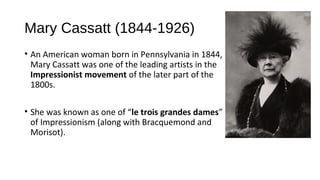
Mary Cassatt (1844-1926)
• An American woman born in Pennsylvania in 1844,
  Mary Cassatt was one of the leading artists in the
  Impressionist movement of the later part of the
  1800s.

• She was known as one of “le trois grandes dames”
  of Impressionism (along with Bracquemond and
  Morisot).
From Pennsylvania to Paris
• Cassatt’s family was upper-class and she spent some time in Europe
  as a child in the 1850s.

• She enrolled at the Pennsylvania Academy of the Fine Arts, where
  she encountered resentment from the male faculty and students.

• She became more and more dissatisfied with the quality of the school
  in Pennsylvania and decided to move to Europe in 1860 in order to
  pursue the study of painting.
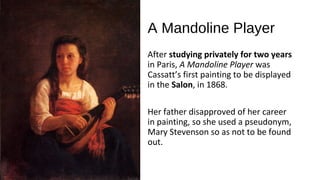
A Mandoline Player
After studying privately for two years
in Paris, A Mandoline Player was
Cassatt’s first painting to be displayed
in the Salon, in 1868.

Her father disapproved of her career
in painting, so she used a pseudonym,
Mary Stevenson so as not to be found
out.
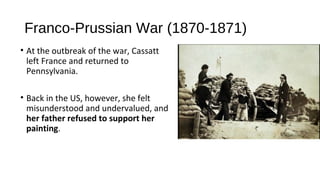
Franco-Prussian War (1870-1871)
• At the outbreak of the war, Cassatt
  left France and returned to
  Pennsylvania.

• Back in the US, however, she felt
  misunderstood and undervalued, and
  her father refused to support her
  painting.
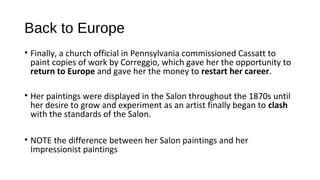
Back to Europe
• Finally, a church official in Pennsylvania commissioned Cassatt to
  paint copies of work by Correggio, which gave her the opportunity to
  return to Europe and gave her the money to restart her career.

• Her paintings were displayed in the Salon throughout the 1870s until
  her desire to grow and experiment as an artist finally began to clash
  with the standards of the Salon.

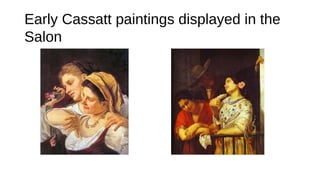
• NOTE the difference between her Salon paintings and her
  Impressionist paintings
Early Cassatt paintings displayed in the
Salon
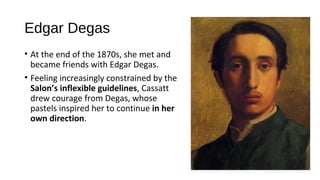
Edgar Degas
• At the end of the 1870s, she met and
  became friends with Edgar Degas.
• Feeling increasingly constrained by the
  Salon’s inflexible guidelines, Cassatt
  drew courage from Degas, whose
  pastels inspired her to continue in her
  own direction.
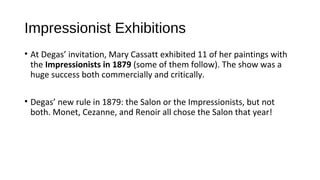
Impressionist Exhibitions
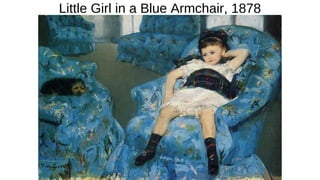
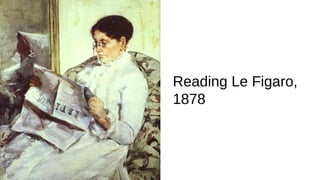
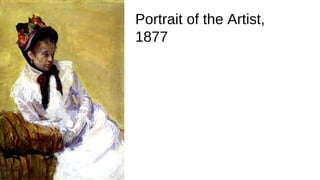
• At Degas’ invitation, Mary Cassatt exhibited 11 of her paintings with
  the Impressionists in 1879 (some of them follow). The show was a
  huge success both commercially and critically.

• Degas’ new rule in 1879: the Salon or the Impressionists, but not
  both. Monet, Cezanne, and Renoir all chose the Salon that year!
Little Girl in a Blue Armchair, 1878
Reading Le Figaro,
1878
Portrait of the Artist,
1877
Matters of the heart and of style
• Shortly after her first exhibitions with the Impressionists, Cassatt was
  forced to withdraw from the art world in order to care for her ill
  mother and sister.

• Her sister died in 1882 and her mother became very ill. Cassatt
  stopped painting for a short period.

• By 1885, she had slowly started up again, but by 1886 she had done
  her last show with the Impressionists and had withdrawn from
  identification with any particular artistic style.
Women and children
• She began to paint in a simpler and more straightforward style.

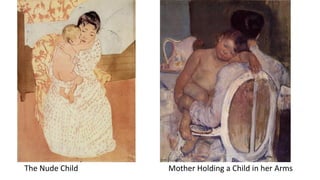
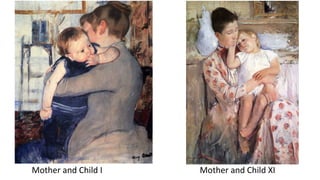
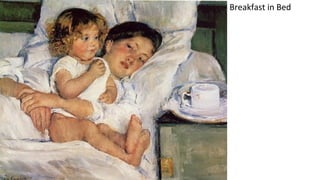
• A major theme for Cassatt was the intimate bond between mothers
  and their children.

• In general, she was interested in depicting both the social and private
  lives of women on canvas.
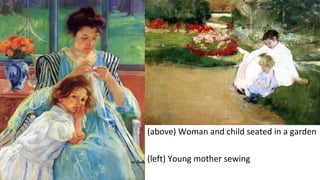
(above) Woman and child seated in a garden

(left) Young mother sewing
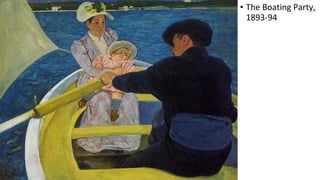
• The Boating Party,
  1893-94
The Nude Child   Mother Holding a Child in her Arms
Mother and Child I   Mother and Child XI
Breakfast in Bed
Later in life
• In 1910 she took a trip to Egypt with her brother. The magnificent
  ancient art made her question her own talent as an artist.
• Soon after their return home, her brother died unexpectedly.
• She was unable to paint again until 1912. However, in 1915 she was
  forced to give up painting altogether as she began to go blind from
  diabetes.
• As the story goes, she died full of bitterness about not having been
  able to paint for the last decade of her life.
References
• (2013). The Biography Channel web site. Retrieved 12:28, Jan 16,
  2013, from
  http://www.biography.com/people/mary-cassatt-9240820.
• http://en.wikipedia.org/wiki/Mary_Cassatt
• http://www.wikipaintings.org/

Mary Cassatt

  • 1.
    Mary Cassatt Belotti/Leone 5B 2013
  • 2.
    Mary Cassatt (1844-1926) •An American woman born in Pennsylvania in 1844, Mary Cassatt was one of the leading artists in the Impressionist movement of the later part of the 1800s. • She was known as one of “le trois grandes dames” of Impressionism (along with Bracquemond and Morisot).
  • 3.
    From Pennsylvania toParis • Cassatt’s family was upper-class and she spent some time in Europe as a child in the 1850s. • She enrolled at the Pennsylvania Academy of the Fine Arts, where she encountered resentment from the male faculty and students. • She became more and more dissatisfied with the quality of the school in Pennsylvania and decided to move to Europe in 1860 in order to pursue the study of painting.
  • 4.
    A Mandoline Player Afterstudying privately for two years in Paris, A Mandoline Player was Cassatt’s first painting to be displayed in the Salon, in 1868. Her father disapproved of her career in painting, so she used a pseudonym, Mary Stevenson so as not to be found out.
  • 5.
    Franco-Prussian War (1870-1871) •At the outbreak of the war, Cassatt left France and returned to Pennsylvania. • Back in the US, however, she felt misunderstood and undervalued, and her father refused to support her painting.
  • 6.
    Back to Europe •Finally, a church official in Pennsylvania commissioned Cassatt to paint copies of work by Correggio, which gave her the opportunity to return to Europe and gave her the money to restart her career. • Her paintings were displayed in the Salon throughout the 1870s until her desire to grow and experiment as an artist finally began to clash with the standards of the Salon. • NOTE the difference between her Salon paintings and her Impressionist paintings
  • 7.
    Early Cassatt paintingsdisplayed in the Salon
  • 8.
    Edgar Degas • Atthe end of the 1870s, she met and became friends with Edgar Degas. • Feeling increasingly constrained by the Salon’s inflexible guidelines, Cassatt drew courage from Degas, whose pastels inspired her to continue in her own direction.
  • 9.
    Impressionist Exhibitions • AtDegas’ invitation, Mary Cassatt exhibited 11 of her paintings with the Impressionists in 1879 (some of them follow). The show was a huge success both commercially and critically. • Degas’ new rule in 1879: the Salon or the Impressionists, but not both. Monet, Cezanne, and Renoir all chose the Salon that year!
  • 10.
    Little Girl ina Blue Armchair, 1878
  • 11.
  • 12.
    Portrait of theArtist, 1877
  • 13.
    Matters of theheart and of style • Shortly after her first exhibitions with the Impressionists, Cassatt was forced to withdraw from the art world in order to care for her ill mother and sister. • Her sister died in 1882 and her mother became very ill. Cassatt stopped painting for a short period. • By 1885, she had slowly started up again, but by 1886 she had done her last show with the Impressionists and had withdrawn from identification with any particular artistic style.
  • 14.
    Women and children •She began to paint in a simpler and more straightforward style. • A major theme for Cassatt was the intimate bond between mothers and their children. • In general, she was interested in depicting both the social and private lives of women on canvas.
  • 15.
    (above) Woman andchild seated in a garden (left) Young mother sewing
  • 16.
    • The BoatingParty, 1893-94
  • 17.
    The Nude Child Mother Holding a Child in her Arms
  • 18.
    Mother and ChildI Mother and Child XI
  • 19.
  • 20.
    Later in life •In 1910 she took a trip to Egypt with her brother. The magnificent ancient art made her question her own talent as an artist. • Soon after their return home, her brother died unexpectedly. • She was unable to paint again until 1912. However, in 1915 she was forced to give up painting altogether as she began to go blind from diabetes. • As the story goes, she died full of bitterness about not having been able to paint for the last decade of her life.
  • 21.
    References • (2013). TheBiography Channel web site. Retrieved 12:28, Jan 16, 2013, from http://www.biography.com/people/mary-cassatt-9240820. • http://en.wikipedia.org/wiki/Mary_Cassatt • http://www.wikipaintings.org/

Editor's Notes

  • #3 She was a groundbreaker because the discipline of art (especially that of Paris in the mid-19 th century) was a discipline for men, not for women.
  • #4 France at the time was equally chauvinistic and did not permit women to attend the school of fine arts in Paris, so she studied via private lessons at the Louvre, where she obtained a permit and copied paintings alongside several other women. She did this from 1866 until 1868, when she submitted a painting to the Salon and was accepted.
  • #6 She attempted to make some money for herself by trying to sell some of her early paintings, but the great Chicago fire destroyed almost all of her early work.
  • #7 Like all artists, Mary needed money in order to paint. Without financial support from her family, she had to find a way (as a woman in the 1860s) to make money for herself.
  • #8 Two women throwing flowers during Carnival 1872; On the balcony 1872; the Salon preferred dark backgrounds, flattering depiction of subjects,
  • #9 1855-56 self-portrait
  • #12 Portrait of her mother
  • #13 Self portrait of Cassatt
  • #16 Young Mother Sewing