14
แนวปฏิบัติบริการสาธารณสุข
โรคปอดอุดกั้นเรื้อรังพ.ศ.2553
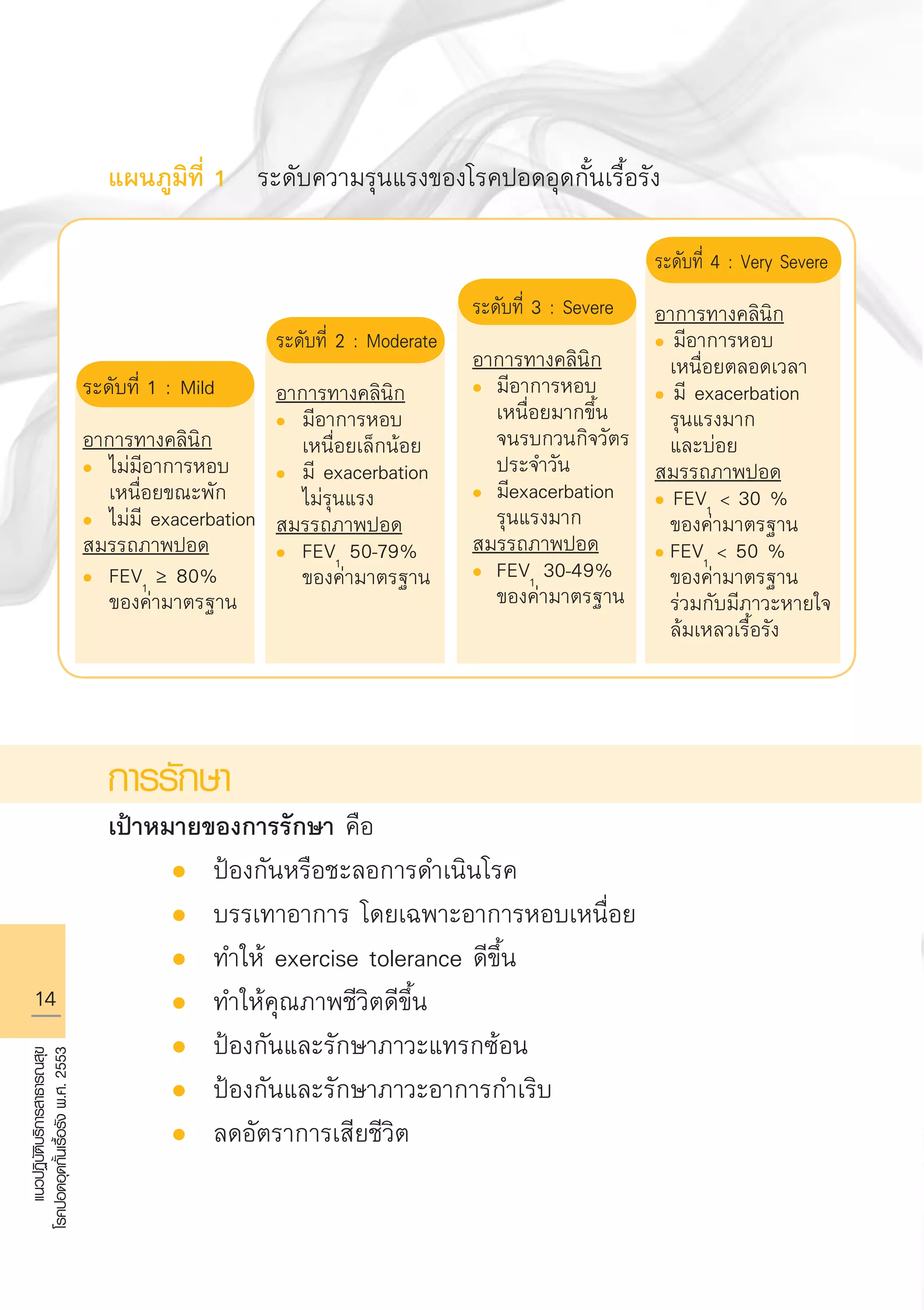
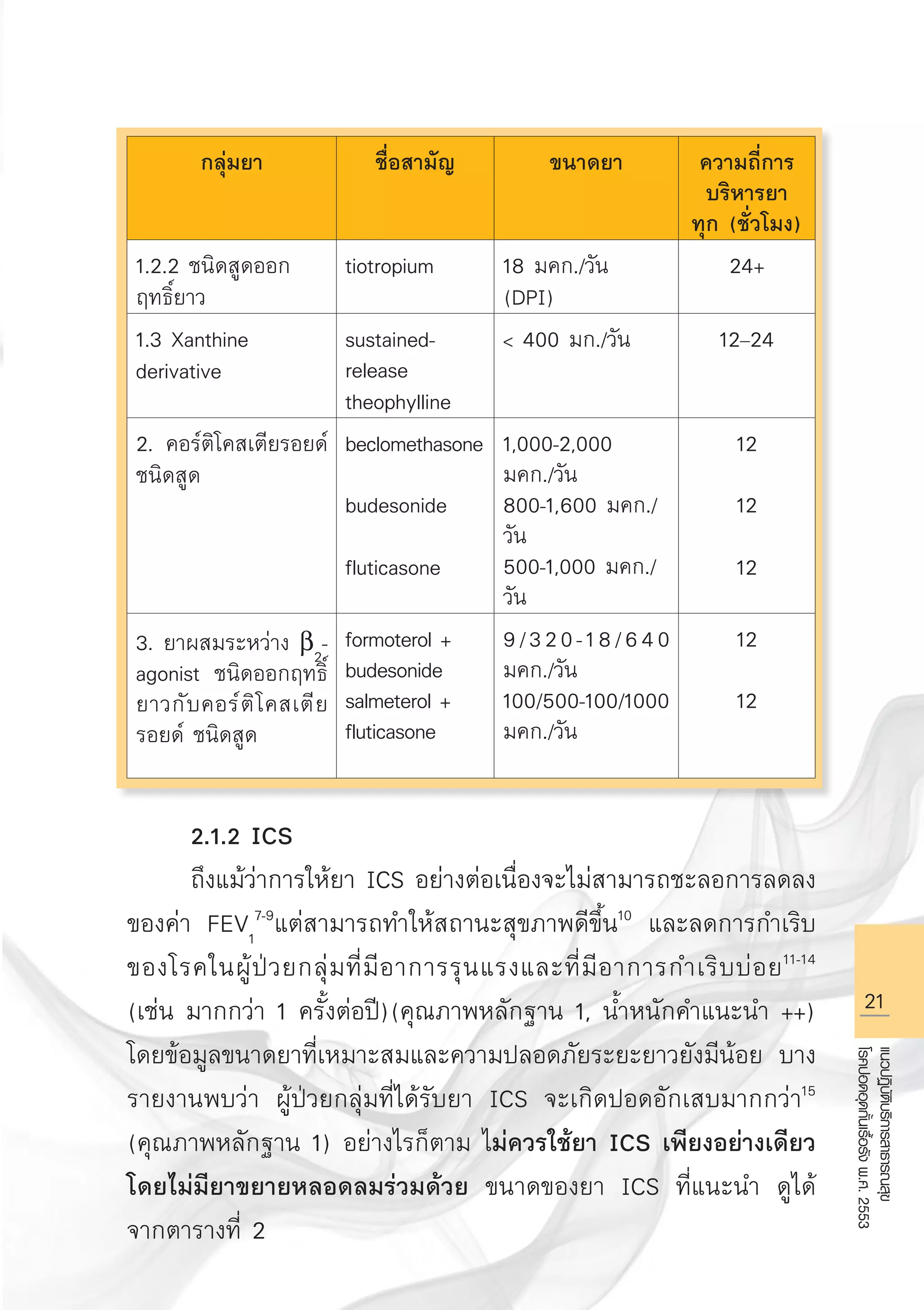
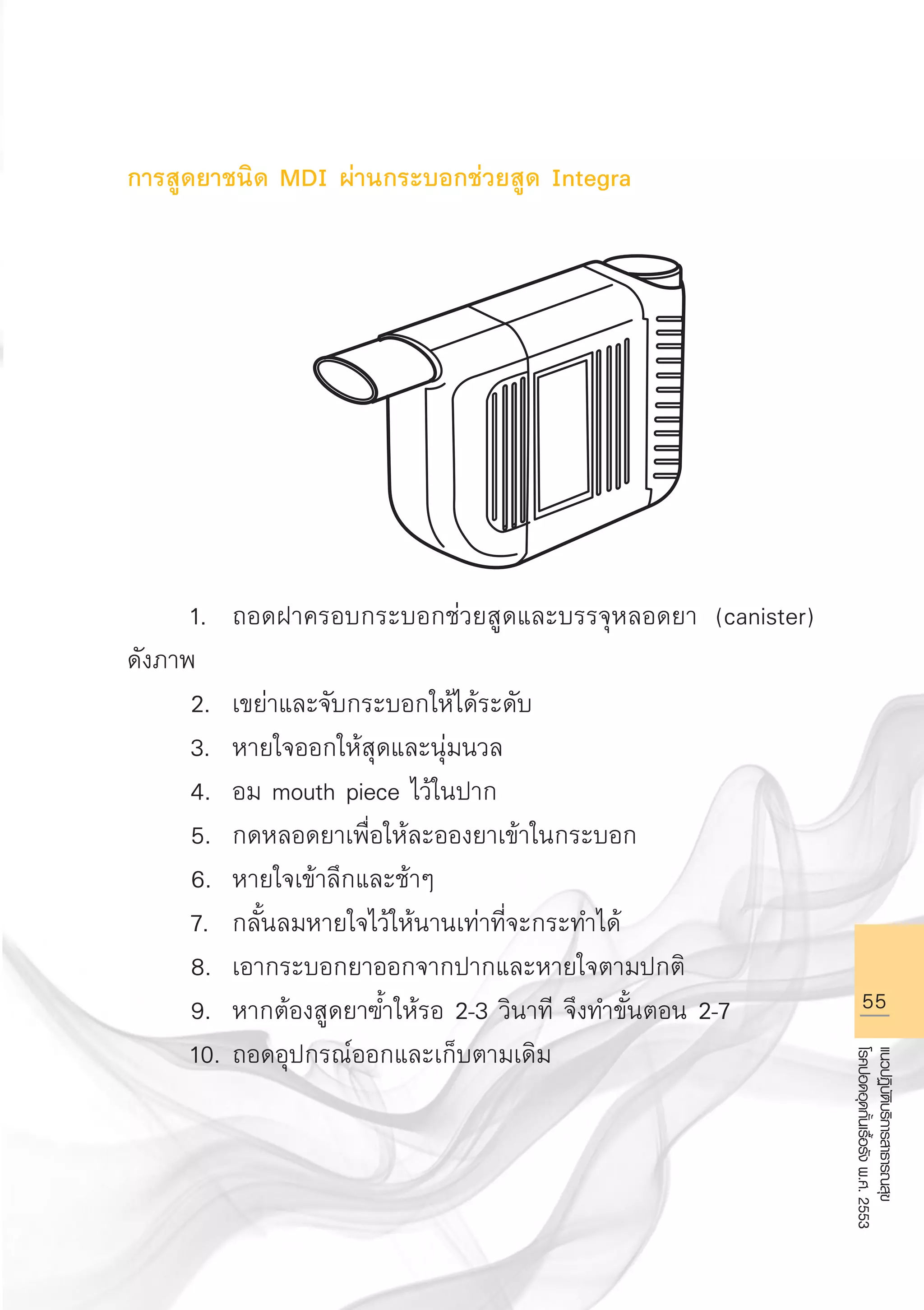
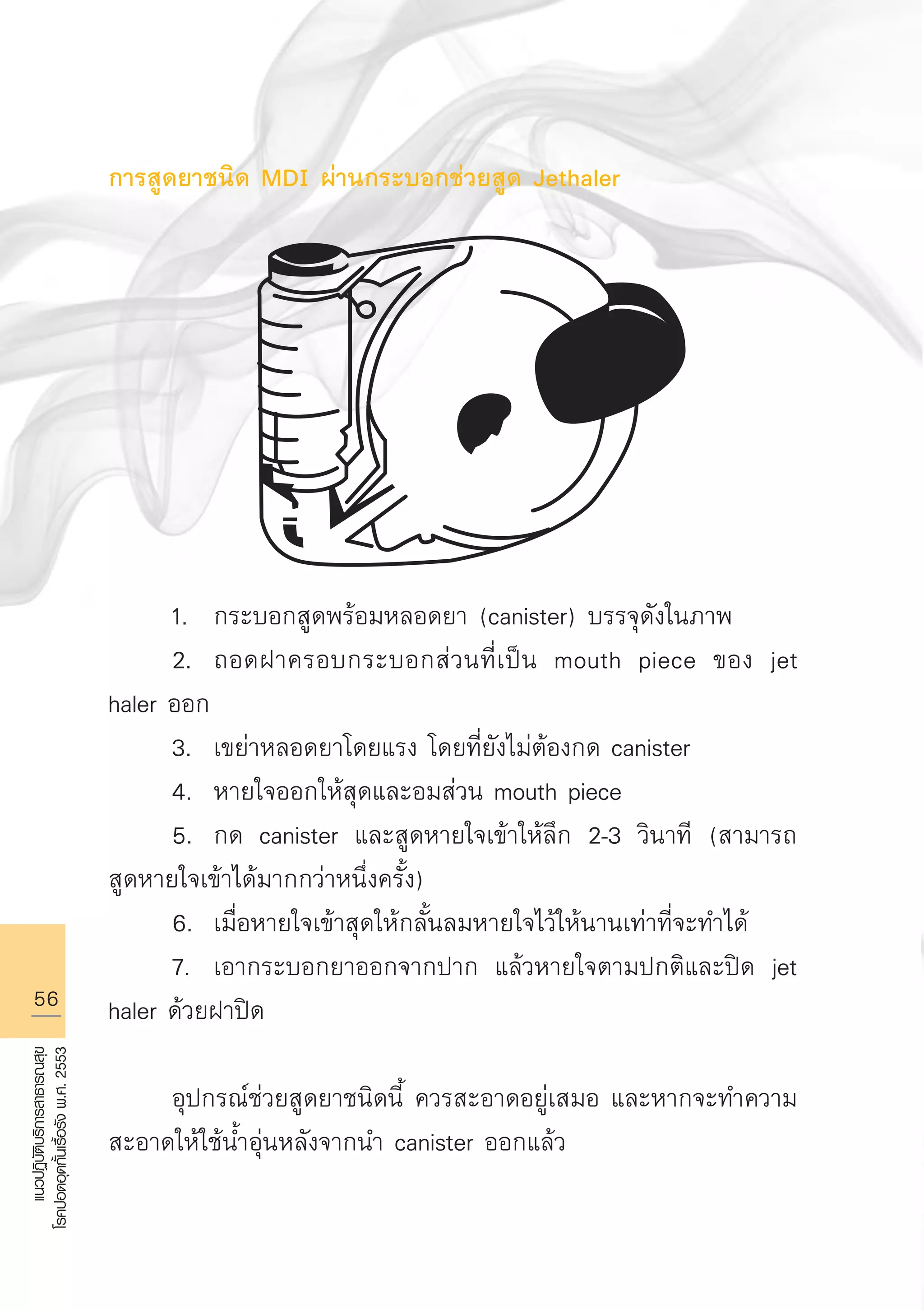
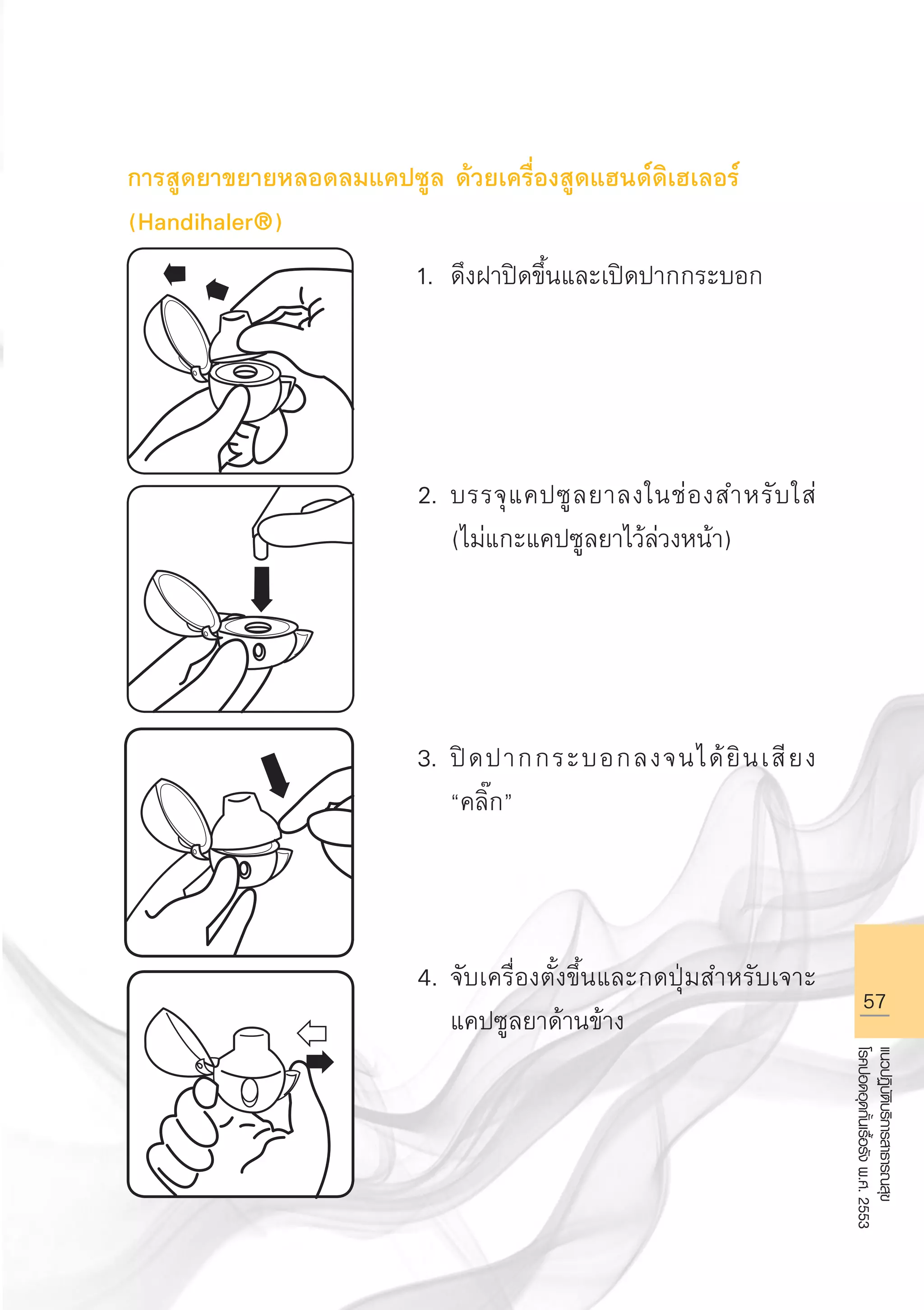
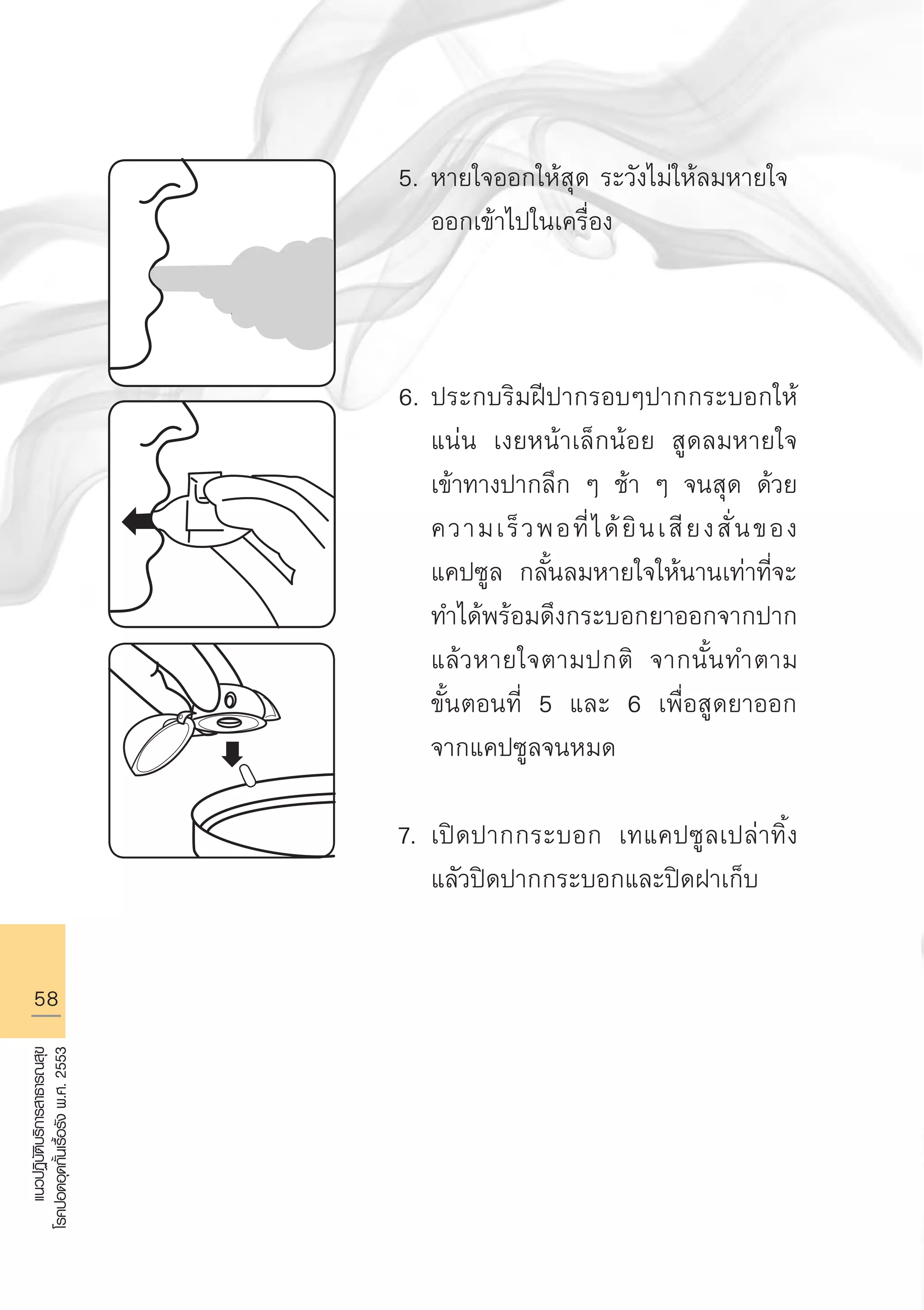
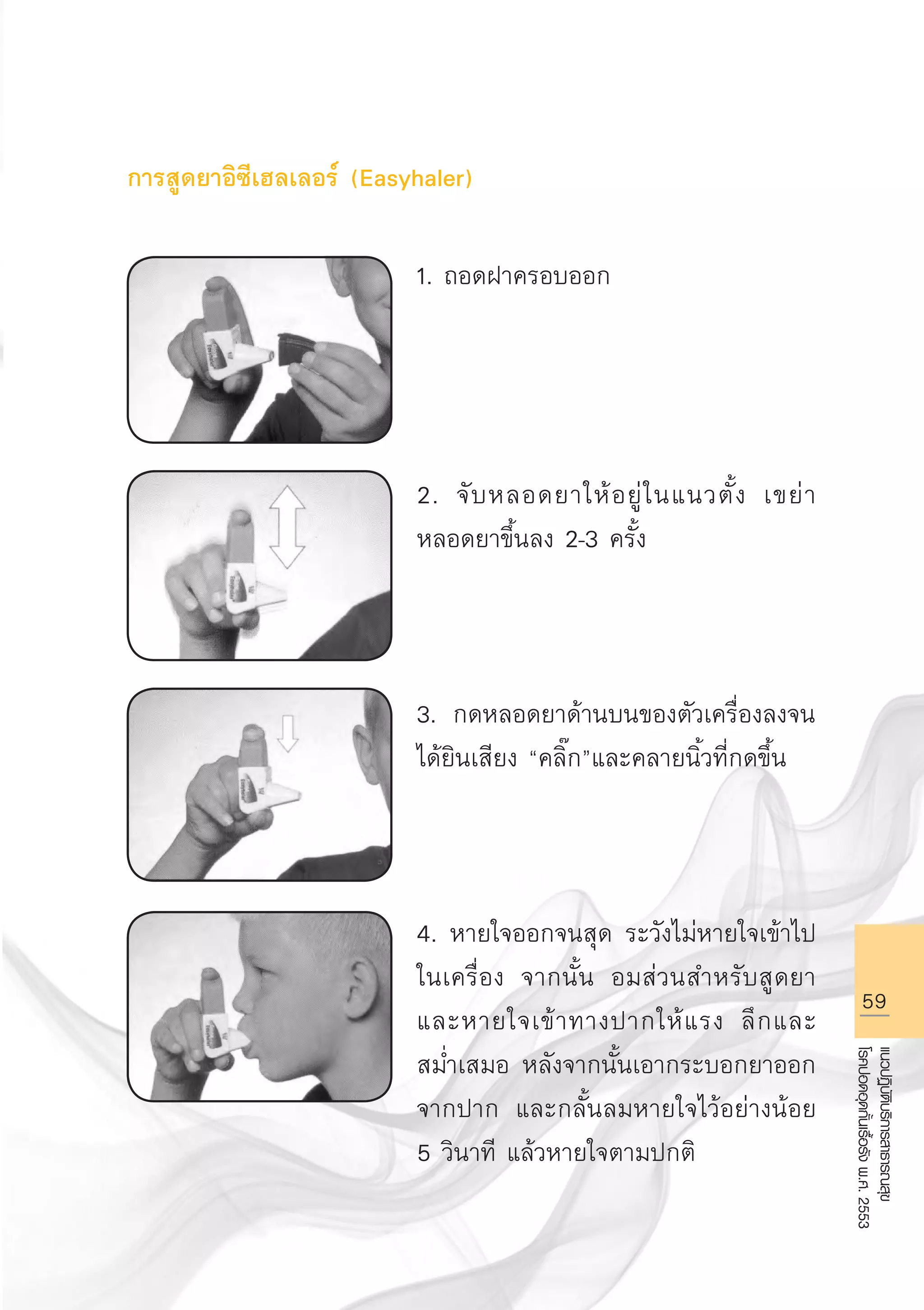
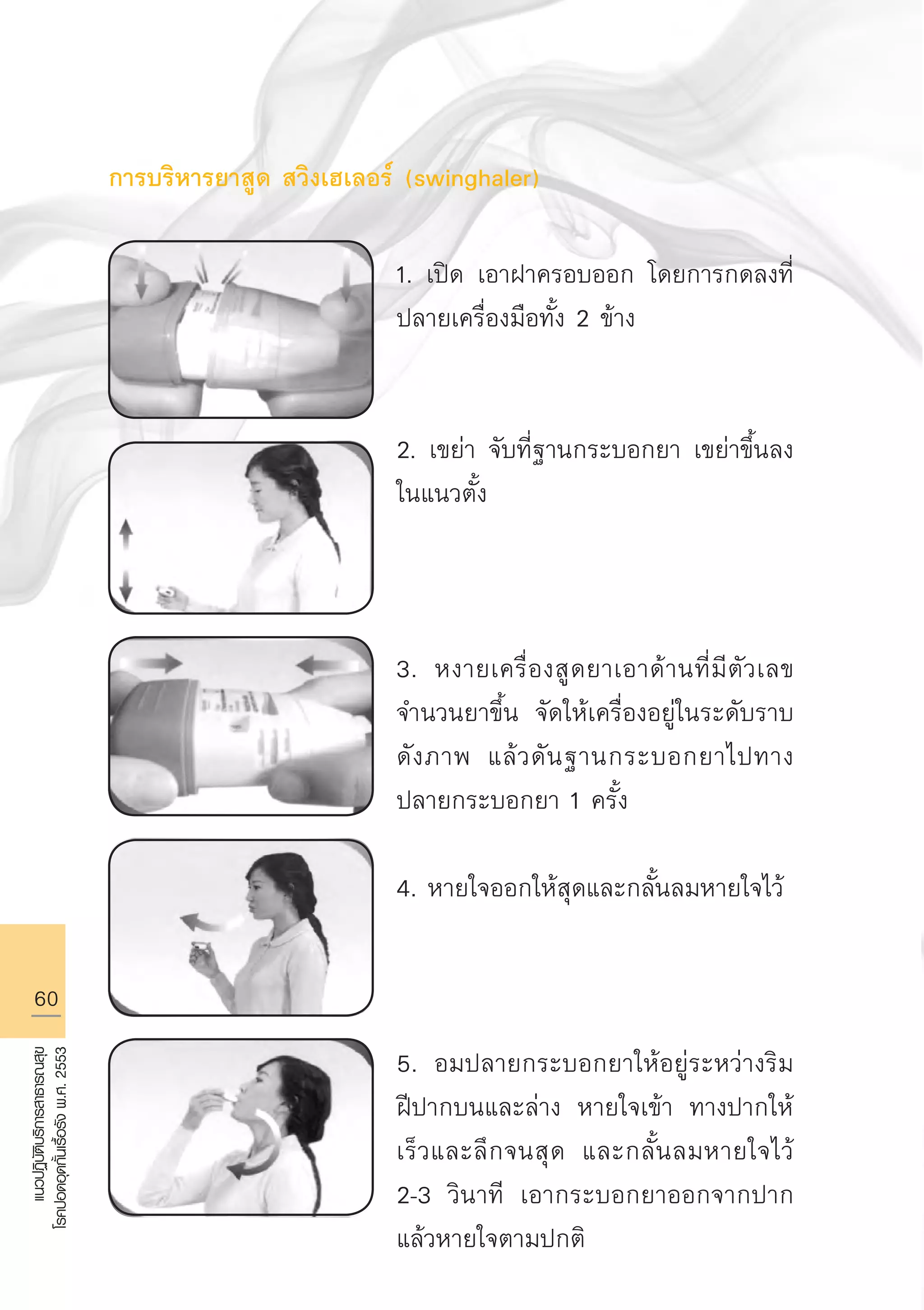
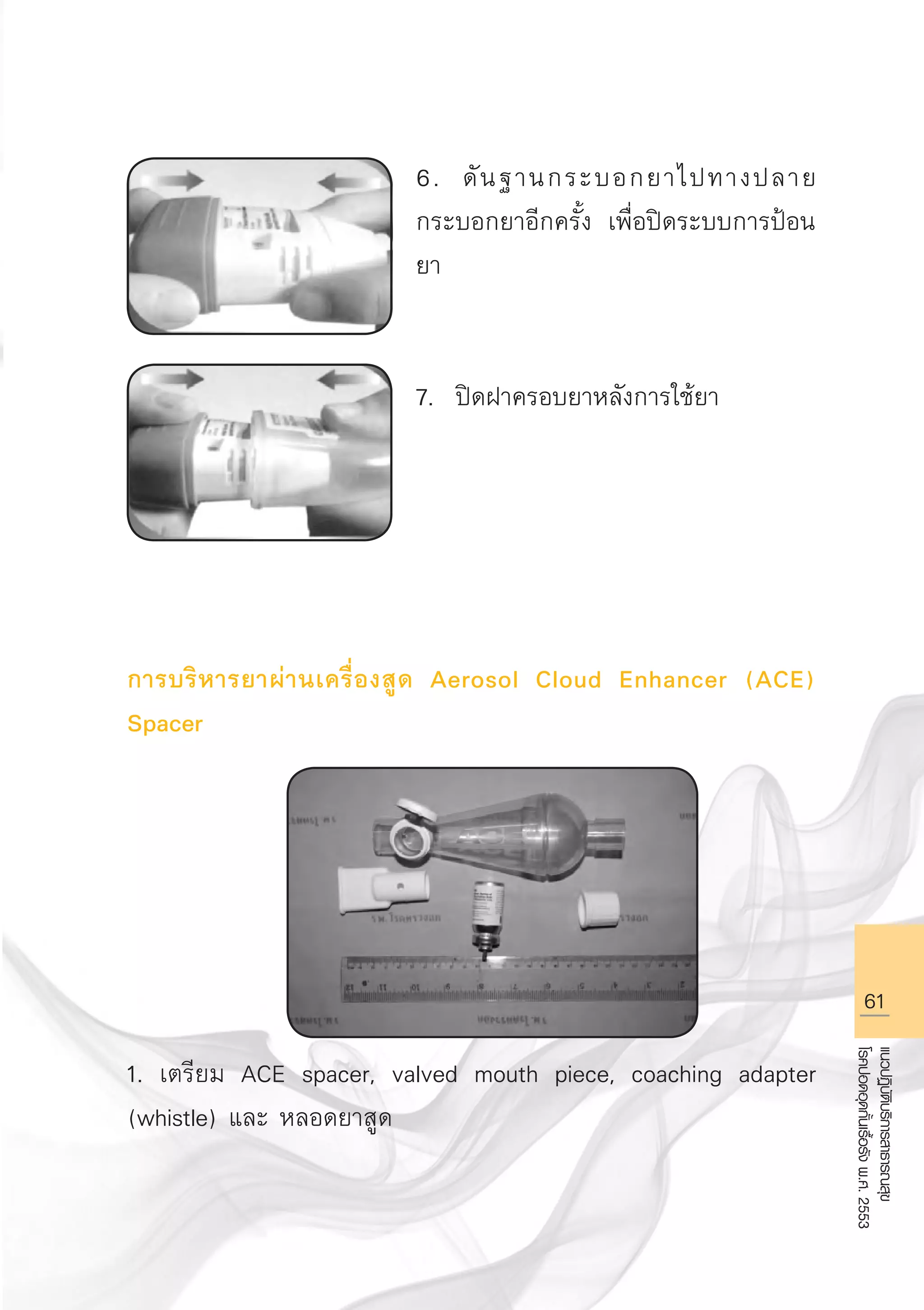
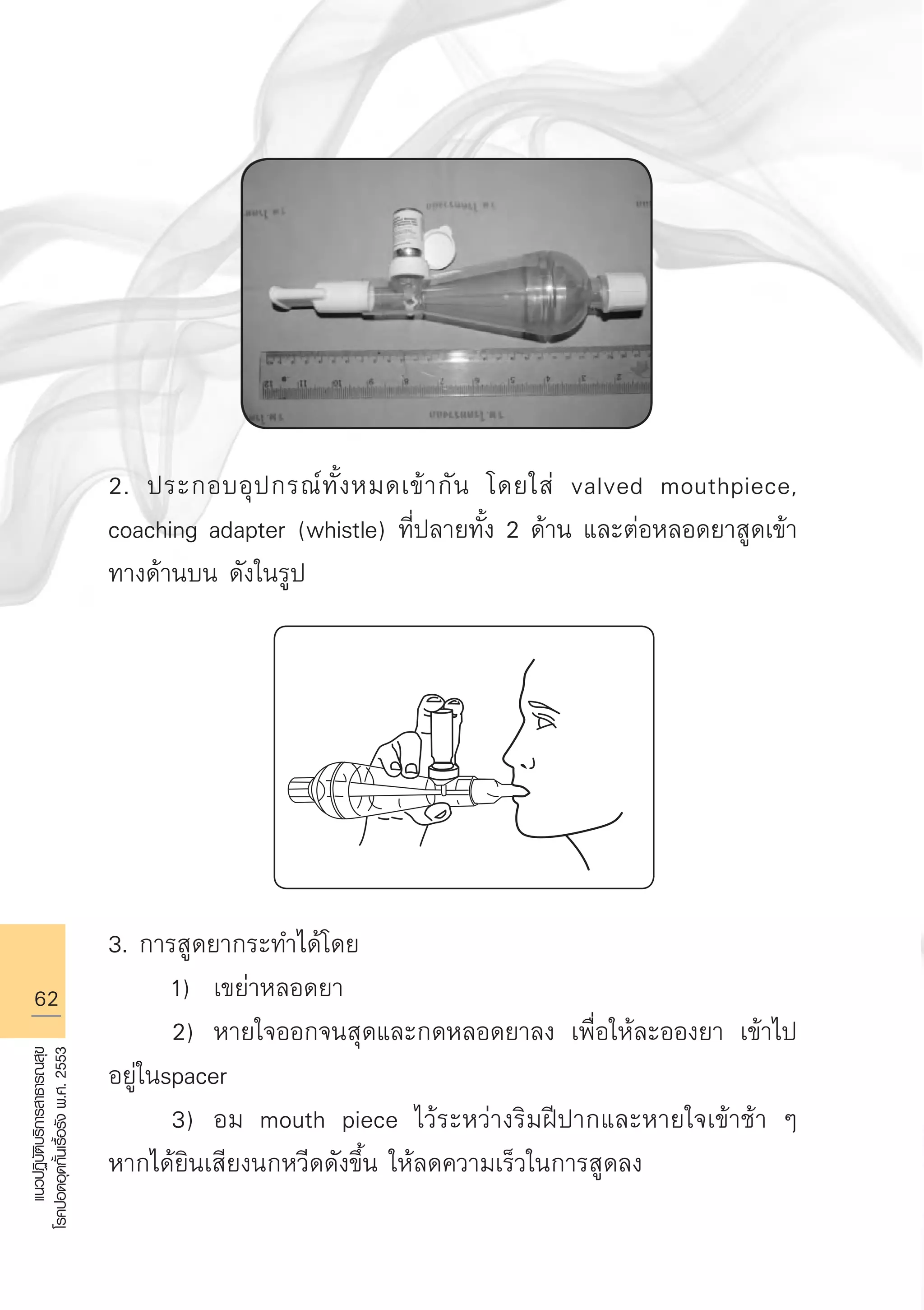
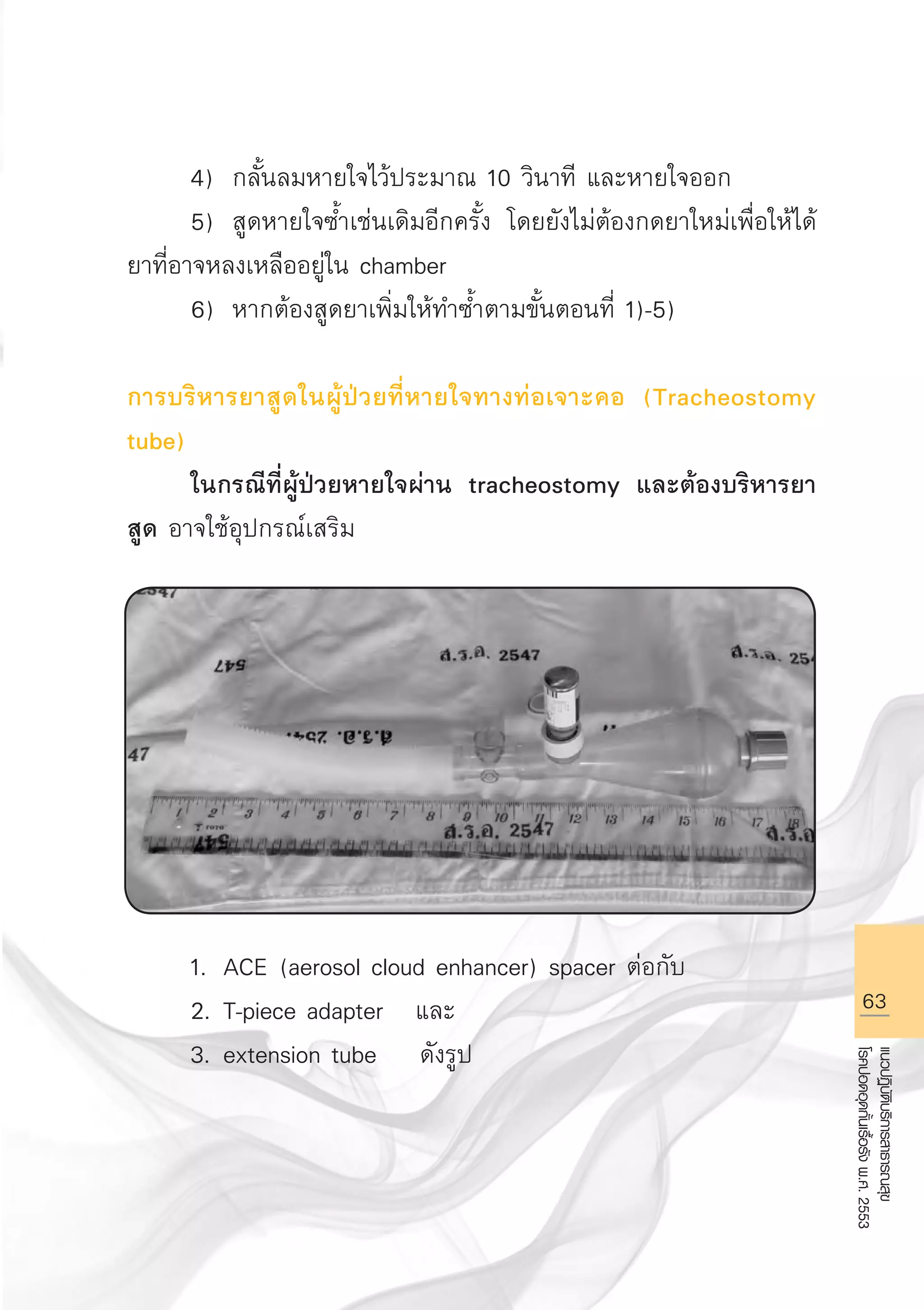
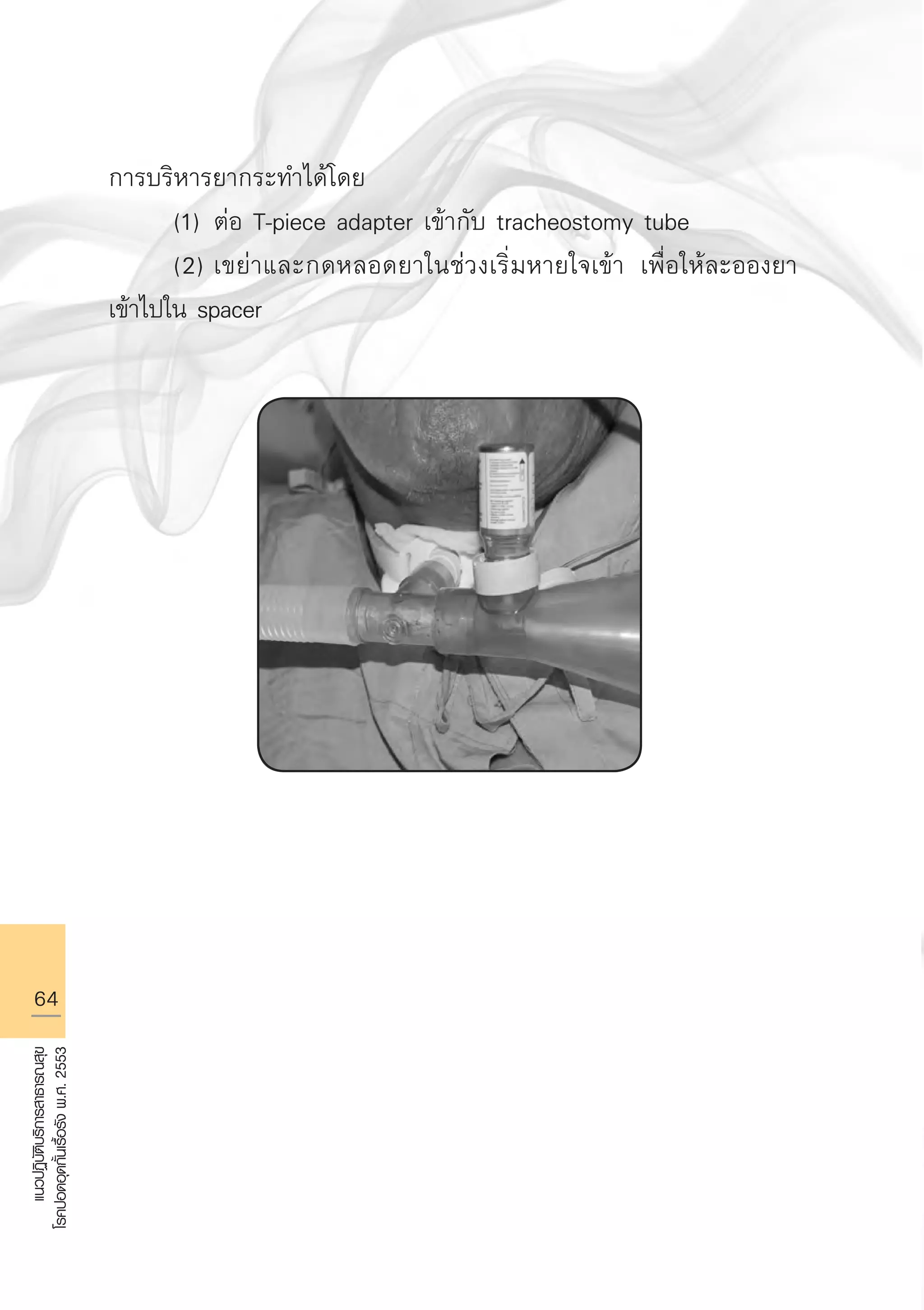
แผนภูมิที่ 1 ระดับความรุนแรงของโรคปอดอุดกั้นเรื้อรัง
การรักษา
เป้าหมายของการรักษา คือ
l ป้องกันหรือชะลอการดำเนินโรค
l บรรเทาอาการ โดยเฉพาะอาการหอบเหนื่อย
l ทำให้ exercise tolerance ดีขึ้น
l ทำให้คุณภาพชีวิตดีขึ้น
l ป้องกันและรักษาภาวะแทรกซ้อน
l ป้องกันและรักษาภาวะอาการกำเริบ
l ลดอัตราการเสียชีวิต
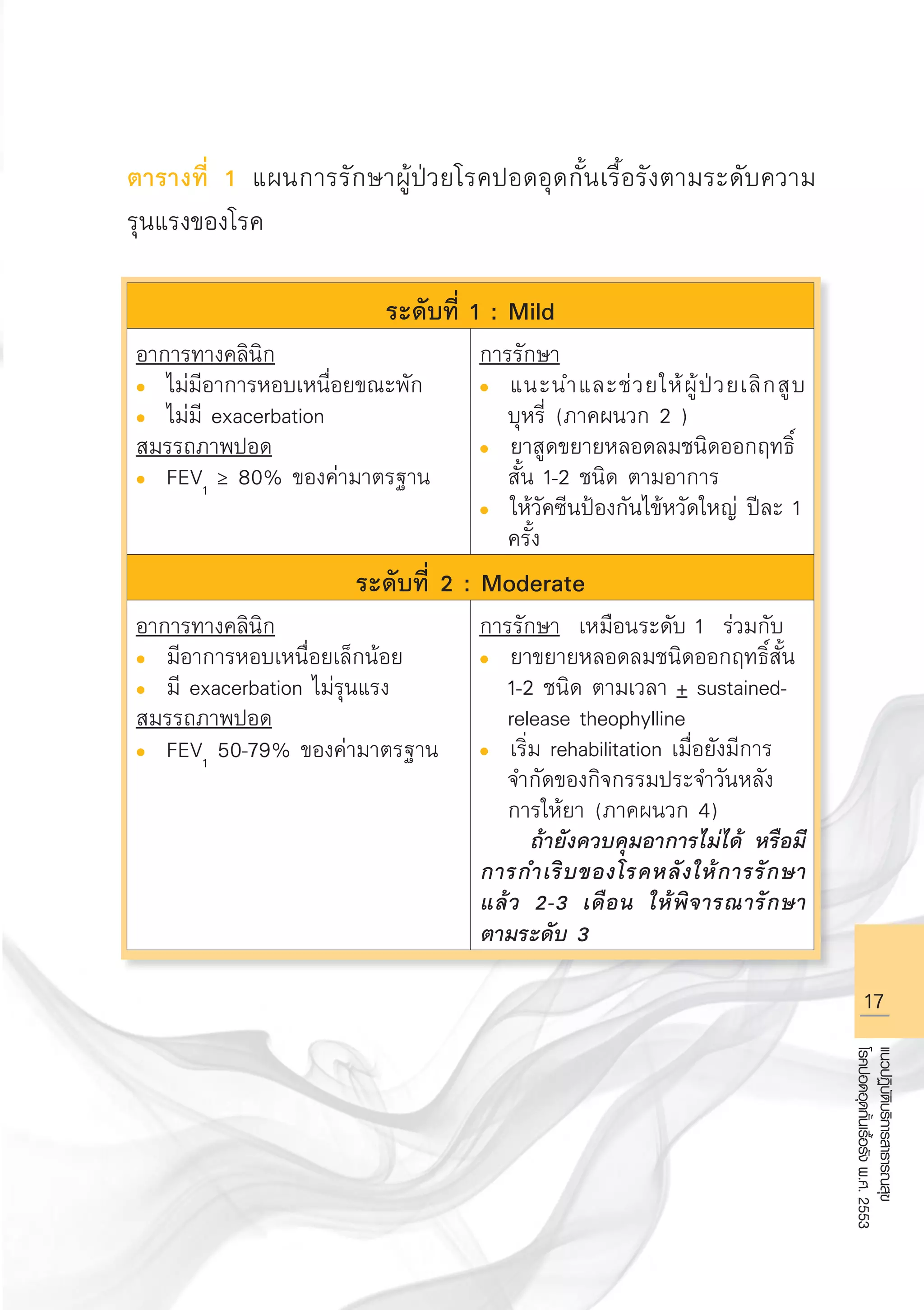
ระดับที่ 1 : Mild
อาการทางคลินิก
l ไม่มีอาการหอบ
เหนื่อยขณะพัก
l ไม่มี exacerbation
สมรรถภาพปอด
l FEV1
≥ 80%
ของค่ามาตรฐาน
ระดับที่ 2 : Moderate
อาการทางคลินิก
l มีอาการหอบ
เหนื่อยเล็กน้อย
l มี exacerbation
ไม่รุนแรง
สมรรถภาพปอด
l FEV1
50-79%
ของค่ามาตรฐาน
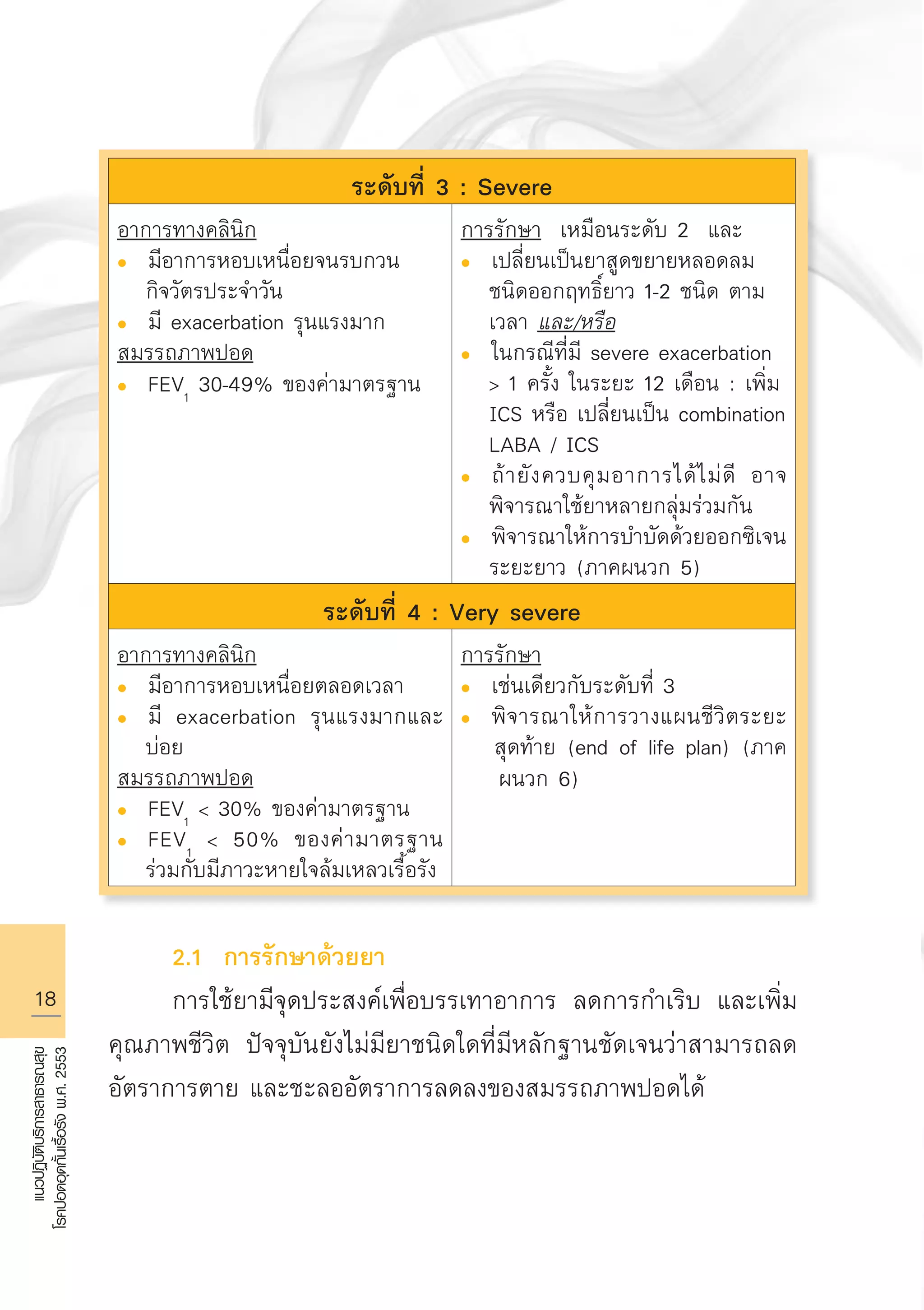
ระดับที่ 3 : Severe
อาการทางคลินิก
l มีอาการหอบ
เหนื่อยมากขึ้น
จนรบกวนกิจวัตร
ประจำวัน
l มีexacerbation
รุนแรงมาก
สมรรถภาพปอด
l FEV1
30-49%
ของค่ามาตรฐาน
ระดับที่ 4 : Very Severe
อาการทางคลินิก
l มีอาการหอบ
เหนื่อยตลอดเวลา
l มี exacerbation
รุนแรงมาก
และบ่อย
สมรรถภาพปอด
l FEV1
30 %
ของค่ามาตรฐาน
l FEV1
50 %
ของค่ามาตรฐาน
ร่วมกับมีภาวะหายใจ
ล้มเหลวเรื้อรัง
AW HSPG 1 C.indd 14 10/26/10 7:29:22 PM
30
แนวปฏิบัติบริการสาธารณสุข
โรคปอดอุดกั้นเรื้อรังพ.ศ.2553
เอกสารอ้างอิง
1. Regional COPDWorking Group. COPD prevalence in 12 Asia-Pacific
countries and regions: projections based on the COPD prevalence
estimation model. Respirology 2003; 8:192-8.
2. Maranetra N, Chuaychoo B, Dejsomritrutai W, et al. The prevalence
and incidence of COPD among urban older persons of Bangkok
Metropolis. J Med Assoc Thai 2002; 85:1147-55.
3. Pothirat C, Petchsuk N, Pisanthanaphan S, et al. (Abstract)
Prevalence, smoking risk factor and severity of COPD in community:
a comparative study between an urban and a rural area in Chiang
Mai. In the proceedings of Annual meeting of Thoracic Society of
Thailand 2007, Pang Saunkaew Hotel, Chiang Mai
4. Pothirat C, Petchsuk N, Deesomchok A, et al. Clinical characteristics
and long-term survival among COPD patients of Northern Thailand
COPD club members. J Med Assoc. Thai 2007; 90: 653-62.
5. Global Initiative for Chronic Obstructive Lung Disease. Global strategy
for the diagnosis, management and prevention of chronic obstructive
pulmonary disease. NHLBI/WHO workshop report. Bethesda, National
Heart, Lung and Blood Institute, Date updated: November 2008.
6. Gross N, Tashkin D, Miller R, et al. Inhalation by nebulization of
albuterol-ipratropium combination (Dey combination) is superior to
either agent alone in the treatment of chronic obstructive pulmonary
disease. Dey Combination Solution Study Group. Respiration 1998;
65: 354-62.
7. Burge PS, Calverley PM, Jones PW, et al. Randomised, double blind,
placebo controlled study of fluticasone propionate in patients with
moderate to severe chronic obstructive pulmonary disease: the
ISOLDE trial. BMJ 2000; 320: 1297-303.
8. Lung Health Study Research Group. Effect of inhaled triamcinolone on
the decline in pulmonary function in chronic obstructive pulmonary
disease: Lung Health Study II. N Engl J Med 2000; 343: 1902-09.
9. Pauwels RA, Lofdahl CG, Laitinen LA, et al. Long-term treatment with
inhaled budesonide in persons with mild chronic obstructive pulmonary
disease who continue smoking. European Respiratory Society Study on
Chronic Obstructive Pulmonary Disease. N Engl J Med 1999; 340:
1948-53.
AW HSPG 1 C.indd 30 10/26/10 7:31:33 PM
41.
31
แนวปฏิบัติบริการสาธารณสุข
โรคปอดอุดกั้นเรื้อรังพ.ศ.2553
10. Spencer S, CalverleyPM, Burge PS, et al. Impact of preventing
exacerbations on deterioration of health status in COPD. Eur Respir J
2004; 23: 698-702.
11. Mahler DA, Wire P, Horstman D, et al. Effectiveness of fluticasone
propionate and salmeterol combination delivered via the Diskus device
in the treatment of chronic obstructive pulmonary disease. Am J
Respir Crit Care Med 2002; 166: 1084-91.
12. Jones PW, Willits LR, Burge PS, et al. Disease severity and the effect
of fluticasone propionate on chronic obstructive pulmonary disease
exacerbations. Eur Respir J 2003; 21: 68-73.
13. Calverley P, Pauwels R, Vestbo J, et al. Combined salmeterol and
fluticasone in the treatment of chronic obstructive pulmonary disease:
a randomized controlled trial. Lancet 2003; 361: 449-56.
14. Szafranski W, Cukier A, Ramirez A, et al. Efficacy and safety of
budesonide/formoterol in the management of chronic obstructive
pulmonary disease. Eur Respir J 2003; 21: 74-81.
15. Singh S, Amin AV, Loke YK. Long-term use of inhaled corticosteroids
and the risk of pneumonia in chronic obstructive pulmonary disease: a
meta-analysis. Arch Intern Med. 2009;169: 219-29.
16. Calverley PM, Anderson JA, Celli B, et al. Salmeterol and fluticasone
propionate and survival in chronic obstructive pulmonary disease. N
Engl J Med 2007; 356: 775-89.
17. Zheng JP, Kang J, Huang SG, et al. Effect of carbocisteine on acute
exacerbation of chronic obstructive pulmonary disease (PEACE Study):
a randomized placebo-controlled study. Lancet. 2008; 371: 2013-8.
18. Decramer M, Rutten-van Molken M, Dekhuijzen PN, et al. Effects of
N-acetylcysteine on outcomes in chronic obstructive pulmonary disease
(Bronchitis Randomized on NAC Cost-Utility Study, BRONCUS): a
randomised placebo-controlled trial. Lancet 2005; 365: 1552-60.
19. Wongsurakiat P, Maranetra KN, Wasi C, et al. Acute respiratory illness
in patients with COPD and the effectiveness of influenza vaccination:
a randomized controlled study. Chest 2004; 125: 2011-20.
AW HSPG 1 C.indd 31 10/26/10 7:31:41 PM
36
แนวปฏิบัติบริการสาธารณสุข
โรคปอดอุดกั้นเรื้อรังพ.ศ.2553
เอกสารอ้างอิง
1. MaranetraN, Chuaychoo B, Lertakyamanee, et al. The
cost-effectiveness of a questionnaire as a screening
test for chronic obstructive pulmonary disease among
the Bangkok elderly. J Med Assoc Thai 2003; 86:
1033 - 41.
2. Maranetra N, Chuaychoo B, Naruman C, et al. The
cost-effectiveness of mini peak expiratory flow as a
screening test for chronic obstructive pulmonary
disease among the Bangkok elderly. J Med Assoc Thai
2003; 86: 1133 - 9.
3. Chuaychoo B, Maranetra N, Naruman C, et al. The
most cost-effective screening method for chronic
obstructive pulmonary disease among the Bangkok
elderly. J Med Assoc Thai 2003; 86 : 1140 - 8.
AW HSPG 1 C.indd 36 10/26/10 7:32:00 PM
65
แนวปฏิบัติบริการสาธารณสุข
โรคปอดอุดกั้นเรื้อรังพ.ศ.2553
เอกสารอ้างอิง
1. Dolovich MB,Ahren RC, Hess DR, et al. Device selection and
outcomes of aerosol therapy: evidence based guideline.
American College of Chest Physicians/American College of
Asthma, Allergy, and Immunology. Chest 2005; 127: 335-71.
2. Newman SP, Clark SW. Inhalation devices and techniques. In
Asthma 3rd ed. Clark TJH, Godfrey S, Lee TH.editers.1992
Chapman Hall, London 469-505.
3. Canadian Asthma Consensus Group. Inhalation devices and
propellants. JAMC 1999;161s44-s52.
4. ACCP : Inhaled Medications and Devices : American College
of Chest Physicians 2003. Tips and Techniques. www.
chestnet.org
AW HSPG 1 C.indd 65 10/26/10 7:36:10 PM
73
แนวปฏิบัติบริการสาธารณสุข
โรคปอดอุดกั้นเรื้อรังพ.ศ.2553
ปรับเปลี่ยนโปรแกรมของตนเองให้เหมาะสมยิ่ง ๆ ขึ้นองค์ประกอบ
สำคัญที่ควรประเมินคือ
ก. ความสามารถในการออกกำลังกาย (exercise capacity)
โดยการวัด 6-minute walking distance (6-MWD,
meters) ในสถาบันที่มีศักยภาพอาจประเมิน maximum
exercise capacities ก็ได้
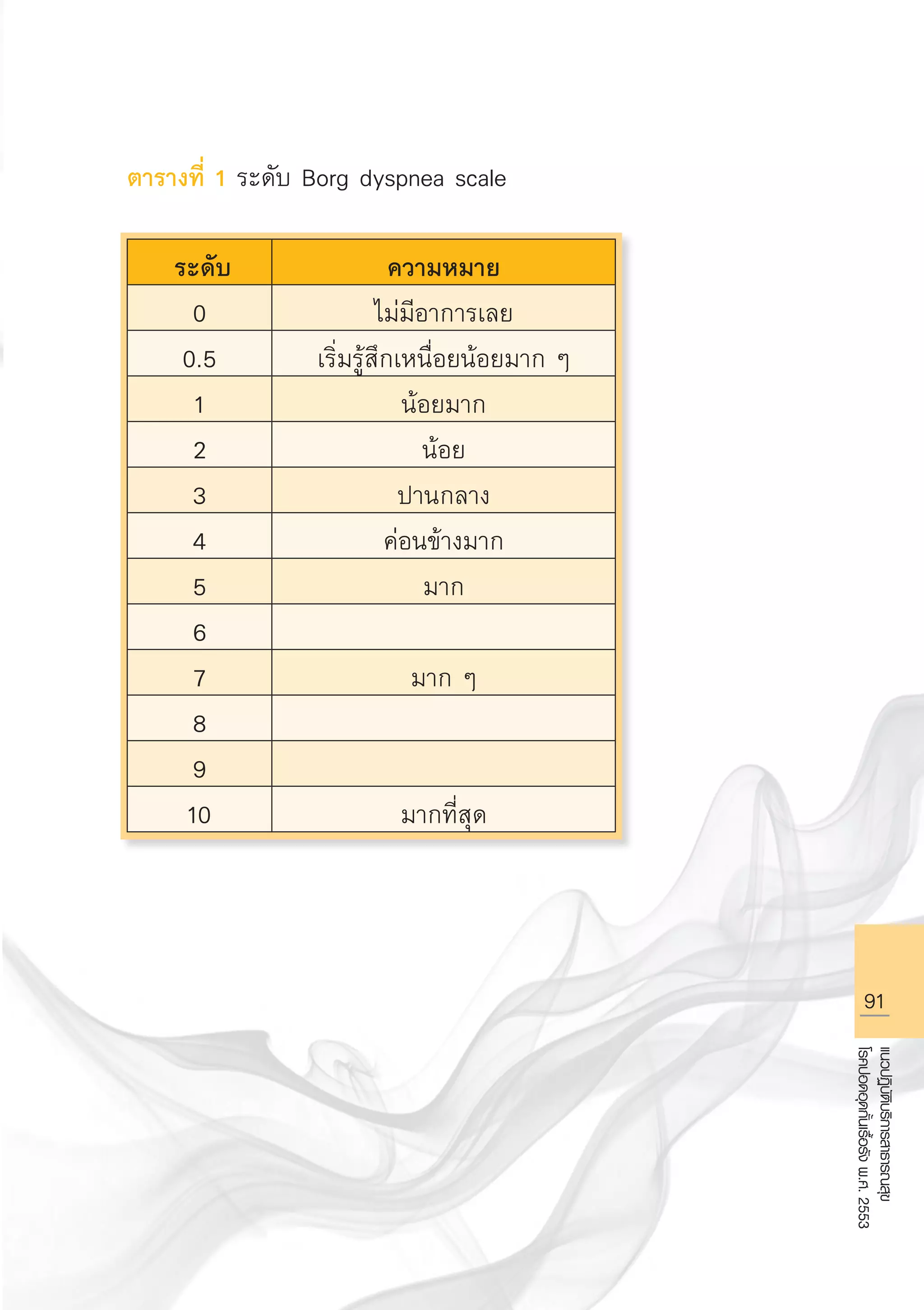
ข. ประเมินความเหนื่อย ก่อนและหลังการออกกำลังกาย
โดยใช้ Borg scale (BDI, TDI)
ค. ประเมินคุณภาพชีวิต
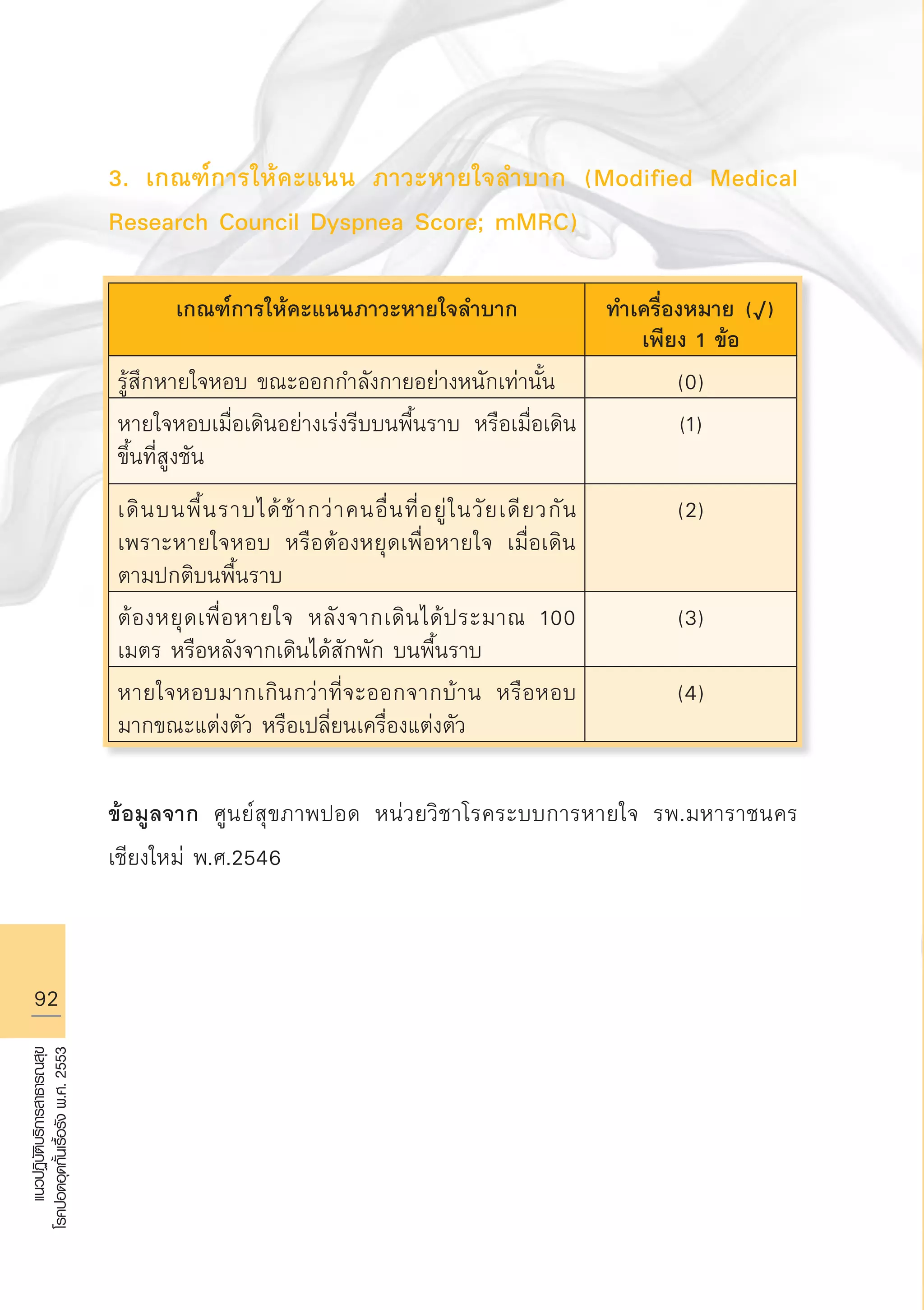
โดยใช้ Modified Medical Research Council (MMRC)
หรือ St. George Respiratory Questionnaires (SGRQ)
การประเมินย่อยอื่น ๆ เช่น อัตราการกำเริบของโรค อัตราการ
นอนโรงพยาบาล หรือค่าใช้จ่ายในการรักษาโรค ล้วนช่วยเสริมให้เห็น
ประโยชน์ของการฟื้นฟูสมรรถภาพปอดมากขึ้น
3.6 การประเมินด้านโภชนาการ (Nutritional assessment)
ผู้ป่วย COPD ที่มีน้ำหนักน้อย มีความสัมพันธ์กับอัตราตายที่สูง
ขึ้น ควรประเมินภาวะโภชนาการของผู้ป่วย เช่น วัดน้ำหนักตัว, ค่า
Body Mass Index (BMI) ปริมาณไขมัน มวลกล้ามเนื้อ ก่อนการพื้นฟู
สมรรถภาพ ควรให้การแนะนำด้านโภชนาการควบคู่กับการออกกำลัง
กายเพื่อปรับสมดุลย์ของน้ำหนักตัวและภาวะโภชนาการให้อยู่ในเกณฑ์
ใกล้เคียงปกติมากที่สุด
AW HSPG 1 C.indd 73 10/26/10 7:37:16 PM
84.
74
แนวปฏิบัติบริการสาธารณสุข
โรคปอดอุดกั้นเรื้อรังพ.ศ.2553
เอกสารอ้างอิง
1. AmericanThoracic Society Statement. Pulmonary rehabilitation-
1999. Am J Respir Crit Care Med 1999; 159:1666-82.
2. Troosters T, Casaburi R, Gosselink R, et al. Pulmonary
rehabilitation in chronic obstructive pulmonary disease–State of
the art. Am J Respir Crit Care Med 2005; 172:19–38.
3. Kiatboonsri S, Vorakitvat K, Vongvivat K, et al. Effect of Tai Chi
Qigong exercise. Training in stable COPD patients. ERS Meeting
Abstracts 2006 28: 3186a.
4. Kiatboonsri S., Amornputtisathaporn N, Siriket S, et al. Tai Chi
Qigong exercise training in COPD. Chest Meeting Abstracts 2007
132: 535a.
5. วีซีดีการออกกำลังกายชุด “การออกกำลังกายฟื้นฟูสมรรถภาพปอด ไทชิ
ชี่กง” (Tai Chi Qigong exercise-based pulmonary rehabilitation)
2009 โดย ศาสตราจารย์แพทย์หญิง สุมาลี เกียรติบุญศรี หน่วยโรค
ระบบการหายใจและเวชบำบัดวิกฤต ภาควิชาอายุรศาสตร์ โรงพยาบาล
รามาธิบดี
6. Chaicharn Pothirat, Kingkaew Somrit, Nittaya Petchsuke, et al.
Suandok intensive exercise training program for COPD patients: A
short and long term efficacy analysis.(บทคัดย่อ)หนังสือประกอบการ
ประชุมสามัญประจำปี สมาคมอุรเวชช์แห่งประเทศไทย ปี 2549.
Collaborations in Pulmonary Medicine.โรงแรมอิมพีเรียลภูแก้ว
จ. เพชรบูรณ์, 18-20 มกราคม 2549 หน้า 104.
7. Chaicharn Pothirat, Nittaya Petsuk, Warawut Chaiwong. Efficacy
of Modified Suandok Exercise Training(MSET) program applied for
Advanced COPD patients in community-based hospital.(บทคัดย่อ)
AW HSPG 1 C.indd 74 10/26/10 7:37:24 PM