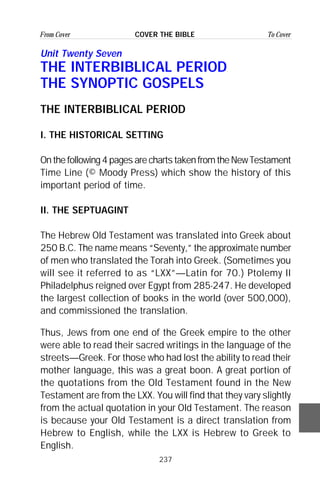
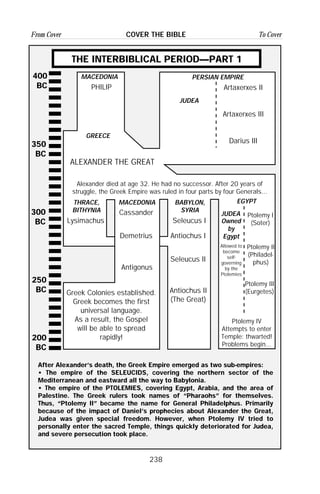
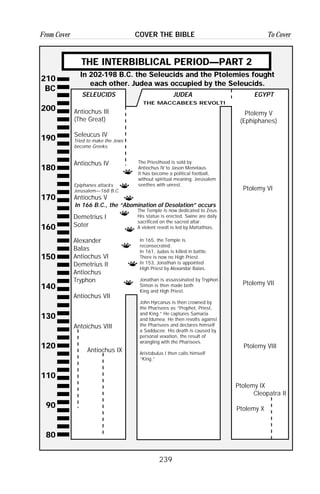
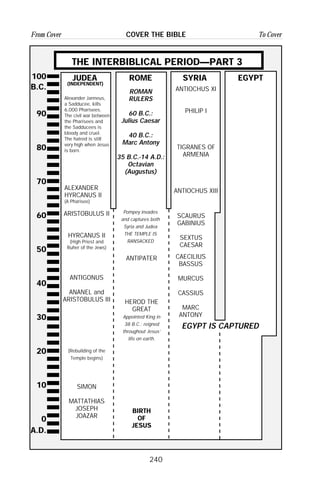
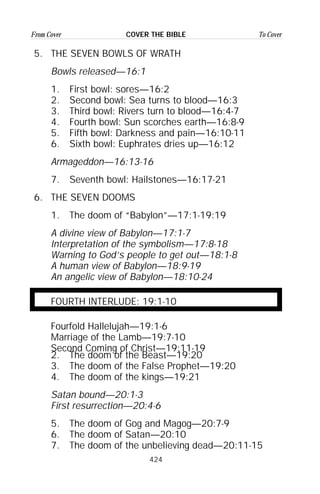
COVER
THE
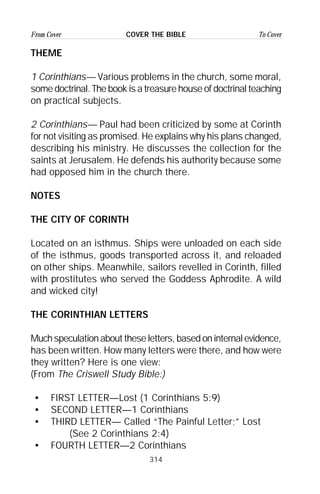
BIBLE
Dr. Ralph W. Neighbour, Jr.
COVER THE BIBLE - Fourth Revision
Published by Touch Outreach Ministries, Inc.
P. O. Box 19888
Houston, TX 77224, USA
Copyright © 1986, 1989, 1991, 1999 by Ralph W. Neighbour, Jr.
ACKNOWLEDGEMENT
Special thanks to Joe Wilson, Natalie Goodhart,
Jan Matthews, Barbara Littlefield,
Joey and Bill Beckham, and Johnson Lim
for their hours spent in proof reading
this book.
This book is dedicated to
D. Dean Rhoads
The closest earthly friend I have ever had.
For twenty years, perhaps longer, I have helped new Christians
learn about the Bible. Many hundreds have told me that they
profitedmostfrommyministrythroughsittingundertheteaching
of this course.
I write these materials with the earnest prayer that a lifetime
of study and preparation might help both those who are not
yet believers, and those who are, to know more about this
inspired book, the Bible.
For a very long time, I kept folders on each book in the Bible.
Each time COVER THE BIBLE was taught, I added a few
notes to each folder. As a result, I confess there is no way
I can give credit to all the books, sermons, conversations,
and student suggestions which are included in these
pages.
Thus, some material has been unconsciously “plagiarized”
without proper credit being given. If writers recognize their
material and notify me, I shall be glad to include credits in
later editions. And, if they are like me, they will probably just
smile and thank the Lord that their thoughts were valuable
enough that someone else felt they should be shared.
It’s my deep desire that, at the end of this course, you will
have penned marginal notes throughout your Bible, including
suggested comments included at the close of each Unit.
This year of study could change not only your life, but also
your eternity. Know you are prayed for as you study each
unit! I welcome response from you. As my Chinese brothers
say when temporarily parting, Tsai Tsien, Tsai Tsien!
PREFACE
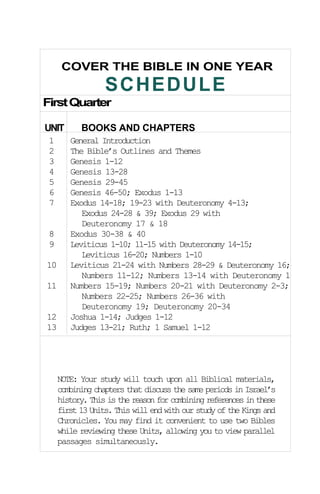
UNIT BOOKS AND CHAPTERS
1 General Introduction
2 The Bible’s Outlines and Themes
3 Genesis 1-12
4 Genesis 13-28
5 Genesis 29-45
6 Genesis 46-50; Exodus 1-13
7 Exodus 14-18; 19-23 with Deuteronomy 4-13;
Exodus 24-28 & 39; Exodus 29 with
Deuteronomy 17 & 18
8 Exodus 30-38 & 40
9 Leviticus 1-10; 11-15 with Deuteronomy 14-15;
Leviticus 16-20; Numbers 1-10
10 Leviticus 21-24 with Numbers 28-29 & Deuteronomy 16;
Numbers 11-12; Numbers 13-14 with Deuteronomy 1
11 Numbers 15-19; Numbers 20-21 with Deuteronomy 2-3;
Numbers 22-25; Numbers 26-36 with
Deuteronomy 19; Deuteronomy 20-34
12 Joshua 1-14; Judges 1-12
13 Judges 13-21; Ruth; 1 Samuel 1-12
NOTE: Your study will touch upon all Biblical materials,
combining chapters that discuss the same periods in Israel’s
history. This is the reason for combining references in these
first 13 Units. This will end with our study of the Kings and
Chronicles. You may find it convenient to use two Bibles
while reviewing these Units, allowing you to view parallel
passages simultaneously.
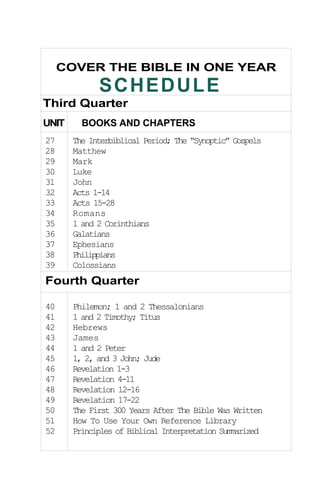
COVER THE BIBLE IN ONE YEAR
SCHEDULE
FirstQuarter
UNIT BOOKS AND CHAPTERS
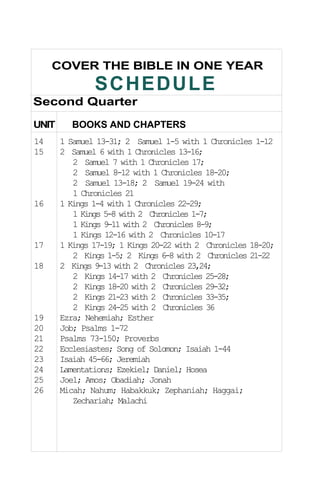
14 1 Samuel 13-31; 2 Samuel 1-5 with 1 Chronicles 1-12
15 2 Samuel 6 with 1 Chronicles 13-16;
2 Samuel 7 with 1 Chronicles 17;
2 Samuel 8-12 with 1 Chronicles 18-20;
2 Samuel 13-18; 2 Samuel 19-24 with
1 Chronicles 21
16 1 Kings 1-4 with 1 Chronicles 22-29;
1 Kings 5-8 with 2 Chronicles 1-7;
1 Kings 9-11 with 2 Chronicles 8-9;
1 Kings 12-16 with 2 Chronicles 10-17
17 1 Kings 17-19; 1 Kings 20-22 with 2 Chronicles 18-20;
2 Kings 1-5; 2 Kings 6-8 with 2 Chronicles 21-22
18 2 Kings 9-13 with 2 Chronicles 23,24;
2 Kings 14-17 with 2 Chronicles 25-28;
2 Kings 18-20 with 2 Chronicles 29-32;
2 Kings 21-23 with 2 Chronicles 33-35;
2 Kings 24-25 with 2 Chronicles 36
19 Ezra; Nehemiah; Esther
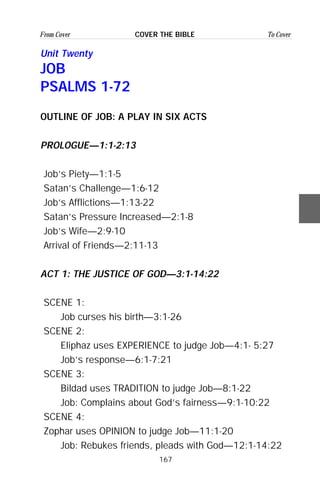
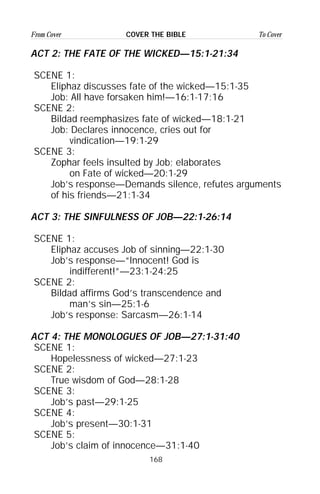
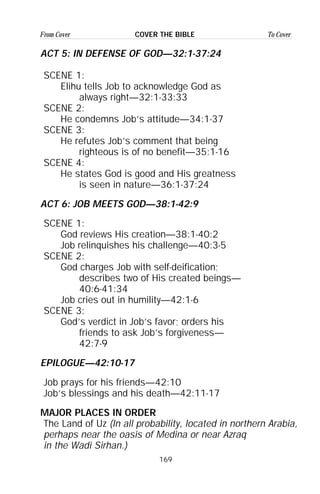
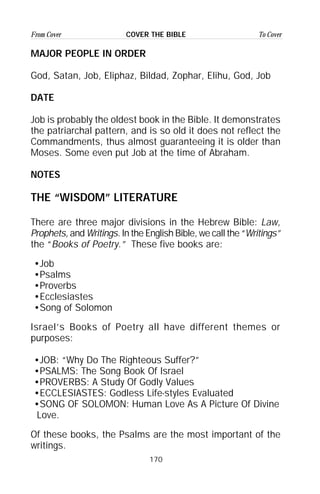
20 Job; Psalms 1-72
21 Psalms 73-150; Proverbs
22 Ecclesiastes; Song of Solomon; Isaiah 1-44
23 Isaiah 45-66; Jeremiah
24 Lamentations; Ezekiel; Daniel; Hosea
25 Joel; Amos; Obadiah; Jonah
26 Micah; Nahum; Habakkuk; Zephaniah; Haggai;
Zechariah; Malachi
COVER THE BIBLE IN ONE YEAR
SCHEDULE
Second Quarter
UNIT BOOKS AND CHAPTERS
27 The Interbiblical Period; The “Synoptic” Gospels
28 Matthew
29 Mark
30 Luke
31 John
32 Acts 1-14
33 Acts 15-28
34 Romans
35 1 and 2 Corinthians
36 Galatians
37 Ephesians
38 Philippians
39 Colossians
40 Philemon; 1 and 2 Thessalonians
41 1 and 2 Timothy; Titus
42 Hebrews
43 James
44 1 and 2 Peter
45 1, 2, and 3 John; Jude
46 Revelation 1-3
47 Revelation 4-11
48 Revelation 12-16
49 Revelation 17-22
50 The First 300 Years After The Bible Was Written
51 How To Use Your Own Reference Library
52 Principles of Biblical Interpretation Summarized
COVER THE BIBLE IN ONE YEAR
SCHEDULE
Third Quarter
Fourth Quarter
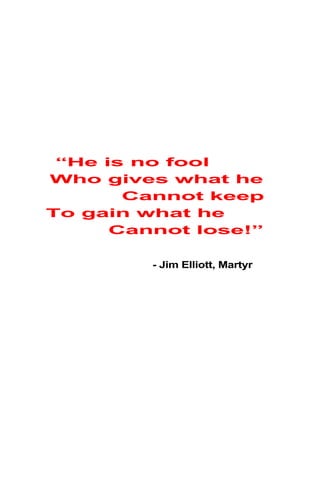
“He is no fool
Who gives what he
Cannot keep
To gain what he
Cannot lose!”
- Jim Elliott, Martyr
1
From Cover To CoverCOVER THE BIBLE
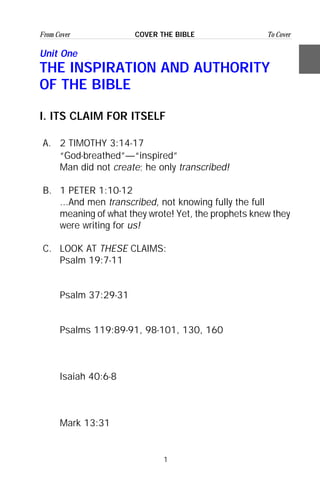
Unit One
THE INSPIRATION AND AUTHORITY
OF THE BIBLE
I. ITS CLAIM FOR ITSELF
A. 2 TIMOTHY 3:14-17
“God-breathed”—“inspired”
Man did not create; he only transcribed!
B. 1 PETER 1:10-12
...And men transcribed, not knowing fully the full
meaning of what they wrote! Yet, the prophets knew they
were writing for us!
C. LOOK AT THESE CLAIMS:
Psalm 19:7-11
Psalm 37:29-31
Psalms 119:89-91, 98-101, 130, 160
Isaiah 40:6-8
Mark 13:31
2
From Cover To CoverCOVER THE BIBLE
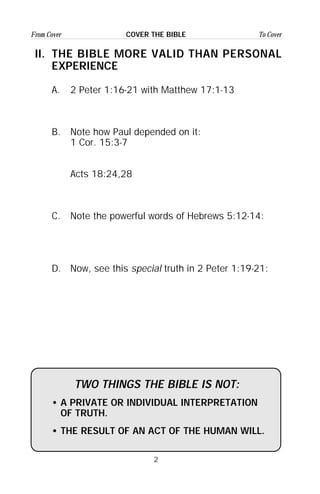
II. THE BIBLE MORE VALID THAN PERSONAL
EXPERIENCE
A. 2 Peter 1:16-21 with Matthew 17:1-13
B. Note how Paul depended on it:
1 Cor. 15:3-7
Acts 18:24,28
C. Note the powerful words of Hebrews 5:12-14:
D. Now, see this special truth in 2 Peter 1:19-21:
TWO THINGS THE BIBLE IS NOT:
• A PRIVATE OR INDIVIDUAL INTERPRETATION
OF TRUTH.
• THE RESULT OF AN ACT OF THE HUMAN WILL.
3
From Cover To CoverCOVER THE BIBLE
III. NOTE ITS AMAZING PROPHECIES:
A. Micah 5:2 with Matthew 2:1-6—Bethlehem predicted
as His birthplace...
B. Isaiah 53:5, 7, 9—description of death on the cross
prior to the use of crosses...
C. COMPARE THIS WITH:
John 19:34—soldiers pierced Jesus...
John 20:27—Thomas saw the wounds...
John 19:1-2—Jesus beaten, crown of thorns...
Matthew 27:14—He did not respond...
Matthew 27:38—crucified between two robbers...
Matthew 27:57-60—body of Jesus in tomb with stone
over entrance...
John 19:4—Pilate said there was no charge against
Jesus...
4
From Cover To CoverCOVER THE BIBLE
IV. CONSIDER JESUS’ PREDICTION
OF THE FUTURE:
A. John 14:2-3:
(CAN YOU COUNT ON IT?)
B. Matthew 25:31:
V. CONCLUSION
The Bible is not just inspired in parts; it’s a fully
“God-breathed” volume! It’s a perfect book, a treasury
of truth. Not one part of it—as we shall see during this
course—is without meaning and value!
Therefore, as you read it during these next months, be
certain of this fact: the very passage you decide to be
irrelevant is hiding a special truth for your blind eyes!
5
From Cover To CoverCOVER THE BIBLE
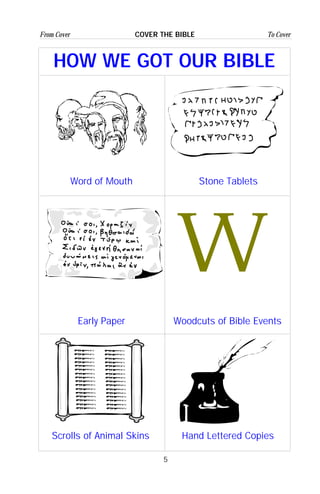
HOW WE GOT OUR BIBLE
Early Paper Woodcuts of Bible Events
Scrolls of Animal Skins Hand Lettered Copies
Word of Mouth Stone Tablets
W
6
From Cover To CoverCOVER THE BIBLE
With the coming of the printing press in 1517, a new era in
Bible knowledge began. The printed word of God was translated
into many languages.
But translations of the scriptures began much earlier! Let’s
look at some of them...
THE SEPTUAGINT—Third to First Century B. C.
The Old Testament was translated from Hebrew to
Greek—for Jews who could not read their native language
any more.
LATIN VULGATE—About 400 A. D.
The work of Jerome; for centuries, the major Bible used
by the Roman Catholic church.
WYCLIFFE BIBLE—1383
TYNDALE NEW TESTAMENT—1526
COVERDALE BIBLE—1535
THE GREAT BIBLE—1539
GENEVA BIBLE—1560
RHEIMS NEW TESTAMENT—1582
DOUAY OLD TESTAMENT—1610
KING JAMES VERSION—1611
ENGLISH REVISED VERSION—1881-1885
7
From Cover To CoverCOVER THE BIBLE
AMERICAN STANDARD VERSION—1901
MOFFATT BIBLE—1913-1924
SMITH-GOODSPEED TRANSLATION—1923-1927
REVISED STANDARD VERSION—1946-1952
PHILLIPS NEW TESTAMENT—1958
BERKELEY VERSION—1959
NEW ENGLISH BIBLE—1951-1970
TODAY’S ENGLISH VERSION NEW TESTAMENT—1966
THE LIVING BIBLE—1971
NEW AMERICAN STANDARD VERSION—1974
NEW KING JAMES VERSION—1979
NEW INTERNATIONAL VERSION—1979
Note the periods of history when Bible translations were being
produced. Over and over, the need for a modern translation
which could be clearly understood by the people caused new
versions to be prepared.
Literally hundreds of early manuscripts, not yet discovered
at the time the King James Version was translated, have been
used by translators of more recent versions. Thus, modern
versions like the New International Version are quite
dependable.
8
From Cover To CoverCOVER THE BIBLE
2
Suggestions for
marking
your Bible...
Each Unit will end with a page like this one.
It will suggest verses you might wish to underline in your
own Bible. It will also provide brief notations for you to write
in the margins of your Bible.
Taking the few moments to do this will make your Bible
a very special study book. You will get much more from the
course if you will do so!
THIS UNIT...
Underline some or all of the verses you have studied which
reveal your Bible is inspired by the Holy Spirit.
A WORD ABOUT UNDERLINING...
If you have a fine Bible with very thin paper, be careful to
select a pen which will not bleed through the paper. Often,
humidity will cause this to take place over a period of
months—even though at the time you mark your Bible it
seemed to be all right.
Best way is with India ink and a pen used by draftsmen.
There are also special Bible marking pens, available at
many Christian book stores. Colored pencils are also
satisfactory, as are a limited number of the “highlighters”on
the market. Test your pen on a back page of your Bible before
using it. (India ink is impossible to remove if pen leaks in
your pocket! Beware of airplanes...pressure in cabin makes
it leak.)
9
From Cover To CoverCOVER THE BIBLE
Unit Two
THE BIBLE’S OUTLINES AND THEMES
I. ITS BOOKS
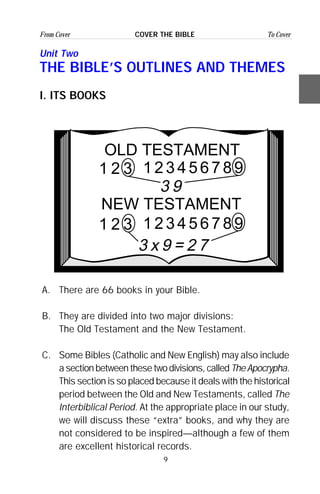
OLD TESTAMENT
NEW TESTAMENT
1 2 3 123456789
3 x 9 = 2 7
3 9
1 2 3 123456789
A. There are 66 books in your Bible.
B. They are divided into two major divisions:
The Old Testament and the New Testament.
C. Some Bibles (Catholic and New English) may also include
asectionbetweenthesetwodivisions,called TheApocrypha.
This section is so placed because it deals with the historical
period between the Old and New Testaments, called The
Interbiblical Period. At the appropriate place in our study,
we will discuss these “extra” books, and why they are
not considered to be inspired—although a few of them
are excellent historical records.
10
From Cover To CoverCOVER THE BIBLE
II. THE “STORY LINE”OF THE BIBLE
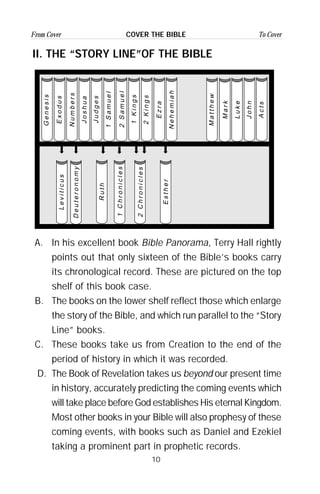
Genesis
Exodus
Numbers
Joshua
Judges
1Samuel
2Samuel
1Kings
2Kings
Ezra
Nehemiah
Mark
Luke
John
Acts
Leviticus
Deuteronomy
Ruth
1Chronicles
2Chronicles
Esther
Matthew
A. In his excellent book Bible Panorama, Terry Hall rightly
points out that only sixteen of the Bible’s books carry
its chronological record. These are pictured on the top
shelf of this book case.
B. The books on the lower shelf reflect those which enlarge
the story of the Bible, and which run parallel to the “Story
Line” books.
C. These books take us from Creation to the end of the
period of history in which it was recorded.
D. The Book of Revelation takes us beyond our present time
in history, accurately predicting the coming events which
will take place before God establishes His eternal Kingdom.
Most other books in your Bible will also prophesy of these
coming events, with books such as Daniel and Ezekiel
taking a prominent part in prophetic records.
11
From Cover To CoverCOVER THE BIBLE
Note: The “Major” prophets are so called for only one
reason—their size! They are not more “important” than the
Minor Prophets. In ancient days, scrolls were shaped from
animal skins. To accommodate the size of these leather rolls,
the smaller writings were gathered to comprise one scroll.
Thus, the “Minor” Prophets were collected by their size—not
by their importance, or even by the dates of writing. Thus,
you will want to treat them with the same respect as the larger
documents.
III. THE OLD TESTAMENT BY SECTIONS
A. THE BOOKS OF THE LAW
(Also called The Books of Moses; The Pentateuch)
Genesis, Exodus, Leviticus, Numbers, Deuteronomy
B. THE BOOKS OF HISTORY
Joshua, Judges, Ruth, 1 and 2 Samuel,
1 and 2 Chronicles, 1 and 2 Kings,
Ezra, Nehemiah, and Esther
C. THE BOOKS OF POETRY (Jewish style)
Job, Psalms, Proverbs,
Song of Solomon, Ecclesiastes
D. MAJOR PROPHETS
Isaiah, Jeremiah, Ezekiel, Daniel
E. MINOR PROPHETS
All the rest of the Old Testament
12
From Cover To CoverCOVER THE BIBLE
IV. THE NEW TESTAMENT BY SECTIONS
A. THE SYNOPTIC GOSPELS
1. “Synoptic”—same root as the word “synopsis.” These
Gospels tell the chronological history of the life of
Jesus.
2. Matthew, Mark, Luke (Mark is the earliest one)
B. THE FOURTH GOSPEL
1. “Fourth”—A simple way of separating it from the
Synoptics, since it is the fourth Gospel.
2. John
C. HISTORY OF THE CHURCH
Acts
D. PAUL’S LETTERS
Romans, 1 and 2 Corinthians, Galatians, Ephesians,
Philippians, Colossians, 1 and 2 Thessalonians, 1 and
2 Timothy, Titus, Philemon
(Note: Luther is responsible for putting them in this order.
He put Romans first because of his regard for the
book.)
E. HEBREWS
Placed here because the authorship is in question. Did
Paul write it, or did one of the other apostles? So placed,
it could be the last of Paul’s letters, or the first of the
General Epistles, a collection of letters written by men
other than Paul.
F. GENERAL EPISTLES
James, 1 and 2 Peter, 1,2,3 John, Jude
G. THE REVELATION OF JESUS CHRIST
13
From Cover To CoverCOVER THE BIBLE
V. THE BIBLE’S THEMES
A. MAN’S FALLEN CONDITION
1. Two lines extend from Adam’s children
2. The “God Seekers”—grace is provided
3. The “God Rejecters”—no provision for them!
B. GOD’S PLAN OF REDEMPTION
1. Jesus Christ—“No man comes to the Father except
by me.”
2. He is not only the Savior of the world, but also the
King of the Jews.
C. ISRAEL, A CHOSEN PEOPLE
1. A nation with a spiritual purpose!
2. They are called to witness to the nations about Jehovah,
the only true God.
3. They become a disobedient people, scattered among
the nations in judgment.
4. Nevertheless, God’s covenants with them are to
be fulfilled, and they will become a witness to the
nations!
5. KEY PERSONS:
Abraham, the father of the nations
Moses, the deliverer of God’s people
Joshua, the conqueror of the Land
David, the beloved King
Prophets, the spokesmen of God
14
From Cover To CoverCOVER THE BIBLE
D. THE CHURCH, A CHOSEN WITNESS
1. After the default of Israel, God created a witness
to carry the message of His love to the nations of
the world: Jesus Christ, His Son.
2. His presence on earth was first felt as He lived in a
a body miraculously created in a virgin, Mary.
3. He came to the Jews, offering Himself as their King.
They rejected Him, finally crucifying Him.
4. They did not know that His death would be the only
connecting link between all men and Himself.
5. After His death, He arose, lived 40 more days on the
earth, and then ascended into the clouds as his
followers watched in amazement.
6. Ten days later His Holy Spirit returned. First,
He occupied the lives of 120 persons. Quickly, as
these 120 shared what had happened to them,
thousands of others said, “We want Him to live in
us, too!” As they invited Him to do so by repenting
of a self-owned life, accepting His death as their
connecting link to God, He also came to live in
them!
7. All those people who have been occupied by the
Spirit of Christ make up His present Body on earth
today. These people are called “The Church, the
Body of Christ.”
8. The expression of His Body on earth arelocal churches.
It is not possible to be a practicing Christian and
develop as God intended unless you are a part of
a local Body of Christ. If you do not understand why,
take a moment to read 1 Corinthians 12.
15
From Cover To CoverCOVER THE BIBLE
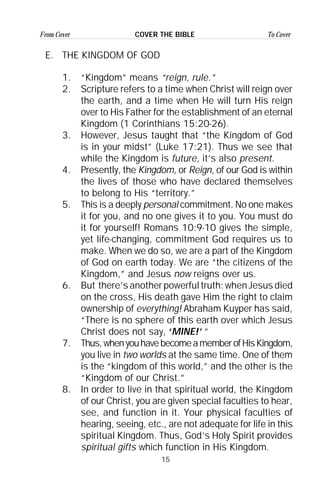
E. THE KINGDOM OF GOD
1. “Kingdom” means “reign, rule.”
2. Scripture refers to a time when Christ will reign over
the earth, and a time when He will turn His reign
over to His Father for the establishment of an eternal
Kingdom (1 Corinthians 15:20-26).
3. However, Jesus taught that “the Kingdom of God
is in your midst” (Luke 17:21). Thus we see that
while the Kingdom is future, it’s also present.
4. Presently, the Kingdom, or Reign, of our God is within
the lives of those who have declared themselves
to belong to His “territory.”
5. This is a deeply personal commitment. No one makes
it for you, and no one gives it to you. You must do
it for yourself! Romans 10:9-10 gives the simple,
yet life-changing, commitment God requires us to
make. When we do so, we are a part of the Kingdom
of God on earth today. We are “the citizens of the
Kingdom,” and Jesus now reigns over us.
6. But there’s another powerful truth: when Jesus died
on the cross, His death gave Him the right to claim
ownership of everything! Abraham Kuyper has said,
“There is no sphere of this earth over which Jesus
Christ does not say, ‘MINE!’ ”
7. Thus,whenyouhavebecomeamemberofHisKingdom,
you live in two worlds at the same time. One of them
is the “kingdom of this world,” and the other is the
“Kingdom of our Christ.”
8. In order to live in that spiritual world, the Kingdom
of our Christ, you are given special faculties to hear,
see, and function in it. Your physical faculties of
hearing, seeing, etc., are not adequate for life in this
spiritual Kingdom. Thus, God’s Holy Spirit provides
spiritual gifts which function in His Kingdom.
16
From Cover To CoverCOVER THE BIBLE
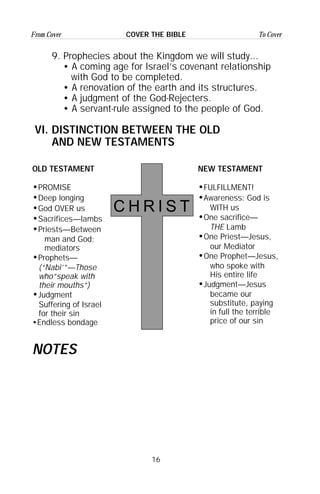
OLD TESTAMENT
•PROMISE
•Deep longing
•God OVER us
•Sacrifices—lambs
•Priests—Between
man and God;
mediators
•Prophets—
(“Nabi’”—Those
who“speak with
their mouths”)
•Judgment
Suffering of Israel
for their sin
•Endless bondage
C H R I S T
NEW TESTAMENT
•FULFILLMENT!
•Awareness: God is
WITH us
•One sacrifice—
THE Lamb
•One Priest—Jesus,
our Mediator
•One Prophet—Jesus,
who spoke with
His entire life
•Judgment—Jesus
became our
substitute, paying
in full the terrible
price of our sin
NOTES
9. Prophecies about the Kingdom we will study...
• A coming age for Israel’s covenant relationship
with God to be completed.
• A renovation of the earth and its structures.
• A judgment of the God-Rejecters.
• A servant-rule assigned to the people of God.
VI. DISTINCTION BETWEEN THE OLD
AND NEW TESTAMENTS
17
From Cover To CoverCOVER THE BIBLE
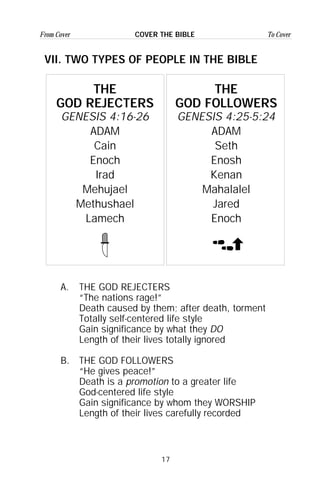
VII. TWO TYPES OF PEOPLE IN THE BIBLE
A. THE GOD REJECTERS
“The nations rage!”
Death caused by them; after death, torment
Totally self-centered life style
Gain significance by what they DO
Length of their lives totally ignored
B. THE GOD FOLLOWERS
“He gives peace!”
Death is a promotion to a greater life
God-centered life style
Gain significance by whom they WORSHIP
Length of their lives carefully recorded
THE
GOD REJECTERS
GENESIS 4:16-26
ADAM
Cain
Enoch
Irad
Mehujael
Methushael
Lamech
THE
GOD FOLLOWERS
GENESIS 4:25-5:24
ADAM
Seth
Enosh
Kenan
Mahalalel
Jared
Enoch
18
From Cover To CoverCOVER THE BIBLE
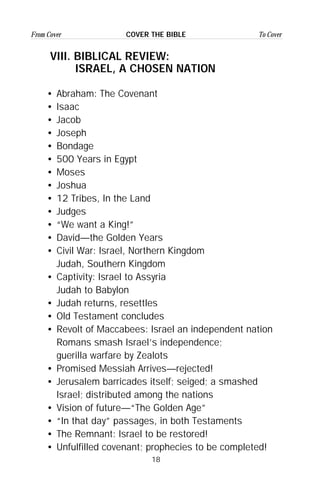
VIII. BIBLICAL REVIEW:
ISRAEL, A CHOSEN NATION
• Abraham: The Covenant
• Isaac
• Jacob
• Joseph
• Bondage
• 500 Years in Egypt
• Moses
• Joshua
• 12 Tribes, In the Land
• Judges
• “We want a King!”
• David—the Golden Years
• Civil War: Israel, Northern Kingdom
Judah, Southern Kingdom
• Captivity: Israel to Assyria
Judah to Babylon
• Judah returns, resettles
• Old Testament concludes
• Revolt of Maccabees: Israel an independent nation
Romans smash Israel’s independence;
guerilla warfare by Zealots
• Promised Messiah Arrives—rejected!
• Jerusalem barricades itself; seiged; a smashed
Israel; distributed among the nations
• Vision of future—“The Golden Age”
• “In that day” passages, in both Testaments
• The Remnant: Israel to be restored!
• Unfulfilled covenant; prophecies to be completed!
19
From Cover To CoverCOVER THE BIBLE
IX. BIBLICAL REVIEW:
THE CHURCH, A CHOSEN WITNESS
• Jesus, fully God, becomes fully Man
• He offers Himself as King to Israel; rejected
• Offers Himself as King of Kings to all the nations
• Began His life by living inside Israel’s culture
• Chooses 12 Jews to be His disciples
• Spends 3 years revealing truth
• Describes “the church” to His disciples
Church = Ecclesia (Greek), “Called Out Ones”
The Church is the “second” Body of Christ!
• Jesus’ atonement on the cross (“At-one-ment”)
• His resurrection
• His ascension
• His entrance into His new Body
• His continued activity among men through His Body
• The spread of His Body and His activity from Jews to
all the nations of the earth
• The Church is a “grafted limb” into the Tree of
Israel, but in no way replaces Israel!
• The Future: His personal return in His resurrected
Body, establishing His Kingdom
• He completes His work in His 1,000 year reign as
King of Kings and Lord of Lords
• The Church reigns with Christ: those who were
faithful over much, or little, serve accordingly
• Through Jesus, the Jews enter the “Golden Age”
• The covenant promises of God are fulfilled to His
chosen People
• The Kingdom of Our Christ Becomes The Kingdom
Of Our God
• Total renovation of all things
• Eternal Kingdom of God: “And He shall reign
forever and ever!”
20
From Cover To CoverCOVER THE BIBLE
2
Suggestions for
marking
your Bible...
1. On the Title Pages of the 16 “Story Line” Books, write
A STORY LINE BOOK.
2. On the Table of Contents page in the front of your Bible,
write the information about the sections of the Old and
New Testament books in the margin:
EXAMPLE:
Genesis................
Exodus..................
Leviticus................
Numbers................
Deuteronomy..........
3. Mark the secondary books of history, (see page 10) by
writing at the head of these books:
Leviticus................
Deuteronomy..........
Ruth......................
4. Mark the columns of your Bible with the notes about
Genesis 4:16-5:24. Underline the names of the seven
men in each category.
5. Find and mark some “In that day...” passages in Amos
8:11 and 13, and Micah 4:6-8.
6. Read and underline significant verses in John 1 which
speak of Jesus as (1) God; (2) Messiah; (3) Savior of
non-Jews.
“The Law”
Also called...
“The
Pentateuch”
“The Books”
Connects to Numbers
and Joshua
Parallels Judges
Connects to Exodus
and Numbers
21
From Cover To CoverCOVER THE BIBLE
Unit Three
THE BOOK OF GENESIS
INTRODUCTION
CHAPTERS 1-12
AUTHOR: Moses
THEME: “The Book of Beginnings”
OUTLINE:
(Look for the phrase, “These are the generations of...”)
Introduction: The Story of Creation—1:1-2:3
Generations of the Heavens and the Earth—2:4-4:26
Generations of Adam—5:1-6:8
Generations of Noah—6:9-9:29
Generations of the Sons of Noah—10:1-11:9
Generations of Shem—11:10-26
Generations of Terah—11:27-25:11
Generations of Ishmael—25:12-18
Generations of Isaac—25:19-35:29
Generations of Esau—36:1-37:1
Generations of Jacob—37:2-50:26
MAJOR PLACES IN ORDER (Genesis 1-12):
Earth, Eden, Ararat, Babel, Ur of Chaldea, Haran of
Mesopotamia, Canaan, Egypt
MAJOR PEOPLE IN ORDER:
Adam, Eve, Abel, Seth, Noah, Ham, Shem, Japheth,
Abraham, Sarah
AMOUNT OF TIME COVERED:
At least 2,000 years
22
From Cover To CoverCOVER THE BIBLE
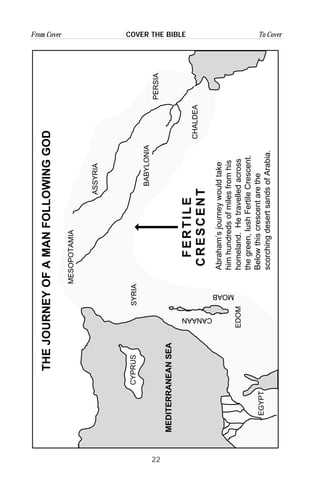
CYPRUS
EGYPT
BABYLONIA
ASSYRIA
MESOPOTAMIA
PERSIA
CHALDEA
SYRIA
EDOM
CANAAN
MOAB
FERTILE
CRESCENT
Abraham’sjourneywouldtake
himhundredsofmilesfromhis
homeland.Hetravelledacross
thegreen,lushFertileCrescent.
Belowthiscrescentarethe
scorchingdesertsandsofArabia.
MEDITERRANEANSEA
THEJOURNEYOFAMANFOLLOWINGGOD
23
From Cover To CoverCOVER THE BIBLE
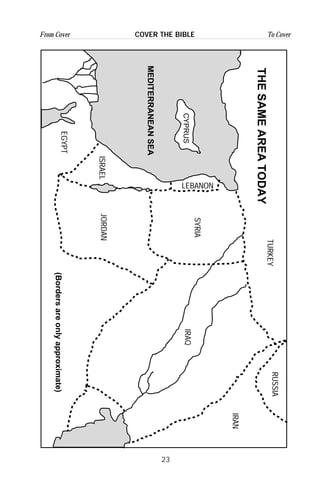
CYPRUS
MEDITERRANEANSEA
THESAMEAREATODAY
ISRAELJORDAN
LEBANON
SYRIA
IRAQ
IRAN
RUSSIA
TURKEY
EGYPT
(Bordersareonlyapproximate)
24
From Cover To CoverCOVER THE BIBLE
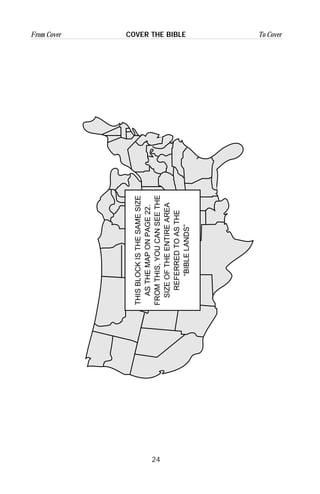
THISBLOCKISTHESAMESIZE
ASTHEMAPONPAGE22.
FROMTHIS,YOUCANSEETHE
SIZEOFTHEENTIREAREA
REFERREDTOASTHE
“BIBLELANDS”
25
From Cover To CoverCOVER THE BIBLE
THE LAW OF RECURRENCE
As Author of the Scriptures, the Holy Spirit will use this law
over and over, especially in the Prophets:
• THE OUTLINES OF A SUBJECT ARE GIVEN
• THE OUTLINE IS REPEATED;
NEW DETAILS ARE ADDED
EXAMPLE:
GENESIS 1: The account of creation is given in outline
GENESIS 2: The same account repeated, details added:
2:7: The nature of man’s being
2:8-14: The location where man was placed
2:15-17: The moral test laid on man
2:18-25: The help-mate provided for him
MAJOROUTLINE
A.
B.
C.
D.
E.
F.
F. EXPANDED
DETAILS
1.
2.
3.
4.
Watchfor
“TheLawof
Recurrence”
asyoustudy
theBible
26
From Cover To CoverCOVER THE BIBLE
THE WORD OUTLINE FOR THIS SECTION:
USE THIS OUTLINE TO TAKE NOTES...
• CREATION (1 and 2)
• FALL (3)
• DELUGE (5—9)
• NATIONS (10 and 11)
• ABRAHAM (12)
27
From Cover To CoverCOVER THE BIBLE
How to apply the word of God to your own life...
THE FACTS PRINCIPLE
1. Rehearse the story. Get the details in mind.
2. What do these facts suggest?
• About the character of the person?
• About the nature of the person?
3. How do you identify that person’s character and nature
with your own?
4. How can you learn from this person’s good trait, or squarely
challenge that person’s bad trait which exists in your
own life?
EXAMPLE
CHAPTER 12: THE STORY OF ABRAHAM
FACTS OF THE STORY. . .
• God led Abram
• Abram obeyed
• Lot went along
• Abram worshipped
• Egypt
• Passed off Sarai as sister
• Sarai
• Abram expelled from
Egypt
•God leads men
•Obedience is the result of
faith
•Abram’s insecurity;
against God’s directions!
•Developed relationship
with Jehovah
•Left Promised Land; an
act of unbelief
•Compromised, wanted
personal safety; unbelief
•Obeyed her husband
(amazing!)
•Humiliation, the result of
disobedience
28
From Cover To CoverCOVER THE BIBLE
WHAT ARE MY PERSONAL CONCLUSIONS?
1. Every good thing is the result of faith.
2. Every bad feature in a man is the result of unbelief.
3. God always leads! How do I hear His voice?
4. Those living with a person acting in unbelief will
be hurt by it.
5. What a wierd mixture of faith and unbelief in this man!
I, too, am such a mixture!
6. How can I squarely face my unbelief and do
something about it?
7. What can I do to “stick” where God put me, and not
run when my “spiritual famine” comes?
8. How has my own reputation been tarnished by my
faithless behaviour?
MEDITATION
What could Abraham ever again do in Egypt?
Where have I cut myself off from people/areas by my
own behavior?
What is the best way to handle such problems?
Is this part of what Paul meant in Philippians when he wrote,
“forgetting those things which are behind...” ?
(If you don’t forget things which are behind, the memories
could destroy you!)
29
From Cover To CoverCOVER THE BIBLE
(See the next page for instructions about doing this study...)
LEARNING FROM A STUDY OF ADAM...
STUDY GENESIS 2 and 3
FACTS ABOUT ADAM:
• First Man
• Created in God’s own image
• Adam was to have dominion, subdue, replenish, dress,
and keep...
• Eve was created from Adam
• Adam was not aware of sin
• Adam lived in total communion with God
• Adam was provided for...every need met by God; the result
of total communion was total provision
• Adam was tested...and failed
THESE ARE MY PERSONAL CONCLUSIONS...
30
From Cover To CoverCOVER THE BIBLE
1. Copy the 10 divisions of Genesis into your Bible. Underline
the key phrase “These are the generations of...” or its
corresponding paraphrase of that term in your translation.
Then, print in the margin beside the phrase the title of
the Division.
EXAMPLE:
Generations
of Adam
5:1-6:8
2. Write this note about “The Law Of Recurrence” in the
bottom margin of the page where Chapter 2 begins...
“The Law Of Recurrence:”—The outline of a
subjectisgiven;then,theoutlinerecursanddetails
are added. Chapter 2 is an excellent example of
this.
3. In the margin beside Genesis 3:15, write:
The Protevangelium: first promise
of Jesus’ coming in the Bible!
4. Add any other notes from the explanations which you
wrote in your notebook and now wish to preserve in your
Bible.
5. Do a study of ADAM, like the one we did in this lesson
on Abram, using Genesis 2 and 3.
(Use preceding page.)
1 This is the book of...
God created man, He...
2 He created them...
2
Suggestions for
marking
your Bible...
31
From Cover To CoverCOVER THE BIBLE
Unit Four
THE BOOK OF GENESIS
CHAPTERS 13-28
OUTLINE:
Abram renews his worship—13:1-4
Separation from Lot—13:5-14:24
God “cuts a covenant”—15:1-21
Ishmael, the child of faithlessness—16:1-16
The Abrahamic Covenant—17:1-27
The Angel of the Lord and a promised son—18:1-15
Sodom, Lot, and incest—18:16-19:38
Abraham’s weakness recycles—20:1-18
Isaac, Hagar, and Abimilech—21:1-34
Isaac sacrificed—22:1-14
Abrahamic Covenant renewed—22:15-19
Nahor’s Sons—22:20-24
Death of Sarah—23:1-20
Isaac and Rebecca—24:1-67
Abraham’s death—25:1-11
Ishmael’s descendants—25:12-18
Jacob and Esau—25:19-34
Isaac copies his father’s deception—26:1-34
Jacob deceives Esau—27:1-28:9
Abrahamic Covenant renewed with Jacob—28:10-22
MAJOR PLACES IN ORDER (CHAPTERS 13-28)
Bethel—Sodom—Gerar—Beersheba—
Nahor, Mesopotamia—Beerlahairoi—Gerar—Haran
MAJOR PEOPLE IN ORDER
Abraham, Sarah, Isaac, Jacob
32
From Cover To CoverCOVER THE BIBLE
AMOUNT OF TIME COVERED:
About 120 years
THE WORD OUTLINE FOR THIS SECTION:
ABRAHAM—13-20
ISAAC—21-28
THE HISTORY OF ABRAHAM IN OUTLINE FORM:
His call and move to Canaan—12:1-9
His life in Egypt—12:10-20
His separation from Lot—13-14
His Covenant with God—15
His relationship with Hagar—16
His circumcision as a sign of the Covenant—17
His intercession for Sodom—18
His life at Gerar—20
His blessing in the birth of Isaac—21
His sacrifice of Isaac—22
His choice of a bride for Isaac—24
His child by Keturah—25
His death—25
Note: The missionary heart of God is revealed in this section
of scripture. Abraham longs to fully follow Jehovah, longs to
be in deeper fellowship with Him. Would we not expect God
would send him to a quiet beach, or a lovely mountain retreat
where communion would be uninterrupted? Oh, no! His Lord
sends His servant to a land inhabited by the vilest tribes
imaginable! Human sacrifices, sexual perversion, and cruelty
were their way of life. God says to us as well, “Go where the
need is great!”
33
From Cover To CoverCOVER THE BIBLE
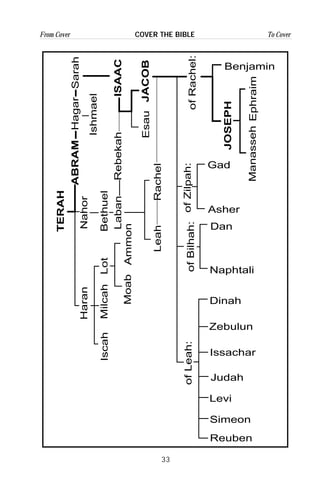
TERAH
ABRAM
ISAAC
JACOB
JOSEPH
Haran
IscahMilcahLot
MoabAmmon
Nahor
Bethuel
LabanRebekah
Hagar
Ishmael
Sarah
Esau
LeahRachel
ofRachel:ofLeah:ofBilhah:ofZilpah:
Benjamin
ManassehEphraim
Gad
Asher
Dan
Naphtali
Dinah
Zebulun
Issachar
Judah
Levi
Simeon
Reuben
34
From Cover To CoverCOVER THE BIBLE
THE “BLESS AND TEST” PRINCIPLE
Abraham’s life is a classic illustration of how God works with
us. First, He BLESSES. Next, He stretches us by TESTING.
If we pass that test, He BLESSES again. If we fail it, we are
TAUGHT SOME MORE, then TESTED again.
EXAMPLES:
• TEST: Will Abraham leave His homeland? PASSES
• TEST: Will he leave ALL his relatives? FAILS
• BLESSED: GIVEN THE LAND
• TEST: Will he trust during the famine? FAILS
• TEST: Will he trust God for his safety? FAILS
• RETURNS, WORSHIPS GOD. CYCLE STARTS AGAIN...
• TEST: Will he give up Lot? PASSES
• BLESSED: GIVEN ALL THE LAND HE CAN SEE
• TEST: Will he believe God for a son? FAILS
• ETC., ETC. ...
A basic principle of God’s working within lives of the “God
Followers” is “BLESS AND TEST.” It is unknown by the “God
Rejecters!” God honors our faith by blessing us. At the same
time, He does not take away our freedom! When we choose
a non-faith path, He lets His natural laws operate, causing
us to learn the consequences of faithlessness for our-
selves—the hard way!
Abraham learned a definition of faith:
FAITH IS BELIEVING IT’S SO
WHEN IT’S NOT SO
BECAUSE YOU KNOW
GOD’S GOING TO MAKE IT SO!
35
From Cover To CoverCOVER THE BIBLE
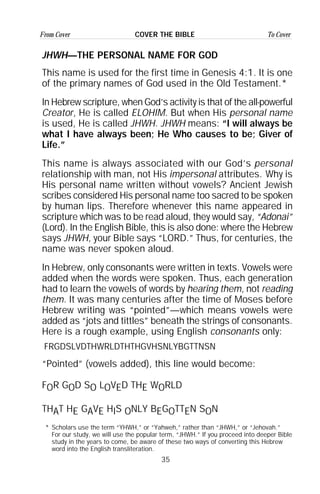
JHWH—THE PERSONAL NAME FOR GOD
This name is used for the first time in Genesis 4:1. It is one
of the primary names of God used in the Old Testament.*
In Hebrew scripture, when God’s activity is that of the all-powerful
Creator, He is called ELOHIM. But when His personal name
is used, He is called JHWH. JHWH means: “I will always be
what I have always been; He Who causes to be; Giver of
Life.”
This name is always associated with our God’s personal
relationship with man, not His impersonal attributes. Why is
His personal name written without vowels? Ancient Jewish
scribes considered His personal name too sacred to be spoken
by human lips. Therefore whenever this name appeared in
scripture which was to be read aloud, they would say, “Adonai”
(Lord). In the English Bible, this is also done: where the Hebrew
says JHWH, your Bible says “LORD.” Thus, for centuries, the
name was never spoken aloud.
In Hebrew, only consonants were written in texts. Vowels were
added when the words were spoken. Thus, each generation
had to learn the vowels of words by hearing them, not reading
them. It was many centuries after the time of Moses before
Hebrew writing was “pointed”—which means vowels were
added as “jots and tittles” beneath the strings of consonants.
Here is a rough example, using English consonants only:
FRGDSLVDTHWRLDTHTHGVHSNLYBGTTNSN
“Pointed” (vowels added), this line would become:
FOR GOD SO LOVED THE WORLD
THAT HE GAVE HIS ONLY BEGOTTEN SON
* Scholars use the term “YHWH,” or “Yahweh,” rather than “JHWH,” or “Jehovah.”
For our study, we will use the popular term, “JHWH.” If you proceed into deeper Bible
study in the years to come, be aware of these two ways of converting this Hebrew
word into the English transliteration.
36
From Cover To CoverCOVER THE BIBLE
Here are the possible vowel inserts for JHWH:
Jehovah Jahveh Jahoveh
Usually, we say, “Jehovah.”
When, in your Bible, you find phrases similar to these:
“and the LORD said...”
“and the LORD caused...”
...the word Adonai, LORD, is being used as a substitute for
JHWH (sometimes spelled, JHVH). Consider the nature of
God as being very personal in all these passages.
Where ELOHIM (a plural noun) appears in the Hebrew text,
the word “GOD” (all in capital letters) is used in our English
bible. In these references, the emphasis is upon His power
as a Creator, rather than upon His deep and personal relationship
with men expressed by JHWH.
Many adjectives are added to JHWH, to further describe His
precious nature. Thus, He will be called:
JHWH-JIREH: Jehovah will see or provide or heal
(Genesis 22:14)
JHWH-NISSI: Jehovah is my banner (Exodus 17:15-16)
JHWH-SHALOM: Jehovah is my peace (Judges 6:23-24)
JHWH-SHAMMAH: Jehovah is coming again (Ezekiel 48:35)
JHWH-TSIDKENU: Jehovah is my righteousness
(Jeremiah 23:6)
JHWH-ROPHE: Jehovah is my healer
37
From Cover To CoverCOVER THE BIBLE
“THE ANGEL OF THE LORD” IN THE BIBLE
In Genesis 16:7, 21:17-18, etc., we are introduced to a very
important phrase: “The Angel of the Lord.” A careful study
of the term reveals it to be God Himself, in bodily form, relating
personally to men. This is called a THEOPHANY.
Carefully study 16:9-13:
v. 10: Only God could make such a statement!
v. 11-12: Only God could make such a forecast!
v. 13: The “Angel of the Lord” was identified by Hagar
as God Himself.
In Genesis 18, we again see God in human form, as one of
“three men” (verses 2, 13, 14, 33).
In Genesis 22:11 and 15, the “Angel of the Lord” calls to
Abraham from heaven.
See also Genesis 31:11, 13; Exodus 3:2,4;
Joshua 5:13-15 and 6:2;
Zechariah 1:10-13 and 3:1-2
In Exodus 32:34 and 33:14, along with Isaiah 63:9, the presence
of the Angel of Jehovah is equivalent to Jehovah’s presence.
The Angel of the Lord thus appears as a manifestation of Jehovah
Himself!
Perhaps this will help you understand more clearly all Jesus
meant when He said, “Before Abraham was, I AM” (in Hebrew,
the letters for the word JHWH).
Some Bible scholars thus consider The Angel of JHWH to
be none other than the pre-incarnate Christ, who is the “Word”
described as being “in the beginning” (John 1:1).
38
From Cover To CoverCOVER THE BIBLE
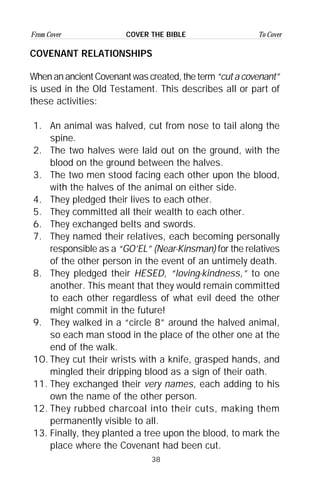
COVENANT RELATIONSHIPS
WhenanancientCovenantwascreated,theterm“cutacovenant”
is used in the Old Testament. This describes all or part of
these activities:
1. An animal was halved, cut from nose to tail along the
spine.
2. The two halves were laid out on the ground, with the
blood on the ground between the halves.
3. The two men stood facing each other upon the blood,
with the halves of the animal on either side.
4. They pledged their lives to each other.
5. They committed all their wealth to each other.
6. They exchanged belts and swords.
7. They named their relatives, each becoming personally
responsible as a “GO’EL” (Near-Kinsman) for the relatives
of the other person in the event of an untimely death.
8. They pledged their HESED, “loving-kindness,” to one
another. This meant that they would remain committed
to each other regardless of what evil deed the other
might commit in the future!
9. They walked in a “circle 8” around the halved animal,
so each man stood in the place of the other one at the
end of the walk.
1O. They cut their wrists with a knife, grasped hands, and
mingled their dripping blood as a sign of their oath.
11. They exchanged their very names, each adding to his
own the name of the other person.
12. They rubbed charcoal into their cuts, making them
permanently visible to all.
13. Finally, they planted a tree upon the blood, to mark the
place where the Covenant had been cut.
39
From Cover To CoverCOVER THE BIBLE
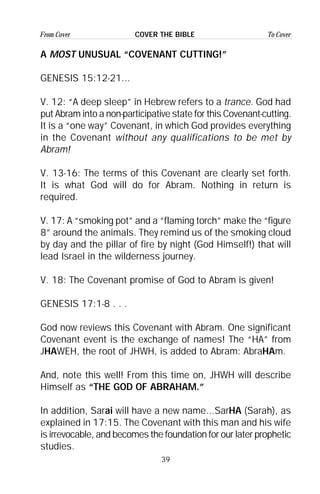
A MOST UNUSUAL “COVENANT CUTTING!”
GENESIS 15:12-21...
V. 12: “A deep sleep” in Hebrew refers to a trance. God had
put Abram into a non-participative state for this Covenant-cutting.
It is a “one way” Covenant, in which God provides everything
in the Covenant without any qualifications to be met by
Abram!
V. 13-16: The terms of this Covenant are clearly set forth.
It is what God will do for Abram. Nothing in return is
required.
V. 17: A “smoking pot” and a “flaming torch” make the “figure
8” around the animals. They remind us of the smoking cloud
by day and the pillar of fire by night (God Himself!) that will
lead Israel in the wilderness journey.
V. 18: The Covenant promise of God to Abram is given!
GENESIS 17:1-8 . . .
God now reviews this Covenant with Abram. One significant
Covenant event is the exchange of names! The “HA” from
JHAWEH, the root of JHWH, is added to Abram: AbraHAm.
And, note this well! From this time on, JHWH will describe
Himself as “THE GOD OF ABRAHAM.”
In addition, Sarai will have a new name...SarHA (Sarah), as
explained in 17:15. The Covenant with this man and his wife
is irrevocable, and becomes the foundation for our later prophetic
studies.
40
From Cover To CoverCOVER THE BIBLE
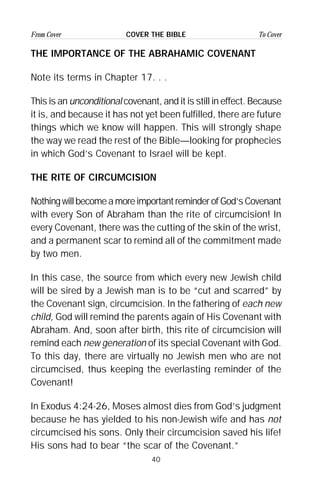
THE IMPORTANCE OF THE ABRAHAMIC COVENANT
Note its terms in Chapter 17. . .
This is an unconditional covenant, and it is still in effect. Because
it is, and because it has not yet been fulfilled, there are future
things which we know will happen. This will strongly shape
the way we read the rest of the Bible—looking for prophecies
in which God’s Covenant to Israel will be kept.
THE RITE OF CIRCUMCISION
NothingwillbecomeamoreimportantreminderofGod’sCovenant
with every Son of Abraham than the rite of circumcision! In
every Covenant, there was the cutting of the skin of the wrist,
and a permanent scar to remind all of the commitment made
by two men.
In this case, the source from which every new Jewish child
will be sired by a Jewish man is to be “cut and scarred” by
the Covenant sign, circumcision. In the fathering of each new
child, God will remind the parents again of His Covenant with
Abraham. And, soon after birth, this rite of circumcision will
remind each new generation of its special Covenant with God.
To this day, there are virtually no Jewish men who are not
circumcised, thus keeping the everlasting reminder of the
Covenant!
In Exodus 4:24-26, Moses almost dies from God’s judgment
because he has yielded to his non-Jewish wife and has not
circumcised his sons. Only their circumcision saved his life!
His sons had to bear “the scar of the Covenant.”
41
From Cover To CoverCOVER THE BIBLE
2
Suggestions for
marking
your Bible...
1. Copy the outline for this Unit into your Bible.
2. Write beside Genesis 16:7:
First use of JHWH as the personal name for
God.
3. In the margin beside Genesis 16:7, write:
First use of “The Angel of JHWH”
4. Add any notes from the explanations about Covenants
which you now wish to preserve in your Bible.
5. Do a study of LOT, like the one we did on Abram, using
Genesis 13 and 14.
(See the next page for the outline for this study...)
42
From Cover To CoverCOVER THE BIBLE
(See the previous page for instructions about doing this study...)
LEARNING FROM A STUDY OF LOT...
Study GENESIS 13 and 14:
FACTS ABOUT LOT:
THESE ARE MY PERSONAL CONCLUSIONS:
43
From Cover To CoverCOVER THE BIBLE
Unit Five
THE BOOK OF GENESIS
CHAPTERS 29-45
OUTLINE:
Jacob’s years at Haran—29:1-31:10
Parenthesis—The call back to Bethel—31:11-13
The flight of Jacob—31:14-55
Jacob becomes Israel—32
Jacob meets Esau—33:1-17
Jacob’s worship in self-will—33:18-20
Jacob reaps the harvest of his evil years—34
Jacob’s return to Bethel—35:1-15
Death of Rachel, birth of Benjamin—35:16-26
Death of Isaac—35:27-29
The generations of Esau—36
Joseph, the beloved of his father—37:1-7
Joseph sold into slavery—37:8-36
Parenthesis—The shame of Judah—38
Joseph’s character tested—39-40
The dream of Pharaoh—41:1-13
Joseph exalted in Egypt—41:14-57
Joseph faces his brothers—42-44
Joseph reveals himself—45
MAJOR PLACES IN ORDER (Genesis 29-45):
Haran of Mesopotamia, Canaan, Egypt
MAJOR PEOPLE IN ORDER:
Jacob, Joseph, Judah
AMOUNT OF TIME COVERED:
About 80 years
44
From Cover To CoverCOVER THE BIBLE
THE WORD OUTLINE FOR OUR SECTION:
Jacob, 29-36
Joseph, 37-45
THE HISTORY OF JACOB:
Birth—25
Purchase of the birthright—25
Deception of his father—27
Flight to Haran—28
Marriage and prosperity—29,30
Return to Canaan—31-35
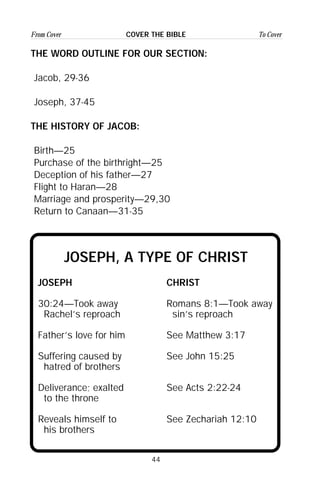
JOSEPH, A TYPE OF CHRIST
JOSEPH CHRIST
30:24—Took away Romans 8:1—Took away
Rachel’s reproach sin’s reproach
Father’s love for him See Matthew 3:17
Suffering caused by See John 15:25
hatred of brothers
Deliverance; exalted See Acts 2:22-24
to the throne
Reveals himself to See Zechariah 12:10
his brothers
45
From Cover To CoverCOVER THE BIBLE
ELECTION IN THE BIBLE: 1 PETER 1:2
Esau and Jacob a classic illustration of Election
• Jacob: election unto salvation
• Esau: election unto condemnation
“Chosen according to the foreknowledge of God the
Father...”
The word to Rebekah was a prophecy. Its purpose was to create
long-term faith within these parents, which would carry them
through the heartaches caused by their own wrongdoings and
those of their children. They had the assurance that right and
truth would prevail in the end.
Note: Because God foreknows, it does not mean He is the
cause of what He knows! If you see a child run into the street,
and foreknow a speeding car will hit the child, you have not
caused the child to be hurt.
“...by the sanctifying work of the Spirit...”
God, knowing those whose hearts are bent toward Him in the
line of the “God-Followers,” sanctifies, or sets apart, these
special people. Even when a person has not yet made the
free choice to follow God and live righteously, God knows that
time will come, and responds to that life accordingly.
46
From Cover To CoverCOVER THE BIBLE
ELECTION, CONTINUED
“...that you may obey Jesus Christ and be sprinkled with His
blood...”
Obedience resulted from faith on Jacob’s part. God’s response
was to honor his obedience by providing redemption through
the blood of Jesus Christ.
HERE IS AN ANSWER TO A THORNY QUESTION!
How were the people of the Old Testament “saved,” since
they lived before the coming of Christ and before His atoning
death on the cross? Was there a different way of faith for them?
No!
Luke 18:7: “Shall not God bring about justice for His elect,
who cry to Him day and night...?”
Ephesians 1:4-7: “Just as He chose us in Him before the
foundation of the world, that we should be holy and blameless
before Him. In love He predestined us to adoption as sons
through Jesus Christ to Himself, according to the kind intention
of His will, to the praise of the glory of His grace, which He
freely bestowed on us in the Beloved. In Him we have redemption
through His blood, the forgiveness of our trespasses, according
to the riches of His grace...”
The giving of salvation came to every Old Testament person
in exactly the same way it comes to us: through faith in the
Redeemer, promised to mankind in Genesis 3:16!
47
From Cover To CoverCOVER THE BIBLE
ELECTION, CONTINUED
Those God knew would seek His face (called in this study the
“God-Followers”) were “elected” unto salvation. Those God
knew would use their freedom of choice to reject His fellowship
were “elected” unto condemnation. The important thing to
remember is that each person is free to make the choice.
God, knowing the future, acts upon His knowledge of what
that choice will be, long before it has been made.
WHAT IS GOD’S CHOICE FOR EVERY MAN?
Exactly the same for all: “He was not willing that any should
perish, but that all should come to salvation.” God no more
damns some people to hell and capriciously chooses others
for heaven, than a judge in a courtroom condemns some to
be hung and others to be set free! Your free choice causes
the consequences you will face.
37:35—SHEOL
This is the first use of this term, used 65 times in the Old
Testament. It is described as the place of the departed spirits.
It is often spoken of as simply the grave, where all activities
cease.
Without revelation from God, the natural man sees the grave
as the end of everything (see Ecclesiastes 9:5, 10). In
Ecclesiastes, this is the case. Beware of the cults (Mormonism,
Christian Science, Jehovah’s Witnesses) which take passages
like this one and try to prove the Bible teaches there is no
life after death for the unbeliever!
48
From Cover To CoverCOVER THE BIBLE
SHEOL, CONTINUED
Scripture reveals SHEOL as a place of sorrow (2 Samuel 22:6,
Psalm 18:5, 116:3), into which the wicked are sent (Psalm
9:17), and where they are fully conscious (Isaiah 14:9-17).
The SHEOL of the Old Testament and the HADES of the New
Testament (Luke 16:23) are identical.
NOTES FROM LECTURE:
49
From Cover To CoverCOVER THE BIBLE
2
Suggestions for
marking
your Bible...
1. Copy the outline into your Bible.
2. Write beside Genesis 37:35:
First Use of Sheol
3. Add any notes about Election or Sheol, which you want
to keep, in the margins of your Bible.
4. Add any other notes from the explanations which you
wish to preserve in your Bible.
5. Complete the Study of Jacob on the following page, using
the helps for personal study you have been given in the
course.
50
From Cover To CoverCOVER THE BIBLE
LEARNING FROM A STUDY OF JACOB...
GENESIS 29—33
FACTS ABOUT JACOB:
THESE ARE MY PERSONAL CONCLUSIONS:
51
From Cover To CoverCOVER THE BIBLE
Unit Six
THE BOOK OF GENESIS
CHAPTERS 46-50
THE BOOK OF EXODUS
CHAPTERS 1-13
Genesis 46-50:
OUTLINE:
Jacob’s journeys to Egypt: 46
Jacob and his descendants exalted: 47:1-26
The last days of Jacob: 47:27-50:14
The fear of Joseph’s brothers: 50:15-21
The last days and death of Joseph: 50:22-26
MAJOR PLACES IN ORDER (Genesis 46-50):
Egypt, Mamre in Canaan
MAJOR PEOPLE IN ORDER:
Jacob and Joseph
AMOUNT OF TIME COVERED:
17 years
NOTES:
52
From Cover To CoverCOVER THE BIBLE
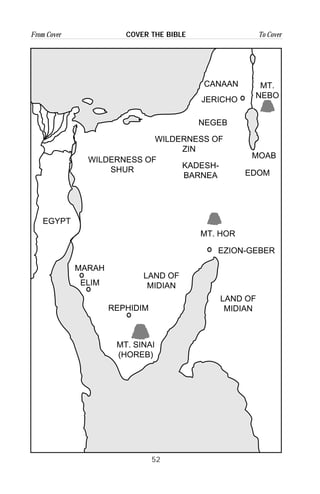
WILDERNESS OF
SHUR
EGYPT
MARAH
ELIM
REPHIDIM
MT. SINAI
(HOREB)
LAND OF
MIDIAN
LAND OF
MIDIAN
EZION-GEBER
MT. HOR
MT.
NEBO
MOAB
EDOM
KADESH-
BARNEA
WILDERNESS OF
ZIN
NEGEB
CANAAN
JERICHO
53
From Cover To CoverCOVER THE BIBLE
Exodus 1-13
OUTLINE:
Israel in Egypt—1
The coming of Moses—2
The call of Moses—3, 4:1-18
The return of Moses to Egypt—4:19-31
The contest with Pharaoh, part 1—5:1-23
Jehovah answers Moses’ prayer—6:1-13
The families of Israel—6:14-27
The renewed commissions—6:28-7:13
The contest with Pharaoh, part 2—7:14-11:10
The Passover—12:1-36
First stage of the Journey—12:37-51
The firstborn set apart for Jehovah—13:1-19
Second stage of the journey—13:20-22
MAJOR PLACES IN ORDER (Exodus 1-13):
Egypt, Midian, Egypt
MAJOR PEOPLE IN ORDER:
Moses, Pharaoh
AMOUNT OF TIME COVERED:
215 Years
THE WORD OUTLINE FOR OUR SECTION:
MOSES, 1-6
CONTEST WITH PHARAOH, 7-13
54
From Cover To CoverCOVER THE BIBLE
A QUICK LOOK AT EXODUS:
Seventy Jewish people entered Egypt.
During 400+ years, they multiplied to about 3 1/2 million.
They were enslaved.
God selected Moses to deliver them.
Pharaoh resisted the request of Moses to free the people.
Ten plagues were required to break his rebellion.
The Passover, crossing of the Red Sea, manna, quail from
heaven, water from rocks, follow.
Wilderness journey takes Israel to Mt. Sinai, where God gave
His law.
It involved 613 commandments,
instructions for building the Tabernacle,
and assignment of priestly duties.
NOTES:
55
From Cover To CoverCOVER THE BIBLE
THE EXCUSES OF MOSES
3:11: Personal inadequacy in light of past.
3:13: Religiousexperienceconsideredinadequate;knowledge
and experience limited.
4:1: Others would reject him as a spiritual man.
Felt his personal testimony would be discounted.
4:10: Did not possess talent equal to the task.
THE DISCLOSURE OF GOD’S NAME
(See earlier notes on JHWH)
Exodus 3:13-14— JHWH: the verb form for “I will be” is identical
to this. The use of the double verb here, “I AM WHO I AM”
means, “I shall continually be that which I have always been;”
or, “I will be all that is necessary as the occasion will
arise.”
Note verse 15: “This is My name forever, and this is My memorial
name to all generations.”
NOTES:
56
From Cover To CoverCOVER THE BIBLE
THE TEN PLAGUES
WATER TURNS TO BLOOD
FROGS
LICE
FLIES
DEATH OF CATTLE
BOILS
HAIL
LOCUSTS
DARKNESS
DEATH OF THE FIRSTBORN
NOTE:
The significance of these plagues is not their uniqueness.
Every single one of these plagues were already known in Egypt.
Their significance is in the fact that God “made the clock speed
up,” compressing the equivalent of years of plagues into just
a few hours.
57
From Cover To CoverCOVER THE BIBLE
In addition, these plagues attacked the areas of sacred beings
and objects worshipped in the religion of Egypt!
The waters of the Nile were most sacred...
Frogs, gnats, and insects were worshipped...
Intricate jewelry was fashioned after them, using gold
and precious stones. (We still have scarab or beetle jewelry
from the Middle East being sold today).
Bulls were worshipped...
so much so that they were mummified! Apis, the Black
Bull, was worshipped in the second largest temple in
Egypt, located in Memphis.
The boils were caused by the soot...
(9:8) taken from kilns where gold was smelted. The soot
caused boils. Gold was also considered a sacred object,
an object of actual worship.
Hail was unknown...
Less than an inch of rain per year fell in Cairo. Judgment
fell upon their fields, their possessions, all that they
cherished!
Locusts were carved in gold on the crown of Pharaoh,
and were actually worshipped.
The Sun was an object of particularly significant worship
in Egypt; it was blotted out!
The Pharaoh was considered a Divine God...
his son, his heir, also Divinity.
58
From Cover To CoverCOVER THE BIBLE
2
Suggestions for
marking
your Bible...
1. Copy the outline into your Bible.
2. Write beside Exodus 3:13:
Means “I shall continually be
that which I have always been.”
3. Add any notes about Moses’ excuses, which you want
to preserve, in the margins of your Bible.
4. Add any other notes from the explanations which you
want to preserve in your Bible.
59
From Cover To CoverCOVER THE BIBLE
Unit Seven
EXODUS 14-18; EXODUS 19-23
with DEUTERONOMY 4-13;
EXODUS 24-28 and 39;
EXODUS 29
with DEUTERONOMY 17 and 18
OUTLINES
Exodus 14-18; 19-23
13:17-15:21—At The Red Sea
15:22-26—At Marah
15:27-16:36—At Elim And The Wilderness Of Sin
17:1-7—At Rephidim
17:8-16—Victory Over Amalek
18:1-27—Visit Of Jethro
19:1-6—The Offer Of A Covenant
19:7-23:33—The Specifications Of The Covenant
Deuteronomy 4-13 (parallels Exodus 19-23)
4:1-40—Pleas For Trust And Obedience
4:41-43—Cities Of Refuge East Of Jordan
4:44-49—Historical Note
5:1-2—Pleas: Concerning Conditions Of Possession
5:3-6:9—Plea: Keep The Law Because Of Promises
6:10-25—Plea: Keep The Law Because Of What The
Future Will Be
7—Plea: Keep The Law Because Of Necessary
Separation From Idolatry
8—Plea: Keep The Law Because Of Trials
9-10—Plea: Keep The Law Because Of The
Intercession Of Moses
11:1-7—Plea: Keep The Law Because Of Deliverance At
Red Sea
60
From Cover To CoverCOVER THE BIBLE
11:8-25—Plea: Keep The Law Because Of Dependence
On Jehovah For Rain
11:26-32— A Blessing And A Curse Set Before Them
12-13—Living As A “Holy People,” Part 1
Exodus 24-29
24:1-11—The Ratification Of The Covenant
24:12-18—Moses Called To The Mount
25:1-27:21—The Tabernacle
28—The Priestly Garments
(see 39: Making the Priestly Garments)
29—The Priestly Installation
Deuteronomy 17 and 18 (parallels Exodus 29)
17—Commands about Kings
18—Maintaining of the Levites
MAJOR PLACES IN ORDER (Exodus 14-29):
Red Sea, Wilderness, Sinai
MAJOR PEOPLE IN ORDER:
Moses, Aaron, Joshua
AMOUNT OF TIME COVERED: 1 Year (?)
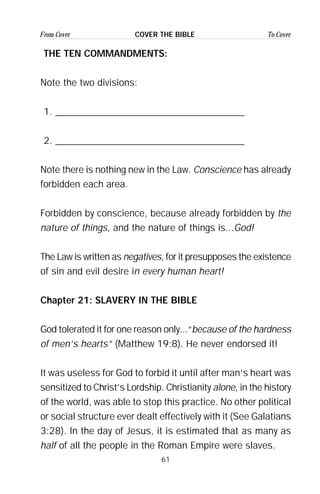
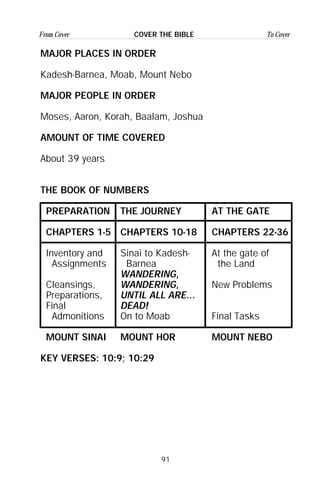
HOLINESS
WORKS,
OBEDIENCE
FAITH,
TRUST
KINGDOM
OF
PRIESTS
ELECTION
PROVISIONS OF THE COVENANT: EXODUS 19:5-6
61
From Cover To CoverCOVER THE BIBLE
THE TEN COMMANDMENTS:
Note the two divisions:
1. _______________________________________
2. _______________________________________
Note there is nothing new in the Law. Conscience has already
forbidden each area.
Forbidden by conscience, because already forbidden by the
nature of things, and the nature of things is...God!
The Law is written as negatives, for it presupposes the existence
of sin and evil desire in every human heart!
Chapter 21: SLAVERY IN THE BIBLE
God tolerated it for one reason only...“because of the hardness
of men’s hearts” (Matthew 19:8). He never endorsed it!
It was useless for God to forbid it until after man’s heart was
sensitized to Christ’s Lordship. Christianity alone, in the history
of the world, was able to stop this practice. No other political
or social structure ever dealt effectively with it (See Galatians
3:28). In the day of Jesus, it is estimated that as many as
half of all the people in the Roman Empire were slaves.
62
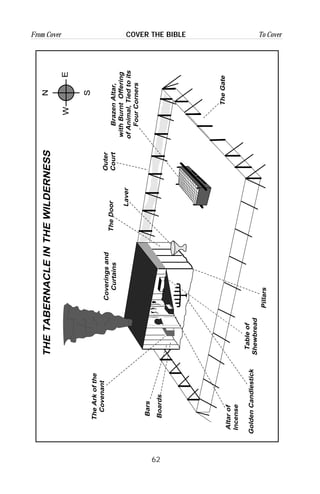
From Cover To CoverCOVER THE BIBLE
THETABERNACLEINTHEWILDERNESSN
S
EW
Bars
Boards
Coveringsand
CurtainsTheDoor
Laver
Outer
CourtBrazenAltar,
withBurntOffering
ofAnimal,Tiedtoits
FourCorners
TheGate
Pillars
Tableof
Shewbread
GoldenCandlestick
Altarof
Incense
TheArkofthe
Covenant
63
From Cover To CoverCOVER THE BIBLE
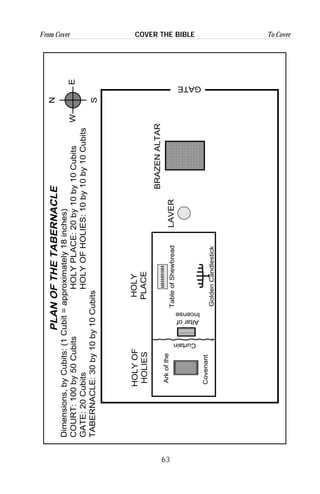
PLANOFTHETABERNACLE
Dimensions,byCubits:(1Cubit=approximately18inches)
COURT:100by50Cubits
GATE:20Cubits
TABERNACLE:30by10by10Cubits
HOLYPLACE:20by10by10Cubits
HOLYOFHOLIES:10by10by10Cubits
N
S
EW
GATE
BRAZENALTAR
LAVER
HOLY
PLACE
HOLYOF
HOLIES
Arkofthe
Covenant
TableofShewbread
GoldenCandlestick
Altarof
Incense
Curtain
64
From Cover To CoverCOVER THE BIBLE
28:1-30:11: THE MEANING OF ATONEMENT
The Priesthood and Service teach the meaning of the atonement
(at-one-ment), or perfect spiritual union.
1. The provision of a covering for sin
2. The privilege of communion with Jehovah
3. The assurance of holiness
65
From Cover To CoverCOVER THE BIBLE
THE TABERNACLE, THE TEMPLE, AND THE SACRIFICES
THE TABERNACLE:
THE TEMPLE OF SOLOMON:
THE TEMPLE, REBUILT AFTER THE CAPTIVITY:
THE TEMPLE, REBUILT BY HEROD:
THE FUTURE TEMPLE IN PROPHECY:
66
From Cover To CoverCOVER THE BIBLE
2
Suggestions for
marking
your Bible...
1. Copy the outline into your Bible.
2. Write beside Exodus 17:14 and 34:27:
Note: proof that Moses is
the author of Pentateuch
3. Write beside Exodus 23:20-33:
Note: The “Angel of JHWH”
is the “Angel of the Covenant:” Christ
is the assurance of the assurances!
4. Add any other notes from the explanations which you
wish to preserve in your Bible.
67
From Cover To CoverCOVER THE BIBLE
Unit Eight
EXODUS 30-38 AND 40
OUTLINE
The Altar of Incense—30:1-10
Atonement for Each Person—30:11-16
The Laver of Bronze—30:17-21
The Anointing Oil and Incense—30:22-38
Appointment of Skilled Workmen—31:1-11
The Sabbath—31:12-18
Forty Days and Nights Without God—32-34
The Tabernacle Instituted—35-38
The Tabernacle Erected—40
MAJOR PLACES IN ORDER (Exodus 30-38 and 40):
Sinai
MAJOR PEOPLE IN ORDER:
Moses, Aaron, Bezalel
AMOUNT OF TIME COVERED:
A few months
68
From Cover To CoverCOVER THE BIBLE
NOTES ON CHAPTER 30:
THE ALTAR OF INCENSE
Symbolical of the place of prayer.
“May my prayer be counted as incense before Thee; The
lifting up of my hands as the evening offering.”
(Psalm 141:2)
THE ATONEMENT MONEY
A special means of reminding each person that he was not
his own. Think of it as you would the leasing of a piece of
land, which has an annual fee required. The word for
“contribution” is literally “heave offering”—an offering freely
given by the giver. It was a way of saying, “I recognize I do
not own my own life!”
THE PLACE OF CLEANSING
The Laver of Bronze—a type of the word of God. See 38:8
for the source of the bronze. It was a mirror-like, reflecting
surface. Unless we wash, our fellowship with God dies! (See
John 13:6-10—“If I wash thee not, thou hast no part with
me.”)
THE ANOINTING OIL AND THE INCENSE
THE OIL—A powerful, oil-based perfume. All objects and
all priests were anointed with it. The fragrance revealed the
object or person was, in a special way, set apart (sanctified)
for the special activity of God among men. Everywhere the
anointed ones went, their special fragrance marked them.
Because of it, Aaron and his sons were prohibited from
sharing in the burial of Nadab and Abihu. One odor—one
use!
69
From Cover To CoverCOVER THE BIBLE
THE INCENSE
Symbolical of prayer. A beautiful study for you! See Psalm
141:2; Luke 1:10-11; Revelation 5:8 and 8:4,5. (Be sure
to underline these verses as you read them and “key” them
with your own marginal reference to “Cf. Exodus
30:22ff.”)
NOTES ON CHAPTER 31:
Where did we get the idea that our skills are self- developed,
or came to us from our parents? Verses 1-11 point out that
GOD has put the skills we possess into our lives, and they
belong to Him. It’s not just a preacher who is “special!”
Bezalel had both natural and spiritual skills for his life’s
work.
THE SABBATH
Man is essentially a spiritual being. He must make time
to be with God. It is a physical, a family, and a national
necessity. The person who secularizes life for weeks at
a time is a fool! Note verse 17: even in eternity the Sabbath
will be kept!
For the Christian, the day changes from a Sabbath Saturday
to Sunday, called “The Lord’s Day,” to make the resurrection
day of our Lord more significant than even the creation of
the earth. However, the special significance of the Sabbath,
taught here, does not change as it moves from Saturday
to Sunday. Note verse 14: was it important to God, or an
“option” to be remembered by those who are not preoccupied
with other things?
70
From Cover To CoverCOVER THE BIBLE
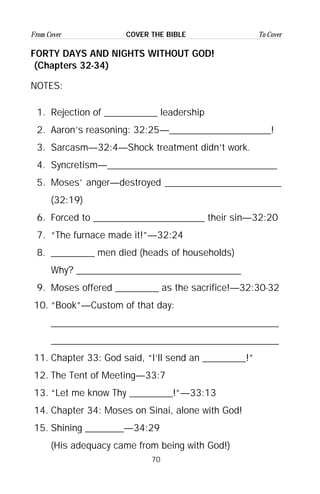
FORTY DAYS AND NIGHTS WITHOUT GOD!
(Chapters 32-34)
NOTES:
1. Rejection of ___________ leadership
2. Aaron’s reasoning: 32:25—_____________________!
3. Sarcasm—32:4—Shock treatment didn’t work.
4. Syncretism—___________________________________
5. Moses’ anger—destroyed ________________________
(32:19)
6. Forced to _______________________ their sin—32:20
7. “The furnace made it!”—32:24
8. _________ men died (heads of households)
Why? __________________________________
9. Moses offered _________ as the sacrifice!—32:30-32
10. “Book”—Custom of that day:
_______________________________________________
_______________________________________________
11. Chapter 33: God said, “I’ll send an _________!”
12. The Tent of Meeting—33:7
13. “Let me know Thy _________!”—33:13
14. Chapter 34: Moses on Sinai, alone with God!
15. Shining ________—34:29
(His adequacy came from being with God!)
71
From Cover To CoverCOVER THE BIBLE
THE INSTITUTION OF THE TABERNACLE
35:5—The “heave” or “wave” offering...
Hebrew is teruma—used when personal possessions are
freely given to God.
Note there was something for everyone to bring, and something
for all to do. Note verse 29—it was a heart relationship
which led them to bring their possessions!
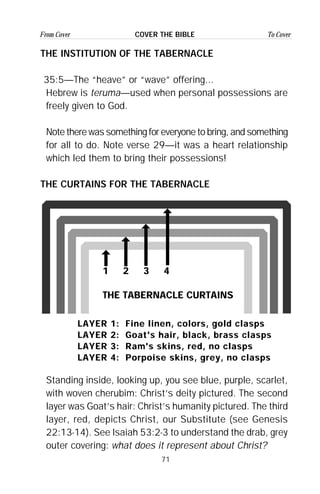
THE CURTAINS FOR THE TABERNACLE
Standing inside, looking up, you see blue, purple, scarlet,
with woven cherubim: Christ’s deity pictured. The second
layer was Goat’s hair: Christ’s humanity pictured. The third
layer, red, depicts Christ, our Substitute (see Genesis
22:13-14). See Isaiah 53:2-3 to understand the drab, grey
outer covering: what does it represent about Christ?
1 2 3 4
THE TABERNACLE CURTAINS
LAYER 1: Fine linen, colors, gold clasps
LAYER 2: Goat's hair, black, brass clasps
LAYER 3: Ram's skins, red, no clasps
LAYER 4: Porpoise skins, grey, no clasps
72
From Cover To CoverCOVER THE BIBLE
THE BOARDS OF THE TABERNACLE
One cubit=about 18 inches
The size of the outer courtyard fencing was about 175 feet
long, 87 1/2 feet wide, and 8 1/3 feet high.
The size of the tabernacle building was about 45 feet long,
18 feet wide, and 18 feet high. All boards were overlaid with
pure gold. All sockets were of pure silver.
THE VEIL
Inside that veil, in the Holy of Holies: one man, alone with
God! That veil was the thickness of a man’s fist...
THE ARK
The precious Mercy Seat: see 1 Samuel 6:19
THE TABLE OF SHEWBREAD
The priests fed on that bread daily.
THE LAMPSTAND
Six=Man; One=God
Pictures the church!
Seven branches, one candlestick: See Matthew 5:14-16
THE ALTAR OF INCENSE
The place of prayer in the life of the believer
THE BRAZEN ALTAR
The sacrificed lamb took away the sin of one man; and each
lamb, without spot or blemish, was a sign of The Lamb of
God, Who would take away the sin of the world! Later, the
writer of Hebrews would make this clear.
73
From Cover To CoverCOVER THE BIBLE
THE SIGNIFICANCE OF THE TABERNACLE . . .
1. This place of worship was manufactured from the items
contributed by the worshipers. They bought nothing; only
what they gave was used for its construction!
2. It was in the center of the camp, not on its edge. Their
worship was the central point of all they did.
3. It was mobile. Wherever they went, their worship was
to remain central to their lifestyle.
4. The way to God always began with a sacrifice for sin.
There was no thought that man had a “spark of goodness”
in him that might make it possible to bypass the brazen
altar.
5. The Laver reminds us that we must be cleansed before
entering into the place of priestly service (1 John 1:9).
6. Trace the fire which is used in the Tabernacle: first, it
is used under the sacrifice. Where does it go from there?
Do you see the significance of this? What does this say
to your heart?
7. The veil—thick as a man’s fist—would one day be ripped
in half, from the top down. This barrier between men
and God would be torn by the Father, and the “middle
wall of partition” separating God and man would be removed.
Do you know when this happened? (Read the last chapters
of the Gospels to find the answer!)
74
From Cover To CoverCOVER THE BIBLE
2
Suggestions for
marking
your Bible...
1. Copy the outline into your Bible.
2. Write beside Exodus 35:5:
NNNNooootttteeee:::: HHHHeeeebbbbrrrreeeewwww TTTTeeeennnnuuuupppphhhhaaaahhhh::::,,,,
uuuusssseeeedddd wwwwhhhheeeennnn ppppeeeerrrrssssoooonnnnaaaallll ppppoooosssssssseeeessssssssiiiioooonnnnssss
aaaarrrreeee ffffrrrreeeeeeeellllyyyy ggggiiiivvvveeeennnn ttttoooo GGGGoooodddd,,,,
nnnnooootttt ffffrrrroooommmm oooobbbblllliiiiggggaaaattttiiiioooonnnn
3. Write beside Exodus 35:20:
NNNNooootttteeee:::: TTTThhhheeeeyyyy wwwweeeennnntttt hhhhoooommmmeeee ttttoooo
rrrreeeemmmmeeeemmmmbbbbeeeerrrr wwwwhhhhaaaatttt GGGGoooodddd hhhhaaaadddd
ddddoooonnnneeee ffffoooorrrr tttthhhheeeemmmm....
4. Add any other notes from the explanations which you
now wish to preserve in your Bible.
75
From Cover To CoverCOVER THE BIBLE
Unit Nine
LEVITICUS 1-10
LEVITICUS 11-15 with
DEUTERONOMY 14-15
LEVITICUS 16-20; NUMBERS 1-10
OUTLINE
Leviticus 1-7—Laws Concerning Sacrifices
1:1-17—Burnt Offering
2:1-16—Meal Offering
3:1-17—Peace Offering
4:1-7:38—Laws Concerning Offerings
Leviticus 8-10—Historical Interlude: The Institution of
the Priesthood
Leviticus 11-15—Laws Concerning Purity and Impurity
(DEUTERONOMY 14 parallels LEVITICUS 11-15)
Deuteronomy 15—The Sabbatic Year
15:1-11—The Remission of Debts
15:12-18—The Bondslave Relationship
15:19-23—Consecration of first-born in the flock
Leviticus 16—The Law for the Day of Atonement
Leviticus 17—The Law for Sacrifice
Leviticus 18:1-19:21—Laws Commanding Holiness and
Non-Conformity with Pagan Practices
Numbers 1-4—The Commands for a Census of the People
Numbers 5-10—The Commands for Purity of the People
5—A Test for Jealousy
6—The Nazirite Vow and the Aaronic Benediction
7—The Offerings of the 12 Leaders
8-9—Levites separated, the Passover observed
10—The Covering Cloud and the Silver Trumpets
76
From Cover To CoverCOVER THE BIBLE
MAJOR PLACES IN ORDER (Exodus 30-38 and 40):
Sinai
MAJOR PEOPLE IN ORDER:
Moses, Aaron, Bezalel
AMOUNT OF TIME COVERED:
A few months, or even weeks
NOTES:
Hebrew title: “And he called...”
(the first Hebrew word of the book).
Leviticus means “The Book of the Priests”
Since we as believers are priests, there are many symbolical
truths waiting for us in the study of this book.
The key to this book is 26:11-12.
AN OVERVIEW OF LEVITICUS
How do we draw near to God?
Drawing near to God, using the sacrifices.
Drawing near to God, using the Priesthood.
Drawing near to God: cleanness demanded.
Day of Atonement provided for each one.
In contrast to the pagan neighbors, the People of
God were to be holy in ALL particulars.
Israel’s choices will bring blessing or curse!
1-7—
8-10—
11-15—
16—
17-25—
26—
27—
77
From Cover To CoverCOVER THE BIBLE
THE SACRIFICES IN LEVITICUS 1-5
These sacrifices are only for those who are in a covenant
relationship with God. They sound “odd” to all others!
Let us approach Leviticus remembering Paul’s words about
the Pentateuch, found in 1 Corinthians 10:11:
“Now these things happened to them as an example, and they were
written for our instruction, upon whom the ends of the ages have
come.”
Note the progression:
BURNT OFFERING
Total sacrifice. Romans 12:1-2.
Surrender of my life to Christ.
MEAL OFFERING
Giving my labors (fruit) to Christ.
PEACE OFFERING
Part to God, part eaten by Priest, part eaten by giver:
fellowship!
SIN OFFERING
For inadvertent sins, not willful! (See 1 John 5:16-17)
TRESPASS OFFERING
I am to restore, adding 20%, to those who have been
trespassed against by me.
78
From Cover To CoverCOVER THE BIBLE
THE CONSECRATION OF A PRIEST
CLEANSING
GIRDING
CONSECRATING (SETTING APART)
OFFERINGS:
1. THE BURNT OFFERING
2. THE OFFERING OF “FILLING”
3. THE HEAVE OFFERING
PRIEST IS COVERED WITH OIL AND BLOOD!
Oil=Sacred, set apart
Blood=Clean, through another’s sacrifice
LEVITICUS 10: 1—STRANGE FIRE!
Note these were Aaron’s own sons! How tragic was the sorrow
caused in the hearts of those who remained after they died.
“Strange Fire” always leaves pain in the lives of others.
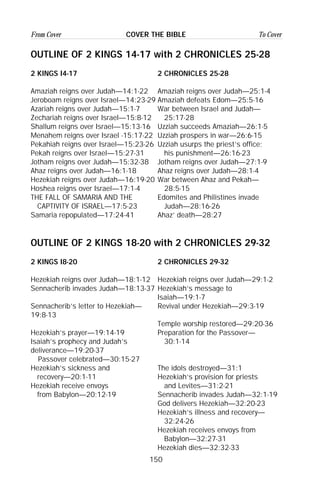
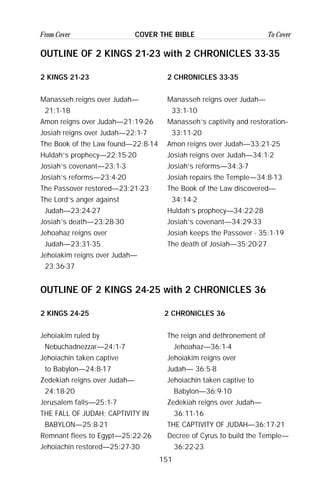
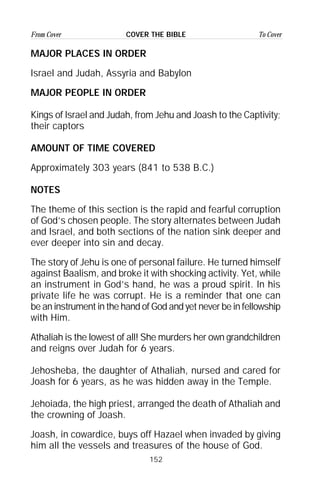
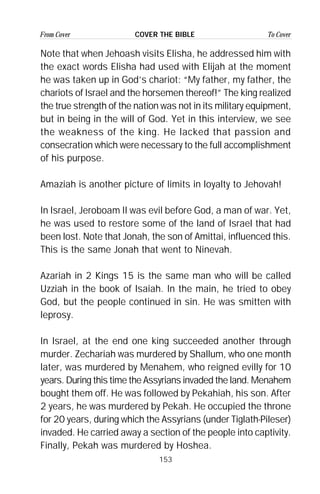
THE DAY OF ATONEMENT
Note the occasion—16:1
Two offerings: one for salvation, one for sanctification:
16:3
The “scapegoat”—16:10 (Literally, the goat of removal). 16:15
ties to Hebrews 9:25, which tells us something significant
about the sacrifice of Christ on the cross.
79
From Cover To CoverCOVER THE BIBLE
THE LAW FOR SACRIFICE
17:4—Note the place for sacrifice: ONLY ONE DOOR!
17:10-12—Eating Blood
Cf. Genesis 9:4 and Acts 15:19-20
The blood is for God, and is to be held in deepest reverence.
It is from God, and is a substitute for our sin.
Why were they not to eat blood?
To do so was a sign of self-redemption. Ingesting it was
to take from it the sacredness of the truth that the blood
is for God, not man!
Note 1 Peter 1:18-19—the blood is God’s only price of
redemption.
NUMBERS: ORGANIZED AS A CONQUERING ARMY
Leaving Sinai, Israel marches forth as Jehovah’s conquering
army, with God himself leading them! The book graphically
portrays Israel as the servants of God. They are to establish
His Kingdom. They have His power to do so.
At the same time, we are told how Israel broke the covenant
relationship God had established with them. The opportunity
to serve was available—and the freedom to not serve was
also available. Israel was organized as an army, but they didn’t
have the desire to do battle in Jehovah’s name. Thus, as
we read through the book we are saddened by the results
of disobedience.
80
From Cover To CoverCOVER THE BIBLE
2
Suggestions for
marking
your Bible...
1. Copy the Outline into your Bible.
2. Underline Leviticus 26:11-12. Write beside them:
Note: Key to Leviticus
3. Write marginal comments beside the offerings which
are described in the first five chapters of Leviticus.
4. Add any other notes from the explanations which you
now wish to preserve in your Bible.
81
From Cover To CoverCOVER THE BIBLE
Unit Ten
LEVITICUS 21-24 with
NUMBERS 28-29 and
DEUTERONOMY 16;
NUMBERS 11-12;
NUMBERS 13-14 with
DEUTERONOMY 1
OUTLINE
PART 1: LAWS FOR LIVING CLOSE TO GOD
Leviticus 21-22—Laws For The Priesthood
21—Laws For Personal Purity
22—Laws For Eating and Offering Sacrifices
Leviticus 23—Laws Of The Sacred Calendar
Leviticus 24—Laws For The Tabernacle and Camp
(NUMBERS 28-29 parallels LEVITICUS 21-24)
Numbers 28:1-8—The Daily Offerings
Numbers 28:9-15—The Sabbath and Monthly Offerings
Numbers 28:16-29:40—The Offerings At The Appointed
Feasts
(DEUTERONOMY 16 parallels LEVITICUS 21-24)
Deuteronomy 16—The Feasts
16:1-9—The Feast Of The Passover
16:10-12—The Feast Of Weeks
16:13-17—The Feast Of Booths
82
From Cover To CoverCOVER THE BIBLE
PART 2: THE NEGATIVE SIDE OF LIVING UNDER LAW
(See Romans 8:13-16)
Numbers 11:1-9—The Complaining People
Numbers 11:10-15—The Complaining Leader
Numbers 11:16-35—God’s Method Of Dealing With
Complainers
Numbers 12:1-9—Miriam And Aaron Complain Against
Moses
Numbers 12:10-16—Miriam Smitten With Leprosy
Numbers 13—Twelve Spies Sent To Canaan
Numbers 14—The Rebelling People Pay...And Pay...
(DEUTERONOMY 1 SUMMARIZES NUMBERS 11-14)
MAJOR PLACES IN ORDER:
Sinai, Wilderness of Paran, Kadesh-Barnea
MAJOR PEOPLE IN ORDER:
Moses, Aaron, The 70 Elders, Eldad and Medad,
Miriam, The 12 Spies
AMOUNT OF TIME COVERED:
A few months in B. C. 1490.
83
From Cover To CoverCOVER THE BIBLE
NOTES
SANCTIFICATION SHOWN IN THE PRIESTLY LAWS
LEVITICUS 21:8—Illustrates the Old Testament concept of
sanctification. Every Christian is to be “set apart” for the service
of God.
LEVITICUS 21:17-23—Restricted any man with a physical
blemish or imperfection from serving as a priest. Not only the
sacrifice, but the one offering it, had to be without blemishes.
See Hebrews 4:15 and 1 John 3:5.
LEVITICUS 22:18-25—Refers to special types of Peace
Offerings—the Votive and the Free Will Offerings.
The Peace Offering expressed peace and fellowship between
the offerer and God. It included a communal meal.
There were three kinds of Peace Offerings:
THANK OFFERING—showed gratitude for a special blessing
or deliverance.
VOTIVE OFFERING—showed gratitude for a special answer
when a vow had accompanied the petition.
FREE WILL OFFERING—Expressed gratitude to God without
regard to any specific blessing or deliverance.
84
From Cover To CoverCOVER THE BIBLE
THE FEASTS OF THE SACRED CALENDAR
There were 7 religious festivals ordained of God for Israel’s
year, mentioned in LEVITICUS 23:
THE PASSOVER—v. 5.
Deliverance by Christ from sin’s bondage.
THE FEAST OF UNLEAVENED BREAD—vv. 6-8
Unleavened bread a type of Christ and the Church.
THE DAY OF FIRST FRUITS—vv. 9-12
Always a Sunday. Jesus resurrected from the dead on this
day, a guarantee of our resurrection (See 1 Cor. 15:20-23,
1 Thess. 4:13-18).
THE FEAST OF WEEKS (PENTECOST)—vv. 15-22
Always a Sunday. Day of the outpouring of the Holy Spirit.
Two loaves represent Jew and Gentile, contained leaven, because
sin is yet present within the Church.
THE DAY OF TRUMPETS—vv. 23-25
The blowing of the trumpets is associated with the coming
of our Lord.
THE DAY OF ATONEMENT—vv. 26-32
The only fast day among the festivals. On this day annual
atonement was made for the sins of the priests, the people,
and the tabernacle. Points to the redeeming work of Christ
more than any other festival.
THE FEAST OF TABERNACLES (BOOTHS)—vv. 33-43
Foreshadows the millennial reign of Christ.
(See Zechariah 14:16)
85
From Cover To CoverCOVER THE BIBLE
NOTES
Nisan is also called Abib. Passover is in this month.
Iyyar (Ziv) is the month of the Feast of Unleavened Bread,
followed by the Day of First Fruits.
Seven weeks later, in Sivan, is the Feast of Pentecost.
Tishri is the month of the following festivals:
• The Day of Trumpets
• The Day of Atonement
• The Feast of Tabernacles
1
5
67
8
9
10
11
12
2
4
3
Adar
Nisan
Iyyar
Sivan
Tammuz
Ab
ElulTishri
Heshvan
Kislev
Tebeth
Shebat
Feb-Mar
Mar-
Apr
Apr-May
May-June
Jun-Jul
Jul-Aug
Aug-SeptSept-Oct
Oct-Nov
Nov-Dec
Dec-Jan
Jan-Feb
86
From Cover To CoverCOVER THE BIBLE
Camp Arrangement of
Israel's Tribes
DAN ASHER NAPHTALI
KOHATHITES
GAD SIMEON REUBEN
MERARITES
MOSES,AARON
ANDHISSONS
ZEBULUNISSACHARJUDAH
EPHRAIMMANASSEHBENJAMIN
GERSHONITES
GATE
TABERNACLE
87
From Cover To CoverCOVER THE BIBLE
STUPID IS FOREVER!
THE HIGH COST OF COMPLAINING
Numbers 11:1—Fire is a sign of God’s presence and
judgment.
11:6—Manna means, “What is it?”
See John 6:31-35, 48-58!
11:26—NABI’: means “Prophesied”
Noting the difference between NABI’ and the New
Testament concept of “prophet” is important...
CLASS NOTES ON NUMBERS 11-14:
1. No one who rebelled will live to see the land: 14:23
2. They must return to the wilderness: 14:25
3. Forty years will pass: 14:34
4. The ten spies who misled the people will die: 14:37
5. The people will have no success in military
encounters with the people of the land: 14:33
6. Only Joshua and Caleb will enter!
Does this press upon us the terrible result of unbelief? Why
are we so prone to recycle, over and over, the learning of this
lesson?
88
From Cover To CoverCOVER THE BIBLE
2
Suggestions for
marking
your Bible...
1. Copy the Outline into your Bible.
2. Write beside Leviticus 21:8, and underline the verse:
Note: Description of Sanctification
3. Write comments of your choice beside the Feasts, as
described in your notes.
4. Add any other notes from the explanations which you
now wish to preserve in your Bible.
89
From Cover To CoverCOVER THE BIBLE
Unit Eleven
NUMBERS 15-19
NUMBERS 20-21 with
DEUTERONOMY 2-3
NUMBERS 22-25
NUMBERS 26-36 with
DEUTERONOMY 19
DEUTERONOMY 20-34
OUTLINE
Laws Concerning Offerings—Numbers 15:1-31
The Stoning Of A Sabbath Breaker—Numbers 15:32-36
Fringes On Garments—Numbers 15:37-41
Korah’s Rebellion—Numbers 16:1-40
Ravages Of The Plague—Numbers 16:41-50
Aaron’s Rod—Numbers 17
Provision For The Priests and Levites—Numbers 18:1-24
The Heave Offering—Numbers 18:25-32
Purification With Heifer Ashes—Numbers 19
Miriam’s Death—Numbers 20:1
Water From The Rock—Numbers 20:2-21
Aaron’s Death—Numbers 20:22-29
The Canaanites Attack—Numbers 21:1-3
The Fiery Serpents—Numbers 21:4-9
Detour Around Moab—Numbers 21:10-20
Israel Conquers Foes—Numbers 21:21-35
(Note: Deuteronomy 2-3 summarizes the above material)
Balaam, The Surprised Prophet—Numbers 22-24
Israel Worships Baal-peor—Numbers 25
Israel Takes A Census—Numbers 26
The Law Of Inheritance—Numbers 27:1-17
(Continued on next page)
90
From Cover To CoverCOVER THE BIBLE
Joshua Appointed Moses’ Successor—Numbers 27:18-23
The Daily Offerings—Numbers 28-29
The Law Concerning Vows—Numbers 30
The Midianites Conquered—Numbers 31
Reuben, Gad Inherit East Of Jordan—Numbers 32
The Wilderness Journeys—Numbers 33:1-49
Orders To Expel Canaanites—Numbers 33:50-56
Partitioning The Land—Numbers 34:1-35:8
Laws Concerning Murder—Numbers 35:9-36
Female Inheritance And Marriage—Numbers 36
The Cities Of Refuge—Deuteronomy 19
Laws Concerning War—Deuteronomy 20
Settlement For An Unknown Murderer’s Crime;
Miscellaneous Laws—Deuteronomy 21-25:16
Command To Destroy Amalek—Deuteronomy 25:17-19
Offerings—Deuteronomy 26
Mount Ebal: Signs Of Blessings And Curses—
Deuteronomy 27-30
Joshua Commissioned—Deuteronomy 31
The Law To Be Placed In The Ark—Deuteronomy 31:24-29
The Song Of Moses—Deuteronomy 31:30-32:47
Moses Permitted To See Canaan—Deuteronomy 32:48-52
Moses Blesses The Tribes—Deuteronomy 33
The Death Of Moses—Deuteronomy 34:1-8
Joshua Succeeds Moses—Deuteronomy 34:9-12
91
From Cover To CoverCOVER THE BIBLE
MAJOR PLACES IN ORDER
Kadesh-Barnea, Moab, Mount Nebo
MAJOR PEOPLE IN ORDER
Moses, Aaron, Korah, Baalam, Joshua
AMOUNT OF TIME COVERED
About 39 years
THE BOOK OF NUMBERS
PREPARATION THE JOURNEY AT THE GATE
CHAPTERS 1-5 CHAPTERS 10-18 CHAPTERS 22-36
Inventory and Sinai to Kadesh- At the gate of
Assignments Barnea the Land
WANDERING,
Cleansings, WANDERING, New Problems
Preparations, UNTIL ALL ARE...
Final DEAD!
Admonitions On to Moab Final Tasks
MOUNT SINAI MOUNT HOR MOUNT NEBO
KEY VERSES: 10:9; 10:29
92
From Cover To CoverCOVER THE BIBLE
DEUTERONOMY: “BOOK OF REMEMBRANCE”
Key Verses: 4:23; 5:29; 8:11; 10:12-13; 11:26-28; 28:1;
29:1
INTRODUCTION THE WORD OF THE COVENANT CONCLUSION
1-4: Remember, 4:44-26: Commandments for 31-34: Parting
Lest you forget... the present Words of
Moses
27-30: Options Affecting
the future
ISRAEL’S HISTORY BY PERIODS
PENTATEUCH JOSHUA 1, 2 SAMUEL EZRA
(BOOKS OF JUDGES 1, 2 KINGS NEHEMIAH
MOSES) RUTH 1, 2 CHRONICLES ESTHER
IN EGYPT IN CANAAN, IN CANAAN, IN
IN THE UNDER UNDER CAPTIVITY,
WILDERNESS THE JUDGES THE KINGS IN ASSYRIA
and BABYLON
660 360 460 160
YEARS YEARS YEARS YEARS
WE HAVE COME THIS FAR IN OUR STUDY...
93
From Cover To CoverCOVER THE BIBLE
KORAH’S REBELLION: NUMBERS 16
Korah was joined by 250 leaders who challenged the authority
of Moses.
They tried to establish a priestly order without God’s permission.
God dealt harshly with them!
THE RED HEIFER: NUMBERS 19
A type of the sacrifice of Christ in cleansing the believer:
1. The sacrifice is killed
2. Sevenfold sprinkling of blood
3. Sacrifice turned into ashes
4. Ashes become a memorial
5. Used to cleanse from defilement
Water is both a type of the Holy Spirit and the Word of God
(John 7:37-39). The Holy Spirit uses the sacrifice of Christ
to bring the forgiveness of the believer, and cleansing! (See
1 John 1:9)
Always remember that everything you will ever need in your
Christian life comes from the CROSS! There are NO “second
sources!”
MOSES’ SIN: NUMBERS 20:7 ff.
Why was God so hard on Moses? The rock was a symbol of
Christ (1 Corinthians 10:4). Moses had already struck the
rock once (Exodus 17:6), and his striking it the second time
said the one sacrifice was not enough (Hebrews 9:26). His
act exalted himself (v. 10). His frustration and anger at the
people cost him...everything!
94
From Cover To CoverCOVER THE BIBLE
BAALAM, THE HIRELING PROPHET: (Numbers 22 ff.)
This passage is important because of 2 Peter 2:15, Jude
11, and Revelation 2:14. He sought to “sell” his spiritual
gift, and was a false teacher. He reasoned that a holy God
would be glad for him to curse a people as corrupt as Israel.
He disregarded God’s willingness to justify believing
sinners.
CITIES OF REFUGE: DEUTERONOMY 19
A beautiful picture of our safety in Christ, where we are free
from the retaliation of our sins. Later, we will see Abner die
“as a fool” because he did not stay in the city of refuge. What
about you?
Have you taken your refuge in Jesus Christ? There are so
many folks in our age who take their refuge in church membership.
Joining a church no more makes you a Christian than entering
a garage makes you an auto-mobile!
John 1:12-13: “But as many as received Him, to them He
gave the right to become children of God, even to those who
believe in His name, who were born not of blood, nor of the
will of the flesh, nor of the will of man, but of God.”
We did not make ourselves the children of our parents by
what we accomplished. We are the product of their activity.
So it is with becoming a child of God. We are not the product
of our own deeds (even joining a church!), but rather the product
of the activity of God. He so loved us that He sent His son
to the cross. The “birthing” of our spiritual sonship comes
not from the blood and water of physical birth, but from Christ’s
death on the cross. (See John 19:34.)
95
From Cover To CoverCOVER THE BIBLE
A FAREWELL TO THE WILDERNESS...
Don’t miss the sheer horror of how the Pentateuch ends!
Because of unbelief, an entire generation of Israelites spent
their lives wandering aimlessly, never getting any meaning
out of life. Is that not always the result of life apart from God?
Their environment was not pleasant. Their lives had no destiny
except dusty graves. Their investment in history was to serve
only as a lesson of the futility of unbelief.
WHYDIDTHEWILDERNESSLIEBETWEENEGYPTANDCANAAN
FOR THESE PEOPLE?
The answer to that question is appropriate for each one of
us. Egypt stands for a land of carnal, lustful lifestyle. To leave
the habits and foods of that land behind and to immediately
enter into the promised land would have left a lesson unlearned!
The people of Israel had to learn that all their sufficiency,
all their supply, came from God and God alone.
Had they slipped out of Egypt to reside at once in the promised
land, where abundance was everywhere, would have created
a self- centered people. They would have taken their environment
for granted. Because of the wilderness, there was a stark
realization that land without God’s blessing—without God’s
provision—life is barren and dry.
In our Christian lives, we sometimes wonder why God allows
the “desert experiences.” It is obvious: sin creates this
barrenness. Living in the midst of sin, there is only one valid
supply—God. When we trust Him, we find the reality of life.
It’s not in the environment, but in Him!
96
From Cover To CoverCOVER THE BIBLE
1. Copy the Outline into your Bible.
2. Underline the key verses for Numbers and
Deuteronomy.
3. Write marginal comments beside the scriptures explained
in your notes.
4. Add any other notes from the explanations which you
now wish to preserve in your Bible.
2
Suggestions for
marking
your Bible...
97
From Cover To CoverCOVER THE BIBLE
Unit Twelve
JOSHUA 1-24
JUDGES 1-12
OUTLINE OF JOSHUA
PART ONE: CONQUEST OF THE LAND
(Joshua 1:1-11:15)
Chapters 1-5—Preparation
Charge to Joshua—Joshua 1
Spying Jericho—Joshua 2
Crossing Jordan—Joshua 3
Memorial Stones—Joshua 4
Circumcision and Passover—Joshua 5
Chapters 6-11:15—Conquest
Chapters 6-8—Central Campaign
Jericho—Joshua 6
Ai Defeats Israel—Joshua 7
Israel Defeats Ai—Joshua 8
Chapters 9-10—Southern Campaign
Pact With Gibeon—Joshua 9
Five Kings Slain—Joshua 10
Chapter 11:1-15—Northern Campaign
Chapters 11:16-23—Summary
PART TWO: DIVISION OF THE LAND (Joshua 13-21)
PART THREE: JOSHUA’S FINAL YEARS (Joshua 22-24)
MAJOR PLACES IN ORDER
Jericho, Ai, and the territories of the South and the North in
the Promised Land
98
From Cover To CoverCOVER THE BIBLE
MAJOR PEOPLE IN ORDER
Joshua
AMOUNT OF TIME COVERED
Approximately 7 years
OUTLINE OF JUDGES
PART ONE: WILL THEY NEVER LEARN? (Judges 1-16)
Incomplete Obedience—Judges 1
“As The Wheel Turns:”—Judges 2
The Roster of Players—Judges 3:1-6
First Cycle: Othniel—Judges 3:7-11
Second Cycle: Ehud—Judges 3:12-31
Third Cycle: Deborah—Judges 4
Parenthesis: The Song of Deborah—Judges 5
Fourth Cycle: Gideon—Judges 6:1-8:32
Fifth Cycle: Abimelech Made King, Tola—
Judges 8:33-10:5
Sixth Cycle: Jephthah—Judges 10:6-12:15
MAJOR PLACES IN ORDER:
The Land of Israel
MAJOR PEOPLE IN ORDER:
Judges: Othniel, Ehud, Deborah, Gideon, Abimelech, Tola,
Jephthah
AMOUNT OF TIME COVERED:
Judges covers approximately 400 years
(1500-1000 B. C.)
99
From Cover To CoverCOVER THE BIBLE
NOTES
JOSHUA
In the Jewish Old Testament, this is the first of the Historical
Books.
It took 7 years to conquer Canaan. The secret of Joshua was
OBEDIENCE!
The spiritual message of this book is victory over the POWER
of Sin.
The Summary of Joshua is found in 21:42-45.
JOSHUA 7: THE SIN OF ACHAN
When we are defeated, we must root out OUR Achan and
utterly destroy that area in our life style!
JUDGES:
The 5 Spokes of the “Wheel:” (see page 103)
1. 2:5—“They sacrificed to the Lord”
2. 2:11—“The sons of Israel did evil in the sight of the
Lord, and served the Baals”
3. 2:14—“And the anger of the Lord burned against Israel,
and He gave them into the hands of...their enemies around
them”
4. 2:15—“They were severely distressed”
5. 2:16—“Then the Lord raised up judges who delivered
them from the hands of those who plundered them”
100
From Cover To CoverCOVER THE BIBLE
FIRST
CAMPAIGN
SECOND CAMPAIGN
THIRD CAMPAIGN
MT. EBAL
MT. GERIZIM
Shechem
Ai
Gilgal
Jericho
Shittim
JordanRiver
Dead
Sea
Arnon River
Jabbok River
Yarmuk
River
Sea of Kinnereth
(Galilee)
Lake Huleh
JOSHUA’S MILITARY CAMPAIGNS
Following the directions of Jehovah, the Israelite army saw
victory at Jericho. Disobeying Jehovah, they suffered
defeat at Ai. In the Second and Third Campaigns they
were able to defeat their enemies, but through their
disobedience created serious problems for the
future...problems which would eventually destroy their
nation.
Partial obedience is not enough! Compromise with what is
God’s best doesn’t bring “almost best.” It brings disaster.
101
From Cover To CoverCOVER THE BIBLE
NAPHTALI
ZEBULUN
ASHER
MANASSEH
EPHRAIM
DAN
JUDAH
SIMEON
DAN
MANASSEH
GAD
ISSACHAR
REUBEN
CANAAN AS DIVIDED AMONG THE TWELVE TRIBES
Hebron, Bezer, Shechem, Ramoth-Gilead, Golan, and
Kadesh were set apart as Cities of Refuge to receive and
protect accidental manslayers. Note Dan and Manasseh
occupy two portions. The Sidonians were to the North.
The Philistines occupied the coastal territory in Judah.
MT. EBAL
MT. GERIZIM
Ai
Gilgal
Jericho
Shittim
JordanRiver
Dead
Sea
Arnon River
Jabbok River
Yarmuk
River
Sea of Kinnereth
(Galilee)
Lake Huleh
BENJAMIN
Bezer
Ramoth-Gilead
Golan
Kedesh
Shechem
Hebron
102
From Cover To CoverCOVER THE BIBLE
USING YOUR ZONDERVAN
PICTORIAL BIBLE ENCYCLOPEDIA...
In volume 3 of the Encyclopedia, you will find an excellent
article on page 756 about Israel’s judges. Note the explanation
that the word “judge” means more here than one who is involved
with legal affairs. Besides judicial functions “they exercised
a saving, liberating activity that was conceived to be the result
of a direct endowment from Jahweh.”
The article goes on to explain that all these judges came from
three classes of men: High priest, wise man, and warrior.
Note that these men frequently fell below the character of
other great men or women in the Old Testament, but “they
were men of faith.”
Someone has rightly said, “The Lord hits many a lick with
a crooked stick!” One of the Devil’s tricks with us is to accuse
us of not being “spiritual enough” to do anything for the Lord.
That’s just not true. David was a murderer and an adulterer,
and God used him in spite of these things. It’s true that his
personal life was wretched because of his sin, but his sin
did not make him useless.
The old joke has two men meeting on the street. One says
to the other, “How’s your wife?” He replies, “Compared to
what?” How pure do you have to be for the Lord to use you?
“Compared to what?”
The point is this: you and I will never become RIGHTEOUS
ENOUGHtobeGod-like.Therefore,HegivesusHisrighteousness.
It is always adequate when our own is not. This is not a license
to SIN; instead, it’s a license to SERVE!
103
From Cover To CoverCOVER THE BIBLE
1
They
sacrificed
to
the
Lord
2
They
did evil in
the sight of
the
Lord
3
The anger of
the Lord
burned
against
Israel
5
The Lord raised up
Judges, who
delivered them
from the hands of
those who
plundered them.
4
They were severely
distressed, and
cried unto
the Lord.
THE “WHEEL OF LIFE” IN THE BOOK OF JUDGES
Chapter 2 is an excellent place to review this cycle. It is obsrved throughout
the book.
FIND AND UNDERLINE THESE POSITIONS ON THE WHEEL:
2:5-10: Position 1—but note last part of verse 10.
2:11-13: Position 2—note their rejection and substitutions.
2:14-15a: Position 3—note God’s hand was against them.
2:15b: Position 4—Finally, they began to cry out for help.
2:16: Position 5—The Lord raised up Judges to deliver them.
CONTINUE TO TRACE THE WHEEL IN VERSES 17-23...
Is it not tragic that we have never learned for ourselves that disobedience
causes misery? Note: God was always ready to deliver them if they
would turn to Him. So it is today. NEVER believe you have passed
out of the love and grace of our God.
104
From Cover To CoverCOVER THE BIBLE
1. Copy the outline into your Bible.
2. Write beside Joshua 21:42-45:
Note: Summary Statement of Joshua
3. Write beside Joshua 10:12-13:
Note: The sun and the moon
replaced God as objects
of worship to these people!
4. Add any other notes from the explanations which you
now wish to preserve in your Bible.
2
Suggestions for
marking
your Bible...
105
From Cover To CoverCOVER THE BIBLE
Unit Thirteen
JUDGES 13-21
RUTH
1 SAMUEL 1-12
OUTLINE
JUDGES 13-21:
Seventh Cycle: Samson—Judges 13-16
Idols in Israel—Judges 17
Tribe of Dan Seeks An Inheritance—Judges 18
Tragedy: A Levite and A Harlot—Judges 19
Israel At War—Judges 20
Benjamites Barely Squeak By—Judges 21
MAJOR PLACES IN ORDER
Israel, Gaza, Gibeah, Rimmon’s Rock, Mizpah, Bethel
MAJOR PEOPLE IN ORDER
Samson, Delilah, Micah, “A certain Levite,” Phineas
AMOUNT OF TIME COVERED
Approximately 263 years
106
From Cover To CoverCOVER THE BIBLE
NOTES
Key to this book: Judges 21:25—“In those days there was
no king in Israel; everyone did what was right in his own
eyes.”
13:2-5—THE NAZARITE VOW
Why this vow? It was the means by which a “lay priesthood”
was established.
It included...
1. No strong drink
2. Hair never to be cut
3. Cannot touch a dead body or eat unclean things
Samson repeatedly violated these vows, including eating honey
from a carcass of a dead animal. He is a symbol of those
who try to follow God’s will without accepting God’s values.
He is deluded, imprisoned, blinded, degraded, chained, and
given a life of drudgery.
THE TRAGEDY OF THE CONCUBINE
Israel had finally yielded to the vulgarity of the religious scene
around them, among the Baal worshippers! Even the practice
of homosexual activity had penetrated their lifestyles. At Gibeah
the homosexuals are called “Sons of Belial” (Satan) in 19:22.
In 20:5 we discover the concubine was left dead or dying,
her hands on the threshhold of the house where the Levite
had stayed. The Levite dramatically publicized their atrocity
by dismembering the body of the woman and sending pieces
to the tribes.
107
From Cover To CoverCOVER THE BIBLE
This period of Israel is the story of people who lived without
any mourning for sin, no return to Jehovah. They acted in
self-will. 40,000 Israelites and 25,000 Benjamites are killed,
cities destroyed, the population decimated.
What a terrible, lawless period!
WHY? WHY SUCH A LAWLESS PERIOD?
There were not enough models of Godly living to permeate
the families of Israel. The mothers and fathers who bred this
generation of Israelites had been born in Egypt or the Wilderness.
All of those who first entered Canaan with Joshua were born
in the Wilderness.
As they entered the land, they were disobedient. They did
not follow the orders God plainly gave to them to create a
holy territory. Inside the borders was to be one thing—the
worship of Jehovah.
Instead, they endorsed a “pluralistic society,” where each
person could do what they desired to do, as long as they did
not hurt anyone else. The evil of this compromise is that truth
no longer exists for anyone. Each person is the final judge
of “right” and “wrong.” We are experiencing such a life-style
in America today. It never brought any meaning or peace to
Israel, and it will not bring any peace to us! We may not be
able to change all society, but there is one place we can keep
sacred...our own lives. We Christians compose a special group
of people called the “body of Christ.” Holy living is a
necessity.
AUTHORSHIP OF BOOK:
Probably Samuel.
108
From Cover To CoverCOVER THE BIBLE
SIDONIANS MESOPOTAMIA
E D O M I T E S
M O A B I T E S
HITTITES
JE
B
U
S
IT
E
S
P
H
IL
IS
T
IN
E
S
H
IV
IT
E
S
P
E
R
IZ
Z
IT
E
S
AMMONITES
C
A
N
A
A
N
IT
E
S
AMORITES
AMORITES
TRIBES DWELLING IN CANAAN
DURING THE TIME OF THE JUDGES
In every case, they should not have been present. God had given directions
for them to be cleared out of the land. Israel could no more co-exist
with them than WE can co-exist with sin!
109
From Cover To CoverCOVER THE BIBLE
NAME
Othniel
Ehud
Shamgar
Deborah
Gideon
Tola
Jair
Jephthah
Ibzan
Elon
Abdon
Samson
TRIBE
Judah
Benjamin
Naphtali
Ephraim
Manasseh
Issachar
Gilead
Gilead
Bethlehem
Zebulun
Ephraim
Dan
IDENTIFICATION
Nephew of Caleb
Left-handed
An Assassin
Used Ox Goad
Only woman judge
An obscure
family
30 sons,
30 cities
Made rash vow
30 sons,
30 daughters
Nazarite from birth
ENEMY
Mesopo-
tamia
Moabites
Philistines
Canaanites
Midianites
Ammonites
Philistines
YRS
OF
OPPRES-
SION
40
80
?
40
40
23
22
6
7
10
8
20
YRS
OF
PEACE
8
18
?
20
7
18
40
REFERENCE
3:9-11
3:12-30
3:31
4:4-5:31
6:11-8:35
10:1-2
10:3-5
11:1-12:7
12:8-10
12:11-12
12:13-15
13:2-16:31
JUDGES OF ISRAEL
Some of them prove the Lord “hits many a lick with a crooked stick!”
110
From Cover To CoverCOVER THE BIBLE
1370
1360
1373
1334
1316
1237
1198
1191
1151
1149
1126
1105
1265
1252
1059
1049
1087
1081
1075
1065
1058
1107
1067
1028
JEPHTHAT
IBZAN
ELON
ABDON
1120 Ruth and Boaz
are married
ABIMELECH
SHAMGAR
OTHNIEL
EHUD
DEBORAH
AND
BARAK
GIDEON
TOLA
JAIR
SAMSON
ELISAMUEL
TribleofBenjamin
nearlyannihilated
TribeofDan
migrated
THE TIME OF THE JUDGES:
EVENTS AND PEOPLE
111
From Cover To CoverCOVER THE BIBLE
OUTLINE OF RUTH
Elimelech Migrates To Moab—1:1-5
Family Faces Crisis—1:6-21
Naomi Returns To Bethlehem—1:22
Ruth Meets Boaz—2:1-23
Ruth And Naomi Trust Boaz To Be
Their Kinsman-Redeemer—3:1-18
Boaz And Ruth—4:1-12
Their Son, Obed—4:13-16
Ruth’s Part In David’s Genealogy—4:17-22
MAJOR PLACES IN ORDER
Bethlehem, Moab, Bethlehem
MAJOR PEOPLE IN ORDER
Elimilech, Naomi, Ruth, Boaz
AMOUNT OF TIME COVERED
Approximately 10 years
NOTES ON THE BOOK OF RUTH
Bethlehem means “House of Bread and Praise”
Elimelech means “My God Is King”
Naomi means “Pleasant”
Mahlon and Chilion mean “Sick” and “Pining”
Orphah means “Fawn”
Ruth means “Friendship”
Boaz means “Fleetness”
Obed means “The Serving One”
112
From Cover To CoverCOVER THE BIBLE
THE CONCEPT OF THE KINSMAN-REDEEMER
In Hebrew, GO’EL. The nearest kinsman had the right to redeem
the forfeited inheritance of the family. Elimelech’s death meant
the needs of the women were to be met by the GO’EL. Involved
were:
1. Support and protect the women.
2. Insure their property remained intact for them, even if
liens had to be paid.
3. In a childless marriage where there was no heir, the GO’EL
must marry the widow and sire a child to inherit the land
of his father.
4. If the widow’s property was put up for sale, the GO’EL
would buy it at public auction.
5. If the man had been murdered, the GO’EL would avenge
the death.
6. If the dead man’s relatives were sold into slavery or
servitude, the GO’EL would purchase and free them.
7. If the nearest kinsman-redeemer refused the responsibility
to act as GO’EL, he lost the right to the inheritance and
sometimes suffered the indignity of spit in the face (See
Deut. 25:9).
8. The next kinsman was then free to come forward and
take over. Taking off the shoe and handing it to another
was a symbol of transfer of obligation—“You walk in
my shoe!”
113
From Cover To CoverCOVER THE BIBLE
OUTLINE OF 1 SAMUEL 1-12:
SAMUEL AS JUDGE AND PROPHET—1:1-8:22
Childhood—1:1-3:21
The Ark—4:1-7:2
Reconsecration at Mizpah—7:3-17
The Call for a King—8:1-22
SAMUEL AND SAUL—9:1-12
Saul Anointed—9:1-10:27
Defeat of the Ammonites—11:1-11
Renewal of the Kingdom at Gilgal—11:12-15
The Farewell Address of Samuel—12
MAJOR PLACES IN ORDER
Mount Ephraim, Shiloh, Ebenezer, Ashdod, Bethshemite,
Kirjath-jearim, Mizpeh, Ramah, Gibeah, Jabesh-Gilead,
Gilgal
MAJOR PEOPLE IN ORDER
Elkanah, Hannah, Eli, Samuel, Philistines,
Joshua the Bethshemite, Abinadab, Saul
AMOUNT OF TIME COVERED
Approximately 76 years
114
From Cover To CoverCOVER THE BIBLE
AUTHOR
Not known for certain. Jewish tradition picks Samuel; Gad
and Nathan added the sections following his death.
NOTES
SAMUEL combines two Hebrew words meaning, “Heard of
God.” In 1:20 Hannah explains why she chose that name.
ELI: a good man, a poor father. He humored his children more
than he honored God. He ruined both them and himself! When
love refuses to be “tough,” it’s not love...
3:1: “And word from the Lord was rare in those days, visions
wereinfrequent.”Thisconditionoccurswhenthereisnoreceptivity
to God’s word! He does not talk to those who will not
listen—for obvious reasons.
3:7: He needed a personal encounter!
God’s call to Samuel: Remember—if He calls, and you do
not understand what is happening, He will not FORSAKE you.
He will keep on calling until you understand what is taking
place. Don’t worry about “missing” God’s message to you.
4:21: Kabod = “Glory;” I-Kabod = “No Glory”
Shiloh was probably burned following the capture of the ark.
Shiloh is never mentioned again.
115
From Cover To CoverCOVER THE BIBLE
(Do this Bible study on your own...)
THE LOSS OF THE ARK: 1 SAMUEL 4-7
1. What nation is Israel’s enemy at this time?
2. What mistake was made in bringing the Ark into
battle?
3. How can the error of trusting in the symbol instead of
the One symbolized teach us a powerful lesson?
4. What prophecy was fulfilled in 4:11?
5. What is the meaning of “Ichabod?”
6. Did the Ark bless or curse its captors?
7. How were their idols put to ridicule?
8. How does 6:10-12 attest the supernatural?
9. What judgment befell the Betshemites, and why?
10. Where, and for how long a period, did the Ark then
rest?
11. How would you account for the changed conditions of
affairs in chapter 7?
Note that Israel’s attitude about the ark came not from the
counsel of God, but by copying the heathen around them who
carried their idols into battle for “luck.” God allowed the Ark
to be captured to discipline Israel, and to show His power
over the silly deities worshipped by other nations.
(This Bible study is adapted from James M. Gray’s Synthetic Bible Studies, published
back in 1906 by Fleming H. Revell Company.)
116
From Cover To CoverCOVER THE BIBLE
1. Copy the outline into your Bible.
2. Write beside Judges 21:25:
Key to understanding this book:
People think what they do is right!
They often do not act out of deceit,
but out of blindness.
3. Write beside Ruth 1 the meaning of the names of the
characters of this lovely story (see page 118).
4. Add any other notes from the explanations which you
now wish to preserve in your Bible.
2
Suggestions for
marking
your Bible...
117
From Cover To CoverCOVER THE BIBLE
Unit Fourteen
1 SAMUEL 13-31
2 SAMUEL 1-5
with 1 CHRONICLES 1-12
OUTLINE OF 1 SAMUEL 13-31:
THE DECLINE OF SAUL and THE RISE OF DAVID
The reign of Saul—13:1-14:52
Saul’s great sin—13:1-14
Jonathan’s victory—13:15 -14:15
Saul’s poor judgment—14:16-52
Enmity between Saul and David—15:1-18:30
Saul’s disobedience—15:1-9
Samuel hews Agag to pieces—15:10-35
Samuel anoints David—16:1-23
David kills Goliath—17:1-17:58
Jonathan and David—18:1-19
Saul seeks to kill David by indirect means—18:20-30
David’s flights and dangers—19:1-23:29
Saul seeks to kill David directly—19:1-24
David and Jonathan cut a covenant—20:1-23
Saul and Jonathan divide over David—20:24-42
David eats consecrated bread—21:1-6
David feigns madness—21:7-15
Saul murders priests and families—22:16-23
David delivers Keilah—23:1-29
David’s mercy to Saul and rising popularity—24:1-31:13
Deliverance at Engedi—24:1-22
Deliverance at Hachilah—25:1-26:25
Suicide provoked by defeat at hands of Philistines—
27:1-31:13
118
From Cover To CoverCOVER THE BIBLE
MAJOR PLACES IN ORDER
Gilgal, Gibeah, Jerusalem, Ramah, Jerusalem, Keilah, Maon,
Engedi, Hakilah
MAJOR PEOPLE IN ORDER
Saul, Jonathan, Samuel, Agag, David, Goliath, Michael,
Abishai
AMOUNT OF TIME COVERED
Approximately 39 years
NOTES
In the Hebrew Bible, 1 and 2 Samuel appear as one book:
Samuel. 1 and 2 Kings appear as simply Kings. The four books
are collectively called “The Books of the Kingdoms.”
The theme of 1 and 2 Samuel is the establishment of the
Kingdom. The theme of 1 and 2 Kings is the taking away of
the Kingdom.
The Holy Spirit’s purpose running through these books is not
to give the history of Samuel, Saul, and David, but rather to
interpret the relation of these men to the establishment of
the Kingdom.
Samuel laid its foundations;
Saul tried to establish it and failed;
David succeeded in establishing it.
119
From Cover To CoverCOVER THE BIBLE
SAMUEL: GREATEST BETWEEN MOSES AND DAVID
His principles of statecraft were summed up in 1 Samuel 12:12:
“Jehovah your God was your king.” The responsibility of the
human king was outlined in 1 Samuel 12:13-15:
1. You are appointed by JHWH, not the people;
2. If you serve JHWH, it will be well;
3. If not, JHWH will be against you and Israel.
Two significant phrases are then used:
“The Anointed of Jehovah”
Used to describe both Saul and David
“The Servant of Jehovah”
Never used of Saul, frequently used of David
THE ANOINTED OF JEHOVAH
The anointing with oil symbolized being “set apart” (sanctified)
for the work of God. This rite was done to both political and
religious leaders. It indicated:
•Divine ordination to office
•Spirit-given power for duties of the office
•Divine protection to fulfill the call to the office
The coming of the Spirit of JHWH upon the anointed one was
significant:
1 Samuel 10:9-12—For Saul, it produced ecstatic emotions
which caused him to prophesy;
(Continued on next page)
120
From Cover To CoverCOVER THE BIBLE
(Continued from previous page)
1 Samuel 11:6-15—It gave him the will to fight Israel’s enemies.
1 Samuel 18:1; 20:12-17—For David, it went much further,
leading to the love of David and Jonathan, to wise behavior
under difficult circumstances, to constant seeking for the guidance
of God, to respect for Saul’s position, to hymn writing, to devoted
planning for the temple and its service, to prophetic insight
into the future of Israel.
DAVID’S ATTITUDE TOWARD SAUL
David recognized Saul as God’s appointed man. JHWH alone
should remove him. Anointing guaranteed God’s aid, but not
success. Success depended upon the choice of a man to
appropriate the aid of God!
SAUL: A STUDY OF A MAN WHO WOULD NOT
DEPEND ON GOD
•Poor judgment (wisdom comes from God)
•Jealousy
•Fear
•Despair
•Suicide
DAVID: A STUDY OF A MAN WITH A HEART FOR GOD
• Lust, yes...but always a heart for God
• Response to God’s chastening
• Restoration
121
From Cover To CoverCOVER THE BIBLE
THE SERVANT OF JHWH
David became an outstanding example of a servant:
1. Jerusalem made the capital of a united Israel.
2. He put worship at the heart of the nation.
3. He headed the line ordained to rule Israel forever.
4. He established justice and righteousness in his realm.
5. He learned to bow his will to God’s will in all things.
6. He laid the plans for the Temple.
7. He led in preparation of a hymnbook for Israel
(the Psalms).
A STUDY OF THE SERVANT OF JEHOVAH:
(Note: the references below give you an opportunity to do some
personal, independent study of this subject. Using these
scriptures, trace the topic. Jot down your personal conclusions
on a note sheet, and insert it in your notebook at this point
if you wish.)
• Angels: Job 4:18
• Abraham: Genesis 26:24
• Isaac: Genesis 24:14
• Jacob: Exodus 32:13
• Moses: Exodus 14:31
• Joshua: Joshua 24:29
• Caleb: Numbers 14:24
• Job: Job 1:8
• Hezekiah: 2Chronicles 24:6
• Zerubbabel: Haggai 2:23
• Eliakim: Isaiah 22:20
• The Prophets: 2 Kings 9:7
• Messiah: Isaiah 49:5-7
122
From Cover To CoverCOVER THE BIBLE
OUTLINE OF 2 SAMUEL 1-5:
DAVID BECAME KING OF JUDAH—1:1-4:12
David made King at Hebron—1:1-2:4
Men of Jabesh-Gilead blessed for burying Saul—
2:4-2:7
Victory over northern tribes—2:8-3:5
Northern tribes turn to David—3:6-4:12
DAVID BECAME KING OF JUDAH and ISRAEL—5:1-20:26
Tribes rally to David—5:1-5
Jerusalem made capital of Israel—5:6-16
Victories over the Philistines—5:17-25
MAJOR PLACES IN ORDER
Ziklag, Hebron, Jerusalem, Philistia
MAJOR PEOPLE IN ORDER
David, Abner, Ishbosheth, Joab, Asahel, Mephibosheth,
Hiram
AMOUNT OF TIME COVERED
Approximately 8 years
NOTE
2 Samuel deals with David.
It pictures a “Theocratic Monarchy.”
123
From Cover To CoverCOVER THE BIBLE
OUTLINE OF 1 CHRONICLES 1-12:
Genealogies—1:1-2:55
David’s Genealogies—3:1-24
Judah’s Genealogies—4:1-43
Reuben’s Genealogies—5:1-26
Levi’s Genealogies—6:1-81
Issachar’s Genealogies—7:1-5
Benjamin’s Sons—7:6-12
Naphtali, Manasseh, Ephraim, Asher’s Genealogies—
7:13-40
Benjamin’s Genealogies—8:1-40
Israel/Judah’s Genealogies—9:1-44
Saul’s overthrow and death—10:1-14
David’s mighty men—11:1-47
The men who made David King—12:1-40
NOTES
Like 1 and 2 Kings, there is only one “Chronicles” in the Jewish
Bible. They cover the period from the death of Saul to the time
of the captivity of Judah and Israel. The document was probably
written during the time of the captivity.
Chronicles records this history from an entirely different standpoint
than Kings. The outlook is almost totally confined to Judah,
the chronicler mentioning Israel only as necessary. Everything
is written from the viewpoint of the Davidic line.
The story of the Chronicles centers around the Temple. The
chief matter in David’s reign is his desire to get it built. For
Solomon, the chief matter was the building of it.
124
From Cover To CoverCOVER THE BIBLE
SUBTITLE 1 CHRONICLES
“THE LINE OF THE GOD-FOLLOWERS”
The genealogies are very carefully selected. They trace the
line of the “God Followers!” The opening verse mentions Seth
as the only son of Adam (from him came the “God Followers!”).
From Noah, we continue the direct line of this special “faith
people” through his son Shem. We then go to Abraham, through
Isaac, to David.
Note there are brief “side excursions” to position this line
of “God Followers” in parallel to other lineages. However, none
of the others are followed very far; in every case, they are
mentioned to give perspective, nothing more.
...THIS BRINGS UP AN IMPORTANT POINT!
A quick look at the Kings and Chronicles materials might cause
you to think they are dull and repetitious. Or, you might look
at a set of genealogies and say, “Ugh! What is that good
for?”
God has not breathed inspiration into any portion of His book
to bore us. All of it has truth which can guide us, and further
reveal the nature of God to us.
“BUT CAN I UNDERSTAND ALL OF IT?”
Yes, you can! H. A. Zimmerman is a classic example of how
even an uneducated person can grow from the study of scripture.
Raised on a Pennsylvania Dutch farm, he was apprenticed
to a Jewish jeweler while in his teens. Early in his life, he began
to read the Bible every day. At age 22, he and his bride left
125
From Cover To CoverCOVER THE BIBLE
the countryside and moved to Shamokin, where they opened
a small jewelry store. He made a small stool which would fit
under their bed and placed a Bible on it. Each morning he
would awaken about 4 A.M., turn on his side and quietly turn
on a light near the floor. He spent much time reading his Bible
in this way.
His jewelry store prospered as he and his wife worked six days
a week, 12-15 hours a day. He became known as the best
“watch fixer” in the region. Beside his workbench, always spread
with tiny watch parts, was another Bible! As he worked into
the night on a broken clock, he would meditate on scripture
portions. He learned how to remember the locations of passages
by ingenious memory devices he created for himself.
For him, the Bible was a living thing! This poorly educated
watchman became a friend of preachers and Bible scholars,
who frequented his workroom on a daily basis. Doctrinal
discussions raged in the back of “Zimmie’s” jewelry store
as travelling evangelists and pastors met with the
watchmaker.
H. A. Zimmerman was my grandfather. As a five year old boy,
I learned to love scripture in his workroom. At age seven, he
gave me my first Bible and began to teach me how to study
it. I never had a seminary professor who knew as much about
the Bible in a practical way as did this Godly jeweler. On Sundays,
he drove to all the little “coal patches” in the countryside around
Shamokin to teach the miners and their children the truths
of the scriptures he had discovered.
He put all the truths he learned into his lifestyle. Literally hundreds
of persons accepted Christ because of his loving, caring witness
to them in his store.
You, too, can understand your Bible.
All it takes is a love for its truths!
126
From Cover To CoverCOVER THE BIBLE
1. Copy the outline in your Bible.
2. Write beside 2 Samuel 28:16-19 and 31:2-4:
Key Verses
3. Underline special passages referred to in the class
discussions of Samuel, David, and Saul, etc.
4. Add any other notes from the explanations which you
now wish to preserve in your Bible.
2
Suggestions for
marking
your Bible...
127
From Cover To CoverCOVER THE BIBLE
Unit Fifteen
2 SAMUEL 6
with 1 CHRONICLES 13-16
2 SAMUEL 7 with 1 CHRONICLES 17
2 SAMUEL 8-12
with 1 CHRONICLES 18-20
2 SAMUEL 13-18
2 SAMUEL 19-24
with 1 CHRONICLES 21
LIFE OF KING DAVID
2 SAMUEL 1 CHRONICLES
Throne Emphasis Temple Emphasis
No Genealogues 9 Chapters of Genealogies
Bathsheba: Key No Mention of Bathsheba
David, A Man David, God’s Man
In order to help you correlate these sections of scripture,
we are going to parallel portions of each book which cover
the same events. As you study in this way, you will begin to
see how the different emphases of the writers directed their
choice of materials.
If you have two Bibles available, it might be helpful to open
one of them to the Samuel passages and the other one to
the Chronicles passages. Thus, all the materials can be quickly
compared.
1-10
10-291-9
13-2411-12
128
From Cover To CoverCOVER THE BIBLE
OUTLINE OF 2 SAMUEL 6 with 1 CHRONICLES 13-16:
2 SAMUEL 6 1 CHRONICLES 13-16
David brings the ark to Zion—6:1-19 David’s desire to remove the ark—13:1-8
David reproves Michael—6:20-23 Uzzah is smitten—13:9-14
Hiram’s kindness to David—14:1-2
Children born to David in
Jerusalem—14:3-7
David’s victories over the
Philistines—14:8-17
David brings the ark to Zion—15:1-29
David’s sacrifices and thanks—16:1-6
David’s Psalm of thanksgiving—16:7-36
Levites appointed for the ark—16:37-43
OUTLINE OF 2 SAMUEL 7 with 1 CHRONICLES 17:
2 SAMUEL 7 1 CHRONICLES 17
David plans to build a temple—7:1-3 God’s covenant with David—17:1-15
God’s covenant with David—7:4-29 David’s prayer and
thanksgiving—17:16-27
OUTLINE OF 2 SAMUEL 8-12 with 1 CHRONICLES 18-20:
2 SAMUEL 8-12 1 CHRONICLES 18-20
David extends his kingdom—8:1-13 David extends his kingdom—18:1-17
David’s officers—8:14-18 David’s messengers humiliated—19:1-5
David’s kindness to Mephibosheth— David defeats Ammon—19:6-15
9:1-13
Defeat of Ammonites and Syrians— David defeats the Syrians—19:16-19
10:1-19
David and Bathsheba—11:1-27 Joab and David capture Rabbah—20:1-8
Nathan rebukes David—12:1-12
David’s repentance and sorrow—
12:13-25
David captures Rabbah—12:26-31
129
From Cover To CoverCOVER THE BIBLE
OUTLINE OF 2 SAMUEL 13-18:
Amnon’s sin against Tamar—13:1-19
Absalom’s revenge—13:20-33
Absalom’s flight—13:34-39
Joab’s scheme for Absalom’s return—14:1-24
Absalom returns to David’s court—14:25-33
Absalom revolts against David—15:1-12
David flees from Jerusalem—15:13-37
Ziba’s deceit—16:1-4
Shimei curses David—16:5-14
Absalom enters Jerusalem—16:15-23
Absalom receives counsel—17:1-14
Hushai reports to David—17:15-22
Ahithophel commits suicide—17:23-29
Absalom and Israel defeated—18:1-8
Absalom murdered by Joab—18:9-33
OUTLINE OF 2 SAMUEL 19-24 with 1 CHRONICLES 21:
2 SAMUEL 19-24 1 CHRONICLES 21
Joab causes the king to stop David numbers Israel and Judah—
mourning—19:1-14 21 :1-6
David returns to Jerusalem— David chooses his punishment—
19:15-43 21:7-17
Sheba revolts against David— David builds an altar—21:18-30
20:1-13
Sheba is slain—20:14-26
Seven sons of Saul hanged—
21:1-14
Abishai rescues David from the
Giant—21:15-22
David’s song of deliverance—
22:1-51
The last words of David:—23:1-7
David’s mighty men—23:8-39
David numbers Israel and Judah—
24:1-9
God punishes David—24:10-25
130
From Cover To CoverCOVER THE BIBLE
MAJOR PLACES IN ORDER
Jerusalem
MAJOR PEOPLE IN ORDER
David, Hiram, Mephibosheth, Bathsheba, Nathan, Joab, Amnon,
Tamar, Absalom, Ziba, Shimei, Hushai, Ahithophel, Sheba,
Abishai
AMOUNT OF TIME COVERED
Approximately 33 years (2 Samuel 5:5)
NOTES
2 Samuel 6:3—David did a right thing the wrong way. The
ark should never have been transported with a cart. God desires
us not only to have the right spirit, but to also do His will according
to HIS plans, not our own.
7:10-16—Why do we see a prophecy of Christ in this passage?
Compare this with Hebrews 1:5...
Nathan announces the term of an unconditional covenant
with David. Therefore, this covenant must be fulfilled at some
future date during the reign of Christ as King of Kings.
David’s sin—read Psalm 51 for insights into him in relationship
to this!
Chapter 13—David’s weakness for giving in to his lust sets
the scene for this sad situation! The tragedy of David’s children
and their problems is a reflection on him. His own weaknesses
were duplicated in their characters.
131
From Cover To CoverCOVER THE BIBLE
STUDY: THE LAW OF DOUBLE REFERENCE
On page 25, we learned about “The Law of Recurrence.” Now
we shall view another law in Bible study, called “The Law of
Double Reference.” This is a passage that applies primarily
to a person or event in the present, but used by the Holy Spirit
at a later time to apply to the person of Christ or the activities
of His kingdom.
The human writers probably did not have this two-fold sense
in mind. Instead, the double reference was in the mind of the
Holy Spirit as He dictated the passages. It is really important
to understand this Law before we study the Psalms and the
books of prophecy.
Example: 2 Samuel 7:11ff.
1. What new blessing is promised at the end of v. 11?
2. In v. 12, to whom did this promise apply?
3. But...note v. 13! This is speaking of CHRIST!
4. Now, look at v. 10: this speaks of a yet future event!
5. Look at v. 14: how does Hebrews 1:5 explain it does
not refer to Solomon, but to Christ?
COMMENT ON HEBREWS 1:5...
The comment in 2 Samuel 7:14 is here explained as applying
to God’s son, Jesus. Thus, these words are Messianic prophecies.
Thus, while God tells David He will build him a house, He is
not referring to a material building, such as David was considering,
but a kingdom—one that would be set up by Christ, not by
Solomon.
An alternate Hebrew rendering for v. 14 is: “When iniquity is
laid upon Him I will chasten Him with the rod of men.” This
refers to Christ’s substitutionary death!
132
From Cover To CoverCOVER THE BIBLE
1. Copy the outline in your Bible.
2. Write beside 2 Samuel 7:10:
Davidic Covenant:
10-16
3. Underline special passages referred to in the lecture.
4. Add any other notes from the explanations which you
now wish to preserve in your Bible.
2
Suggestions for
marking
your Bible...
133
From Cover To CoverCOVER THE BIBLE
Unit Sixteen
1 KINGS 1-4 with 1 CHRONICLES
22-29
1 KINGS 5-8 with 2 CHRONICLES 1-7
1 KINGS 9-11 with 2 CHRONICLES 8-9
1 KINGS 12-16
with 2 CHRONICLES 10-17
OUTLINE OF 1 KINGS 1-4 with 1 CHRONICLES 22-29:
1 KINGS 1-4 1 CHRONICLES 22-29
The last days of David—1:1-2:11 David prepares materials
Abishag ministers to David—1:1-4 for the Temple—22:1-19
Adonijah usurps the throne—1:5-31 Preparations for operating
Solomon anointed king—1:32-40 the Temple—23:1-27:34
Adonijah’s reaction—1:41-53 The great convocation—28:1-8
David charges Solomon—2:1-9 The charge to Solomon—28:9-21
The death of David—2:10-18 David challenges the
people—29:1-9
The beginning of the reign of David prays—29:10-19
Solomon—2:19-4:34 Solomon enthroned—29:20-25
He ascends the throne—2:12 The death of David—29:26-30
He removes his enemies—2:13-3:2
He prays for wisdom—3:3-28
His staff and reign—4:1-34
OUTLINE OF 1 KINGS 5-8 with 2 CHRONICLES 1-7:
1 KINGS 5-8 2 CHRONICLES 1-7
Preparations for building the Temple— Solomon’s kingdom established—
5:1-18 1:1-2:18
The building of the Temple—6:1-38 The erection and dedication of
The building of the Royal Palace— the Temple—3:1-7:22
7:1-12
The making of the Temple Vessels—
7:13-51
The dedication of the Temple— 8:1-66
134
From Cover To CoverCOVER THE BIBLE
OUTLINE OF 1 KINGS 9-11 with 2 CHRONICLES 8-9:
1 KINGS 9-11 2 CHRONICLES 8-9
God’s covenant with Solomon—9:1-9 Solomon’s accomplishments—
Solomon’s activity and fame—9:10-10:29 8:1-18
Solomon’s fall and demise—11:1-43 The praise heaped upon Solomon—
9:1-31
OUTLINE OF 1 KINGS 12-16 with 2 CHRONICLES 10-17:
1 KINGS 12-16 2 CHRONICLES 10-17
Solomon’s successor—12:1-20 Apostasy of the Northern tribes—
Rehoboam made king—12:1 10:1-11:23
Revolt of the 10 tribes—12:2-19 Apostasy and repentance of
Jeroboam made king in Israel—12:20 Rehoboam—12:1-16
The command for Peace—12:21-25 Abijah and Asa’s
reigns—13:1-16:14
Jeroboam’s reign over Israel— Jehoshaphat succeeds Asa—17:1-5
12:26-14:20 Revival under Jehoshaphat—17:6-9
Rehoboam’s reign over Judah:— Jehoshaphat’s power increased—
14:21-31 17:10-19
Abijah’s reign over Judah—15:1-8
Asa’s reign over Judah—15:9-24
Nadab’s reign over Israel—15:25-32
Baasha’s reign over Israel—15:33-16:7
Elah’s reign over Israel—16:8-14
Zimri’s reign over Israel—16:15-20
Omri’s reign over Israel—16:21-28
Ahab’s accession to the throne—16:29-34
MAJOR PLACES IN ORDER
Jerusalem, Shechem
MAJOR PEOPLE IN ORDER
David, Solomon, Rehoboam, Jeroboam, Jehoshaphat
AMOUNT OF TIME COVERED
Approximately 90 years
135
From Cover To CoverCOVER THE BIBLE
THERELATIONSHIPBETWEENKINGSANDCHRONICLES
538
562
586
722
931
971
1011
1043
B.C.
NOTE:
N.KINGDOM
ISRAEL
SAMARIA
S.KINGDOM
JUDAH
SAME
SAME
}
}
FIRSTKINGSSECONDKINGS
FIRSTCHRONICLESSECONDCHRONICLES
11211725
FALLOF
N.KINGDOM
David
Solomon
Epilogue: 26:27
Jehosh-
aphat
Ahaziah
Jero-
boam
REIGN OF
DAVID
REIGN OF SOLOMON
GENEALOGIES
FromAdam
toDavid
HISTORYOFTHESOUTHERNKINGDOM(JUDAH)
TOTHETIMEOFCAPTIVITY
FALLOF
JERUSALEM
Reho-
boam
110103636
EPILOGUE
ELIJAHELISHA
1
136
From Cover To CoverCOVER THE BIBLE
ANOVERVIEWOF2CHRONICLES
THEKINGSOFJUDAHFOLLOWINGHIMSOLOMON
TheKingdom
Divided:
“Northern”&
“Southern”
“Northern”=“Israel”
“Southern”=“Judah”
Chapter
36:17
Chapter
12
The
Exile
of
Judah
Temple
Destroyed
36:22: Order
to rebuild it
ThesechaptersfocusonthedeclineoftheTemple
underkingswhoarenotintouchwithJehovah...
Thesetenchaptersfocuson
theconstructionoftheTemple...
Solomon’s
Glory
Solomon’s
Temple
Inauguration
Chapters1-10
137
From Cover To CoverCOVER THE BIBLE
KINGS OF JUDAH
Rehoboam 41 17 Bad War 1 Ki 12:1-14:31
2 Ch 10:1-12:16
Abijah n.a. 3 Bad War 1 Ki 15:1-8
2 Ch 13:1-22
Asa n.a. 41 Good War 1 Ki 15:9-24
2 Ch 14:1-16:14
Jehoshaphat 35 25 Good Peace 1 Ki 22:41-50
2 Ch 17:1-20:37
Jehoram 32 8 Bad Peace 2 Ki 8:16-24
2Ch 21:1-20
Ahaziah 22 1 Bad Alliance 2 Ki 8:25f, 9:27f
2 Ch 22:1-9
Athaliah n.a. 6 Bad Peace 2 Ki 8:18f, 11:1f
(Queen) 2 Ch 22:1-23:21
Joash 7 40 Good Peace 2 Ki 11:1-12:21
2 Ch 22:10-24:27
Amaziah 25 29 Good War 2 Ki 14:1-14
2 Ch 25:1-28
Uzziah 16 52 Good Peace 2 Ki 15:1-7
2 Ch 26:1-23
Jotham 25 16 Good War 2 Ki 15:32-38
2 Ch 27:1-9
Ahaz 20 16 Bad War 2 Ki 16:1-20
2 Ch 28:1-27
Hezekiah 25 29 Good 2 Ki 18:1-20:21
2 Ch 29:1-32:33
Manasseh 12 55 Bad 2 Ki 21:1-18
2 Ch 33:1-20
Amnon 22 2 Bad 2 Ki 21:19-23
2 Ch 33:21-25
Josiah 8 31 Good 2 Ki 22:1-23:30
2 Ch 34:1-36:27
Jehoahaz 23 3 mo. Bad 2 Ki 23:31-33
2 Ch 36:1-4
Jehoiakim 25 11 Bad 2 Ki 23:34-24:5
2 Ch 36:8-10
Jehoiachin 18 3 mo. Bad 2Ki 24:6-16
2Ch 36:8-10
Zedekiah 21 11 Bad 2 Ki 24:17-25:7
2 Ch 36:11-21
NAME
OF
KING
AGE
BEGAN
REIGN
YEARS
OF
REIGN
CHAR-
ACTER
RELATION
WITH
ISRAEL
SCRIPTURE
REFERENCE
138
From Cover To CoverCOVER THE BIBLE
Jeroboam 22 Bad War 1 Ki 11:26-14:20
2 Ch 9:29-13:22
Nadab 2 Bad Baasha War 1 Ki 15:25-28
Baasha 24 Bad War 1 Ki 15:27-16:7
2 Ch 6:1-6
Elah 2 Drunkard Zimri War 1 Ki 16:8-10
Zimri 7 days Murderer Omri War 1 Ki 16:10-20
Omri 12 Very Bad War 1 Ki 16:16-27
Ahab 22 Horrible Alliance 1 Ki 16:28-27:40
2 Ch 18:1-34
Ahaziah 2 Bad Peace 1 Ki 22:40, 51-53
2 Ki 1:1-17
Joram 12 Bad Jehu Alliance 2 Ki 3:1ff, 9:14ff
2 Ch 22:5-7
Jehu 28 Bad War 2 Ki 9:1-10:36
2 Ch 22:7-12
Jehoahaz 17 Bad Peace 2 Ki 13:1-9
Jehoash 16 Bad War 2 Ki 13:10, 14:8ff
2 Ch 25:17-24
Jeroboam II 41 Bad Peace 2 Ki 14:23-29
Zechariah 6 mo. Bad Shallum Peace 2 Ki 15:8-12
Shallum 1 mo. Bad Menahem Peace 2 Ki 15:13-15
Menahem 10 Bad Peace 2 Ki 15:16-22
Pekahiah 2 Bad Pekah Peace 2 Ki 15:23-26
Pekah 20 Bad Hoshea War 2 Ki 15:27-31
2 Ch 28:5-8
Hosheah 9 Bad Peace 2 Ki 17:1-41
In 722 B.C., the Northern Kingdom fell...
KINGS OF ISRAEL
NAME
OF
KING
YEARS
OF
REIGN
CHAR-
ACTER
DETHRONED
BY . . .
RELATION
WITH
JUDAH
SCRIPTURE
REFERENCE
139
From Cover To CoverCOVER THE BIBLE
THEKINGSANDPROPHETS
NORTHERNKINGDOM
SOUTHERNKINGDOM
1050
1000
950
900
850
800
SAULDAVIDSOLOMON
Jeroboam
Nadab
Baasha
Elah, Zimri,
Omri
Ahab
Ahaziah
Joram
Jehu
Jehoahaz
Rehoboam
ELISHA
(850-800)
ELIJAH
(874-852)
JEHU
IDDO
AHIJAH
JOELOBADIAH
JAHAZIEL
AZARIAH
HANANI
SHEMAIAH
Abijah
Asa
Jehoshaphat
Jehoram
Ahaziah
Athaliah
Joash
140
From Cover To CoverCOVER THE BIBLE
THEKINGSANDPROPHETS
NORTHERN SOUTHERN
790
Jehoahash
Jeroboam II
Zechariah
Shallum
Menahem
Pekahiah
Amaziah
Uzziah
Jotham
Ahaz
Hezekiah
Manasseh
Pekah
EZEKIEL
JEREMIAH
NAHUM
DANIEL
HABAKKUK
HULDAH
ISAIAH
ZEPHANIAH
HOSEAJONAH
MICAH
Hoshea
722 B. C.:
The Northern
Kingdom was
taken captive
by Assyria
Amnon
Josiah
Jehoahaz
Jehoiakim
Zedekiah
550
600
650
700
750
ODEDAMOS
Jehoiachin
586 B. C.
The Southern
Kingdom was
taken captive
by Babylon
141
From Cover To CoverCOVER THE BIBLE
HERE’S WHERE YOUR ZONDERVAN PICTORIAL BIBLE
ENCYCLOPEDIA CAN BE MOST USEFUL!
Look up the articles about “Judah” and “Israel.” Browse through
the various articles on these Kings. Read about the prophets.
Spend a little time digesting the history of this period. Those
who will spend 5 or 6 hours just absorbing the basics for this
period in the history of Israel will find many lessons to be
learned!
In particular, research the religions of that day. Learn more
about Baal worship, with its infanticide, vile immorality, and
evil practices. Recognize how shocking the conduct of the
bad kings really was!
Then, marvel at the patience of God with sinning people. You
will find yourself saying, “If I had been God, I would have utterly
destroyed Israel!” ...But you are not God, and He is astonishingly
willing to wait for rebellious men to come to Him. That’s the
only reason Israel was treated as kindly as it was. Being sent
into captivity was the least of all the judgments God could
have bestowed on them!
Occasionally, you’ll hear some half-enlightened soul saying
that the “God of the Old Testament” lacked love and
compassion—and that in the “evolution” of the Bible, the
“God of the New Testament” has significantly changed. DON’T
YOU BELIEVE IT! And, to document this, spend time in
understanding Israel during this period of their wicked
kings.
142
From Cover To CoverCOVER THE BIBLE
2
Suggestions for
marking
your Bible...
1. Copy the outline into your Bible.
2. Using the charts in this lesson, find the passages where
the history of each king of Israel and Judah appears. In
the margins, write two things about each king: which
Kingdom they ruled, and whether their character was
good or bad.
EXAMPLE:
ABIJAH=JUDAH (BAD!)
3. Underline special passages you read in your research
which you want to remember.
4. Add any other notes from the explanations which you
now wish to preserve in your Bible.
143
From Cover To CoverCOVER THE BIBLE
Unit Seventeen
1 KINGS 17-19
1 KINGS 20-22
with 2 CHRONICLES 18-20
2 KINGS 1-5
2 KINGS 6-8
with 2 CHRONICLES 21-22
OUTLINE OF 1 KINGS 17-19
Elijah predicts drought—17:1
Elijah fed by ravens—17:2-7
Elijah and widow of Zarephath—17:8-16
Elijah raises the widow’s son—17:17-24
Elijah returns to Ahab—18:1-14
The contest on Mt. Carmel—18:20-40
Elijah prays for rain—18:41-46
Elijah flees from Jezebel—19:1-7
Elijah flees to Horeb—19:8-18
The call of Elisha—19:19-21
OUTLINE OF 1 KINGS 20-22 with 2 CHRONICLES 18-20
1 KINGS 20-22 2 CHRONICLES 18-20
Ben-Hadad beseiges Samaria— Jehoshaphat’s alliance with Ahab—
20:1-12 18:1-3
Ahab defeats the Syrians—20:13-30 Ahab’s false prophets—18:4-11
Ahab spares the life of Micaiah’s true prophecy—18:12-27
Ben-Hadad—20:31-34 Defeat of Jehoshaphat and death of
The prophet scolds Ahab—20:35-43 Ahab—18:28-34
Ahab denied Naboth’s vineyard— Jehu rebukes Jehoshaphat—19:1-3
21:1-4 Jehoshaphat’s additional reforms—
Jezebel plots Naboth’s death— 19:4-11
21:5-16 Moab invades Judah—20:1-2
Elijah pronounces Ahab’s doom— Jehoshaphat prays for deliverance—
21:17-26 20:3-12
Ahab repents—21:27-29 Jehaziel promises a great deliverance—
Ahab seduced by false prophets— 20:13-19
22:1-28 Invading armies die—20:20-25
The Death of Ahab—22:29-40 Triumphant return to Jerusalem—
Reign of Jehoshaphat—22:41-50 20:26-30
Ahaziah’s reign over Israel— Jehoshaphat reigns over Judah—
22:51-53 20:31-37
144
From Cover To CoverCOVER THE BIBLE
OUTLINE OF 2 KINGS 1-5
Ahaziah of Israel—1:1-18
Elijah translated—2:1-11
Elijah’s spirit rests upon Elisha—2:12-18
Elisha heals the poisoned waters—2:19-22
The cursing of the children—2:23-25
Joram reigns over Israel—3:1-3
Elisha predicts victory over Moab—3:4-20
Moab defeated—3:21-27
The widow’s oil—4:1-7
Elisha and the Shunamite woman—4:8-37
Elisha’s miracles for the prophets—4:38-44
Naaman’s leprosy cured—5:1-14
Elisha declines Naaman’s gifts—5:15-19
The sin and punishment of Elisha’s servant—5:20-27
OUTLINE OF 2 KINGS 6-8 with 2 CHRONICLES 21-22
2 KINGS 6-8 2 CHRONICLES 21-22
The axe head floats—6:1-7 Jehoram reigns over Judah—21:1-7
Elisha and the Syrians—6:8-23 Edom, Libnah revolt—21:8-10
The seige of Samaria—6:24-29 Elijah prophesies against Jehoram—
Ben-Hadad seeks Elisha’s life— 21:11-15
6:30-33 Philistines and Arabians invade Judah—
Elisha’s prophecy—7:1-4 21:16-17
Flight of Syrians—7:5-15 Jehoram’s illness and death—
Elisha’s prophecy fulfilled—7:16-20 21:18-20
The Shunamite’s land restored— Ahaziah’s wicked reign over Judah—
8:1-6 22:1-6
Hazael becomes King of Syria— Jehu kills Ahaziah—22:7-9
8:7-15 Athaliah usurps the throne—22:10-12
Jehoram reigns over Judah—8:16-24
Ahaziah reigns over Judah—8:25-29
145
From Cover To CoverCOVER THE BIBLE
MAJOR PLACES IN ORDER
Israel and Judah
MAJOR PEOPLE IN ORDER
Elijah, Elisha, Ahab, Jehoshaphat, Ahaziah, Jehoram
AMOUNT OF TIME COVERED
Approximately 33 years (874 to 841 B.C.)
NOTES
THE KINGS OF JUDAH
• Protected by their geographical position.
• Prosperity of country gained through control of the trade
routes to Egypt and the Red Sea.
• The nation’s capitol, Jerusalem, was beseiged by the
Assyrians in 701 B.C., and by the Babylonians in 597
and 586 B.C.
• Finally, Nebuchadnezzar destroyed all of Jerusalem and
ended the monarchy.
• All the Kings followed the line of David.
THE KINGS OF ISRAEL
• NOT protected by their geographical position.
• Forced to develop an efficient standing army and enough
chariots to defend themselves against all too frequent
attacks.
• Ahab of Israel provided 2,000 chariots in a battle held
in 853 B. C.!
• Unstable government; army officers caused many internal
revolutions.
146
From Cover To CoverCOVER THE BIBLE
THE LIFE AND MINISTRY OF ELIJAH
• Remember Elijah’s ministry was in ISRAEL, not JUDAH!
He had a difficult assignment...
• God sent him to oppose, by word and action, both Baal
worship and those who engaged in it.
• See 1 Kings 17:1—Elijah tells wicked Ahab pointedly
that the King does not have his allegiance: God has
it!
• Note verse 2—God tells him to leave Israel!
Imagine...a nation without a prophet and only a wicked
king.
• Note how he is cared for by God, using ravens.
• Meanwhile, in his absence judgment becomes more intense
than before...
• 17:7—Read the wonderful story of the Widow at
Zarephath...
• 18:16—Read the thrilling story of Elijah on Mt.
Carmel...
2 KINGS 2: THE TRANSFER OF THE PROPHET’S MANTLE
TO ELISHA—THE CONTINUANCE OF GOD’S ACTS
(Add comments from explanation...)
147
From Cover To CoverCOVER THE BIBLE
THE LIFE AND MINISTRY OF ELISHA
(Add comments from explanation...)
148
From Cover To CoverCOVER THE BIBLE
2
Suggestions for
marking
your Bible...
1. Copy the outline into your Bible.
2. Write beside 2 Kings 4:1:
God’s way of making our resources enough!
3. Write beside 2 Kings 4:23:
Faith is the victory!
4. Add any other notes from the explanations which you
wish to preserve in your Bible.
149
From Cover To CoverCOVER THE BIBLE
Unit Eighteen
2 KINGS 9-13
with 2 CHRONICLES 23-24
2 KINGS 14-17
with 2 CHRONICLES 25-28
2 KINGS 18-20
with 2 CHRONICLES 29-32
2 KINGS 21-23
with 2 CHRONICLES 33-35
2 KINGS 24-25
with 2 CHRONICLES 36
OUTLINE OF 2 KINGS 9-13 with 2 CHRONICLES 23-24
2 KINGS 9-13 2 CHRONICLES 23-24
Jehu anointed King over Israel—9:1-13 Joash becomes King over Judah—
Jehu kills Joram, King of 23:1-11
Israel—9:14-26 Athaliah is slain—23:12-15
Revival under Jehoiada—23:16-21
Jehu kills Ahaziah, Joash reigns in Judah—24:1-3
King of Judah—9:27-29 Joash repairs the Temple— 24:4-14
Jezebel’s Death—9:30-37 Jehoiada the good priest dies—
Jehu destroys the House of Ahab— 24:15-16
10:1-17 Joash turns to idolatry—24:17-22
Jehu slays the Baal worshipers— Syrians invade and defeat Judah—
10:18-31 24:23-27
Jehu’s death—10:32-36
Athaliah kills her grand-children
to get the throne—11:1
Joash is saved—11:2-11
Joash made king (age 7)—11:12-15
Athaliah killed—11:16-21
Jehoash reigns over Judah—12:1-21
Jehoahaz reigns over Israel—13:1-9
Jehoash reigns over Israel—13:10-13
Elisha’s final prophecy
and death—13:14-25
150
From Cover To CoverCOVER THE BIBLE
OUTLINE OF 2 KINGS 14-17 with 2 CHRONICLES 25-28
2 KINGS I4-17 2 CHRONICLES 25-28
Amaziah reigns over Judah—14:1-22 Amaziah reigns over Judah—25:1-4
Jeroboam reigns over Israel—14:23-29 Amaziah defeats Edom—25:5-16
Azariah reigns over Judah—15:1-7 War between Israel and Judah—
Zechariah reigns over Israel—15:8-12 25:17-28
Shallum reigns over Israel—15:13-16 Uzziah succeeds Amaziah—26:1-5
Menahem reigns over Israel -15:17-22 Uzziah prospers in war—26:6-15
Pekahiah reigns over Israel—15:23-26 Uzziah usurps the priest’s office;
Pekah reigns over Israel—15:27-31 his punishment—26:16-23
Jotham reigns over Judah—15:32-38 Jotham reigns over Judah—27:1-9
Ahaz reigns over Judah—16:1-18 Ahaz reigns over Judah—28:1-4
Hezekiah reigns over Judah—16:19-20 War between Ahaz and Pekah—
Hoshea reigns over Israel—17:1-4 28:5-15
THE FALL OF SAMARIA AND THE Edomites and Philistines invade
CAPTIVITY OF ISRAEL—17:5-23 Judah—28:16-26
Samaria repopulated—17:24-41 Ahaz’ death—28:27
OUTLINE OF 2 KINGS 18-20 with 2 CHRONICLES 29-32
2 KINGS I8-20 2 CHRONICLES 29-32
Hezekiah reigns over Judah—18:1-12 Hezekiah reigns over Judah—29:1-2
Sennacherib invades Judah—18:13-37 Hezekiah’s message to
Isaiah—19:1-7
Sennacherib’s letter to Hezekiah— Revival under Hezekiah—29:3-19
19:8-13
Temple worship restored—29:20-36
Hezekiah’s prayer—19:14-19 Preparation for the Passover—
Isaiah’s prophecy and Judah’s 30:1-14
deliverance—19:20-37
Passover celebrated—30:15-27
Hezekiah’s sickness and The idols destroyed—31:1
recovery—20:1-11 Hezekiah’s provision for priests
Hezekiah receive envoys and Levites—31:2-21
from Babylon—20:12-19 Sennacherib invades Judah—32:1-19
God delivers Hezekiah—32:20-23
Hezekiah’s illness and recovery—
32:24-26
Hezekiah receives envoys from
Babylon—32:27-31
Hezekiah dies—32:32-33
151
From Cover To CoverCOVER THE BIBLE
OUTLINE OF 2 KINGS 21-23 with 2 CHRONICLES 33-35
2 KINGS 21-23 2 CHRONICLES 33-35
Manasseh reigns over Judah— Manasseh reigns over Judah—
21:1-18 33:1-10
Amon reigns over Judah—21:19-26 Manasseh’s captivity and restoration--
Josiah reigns over Judah—22:1-7 33:11-20
The Book of the Law found—22:8-14 Amon reigns over Judah—33:21-25
Huldah’s prophecy—22:15-20 Josiah reigns over Judah—34:1-2
Josiah’s covenant—23:1-3 Josiah’s reforms—34:3-7
Josiah’s reforms—23:4-20 Josiah repairs the Temple—34:8-13
The Passover restored—23:21-23 The Book of the Law discovered—
The Lord’s anger against 34:14-2
Judah—23:24-27 Huldah’s prophecy—34:22-28
Josiah’s death—23:28-30 Josiah’s covenant—34:29-33
Jehoahaz reigns over Josiah keeps the Passover - 35:1-19
Judah—23:31-35 The death of Josiah—35:20-27
Jehoiakim reigns over Judah—
23:36-37
OUTLINE OF 2 KINGS 24-25 with 2 CHRONICLES 36
2 KINGS 24-25 2 CHRONICLES 36
Jehoiakim ruled by The reign and dethronement of
Nebuchadnezzar—24:1-7 Jehoahaz—36:1-4
Jehoiachin taken captive Jehoiakim reigns over
to Babylon—24:8-17 Judah— 36:5-8
Zedekiah reigns over Judah— Jehoiachin taken captive to
24:18-20 Babylon—36:9-10
Jerusalem falls—25:1-7 Zedekiah reigns over Judah—
THE FALL OF JUDAH; CAPTIVITY IN 36:11-16
BABYLON—25:8-21 THE CAPTIVITY OF JUDAH—36:17-21
Remnant flees to Egypt—25:22-26 Decree of Cyrus to build the Temple—
Jehoiachin restored—25:27-30 36:22-23
152
From Cover To CoverCOVER THE BIBLE
MAJOR PLACES IN ORDER
Israel and Judah, Assyria and Babylon
MAJOR PEOPLE IN ORDER
Kings of Israel and Judah, from Jehu and Joash to the Captivity;
their captors
AMOUNT OF TIME COVERED
Approximately 303 years (841 to 538 B.C.)
NOTES
The theme of this section is the rapid and fearful corruption
of God’s chosen people. The story alternates between Judah
and Israel, and both sections of the nation sink deeper and
ever deeper into sin and decay.
The story of Jehu is one of personal failure. He turned himself
against Baalism, and broke it with shocking activity. Yet, while
an instrument in God’s hand, he was a proud spirit. In his
private life he was corrupt. He is a reminder that one can
be an instrument in the hand of God and yet never be in fellowship
with Him.
Athaliah is the lowest of all! She murders her own grandchildren
and reigns over Judah for 6 years.
Jehosheba, the daughter of Athaliah, nursed and cared for
Joash for 6 years, as he was hidden away in the Temple.
Jehoiada, the high priest, arranged the death of Athaliah and
the crowning of Joash.
Joash, in cowardice, buys off Hazael when invaded by giving
him all the vessels and treasures of the house of God.
153
From Cover To CoverCOVER THE BIBLE
Note that when Jehoash visits Elisha, he addressed him with
the exact words Elisha had used with Elijah at the moment
he was taken up in God’s chariot: “My father, my father, the
chariots of Israel and the horsemen thereof!” The king realized
the true strength of the nation was not in its military equipment,
but in being in the will of God. Yet in this interview, we see
the weakness of the king. He lacked that passion and
consecration which were necessary to the full accomplishment
of his purpose.
Amaziah is another picture of limits in loyalty to Jehovah!
In Israel, Jeroboam II was evil before God, a man of war. Yet,
he was used to restore some of the land of Israel that had
been lost. Note that Jonah, the son of Amittai, influenced this.
This is the same Jonah that went to Ninevah.
Azariah in 2 Kings 15 is the same man who will be called
Uzziah in the book of Isaiah. In the main, he tried to obey
God, but the people continued in sin. He was smitten with
leprosy.
In Israel, at the end one king succeeded another through
murder. Zechariah was murdered by Shallum, who one month
later, was murdered by Menahem, who reigned evilly for 10
years. During this time the Assyrians invaded the land. Menahem
bought them off. He was followed by Pekahiah, his son. After
2 years, he was murdered by Pekah. He occupied the throne
for 20 years, during which the Assyrians (under Tiglath-Pileser)
invaded. He carried away a section of the people into captivity.
Finally, Pekah was murdered by Hoshea.
154
From Cover To CoverCOVER THE BIBLE
In Judah, things were also decayed. Ahaz, who was challenged
by Isaiah the prophet, was a depraved man. He sought help
from the Assyrians, and placed his neck in their yoke. Then
he set up a heathen altar in the actual courts of the Temple!
Both Isaiah and Micah were delivering the word of God during
this time.
Note in 2 Kings 17:7-12 how the writer declares exactly why
the people were taken away into captivity:
•Disobedience to Jehovah
•Conformity to the nations around them
•Secret practice of abominations
•Public idolatry
Where did Hezekiah get any spiritual guidance? He was the
son of depraved Ahaz! The answer is in a prophet’s influence.
All his life he was under the influence of Isaiah. The people
had made a fetish out of the serpent of brass that Moses
had used in the wilderness. Hezekiah called it Nehushtan,
“a piece of brass,” and broke it in pieces.
It was in the sixth year of his reign in Judah that Israel was
carried off into captivity. Yet, before Sennacherib, Hezekiah
showed a weakness. Again, later in life, he showed his weakness
during the Babylonian’s visit, when he showed them all the
treasures of his house. Isaiah rebuked him, saying they would
eventually carry it all away.
155
From Cover To CoverCOVER THE BIBLE
PENTATEUCH
POETRYPROPHETS
HISTORYHISTORY
JoshuatoIIChronicles
*SouthernKingdomtakencaptivetoBabylon
*
Obadiah
Joel
Isaiah
Micah
Jeremiah
Nahum
Zephaniah
Habakkuk
NORTHERNKINGDOM
SOUTHERNKINGDOM
RESTORED
TOTHE
LAND
ISRAEL
INTHE
LAND
EXILED
ISRAELLIVINGINTHELAND
ABRAHAM
TO
JOSHUA
ADAM
TO
ABRAHAM
CREATION
NOAH
BONDAGEJUDGES
ONE
KINGDOM
Ezra
Nehemiah
Esther
Malachi
Haggai
Zechariah
Ezekiel
Daniel
Jonah
Amos
Hosea
Saul
David
Solomon
Moses
Joshua
Abraham
Isaac
Jacob
Joseph
400 SILENT
YEARS
400
536
588
722
931
1000
1500
1875
THEOLDTESTAMENTONONEPAGE
INTO
ASSYRIAN
CAPTIVITY
156
From Cover To CoverCOVER THE BIBLE
2
Suggestions for
marking
your Bible...
1. Copy the outline into your Bible.
2. Write beside 2 Kings 19:31:
Mention of the “remnant”
important in prophecy.
3. Write beside 2 Chronicles 28:3:
The valley of Hinnom
Place where parents offered children as
sacrifices to idol Molech. In N.T., “Gehenna”
(hell) is the Greek word for this valley.
4. Add any other notes from the explanations which you
wish to preserve in your Bible.
157
From Cover To CoverCOVER THE BIBLE
Unit Nineteen
EZRA—NEHEMIAH—ESTHER
OUTLINE OF EZRA
I. THE EARLY RETURN OF THE JEWISH EXILES—1:1-2:70
The royal decree of Cyrus—1:1-4
Reactions to the decree—1:5-11
The return of the first wave of exiles—2:1-70
II. THE REINSTATEMENT OF THE WORSHIP OF JEHOVAH—
3:1-6:22
Renewal of the Altar of Burnt Offerings—3:1-3
Observance of the Feast of Tabernacles—3:4-7
Rebuilding of the Temple—3:8-13
Conflict over rebuilding—4:1-5
Continued opposition—4:6-24
Haggai and Zechariah, the prophets, inspire the resuming
of rebuilding—5:1-17
Darius searches for Cyrus’ Edict—6:1-12
Darius’ Decree implemented—6:13-16
The Dedication of the Temple—6:17-22
III. EZRA’S LEADERSHIP AND THE RETURN OF THE EXILES
7:1-10:44
Ezra’s activities under Artaxerxes—7:1-10
Artaxerxes’ assignment to restore the Temple—7:11-26
The blessing of Ezra—7:27-28
Record of those returning with Ezra—8:1-14
Jewish Chiefs convened at Ahava—8:15-36
Ezra’s lament over intermarriage by the exiles—9:1-4
Ezra’s deep intercession—9:5-15
Ezra gives the way for reform—10:1-17
The naming of priests guilty of intermarriage—10:18-44
158
From Cover To CoverCOVER THE BIBLE
MAJOR PLACES IN ORDER
Persia, Jerusalem
MAJOR PEOPLE IN ORDER
Cyrus, Zerubbabel and Jeshua, Haggai and Zechariah, Darius,
Ezra, Artaxerxes
AMOUNT OF TIME COVERED
Approximately 86 years (541 to 455 B.C.)
OUTLINE OF NEHEMIAH
I. THE REBUILDING OF THE WALLS OF JERUSALEM—
1:1-7:73
The arrival of Nehemiah in Jerusalem—1:1-2:20
Eliashib the High Priest as leader in the
restoration of Jerusalem’s walls—3:1-6:19
The responsibility of Hanani—7:1-73
II. THE ACTIVITIES OF EZRA AND NEHEMIAH
SUMMARIZED—8:1-13:31
Renewal of the Covenant—8:1-10:39
Listing of Jerusalem dwellers—11:1-36
Identification of the Priests and Levites—12:1-26
Dedication of the Walls—12:27-43
Priests, Levites, Singers, Porters, and their method of
support—12:44-47
Exclusivism: the prohibition of Ammonites and
Moabites—13:1-5
The second return of Nehemiah—13:6-31
159
From Cover To CoverCOVER THE BIBLE
MAJOR PLACES IN ORDER
Persia, Jerusalem
MAJOR PEOPLE IN ORDER
Nehemiah, Artaxerxes, Eliashib, Hanani, Ezra
AMOUNT OF TIME COVERED
Approximately 15 years (445 to 430 B.C.)
OUTLINE OF ESTHER
I. ESTHER CHOSEN QUEEN—1:1-2:18
The feasts of King Ahasuerus (Xerxes) in Shushan -
1:1-9
Queen Vashti deposed—1:10-22
Vashti’s successor sought—2:1-14
Esther becomes queen—2:15-18
II. ESTHER’S DELIVERANCE OF THE JEWS—2:19-7:10
Mordecai sits in the King’s gate—2:19-20
Mordecai saves the King’s life—2:21-23
Haman conspires against the Jews—3:1-15
Jews mourn; Esther hears of conspiracy—4:1-9
Esther asked by Mordecai to risk her life
for her people—4:10-17
Esther’s courage; her request—5:1-14
The king’s insomnia—6:1-3
Haman forced to honor Mordecai—6:4-14
Esther pleads for herself and her people—7:1-6
Haman hanged on his own gallows—7:7-10
160
From Cover To CoverCOVER THE BIBLE
III. THE JEW’S REVENGE UPON THEIR ENEMIES—
8:1-10:3
Haman’s conspiracy defeated—8:1-14
Mordecai exalted; Jews rejoice—8:15-17
Jews destroy their enemies; they rest and are glad—
9:1-19
The Feast of Purim instituted—9:20-32
Mordecai’s further advancement—10:1-3
MAJOR PLACES IN ORDER
The Persian palace of Shushan
MAJOR PEOPLE IN ORDER
Ahasuerus, Vashti, Mordecai, Esther, Haman
AMOUNT OF TIME COVERED
Approximately 1 year (485 B.C.)
NOTES
Ezra, Nehemiah and Esther conclude the historical books
of the Old Testament. Both Ezra and Nehemiah tell about the
events which occur in Israel at the end of the Captivity. Ezra
and Nehemiah relate to events concerning JUDAH, not ISRAEL.
Connect these stories, then, to 2 Chronicles 36:6: this was
the first deportation of Judah (597 B.C.); the final deportation
is in 36:15-21.
In 538 B.C., Cyrus permitted the Jews to return to the ruins
of Jerusalem.
161
From Cover To CoverCOVER THE BIBLE
Ezra emphasizes the rebuilding of the Temple; Nehemiah,
the rebuilding of the wall of Jerusalem. Both books contain
lengthy genealogies, designed to establish the priesthood
as descended from Aaron.
There is a gap of about 50 years between Ezra 6 and 7. Thus,
the people who lived in the first half of the book have died
by the time Ezra began his ministry in Jerusalem. Esther’s
story fits into this 50 year gap. Ezra was a priest; Nehemiah
was not. They were contemporaries. Be sure to fit Haggai
and Zechariah into this period (see Ezra 5).
MORE THAN YOU EVER WANTED TO KNOW ABOUT THE
ASSYRIAN, CHALDEAN, AND BABYLON EMPIRES...
It is confusing to tie the captivities of Israel and Judah into
the contemporary scene if you do not know something about
the huge world powers which surrounded this little nation.
THE ASSYRIAN EMPIRE
The original center of Assyrian power began in 3000 B.C. in
Asshur, located 60 miles south of Nineveh on the west bank
of the Tigris River. Assyria was founded by colonists from
Babylonia.
Tiglath-Pileser (1115 B.C.) made it a great nation. Assyria
dominated everything in the region! It declined during the period
of David and Solomon (1010-931 B.C.). Otherwise, their Jewish
empire would not have been permitted.
The mighty Assyrian Empire lasted from 885-612 B.C. Its capital
was Nineveh. (See the book of Nahum.)
162
From Cover To CoverCOVER THE BIBLE
A SUMMARY OF THE KINGS OF THAT EMPIRE:
Ashurnasirpal II (885-860). Powerful fighter; extended Assyria
to the Mediterranean.
Shalmaneser III (859-824). First Assyrian king to clash with
Israel. Ahab fought against him with Benhadad (853). Jehu
paid tribute to him.
Shamsi-Adad V (824-815), Adadnirari III (808-783), and several
weak emperors through 747, enabled Uzziah of Judah and
Jeroboam II of Israel to rule without threat.
Shalmaneser IV (781-772) allowed Jeroboam III to expand
the border of Israel while he concentrated on Damascus.
Asshur-Dan III (771-746) suffered a painful defeat in battle,
marked by an ominous eclipse in 763 B.C.
Tiglath-Pileser III (745-727), “Pul,” carried northern Israel
into exile in 734 B.C.
Shalmaneser V (726-722) besieged Samaria.
Sargon II (722-705) conquered Samaria in 722.
Sennacherib (705-681) was a great conqueror, but failed to
take Jerusalem.
Esarhaddon (681-668) rebuilt Babylon and conquered
Egypt.
Ashurbanipal (669-626), called Asnapper (see Ezra 4:10),
was the last great emperor.
The period 626-607 witnessed the disintegration and fall
of this cruel empire.
163
From Cover To CoverCOVER THE BIBLE
THE CHALDEAN EMPIRE
OLD BABYLONIAN PERIOD (1830-1550). Babel dates from
prehistoric times, but did not become the capital of a great
empire until this time. Hammurabi (1728-1686) created the
first dynasty of Babylon, and lifted it to the height of power.
Babylon and Assyria struggled for supremacy until Assyria finally
subdued them. This conflict between them lasted from
885-626.
THE CHALDEAN EMPIRE (605-539). This “Neo-Babylonian
Empire” was ended when Judah was sent into captivity.
Here is a summary of the Kings of that Empire:
Nabopolassar (625-605), governor of Babylon, threw off the
Assyrian yoke and destroyed Nineveh, 612 B.C. He was the
father of Nebuchadnezzar II.
Nebuchadnezzar II (605-562). His first deportation of Judah
(Daniel 1:2) came in 605 B.C., the second in 597, and the
third in 586, when he destroyed Jerusalem. He besieged Tyre
(585-573) and also invaded and desolated Moab, Ammon,
Edom and Lebanon. He invaded Egypt in 572 and 568 B.C.,
and died in 562. He was one of the most autocratic and powerful
rulers of the ancient world. His capital city of Babylon was
awesome in its grandeur!
Evil-Merodach, also called Amel-Marduk or “Man of Marduk”
(562-560), son of Nebuchadnezzar, was murdered by this
brother-in-law Nergal-shar-usur.
164
From Cover To CoverCOVER THE BIBLE
Neriglissar (560-556), reigned 4 years.
His son Labashi-Marduk was murdered after reigning a few
months.
Nabonidus (556-539) was one of the men who usurped the
throne. He was also called “the god Nebo (Nabu).”
His oldest son was Belshazzar (meaning “Bel, protect the
King!”), who was coregent with him when Babylon fell to the
Persians (Daniel 5) in October, 539 B.C.
THE PERSIAN EMPIRE (539-331 B.C.)
The Persian kings were humane rulers who permitted the Jews
to return and rebuild their temple and city. Persia reversed
the cruel policies of Assyria and Chaldea, and repatriated the
displaced peoples. Under the two century Persian regime,
Judah became a tiny province in the Fifth Persian Satrapy.
Its southern frontier fortress was Lachish, and it was controlled
from the palace of the Persian administrator.
Here is a summary of the Kings of that Empire:
CYRUS (539-530) united Media and Persia (549), conquered
Lydia (546), Babylon (539), ruled at the time by Nabonidus
and crown prince Belshazzar. His decree (Ezra 1:1-4) permitted
the return of the Jews to Palestine.
CAMBYSES (530-522) conquered Egypt. His death was by
suicide (Ezra 4:7,11).
165
From Cover To CoverCOVER THE BIBLE
SMERDIS (522) was a Magian usurper who caused civil war
(Ezra 4:7,11).
[NOTE: Magis were a part of the governmental system, the
Megistanes, similar to our Senate. Thus, the “Magis” visited
Jesus when he was a baby.]
DARIUS I THE GREAT (522-486) put down the insurrection
under Smerdis and saved the empire. He erected the famous
Behistun Inscription on the road from Babylon to Ecbatana
which furnished the key to Babylonian-Akkadian cuneiform,
as the Rosetta Stone in Egypt proved to be the key to Egyptian
hieroglyphics. The temple at Jerusalem was completed under
his encouraging reign in 520-515 (Ezra 6:15).
XERXES I, also called AHASUERUS (486-465), was the husband
of Esther. Mordecai was his Prime Minister. He warred against
Greece.
ARTAXERXES I LONGIMANUS (465-424) was a friend of
Jerusalem. Ezra returned in 458 B.C.; Nehemiah became
Governor (Ezra 7:1, 8; Nehemiah 2:1) in April/May, 445 B.C.
The famous Elephantine Papyri from the Jewish military colony,
discovered at the Nile in 1903, confirm this period.
XERXES II (424), DARIUS II (423-404), ARTAXERXES II
(404-358),ARSES(338-336),andDARIUSIII(336-331)conclude
the Kings of this Empire.
166
From Cover To CoverCOVER THE BIBLE
2
Suggestions for
marking
your Bible...
1. Copy the outline into your Bible.
2. Write beside Ezra 9:3:
An idiomatic expression of indignation. His
agony over the situation led to confession and
intercession.
3. Write beside Nehemiah 5:13:
“Amen,” “Aman” in Hebrew, means “to be firm or sure.”
Sometimes translated “verily” in New
Testament. It signifies that which is truth. Its
double use (John. 3:3) increases its intensity that
something is true.
4. Add any other notes from the explanations which you
wish to preserve in your Bible.
167
From Cover To CoverCOVER THE BIBLE
Unit Twenty
JOB
PSALMS 1-72
OUTLINE OF JOB: A PLAY IN SIX ACTS
PROLOGUE—1:1-2:13
Job’s Piety—1:1-5
Satan’s Challenge—1:6-12
Job’s Afflictions—1:13-22
Satan’s Pressure Increased—2:1-8
Job’s Wife—2:9-10
Arrival of Friends—2:11-13
ACT 1: THE JUSTICE OF GOD—3:1-14:22
SCENE 1:
Job curses his birth—3:1-26
SCENE 2:
Eliphaz uses EXPERIENCE to judge Job—4:1- 5:27
Job’s response—6:1-7:21
SCENE 3:
Bildad uses TRADITION to judge Job—8:1-22
Job: Complains about God’s fairness—9:1-10:22
SCENE 4:
Zophar uses OPINION to judge Job—11:1-20
Job: Rebukes friends, pleads with God—12:1-14:22
168
From Cover To CoverCOVER THE BIBLE
ACT 2: THE FATE OF THE WICKED—15:1-21:34
SCENE 1:
Eliphaz discusses fate of the wicked—15:1-35
Job: All have forsaken him!—16:1-17:16
SCENE 2:
Bildad reemphasizes fate of wicked—18:1-21
Job: Declares innocence, cries out for
vindication—19:1-29
SCENE 3:
Zophar feels insulted by Job; elaborates
on Fate of wicked—20:1-29
Job’s response—Demands silence, refutes arguments
of his friends—21:1-34
ACT 3: THE SINFULNESS OF JOB—22:1-26:14
SCENE 1:
Eliphaz accuses Job of sinning—22:1-30
Job’s response—“Innocent! God is
indifferent!”—23:1-24:25
SCENE 2:
Bildad affirms God’s transcendence and
man’s sin—25:1-6
Job’s response: Sarcasm—26:1-14
ACT 4: THE MONOLOGUES OF JOB—27:1-31:40
SCENE 1:
Hopelessness of wicked—27:1-23
SCENE 2:
True wisdom of God—28:1-28
SCENE 3:
Job’s past—29:1-25
SCENE 4:
Job’s present—30:1-31
SCENE 5:
Job’s claim of innocence—31:1-40
169
From Cover To CoverCOVER THE BIBLE
ACT 5: IN DEFENSE OF GOD—32:1-37:24
SCENE 1:
Elihu tells Job to acknowledge God as
always right—32:1-33:33
SCENE 2:
He condemns Job’s attitude—34:1-37
SCENE 3:
He refutes Job’s comment that being
righteous is of no benefit—35:1-16
SCENE 4:
He states God is good and His greatness
is seen in nature—36:1-37:24
ACT 6: JOB MEETS GOD—38:1-42:9
SCENE 1:
God reviews His creation—38:1-40:2
Job relinquishes his challenge—40:3-5
SCENE 2:
God charges Job with self-deification;
describes two of His created beings—
40:6-41:34
Job cries out in humility—42:1-6
SCENE 3:
God’s verdict in Job’s favor; orders his
friends to ask Job’s forgiveness—
42:7-9
EPILOGUE—42:10-17
Job prays for his friends—42:10
Job’s blessings and his death—42:11-17
MAJOR PLACES IN ORDER
The Land of Uz (In all probability, located in northern Arabia,
perhaps near the oasis of Medina or near Azraq
in the Wadi Sirhan.)
170
From Cover To CoverCOVER THE BIBLE
MAJOR PEOPLE IN ORDER
God, Satan, Job, Eliphaz, Bildad, Zophar, Elihu, God, Job
DATE
Job is probably the oldest book in the Bible. It demonstrates
the patriarchal pattern, and is so old it does not reflect the
Commandments, thus almost guaranteeing it is older than
Moses. Some even put Job at the time of Abraham.
NOTES
THE “WISDOM” LITERATURE
There are three major divisions in the Hebrew Bible: Law,
Prophets, and Writings. In the English Bible, we call the “Writings”
the “Books of Poetry.” These five books are:
•Job
•Psalms
•Proverbs
•Ecclesiastes
•Song of Solomon
Israel’s Books of Poetry all have different themes or
purposes:
•JOB: “Why Do The Righteous Suffer?”
•PSALMS: The Song Book Of Israel
•PROVERBS: A Study Of Godly Values
•ECCLESIASTES: Godless Life-styles Evaluated
•SONG OF SOLOMON: Human Love As A Picture Of Divine
Love.
Of these books, the Psalms are the most important of the
writings.
171
From Cover To CoverCOVER THE BIBLE
UNDERSTANDING HEBREW POETRY
Unlike English poetry, Hebrew poetry does not rhyme the end
word of each line. Instead, this form of poetry is called
PARALLELISM.
Their poetry does not play with words, but with thoughts.
It is not difficult to understand this and to gain a deep appreciation
for their poetry!
There are only 4 types of “rhymes” to remember:
(Underline the scriptures below as we read them)
1. SYNONYMOUS
The Second line repeats the idea of the first line:
Psalm 3:1, 24:1, 49:1, 8:4, 19:1
2. ANTITHETIC
The Second line contrasts the idea of the first line:
Psalm 1:6, 90:6, 37:9, 1:6
3. SYNTHETIC
The Second line develops the idea of the first line:
Psalm 1:1, 19:7, 55:6, 95:3
4. EMBLEMATIC
The Second line illustrates the idea of the first line:
Psalm 42:1
5. CLIMACTIC
The second line amplifies the first line:
Psalm 55:12,13
172
From Cover To CoverCOVER THE BIBLE
NOTES:
BACKGROUND OF JOB:
SATAN AS DESCRIBED IN JOB:
SOURCES OF RELIGIOUS AUTHORITY IN JOB:
173
From Cover To CoverCOVER THE BIBLE
JOB’S GO’EL: Job 19:23-27
ABOUT SUFFERING:
174
From Cover To CoverCOVER THE BIBLE
OUTLINE OF PSALMS 1-72 (BOOKS 1 AND 2)
BOOK 1: PSALMS 1-41
The Godly Man Vs. The Ungodly Man—1
Messiah’s Kingship and Kingdom—2
Trials of the Godly—3-7
Messiah’s Sovereignty—8
The Godly and The Wicked One—9-15
Prophetic Vistas of Christ—16-24
Soul Exercise of the Godly—25-39
David’s Experiences Foreshadow Christ’s—40-41
BOOK 2: PSALMS 42-72
Through Tribulation to Kingdom Blessing—42-49
The Righteous God and His Penitent People—50-51
Israel’s Time of Trouble—52-55
Trials of the Saints Before Blessing—56-60
Through Sufferings to Kingdom Blessing—61-68
Christ Rejected and Exalted—69-72
NOTES
THE USE OF ACROSTICS
Nine of the Psalms play with the alphabet, or are acrostic.
They are:
9, 10, 25, 34, 37, 111, 112, 119, 145
The classic example of this is 119. Each stanza of 8 verses
begins with a successive letter of the Hebrew alphabet, and
each verse in a stanza begins with the same letter.
Of course, all this is lost in the translation of the Hebrew into
English. (In some English Bibles, Psalm 119 has captions
showing the Hebrew alphabet used in the acrostics.)
175
From Cover To CoverCOVER THE BIBLE
EDITORIAL TITLES
For all but thirty-four of the Psalms, there are editorial titles
introducing them. In the Hebrew text, these titles are considered
the first verse of the Psalm. In your English Bible, they are
usually in italics and are printed above the first verse.
These titles include:
• Technical names designating the type of Psalm
• Musical terms
• Hymn tunes to be used
• Liturgical notes
• Historical information
AUTHORSHIP OF THE PSALMS
David—approximately 92
Moses—Psalm 90
Solomon—Psalm 72, 127
Heman the Ezrahite—Psalm 88
Ethan the Ezrahite—Psalm 89
Asaph—Psalm 50 and 73-83
Sons of Korah—Psalms 42, 44-49, 84, 85, 87,88
The oldest Psalm is written by Moses.
The youngest Psalm is 137, written in the Sixth Century
B.C.
The final compiling of the Psalms was done in the time of
Ezra and Nehemiah.
176
From Cover To CoverCOVER THE BIBLE
2
Suggestions for
marking
your Bible...
1. Copy the outline into your Bible.
2. Add headings to chapters in Psalms. It will help you become
familiar with them! The following material can be transferred
as chapter headings...
Types Of Psalms
Penitential: 6,32,38,51,102,130,143
Praise: 113-118
Imprecatory ( Invokes evil on one’s enemies):
35,52,58,59,69,79,83,109,137,140
“Songs of Ascent”: 120-134
Probably written by Hezekiah (2 Kings 20:1-11.)
His sun dial reversed 15 degrees to signify God’s
promise of 15 additional years of life.
It is believed he wrote these Psalms in
gratefulness for the extra years of life God
granted him.
Messianic Psalms: 2, 8, 16, 22-24,
40-41, 45, 68-69, 72, 89, 96,
98, 102, 110, 118, 132
4. Add any other notes from the explanations which you
wish to preserve in your Bible.
177
From Cover To CoverCOVER THE BIBLE
Unit Twenty One
PSALMS 73-150
PROVERBS
OUTLINE OF PSALMS 73-150 (BOOKS 3, 4, AND 5)
BOOK 3: PSALMS 73-89—
THE HOLINESS OF THE LORD’S SANCTUARY
Why do the wicked prosper?—73
The Sanctuary desecrated—74
God intervenes for the sanctuary—75
Divine government set up—76
The troubled saint—77
God seen in Israel’s history—78
Prayer for judgment on enemies—79
Cry for restoration of Israel—80
Israel’s regathering—81
Pre-Kingdom judgment—82
Israel’s enemies overthrown—83
Prayer Issuing in Kingdom glory—84-89
BOOK 4: PSALMS 90-106—WILDERNESS EXPERIENCES
From sinful wandering to redemption rest—90-93
Judgment; the glories of the coming Kingdom age—
94-100
The Righteous King in humiliation and glory—101-106
178
From Cover To CoverCOVER THE BIBLE
BOOK 5: PSALMS 107-150—PRAISES TO GOD
Israel’s deliverances and praise to God—107-108
Christ in rejection, exaltation and coming glory—109-113
Past deliverances and future praise—114-117
Messiah and Word of God exalted—118-119
The Psalms of Ascent—120-134
Restored Israel worships—135-136
The exile’s experiences—137
Praise to the Lord—138
Israel’s Creator-Redeemer—139
Trials and troubles of God’s people—140-143
Prayer for the Lord’s power—144
The Messiah’s glory and His Kingdom—145
The Grand Hallelujah Finale—146-150
A WALK THROUGH THE PSALMS—NOTES
179
From Cover To CoverCOVER THE BIBLE
PROVERBS
BOOK 1: PROVERBS OF SOLOMON—1-9
Introduction—1:1-6
Lessons in wisdom—1:7-4:27
Discussion of folly, the prelude to sin—5-7
An ode to wisdom—8-9
BOOK 2: VARIOUS SAYINGS OF SOLOMON—10-22:16
Contrast of the wise and foolish—10-15
Moral, ethical, and spiritual lessons—16-22:16
BOOK 3: WORDS OF THE WISE—22:17-24
The first series—22:17-24:22
The second series—24:23-34
BOOK 4: PROVERBS OF SOLOMON COPIED BY
HEZEKIAH’S COMMITTEE—25-29
Wise conduct—25-27
Other comments on conduct—28-29
BOOK 5: FINAL APPENDICES
The sayings of Agur—30
The sayings of Lemuel—31:1-9
The “Perfect Wife” acrostic—31:10-31
(Each verse begins with a letter of the Hebrew alphabet)
180
From Cover To CoverCOVER THE BIBLE
AUTHOR
1 Kings 4:32 attributes 3,000 proverbs to Solomon (there
are 800 in Proverbs.) Most are his work.
DATE
About the tenth century B.C., during the lifetime of
Solomon.
NOTES
You will notice “balanced antithesis” in these writings: the
wise and the foolish, the good and the wicked, etc.
USING PROVERBS WITH THE FAMILY
The family holds a pivotal position in this book, just as it did
in God’s covenant with Israel on Sinai.
Because of this fact, the use of the book of Proverbs in raising
children is important! As you read it, notice how it deals with
moral and ethical problems, the use of money, the importance
of good judgment, the value of spiritual viewpoints about secular
things, etc. There is literally no area of life that is not touched
on in this book!
Note also the number of chapters in Proverbs...one for each
day of the month. Time yourself as you read a chapter aloud...it
takes just a few minutes.
Many years ago, the Chinese evangelist Leland Wang shared
how he had used this book for family devotions as his children
were growing up. I heard this report of his when I was a college
student.
As our children came along, we began to use Proverbs as the
material for our daily devotions. Using a modern paraphrase,
181
From Cover To CoverCOVER THE BIBLE
easy to understand, these truths were given to our three
sons.
When our third son was entering his teen years, we went to
Singapore as missionaries. Living outside his own culture
was not an easy adjustment for him. For an entire year of
our stay there, we used Proverbs every night for our family
devotions. At the end of the meal, we took turns reading the
chapters. On the twelfth month, I asked Randall to read all
the chapters every night.
He became so well acquainted with the materials that he
would make comments, with boyish humor, before reading
for us—remarks such as, “Oh, boy! We’re going to get the
word about prostitutes again tonight!”
Those truths have carried him through life into adulthood.
Many times, in many ways, I see him living by the standards
of the book of Proverbs.
If you have children (or grandchildren!), give Proverbs a chance
to influence them. You will be glad you helped to saturate their
values with the wisdom of Solomon!
182
From Cover To CoverCOVER THE BIBLE
2
Suggestions for
marking
your Bible...
1. Copy the outline into your Bible.
2. Write beside Proverbs 1:7:
“Fear” in Hebrew: “Reverence and Awe”
3. Write beside Proverbs 3:5-6:
“Trust” in Hebrew: “Cling to”
4. Add any other notes from the explanations which you
wish to preserve in your Bible.
183
From Cover To CoverCOVER THE BIBLE
Unit Twenty Two
ECCLESIASTES
SONG OF SOLOMON
ISAIAH 1-44
OUTLINE OF ECCLESIASTES
FIRST SERMON: 1:2-2:26
Premise: Effort and achievement futile—1:2-3
Premise demonstrated—1:4-2:23
•By life and history—1:4-11
•By human wisdom and philosophy—1:12-18
•By pleasure and wealth—2:1-11
•By certainty of death—2:12-17
•By the inequity of work—2:18-23
Conclusion: contentment with God’s providence—
2:24-26
SECOND SERMON: 3:1-5:20
Premise: Reality of life and death—3:1-22
Frustration and disappointment in life—4:1-16
Conclusion: Self-seeking life is futile—5:1-20
THIRD SERMON: 6:1-8:17
Premise: Materialism is inadequate—6:1-12
Wise counsel for living—7:1-8:11
Conclusion: God’s justice—8:12-17
FOURTH SERMON: 9:1-12:8
Premise: Death certain; life uncertain—9:1-18
Premise demonstrated—10:1-20
Conclusion: each man responsible for life—11:1-12:8
184
From Cover To CoverCOVER THE BIBLE
(Outline, continued...)
EPILOGUE: THE THEME PRESENTED
The cycles of life—12:9-12
The duties of life—12:13-14
TITLE
Ecclesiastes is a Greek word, which means “Assembly” or
“Congregation.” The Hebrew title is Koheleth, meaning “the
same,” and thus translated “The Preacher”—i.e., “the one
who assembles the congregation.”
AUTHOR
Solomon (See 1:1 and 12)
DATE
Tenth Century B.C.
THEME
Solomon presents man seeking the meaning of life without
God. In the final chapter, Solomon gives the solution
(12:1,13,14).
The theme describes the futility of a value system based upon
material possessions and ambitions. It points out that to
seek happiness as one’s primary goal is absurd.
185
From Cover To CoverCOVER THE BIBLE
OUTLINE OF SONG OF SOLOMON
Bride muses in the Bridegroom’s palace—1:1-3:5
She muses on her first love for Solomon—1:1-17
The Bride’s musings on the blossoming romance—
2:1-3:5
Bride accepts the Bridegroom’s invitation—3:6-5:1
Solomon brings his Bride to Jerusalem—3:6-11
The Bridegroom praises the Bride—4:1-15
Anticipation of the joys of married love—4:16-5:1
Bride dreams of separation from the Bridegroom—5:2-6:3
The Bride’s second dream—5:2-8 (cf. 3:1-4)
In praising him to others, she claims him as her
own—5:9-6:3
Bride and Bridegroom express ardent love for each
other—6:4-8:14
He praises her loveliness—6:4-10
Her experience in the nut orchard—6:11-13
Mutual praise and devotion—7:1-8:14
TITLE
Taken from 1:1
AUTHOR
Solomon (see 1:1)
DATE
Tenth century B.C.
186
From Cover To CoverCOVER THE BIBLE
THEME
1. Literally, conjugal love
2. Allegorically, God’s love for Israel
3. Allegorically, Christ’s love for the Church
4. Typically, conjugal love as a type of (2) and (3). See
Ephesians 5:22-33.
SETTING OF THE POEM
(From the pen of Dr. H. A. Ironside)
“King Solomon had a vineyard in the hill country of Ephraim,
50 miles N. of Jerusalem (8:11). He let it out to keepers (8:11),
consisting of a mother, two sons (1:6), and two daughters:
the Shulammite (6:13) and a little sister (8:8). The Shulammite
was the ‘Cinderella’ of the family (1:5), naturally beautiful
but unnoticed. Her brothers were likely half brothers (1:6).
They made her work very hard tending the vineyards, so that
she had little opportunity to care for her personal appearance
(1:6). She pruned the vines and set traps for the little foxes
(2:15). She also kept the flocks (1:8). Being out in the open
so much, she had a deep tan (1:5).
“One day a handsome stranger came to the vineyard. It was
Solomon disguised. He showed an interest in her, and she
became embarrassed concerning her personal appearance
(1:6). She took him for a shepherd and asked about his flocks
(1:7). He answered evasively (1:8), but also spoke loving
words to her (1:8-10), and promised rich gifts for the future
(1:11). He won her heart and left with the promise that some
day he would return.
“She dreamed of him at night and sometimes thought he
was near (3:1). Finally, he did return in all his kingly splendor
to make her his bride (3:6-7).
(continued on next page)
187
From Cover To CoverCOVER THE BIBLE
(Continued from preceding page)
“This prefigures Christ, who came first as Shepherd and won
His Bride. Later He will return as King, and then will be
consummated the marriage of the Lamb.”
OUTLINE OF ISAIAH 1-44
The Setting: 1:1-31
Judah’s sinful condition—1:1-9
God’s judgment on Judah—1:10-31
Isaiah’s Early Messages: 2:1-6:13
Christ’s Kingdom announced—2:1-5:30
Isaiah’s call—6:1-13
Isaiah’s Messianic Messages: 7:1-12:6
The sign of Emmanuel—7:1-25
Deliverance foreshadowed—8:1-9:7
Samaria will be invaded; Northern Kingdom will
collapse—9:8-10:34
The Throne of David restored in the Rule
of the Messiah—11:1-12:6
The Oracles of Divine Judgment Against The Enemies
of Israel: 13:1-23:18
Fall of Babylon—13:1-14:27
Fall of Philistia—14:28-32
Fall of Moab—15:1-16:14
Fall of Damascus and Samaria—17:1-14
Fall and Conversion of Ethiopia—18:1-7
Afflictions of Egypt—19:1-20:6
Defeat of Babylon—21:1-10
Defeat of Edom—21:11-12
Destruction of Dedan and Kedar—21:13-17
Fall of Jerusalem predicted—22:1-25
Fall and Enslavement of Tyre—23:1-18
(Continued on next page)
188
From Cover To CoverCOVER THE BIBLE
(Continued from preceding page)
Messages on the Consummation of the Age: 24:1-27:13
The universal judgment—24:1-23
A song of praise for Jehovah—25:1-12
A hymn of thanksgiving—26:1-21
Punishment of oppressors; preservation of Israel—
27:1-13
Messages of Woe upon Israel: 28:1-35:10
On Ephraim’s drunks and Israel’s scoffers—28:1-29
On the hypocrites—29:1-24
On the Egyptian alliance—30:1-31:9
The final deliverance of Israel—32:1-33:24
On the complete destruction of Israel’s enemies—
34:1-17
The glory of the redeemed of God—35:1-10
A Historical Interlude Concerning Hezekiah: 36:1-39:8
The deliverance of Judah—36:1-37:38
The healing of Hezekiah—38:1-39:8
Messages of Comfort: 40:1-66:24
Comfort through trust in the Lord—40:1-11
The Lord’s majesty—40:12-31
Israel’s final restoration—41:1-20
No hope apart from the Lord—41:21-29
The Lord’s Servant—42:1-16
Israel’s suffering: result of sin—42:17-25
The Lord the only Redeemer—43:1-28
God’s redemption; idols are folly—44:1-28
189
From Cover To CoverCOVER THE BIBLE
AUTHOR:
Isaiah—ONE Isaiah!!!
THEME:
Salvation by faith (7:9, 28:16, 30:15)
God’s holiness and holy living (6:1-8, 37:23)
Man’s sins an offense (1:2-4, 29:13-17)
The certainty of judgment (chs. 1-35)
The assurance of redemption to a remnant
(1:9, 19; 10:19-22; 46:3-4; 65:8-10)
DATE:
740 to 681 B.C.
NOTES:
MESSIANIC PREDICTIONS:
His incarnation—7:14, 9:6
His youth—7:15, 11:1, 53:2
His mild manner—42:2
His obedience—50:5
His message—61:1-2
His miracles—35:5-6
His sufferings—50:6
His rejections—53:1-3
His shame—53:4-6
His vicarious death—53:10
His ascension—52:13
190
From Cover To CoverCOVER THE BIBLE
1. Copy the outline into your Bible.
2. Write beside Ecclesiastes 12:3-8:
“Allegorical description of a very old person”
3. Write beside Isaiah 7:14:
“Virgin Birth predicted 742 years in advance!”
4. Add any other notes from the explanations which you
wish to preserve in your Bible.
2
Suggestions for
marking
your Bible...
191
From Cover To CoverCOVER THE BIBLE
Unit Twenty Three
ISAIAH 45-66
JEREMIAH
OUTLINE OF ISAIAH 45-66
Messages of Comfort: 40:1-66:24
(Continued from last unit...)
A charge to Cyrus, not yet born—45:1-7
The Lord the Creator—45:8-13
An everlasting salvation for Israel—45:14-25
God’s power vs. that of idols—46:1-13
Judgment on Babylon—47:1-15
Israel’s unfaithfulness rebuked—48:1-22
Final deliverance through the Prince of Peace: 49:1-53:12
The Restorer of Israel—49:1-26
The Lord of Israel—50:1-11
The Judge of Israel—51:1-52:12
The Suffering Servant of Israel—52:13-53:12
Final promises to Israel from the God of Peace:
54:1-57:21
The blessings for Israel and the Church—54:1-17
God’s grace toward repentant sinners—55:1-13
Gentiles included in Israel’s blessing—56:1-8
Israel’s corrupt leaders condemned—56:9-57:21
Final details of the Program of Peace: 58:1-66:24
True and false worship compared—58:1-14
Israel’s confession and God’s deliverance—59:1-21
The prosperity and peace of the redeemed—
60:1-63:6
Prayer; plea for revival to come—63:7-64:12
God’s answer of mercy and deliverance—65:1-66:24
192
From Cover To CoverCOVER THE BIBLE
NOTES
ISAIAH 44:28
150 years before his birth, Isaiah spoke to Cyrus, a future
king! Thus, his visions of future events included more than
the birth and death of Christ. His leaps of prophetic vision
carry him through time in an amazing manner. Critics find this
irrational, and insist this passage must postdate the event.
In doing so, they simply reveal their unbelief and cynicism
against God’s revelation.
ISAIAH 52:13-15
Note the “sandwiching” of the horror between reassurances
that this suffering one WILL be victorious! These verses are
the Prologue to the powerful chapter depicting our Lord’s
crucifixion.
ISAIAH 60ff.
It is important to note that these chapters are addressed to
ISRAEL, not to the CHURCH! This misinterpretation results
from the teaching that Israel has forfeited her election, and
the church has replaced her in God’s covenant relationships.
(See 66:22)
ISAIAH 61:1-3
This is Isaiah’s “Job Description” for the ministry of our Lord.
He Himself read this passage aloud in Luke 4, remarking in
v. 21: “This day is this scripture fulfilled in your ears.” Now
that WE have become “The body of Christ,” He continues to
do this work through us—whenever and wherever we become
the authentic church.
ISAIAH 63:7
“Lovingkindness”—our old friend chesed!
193
From Cover To CoverCOVER THE BIBLE
ISAIAH 64:1-8
This deeply moving passage became the wail of the people
of Wales, quoted with tears and prayer. It triggered the mighty
Welsh Revival (about 1900 A.D.). Thousands of people were
swept into the Kingdom of God at that time. One pastor from
England embarked from the boat in Wales, walked up to a
policeman and asked: “Can you tell me where I can find the
revival?” The officer, choking with emotion, tapped his chest
and said, “Sir, it is in here!”
OUTLINE OF JEREMIAH
Introduction—1:1-19
Prophetic Proclamation—2:1-33:26
Divine judgment pronounced—2:1-29:32
Prophecies about the coming captivity—2:1-20:18
Messages illustrating the captivity—21:1-23:40
Signs of the severity of the captivity—24:1-29:32
The extension of Divine Favor—30:1-33:26
Promised return of Israel and Judah—30:1-24
The New Covenant—31:1-40
Illustration of faith triumphant—32:1-44
Promised Branch of Righteousness—33:1-26
The Historical Realization—34:1-39:18
Zedekiah’s revelation of the coming captivity—34:1-7
Liberty for Hebrew slaves—34:8-22
The lesson of the Recabites—35:1-19
Jeremiah’s scroll—36:1-32
Jeremiah’s Final Appeal—37:1-39:18
Concerning the Babylonian invasion—37:1-21
Concerning Zedekiah—38:1-28
Concerning the fall of Jerusalem—39:1-18
194
From Cover To CoverCOVER THE BIBLE
Messages Of The Prophet—40:1-51:64
Messages of hope—40:1-44:30
Message of promise—45:1-5
Messages of judgment—46:1-51:64
To Egypt—46:1-28
To Philistia—47:1-7
To Moab—48:1-47
To Ammon—49:1-6
To Edom—49:7-22
To Damascus—49:23-27
To Kedar and Hazor—49:28-33
To Elam—49:34-39
To Babylon—50:1-51:64
Epilogue—52:1-34
AUTHOR
Jeremiah of Anathoth, a suburban city located 3 miles northeast
of Jerusalem.
THEME
The judgment of God on Israel for constant rebellion. The
coming captivity is predicted by a prophet who weeps as
he strives to turn the people back to God.
DATE
Seventh century B.C. (See 2 Kings 21-25)
195
From Cover To CoverCOVER THE BIBLE
ABOUT THE BOOK OF JEREMIAH
Jeremiah lived during the reigns of 7 Kings of Judah:
Manasseh—686-642 B.C.
Amon—642-640 B.C.
Josiah—640-609 B.C.
Jehoahaz—609 B.C.
Jehoiakim—609-597 B.C.
Jehoiachin—597 B.C.
Zedekiah—597-586 B.C.
It was under Jehoiakim in 605 B.C. that Jehovah told Jeremiah
to write the prophecies of this book (36:1-2). So inflammatory
were the writings that the king burned the scroll. Jeremiah
reproduced its contents again! The final compilation of the
book was made subsequent to the fall of Jerusalem and the
death of the prophet.
The chronology of the book is confusing to the ordered mind
of the Westerner. It is helpful to remember that Jeremiah is
described as “The Weeping Prophet.” Those who live in deep
emotional sorrow are more regulated by their sobs than their
minds. Jeremiah is as a man who looks this way and that,
seeing with the visions of a prophet, and randomly recording
what he sees and feels.
For your use, Jeremiah is a powerful book to use when reflecting
on the meaning of true reform. You will find scores of passages
which will tear at your heart and cause you to underline
truths.
196
From Cover To CoverCOVER THE BIBLE
2
Suggestions for
marking
your Bible...
1. Copy the outline into your Bible.
2. Write beside Isaiah 43:25:
Excludes human merit!
3. Write beside Jeremiah 31:31-34:
Promise of a new Covenant: see Heb. 8:8-12
4. Add any other notes from the explanations which you
wish to preserve in your Bible.
197
From Cover To CoverCOVER THE BIBLE
Unit Twenty Four
LAMENTATIONS
EZEKIEL
DANIEL
HOSEA
OUTLINE OF LAMENTATIONS
THE FAITHFUL GOD AND THE FALLEN CITY: 1:1-22
The Suffering of Jerusalem—1:1-11
A Cry for Sympathetic Understanding—1:12-22
THE SOVEREIGN GOD AND HIS SUFFERING PEOPLE:
2:1-22
The Mystery of Suffering—2:1-10
God’s Purpose and Power—2:11-17
God’s Judgment and Mercy—2:18-22
THE COMFORTING GOD AND HIS AFFLICTED PEOPLE:
3:1-66
A Personal Participation in Affliction—3:1-21
A Corporate Anticipation of Hope—3:22-39
A Corporate Admission of Guilt—3:40-54
A Prayerful Affirmation of Assurance—3:55-66
THE COMPASSIONATE GOD AND HIS CORRUPTED PEOPLE:
4:1-22
A Description Of The Corruption—4:1-10
The Judgment Of God Upon Them: Scattered Among
The Nations—4:11-20
Judgment Pronounced On Edom—4:21-22
THE ETERNAL GOD AND HIS PRAYING PEOPLE: 5:1-22
An Occasion for Prayer—5:1-15
A Prayer of Confession—5:16-18
A Prayer of Confidence—5:19
A Prayer of Inquiry—5:20
A Prayer of Petition—5:21-22
198
From Cover To CoverCOVER THE BIBLE
AUTHOR
Jeremiah
THEME
An acrostic poem, built on the letters of the Hebrew alphabet.
Each chapter has 22 verses except Chapter 3, which has
3 x 22=66.
DATE
Sixth Century B.C.
NOTES
Shows the sorrows which flooded Jerusalem when its destruction
took place. Jeremiah affirms the rightness of the judgment.
Chapter 3 is a beautiful promise, filled with a message of
hope and deliverance.
Lamentations is read annually in Israel to remind the Jewish
people of their deepest hour of grief, caused by their sin and
guilt. It also reminds them of the future deliverance God has
promised!
Saddest of all, it is the heart cry of a Godly man who was caught
in the general judgment of a sinning nation. If it had not been
for the “remnant” within Israel who had not bowed to worship
Baal, this event would have happened years earlier. When
it did happen, it swept the devout, along with the wicked, into
captivity. Is this not always the result of sin? In a home with
a rebellious family member, does not all the family suffer as
a result? Consider Germany under Hitler: Godly people also
suffered in the terrible judgment he brought down upon his
nation. Remember that this is one of the reasons why Godly
people suffer.
199
From Cover To CoverCOVER THE BIBLE
INTRODUCTION TO PROPHETIC SCRIPTURES
We have already learned that prophets appeared in Israel
after the time of the Judges, as the Kings began to reign over
the nation. Disobedient political leaders often found these
men of God to be thorns beside their thrones!
But, for 200 years, these prophets were not writers of their
prophecies. During that period, none of them made any mention
of the Messiah or His Kingdom. Why?
The depraved conditions in Judah and Israel caused them
to have no interest—none—in spiritual truths. Therefore, the
prophets of that time did not speak of future spiritual blessings.
It’s a terrible thing to live in a culture like that. In our world
today, such cultures also exist. In the midst of them, the word
of the Lord is hated. These are called “the resistant peoples”
by church growth scholars. On the other hand, there are cultures
where people have a thirst for God, and where the power of
God is mighty. An example of such a nation in our generation
is Korea.
Then, God began to cause his prophets in both Israel and
Judah to write! This began about the eighth or ninth century
B.C. It’s important for you to understand the way they wrote.
Their words were ominous!
They told of a withdrawal of Jehovah’s presence, the ending
of prophetic messages from Him, and a long delay in the
establishing of the Messianic kingdom. (See Amos 8:11-12
and Lamentations 2:9.) Even more significant, they began
to write words for future generations.
200
From Cover To CoverCOVER THE BIBLE
In stairsteps, Israel and Judah would deteriorate and go into
captivity. Remember that Israel fell to the Assyrians in 722
B.C., never to return to their land again in any national capacity.
One hundred and forty years later, Judah was carried away
into Babylon.
Seventy years later, Judah would see a remnant return to the
land, but not to establish the nation of Israel. With the exception
of one very brief time in the Interbiblical Period, Israel as a
nation would not be established again until the “end times.”
We have seen that happen in our own generation! For this
reason alone, we may be sure we are living in an age very
close to the time when Christ will return to establish the Messianic
reign.
THE PROPHET’S TWO-FOLD MISSION
The prophet’s writings sometimes spoke about activities in
the present which also applied to events in the distant future.
Their messages revolved around three points:
1. God’s blessings to his covenant people if they would
be faithful to Him.
2. Coming judgment for unfaithfulness.
3. His promise of grace to them when they would repent.
Each prophet will speak in a slightly different way, the result
of his own context, but all will refer to:
1. A day of judgment is coming.
2. It will bring true repentance to God’s chosen race.
3. This repentance will prepare the way for the coming of
the Messianic kingdom.
4. While these judgments chiefly affect Israel, they will also
involve all the Gentile nations of the whole earth.
201
From Cover To CoverCOVER THE BIBLE
5. The tribes of Israel will be regathered.
6. A remnant, purified by discipline, will form the nucleus
of the reconstituted Israel, among whom Jehovah will
again dwell with spiritual and temporal blessings.
7. This reconstituted Israel will be the beginning of the
Messianic Kingdom, which will extend over the whole
earth and encompass all nations and tribes.
IS THE PRESENT NATION OF ISRAEL
THIS “RECONSTITUTED ISRAEL?”
Absolutely not! The present nation has no sensitivity to its
relationship to Jehovah, although within it are strongly committed
religious sects who preserve the traditions of Judaism. The
prophets of the Old Testament see a remnant within Israel
who will follow the Messiah—Jesus Christ—and be totally
under His Lordship.
Therefore, what we are viewing today is a political Israel, not
the spiritual Israel which is prophesied. Today’s scene is only
the preparation for that which is to come!
WHY DID JEWISH PROPHETS ADDRESS THE GENTILES?
As we enter the study of the Prophets, we will see some of
them “do a 360 degree rotation” as they send their cries of
“woe, woe” into the nations surrounding Israel. As the hands
of a clock move across the dial, they will face each compass
point, look at the wickedness in Gentile nations, and speak
God’s word of judgment upon them.
Since many of these nations no longer exist, why did the Holy
Spirit cause these words to be recorded for us to read? One
quick answer would be to say that their predictions about these
nations were accurately fulfilled, thus confirming our faith in
the inspiration of the Bible.
202
From Cover To CoverCOVER THE BIBLE
There is a more important reason. God will “sprinkle” the Jew
among the Gentile nations. While names may change (example:
“Moab” is now “Jordan”), others will continue: Syria and Egypt,
for example. Wherever Jews are found, whatever nation they
are within, they continue to have a sacred character! In their
day of their restoration and the judgment of the nations, one
question God will always ask will be, “How did this Gentile
nation regard my chosen people? How did they treat
them?”
Yes, there will be a day of reckoning for Nazi Germany and
their ovens, for Russian persecution today of the Jew, and
for me and for you if we hate the Jew who lives beside us!
HOWOURHEARTSSHOULDBLEEDINLOVEFORTHEPRECIOUS
JEWISH COMMUNITY TODAY!
Have you had much dialogue with Jews who live near you?
Blindness to God’s Messiah continues among most of them.
“Having ears to hear, they will not hear.”
Further, the Jew today is often not a religious person. Only
a small percentage of them actually practice one of the three
forms of current Judaism (Reformed, Conservative, Orthodox).
Some forms of Judaism actually reject the existence of a personal
God, and are totally humanistic.
Yet, the “remnant of faith” in our generation grows among
them! More and more are receiving Jesus as their Messiah,
rejoicing in their spiritual heritage. They are often heavily
persecuted by fellow Jews whose loyalty is only to their cultural
heritage.
Remember that there is a blessing promised to those who
love and respect God’s chosen people, and a judgment upon
those who do not. A father may discipline his own disobedient
child—but he will not tolerate others who hate that disobedient
child. Israel is a child still loved!
203
From Cover To CoverCOVER THE BIBLE
HOW MANY MILES DO THESE MOUNTAIN RANGES EXTEND
IN THIS PICTURE?
They seemingly extend for miles...perhaps a hundred or more!
In reality, the entire mountain range extends no more than
the thickness of the ink on this sheet of paper.
Note that we can’t see what might be on the backside of each
mountain range. It is hidden from view. In one of the valleys
there might be a lovely lake, or a city teeming with people.
THIS IS THE WAY THE PROPHETS VIEWED
THE MESSAGES GIVEN THEM BY THE HOLY SPIRIT!
They wrote for their own day, for the future, and for both Jews
and Gentiles. Some of what they wrote was understood by
them, but a great deal of it was not! When the vision and
inspiration of the Holy Spirit came upon them, they often saw,
in one glance, events “close,” events “later on,” and events
“far off.” It was all in “one picture,” and impossible for them
to interpret chronologically. Peter tells us that this mystified
them! In fact, after they had written prophecy, they tried to
understand it:
(continued on next page)
204
From Cover To CoverCOVER THE BIBLE
Concerning this salvation, the prophets, who spoke of the
grace that was to come to you, searched intently and with
the greatest care, trying to find out the time and circumstances
to which the Spirit of Christ in them was pointing when he
predicted the sufferings of Christ and the glories that would
follow. It was revealed to them that they were not serving
themselves but you, when they spoke of the things that have
now been told you by those who have preached the gospel
to you, by the Holy Spirit sent from heaven. Even angels long
to look into these things.
—1 PETER 1:10-12
THE SIGNIFICANT RANGES IN THEIR VISIONS...
1. The things which would take place within the coming
century or so.
2. Details about the coming Messiah’s birth, life, and
death—to occur centuries later.
3. Details about the coming Messianic Age, when the Kingdom
Reign would occur.
In the valley between (2) and (3) above, the time of the Church
Age was unseen, hidden from view!
There is no vision given to the Old Testament prophets about
that period in history when the Church would exist. This period,
in which we now live, was not a part of what God showed these
men. The reason is important: they saw only that which related
to Israel, not to the gentiles.
They wrote without awareness of the time frames mingling
within their prophecies.
In some instances, they would see a vision of that which was
impending, jump to the far-off Messianic age, and perhaps
then jump to the time of the Messiah’s coming! This mixture
of time frames is called the “scissors effect” in prophecy,
and we will study several examples of it.
205
From Cover To CoverCOVER THE BIBLE
OUTLINE OF EZEKIEL
THE PROPHETIC CALL OF EZEKIEL—1:1-3:27
THE PROPHETIC MESSAGES CONCERNING JUDAH AND
JERUSALEM—4:1-24:27
The Destruction of Judah and Jerusalem—4:1-7:27
The Pollution of the Temple—8:1-11:25
Judgments on Jerusalem—12:1-19:14
Judgments on Judah—20:1-24:27
THE PROPHETIC MESSAGES CONCERNING FOREIGN
NATIONS—25:1-32:32
THE PROPHETIC MESSAGE CONCERNING THE RESTORED
ISRAEL—33:1-39:29
THE PROPHETIC VISIONS OF THE RESTORED
COMMUNITY—40:1-48:35
The New Temple—40:1-43:27
The New Priesthood—44:1-46:24
The New Boundaries—47:1-48:35
AUTHOR
EZEKIEL (“God Strengthens”)
THEME
JUDGMENT
DATE
591-586 B.C.
206
From Cover To CoverCOVER THE BIBLE
NOTES
A COMPARISON OF THREE PROPHETS...
Jeremiah: “The Prophet of the Father”
Isaiah: “The Prophet of the Son”
Ezekiel: “The Prophet of the Spirit”
The responsibility of each individual before God is stressed
by Ezekiel.
NOTE 2:3-5: What a solemn assignment!
NOTE 8:1-4: Ezekiel is sitting in his house in Tel Abib when
he is taken to Jerusalem in a vision, then returned to his house.
He makes prophecies about the final fate of King Zedekiah,
5 years in advance.
NOTE CHAPTER 20: Study the passages where God explains,
“I acted for the sake of my name...” (v. 9, 14, 22, 44). In
this chapter, God rehearses His dealings with Israel. Read
also 36:21-27—powerful!
NOTE 22:30-31: Without an intercessor, the judgment had
to come!
NOTE 33:30-33: There’s no business like “show” busi-
ness—no business at all!
NOTE 34:4ff.: What an accusation against those who are
called to shepherd the sheep...and what an awesome thing
it is to be a shepherd of God’s people in any age...
NOTE 37:24-28: The renewal of the covenant by God and Israel,
restated. It has never been cancelled!
207
From Cover To CoverCOVER THE BIBLE
EZEKIEL 38—AN AMAZING PROPHECY,SPEAKING OF
EVENTS TAKING PLACE IN OUR OWN GENERATION...
Write the following explanations in your Bible:
VERSE 1:
• Gog: “A powerful ruler”
• Land of Magog: The land of the Scythians, north of the
Caucasian mountains—Russia!
• Rosh: Ancient term for Russia
• Meshech: Ancient name for the city of Moscow
• Tubal: Ancient name for modern Tobolsk
VERSE 5:
• Persia: Modern Iran
• Cush: Modern Iraq
• Put: Modern Central Europe
VERSE 6:
• Gomer: Modern Germany, the Crimea, and Turkey
• Beth-Togarmah: Armenia and Afghanistan
• “From the far North:” Russia
VERSE 8:
This speaks directly of Israel’s restoration to the land,
accomplished in 1948 for the very first time in history!
VERSE 10:
The scheming by nations that is going on now...control the
oil, and you will control the world! We now see the unfolding:
Russia will move through Afghanistan, gathering forces from
other nations, continuing through Iran and Iraq, and entering
Israel with her armies. Read verses 11 and 12 to get the
details...
208
From Cover To CoverCOVER THE BIBLE
VERSE 13:
• Sheba and Dedan: The ancient great trade centers in
Arabia—where there now is OIL!
• Tarshish: Arabia. (Are the “merchants” members of
OPEC?)
THE STORY UNFOLDS FURTHER:
BEGIN READING IN V. 14...
God says Russia will come into Israel “in the last days.” Note
that the “great earthquake” is the activity of God acting against
Russia.
Does verse 20 describe a massive atomic blast? (We can
only wonder...)
War of immense proportions is described in these closing
verses. We have seen Israel enter the land, and we have seen
Russia enter Afghanistan. We may be very near to the time
when this begins to unfold!
THE OIL IN ISRAEL WILL GIVE A REASON FOR ALL THIS TO
TAKE PLACE!
A Houstonian named Andrew C. Sorrelle, Jr., found oil exactly
where the Bible said it would be (see Deut. 33:24), where
Asher would dip (bathe) his foot in oil. He drilled in this spot
for no other reason than his belief that the Bible told the
truth.
Sorrelle found, at 24,000 feet, a vast bed of oil...in all likelihood,
the same oil bed that is being drilled at 5,000 feet in Saudi
Arabia and elsewhere in the Arab world. This recent find, which
may just be the largest oil field in the world, gives good reason
for the events of these verses. Stay tuned to your newscasts
for more about Ezekiel 38...
209
From Cover To CoverCOVER THE BIBLE
CHAPTER 40:
The Temple envisioned by Ezekiel is shown on page 1284
of the NIV Study Bible. It does not match the temples built
by Solomon, Zerubbabel, or Herod. It has not yet been constructed
in the history of the world. But it will be...in the Kingdom
age!
CHAPTER 43:
The glory of God returns to the Temple. The altar is reconsecrated,
and sacrifices are reconstituted.
ABOUT BLOOD SACRIFICES IN THE FUTURE TEMPLE...
Those who reject the clear teaching in the scripture about the
thousand year reign of Christ usually ask, “Do you really believe
that in the future Temple there will be the bloody sacrifices
reinstituted? That’s absurd! Did not Christ’s sacrifice of Himself
remove the need for animal sacrifices?”
Throughout the Old Testament, the use of animal sacrifices
was only symbolical of THE LAMB OF GOD THAT WOULD REMOVE
THE SINS OF THE WORLD. Even as the observance of the
Lord’s Supper in this church age commemorates Jesus’ death,
in the Millennial Age, the age of Ezekiel’s Temple, there will
be similar commemorative ceremonies looking back to the
past.. Read Revelation 5:11-14: thanksgiving for the atonement
will remain throughout eternity. Thus, the commemorative
act of the sacrifices are also appropriate.
CHAPTERS 47-48:
A new Holy Land is also described. Note the boundaries of
it. It extends through a great deal of territory now in the hands
of the Arabs, including Syria!
210
From Cover To CoverCOVER THE BIBLE
OUTLINE OF DANIEL
GOD’S PROVIDENCE DURING THE EXILE—1:1-6:28
The historical setting—1:1-7
The purity of Daniel and his friends—1:8-21
The dream of Nebuchadnezzar—2:1-49
The image of gold and the furnace of fire—3:1-30
Nebuchadnezzar’s insanity—4:1-37
Belshazzar and the Fall of Babylon—5:1-31
Darius the Mede and the den of lions—6:1-28
GOD’S PURPOSE IN HISTORY—7:1-12:13
Daniel’s vision of 4 World Empires—7:1-28
The rise and fall of Alexander the Great and Antiochus
Epiphanes—8:1-27
Daniel’s understanding of Jeremiah—9:1-19
The 70 Weeks of God’s purpose for Israel—9:20-27
A Theophany—10:1-21
Prophecy of the conflicts of the Ptolemies and
Seleucids—11:1-35
The activity of the Antichrist—11:36-45
A chronology of the Seventieth Week—12:1-13
AUTHOR
DANIEL (A contemporary of Jeremiah and Ezekiel)
THEME
A. The providence of God among His people, even in
exile.
B. Visions of future events.
DATE
535 B.C.
211
From Cover To CoverCOVER THE BIBLE
APOCALYPTIC LITERATURE
The word apocalypse means “unveiling.” Daniel is the only
Old Testament book which is classified as “apocalyptic.”
Revelation is the only New Testament book written in this form.
An apocalyptic book is an unveiling of secret purposes of
God, truths not otherwise known. The way these events are
revealed is primarily by visions filled with images and symbols.
In Daniel, the terms “vision” and “visions” appear a total
of 32 times. This style of literature is written as prose, but
it is packed with images and symbols. As a result, it may look
like poetry.
The significance of Daniel is that it gives detailed information
about Gentile nations. So accurate were his predictions about
the emerging of kingdoms following his own day that skeptical
Bible scholars 75 years ago insisted that Daniel was probably
written after the time of Christ, and forged to look like it was
writtenin530B.C.Theircynicismwasshatteredwiththediscovery
of the Dead Sea Scrolls, which included an early copy of
Daniel.
When Alexander the Great conquered the area occupied by
Israel, the prediction of his own life and reign were read to
him from Daniel. So impressed was he that he gave many
special privileges to the Jews!
The diagrams on the following pages, adapted from those
created by the gifted Irving L. Jensen, will help you understand
the meaning of the dreams and visions in this book.
212
From Cover To CoverCOVER THE BIBLE
THE PROPHECIES OF DANIEL
NATION and
DATE
BABYLON
606-539 B. C.
MEDES and
PERSIANS
539-331 B.C.
GREECE
331-323 B. C.
ROME
322 B.C. to
476 A.D.
YET
FUTURE
ERA
CHAPTER
EIGHT
TWO HORNED
RAM
Darius II
ONE HORNED
GOAT
Alexander
TWO LITTLE
HORNED
KINGS
Antiochus
Epiphanes
REVIVED
ROMAN
EMPIRE
Antichrist
CHAPTER
SEVEN
LION
Nebuchad-
nezzar
BEAR
Persia
Cyrus
LEOPARD
Alexander the
Great
MONSTER
Historical:
Caesars;
Prophetical:
Antichrist
EVERLASTING
KINGDOM
Jesus Christ
CHAPTER
TWO
HEAD
Gold
CHEST AND
ARMS
Silver
STOMACH
AND THIGHS
Brass
LEGS AND
FEET
Iron and Clay
GREAT STONE
Jesus Christ
CHAPTER 11—KINGS
Verses 1-20: Alexander and his predecessors
Verses 21-15: Antiochus Epiphanes (Syrian) 175-164 B. C.
Verses 36-45: Antichrist
213
From Cover To CoverCOVER THE BIBLE
CHAPTER NINE
THE SEVENTY SEVENS
THE SEVEN WEEKS
49 Years (7 times 7)
445-396 B.C.
The walls of Jerusalem to be rebuilt in troubled times
THE SIXTY-TWO WEEKS
434 Years (62 times 7)
396 B.C.—32 A.D.
THE ONE WEEK
Seven Years (7 times 1)
From the Rapture (taking away of the church)
to the Battle of Armageddon
The activity of the Antichrist
The return of the Lord Jesus Christ
There is a gap between the sixty-ninth and seventieth weeks.
During that time the period we are now living in is taking
place. It is the “Church Age,” and will come to an end when
the church is taken away.
No one knows for sure when the action will start, but at some
point God will start the clock running again.
That clock stopped at Calvary and starts with the Rapture
of the church. Events of our own day give us every reason
to believe we are on the verge of the end of this period.
(See 1 Thessalonians 4:13-18)
214
From Cover To CoverCOVER THE BIBLE
OUTLINE OF HOSEA
INTRODUCTION: 1:1
UNFAITHFULNESS, REJECTION, AND
RESTORATION OF ISRAEL…
...ILLUSTRATED BY HOSEA’S MARRIAGE: 1:2-3:5
Symbolized by Gomer’s 3 children—1:2-9
Promised restoration—1:10-2:1
Condemnation of Israel’s unfaithfulness—2:2-7
Announcement of Israel’s punishment—2:8-13
Promise of God’s restoration of Israel—2:14-23
Symbolized by Hosea’s restoration of Gomer—3:1-5
UNFAITHFULNESS, REJECTION, AND
RESTORATION OF ISRAEL…
...ILLUSTRATED BY HOSEA’S MESSAGES: 4:1-14:9
God’s controversy with Israel—4:1-19
Warning to priests, the people, and the king—5:1-7
Announcement of Israel’s judgment—5:8-15
Call to repentance—6:1-3
Gods’ concern for inner love, not rituals—6:4-11
Israel’s inner iniquity and outer rebellion—7:1-16
Announcement of Israel’s Judgment—8:1-14
Rejection and exile—9:1-17
Israel’s idolatry and wickedness—10:1-15
God’s sorrow like that of a father for a child—11:1-11
Wicked Israel contrasted with Jacob—11:12-12:14
Certainty of Israel’s destruction—13:1-16
Israel’s restoration dependent upon repentance—
14:1-9
215
From Cover To CoverCOVER THE BIBLE
AUTHOR
Hosea’s ministry overlapped that of Isaiah and Micah in Judah,
and Amos in Israel. The period of his prophetic activity is dated
according to the reigns of these kings in Judah:
• Uzziah
• Jotham
• Ahaz
• Hezekiah
In Israel, the kings were:
• Jeroboam II
• Zachariah
• Shallum
• Menahem
• Pekahiah
• Pekah
• Hoshea
THEME
God’s redeeming love for Israel is depicted through the way
Hosea treats his wife, a common whore and bearer of illegitimate
children.
DATE
755-725 B. C.
216
From Cover To CoverCOVER THE BIBLE
2
Suggestions for
marking
your Bible...
1. Copy the outline into your Bible.
2. Write beside Ezekiel 36:26-27:
Clearest statement of N.T. conversion
found in O.T.
3. Write beside Hosea 11:8-9:
The God of Mercy DOES exist in
the Old Testament!
4. Add any other notes from the explanations which you
wish to preserve in your Bible.
217
From Cover To CoverCOVER THE BIBLE
Unit Twenty Five
JOEL
AMOS
OBADIAH
JONAH
OUTLINE OF JOEL
The locust plague in Judah—1:1-12
Joel’s warning and intercession—1:13-20
Call to repentance and fasting—2:1-17
God’s response and promise—2:18-27
The outpouring of God’s spirit—2:28-32
Judgment on the nations—3:1-21
AUTHOR
JOEL
THEME
Repentance
DATE
About 835 B.C.
NOTES
Israel has not yet been taken into captivity when Joel writes.
A locust plague has covered the land (ch. 1). Joel says it is
because of Israel’s sin (v.5). He calls for a season of repentance
and prayer.
218
From Cover To CoverCOVER THE BIBLE
PROPHECIES OF THE FUTURE: CHAPTERS 2-3
Joel gives us a picture of the coming invasion of Israel, probably
in two phases:
The Russian invasion (Ezekiel 38-39)
The final invasion at the end of the Tribulation, led by
the Antichrist (Revelation 16:13-16; 19:11-21)
This is to take place in the Valley of Jehoshaphat (3:2, 9-14).
The results will be the salvation of Israel (3:15-21). It is then
that God’s Spirit will be poured out upon all flesh—see
2:28-32. All needs will be provided for, and nature will be
transformed. Christ Himself is seen as reigning in Zion
(3:21).
ABOUT MOUNT ZION…
Surrounding Jerusalem are “mounts,” or heights. The one
at the southwest corner of the ancient city is called “Mount
Zion.” It was once within the walls of Jerusalem. It is there
David was buried, and it is to this place our Lord will come
to reign.
PETER’S USE OF JOEL IN HIS SERMON
In Acts 2:16-21, Peter quoted from this passage in his sermon
delivered on the day of Pentecost. He did not indicate that
Pentecost was the fulfillment of Joel’s prophecy, but rather
an example of it. He said, “This is like that which was spoken
of by the prophet Joel...” Be careful to make a note of that
distinction in the margin of your Bible.
219
From Cover To CoverCOVER THE BIBLE
OUTLINE OF AMOS
Judgments on Israel’s neighbors—1:1-2
Damascus—1:3-5
Gaza—1:6-8
Tyrus—1:9-10
Edom—1:11-12
Ammon—1:13-15
Moab—2:1-3
Judah—2:4-5
Judgment on Israel—2:6-16
The lion roars—3:1-8
The condemnation of Samaria—3:9-15
The depravity of Israel—4:1-3
God’s punishments have not reformed Israel—4:4-13
A call to repentance—5:1-27
The judgment on Israel—6:1-14
The grasshoppers—7:1-3
The fire—7:4-6
The plumb line—7:7-9
Amos and Amaziah—7:10-17
The basket of summer fruit—8:1-3
The imminent judgment—8:4-14
The Lord’s judgments inescapable—9:1-10
The future restoration of Israel—9:11-15
AUTHOR
AMOS (“The Lord Upholds”)
THEME
Certainty of judgment on Israel
DATE
760 B.C.
220
From Cover To CoverCOVER THE BIBLE
NOTES
Amos is a rugged, blunt prophet. He is a “pincher of sycamore
fruit,” a task requiring the bruising of the fruit on the trees
to make it ripen, and a herdsman. His name means
“burden.”
Get the picture: at the annual gathering of Israel for a “religious”
festival (really not religious at all!), Amos strides into the
carnival-like atmosphere. He is wearing skins, and his eyes
are flashing with indignation. He strides to a high promontory
which overlooks the priests fawning over the rich families,
the fine foods, and the public officials. He releases his words
with power and without fear.
He tells the priests they are panderers. He calls the wives
of the rich “fat cows of Bashan,” the fattest cows of all, and
warns the rich they will pay for their greed. He rips apart the
hypocritical priests, and does not spare the king or the other
government officials.
He begins with Syria, and pronounces judgment upon all the
territories surrounding Israel, includes Judah, and then touches
on his own nation. He says God has tried everything to bring
them to repentance, and now will judge them severely.
He presents five visions: The Locust Plague, The Great Fire,
The Plumb Line, The Basket of Summer Fruit, and The Lord
at the Altar. In 9:11-15, he sees the restoration of David’s
Tabernacle during the glorious millennium. James quotes from
Amos at the Jerusalem Council (Acts 15:14-17), refusing to
vote to circumcise saved Gentiles.
221
From Cover To CoverCOVER THE BIBLE
OUTLINE OF OBADIAH
Natural security for Edom—1:1-9
Judah’s misfortunes—1:10-14
Edom’s fate—1:15-16
Israel’s ultimate triumph—1:17-21
AUTHOR
OBADIAH (“Servant of the Lord”)
THEME
The judgment of Edom for its treatment of Jerusalem.
DATE
586-539 B.C.
NOTES
Obadiah is the shortest and smallest Old Testament book.
All we know of the author is the meaning of his name: “The
servant of the Lord.”
The single theme of this book is the destruction of Edom for
its treachery toward Judah. There are four instances when
Edom helped plunder Jerusalem and Judah:
1. During Joram’s reign: 2 Chronicles 21:8, 16, 17 with
Amos 1:6.
2. During Amaziah’s reign: 2 Chronicles 25:11, 12, 23,
24.
3. During Ahaz’ reign: 2 Chronicles 28:16-21.
4. During Zedekiah’s reign: 2 Chronicles 36:11-21 with
Psalm 137:7.
PETRA was found in 1812. It has never been built upon since
the time of its destruction, as Obadiah predicted!
222
From Cover To CoverCOVER THE BIBLE
OUTLINE OF JONAH
Jonah commissioned—1:1-2
Jonah flees—1:3
The storm at sea—1:4-17
Jonah’s prayer and God’s answer—2:1-10
Jonah’s second commission—3:1-4
Nineveh repents—3:5-10
Jonah’s displeasure—4:1-3
God’s lesson to Jonah—4:4-11
AUTHOR
JONAH
THEME
God’s mercy to Gentile nations through the preaching of
repentance.
DATE
About 745 B.C.
NOTES
The significance of this book is related to its use in Matthew
12:38-41, where it is specifically stated that Jonah’s entombment
in the belly of the great fish was a prediction of the death
and resurrection of Christ.
In 2:1-8, it is obvious that Jonah actually died. See v. 2, 6,
and 7. In doing so, he validated the actual death of Jesus.
While some suggest he was simply at the point of death, there
is no reason to so interpret these verses except for a skepticism
of God’s power.
223
From Cover To CoverCOVER THE BIBLE
MORE ABOUT JONAH...
To get this book into perspective, recognize that Nineveh
was, in Jonah’s day, the center of world power. It was the
capital of Assyria at its height. It fell in 612 B. C. The ruins
of Nineveh are surrounded by a rectangle of walls nearly eight
miles in circumference.
The Assyrians were vicious and heartless invaders of territories.
Jonah had no reason to appreciate God’s compassion for this
city. Destroyed, Jonah’s generation would have been freed
from the hostile activities of its powerful rulers. Jonah wanted
Nineveh destroyed!
Once again, we are impacted by the compassion of God in
the Old Testament setting. For the sake of the innocents
who lived there, God was willing to withhold his judgment if
repentance could be created. He Himself initiated the call
to repentance by sending Jonah to them.
God has never been willing that men should perish. Regardless
of the viciousness and wickedness of their hearts, He does
not easily give up on people. The end of Nineveh is prophesied
by Zephaniah and Nahum.
Interesting comparisons exist between Jonah as a type of
Jesus. Both were dead for three days and nights. But there
is another comparison: the coming of Jonah to call Nineveh
to repentance, and the coming of Jesus to call the Jews to
repentance. The people of Nineveh, according to Jesus, will
rise up at the last day to condemn the generation of Jesus,
who rejected His call to repentance (Matthew 12:41, Luke 11:30,
32).
224
From Cover To CoverCOVER THE BIBLE
2
Suggestions for
marking
your Bible...
1. Copy the outlines into your Bible.
2. Write beside Joel 2:13-14:
One of most powerful expressions
of repentance in the Bible.
3. Write beside Amos 9:11-15:
The hope here refers
to the Millennium.
4. Add any other notes from the explanations which you
wish to preserve in your Bible.
225
From Cover To CoverCOVER THE BIBLE
Unit Twenty Six
MICAH HAGGAI
NAHUM ZECHARIAH
HABAKKUK MALACHI
ZEPHANIAH
THE WRITING PROPHETS
IN THE PERIOD OF KINGDOM CHAOS
AUTHOR YEARS DATES DESTINATION
SERVED
OBADIAH 10 850-840 EDOM
JONAH 35 785-750 NINEVEH
NAMUM 30 650-620 NINEVEH
AMOS 7 760-753 ISRAEL
HOSEA 60 760-700 ISRAEL
JOEL 7 841-834 JUDAH
ISAIAH 58 739-681 JUDAH
MICAH 35 735-700 JUDAH
ZEPHANIAH 20 640-620 JUDAH
HABAKKUK 3 609-606 JUDAH
JEREMIAH 32 627-575 JUDAH
LAMENTATIONS --- 586 JUDAH
226
From Cover To CoverCOVER THE BIBLE
OUTLINE OF MICAH
Judgment on Samaria and Jerusalem—1:1-16
Woe to the oppressor of the poor—2:1-11
Promise to the remnant—2:12-13
Judgment on Israel’s leaders—3:1-4
Judgment on the prophets—3:5-12
Swords into plowshares—4:1-13
The Deliverer, Who will come from Bethlehem—5:1-15
The Lord’s contention with Israel—6:1-5
The requirements of the Lord—6:6-16
The moral sins of Israel—7:1-7
God’s concern for His people—7:8-20
AUTHOR
Micah is a prophet of the Southern Kingdom, Judah.
He was a contemporary of Amos, Hosea, Isaiah, and
Jonah. He lived about 20 miles southwest of Jerusalem.
THEME
See 6:8: God expects His people “to do justly, and
love mercy.” Micah sees beyond current events to the
incarnation of Christ and the blessings of the millennial
Kingdom.
DATE
740-686 B.C.
227
From Cover To CoverCOVER THE BIBLE
KING DATE CONDITION
UZZIAH 767-740 B.C. Nation prospered; Assyria
(AZARIAH) was weak, non-threatening.
AHAZ 745-739 B.C.
732 B.C. Assyrians began the
deportation of Israel
(N. Kingdom).
HEZEKIAH 701 B.C. Tried to secede from Assyria.
Judah was overrun by its
enemies. (2 Kings 19:34-37)
KEY VERSES
4:1-4— Millennium. Jerusalem the capitol, Gentiles
there, (v.2). Peace. No abolishment of property
rights (v.4).
4:10— Not fulfilled for over a century.
5:2— See Matthew 2:5; 5:3—See Isaiah 7:14.
6:8— Underline verse; 7:18-20—Covenant is intact!
Tiglath-Pileser III revived
Assyria. Both Damascus and
Israel were controlled by him.
Ahaz was contacted by Israel,
asked to join in a rebellion
against Assyria. Instead, Ahaz
informed the Assyrians of the
plot. He became totally
dependent upon them. He
even introduced Assyrian
worship to Jerusalem.
228
From Cover To CoverCOVER THE BIBLE
OUTLINE OF NAHUM
God’s wrath concerning Nineveh—1:1-15
The siege and destruction of Nineveh—2:1-13
The overthrow of Nineveh—3:1-19
AUTHOR
NAHUM
THEME
Nineveh’s doom. The Assyrian capitol will be destroyed because
of the inhumanities of their army (2:12) and the vice in the
city (3:4). 1:2-10 speaks generally of God’s wrath.
DATE
About 663 B.C. (Nineveh fell in 612.)
NOTES
Excavations of Nineveh began in 1845 and corroborate the
predictions of Nahum.
1:9—Literally fulfilled. Since 612 B.C., Nineveh has never
been rebuilt.
1:12—The Assyrian slogan (see King James Version) “Quiet
And Likewise Many” is referred to here. It meant they were
so united they made the sound of only one voice when they
spoke!
2:6—Ninevehfellbecausethefloodingriverserodedthedefenses
of the city.
WORTH MEMORIZING: 1:7
229
From Cover To CoverCOVER THE BIBLE
OUTLINE OF HABAKKUK
Why does God permit injustice?—1:1-4
God uses the Chaldeans to punish Judah—1:5-11
Why does God use the wicked for His judgment?—1:12-17
The just live by faith—2:1-4
The unrighteous are judged—2:5-20
The prayer of Habakkuk—3:1-19
AUTHOR
HABAKKUK
THEME
How can a holy God use the wicked Chaldeans (Babylonians)
to chastise His children? God responds by saying His way is
always best; Habakkuk must be concerned instead about
his own righteousness and live by faith (2:4).
DATE
609-605 B.C.
NOTES
Chapter 3 is unrivalled in literature!
230
From Cover To CoverCOVER THE BIBLE
OUTLINE OF ZEPHANIAH
The day of the Lord’s wrath—1:1-18
The scope of divine judgment—2:1-15
Jerusalem’s sin and redemption—3:1-8
Ultimate supremacy of Israel—3:9-20
AUTHOR
1:1 traces Zephaniah’s lineage back four generations to King
Hezekiah. Zephaniah was a prophet of Judah, the Southern
Kingdom. He was a contemporary of Jeremiah.
THEME
The coming of the Day of the Lord
DATE
626-625 B.C.
NOTES
Zephaniah was the great-great-grandson of King Hezekiah
and, therefore, of royal blood. He was also kin to Josiah, under
whose godly reign he prophesied.
Zephaniah was used of God to prepare for the great revival
of 621 B.C. It was at that time the law of Moses was rediscovered
during the repair of the temple. The record of this event is
found in 2 Chronicles 34-35.
231
From Cover To CoverCOVER THE BIBLE
OUTLINE OF HAGGAI
First Message: Rebuke—1:1-15
Second Message: Encouragement—2:1-9
Third Message: Promise—2:10-19
Fourth Message: Prophecy—2:20-23
AUTHOR
Haggai (cf. Ezra 5:1, 6:14)
THEME
Despite all the odds against them, God will guarantee the
peace and prosperity of Jerusalem if the people will be faithful
to Him.
DATE
520 B.C.
NOTES
Haggai is a “Post-Exile Prophet.” Judah has returned to Jerusalem.
The walls and houses are rubble. The Temple is rubbish and
ashes. There is drought in the land. In 536 B.C. the Temple
foundations are laid.
Judah’s enemies politically succeed in stopping the work for
16 years. The people become lethargic, worshipping in the
unfinishedTemplestructure.Haggai’sfourmessagesareintended
to inspire them and to resume the construction.
232
From Cover To CoverCOVER THE BIBLE
OUTLINE OF ZECHARIAH
Three Messages To Those Rebuilding the Temple:
FIRST MESSAGE: Call for National Repentance: 1:1-6
SECOND MESSAGE: 8 Visions Concerning Israel’s
Comfort: 1:7-6:15
1. The Angel of JHWH and the horsemen: 1:7-17
2. The 4 Horns and 4 Craftsmen: 1:18-21
3. The Man with the Measuring Line: 2:1-13
4. Vision of Joshua the High Priest: 3:1-10
5. The Golden Lampstand and 2 Olive Trees: 4:1-14
6. Vision of Flying Scroll: 5:1-4
7. The woman in the Ephah: 5:5-11
8. Vision of 4 Chariots: 6:1-8
Climax of visions: Joshua is crowned: 6:9-15
THIRD MESSAGE: Fasts Will Become Feasts: 7:1-8:23
Two Messages Concerning the Messiah:
Initial rejection of Messiah: 9:1-11:17
Triumphant arrival of Messiah: 9:1-9
Announcement of Messiah’s Kingdom: 9:10-10:12
Israel’s rejection of the Good Shepherd: 11:1-4
Israel’s acceptance of the worthless shepherd:
11:5-17
Final establishment of Messiah’s Kingdom: 12:1-14:21
The triumph and conversion of Israel: 12:1-13:6
The enthronement of Israel’s rejected King:
13:7-14:21
AUTHOR
Zechariah
233
From Cover To CoverCOVER THE BIBLE
THEME
The rebuilding of the Temple is bound up with God’s purpose
to establish the Messianic Kingdom. Eight visions are given,
each speaking directly to the contemporary situation but also
pointing toward the ultimate fulfillment of prophecy related
to the coming of the Messiah.
DATE
520-519 and 480 B.C.
NOTES
Zechariah means “Jehovah Remembers.” He was of priestly
descent. Josephus (a historian following Jesus’ generation)
tells us he was killed in the Temple, a martyr for his faith in
God.
He was born in Babylon, but wrote in Israel. His writings resemble
those of Daniel, and remind us of Revelation. His book contains
more Messianic passages than any other Minor Prophet:
see 3:8, 13:7, 9:9, 11:12-13, 12:10, and 14:3-8.
His visions apparently were all received during the same night.
The close connection between his prophecies and those of
Revelation make this book, along with Daniel, a very special
book for those interested in prophecy.
This significant prophecy sees many details related to both
the first coming and the second coming of Christ. From the
betrayal of Jesus, to the settling of Israel in the land, the visions
this man saw could not have occurred apart from the divine
inspiration of God’s Spirit.
234
From Cover To CoverCOVER THE BIBLE
OUTLINE OF MALACHI
Six Messages of the Prophet
Introduction—1:1
The Six Messages:
1. God’s love for Israel reaffirmed—1:2-5
2. Priestly corruptions denounced—1:6-2:9
3. Proliferation of divorce and mixed marriages
denounced—2:10-16
4. Announcement of a coming day of judgment—
2:17-3:5
5. Rebuke for the neglect of tithes
and offerings—3:6-12
6. Vindication of the Godly remnant—3:13-4:3
Concluding Exhortations—4:4-6
AUTHOR
Malachi
THEME
Only a century after the judgment of God fell upon Israel, they
have once again forgotten their walk before Him. Their moral
degeneracy causes Malachi to indict and warn them of the
consequences.
DATE
433-430 B.C.
235
From Cover To CoverCOVER THE BIBLE
MALACHI’S FINAL WORDS...
The last of the prophets, Malachi is a miniature of the entire
Old Testament. Among his great themes is this summary:
1. ISRAEL SELECTED BY GOD: 1:2; 2:4-6, 10
2. ISRAEL TRANSGRESSED AGAINST GOD:
1:6; 2:11, 17
3. THE MESSIAH IS MANIFESTED: 3:1, 4:2
4. THE TRIBULATION UPON THE NATIONS: 4:1
5. THE FINAL PURIFICATION OF ISRAEL: 3:2-4 and 12;
3:16-18; 4:2-6
The prophecies of Daniel’s 70 weeks conclude in 396 B.C.,
the date of Malachi’s ministry.
Malachi answers the “Seven Stupid Questions” the Israelites
address to God:
1. In what way have You loved us?—1:2
2. In what way have we despised Your name?—1:6
3. In what way have we polluted You?—1:7
4. In what way have we wearied You?—2:17
5. In what way shall we return?—3:7
6. How have we robbed You?—3:8
7. What have we spoken so much against You?—3:13
Using these questions as a basis for your study, underline
the answers God gives through His prophet. You will learn
much about the ways of God by doing so!
236
From Cover To CoverCOVER THE BIBLE
2
Suggestions for
marking
your Bible...
1. Copy the outline into your Bible.
2. Write beside Zechariah 9:9-10:
One of the clearest
Messianic prophecies
in O.T.
3. Write beside Malachi 3:8-10:
This exhortation speaks
to the Church, too!
4. Add any other notes from the explanations which you
wish to preserve in your Bible.
237
From Cover To CoverCOVER THE BIBLE
Unit Twenty Seven
THE INTERBIBLICAL PERIOD
THE SYNOPTIC GOSPELS
THE INTERBIBLICAL PERIOD
I. THE HISTORICAL SETTING
Onthefollowing4pagesarechartstakenfromtheNewTestament
Time Line (© Moody Press) which show the history of this
important period of time.
II. THE SEPTUAGINT
The Hebrew Old Testament was translated into Greek about
250 B.C. The name means “Seventy,” the approximate number
of men who translated the Torah into Greek. (Sometimes you
will see it referred to as “LXX”—Latin for 70.) Ptolemy II
Philadelphus reigned over Egypt from 285-247. He developed
the largest collection of books in the world (over 500,000),
and commissioned the translation.
Thus, Jews from one end of the Greek empire to the other
were able to read their sacred writings in the language of the
streets—Greek. For those who had lost the ability to read their
mother language, this was a great boon. A great portion of
the quotations from the Old Testament found in the New
Testament are from the LXX. You will find that they vary slightly
from the actual quotation in your Old Testament. The reason
is because your Old Testament is a direct translation from
Hebrew to English, while the LXX is Hebrew to Greek to
English.
238
From Cover To CoverCOVER THE BIBLE
THE INTERBIBLICAL PERIOD—PART 1
400
BC
350
BC
300
BC
250
BC
200
BC
Demetrius
Antigonus
Greek Colonies established.
Greek becomes the first
universal language.
As a result, the Gospel
will be able to spread
rapidly!
Antiochus II
(The Great)
Seleucus II
Antiochus I
Seleucus I
Cassander
Lysimachus
Ptolemy I
(Soter)
Ptolemy II
(Philadel-
phus)
Ptolemy III
(Eurgetes)
Ptolemy IV
Attempts to enter
Temple: thwarted!
Problems begin...
Allowed to
become
self-
governing
by the
Ptolemies
ALEXANDER THE GREAT
Alexander died at age 32. He had no successor. After 20 years of
struggle, the Greek Empire was ruled in four parts by four Generals...
THRACE,
BITHYNIA
MACEDONIA BABYLON,
SYRIA
EGYPT
JUDEA
Owned
by
Egypt
GREECE
JUDEA
MACEDONIA PERSIAN EMPIRE
PHILIP Artaxerxes II
Artaxerxes III
Darius III
After Alexander’s death, the Greek Empire emerged as two sub-empires:
• The empire of the SELEUCIDS, covering the northern sector of the
Mediterranean and eastward all the way to Babylonia.
• The empire of the PTOLEMIES, covering Egypt, Arabia, and the area of
Palestine. The Greek rulers took names of “Pharaohs” for themselves.
Thus, “Ptolemy II” became the name for General Philadelphus. Primarily
because of the impact of Daniel’s prophecies about Alexander the Great,
Judea was given special freedom. However, when Ptolemy IV tried to
personally enter the sacred Temple, things quickly deteriorated for Judea,
and severe persecution took place.
239
From Cover To CoverCOVER THE BIBLE
THE INTERBIBLICAL PERIOD—PART 2
210
BC
200
190
180
170
160
150
140
130
120
110
90
80
In 202-198 B.C. the Seleucids and the Ptolemies fought
each other. Judea was occupied by the Seleucids.
Ptolemy VII
Ptolemy VIII
Ptolemy IX
Cleopatra II
Ptolemy X
Ptolemy VI
Ptolemy V
(Ephiphanes)
JUDEA EGYPTSELEUCIDS
In 166 B.C., the “Abomination of Desolation” occurs
THE MACCABEES REVOLT!
Antiochus III
(The Great)
Seleucus IV
Tried to make the Jews
become Greeks
Antiochus IV
Epiphanes attacks
Jerusalem—168 B.C.
Antiochus V
Demetrius I
Soter
Alexander
Balas
Antiochus VI
Demetrius II
Antiochus
Tryphon
Antiochus VII
Antoichus VIII
Antiochus IX
The Priesthood is sold by
Antiochus IV to Jason Menelaus.
It has become a political football,
without spiritual meaning. Jerusalem
seethes with unrest.
The Temple is now dedicated to Zeus.
His statue is erected. Swine are daily
sacrificed on the sacred altar.
A violent revolt is led by Mattathias.
In 165, the Temple is
reconsecrated.
In 161, Judas is killed in battle.
There is now no High Priest.
In 153, Jonathan is appointed
High Priest by Alexandar Balas.
Jonathan is assassinated by Tryphon.
Simon is then made both
King and High Priest.
John Hyrcanus is then crowned by
the Pharisees as “Prophet, Priest,
and King.” He captures Samaria
and Idumea. He then revolts against
the Pharisees and declares himself
a Sadducee. His death is caused by
personal vexation, the result of
wrangling with the Pharisees.
Aristobulus I then calls himself
“King.”
240
From Cover To CoverCOVER THE BIBLE
100
B.C.
90
80
70
60
50
40
30
20
10
0
A.D.
THE INTERBIBLICAL PERIOD—PART 3
JUDEA ROME SYRIA EGYPT
(INDEPENDENT)
Alexander Janneus,
a Sadducee, kills
6,000 Pharisees.
The civil war between
the Pharisees and
the Sadducees is
bloody and cruel.
The hatred is still
very high when Jesus
is born.
ALEXANDER
HYRCANUS II
(A Pharisee)
ARISTOBULUS II
HYRCANUS II
(High Priest and
Ruher of the Jews)
ANTIGONUS
ANANEL and
ARISTOBULUS III
(Rebuilding of the
Temple begins)
SIMON
MATTATHIAS
JOSEPH
JOAZAR
ROMAN
RULERS
60 B.C.:
Julius Caesar
40 B.C.:
Marc Antony
35 B.C.-14 A.D.:
Octavian
(Augustus)
Pompey invades
and captures both
Syria and Judea
THE TEMPLE IS
RANSACKED
ANTIPATER
HEROD THE
GREAT
Appointed King in
38 B.C.; reigned
throughout Jesus’
life on earth.
BIRTH
OF
JESUS
EGYPT IS CAPTURED
ANTIOCHUS XI
PHILIP I
TIGRANES OF
ARMENIA
ANTIOCHUS XIII
SCAURUS
GABINIUS
SEXTUS
CAESAR
CAECILIUS
BASSUS
MURCUS
CASSIUS
MARC
ANTONY
241
From Cover To CoverCOVER THE BIBLE
BC
4
3
2
1
AD
1
2
3
4
5
6
7
8
9
10
11
12
13
14
15
16
17
18
19
20
21
22
23
24
25
26
27
28
29
30
31
32
33
34
35
36
THE INTERBIBLICAL PERIOD—PART 4
THE LIFE OF OUR LORD JESUS CHRIST
BIRTH
AGE 12
JESUS VISITS
THE TEMPLE
JESUS GROWS
TO MANHOOD
IN NAZARETH
HIS PUBLIC
MINISTRY
CRUCIFIXION
TEMPLE HIGH
PRIESTS:
JESUS
JOAZAR
ANNAS
ISHMAEL
ELEAZAR
SIMON
JOSEPH
CAIAPHAS
(To 36 AD)
DEATH OF HEROD
THE GREAT
HEROD
ANTIPAS
Tetrarch of
Galilee and
Perea
HEROD
PHILIP
Tetrarch of
Batania,
Trachonitis,
Auranitis
Your study of the life of Jesus will be much
enlarged if you will take a little time to get the
facts in mind which are presented in the tables
on pages 238-241.
As you read the New Testament, take a few
moments to look up the backgrounds of the
people mentioned, using your Zondervan
Pictorial Bible Encyclopedia. If you will take a
little time to do this, the significance of what is
being explained will be multiplied tenfold!
242
From Cover To CoverCOVER THE BIBLE
OLD TESTAMENT APOCRYPHA
“The Outside Writings”
1 ESDRAS
Another version of parts of Chronicles, Ezra, and
Nehemiah.
2 ESDRAS
Written after the Romans destroyed Jerusalem in A. D. 70.
Style is Apocalyptic.
TOBIT
A short story. Tobit arranges a marriage in God’s will for
his son.
JUDITH
A resourceful Jewess delivers her people.
ADDITIONS TO ESTHER
Interesting additions to part of the book.
WISDOM OF SOLOMON
A book of theology.
ECCLESIASTICUS
Wise sayings (like Proverbs).
BARUCH
Supposedly written by Jeremiah’s scribe, in captivity.
A LETTER OF JEREMIAH
A sermon on idolatry, supposedly by Jeremiah.
(Continued on next page)
243
From Cover To CoverCOVER THE BIBLE
ADDITIONS TO DANIEL:
Song of the Three
A prayer of praise by the young men in the fiery
furnace.
Daniel and Susanna
A courtroom drama.
Daniel, Bel, and the Dragon
Wise Daniel exposes idolatry in Babylon.
PRAYER OF MANASSEH
Supposedly by a King of Judah in captivity.
1 MACCABEES
Epic history of a successful Jewish revolt.
2 MACCABEES
A second account of the revolt.
IN ADDITION, THERE ARE “APOCALYPTIC” BOOKS WHICH
WERE ADDED...for example, 1 ENOCH and THE BOOK OF
THE JUBILEES.
None of these writings have ever been accepted as a part
of the Canon (“rule”) of the Scriptures. Because they were
included in the LXX (Septuagint), they were translated by Jerome
and made a part of the Catholic Bible. Protestant Reformers
firmly rejected them; therefore, they are not found in Protestant
versions (exception: New English Bible).
The best way to convince yourself they are not inspired and
do not belong in your Bible is to read them! They are “religious
fiction.”
244
From Cover To CoverCOVER THE BIBLE
WHILE WE’RE ON THE SUBJECT...
Have you ever picked up a magazine and read an ad telling
you to order the “Lost Books of the Bible?” Such spurious
writings are called “pseudepigrapha” (Pseude = false; Grapha
= writings).
What you buy are not “lost books,” but some of the many
writings which were fabricated to look like Bible books. Most
of them were written about the second century A.D., probably
by enterprising writers who preyed on the devout. Some of
these are quite impressive at first reading! (Such enterprisers
sell them today to the gullible public. After all, there’s no copyright
on them!)
However, unless you are a collector of oddities, save your
money. There is not a possibility there are any “lost books.”
The Holy Spirit of God is in charge of the Scriptures, and He
has not permitted the loss of any writing we need.
At the same time, there is not a possibility that any of the
existing Bible books should be eliminated. Martin Luther did
not like the book of James, calling it “a right strawy epistle.”
His inability to reconcile faith and works within it said more
about his personal deficiencies in theology than the value
of the book. Nevertheless, he left the book intact when he
translated the Bible into German.
Our Bible is, indeed, “a perfect treasury of truth!”
(Suggestion: in your Bible Encyclopedia, read the section on
the Canon of the Scriptures.)
245
From Cover To CoverCOVER THE BIBLE
THE SYNOPTIC GOSPELS
“Synoptic” (meaning “synopsis”) Gospels are those which
tell the story of Jesus chronologically. The first three Gospel
accounts are chronological: Matthew, Mark, Luke.
John’s Gospel is totally different! It is not written to tell the
story of Jesus’ life, but rather to reveal miracles performed
by Him which prove His divinity. Thus, John records “SIGNS,”
or “MIRACLES,” in the life of Jesus.
Matthew, Mark, and Luke, therefore have a special relationship
to each other. Note their emphases:
MATTHEW: BEHOLD YOUR KING
The genealogy proves Jesus had a legal right to be King of
the Jews through His “legal” father, Joseph.
MARK: BEHOLD THE SERVANT
There is no genealogy: who cares about the lineage of a servant?
Christ is portrayed in a totally different perspective; therefore,
there are special details about His life not related by Matthew’s
account.
LUKE: BEHOLD THE MAN
Written by a physician, the genealogy flows through Mary back
to David, then to Abraham, then to Adam! It is proving a different
point than the one recorded in Matthew. Again, there are special
details about His life not included by either Matthew and
Mark.
HAVE YOU EVER HEARD OF A “HARMONY OF THE GOSPELS?”
It’s a great tool for Bible study! It combines, in parallel columns,
the chronology of Christ’s life. Get one soon.
246
From Cover To CoverCOVER THE BIBLE
As you enter your study of the Gospels, you will do
well to remember the facts given on this page and the
one which follows.
It would be a good idea to write this outline in a blank
page in your Bible...perhaps on one of the flyleafs
inside the back cover.
COMPARISON OF THE FOUR GOSPELS
PORTRAIT
OF JESUS
PROMINENT
WORDS
CULTURES
OF THE
ORIGINAL
READERS
OUTLOOK
AND STYLE
OF THE
WRITERS
OUT-
STANDING
SECTIONS
PROMINENT
IDEAS
BROAD
DIVISION
MATTHEW
The Prophe-
sied King
“Fulfilled”
Jews
(Jesus, Son
of Abraham)
TEACHER
SERMONS
LAW
LUKE
The Perfect
Man
“Son Of
Man”
Greeks
(Jesus, Son
of Adam)
HISTORIAN
PARABLES
GRACE
MARK
The Obedient
Servant
“Straight-
way”
Romans
(Action, no
genealogy)
PREACHER
MIRACLES
POWER
JOHN
The Divine
Son
“Believe”
Church
(Jesus, Son
of God)
THEOLOGIAN
DOCTRINES
GLORY
“FOURTH
GOSPEL”
Stresses His
Deity.
“SYNOPTIC GOSPELS”
Stresses the humanity of Christ,
from the outward, earthly side.
247
From Cover To CoverCOVER THE BIBLE
THE GENEALOGICAL RECORDS
MATTHEW 1:1-17
Written from the view of Christ’s right to be King.
Traces the regal line of David through Solomon.
Leads to Joseph, the legal stepfather of Jesus.
LUKE 3:23-28
Written from the view of Christ’s perfect humanity.
Traces the physical line of David through another son,
Nathan.
Leads to Mary, the physical mother of Jesus.
MATTHEW MARK LUKE JOHNPORTRAITS
SECOND
CREATURE:
OX-LIKE
REVELATION 4,
EZEKIEL 1
FIRST CREATURE:
LION-LIKE
THIRD
CREATURE:
MAN-LIKE
FOURTH
CREATURE:
EAGLE-LIKE
PORTRAITS OF CHRIST IN THE GOSPELS
BEHOLD, THE...
SERVANT
MAN
GOD
KING
248
From Cover To CoverCOVER THE BIBLE
2
Suggestions for
marking
your Bible...
1. Copy the outline into your Bible.
2. Write beside MATTHEW, MARK, LUKE, and JOHN chapter
headings the following:
(Matthew): Behold The King
(Mark): Behold The Servant
(Luke): Behold The Man
(John): Behold Your God!
3. Write beside Matthew 1:1:
The Book of the Generation
of...the same phrase used
for the outline in Genesis!
As Genesis traced the
First Adam, so Matthew
will trace the lineage of
the Second Adam.
4. Add any other notes from the explanations which you
wish to preserve in your Bible.
249
From Cover To CoverCOVER THE BIBLE
Unit Twenty Eight
THE GOSPEL OF MATTHEW
OUTLINE OF MATTHEW
I. THE BIRTH OF THE KING
The Genealogy of the King—1:1-17
The Incarnation—1:18-25
The Visit of the Magi—2:1-12
The Flight to Egypt—2:13-23
II. THE GALILEAN MINISTRY OF THE KING
The Forerunner of Jesus—3:1-12
The Baptism of Jesus—3:13-17
The Temptation of Jesus—4:1-11
The Initial Ministry of Jesus—4:12-25
The Sermon on the Mount—5:1-7:29
The Miracles of Authentication—8:1-9:38
The Mission of the Twelve—10:1-42
The Question of John the Baptist—11:1-19
Warnings—11:20-12:50
The Parables of the Kingdom—13:1-58
The Death of John the Baptist—14:1-12
The Miracles of Providence—14:13-36
Conflicts with Religious Authorities—15:1-16:12
The Confession of Peter—16:13-28
The Transfiguration—17:1-13
The Continuing Ministry in Galilee—17:14-18:35
III. THE JUDEAN MINISTRY OF THE KING
Questions Concerning the Family—19:1-15
The Approach of the Rich Young Ruler—19:16-30
The Parable of the Vineyard Workers—20:1-19
The Request of Zebedee’s Wife—20:20-29
The Healing of Two Blind Men—20:30-34
250
From Cover To CoverCOVER THE BIBLE
IV. THE LAST DAYS IN JUDEA
The Triumphal Entry—21:1-11
The Cleansing of the Temple—21:12-22
The Questions of Authority—21:23-46
The Questions of Theology—22:1-46
Prophetic Woes—23:1-39
The Olivet Discourse—24:1-25:46
The Passover and Last Supper—26:1-35
The Garden of Gethsemane—26:36-46
The Betrayal and Trial—26:47-27:45
The Scourging and Crucifixion—27:46-66
V. THE CONCLUDING EVENTS
The Resurrection—28:1-15
The Commission—28:16-20
AUTHOR
Matthew, the Apostle. Papias, who lived in 130 A.D., mentioned
that Matthew compiled the “sayings of Jesus” in “the Hebrew
speech,” i.e., Aramaic.
DATE
Probably 50-53 A.D. Those who accept the theory that Matthew
used Mark to write his Gospel would say 45-70 A.D.
THEME
Matthew presents Jesus as the Messiah, who fulfilled the
promises of the Old Testament. He wrote for Jews. He presents
the mission of Jesus as bringing the kingdom of God to mankind
in His person, words, and deeds.
251
From Cover To CoverCOVER THE BIBLE
NOTES
Matthew alone, of the 4 Gospels, mentions the Church.
He is also the only one who calls Jesus the King of the twelve
tribes of Israel (19:28).
He also is the only writer who includes nine proof verses from
the Old Testament which would be especially appealing to
Jewish readers: 1:22-23; 2:15, 17-18, 23; 4:14-16; 8:17;
12:17-21; 13:35; 27:9-10.
Their purpose is to prove that Jesus is the promised kingly
Son whose coming has brought God’s Kingdom against the
kingdom of Satan in this age.
THE GENEALOGY IN CHAPTER 1
It is taken from the LXX (Septuagint Version) record of 1 Chronicles
1-3, transliterated from Hebrew into Greek. His divisions point
to Abraham as the beginning, David as the high point, the
Captivity as the low point, and Jesus’ coming as the final
point.
As mentioned earlier, the legal rather than the biological descent
of Jesus is traced from David to Joseph. Through Joseph,
his legal father, Jesus has legal rights to the throne of Israel.
Through Mary, he has blood rights to it (see Luke’s differing
genealogy).
1:18-25: Matthew and Luke affirm the virgin birth of Jesus.
A rejection of the virgin birth usually proceeds from, or ends
in, the rejection of the supernatural nature of Christ.
252
From Cover To CoverCOVER THE BIBLE
GENERAL OUTLINE OF THE NEW TESTAMENT
HISTORY
GOSPELS
Matthew
Mark
Luke
John
ACTS OF THE APOSTLES
EPISTLES
PAULINE
JOURNEY EPISTLES
Galatians
1 and 2 Thessalonians
1 and 2 Corinthians
Romans
PRISON EPISTLES
Philemon
Colossians
Ephesians
Philippians
PASTORAL EPISTLES
1 Timothy
Titus
2 Timothy
GENERAL
HEBREW-CHRISTIAN
Hebrews
James
OTHER
1 and 2 Peter
1, 2, and 3 John
Jude
VISIONS
Revelation (The Apocalypse)
253
From Cover To CoverCOVER THE BIBLE
THE KINGDOM OF GOD
Note: because of their reverence for the name of God, the
Jews rather referred to that which was closer to Him…“heaven.”
Thus, in Matthew, the term “Kingdom of Heaven” is used instead.
The term refers to the “Kingdom of God.”
The word “Kingdom” means literally, “Rule, Reign.” In scripture,
the Kingdom is viewed in five aspects:
1. A Kingdom introduced by Jesus, its King and Head. See
Mark 1:14,15.
2. A Kingdom rejected by Israel, and now restricted to those
who are committed to its principles. Those who are so
committed compose the church, the body of Christ. To
“testify the gospel of the grace of God” is the equivalent
of “preaching the Kingdom of God.” See Acts
20:24,25.
3. In Matthew 13, the visible Kingdom includes all who profess
to belong to Christ—some truly, some falsely. The wheat
and tares grow together until the final judgment, when
they are separated.
4. There is a future aspect to the Kingdom, reference when
we pray “Thy Kingdom come...” The government of Christ
will be brought in power over all the earth. This Kingdom
will include the risen “church of the first-born ones,”
described in Hebrews 12. But it will also consist of Israel
as a converted people, along with the converted Gentiles
throughout the earth.
5. In 1 Corinthians 15:24, we discover this Kingdom of
Christ will be delivered up to God the Father. An eternal
Kingdom will be established, which will never end.
254
From Cover To CoverCOVER THE BIBLE
POWERFUL CHAPTERS YOU WILL WANT TO STUDY IN
DEPTH IN THE DAYS TO COME…
CHAPTERS 5-7: THE SERMON ON THE MOUNT
These chapters contain the only section of scripture in which
our Lord summarized His entire teaching. It contains the
Beatitudes and many significant truths. One brilliant attorney
committed the entire passage to memory as a means of filling
his heart with the truths of Christ…an excellent idea!
CHAPTER 13, ETC: THE PARABLES
Sprinkled through Jesus’ teachings are the illustrations taken
from common things, which illustrate the Kingdom of God.
A special study of them will open many insights for you!
CHAPTER 16: FOUNDING OF THE CHURCH
Note the church is not founded on Peter, but upon the insight
Peter verbalized: “You are the Christ, the SON OF THE LIVING
GOD.” This is the truth that Jesus said He would build His
church upon. One human, frail and capable of denying His
Lord, is not the “rock” which is the foundation for the church.
There is another Man who is the “foundation which no man
can lay”—Jesus!
HAS IT BEEN SETTLED IN YOUR MIND AND HEART THAT JESUS
IS NOT LIKE GOD, BUT THAT HE IS GOD?
It is amazing to discover how many people have never truly
understood this basic truth. All who are a part of the true Church
acknowledge this: Romans 10:9-15.
255
From Cover To CoverCOVER THE BIBLE
CHAPTER 24-25: WORDS ABOUT THE FUTURE
In 24:3, the disciples ask him three questions:
1. When will the Temple be destroyed (see v. 1 and 2)?
2. What will be the sign of Your coming?
3. What will be the sign of the end of the age?
In 24:1-14, He outlines the events between His departure
and His coming, which will come with the end of the age.
In 24:15-28, He outlines the culminating events in the city
of Jerusalem at the time of His coming.
In 24:29-31, He describes the actual event of His second
coming.
The judgment of the nations, fitting Old Testament prophecies,
is given in 25:31-46. This does not occur at the end of the
world (see Revelation 20), but rather at the end of this present
age, when Jesus comes to set up His earthly Kingdom with
Israel as its center.
CHAPTERS 26-27: THE DEATH OF OUR LORD
In these chapters, He offered Himself as the “Lamb of God,”
to take away the sin of all men.
CHAPTER 28: THE TRIUMPH OF THE MESSIAH
Two great facts are recorded: His resurrection from the dead,
and the “Great Commission” given in 28:18-20. If you should
memorize only one scripture beyond John 3:16 in your entire
life, let that scripture be Matthew 28:18-20!
256
From Cover To CoverCOVER THE BIBLE
2
Suggestions for
marking
your Bible...
1. Copy the outline into your Bible.
2. Write beside Matthew 28:18-20:
The Great Commission
applies to MY life!
3. Write beside Matthew 5:1:
The Sermon on the Mount
Full summary of Jesus teachings
4. Add any other notes from the explanations which you
wish to preserve in your Bible.
257
From Cover To CoverCOVER THE BIBLE
Unit Twenty Nine
THE GOSPEL OF MARK
OUTLINE OF MARK
INTRODUCTION—1:1-8
I. THE PREPARATION FOR CHRIST’S MINISTRY
The Baptism of Jesus—1:9-11
The Temptation of Jesus—1:12-13
II. THE BEGINNING OF CHRIST’S MINISTRY
The Early Ministry in Galilee—1:14-15
The Call of the First Disciples—1:16-20
III. THE HEALING MINISTRY OF CHRIST
The Demoniac Healed—1:21-28
Peter’s Mother-In-Law Healed—1:29-31
A Multitude Healed—1:32-34
A Brief Tour of Galilee—1:35-39
The Leper Healed—1:40-45
The Paralytic Healed—2:1-12
IV. OPPOSITION TO THE ENLARGED MINISTRY
The Charge: A Friend of Sinners—2:13-17
Jesus’ Answer to His Critics—2:18-3:6
The Pressure From the Multitude—3:7-12
The Appointment of the Twelve—3:13-19
Increased Opposition—3:20-30
Relationships in the Kingdom of God—3:31-35
Lessons on Discipleship—4:1-25
Kingdom Parables—4:26-34
Jesus Works Miracles—4:35-5:43
Jesus’ Visit to Nazareth—6:1-6
The Sending Out of the Twelve—6:7-13
The Martyrdom of John the Baptist—6:14-29
258
From Cover To CoverCOVER THE BIBLE
V. THE TRAINING MINISTRY OF CHRIST
Jesus Seeks A Quiet Place—6:30-52
Ministry in Gennesaret and Galilee—6:53-7:23
The Twelve Trained in Tyre and Sidon—7:24-30
The Twelve Trained in Decapolis—7:31-8:26
The Twelve Trained in Caesarea Philippi—8:27-9:29
The Journey Through Galilee—9:30-50
Enroute to Jerusalem—10:1-52
VI. THE REDEMPTIVE MINISTRY OF CHRIST
The Presentation of the Messiah—11:1-11
A Demonstration of Messiah’s Authority—11:12-19
Questioning the King—11:20-12:40
A Lesson in Christian Giving—12:41-44
Eschatological Teachings—13:1-37
Increased Persecution—14:1-11
Final Hours with the Twelve—14:12-52
Trial and Crucifixion of Jesus—14:53-15:47
Resurrection of Jesus—16:1-20
AUTHOR
John Mark, son of Mary and cousin of Barnabas, is the author.
His mother Mary was evidently a woman of prominence and
wealth. His attempts at missionary service with Paul did not
work out well (Acts 13:13), but later he became closely associated
with him, according to the historian Papias (140 A.D.).
DATE
Probably 55 A.D.
THEME
The Servanthood of Jesus Christ, the Son of God.
259
From Cover To CoverCOVER THE BIBLE
NOTES
As Matthew wrote for the Jews, Mark wrote for the Gentiles.
Evidences of this are:
1. He omits practically all Old Testament references, except
in 1:1-2 and as Jesus quotes from it.
2. He omits a genealogy.
3. All allusions to His birth and infancy are eliminated.
4. Mark feels a necessity to explain Jewish terms, which
he would skip over if he had been writing for Jewish readers
(5:41; 7:34; 7:1-4).
What Gentiles? A large host of scholars have concluded this
book was probably written in Rome. It was directed to the
Romans, the citizens of the ruling power. Thus, it has an
evangelistic motive.
Jesus is presented as being in direct conflict with all their
value systems! He is described as a slave—a common servant.
Romans believed the greatest was the one who sat at the
head of the table; Jesus taught the exact opposite.
Omitted are the following passages:
• The Sermon on the Mount
• Jesus’ charge to the twelve
• His discourses on the Second Coming
(For more on this theme of servanthood, see the article which
follows in this Unit. This is one of the most important themes
in the Bible, and certainly is the key to the Christian life.)
260
From Cover To CoverCOVER THE BIBLE
A WORD PECULIAR TO MARK
The word “STRAIGHTWAY” is used about 40 times in this book.
It reveals to the Roman Gentiles the energy, the thrust, in
the Gospel. Most important, it is the sign of a servant who
reveals unquestioning obedience—without hesitation—to the
will of the Master. The use of the word places side by side
two thoughts: the energy and power of Jesus, the Christ; and
His humility and patience.
1:14-15: MORE ON “THE KINGDOM OF GOD”
KINGDOM: “Basileia,” “Reign, Rule”
Seven Things To Remember About The Kingdom:
1. God owns and possesses all things.
2. God is the only King of Israel. In the Old Testament, we
saw Him as King, and there was a “Theocracy.” He only
tolerated the desire of the Israelites to have human kings.
His permission proved to them the foolishness of their
choice.
3. God is reestablishing His throne once again over Israel.
The Theocracy is thus reestablished!
4. Jesus comes, with every right to the Throne, and offers
Himself. He is rejected.
5. Jewish rejection opened the way for Gentiles to be included
in the Kingdom. This is a “mystery,” the Church. Christ
reigns in the hearts of subjects who have experienced
the New Birth and become members of His Body.
6. This “hidden” nature of the Kingdom, within the hearts
of men, is only temporary. Jesus shall return, usher in
the Kingdom, and reign on the throne of David for a thousand
years (Rev. 20:4-6).
261
From Cover To CoverCOVER THE BIBLE
7. This reign of Christ will be replaced at the end of His
thousand year reign by God’s eternal reign. He will turn
over the Kingdom to the Father.
(1 Cor. 15:24-26, 28; 2 Tim. 4:18; Rev. 22:3,5).
In Mark, two facts are continuous: God ushers in the Kingdom,
and Jesus is His King!
NOTES ABOUT THE PARABLES
Every one of these parables relates to the Kingdom of God.
You will enjoy “digging out” the truths for yourself. This is
where your library of study books will come in handy!
THE SOWER, SEED AND SOIL—Matthew 13
THE GOOD SAMARITAN—Luke 10:30-37
THE RICH FOOL—Luke 12:16-21
THE LOST SHEEP, COIN, AND SON—Luke 15:3-32
LAZARUS AND THE RICH MAN—Luke 16:19-31
THE BUDDING OF THE FIG TREE—Matthew 24:32-35
THE TEN VIRGINS—Matthew 25:1-13
SEPARATING OF THE SHEEP AND GOATS—
Matthew 25:31-46
262
From Cover To CoverCOVER THE BIBLE
MARK’S EMPHASIS ON SERVANTHOOD
One of the most overwhelming studies you can do on your
own is to research all the passages where Jesus speaks of
servanthood. This is an excellent way to learn the value of
using your exhaustive Concordance.
Look up all the verses in which the word “Servant” appears.
Note the number of times in the Old Testament God speaks
of His relationship with “Abraham, my servant...” “Moses,
my servant...”
In Mark, the life of Jesus is portrayed as One who has come
to be the “servant of all.” He runs totally counter to all the
structures of men in teaching that the greatest among us is
the one who serves, not the one who sits at the head of the
table.
His disciples did not comprehend what He was teaching. They
expected Him to establish a political kingdom, perhaps like
the one established during the Interbiblical Period. He was
seen by them to be a Moses, who would set His people free.
They argued among themselves about who would be the greatest
among them when He handed out offices in His kingdom.
You have not even started to grasp the teaching of Jesus until
youhavegraspedthemeaningoftheKingdomandtheimportance
of being a servant. This is at the very heart of Christ’s
truth.
Mark 9:35 is a classic statement which summarizes His teaching.
God’s value system runs exactly counter to that of man. To
comprehend this, take notes during the lecture on this Unit,
using the following diagrams…
263
From Cover To CoverCOVER THE BIBLE
TWO WAYS OF RELATING TO GOD
264
From Cover To CoverCOVER THE BIBLE
2
Suggestions for
marking
your Bible...
1. Copy the outline into your Bible.
2. Write beside Mark 10:35:
The way to be great
in the Kingdom of God
3. Write beside Mark 10:22:
Greek is ssssttttuuuuggggnnnnaaaassssaaaa,
meaning shocked, appalled
4. Add any other notes from the explanations which you
wish to preserve in your Bible.
265
From Cover To CoverCOVER THE BIBLE
Unit Thirty
THE GOSPEL OF LUKE
OUTLINE OF LUKE
INTRODUCTION—1:1-4
I. THE INFANCY AND EARLY YEARS OF JESUS
Annunciation of the Birth of John the Baptist—1:5-25
Annunciation of the Birth of Jesus—1:26-38
Visit of Mary to Elizabeth—1:39-56
Birth of John the Baptist—1:57-80
Birth of Jesus—2:1-20
Circumcision and presentation of Jesus in
the Temple—2:21-40
Jesus’ boyhood—2:41-52
II. THE BEGINNING OF JESUS’ MINISTRY
John the Baptist’s ministry—3:1-20
Baptism of Jesus—3:21-22
Genealogy of Jesus—3:23-38
Jesus’ temptation in the wilderness—4:1-13
III. JESUS, THE AGENT OF GOD’S SALVATION
The rejection at Nazareth—4:14-30
The dawning of the new age—4:31-44
The first Disciples—5:1-11
The struggle between the new and old—5:12-6:11
The new community of Disciples—6:12-49
Reaching out to others—7:1-8:3
The itinerary of Jesus’ ministry—8:4-56
An assignment for the Disciples—9:1-17
(continued on next page)
266
From Cover To CoverCOVER THE BIBLE
(Continued from previous page)
Peter’s great confession—9:18-21
Jesus foretells His death—9:22-27
The Transfiguration—9:28-36
The future of the Disciples—9:37-50
IV. THE SAVIOR PROCEEDS TOWARD THE CROSS
The meaning of discipleship—9:51-11:13
Israel’s rejection of the Savior—11:14-13:17
Teaching about the Kingdom—13:18-14:35
Recovering the lost—15:1-32
Teaching the duties of discipleship—16:1-17:19
Watching for the Kingdom—17:20-18:34
Jericho, the last stop on the road—18:35-19:27
V. JESUS IN JERUSALEM
The enthusiasm of the crowds—19:28-38
Jesus points out the failures of Judaism—19:39-21:4
Warnings about the future—21:5-36
Summary of His days in Jerusalem—21:37-38
VI. THE DEATH AND RESURRECTION OF JESUS
Preparing for the cross—22:1-53
The trials of Jesus—22:54-23:25
The crucifixion—23:26-56
His resurrection and ascension—24:1-53
267
From Cover To CoverCOVER THE BIBLE
AUTHOR
Luke, a physician, was the companion of Paul on his trips.
From historical writings we are told he was a native of Antioch,
he wrote his gospel in Achaia, and he died unmarried and
childless in Boetia at the age of 84. He appears to be a
“second-generation” Christian. However, he had closely
associated with eyewitnesses of the beginning of Christianity.
This group included Mary, Jesus’ mother. With the skill of
a diagnostician, he gathered the details of the life of our Lord.
He was highly educated. This is revealed in the quality of Greek
he used and his almost poetic ability to write prose. It is practically
certain he was a Gentile, probably a Greek. This is surmised
from Col. 4:10-14, where Paul divides six of his helpers into
two groups. The first three are “of the circumcision” (Jews);
Luke is among the second three, who are Gentiles.
DATE
58-63 A.D.
THEME
The Son of Man among men.
LENGTH OF BOOK
Mark is the shortest of the Gospels; Luke is the longest, and
the most detailed of the four Gospels.
268
From Cover To CoverCOVER THE BIBLE
THE “SON OF MAN”
God refers to Ezekiel more than 90 times as the “Son of
man.” It referred to his humanity and frailty, as compared
with God’s power and deity. In Daniel 7:13 and 8:17, it is
given a totally new meaning: it becomes the title for the person
who will receive the kingdom from the “Ancient of Days,” and
who will offer it to the saints.
Jesus assigned the term to Himself often. In doing so, He
referred not only to His humanity, but also to His role as the
One who would offer the kingdom to the saints.
WRITTEN FOR GENTILES
Luke explained Jewish customs and localities. He traced the
genealogy back to Adam. He used reigns of Roman emperors
to date Jesus’ birth and John’s preaching. He substituted
Greek terms for Hebrew words. He often quoted Old Testament
passages which include Gentiles in the promises of God.
He presented Jesus universally for every man on the earth!
SPECIAL SECTION
9:51-18:14 is a section containing many parables not otherwise
recorded.
JESUS’ JOB DESCRIPTION
Luke 4:18-19, recorded by Isaiah 742 years earlier, is the
“job description” of our Lord. Because He has come to dwell
in YOU when you are born again, it is also YOUR job description,
if He is to minister through you!
269
From Cover To CoverCOVER THE BIBLE
I. THE YEARS OF PREPARATION (About 30)
Birth at Bethlehem (January-March, 4 B.C.)
Boyhood at Nazareth
To Jerusalem for Passover, age 12
II.THE YEAR OF INAUGURATION
(13 Months)
THE BEGINNING
Baptism by John
Temptation in the wilderness
First miracle at Cana
EARLY JUDEAN MINISTRY (8 Months)
First Passover of Jesus’ ministry
Cleansing of Temple
Public preaching
SAMARIA (A Few Days)
Woman at the well
RETURN TO GALILEE (2 Months)
Healing of the nobleman’s son
Rejection at Nazareth
Move to Capernaum
III. THE YEAR OF POPULARITY (14 Months)
EARLIER GALILEAN MINISTRY (4 Months)
Ministry near Sea of Galilee
Calling of Disciples
Second Passover
Sermon on the Mount
LATER GALILEAN MINISTRY (10 Months)
Raised widow’s son
Stilled the storm
Raised daughter of Jairus to life
Second rejection at Nazareth
Sent out 12 disciples
Feeding of 5,000
Third Passover
IV. THE YEAR OF OPPOSITION
(12 Months)
PERIOD OF RETIREMENTS (6 Months)
In Tyre and Sidon
In Decapolis
To the North—Transfiguration
LATER JUDEAN MINISTRY (3 Months)
Feast of Tabernacles
Mary and Martha
Feast of Dedication
PEREAN MINISTRY (3 Months)
Parables along the way
Raising Lazarus from the dead
Prediction of death
PASSION WEEK
The final passover
Resurrection (About A. D. 30)
ASCENSION (40 Days Later)
CHRONOLOGY: THE MINISTRY OF CHRIST
270
From Cover To CoverCOVER THE BIBLE
2
Suggestions for
marking
your Bible...
1. Copy the outline into your Bible.
2. Write beside Luke 1:1:
Theophilus: “Lover of God”
Luke’s content: “exact truth”
Luke’s form: “consecutive order”
3. Write beside Luke 9:51:
From here to end of
chapter 18—60% of
material is found only in Luke
4. Add any other notes from the explanations which you
wish to preserve in your Bible.
271
From Cover To CoverCOVER THE BIBLE
Unit Thirty One
THE GOSPEL OF JOHN
OUTLINE OF JOHN
I. JESUS–THE WORD OF GOD,
INCARNATE AND REVEALED
The Prologue—1:1-18
A Week of Witness and Revelation—1:19-2:11
Day 1—v. 19
Day 2—v. 29
Day 3—v. 35
Day 4—v. 40
Day 5—v. 43
Day 6—2:1(3 days after first disciples followed
Him)
The first “Sign”—2:1-11
II. THE NEW TEMPLE; THE NEW BIRTH;
THE NEW WORSHIP
The cleansing of the Temple—2:12-25
“Beholding His signs”—2:23
The interview with Nicodemus—3:1-21
John the Baptist’s final witness to Jesus—3:22-36
The woman of Samaria—4:1-42
The healing of the Nobleman’s son—4:43-53
The second “Sign”—4:54
III. THE UNBELIEF OF ISRAEL
Bridge verse—5:1
The disabled man at Bethesda—5:2-47
The third “Sign”
The feeding of the 5,000—6:1-71
The fourth “Sign”
272
From Cover To CoverCOVER THE BIBLE
IV. JESUS, THE APOSTLE OF GOD; THE GIVER OF
SIGHT; THE SHEPHERD OF THE SHEEP
The Feast of Tabernacles—7:1-13
Jesus the Apostle of God—7:14-52
Jesus and the woman taken in adultery—7:53-8:11
Jesus the Light of the World—8:12-30
Christian freedom—8:31-59
The man born blind—9:1-41
The fifth “Sign”
Jesus the Good Shepherd—10:1-21
V. JESUS, THE GIVER OF ETERNAL LIFE
The Festival of Dedication—10:22-42
The raising of Lazarus—11:1-57
The sixth “Sign”
The supper at Bethany—12:1-8
The triumphal entry and the final rejection—12:9-50
VI. THE UPPER ROOM
The washing of feet—13:1-17
The traitor—13:18-35
The Disciple’s questions—13:36-14:31
The allegory of the vine and the branches—15:1-16
Persecution—15:17-25
The work of the Advocate—15:26-16:15
The “Little While”—16:16-33
The prayer of the Great High Priest—17:1-26
VII. THE ARREST, TRIALS, AND CRUCIFIXION
OF JESUS
The arrest of Jesus—18:1-11
The trial before the High Priest—18:12-27
The trial before Pilate—18:28-19:16
The crucifixion—19:17-37
The burial—19:38-42
273
From Cover To CoverCOVER THE BIBLE
VIII.THE RESURRECTION APPEARANCES
The seventh “Sign”
To Mary Magdalene—20:1-10
To Mary—20:11-18
To the Disciples—20:19-23
To Thomas— 20:24-29
IX. THE PURPOSE OF THE EVANGELIST—20:30,31
X. THE EPILOGUE—21:1-23
XI. THE CONCLUSION—21:24, 25
AUTHOR
“The disciple whom Jesus loved” is the author (see 21:20,
23-24). John thus described Himself out of modesty. He was
a son of Zebedee (21:2) and Salome (John 19:25, Mark 15:40,
Matthew 27:56). His brother was James, and they were the
“Sons of Thunder”—fishermen from Galilee. He lived to be
a hundred, and according to Galatians 2:9 he became a leader
of the Jerusalem church. He wrote five books of the New
Testament: the Gospel of John, 1, 2, 3 John, and
Revelation.
DATE
About 85 A.D., while John was ministering at Ephesus. Ten
years later, about 95 A.D., he wrote Revelation.
THEME
Behold your God!
274
From Cover To CoverCOVER THE BIBLE
NOTES
John explains in 20:30-31 why he is writing his account. It
was primarily to bring unbelievers (Jew and Gentile) to a saving
faith.
John focuses on Jesus’ ministry around Judea. While the Synoptic
Gospels mention only one Passover, John records three, possibly
four of them (2:13, 5:1, 6:4, 11:55).
John also extensively covers the first year of Jesus’ ministry.
He also gives lengthy coverage of the last months of His life.
Interestingly, one verse, 7:1, then covers six months of His
specialized ministry.
KEY WORDS
• Believe—98 times
• World—78 times
• Jew—71 times
• Know—55 times
• Glorify—42 times
• My Father—35 times
The Private Ministry of Jesus is beautifully recorded by John,
beginning with 12:36. It includes chapters 14, 15, 16, 17,
18, 19, 20, and 21. All these chapters cover only a few days
of His life.
275
From Cover To CoverCOVER THE BIBLE
SPECIAL THINGS ABOUT JOHN’S GOSPEL...
The Witness of His Deity
In 1:1-14, John gives his witness that Jesus was not just a
greatteacher:HewasGod!Inhispowerfulbook, MereChristianity,
C. S. Lewis reminds us that Jesus claimed to be God. As he
points out, what can you do with a man who walks up to you
and says,
“I and the Father are one.”
“If you have seen me, you have seen the Father.”
“Before Abraham was, I am.”
What response can be made to such comments? He suggests
that the one thing you cannot do is to call Him a “great teacher.”
Either he is…
A Liar, and knows He is lying…
A Lunatic, as crazy as one who claims to be an egg…
…Or He is exactly who He claims to be!
John doesn’t have any doubts about Jesus being God. His
powerful opening verses do not appear in the other Gospels.
He is careful to point out that Jesus alone is the source of
spiritual life within each person.
The Testimony of John the Baptist
In 1:15-18, the testimony of this witness is clear. Jesus
pre-existed, and He was God. In verse 29, the significance
of His sacrificial death is presented.
The important point of this Gospel is made over and over...JESUS
IS GOD! John, writing a little later than the first three writers
of the Gospels, is already feeling the first wave of unbelief
which begins to buffet the church. He is speaking to all
generations when he stresses this point.
276
From Cover To CoverCOVER THE BIBLE
Special Section...
LEARNING TO USE YOUR
HARMONY OF THE GOSPELS
One of the finest tools you will use as a Bible student
will be the Harmony of the Words and Works of Jesus
Christ. This volume is carefully prepared to coordinate
all the details of the life of Christ, stressed in different
ways in the other Gospels.
Remember the four themes of the writers:
• Matthew—Behold The King
• Mark—Behold The Servant
• Luke—Behold The Man
• John—Behold Your God
As a result of these differing emphases, there are some
details of our Lord’s life which may be mentioned only
once, by only one writer. There are other details which
are mentioned by all four writers, but with different
information about the same event. Thus, to truly digest
the details of the life of our Lord, it is good to spend some
extended time in the Harmony.
In this section, you will be given the opportunity to use
your Harmony. These practical questions will show you
why this volume is significant to your personal growth
as a Christian.
Using your Harmony, answer the questions on the following
pages…
277
From Cover To CoverCOVER THE BIBLE
Special Section...
HOW YOUR HARMONY IS ARRANGED…
Note: this material assumes you have your own personal
copy of Harmony of the Words and works of Jesus Christ
(J. Dwight Pentecost; Zondervan, 1981).
PAGE 3:
This page provides the parallel accounts of Matthew and
Luke, registering the genealogies of Jesus.
QUESTION:
Why only Matthew and Luke? Why are there not columns
for the genealogies in Mark and John?
–––––––––––––––––––––––––––––––––––––––––
PAGES 4-5:
Now we have records only from Luke! These have been
put into the Harmony at this point because they fit
chronologically. The reason there are not columns of text
here is because Luke is the only writer to share this
information.
PAGE 7:
Note that a segment of Matthew is inserted. Again, Matthew
is the only one to share this information.
PAGE 12:
On this page, there are three columns to show the parallel
accounts of Matthew, Mark, and Luke. At the bottom of
the page, there are only two columns, sharing details
recorded by only Matthew and Luke.
PAGE 62:
Here we find all four Gospels relating material.
278
From Cover To CoverCOVER THE BIBLE
Special Section...
THE MAPS IN THE BACK OF THE HARMONY...
The maps inserted showing the Herodian Kingdoms and
the Road System in Roman Palestine really help you to
understand the reasons for many of the comments made
in the Gospels.
Also note the rivers and valleys on the maps. It’s really
helpful to “see” the geography as you read the story of
Jesus’ earthly ministry.
Note the small size of Jerusalem in the day of Jesus.
Actually, it covered less than 30 acres! Many times we
feel that Jerusalem was a massive city; in reality, it probably
didnothaveapopulationmuchlargerthan35,000—including
the suburbs. “Upper” and “Lower” cities reflect the
topography of the area. The Kidron Valley is far below the
wall you see. It’s a sharp drop down from that wall to the
valley, and then another sharp rise up to the place called
Gethsemane. Descending down and then up again, the
task force sent to arrest Jesus would clearly be visible
as they laboriously made the journey to Him.
THE ACCOUNTS OF JESUS’ CRUCIFIXION
PAGES 141-142:
The accounts of the three writers vary in length. Note the
differences in emphasis made among them. John simply
notes the fact that Jesus was in the garden, while Matthew
focuses on His prayer and the attitudes of the disciples
during this time. Note this will be typical of all the accounts
which follow: each writer focuses on details important
to his emphasis.
279
From Cover To CoverCOVER THE BIBLE
Special Section...
As you read through the accounts sharing the details of
the death of our Lord, you will gain a special appreciation
for the value of a Harmony. Each separate account
reemphasizes important details which all four writers did
not wish to exclude. At the same time, by reading the
parallel accounts, a richer awareness of the complete
details is provided for you.
Note on page 149 that John goes into much detail about
the trial before Pilate. This is in keeping with John’s special
emphasis. Here the deity of Christ is reaffirmed for us:
“My kingdom is not of this world. If it were, my servants
would fight to prevent my arrest by the Jews. But now
my kingdom is from another place.” The conversation
which follows these words confirms the truth that Jesus
is King of Kings!
PAGE 156:
Note that under “Accompanying Signs”, it is only Matthew
who records the fact that from the tombs came the bodies
of many holy people who had died and who were raised
to life. Were it not for his account, this would not be known
to us.
PAGE 157:
The details about the burial of Jesus are a special focus
of John. He is giving all this information to confirm that
He was really dead. God has gone to the world of the
dead, we shall discover, to preach peace to those who
are its captives.
280
From Cover To CoverCOVER THE BIBLE
2
Suggestions for
marking
your Bible...
1. Copy the outline into your Bible.
2. Write beside John 20:30-31:
Key to the book
3. Write beside John 9:4:
Written by Samuel Johnson
in Greek across the face of
his watch before he began
his famous dictionary of the
English language.
4. Add any other notes from the explanations which you
wish to preserve in your Bible.
281
From Cover To CoverCOVER THE BIBLE
Unit Thirty Two
THE BOOK OF ACTS
PART 1: CHAPTERS 1-13
OUTLINE OF ACTS 1-13
PROLOGUE: 1:1-3
PART I: THE BIRTH OF THE BODY
The Ascension—1:4-11
The birth of Christ’s new body—1:12-2:4
The place—1:12-13a
The persons—1:13b-14
Judas’ replacement in the body—1:15-26
The Coming of Christ into the new body—2:1-4
PART II: THE ACTIVITY OF THE BODY
Jerusalem reacts to the new body—2:5-13
Peter explains the body’s presence—2:14-36
The body increases—2:37-41
The body’s life-style, Part 1—2:42-47
Healing of the lame beggar—3:1-10
Peter’s second explanation—3:11-26
Peter and John arrested—4:1-3
The body increases again!—4:4
Peter and John face the Council—4:5-22
The body’s life style, Part 2—4:23-37
The purification of the body—5:1-11
The body’s life style, Part 3—5:12-16
Imprisonment and deliverance of the apostles—
5:17-32
Gamaliel’s advice—5:33-41
The body’s life style, Part 4—5:42-6:7
282
From Cover To CoverCOVER THE BIBLE
(continued from previous page)
The ministry and arrest of Stephen, a member of the
Body—6:8-7:1
Stephen’s indictment of Jews—7:2-53
The Body suffers martyrdom—7:54-60
The Body scattered (The “Diaspora”)—8:1-4
PART III: THE BODY SPREADS FROM JERUSALEM TO
SAMARIA
Philip evangelizes in Samaria—8:5-8
Simon the Sorcerer introduced—8:9-14
The Body established in Samaria—8:15-17 and 25
Simon rebuked—8:18-24
Ethiopian eunuch included in the Body—8:26-40
PART IV: THE BODY DEVELOPS A MISSIONARY STRATEGY
Conversion of Saul—9:1-19
Saul witnesses—9:20-22
Assassination of Paul thwarted—9:23-25
Paul meets the Apostles—9:26-27
Second assassination of Paul attempted—9:28-30
The Body’s life-style, Part 5—9:31
Peter at Lydda—9:32-35
The Body sees a dead member restored to life—
9:36-43
283
From Cover To CoverCOVER THE BIBLE
PART V: THE BODY STRUGGLES WITH THE ENTRY OF
GENTILES
Cornelius converted through Peter’s reluctant ministry
—10:1-48
Peter faces the anger of the Jerusalem church
—11:1-18
Further spread of the body among Gentiles
— 11:19-21
Barnabas in Antioch; Paul brought from Tarsus
—11:22-26
Prophecy of Agabus; support sent to Judean
Christians through Paul and Barnabas—11:27-30
Another martyrdom; Peter arrested—12:1-4
The Body’s life-style, Part 7—12:5
Peter’s deliverance—12:6—11
The Body’s surprise at answered prayer—12:12-17
The death of Herod—12:18-23
PART VI: THE BODY REACHES TO THE UTTERMOST
PARTS
Antioch (not Jerusalem) becomes the sending body
—12:24-13:3
Paul’s First Missionary Journey
Cyprus: Conflict with Elymas; conversion of Sergius
Paulus—13:4-12
Antioch in Pisidia: Paul preaches in the Synagogue
—13:13-41
Conflict with the Jews; Paul turns to Gentiles
—13:42-49
Persecution; team moves to Iconium—13:50-52
284
From Cover To CoverCOVER THE BIBLE
AUTHOR
Without question, Dr. Luke! See 1:1. He was a companion
of Paul in some of his journeys. Thus, much of this account
is his personal observation of Paul’s ministry. Note: the
“Luke-Acts” materials were originally combined into one book.
Much attention has been called to the “We” Passages in the
book—where Luke says, “We” did this or that... (Can you find
them? Using your full-sized Concordance, it’s easy! Or, look
in 16:10-17; 20:5-21:18; 27:1-28:16.)
DATE
Luke undoubtedly wrote Acts while Paul was at the end of
his 2-year imprisonment there. A.D. 61 is a proper date. He
could not have written earlier than that, for the record of the
imprisonment is in 28:30. It was not later than that date,
because Luke does not record the Jewish War of 66-70, with
the holocaust of Jerusalem’s destruction. He does not mention
Nero’s anti-Christian policy, following the great fire of Rome
(A.D. 64), nor Paul’s time in the execution cell at Rome from
which he wrote 2 Timothy, his “dying letter.” Paul was executed
shortly before Nero’s suicide on June 8, 68 A.D.
THEME
Acts was NOT written (as was Romans) to furnish a system
of doctrine for the church. Those who build doctrines from
it create many errors to ensnare the “little children” in the
church. Beware of people who “prove” a doctrinal point from
Acts which is not validated with clear teaching in the doctrinal
sections.
285
From Cover To CoverCOVER THE BIBLE
Acts was written to show the gospel of the Resurrected Christ
at work. Luke obviously connected it to Luke to extend our
knowledge of how the Church developed, and how it became
the new body of Christ, replacing the body in which Jesus lived
while on earth.
Particularly, the Greek word AKOLUTOS (translated “unhindered”)
reveals a major theme of the book. The way the gospel broke
out of Judaism, struggling to be free of the bonds of Jewish
traditions which made it unpalatable to “all nations” (Matthew
28:18ff), is a major theme.
NOTES
THE “UNHINDERED” THEME
Meditate on the “unhindering” of the Gospel in this book!
The early church began within the eggshell of Judaism.
Centuries of self-righteous thinking made the Apostles reject
the idea that the Gentiles should be a part of God’s activity.
Peter’s struggle over the conversion of Cornelius and his vision
of unclean animals (chapter 10) is a crucial issue. You will
note that there is a subtle switch in the leadership of the
Jerusalem church after this: James replaces Peter!
As you read the chapters of Acts, you see the “breakout” taking
place. Tradition has never been a friend to the Gospel. The
struggle goes on today. Those who want to preserve the “status
quo” often seem to be like the Pharisees of Jesus’ day, who
saw Him do miracles and claimed He did it by the power of
Satan. We are still trying to “break out” of hinderances, aren’t
we?
286
From Cover To CoverCOVER THE BIBLE
THE FORMING OF THE CHURCH
A careful study of Acts indicates that the Holy Spirit fell on
each new segment of the Body. First, the Jews received the
Holy Spirit in Jerusalem (2:4). Next, the half-Jews, called
Samaritans, received Him (8:14-17). Then Gentiles received
the Spirit (10:44-46, 15:7-9).
Of great importance is the passage in Acts 8:16. Ray Stedman
writes in Birth of the Body,
Both outwardly and inwardly these Samaritan believers were
demonstrating the presence of the Holy Spirit in their lives.
They were regenerate. They had been baptized in water as
a testimony to that...what the account specifically says is that
the Holy Spirit had not yet fallen upon them...These Christians
had not yet been baptized by the Spirit into one body. They
were still separate, individual, regenerated Christians--just
astheApostlesthemselveshadbeenbeforetheDayofPentecost.
On that day they were baptized into a body and made members
of one another...What the Christians in Samaria had not yet
received, then, was this baptism into one body and the gifts
of the Holy Spirit. (Page 138)
Applying our statement that we are not to build doctrines from
the Book of Acts, we turn instead to 1 Corinthians 12:13,
where Paul is teaching doctrine. Here we have the key passage
about the Baptism by the Holy Spirit:
“For by one Spirit we were all baptized into one body, whether
Jews or Greeks, whether slaves or free, and we were all made
to drink of one Spirit.”
287
From Cover To CoverCOVER THE BIBLE
This is the only baptism described in the New Testament,
apart from water baptism, which is a public act done after
(never before!) we are born again. It is not a “baptism IN the
Holy Spirit;” it is a “baptism BY the Holy Spirit.” The Holy
Spirit does not baptize us into Himself, but rather into the
Body of Christ, the Church. Thus, the work of the Holy Spirit
is to plunge us into Christ, making us a part of His present
Body on the earth.
There are no “Lone Ranger” Christians!
THE LIFESTYLE OF THE EARLY CHURCH
Acts 2:42-46 reveals they moved from house to house, breaking
bread, sharing, and praying. Their essential life was in small
groups, not huge meetings. You see, there was no area in
Jerusalem, including the Temple itself, which could house
the 5,000 men (be sure to add on the 5,000 women!) mentioned
in Acts 4:4.
With 30,000 people living in about 6,000 dwellings in Jerusalem,
there were probably 1,500 of those dwellings used for the
nightly gatherings of the Body. No wonder the cell groups had
such an impact! Based upon this knowledge, our church has
established cell groups which follow the pattern in Acts
2:42-46. They are God’s natural way of evangelism—the living
Body of Christ penetrating neighborhoods with love and
truth.
Cell Group Churches around the world have taken very seriously
the scripture in Ephesians 4 that says, “If you’re a true Christian,
you’re also a minister!” Being equipped for your ministry involves
learning about your Bible—but it also means you must learn
about the power of Christ flowing through you into a world
where Satan’s power exists.
288
From Cover To CoverCOVER THE BIBLE
TONGUES SPEAKING IN THE BOOK OF ACTS
1. Spirit-directed, simultaneous translation into known
languages (2:6-11).
2. Term in Greek never means “unknown” tongues.
3. Their message: “The mighty deeds of God.”
4. Their motive: 1 Corinthians 14:20-22. This is precisely
what happened in Acts. Their use of tongues in this case
was to bring a warning to unbelieving Jews.
5. Not a proof of having been baptized by the Holy Spirit,
but rather the result of it.
6. Used as a witness, a warning to unbelieving Jews. The
history of this use of tongues, according to 1 Corinthians
14:20-22, is rooted in Deuteronomy 28:49, Isaiah
28:11-19, and Jeremiah 5:15-19. It was a warning to
JewswhohadrejectedtheirMessiahthattherewasjudgment
by God, involving invasion of the land by foreign
armies.
7. Jerusalem was destroyed in 70 A.D. in a horrible massacre.
The prophecy given by these tongues was fulfilled. “Men
of strange tongues” came as a Roman army of judgment,
and conquered their land.
Can...do...people authentically speak in tongues today in their prayer
times? Of course! Paul claimed he spoke in tongues (a personal
activity—see 1 Corinthians 14) more than all. Let’s get some sanity
about this issue which has, unfortunately and unnecessarily, divided
the Body of Christ! Why have we made such a fuss over the least
of all the gifts? Why not be thankful for the activity of God in our
world? Why such suspicion over just one of the gifts, when we ignore
the terrible lack of many of the others within the Body of Christ?
Tongues are the least of all the gifts. What about the rest of them?
If tongues are invalid today, why is the gift of wise speech, or putting
deepest knowledge into words, still seen as valid? Because some
segments of the Christian community have “wild fire,” are we to
reject the fire that is authentic (see Matthew 3:11)? How can the
work of God be done without His power being manifested?
289
From Cover To CoverCOVER THE BIBLE
THE BOOK OF ACTS AND THE POWER OF GOD
In our own day, we have substituted the power of man for
the power of God! The work of the church often goes on without
expecting the power of God and certainly not appropriating
it.
One large church sponsored “the feeding of the 5,000” in
their city. Women in the church cooked chicken all week long.
Newspaper ads invited everyone to come and eat free. Men
stood around the perimeter of the church grounds, carefully
counting all who came to eat. With joy, the congregation sang
the doxology at their next church service, rejoicing that at least
5,000 had been fed.
The only problem was that no one had broken a basket of
loaves and fishes into enough particles to feed all these
people.
Typically, the church activities of today use nothing but the
human abilities of its pastors and members. When one reads
the book of Acts, there is an obvious discrepancy between
the activity of God among these early Christians and His activity
among us today.
To further complicate matters, numerous charlatans prey
upon the desire of people to experience the miraculous, faking
clairvoyant “words from the Lord,” unreal “healings,” etc.
They only affirm the point: we lack the reality of God’s power
among us in today’s church.
Pure Christianity will always reveal the power and the presence
of God in its activity. Dead religious rites do not. “Wildfire”
activities which deceive the gullible do not. There is a form
of church life which manifests the true work of God. Don’t
settle for anything else! God’s power is manifested in our
age. People are authentically healed and freed from strongholds.
The power encounters of the New Testament take place DAILY
in our world.
290
From Cover To CoverCOVER THE BIBLE
2
Suggestions for
marking
your Bible...
1. Copy the outline into your Bible.
2. Write beside Acts 28:31:
Unhindered—
Greek: AAAAKKKKOOOOLLLLUUUUTTTTOOOOSSSS —
Theme of Acts. Book
shows how Gospel broke
out of Judaism to reach
all men.
3. Write beside Acts 4:4:
(Or, put an asterisk beside it and write this on the bottom
of the page as a footnote...)
“Men”—Jewish. Add
the women on a 1:1
ratio (conservative!)
equals 10,000 people. Total
population of Jerusalem
was only 30,000!
4. Add any other notes from the explanations which you
wish to preserve in your Bible.
291
From Cover To CoverCOVER THE BIBLE
Unit Thirty Three
THE BOOK OF ACTS
PART 2: CHAPTERS 14-28
OUTLINE
PART VI (CONTINUED):
THE BODY REACHES TO THE UTTERMOST PARTS
Paul’s First Missionary Journey
Iconium:
Mixed response—14:1-7
Lycaonia, Lystra, Derbe:
Lame man healed—14:8-10
Barnabas and Paul mistaken for gods—14:11-14
A model for witnessing to pagans—14:15-18
Paul stoned, left for dead—14:19-20
Derbe:
Many converts—14:21
Lystra, Iconium, Antioch:
Elders appointed—14:22-23
Missionaries return to base—14:24-28
Furlough Report: Further Unhindering of the Gospel
A Council called—15:1-21
Council’s Report distributed to churches—15:22-34
Paul and Barnabas split over John Mark—15:35-38
Two missionary teams sent in place of
one—15:39-41
Paul’s Second Missionary Journey
Derbe and Lystra:
Timothy selected and circumcised—16:1-3
Discipling activity—16:4-5
Waiting for Spirit’s directions—16:6-12
292
From Cover To CoverCOVER THE BIBLE
Macedonia:
Conversion of Lydia—16:13-15
Healing of a slave-girl; persecution—16:16-23
Paul and Silas released from prison;
Jailer converted—16:24-34
Paul demands his rights as Roman citizen
—16:35-40
Thessalonica:
Pattern repeated: converts and controversy
—17:1-9
Berea:
Pattern repeated: Paul departs, leaving Silas
and Timothy—17:10-15
Athens:
Paul’s strategy among educated pagans
—17:16-34
Corinth:
Aquila and Priscilla, “Tentmakers”—18:1-4
Paul’s “unhindering” step to Gentiles—18:5-11
Paul before Gallio—18:12-17
Paul’s vow of the Nazarite—18:18-23
Apollos corrected—18:24-28
Paul’s Third Missionary Journey
Ephesus:
A Body of Christ is born—19:1-7
The Body’s presence starts a riot—19:8-41
Macedonia and Greece:
A period of moving about—20:1-5
Troas:
Paul’s long preaching and Eutychus—20:6-12
Miletus:
Account of journey—20:13-16
Meeting with Ephesian elders—20:17-38
Tyre:
Account of journey—21:1-3
Holy Spirit forbids Paul to go to Jerusalem
—21:4-6
293
From Cover To CoverCOVER THE BIBLE
Ptolemais and Caesarea:
Holy Spirit again warns Paul—21:7-14
Jerusalem:
The party arrives—21:15-16
PART VII: PAUL’S IMPRISONMENTS AND TRIBULATIONS
Paul an embarrassment to Jerusalem leaders; he
takes a Jewish vow to become palatable
—21:17-26
Paul seized in the Temple—21:27-30
Paul rescued and arrested by Roman soldiers
—21:31-40
Paul fearlessly addressed crowd—22:1-21
Paul incites riot; he asserts rights as Roman citizen
—22:22-29
Paul brought before Sanhedrin—22:30-23:5
Paul appeals to Pharisees—23:6-10
A word from the Holy Spirit—23:11
Conspiracy to kill Paul—23:12-22
Paul removed by night to Caesarea—23:23-35
Paul before Felix, the governor—24:1-9
Paul’s defense—24:10-23
Felix adjourns the case—24:24-26
Two years at Caesarea—24:27
Paul before the new governor, Festus—25:1-9
Paul appeals his case to Caesar—25:10-12
Festus rehearses case to King Agrippa—25:13-22
Agrippa prepares to hear Paul—25:23-27
Paul’s defense before Agrippa—26:1-23
Personal appeal to Agrippa—26:24-32
294
From Cover To CoverCOVER THE BIBLE
PART VIII: PAUL’S JOURNEY TO ROME
Paul sent to Rome—27:1-13
Caught in a storm—27:14-20
Paul’s strong leadership—27:21-38
The ship sinks; all escape—27:39-44
Mileta (Malta): miracle of viper’s bite—28:1-6
Father of Publius healed—28:7-10
Paul arrives in Rome—28:11-16
Paul witnesses to the Jews in Rome—28:17-24
Paul turns to the Gentiles—28:25-29
Paul under house arrest in Rome—28:30-31
NOTES
PAUL’S DISOBEDIENCE
Scripture never “covers up” the foibles in the lives of Godly
men! We have seen the weaknesses in Abraham, Jacob, Moses,
and others. Now we see the human side of Paul as well. His
planned ministry was cut short by a determination to go back
to Jerusalem. In 21:4, the Holy Spirit warns Paul not to go
there!
In earlier times, Paul has been careful to hear the instructions
of the Holy Spirit. He previously diverted his trip, you recall,
to obediently go to Macedonia. This time, however, he stubbornly
continues toward Jerusalem.
More than once, the Spirit warns him not to do it. What is
causing this man to function in this way? Two answers come
quickly from scripture: the first one is that his burden for the
salvation of Israel was deeper than life itself to him. Carefully
begin reading at Romans 9:1 to catch his heavy heart!
295
From Cover To CoverCOVER THE BIBLE
He had raised funds throughout the Gentile churches in Asia
for the poor Christians in Jerusalem (Romans 15:25-28). He
felt this might open the hearts of the Jewish believers there
to understand the good news of God’s grace. (They were legalistic
to the core!)
Paul’s message had everywhere stirred up anger among the
orthodox Jews. He had Jewish enemies all over his mission
fields. Yet, he desired to have the endorsement of the Christian
Jews in Jerusalem. This second reason for going to
Jerusalem—to receive affirmation from those who had not
appreciated his ministry—perhaps was a bit of the “flesh”
in Paul which had not been crucified. On the other hand, perhaps
it was a deep yearning for a more pure Christian teaching
among the leaders there.
When he arrived in Jerusalem, his presence was an
embarrassment to the church leaders. They felt he could only
cause them trouble. It is very significant that this brief stop
in Jerusalem is the only place where absolutely nothing of
spiritual value came from his activity.
In 21:13, Paul agonizes as he says, “I am ready not only to
be bound, but also to die at Jerusalem for the name of the
Lord Jesus!”
Who can fault the zeal of this man’s heart? Although his planned
trip to Jerusalem was not in God’s perfect will for his life, it
fell within God’s permissive will for him. (Does he not do the
same for us today—allowing us to learn from our
mistakes?)
At any rate, this decision of Paul cut short his desire to minister
the Gospel in Spain. It would limit other missionary trips, too.
His next stop would be Rome...and death by beheading.
296
From Cover To CoverCOVER THE BIBLE
“AKOLUTOS”
IN THE BOOK OF ACTS…
NOTES
297
From Cover To CoverCOVER THE BIBLE
THE JERUSALEM COUNCIL
In Acts 15:1-35, Paul plays a role in trying to settle some of
the conflicts which arose between the Gentiles and the Jews
within the Body of Christ. Jerusalem leaders were demanding
that all Gentile converts be circumcised—a rite of Judaism,
not of Christianity.
A significant struggle took place in this Council, with both public
(4,5) and private (6) sessions held. A second public session
followed (7-21), leading to a decision: Gentiles do not have
to be circumcised, but do have to abstain from pollutions of
idols, fornication, and from things strangled and from eating
blood.
Formal letters were drafted and sent to all local churches, telling
them of the decision of the Jerusalem Council. Thus, a part
of the “akolutos” process was dealt with, and the “unhindering”
of the gospel accomplished to some degree.
LATER COUNCILS
This gathering of key men to struggle with key issues set a
pattern. The history of the church from then until now is the
record of scores and scores of such councils. They would deal
with heresies, doctrinal disagreements, etc., in the centuries
to follow. Even today, when Christians cannot see eye to eye,
it is wise for them to follow the teaching of Jesus and “take
it to the church.”
It was at a Council held many generations later that the “canon”
of Bible books would be prayerfully established, and the
endorsement of scriptures which obviously had the marks
of inspiration upon them would be given.
298
From Cover To CoverCOVER THE BIBLE
THE MISSIONARY JOURNEYS OF PAUL
FIRST THIRDSECOND TO ROME
TEAM
Paul
Barnabas
John Mark
TEAM
Paul
Silas
Timothy
(At Lystra)
Luke
(at Troas)
Aquila and
Priscilla
(Corinth to
Ephesus)
TEAM
Paul
Timothy
Erastus
Gaius
Aristarchus
Luke
TEAM
Paul
Luke
Epaphroditus
Aristarchus
(Centurion)
STOPS STOPS STOPSSTOPS
Antioch in Pisidia
Iconium
Lystra
Antioch in Syria
(Home Base)
Lystra
Troas
Philippi
Thessalonica
Berea
Athens
Corinth
Ephesus
Antioch, Syria
(Home Base)
Ephesus
Troas
Island of
Miletus
Tyre
Caesarea
Jerusalem
(Imprisoned)
Caesarea
...Before Felix
...Before Festus
...Before Agrippa
Myra
Lasea, Crete
(Fair Havens)
Mediteranean
Sea
...Shipwrecked
Island of Melita
Rome
As you read through the letters of Paul, consider the additional
names of those he has with him at the time of writing each
letter, and the many names of people he greets or refers to
who live in each location. Paul had many contacts! He left
his life all over his world, impacting many cities and
regions.
299
From Cover To CoverCOVER THE BIBLE
THE TWENTY-NINTH CHAPTER OF ACTS
Someone has said that Acts should be called “The Acts of
the Holy Spirit,” not “The Acts of the Apostles.” The continuation
of the ministry of the Spirit has never slowed down!
In every generation, in every area of earth, the presence of
God’s loving Spirit has been calling men to Him. This generation
is no exception. However, there is one significant difference
in our day...the population explosion.
In 1900, there were two billion people on earth. It took the
history of man to create that many people, all alive at once.
Look what has happened since then:
• In 1929, there were three billion people.
• In 1974, there were four billion people.
• In 1986, the five billion figure was passed.
• In 2000, the figure will pass six billion, perhaps closer
to seven billion.
But—Christians are not making converts as fast as the world
is being populated! To preserve the same ratio of believers
to unbelievers we have today, in the year 2000, it will require
every believer in the world to evangelize four persons per year.
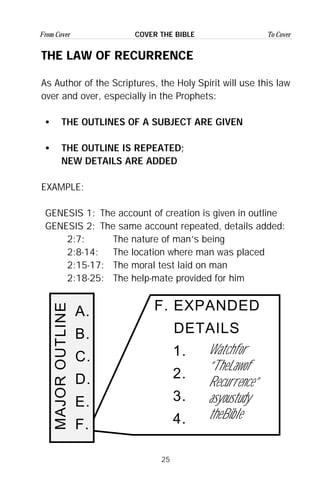
Dear reader, have you ever recognized the urgent responsibility
you must assume to reach unbelievers in your personal “world”
for Christ?
If you do not bring them to Jesus, do you think someone will
come to do it for you?
300
From Cover To CoverCOVER THE BIBLE
2
Suggestions for
marking
your Bible...
1. Copy the outline into your Bible.
2. Write beside Acts 15:20:
The sacredness of
the blood is because
it is the source of life
and the source of
forgiveness for sin.
Sanctity of blood
remains for the Gentiles, too!
3. Write beside Acts 16:27:
(Or put an asterisk beside it and write on the bottom
of the page as a footnote...)
In Roman law, if
a prisoner escaped,
the guard who was
responsible for the
prisoner was required
to serve the sentence,
even if it meant death.
4. Add any other notes from the explanations which you
now wish to preserve in your Bible.
301
From Cover To CoverCOVER THE BIBLE
Unit Thirty Four
THE BOOK OF ROMANS
OUTLINE
NOTE:Forthispreciousbook,youwillbegiventhemajorheadings,
but NOT the references showing the beginning and ending
of each section. Dig it out for yourself, and grow another level
in your Bible study. (Estimated time to do so: one hour or
less!)
PROLOGUE: 1:1-17
Salutation: ________
Personal Testimony: ________
Theme Introduced: ________
DOCTRINAL SECTION: 1:18-11:36
God’s Holiness in condemning sin: 1:18-3:20
The guilt of mankind: ________
The revelation of God to all men: ________
The steps of rebellion against His
revelation:_____
To judge others is to condemn self: ________
God is no respecter of persons: ________
The Jew and the law: ________
What advantage has the Jew?: ________
There is none righteous: ________
God’s Grace in justifying sinners: 3:21-5:21
Righteousness through faith: ________
Abraham’s justification: ________
The promise realized through faith: ________
Results of justification: ________
Sin through Adam; salvation through Christ:_____
302
From Cover To CoverCOVER THE BIBLE
God’s Power in sanctifying believers: 6:1-8:39
Freedom from sin’s power: ________
Christians are under grace, the Spirit’s “law:”
_________
The law and sin: ________
The problem of indwelling sin: ________
The struggle of two natures: ________
Life in the Spirit: ________
More than conquerors: ________
God’s Sovereignty in saving Jew and Gentile—
9:1-11:36
The Jew and the Gospel: ________
Zeal but no righteousness: ________
Righteousness is by faith in Christ: ________
The remnant of Israel: ________
Salvation has come to the Gentiles: ________
The Gentiles are warned: ________
The restoration of Israel: ________
The almighty God: ________
PRACTICAL SECTION: 12:1-15:13
God’s Glory, the object of service: ________
Consecration of Christians: ________
Practical Christian Service: ________
Honor authority: ________
Walk in love: ________
Conduct and the weaker brother: ________
Christ, the only Judge: ________
Unity in Christ: ________
The Gospel to the Gentiles: ________
EPILOGUE: 15:14-16:27
Personal notes: ________
Benediction and Doxology: ________
303
From Cover To CoverCOVER THE BIBLE
AUTHOR
Paul, written during his third missionary journey.
DATE
56 A.D., 11 years before his death by beheading in Rome.
James Stalker in The Life Of St. Paul writes,
THEME
GOD’S SALVATION FOR SINNERS
Paul was condemned and delivered over to the
executioner. He was led out of the city with a crowd
of the lowest rabble at his heels. The fatal spot
was reached; he knelt beside the block; the
headsman’s axe gleamed in the sun and fell; and
the head of the apostle of the world rolled down
in the dust. So sin did its uttermost and its worst.
Yet how poor and empty was its triumph!...ten
thousand times ten thousand welcomed him in the
same hour at the gates of the city which is really
eternal. Even on earth Paul could not die...in ten
thousand churches every Sabbath ...his eloquent
lips still teach that gospel of which he was never
ashamed. (p. 143)
304
From Cover To CoverCOVER THE BIBLE
FIRST
FURLOUGH
THE LETTERS OF PAUL
SITUATION
LETTERS WRITTEN
DURING THIS PERIOD
FIRST
MISSIONARY
TRIP
NONE
GALATIANS
SECOND
MISSIONARY
TRIP
1 THESSALONIANS
2 THESSALONIANS
THIRD
MISSIONARY
TRIP
1 CORINTHIANS
2 CORINTHIANS
ROMANS
HEBREWS (?)
FIRST
IMPRISONMENT
EPHESIANS
COLOSSIANS
PHILEMON
PHILIPPIANS
RELEASE 1 TIMOTHY
TITUS
FINAL
IMPRISONMENT
2 TIMOTHY
If you would like more information about the life of
Paul, see the extensive article in the ZONDERVAN
PICTORIAL ENCYCLOPEDIA...
305
From Cover To CoverCOVER THE BIBLE
PAUL’S CONTRAST OF
ADAM AND CHRIST
ADAM CHRIST
BROUGHT SIN AND
DEATH INTO THE
WORLD
BROUGHT RIGHTEOUSNESS
AND ETERNAL LIFE
INTO THE WORLD
REASON:
Desired to be like God
REASON:
God’s desire for men
to be reconciled
RESULTS:
Condemnation—
Upon himself
Upon all men
Eternal judgment
upon all men
RESULTS:
Justification—
immediate,
imputed.
Eternal life for
all who believe
THE LAW GIVEN
TO REVEAL THE
DEPRAVITY OF
MAN’S HEART
GRACE GIVEN
TO REVEAL THE
LIMITLESS LOVE OF
GOD FOR MAN
THE IMPACT OF
ADAM’S ACT:
Spread to all
who would ever
be born from
his seed
THE IMPACT OF
JESUS’ ACT:
Made salvation
available to all
who would ever
confess
“Jesus is Lord!”
306
From Cover To CoverCOVER THE BIBLE
NOTES
THE BOOK OF ROMANS, SUMMARIZED...
The writer of Romans neatly summarizes this book in Galatians
3:22-29. It’s an interesting passage to read after you have
digested this book.
DO ALL MEN HAVE AN EQUAL OPPORTUNITY
TO KNOW GOD?
Yes! According to Paul (1:18ff), God has revealed all of his
character and attributes through the creation He made. Indeed,
the very purpose of creation is to reveal Him! Thus, all men
in all generations have had equal access to the truth that there
is a God.
HAVE ALL MEN EQUALLY REJECTED THAT KNOWLEDGE?
Yes! Paul says (1:21ff) men have equally recognized God’s
presence, and have all rejected the obvious call to become
His servants. Having “eliminated” God from their thinking,
they began to create manufactured gods of their own
(v.23).
WHY DID GOD “GIVE THEM UP?”
Because they gave Him up! The staircase of depravity is revealed
for us (1:24ff), and we see the degrading of the dignity and
worth of man taking place.
WHO WILL WITNESS AGAINST EACH MAN?
According to 2:1-16, each individual’s conscience will testify
that the knowledge of God was deliberately scorned!
307
From Cover To CoverCOVER THE BIBLE
WITHOUT EXCUSE!
That’s what Paul’s conclusion is! The Jew had the Law to remind
him how short he fell from God’s righteousness. The Gentile
had the Law written in his heart, even though he had never
read it with his eyes. Therefore, all men everywhere are without
excuse.
TESTIMONIES FROM TWO WHO EXPERIENCED
JUSTIFICATION CENTURIES EARLIER…
Abraham (4:1ff) was saved by faith. His faith caused
righteousness to be “imputed” to him. ("Imputed” is to add
something to someone’s account.) Paul indicates Abraham
was saved before circumcision, not after it! (Compare Genesis
15:6 with 17:24.)
David (4:6ff) was forgiven by God’s “imputing” righteousness
without works (4:6). No sin offering in the Levitical system
could forgive, or cover, the sins of adultery and murder—both
of which David committed! By throwing himself upon the mercy
of God, he bypassed the law and became the subject of God’s
grace.
JUSTIFICATION SUMMARIZED…
In 5:1-21, we are told that we have peace with God through
Jesus Christ. Note that there is no other way for man to have
peace with God! It is not offered by any world religion. It is
not available by living a good life. It is not available by joining
a church. It is not available by being active in a church. It
is only available through the activity of Jesus Christ! Has
that truth clearly lodged in your heart and your mind?
308
From Cover To CoverCOVER THE BIBLE
PEACE WITH GOD!
In chapter 5, Paul begins verse 1 with the pronoun “we.” He
is now writing to those who are believers, and will discuss
details about our Christian walk.
This is not a small fact for you to digest!
There are those who seek to make chapter 7 a reference to
unbelievers, and not to believers. This violates the very integrity
of Paul’s letter. Back here in chapter 5, he begins to discuss
details of the Christian walk for us. From now on, this book
discusses our life in Christ.
FIND AND UNDERLINE CHAPTER FIVE’S
“MUCH MORE’S”
As you do so, your heart will sing worship songs to your God!
It’s one of the beautiful self-studies in this great book of
Romans.
THE MEANING OF BAPTISM...
In 6:1, we discover that baptism is a means of identification
of the believer with the death, burial, and resurrection of our
Lord. Note that it does not bring salvation—the blood of Christ
does that—but it does bring witness to that salvation.
KING SIN AND KING JESUS AND YOUR THRONE ROOM
In 6:12ff, we are told that we have one throne and two
masters...the old “King Sin,” which reigned freely for so long,
and the new “King Jesus,” now come to be Lord. This passage
deserves careful study and meditation. Note that you are not
free from the presence of that old nature. That comes later...at
His coming or at your death.
309
From Cover To CoverCOVER THE BIBLE
IT’S TIME NOW TO SET YOU FREE TO COMPLETE THE STUDY
OF ROMANS ON YOUR OWN!
In chapter 7, the war between the two natures is described.
In chapter 8, the liberty that is ours in Christ is outlined. Then,
in chapters 9-11, Paul deals with the Jew. In chapter 12, he
speaks to us again, and tells us a little bit about the spiritual
gifts which God has given to those in the church, the body
of Christ. Beginning in chapter 13, he presents clear teaching
about ethical issues we will face in our daily walk. Chapters
14 and 15 present a very important discussion about the
responsibility of the “stronger” Christian toward the “weaker”
one. Chapter 16 is not a chapter to “skip” because of all the
names and the local greetings. In fact, it has much meat in
it.
HIGH DRAMA IN ROMANS 16:15...
In 95 A.D., Rome was shocked when its two most out—standing
citizens were condemned for becoming Christians. Flavius
Clemens was the Consul of Rome; he was put to death for
his faith. His wife, Domatilla, was of royal blood, a niece of
the Emperor Domitian. She was, therefore, spared—but banished
to the island of Pontia, where she lived her life in isolation.
Their two sons were both in line as heirs to the throne of
Rome!
How did the Gospel penetrate their chambers, and enter their
hearts?
History tells us their chamber-slave was...
NEREUS!
310
From Cover To CoverCOVER THE BIBLE
2
Suggestions for
marking
your Bible...
1. Copy the outline into your Bible.
2. Write beside Romans 1:16-17:
Key verses of Romans
3. Write beside 16:11:
“household”—such persons
so designated were slaves
of the person named. A
large number of the names
in this chapter refer to
slaves who were believers.
4. Add any other notes from the explanations which you
now wish to preserve in your Bible.
311
From Cover To CoverCOVER THE BIBLE
Unit Thirty Five
1 CORINTHIANS
2 CORINTHIANS
OUTLINE OF 1 CORINTHIANS
INTRODUCTION
Opening statement—1:1-9
DISORDERS REPORTED TO PAUL
Division at Corinth—1:10-4:21
Church Discipline—5:1-13
Judicial Entanglements—6:1-8
Immorality—6:9-20
PROBLEMS RAISED BY THE CORINTHIANS
Marriage—7:1-40
Meat Offered to Idols—8:1-10:33
MORE DISORDERS REPORTED TO PAUL
The Woman’s Position and Covering—11:1-16
Factions Within The Church—11:17-19
Abuses related to the Lord’s Supper—11:23-34
The use of spiritual gifts—12:1-31
THE EXCELLENCE OF LOVE—13:1-13
THE IMPORTANCE OF EDIFICATION
Prophecy a Superior Gift—14:1-11
Purpose of Cell Groups: Edification—14:12-19
Instructions to the Church—14:20-40
THE RESURRECTION OF CHRIST—15:1-58
THE OFFERING
The collection for the saints—16:1-4
Personal plans—16:5-12
CONCLUSION
Exhortations—16:13-24
312
From Cover To CoverCOVER THE BIBLE
2 CORINTHIANS
INTRODUCTION
Salutation—1:1-2
Paul’s affliction—1:3-14
THE CHANGE OF PLAN
An explanation of the change of plan, Part 1—1:15-2:13
The Christian Ministry—2:14-6:10
Led in triumph—2:14-17
Ministry of the New Covenant—3:1-18
Encouragement in difficulty—4:1-5:10
The motive and the message—5:11-21
Appeal to the Corinthians—6:1-7:4
An explanation of the change of plan, Part 2—7:5-16
THE OFFERING FOR THE JERUSALEM CHURCH
Presentation of need—8:1-8
Christ the example—8:9
Message on stewardship—8:10-24
God loves a cheerful giver—9:1-15
PAUL’S DEFENSE OF HIS AUTHORITY
Spiritual warfare—10:1-6
Painful rebuke—10:7-15
Paul’s suffering as an Apostle—10:16-33
Paul’s “thorn in the flesh”—12:1-10
Paul’s Apostleship demonstrated—12:11-13
A third visit planned—12:14-18
Paul seeks repentance from the Corinthians—
12:19-21
CONCLUSION
Paul speaks of his coming; warns of sin—13:1-10
Benediction—13:11-14
313
From Cover To CoverCOVER THE BIBLE
AUTHOR
Paul, as validated by 1:1 in each book.
DATE
1 Corinthians
Paul wrote this letter between 54 A.D. and before the
Spring of 57 A.D. 2 Corinthians was written 6 months later.
In 50 A.D., Paul reached Corinth on his second missionary
journey, staying 18 months (Acts 18:1-8). The first letter Paul
wrote them has been lost (5:9). In 5:9-11, Paul heard they
had misunderstood some things he had said, and that there
were divisions in the church (1:11). He had received three
questions from them (7:1), and wrote the letter known as
First Corinthians to answer them. At the time, Paul was in
Ephesus (16:8), near the end of a three-year stay there (Acts
20:31), and before his departure for Macedonia (16:5, Acts
20:1).
2 Corinthians
After writing 1 Corinthians, Paul visited Corinth (13:1), which
was a painful experience involving discipline (2:1-6). Paul then
wrote “The Sorrowful Letter” (2:4), which is lost.
Titus carried this letter to Corinth, bringing good news to Paul
when they regrouped in Macedonia (7:6-8). In relief, Paul wrote
2 Corinthians in October of 57 A.D., following the Macedonian
and Jewish civil new year, which began in September (8:10).
314
From Cover To CoverCOVER THE BIBLE
THEME
1 Corinthians— Various problems in the church, some moral,
some doctrinal. The book is a treasure house of doctrinal teaching
on practical subjects.
2 Corinthians— Paul had been criticized by some at Corinth
for not visiting as promised. He explains why his plans changed,
describing his ministry. He discusses the collection for the
saints at Jerusalem. He defends his authority because some
had opposed him in the church there.
NOTES
THE CITY OF CORINTH
Located on an isthmus. Ships were unloaded on each side
of the isthmus, goods transported across it, and reloaded
on other ships. Meanwhile, sailors revelled in Corinth, filled
with prostitutes who served the Goddess Aphrodite. A wild
and wicked city!
THE CORINTHIAN LETTERS
Muchspeculationabouttheseletters,basedoninternalevidence,
has been written. How many letters were there, and how were
they written? Here is one view:
(From The Criswell Study Bible:)
• FIRST LETTER—Lost (1 Corinthians 5:9)
• SECOND LETTER—1 Corinthians
• THIRD LETTER— Called “The Painful Letter;” Lost
(See 2 Corinthians 2:4)
• FOURTH LETTER—2 Corinthians
315
From Cover To CoverCOVER THE BIBLE
IMPORTANT THEMES IN THESE LETTERS
Carnality
Stewardship
The Lord’s Supper
The Gifts of the Spirit
The Resurrection of the Dead
Marriage
Church Order
The Kingdom of Christ
316
From Cover To CoverCOVER THE BIBLE
Why God Permits Weaknesses
The Ministry of the Spirit
Adiaphora (Doubtful Things)
Christian Liberty
THE CORINTHIAN CHURCH
Paul seemingly had nothing but headaches with this group
of believers! To describe them, the one word “carnal” is used.
The Greek word is sarkikos. As you pronounce it, it is a gutteral
sounding word, isn’t it? The word originated from the description
of a bird of prey finding and eating the rotted flesh of a dead
animal!
If you will scan the book of 1 Corinthians, the shocking problems
of this church will become visible. Incest, pride, factions, class
divisions, immorality, doctrinal errors, and more are revealed!
In addition to all else, these Christians had taken spiritual
powers (called “gifts”) and misused them. Their pride had
caused them to use their gifts as private toys.
317
From Cover To CoverCOVER THE BIBLE
SOME HELP WITH “SPIRITUAL GIFTS” IN THE BIBLE
TWO TYPES:
• SIGN GIFTS
Miracles
Healings
Tongues
Interpretation
• SERVICE GIFTS
Different levels:
1. Basic Gifts
a. Serving
b. Giving
2. Ministry Gifts
a. Faith
b. Helping Others In Distress
c. Discerning True and False Spirits
3. Equipping Gifts
a. Prophecy (Forth-telling, not “Fore-telling”)
b. Teaching
c. Putting Deepest Knowledge Into Words
d. Paraclete (Counselor)
e. Wisdom
Our gifts are given to us. Most important of all, gifts are not
for private enjoyment, but are rather spiritual capacities to
be poured out in service. Therefore, if we are not serving, there
is no reason to expect we will have any use of our gifts. They
are not to be stored up, but poured out. Hebrews 5:12-14,
along with Hebrews 6:11-12, indicate that our gifts may not
develop at all because of carnal immaturity and spiritual
sluggishness. According to 1 Corinthians 14, the primary purpose
of gifts is for the edification of others in the Body. Thus, unless
and until the church is a “Basic Christian Community” of
8-15 people (a “cell group”), gifts cannot be effectively used.
(See my book Where Do We Go From Here?)
318
From Cover To CoverCOVER THE BIBLE
THREE TYPES OF PEOPLE: 1 CORINTHIANS 2:14-3:3
There are three Greek words used in this section to describe
three types of persons:
PSUKIKOS PEOPLE
The word PSUKIKOS is found in 2:14, translated “the man
without the Spirit” in the NIV. Other translations simply call
this person the “Natural” man. Here is described a person
who is spiritually dead, rejecting truth about God. Note the
person is deaf. This person has a heart problem, hates God,
avoids Him, and is “far away” from interest in spiritual
things.
SARKIKOS PEOPLE
The word SARKIKOS is found in 3:1, translated “worldly,”
or “men of flesh.” This person is a believer, but living a
disobedient, self-directed existence. Where the PSUKIKOS
person rejects, the SARKIKOS person rebels against Christ’s
Lordship. They have a value problem, and use God for their
own ends. They are uncomfortable to be too intimate with
Christ. Like the Hebrew people in Moses’ day, they feel most
comfortable when someone else gets close to God and comes
to tell them about it. These are Christians who live in the bondage
of sin, and fight an inner war between their own desires and
those of their rightful Lord and Master.
PNEUMATIKOS PEOPLE
The word PNEUMATIKOS occurs in 2:15, and is translated
“spiritual.” These persons receive the word of God, are alive,
open, listening, and used by God.
319
From Cover To CoverCOVER THE BIBLE
SPIRITUAL GIFTS ARE GOING TO BE FOUND AMONG
PNEUMATIKOS PEOPLE!
They do not belong to unbelievers. They are given only to those
who are the children of God.
They will have no value or worth to those who are “carnal,”
who are God’s disobedient children. What would they do with
them? They would use them for personal enjoyment! They
are not given for this purpose, but for the activity of God flowing
through those who desire to do His will in all things.
Thus, spiritual gifts—while latently endowed in all believers
at the time of conversion—will not be significant until the
“battle within” is settled, and the believer is ready to engage
in God’s battles!
Every single Christian is to receive and use spiritual gifts as
a part of life in the cell group. Gifts will vary with the ministry
to be performed. Christ will provide that spiritual power which
is required for His work to be done.
You are not to wait until you “feel” a gift coming on you. A
gift is to be exercised, not felt. When you face a situation
where you know Christ wants to use you, with boldness expect
the gift to be present to do His work. For example, if someone
needs healing, there is no reason why you cannot pray for
this to be done. Let your gift of faith be strong enough to expect
the healing to take place. After all, you know it doesn’t depend
on you or your power, but His—so step out in faith and pray
for the healing. God always gives His best to those who trust
Him most!
320
From Cover To CoverCOVER THE BIBLE
2
Suggestions for
marking
your Bible...
1. Copy the outline into your Bible.
2. Write beside 1 Corinthians 13:1:
The Greatest Thing
In The World: Love!
3. Write beside 2 Corinthians 9:8:
God’s Economy—
Circulation of what
He entrusts to us!
4. Add any other notes from the explanations which you
now wish to preserve in your Bible.
321
From Cover To CoverCOVER THE BIBLE
Unit Thirty Six
THE BOOK OF GALATIANS
OUTLINE OF GALATIANS: “PASSPORT TO FREEDOM”
PROLOGUE
Opening statement—1:1-4
GALATIAN PROBLEM DEFINED
Paul labels them deserters—1:5a
False gospel defined—1:5b-7
Curse on heretic preachers and adherents—1:8-10
PAUL DEFENDS HIS APOSTLESHIP
Authority divinely received—1:11-12
Pharisaic background chronicled—1:13-14
Paul’s commission—1:15-16a
Taught by the Spirit—1:16b-17a
Early missionary history—1:17b-24
JERUSALEM APOSTLES APPROVE PAUL’S MESSAGE
Divine Revelation—2:1-2
Titus compelled to be circumcised—2:3-5
Paul directed to the Gentiles—2:6-10
PAUL REBUKES PETER
Peter’s problem reviewed—2:11-14a
Peter openly criticized—2:14b-15
Paul champions faith—2:16-21
322
From Cover To CoverCOVER THE BIBLE
GRACE VS. THE LAW
Appeals to their experience—3:1-5
Appeals to Abraham’s experience—3:6-7
Abrahamic prophecy—3:8-9
The curse of the Law—3:10-13
The promise of the Spirit—3:14-16
The Law vs. the Covenant—3:17-23
The Law as a tutor—3:24-25
Spiritual seed of the covenant—3:26-29
THE FULNESS OF TIME (KAIROS)
Heirs, yet slaves—4:1-4
Adoption as sons—4:5-7
Regression to slavery—4:8-11
PERSUASIONS AGAINST BONDAGE
Appeals to their initial faith—4:12-16
Denounces Judaistic intentions—4:17-18
States his perplexity—4:19-20
Allegorical: Ishmael and Isaac—4:21-27
Allegory explanations—4:28-31
JUSTIFICATION BY FAITH
The Law a slave yoke—5:1
They cannot have both!—5:2-3
Choice: Law or grace—5:4
Faith through the Spirit—5:5
Faith through love—5:6
A curse on Judaistic legalism—5:7-12
FREEDOM NOT A LICENSE TO SIN
Rather serve one another—5:13
Love your neighbour—5:14
Consume not one another—5:15
323
From Cover To CoverCOVER THE BIBLE
WALKING IN THE SPIRIT
Precludes walking in the flesh—5:16
The Spirit/flesh wars—5:17,18
The deeds of the flesh—5:19-21
The fruit of the Spirit—5:22,23
Believers crucifying the flesh—5:24-26
HELPING THE SINNING MEMBER
Restoring in gentleness—6:1
Bearing one another’s burdens—6:2
Objective self-examinations—6:3,4
Bearing and sharing burdens—6:5,6
SOWING AND REAPING
God is not mocked—6:7a
We reap what we sow—6:7b, 8
Steadfast laboring—6:9,10
CONCLUSION
Written in Paul’s own hand—6:11
Final blast at Judaizers—6:12-15
Exhortation to walk as new creatures—6:16-18
AUTHOR
Paul, as validated by 1:1 and other personal references.
DATE
Approximately 48 A.D.; certainly before the Jerusalem conference
in 49 A.D. (Acts 15), which supported Paul’s position as detailed
in this book.
324
From Cover To CoverCOVER THE BIBLE
THEME
Almost immediately behind Paul’s missionary journey to the
Galatians had come Judaizers attempting to undermine both
Paul’s apostleship and his message of Christian freedom.
Paul writes this biting, yet compassionate letter to defend
his apostleship (as divinely received) and to attack the very
foundation of the Judaizers’ legalistic, bondage doctrine. Clearly
he offered the Galatians and Christendom, for all time, a simple
alternative: Law, or Christ. There could be no mixture, no
compromise. Either live under the Law and obey every edict
(which is impossible), or live under the grace of God through
His son, Jesus Christ. The principle is:
“No Jesus, No Grace!”
Historically, he shows that the Law was not opposed to
Christianity, but was a preparation for the Gospel. It kept the
Jews under guardianship until “the fullness of time.” However,
that “fullness” had arrived in the person of Jesus, and every
person was now confronted with that fact.
NOTES
GALATIA
The term “Galatia” was one used both geographically and
politically. In this letter, it is most likely referring to South
Galatia, the area covered in Paul’s first missionary journey
(47-48 A.D.). This territory would have included Lycaonia, Phrygia,
and a portion of Pisidia, in which existed Antioch, Iconium,
Lystra, and Derbe.
325
From Cover To CoverCOVER THE BIBLE
The Galatians were originally a torrent of barbaric peoples
who poured into and across Asia Minor in the Third Century
B. C. They were tough, aggressive, and extremely volatile. In
no time they conquered the province, levying tribute on local
kings and cities. Caesar Augustus conquered the province
and it became a part of the Roman Empire.
These people had little traditional religion. They apparently
adopted the superstitions and pagan mythologies of the Greeks.
Paul introduced the Gospel to this people and, true to their
historic nature, they readily accepted the faith. Shortly thereafter,
Jerusalem Judaizers followed Paul. They preached a false
doctrine, which the Galatians again accepted readily. This
prompted Paul’s amazement and perplexion (see 3:1).
SETTING
Push had come to shove!
In the fifteen years since Jesus ascended, a fundamental issue
had arisen. It threatened to permanently alter the form and
content of Christianity:
Would the church be a separate entity, or exist as a sect within
Judaism?
326
From Cover To CoverCOVER THE BIBLE
The early Christians, mostly Jewish converts, were beginning
to approach church doctrinal matters through Jewish traditionalist
perspectives. True, Jesus was the Messiah. True, he came
to establish His church.
Judaism was the religion from which Christianity and Christ
Himself came. Both had been established by Jehovah. Could
it be possible that a combination, a mixture of both, would
be in order? Let Christ be the deity to be mixed with Judaistic
worship. Why not mix a little freedom and a little Law? The
welcome mat would thus be spread before the Gentiles by
Israel—but it would be a conditional welcome.
Circumcision and legal observation of existing Jewish feast
days would be required. After all, were not all the Apostles
circumcised, and Paul, too? Was there any Christian law against
celebrating certain special Jewish occasions?
Into this issue stepped an uncompromising, brilliantly logical
Paul. He saw only too clearly what Jesus had warned His disciples
about, time and time again: “A little leaven leavens the whole
lump.” No easier could new wine be poured into old wineskins
than could Jesus’ new teachings be poured into the old wineskins
of Judaism.
The doctrinal question was LIBERTY versus BONDAGE. The
underlying issue was the structure and content of the Christian
faith. Paul knew this as did no one else around him! He wrote
this crucial letter not only to discredit the Judaizers, but also
to set forth once and for all time what the Christian faith was,
and what it was not!
Today’s church struggles with much the same issue. Tradition
within the church has smothered the “new wine” of God’s
Spirit. Many who love the systems of “churchianity” are seeking
to pour new wine in the old wineskins of churches which are
rigid in their commitment to existing structures. Old wineskins
never have held new wine!
327
From Cover To CoverCOVER THE BIBLE
IMPACT
Almost immediately following this letter, the Jerusalem Council
convened to ratify Paul’s message. They decreed that Gentiles
were not to be forced to become partial Jews. Peter was to
later say that Paul wrote scripture.
The Judaizers never forgave Paul. He had dealt them a death
blow from which they never recovered.
Ironically, years later, the issue of works was to again raise
its legalistic head. Again and again the church would wrestle
with this problem. Fifteen centuries later, Martin Luther wrote
his commentary on Galatians as a battering ram against the
Catholic Church. Today, over nineteen centuries later, the
battle still goes on. It is hard for man to accept the fact that
NOTHING he accomplishes or does can give him “merit” to
deserve special treatment by God.
KEY WORDS IN THIS LETTER
(CAN YOU FIND AND UNDERLINE EACH ONE?)
• LAW—31 times
• FLESH—18 times
• SPIRIT—15 times
• FAITH—22 times
• BONDAGE, or related words—11 times
328
From Cover To CoverCOVER THE BIBLE
THE KEY WORD OF THE ENTIRE LETTER
It is liberty, used eleven times. This word is used more in this
one letter than in all his other letters combined!
THE NATURE OF THE BOOK
As you read through this document, notice that there is not
a single word of praise, commendation, or thanksgiving.
There is not a single request for prayer. There is no mention
of their standing in Christ, as in Ephesians. Paul is upset!
He has absolutely no tolerance for legalism, and he shows
it in this writing.
MARTIN LUTHER’S FAVORITE BOOK
In 1517, Luther was fighting the legalistic system of the church.
This book of Galatians became his favorite volume in the entire
Bible. His Commentary on Galatians remains to this day as
the best treatise in print.
Luther realized that not only is a sinner saved by grace through
faith, but that a saved sinner also lives by grace! Grace is
not only the way we are saved; it is also our way of life from
that time forward.
329
From Cover To CoverCOVER THE BIBLE
WHAT WAS…
PAUL’S SECRET?
330
From Cover To CoverCOVER THE BIBLE
2
Suggestions for
marking
your Bible...
1. Copy the outline into your Bible.
2. Write beside Galatians 2:20:
Paul’s “great secret”—
CHRIST IN ME!
3. Write beside Galatians 6:14:
In that cross I receive
all God has for me!
4. Add any other notes from the explanations which you
now wish to preserve in your Bible.
331
From Cover To CoverCOVER THE BIBLE
Unit Thirty Seven
THE BOOK OF EPHESIANS
OUTLINE OF EPHESIANS: “HIS VERY OWN”
PROLOGUE: 1:1-2
PART 1: STANDING...
...As His CHILDREN
Father chooses, adopts, will accept—1:3-6
Son purchases, enlightens, will inherit—1:7-12
Spirit saves, seals, will claim—1:13,14
(PRAYER: 1:15-21)
...As His BODY
Christ the Head—1:22a
Church the body—1:22b-23
Quickened by the grace of God—2:1-10
Made one by the blood of Christ—2:11-17
Given access by the one Spirit—2:18-19
...As His BUILDING
The foundation—2:20
Built together—2:21-22
The household of God—3:1-13
…As His MYSTERY OF THE AGES
The temple in the Lord—3:6
…As He REMOVES ALL PARTITIONS
Paul’s assignment to the Gentiles—3:7-10
Done according to an eternal plan—3:11-13
(PRAYER: 3:14-21)
332
From Cover To CoverCOVER THE BIBLE
PART 2: WALKING...
...Worthily as a BODY
One Body (inward), with stature of Christ—4:1-16
New Man (outward), with fruit of Spirit—4:17-32
In love (upward), imitators of God—5:1-20
...Heavenward as a FAMILY
Wives and husbands—5:21-33
Children and parents—6:1-4
Servants (slaves) and masters—6:5-9
PART 3: WARRING...
...Finally, FACING THE FOE
Strength (inward) in Christ—6:10
Armor (outward) of God—6:11-17
Petition (upward) in the Spirit—6:18-20
EPILOGUE—6:21-24
AUTHOR
Paul, as validated by 1:1, 3:1, etc.
DATE
This is one of Paul’s “Prison Epistles,” along with PHILIPPIANS,
COLOSSIANS, and PHILEMON. The date of the letter would
be about 60-61 A.D., written from Rome. His time in prison
permitted him the time to develop the meticulous outline of
this powerful letter.
333
From Cover To CoverCOVER THE BIBLE
THEME
Our position in Christ and our responsibilities in Christian
living.
NOTES
• ROMANS is God’s message to the NATURAL man.
• 1, 2 CORINTHIANS, GALATIANS are God’s messages to
the CARNAL man.
• EPHESIANS, PHILIPPIANS, and COLOSSIANS are messages
from God to the SPIRITUAL man.
DESTINATION OF LETTER
“...at Ephesus” is omitted in some manuscripts. It has long
been believed this was a circular letter, addressed to the churches
of Asia Minor as a whole, and circulated from church to church.
Each church would insert its own name in the salutation as
it was read locally. Since Ephesus was the chief city in Asia
Minor, it is not unusual that other manuscript copies would
bear the name of this city.
SEVEN SIGNIFICANT WORDS IN EPHESIANS
GRACE
Occurs 13 times. The key word in the book. (Can you find
and underline each time the word is used?)
SPIRITUAL
Also occurs 13 times. It speaks of the sphere of life in which
we are living.
334
From Cover To CoverCOVER THE BIBLE
HEAVENLIES
Occurs 5 times (1:3, 20; 2:6; 3:10; 6:12). It is a plural noun
in the Greek.
“Places” is not in the original: it is “In the Heavenlies.” It
references the “fourth dimension” of life. In these realms
called the Heavenlies dwells every spiritual blessing. There,
Christ is seated at God’s right hand. Christians are seated
there with Him. Angelic beings are there, learning the wisdom
of God from the Church. It is also there that Christians war
against spiritual hosts of wickedness!
MYSTERY
Occurs 5 times (1:9; 3:3, 4, 9; 5:32). It is a crucial word in
Paul’s writings. It refers not to something “mysterious,” but
rather a secret God reserved until it was time to reveal it.
That time has now come. The mystery concerns the church
and God’s eternal purposes centering in her.
BODY
Occurs 8 times. It refers to the fact that we who are the “church”
are the literal body of Christ on this earth! In this fact is found
our position in Christ (ch. 1-3), and from this fact flow the
duties of Christian living (ch. 4-6).
WALK
Also occurs 8 times. If the BODY is what we are, WALK is
what we must do—and always in a manner worthy of Him
who is the Head.
335
From Cover To CoverCOVER THE BIBLE
IN
Occurs 93 times in English, 89 times in Greek. It is the most
used word in the book! It parallels John 15. Our life is IN Christ,
IN union with Him, to be lived IN the unity that this relationship
implies.
THE MANY “THREES” OF EPHESIANS
• Father, Son, Holy Spirit
• Past, Present, Future
• Natural, Carnal, Spiritual
Watchman Nee’s Classic Outline...
SIT - WALK - STAND
In his lovely commentary on this book, Nee points out that
in the first three chapters of this book there is absolutely nothing
for the believer to do! He is “seated” with Christ in the heavenlies.
Our position is beautifully described.
First, we were selected before the foundation of the world,
predestined to be chosen in Christ. Note this selection was
made before we merited it by performing some good deed!
Next, we were given an inheritance in Christ, and provided
with the indwelling Holy Spirit as the “down payment” on
it.
Then, God seated Christ at His right hand in the heavenly
places, putting all things under His control. He then gave His
Son a new body…the church. If you are a Christian, you are
a part of the body of Christ. He lives in you, and your reason
for being alive is to be a container for Him!
336
From Cover To CoverCOVER THE BIBLE
Paul then reminds us what “life in the tomb” was like for us,
when previously we were dead in trespasses and sins. It seems
the stark contrast between what we are and what we were
is provided as a setting for the next great truth: we, too, along
with Christ, are seated in the heavenly places.
In 2:10, we are described as His workmanship, with a special
reason for our existence: the Godly activity He prepared for
us before our existence.
Again, he contrasts what we were as PSUKIKOS people with
what we are as PNEUMATIKOS people. Paul is hammering
home the point that we have been brought near by the blood
of Christ, not by some deed of our own.
Then, Paul adds another thought. Christ is our peace, and
He has united both Jews and Gentiles into “one body” through
the cross. There is no separation between us any more. We
are all built together into a dwelling of God in the Spirit. That
“dwelling” is a body—Christ’s body—the church.
PAUL’S MYSTERY...
In Galatians, we were introduced to Paul’s great secret—
Christ is IN us, the hope of a glory which is still to come. Now,
he adds to his secret a mystery. He points out in 3:5 this
was a hidden truth until God revealed it to him. That marvelous
mystery is that Gentiles are fellow-heirs, along with Jews, of
the inheritance Christ purchased for mankind on the cross.
Chapter 3 ends with one of the most beautiful prayers in the
Bible—one many Christians have memorized.
337
From Cover To CoverCOVER THE BIBLE
CHAPTERS 4 AND 5: “WALK”
The fourth chapter begins with Paul’s reminder that he is writing
to us as a “prisoner” of the Lord. Actually, you remember
he wrote this while in Rome, incarcerated by the government.
He discusses the walk of the believer. No longer “seated,”
the activity of Christ’s body on earth is outlined.
This chapter points out the unity which should exist among
the members of the Body of Christ. Underline the number
of times the word “one” appears.
As a human body knows no competition or struggle among
its members, so should the body of Christ flow with oneness
and directed actions. As the bones of the hand perform different
functions for the body than the bones of the foot, even so
have each of us been given our “gifts” to operate effectively
within the Body of Christ.
Remember…these “gifts” have nothing to do with physical
“talents.” They are the spiritual powers which exist within
us for no better reason than that Christ Himself dwells in us,
and we are His body. He fills all things, including us, and he
gives these gifts to men by giving Himself to dwell within
them.
GIFTED MEN GIVEN TO EQUIP THE GIFTED…
In our generation, the role of “prophets,” “evangelists,” and
“pastor-teachers” has been severely distorted. We see the
“prophet” as a special person who is to be heard. We see
the “evangelist” as a special person who is to be heard. We
view the “Pastor-teacher” as a special person who is to be
heard, and who is to marry, bury, counsel, etc.
338
From Cover To CoverCOVER THE BIBLE
Perhaps no passage reveals the drift of the church in this
generation as does 4:11ff! The significance of these offices
within the church is made very clear: their job assignment
is “to prepare God’s people for works of service...” This is
not understood or practiced by the church as we know it today.
Instead, these men become “hired holy men” to do the work
of God under the sponsorship of the “laymen” who assume
lesser positions and too often become a “backup system”
for the clergy.
Note that the clergy are the equippers and all the members
of the Body of Christ are the ministers! The work of the clergy
is to equip the ministers, not to do the ministry for them. The
reason verse 16 is virtually unknown today is because the
body has not been properly cared for, and is unable to function
in its separate parts. Today’s religious systems are simply
not Biblical. They are encrusted with years of traditions, and
many who wish to “protect their turf” continue to propagate
the church as a campus with buildings, programs, and agendas
that virtually end at the parking lot!
To verify the tragedy of this, note that scores of surveys of
Pastors and Church Staff members admit they have no
unchurched friends. Rarely do they have close fellowship with
anyone who is not in a position of church leadership. We have
made the church a “closed society,” an island of religious
activity within a secular society.
How can we possibly excuse this default? The “church” is
the “body of Christ!” Jesus spent practically no time in the
Temple (except to use whips in it!). How dare we claim that
a series of programs which occur on a church campus is the
work of the “body of Christ?”
Chapter 4 describes the place where the Body is to be ministering:
among those who are “darkened in their understanding.”
We are to “speak truth” in their midst.
339
From Cover To CoverCOVER THE BIBLE
TO CORRECT A THIEF: 4:28
To correct a thief, let him work with his hands. A thief knows
the price of things stolen (tin is never taken; gold is selected!),
but does not know the value of anything. Working with the
hands corrects the problem!
MORE ABOUT THE WALK: CHAPTER 5
Paul contrasts the church with the relationship existing between
a husband and a wife—and gives us the Christian view of
marriage.
CHAPTER 6: “STAND”
Finally, Paul deals with the warfare of the Christian. Note that
the armor which is worn is all defensive. We simply stand
upon ground claimed by Christ’s act on the cross.
Note also that “in the heavenly places” there are also battles,
and conflict with the Devil. Do you believe in a personal devil?
If you have not settled that issue, you may be sure the Evil
One laughs every time your name is mentioned! While some
have gone overboard into demonism, no one is more “overboard”
than Christians who deny the reality of Satan and his demonic
forces. Ephesians 6 refers to a real world—and you live in
it.
340
From Cover To CoverCOVER THE BIBLE
2
Suggestions for
marking
your Bible...
1. Copy the outline into your Bible.
2. Write beside Ephesians 1:3:
“In heavenly places”—
The sphere of spiritual,
not physical, activity.
3. Write beside Ephesians 4:12:
We are ALL ministers!
4. Add any other notes from the explanations which you
wish to preserve in your Bible.
341
From Cover To CoverCOVER THE BIBLE
Unit Thirty Eight
THE BOOK OF PHILIPPIANS
OUTLINE OF PHILIPPIANS, “THE JOY WAY”
INTRODUCTION: 1:1-2
PART 1: PAUL’S THANKSGIVING AND PRAYER
Thanksgiving—1:3-7
Prayer—1:8-11
PART 2: PAUL’S SITUATION IN ROME
Imprisonment and opposition—1:12-18
Expectation of deliverance—1:19-26
PART 3: PAUL’S EXHORTATIONS
To steadfastness—1:27-30
To meekness and unity—2:1-4
PART 4: PAUL’S SUPREME EXAMPLE
The humiliation of Christ—2:5-8
The exaltation of Christ—2:9-11
The “working out” of salvation—2:12-18
PART 5: PAUL’S MESSENGERS TO THE CHURCH
Timothy—2:19-24
Epaphroditus—2:25-30
PART 6: PAUL’S WARNING AGAINST HERESIES
Judaism—3:1-14
Carnality and lawlessness—3:15-19
342
From Cover To CoverCOVER THE BIBLE
PART 7: PAUL’S ENCOURAGEMENTS TO THE BODY
Our new bodies—3:20-21
Stand fast—4:1
Be of the same mind—4:2
Minister to the ministers—4:3
Rejoice—4:4
Moderation in all things—4:5
Promise that prayer brings peace—4:6-7
PART 8: PAUL’S LOOK INTO THE THOUGHT LIFE
The thought patterns of joy—4:8
Follow Paul as a model—4:9
PART 9: APPRECIATION FOR THE GIFT
Appreciation expressed—4:10
Contentment is a choice—4:11-14
Loving gratitude for missionary support—4:15-20
EPILOGUE—4:21-23
AUTHOR
Paul, with Timothy in his company.
DATE
A “Prison Epistle.”
The date of the letter would be about 61-62 A.D., written from
Rome. Read Acts 28:16-31 for Luke’s report of those two
years of imprisonment.
343
From Cover To CoverCOVER THE BIBLE
THEME
Paul had two themes in writing this book. One was PERSONAL;
the other was to TEACH.
The financial support received from this Body of Christ was
gratefully received by Paul, and he wrote this letter to thank
them for it.
He dealt with the event of Christ’s coming to earth in the
most powerful of terms as he added teaching to the thanks...and,
along with it, expressed his own views toward death. Perhaps
he knew how quickly the Caesar of those hours could decide
to snuff out his life!
NOTES
A LOOK AT PHILIPPI
Philippi was a city in the Province of Macedonia. It is about
10 miles inland from the coastal town of Neapolis (see Acts
16:11-12). Philippi was located on the Egnatian Way, a major
overland route of Macedonia.
Note that Epaphroditus was sent back to Philippi from Rome:
he would have journeyed over the Appian Way across Italy,
then 80 miles by boat across the Sea of Adria, and then the
Egnatian Way to Philippi.
This city became a Roman Colony in 42 B.C., and was a miniature
Rome. It was exempt from taxation, because it was a military
defense center. About 200,000 people lived there in Paul’s
time, mostly Greeks. Note Acts 16:13, where Paul held his
first evangelistic meeting in the city.
344
From Cover To CoverCOVER THE BIBLE
THE CHURCH IN PHILIPPI
When Paul wrote this letter, the church was about 10 years
old. You may recall that the first converts included Lydia, a
seller of purple dye, and the town jailer (Acts 16). This church
is considered the birthplace of European Christianity. The church
was made up of Greeks, with some converted Jews. Their
organization included bishops and deacons (1:1).
EPAPHRODITUS
LIFE AFTER DEATH
345
From Cover To CoverCOVER THE BIBLE
THE STEPS OF OUR LORD FROM HEAVEN TO EARTH AND
BACK
THE STEPS OF PAUL FROM SELF PRIDE TO REALITY
346
From Cover To CoverCOVER THE BIBLE
NOTES
THE THREE ASPECTS OF SALVATION: 1:6
There is a past tense to our salvation first mentioned in this
verse. Christ “has begun” a good work in us...and that points
us back to the cross, the beginning place of our salvation.
There, we were released from the penalty of sin.
There is a present tense to our salvation. Christ will “carry
it on...” This continuing aspect of our salvation refers to the
the daily activity of Christ within us, as He sets us free from
the power of sin.
There is a future tense to our salvation: “...to completion until
the day of Christ Jesus.” (Do you remember our previous study
about the term “the day of Christ?”) In the future, Christ will
not only set us free from the penalty and the power of sin,
but also will release us from the presence of sin.
While there are those who seek to teach us we may, at this
present time, attain sinlessness, the scriptures do not sustain
this view. Such a teaching has skirted around the edges of
Christian teaching for centuries. Don’t be deceived by this
doctrine! You have an old nature and a new nature, and you
will continue to have them both until that final day of our
redemption. One teacher even goes so far as to say 1 John
1:9 is not for the Christian—that it is written for unbelievers.
Such a distortion to prove a doctrine wrenches the verse totally
out of its context!
Foolish Galatian Christians and carnal Corinthian Christians
help us realize sinless perfection is not verifiable.
347
From Cover To CoverCOVER THE BIBLE
PAUL’S RESPONSE TO FACTIONS IN
THE CHURCH IN ROME...
Poor Paul! He had longed to visit Rome. His long letter to the
church there has blessed centuries of Christians. But the church
itself did not have the purity it should have had, and some
within it were jealous of Paul. His reputation somehow clouded
theirs, they thought, and when he finally arrived in the city,
they delighted in his incarceration.
In 1:12ff, Paul sees this group of people through loving eyes.
He admits that some are preaching Christ from envy and strife.
Nevertheless, he rejoices that Christ is being proclaimed!
He seems to be saying to us, “The Lord can hit a pretty good
lick with a crooked stick!”
Those who demand perfection from others in ministry usually
have a spiritually neurotic personality. Whatever God does
with any of us, He must do in spite of us. Paul picks his fights
carefully. One fight he avoids is with those not worth battling.
He knew that “the main thing was to keep the main thing the
main thing.”
HAVEYOUNOTICEDTHECONTRASTSPAULINSERTSBETWEEN
BELIEVERS AND UNBELIEVERS?
In nearly all of his writings, Paul references the PSUKIKOS
people, who live in rebellion against God, and reminds his
readers that they used to be a part of that community. In
Philippians 3:18ff, he again touches upon the condition of
the unbelievers.
Sin leaves a swollen place in every life it stings. It is that painful
area we focus upon when we bring the Gospel to them. That’s
why our message is “good news.”
348
From Cover To CoverCOVER THE BIBLE
HAPPINESS IS A CHOICE!
In Paul’s final chapter, he points out that happiness is not
something we receive; it is something we choose. Note the
eightfold path he outlines which will bring us happiness:
1. Have a gentle spirit—v. 5
Some folks get out of bed and put on boxing gloves. Letting
the world know yours is a gentle spirit will create an inner
peace. “You tell the size of a man by the size of what it takes
to get his goat.”
2. Have no anxiety—v. 6
Anxiety is a very serious emotion, which has physical symptoms.
These include hyperventilation, sweating, nervousness, weeping
profusely, etc. It is the result of deep fear. Those who feel
they are controlled by circumstances, and that they have no
control of what will happen to them, are victims of anxiety.
The solution is clearly given. It is prevailing prayer! When we
realize our Lord is in charge of all there is, we can then relax
in the assurance that He—not circumstances—will control
what happens to us.
3. Let God guard your thought life—v. 7
Satan is no fool. He knows he can slip into your subconscious
and plant fear within you! Letting God guard thoughts
is crucial.
4. Meditate on positive thoughts—v. 8
This verse is well worth memorizing!
349
From Cover To CoverCOVER THE BIBLE
5. Focus on Godly behavior—v. 9
Each time we choose a certain form of behavior, we generate
happiness or sorrow from it. Only fools believe they will find
happiness in practicing behavior out of keeping with Christ’s
Lordship.
6. Divert attention from yourself to others—v. 10
Instead of focusing upon himself, Paul speaks words of
commendation to the Philippians. Folks who dwell on their
own need, problems, or accomplishments don’t collect much
joy from the experience, do they?
7. Make a job out of being content—v. 11
Enjoy the half of the glass that is full, rather than complaining
about the half that is empty.
8. Remember the twofold activity in all I do—v. 13
When I do all things through Christ, how can I avoid being
happy? How can I be anything else but happy?
350
From Cover To CoverCOVER THE BIBLE
2
Suggestions for
marking
your Bible...
1. Copy the outline into your Bible.
2. Write beside Philippians 1:3:
All 3 aspects of Salvation
are in this verse!
3. Write beside Philippians 4:13:
Note: 2-fold responsibility:
Mine and Christ’s
4. Add any other notes from the explanations which you
wish to preserve in your Bible.
351
From Cover To CoverCOVER THE BIBLE
Unit Thirty Nine
THE BOOK OF COLOSSIANS
OUTLINE OF COLOSSIANS: “CHRIST IS ALL, AND IN ALL”
INTRODUCTION: 1:1-2
PART 1: PAUL’S THANKSGIVING AND PRAYER
Thanksgiving—1:3-8
Prayer—1:9-14
PART 2: PAUL’S DOCTRINE OF THE PERSON OF CHRIST
His divine person—1:15-20
His reconciling work—1:21-23
PART 3: PAUL’S PART IN GOD’S PLAN
Rejoicing in suffering—1:24
Proclaiming the word—1:25-29
Concern for the saints—2:1-5
PART 4: PAUL’S WARNINGS AGAINST FALSE TEACHING
Abide in the truth—2:6-7
Beware of man-made theories—2:8
The all-sufficiency of Christ—2:9-15
PART 5: PAUL EXPOSES A HERESY
The fallacy of the teachings—2:16-19
The folly of returning to bondage—2:20-23
The superiority of the Christ-life—3:1-4
352
From Cover To CoverCOVER THE BIBLE
PART 6: THE NEW MAN IN CHRIST
Vices to be put off—3:5-11
Graces to be put on—3:12-17
Family relations—3:18-25
PART 7: PAUL’S COMMENDATIONS
Commendation of his messengers—4:7-9
Greetings from friends—4:10-14
Greetings to friends—4:15-17
EPILOGUE—4:18
AUTHOR
Paul, once again with Timothy in his company.
DATE
A “Prison Epistle.” The date of the letter would be about
62-63 A.D., written from Rome.
THEME
About 6 years after this church was founded, an unspecified
but dangerous error crept into this congregation. Epaphras
visits Paul near the end of his imprisonment in Rome, and
shares the disturbing news that certain false doctrines and
practices threaten the faith of the Colossian Christians. They
are in danger of drifting from the truth (1:23, 2:8). Paul writes
to counteract these false teachings about the Person of Christ,
and to give encouragement to their walk.
353
From Cover To CoverCOVER THE BIBLE
NOTES
A LOOK AT COLOSSI
Colossi was one of the “tri-cities” of the Lycus Valley. The
area was about 100 miles inland from Ephesus. 500 years
before Christ, it was called “The Great City of Phrygia.” But,
by Paul’s time, it was a small town. When Paul wrote this
book, there was a Christian congregation meeting in all three
of the important regional “tri-cities”—Heirapolis, Laodicea,
and Colossi. The inhabitants were mostly Greeks and Phrygians,
with an unusually large Jewish community. The area was famous
for its soft wool.
THE CHURCH IN COLOSSI
From Colossians 1:3-4, some have concluded that the members
of the church were mostly strangers to Paul. Epaphras, who
possibly was one of the converts of Paul in Ephesus, might
have been the founder of the church (1:7), as well as the churches
in the other nearby cities (4:13). He was a key member in
the life of the congregation (4:12). Colossians 4:17 infers
that Archippus was the church’s pastor when Paul wrote the
epistle (see Philemon 2). The church met in the home of Philemon,
who was deeply devoted to its life (4:9 and Philemon 1, 5,
7).
354
From Cover To CoverCOVER THE BIBLE
LECTURE NOTES
THE MAIN THEME OF THE BOOK
THE HERESY IN THE CHURCH
WHAT DOES “CHRIST IN YOU” MEAN?
355
From Cover To CoverCOVER THE BIBLE
THE THREE ASPECTS OF SALVATION IN COLOSSIANS…
• Salvation past: 1:13
• Salvation present: 1:10
• Salvation future: 1:12
THE “COLOSSIAN FORCE”
In 1:16, we are told that all creation has occurred through
Christ and for Christ. In 1:17, Paul goes on to say, “in Him
all things hold together.” Within nuclear science, this has
spawned the term “Colossian Force,” used to describe the
unexplainable and mysterious force that keeps the
atoms—and the very universe—from flying apart.
THE DEITY OF CHRIST
The powerful affirmations of Paul in this book about our Lord
Jesus leave little to speculate about! Note 2:9-10. What more
are we looking for? When God gives Himself and He has no
more to give, some still wish for more proof from Him that
He loves us, and that we can be joined to Him.
MORE ABOUT OUR MINDS...
In 3:2, we are reminded that if we set our minds on the things
above, and not on the things that are on the earth, life will
take a new direction.
356
From Cover To CoverCOVER THE BIBLE
2
Suggestions for
marking
your Bible...
1. Copy the outline into your Bible.
2. Write beside Colossians 3:11:
This verse gives the
main theme of the book
3. Write as a footnote to Colossians 3:11:
Paul does not preach
a system or a philosophy,
but a person—Jesus Christ.
4. Add any other notes from the explanations which you
wish to preserve in your Bible.
357
From Cover To CoverCOVER THE BIBLE
Unit Forty
THE BOOKS OF
1 THESSALONIANS
2 THESSALONIANS
PHILEMON
OUTLINE OF 1 THESSALONIANS
INTRODUCTION: 1:1
PART 1: COMMENDATIONS TO THE THESSALONIANS
For their faith and steadfast labor—1:2-4
Word received with full conviction—1:5
Became imitators of Apostles and the Lord—1:6
Lived as Christian examples—1:7-9a
Turned from idols to God—1 :9b
Waiting for the coming of Christ—1 :10
PART 2: PAUL DEFENDS HIS CONDUCT
Coming was not in vain—2:1
Gospel proclaimed in boldness—2:2
Words were entrusted to Paul by God—2:3, 4
Delivered not with flattery or greed—2:5
Or from vain glory—2:6
But with gentleness and affection—2:7, 8
And hard labor—2:9
With devotion—2:10
Exhorting and encouraging as a father—2:11
So they might walk worthy of God—2:12
358
From Cover To CoverCOVER THE BIBLE
PART 3: PAUL’S CONCERN FOR THE CHURCH
Thanks God for the word received—2:13
Likens their sufferings to the Judeans—2:14a
Condemns the unrepentant Jews—2:14b-16
Blames Satan and Jews for his absence—2:17, 18
The Church his crown, hope, and glory—2:19, 20
PART 4: TIMOTHY’S VISIT
Timothy sent to strengthen and encourage—3:1, 2
Preparing them for afflictions—3:3-5
Timothy’s good report of faith and love—3:6
A real comfort to Paul in his afflictions—3:7
Stand firm in the Lord!—3:8
Prayer of intercession—3:9-13
PART 5: PAUL REJOICES and PRAYS FOR THEM
To walk and please God—4:1
By the authority of Jesus—4:2
Abstain from sexual immorality—4:3-5
Not to defraud their brothers—4:6
God called them to sanctification—4:7
Rejecting this word is rejecting God—4:8
Increase your brotherly love—4:9,10
Tend to your own business—4:11,12
PART 6: THOSE ALREADY DEAD TO BE RESURRECTED
Don’t grieve as those without hope—4:13
Belief in Jesus’ resurrection the key—4:14
Those alive at His coming—4:15
Those dead at His coming—4:16
Those alive “forcefully caught up”—4:17
Use this knowledge as comfort—4:18
359
From Cover To CoverCOVER THE BIBLE
PART 7: THE “DAY OF THE LORD”
Coming as a thief in the night—5:1,2
As the birth pangs of a pregnant woman—5:3
Brethren are not of the darkness—5:4,5
Stay alert, sober, faithful—5:6-8
God has destined you for salvation—5:9-10
Therefore, encourage one another—5:11
PART 8: PAUL EXHORTS THEM TO BROTHERLY LOVE
Esteem your church leaders—5:12,13
Admonish the unruly, help the weak—5:14
Repay not evil for evil—5:15
Rejoice always—5:17
Pray continuously—5:18
Quench not the Spirit—5:19
Despise not prophecy—5:20
Examine everything carefully—5:21
Abstain from evil—5:22
PART 9: PAUL’S CONCLUDING REMARKS
For their preservation at His coming—5:23
He is faithful and true—5:24
EPILOGUE—5:25-28
AUTHOR
Paul—as validated by 1:1 and multiple personal
references.
DATE
Approximately52A.D.Weknowtheyoungchurchwasestablished
on his second missionary journey (A.D. 51), and that this first
letter followed shortly after.
360
From Cover To CoverCOVER THE BIBLE
SETTING
Unbelieving Thessalonian Jews, angered by Paul’s many Jewish
converts, forced Paul to flee the city after he had been there
for about three weeks (Acts 17:2). Not content to just chase
him from their city, these Jews pursued him to Berea, 50
miles west, and again forced him to leave town. He then went
200 miles south to Athens.
FromAthens,aconcernedPaulsentTimothybacktoThessalonica
to determine how the young church was faring. Timothy made
the journey, catching up with Paul in Corinth with a most
heartening report. This first letter was sent in response to
that good report.
THEME
In many respects, this is a love letter. More than any of his
other letters, it is characterized by simplicity, gentleness,
affection, and intimacy.
Paul is genuinely pleased with the new church’s growth and
early maturity. Already they had become shining examples
of faithfulness and steadfastness in the face of persecution.
Gently, Paul admonishes them to remember how he came
to them with affection, hard labor, and devotion, exhorting
and encouraging them as a father. His earnest desire was
that they might walk worthy of God. He reminds them that
he had told them of their coming afflictions, and encourages
them to remain steadfast in their faith when the persecution
comes. He reminds them again that God will indeed deal
with those who persecute His people.
361
From Cover To CoverCOVER THE BIBLE
At that point, his letter takes a radical turn. He first pleads
with them to walk with God, to abstain from sexual immorality,
and not to be guilty of defrauding their brothers. He reminds
them that God has called them to sanctification (being set
apart as holy vessels), and that those who reject this word
are rejecting God Himself, who gave these words to Paul.
He encourages them to mind their own business, and to increase
in brotherly love.
Then, obviously responding to Timothy’s report of his stay
with them, he becomes their teacher. Their questions about
the return of Christ are answered. He tells them not to grieve
over those who have departed: they will be raised up first
when Christ returns. Those who are still alive will be “snatched
forcefully” from the earth, to meet them with Christ in the
air. Therefore, they are not to grieve as the pagans, who see
death as the end of relationships with their loved ones. Christ’s
return will come as a complete surprise to those who live in
the darkness. Their prior knowledge should shape the way
they will live out their lives.
NOTES
KEY VERSES IN 1 THESSALONIANS
4:16: Note 3 significant words:
“SHOUT”—given by the Lord as His resurrection command
to the church.
“VOICE”—the voice of the archangel Michael; signals a gathering
is taking place.
“TRUMPET”—in scripture, always signifies judgment.
362
From Cover To CoverCOVER THE BIBLE
5:3: NOTE...
“ ...Iike birth pangs upon a woman with child.”
This powerful prophetical statement is, in the scripture, always
used in conjunction with Jesus’ second coming and final
judgment. It describes the travail of a pain-filled creation that
is similar to childbirth pangs. That is, they start slowly, increasing
steadily in intensity and rapidity until the actual moment of
birth.
Most Bible scholars agree this accurately depicts the final
3 1/2 years of the “Great Tribulation,” when the Lord permits
the Antichrist to proclaim himself “god.” This momentous
blasphemy is the signal for the final countdown to Jesus’
second coming. Then, like a woman’s birth pangs, the world
scene gets continually more wicked. Sin spreads pain in all
directions! Jesus appears to herald a new order, a new birth.
His coming ushers in a thousand year reign, called the
“Millennium.”
THE “MEETING IN THE AIR”
AND THE “RETURN OF CHRIST”
363
From Cover To CoverCOVER THE BIBLE
OUTLINE OF 2 THESSALONIANS
INTRODUCTION
Thanksgiving and encouragement in their persecution
and affliction—1:1-2
God will repay those afflicting you—1:3-5
PART 1: THE DAY OF RETRIBUTION
When Jesus is revealed from Heaven—1:6-7
Delivering destruction to those who know not God
—1:8
Those banished forever from His presence—1:9
When He comes to be glorified—1:10-12
PART 2: CORRECTIONS CONCERNING “THE DAY OF THE
LORD”
Don’t be deceived: it has not come—2:1-2
First must come the “Apostasy”—2:3
The Son of Destruction will be revealed—2:3b-4a
Displays himself as God—2:4b, 5
The “Restrainer” removed—2:6-9
Perishing of the unbelievers—2:10
By delusion from God—2:11
For the unbeliever’s judgment—2:12
PART 3: SALVATION OF THE BELIEVERS
Through sanctification and faith—2:13
Called through the Gospel—2:14
Stand firm: be comforted and strengthened—2:15-17
PART 4: EXHORTATION TO PRAYER AND STEADFASTNESS
Pray for the rapid spread of the Gospel—3:1,2
The Lord is faithful and will direct you—3:3-5
364
From Cover To CoverCOVER THE BIBLE
PART 5: EXHORTATIONS TO DISCIPLINE
Keep aloof from unruly and undisciplined persons
—3:6,7
As we taught, be an example—3:8, 9
No work, no eat!—3:10
Quit being busybodies—3:11, 12
Don’t weary in doing good—3:13
Disassociate yourselves from dissenters—3:14
Admonish them as brothers—3:15
EPILOGUE
Peace and grace to you—in my own hand!—3:16-18
AUTHOR
Paul, as validated by 1:1 and numerous other personal references
throughout the book.
DATE
Approximately 53 A.D., certainly not too long after his first
letter.
SETTING
Paul hears that the first letter’s teaching concerning Jesus’
second coming has been misinterpreted by some of the church
members. Some, it appears, presumed that the “Day of the
Lord” was immediately at hand. Believing this, they were leaving
their employment, sitting around, doing little except becoming
busybodies and a general financial burden to the members
who were employed.
365
From Cover To CoverCOVER THE BIBLE
Upon hearing this news, Paul writes the second letter. This
time, the words are sterner and more urgent. Nevertheless,
his overall approach is one of deep love and praise, with a
generous portion of caution sprinkled in for appropriate
preventative measures.
Paul opens by thanking them for their increased faith and love
towards one another. He again mentions their steadfastness
in suffering, and reiterates that God will indeed repay their
tormentors with affliction, dealing out retribution to those
who knew Him not. He describes the awful price of eternal
destruction, separation forever from God’s presence and
glory.
Paul then focuses on the theme of his second letter: corrections
pertaining to their erroneous beliefs concerning the “Day of
the Lord.”
That day has NOT come, he says, and WILL NOT come until
(1) the “apostasy” comes; and (2) the Son of Destruction takes
his seat in God’s temple, declaring himself to be God. Further,
he explains, the “restrainer” must be taken away so that the
lawless one can be revealed—that is, the one who proceeds
from Satan with power, signs, and false miracles. These false
signs will be believed, Paul says, because God Himself will
send upon those unbelieving people a deluding influence so
that they might believe a lie, and be judged by their unbelief
of the truth and constantly enjoying perverted pleasures.
366
From Cover To CoverCOVER THE BIBLE
Paul insists that God has chosen them not for this awesome
destruction, but rather for salvation through sanctification
by the Spirit and faith in the truth. It was for this, he says,
that they were called. They are to stand firm in the truth and
the Lord will comfort and strengthen them.
Paul then closes his letter, directing his flock to steer themselves
away and remain aloof from any who lead unruly, undisciplined
lives. He reminds them of his own disciplined walk while among
them. He tells them that if any member of the flock will not
work, they are not to eat! Further, he adds, they are to
disassociate themselves from all who walk in this way, not
to the point of making them an enemy, but for brotherly
discipline.
NOTES
KEY VERSES IN 2 THESSALONIANS
1:10: “...when He comes to be glorified in His saints
on that day, and to be marveled at among all who
believe...”
Paul here plainly teaches that Jesus’ glory is in His saints;
that is, those who choose to follow Him and receive His Gospel.
We, who are by His grace, redeemed and given eternal life
are His glory. We, in turn, will absolutely marvel at Him “on
that day.” Nothing we can now comprehend in the ripest fertility
of our rich, God-given imaginations can prepare us for the
awesome glory of His coming or His appearance.
367
From Cover To CoverCOVER THE BIBLE
2:7: “...only he who restrains will do so until he is taken
out of the way.”
Bible scholars have for years debated over the identity of the
“Restrainer.” The earliest church fathers thought it was the
Roman Empire, which had for so long maintained law and
order. However, this was proven to not be so. Today, many
scholars point to the Holy Spirit as the Restrainer. However,
this teaching presents us with a dilemma: if the Holy Spirit
be removed, how can any person be saved? Unless we be
indwelled by the Holy Spirit, we plainly have no chance for
sanctification. Yet we know that during the tribulation, multitudes
will be saved. Today many are asking,“Why cannot the Restrainer
be the Church?” It is a case of reverse leavening, where we
who are the Church are the “yeast” in the “bread” of humanity.
It is the influence and prayer of the Christians that keep the
light in the midst of the darkness of unbelief. If the true Church
be raptured, what Godly influence will remain? Satan will,
at that point, have full reign.
Still, the Holy Spirit will linger, waiting for those multitudes
who, in the midst of the Great Tribulation, will see Satan and
the “Lawless One” for who they truly are. Again, the Spirit
will be waiting for the firm conviction of the Jewish remnant.
They will be jolted by the unfolding prophecy that has come
to pass in a most frightening fashion.
368
From Cover To CoverCOVER THE BIBLE
2:13:
“...God has chosen you from the beginning for salvation through
sanctification by the Spirit and faith in the truth.”
Here Paul refers to predestination. It is important that we
understand that when the Bible speaks of predestination it
does so in an ultimate sense of God’s foreknowledge of events,
choices, and decisions. It is crucial we understand the
significance of time to God and to us.
God knows no such thing as “time.” He Who has always been
and always will be, the Alpha and the Omega, is of infinite
existence. Therefore, the concept of time is to Him without
meaning.
It is we humans, trapped now inside the envelope of time,
to whom this concept is meaningful. In a sense, Adam invented
“time.” Without sin, he and we would live forever, and therefore
would not be subject to such a limiting concept. But with sin
came death, finite existence, and the entrance of “time.”
Now, all mankind is of limited duration.
A thrice Holy God, unable to even bear the sight of sin, has
no such limitation. Therefore, He sees at a mere glance what
was, what is, and what will be, because all are, to Him, all
in the present.
It is from this dual view of “time” that predestination is to
be understood. It does not mean that ages ago, before man
was created, God selected certain persons for salvation and
others for destruction. He simply knows who will, and who
won’t, be the “God Followers.” In that sense, predestination
is part and parcel of our existence.
369
From Cover To CoverCOVER THE BIBLE
Isn’t it amazing? Knowing that man would sin—knowing that
He would ultimately have to send His Son—still God elected
to create mankind! Doesn’t this fact fill you with wonder?
Doesn’t His grace appear, in this light, to be more awesome
than we can conceive? The very concept of predestination
should make us more appreciative of Him, our love deeper,
our wonder more intense. Is it any wonder that “in that day”
we will behold Him, and marvel?
OUTLINE OF THE BOOK OF PHILEMON
INTRODUCTION AND GREETINGS
From Paul and Timothy to Philemon—1:1
To Apphia and Archippus and the church in their
house—1:2
The “Apostolic Benediction”—1:3
PART 1: PAUL PRAISES PHILEMON: 1:4-7
PART 2: PAUL PLEADS WITH PHILEMON
By Christ’s authority speaks—1:8
For love’s sake pleads—1:9-12
Wanted to keep Onesimus—1:13
But not without consent—1:14
Onesimus’ parting providential—1:15-17
Charge any loss or wrong to Paul—1:18-19
Pleads for acceptance and obedience—1:20,21
PART 3: PERSONAL REQUESTS
Prepare a lodging—1:22
Sends greetings from others—1:23,24
Sends grace from the Lord—1:25
370
From Cover To CoverCOVER THE BIBLE
AUTHOR
Paul, as verified in 1:1.
DATE
Approximately 62 A.D., from a Roman prison.
SETTING
Onesimus, one of millions of Roman slaves, had stolen from
his master, Philemon, and had run away. Providentially,
his flight took him to Rome, where he was eventually led to
faith in Jesus Christ by Paul. Upon his conversion, he remained
with Paul, serving him. Now he has faced his Christian
responsibility of returning to Philemon and making
restitution.
What a dilemma! Here is Paul, confronted with a situation
tailored for explosion or exaltation. A slave (as are we to sin)
has stolen from his master (as we have from God), and has
run away (as have we). The slave Onesimus has become a
willing slave to Jesus, his new Master, and to Paul, his mentor.
THEME
Christian responsibility and restitution are clearly in order,
and it is to this issue this letter is addressed.
371
From Cover To CoverCOVER THE BIBLE
By Roman law, Philemon has the right to punish, even to put
to death, his slave (the just punishment of sin). Would Philemon
forgive the errant slave? Paul becomes the advocate (the
Holy Spirit’s role for us), pleading and persuading on behalf
of Onesimus. He writes to a man who is his close friend and
who has also been led to Christ by Paul. Thus, Paul finds
himself in the place of being an earthly redeemer, but with
the added problem of a redeemer trying desperately to serve
both this slave and his dear friend.
Paul begins his case by addressing the letter to Philemon
as a beloved brother and fellow worker. In addition, he also
sends the letter to the local church. (A little peer pressure,
perhaps!)
There is no hammer in Paul’s words: he is pleading. He explains
he could easily command Philemon, but wishes rather for
his decision to come from his own free will. It is a letter filled
with diplomacy and skill.
Note that Paul does not command or advise Philemon to get
out of the business of slavery. Slavery is not the issue. Receiving
a Christian slave as a brother is the real issue. The brotherhood
in Christ went beyond that of a slave/master relationship.
Would Philemon forgive his slave? Would he accept him as
a brother, even while he remained as a slave?
The message is sensitive, yet important to the Kingdom! In
Christ, there is neither bond nor free, rich or poor. Earthly
position or status is of no importance in a Kingdom in which
the greatest among us is the one who is a bondslave! With
these facts in mind, Paul offers to pay the slave’s debt himself.
372
From Cover To CoverCOVER THE BIBLE
ThisisPaul’smostpersonalsurvivingletter.Itshowshischaracter
and personality more clearly than any other letter. It also shows
his grasp of the eventual impact of such letters being distributed
among the young churches. The impact of it would help countless
others who face similar circumstances.
KEY VERSE IN PHILEMON
1:14: “...without your consent I did not want to do anything,
that your goodness should not be as it were by compulsion
but of your own free will.”
Ordering and commanding is easy, and there are times when
safety or timeliness is of such importance that commanding
or ordering is the only way to save a life, a soul, or someone
from what is beyond his comprehension. God uses both
commands and pleas. Clearly, He will always show us which
is best. Just as clearly, He tells us that (if necessary) we are
to jerk a brother out of the fire for the saving of his soul. God
is first a God of love. Those who choose to obey Him because
they love Him receive the greater rewards.
NOTES
373
From Cover To CoverCOVER THE BIBLE
IN RETROSPECT...
Paul’s helpful explanations to the Thessalonians clear up
many questions for us about the coming events of history.
We are more prepared than ever to move shortly into the book
of Revelation, which details the events of the end times.
Let us not miss the important stress made by Paul again and
again as he wrote these letters: the time is short, and this
is a time to live each day in the light of His soon coming.
In these times, we are observing world powers move in uncanny
ways to take the positions predicted for them by the holy
scriptures. Russia moves closer and closer to her final destiny
as the dark force of Satan in the end times. China has come
alive with international prominence after being a nonentity
for millennia.
Do you realize the importance of using this time of personal
Bible study to become equipped for your own personal ministry?
It’s an urgent time. We can ill afford to know more and more
about the Bible, and be less and less involved in the redemption
of our neighbors, our relatives, and our friends.
If these Bible books in Unit 40 make any sense at all, we
must realize that the shortness of the days requires longer
and longer outreaches of love to the lost!
374
From Cover To CoverCOVER THE BIBLE
2
Suggestions for
marking
your Bible...
1. Copy the outline into your Bible.
2. Write beside 1 Thessalonians 4:14-17:
This is another evidence
that the early church knew
no form of church life except
the house church.
3. Write as a footnote to 1 Thessalonians 5:1-11:
The Second Coming of
Jesus Christ, separated
from the Rapture by
7 years.
4. Add any other notes from the explanations which you
wish to preserve in your Bible.
375
From Cover To CoverCOVER THE BIBLE
Unit Forty One
THE BOOKS OF
1 TIMOTHY
2 TIMOTHY
TITUS
GROUP SETTING EPISTLES DATE MAIN SUBJECTS PURPOSES
Travel
Epistles
Prison
Epistles
Pastoral
Epistles
Between
1 & 2
Journey
2 Journey
3 Journey
First
Roman
Imprison-
ment
Release
2 Roman
Imprison-
ment
Galatians
1,2 Thess.
1,2 Corin.
Romans
Colossians
Ephesians
Philemon
Philippians
1 Timothy
Titus
2 Timothy
48
52
55
56
61
62
67
SALVATION
PAST,
PRESENT,
FUTURE
THE INDWELLING
CHRIST AND
THE LIFE OF
THE CHRISTIAN
THE
CELL CHURCH
AND ITS
WORKERS
Evangelizing
Edifying
Establishing
Personal
Farewell
TO
INDIVIDUALS
TO
CHURCHES
OUTLINE OF 1 TIMOTHY
PAUL GREETS TIMOTHY—1:1-2
PART 1: TRUE AND FALSE MINISTRY—1:3-20
Warning against false doctrine—1:3-7
The law and the Gospel—1:8-11
Paul’s thankfulness for mercy—1:12-20
376
From Cover To CoverCOVER THE BIBLE
PART 2: INSTRUCTIONS FOR CHRISTIAN WORSHIP
—2:1-15
Paul exhorts to prayer—2:1-8
The place and dress of women—2:9-15
PART 3: THE QUALIFICATIONS OF BISHOPS AND
DEACONS—3:1-13
Qualifications of Bishops—3:1-7
Qualifications of Deacons—3:8-13
PART 4: THE REASON FOR WRITING—3:14-16
Paul hopes to see Timothy—3:14-16
PART 5: ERROR AND ITS ANTIDOTE— 4:1-16
Predictions of apostasy—4:1-5
A good minister of Jesus Christ—4:6-16
PART 6: THE TREATMENT OF WIDOWS, ELDERS, ETC.
—5:1-6:2
Instructions concerning widows—5:1-16
Duty of elders—5:17-25
PART 7: THE TRUE and FALSE TEACHER CONTRASTED
—6:1-21
Warning against false teachers—6:1-10
The good fight of faith—6:11-21
AUTHOR
Paul, as validated by 1:1 and multiple personal references
DATE
Approximately 62 A.D.
377
From Cover To CoverCOVER THE BIBLE
SETTING
Paul, having been released from his first imprisonment in
Rome, is instructing his beloved associate Timothy. The subject
is how to deal with church problems in Ephesus.
THEME
Paul had left Timothy in Ephesus (1:3) to deal with problems,
the greatest one being FALSE DOCTRINE (1:3). Note the attacks
made by Paul in 1:4, 7, 19, and in 4:1-3, 7, along with
6:3-5. This is a deeply personal letter. His comments about
church leadership and structures are vital to our understanding
of how the church is to operate.
NOTES
TIMOTHY: A MAN AFTER GOD’S OWN HEART!
Timothy was a native of Derbe (Acts 16:1, 20:4). His name
means “Honoring God” or “Honored by God.” He was the son
of a Gentile father and a Jewish mother (Acts 16:1,3). His
mother was Eunice, his grandmother Lois (see 2 Tim. 1:5).
Paul was 30-35 years old when Timothy was born, causing
him to treat Timothy as he would a son (1 Tim. 4:12).
From childhood, Timothy had been taught scripture by his
mother (2 Tim. 1:5, 3:14-15). Timothy’s Gentile father evidently
did not stand in the way of this training.
Timothy and his mother probably were converted when Paul
visited Derbe (Acts 14:6-7, 20-21). As we study 1 Corinthians
4:14-17 and 1 Timothy 1:2, we may surmise Paul led Timothy
to Christ as a young man, evidently in his late teens.
378
From Cover To CoverCOVER THE BIBLE
On the second missionary journey, Timothy was
recommended to Paul as an associate (Acts 16:1-2). He was
then circumcised. He was also set apart for ministry (see
Acts 16:3-5, 1 Tim. 4:14). He served as Paul’s assistant,
doing many tasks, both significant assignments and simple
“housekeeping” tasks (Acts 19:22, 1 Thess. 3:1-2). He served
Paul while he was in prison in Rome (Phil. 1:1, Col. 1:1, Philemon
1, Hebrews 13:23). Tradition (not the Bible) tells us Timothy
was martyred under Emperor Domitian or Nerva.
THE CHURCH AT EPHESUS
The congregations at Ephesus were 5-8 years old when Paul
wrote 1 Timothy. Timothy had a full-time job, helping leaders
of the various congregations fulfill their ministry. Paul, anticipating
a long delay before he could get back there (3:14-15), wrote
this letter of instruction.
KEY THEMES
SOUND DOCTRINE
PUBLIC WORSHIP
• Prayer
• Place of women
CHURCH OFFICERS
• Bishops
• Deacons
PASTOR/CONGREGATION RELATIONSHIPS
• Church and widows
• Church and elders
• Slaves and masters
379
From Cover To CoverCOVER THE BIBLE
OUTLINE OF THE BOOK OF TITUS
Greeting—1:1-4
Qualifications of Elders (Bishops)—1:5-9
Warning against false teachers—1:10-16
Domestic relations—2:1-10
The Christian life—2:11-15
Christian citizenship—3:1-2
The basis of the Christian ethic—3:3-8
The disciplining of factious men—3:9-11
Personal plans and greetings—3:12-15
AUTHOR
Paul, as verified in 1:1.
DATE
Approximately 62 A.D., from Rome
SETTING
Paul’s young associate, Titus, is the recipient. Unlike his fellow
worker Timothy, he was all Gentile. He served at Corinth and
Crete. He had a strong and stern personality. He is not mentioned
in Acts. He accompanied Paul and Barnabas to the Jerusalem
Council in Acts 15 (See Galatians 2:1-4). He was Paul’s
representative in Corinth during Paul’s third missionary journey
(2 Cor. 7:6, 13-14), and collected money for the poor (2 Cor.
8:6, 16, 23). He was also Paul’s representative to the churches
in Crete after Paul was released from his first Roman
imprisonment (1:4-5). He also had a ministry at Dalmatia
(2 Tim. 4:10).
380
From Cover To CoverCOVER THE BIBLE
THEME
The theme of the book focuses upon proper relationships
within the developing church. This “pastoral” letter speaks
to pastors (1:5-9); the ethics of believers (2:1-10); the return
of Christ (2:11-14); and, finally, the nature of salvation
(3:3-7).
NOTES
ABOUT CRETE:
The towns of Crete were heavily populated. Morally and socially,
Cretans had a bad reputation, as evidenced by the comment
of Epimenides quoted by Paul in 1:12. Leonides said, “The
Cretans are always brigands and piratical, and unjust.”
SIGNIFICANCE OF BOOK:
1 Timothy and Titus are sometimes called “Twin Epistles.”
The book of Titus gives significant insights into the doctrine
of God. He is shown as manifesting His word (1:3), revealing
His grace (2:11) and His kindness (3:4).
381
From Cover To CoverCOVER THE BIBLE
OUTLINE OF THE BOOK OF 2 TIMOTHY
Personal Greeting—1:1-2
Thanksgiving for Timothy—1:3-5
Exhortation to endurance—1:6-18
A good soldier of Jesus Christ—2:1-13
Advice on personal conduct and relationships—2:14-15
People and situations to avoid—2:16-26
Difficult times to come—3:1-13
The central place of scripture—3:14-17
Exhortation to preach the word—4:1-5
Paul’s hope—4:6-8
Personal concerns—4:9-22
AUTHOR
Paul, as validated by 1:1 and numerous other personal references
scattered through the material.
DATE
Approximately 67 A.D., months or even weeks prior to his
death.
SETTING
Paul was released from the imprisonment recorded in Acts
28:30. He then travelled to Ephesus (1 Tim. 1:3), Crete (Titus
1:5), Nicopolis (Titus 3:12), Miletus (4:20), and Troas (4:13).
He returns to Rome as a prisoner (1:16-17). As he writes,
he sees his death as very near (4:6-8).
THEME
This letter, Paul’s last, gives his final words of instruction
and encouragement to Timothy, who had a tendency to be
timid (1:7-8, 2:1). He again warns about false teachers.
382
From Cover To CoverCOVER THE BIBLE
NOTES
1:6—Laying on of hands: Timothy is told to “stir up the charisma”
(grace gift), a Spirit-given enablement for ministry. His usefulness
began at the time he was set apart by Paul to be an equipper
of the believers. This gift was bestowed by the laying on of
hands. This was the symbolical act used by churches when
setting apart (making holy) a person for ministry. In this way,
the churches recognized the presence of the gifts of the
pastor-teacher.
2:2—THE EQUIPPING PATTERN
383
From Cover To CoverCOVER THE BIBLE
SOME THOUGHTS ABOUT MODERN DISCIPLESHIP...
Do we grow to go, or do we go to grow?
In today’s way of thinking, young Christians should be matured
before they are sent to minister. Thus, we have cloistered
discipleship groups. Folks learn to memorize a hundred verses,
outline their Bible six ways, take sermon notes three ways,
and pray five ways. After their “quiet time” is fully developed,
some think it might be time to reach out to the unreached
persons around them.
The problem is that this form of discipleship has created a
group of scholarly Christians who know more about discipleship
methods than about people who hurt, and how to help
them!
Jesus never gave his disciples a notebook. He never had a
classroom. He walked with them for miles, constantly showing
them how to heal, how to pray, how to love, how to react to
evil.
Paul never gave his men a discipleship course. He took them
to Cyprus, to Crete, to Athens, to riots, and to tough situations,
but he never took them to a classroom.
Our generation believes you grow to go.
The New Testament pattern is to go to grow.
Cell Group Churches follow that pattern. For that reason, a
vital part of your cell group life is reaching out to others through
visitation and through Share Groups. (For further information,
see my book “Where Do We Go From Here?”)
384
From Cover To CoverCOVER THE BIBLE
2
Suggestions for
marking
your Bible...
1. Copy the Outline into your Bible.
2. Write beside 1 Timothy 3:16:
These 6 phrases are
a quotation from an
early hymn.
3. Write as a footnote to 2 Timothy 3:16:
Literally, “All
scripture, because it
is God-breathed, is
profitable...”
4. Add any other notes from the explanations which you
wish to preserve in your Bible.
385
From Cover To CoverCOVER THE BIBLE
Unit Forty Two
THE BOOK OF HEBREWS
OUTLINE OF HEBREWS
THEME ESTABLISHED: 1:1-3
FIRST SECTION: INSTRUCTION: 1:4-9:28
(WHAT HAVE WE?)
Christ, greater than the Angels—1:4-14
FIRST WARNING SECTION: 2:1-4
How shall we escape, if we neglect
so great salvation?
Christ, our Redeemer—2:5-18
Christ, greater than Moses—3:1-6
SECOND WARNING SECTION: 3:7-4:13
Harden not your heart, as in the provocation...
Christ, our High Priest—5:1-10
THIRD WARNING SECTION: 5:11-6:20
Leaving the principles, let us go on
unto perfection...
Christ, Priest after the order of Melchizedek—7:1-10
Christ, Priest superior to Aaron—7:11-28
Christ’s Priesthood summarized—8:1-5
Christ’s New Covenant—8:6-13
Old and New Covenants contrasted—9:1-14
Christ’s sacrifice establishes the New Covenant
—9:15-28
The failure of the Old Covenant—10:1-18
386
From Cover To CoverCOVER THE BIBLE
SECOND SECTION: EXHORTATION:
10:19-13:25 (HAVING THEREFORE...LET US)
A plea to hold to the new faith—10:19-25
FOURTH WARNING SECTION: 10:26-31
It is a fearful thing to fall into the hands of the
living God
Remember the former days—10:32-39
What is Faith?—11:1-40
Run the race—12:1-2
God’s discipline necessary—12:3-11
Walking a straight path—12:12-17
FIFTH WARNING SECTION: 12:18-29
See that you refuse not Him that speaketh
Workings of Faith—13:1-17
Benediction—13:18-25
AUTHOR
The book of Hebrews is anonymous. Many believe its authorship
is Paul (see Hebrews 13:19, 23-24). Because its authorship
is so uncertain, Martin Luther placed it at the end of Paul’s
writings and at the beginning of the General Epistles. Thus,
it can “fall” into either category. It is not necessary to know
its authorship to know its true writer is the Holy Spirit! It is
one of the most profound of all New Testament books.
DATE
Since Clement quoted from it in 96 A.D., it cannot be later
than that date. However, it seems the Jewish sacrificial system
was still functioning (7:8, 8:4, 10:1, 2, 8, 11). If so, no date
later than the time of the Destruction of Jerusalem will suffice
(70 A.D.).
387
From Cover To CoverCOVER THE BIBLE
Because the writer seemed to be presenting his materials
to “second generation” Christians, a date of 85 A.D. is also
possible. Those who see an earlier date would place it about
65-69 A.D. As with the authorship, its date is really unimportant
to us as we glean truth from it.
SETTING
The earliest manuscripts have the title Pros Hebraious (“To
Hebrews”) for the title. From the internal study of the book,
we learn that it was written to a single congregation of Hebrew
Christians, living in a segment of the Roman world (2:3,
5:11-12, 6:9-10, 13:23-24). Some think it was written to the
church in Jerusalem.
The readers were in a backslidden condition, in danger of
apostasy and departure from the faith. Faith was waning
(3:6-14); prayer, public worship, and even basic Bible study
were being neglected (2:1, 10:25, 12:12-13). In 5:12, their
infant-like state is described.
One of the reasons for their condition was the threat of
persecution. They had earlier withstood severe persecution
(10:32-34), but now were beginning to weaken before it.
THEME
The purpose of the book is to rekindle embers which are burning
low! Dullness of hearing was an alarming condition. The writer
carefully alternates between TEACHING and WARNING sections
(see outline).
In a glorious declaration of truth, Jesus Christ is exalted as
being greater than all, our only hope, our High Priest, and
above all, the Son of God.
388
From Cover To CoverCOVER THE BIBLE
NOTES
HEBREWS IS A COMMENTARY ON THE PENTATEUCH
Hebrews has been called the New Testament’s “Commentary
on the Pentateuch,” especially the Book of Leviticus. There
are 86 direct references to the Old Testament scriptures,
traceable to at least 100 passages. This book explains the
significance of Old Testament rituals in the light of Christ’s
coming. The numerous ceremonial laws, the sacrifices, the
Priesthood—all are explained as nothing more than “shadows”
of Christ. He becomes, for the New Covenant, the Sacrifice,
the Priest, and the true Mediator between God and man.
All the TYPES of the Old Testament are revealed as foreshadowing
the coming Christ. Hebrews has sometimes been called “The
Fifth Gospel,” because it tells of Jesus’ finished work on earth
and His continuing work in Heaven.
KEY PHRASES TO THINK ABOUT AS YOU READ...
“What have we...?” (1:1-7:28)
Found in 8:1, this phrase helps us focus on what we
have in our Lord Jesus Christ.
“We have...” (8:1-10:18)
Also found in 8:1, we have a High Priest! But the emphasis
is on the word “such!”
“Having, therefore, let us...” (10:19-13:25)
This phrase is found in the section listed above.
389
From Cover To CoverCOVER THE BIBLE
NOTE THESE CONTRASTS IN THE BOOK:
• Son and Angels—1:4-2:4
• Son and Moses—3:1-6
• Canaan rest and God’s rest—3:12-4:13
• Christ and Aaron—4:14-5:10
• Spiritual infancy and maturity—5:11-14
• Apostasy and faithfulness—5:11-6:20
• Old and New Covenants—8:1-13
• Offerings of the Law and of Christ—9:1-10:18
• Faith and sight—11:1-40
• Mount Sinai and Mount Zion—12:18-29
CHRIST...
• The Son of God—1:1-2:4
• The Son of Man—2:5-4:13
• The High Priest—4:14-10:18
LET’S WALK THROUGH “THE FIFTH GOSPEL...”
Matthew, Mark, Luke, and John tell us all about the life of
Jesus from the time of His birth until His resurrection. In Acts,
we see Him ascending into Heaven. Paul has told us He is
dwelling within us now, that we are literally His new body on
this earth, and that He consequently carries on His work through
us, flowing His power (spiritual gifts) into His activities.
Now, Hebrews will focus upon the life of Jesus following His
ascension. We discovered that He is “seated at the right hand
of the Father” in Ephesians, and that He is not only in us,
but we are also “in Him,” seated with Him in heavenly
places.
390
From Cover To CoverCOVER THE BIBLE
In Hebrews, we are going to dwell on the life and activity of
Jesus in those heavenly places, and see our own situation
there as well!
First, we focus upon the character of Jesus...
He is superior to all others!
He is greater than the prophets (1:1-3)
These verses give us the Father’s description of Him in the
Heavenlies—appointed by God as heir of all things, the One
through whom God made the ages, the total expression of
God’s character, the One who holds all things together, the
purifier of sins, and at God’s right hand.
He is greater than the angels (1:4-2:18)
He has, by inheritance as a son, a greater name than angels.
He has a greater relationship to the Father. He reigns forever
and ever. His righteousness is the sceptre of His Kingdom.
We then are warned not to disregard God’s word
Note the five warnings in this book, bracketed in the outline.
The first one makes a point flowing from the position of Jesus
in the Heavenlies. If Israel faced punishment in the Old Testament
for disobeying the word of angels, how much greater will be
the punishment for us if we disobey the word spoken by
Jesus!
391
From Cover To CoverCOVER THE BIBLE
The author then continues in 2:5-18 to show why Jesus is
greater than the angels. The focus is upon the redemptive
ministry of Jesus in His earthly life.
Why did He have to come to earth?
First, in order to recapture our lost destiny (2:5-9). Man was
originally created to rule over all the earth. He was put into
training, positioned a little lower than the angels. Because
he sinned, he was unable to rule. Jesus came to make that
rule possible again.
Second, in order for us to regain our lost fellowship
(2:10-13). Because of His suffering, Christ now unites us to
the Father and is our “older Brother.”
Third, to deliver us from bondage (2:14-18). The power of
deathkeepsus“lockedin”toabondagethatlimitsourconfidence
to function properly.
He is greater than Moses (3:1-19)
The reason is that Moses was a servant, while Christ is the
beloved Son.
The second warning relates to Moses’ not entering the promised
land...
Recall that Moses stopped short of entering Canaan because
of his disobedience to God. Our writer extends his thoughts
about Moses and further reminds us that an entire generation
of Israelites died in the wilderness because of unbelief. Sin’s
deceitfulness can generate unbelief within us. There is a “rest”
to the people of God, and we are urged to enter into it.
392
From Cover To CoverCOVER THE BIBLE
THE “REST”
The “rest” of Hebrews is “His (God’s) rest.” He enjoys it, and
He gives it! He enjoyed it when creation was finished, and
He now has it because of the completed work of His Son’s
redemption. It is intended for the People of God. See 4:10
for the great conclusion!
There are three “rests” in the Bible:
1. The rest from creation (4:4)
2. The rest from salvation (4:10)
3. The rest from consecration (4:11)
This “rest for the people of God” is a powerful truth. It means
there is nothing left for us to do. Jesus has finished the activity
required for us to be the children of God. By faith, the opposite
of unbelief, we enter into that finished work.
While others may seek to gain “significance” before God, gaining
“merit” by their works, we need only rest with Christ in the
Heavenlies. He has completed our salvation and there is
absolutely nothing we can add to it by good works.
He is greater than Joshua (4:1-16)
Jesus’ rest is greater than the “rest” given to the Israelites
by Joshua. The Israelites only had 25-40 years of “rest” in
the land, while Jesus gives us a “rest” that is eternal.
Note the power of God’s word (4:12-13)
This is a classic statement about the power of God’s revealed
truth. Think deeply about these verses...
393
From Cover To CoverCOVER THE BIBLE
He is greater than Aaron (5:1-10)
Have you noted the pattern used by the writer? He is comparing
Jesus to all the “heroes” of the Jews. The comparison with
Aaron is leading to a great truth...
Jesus possesses perfectly what Aaron only possessed in
part. Like Aaron, Jesus was taken from among men (5:1).
He was also like Aaron in that he was chosen (5:4),
compassionate (5:2), learned obedience (5:8 and 2:10), prayed
(5:7), and suffered (5:8). But, unlike Aaron, Jesus is God’s
unique Son, a priest like Melchizedek, and the author of eternal
salvation.
The third warning is not to remain undeveloped in your spiritual
growth (5:11-6:20)
Our great danger is that we might receive the precious salvation
purchased by Christ’s blood on Calvary and then not enter
into all the depths of that new relationship! Without any question,
this is the warning needed most by the typical Christian in
our generation.
Slowly read 5:11-14. Here is a picture of stunted growth.
Note that spiritual gifts do not develop (teaching, v. 11; discerning
true and false spirits, v. 14). The lesson is powerful—it is
not enough to accept Christ as your Savior; but you must also
crown Him Lord of all you are. Only when we let Him be Lord,
and we become His servants, will we mature in our faith.
If you are among those who have received Christ into your
heart through faith, and now have no appetite for Godly things,
you are being described in this passage. The writer says (6:1),
“GO ON! DON’T STOP HERE!”
394
From Cover To CoverCOVER THE BIBLE
His explanation is very simple. Once you have passed certain
milestones in the Christian life, there is no way to further
develop at that point. For example, if you have already completed
Algebra 1, why would you desire to take that class over and
over? It would be logical for you to move on to Algebra 2,
would it not?
In the opening verses of chapter 6, we are given a list of the
truths that babes in Christ need to know about. In verses
4-6, the writer says, “How many times can you go to the cross
and be saved by Christ? How many times can you enter
salvation?” Only once! Therefore, if you continue to stay at
the cross, you are saying, “Jesus, climb back on your cross
and die for me again and again. One time was not enough.
I have already lost what you gained for me by my first trip to
Calvary. I want my salvation back again. Die again for me!”
The writer says, “Friend, if you do that, you put Christ to an
open shame! You tell the world the work of Jesus was not
a finished work! And, it is a finished work!”
His illustration is in the next verses. How do you know that
a piece of ground has been seeded? There is growth as a
result. When the rains come, the seeds grow and show the
plants. But, if the rains come and nothing has been planted
in the ground, only weeds will grow. This is positive proof
that no seed was planted.
Now, if the readers have not had the “seed of Christ” implanted
within them, then there might be good reason to continue
to think about the basic salvation doctrines. But this is not
true of them. In verses 9-12, they are told there are signs
of spiritual life within them. Therefore, they have no reason
to continue to dwell on basic truths.
395
From Cover To CoverCOVER THE BIBLE
The writer continues in 6:13-20 by comparing the promise
God made to Abraham with His promise to us that He would
give us much more than just the salvation experience received
at Calvary. All He has reserved for us is waiting for us!
WhenGodmadeHiscovenantwithAbraham,itwasacommitment
based upon the integrity of God’s own name. It could not be
cancelled. Therefore, Abraham’s patient waiting was justified.
He could not possibly miss receiving God’s promises. God
could not swear by anything greater than Himself.
God has made an even greater oath than the one He made
to Abraham! He has promised us full maturity in His Son.
We are to “go on” until we have received it. This hope of full
maturity is sure and steadfast.
Further, Jesus (v. 20) is seen as our “forerunner” in this guarantee
of the maturity waiting for us. That is an interesting
expression...“forerunner!” In ancient times, a large ship would
throw its anchor, connected by a rope to its bow, into a smaller
ship called the “forerunner.” That little tugboat would then
draw the ship into the safety of the harbor, carefully pulling
it around hidden rocks. Jesus is doing this for us. And, says
the author, He is doing it as our everlasting “High
Priest...according to the order of Melchizedek.”
The Superior Priesthood of Christ (7:1-10:35)
In chapter 7, His priesthood is a royal one. He is a King as
well as a priest. Melchizedek was such a person. His priesthood
is a timeless one. Melchizedek was such a person. His priesthood
is an independent one. So also was the priesthood of
Melchizedek.
396
From Cover To CoverCOVER THE BIBLE
(On your own, continue to study the comparisons and contrasts
of the High Priesthood of Jesus which follows...)
Note the contrast of the COVENANTS of the old and the new
priesthoods.
Three views concerning the identity of those who are within
the new covenant:
1. The church has replaced Israel as the sole participant
in this new covenant. (Paul refutes this in Romans
9-11!)
2. The covenant is only with Israel. (Thus, it does not fit
chapter 8.)
3. The new covenant includes Israel, with the church a full
participant with them in it.
In chapter 9, this new covenant is superior to the old one in
the same way that the heavenly “temple” is superior to the
earthly temple. In chapter 10, it is superior to the old one
because the sacrifice of the heavenly “temple” is the Lamb
of God, while the sacrifices of the earthly temple were endless
animal lambs.
The fourth warning is about despising God’s word
(10:26-31)
These verses clearly refer to disobedient Christians. “Papa
will spank His rebellious, immature child!”
397
From Cover To CoverCOVER THE BIBLE
The final section deals with the Faith Principle.
Chapter 11 is one of the greatest chapters in all of your Bible.
Verse 1 tells us that “faith is believing something IS SO because
you KNOW God is going to MAKE IT SO!”
In verse 39, we are told the justified will live by faith. Sandwiched
between these verses are the heroes of faith in the Bible.
Chapter 12 outlines the pattern of faith. He tells us we are
now on the playing field, and all those mentioned in chapter
11 are sitting in the bleachers watching us. We are to lay
aside all that would weight us down, and run our race through
total faith in Christ.
As every runner is disciplined to run more effectively by his
coach, even so, our Father will discipline us. If we do not receive
it, we are not His children! We can despise this discipline,
as did Esau—who despised his birthright—or we can be
stimulated by it.
The fifth warning: disagreeing with God’s word (12:25)
The teaching about faith concludes in chapter 13 with a
description of the performance of faith. Note the powerful
benediction which closes this letter in 13:20-21.
Understanding Hebrews is not easy, but offers more “meat”
than any book other than Romans in your Bible!
398
From Cover To CoverCOVER THE BIBLE
2
Suggestions for
marking
your Bible...
1. Copy the Outline into your Bible.
2. Write beside Hebrews 6:4-6:
If one were to fall,
reinstatement would
be impossible. Falling
itself is impossible!
3. Write beside Hebrews 11:1:
Greatest definition
of faith in Bible
4. Underline 4:16 in your Bible. This verse became the flag
of Luther, Calvin, and Zwingli during the Reformation.
In the margin, write:
No sacrifice but
Calvary; No priest
but Christ; No
confessional but the
Throne of Grace.
4. Add any other notes from the explanations which you
wish to preserve in your Bible.
399
From Cover To CoverCOVER THE BIBLE
Unit Forty Three
THE BOOK OF JAMES
OUTLINE OF JAMES
INTRODUCTION: 1:1
FIRST SECTION: GENUINE RELIGION
Purpose of Trials—1:2-4
Asking in Faith—1:5-8
The Rich are Poor—1:9-11
Testings and Temptations Compared—1:12-18
Anger Discouraged—1:19-20
Doing the Word—1:21-25
Bridled Tongues—1:26
Pure Religion—1:27
SECOND SECTION: GENUINE FAITH
Favoritism Attacked—2:1-13
Faith Without Works—2:14-26
THIRD SECTION: GENUINE WISDOM
Teaching an Awesome Task—3:1-2
The Bridling of the Tongue—3:3-12
Bitter Jealousy and Selfish Ambition—3:13-18
FOURTH SECTION: GENUINE HUMILITY
Source of Quarrels and Conflicts—4:1-3
Adulteresses Admonished—4:4-10
Critical Spirits—4:11-12
Life’s Length Unpredictable—4:13-17
400
From Cover To CoverCOVER THE BIBLE
FIFTH SECTION: GENUINE BEHAVIOR AWAITING THE
LORD’S RETURN
The Ugly Rich—5:1-6
The Pricelessness of Patience—5:7-11
Oaths—5:12
Prayer for Healing—5:13-18
Restoration—5:19-20
AUTHOR
The writer of this book is James, the half-brother of Jesus.
He was one of four younger brothers of our Lord (see Matthew
13:55, Mark 6:3). He was slow to accept Christ (John 7:5),
and was converted by the appearance of the risen Lord (1
Corinthians 15:7).
After Peter’s activity in converting Cornelius the Gentile, the
leadership of the Jerusalem church subtly shifts from him to
James. (He never fully recovered from the suspicion left by
his obedience to the Lord in that instance!). James then appears
as the Bishop of the church in Jerusalem (see Acts 12:17,
15:13-29, 21:17-18, Galatians 1:19, 2:9,12).
DATE
The understanding of this book rests strongly on how we date
it. The latest possible date for it must be 62 A.D., the year
of his martyrdom. However, the letter does not refer at all
to the Council in Jerusalem, held in 50 A.D. (Acts 15).
The diaspora (dispersion) of the Jews mentioned in James
1:1 probably took place in 34 A.D. Thus, a dating between
34 and 50 A.D. seems to be in order.
401
From Cover To CoverCOVER THE BIBLE
Since the book is almost devoid of doctrinal content, it must
have appeared before the writings of Paul (48-50 A.D.).
Thus, James must be the earliest book written in the New
Testament. When we read 1 Corinthians and see the strife
and immorality within that early church, we can understand
the emotions in James’ heart as he hears of the “falling away”
from a vital, true faith which is taking place in these scattered
churches.
Assuming that it would take a couple of years for the scattered
churches to become so carnal, we may position a date as
early as 36 A.D.
THEME
Filled with sadness over the lack of pure love’s expression,
and concerned over the developing persecution by the Romans,
James writes to the Jewish churches. If we assume Paul’s
ministry has not yet begun and Gentiles are not yet being
added in large numbers to the Christian community, the salutation
in 1:1 makes sense. In a word, James says, FAITH WITHOUT
WORKS? DEAD!
NOTES
TRIALS AND TEMPTATION (Chapter 1)
402
From Cover To CoverCOVER THE BIBLE
HEARING AND DOING (James 1:19 ff)
FAITH THAT WORKS (James 2:14ff)
THE TONGUE (James 3:1-12)
403
From Cover To CoverCOVER THE BIBLE
THE BREVITY OF LIFE (James 4:13 ff)
HEALING IN THE BOOK OF JAMES (James 5:13ff)
404
From Cover To CoverCOVER THE BIBLE
2
Suggestions for
marking
your Bible...
1. Copy the Outline into your Bible.
2. Write beside James 1:22:
Key to book
3. Write beside James 5:14:
Note: the sick
call for the ELDERS,
not the ELDERS
calling for the SICK!
4. Add any other notes to your Bible you want to preserve
from this study.
405
From Cover To CoverCOVER THE BIBLE
Unit Forty Four
1 PETER
2 PETER
OUTLINE OF 1 PETER
INTRODUCTION: 1:1-2
FIRST SECTION: OUR SALVATION
Begotten by the Father—1:3
Provided as an Inheritance—1:4
Preserved by His power, not our works—1:5a
Future salvation—1:5b
Cause for rejoicing—1:6
Purpose of trials—1:7a
Future salvation, ours at His appearing—1:7b-9
Prophesied by Old Testament authors—1:10
Wrote, but did not understand—1:11-12
Our response—1:13-16
Our judgment—1:17
Basis for redemption—1:18-21
Love of the brethren—1:22
Being “born again”—1:23
The authority of the Word—1:24-25
SECOND SECTION: OUR SANCTIFICATION
Change your diet—2:1-3
The Church as “living stones”—2:4-8
The Church as “segullah”—2:9-10
Conduct as Christians—2:11-18
Suffering’s place—2:19-25
406
From Cover To CoverCOVER THE BIBLE
THIRD SECTION: HUSBANDS AND WIVES IN CHRIST
Words to wives with unsaved husbands—3:1-6
Words to husbands with unsaved wives—3:7
Words to husbands and wives alike—3:8-12
FOURTH SECTION: HOW TO SUFFER
Suffering for well-doing—3:13-17
Christ’s suffering—3:18
His preaching unto the spirits in prison (the dead)
—3:19-20
The meaning of baptism—3:21-22
Suffering without sinning—4:1-5
Commentary on 3:19—4:6
Love and hospitality—4:7-9
Using spiritual gifts—4:10-11
More suffering to come—4:12-13
Suffer for Christ, not because of sin—4:14-19
FIFTH SECTION: GENERAL WORDS TO THE CHURCHES
To the elders—5:1-4
To the members—5:5-7
Resisting Satan—5:8-9
Apostolic Benediction—5:10-11
Final farewells—5:12-14
407
From Cover To CoverCOVER THE BIBLE
OUTLINE OF 2 PETER
OPENING BENEDICTION—1:1-4
FIRST SECTION: GROWING AND GROUNDING
The steps of Christian growth—1:5-11
Peter’s awareness of his death—1:12-15
The ground for his teachings: his own eyewitness
—1:16-18
BUT...the scriptures even more authoritative!
—1:19-21
SECOND SECTION: ATTACK UPON FALSE TEACHERS
Their danger described—2:1-2
The surety of their judgment: past judgments—2:3-10
The vileness of their inner character—2:11-22
THIRD SECTION: THE EVENTS SURROUNDING “THE DAY
OF THE LORD”
Remember Old Testament prophecies—3:1-2
Dealing with the scoffers—3:3-4
The “Word” that spoke creation…—3:5
…and caused the flood…—3:6
…is the “Word” which will act upon it again!—3:7
The time frame belongs to God—3:8
Reason for the delay—3:9
The earth to be burned up—3:10
How shall we then live?—3:11-12
After the fire, a renovation—3:13
Again: How shall we then live?—3:14
Refers to Paul’s writings—3:15-18
408
From Cover To CoverCOVER THE BIBLE
AUTHOR
Without any dispute, Peter wrote both letters, as evidenced
by his many personal references.
DATE
The date for 1 Peter relates to his reference in
1 Peter 5:13, where he says he is writing from “Babylon.”
Some think Peter was speaking literally, and that he spent
his last days in that city. Little evidence exists to confirm this
view. The clearer meaning is that this Old Testament city’s
name has taken on a special meaning. It had always stood
for a place of satanic power and deception.
One of the earliest writers of the church, following the death
of the Apostles, was Tertullian. He said, “Babylon, in [the
writings of] John, is a figure of the city Rome, as being equally
great and proud of her sway, and triumphant over the
saints.”
Thus, Peter is considered by some to have been in Rome
when he wrote. If this is true, the date would be during the
reign of Nero in 63 or 64 A.D. Nero was responsible for the
death by martyrdom of Peter, as Jesus had prophesied (John
21:18-19).
2 Peter was written shortly thereafter, from the same place
and possibly within months. It was a final word from Peter
to his beloved brothers and sisters as he expected his execution.
Considering the fact that Peter had a child at the time he followed
Jesus, he probably was in his sixties when death came.
409
From Cover To CoverCOVER THE BIBLE
THEME
In 1 Peter, he seems to anticipate the terrible persecution
which may be unleashed by Nero, who was literally insane
at the time of his rule over the Roman empire. He seeks to
strengthen the readers by helping them see there are future
aspects to their salvation and that death brings the joy of
experiencing them. Many practical “how to walk in Christ”
comments are made.
In 2 Peter, he is anticipating his own death, and is sharing
three primary things. First, he wants the readers to know their
authority is in the written Word of God, and that they should
not follow the false teachings of contemporaries. Second,
he wants them to face suffering for their faith in a different
way than suffering for their own faults. Third, he wants them
to recognize that the “Day of the Lord” will change every vestige
of earth, and that a new Kingdom will be established here.
THREE ASPECTS OF SALVATION
PAST PRESENT FUTURE
410
From Cover To CoverCOVER THE BIBLE
THE CHURCH AS LIVING STONES
THE CHURCH AS “SEGULLAH”
LIVING WITH AN UNBELIEVER
411
From Cover To CoverCOVER THE BIBLE
THE USE OF SPIRITUAL GIFTS
“PREACHING TO THE SPIRITS”
PETER’S VIEW OF INSPIRATION
THE “DAY OF THE LORD” AND THE
RENOVATION OF THE EARTH
412
From Cover To CoverCOVER THE BIBLE
2
Suggestions for
marking
your Bible...
1. Copy the outline into your Bible.
2. Write beside 1 Peter 1:10-12, or as a footnote:
Bible authors read
their own writings
to see what God
had said through them!
3. Write beside 2 Peter 3:10-14:
The climax of the
Day of the Lord:
complete renovation!
4. Add any other notes from the explanations which you
wish to preserve in your Bible.
413
From Cover To CoverCOVER THE BIBLE
Unit Forty Five
1 JOHN
2 JOHN
3 JOHN
JUDE
OUTLINE OF 1 JOHN
INTRODUCTION: THE PERSONS OF
THE FELLOWSHIP—1:1-4
Testimony to Christ—1:1-4
FIRST SECTION: THE LIGHT OF FELLOWSHIP—1:5-2:27
God is light—1:5-7
Sin, its reality and remedy—1:8-2:2
Tests of true knowledge—2:3-6
The first love—2:7-17
The danger of antichrists—2:18-27
SECOND SECTION: THE LOVE OF FELLOWSHIP—2:28-4:21
The children of God and righteousness—2:28-3:10
Love one another—3:11-24
Trying the spirits—4:1-6
God is love—4:7-21
THIRD SECTION: THE WAY TO FELLOWSHIP—5:1-12
The New Birth: its threefold proof—5:1-5
The witness concerning the son—5:6-12
414
From Cover To CoverCOVER THE BIBLE
FOURTH SECTION: THE CERTAINTY OF FELLOWSHIP
—5:13-21
The knowledge of eternal life—5:13-20
FIFTH SECTION: GENERAL WORDS TO THE CHURCHES
—5:21
AUTHOR
The disciple John is the author. There is a remarkable similarity
in vocabulary and style between the Gospel of John and the
three letters in this section.
DATE
Writing from Ephesus, the location of John in the later years
of his ministry, this letter dates between 85-95 A.D. He wrote
to the churches in the region around that city.
THEME
This is a pastoral letter, dealing with several themes:
1. The Gnostic heresy
2. Dealing with sin
3. The marks of the true Christian
4. The assurance of salvation
415
From Cover To CoverCOVER THE BIBLE
OUTLINE OF 2 JOHN
INTRODUCTION: 1:1-3
FIRST SECTION: A NEW REASON FOR REJOICING—4
SECOND SECTION: A NEW LEVEL OF LIFE—5-6
THIRD SECTION: A NEW SOURCE OF DANGER—7
FOURTH SECTION: A NEW BASIS OF APPEAL—8
FIFTH SECTION: A NEW NEED FOR WATCHFULNESS—9-11
CONCLUSION: 12-13
AUTHOR
John, the beloved disciple, writing from Ephesus. He ministered
to the people in Asia Minor after the destruction of
Jerusalem (70 A.D.) until nearly the end of the century.
DATE
All three of these letters were written between 85-95 A.D.
THEME
A Pastoral Letter, written to encourage faithfulness to the truth
of God.
416
From Cover To CoverCOVER THE BIBLE
OUTLINE OF 3 JOHN
SALUTATION—1-2
WITNESS OF THEIR WALK IN THE TRUTH—3-4
SERVICE TO THE BRETHREN—5-8
REBUKE TO DIOTREPHES—9-10
A GOOD TESTIMONY—11-12
CONCLUSION—13-14
AUTHOR
John, the beloved disciple, writing from Ephesus.
DATE
All three of these letters were written between 85-95 A.D.
THEME
Working together in love.
OUTLINE OF THE BOOK OF JUDE
SALUTATION—1-2
JUDGMENT ON FALSE TEACHERS—3-16
EXHORTATIONS TO CHRISTIANS—17-23
BENEDICTION—24-25
417
From Cover To CoverCOVER THE BIBLE
AUTHOR
Jude identifies himself as the brother of James (v.1); thus,
he is one of the Lord’s half-brothers.
DATE
Possibly between 80-90 A.D.
THEME
The threat of subversive teachers compelled Jude to write
a strong letter contending for the faith. The entire letter is
a warning against false teachers within the church, and contains
strong words!
SPECIAL STUDIES:
ABIDING AND KNOWING
THE HUMANITY OF JESUS
CONFESSION
418
From Cover To CoverCOVER THE BIBLE
COMMITTING SIN
PROPITIATION
UNCTION
419
From Cover To CoverCOVER THE BIBLE
THE WITNESS CONCERNING THE SON
THE ASSURANCE OF ETERNAL LIFE
THE ELECT LADY
ANGELS WHO KEPT NOT THEIR FIRST ESTATE
FALSE TEACHERS
420
From Cover To CoverCOVER THE BIBLE
2
Suggestions for
marking
your Bible...
1. Copy the outline into your Bible.
2. Write beside 1 John 1:9
(or footnote if room is needed):
Confess: “to agree with
God.” It is viewing sin
as God views it and to
agree with His judgment
against sin.
3. Write beside Jude 14:
The return of Christ
after the rapture:
He comes with His saints.
4. Add any other notes from the explanations which you
wish to preserve in your Bible.
421
From Cover To CoverCOVER THE BIBLE
Unit Forty Six
THE BOOK OF REVELATION—I
OUTLINE OF THE BOOK OF REVELATION
INTRODUCTION: CHAPTER 1
The Revelation of Jesus Christ—1:1-3
Destination: The 7 Churches—1:4
Description: The Bridegroom and the Bride—1:5-8
Author’s Explanation—1:9-18
Outline of Book—1:19
Symbolism Explained—1:20
PART 1: THE THINGS WHICH YOU HAVE SEEN:
CHAPTERS 2-3
Message to Ephesus—2:1-7
Message to Smyrna—2:8-11
Message to Pergamum—2:12-17
Message to Thyatira—2:18-29
Message to Sardis—3:1-6
Message to Philadelphia—3:7-13
Message to Laodicea—3:14-22
PART 2: THE THINGS WHICH ARE: CHAPTERS: 4-5
The Throne of God—4:1-4
The Worship of the Creator—4:5-11
The Seven-Sealed Book—5:1-4
Christ, the “Slain Lamb,” worthy to open it—5:5-7
The Worship of the Lamb—5:8-14
422
From Cover To CoverCOVER THE BIBLE
PART 3: THE THINGS WHICH SHALL TAKE PLACE:
CHAPTERS 6-22
1. THE BOOK OPENED, SEAL BY SEAL
1. The first seal: False Christ—6:1-2
2. The second seal: War—6:3-4
3. The third seal: Famine—6:5-6
4. The fourth seal: Death—6:7-8
5. The fifth seal: Martyrdom—6:9-11
6. The sixth seal: Terror—6:12-17
FIRST INTERLUDE—7:1-17
2. THE SEVENTH SEAL: SEVEN TRUMPETS SOUND
7. The breaking of the seventh seal—8:1
Seven angels with seven trumpets—8:2
The prayers of the saints at the altar—8:3-5
The angels begin sounding the trumpets—8:6
1. First trumpet: 1/3 of earth burned up—8:7
2. Second trumpet: 1/3 of sea becomes blood, 1/3
of marine life and ships destroyed—8:8-9
3. Third trumpet: 1/3 of waters made bitter
—8:10-11
4. Fourth trumpet: 1/3 of universe smitten—8:12
3. THE LAST 3 TRUMPETS: THE THREE “WOES”
Announcing of the three woes—8:13
5. Fifth trumpet, First Woe: bottomless pit opened;
locusts bring torment—9:1-12
423
From Cover To CoverCOVER THE BIBLE
6. Sixth trumpet, Second Woe: army from the East
—9:13-21
SECOND INTERLUDE—10:1-11:14
The angel and the “Little Book”—10:1-11
The Two Witnesses—11:1-14
4. THE SEVENTH TRUMPET: SEVEN PERSONS
1. First person: Israel—12:1-2
2. Second person: Satan—12:3-4
3. Third person: Christ—12:5-6
4. Fourth person: Archangel Michael—12:7-12
Satan persecutes Israel—12:13-16
5. Fifth person: Jewish remnant—12:17
6. Sixth person: Beast out of the Sea—13:1-10
7. Seventh person: Beast out of the Earth
—13:11-18
THIRD INTERLUDE: 14:1-15:8
Vision of the Lamb and the 144,000—14:1-5
Vision of the Angel with the Everlasting Gospel
—14:6-7
Fall of Babylon announced—14:8
Doom of the Beast-worshippers announced—14:9-12
Blessedness of the holy dead—14:13
Vision of Armageddon—14:14-20
Before the Throne of God—15:1-8
424
From Cover To CoverCOVER THE BIBLE
5. THE SEVEN BOWLS OF WRATH
Bowls released—16:1
1. First bowl: sores—16:2
2. Second bowl: Sea turns to blood—16:3
3. Third bowl: Rivers turn to blood—16:4-7
4. Fourth bowl: Sun scorches earth—16:8-9
5. Fifth bowl: Darkness and pain—16:10-11
6. Sixth bowl: Euphrates dries up—16:12
Armageddon—16:13-16
7. Seventh bowl: Hailstones—16:17-21
6. THE SEVEN DOOMS
1. The doom of “Babylon”—17:1-19:19
A divine view of Babylon—17:1-7
Interpretation of the symbolism—17:8-18
Warning to God’s people to get out—18:1-8
A human view of Babylon—18:9-19
An angelic view of Babylon—18:10-24
FOURTH INTERLUDE: 19:1-10
Fourfold Hallelujah—19:1-6
Marriage of the Lamb—19:7-10
Second Coming of Christ—19:11-19
2. The doom of the Beast—19:20
3. The doom of the False Prophet—19:20
4. The doom of the kings—19:21
Satan bound—20:1-3
First resurrection—20:4-6
5. The doom of Gog and Magog—20:7-9
6. The doom of Satan—20:10
7. The doom of the unbelieving dead—20:11-15
425
From Cover To CoverCOVER THE BIBLE
7. THE SEVEN NEW THINGS
1. New Heaven—21:1
2. New Earth—21:1-2
3. New Peoples—21:3-8
4. New Jerusalem—21:9-21
5. New Temple—21:22
6. New Light—21:23-27
7. New Paradise—22:1-7
FINAL INTERLUDE: 21:8-21
THE LAST MESSAGE OF THE BIBLE—21:8-19
THE LAST PROMISE AND PRAYER
OF THE BIBLE—21:20-21
AUTHOR
Five times the book is declared to be the writing of John, the
beloved disciple: 1:1,4, 9; 21:2; 22:8.
An attestation to John’s authorship also comes from these
disciples:
JOHN discipled POLYCARP, the pastor of the church in
Smyrna;
POLYCARP discipled IRENAEUS, who died in 190 A.D.;
IRENAEUS of Lyons, in documents written by him which we
possess today, attested to John’s authorship.
426
From Cover To CoverCOVER THE BIBLE
DATE
Revelation was written during the latter time of Domitian’s
reign (95-96 A.D.). One of the characteristics of this Caesar’s
determined attempt to destroy Christianity was the exiling
of its leaders. Thus, John (the leader of Christianity at this
time in Asia Minor) writes from the island of Patmos. It is a
horseshoe-shaped rock island about 6 miles wide and 10
miles long. It is about 25 miles off the coast, due west of
Miletus. He was a prisoner required to chip out rocks used
for state buildings and pagan temples. John was a very old
man, perhaps in his eighties, at the time of writing.
THEME
The Greek title is APOKALUPSIS: “Unveiling.” At the heart
of this book is our Christ. It unveils the future in much the
same way the book of Daniel did. We may attest to the accuracy
of this book by noticing the precision in forecasting the future
found in that Old Testament book!
THE READERS
The letter is to be cycled among seven churches in Asia Minor.
These churches are in their third generation of life, and have
faced the vileness of a pagan culture since their beginnings.
Slavery, idolatry, sexual promiscuity, and delusions of the
Mystery Religions have always surrounded them. In addition,
the terrible persecution of the Roman government is now at
its height. Emperor Worship had been set forth in earnest;
any who refused to worship Domitian were considered
subversive.
427
From Cover To CoverCOVER THE BIBLE
APOCALYPTIC WRITING
Apocalyptic writing has well-marked characteristics:
• Figurative style
Many of the phrases are drawn from Biblical writings.
• Supernatural conveying of information
The announcements are made by angels, visions, and
other supernatural means. The unseen world that lies
behind the action of this present world is highlighted.
NUMERICAL SIGNIFICANCE
The use of numbers in Revelation is obviously a part of the
symbolisms which must be understood. In Scripture, the numbers
which commonly contain symbolic value include:
1: Unity, oneness (Deuteronomy 6:4)
2: Strength (Ecclesiastes 4:9-12)
3: God, the Trinity (Matthew 28:19)
4: The World (Revelation 7:1)
5: Man (Leviticus 14:14-16)
6: Evil, Satanic (Revelation 13:18)
7: Perfection, completeness (Revelation 1:4)
10: Five doubled; hence, completeness (Revelation 2:10)
12: God’s perfection revealed to the created order
(Revelation 21:12)
428
From Cover To CoverCOVER THE BIBLE
HOW TO INTERPRET
1. Take everything literally unless there is an obvious
symbolism intended. (Example: 1:1-3)
2. Look for an explanation of the meaning within the book
itself. (Example: Revelation 1:20)
3. Look for a further explanation of the meaning within the
Bible itself.
(Example: Revelation 4:3 with Ezekiel 1:26,27)
THE OLD TESTAMENT BACKGROUND OF REVELATION
This book assumes a good understanding of the Old Testament
by the reader. Three hundred and forty-eight references to
it are to be found! Of these, 95 are repeated more than once,
so the actual number of different Old Testament passages
are two hundred and fifty—an average of more than TEN
for EVERY CHAPTER in Revelation.
Only a small number of these references include more than
three or four words in sequence. One authority points out that
of the 404 verses of the Apocalypse, 278 refer to the Old
Testament.
429
From Cover To CoverCOVER THE BIBLE
SOME FINAL THOUGHTS …
Revelation is the only book of prophecy in the New Testament,
in contrast to seventeen in the Old Testament! It is also the
only one in the entire Bible that promises a special blessing
on those who study it, and a judgment on those who add or
take away from it.
COMPARISONS WITH DANIEL
ITEM DANIEL REVELATION
ISRAEL 3:6 Chapter 12
ANTICHRIST 3:1-7 Chapter 13
7:7,8,24-25
9:27
11:36-45
LENGTH OF THE 9:24-27 11:2
TRIBULATION 12:6
13:5
Chapter 14
430
From Cover To CoverCOVER THE BIBLE
2
Suggestions for
marking
your Bible...
1. Copy the outline into your Bible.
2. Write beside Revelation 1:19:
Key to outline
of Revelation
3. Write beside Revelation 22:17:
The final invitation
of a loving Deity!
4. Add any other notes from the explanations which you
wish to preserve in your Bible.
431
From Cover To CoverCOVER THE BIBLE
Unit Forty Seven
THE BOOK OF REVELATION—II
CHAPTERS 1-5
OUTLINE OF REVELATION 1-5
INTRODUCTION TO REVELATION: CHAPTER 1
The Revelation of Jesus Christ—1:1-3
Destination: The 7 Churches—1:4
Description: The Bridegroom and the Bride—1:5-8
Author’s Explanation—1:9-18
Outline of Book—1:19
Symbolism Explained—1:20
PART 1: THE THINGS WHICH YOU HAVE SEEN:
CHAPTERS 2—3
Message to Ephesus—2:1-6
Lost first love
Message to Smyrna—2:8-11
Persecuted
Message to Pergamum—2:12-17
Worldly
Message to Thyatira—2:18-29
Paganized
Message to Sardis—3:1-6
Lifeless
Message to Philadelphia—3:7-13
Missionary
Message to Laodicea—3:14-22
Lukewarm
432
From Cover To CoverCOVER THE BIBLE
MEDITERRANEAN SEA
CYPRUS
PATMOS
THE
AREA
WHERE
THE
SEVEN
CHURCHES
WERE
LOCATED
ASIA MINOR
FROM PATMOS, John could see Asia Minor. In his heart, he
could see the spiritual condition of the seven church bodies he
had nurtured for so many years. He felt their future was
threatened by their poor relationships with their Lord, and saw
their future in a vision.
433
From Cover To CoverCOVER THE BIBLE
PART 2: THE THINGS WHICH ARE: CHAPTERS: 4—5
The Throne of God—4:1-4
24 Elders: see 5:10. They are the Church, the Bride of
Christ.
The Worship of the Creator—4:5-11
4 Living Creatures: see Ezekiel 10:20.
They are the Cherubim. Numerous eyes indicate spiritual
perception. Both men and angels worship God!
The Seven-Sealed Book—5:1-4
This is the record of history yet unrevealed. It is not under
the power of any man!
Christ, the “Slain Lamb,” worthy to open it—5:5-7
V. 6 in the Greek describes a lamb with its throat slit,
the head hanging awkwardly.
The Worship of the Lamb—5:8-14
Overwhelming! All creatures everywhere join in the mighty
song of praise to the Lamb!
NOTES
434
From Cover To CoverCOVER THE BIBLE
THE FOUR MAIN SCHOOLS OF INTERPRETATION
OF THE BOOK OF REVELATION
SYMBOLIC, OR IDEALIST
PREMISE: Revelation is seen as only a series of pictures teaching
spiritual truths. It sees no prophecy of specific historical events.
It is held by those who have a low view of inspiration of
scripture.
PRETERIST
PREMISE: All of the prophecies in Revelation were fulfilled
in the First Century, with eternal destiny taught only in the last
two chapters. It also is held by those who have a low view
of inspiration of scripture.
CONTINUOUS-HISTORICAL
PREMISE: All of Revelation up to 19:1 applies to the centuries
since the time of Christ. Only chapters 19-22 foretell events
after Christ’s second coming. Those who hold this view are
widely scattered in their interpretations. For example, the
Reformation is the mighty Angel in Chapter 10. Chapters
12-18 deal with the church internally, not chronologically. This
view is typical of those who come to the book with prior decision
to interpret it by personal projection, not by the direction of
scripture itself.
FUTURIST
PREMISE: All of Revelation from chapter 4 speaks prophetically
of “The Day of the Lord.” It is the only interpretation that truly
perceives the prophetic nature of the Old and New Testaments,
and the perfect harmony which exists between them where
prophecy is concerned.
435
From Cover To CoverCOVER THE BIBLE
Futurists divide into two camps in interpreting the Letters to
the Seven Churches. One sees these churches representing
seven periods of church history, leading up to the rapture in
4:1. The other sees these churches as describing literal churches
in John’s day, but descriptive of churches in all ages of history,
up to the end times.
THE 3 VIEWS OF THE MILLENNIUM
POSTMILLENNIAL
PREMISE: Virtually extinct today, this view was popular among
Heilsgeschichte scholars (do you remember what that means?)
in the 1800’s. It held that the Millennium was an age of peace
and enlightenment, followed by the return of Christ. “Bringing
back the King” would be done by educating the illiterates of
the earth: literate people would be civilized to the point that
they would no longer follow their animal instincts. World War I
popped this bubble!
AMILLENNIAL
PREMISE: Commonly held today among neo-orthodox scholars,
this view says there is NO (A) Millennium. The Millennium is
a spiritual thing, taking place as Christ reigns with His saints
in heaven at the present time. Further, God has ended all
covenant commitments with the Jew. The church has replaced
Israel as the chosen people. There is only the “spiritual Jew”
today.
436
From Cover To CoverCOVER THE BIBLE
PREMILLENNIAL
PREMISE: Christ will come to the earth BEFORE (PRE) the
Millennium begins, to rule the world with His saints, for a literal
1,000 years. Satan is bound and powerless during this
time.
The period called The Great Tribulation precedes this Millennial
reign. Its duration is 7 years, broken into two halves of 3
1/2 years (42 months).
The rapture, or taking away of the Church, is usually seen
as taking place at the start of The Great Tribulation. While
some minor schools of Bible scholars see the rapture as taking
place in the middle (Mid-Tribulation) or the end (Post-Tribulation)
of the period, the vast majority hold to the first view.
NOTES
437
From Cover To CoverCOVER THE BIBLE
NOTES
438
From Cover To CoverCOVER THE BIBLE
2
Suggestions for
marking
your Bible...
1. Copy the outline into your Bible.
2. Write beside Revelation 1:6:
See 4:4 and 5:10,
along with 1 Peter 2:5
3. Write beside Revelation 1:18:
HADES—lit., “GEHENNAH”—
the place of eternal
confinement for those
who have rejected God.
4. Add any other notes from the explanations which you
wish to preserve in your Bible.
439
From Cover To CoverCOVER THE BIBLE
Unit Forty Eight
THE BOOK OF REVELATION—III
CHAPTERS 6—16
PART 3: THE THINGS WHICH SHALL TAKE PLACE:
CHAPTERS 6—22
AN OVERVIEW OF CHAPTERS 6-16
In chapters 6 through 11, we read about the breaking of the
Seven Seals on the Book of History. The broken seventh Seal
introduces us to 7 Trumpets, which sound in turn. The sequence
of these two series is uninterrupted. They flow out of chapters
4 and 5.
THE SEALS deal with broad principles of judgment: war, poverty,
pestilence, etc., true of all periods in history.
THE TRUMPETS deal with specific, concrete judgments, set
into a more narrow interval of time than the seals. The first
4 trumpet judgments are physical in character; the last 3 are
produced by spiritual forces.
BOTH deal with a real order of events. The seventh trumpet
(10:7, 11:15-19) marks the establishment of the Kingdom
of God over all lesser powers. With it, the period of the Great
Tribulation comes to a conclusion.
440
From Cover To CoverCOVER THE BIBLE
In chapters 12 through 16, we find a detailed treatment of
“signs,” describing certain aspects of this period of Tribulation.
In these signs “the wrath of God is finished” (15:1). There
are three main “signs:”
1. The woman clothed with the sun, with the moon under
her feet
2. The great red dragon (12:3)
3. The final judgments of the 7 bowls (15:1)
Thus, chapters 12-16 are a more detailed presentation of the
period generally described by the trumpets. We see a powerful
dictatorship uniting politics, commerce, society, and cults.
It deals with the conflict between the dictatorship of the Dragon
and the first Beast, and the loyalty of God’s servants.
In chapters 12-16, we are introduced to a period of time described
as 1,260 days (12:6), “a time, times, and half a time” (12:14),
or 42 months (13:5). This measures the final 3 1/2 year span
of the 7-year Tribulation period, a period in which the Woman
(Israel) is persecuted by the Dragon (Satan).
THE DATING OF THIS PERIOD
These chapters cover a 7 year period, The Great Tribulation.
With the completion of chapter 3, we leave the age of the
Church, the time period in which we now live. In 4:1 the removal
of the church, described in 1 Thessalonians 4:16-17, takes
place: “Come up here, and I will show you what must take
place after these things.”
441
From Cover To CoverCOVER THE BIBLE
1. THE BOOK OPENED, SEAL BY SEAL
1. The first seal: False Christ—6:1-2
The Antichrist has appeared! He assumes the posture
of the Christ, who is the true wearer of the
Crown.
2. The second seal: War—6:3-4
He throws the world into war, taking peace “from
the earth.”
3. The third seal: Famine—6:5-6
World famine follows...
4. The fourth seal: Death—6:7-8
In the Greek, this horse is the color of green, rotted
flesh. A fourth of the population dies...
(Four=partial).
5. The fifth seal: Martyrdom—6:9-11
This takes place in the middle of the Tribulation.
These martyrs are also described in 20:4...
6. The sixth seal: Terror—6:12-17
This passage introduces a dramatic, natural upheaval
in the trauma of the Tribulation.
FIRST INTERLUDE—7:1-17
Back to the Throne (chapters 4-5) we go! Four angels are
holding back the next holocaust. There we see 144,000 Israelites
who have been martyred, along with a countless multitude
of Gentiles. In this first period of Tribulation, Israel has recognized
Jesus as the Messiah; the nation is sending Jewish missionaries
to the ends of the earth. Finally, finally, the nations of the
earthwillreceivethemessageofGod’slove,grace,andredeeming
power through Israel.
442
From Cover To CoverCOVER THE BIBLE
2. THE SEVENTH SEAL INTRODUCES SEVEN TRUMPETS,
SOUNDING JUDGMENT
7. The breaking of the seventh seal—8:1
“Silence”—awe because of what will take place!
Seven angels with seven trumpets—8:2
Each angel’s trumpet will release judgment.
The prayers of the saints at the altar—8:3-5
Do you recall our Tabernacle studies, and the fire
taken from the altar where the lamb was slain? The
Priest used it to ignite the incense, which burned
inside the Tabernacle on the Altar of Incense
(prayer).
The angels begin to sound the trumpets—8:6
1. First trumpet: 1/3 of earth burned up—8:7
In the context of Ezekiel 38:22, we see God’s judgment
falling through natural calamities upon the wickedness
of those on earth.
2. Second trumpet: 1/3 of sea becomes blood, 1/3
of marine life and ships destroyed—8:8-9
The judgment spreads from land to sea...
3. Third trumpet: 1/3 of waters made bitter—
8:10-11
Could this polluted water result from atomic
fission?
4. Fourth trumpet: 1/3 of universe smitten—8:12
This is unprecedented in history!
443
From Cover To CoverCOVER THE BIBLE
3. THE LAST 3 TRUMPETS: THE THREE “WOES”
Announcing of the three woes—8:13
Into this awesome scene comes the warning that
the worst is yet to come!
5. Fifth trumpet, First Woe:
B o t t o m l e s s p i t o p e n e d , l o c u s t s b r i n g
torment—9:1-12
These represent demonic angelic forces—(Jude 6,
2 Thessalonians 2:6-7)—which are released to infect
the activity of men with their evil power.
6. Sixth trumpet, Second Woe:
Army from the East—9:13-21
This army of 200 million comes from China. They
currently possess the largest army of footsoldiers
on the face of the earth.
SECOND INTERLUDE—10:1-11:14
The angel and the “Little Book”—10:1-11
In Greek, a “scrap of paper,” not a “book” as we
think of one. It is the Gospel: sweet to the mouth,
bitter to the stomach, speaking of the judgment it
brings to those who do not confess Jesus as
Lord.
The Two Witnesses—11:1-14
While some suggest these are Moses and Elijah,
it is not necessary to identify them. Their death occurs
in Jerusalem.
444
From Cover To CoverCOVER THE BIBLE
4. THE SEVENTH TRUMPET:
SEVEN PERSONS—11:15-19
Once again, we start from the throne of God. In the introductory
verses, we see the activity of the twenty-four elders. Then,
in 12:1, we return to the earth’s trauma. Note the “signs”
referred to earlier in this lesson. We are not continuing a
chronology of the Tribulation in this section. Rather, we are
returningtospecificpersonswhomustbeconsideredasimportant
in the events already described.
1. First person: Israel—12:1-2
Israel, pictured as the “mother” of Jesus...
2. Second person: Satan—12:3-4
He awaits Christ’s coming, to destroy Him...
3. Third person: Christ—12:5-6
A panorama of messianic history is unfolding...
4. Fourth person: Archangel Michael—12:7-12
In the panorama, an explanation of how Satan was
cast out of heaven. The method of “overcoming” is
the atonement of Christ!
Satan persecutes Israel—12:13-16
Worse than Hitler’s persecution by far, Satan is
determined to exterminate Israel from the face of
the earth!
5. Fifth person: Jewish remnant—12:17
These Jews remain faithful to Jesus in spite of the
persecution.
445
From Cover To CoverCOVER THE BIBLE
6. Sixth person: Beast out of the Sea—13:1-10
We are now introduced to two “Beasts.” See Daniel
7:7, 24-27. This is a revival of the ancient Roman
Empire, greatly expanded. In Revelation 17, a “scarlet
woman” will ride this beast. This world power will
be the tool of Satan. Verses 1-3 refer to the empire;
4-10 to the emperor. He will be called “The Beast”
in Revelation 19:20.
7. Seventh person: Beast out of the Earth—
13:11-18
This deceitful beast is the False Prophet, the world
leader of an apostate religion. He will align his evil
powers to force allegiance to the Kingdom described
in verses 1-3. He is the Antichrist.
NOTE: The “Unholy Trinity” is made up of Satan,
plus these two evil beings...
THIRD INTERLUDE: 14:1-15:8
In the midst of this trauma, John is again transported to the
Throne of God! No matter how bad things look here, there is
always a heavenly side to it...
Vision of the Lamb and the 144,000—14:1-5
These who have been martyred are lovingly portrayed in
their purity, before the Throne of God.
Vision of the Angel with the Everlasting Gospel—
14:6-7
There is a sense of excitement! We are now drawing close
to the “invasion” of earth by God’s people...
446
From Cover To CoverCOVER THE BIBLE
Fall of Babylon announced—14:8
“Babylon” is Rome, the seat of the Antichrist and the
world government controlled by Satan.
Doom of the Beast-worshipers announced—14:9-12
A judgment upon the wicked is coming!
Blessedness of the holy dead—14:13
...But precious are those in Christ.
Vision of Armageddon—14:14-20
Here is our first vision of the battle of Armageddon.
Before the Throne of God—15:1-8
This scene in heaven prepares us for the final “sign,”
the bowls of wrath...
5. THE SEVEN BOWLS OF WRATH
Bowls released—16:1
Direct judgment falls upon the evil of earth. We are reminded
of the plagues which fell on Egypt!
1. First bowl: sores—16:2
Some interpreters see this as referring to serious
emotional disorders…
2. Second bowl: Sea turns to blood—16:3
Note this is parallel to the Second Trumpet.
3. Third bowl: Rivers turn to blood—16:4-7
Note this is parallel to the Third Trumpet.
4. Fourth bowl: Sun scorches earth—16:8-9
The possibilities for explaining this are many!
5. Fifth bowl: Darkness and pain—16:10-11
Is “Aids” a harbinger of things to come?
447
From Cover To CoverCOVER THE BIBLE
6. Sixth bowl: Euphrates dries up—16:12
Preparatory for the marching of an army...
Armageddon—16:13-16
Once again, we come to Armageddon. Three unclean
spirits inject a spirit of unrest and reprisal in the
kings of the earth. They come from the mouth of
the Dragon (see 13:4).
7. Seventh bowl: Hailstones—16:17-21
To the very end, nothing deters evil men from cursing
God and living in rebellion against Him! The heart
of man is deceitful above all things, and desperately
wicked...
NOTES
448
From Cover To CoverCOVER THE BIBLE
2
Suggestions for
marking
your Bible...
1. Copy the outline into your Bible.
2. Write beside Revelation 7:17:
The precious promise
about life after death
3. Write beside Revelation 15:3:
Note the use of
“Bondservant” here,
referring to Moses
4. Add any other notes from the explanations which you
now wish to preserve in your Bible.
449
From Cover To CoverCOVER THE BIBLE
Unit Forty Nine
THE BOOK OF REVELATION—IV
CHAPTERS 17—22
AN OVERVIEW OF CHAPTERS 17—22
Revelation 17:1-21:8 and 21:9-22:21—there are significant
differences between these two sections of Revelation.
In the FIRST section, we deal with the forces of evil; in the
SECOND section, the Glory of God. The FIRST section focuses
on Babylon, the evil center for the final world power of Satan.
The SECOND section ends with the New Jerusalem, the glorious
capitol of God’s eternal reign.
Note these contrasts:
SETTINGS: A Wilderness, 17:3; A High Mountain, 21:10
A WOMAN: A Harlot, 17:3; A Bride, 21:9
SUMMARY
The figure of the great harlot occupies chapters 17 and 18.
Chapter 19, verses 1-10 are transitional.
The woman’s identity is clear: she is a city, a ruling center
described as “Babylon,” the apocalyptic word for the city of
Rome (17:18-19). But see also the spirit of rebellion connected
to this city from the beginning of time, described in Genesis
11:4. It is revealed again in Daniel 4:30, where Nebuchadnezzar
said Babylon existed to reveal his might, his great power,
and “the glory of his majesty.”
450
From Cover To CoverCOVER THE BIBLE
Harlotry in the Old Testament is used over and over to describe
infidelity of man to God, especially in connection with idolatry
(See Isaiah 1:21, Jeremiah 2:20). Thus, the description fits
the world capitol of the Antichrist.
The Beast of Revelation 17 is identical with the first Beast
of chapter 13. He is the dominating figure of the final world
empire, evil to the core.
Chapter 18 deals at length with the overthrow of Babylon.
A dual viewpoint of heaven and earth is shown. Note that the
people of God are told to separate themselves from her.
Chapter 19 presents a scene of joy! The Marriage Supper
of the Lamb is presented. The Second Coming of Christ follows.
Such a full description is found in no other place in the
Bible.
Chapter 20 shows the thousand year period known as the
Millennium. Satan is bound in the “bottomless pit.” Believers
reign with Christ. Unregenerate men live in this period, but
with their evil restrained. The curse of sin is removed from
the earth. All the unfulfilled prophecies in scripture are now
completed. Isaiah’s vision of the Messianic period has come!
The lion lies down with the lamb; men beat their swords into
plowshares.
451
From Cover To CoverCOVER THE BIBLE
Among other facts demonstrated within the Millennium is that
a perfect environment will not produce a perfect heart. In 20:7,
the basic spirit of rebellion among unregenerate men (which
has been latent for the Millennium) again erupts. The Battle
of Gog and Magog takes place, the last war of history. Christ
ends, for all time, the spirit of rebellion on this earth.
There follows the permanent abolition of Satan, along with
the Beast and the False Prophet (Antichrist). They are thrown
into the lake of fire. Then, all those from all time who lived
in rebellion against God are brought to trial at the Great White
Throne Judgment (20:11-15).
Think of the Millennium as the “Kingdom of Christ” (read carefully
1 Corinthians 15:23-28), which is to be followed by the “Kingdom
of God.” According to Paul’s explanation, Christ must reign
until He has put all enemies under His feet. Then, the Son
shall surrender Himself and all the earth, “that God may be
all in all.” Thus, at the end of the Millennial period there follows
the eternal Kingdom, with the total renovation of the earth.
Chapter 21:8 ends this first section, and we are introduced
to this final, eternal period. The earth is destroyed by fire and
renovation begins. The eternal Kingdom of the Father will have
its headquarters not in Babylon, but in the New Jerusalem,
described in 22:9ff. This awesome city is hard to imagine!
It is 1,500 miles long, wide, and high.
Even the concluding verses (22:6-21) are charged with drama
and power.
452
From Cover To CoverCOVER THE BIBLE
6. THE SEVEN DOOMS
1. The doom of “Babylon”—17:1-19:19
A divine view of Babylon—17:1-7
Babylon is pictured as a corrupt and immoral political
system, godless and blasphemous. The “ten horns”
send us back to Daniel. The awful persecution of
believers is highlighted.
Interpretation of the symbolism—17:8-18
The beast is identical with the one in 13:1. Read
13:14, 17:8 and 11...note its parallel to the One
“who is, who was, and who is to come” (1:8). The
beast is the dominating figure of the earth’s last
empire.
“Seven heads” are seven kings, one still to come.
Various attempts have been made to identify these
world empires. It is best to leave it to the future...
The “waters” are people (17:15)
Warning to God’s people to get out—18:1-8
Judgment “has” fallen in heaven upon Babylon before
the fact! The people of God are told to separate
themselves from the values of this society. Her culture
originated in disobedience to God; she is doomed.
The creation of a civilization pleasing to God must
begin with a new life; it cannot ever be a revision
of the old one!
453
From Cover To CoverCOVER THE BIBLE
A human view of Babylon—18:9-19
Note the suddenness of her destruction: “one hour!”
Those who sorrow at her parting are those who lived
for the luxuries within her.
An angelic view of Babylon—18:20-24
Six times the phrase “not be ....any longer” is used!
While evil men weep, the angel says, “Rejoice!”
FOURTH INTERLUDE: 19:1-10
Fourfold Hallelujah—19:1-6
This occurs after Babylon has been destroyed. We
are again at the Throne. The first announcement (v. 1,
2) declares the bride of the Lamb is ready, and the
wedding is to begin. From this point, God will bring
to pass His purposes which have been so carefully
developed from before the foundations of the
earth.
Marriage of the Lamb—19:7-10
“Bride” can scarcely mean anything other than “church”
(see Ephesians 5:23-32). Note the awesome contrast
between the previous stormy chapter and the peace
of this one!
Second Coming of Christ—19:11-19
He is followed by the armies of heaven. The next
series of events hardly needs comment: it flows from
the event of His return...
2. The doom of the Beast—19:20
3. The doom of the False Prophet—19:20
4. The doom of the kings—19:21
454
From Cover To CoverCOVER THE BIBLE
Satan bound—20:1-3
Temporarily(1,000years),Satan’spresenceisremoved
from the earth. The Kingdom of Christ will not involve
conflict with this fallen angel!
First resurrection—20:4-6
It would seem that those in the Church Age are
resurrected from the dead at the time of the Rapture,
and come with Christ. Now, those from the Tribulation
Period who were martyred are brought to life, and
reign alongside those from the Church Age for a
thousand years.
5. The doom of Gog and Magog—20:7-9
Satan’s release proves that an unregenerate heart
never changes. His attempt to rally another rebellion
is permitted to develop only long enough to reveal
those who will follow him. There is no “battle” between
the saints and those in rebellion. God swiftly deals
with it!
6. The doom of Satan—20:10
Note the fact that there is no slight hint of a termination
to this torment! Beware of all who teach such. It is
in direct conflict with Scripture. Prevalent among
all cults is the belief that the dead are simply
annihilated...
7. The doom of the unbelieving dead—20:11-15
This judgment closes all accounts, and brings ultimate
responsibility to be faced by all who have lived in
rebellion against God. Note the careful records of
all deeds which are used, and the final destination
of those whose names are not found written in the
Lamb’s Book of Life.
455
From Cover To CoverCOVER THE BIBLE
7. THE SEVEN NEW THINGS
1. New Heaven—21:1
God’s eternal renovation includes the universe! By
then, man’s clutter will be everywhere...
2. New Earth—21:1-2
This new city, Jerusalem, is built by God!
3. New Peoples—21:3-8
Once again, the promise of no more tears. The medical
profession will have to be retrained for more suitable
work!
4. New Jerusalem—21:9-21
Nothing in our experience can prepare us to take
this in. Some may ask, “Is this figurative?” Why should
it be so interpreted...certainly not because it would
seem more “rational” for us to do so!
5. New Temple—21:22
God Himself is the Temple!
6. New Light—21:23-27
God Himself is the Light! (He always has been...)
7. New Paradise—22:1-7
The Bible began with a garden, and it ends with
one.
456
From Cover To CoverCOVER THE BIBLE
FINAL INTERLUDE— 22:8-21
THE LAST MESSAGE OF THE BIBLE— 22:8-19
Tenderly read these verses. Catch the spirit of our God,
who is not willing that any should perish!
THE LAST PROMISE AND PRAYER
OF THE BIBLE—22:20-21
Oh, come, Lord Jesus! Our hearts long for you!
NOTES
457
From Cover To CoverCOVER THE BIBLE
THE END OF YOUR SURVEY IS THE BEGINNING OF YOUR
LIFETIME OF STUDY!
God’s Word is so very, very rich! The treasures in it are not
exhaustible. Those who have spent the most time in the study
of it are those who continue to study it the most. You are
now equipped, through the deliberate survey you have completed,
to begin a book by book study.
As you close the book of Revelation, note the urgency of the
final verses. Christ is coming soon! Even as we wait for His
coming, we are told that the Spirit and the Bride say, “Come!”
Are you a part of that Bride? Are you a child of God?
Have you made that personal decision to confess with your
lips that Jesus is Lord, and to entrust the ownership of your
life to Him?
If not, the study of this inspired book has not penetrated your
eternity. You stand in need of the blood of the Lamb of God
we have studied about, and that precious blood is ready to
cleanse you and make you God’s child.
You are lovingly encouraged to share with your cell group if
there is any area of your personal walk with Christ which disturbs
you. Your cell group is ready to listen with concern, ministering
to meet your needs.
458
From Cover To CoverCOVER THE BIBLE
2
Suggestions for
marking
your Bible...
1. Copy the outline into your Bible.
2. Write beside Revelation 20:11:
The Great White
Throne Judgment
3. Write beside Revelation 22:19:
A warning to those
who might tamper
with this book...
4. Add any other notes from the explanations which you
now wish to preserve in your Bible.
459
From Cover To CoverCOVER THE BIBLE
Unit Fifty
THE FIRST 300 YEARS
AFTER THE BIBLE
PERSECUTION OF CHRISTIANS
Nero, having burned Rome, made the Christians the scapegoats.
Some were sewn inside the skins of animals and torn apart
by dogs. Others were crucified or doused with oil and burned
as torches. Peter and Paul are described as being martyred
during this period.
EARLY EVENTS
The collection of the writings of the Apostles began in earnest
with the deaths of these two men.
Thomas went to India to preach the Gospel message. The
IndianChurchofMarThoma,numberingseveralmillionadherents,
exists today as the oldest continuing church in history.
The earliest known Christian writing outside the books of the
New Testament which we can date with certainty is 1 Clement,
A.D. 96-97. It is a letter from the church in Rome to the one
in Corinth, and describes a schism between the young men
and the established presbyters. The rebels claimed special
spiritual gifts and words of knowledge. Clement urges harmony
among them.
460
From Cover To CoverCOVER THE BIBLE
A.D. 98-180
Trajan was the Roman Emperor. Martyrdom of Christians
was a common occurrence during this time. Intense persecution
of Christians broke out in Asia Minor, where Pliny was Governor.
He writes of his orders to kill all those who will not recant their
faith: “in any case obstinacy and unbending perversity deserve
to be punished.”
Ignatius of Antioch was a Christian sent to Rome as a condemned
gladiator. He wrote seven letters while being taken in chains
from Syria to Troas. At this time, Polycarp was the bishop
of Smyrna. He also wrote letters which are in existence today,
including one to the Philippian Christians. He was burned
at the stake in A.D. 155-156 because he would not deny the
Lord and King, “who has never done me ill during eighty-six
years.”
The next emperor was Hadrian. A brilliant defense of the
Christians was written to him by Quadratus about 125 A.D.
He wrote, “Christians are in the world but not of the world...Do
you not see how (Christians) are thrown to wild animals to
make them deny the Lord, and how they are not vanquished?
Do you not see that the more of them that are punished, the
more do others join their ranks?”
In 132, Hadrian decided to rebuild Jerusalem as a Roman
city with temples to Roman gods. Jews in Judea revolted.
Roman soldiers retreated from Jerusalem’s area, and the Jews
took it over. This was a brief rebellion, crushed as the Romans
destroyed 985 villages and killed more than a million people
in Israel. Jews were banished from the entire area of Jerusalem.
The rebuilt city was called Aelia. The church within it was
composed only of Gentiles.
461
From Cover To CoverCOVER THE BIBLE
JEWISH ANTI-CHRISTIAN SENTIMENT
It is about this period of time that the Talmud begins to record
anti-Christian sentiment. Jesus’ miracles were attributed to
Egyptian magic; He was described as the illegitimate son
of an adulteress. From this time forward, Christianity grew
primarily among Gentiles, not Jews.
MARCION HERESY
About 139 A.D., a heretic named Marcion appeared within
the church in Rome. He taught that the God of the New Testament
was not the same God as in the Old Testament, and that Jesus
was not born of a woman. He demanded that true Christians
stop eating meat. He was excommunicated, gathered his
followers in a separate church, and compiled a special “Bible.”
Once when Marcion met Polycarp, he asked, “Do you know
us?” Polycarp replied, “I know you, the firstborn of Satan.”
JUSTIN MARTYR
Emperor Antoninus reigned from 138-161 A.D. During his
reign, Justin Martyr, about 155 A.D., stands out among the
early apologists (a defender of the faith). He had been a
philosopher, whose search for truth brought him through several
Greek philosophical systems before he became a Christian.
His First Apology rejected the current teaching that Christians
practiced gross immoralities under the guise of religious rites.
He tried to reconcile faith and reason for those who considered
it to be irrational. He also wrote Dialogue with Trypho the
Jew, which sets Christianity as flowing naturally out of Jewish
religious thought.
462
From Cover To CoverCOVER THE BIBLE
Marcus Aurelius reigned from 161-180. Justin tells of three
Christians executed for nothing except their faith. He himself
was beheaded in Rome about A.D. 165.
In the period immediately following the New Testament, a
“bishop” and a “presbyter” were terms used interchangeably.
In the second century (100-180 A.D.), the term “bishop” was
considered to be above the “presbyter,” who was, in turn,
above the “deacon.” The supervision of the clergy in the area
became one of the chief functions of the bishop’s duties.
His territory was called a “diocese.”
THEOPHILUS
Theophilus was born of pagan parents, converted to Christianity,
and became the bishop of the diocese of Antioch about 168
A.D. He was a prolific writer, loved the churches and sought
to protect them from the heresies of Marcion and others.
He was the founder of Biblical chronology, dating the time
of the Biblical record from his own era backward 5,698 years
to Genesis 1:1.
By 180, the church was established in all parts of the Roman
Empire and beyond its borders to the south and east. Missionary
activities were carried out by the members and clergy of the
local congregations through personal witness.
In London, Peter-upon-Cornhill is claimed to have been the
site of a Christian church since 179 A.D. Ancient Christian
ruins abound in Scotland.
463
From Cover To CoverCOVER THE BIBLE
IRENAEUS
Irenaeus grew up in Smyrna, where he saw and heard “the
blessed Polycarp.” Later, he moved to Lyons in Gaul (France),
where there was a colony of Christians. He was ordained
a Presbyter. He died about 200 A.D. He belongs among the
outstanding theologians of the church’s history.
MONTANISM
Montanism was a movement in the early church similar to
modern day Pentecostalism. It was launched by Montanus
in Phrygia. Their teachings looked toward an outpouring of
the Holy Spirit, the establishment of a heavenly Jerusalem.
They claimed the gift of “prophecy,” involving continuing revelation
beyond scripture. It was legalistic, commanded fasting, forbade
remarriage. Penance was imposed on those who sinned,
and those who lapsed from the faith would find no forgiveness.
The movement was condemned by all of the Christian community.
In one form or another, it continued as a submovement through
the eighth century.
Actually, all we know about this movement is from its foes.
Some feel it was a sincere desire to correct the stagnant forms
which began to smother New Testament life, and the movement
should be treated with respect.
TERTULLIAN, CLEMENT, AND ORIGEN
Tertullian of Carthage was the son of a pagan centurion.
He was trained as a lawyer. He returned from Rome to Carthage
after his conversion to Christ in 195 A.D. He was a prolific
writer, and converted to Montanism in 207 A.D.
464
From Cover To CoverCOVER THE BIBLE
Clement of Alexandria (220 A.D.) and Origen (254), his pupil,
are noted for their scholarship. They were the first “university
men” of the early church. They were associated with the
Catechetical School in Alexandria. This school combined
philosophy, science, and theology, viewing all from a Christian
perspective.
Although Clement was a brilliant theologian, he was outdone
by his pupil, Origen. Some regard him as the most profound
mind in the history of the church. Because of persecution,
he had to flee to Caesarea. He wrote many volumes which
have been lost. His Principles is a systematic presentation
of Christian beliefs about God, man, free will, and the scriptures.
He defended the faith against Celsus, who was a true “theological
liberal.” Celsus opposed the incarnation and criticized believers
for looking to the cross for forgiveness.
As a result of Gnosticism, Marcionism and Montanism, there
was a growing desire to settle the limits of inspired writings,
called the Canon (Rule). In addition, as the church grew, there
was more and more need for organization. The educating
of future leaders began to take place in special schools like
the one in Alexandria.
180-313 A.D.
With the death of Marcus Aurelius in 180, the Roman Empire
entered 100 years of tempest. Corruption, pride, licentiousness,
and cruelty marked the emperor’s life styles. Heavy taxation
destroyed the middle class. Inflation soared.
465
From Cover To CoverCOVER THE BIBLE
This same period among Christians was marked by the church
becoming institutionalized. Marriages between Christians
were solemnized by the church for the first time about 200
A.D. Veneration of martyrs and their remains became a cult.
Penance was developed. Between 180-250, the bishop’s
power was increased significantly. The chief bishoprics were
in Rome, Alexandria, Carthage, Ephesus, and Antioch. Rome
was first because it was the seat of the Empire, but the Roman
papacy would not develop for two more centuries. Power-hungry
bishops were nowon the scene—a far cry from the devoted
men who had first led the churches.
A distinctive clerical class developed, all subordinate to the
bishops. In Asia Minor, groups of bishops and clergy first
met in synods to discuss points of doctrine and coordinate
activities. This quickly spread to the other parts of the Empire.
Alexandria and Rome were further elevated to the status of
“Patriarchates.”
DECIAN PERSECUTIONS; CYPRIAN
The time of the Decian persecutions began in 249. Many
Christians were put to death. Many others denied the faith.
Some Christians purchased certificates of participation in
pagan sacrifices and did not actually participate in them.
Cyprian was elected Bishop of Carthage just 2 years after
his conversion (248 A.D.). He died in 258. Although he violently
opposed the power of the Roman bishop, his contributions
to the development of Roman Catholicism were very great.
466
From Cover To CoverCOVER THE BIBLE
Due to the Decian persecutions, he fled from Carthage, only
to give himself up later. He favored a lenient position toward
Christians who had purchased the certificates of participation,
suggesting a period of penance and probation. He was martyred
in Carthage on September 14, 258 A.D.
NOVATIAN AND THE ROMAN CHURCH
Novation was elected as a rival bishop in Rome, and opposed
Cyprian’s leniency. He demanded that purchasers of certificates
should be subjected to lifelong excommunication from the
church. His position was known as “Novationism.” He himself
died as a martyr, and his followers continued in small groups
for 200 years.
Rome had the richest and largest Christian congregation from
200-313 A.D. Victor I, Bishop of Rome (189-198), demanded
the bishops of Asia Minor surrender to him. Extensive church
properties in Rome developed, along with a far-reaching ministry
to the poor.
The voluminous writings of Cyprian make it clear that the church
was neither pure nor orthodox at this time. Schisms, heresies,
arguments, and defections under persecution were
frequent.
Late in this century, there was a phenomenal mass conversion
of Armenians. Gregory, an Arminian aristocrat, was converted
in Caesarea. Upon returning home, he won the king to personal
faith. Following his lead, much of the population converted
to Christianity.
467
From Cover To CoverCOVER THE BIBLE
The political situation of the Empire was crucial as 300 A.D.
approached. Chaos in government and society ruled. It was
considered necessary for religion to be unified in order to
stabilize the state. It was this conviction that triggered the
Decian persecutions. The demands for an outward agreement
with paganism was pressed by the Emperor. Where Christians
refused to conform, persecutions were terrible.
UNPRECENDENTED PERSECUTIONS
After Decius came Valerian (253-260 A.D.). He made it illegal
for Christians to assemble. The deaths of church leaders
were by torture.
Following his death, 40 years passed without further persecution.
Then came Diocletian! From 284-305, an unprecedented
persecution of Christians took place.
Diocletian was determined to restore the glory of Rome. In
303, all churches were ordered to be destroyed. All Christian
books, including Bibles, were to be burned. All gatherings
were banned. Church leaders were ordered to be put to death.
These persecutions continued to 312 A.D. For a decade,
Christians were under the constant fear of death for their
faith.
CONSTANTINE BRINGS PEACE
In the struggle for the throne which followed Diocletian’s
abdication, Constantine emerged as victor on October 28,
312. His first act was to issue the Edict of Milan, which made
Christianity a legal religion alongside non-Christian cults.
468
From Cover To CoverCOVER THE BIBLE
Perhaps 10% of the Empire was Christian at this time. He
triggered the beginnings of what would eventually emerge
as the “Holy Roman Empire.” (It was neither holy, nor did
it remain Roman, nor was it long to be an empire.) As he
began his reign, he merged Christian and pagan festivals
and calendars, thus creating a syncretized Christianity which
laid the foundations for the Catholic church to emerge 150
years later.
469
From Cover To CoverCOVER THE BIBLE
Unit Fifty One
HOW TO BUILD YOUR OWN
REFERENCE LIBRARY
1. LIST THE BOOKS YOU NEED
Study Bible
A leather bound copy. Wide margins! References are helpful
but not as important as plenty of space to write, to underline.
Suggested text: New International Version Study Bible (NIV).
Concordance
Get one to match your NIV translation. You can purchase
a King James Concordance cheaper, but it’s a problem using
it with a modern translation.
Bible Dictionary
Many are on the market. The NIV Dictionary of the Bible is
a good buy. Use mainly for quick references when the
Encyclopedia will be too detailed for your question.
Commentary (Build slowly!)
You can purchase entire Commentaries. They will be heavy
in spots, and thin in spots. Most Bible scholars prefer to
purchase the best volume for each Bible book, instead of investing
money in a full commentary. For example, Leupold’s commentary
on Genesis is without peer for conservative, scholarly study
of the book. Perhaps no one has ever written a better commentary
on Galatians than Martin Luther. Get the best! How will you
know what is the best? Ask a Pastor who is a scholar of the
Word of God. His eyes will light up and he will share gladly!
Or, find a Christian book store with a “bookworm” on the staff,
and you will get more help than you need!
470
From Cover To CoverCOVER THE BIBLE
Special Bibles
You may wish to add to your basic study Bible one or more
of the following:
Nave’s Topical Bible
The Bible, rearranged by topics. Great to follow themes through
scripture.
The Layman’s Parallel Bible
Combines four of the best known and most used translations
in a 4-column parallel format which allows for easy
comparison.
Paraphrases
A “paraphrase” is not a direct translation of the Bible. It is
good to use for comparison, but not for a study Bible. Examples
are the Living Bible and the Phillips Translation.
Amplified
The Amplified Bible gives several parallel words for the text
of the Bible. It is slow to read but rich in study value! It’s
an excellent addition to your library.
Bible Encyclopedia
The best is, without question, the Zondervan Bible Encyclopedia.
This five volume set has been written by over 200 of the most
outstanding evangelical scholars. Photographs, illustrations,
maps, and articles on practically any question you will ever
ask when reading your Bible are all included. No library is
complete until it includes this set!
Dictionary of Old and New Testament Words
Vine’s Dictionary of Old and New Testament Words and Wilson’s
Old Testament Studies are most helpful. They will explain
many of the words of the Hebrew and the Greek, and you can
forgo the pain of learning those languages!
471
From Cover To CoverCOVER THE BIBLE
Bible Handbook
This is a small book that you can take to a group Bible study,
containing many key facts about the books of the Bible. Two
books here would be helpful: Unger’s Bible Handbook (better
than the others!), and the more detailed Eerdmans Bible
Handbook. You may eventually want to own both.
Bible Atlas
A Bible Atlas is a good choice. It gives lots of maps of Bible
times, and is most helpful in learning your Bible
geography.
2. SET A SCHEDULE FOR THEIR PURCHASE
1. Budget on a monthly basis for a year.
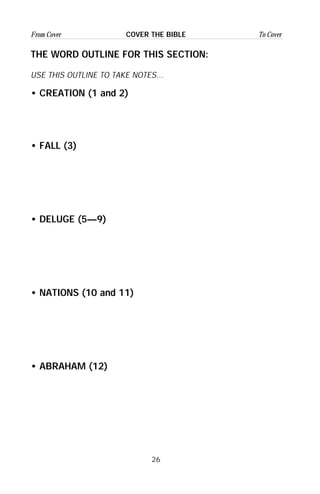
2. Buy a book at a time.
3. AVOID “IMPULSE BUYING” UNTIL YOU HAVE
PURCHASED THE BASIC BOOKS
1. Get the basic books first!
2. Setting priorities will make it easier to get the full library
sooner.
4. SET ASIDE A REGULAR TIME
TO USE YOUR REFERENCE LIBRARY
1. It’s foolish to buy these books and not use them
2. How will you do it? Daily? Weekly?
3. Have a special place where they will be handy to take
down and use. Avoid halls, living rooms, etc., where
books are “stored.” Don’t “store” them...USE them!
472
From Cover To CoverCOVER THE BIBLE
5. KEEP A NOTEBOOK OR A REFERENCE FILE
1. A file, with one folder for each Bible book, is great! You
can throw notes, sermon outlines, etc. into it.
2. A loose leaf notebook with dividers can serve much the
same purpose.
3. Preserve your study!
6. DON’T ASK FOR HELP UNTIL YOU HAVE SEARCHED
BY YOURSELF
1. From now on, don’t “ask the preacher” until you have
assured yourself you can’t find the answer In your own
library of reference books.
2. When you DO ask, try to find out the source for the answer
you have been given. Consider adding that particular
book to your library.
7. ADD SPECIAL BOOKS AS YOU STUDY
1. When you are going to study one special book of the
Bible, purchase at least one good commentary for your
library.
2. When you find a special reference book, buy it on the
spot! (If you don’t, it may be gone when you go back.)
8. MEDITATE AFTER EACH PERIOD OF STUDY ABOUT
WHAT THE SPIRIT HAS TAUGHT YOU
1. You will appreciate the opportunity to simply sit and reflect
on the new light you have gained by your study. Often
the greatest value comes from these “Selah” periods!
2. Remember to write each reflection in your notes or
file.
473
From Cover To CoverCOVER THE BIBLE
9. BECOME FAMILIAR WITH PUBLISHER’S DOCTRINAL
POSITIONS
1. Avoid doctrinal type books which are published by presses
which have a strong theological bias...at least in the
beginning!
2. Learn which publishing houses you can trust, and which
are unpredictable.
NOTES
474
From Cover To CoverCOVER THE BIBLE
TOUCH OUTREACH MINISTRIES PROVIDES
ADDITIONAL DISCIPLESHIP TOOLS!
Dr. Ralph W. Neighbour, Jr. is the author of the widely used
TOUCH BASIC TRAINING materials, which equip persons like
yourself to effectively share their faith with friends.
Particular emphasis is placed in this equipping course in the
most effective ways to share your faith with friends who have
no interest in the church and who know little about the Bible.
Your continuation of training through TOUCH BASIC will put
you “light years” ahead of most of your Christian friends!
Remember...it is simply not enough to know what is IN the
Bible. It is crucial that each one of us go beyond knowledge
to the practice of Bible truths. Therefore, you may desire to
secure the special TOUCH BASIC TRAINING self-study course,
and convert your knowledge to a personal ministry!
475
From Cover To CoverCOVER THE BIBLE
Unit Fifty Two
PRINCIPLES OF
BIBLICAL INTERPRETATION
Study your Bible in the same manner you would explore a
magnificent mansion:
1. CAREFULLY SELECT YOUR GUIDE.
We have discussed the books you should add to your
library. These “guides” should be trustworthy. As you
build your commentaries and dictionaries, be sure you
get ones you can trust.
2. USE THE RIGHT KEY TO ENTER.
Each book has a “key” which unlocks the theme or the
outline for you. An example of this is in the book of
Revelation, where we discovered the outline in 1:19.
Sometimes there are several “keys” which unlock
intertwining themes. An example of this is 1 John, where
“know,” “love,” “abide,” etc., each present a new way
to view the book.
In your class notes, you will find many of these “keys”
included for your use. Pay attention to them.
476
From Cover To CoverCOVER THE BIBLE
3. BE FAMILIAR WITH THE FLOOR PLAN.
The divisions of each book are critical to understanding
it. This is also true of the subdivisions, and frequently
true of individual thoughts within a chapter. For example,
our study of Revelation and Hebrews both required us
to consider the “parentheses,” or “interludes,” inserted
in the flow of the material.
The Psalms are grouped into sections. On a broader
basis, the books themselves fall into sections: “The
Pentateuch,” “Minor Prophets,” “Pauline Epistles.” Knowing
where you are in the outline of the book is important!
Do you recall the divisions of Ephesians?
• “Sit”—Chapters 1-3;
• “Walk”—Chapters 4-5;
• “Stand”—Chapter 6.
What about Genesis? …Ten divisions, with each one
introduced by the phrase “These are the generations
of...”
What are the two major divisions of Joshua?
How many “Books” are there in the Psalms?
What is the outline for Daniel?
What are the four “Beholds” for the four Gospels?
What chapters in Romans deal with the place of the
Jew?
477
From Cover To CoverCOVER THE BIBLE
4. KNOW WHO LIVES IN EACH “ROOM.”
The Bible is written to, or about, distinct classes of people.
In 1 Corinthians 10:32, Paul refers to Jews, Gentiles,
and the Church of God. Each passage in the Bible is
written about or to one of these three classes of persons.
Sometimes a passage will be addressed to all three,
or have application to all of them. But there are books
which belong to one class, rigidly excluding the others.
Knowing the priority the writer has in mind as he writes
is important!
This does not mean, however, that some scriptures “are
for the Jew, and have no meaning for me!” For example,
if a Jewish friend of mine is sent a letter, the primary
meaning is for him. But, as he hands the letter to me
and I read it, I may find some segments of it that speak
directly to my own situation.
Failing to do this creates many of the problems found
in different interpretations of the scriptures. For example,
one of the basic errors of the Seventh Day Adventists
results from their taking all the Jewish patterns of the
Old Testament and applying them to Gentiles and the
church!
Most of the Amillennial positions are developed by ignoring
this principle. Promises given to Israel are taught as though
they belonged to the church.
478
From Cover To CoverCOVER THE BIBLE
An example of this is to be found in treatments of Isaiah
60. This chapter speaks of the time when the Jew shall
be the head and no longer the tail of the nations. Jerusalem
will be exalted as the capitol of the whole earth, and the
wealth of the Gentiles shall pour into it as a tide rises
in the ocean. It is common to find teachers who will take
all this and apply it to the church, and to Christians!
There is no reason for this. The Jew is never called a
Christian any more than he is known as a Gentile. Mount
Zion is no more the “church” than Mount Rushmore
symbolizes Westminster Abbey in London.
When you enter a book or a section of a book, consider
the people the book is written to or who are being talked
about. For example, the book of Ecclesiastes is written
by Solomon to describe a special kind of person: the
man who tries to find meaning in life without recognizing
the place of God. To develop theology about the Christian
life from such teachings is deadly.
The Jehovah’s Witnesses take you to Ecclesiastes to
prove there is no hell, no life beyond the grave. They
take you to Revelation and describe themselves as the
Woman of chapter 12! Sad to say, it is not just cult groups
who take such license with the texts. This is why it is
important to know the credentials of your “guides”
(commentaries).
479
From Cover To CoverCOVER THE BIBLE
5. CAREFULLY EXAMINE ALL THE “FURNISHINGS.”
In each passage, phrases which may be similar to others
should be prayerfully examined. An example of this is
to be found in 2 scriptures:
Luke 21:24—“...Jerusalem will be trampled under foot
by the Gentiles until the times of the Gentiles be
fulfilled.”
Romans 11:25—“...a partial hardening has happened
to Israel until the fulness of the Gentiles has come
in...”
The “times of the Gentiles” signifies the rule of the Gentile
nations. That rule began with Nebuchadnezzar, as God
set aside the Jews because of sin and evil, and brought
in the Gentile governmentally. It will continue until Christ
and His Church come to the Mount of Olives and overthrow
it, bringing in “The Times of the Jew.” (Study Zechariah
14:1-11, Zechariah 8:23, Deuteronomy 28:13).
On the other hand, the “fullness of the Gentiles” is referring
to the filling up of God’s purposes in this age, as He takes
out of the Gentiles a people for His name: “...God first
concerned Himself about taking from among the Gentiles
a people for His name.” (Acts 15:14)
The passage in Acts goes on to say, “After these things
I will return, and I will rebuild the Tabernacle of David
which has fallen, and I will rebuild its ruins, and I will restore
it, in order that the rest of mankind may seek the Lord,
and all the Gentiles who are called by my name...” (verses
16-17).
480
From Cover To CoverCOVER THE BIBLE
Thus, the Times of the Gentiles began centuries before
the birth of Christ and will end only at His appearing to
set up the Kingdom of Israel. The Fullness of the Gentiles
began only after the resurrection of the Lord and may
end at any moment, as the sudden secret rapture of the
church takes place.
NOTES
481
From Cover To CoverCOVER THE BIBLE
6. CARRY IN LIGHT FROM OTHER PLACES.
In the study above, we have just seen how one section
of the scripture (in Acts) sheds light on our study. If you
have not yet discovered for yourself the thrill of suddenly
getting insights into one passage of scripture through
previous study, you will! As catching a 7-pound bass
sends the fisherman back to the lake, so these insights
send the Bible student back, again and again, for deeper
looks at “familiar things.”
NOTES
482
From Cover To CoverCOVER THE BIBLE
BIBLE STUDY
Passage: __________________________________________
1. CAREFULLY SELECT YOUR GUIDE:
Texts I will use in my study:
1.__________________________________________
2.__________________________________________
3.__________________________________________
2. USE THE RIGHT KEY TO ENTER:
The key scripture that unlocks this passage is...
____________________________________________
3. BE FAMILIAR WITH THE FLOOR PLAN:
The outline I will use is found:
___ In my Cover the Bible Notes
_____________________________________________
4. KNOW WHO LIVES IN EACH ROOM:
This book/chapter/passage is written to or about:
___ The Jew
___ The Gentile
___ The Church
___ General; applies to all
___ Other: __________________________________
5. CAREFULLY EXAMINE ALL THE FURNISHINGS:
Word/phrase studies:
6. CARRY IN LIGHT FROM OTHER PLACES:
Other scripture references I found to help me:
483
From Cover To CoverCOVER THE BIBLE
BIBLE STUDY
Passage: __________________________________________
1. CAREFULLY SELECT YOUR GUIDE:
Texts I will use in my study:
1.__________________________________________
2.__________________________________________
3.__________________________________________
2. USE THE RIGHT KEY TO ENTER:
The key scripture that unlocks this passage is...
____________________________________________
3. BE FAMILIAR WITH THE FLOOR PLAN:
The outline I will use is found:
___ In my Cover the Bible Notes
_____________________________________________
4. KNOW WHO LIVES IN EACH ROOM:
This book/chapter/passage is written to or about:
___ The Jew
___ The Gentile
___ The Church
___ General; applies to all
___ Other: __________________________________
5. CAREFULLY EXAMINE ALL THE FURNISHINGS:
Word/phrase studies:
6. CARRY IN LIGHT FROM OTHER PLACES:
Other scripture references I found to help me:
484
From Cover To CoverCOVER THE BIBLE
BIBLE STUDY
Passage: __________________________________________
1. CAREFULLY SELECT YOUR GUIDE:
Texts I will use in my study:
1.__________________________________________
2.__________________________________________
3.__________________________________________
2. USE THE RIGHT KEY TO ENTER:
The key scripture that unlocks this passage is...
____________________________________________
3. BE FAMILIAR WITH THE FLOOR PLAN:
The outline I will use is found:
___ In my Cover the Bible Notes
_____________________________________________
4. KNOW WHO LIVES IN EACH ROOM:
This book/chapter/passage is written to or about:
___ The Jew
___ The Gentile
___ The Church
___ General; applies to all
___ Other: __________________________________
5. CAREFULLY EXAMINE ALL THE FURNISHINGS:
Word/phrase studies:
6. CARRY IN LIGHT FROM OTHER PLACES:
Other scripture references I found to help me:
485
From Cover To CoverCOVER THE BIBLE
BIBLE STUDY
Passage: __________________________________________
1. CAREFULLY SELECT YOUR GUIDE:
Texts I will use in my study:
1.__________________________________________
2.__________________________________________
3.__________________________________________
2. USE THE RIGHT KEY TO ENTER:
The key scripture that unlocks this passage is...
____________________________________________
3. BE FAMILIAR WITH THE FLOOR PLAN:
The outline I will use is found:
___ In my Cover the Bible Notes
_____________________________________________
4. KNOW WHO LIVES IN EACH ROOM:
This book/chapter/passage is written to or about:
___ The Jew
___ The Gentile
___ The Church
___ General; applies to all
___ Other: __________________________________
5. CAREFULLY EXAMINE ALL THE FURNISHINGS:
Word/phrase studies:
6. CARRY IN LIGHT FROM OTHER PLACES:
Other scripture references I found to help me:

Cover the bible

  • 1.
  • 2.
    COVER THE BIBLE- Fourth Revision Published by Touch Outreach Ministries, Inc. P. O. Box 19888 Houston, TX 77224, USA Copyright © 1986, 1989, 1991, 1999 by Ralph W. Neighbour, Jr. ACKNOWLEDGEMENT Special thanks to Joe Wilson, Natalie Goodhart, Jan Matthews, Barbara Littlefield, Joey and Bill Beckham, and Johnson Lim for their hours spent in proof reading this book.
  • 3.
    This book isdedicated to D. Dean Rhoads The closest earthly friend I have ever had.
  • 4.
    For twenty years,perhaps longer, I have helped new Christians learn about the Bible. Many hundreds have told me that they profitedmostfrommyministrythroughsittingundertheteaching of this course. I write these materials with the earnest prayer that a lifetime of study and preparation might help both those who are not yet believers, and those who are, to know more about this inspired book, the Bible. For a very long time, I kept folders on each book in the Bible. Each time COVER THE BIBLE was taught, I added a few notes to each folder. As a result, I confess there is no way I can give credit to all the books, sermons, conversations, and student suggestions which are included in these pages. Thus, some material has been unconsciously “plagiarized” without proper credit being given. If writers recognize their material and notify me, I shall be glad to include credits in later editions. And, if they are like me, they will probably just smile and thank the Lord that their thoughts were valuable enough that someone else felt they should be shared. It’s my deep desire that, at the end of this course, you will have penned marginal notes throughout your Bible, including suggested comments included at the close of each Unit. This year of study could change not only your life, but also your eternity. Know you are prayed for as you study each unit! I welcome response from you. As my Chinese brothers say when temporarily parting, Tsai Tsien, Tsai Tsien! PREFACE
  • 5.
    UNIT BOOKS ANDCHAPTERS 1 General Introduction 2 The Bible’s Outlines and Themes 3 Genesis 1-12 4 Genesis 13-28 5 Genesis 29-45 6 Genesis 46-50; Exodus 1-13 7 Exodus 14-18; 19-23 with Deuteronomy 4-13; Exodus 24-28 & 39; Exodus 29 with Deuteronomy 17 & 18 8 Exodus 30-38 & 40 9 Leviticus 1-10; 11-15 with Deuteronomy 14-15; Leviticus 16-20; Numbers 1-10 10 Leviticus 21-24 with Numbers 28-29 & Deuteronomy 16; Numbers 11-12; Numbers 13-14 with Deuteronomy 1 11 Numbers 15-19; Numbers 20-21 with Deuteronomy 2-3; Numbers 22-25; Numbers 26-36 with Deuteronomy 19; Deuteronomy 20-34 12 Joshua 1-14; Judges 1-12 13 Judges 13-21; Ruth; 1 Samuel 1-12 NOTE: Your study will touch upon all Biblical materials, combining chapters that discuss the same periods in Israel’s history. This is the reason for combining references in these first 13 Units. This will end with our study of the Kings and Chronicles. You may find it convenient to use two Bibles while reviewing these Units, allowing you to view parallel passages simultaneously. COVER THE BIBLE IN ONE YEAR SCHEDULE FirstQuarter
  • 6.
    UNIT BOOKS ANDCHAPTERS 14 1 Samuel 13-31; 2 Samuel 1-5 with 1 Chronicles 1-12 15 2 Samuel 6 with 1 Chronicles 13-16; 2 Samuel 7 with 1 Chronicles 17; 2 Samuel 8-12 with 1 Chronicles 18-20; 2 Samuel 13-18; 2 Samuel 19-24 with 1 Chronicles 21 16 1 Kings 1-4 with 1 Chronicles 22-29; 1 Kings 5-8 with 2 Chronicles 1-7; 1 Kings 9-11 with 2 Chronicles 8-9; 1 Kings 12-16 with 2 Chronicles 10-17 17 1 Kings 17-19; 1 Kings 20-22 with 2 Chronicles 18-20; 2 Kings 1-5; 2 Kings 6-8 with 2 Chronicles 21-22 18 2 Kings 9-13 with 2 Chronicles 23,24; 2 Kings 14-17 with 2 Chronicles 25-28; 2 Kings 18-20 with 2 Chronicles 29-32; 2 Kings 21-23 with 2 Chronicles 33-35; 2 Kings 24-25 with 2 Chronicles 36 19 Ezra; Nehemiah; Esther 20 Job; Psalms 1-72 21 Psalms 73-150; Proverbs 22 Ecclesiastes; Song of Solomon; Isaiah 1-44 23 Isaiah 45-66; Jeremiah 24 Lamentations; Ezekiel; Daniel; Hosea 25 Joel; Amos; Obadiah; Jonah 26 Micah; Nahum; Habakkuk; Zephaniah; Haggai; Zechariah; Malachi COVER THE BIBLE IN ONE YEAR SCHEDULE Second Quarter
  • 7.
    UNIT BOOKS ANDCHAPTERS 27 The Interbiblical Period; The “Synoptic” Gospels 28 Matthew 29 Mark 30 Luke 31 John 32 Acts 1-14 33 Acts 15-28 34 Romans 35 1 and 2 Corinthians 36 Galatians 37 Ephesians 38 Philippians 39 Colossians 40 Philemon; 1 and 2 Thessalonians 41 1 and 2 Timothy; Titus 42 Hebrews 43 James 44 1 and 2 Peter 45 1, 2, and 3 John; Jude 46 Revelation 1-3 47 Revelation 4-11 48 Revelation 12-16 49 Revelation 17-22 50 The First 300 Years After The Bible Was Written 51 How To Use Your Own Reference Library 52 Principles of Biblical Interpretation Summarized COVER THE BIBLE IN ONE YEAR SCHEDULE Third Quarter Fourth Quarter
  • 8.
    “He is nofool Who gives what he Cannot keep To gain what he Cannot lose!” - Jim Elliott, Martyr
  • 9.
    1 From Cover ToCoverCOVER THE BIBLE Unit One THE INSPIRATION AND AUTHORITY OF THE BIBLE I. ITS CLAIM FOR ITSELF A. 2 TIMOTHY 3:14-17 “God-breathed”—“inspired” Man did not create; he only transcribed! B. 1 PETER 1:10-12 ...And men transcribed, not knowing fully the full meaning of what they wrote! Yet, the prophets knew they were writing for us! C. LOOK AT THESE CLAIMS: Psalm 19:7-11 Psalm 37:29-31 Psalms 119:89-91, 98-101, 130, 160 Isaiah 40:6-8 Mark 13:31
  • 10.
    2 From Cover ToCoverCOVER THE BIBLE II. THE BIBLE MORE VALID THAN PERSONAL EXPERIENCE A. 2 Peter 1:16-21 with Matthew 17:1-13 B. Note how Paul depended on it: 1 Cor. 15:3-7 Acts 18:24,28 C. Note the powerful words of Hebrews 5:12-14: D. Now, see this special truth in 2 Peter 1:19-21: TWO THINGS THE BIBLE IS NOT: • A PRIVATE OR INDIVIDUAL INTERPRETATION OF TRUTH. • THE RESULT OF AN ACT OF THE HUMAN WILL.
  • 11.
    3 From Cover ToCoverCOVER THE BIBLE III. NOTE ITS AMAZING PROPHECIES: A. Micah 5:2 with Matthew 2:1-6—Bethlehem predicted as His birthplace... B. Isaiah 53:5, 7, 9—description of death on the cross prior to the use of crosses... C. COMPARE THIS WITH: John 19:34—soldiers pierced Jesus... John 20:27—Thomas saw the wounds... John 19:1-2—Jesus beaten, crown of thorns... Matthew 27:14—He did not respond... Matthew 27:38—crucified between two robbers... Matthew 27:57-60—body of Jesus in tomb with stone over entrance... John 19:4—Pilate said there was no charge against Jesus...
  • 12.
    4 From Cover ToCoverCOVER THE BIBLE IV. CONSIDER JESUS’ PREDICTION OF THE FUTURE: A. John 14:2-3: (CAN YOU COUNT ON IT?) B. Matthew 25:31: V. CONCLUSION The Bible is not just inspired in parts; it’s a fully “God-breathed” volume! It’s a perfect book, a treasury of truth. Not one part of it—as we shall see during this course—is without meaning and value! Therefore, as you read it during these next months, be certain of this fact: the very passage you decide to be irrelevant is hiding a special truth for your blind eyes!
  • 13.
    5 From Cover ToCoverCOVER THE BIBLE HOW WE GOT OUR BIBLE Early Paper Woodcuts of Bible Events Scrolls of Animal Skins Hand Lettered Copies Word of Mouth Stone Tablets W
  • 14.
    6 From Cover ToCoverCOVER THE BIBLE With the coming of the printing press in 1517, a new era in Bible knowledge began. The printed word of God was translated into many languages. But translations of the scriptures began much earlier! Let’s look at some of them... THE SEPTUAGINT—Third to First Century B. C. The Old Testament was translated from Hebrew to Greek—for Jews who could not read their native language any more. LATIN VULGATE—About 400 A. D. The work of Jerome; for centuries, the major Bible used by the Roman Catholic church. WYCLIFFE BIBLE—1383 TYNDALE NEW TESTAMENT—1526 COVERDALE BIBLE—1535 THE GREAT BIBLE—1539 GENEVA BIBLE—1560 RHEIMS NEW TESTAMENT—1582 DOUAY OLD TESTAMENT—1610 KING JAMES VERSION—1611 ENGLISH REVISED VERSION—1881-1885
  • 15.
    7 From Cover ToCoverCOVER THE BIBLE AMERICAN STANDARD VERSION—1901 MOFFATT BIBLE—1913-1924 SMITH-GOODSPEED TRANSLATION—1923-1927 REVISED STANDARD VERSION—1946-1952 PHILLIPS NEW TESTAMENT—1958 BERKELEY VERSION—1959 NEW ENGLISH BIBLE—1951-1970 TODAY’S ENGLISH VERSION NEW TESTAMENT—1966 THE LIVING BIBLE—1971 NEW AMERICAN STANDARD VERSION—1974 NEW KING JAMES VERSION—1979 NEW INTERNATIONAL VERSION—1979 Note the periods of history when Bible translations were being produced. Over and over, the need for a modern translation which could be clearly understood by the people caused new versions to be prepared. Literally hundreds of early manuscripts, not yet discovered at the time the King James Version was translated, have been used by translators of more recent versions. Thus, modern versions like the New International Version are quite dependable.
  • 16.
    8 From Cover ToCoverCOVER THE BIBLE 2 Suggestions for marking your Bible... Each Unit will end with a page like this one. It will suggest verses you might wish to underline in your own Bible. It will also provide brief notations for you to write in the margins of your Bible. Taking the few moments to do this will make your Bible a very special study book. You will get much more from the course if you will do so! THIS UNIT... Underline some or all of the verses you have studied which reveal your Bible is inspired by the Holy Spirit. A WORD ABOUT UNDERLINING... If you have a fine Bible with very thin paper, be careful to select a pen which will not bleed through the paper. Often, humidity will cause this to take place over a period of months—even though at the time you mark your Bible it seemed to be all right. Best way is with India ink and a pen used by draftsmen. There are also special Bible marking pens, available at many Christian book stores. Colored pencils are also satisfactory, as are a limited number of the “highlighters”on the market. Test your pen on a back page of your Bible before using it. (India ink is impossible to remove if pen leaks in your pocket! Beware of airplanes...pressure in cabin makes it leak.)
  • 17.
    9 From Cover ToCoverCOVER THE BIBLE Unit Two THE BIBLE’S OUTLINES AND THEMES I. ITS BOOKS OLD TESTAMENT NEW TESTAMENT 1 2 3 123456789 3 x 9 = 2 7 3 9 1 2 3 123456789 A. There are 66 books in your Bible. B. They are divided into two major divisions: The Old Testament and the New Testament. C. Some Bibles (Catholic and New English) may also include asectionbetweenthesetwodivisions,called TheApocrypha. This section is so placed because it deals with the historical period between the Old and New Testaments, called The Interbiblical Period. At the appropriate place in our study, we will discuss these “extra” books, and why they are not considered to be inspired—although a few of them are excellent historical records.
  • 18.
    10 From Cover ToCoverCOVER THE BIBLE II. THE “STORY LINE”OF THE BIBLE Genesis Exodus Numbers Joshua Judges 1Samuel 2Samuel 1Kings 2Kings Ezra Nehemiah Mark Luke John Acts Leviticus Deuteronomy Ruth 1Chronicles 2Chronicles Esther Matthew A. In his excellent book Bible Panorama, Terry Hall rightly points out that only sixteen of the Bible’s books carry its chronological record. These are pictured on the top shelf of this book case. B. The books on the lower shelf reflect those which enlarge the story of the Bible, and which run parallel to the “Story Line” books. C. These books take us from Creation to the end of the period of history in which it was recorded. D. The Book of Revelation takes us beyond our present time in history, accurately predicting the coming events which will take place before God establishes His eternal Kingdom. Most other books in your Bible will also prophesy of these coming events, with books such as Daniel and Ezekiel taking a prominent part in prophetic records.
  • 19.
    11 From Cover ToCoverCOVER THE BIBLE Note: The “Major” prophets are so called for only one reason—their size! They are not more “important” than the Minor Prophets. In ancient days, scrolls were shaped from animal skins. To accommodate the size of these leather rolls, the smaller writings were gathered to comprise one scroll. Thus, the “Minor” Prophets were collected by their size—not by their importance, or even by the dates of writing. Thus, you will want to treat them with the same respect as the larger documents. III. THE OLD TESTAMENT BY SECTIONS A. THE BOOKS OF THE LAW (Also called The Books of Moses; The Pentateuch) Genesis, Exodus, Leviticus, Numbers, Deuteronomy B. THE BOOKS OF HISTORY Joshua, Judges, Ruth, 1 and 2 Samuel, 1 and 2 Chronicles, 1 and 2 Kings, Ezra, Nehemiah, and Esther C. THE BOOKS OF POETRY (Jewish style) Job, Psalms, Proverbs, Song of Solomon, Ecclesiastes D. MAJOR PROPHETS Isaiah, Jeremiah, Ezekiel, Daniel E. MINOR PROPHETS All the rest of the Old Testament
  • 20.
    12 From Cover ToCoverCOVER THE BIBLE IV. THE NEW TESTAMENT BY SECTIONS A. THE SYNOPTIC GOSPELS 1. “Synoptic”—same root as the word “synopsis.” These Gospels tell the chronological history of the life of Jesus. 2. Matthew, Mark, Luke (Mark is the earliest one) B. THE FOURTH GOSPEL 1. “Fourth”—A simple way of separating it from the Synoptics, since it is the fourth Gospel. 2. John C. HISTORY OF THE CHURCH Acts D. PAUL’S LETTERS Romans, 1 and 2 Corinthians, Galatians, Ephesians, Philippians, Colossians, 1 and 2 Thessalonians, 1 and 2 Timothy, Titus, Philemon (Note: Luther is responsible for putting them in this order. He put Romans first because of his regard for the book.) E. HEBREWS Placed here because the authorship is in question. Did Paul write it, or did one of the other apostles? So placed, it could be the last of Paul’s letters, or the first of the General Epistles, a collection of letters written by men other than Paul. F. GENERAL EPISTLES James, 1 and 2 Peter, 1,2,3 John, Jude G. THE REVELATION OF JESUS CHRIST
  • 21.
    13 From Cover ToCoverCOVER THE BIBLE V. THE BIBLE’S THEMES A. MAN’S FALLEN CONDITION 1. Two lines extend from Adam’s children 2. The “God Seekers”—grace is provided 3. The “God Rejecters”—no provision for them! B. GOD’S PLAN OF REDEMPTION 1. Jesus Christ—“No man comes to the Father except by me.” 2. He is not only the Savior of the world, but also the King of the Jews. C. ISRAEL, A CHOSEN PEOPLE 1. A nation with a spiritual purpose! 2. They are called to witness to the nations about Jehovah, the only true God. 3. They become a disobedient people, scattered among the nations in judgment. 4. Nevertheless, God’s covenants with them are to be fulfilled, and they will become a witness to the nations! 5. KEY PERSONS: Abraham, the father of the nations Moses, the deliverer of God’s people Joshua, the conqueror of the Land David, the beloved King Prophets, the spokesmen of God
  • 22.
    14 From Cover ToCoverCOVER THE BIBLE D. THE CHURCH, A CHOSEN WITNESS 1. After the default of Israel, God created a witness to carry the message of His love to the nations of the world: Jesus Christ, His Son. 2. His presence on earth was first felt as He lived in a a body miraculously created in a virgin, Mary. 3. He came to the Jews, offering Himself as their King. They rejected Him, finally crucifying Him. 4. They did not know that His death would be the only connecting link between all men and Himself. 5. After His death, He arose, lived 40 more days on the earth, and then ascended into the clouds as his followers watched in amazement. 6. Ten days later His Holy Spirit returned. First, He occupied the lives of 120 persons. Quickly, as these 120 shared what had happened to them, thousands of others said, “We want Him to live in us, too!” As they invited Him to do so by repenting of a self-owned life, accepting His death as their connecting link to God, He also came to live in them! 7. All those people who have been occupied by the Spirit of Christ make up His present Body on earth today. These people are called “The Church, the Body of Christ.” 8. The expression of His Body on earth arelocal churches. It is not possible to be a practicing Christian and develop as God intended unless you are a part of a local Body of Christ. If you do not understand why, take a moment to read 1 Corinthians 12.
  • 23.
    15 From Cover ToCoverCOVER THE BIBLE E. THE KINGDOM OF GOD 1. “Kingdom” means “reign, rule.” 2. Scripture refers to a time when Christ will reign over the earth, and a time when He will turn His reign over to His Father for the establishment of an eternal Kingdom (1 Corinthians 15:20-26). 3. However, Jesus taught that “the Kingdom of God is in your midst” (Luke 17:21). Thus we see that while the Kingdom is future, it’s also present. 4. Presently, the Kingdom, or Reign, of our God is within the lives of those who have declared themselves to belong to His “territory.” 5. This is a deeply personal commitment. No one makes it for you, and no one gives it to you. You must do it for yourself! Romans 10:9-10 gives the simple, yet life-changing, commitment God requires us to make. When we do so, we are a part of the Kingdom of God on earth today. We are “the citizens of the Kingdom,” and Jesus now reigns over us. 6. But there’s another powerful truth: when Jesus died on the cross, His death gave Him the right to claim ownership of everything! Abraham Kuyper has said, “There is no sphere of this earth over which Jesus Christ does not say, ‘MINE!’ ” 7. Thus,whenyouhavebecomeamemberofHisKingdom, you live in two worlds at the same time. One of them is the “kingdom of this world,” and the other is the “Kingdom of our Christ.” 8. In order to live in that spiritual world, the Kingdom of our Christ, you are given special faculties to hear, see, and function in it. Your physical faculties of hearing, seeing, etc., are not adequate for life in this spiritual Kingdom. Thus, God’s Holy Spirit provides spiritual gifts which function in His Kingdom.
  • 24.
    16 From Cover ToCoverCOVER THE BIBLE OLD TESTAMENT •PROMISE •Deep longing •God OVER us •Sacrifices—lambs •Priests—Between man and God; mediators •Prophets— (“Nabi’”—Those who“speak with their mouths”) •Judgment Suffering of Israel for their sin •Endless bondage C H R I S T NEW TESTAMENT •FULFILLMENT! •Awareness: God is WITH us •One sacrifice— THE Lamb •One Priest—Jesus, our Mediator •One Prophet—Jesus, who spoke with His entire life •Judgment—Jesus became our substitute, paying in full the terrible price of our sin NOTES 9. Prophecies about the Kingdom we will study... • A coming age for Israel’s covenant relationship with God to be completed. • A renovation of the earth and its structures. • A judgment of the God-Rejecters. • A servant-rule assigned to the people of God. VI. DISTINCTION BETWEEN THE OLD AND NEW TESTAMENTS
  • 25.
    17 From Cover ToCoverCOVER THE BIBLE VII. TWO TYPES OF PEOPLE IN THE BIBLE A. THE GOD REJECTERS “The nations rage!” Death caused by them; after death, torment Totally self-centered life style Gain significance by what they DO Length of their lives totally ignored B. THE GOD FOLLOWERS “He gives peace!” Death is a promotion to a greater life God-centered life style Gain significance by whom they WORSHIP Length of their lives carefully recorded THE GOD REJECTERS GENESIS 4:16-26 ADAM Cain Enoch Irad Mehujael Methushael Lamech THE GOD FOLLOWERS GENESIS 4:25-5:24 ADAM Seth Enosh Kenan Mahalalel Jared Enoch
  • 26.
    18 From Cover ToCoverCOVER THE BIBLE VIII. BIBLICAL REVIEW: ISRAEL, A CHOSEN NATION • Abraham: The Covenant • Isaac • Jacob • Joseph • Bondage • 500 Years in Egypt • Moses • Joshua • 12 Tribes, In the Land • Judges • “We want a King!” • David—the Golden Years • Civil War: Israel, Northern Kingdom Judah, Southern Kingdom • Captivity: Israel to Assyria Judah to Babylon • Judah returns, resettles • Old Testament concludes • Revolt of Maccabees: Israel an independent nation Romans smash Israel’s independence; guerilla warfare by Zealots • Promised Messiah Arrives—rejected! • Jerusalem barricades itself; seiged; a smashed Israel; distributed among the nations • Vision of future—“The Golden Age” • “In that day” passages, in both Testaments • The Remnant: Israel to be restored! • Unfulfilled covenant; prophecies to be completed!
  • 27.
    19 From Cover ToCoverCOVER THE BIBLE IX. BIBLICAL REVIEW: THE CHURCH, A CHOSEN WITNESS • Jesus, fully God, becomes fully Man • He offers Himself as King to Israel; rejected • Offers Himself as King of Kings to all the nations • Began His life by living inside Israel’s culture • Chooses 12 Jews to be His disciples • Spends 3 years revealing truth • Describes “the church” to His disciples Church = Ecclesia (Greek), “Called Out Ones” The Church is the “second” Body of Christ! • Jesus’ atonement on the cross (“At-one-ment”) • His resurrection • His ascension • His entrance into His new Body • His continued activity among men through His Body • The spread of His Body and His activity from Jews to all the nations of the earth • The Church is a “grafted limb” into the Tree of Israel, but in no way replaces Israel! • The Future: His personal return in His resurrected Body, establishing His Kingdom • He completes His work in His 1,000 year reign as King of Kings and Lord of Lords • The Church reigns with Christ: those who were faithful over much, or little, serve accordingly • Through Jesus, the Jews enter the “Golden Age” • The covenant promises of God are fulfilled to His chosen People • The Kingdom of Our Christ Becomes The Kingdom Of Our God • Total renovation of all things • Eternal Kingdom of God: “And He shall reign forever and ever!”
  • 28.
    20 From Cover ToCoverCOVER THE BIBLE 2 Suggestions for marking your Bible... 1. On the Title Pages of the 16 “Story Line” Books, write A STORY LINE BOOK. 2. On the Table of Contents page in the front of your Bible, write the information about the sections of the Old and New Testament books in the margin: EXAMPLE: Genesis................ Exodus.................. Leviticus................ Numbers................ Deuteronomy.......... 3. Mark the secondary books of history, (see page 10) by writing at the head of these books: Leviticus................ Deuteronomy.......... Ruth...................... 4. Mark the columns of your Bible with the notes about Genesis 4:16-5:24. Underline the names of the seven men in each category. 5. Find and mark some “In that day...” passages in Amos 8:11 and 13, and Micah 4:6-8. 6. Read and underline significant verses in John 1 which speak of Jesus as (1) God; (2) Messiah; (3) Savior of non-Jews. “The Law” Also called... “The Pentateuch” “The Books” Connects to Numbers and Joshua Parallels Judges Connects to Exodus and Numbers
  • 29.
    21 From Cover ToCoverCOVER THE BIBLE Unit Three THE BOOK OF GENESIS INTRODUCTION CHAPTERS 1-12 AUTHOR: Moses THEME: “The Book of Beginnings” OUTLINE: (Look for the phrase, “These are the generations of...”) Introduction: The Story of Creation—1:1-2:3 Generations of the Heavens and the Earth—2:4-4:26 Generations of Adam—5:1-6:8 Generations of Noah—6:9-9:29 Generations of the Sons of Noah—10:1-11:9 Generations of Shem—11:10-26 Generations of Terah—11:27-25:11 Generations of Ishmael—25:12-18 Generations of Isaac—25:19-35:29 Generations of Esau—36:1-37:1 Generations of Jacob—37:2-50:26 MAJOR PLACES IN ORDER (Genesis 1-12): Earth, Eden, Ararat, Babel, Ur of Chaldea, Haran of Mesopotamia, Canaan, Egypt MAJOR PEOPLE IN ORDER: Adam, Eve, Abel, Seth, Noah, Ham, Shem, Japheth, Abraham, Sarah AMOUNT OF TIME COVERED: At least 2,000 years
  • 30.
    22 From Cover ToCoverCOVER THE BIBLE CYPRUS EGYPT BABYLONIA ASSYRIA MESOPOTAMIA PERSIA CHALDEA SYRIA EDOM CANAAN MOAB FERTILE CRESCENT Abraham’sjourneywouldtake himhundredsofmilesfromhis homeland.Hetravelledacross thegreen,lushFertileCrescent. Belowthiscrescentarethe scorchingdesertsandsofArabia. MEDITERRANEANSEA THEJOURNEYOFAMANFOLLOWINGGOD
  • 31.
    23 From Cover ToCoverCOVER THE BIBLE CYPRUS MEDITERRANEANSEA THESAMEAREATODAY ISRAELJORDAN LEBANON SYRIA IRAQ IRAN RUSSIA TURKEY EGYPT (Bordersareonlyapproximate)
  • 32.
    24 From Cover ToCoverCOVER THE BIBLE THISBLOCKISTHESAMESIZE ASTHEMAPONPAGE22. FROMTHIS,YOUCANSEETHE SIZEOFTHEENTIREAREA REFERREDTOASTHE “BIBLELANDS”
  • 33.
    25 From Cover ToCoverCOVER THE BIBLE THE LAW OF RECURRENCE As Author of the Scriptures, the Holy Spirit will use this law over and over, especially in the Prophets: • THE OUTLINES OF A SUBJECT ARE GIVEN • THE OUTLINE IS REPEATED; NEW DETAILS ARE ADDED EXAMPLE: GENESIS 1: The account of creation is given in outline GENESIS 2: The same account repeated, details added: 2:7: The nature of man’s being 2:8-14: The location where man was placed 2:15-17: The moral test laid on man 2:18-25: The help-mate provided for him MAJOROUTLINE A. B. C. D. E. F. F. EXPANDED DETAILS 1. 2. 3. 4. Watchfor “TheLawof Recurrence” asyoustudy theBible
  • 34.
    26 From Cover ToCoverCOVER THE BIBLE THE WORD OUTLINE FOR THIS SECTION: USE THIS OUTLINE TO TAKE NOTES... • CREATION (1 and 2) • FALL (3) • DELUGE (5—9) • NATIONS (10 and 11) • ABRAHAM (12)
  • 35.
    27 From Cover ToCoverCOVER THE BIBLE How to apply the word of God to your own life... THE FACTS PRINCIPLE 1. Rehearse the story. Get the details in mind. 2. What do these facts suggest? • About the character of the person? • About the nature of the person? 3. How do you identify that person’s character and nature with your own? 4. How can you learn from this person’s good trait, or squarely challenge that person’s bad trait which exists in your own life? EXAMPLE CHAPTER 12: THE STORY OF ABRAHAM FACTS OF THE STORY. . . • God led Abram • Abram obeyed • Lot went along • Abram worshipped • Egypt • Passed off Sarai as sister • Sarai • Abram expelled from Egypt •God leads men •Obedience is the result of faith •Abram’s insecurity; against God’s directions! •Developed relationship with Jehovah •Left Promised Land; an act of unbelief •Compromised, wanted personal safety; unbelief •Obeyed her husband (amazing!) •Humiliation, the result of disobedience
  • 36.
    28 From Cover ToCoverCOVER THE BIBLE WHAT ARE MY PERSONAL CONCLUSIONS? 1. Every good thing is the result of faith. 2. Every bad feature in a man is the result of unbelief. 3. God always leads! How do I hear His voice? 4. Those living with a person acting in unbelief will be hurt by it. 5. What a wierd mixture of faith and unbelief in this man! I, too, am such a mixture! 6. How can I squarely face my unbelief and do something about it? 7. What can I do to “stick” where God put me, and not run when my “spiritual famine” comes? 8. How has my own reputation been tarnished by my faithless behaviour? MEDITATION What could Abraham ever again do in Egypt? Where have I cut myself off from people/areas by my own behavior? What is the best way to handle such problems? Is this part of what Paul meant in Philippians when he wrote, “forgetting those things which are behind...” ? (If you don’t forget things which are behind, the memories could destroy you!)
  • 37.
    29 From Cover ToCoverCOVER THE BIBLE (See the next page for instructions about doing this study...) LEARNING FROM A STUDY OF ADAM... STUDY GENESIS 2 and 3 FACTS ABOUT ADAM: • First Man • Created in God’s own image • Adam was to have dominion, subdue, replenish, dress, and keep... • Eve was created from Adam • Adam was not aware of sin • Adam lived in total communion with God • Adam was provided for...every need met by God; the result of total communion was total provision • Adam was tested...and failed THESE ARE MY PERSONAL CONCLUSIONS...
  • 38.
    30 From Cover ToCoverCOVER THE BIBLE 1. Copy the 10 divisions of Genesis into your Bible. Underline the key phrase “These are the generations of...” or its corresponding paraphrase of that term in your translation. Then, print in the margin beside the phrase the title of the Division. EXAMPLE: Generations of Adam 5:1-6:8 2. Write this note about “The Law Of Recurrence” in the bottom margin of the page where Chapter 2 begins... “The Law Of Recurrence:”—The outline of a subjectisgiven;then,theoutlinerecursanddetails are added. Chapter 2 is an excellent example of this. 3. In the margin beside Genesis 3:15, write: The Protevangelium: first promise of Jesus’ coming in the Bible! 4. Add any other notes from the explanations which you wrote in your notebook and now wish to preserve in your Bible. 5. Do a study of ADAM, like the one we did in this lesson on Abram, using Genesis 2 and 3. (Use preceding page.) 1 This is the book of... God created man, He... 2 He created them... 2 Suggestions for marking your Bible...
  • 39.
    31 From Cover ToCoverCOVER THE BIBLE Unit Four THE BOOK OF GENESIS CHAPTERS 13-28 OUTLINE: Abram renews his worship—13:1-4 Separation from Lot—13:5-14:24 God “cuts a covenant”—15:1-21 Ishmael, the child of faithlessness—16:1-16 The Abrahamic Covenant—17:1-27 The Angel of the Lord and a promised son—18:1-15 Sodom, Lot, and incest—18:16-19:38 Abraham’s weakness recycles—20:1-18 Isaac, Hagar, and Abimilech—21:1-34 Isaac sacrificed—22:1-14 Abrahamic Covenant renewed—22:15-19 Nahor’s Sons—22:20-24 Death of Sarah—23:1-20 Isaac and Rebecca—24:1-67 Abraham’s death—25:1-11 Ishmael’s descendants—25:12-18 Jacob and Esau—25:19-34 Isaac copies his father’s deception—26:1-34 Jacob deceives Esau—27:1-28:9 Abrahamic Covenant renewed with Jacob—28:10-22 MAJOR PLACES IN ORDER (CHAPTERS 13-28) Bethel—Sodom—Gerar—Beersheba— Nahor, Mesopotamia—Beerlahairoi—Gerar—Haran MAJOR PEOPLE IN ORDER Abraham, Sarah, Isaac, Jacob
  • 40.
    32 From Cover ToCoverCOVER THE BIBLE AMOUNT OF TIME COVERED: About 120 years THE WORD OUTLINE FOR THIS SECTION: ABRAHAM—13-20 ISAAC—21-28 THE HISTORY OF ABRAHAM IN OUTLINE FORM: His call and move to Canaan—12:1-9 His life in Egypt—12:10-20 His separation from Lot—13-14 His Covenant with God—15 His relationship with Hagar—16 His circumcision as a sign of the Covenant—17 His intercession for Sodom—18 His life at Gerar—20 His blessing in the birth of Isaac—21 His sacrifice of Isaac—22 His choice of a bride for Isaac—24 His child by Keturah—25 His death—25 Note: The missionary heart of God is revealed in this section of scripture. Abraham longs to fully follow Jehovah, longs to be in deeper fellowship with Him. Would we not expect God would send him to a quiet beach, or a lovely mountain retreat where communion would be uninterrupted? Oh, no! His Lord sends His servant to a land inhabited by the vilest tribes imaginable! Human sacrifices, sexual perversion, and cruelty were their way of life. God says to us as well, “Go where the need is great!”
  • 41.
    33 From Cover ToCoverCOVER THE BIBLE TERAH ABRAM ISAAC JACOB JOSEPH Haran IscahMilcahLot MoabAmmon Nahor Bethuel LabanRebekah Hagar Ishmael Sarah Esau LeahRachel ofRachel:ofLeah:ofBilhah:ofZilpah: Benjamin ManassehEphraim Gad Asher Dan Naphtali Dinah Zebulun Issachar Judah Levi Simeon Reuben
  • 42.
    34 From Cover ToCoverCOVER THE BIBLE THE “BLESS AND TEST” PRINCIPLE Abraham’s life is a classic illustration of how God works with us. First, He BLESSES. Next, He stretches us by TESTING. If we pass that test, He BLESSES again. If we fail it, we are TAUGHT SOME MORE, then TESTED again. EXAMPLES: • TEST: Will Abraham leave His homeland? PASSES • TEST: Will he leave ALL his relatives? FAILS • BLESSED: GIVEN THE LAND • TEST: Will he trust during the famine? FAILS • TEST: Will he trust God for his safety? FAILS • RETURNS, WORSHIPS GOD. CYCLE STARTS AGAIN... • TEST: Will he give up Lot? PASSES • BLESSED: GIVEN ALL THE LAND HE CAN SEE • TEST: Will he believe God for a son? FAILS • ETC., ETC. ... A basic principle of God’s working within lives of the “God Followers” is “BLESS AND TEST.” It is unknown by the “God Rejecters!” God honors our faith by blessing us. At the same time, He does not take away our freedom! When we choose a non-faith path, He lets His natural laws operate, causing us to learn the consequences of faithlessness for our- selves—the hard way! Abraham learned a definition of faith: FAITH IS BELIEVING IT’S SO WHEN IT’S NOT SO BECAUSE YOU KNOW GOD’S GOING TO MAKE IT SO!
  • 43.
    35 From Cover ToCoverCOVER THE BIBLE JHWH—THE PERSONAL NAME FOR GOD This name is used for the first time in Genesis 4:1. It is one of the primary names of God used in the Old Testament.* In Hebrew scripture, when God’s activity is that of the all-powerful Creator, He is called ELOHIM. But when His personal name is used, He is called JHWH. JHWH means: “I will always be what I have always been; He Who causes to be; Giver of Life.” This name is always associated with our God’s personal relationship with man, not His impersonal attributes. Why is His personal name written without vowels? Ancient Jewish scribes considered His personal name too sacred to be spoken by human lips. Therefore whenever this name appeared in scripture which was to be read aloud, they would say, “Adonai” (Lord). In the English Bible, this is also done: where the Hebrew says JHWH, your Bible says “LORD.” Thus, for centuries, the name was never spoken aloud. In Hebrew, only consonants were written in texts. Vowels were added when the words were spoken. Thus, each generation had to learn the vowels of words by hearing them, not reading them. It was many centuries after the time of Moses before Hebrew writing was “pointed”—which means vowels were added as “jots and tittles” beneath the strings of consonants. Here is a rough example, using English consonants only: FRGDSLVDTHWRLDTHTHGVHSNLYBGTTNSN “Pointed” (vowels added), this line would become: FOR GOD SO LOVED THE WORLD THAT HE GAVE HIS ONLY BEGOTTEN SON * Scholars use the term “YHWH,” or “Yahweh,” rather than “JHWH,” or “Jehovah.” For our study, we will use the popular term, “JHWH.” If you proceed into deeper Bible study in the years to come, be aware of these two ways of converting this Hebrew word into the English transliteration.
  • 44.
    36 From Cover ToCoverCOVER THE BIBLE Here are the possible vowel inserts for JHWH: Jehovah Jahveh Jahoveh Usually, we say, “Jehovah.” When, in your Bible, you find phrases similar to these: “and the LORD said...” “and the LORD caused...” ...the word Adonai, LORD, is being used as a substitute for JHWH (sometimes spelled, JHVH). Consider the nature of God as being very personal in all these passages. Where ELOHIM (a plural noun) appears in the Hebrew text, the word “GOD” (all in capital letters) is used in our English bible. In these references, the emphasis is upon His power as a Creator, rather than upon His deep and personal relationship with men expressed by JHWH. Many adjectives are added to JHWH, to further describe His precious nature. Thus, He will be called: JHWH-JIREH: Jehovah will see or provide or heal (Genesis 22:14) JHWH-NISSI: Jehovah is my banner (Exodus 17:15-16) JHWH-SHALOM: Jehovah is my peace (Judges 6:23-24) JHWH-SHAMMAH: Jehovah is coming again (Ezekiel 48:35) JHWH-TSIDKENU: Jehovah is my righteousness (Jeremiah 23:6) JHWH-ROPHE: Jehovah is my healer
  • 45.
    37 From Cover ToCoverCOVER THE BIBLE “THE ANGEL OF THE LORD” IN THE BIBLE In Genesis 16:7, 21:17-18, etc., we are introduced to a very important phrase: “The Angel of the Lord.” A careful study of the term reveals it to be God Himself, in bodily form, relating personally to men. This is called a THEOPHANY. Carefully study 16:9-13: v. 10: Only God could make such a statement! v. 11-12: Only God could make such a forecast! v. 13: The “Angel of the Lord” was identified by Hagar as God Himself. In Genesis 18, we again see God in human form, as one of “three men” (verses 2, 13, 14, 33). In Genesis 22:11 and 15, the “Angel of the Lord” calls to Abraham from heaven. See also Genesis 31:11, 13; Exodus 3:2,4; Joshua 5:13-15 and 6:2; Zechariah 1:10-13 and 3:1-2 In Exodus 32:34 and 33:14, along with Isaiah 63:9, the presence of the Angel of Jehovah is equivalent to Jehovah’s presence. The Angel of the Lord thus appears as a manifestation of Jehovah Himself! Perhaps this will help you understand more clearly all Jesus meant when He said, “Before Abraham was, I AM” (in Hebrew, the letters for the word JHWH). Some Bible scholars thus consider The Angel of JHWH to be none other than the pre-incarnate Christ, who is the “Word” described as being “in the beginning” (John 1:1).
  • 46.
    38 From Cover ToCoverCOVER THE BIBLE COVENANT RELATIONSHIPS WhenanancientCovenantwascreated,theterm“cutacovenant” is used in the Old Testament. This describes all or part of these activities: 1. An animal was halved, cut from nose to tail along the spine. 2. The two halves were laid out on the ground, with the blood on the ground between the halves. 3. The two men stood facing each other upon the blood, with the halves of the animal on either side. 4. They pledged their lives to each other. 5. They committed all their wealth to each other. 6. They exchanged belts and swords. 7. They named their relatives, each becoming personally responsible as a “GO’EL” (Near-Kinsman) for the relatives of the other person in the event of an untimely death. 8. They pledged their HESED, “loving-kindness,” to one another. This meant that they would remain committed to each other regardless of what evil deed the other might commit in the future! 9. They walked in a “circle 8” around the halved animal, so each man stood in the place of the other one at the end of the walk. 1O. They cut their wrists with a knife, grasped hands, and mingled their dripping blood as a sign of their oath. 11. They exchanged their very names, each adding to his own the name of the other person. 12. They rubbed charcoal into their cuts, making them permanently visible to all. 13. Finally, they planted a tree upon the blood, to mark the place where the Covenant had been cut.
  • 47.
    39 From Cover ToCoverCOVER THE BIBLE A MOST UNUSUAL “COVENANT CUTTING!” GENESIS 15:12-21... V. 12: “A deep sleep” in Hebrew refers to a trance. God had put Abram into a non-participative state for this Covenant-cutting. It is a “one way” Covenant, in which God provides everything in the Covenant without any qualifications to be met by Abram! V. 13-16: The terms of this Covenant are clearly set forth. It is what God will do for Abram. Nothing in return is required. V. 17: A “smoking pot” and a “flaming torch” make the “figure 8” around the animals. They remind us of the smoking cloud by day and the pillar of fire by night (God Himself!) that will lead Israel in the wilderness journey. V. 18: The Covenant promise of God to Abram is given! GENESIS 17:1-8 . . . God now reviews this Covenant with Abram. One significant Covenant event is the exchange of names! The “HA” from JHAWEH, the root of JHWH, is added to Abram: AbraHAm. And, note this well! From this time on, JHWH will describe Himself as “THE GOD OF ABRAHAM.” In addition, Sarai will have a new name...SarHA (Sarah), as explained in 17:15. The Covenant with this man and his wife is irrevocable, and becomes the foundation for our later prophetic studies.
  • 48.
    40 From Cover ToCoverCOVER THE BIBLE THE IMPORTANCE OF THE ABRAHAMIC COVENANT Note its terms in Chapter 17. . . This is an unconditional covenant, and it is still in effect. Because it is, and because it has not yet been fulfilled, there are future things which we know will happen. This will strongly shape the way we read the rest of the Bible—looking for prophecies in which God’s Covenant to Israel will be kept. THE RITE OF CIRCUMCISION NothingwillbecomeamoreimportantreminderofGod’sCovenant with every Son of Abraham than the rite of circumcision! In every Covenant, there was the cutting of the skin of the wrist, and a permanent scar to remind all of the commitment made by two men. In this case, the source from which every new Jewish child will be sired by a Jewish man is to be “cut and scarred” by the Covenant sign, circumcision. In the fathering of each new child, God will remind the parents again of His Covenant with Abraham. And, soon after birth, this rite of circumcision will remind each new generation of its special Covenant with God. To this day, there are virtually no Jewish men who are not circumcised, thus keeping the everlasting reminder of the Covenant! In Exodus 4:24-26, Moses almost dies from God’s judgment because he has yielded to his non-Jewish wife and has not circumcised his sons. Only their circumcision saved his life! His sons had to bear “the scar of the Covenant.”
  • 49.
    41 From Cover ToCoverCOVER THE BIBLE 2 Suggestions for marking your Bible... 1. Copy the outline for this Unit into your Bible. 2. Write beside Genesis 16:7: First use of JHWH as the personal name for God. 3. In the margin beside Genesis 16:7, write: First use of “The Angel of JHWH” 4. Add any notes from the explanations about Covenants which you now wish to preserve in your Bible. 5. Do a study of LOT, like the one we did on Abram, using Genesis 13 and 14. (See the next page for the outline for this study...)
  • 50.
    42 From Cover ToCoverCOVER THE BIBLE (See the previous page for instructions about doing this study...) LEARNING FROM A STUDY OF LOT... Study GENESIS 13 and 14: FACTS ABOUT LOT: THESE ARE MY PERSONAL CONCLUSIONS:
  • 51.
    43 From Cover ToCoverCOVER THE BIBLE Unit Five THE BOOK OF GENESIS CHAPTERS 29-45 OUTLINE: Jacob’s years at Haran—29:1-31:10 Parenthesis—The call back to Bethel—31:11-13 The flight of Jacob—31:14-55 Jacob becomes Israel—32 Jacob meets Esau—33:1-17 Jacob’s worship in self-will—33:18-20 Jacob reaps the harvest of his evil years—34 Jacob’s return to Bethel—35:1-15 Death of Rachel, birth of Benjamin—35:16-26 Death of Isaac—35:27-29 The generations of Esau—36 Joseph, the beloved of his father—37:1-7 Joseph sold into slavery—37:8-36 Parenthesis—The shame of Judah—38 Joseph’s character tested—39-40 The dream of Pharaoh—41:1-13 Joseph exalted in Egypt—41:14-57 Joseph faces his brothers—42-44 Joseph reveals himself—45 MAJOR PLACES IN ORDER (Genesis 29-45): Haran of Mesopotamia, Canaan, Egypt MAJOR PEOPLE IN ORDER: Jacob, Joseph, Judah AMOUNT OF TIME COVERED: About 80 years
  • 52.
    44 From Cover ToCoverCOVER THE BIBLE THE WORD OUTLINE FOR OUR SECTION: Jacob, 29-36 Joseph, 37-45 THE HISTORY OF JACOB: Birth—25 Purchase of the birthright—25 Deception of his father—27 Flight to Haran—28 Marriage and prosperity—29,30 Return to Canaan—31-35 JOSEPH, A TYPE OF CHRIST JOSEPH CHRIST 30:24—Took away Romans 8:1—Took away Rachel’s reproach sin’s reproach Father’s love for him See Matthew 3:17 Suffering caused by See John 15:25 hatred of brothers Deliverance; exalted See Acts 2:22-24 to the throne Reveals himself to See Zechariah 12:10 his brothers
  • 53.
    45 From Cover ToCoverCOVER THE BIBLE ELECTION IN THE BIBLE: 1 PETER 1:2 Esau and Jacob a classic illustration of Election • Jacob: election unto salvation • Esau: election unto condemnation “Chosen according to the foreknowledge of God the Father...” The word to Rebekah was a prophecy. Its purpose was to create long-term faith within these parents, which would carry them through the heartaches caused by their own wrongdoings and those of their children. They had the assurance that right and truth would prevail in the end. Note: Because God foreknows, it does not mean He is the cause of what He knows! If you see a child run into the street, and foreknow a speeding car will hit the child, you have not caused the child to be hurt. “...by the sanctifying work of the Spirit...” God, knowing those whose hearts are bent toward Him in the line of the “God-Followers,” sanctifies, or sets apart, these special people. Even when a person has not yet made the free choice to follow God and live righteously, God knows that time will come, and responds to that life accordingly.
  • 54.
    46 From Cover ToCoverCOVER THE BIBLE ELECTION, CONTINUED “...that you may obey Jesus Christ and be sprinkled with His blood...” Obedience resulted from faith on Jacob’s part. God’s response was to honor his obedience by providing redemption through the blood of Jesus Christ. HERE IS AN ANSWER TO A THORNY QUESTION! How were the people of the Old Testament “saved,” since they lived before the coming of Christ and before His atoning death on the cross? Was there a different way of faith for them? No! Luke 18:7: “Shall not God bring about justice for His elect, who cry to Him day and night...?” Ephesians 1:4-7: “Just as He chose us in Him before the foundation of the world, that we should be holy and blameless before Him. In love He predestined us to adoption as sons through Jesus Christ to Himself, according to the kind intention of His will, to the praise of the glory of His grace, which He freely bestowed on us in the Beloved. In Him we have redemption through His blood, the forgiveness of our trespasses, according to the riches of His grace...” The giving of salvation came to every Old Testament person in exactly the same way it comes to us: through faith in the Redeemer, promised to mankind in Genesis 3:16!
  • 55.
    47 From Cover ToCoverCOVER THE BIBLE ELECTION, CONTINUED Those God knew would seek His face (called in this study the “God-Followers”) were “elected” unto salvation. Those God knew would use their freedom of choice to reject His fellowship were “elected” unto condemnation. The important thing to remember is that each person is free to make the choice. God, knowing the future, acts upon His knowledge of what that choice will be, long before it has been made. WHAT IS GOD’S CHOICE FOR EVERY MAN? Exactly the same for all: “He was not willing that any should perish, but that all should come to salvation.” God no more damns some people to hell and capriciously chooses others for heaven, than a judge in a courtroom condemns some to be hung and others to be set free! Your free choice causes the consequences you will face. 37:35—SHEOL This is the first use of this term, used 65 times in the Old Testament. It is described as the place of the departed spirits. It is often spoken of as simply the grave, where all activities cease. Without revelation from God, the natural man sees the grave as the end of everything (see Ecclesiastes 9:5, 10). In Ecclesiastes, this is the case. Beware of the cults (Mormonism, Christian Science, Jehovah’s Witnesses) which take passages like this one and try to prove the Bible teaches there is no life after death for the unbeliever!
  • 56.
    48 From Cover ToCoverCOVER THE BIBLE SHEOL, CONTINUED Scripture reveals SHEOL as a place of sorrow (2 Samuel 22:6, Psalm 18:5, 116:3), into which the wicked are sent (Psalm 9:17), and where they are fully conscious (Isaiah 14:9-17). The SHEOL of the Old Testament and the HADES of the New Testament (Luke 16:23) are identical. NOTES FROM LECTURE:
  • 57.
    49 From Cover ToCoverCOVER THE BIBLE 2 Suggestions for marking your Bible... 1. Copy the outline into your Bible. 2. Write beside Genesis 37:35: First Use of Sheol 3. Add any notes about Election or Sheol, which you want to keep, in the margins of your Bible. 4. Add any other notes from the explanations which you wish to preserve in your Bible. 5. Complete the Study of Jacob on the following page, using the helps for personal study you have been given in the course.
  • 58.
    50 From Cover ToCoverCOVER THE BIBLE LEARNING FROM A STUDY OF JACOB... GENESIS 29—33 FACTS ABOUT JACOB: THESE ARE MY PERSONAL CONCLUSIONS:
  • 59.
    51 From Cover ToCoverCOVER THE BIBLE Unit Six THE BOOK OF GENESIS CHAPTERS 46-50 THE BOOK OF EXODUS CHAPTERS 1-13 Genesis 46-50: OUTLINE: Jacob’s journeys to Egypt: 46 Jacob and his descendants exalted: 47:1-26 The last days of Jacob: 47:27-50:14 The fear of Joseph’s brothers: 50:15-21 The last days and death of Joseph: 50:22-26 MAJOR PLACES IN ORDER (Genesis 46-50): Egypt, Mamre in Canaan MAJOR PEOPLE IN ORDER: Jacob and Joseph AMOUNT OF TIME COVERED: 17 years NOTES:
  • 60.
    52 From Cover ToCoverCOVER THE BIBLE WILDERNESS OF SHUR EGYPT MARAH ELIM REPHIDIM MT. SINAI (HOREB) LAND OF MIDIAN LAND OF MIDIAN EZION-GEBER MT. HOR MT. NEBO MOAB EDOM KADESH- BARNEA WILDERNESS OF ZIN NEGEB CANAAN JERICHO
  • 61.
    53 From Cover ToCoverCOVER THE BIBLE Exodus 1-13 OUTLINE: Israel in Egypt—1 The coming of Moses—2 The call of Moses—3, 4:1-18 The return of Moses to Egypt—4:19-31 The contest with Pharaoh, part 1—5:1-23 Jehovah answers Moses’ prayer—6:1-13 The families of Israel—6:14-27 The renewed commissions—6:28-7:13 The contest with Pharaoh, part 2—7:14-11:10 The Passover—12:1-36 First stage of the Journey—12:37-51 The firstborn set apart for Jehovah—13:1-19 Second stage of the journey—13:20-22 MAJOR PLACES IN ORDER (Exodus 1-13): Egypt, Midian, Egypt MAJOR PEOPLE IN ORDER: Moses, Pharaoh AMOUNT OF TIME COVERED: 215 Years THE WORD OUTLINE FOR OUR SECTION: MOSES, 1-6 CONTEST WITH PHARAOH, 7-13
  • 62.
    54 From Cover ToCoverCOVER THE BIBLE A QUICK LOOK AT EXODUS: Seventy Jewish people entered Egypt. During 400+ years, they multiplied to about 3 1/2 million. They were enslaved. God selected Moses to deliver them. Pharaoh resisted the request of Moses to free the people. Ten plagues were required to break his rebellion. The Passover, crossing of the Red Sea, manna, quail from heaven, water from rocks, follow. Wilderness journey takes Israel to Mt. Sinai, where God gave His law. It involved 613 commandments, instructions for building the Tabernacle, and assignment of priestly duties. NOTES:
  • 63.
    55 From Cover ToCoverCOVER THE BIBLE THE EXCUSES OF MOSES 3:11: Personal inadequacy in light of past. 3:13: Religiousexperienceconsideredinadequate;knowledge and experience limited. 4:1: Others would reject him as a spiritual man. Felt his personal testimony would be discounted. 4:10: Did not possess talent equal to the task. THE DISCLOSURE OF GOD’S NAME (See earlier notes on JHWH) Exodus 3:13-14— JHWH: the verb form for “I will be” is identical to this. The use of the double verb here, “I AM WHO I AM” means, “I shall continually be that which I have always been;” or, “I will be all that is necessary as the occasion will arise.” Note verse 15: “This is My name forever, and this is My memorial name to all generations.” NOTES:
  • 64.
    56 From Cover ToCoverCOVER THE BIBLE THE TEN PLAGUES WATER TURNS TO BLOOD FROGS LICE FLIES DEATH OF CATTLE BOILS HAIL LOCUSTS DARKNESS DEATH OF THE FIRSTBORN NOTE: The significance of these plagues is not their uniqueness. Every single one of these plagues were already known in Egypt. Their significance is in the fact that God “made the clock speed up,” compressing the equivalent of years of plagues into just a few hours.
  • 65.
    57 From Cover ToCoverCOVER THE BIBLE In addition, these plagues attacked the areas of sacred beings and objects worshipped in the religion of Egypt! The waters of the Nile were most sacred... Frogs, gnats, and insects were worshipped... Intricate jewelry was fashioned after them, using gold and precious stones. (We still have scarab or beetle jewelry from the Middle East being sold today). Bulls were worshipped... so much so that they were mummified! Apis, the Black Bull, was worshipped in the second largest temple in Egypt, located in Memphis. The boils were caused by the soot... (9:8) taken from kilns where gold was smelted. The soot caused boils. Gold was also considered a sacred object, an object of actual worship. Hail was unknown... Less than an inch of rain per year fell in Cairo. Judgment fell upon their fields, their possessions, all that they cherished! Locusts were carved in gold on the crown of Pharaoh, and were actually worshipped. The Sun was an object of particularly significant worship in Egypt; it was blotted out! The Pharaoh was considered a Divine God... his son, his heir, also Divinity.
  • 66.
    58 From Cover ToCoverCOVER THE BIBLE 2 Suggestions for marking your Bible... 1. Copy the outline into your Bible. 2. Write beside Exodus 3:13: Means “I shall continually be that which I have always been.” 3. Add any notes about Moses’ excuses, which you want to preserve, in the margins of your Bible. 4. Add any other notes from the explanations which you want to preserve in your Bible.
  • 67.
    59 From Cover ToCoverCOVER THE BIBLE Unit Seven EXODUS 14-18; EXODUS 19-23 with DEUTERONOMY 4-13; EXODUS 24-28 and 39; EXODUS 29 with DEUTERONOMY 17 and 18 OUTLINES Exodus 14-18; 19-23 13:17-15:21—At The Red Sea 15:22-26—At Marah 15:27-16:36—At Elim And The Wilderness Of Sin 17:1-7—At Rephidim 17:8-16—Victory Over Amalek 18:1-27—Visit Of Jethro 19:1-6—The Offer Of A Covenant 19:7-23:33—The Specifications Of The Covenant Deuteronomy 4-13 (parallels Exodus 19-23) 4:1-40—Pleas For Trust And Obedience 4:41-43—Cities Of Refuge East Of Jordan 4:44-49—Historical Note 5:1-2—Pleas: Concerning Conditions Of Possession 5:3-6:9—Plea: Keep The Law Because Of Promises 6:10-25—Plea: Keep The Law Because Of What The Future Will Be 7—Plea: Keep The Law Because Of Necessary Separation From Idolatry 8—Plea: Keep The Law Because Of Trials 9-10—Plea: Keep The Law Because Of The Intercession Of Moses 11:1-7—Plea: Keep The Law Because Of Deliverance At Red Sea
  • 68.
    60 From Cover ToCoverCOVER THE BIBLE 11:8-25—Plea: Keep The Law Because Of Dependence On Jehovah For Rain 11:26-32— A Blessing And A Curse Set Before Them 12-13—Living As A “Holy People,” Part 1 Exodus 24-29 24:1-11—The Ratification Of The Covenant 24:12-18—Moses Called To The Mount 25:1-27:21—The Tabernacle 28—The Priestly Garments (see 39: Making the Priestly Garments) 29—The Priestly Installation Deuteronomy 17 and 18 (parallels Exodus 29) 17—Commands about Kings 18—Maintaining of the Levites MAJOR PLACES IN ORDER (Exodus 14-29): Red Sea, Wilderness, Sinai MAJOR PEOPLE IN ORDER: Moses, Aaron, Joshua AMOUNT OF TIME COVERED: 1 Year (?) HOLINESS WORKS, OBEDIENCE FAITH, TRUST KINGDOM OF PRIESTS ELECTION PROVISIONS OF THE COVENANT: EXODUS 19:5-6
  • 69.
    61 From Cover ToCoverCOVER THE BIBLE THE TEN COMMANDMENTS: Note the two divisions: 1. _______________________________________ 2. _______________________________________ Note there is nothing new in the Law. Conscience has already forbidden each area. Forbidden by conscience, because already forbidden by the nature of things, and the nature of things is...God! The Law is written as negatives, for it presupposes the existence of sin and evil desire in every human heart! Chapter 21: SLAVERY IN THE BIBLE God tolerated it for one reason only...“because of the hardness of men’s hearts” (Matthew 19:8). He never endorsed it! It was useless for God to forbid it until after man’s heart was sensitized to Christ’s Lordship. Christianity alone, in the history of the world, was able to stop this practice. No other political or social structure ever dealt effectively with it (See Galatians 3:28). In the day of Jesus, it is estimated that as many as half of all the people in the Roman Empire were slaves.
  • 70.
    62 From Cover ToCoverCOVER THE BIBLE THETABERNACLEINTHEWILDERNESSN S EW Bars Boards Coveringsand CurtainsTheDoor Laver Outer CourtBrazenAltar, withBurntOffering ofAnimal,Tiedtoits FourCorners TheGate Pillars Tableof Shewbread GoldenCandlestick Altarof Incense TheArkofthe Covenant
  • 71.
    63 From Cover ToCoverCOVER THE BIBLE PLANOFTHETABERNACLE Dimensions,byCubits:(1Cubit=approximately18inches) COURT:100by50Cubits GATE:20Cubits TABERNACLE:30by10by10Cubits HOLYPLACE:20by10by10Cubits HOLYOFHOLIES:10by10by10Cubits N S EW GATE BRAZENALTAR LAVER HOLY PLACE HOLYOF HOLIES Arkofthe Covenant TableofShewbread GoldenCandlestick Altarof Incense Curtain
  • 72.
    64 From Cover ToCoverCOVER THE BIBLE 28:1-30:11: THE MEANING OF ATONEMENT The Priesthood and Service teach the meaning of the atonement (at-one-ment), or perfect spiritual union. 1. The provision of a covering for sin 2. The privilege of communion with Jehovah 3. The assurance of holiness
  • 73.
    65 From Cover ToCoverCOVER THE BIBLE THE TABERNACLE, THE TEMPLE, AND THE SACRIFICES THE TABERNACLE: THE TEMPLE OF SOLOMON: THE TEMPLE, REBUILT AFTER THE CAPTIVITY: THE TEMPLE, REBUILT BY HEROD: THE FUTURE TEMPLE IN PROPHECY:
  • 74.
    66 From Cover ToCoverCOVER THE BIBLE 2 Suggestions for marking your Bible... 1. Copy the outline into your Bible. 2. Write beside Exodus 17:14 and 34:27: Note: proof that Moses is the author of Pentateuch 3. Write beside Exodus 23:20-33: Note: The “Angel of JHWH” is the “Angel of the Covenant:” Christ is the assurance of the assurances! 4. Add any other notes from the explanations which you wish to preserve in your Bible.
  • 75.
    67 From Cover ToCoverCOVER THE BIBLE Unit Eight EXODUS 30-38 AND 40 OUTLINE The Altar of Incense—30:1-10 Atonement for Each Person—30:11-16 The Laver of Bronze—30:17-21 The Anointing Oil and Incense—30:22-38 Appointment of Skilled Workmen—31:1-11 The Sabbath—31:12-18 Forty Days and Nights Without God—32-34 The Tabernacle Instituted—35-38 The Tabernacle Erected—40 MAJOR PLACES IN ORDER (Exodus 30-38 and 40): Sinai MAJOR PEOPLE IN ORDER: Moses, Aaron, Bezalel AMOUNT OF TIME COVERED: A few months
  • 76.
    68 From Cover ToCoverCOVER THE BIBLE NOTES ON CHAPTER 30: THE ALTAR OF INCENSE Symbolical of the place of prayer. “May my prayer be counted as incense before Thee; The lifting up of my hands as the evening offering.” (Psalm 141:2) THE ATONEMENT MONEY A special means of reminding each person that he was not his own. Think of it as you would the leasing of a piece of land, which has an annual fee required. The word for “contribution” is literally “heave offering”—an offering freely given by the giver. It was a way of saying, “I recognize I do not own my own life!” THE PLACE OF CLEANSING The Laver of Bronze—a type of the word of God. See 38:8 for the source of the bronze. It was a mirror-like, reflecting surface. Unless we wash, our fellowship with God dies! (See John 13:6-10—“If I wash thee not, thou hast no part with me.”) THE ANOINTING OIL AND THE INCENSE THE OIL—A powerful, oil-based perfume. All objects and all priests were anointed with it. The fragrance revealed the object or person was, in a special way, set apart (sanctified) for the special activity of God among men. Everywhere the anointed ones went, their special fragrance marked them. Because of it, Aaron and his sons were prohibited from sharing in the burial of Nadab and Abihu. One odor—one use!
  • 77.
    69 From Cover ToCoverCOVER THE BIBLE THE INCENSE Symbolical of prayer. A beautiful study for you! See Psalm 141:2; Luke 1:10-11; Revelation 5:8 and 8:4,5. (Be sure to underline these verses as you read them and “key” them with your own marginal reference to “Cf. Exodus 30:22ff.”) NOTES ON CHAPTER 31: Where did we get the idea that our skills are self- developed, or came to us from our parents? Verses 1-11 point out that GOD has put the skills we possess into our lives, and they belong to Him. It’s not just a preacher who is “special!” Bezalel had both natural and spiritual skills for his life’s work. THE SABBATH Man is essentially a spiritual being. He must make time to be with God. It is a physical, a family, and a national necessity. The person who secularizes life for weeks at a time is a fool! Note verse 17: even in eternity the Sabbath will be kept! For the Christian, the day changes from a Sabbath Saturday to Sunday, called “The Lord’s Day,” to make the resurrection day of our Lord more significant than even the creation of the earth. However, the special significance of the Sabbath, taught here, does not change as it moves from Saturday to Sunday. Note verse 14: was it important to God, or an “option” to be remembered by those who are not preoccupied with other things?
  • 78.
    70 From Cover ToCoverCOVER THE BIBLE FORTY DAYS AND NIGHTS WITHOUT GOD! (Chapters 32-34) NOTES: 1. Rejection of ___________ leadership 2. Aaron’s reasoning: 32:25—_____________________! 3. Sarcasm—32:4—Shock treatment didn’t work. 4. Syncretism—___________________________________ 5. Moses’ anger—destroyed ________________________ (32:19) 6. Forced to _______________________ their sin—32:20 7. “The furnace made it!”—32:24 8. _________ men died (heads of households) Why? __________________________________ 9. Moses offered _________ as the sacrifice!—32:30-32 10. “Book”—Custom of that day: _______________________________________________ _______________________________________________ 11. Chapter 33: God said, “I’ll send an _________!” 12. The Tent of Meeting—33:7 13. “Let me know Thy _________!”—33:13 14. Chapter 34: Moses on Sinai, alone with God! 15. Shining ________—34:29 (His adequacy came from being with God!)
  • 79.
    71 From Cover ToCoverCOVER THE BIBLE THE INSTITUTION OF THE TABERNACLE 35:5—The “heave” or “wave” offering... Hebrew is teruma—used when personal possessions are freely given to God. Note there was something for everyone to bring, and something for all to do. Note verse 29—it was a heart relationship which led them to bring their possessions! THE CURTAINS FOR THE TABERNACLE Standing inside, looking up, you see blue, purple, scarlet, with woven cherubim: Christ’s deity pictured. The second layer was Goat’s hair: Christ’s humanity pictured. The third layer, red, depicts Christ, our Substitute (see Genesis 22:13-14). See Isaiah 53:2-3 to understand the drab, grey outer covering: what does it represent about Christ? 1 2 3 4 THE TABERNACLE CURTAINS LAYER 1: Fine linen, colors, gold clasps LAYER 2: Goat's hair, black, brass clasps LAYER 3: Ram's skins, red, no clasps LAYER 4: Porpoise skins, grey, no clasps
  • 80.
    72 From Cover ToCoverCOVER THE BIBLE THE BOARDS OF THE TABERNACLE One cubit=about 18 inches The size of the outer courtyard fencing was about 175 feet long, 87 1/2 feet wide, and 8 1/3 feet high. The size of the tabernacle building was about 45 feet long, 18 feet wide, and 18 feet high. All boards were overlaid with pure gold. All sockets were of pure silver. THE VEIL Inside that veil, in the Holy of Holies: one man, alone with God! That veil was the thickness of a man’s fist... THE ARK The precious Mercy Seat: see 1 Samuel 6:19 THE TABLE OF SHEWBREAD The priests fed on that bread daily. THE LAMPSTAND Six=Man; One=God Pictures the church! Seven branches, one candlestick: See Matthew 5:14-16 THE ALTAR OF INCENSE The place of prayer in the life of the believer THE BRAZEN ALTAR The sacrificed lamb took away the sin of one man; and each lamb, without spot or blemish, was a sign of The Lamb of God, Who would take away the sin of the world! Later, the writer of Hebrews would make this clear.
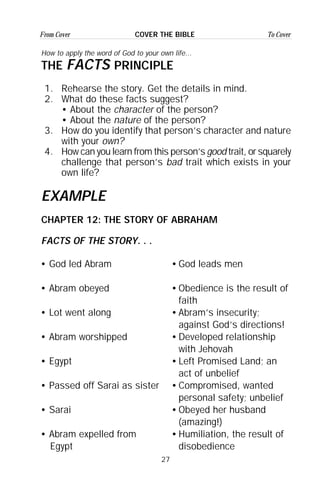
  • 81.
    73 From Cover ToCoverCOVER THE BIBLE THE SIGNIFICANCE OF THE TABERNACLE . . . 1. This place of worship was manufactured from the items contributed by the worshipers. They bought nothing; only what they gave was used for its construction! 2. It was in the center of the camp, not on its edge. Their worship was the central point of all they did. 3. It was mobile. Wherever they went, their worship was to remain central to their lifestyle. 4. The way to God always began with a sacrifice for sin. There was no thought that man had a “spark of goodness” in him that might make it possible to bypass the brazen altar. 5. The Laver reminds us that we must be cleansed before entering into the place of priestly service (1 John 1:9). 6. Trace the fire which is used in the Tabernacle: first, it is used under the sacrifice. Where does it go from there? Do you see the significance of this? What does this say to your heart? 7. The veil—thick as a man’s fist—would one day be ripped in half, from the top down. This barrier between men and God would be torn by the Father, and the “middle wall of partition” separating God and man would be removed. Do you know when this happened? (Read the last chapters of the Gospels to find the answer!)
  • 82.
    74 From Cover ToCoverCOVER THE BIBLE 2 Suggestions for marking your Bible... 1. Copy the outline into your Bible. 2. Write beside Exodus 35:5: NNNNooootttteeee:::: HHHHeeeebbbbrrrreeeewwww TTTTeeeennnnuuuupppphhhhaaaahhhh::::,,,, uuuusssseeeedddd wwwwhhhheeeennnn ppppeeeerrrrssssoooonnnnaaaallll ppppoooosssssssseeeessssssssiiiioooonnnnssss aaaarrrreeee ffffrrrreeeeeeeellllyyyy ggggiiiivvvveeeennnn ttttoooo GGGGoooodddd,,,, nnnnooootttt ffffrrrroooommmm oooobbbblllliiiiggggaaaattttiiiioooonnnn 3. Write beside Exodus 35:20: NNNNooootttteeee:::: TTTThhhheeeeyyyy wwwweeeennnntttt hhhhoooommmmeeee ttttoooo rrrreeeemmmmeeeemmmmbbbbeeeerrrr wwwwhhhhaaaatttt GGGGoooodddd hhhhaaaadddd ddddoooonnnneeee ffffoooorrrr tttthhhheeeemmmm.... 4. Add any other notes from the explanations which you now wish to preserve in your Bible.
  • 83.
    75 From Cover ToCoverCOVER THE BIBLE Unit Nine LEVITICUS 1-10 LEVITICUS 11-15 with DEUTERONOMY 14-15 LEVITICUS 16-20; NUMBERS 1-10 OUTLINE Leviticus 1-7—Laws Concerning Sacrifices 1:1-17—Burnt Offering 2:1-16—Meal Offering 3:1-17—Peace Offering 4:1-7:38—Laws Concerning Offerings Leviticus 8-10—Historical Interlude: The Institution of the Priesthood Leviticus 11-15—Laws Concerning Purity and Impurity (DEUTERONOMY 14 parallels LEVITICUS 11-15) Deuteronomy 15—The Sabbatic Year 15:1-11—The Remission of Debts 15:12-18—The Bondslave Relationship 15:19-23—Consecration of first-born in the flock Leviticus 16—The Law for the Day of Atonement Leviticus 17—The Law for Sacrifice Leviticus 18:1-19:21—Laws Commanding Holiness and Non-Conformity with Pagan Practices Numbers 1-4—The Commands for a Census of the People Numbers 5-10—The Commands for Purity of the People 5—A Test for Jealousy 6—The Nazirite Vow and the Aaronic Benediction 7—The Offerings of the 12 Leaders 8-9—Levites separated, the Passover observed 10—The Covering Cloud and the Silver Trumpets
  • 84.
    76 From Cover ToCoverCOVER THE BIBLE MAJOR PLACES IN ORDER (Exodus 30-38 and 40): Sinai MAJOR PEOPLE IN ORDER: Moses, Aaron, Bezalel AMOUNT OF TIME COVERED: A few months, or even weeks NOTES: Hebrew title: “And he called...” (the first Hebrew word of the book). Leviticus means “The Book of the Priests” Since we as believers are priests, there are many symbolical truths waiting for us in the study of this book. The key to this book is 26:11-12. AN OVERVIEW OF LEVITICUS How do we draw near to God? Drawing near to God, using the sacrifices. Drawing near to God, using the Priesthood. Drawing near to God: cleanness demanded. Day of Atonement provided for each one. In contrast to the pagan neighbors, the People of God were to be holy in ALL particulars. Israel’s choices will bring blessing or curse! 1-7— 8-10— 11-15— 16— 17-25— 26— 27—
  • 85.
    77 From Cover ToCoverCOVER THE BIBLE THE SACRIFICES IN LEVITICUS 1-5 These sacrifices are only for those who are in a covenant relationship with God. They sound “odd” to all others! Let us approach Leviticus remembering Paul’s words about the Pentateuch, found in 1 Corinthians 10:11: “Now these things happened to them as an example, and they were written for our instruction, upon whom the ends of the ages have come.” Note the progression: BURNT OFFERING Total sacrifice. Romans 12:1-2. Surrender of my life to Christ. MEAL OFFERING Giving my labors (fruit) to Christ. PEACE OFFERING Part to God, part eaten by Priest, part eaten by giver: fellowship! SIN OFFERING For inadvertent sins, not willful! (See 1 John 5:16-17) TRESPASS OFFERING I am to restore, adding 20%, to those who have been trespassed against by me.
  • 86.
    78 From Cover ToCoverCOVER THE BIBLE THE CONSECRATION OF A PRIEST CLEANSING GIRDING CONSECRATING (SETTING APART) OFFERINGS: 1. THE BURNT OFFERING 2. THE OFFERING OF “FILLING” 3. THE HEAVE OFFERING PRIEST IS COVERED WITH OIL AND BLOOD! Oil=Sacred, set apart Blood=Clean, through another’s sacrifice LEVITICUS 10: 1—STRANGE FIRE! Note these were Aaron’s own sons! How tragic was the sorrow caused in the hearts of those who remained after they died. “Strange Fire” always leaves pain in the lives of others. THE DAY OF ATONEMENT Note the occasion—16:1 Two offerings: one for salvation, one for sanctification: 16:3 The “scapegoat”—16:10 (Literally, the goat of removal). 16:15 ties to Hebrews 9:25, which tells us something significant about the sacrifice of Christ on the cross.
  • 87.
    79 From Cover ToCoverCOVER THE BIBLE THE LAW FOR SACRIFICE 17:4—Note the place for sacrifice: ONLY ONE DOOR! 17:10-12—Eating Blood Cf. Genesis 9:4 and Acts 15:19-20 The blood is for God, and is to be held in deepest reverence. It is from God, and is a substitute for our sin. Why were they not to eat blood? To do so was a sign of self-redemption. Ingesting it was to take from it the sacredness of the truth that the blood is for God, not man! Note 1 Peter 1:18-19—the blood is God’s only price of redemption. NUMBERS: ORGANIZED AS A CONQUERING ARMY Leaving Sinai, Israel marches forth as Jehovah’s conquering army, with God himself leading them! The book graphically portrays Israel as the servants of God. They are to establish His Kingdom. They have His power to do so. At the same time, we are told how Israel broke the covenant relationship God had established with them. The opportunity to serve was available—and the freedom to not serve was also available. Israel was organized as an army, but they didn’t have the desire to do battle in Jehovah’s name. Thus, as we read through the book we are saddened by the results of disobedience.
  • 88.
    80 From Cover ToCoverCOVER THE BIBLE 2 Suggestions for marking your Bible... 1. Copy the Outline into your Bible. 2. Underline Leviticus 26:11-12. Write beside them: Note: Key to Leviticus 3. Write marginal comments beside the offerings which are described in the first five chapters of Leviticus. 4. Add any other notes from the explanations which you now wish to preserve in your Bible.
  • 89.
    81 From Cover ToCoverCOVER THE BIBLE Unit Ten LEVITICUS 21-24 with NUMBERS 28-29 and DEUTERONOMY 16; NUMBERS 11-12; NUMBERS 13-14 with DEUTERONOMY 1 OUTLINE PART 1: LAWS FOR LIVING CLOSE TO GOD Leviticus 21-22—Laws For The Priesthood 21—Laws For Personal Purity 22—Laws For Eating and Offering Sacrifices Leviticus 23—Laws Of The Sacred Calendar Leviticus 24—Laws For The Tabernacle and Camp (NUMBERS 28-29 parallels LEVITICUS 21-24) Numbers 28:1-8—The Daily Offerings Numbers 28:9-15—The Sabbath and Monthly Offerings Numbers 28:16-29:40—The Offerings At The Appointed Feasts (DEUTERONOMY 16 parallels LEVITICUS 21-24) Deuteronomy 16—The Feasts 16:1-9—The Feast Of The Passover 16:10-12—The Feast Of Weeks 16:13-17—The Feast Of Booths
  • 90.
    82 From Cover ToCoverCOVER THE BIBLE PART 2: THE NEGATIVE SIDE OF LIVING UNDER LAW (See Romans 8:13-16) Numbers 11:1-9—The Complaining People Numbers 11:10-15—The Complaining Leader Numbers 11:16-35—God’s Method Of Dealing With Complainers Numbers 12:1-9—Miriam And Aaron Complain Against Moses Numbers 12:10-16—Miriam Smitten With Leprosy Numbers 13—Twelve Spies Sent To Canaan Numbers 14—The Rebelling People Pay...And Pay... (DEUTERONOMY 1 SUMMARIZES NUMBERS 11-14) MAJOR PLACES IN ORDER: Sinai, Wilderness of Paran, Kadesh-Barnea MAJOR PEOPLE IN ORDER: Moses, Aaron, The 70 Elders, Eldad and Medad, Miriam, The 12 Spies AMOUNT OF TIME COVERED: A few months in B. C. 1490.
  • 91.
    83 From Cover ToCoverCOVER THE BIBLE NOTES SANCTIFICATION SHOWN IN THE PRIESTLY LAWS LEVITICUS 21:8—Illustrates the Old Testament concept of sanctification. Every Christian is to be “set apart” for the service of God. LEVITICUS 21:17-23—Restricted any man with a physical blemish or imperfection from serving as a priest. Not only the sacrifice, but the one offering it, had to be without blemishes. See Hebrews 4:15 and 1 John 3:5. LEVITICUS 22:18-25—Refers to special types of Peace Offerings—the Votive and the Free Will Offerings. The Peace Offering expressed peace and fellowship between the offerer and God. It included a communal meal. There were three kinds of Peace Offerings: THANK OFFERING—showed gratitude for a special blessing or deliverance. VOTIVE OFFERING—showed gratitude for a special answer when a vow had accompanied the petition. FREE WILL OFFERING—Expressed gratitude to God without regard to any specific blessing or deliverance.
  • 92.
    84 From Cover ToCoverCOVER THE BIBLE THE FEASTS OF THE SACRED CALENDAR There were 7 religious festivals ordained of God for Israel’s year, mentioned in LEVITICUS 23: THE PASSOVER—v. 5. Deliverance by Christ from sin’s bondage. THE FEAST OF UNLEAVENED BREAD—vv. 6-8 Unleavened bread a type of Christ and the Church. THE DAY OF FIRST FRUITS—vv. 9-12 Always a Sunday. Jesus resurrected from the dead on this day, a guarantee of our resurrection (See 1 Cor. 15:20-23, 1 Thess. 4:13-18). THE FEAST OF WEEKS (PENTECOST)—vv. 15-22 Always a Sunday. Day of the outpouring of the Holy Spirit. Two loaves represent Jew and Gentile, contained leaven, because sin is yet present within the Church. THE DAY OF TRUMPETS—vv. 23-25 The blowing of the trumpets is associated with the coming of our Lord. THE DAY OF ATONEMENT—vv. 26-32 The only fast day among the festivals. On this day annual atonement was made for the sins of the priests, the people, and the tabernacle. Points to the redeeming work of Christ more than any other festival. THE FEAST OF TABERNACLES (BOOTHS)—vv. 33-43 Foreshadows the millennial reign of Christ. (See Zechariah 14:16)
  • 93.
    85 From Cover ToCoverCOVER THE BIBLE NOTES Nisan is also called Abib. Passover is in this month. Iyyar (Ziv) is the month of the Feast of Unleavened Bread, followed by the Day of First Fruits. Seven weeks later, in Sivan, is the Feast of Pentecost. Tishri is the month of the following festivals: • The Day of Trumpets • The Day of Atonement • The Feast of Tabernacles 1 5 67 8 9 10 11 12 2 4 3 Adar Nisan Iyyar Sivan Tammuz Ab ElulTishri Heshvan Kislev Tebeth Shebat Feb-Mar Mar- Apr Apr-May May-June Jun-Jul Jul-Aug Aug-SeptSept-Oct Oct-Nov Nov-Dec Dec-Jan Jan-Feb
  • 94.
    86 From Cover ToCoverCOVER THE BIBLE Camp Arrangement of Israel's Tribes DAN ASHER NAPHTALI KOHATHITES GAD SIMEON REUBEN MERARITES MOSES,AARON ANDHISSONS ZEBULUNISSACHARJUDAH EPHRAIMMANASSEHBENJAMIN GERSHONITES GATE TABERNACLE
  • 95.
    87 From Cover ToCoverCOVER THE BIBLE STUPID IS FOREVER! THE HIGH COST OF COMPLAINING Numbers 11:1—Fire is a sign of God’s presence and judgment. 11:6—Manna means, “What is it?” See John 6:31-35, 48-58! 11:26—NABI’: means “Prophesied” Noting the difference between NABI’ and the New Testament concept of “prophet” is important... CLASS NOTES ON NUMBERS 11-14: 1. No one who rebelled will live to see the land: 14:23 2. They must return to the wilderness: 14:25 3. Forty years will pass: 14:34 4. The ten spies who misled the people will die: 14:37 5. The people will have no success in military encounters with the people of the land: 14:33 6. Only Joshua and Caleb will enter! Does this press upon us the terrible result of unbelief? Why are we so prone to recycle, over and over, the learning of this lesson?
  • 96.
    88 From Cover ToCoverCOVER THE BIBLE 2 Suggestions for marking your Bible... 1. Copy the Outline into your Bible. 2. Write beside Leviticus 21:8, and underline the verse: Note: Description of Sanctification 3. Write comments of your choice beside the Feasts, as described in your notes. 4. Add any other notes from the explanations which you now wish to preserve in your Bible.
  • 97.
    89 From Cover ToCoverCOVER THE BIBLE Unit Eleven NUMBERS 15-19 NUMBERS 20-21 with DEUTERONOMY 2-3 NUMBERS 22-25 NUMBERS 26-36 with DEUTERONOMY 19 DEUTERONOMY 20-34 OUTLINE Laws Concerning Offerings—Numbers 15:1-31 The Stoning Of A Sabbath Breaker—Numbers 15:32-36 Fringes On Garments—Numbers 15:37-41 Korah’s Rebellion—Numbers 16:1-40 Ravages Of The Plague—Numbers 16:41-50 Aaron’s Rod—Numbers 17 Provision For The Priests and Levites—Numbers 18:1-24 The Heave Offering—Numbers 18:25-32 Purification With Heifer Ashes—Numbers 19 Miriam’s Death—Numbers 20:1 Water From The Rock—Numbers 20:2-21 Aaron’s Death—Numbers 20:22-29 The Canaanites Attack—Numbers 21:1-3 The Fiery Serpents—Numbers 21:4-9 Detour Around Moab—Numbers 21:10-20 Israel Conquers Foes—Numbers 21:21-35 (Note: Deuteronomy 2-3 summarizes the above material) Balaam, The Surprised Prophet—Numbers 22-24 Israel Worships Baal-peor—Numbers 25 Israel Takes A Census—Numbers 26 The Law Of Inheritance—Numbers 27:1-17 (Continued on next page)
  • 98.
    90 From Cover ToCoverCOVER THE BIBLE Joshua Appointed Moses’ Successor—Numbers 27:18-23 The Daily Offerings—Numbers 28-29 The Law Concerning Vows—Numbers 30 The Midianites Conquered—Numbers 31 Reuben, Gad Inherit East Of Jordan—Numbers 32 The Wilderness Journeys—Numbers 33:1-49 Orders To Expel Canaanites—Numbers 33:50-56 Partitioning The Land—Numbers 34:1-35:8 Laws Concerning Murder—Numbers 35:9-36 Female Inheritance And Marriage—Numbers 36 The Cities Of Refuge—Deuteronomy 19 Laws Concerning War—Deuteronomy 20 Settlement For An Unknown Murderer’s Crime; Miscellaneous Laws—Deuteronomy 21-25:16 Command To Destroy Amalek—Deuteronomy 25:17-19 Offerings—Deuteronomy 26 Mount Ebal: Signs Of Blessings And Curses— Deuteronomy 27-30 Joshua Commissioned—Deuteronomy 31 The Law To Be Placed In The Ark—Deuteronomy 31:24-29 The Song Of Moses—Deuteronomy 31:30-32:47 Moses Permitted To See Canaan—Deuteronomy 32:48-52 Moses Blesses The Tribes—Deuteronomy 33 The Death Of Moses—Deuteronomy 34:1-8 Joshua Succeeds Moses—Deuteronomy 34:9-12
  • 99.
    91 From Cover ToCoverCOVER THE BIBLE MAJOR PLACES IN ORDER Kadesh-Barnea, Moab, Mount Nebo MAJOR PEOPLE IN ORDER Moses, Aaron, Korah, Baalam, Joshua AMOUNT OF TIME COVERED About 39 years THE BOOK OF NUMBERS PREPARATION THE JOURNEY AT THE GATE CHAPTERS 1-5 CHAPTERS 10-18 CHAPTERS 22-36 Inventory and Sinai to Kadesh- At the gate of Assignments Barnea the Land WANDERING, Cleansings, WANDERING, New Problems Preparations, UNTIL ALL ARE... Final DEAD! Admonitions On to Moab Final Tasks MOUNT SINAI MOUNT HOR MOUNT NEBO KEY VERSES: 10:9; 10:29
  • 100.
    92 From Cover ToCoverCOVER THE BIBLE DEUTERONOMY: “BOOK OF REMEMBRANCE” Key Verses: 4:23; 5:29; 8:11; 10:12-13; 11:26-28; 28:1; 29:1 INTRODUCTION THE WORD OF THE COVENANT CONCLUSION 1-4: Remember, 4:44-26: Commandments for 31-34: Parting Lest you forget... the present Words of Moses 27-30: Options Affecting the future ISRAEL’S HISTORY BY PERIODS PENTATEUCH JOSHUA 1, 2 SAMUEL EZRA (BOOKS OF JUDGES 1, 2 KINGS NEHEMIAH MOSES) RUTH 1, 2 CHRONICLES ESTHER IN EGYPT IN CANAAN, IN CANAAN, IN IN THE UNDER UNDER CAPTIVITY, WILDERNESS THE JUDGES THE KINGS IN ASSYRIA and BABYLON 660 360 460 160 YEARS YEARS YEARS YEARS WE HAVE COME THIS FAR IN OUR STUDY...
  • 101.
    93 From Cover ToCoverCOVER THE BIBLE KORAH’S REBELLION: NUMBERS 16 Korah was joined by 250 leaders who challenged the authority of Moses. They tried to establish a priestly order without God’s permission. God dealt harshly with them! THE RED HEIFER: NUMBERS 19 A type of the sacrifice of Christ in cleansing the believer: 1. The sacrifice is killed 2. Sevenfold sprinkling of blood 3. Sacrifice turned into ashes 4. Ashes become a memorial 5. Used to cleanse from defilement Water is both a type of the Holy Spirit and the Word of God (John 7:37-39). The Holy Spirit uses the sacrifice of Christ to bring the forgiveness of the believer, and cleansing! (See 1 John 1:9) Always remember that everything you will ever need in your Christian life comes from the CROSS! There are NO “second sources!” MOSES’ SIN: NUMBERS 20:7 ff. Why was God so hard on Moses? The rock was a symbol of Christ (1 Corinthians 10:4). Moses had already struck the rock once (Exodus 17:6), and his striking it the second time said the one sacrifice was not enough (Hebrews 9:26). His act exalted himself (v. 10). His frustration and anger at the people cost him...everything!
  • 102.
    94 From Cover ToCoverCOVER THE BIBLE BAALAM, THE HIRELING PROPHET: (Numbers 22 ff.) This passage is important because of 2 Peter 2:15, Jude 11, and Revelation 2:14. He sought to “sell” his spiritual gift, and was a false teacher. He reasoned that a holy God would be glad for him to curse a people as corrupt as Israel. He disregarded God’s willingness to justify believing sinners. CITIES OF REFUGE: DEUTERONOMY 19 A beautiful picture of our safety in Christ, where we are free from the retaliation of our sins. Later, we will see Abner die “as a fool” because he did not stay in the city of refuge. What about you? Have you taken your refuge in Jesus Christ? There are so many folks in our age who take their refuge in church membership. Joining a church no more makes you a Christian than entering a garage makes you an auto-mobile! John 1:12-13: “But as many as received Him, to them He gave the right to become children of God, even to those who believe in His name, who were born not of blood, nor of the will of the flesh, nor of the will of man, but of God.” We did not make ourselves the children of our parents by what we accomplished. We are the product of their activity. So it is with becoming a child of God. We are not the product of our own deeds (even joining a church!), but rather the product of the activity of God. He so loved us that He sent His son to the cross. The “birthing” of our spiritual sonship comes not from the blood and water of physical birth, but from Christ’s death on the cross. (See John 19:34.)
  • 103.
    95 From Cover ToCoverCOVER THE BIBLE A FAREWELL TO THE WILDERNESS... Don’t miss the sheer horror of how the Pentateuch ends! Because of unbelief, an entire generation of Israelites spent their lives wandering aimlessly, never getting any meaning out of life. Is that not always the result of life apart from God? Their environment was not pleasant. Their lives had no destiny except dusty graves. Their investment in history was to serve only as a lesson of the futility of unbelief. WHYDIDTHEWILDERNESSLIEBETWEENEGYPTANDCANAAN FOR THESE PEOPLE? The answer to that question is appropriate for each one of us. Egypt stands for a land of carnal, lustful lifestyle. To leave the habits and foods of that land behind and to immediately enter into the promised land would have left a lesson unlearned! The people of Israel had to learn that all their sufficiency, all their supply, came from God and God alone. Had they slipped out of Egypt to reside at once in the promised land, where abundance was everywhere, would have created a self- centered people. They would have taken their environment for granted. Because of the wilderness, there was a stark realization that land without God’s blessing—without God’s provision—life is barren and dry. In our Christian lives, we sometimes wonder why God allows the “desert experiences.” It is obvious: sin creates this barrenness. Living in the midst of sin, there is only one valid supply—God. When we trust Him, we find the reality of life. It’s not in the environment, but in Him!
  • 104.
    96 From Cover ToCoverCOVER THE BIBLE 1. Copy the Outline into your Bible. 2. Underline the key verses for Numbers and Deuteronomy. 3. Write marginal comments beside the scriptures explained in your notes. 4. Add any other notes from the explanations which you now wish to preserve in your Bible. 2 Suggestions for marking your Bible...
  • 105.
    97 From Cover ToCoverCOVER THE BIBLE Unit Twelve JOSHUA 1-24 JUDGES 1-12 OUTLINE OF JOSHUA PART ONE: CONQUEST OF THE LAND (Joshua 1:1-11:15) Chapters 1-5—Preparation Charge to Joshua—Joshua 1 Spying Jericho—Joshua 2 Crossing Jordan—Joshua 3 Memorial Stones—Joshua 4 Circumcision and Passover—Joshua 5 Chapters 6-11:15—Conquest Chapters 6-8—Central Campaign Jericho—Joshua 6 Ai Defeats Israel—Joshua 7 Israel Defeats Ai—Joshua 8 Chapters 9-10—Southern Campaign Pact With Gibeon—Joshua 9 Five Kings Slain—Joshua 10 Chapter 11:1-15—Northern Campaign Chapters 11:16-23—Summary PART TWO: DIVISION OF THE LAND (Joshua 13-21) PART THREE: JOSHUA’S FINAL YEARS (Joshua 22-24) MAJOR PLACES IN ORDER Jericho, Ai, and the territories of the South and the North in the Promised Land
  • 106.
    98 From Cover ToCoverCOVER THE BIBLE MAJOR PEOPLE IN ORDER Joshua AMOUNT OF TIME COVERED Approximately 7 years OUTLINE OF JUDGES PART ONE: WILL THEY NEVER LEARN? (Judges 1-16) Incomplete Obedience—Judges 1 “As The Wheel Turns:”—Judges 2 The Roster of Players—Judges 3:1-6 First Cycle: Othniel—Judges 3:7-11 Second Cycle: Ehud—Judges 3:12-31 Third Cycle: Deborah—Judges 4 Parenthesis: The Song of Deborah—Judges 5 Fourth Cycle: Gideon—Judges 6:1-8:32 Fifth Cycle: Abimelech Made King, Tola— Judges 8:33-10:5 Sixth Cycle: Jephthah—Judges 10:6-12:15 MAJOR PLACES IN ORDER: The Land of Israel MAJOR PEOPLE IN ORDER: Judges: Othniel, Ehud, Deborah, Gideon, Abimelech, Tola, Jephthah AMOUNT OF TIME COVERED: Judges covers approximately 400 years (1500-1000 B. C.)
  • 107.
    99 From Cover ToCoverCOVER THE BIBLE NOTES JOSHUA In the Jewish Old Testament, this is the first of the Historical Books. It took 7 years to conquer Canaan. The secret of Joshua was OBEDIENCE! The spiritual message of this book is victory over the POWER of Sin. The Summary of Joshua is found in 21:42-45. JOSHUA 7: THE SIN OF ACHAN When we are defeated, we must root out OUR Achan and utterly destroy that area in our life style! JUDGES: The 5 Spokes of the “Wheel:” (see page 103) 1. 2:5—“They sacrificed to the Lord” 2. 2:11—“The sons of Israel did evil in the sight of the Lord, and served the Baals” 3. 2:14—“And the anger of the Lord burned against Israel, and He gave them into the hands of...their enemies around them” 4. 2:15—“They were severely distressed” 5. 2:16—“Then the Lord raised up judges who delivered them from the hands of those who plundered them”
  • 108.
    100 From Cover ToCoverCOVER THE BIBLE FIRST CAMPAIGN SECOND CAMPAIGN THIRD CAMPAIGN MT. EBAL MT. GERIZIM Shechem Ai Gilgal Jericho Shittim JordanRiver Dead Sea Arnon River Jabbok River Yarmuk River Sea of Kinnereth (Galilee) Lake Huleh JOSHUA’S MILITARY CAMPAIGNS Following the directions of Jehovah, the Israelite army saw victory at Jericho. Disobeying Jehovah, they suffered defeat at Ai. In the Second and Third Campaigns they were able to defeat their enemies, but through their disobedience created serious problems for the future...problems which would eventually destroy their nation. Partial obedience is not enough! Compromise with what is God’s best doesn’t bring “almost best.” It brings disaster.
  • 109.
    101 From Cover ToCoverCOVER THE BIBLE NAPHTALI ZEBULUN ASHER MANASSEH EPHRAIM DAN JUDAH SIMEON DAN MANASSEH GAD ISSACHAR REUBEN CANAAN AS DIVIDED AMONG THE TWELVE TRIBES Hebron, Bezer, Shechem, Ramoth-Gilead, Golan, and Kadesh were set apart as Cities of Refuge to receive and protect accidental manslayers. Note Dan and Manasseh occupy two portions. The Sidonians were to the North. The Philistines occupied the coastal territory in Judah. MT. EBAL MT. GERIZIM Ai Gilgal Jericho Shittim JordanRiver Dead Sea Arnon River Jabbok River Yarmuk River Sea of Kinnereth (Galilee) Lake Huleh BENJAMIN Bezer Ramoth-Gilead Golan Kedesh Shechem Hebron
  • 110.
    102 From Cover ToCoverCOVER THE BIBLE USING YOUR ZONDERVAN PICTORIAL BIBLE ENCYCLOPEDIA... In volume 3 of the Encyclopedia, you will find an excellent article on page 756 about Israel’s judges. Note the explanation that the word “judge” means more here than one who is involved with legal affairs. Besides judicial functions “they exercised a saving, liberating activity that was conceived to be the result of a direct endowment from Jahweh.” The article goes on to explain that all these judges came from three classes of men: High priest, wise man, and warrior. Note that these men frequently fell below the character of other great men or women in the Old Testament, but “they were men of faith.” Someone has rightly said, “The Lord hits many a lick with a crooked stick!” One of the Devil’s tricks with us is to accuse us of not being “spiritual enough” to do anything for the Lord. That’s just not true. David was a murderer and an adulterer, and God used him in spite of these things. It’s true that his personal life was wretched because of his sin, but his sin did not make him useless. The old joke has two men meeting on the street. One says to the other, “How’s your wife?” He replies, “Compared to what?” How pure do you have to be for the Lord to use you? “Compared to what?” The point is this: you and I will never become RIGHTEOUS ENOUGHtobeGod-like.Therefore,HegivesusHisrighteousness. It is always adequate when our own is not. This is not a license to SIN; instead, it’s a license to SERVE!
  • 111.
    103 From Cover ToCoverCOVER THE BIBLE 1 They sacrificed to the Lord 2 They did evil in the sight of the Lord 3 The anger of the Lord burned against Israel 5 The Lord raised up Judges, who delivered them from the hands of those who plundered them. 4 They were severely distressed, and cried unto the Lord. THE “WHEEL OF LIFE” IN THE BOOK OF JUDGES Chapter 2 is an excellent place to review this cycle. It is obsrved throughout the book. FIND AND UNDERLINE THESE POSITIONS ON THE WHEEL: 2:5-10: Position 1—but note last part of verse 10. 2:11-13: Position 2—note their rejection and substitutions. 2:14-15a: Position 3—note God’s hand was against them. 2:15b: Position 4—Finally, they began to cry out for help. 2:16: Position 5—The Lord raised up Judges to deliver them. CONTINUE TO TRACE THE WHEEL IN VERSES 17-23... Is it not tragic that we have never learned for ourselves that disobedience causes misery? Note: God was always ready to deliver them if they would turn to Him. So it is today. NEVER believe you have passed out of the love and grace of our God.
  • 112.
    104 From Cover ToCoverCOVER THE BIBLE 1. Copy the outline into your Bible. 2. Write beside Joshua 21:42-45: Note: Summary Statement of Joshua 3. Write beside Joshua 10:12-13: Note: The sun and the moon replaced God as objects of worship to these people! 4. Add any other notes from the explanations which you now wish to preserve in your Bible. 2 Suggestions for marking your Bible...
  • 113.
    105 From Cover ToCoverCOVER THE BIBLE Unit Thirteen JUDGES 13-21 RUTH 1 SAMUEL 1-12 OUTLINE JUDGES 13-21: Seventh Cycle: Samson—Judges 13-16 Idols in Israel—Judges 17 Tribe of Dan Seeks An Inheritance—Judges 18 Tragedy: A Levite and A Harlot—Judges 19 Israel At War—Judges 20 Benjamites Barely Squeak By—Judges 21 MAJOR PLACES IN ORDER Israel, Gaza, Gibeah, Rimmon’s Rock, Mizpah, Bethel MAJOR PEOPLE IN ORDER Samson, Delilah, Micah, “A certain Levite,” Phineas AMOUNT OF TIME COVERED Approximately 263 years
  • 114.
    106 From Cover ToCoverCOVER THE BIBLE NOTES Key to this book: Judges 21:25—“In those days there was no king in Israel; everyone did what was right in his own eyes.” 13:2-5—THE NAZARITE VOW Why this vow? It was the means by which a “lay priesthood” was established. It included... 1. No strong drink 2. Hair never to be cut 3. Cannot touch a dead body or eat unclean things Samson repeatedly violated these vows, including eating honey from a carcass of a dead animal. He is a symbol of those who try to follow God’s will without accepting God’s values. He is deluded, imprisoned, blinded, degraded, chained, and given a life of drudgery. THE TRAGEDY OF THE CONCUBINE Israel had finally yielded to the vulgarity of the religious scene around them, among the Baal worshippers! Even the practice of homosexual activity had penetrated their lifestyles. At Gibeah the homosexuals are called “Sons of Belial” (Satan) in 19:22. In 20:5 we discover the concubine was left dead or dying, her hands on the threshhold of the house where the Levite had stayed. The Levite dramatically publicized their atrocity by dismembering the body of the woman and sending pieces to the tribes.
  • 115.
    107 From Cover ToCoverCOVER THE BIBLE This period of Israel is the story of people who lived without any mourning for sin, no return to Jehovah. They acted in self-will. 40,000 Israelites and 25,000 Benjamites are killed, cities destroyed, the population decimated. What a terrible, lawless period! WHY? WHY SUCH A LAWLESS PERIOD? There were not enough models of Godly living to permeate the families of Israel. The mothers and fathers who bred this generation of Israelites had been born in Egypt or the Wilderness. All of those who first entered Canaan with Joshua were born in the Wilderness. As they entered the land, they were disobedient. They did not follow the orders God plainly gave to them to create a holy territory. Inside the borders was to be one thing—the worship of Jehovah. Instead, they endorsed a “pluralistic society,” where each person could do what they desired to do, as long as they did not hurt anyone else. The evil of this compromise is that truth no longer exists for anyone. Each person is the final judge of “right” and “wrong.” We are experiencing such a life-style in America today. It never brought any meaning or peace to Israel, and it will not bring any peace to us! We may not be able to change all society, but there is one place we can keep sacred...our own lives. We Christians compose a special group of people called the “body of Christ.” Holy living is a necessity. AUTHORSHIP OF BOOK: Probably Samuel.
  • 116.
    108 From Cover ToCoverCOVER THE BIBLE SIDONIANS MESOPOTAMIA E D O M I T E S M O A B I T E S HITTITES JE B U S IT E S P H IL IS T IN E S H IV IT E S P E R IZ Z IT E S AMMONITES C A N A A N IT E S AMORITES AMORITES TRIBES DWELLING IN CANAAN DURING THE TIME OF THE JUDGES In every case, they should not have been present. God had given directions for them to be cleared out of the land. Israel could no more co-exist with them than WE can co-exist with sin!
  • 117.
    109 From Cover ToCoverCOVER THE BIBLE NAME Othniel Ehud Shamgar Deborah Gideon Tola Jair Jephthah Ibzan Elon Abdon Samson TRIBE Judah Benjamin Naphtali Ephraim Manasseh Issachar Gilead Gilead Bethlehem Zebulun Ephraim Dan IDENTIFICATION Nephew of Caleb Left-handed An Assassin Used Ox Goad Only woman judge An obscure family 30 sons, 30 cities Made rash vow 30 sons, 30 daughters Nazarite from birth ENEMY Mesopo- tamia Moabites Philistines Canaanites Midianites Ammonites Philistines YRS OF OPPRES- SION 40 80 ? 40 40 23 22 6 7 10 8 20 YRS OF PEACE 8 18 ? 20 7 18 40 REFERENCE 3:9-11 3:12-30 3:31 4:4-5:31 6:11-8:35 10:1-2 10:3-5 11:1-12:7 12:8-10 12:11-12 12:13-15 13:2-16:31 JUDGES OF ISRAEL Some of them prove the Lord “hits many a lick with a crooked stick!”
  • 118.
    110 From Cover ToCoverCOVER THE BIBLE 1370 1360 1373 1334 1316 1237 1198 1191 1151 1149 1126 1105 1265 1252 1059 1049 1087 1081 1075 1065 1058 1107 1067 1028 JEPHTHAT IBZAN ELON ABDON 1120 Ruth and Boaz are married ABIMELECH SHAMGAR OTHNIEL EHUD DEBORAH AND BARAK GIDEON TOLA JAIR SAMSON ELISAMUEL TribleofBenjamin nearlyannihilated TribeofDan migrated THE TIME OF THE JUDGES: EVENTS AND PEOPLE
  • 119.
    111 From Cover ToCoverCOVER THE BIBLE OUTLINE OF RUTH Elimelech Migrates To Moab—1:1-5 Family Faces Crisis—1:6-21 Naomi Returns To Bethlehem—1:22 Ruth Meets Boaz—2:1-23 Ruth And Naomi Trust Boaz To Be Their Kinsman-Redeemer—3:1-18 Boaz And Ruth—4:1-12 Their Son, Obed—4:13-16 Ruth’s Part In David’s Genealogy—4:17-22 MAJOR PLACES IN ORDER Bethlehem, Moab, Bethlehem MAJOR PEOPLE IN ORDER Elimilech, Naomi, Ruth, Boaz AMOUNT OF TIME COVERED Approximately 10 years NOTES ON THE BOOK OF RUTH Bethlehem means “House of Bread and Praise” Elimelech means “My God Is King” Naomi means “Pleasant” Mahlon and Chilion mean “Sick” and “Pining” Orphah means “Fawn” Ruth means “Friendship” Boaz means “Fleetness” Obed means “The Serving One”
  • 120.
    112 From Cover ToCoverCOVER THE BIBLE THE CONCEPT OF THE KINSMAN-REDEEMER In Hebrew, GO’EL. The nearest kinsman had the right to redeem the forfeited inheritance of the family. Elimelech’s death meant the needs of the women were to be met by the GO’EL. Involved were: 1. Support and protect the women. 2. Insure their property remained intact for them, even if liens had to be paid. 3. In a childless marriage where there was no heir, the GO’EL must marry the widow and sire a child to inherit the land of his father. 4. If the widow’s property was put up for sale, the GO’EL would buy it at public auction. 5. If the man had been murdered, the GO’EL would avenge the death. 6. If the dead man’s relatives were sold into slavery or servitude, the GO’EL would purchase and free them. 7. If the nearest kinsman-redeemer refused the responsibility to act as GO’EL, he lost the right to the inheritance and sometimes suffered the indignity of spit in the face (See Deut. 25:9). 8. The next kinsman was then free to come forward and take over. Taking off the shoe and handing it to another was a symbol of transfer of obligation—“You walk in my shoe!”
  • 121.
    113 From Cover ToCoverCOVER THE BIBLE OUTLINE OF 1 SAMUEL 1-12: SAMUEL AS JUDGE AND PROPHET—1:1-8:22 Childhood—1:1-3:21 The Ark—4:1-7:2 Reconsecration at Mizpah—7:3-17 The Call for a King—8:1-22 SAMUEL AND SAUL—9:1-12 Saul Anointed—9:1-10:27 Defeat of the Ammonites—11:1-11 Renewal of the Kingdom at Gilgal—11:12-15 The Farewell Address of Samuel—12 MAJOR PLACES IN ORDER Mount Ephraim, Shiloh, Ebenezer, Ashdod, Bethshemite, Kirjath-jearim, Mizpeh, Ramah, Gibeah, Jabesh-Gilead, Gilgal MAJOR PEOPLE IN ORDER Elkanah, Hannah, Eli, Samuel, Philistines, Joshua the Bethshemite, Abinadab, Saul AMOUNT OF TIME COVERED Approximately 76 years
  • 122.
    114 From Cover ToCoverCOVER THE BIBLE AUTHOR Not known for certain. Jewish tradition picks Samuel; Gad and Nathan added the sections following his death. NOTES SAMUEL combines two Hebrew words meaning, “Heard of God.” In 1:20 Hannah explains why she chose that name. ELI: a good man, a poor father. He humored his children more than he honored God. He ruined both them and himself! When love refuses to be “tough,” it’s not love... 3:1: “And word from the Lord was rare in those days, visions wereinfrequent.”Thisconditionoccurswhenthereisnoreceptivity to God’s word! He does not talk to those who will not listen—for obvious reasons. 3:7: He needed a personal encounter! God’s call to Samuel: Remember—if He calls, and you do not understand what is happening, He will not FORSAKE you. He will keep on calling until you understand what is taking place. Don’t worry about “missing” God’s message to you. 4:21: Kabod = “Glory;” I-Kabod = “No Glory” Shiloh was probably burned following the capture of the ark. Shiloh is never mentioned again.
  • 123.
    115 From Cover ToCoverCOVER THE BIBLE (Do this Bible study on your own...) THE LOSS OF THE ARK: 1 SAMUEL 4-7 1. What nation is Israel’s enemy at this time? 2. What mistake was made in bringing the Ark into battle? 3. How can the error of trusting in the symbol instead of the One symbolized teach us a powerful lesson? 4. What prophecy was fulfilled in 4:11? 5. What is the meaning of “Ichabod?” 6. Did the Ark bless or curse its captors? 7. How were their idols put to ridicule? 8. How does 6:10-12 attest the supernatural? 9. What judgment befell the Betshemites, and why? 10. Where, and for how long a period, did the Ark then rest? 11. How would you account for the changed conditions of affairs in chapter 7? Note that Israel’s attitude about the ark came not from the counsel of God, but by copying the heathen around them who carried their idols into battle for “luck.” God allowed the Ark to be captured to discipline Israel, and to show His power over the silly deities worshipped by other nations. (This Bible study is adapted from James M. Gray’s Synthetic Bible Studies, published back in 1906 by Fleming H. Revell Company.)
  • 124.
    116 From Cover ToCoverCOVER THE BIBLE 1. Copy the outline into your Bible. 2. Write beside Judges 21:25: Key to understanding this book: People think what they do is right! They often do not act out of deceit, but out of blindness. 3. Write beside Ruth 1 the meaning of the names of the characters of this lovely story (see page 118). 4. Add any other notes from the explanations which you now wish to preserve in your Bible. 2 Suggestions for marking your Bible...
  • 125.
    117 From Cover ToCoverCOVER THE BIBLE Unit Fourteen 1 SAMUEL 13-31 2 SAMUEL 1-5 with 1 CHRONICLES 1-12 OUTLINE OF 1 SAMUEL 13-31: THE DECLINE OF SAUL and THE RISE OF DAVID The reign of Saul—13:1-14:52 Saul’s great sin—13:1-14 Jonathan’s victory—13:15 -14:15 Saul’s poor judgment—14:16-52 Enmity between Saul and David—15:1-18:30 Saul’s disobedience—15:1-9 Samuel hews Agag to pieces—15:10-35 Samuel anoints David—16:1-23 David kills Goliath—17:1-17:58 Jonathan and David—18:1-19 Saul seeks to kill David by indirect means—18:20-30 David’s flights and dangers—19:1-23:29 Saul seeks to kill David directly—19:1-24 David and Jonathan cut a covenant—20:1-23 Saul and Jonathan divide over David—20:24-42 David eats consecrated bread—21:1-6 David feigns madness—21:7-15 Saul murders priests and families—22:16-23 David delivers Keilah—23:1-29 David’s mercy to Saul and rising popularity—24:1-31:13 Deliverance at Engedi—24:1-22 Deliverance at Hachilah—25:1-26:25 Suicide provoked by defeat at hands of Philistines— 27:1-31:13
  • 126.
    118 From Cover ToCoverCOVER THE BIBLE MAJOR PLACES IN ORDER Gilgal, Gibeah, Jerusalem, Ramah, Jerusalem, Keilah, Maon, Engedi, Hakilah MAJOR PEOPLE IN ORDER Saul, Jonathan, Samuel, Agag, David, Goliath, Michael, Abishai AMOUNT OF TIME COVERED Approximately 39 years NOTES In the Hebrew Bible, 1 and 2 Samuel appear as one book: Samuel. 1 and 2 Kings appear as simply Kings. The four books are collectively called “The Books of the Kingdoms.” The theme of 1 and 2 Samuel is the establishment of the Kingdom. The theme of 1 and 2 Kings is the taking away of the Kingdom. The Holy Spirit’s purpose running through these books is not to give the history of Samuel, Saul, and David, but rather to interpret the relation of these men to the establishment of the Kingdom. Samuel laid its foundations; Saul tried to establish it and failed; David succeeded in establishing it.
  • 127.
    119 From Cover ToCoverCOVER THE BIBLE SAMUEL: GREATEST BETWEEN MOSES AND DAVID His principles of statecraft were summed up in 1 Samuel 12:12: “Jehovah your God was your king.” The responsibility of the human king was outlined in 1 Samuel 12:13-15: 1. You are appointed by JHWH, not the people; 2. If you serve JHWH, it will be well; 3. If not, JHWH will be against you and Israel. Two significant phrases are then used: “The Anointed of Jehovah” Used to describe both Saul and David “The Servant of Jehovah” Never used of Saul, frequently used of David THE ANOINTED OF JEHOVAH The anointing with oil symbolized being “set apart” (sanctified) for the work of God. This rite was done to both political and religious leaders. It indicated: •Divine ordination to office •Spirit-given power for duties of the office •Divine protection to fulfill the call to the office The coming of the Spirit of JHWH upon the anointed one was significant: 1 Samuel 10:9-12—For Saul, it produced ecstatic emotions which caused him to prophesy; (Continued on next page)
  • 128.
    120 From Cover ToCoverCOVER THE BIBLE (Continued from previous page) 1 Samuel 11:6-15—It gave him the will to fight Israel’s enemies. 1 Samuel 18:1; 20:12-17—For David, it went much further, leading to the love of David and Jonathan, to wise behavior under difficult circumstances, to constant seeking for the guidance of God, to respect for Saul’s position, to hymn writing, to devoted planning for the temple and its service, to prophetic insight into the future of Israel. DAVID’S ATTITUDE TOWARD SAUL David recognized Saul as God’s appointed man. JHWH alone should remove him. Anointing guaranteed God’s aid, but not success. Success depended upon the choice of a man to appropriate the aid of God! SAUL: A STUDY OF A MAN WHO WOULD NOT DEPEND ON GOD •Poor judgment (wisdom comes from God) •Jealousy •Fear •Despair •Suicide DAVID: A STUDY OF A MAN WITH A HEART FOR GOD • Lust, yes...but always a heart for God • Response to God’s chastening • Restoration
  • 129.
    121 From Cover ToCoverCOVER THE BIBLE THE SERVANT OF JHWH David became an outstanding example of a servant: 1. Jerusalem made the capital of a united Israel. 2. He put worship at the heart of the nation. 3. He headed the line ordained to rule Israel forever. 4. He established justice and righteousness in his realm. 5. He learned to bow his will to God’s will in all things. 6. He laid the plans for the Temple. 7. He led in preparation of a hymnbook for Israel (the Psalms). A STUDY OF THE SERVANT OF JEHOVAH: (Note: the references below give you an opportunity to do some personal, independent study of this subject. Using these scriptures, trace the topic. Jot down your personal conclusions on a note sheet, and insert it in your notebook at this point if you wish.) • Angels: Job 4:18 • Abraham: Genesis 26:24 • Isaac: Genesis 24:14 • Jacob: Exodus 32:13 • Moses: Exodus 14:31 • Joshua: Joshua 24:29 • Caleb: Numbers 14:24 • Job: Job 1:8 • Hezekiah: 2Chronicles 24:6 • Zerubbabel: Haggai 2:23 • Eliakim: Isaiah 22:20 • The Prophets: 2 Kings 9:7 • Messiah: Isaiah 49:5-7
  • 130.
    122 From Cover ToCoverCOVER THE BIBLE OUTLINE OF 2 SAMUEL 1-5: DAVID BECAME KING OF JUDAH—1:1-4:12 David made King at Hebron—1:1-2:4 Men of Jabesh-Gilead blessed for burying Saul— 2:4-2:7 Victory over northern tribes—2:8-3:5 Northern tribes turn to David—3:6-4:12 DAVID BECAME KING OF JUDAH and ISRAEL—5:1-20:26 Tribes rally to David—5:1-5 Jerusalem made capital of Israel—5:6-16 Victories over the Philistines—5:17-25 MAJOR PLACES IN ORDER Ziklag, Hebron, Jerusalem, Philistia MAJOR PEOPLE IN ORDER David, Abner, Ishbosheth, Joab, Asahel, Mephibosheth, Hiram AMOUNT OF TIME COVERED Approximately 8 years NOTE 2 Samuel deals with David. It pictures a “Theocratic Monarchy.”
  • 131.
    123 From Cover ToCoverCOVER THE BIBLE OUTLINE OF 1 CHRONICLES 1-12: Genealogies—1:1-2:55 David’s Genealogies—3:1-24 Judah’s Genealogies—4:1-43 Reuben’s Genealogies—5:1-26 Levi’s Genealogies—6:1-81 Issachar’s Genealogies—7:1-5 Benjamin’s Sons—7:6-12 Naphtali, Manasseh, Ephraim, Asher’s Genealogies— 7:13-40 Benjamin’s Genealogies—8:1-40 Israel/Judah’s Genealogies—9:1-44 Saul’s overthrow and death—10:1-14 David’s mighty men—11:1-47 The men who made David King—12:1-40 NOTES Like 1 and 2 Kings, there is only one “Chronicles” in the Jewish Bible. They cover the period from the death of Saul to the time of the captivity of Judah and Israel. The document was probably written during the time of the captivity. Chronicles records this history from an entirely different standpoint than Kings. The outlook is almost totally confined to Judah, the chronicler mentioning Israel only as necessary. Everything is written from the viewpoint of the Davidic line. The story of the Chronicles centers around the Temple. The chief matter in David’s reign is his desire to get it built. For Solomon, the chief matter was the building of it.
  • 132.
    124 From Cover ToCoverCOVER THE BIBLE SUBTITLE 1 CHRONICLES “THE LINE OF THE GOD-FOLLOWERS” The genealogies are very carefully selected. They trace the line of the “God Followers!” The opening verse mentions Seth as the only son of Adam (from him came the “God Followers!”). From Noah, we continue the direct line of this special “faith people” through his son Shem. We then go to Abraham, through Isaac, to David. Note there are brief “side excursions” to position this line of “God Followers” in parallel to other lineages. However, none of the others are followed very far; in every case, they are mentioned to give perspective, nothing more. ...THIS BRINGS UP AN IMPORTANT POINT! A quick look at the Kings and Chronicles materials might cause you to think they are dull and repetitious. Or, you might look at a set of genealogies and say, “Ugh! What is that good for?” God has not breathed inspiration into any portion of His book to bore us. All of it has truth which can guide us, and further reveal the nature of God to us. “BUT CAN I UNDERSTAND ALL OF IT?” Yes, you can! H. A. Zimmerman is a classic example of how even an uneducated person can grow from the study of scripture. Raised on a Pennsylvania Dutch farm, he was apprenticed to a Jewish jeweler while in his teens. Early in his life, he began to read the Bible every day. At age 22, he and his bride left
  • 133.
    125 From Cover ToCoverCOVER THE BIBLE the countryside and moved to Shamokin, where they opened a small jewelry store. He made a small stool which would fit under their bed and placed a Bible on it. Each morning he would awaken about 4 A.M., turn on his side and quietly turn on a light near the floor. He spent much time reading his Bible in this way. His jewelry store prospered as he and his wife worked six days a week, 12-15 hours a day. He became known as the best “watch fixer” in the region. Beside his workbench, always spread with tiny watch parts, was another Bible! As he worked into the night on a broken clock, he would meditate on scripture portions. He learned how to remember the locations of passages by ingenious memory devices he created for himself. For him, the Bible was a living thing! This poorly educated watchman became a friend of preachers and Bible scholars, who frequented his workroom on a daily basis. Doctrinal discussions raged in the back of “Zimmie’s” jewelry store as travelling evangelists and pastors met with the watchmaker. H. A. Zimmerman was my grandfather. As a five year old boy, I learned to love scripture in his workroom. At age seven, he gave me my first Bible and began to teach me how to study it. I never had a seminary professor who knew as much about the Bible in a practical way as did this Godly jeweler. On Sundays, he drove to all the little “coal patches” in the countryside around Shamokin to teach the miners and their children the truths of the scriptures he had discovered. He put all the truths he learned into his lifestyle. Literally hundreds of persons accepted Christ because of his loving, caring witness to them in his store. You, too, can understand your Bible. All it takes is a love for its truths!
  • 134.
    126 From Cover ToCoverCOVER THE BIBLE 1. Copy the outline in your Bible. 2. Write beside 2 Samuel 28:16-19 and 31:2-4: Key Verses 3. Underline special passages referred to in the class discussions of Samuel, David, and Saul, etc. 4. Add any other notes from the explanations which you now wish to preserve in your Bible. 2 Suggestions for marking your Bible...
  • 135.
    127 From Cover ToCoverCOVER THE BIBLE Unit Fifteen 2 SAMUEL 6 with 1 CHRONICLES 13-16 2 SAMUEL 7 with 1 CHRONICLES 17 2 SAMUEL 8-12 with 1 CHRONICLES 18-20 2 SAMUEL 13-18 2 SAMUEL 19-24 with 1 CHRONICLES 21 LIFE OF KING DAVID 2 SAMUEL 1 CHRONICLES Throne Emphasis Temple Emphasis No Genealogues 9 Chapters of Genealogies Bathsheba: Key No Mention of Bathsheba David, A Man David, God’s Man In order to help you correlate these sections of scripture, we are going to parallel portions of each book which cover the same events. As you study in this way, you will begin to see how the different emphases of the writers directed their choice of materials. If you have two Bibles available, it might be helpful to open one of them to the Samuel passages and the other one to the Chronicles passages. Thus, all the materials can be quickly compared. 1-10 10-291-9 13-2411-12
  • 136.
    128 From Cover ToCoverCOVER THE BIBLE OUTLINE OF 2 SAMUEL 6 with 1 CHRONICLES 13-16: 2 SAMUEL 6 1 CHRONICLES 13-16 David brings the ark to Zion—6:1-19 David’s desire to remove the ark—13:1-8 David reproves Michael—6:20-23 Uzzah is smitten—13:9-14 Hiram’s kindness to David—14:1-2 Children born to David in Jerusalem—14:3-7 David’s victories over the Philistines—14:8-17 David brings the ark to Zion—15:1-29 David’s sacrifices and thanks—16:1-6 David’s Psalm of thanksgiving—16:7-36 Levites appointed for the ark—16:37-43 OUTLINE OF 2 SAMUEL 7 with 1 CHRONICLES 17: 2 SAMUEL 7 1 CHRONICLES 17 David plans to build a temple—7:1-3 God’s covenant with David—17:1-15 God’s covenant with David—7:4-29 David’s prayer and thanksgiving—17:16-27 OUTLINE OF 2 SAMUEL 8-12 with 1 CHRONICLES 18-20: 2 SAMUEL 8-12 1 CHRONICLES 18-20 David extends his kingdom—8:1-13 David extends his kingdom—18:1-17 David’s officers—8:14-18 David’s messengers humiliated—19:1-5 David’s kindness to Mephibosheth— David defeats Ammon—19:6-15 9:1-13 Defeat of Ammonites and Syrians— David defeats the Syrians—19:16-19 10:1-19 David and Bathsheba—11:1-27 Joab and David capture Rabbah—20:1-8 Nathan rebukes David—12:1-12 David’s repentance and sorrow— 12:13-25 David captures Rabbah—12:26-31
  • 137.
    129 From Cover ToCoverCOVER THE BIBLE OUTLINE OF 2 SAMUEL 13-18: Amnon’s sin against Tamar—13:1-19 Absalom’s revenge—13:20-33 Absalom’s flight—13:34-39 Joab’s scheme for Absalom’s return—14:1-24 Absalom returns to David’s court—14:25-33 Absalom revolts against David—15:1-12 David flees from Jerusalem—15:13-37 Ziba’s deceit—16:1-4 Shimei curses David—16:5-14 Absalom enters Jerusalem—16:15-23 Absalom receives counsel—17:1-14 Hushai reports to David—17:15-22 Ahithophel commits suicide—17:23-29 Absalom and Israel defeated—18:1-8 Absalom murdered by Joab—18:9-33 OUTLINE OF 2 SAMUEL 19-24 with 1 CHRONICLES 21: 2 SAMUEL 19-24 1 CHRONICLES 21 Joab causes the king to stop David numbers Israel and Judah— mourning—19:1-14 21 :1-6 David returns to Jerusalem— David chooses his punishment— 19:15-43 21:7-17 Sheba revolts against David— David builds an altar—21:18-30 20:1-13 Sheba is slain—20:14-26 Seven sons of Saul hanged— 21:1-14 Abishai rescues David from the Giant—21:15-22 David’s song of deliverance— 22:1-51 The last words of David:—23:1-7 David’s mighty men—23:8-39 David numbers Israel and Judah— 24:1-9 God punishes David—24:10-25
  • 138.
    130 From Cover ToCoverCOVER THE BIBLE MAJOR PLACES IN ORDER Jerusalem MAJOR PEOPLE IN ORDER David, Hiram, Mephibosheth, Bathsheba, Nathan, Joab, Amnon, Tamar, Absalom, Ziba, Shimei, Hushai, Ahithophel, Sheba, Abishai AMOUNT OF TIME COVERED Approximately 33 years (2 Samuel 5:5) NOTES 2 Samuel 6:3—David did a right thing the wrong way. The ark should never have been transported with a cart. God desires us not only to have the right spirit, but to also do His will according to HIS plans, not our own. 7:10-16—Why do we see a prophecy of Christ in this passage? Compare this with Hebrews 1:5... Nathan announces the term of an unconditional covenant with David. Therefore, this covenant must be fulfilled at some future date during the reign of Christ as King of Kings. David’s sin—read Psalm 51 for insights into him in relationship to this! Chapter 13—David’s weakness for giving in to his lust sets the scene for this sad situation! The tragedy of David’s children and their problems is a reflection on him. His own weaknesses were duplicated in their characters.
  • 139.
    131 From Cover ToCoverCOVER THE BIBLE STUDY: THE LAW OF DOUBLE REFERENCE On page 25, we learned about “The Law of Recurrence.” Now we shall view another law in Bible study, called “The Law of Double Reference.” This is a passage that applies primarily to a person or event in the present, but used by the Holy Spirit at a later time to apply to the person of Christ or the activities of His kingdom. The human writers probably did not have this two-fold sense in mind. Instead, the double reference was in the mind of the Holy Spirit as He dictated the passages. It is really important to understand this Law before we study the Psalms and the books of prophecy. Example: 2 Samuel 7:11ff. 1. What new blessing is promised at the end of v. 11? 2. In v. 12, to whom did this promise apply? 3. But...note v. 13! This is speaking of CHRIST! 4. Now, look at v. 10: this speaks of a yet future event! 5. Look at v. 14: how does Hebrews 1:5 explain it does not refer to Solomon, but to Christ? COMMENT ON HEBREWS 1:5... The comment in 2 Samuel 7:14 is here explained as applying to God’s son, Jesus. Thus, these words are Messianic prophecies. Thus, while God tells David He will build him a house, He is not referring to a material building, such as David was considering, but a kingdom—one that would be set up by Christ, not by Solomon. An alternate Hebrew rendering for v. 14 is: “When iniquity is laid upon Him I will chasten Him with the rod of men.” This refers to Christ’s substitutionary death!
  • 140.
    132 From Cover ToCoverCOVER THE BIBLE 1. Copy the outline in your Bible. 2. Write beside 2 Samuel 7:10: Davidic Covenant: 10-16 3. Underline special passages referred to in the lecture. 4. Add any other notes from the explanations which you now wish to preserve in your Bible. 2 Suggestions for marking your Bible...
  • 141.
    133 From Cover ToCoverCOVER THE BIBLE Unit Sixteen 1 KINGS 1-4 with 1 CHRONICLES 22-29 1 KINGS 5-8 with 2 CHRONICLES 1-7 1 KINGS 9-11 with 2 CHRONICLES 8-9 1 KINGS 12-16 with 2 CHRONICLES 10-17 OUTLINE OF 1 KINGS 1-4 with 1 CHRONICLES 22-29: 1 KINGS 1-4 1 CHRONICLES 22-29 The last days of David—1:1-2:11 David prepares materials Abishag ministers to David—1:1-4 for the Temple—22:1-19 Adonijah usurps the throne—1:5-31 Preparations for operating Solomon anointed king—1:32-40 the Temple—23:1-27:34 Adonijah’s reaction—1:41-53 The great convocation—28:1-8 David charges Solomon—2:1-9 The charge to Solomon—28:9-21 The death of David—2:10-18 David challenges the people—29:1-9 The beginning of the reign of David prays—29:10-19 Solomon—2:19-4:34 Solomon enthroned—29:20-25 He ascends the throne—2:12 The death of David—29:26-30 He removes his enemies—2:13-3:2 He prays for wisdom—3:3-28 His staff and reign—4:1-34 OUTLINE OF 1 KINGS 5-8 with 2 CHRONICLES 1-7: 1 KINGS 5-8 2 CHRONICLES 1-7 Preparations for building the Temple— Solomon’s kingdom established— 5:1-18 1:1-2:18 The building of the Temple—6:1-38 The erection and dedication of The building of the Royal Palace— the Temple—3:1-7:22 7:1-12 The making of the Temple Vessels— 7:13-51 The dedication of the Temple— 8:1-66
  • 142.
    134 From Cover ToCoverCOVER THE BIBLE OUTLINE OF 1 KINGS 9-11 with 2 CHRONICLES 8-9: 1 KINGS 9-11 2 CHRONICLES 8-9 God’s covenant with Solomon—9:1-9 Solomon’s accomplishments— Solomon’s activity and fame—9:10-10:29 8:1-18 Solomon’s fall and demise—11:1-43 The praise heaped upon Solomon— 9:1-31 OUTLINE OF 1 KINGS 12-16 with 2 CHRONICLES 10-17: 1 KINGS 12-16 2 CHRONICLES 10-17 Solomon’s successor—12:1-20 Apostasy of the Northern tribes— Rehoboam made king—12:1 10:1-11:23 Revolt of the 10 tribes—12:2-19 Apostasy and repentance of Jeroboam made king in Israel—12:20 Rehoboam—12:1-16 The command for Peace—12:21-25 Abijah and Asa’s reigns—13:1-16:14 Jeroboam’s reign over Israel— Jehoshaphat succeeds Asa—17:1-5 12:26-14:20 Revival under Jehoshaphat—17:6-9 Rehoboam’s reign over Judah:— Jehoshaphat’s power increased— 14:21-31 17:10-19 Abijah’s reign over Judah—15:1-8 Asa’s reign over Judah—15:9-24 Nadab’s reign over Israel—15:25-32 Baasha’s reign over Israel—15:33-16:7 Elah’s reign over Israel—16:8-14 Zimri’s reign over Israel—16:15-20 Omri’s reign over Israel—16:21-28 Ahab’s accession to the throne—16:29-34 MAJOR PLACES IN ORDER Jerusalem, Shechem MAJOR PEOPLE IN ORDER David, Solomon, Rehoboam, Jeroboam, Jehoshaphat AMOUNT OF TIME COVERED Approximately 90 years
  • 143.
    135 From Cover ToCoverCOVER THE BIBLE THERELATIONSHIPBETWEENKINGSANDCHRONICLES 538 562 586 722 931 971 1011 1043 B.C. NOTE: N.KINGDOM ISRAEL SAMARIA S.KINGDOM JUDAH SAME SAME } } FIRSTKINGSSECONDKINGS FIRSTCHRONICLESSECONDCHRONICLES 11211725 FALLOF N.KINGDOM David Solomon Epilogue: 26:27 Jehosh- aphat Ahaziah Jero- boam REIGN OF DAVID REIGN OF SOLOMON GENEALOGIES FromAdam toDavid HISTORYOFTHESOUTHERNKINGDOM(JUDAH) TOTHETIMEOFCAPTIVITY FALLOF JERUSALEM Reho- boam 110103636 EPILOGUE ELIJAHELISHA 1
  • 144.
    136 From Cover ToCoverCOVER THE BIBLE ANOVERVIEWOF2CHRONICLES THEKINGSOFJUDAHFOLLOWINGHIMSOLOMON TheKingdom Divided: “Northern”& “Southern” “Northern”=“Israel” “Southern”=“Judah” Chapter 36:17 Chapter 12 The Exile of Judah Temple Destroyed 36:22: Order to rebuild it ThesechaptersfocusonthedeclineoftheTemple underkingswhoarenotintouchwithJehovah... Thesetenchaptersfocuson theconstructionoftheTemple... Solomon’s Glory Solomon’s Temple Inauguration Chapters1-10
  • 145.
    137 From Cover ToCoverCOVER THE BIBLE KINGS OF JUDAH Rehoboam 41 17 Bad War 1 Ki 12:1-14:31 2 Ch 10:1-12:16 Abijah n.a. 3 Bad War 1 Ki 15:1-8 2 Ch 13:1-22 Asa n.a. 41 Good War 1 Ki 15:9-24 2 Ch 14:1-16:14 Jehoshaphat 35 25 Good Peace 1 Ki 22:41-50 2 Ch 17:1-20:37 Jehoram 32 8 Bad Peace 2 Ki 8:16-24 2Ch 21:1-20 Ahaziah 22 1 Bad Alliance 2 Ki 8:25f, 9:27f 2 Ch 22:1-9 Athaliah n.a. 6 Bad Peace 2 Ki 8:18f, 11:1f (Queen) 2 Ch 22:1-23:21 Joash 7 40 Good Peace 2 Ki 11:1-12:21 2 Ch 22:10-24:27 Amaziah 25 29 Good War 2 Ki 14:1-14 2 Ch 25:1-28 Uzziah 16 52 Good Peace 2 Ki 15:1-7 2 Ch 26:1-23 Jotham 25 16 Good War 2 Ki 15:32-38 2 Ch 27:1-9 Ahaz 20 16 Bad War 2 Ki 16:1-20 2 Ch 28:1-27 Hezekiah 25 29 Good 2 Ki 18:1-20:21 2 Ch 29:1-32:33 Manasseh 12 55 Bad 2 Ki 21:1-18 2 Ch 33:1-20 Amnon 22 2 Bad 2 Ki 21:19-23 2 Ch 33:21-25 Josiah 8 31 Good 2 Ki 22:1-23:30 2 Ch 34:1-36:27 Jehoahaz 23 3 mo. Bad 2 Ki 23:31-33 2 Ch 36:1-4 Jehoiakim 25 11 Bad 2 Ki 23:34-24:5 2 Ch 36:8-10 Jehoiachin 18 3 mo. Bad 2Ki 24:6-16 2Ch 36:8-10 Zedekiah 21 11 Bad 2 Ki 24:17-25:7 2 Ch 36:11-21 NAME OF KING AGE BEGAN REIGN YEARS OF REIGN CHAR- ACTER RELATION WITH ISRAEL SCRIPTURE REFERENCE
  • 146.
    138 From Cover ToCoverCOVER THE BIBLE Jeroboam 22 Bad War 1 Ki 11:26-14:20 2 Ch 9:29-13:22 Nadab 2 Bad Baasha War 1 Ki 15:25-28 Baasha 24 Bad War 1 Ki 15:27-16:7 2 Ch 6:1-6 Elah 2 Drunkard Zimri War 1 Ki 16:8-10 Zimri 7 days Murderer Omri War 1 Ki 16:10-20 Omri 12 Very Bad War 1 Ki 16:16-27 Ahab 22 Horrible Alliance 1 Ki 16:28-27:40 2 Ch 18:1-34 Ahaziah 2 Bad Peace 1 Ki 22:40, 51-53 2 Ki 1:1-17 Joram 12 Bad Jehu Alliance 2 Ki 3:1ff, 9:14ff 2 Ch 22:5-7 Jehu 28 Bad War 2 Ki 9:1-10:36 2 Ch 22:7-12 Jehoahaz 17 Bad Peace 2 Ki 13:1-9 Jehoash 16 Bad War 2 Ki 13:10, 14:8ff 2 Ch 25:17-24 Jeroboam II 41 Bad Peace 2 Ki 14:23-29 Zechariah 6 mo. Bad Shallum Peace 2 Ki 15:8-12 Shallum 1 mo. Bad Menahem Peace 2 Ki 15:13-15 Menahem 10 Bad Peace 2 Ki 15:16-22 Pekahiah 2 Bad Pekah Peace 2 Ki 15:23-26 Pekah 20 Bad Hoshea War 2 Ki 15:27-31 2 Ch 28:5-8 Hosheah 9 Bad Peace 2 Ki 17:1-41 In 722 B.C., the Northern Kingdom fell... KINGS OF ISRAEL NAME OF KING YEARS OF REIGN CHAR- ACTER DETHRONED BY . . . RELATION WITH JUDAH SCRIPTURE REFERENCE
  • 147.
    139 From Cover ToCoverCOVER THE BIBLE THEKINGSANDPROPHETS NORTHERNKINGDOM SOUTHERNKINGDOM 1050 1000 950 900 850 800 SAULDAVIDSOLOMON Jeroboam Nadab Baasha Elah, Zimri, Omri Ahab Ahaziah Joram Jehu Jehoahaz Rehoboam ELISHA (850-800) ELIJAH (874-852) JEHU IDDO AHIJAH JOELOBADIAH JAHAZIEL AZARIAH HANANI SHEMAIAH Abijah Asa Jehoshaphat Jehoram Ahaziah Athaliah Joash
  • 148.
    140 From Cover ToCoverCOVER THE BIBLE THEKINGSANDPROPHETS NORTHERN SOUTHERN 790 Jehoahash Jeroboam II Zechariah Shallum Menahem Pekahiah Amaziah Uzziah Jotham Ahaz Hezekiah Manasseh Pekah EZEKIEL JEREMIAH NAHUM DANIEL HABAKKUK HULDAH ISAIAH ZEPHANIAH HOSEAJONAH MICAH Hoshea 722 B. C.: The Northern Kingdom was taken captive by Assyria Amnon Josiah Jehoahaz Jehoiakim Zedekiah 550 600 650 700 750 ODEDAMOS Jehoiachin 586 B. C. The Southern Kingdom was taken captive by Babylon
  • 149.
    141 From Cover ToCoverCOVER THE BIBLE HERE’S WHERE YOUR ZONDERVAN PICTORIAL BIBLE ENCYCLOPEDIA CAN BE MOST USEFUL! Look up the articles about “Judah” and “Israel.” Browse through the various articles on these Kings. Read about the prophets. Spend a little time digesting the history of this period. Those who will spend 5 or 6 hours just absorbing the basics for this period in the history of Israel will find many lessons to be learned! In particular, research the religions of that day. Learn more about Baal worship, with its infanticide, vile immorality, and evil practices. Recognize how shocking the conduct of the bad kings really was! Then, marvel at the patience of God with sinning people. You will find yourself saying, “If I had been God, I would have utterly destroyed Israel!” ...But you are not God, and He is astonishingly willing to wait for rebellious men to come to Him. That’s the only reason Israel was treated as kindly as it was. Being sent into captivity was the least of all the judgments God could have bestowed on them! Occasionally, you’ll hear some half-enlightened soul saying that the “God of the Old Testament” lacked love and compassion—and that in the “evolution” of the Bible, the “God of the New Testament” has significantly changed. DON’T YOU BELIEVE IT! And, to document this, spend time in understanding Israel during this period of their wicked kings.
  • 150.
    142 From Cover ToCoverCOVER THE BIBLE 2 Suggestions for marking your Bible... 1. Copy the outline into your Bible. 2. Using the charts in this lesson, find the passages where the history of each king of Israel and Judah appears. In the margins, write two things about each king: which Kingdom they ruled, and whether their character was good or bad. EXAMPLE: ABIJAH=JUDAH (BAD!) 3. Underline special passages you read in your research which you want to remember. 4. Add any other notes from the explanations which you now wish to preserve in your Bible.
  • 151.
    143 From Cover ToCoverCOVER THE BIBLE Unit Seventeen 1 KINGS 17-19 1 KINGS 20-22 with 2 CHRONICLES 18-20 2 KINGS 1-5 2 KINGS 6-8 with 2 CHRONICLES 21-22 OUTLINE OF 1 KINGS 17-19 Elijah predicts drought—17:1 Elijah fed by ravens—17:2-7 Elijah and widow of Zarephath—17:8-16 Elijah raises the widow’s son—17:17-24 Elijah returns to Ahab—18:1-14 The contest on Mt. Carmel—18:20-40 Elijah prays for rain—18:41-46 Elijah flees from Jezebel—19:1-7 Elijah flees to Horeb—19:8-18 The call of Elisha—19:19-21 OUTLINE OF 1 KINGS 20-22 with 2 CHRONICLES 18-20 1 KINGS 20-22 2 CHRONICLES 18-20 Ben-Hadad beseiges Samaria— Jehoshaphat’s alliance with Ahab— 20:1-12 18:1-3 Ahab defeats the Syrians—20:13-30 Ahab’s false prophets—18:4-11 Ahab spares the life of Micaiah’s true prophecy—18:12-27 Ben-Hadad—20:31-34 Defeat of Jehoshaphat and death of The prophet scolds Ahab—20:35-43 Ahab—18:28-34 Ahab denied Naboth’s vineyard— Jehu rebukes Jehoshaphat—19:1-3 21:1-4 Jehoshaphat’s additional reforms— Jezebel plots Naboth’s death— 19:4-11 21:5-16 Moab invades Judah—20:1-2 Elijah pronounces Ahab’s doom— Jehoshaphat prays for deliverance— 21:17-26 20:3-12 Ahab repents—21:27-29 Jehaziel promises a great deliverance— Ahab seduced by false prophets— 20:13-19 22:1-28 Invading armies die—20:20-25 The Death of Ahab—22:29-40 Triumphant return to Jerusalem— Reign of Jehoshaphat—22:41-50 20:26-30 Ahaziah’s reign over Israel— Jehoshaphat reigns over Judah— 22:51-53 20:31-37
  • 152.
    144 From Cover ToCoverCOVER THE BIBLE OUTLINE OF 2 KINGS 1-5 Ahaziah of Israel—1:1-18 Elijah translated—2:1-11 Elijah’s spirit rests upon Elisha—2:12-18 Elisha heals the poisoned waters—2:19-22 The cursing of the children—2:23-25 Joram reigns over Israel—3:1-3 Elisha predicts victory over Moab—3:4-20 Moab defeated—3:21-27 The widow’s oil—4:1-7 Elisha and the Shunamite woman—4:8-37 Elisha’s miracles for the prophets—4:38-44 Naaman’s leprosy cured—5:1-14 Elisha declines Naaman’s gifts—5:15-19 The sin and punishment of Elisha’s servant—5:20-27 OUTLINE OF 2 KINGS 6-8 with 2 CHRONICLES 21-22 2 KINGS 6-8 2 CHRONICLES 21-22 The axe head floats—6:1-7 Jehoram reigns over Judah—21:1-7 Elisha and the Syrians—6:8-23 Edom, Libnah revolt—21:8-10 The seige of Samaria—6:24-29 Elijah prophesies against Jehoram— Ben-Hadad seeks Elisha’s life— 21:11-15 6:30-33 Philistines and Arabians invade Judah— Elisha’s prophecy—7:1-4 21:16-17 Flight of Syrians—7:5-15 Jehoram’s illness and death— Elisha’s prophecy fulfilled—7:16-20 21:18-20 The Shunamite’s land restored— Ahaziah’s wicked reign over Judah— 8:1-6 22:1-6 Hazael becomes King of Syria— Jehu kills Ahaziah—22:7-9 8:7-15 Athaliah usurps the throne—22:10-12 Jehoram reigns over Judah—8:16-24 Ahaziah reigns over Judah—8:25-29
  • 153.
    145 From Cover ToCoverCOVER THE BIBLE MAJOR PLACES IN ORDER Israel and Judah MAJOR PEOPLE IN ORDER Elijah, Elisha, Ahab, Jehoshaphat, Ahaziah, Jehoram AMOUNT OF TIME COVERED Approximately 33 years (874 to 841 B.C.) NOTES THE KINGS OF JUDAH • Protected by their geographical position. • Prosperity of country gained through control of the trade routes to Egypt and the Red Sea. • The nation’s capitol, Jerusalem, was beseiged by the Assyrians in 701 B.C., and by the Babylonians in 597 and 586 B.C. • Finally, Nebuchadnezzar destroyed all of Jerusalem and ended the monarchy. • All the Kings followed the line of David. THE KINGS OF ISRAEL • NOT protected by their geographical position. • Forced to develop an efficient standing army and enough chariots to defend themselves against all too frequent attacks. • Ahab of Israel provided 2,000 chariots in a battle held in 853 B. C.! • Unstable government; army officers caused many internal revolutions.
  • 154.
    146 From Cover ToCoverCOVER THE BIBLE THE LIFE AND MINISTRY OF ELIJAH • Remember Elijah’s ministry was in ISRAEL, not JUDAH! He had a difficult assignment... • God sent him to oppose, by word and action, both Baal worship and those who engaged in it. • See 1 Kings 17:1—Elijah tells wicked Ahab pointedly that the King does not have his allegiance: God has it! • Note verse 2—God tells him to leave Israel! Imagine...a nation without a prophet and only a wicked king. • Note how he is cared for by God, using ravens. • Meanwhile, in his absence judgment becomes more intense than before... • 17:7—Read the wonderful story of the Widow at Zarephath... • 18:16—Read the thrilling story of Elijah on Mt. Carmel... 2 KINGS 2: THE TRANSFER OF THE PROPHET’S MANTLE TO ELISHA—THE CONTINUANCE OF GOD’S ACTS (Add comments from explanation...)
  • 155.
    147 From Cover ToCoverCOVER THE BIBLE THE LIFE AND MINISTRY OF ELISHA (Add comments from explanation...)
  • 156.
    148 From Cover ToCoverCOVER THE BIBLE 2 Suggestions for marking your Bible... 1. Copy the outline into your Bible. 2. Write beside 2 Kings 4:1: God’s way of making our resources enough! 3. Write beside 2 Kings 4:23: Faith is the victory! 4. Add any other notes from the explanations which you wish to preserve in your Bible.
  • 157.
    149 From Cover ToCoverCOVER THE BIBLE Unit Eighteen 2 KINGS 9-13 with 2 CHRONICLES 23-24 2 KINGS 14-17 with 2 CHRONICLES 25-28 2 KINGS 18-20 with 2 CHRONICLES 29-32 2 KINGS 21-23 with 2 CHRONICLES 33-35 2 KINGS 24-25 with 2 CHRONICLES 36 OUTLINE OF 2 KINGS 9-13 with 2 CHRONICLES 23-24 2 KINGS 9-13 2 CHRONICLES 23-24 Jehu anointed King over Israel—9:1-13 Joash becomes King over Judah— Jehu kills Joram, King of 23:1-11 Israel—9:14-26 Athaliah is slain—23:12-15 Revival under Jehoiada—23:16-21 Jehu kills Ahaziah, Joash reigns in Judah—24:1-3 King of Judah—9:27-29 Joash repairs the Temple— 24:4-14 Jezebel’s Death—9:30-37 Jehoiada the good priest dies— Jehu destroys the House of Ahab— 24:15-16 10:1-17 Joash turns to idolatry—24:17-22 Jehu slays the Baal worshipers— Syrians invade and defeat Judah— 10:18-31 24:23-27 Jehu’s death—10:32-36 Athaliah kills her grand-children to get the throne—11:1 Joash is saved—11:2-11 Joash made king (age 7)—11:12-15 Athaliah killed—11:16-21 Jehoash reigns over Judah—12:1-21 Jehoahaz reigns over Israel—13:1-9 Jehoash reigns over Israel—13:10-13 Elisha’s final prophecy and death—13:14-25
  • 158.
    150 From Cover ToCoverCOVER THE BIBLE OUTLINE OF 2 KINGS 14-17 with 2 CHRONICLES 25-28 2 KINGS I4-17 2 CHRONICLES 25-28 Amaziah reigns over Judah—14:1-22 Amaziah reigns over Judah—25:1-4 Jeroboam reigns over Israel—14:23-29 Amaziah defeats Edom—25:5-16 Azariah reigns over Judah—15:1-7 War between Israel and Judah— Zechariah reigns over Israel—15:8-12 25:17-28 Shallum reigns over Israel—15:13-16 Uzziah succeeds Amaziah—26:1-5 Menahem reigns over Israel -15:17-22 Uzziah prospers in war—26:6-15 Pekahiah reigns over Israel—15:23-26 Uzziah usurps the priest’s office; Pekah reigns over Israel—15:27-31 his punishment—26:16-23 Jotham reigns over Judah—15:32-38 Jotham reigns over Judah—27:1-9 Ahaz reigns over Judah—16:1-18 Ahaz reigns over Judah—28:1-4 Hezekiah reigns over Judah—16:19-20 War between Ahaz and Pekah— Hoshea reigns over Israel—17:1-4 28:5-15 THE FALL OF SAMARIA AND THE Edomites and Philistines invade CAPTIVITY OF ISRAEL—17:5-23 Judah—28:16-26 Samaria repopulated—17:24-41 Ahaz’ death—28:27 OUTLINE OF 2 KINGS 18-20 with 2 CHRONICLES 29-32 2 KINGS I8-20 2 CHRONICLES 29-32 Hezekiah reigns over Judah—18:1-12 Hezekiah reigns over Judah—29:1-2 Sennacherib invades Judah—18:13-37 Hezekiah’s message to Isaiah—19:1-7 Sennacherib’s letter to Hezekiah— Revival under Hezekiah—29:3-19 19:8-13 Temple worship restored—29:20-36 Hezekiah’s prayer—19:14-19 Preparation for the Passover— Isaiah’s prophecy and Judah’s 30:1-14 deliverance—19:20-37 Passover celebrated—30:15-27 Hezekiah’s sickness and The idols destroyed—31:1 recovery—20:1-11 Hezekiah’s provision for priests Hezekiah receive envoys and Levites—31:2-21 from Babylon—20:12-19 Sennacherib invades Judah—32:1-19 God delivers Hezekiah—32:20-23 Hezekiah’s illness and recovery— 32:24-26 Hezekiah receives envoys from Babylon—32:27-31 Hezekiah dies—32:32-33
  • 159.
    151 From Cover ToCoverCOVER THE BIBLE OUTLINE OF 2 KINGS 21-23 with 2 CHRONICLES 33-35 2 KINGS 21-23 2 CHRONICLES 33-35 Manasseh reigns over Judah— Manasseh reigns over Judah— 21:1-18 33:1-10 Amon reigns over Judah—21:19-26 Manasseh’s captivity and restoration-- Josiah reigns over Judah—22:1-7 33:11-20 The Book of the Law found—22:8-14 Amon reigns over Judah—33:21-25 Huldah’s prophecy—22:15-20 Josiah reigns over Judah—34:1-2 Josiah’s covenant—23:1-3 Josiah’s reforms—34:3-7 Josiah’s reforms—23:4-20 Josiah repairs the Temple—34:8-13 The Passover restored—23:21-23 The Book of the Law discovered— The Lord’s anger against 34:14-2 Judah—23:24-27 Huldah’s prophecy—34:22-28 Josiah’s death—23:28-30 Josiah’s covenant—34:29-33 Jehoahaz reigns over Josiah keeps the Passover - 35:1-19 Judah—23:31-35 The death of Josiah—35:20-27 Jehoiakim reigns over Judah— 23:36-37 OUTLINE OF 2 KINGS 24-25 with 2 CHRONICLES 36 2 KINGS 24-25 2 CHRONICLES 36 Jehoiakim ruled by The reign and dethronement of Nebuchadnezzar—24:1-7 Jehoahaz—36:1-4 Jehoiachin taken captive Jehoiakim reigns over to Babylon—24:8-17 Judah— 36:5-8 Zedekiah reigns over Judah— Jehoiachin taken captive to 24:18-20 Babylon—36:9-10 Jerusalem falls—25:1-7 Zedekiah reigns over Judah— THE FALL OF JUDAH; CAPTIVITY IN 36:11-16 BABYLON—25:8-21 THE CAPTIVITY OF JUDAH—36:17-21 Remnant flees to Egypt—25:22-26 Decree of Cyrus to build the Temple— Jehoiachin restored—25:27-30 36:22-23
  • 160.
    152 From Cover ToCoverCOVER THE BIBLE MAJOR PLACES IN ORDER Israel and Judah, Assyria and Babylon MAJOR PEOPLE IN ORDER Kings of Israel and Judah, from Jehu and Joash to the Captivity; their captors AMOUNT OF TIME COVERED Approximately 303 years (841 to 538 B.C.) NOTES The theme of this section is the rapid and fearful corruption of God’s chosen people. The story alternates between Judah and Israel, and both sections of the nation sink deeper and ever deeper into sin and decay. The story of Jehu is one of personal failure. He turned himself against Baalism, and broke it with shocking activity. Yet, while an instrument in God’s hand, he was a proud spirit. In his private life he was corrupt. He is a reminder that one can be an instrument in the hand of God and yet never be in fellowship with Him. Athaliah is the lowest of all! She murders her own grandchildren and reigns over Judah for 6 years. Jehosheba, the daughter of Athaliah, nursed and cared for Joash for 6 years, as he was hidden away in the Temple. Jehoiada, the high priest, arranged the death of Athaliah and the crowning of Joash. Joash, in cowardice, buys off Hazael when invaded by giving him all the vessels and treasures of the house of God.
  • 161.
    153 From Cover ToCoverCOVER THE BIBLE Note that when Jehoash visits Elisha, he addressed him with the exact words Elisha had used with Elijah at the moment he was taken up in God’s chariot: “My father, my father, the chariots of Israel and the horsemen thereof!” The king realized the true strength of the nation was not in its military equipment, but in being in the will of God. Yet in this interview, we see the weakness of the king. He lacked that passion and consecration which were necessary to the full accomplishment of his purpose. Amaziah is another picture of limits in loyalty to Jehovah! In Israel, Jeroboam II was evil before God, a man of war. Yet, he was used to restore some of the land of Israel that had been lost. Note that Jonah, the son of Amittai, influenced this. This is the same Jonah that went to Ninevah. Azariah in 2 Kings 15 is the same man who will be called Uzziah in the book of Isaiah. In the main, he tried to obey God, but the people continued in sin. He was smitten with leprosy. In Israel, at the end one king succeeded another through murder. Zechariah was murdered by Shallum, who one month later, was murdered by Menahem, who reigned evilly for 10 years. During this time the Assyrians invaded the land. Menahem bought them off. He was followed by Pekahiah, his son. After 2 years, he was murdered by Pekah. He occupied the throne for 20 years, during which the Assyrians (under Tiglath-Pileser) invaded. He carried away a section of the people into captivity. Finally, Pekah was murdered by Hoshea.
  • 162.
    154 From Cover ToCoverCOVER THE BIBLE In Judah, things were also decayed. Ahaz, who was challenged by Isaiah the prophet, was a depraved man. He sought help from the Assyrians, and placed his neck in their yoke. Then he set up a heathen altar in the actual courts of the Temple! Both Isaiah and Micah were delivering the word of God during this time. Note in 2 Kings 17:7-12 how the writer declares exactly why the people were taken away into captivity: •Disobedience to Jehovah •Conformity to the nations around them •Secret practice of abominations •Public idolatry Where did Hezekiah get any spiritual guidance? He was the son of depraved Ahaz! The answer is in a prophet’s influence. All his life he was under the influence of Isaiah. The people had made a fetish out of the serpent of brass that Moses had used in the wilderness. Hezekiah called it Nehushtan, “a piece of brass,” and broke it in pieces. It was in the sixth year of his reign in Judah that Israel was carried off into captivity. Yet, before Sennacherib, Hezekiah showed a weakness. Again, later in life, he showed his weakness during the Babylonian’s visit, when he showed them all the treasures of his house. Isaiah rebuked him, saying they would eventually carry it all away.
  • 163.
    155 From Cover ToCoverCOVER THE BIBLE PENTATEUCH POETRYPROPHETS HISTORYHISTORY JoshuatoIIChronicles *SouthernKingdomtakencaptivetoBabylon * Obadiah Joel Isaiah Micah Jeremiah Nahum Zephaniah Habakkuk NORTHERNKINGDOM SOUTHERNKINGDOM RESTORED TOTHE LAND ISRAEL INTHE LAND EXILED ISRAELLIVINGINTHELAND ABRAHAM TO JOSHUA ADAM TO ABRAHAM CREATION NOAH BONDAGEJUDGES ONE KINGDOM Ezra Nehemiah Esther Malachi Haggai Zechariah Ezekiel Daniel Jonah Amos Hosea Saul David Solomon Moses Joshua Abraham Isaac Jacob Joseph 400 SILENT YEARS 400 536 588 722 931 1000 1500 1875 THEOLDTESTAMENTONONEPAGE INTO ASSYRIAN CAPTIVITY
  • 164.
    156 From Cover ToCoverCOVER THE BIBLE 2 Suggestions for marking your Bible... 1. Copy the outline into your Bible. 2. Write beside 2 Kings 19:31: Mention of the “remnant” important in prophecy. 3. Write beside 2 Chronicles 28:3: The valley of Hinnom Place where parents offered children as sacrifices to idol Molech. In N.T., “Gehenna” (hell) is the Greek word for this valley. 4. Add any other notes from the explanations which you wish to preserve in your Bible.
  • 165.
    157 From Cover ToCoverCOVER THE BIBLE Unit Nineteen EZRA—NEHEMIAH—ESTHER OUTLINE OF EZRA I. THE EARLY RETURN OF THE JEWISH EXILES—1:1-2:70 The royal decree of Cyrus—1:1-4 Reactions to the decree—1:5-11 The return of the first wave of exiles—2:1-70 II. THE REINSTATEMENT OF THE WORSHIP OF JEHOVAH— 3:1-6:22 Renewal of the Altar of Burnt Offerings—3:1-3 Observance of the Feast of Tabernacles—3:4-7 Rebuilding of the Temple—3:8-13 Conflict over rebuilding—4:1-5 Continued opposition—4:6-24 Haggai and Zechariah, the prophets, inspire the resuming of rebuilding—5:1-17 Darius searches for Cyrus’ Edict—6:1-12 Darius’ Decree implemented—6:13-16 The Dedication of the Temple—6:17-22 III. EZRA’S LEADERSHIP AND THE RETURN OF THE EXILES 7:1-10:44 Ezra’s activities under Artaxerxes—7:1-10 Artaxerxes’ assignment to restore the Temple—7:11-26 The blessing of Ezra—7:27-28 Record of those returning with Ezra—8:1-14 Jewish Chiefs convened at Ahava—8:15-36 Ezra’s lament over intermarriage by the exiles—9:1-4 Ezra’s deep intercession—9:5-15 Ezra gives the way for reform—10:1-17 The naming of priests guilty of intermarriage—10:18-44
  • 166.
    158 From Cover ToCoverCOVER THE BIBLE MAJOR PLACES IN ORDER Persia, Jerusalem MAJOR PEOPLE IN ORDER Cyrus, Zerubbabel and Jeshua, Haggai and Zechariah, Darius, Ezra, Artaxerxes AMOUNT OF TIME COVERED Approximately 86 years (541 to 455 B.C.) OUTLINE OF NEHEMIAH I. THE REBUILDING OF THE WALLS OF JERUSALEM— 1:1-7:73 The arrival of Nehemiah in Jerusalem—1:1-2:20 Eliashib the High Priest as leader in the restoration of Jerusalem’s walls—3:1-6:19 The responsibility of Hanani—7:1-73 II. THE ACTIVITIES OF EZRA AND NEHEMIAH SUMMARIZED—8:1-13:31 Renewal of the Covenant—8:1-10:39 Listing of Jerusalem dwellers—11:1-36 Identification of the Priests and Levites—12:1-26 Dedication of the Walls—12:27-43 Priests, Levites, Singers, Porters, and their method of support—12:44-47 Exclusivism: the prohibition of Ammonites and Moabites—13:1-5 The second return of Nehemiah—13:6-31
  • 167.
    159 From Cover ToCoverCOVER THE BIBLE MAJOR PLACES IN ORDER Persia, Jerusalem MAJOR PEOPLE IN ORDER Nehemiah, Artaxerxes, Eliashib, Hanani, Ezra AMOUNT OF TIME COVERED Approximately 15 years (445 to 430 B.C.) OUTLINE OF ESTHER I. ESTHER CHOSEN QUEEN—1:1-2:18 The feasts of King Ahasuerus (Xerxes) in Shushan - 1:1-9 Queen Vashti deposed—1:10-22 Vashti’s successor sought—2:1-14 Esther becomes queen—2:15-18 II. ESTHER’S DELIVERANCE OF THE JEWS—2:19-7:10 Mordecai sits in the King’s gate—2:19-20 Mordecai saves the King’s life—2:21-23 Haman conspires against the Jews—3:1-15 Jews mourn; Esther hears of conspiracy—4:1-9 Esther asked by Mordecai to risk her life for her people—4:10-17 Esther’s courage; her request—5:1-14 The king’s insomnia—6:1-3 Haman forced to honor Mordecai—6:4-14 Esther pleads for herself and her people—7:1-6 Haman hanged on his own gallows—7:7-10
  • 168.
    160 From Cover ToCoverCOVER THE BIBLE III. THE JEW’S REVENGE UPON THEIR ENEMIES— 8:1-10:3 Haman’s conspiracy defeated—8:1-14 Mordecai exalted; Jews rejoice—8:15-17 Jews destroy their enemies; they rest and are glad— 9:1-19 The Feast of Purim instituted—9:20-32 Mordecai’s further advancement—10:1-3 MAJOR PLACES IN ORDER The Persian palace of Shushan MAJOR PEOPLE IN ORDER Ahasuerus, Vashti, Mordecai, Esther, Haman AMOUNT OF TIME COVERED Approximately 1 year (485 B.C.) NOTES Ezra, Nehemiah and Esther conclude the historical books of the Old Testament. Both Ezra and Nehemiah tell about the events which occur in Israel at the end of the Captivity. Ezra and Nehemiah relate to events concerning JUDAH, not ISRAEL. Connect these stories, then, to 2 Chronicles 36:6: this was the first deportation of Judah (597 B.C.); the final deportation is in 36:15-21. In 538 B.C., Cyrus permitted the Jews to return to the ruins of Jerusalem.
  • 169.
    161 From Cover ToCoverCOVER THE BIBLE Ezra emphasizes the rebuilding of the Temple; Nehemiah, the rebuilding of the wall of Jerusalem. Both books contain lengthy genealogies, designed to establish the priesthood as descended from Aaron. There is a gap of about 50 years between Ezra 6 and 7. Thus, the people who lived in the first half of the book have died by the time Ezra began his ministry in Jerusalem. Esther’s story fits into this 50 year gap. Ezra was a priest; Nehemiah was not. They were contemporaries. Be sure to fit Haggai and Zechariah into this period (see Ezra 5). MORE THAN YOU EVER WANTED TO KNOW ABOUT THE ASSYRIAN, CHALDEAN, AND BABYLON EMPIRES... It is confusing to tie the captivities of Israel and Judah into the contemporary scene if you do not know something about the huge world powers which surrounded this little nation. THE ASSYRIAN EMPIRE The original center of Assyrian power began in 3000 B.C. in Asshur, located 60 miles south of Nineveh on the west bank of the Tigris River. Assyria was founded by colonists from Babylonia. Tiglath-Pileser (1115 B.C.) made it a great nation. Assyria dominated everything in the region! It declined during the period of David and Solomon (1010-931 B.C.). Otherwise, their Jewish empire would not have been permitted. The mighty Assyrian Empire lasted from 885-612 B.C. Its capital was Nineveh. (See the book of Nahum.)
  • 170.
    162 From Cover ToCoverCOVER THE BIBLE A SUMMARY OF THE KINGS OF THAT EMPIRE: Ashurnasirpal II (885-860). Powerful fighter; extended Assyria to the Mediterranean. Shalmaneser III (859-824). First Assyrian king to clash with Israel. Ahab fought against him with Benhadad (853). Jehu paid tribute to him. Shamsi-Adad V (824-815), Adadnirari III (808-783), and several weak emperors through 747, enabled Uzziah of Judah and Jeroboam II of Israel to rule without threat. Shalmaneser IV (781-772) allowed Jeroboam III to expand the border of Israel while he concentrated on Damascus. Asshur-Dan III (771-746) suffered a painful defeat in battle, marked by an ominous eclipse in 763 B.C. Tiglath-Pileser III (745-727), “Pul,” carried northern Israel into exile in 734 B.C. Shalmaneser V (726-722) besieged Samaria. Sargon II (722-705) conquered Samaria in 722. Sennacherib (705-681) was a great conqueror, but failed to take Jerusalem. Esarhaddon (681-668) rebuilt Babylon and conquered Egypt. Ashurbanipal (669-626), called Asnapper (see Ezra 4:10), was the last great emperor. The period 626-607 witnessed the disintegration and fall of this cruel empire.
  • 171.
    163 From Cover ToCoverCOVER THE BIBLE THE CHALDEAN EMPIRE OLD BABYLONIAN PERIOD (1830-1550). Babel dates from prehistoric times, but did not become the capital of a great empire until this time. Hammurabi (1728-1686) created the first dynasty of Babylon, and lifted it to the height of power. Babylon and Assyria struggled for supremacy until Assyria finally subdued them. This conflict between them lasted from 885-626. THE CHALDEAN EMPIRE (605-539). This “Neo-Babylonian Empire” was ended when Judah was sent into captivity. Here is a summary of the Kings of that Empire: Nabopolassar (625-605), governor of Babylon, threw off the Assyrian yoke and destroyed Nineveh, 612 B.C. He was the father of Nebuchadnezzar II. Nebuchadnezzar II (605-562). His first deportation of Judah (Daniel 1:2) came in 605 B.C., the second in 597, and the third in 586, when he destroyed Jerusalem. He besieged Tyre (585-573) and also invaded and desolated Moab, Ammon, Edom and Lebanon. He invaded Egypt in 572 and 568 B.C., and died in 562. He was one of the most autocratic and powerful rulers of the ancient world. His capital city of Babylon was awesome in its grandeur! Evil-Merodach, also called Amel-Marduk or “Man of Marduk” (562-560), son of Nebuchadnezzar, was murdered by this brother-in-law Nergal-shar-usur.
  • 172.
    164 From Cover ToCoverCOVER THE BIBLE Neriglissar (560-556), reigned 4 years. His son Labashi-Marduk was murdered after reigning a few months. Nabonidus (556-539) was one of the men who usurped the throne. He was also called “the god Nebo (Nabu).” His oldest son was Belshazzar (meaning “Bel, protect the King!”), who was coregent with him when Babylon fell to the Persians (Daniel 5) in October, 539 B.C. THE PERSIAN EMPIRE (539-331 B.C.) The Persian kings were humane rulers who permitted the Jews to return and rebuild their temple and city. Persia reversed the cruel policies of Assyria and Chaldea, and repatriated the displaced peoples. Under the two century Persian regime, Judah became a tiny province in the Fifth Persian Satrapy. Its southern frontier fortress was Lachish, and it was controlled from the palace of the Persian administrator. Here is a summary of the Kings of that Empire: CYRUS (539-530) united Media and Persia (549), conquered Lydia (546), Babylon (539), ruled at the time by Nabonidus and crown prince Belshazzar. His decree (Ezra 1:1-4) permitted the return of the Jews to Palestine. CAMBYSES (530-522) conquered Egypt. His death was by suicide (Ezra 4:7,11).
  • 173.
    165 From Cover ToCoverCOVER THE BIBLE SMERDIS (522) was a Magian usurper who caused civil war (Ezra 4:7,11). [NOTE: Magis were a part of the governmental system, the Megistanes, similar to our Senate. Thus, the “Magis” visited Jesus when he was a baby.] DARIUS I THE GREAT (522-486) put down the insurrection under Smerdis and saved the empire. He erected the famous Behistun Inscription on the road from Babylon to Ecbatana which furnished the key to Babylonian-Akkadian cuneiform, as the Rosetta Stone in Egypt proved to be the key to Egyptian hieroglyphics. The temple at Jerusalem was completed under his encouraging reign in 520-515 (Ezra 6:15). XERXES I, also called AHASUERUS (486-465), was the husband of Esther. Mordecai was his Prime Minister. He warred against Greece. ARTAXERXES I LONGIMANUS (465-424) was a friend of Jerusalem. Ezra returned in 458 B.C.; Nehemiah became Governor (Ezra 7:1, 8; Nehemiah 2:1) in April/May, 445 B.C. The famous Elephantine Papyri from the Jewish military colony, discovered at the Nile in 1903, confirm this period. XERXES II (424), DARIUS II (423-404), ARTAXERXES II (404-358),ARSES(338-336),andDARIUSIII(336-331)conclude the Kings of this Empire.
  • 174.
    166 From Cover ToCoverCOVER THE BIBLE 2 Suggestions for marking your Bible... 1. Copy the outline into your Bible. 2. Write beside Ezra 9:3: An idiomatic expression of indignation. His agony over the situation led to confession and intercession. 3. Write beside Nehemiah 5:13: “Amen,” “Aman” in Hebrew, means “to be firm or sure.” Sometimes translated “verily” in New Testament. It signifies that which is truth. Its double use (John. 3:3) increases its intensity that something is true. 4. Add any other notes from the explanations which you wish to preserve in your Bible.
  • 175.
    167 From Cover ToCoverCOVER THE BIBLE Unit Twenty JOB PSALMS 1-72 OUTLINE OF JOB: A PLAY IN SIX ACTS PROLOGUE—1:1-2:13 Job’s Piety—1:1-5 Satan’s Challenge—1:6-12 Job’s Afflictions—1:13-22 Satan’s Pressure Increased—2:1-8 Job’s Wife—2:9-10 Arrival of Friends—2:11-13 ACT 1: THE JUSTICE OF GOD—3:1-14:22 SCENE 1: Job curses his birth—3:1-26 SCENE 2: Eliphaz uses EXPERIENCE to judge Job—4:1- 5:27 Job’s response—6:1-7:21 SCENE 3: Bildad uses TRADITION to judge Job—8:1-22 Job: Complains about God’s fairness—9:1-10:22 SCENE 4: Zophar uses OPINION to judge Job—11:1-20 Job: Rebukes friends, pleads with God—12:1-14:22
  • 176.
    168 From Cover ToCoverCOVER THE BIBLE ACT 2: THE FATE OF THE WICKED—15:1-21:34 SCENE 1: Eliphaz discusses fate of the wicked—15:1-35 Job: All have forsaken him!—16:1-17:16 SCENE 2: Bildad reemphasizes fate of wicked—18:1-21 Job: Declares innocence, cries out for vindication—19:1-29 SCENE 3: Zophar feels insulted by Job; elaborates on Fate of wicked—20:1-29 Job’s response—Demands silence, refutes arguments of his friends—21:1-34 ACT 3: THE SINFULNESS OF JOB—22:1-26:14 SCENE 1: Eliphaz accuses Job of sinning—22:1-30 Job’s response—“Innocent! God is indifferent!”—23:1-24:25 SCENE 2: Bildad affirms God’s transcendence and man’s sin—25:1-6 Job’s response: Sarcasm—26:1-14 ACT 4: THE MONOLOGUES OF JOB—27:1-31:40 SCENE 1: Hopelessness of wicked—27:1-23 SCENE 2: True wisdom of God—28:1-28 SCENE 3: Job’s past—29:1-25 SCENE 4: Job’s present—30:1-31 SCENE 5: Job’s claim of innocence—31:1-40
  • 177.
    169 From Cover ToCoverCOVER THE BIBLE ACT 5: IN DEFENSE OF GOD—32:1-37:24 SCENE 1: Elihu tells Job to acknowledge God as always right—32:1-33:33 SCENE 2: He condemns Job’s attitude—34:1-37 SCENE 3: He refutes Job’s comment that being righteous is of no benefit—35:1-16 SCENE 4: He states God is good and His greatness is seen in nature—36:1-37:24 ACT 6: JOB MEETS GOD—38:1-42:9 SCENE 1: God reviews His creation—38:1-40:2 Job relinquishes his challenge—40:3-5 SCENE 2: God charges Job with self-deification; describes two of His created beings— 40:6-41:34 Job cries out in humility—42:1-6 SCENE 3: God’s verdict in Job’s favor; orders his friends to ask Job’s forgiveness— 42:7-9 EPILOGUE—42:10-17 Job prays for his friends—42:10 Job’s blessings and his death—42:11-17 MAJOR PLACES IN ORDER The Land of Uz (In all probability, located in northern Arabia, perhaps near the oasis of Medina or near Azraq in the Wadi Sirhan.)
  • 178.
    170 From Cover ToCoverCOVER THE BIBLE MAJOR PEOPLE IN ORDER God, Satan, Job, Eliphaz, Bildad, Zophar, Elihu, God, Job DATE Job is probably the oldest book in the Bible. It demonstrates the patriarchal pattern, and is so old it does not reflect the Commandments, thus almost guaranteeing it is older than Moses. Some even put Job at the time of Abraham. NOTES THE “WISDOM” LITERATURE There are three major divisions in the Hebrew Bible: Law, Prophets, and Writings. In the English Bible, we call the “Writings” the “Books of Poetry.” These five books are: •Job •Psalms •Proverbs •Ecclesiastes •Song of Solomon Israel’s Books of Poetry all have different themes or purposes: •JOB: “Why Do The Righteous Suffer?” •PSALMS: The Song Book Of Israel •PROVERBS: A Study Of Godly Values •ECCLESIASTES: Godless Life-styles Evaluated •SONG OF SOLOMON: Human Love As A Picture Of Divine Love. Of these books, the Psalms are the most important of the writings.
  • 179.
    171 From Cover ToCoverCOVER THE BIBLE UNDERSTANDING HEBREW POETRY Unlike English poetry, Hebrew poetry does not rhyme the end word of each line. Instead, this form of poetry is called PARALLELISM. Their poetry does not play with words, but with thoughts. It is not difficult to understand this and to gain a deep appreciation for their poetry! There are only 4 types of “rhymes” to remember: (Underline the scriptures below as we read them) 1. SYNONYMOUS The Second line repeats the idea of the first line: Psalm 3:1, 24:1, 49:1, 8:4, 19:1 2. ANTITHETIC The Second line contrasts the idea of the first line: Psalm 1:6, 90:6, 37:9, 1:6 3. SYNTHETIC The Second line develops the idea of the first line: Psalm 1:1, 19:7, 55:6, 95:3 4. EMBLEMATIC The Second line illustrates the idea of the first line: Psalm 42:1 5. CLIMACTIC The second line amplifies the first line: Psalm 55:12,13
  • 180.
    172 From Cover ToCoverCOVER THE BIBLE NOTES: BACKGROUND OF JOB: SATAN AS DESCRIBED IN JOB: SOURCES OF RELIGIOUS AUTHORITY IN JOB:
  • 181.
    173 From Cover ToCoverCOVER THE BIBLE JOB’S GO’EL: Job 19:23-27 ABOUT SUFFERING:
  • 182.
    174 From Cover ToCoverCOVER THE BIBLE OUTLINE OF PSALMS 1-72 (BOOKS 1 AND 2) BOOK 1: PSALMS 1-41 The Godly Man Vs. The Ungodly Man—1 Messiah’s Kingship and Kingdom—2 Trials of the Godly—3-7 Messiah’s Sovereignty—8 The Godly and The Wicked One—9-15 Prophetic Vistas of Christ—16-24 Soul Exercise of the Godly—25-39 David’s Experiences Foreshadow Christ’s—40-41 BOOK 2: PSALMS 42-72 Through Tribulation to Kingdom Blessing—42-49 The Righteous God and His Penitent People—50-51 Israel’s Time of Trouble—52-55 Trials of the Saints Before Blessing—56-60 Through Sufferings to Kingdom Blessing—61-68 Christ Rejected and Exalted—69-72 NOTES THE USE OF ACROSTICS Nine of the Psalms play with the alphabet, or are acrostic. They are: 9, 10, 25, 34, 37, 111, 112, 119, 145 The classic example of this is 119. Each stanza of 8 verses begins with a successive letter of the Hebrew alphabet, and each verse in a stanza begins with the same letter. Of course, all this is lost in the translation of the Hebrew into English. (In some English Bibles, Psalm 119 has captions showing the Hebrew alphabet used in the acrostics.)
  • 183.
    175 From Cover ToCoverCOVER THE BIBLE EDITORIAL TITLES For all but thirty-four of the Psalms, there are editorial titles introducing them. In the Hebrew text, these titles are considered the first verse of the Psalm. In your English Bible, they are usually in italics and are printed above the first verse. These titles include: • Technical names designating the type of Psalm • Musical terms • Hymn tunes to be used • Liturgical notes • Historical information AUTHORSHIP OF THE PSALMS David—approximately 92 Moses—Psalm 90 Solomon—Psalm 72, 127 Heman the Ezrahite—Psalm 88 Ethan the Ezrahite—Psalm 89 Asaph—Psalm 50 and 73-83 Sons of Korah—Psalms 42, 44-49, 84, 85, 87,88 The oldest Psalm is written by Moses. The youngest Psalm is 137, written in the Sixth Century B.C. The final compiling of the Psalms was done in the time of Ezra and Nehemiah.
  • 184.
    176 From Cover ToCoverCOVER THE BIBLE 2 Suggestions for marking your Bible... 1. Copy the outline into your Bible. 2. Add headings to chapters in Psalms. It will help you become familiar with them! The following material can be transferred as chapter headings... Types Of Psalms Penitential: 6,32,38,51,102,130,143 Praise: 113-118 Imprecatory ( Invokes evil on one’s enemies): 35,52,58,59,69,79,83,109,137,140 “Songs of Ascent”: 120-134 Probably written by Hezekiah (2 Kings 20:1-11.) His sun dial reversed 15 degrees to signify God’s promise of 15 additional years of life. It is believed he wrote these Psalms in gratefulness for the extra years of life God granted him. Messianic Psalms: 2, 8, 16, 22-24, 40-41, 45, 68-69, 72, 89, 96, 98, 102, 110, 118, 132 4. Add any other notes from the explanations which you wish to preserve in your Bible.
  • 185.
    177 From Cover ToCoverCOVER THE BIBLE Unit Twenty One PSALMS 73-150 PROVERBS OUTLINE OF PSALMS 73-150 (BOOKS 3, 4, AND 5) BOOK 3: PSALMS 73-89— THE HOLINESS OF THE LORD’S SANCTUARY Why do the wicked prosper?—73 The Sanctuary desecrated—74 God intervenes for the sanctuary—75 Divine government set up—76 The troubled saint—77 God seen in Israel’s history—78 Prayer for judgment on enemies—79 Cry for restoration of Israel—80 Israel’s regathering—81 Pre-Kingdom judgment—82 Israel’s enemies overthrown—83 Prayer Issuing in Kingdom glory—84-89 BOOK 4: PSALMS 90-106—WILDERNESS EXPERIENCES From sinful wandering to redemption rest—90-93 Judgment; the glories of the coming Kingdom age— 94-100 The Righteous King in humiliation and glory—101-106
  • 186.
    178 From Cover ToCoverCOVER THE BIBLE BOOK 5: PSALMS 107-150—PRAISES TO GOD Israel’s deliverances and praise to God—107-108 Christ in rejection, exaltation and coming glory—109-113 Past deliverances and future praise—114-117 Messiah and Word of God exalted—118-119 The Psalms of Ascent—120-134 Restored Israel worships—135-136 The exile’s experiences—137 Praise to the Lord—138 Israel’s Creator-Redeemer—139 Trials and troubles of God’s people—140-143 Prayer for the Lord’s power—144 The Messiah’s glory and His Kingdom—145 The Grand Hallelujah Finale—146-150 A WALK THROUGH THE PSALMS—NOTES
  • 187.
    179 From Cover ToCoverCOVER THE BIBLE PROVERBS BOOK 1: PROVERBS OF SOLOMON—1-9 Introduction—1:1-6 Lessons in wisdom—1:7-4:27 Discussion of folly, the prelude to sin—5-7 An ode to wisdom—8-9 BOOK 2: VARIOUS SAYINGS OF SOLOMON—10-22:16 Contrast of the wise and foolish—10-15 Moral, ethical, and spiritual lessons—16-22:16 BOOK 3: WORDS OF THE WISE—22:17-24 The first series—22:17-24:22 The second series—24:23-34 BOOK 4: PROVERBS OF SOLOMON COPIED BY HEZEKIAH’S COMMITTEE—25-29 Wise conduct—25-27 Other comments on conduct—28-29 BOOK 5: FINAL APPENDICES The sayings of Agur—30 The sayings of Lemuel—31:1-9 The “Perfect Wife” acrostic—31:10-31 (Each verse begins with a letter of the Hebrew alphabet)
  • 188.
    180 From Cover ToCoverCOVER THE BIBLE AUTHOR 1 Kings 4:32 attributes 3,000 proverbs to Solomon (there are 800 in Proverbs.) Most are his work. DATE About the tenth century B.C., during the lifetime of Solomon. NOTES You will notice “balanced antithesis” in these writings: the wise and the foolish, the good and the wicked, etc. USING PROVERBS WITH THE FAMILY The family holds a pivotal position in this book, just as it did in God’s covenant with Israel on Sinai. Because of this fact, the use of the book of Proverbs in raising children is important! As you read it, notice how it deals with moral and ethical problems, the use of money, the importance of good judgment, the value of spiritual viewpoints about secular things, etc. There is literally no area of life that is not touched on in this book! Note also the number of chapters in Proverbs...one for each day of the month. Time yourself as you read a chapter aloud...it takes just a few minutes. Many years ago, the Chinese evangelist Leland Wang shared how he had used this book for family devotions as his children were growing up. I heard this report of his when I was a college student. As our children came along, we began to use Proverbs as the material for our daily devotions. Using a modern paraphrase,
  • 189.
    181 From Cover ToCoverCOVER THE BIBLE easy to understand, these truths were given to our three sons. When our third son was entering his teen years, we went to Singapore as missionaries. Living outside his own culture was not an easy adjustment for him. For an entire year of our stay there, we used Proverbs every night for our family devotions. At the end of the meal, we took turns reading the chapters. On the twelfth month, I asked Randall to read all the chapters every night. He became so well acquainted with the materials that he would make comments, with boyish humor, before reading for us—remarks such as, “Oh, boy! We’re going to get the word about prostitutes again tonight!” Those truths have carried him through life into adulthood. Many times, in many ways, I see him living by the standards of the book of Proverbs. If you have children (or grandchildren!), give Proverbs a chance to influence them. You will be glad you helped to saturate their values with the wisdom of Solomon!
  • 190.
    182 From Cover ToCoverCOVER THE BIBLE 2 Suggestions for marking your Bible... 1. Copy the outline into your Bible. 2. Write beside Proverbs 1:7: “Fear” in Hebrew: “Reverence and Awe” 3. Write beside Proverbs 3:5-6: “Trust” in Hebrew: “Cling to” 4. Add any other notes from the explanations which you wish to preserve in your Bible.
  • 191.
    183 From Cover ToCoverCOVER THE BIBLE Unit Twenty Two ECCLESIASTES SONG OF SOLOMON ISAIAH 1-44 OUTLINE OF ECCLESIASTES FIRST SERMON: 1:2-2:26 Premise: Effort and achievement futile—1:2-3 Premise demonstrated—1:4-2:23 •By life and history—1:4-11 •By human wisdom and philosophy—1:12-18 •By pleasure and wealth—2:1-11 •By certainty of death—2:12-17 •By the inequity of work—2:18-23 Conclusion: contentment with God’s providence— 2:24-26 SECOND SERMON: 3:1-5:20 Premise: Reality of life and death—3:1-22 Frustration and disappointment in life—4:1-16 Conclusion: Self-seeking life is futile—5:1-20 THIRD SERMON: 6:1-8:17 Premise: Materialism is inadequate—6:1-12 Wise counsel for living—7:1-8:11 Conclusion: God’s justice—8:12-17 FOURTH SERMON: 9:1-12:8 Premise: Death certain; life uncertain—9:1-18 Premise demonstrated—10:1-20 Conclusion: each man responsible for life—11:1-12:8
  • 192.
    184 From Cover ToCoverCOVER THE BIBLE (Outline, continued...) EPILOGUE: THE THEME PRESENTED The cycles of life—12:9-12 The duties of life—12:13-14 TITLE Ecclesiastes is a Greek word, which means “Assembly” or “Congregation.” The Hebrew title is Koheleth, meaning “the same,” and thus translated “The Preacher”—i.e., “the one who assembles the congregation.” AUTHOR Solomon (See 1:1 and 12) DATE Tenth Century B.C. THEME Solomon presents man seeking the meaning of life without God. In the final chapter, Solomon gives the solution (12:1,13,14). The theme describes the futility of a value system based upon material possessions and ambitions. It points out that to seek happiness as one’s primary goal is absurd.
  • 193.
    185 From Cover ToCoverCOVER THE BIBLE OUTLINE OF SONG OF SOLOMON Bride muses in the Bridegroom’s palace—1:1-3:5 She muses on her first love for Solomon—1:1-17 The Bride’s musings on the blossoming romance— 2:1-3:5 Bride accepts the Bridegroom’s invitation—3:6-5:1 Solomon brings his Bride to Jerusalem—3:6-11 The Bridegroom praises the Bride—4:1-15 Anticipation of the joys of married love—4:16-5:1 Bride dreams of separation from the Bridegroom—5:2-6:3 The Bride’s second dream—5:2-8 (cf. 3:1-4) In praising him to others, she claims him as her own—5:9-6:3 Bride and Bridegroom express ardent love for each other—6:4-8:14 He praises her loveliness—6:4-10 Her experience in the nut orchard—6:11-13 Mutual praise and devotion—7:1-8:14 TITLE Taken from 1:1 AUTHOR Solomon (see 1:1) DATE Tenth century B.C.
  • 194.
    186 From Cover ToCoverCOVER THE BIBLE THEME 1. Literally, conjugal love 2. Allegorically, God’s love for Israel 3. Allegorically, Christ’s love for the Church 4. Typically, conjugal love as a type of (2) and (3). See Ephesians 5:22-33. SETTING OF THE POEM (From the pen of Dr. H. A. Ironside) “King Solomon had a vineyard in the hill country of Ephraim, 50 miles N. of Jerusalem (8:11). He let it out to keepers (8:11), consisting of a mother, two sons (1:6), and two daughters: the Shulammite (6:13) and a little sister (8:8). The Shulammite was the ‘Cinderella’ of the family (1:5), naturally beautiful but unnoticed. Her brothers were likely half brothers (1:6). They made her work very hard tending the vineyards, so that she had little opportunity to care for her personal appearance (1:6). She pruned the vines and set traps for the little foxes (2:15). She also kept the flocks (1:8). Being out in the open so much, she had a deep tan (1:5). “One day a handsome stranger came to the vineyard. It was Solomon disguised. He showed an interest in her, and she became embarrassed concerning her personal appearance (1:6). She took him for a shepherd and asked about his flocks (1:7). He answered evasively (1:8), but also spoke loving words to her (1:8-10), and promised rich gifts for the future (1:11). He won her heart and left with the promise that some day he would return. “She dreamed of him at night and sometimes thought he was near (3:1). Finally, he did return in all his kingly splendor to make her his bride (3:6-7). (continued on next page)
  • 195.
    187 From Cover ToCoverCOVER THE BIBLE (Continued from preceding page) “This prefigures Christ, who came first as Shepherd and won His Bride. Later He will return as King, and then will be consummated the marriage of the Lamb.” OUTLINE OF ISAIAH 1-44 The Setting: 1:1-31 Judah’s sinful condition—1:1-9 God’s judgment on Judah—1:10-31 Isaiah’s Early Messages: 2:1-6:13 Christ’s Kingdom announced—2:1-5:30 Isaiah’s call—6:1-13 Isaiah’s Messianic Messages: 7:1-12:6 The sign of Emmanuel—7:1-25 Deliverance foreshadowed—8:1-9:7 Samaria will be invaded; Northern Kingdom will collapse—9:8-10:34 The Throne of David restored in the Rule of the Messiah—11:1-12:6 The Oracles of Divine Judgment Against The Enemies of Israel: 13:1-23:18 Fall of Babylon—13:1-14:27 Fall of Philistia—14:28-32 Fall of Moab—15:1-16:14 Fall of Damascus and Samaria—17:1-14 Fall and Conversion of Ethiopia—18:1-7 Afflictions of Egypt—19:1-20:6 Defeat of Babylon—21:1-10 Defeat of Edom—21:11-12 Destruction of Dedan and Kedar—21:13-17 Fall of Jerusalem predicted—22:1-25 Fall and Enslavement of Tyre—23:1-18 (Continued on next page)
  • 196.
    188 From Cover ToCoverCOVER THE BIBLE (Continued from preceding page) Messages on the Consummation of the Age: 24:1-27:13 The universal judgment—24:1-23 A song of praise for Jehovah—25:1-12 A hymn of thanksgiving—26:1-21 Punishment of oppressors; preservation of Israel— 27:1-13 Messages of Woe upon Israel: 28:1-35:10 On Ephraim’s drunks and Israel’s scoffers—28:1-29 On the hypocrites—29:1-24 On the Egyptian alliance—30:1-31:9 The final deliverance of Israel—32:1-33:24 On the complete destruction of Israel’s enemies— 34:1-17 The glory of the redeemed of God—35:1-10 A Historical Interlude Concerning Hezekiah: 36:1-39:8 The deliverance of Judah—36:1-37:38 The healing of Hezekiah—38:1-39:8 Messages of Comfort: 40:1-66:24 Comfort through trust in the Lord—40:1-11 The Lord’s majesty—40:12-31 Israel’s final restoration—41:1-20 No hope apart from the Lord—41:21-29 The Lord’s Servant—42:1-16 Israel’s suffering: result of sin—42:17-25 The Lord the only Redeemer—43:1-28 God’s redemption; idols are folly—44:1-28
  • 197.
    189 From Cover ToCoverCOVER THE BIBLE AUTHOR: Isaiah—ONE Isaiah!!! THEME: Salvation by faith (7:9, 28:16, 30:15) God’s holiness and holy living (6:1-8, 37:23) Man’s sins an offense (1:2-4, 29:13-17) The certainty of judgment (chs. 1-35) The assurance of redemption to a remnant (1:9, 19; 10:19-22; 46:3-4; 65:8-10) DATE: 740 to 681 B.C. NOTES: MESSIANIC PREDICTIONS: His incarnation—7:14, 9:6 His youth—7:15, 11:1, 53:2 His mild manner—42:2 His obedience—50:5 His message—61:1-2 His miracles—35:5-6 His sufferings—50:6 His rejections—53:1-3 His shame—53:4-6 His vicarious death—53:10 His ascension—52:13
  • 198.
    190 From Cover ToCoverCOVER THE BIBLE 1. Copy the outline into your Bible. 2. Write beside Ecclesiastes 12:3-8: “Allegorical description of a very old person” 3. Write beside Isaiah 7:14: “Virgin Birth predicted 742 years in advance!” 4. Add any other notes from the explanations which you wish to preserve in your Bible. 2 Suggestions for marking your Bible...
  • 199.
    191 From Cover ToCoverCOVER THE BIBLE Unit Twenty Three ISAIAH 45-66 JEREMIAH OUTLINE OF ISAIAH 45-66 Messages of Comfort: 40:1-66:24 (Continued from last unit...) A charge to Cyrus, not yet born—45:1-7 The Lord the Creator—45:8-13 An everlasting salvation for Israel—45:14-25 God’s power vs. that of idols—46:1-13 Judgment on Babylon—47:1-15 Israel’s unfaithfulness rebuked—48:1-22 Final deliverance through the Prince of Peace: 49:1-53:12 The Restorer of Israel—49:1-26 The Lord of Israel—50:1-11 The Judge of Israel—51:1-52:12 The Suffering Servant of Israel—52:13-53:12 Final promises to Israel from the God of Peace: 54:1-57:21 The blessings for Israel and the Church—54:1-17 God’s grace toward repentant sinners—55:1-13 Gentiles included in Israel’s blessing—56:1-8 Israel’s corrupt leaders condemned—56:9-57:21 Final details of the Program of Peace: 58:1-66:24 True and false worship compared—58:1-14 Israel’s confession and God’s deliverance—59:1-21 The prosperity and peace of the redeemed— 60:1-63:6 Prayer; plea for revival to come—63:7-64:12 God’s answer of mercy and deliverance—65:1-66:24
  • 200.
    192 From Cover ToCoverCOVER THE BIBLE NOTES ISAIAH 44:28 150 years before his birth, Isaiah spoke to Cyrus, a future king! Thus, his visions of future events included more than the birth and death of Christ. His leaps of prophetic vision carry him through time in an amazing manner. Critics find this irrational, and insist this passage must postdate the event. In doing so, they simply reveal their unbelief and cynicism against God’s revelation. ISAIAH 52:13-15 Note the “sandwiching” of the horror between reassurances that this suffering one WILL be victorious! These verses are the Prologue to the powerful chapter depicting our Lord’s crucifixion. ISAIAH 60ff. It is important to note that these chapters are addressed to ISRAEL, not to the CHURCH! This misinterpretation results from the teaching that Israel has forfeited her election, and the church has replaced her in God’s covenant relationships. (See 66:22) ISAIAH 61:1-3 This is Isaiah’s “Job Description” for the ministry of our Lord. He Himself read this passage aloud in Luke 4, remarking in v. 21: “This day is this scripture fulfilled in your ears.” Now that WE have become “The body of Christ,” He continues to do this work through us—whenever and wherever we become the authentic church. ISAIAH 63:7 “Lovingkindness”—our old friend chesed!
  • 201.
    193 From Cover ToCoverCOVER THE BIBLE ISAIAH 64:1-8 This deeply moving passage became the wail of the people of Wales, quoted with tears and prayer. It triggered the mighty Welsh Revival (about 1900 A.D.). Thousands of people were swept into the Kingdom of God at that time. One pastor from England embarked from the boat in Wales, walked up to a policeman and asked: “Can you tell me where I can find the revival?” The officer, choking with emotion, tapped his chest and said, “Sir, it is in here!” OUTLINE OF JEREMIAH Introduction—1:1-19 Prophetic Proclamation—2:1-33:26 Divine judgment pronounced—2:1-29:32 Prophecies about the coming captivity—2:1-20:18 Messages illustrating the captivity—21:1-23:40 Signs of the severity of the captivity—24:1-29:32 The extension of Divine Favor—30:1-33:26 Promised return of Israel and Judah—30:1-24 The New Covenant—31:1-40 Illustration of faith triumphant—32:1-44 Promised Branch of Righteousness—33:1-26 The Historical Realization—34:1-39:18 Zedekiah’s revelation of the coming captivity—34:1-7 Liberty for Hebrew slaves—34:8-22 The lesson of the Recabites—35:1-19 Jeremiah’s scroll—36:1-32 Jeremiah’s Final Appeal—37:1-39:18 Concerning the Babylonian invasion—37:1-21 Concerning Zedekiah—38:1-28 Concerning the fall of Jerusalem—39:1-18
  • 202.
    194 From Cover ToCoverCOVER THE BIBLE Messages Of The Prophet—40:1-51:64 Messages of hope—40:1-44:30 Message of promise—45:1-5 Messages of judgment—46:1-51:64 To Egypt—46:1-28 To Philistia—47:1-7 To Moab—48:1-47 To Ammon—49:1-6 To Edom—49:7-22 To Damascus—49:23-27 To Kedar and Hazor—49:28-33 To Elam—49:34-39 To Babylon—50:1-51:64 Epilogue—52:1-34 AUTHOR Jeremiah of Anathoth, a suburban city located 3 miles northeast of Jerusalem. THEME The judgment of God on Israel for constant rebellion. The coming captivity is predicted by a prophet who weeps as he strives to turn the people back to God. DATE Seventh century B.C. (See 2 Kings 21-25)
  • 203.
    195 From Cover ToCoverCOVER THE BIBLE ABOUT THE BOOK OF JEREMIAH Jeremiah lived during the reigns of 7 Kings of Judah: Manasseh—686-642 B.C. Amon—642-640 B.C. Josiah—640-609 B.C. Jehoahaz—609 B.C. Jehoiakim—609-597 B.C. Jehoiachin—597 B.C. Zedekiah—597-586 B.C. It was under Jehoiakim in 605 B.C. that Jehovah told Jeremiah to write the prophecies of this book (36:1-2). So inflammatory were the writings that the king burned the scroll. Jeremiah reproduced its contents again! The final compilation of the book was made subsequent to the fall of Jerusalem and the death of the prophet. The chronology of the book is confusing to the ordered mind of the Westerner. It is helpful to remember that Jeremiah is described as “The Weeping Prophet.” Those who live in deep emotional sorrow are more regulated by their sobs than their minds. Jeremiah is as a man who looks this way and that, seeing with the visions of a prophet, and randomly recording what he sees and feels. For your use, Jeremiah is a powerful book to use when reflecting on the meaning of true reform. You will find scores of passages which will tear at your heart and cause you to underline truths.
  • 204.
    196 From Cover ToCoverCOVER THE BIBLE 2 Suggestions for marking your Bible... 1. Copy the outline into your Bible. 2. Write beside Isaiah 43:25: Excludes human merit! 3. Write beside Jeremiah 31:31-34: Promise of a new Covenant: see Heb. 8:8-12 4. Add any other notes from the explanations which you wish to preserve in your Bible.
  • 205.
    197 From Cover ToCoverCOVER THE BIBLE Unit Twenty Four LAMENTATIONS EZEKIEL DANIEL HOSEA OUTLINE OF LAMENTATIONS THE FAITHFUL GOD AND THE FALLEN CITY: 1:1-22 The Suffering of Jerusalem—1:1-11 A Cry for Sympathetic Understanding—1:12-22 THE SOVEREIGN GOD AND HIS SUFFERING PEOPLE: 2:1-22 The Mystery of Suffering—2:1-10 God’s Purpose and Power—2:11-17 God’s Judgment and Mercy—2:18-22 THE COMFORTING GOD AND HIS AFFLICTED PEOPLE: 3:1-66 A Personal Participation in Affliction—3:1-21 A Corporate Anticipation of Hope—3:22-39 A Corporate Admission of Guilt—3:40-54 A Prayerful Affirmation of Assurance—3:55-66 THE COMPASSIONATE GOD AND HIS CORRUPTED PEOPLE: 4:1-22 A Description Of The Corruption—4:1-10 The Judgment Of God Upon Them: Scattered Among The Nations—4:11-20 Judgment Pronounced On Edom—4:21-22 THE ETERNAL GOD AND HIS PRAYING PEOPLE: 5:1-22 An Occasion for Prayer—5:1-15 A Prayer of Confession—5:16-18 A Prayer of Confidence—5:19 A Prayer of Inquiry—5:20 A Prayer of Petition—5:21-22
  • 206.
    198 From Cover ToCoverCOVER THE BIBLE AUTHOR Jeremiah THEME An acrostic poem, built on the letters of the Hebrew alphabet. Each chapter has 22 verses except Chapter 3, which has 3 x 22=66. DATE Sixth Century B.C. NOTES Shows the sorrows which flooded Jerusalem when its destruction took place. Jeremiah affirms the rightness of the judgment. Chapter 3 is a beautiful promise, filled with a message of hope and deliverance. Lamentations is read annually in Israel to remind the Jewish people of their deepest hour of grief, caused by their sin and guilt. It also reminds them of the future deliverance God has promised! Saddest of all, it is the heart cry of a Godly man who was caught in the general judgment of a sinning nation. If it had not been for the “remnant” within Israel who had not bowed to worship Baal, this event would have happened years earlier. When it did happen, it swept the devout, along with the wicked, into captivity. Is this not always the result of sin? In a home with a rebellious family member, does not all the family suffer as a result? Consider Germany under Hitler: Godly people also suffered in the terrible judgment he brought down upon his nation. Remember that this is one of the reasons why Godly people suffer.
  • 207.
    199 From Cover ToCoverCOVER THE BIBLE INTRODUCTION TO PROPHETIC SCRIPTURES We have already learned that prophets appeared in Israel after the time of the Judges, as the Kings began to reign over the nation. Disobedient political leaders often found these men of God to be thorns beside their thrones! But, for 200 years, these prophets were not writers of their prophecies. During that period, none of them made any mention of the Messiah or His Kingdom. Why? The depraved conditions in Judah and Israel caused them to have no interest—none—in spiritual truths. Therefore, the prophets of that time did not speak of future spiritual blessings. It’s a terrible thing to live in a culture like that. In our world today, such cultures also exist. In the midst of them, the word of the Lord is hated. These are called “the resistant peoples” by church growth scholars. On the other hand, there are cultures where people have a thirst for God, and where the power of God is mighty. An example of such a nation in our generation is Korea. Then, God began to cause his prophets in both Israel and Judah to write! This began about the eighth or ninth century B.C. It’s important for you to understand the way they wrote. Their words were ominous! They told of a withdrawal of Jehovah’s presence, the ending of prophetic messages from Him, and a long delay in the establishing of the Messianic kingdom. (See Amos 8:11-12 and Lamentations 2:9.) Even more significant, they began to write words for future generations.
  • 208.
    200 From Cover ToCoverCOVER THE BIBLE In stairsteps, Israel and Judah would deteriorate and go into captivity. Remember that Israel fell to the Assyrians in 722 B.C., never to return to their land again in any national capacity. One hundred and forty years later, Judah was carried away into Babylon. Seventy years later, Judah would see a remnant return to the land, but not to establish the nation of Israel. With the exception of one very brief time in the Interbiblical Period, Israel as a nation would not be established again until the “end times.” We have seen that happen in our own generation! For this reason alone, we may be sure we are living in an age very close to the time when Christ will return to establish the Messianic reign. THE PROPHET’S TWO-FOLD MISSION The prophet’s writings sometimes spoke about activities in the present which also applied to events in the distant future. Their messages revolved around three points: 1. God’s blessings to his covenant people if they would be faithful to Him. 2. Coming judgment for unfaithfulness. 3. His promise of grace to them when they would repent. Each prophet will speak in a slightly different way, the result of his own context, but all will refer to: 1. A day of judgment is coming. 2. It will bring true repentance to God’s chosen race. 3. This repentance will prepare the way for the coming of the Messianic kingdom. 4. While these judgments chiefly affect Israel, they will also involve all the Gentile nations of the whole earth.
  • 209.
    201 From Cover ToCoverCOVER THE BIBLE 5. The tribes of Israel will be regathered. 6. A remnant, purified by discipline, will form the nucleus of the reconstituted Israel, among whom Jehovah will again dwell with spiritual and temporal blessings. 7. This reconstituted Israel will be the beginning of the Messianic Kingdom, which will extend over the whole earth and encompass all nations and tribes. IS THE PRESENT NATION OF ISRAEL THIS “RECONSTITUTED ISRAEL?” Absolutely not! The present nation has no sensitivity to its relationship to Jehovah, although within it are strongly committed religious sects who preserve the traditions of Judaism. The prophets of the Old Testament see a remnant within Israel who will follow the Messiah—Jesus Christ—and be totally under His Lordship. Therefore, what we are viewing today is a political Israel, not the spiritual Israel which is prophesied. Today’s scene is only the preparation for that which is to come! WHY DID JEWISH PROPHETS ADDRESS THE GENTILES? As we enter the study of the Prophets, we will see some of them “do a 360 degree rotation” as they send their cries of “woe, woe” into the nations surrounding Israel. As the hands of a clock move across the dial, they will face each compass point, look at the wickedness in Gentile nations, and speak God’s word of judgment upon them. Since many of these nations no longer exist, why did the Holy Spirit cause these words to be recorded for us to read? One quick answer would be to say that their predictions about these nations were accurately fulfilled, thus confirming our faith in the inspiration of the Bible.
  • 210.
    202 From Cover ToCoverCOVER THE BIBLE There is a more important reason. God will “sprinkle” the Jew among the Gentile nations. While names may change (example: “Moab” is now “Jordan”), others will continue: Syria and Egypt, for example. Wherever Jews are found, whatever nation they are within, they continue to have a sacred character! In their day of their restoration and the judgment of the nations, one question God will always ask will be, “How did this Gentile nation regard my chosen people? How did they treat them?” Yes, there will be a day of reckoning for Nazi Germany and their ovens, for Russian persecution today of the Jew, and for me and for you if we hate the Jew who lives beside us! HOWOURHEARTSSHOULDBLEEDINLOVEFORTHEPRECIOUS JEWISH COMMUNITY TODAY! Have you had much dialogue with Jews who live near you? Blindness to God’s Messiah continues among most of them. “Having ears to hear, they will not hear.” Further, the Jew today is often not a religious person. Only a small percentage of them actually practice one of the three forms of current Judaism (Reformed, Conservative, Orthodox). Some forms of Judaism actually reject the existence of a personal God, and are totally humanistic. Yet, the “remnant of faith” in our generation grows among them! More and more are receiving Jesus as their Messiah, rejoicing in their spiritual heritage. They are often heavily persecuted by fellow Jews whose loyalty is only to their cultural heritage. Remember that there is a blessing promised to those who love and respect God’s chosen people, and a judgment upon those who do not. A father may discipline his own disobedient child—but he will not tolerate others who hate that disobedient child. Israel is a child still loved!
  • 211.
    203 From Cover ToCoverCOVER THE BIBLE HOW MANY MILES DO THESE MOUNTAIN RANGES EXTEND IN THIS PICTURE? They seemingly extend for miles...perhaps a hundred or more! In reality, the entire mountain range extends no more than the thickness of the ink on this sheet of paper. Note that we can’t see what might be on the backside of each mountain range. It is hidden from view. In one of the valleys there might be a lovely lake, or a city teeming with people. THIS IS THE WAY THE PROPHETS VIEWED THE MESSAGES GIVEN THEM BY THE HOLY SPIRIT! They wrote for their own day, for the future, and for both Jews and Gentiles. Some of what they wrote was understood by them, but a great deal of it was not! When the vision and inspiration of the Holy Spirit came upon them, they often saw, in one glance, events “close,” events “later on,” and events “far off.” It was all in “one picture,” and impossible for them to interpret chronologically. Peter tells us that this mystified them! In fact, after they had written prophecy, they tried to understand it: (continued on next page)
  • 212.
    204 From Cover ToCoverCOVER THE BIBLE Concerning this salvation, the prophets, who spoke of the grace that was to come to you, searched intently and with the greatest care, trying to find out the time and circumstances to which the Spirit of Christ in them was pointing when he predicted the sufferings of Christ and the glories that would follow. It was revealed to them that they were not serving themselves but you, when they spoke of the things that have now been told you by those who have preached the gospel to you, by the Holy Spirit sent from heaven. Even angels long to look into these things. —1 PETER 1:10-12 THE SIGNIFICANT RANGES IN THEIR VISIONS... 1. The things which would take place within the coming century or so. 2. Details about the coming Messiah’s birth, life, and death—to occur centuries later. 3. Details about the coming Messianic Age, when the Kingdom Reign would occur. In the valley between (2) and (3) above, the time of the Church Age was unseen, hidden from view! There is no vision given to the Old Testament prophets about that period in history when the Church would exist. This period, in which we now live, was not a part of what God showed these men. The reason is important: they saw only that which related to Israel, not to the gentiles. They wrote without awareness of the time frames mingling within their prophecies. In some instances, they would see a vision of that which was impending, jump to the far-off Messianic age, and perhaps then jump to the time of the Messiah’s coming! This mixture of time frames is called the “scissors effect” in prophecy, and we will study several examples of it.
  • 213.
    205 From Cover ToCoverCOVER THE BIBLE OUTLINE OF EZEKIEL THE PROPHETIC CALL OF EZEKIEL—1:1-3:27 THE PROPHETIC MESSAGES CONCERNING JUDAH AND JERUSALEM—4:1-24:27 The Destruction of Judah and Jerusalem—4:1-7:27 The Pollution of the Temple—8:1-11:25 Judgments on Jerusalem—12:1-19:14 Judgments on Judah—20:1-24:27 THE PROPHETIC MESSAGES CONCERNING FOREIGN NATIONS—25:1-32:32 THE PROPHETIC MESSAGE CONCERNING THE RESTORED ISRAEL—33:1-39:29 THE PROPHETIC VISIONS OF THE RESTORED COMMUNITY—40:1-48:35 The New Temple—40:1-43:27 The New Priesthood—44:1-46:24 The New Boundaries—47:1-48:35 AUTHOR EZEKIEL (“God Strengthens”) THEME JUDGMENT DATE 591-586 B.C.
  • 214.
    206 From Cover ToCoverCOVER THE BIBLE NOTES A COMPARISON OF THREE PROPHETS... Jeremiah: “The Prophet of the Father” Isaiah: “The Prophet of the Son” Ezekiel: “The Prophet of the Spirit” The responsibility of each individual before God is stressed by Ezekiel. NOTE 2:3-5: What a solemn assignment! NOTE 8:1-4: Ezekiel is sitting in his house in Tel Abib when he is taken to Jerusalem in a vision, then returned to his house. He makes prophecies about the final fate of King Zedekiah, 5 years in advance. NOTE CHAPTER 20: Study the passages where God explains, “I acted for the sake of my name...” (v. 9, 14, 22, 44). In this chapter, God rehearses His dealings with Israel. Read also 36:21-27—powerful! NOTE 22:30-31: Without an intercessor, the judgment had to come! NOTE 33:30-33: There’s no business like “show” busi- ness—no business at all! NOTE 34:4ff.: What an accusation against those who are called to shepherd the sheep...and what an awesome thing it is to be a shepherd of God’s people in any age... NOTE 37:24-28: The renewal of the covenant by God and Israel, restated. It has never been cancelled!
  • 215.
    207 From Cover ToCoverCOVER THE BIBLE EZEKIEL 38—AN AMAZING PROPHECY,SPEAKING OF EVENTS TAKING PLACE IN OUR OWN GENERATION... Write the following explanations in your Bible: VERSE 1: • Gog: “A powerful ruler” • Land of Magog: The land of the Scythians, north of the Caucasian mountains—Russia! • Rosh: Ancient term for Russia • Meshech: Ancient name for the city of Moscow • Tubal: Ancient name for modern Tobolsk VERSE 5: • Persia: Modern Iran • Cush: Modern Iraq • Put: Modern Central Europe VERSE 6: • Gomer: Modern Germany, the Crimea, and Turkey • Beth-Togarmah: Armenia and Afghanistan • “From the far North:” Russia VERSE 8: This speaks directly of Israel’s restoration to the land, accomplished in 1948 for the very first time in history! VERSE 10: The scheming by nations that is going on now...control the oil, and you will control the world! We now see the unfolding: Russia will move through Afghanistan, gathering forces from other nations, continuing through Iran and Iraq, and entering Israel with her armies. Read verses 11 and 12 to get the details...
  • 216.
    208 From Cover ToCoverCOVER THE BIBLE VERSE 13: • Sheba and Dedan: The ancient great trade centers in Arabia—where there now is OIL! • Tarshish: Arabia. (Are the “merchants” members of OPEC?) THE STORY UNFOLDS FURTHER: BEGIN READING IN V. 14... God says Russia will come into Israel “in the last days.” Note that the “great earthquake” is the activity of God acting against Russia. Does verse 20 describe a massive atomic blast? (We can only wonder...) War of immense proportions is described in these closing verses. We have seen Israel enter the land, and we have seen Russia enter Afghanistan. We may be very near to the time when this begins to unfold! THE OIL IN ISRAEL WILL GIVE A REASON FOR ALL THIS TO TAKE PLACE! A Houstonian named Andrew C. Sorrelle, Jr., found oil exactly where the Bible said it would be (see Deut. 33:24), where Asher would dip (bathe) his foot in oil. He drilled in this spot for no other reason than his belief that the Bible told the truth. Sorrelle found, at 24,000 feet, a vast bed of oil...in all likelihood, the same oil bed that is being drilled at 5,000 feet in Saudi Arabia and elsewhere in the Arab world. This recent find, which may just be the largest oil field in the world, gives good reason for the events of these verses. Stay tuned to your newscasts for more about Ezekiel 38...
  • 217.
    209 From Cover ToCoverCOVER THE BIBLE CHAPTER 40: The Temple envisioned by Ezekiel is shown on page 1284 of the NIV Study Bible. It does not match the temples built by Solomon, Zerubbabel, or Herod. It has not yet been constructed in the history of the world. But it will be...in the Kingdom age! CHAPTER 43: The glory of God returns to the Temple. The altar is reconsecrated, and sacrifices are reconstituted. ABOUT BLOOD SACRIFICES IN THE FUTURE TEMPLE... Those who reject the clear teaching in the scripture about the thousand year reign of Christ usually ask, “Do you really believe that in the future Temple there will be the bloody sacrifices reinstituted? That’s absurd! Did not Christ’s sacrifice of Himself remove the need for animal sacrifices?” Throughout the Old Testament, the use of animal sacrifices was only symbolical of THE LAMB OF GOD THAT WOULD REMOVE THE SINS OF THE WORLD. Even as the observance of the Lord’s Supper in this church age commemorates Jesus’ death, in the Millennial Age, the age of Ezekiel’s Temple, there will be similar commemorative ceremonies looking back to the past.. Read Revelation 5:11-14: thanksgiving for the atonement will remain throughout eternity. Thus, the commemorative act of the sacrifices are also appropriate. CHAPTERS 47-48: A new Holy Land is also described. Note the boundaries of it. It extends through a great deal of territory now in the hands of the Arabs, including Syria!
  • 218.
    210 From Cover ToCoverCOVER THE BIBLE OUTLINE OF DANIEL GOD’S PROVIDENCE DURING THE EXILE—1:1-6:28 The historical setting—1:1-7 The purity of Daniel and his friends—1:8-21 The dream of Nebuchadnezzar—2:1-49 The image of gold and the furnace of fire—3:1-30 Nebuchadnezzar’s insanity—4:1-37 Belshazzar and the Fall of Babylon—5:1-31 Darius the Mede and the den of lions—6:1-28 GOD’S PURPOSE IN HISTORY—7:1-12:13 Daniel’s vision of 4 World Empires—7:1-28 The rise and fall of Alexander the Great and Antiochus Epiphanes—8:1-27 Daniel’s understanding of Jeremiah—9:1-19 The 70 Weeks of God’s purpose for Israel—9:20-27 A Theophany—10:1-21 Prophecy of the conflicts of the Ptolemies and Seleucids—11:1-35 The activity of the Antichrist—11:36-45 A chronology of the Seventieth Week—12:1-13 AUTHOR DANIEL (A contemporary of Jeremiah and Ezekiel) THEME A. The providence of God among His people, even in exile. B. Visions of future events. DATE 535 B.C.
  • 219.
    211 From Cover ToCoverCOVER THE BIBLE APOCALYPTIC LITERATURE The word apocalypse means “unveiling.” Daniel is the only Old Testament book which is classified as “apocalyptic.” Revelation is the only New Testament book written in this form. An apocalyptic book is an unveiling of secret purposes of God, truths not otherwise known. The way these events are revealed is primarily by visions filled with images and symbols. In Daniel, the terms “vision” and “visions” appear a total of 32 times. This style of literature is written as prose, but it is packed with images and symbols. As a result, it may look like poetry. The significance of Daniel is that it gives detailed information about Gentile nations. So accurate were his predictions about the emerging of kingdoms following his own day that skeptical Bible scholars 75 years ago insisted that Daniel was probably written after the time of Christ, and forged to look like it was writtenin530B.C.Theircynicismwasshatteredwiththediscovery of the Dead Sea Scrolls, which included an early copy of Daniel. When Alexander the Great conquered the area occupied by Israel, the prediction of his own life and reign were read to him from Daniel. So impressed was he that he gave many special privileges to the Jews! The diagrams on the following pages, adapted from those created by the gifted Irving L. Jensen, will help you understand the meaning of the dreams and visions in this book.
  • 220.
    212 From Cover ToCoverCOVER THE BIBLE THE PROPHECIES OF DANIEL NATION and DATE BABYLON 606-539 B. C. MEDES and PERSIANS 539-331 B.C. GREECE 331-323 B. C. ROME 322 B.C. to 476 A.D. YET FUTURE ERA CHAPTER EIGHT TWO HORNED RAM Darius II ONE HORNED GOAT Alexander TWO LITTLE HORNED KINGS Antiochus Epiphanes REVIVED ROMAN EMPIRE Antichrist CHAPTER SEVEN LION Nebuchad- nezzar BEAR Persia Cyrus LEOPARD Alexander the Great MONSTER Historical: Caesars; Prophetical: Antichrist EVERLASTING KINGDOM Jesus Christ CHAPTER TWO HEAD Gold CHEST AND ARMS Silver STOMACH AND THIGHS Brass LEGS AND FEET Iron and Clay GREAT STONE Jesus Christ CHAPTER 11—KINGS Verses 1-20: Alexander and his predecessors Verses 21-15: Antiochus Epiphanes (Syrian) 175-164 B. C. Verses 36-45: Antichrist
  • 221.
    213 From Cover ToCoverCOVER THE BIBLE CHAPTER NINE THE SEVENTY SEVENS THE SEVEN WEEKS 49 Years (7 times 7) 445-396 B.C. The walls of Jerusalem to be rebuilt in troubled times THE SIXTY-TWO WEEKS 434 Years (62 times 7) 396 B.C.—32 A.D. THE ONE WEEK Seven Years (7 times 1) From the Rapture (taking away of the church) to the Battle of Armageddon The activity of the Antichrist The return of the Lord Jesus Christ There is a gap between the sixty-ninth and seventieth weeks. During that time the period we are now living in is taking place. It is the “Church Age,” and will come to an end when the church is taken away. No one knows for sure when the action will start, but at some point God will start the clock running again. That clock stopped at Calvary and starts with the Rapture of the church. Events of our own day give us every reason to believe we are on the verge of the end of this period. (See 1 Thessalonians 4:13-18)
  • 222.
    214 From Cover ToCoverCOVER THE BIBLE OUTLINE OF HOSEA INTRODUCTION: 1:1 UNFAITHFULNESS, REJECTION, AND RESTORATION OF ISRAEL… ...ILLUSTRATED BY HOSEA’S MARRIAGE: 1:2-3:5 Symbolized by Gomer’s 3 children—1:2-9 Promised restoration—1:10-2:1 Condemnation of Israel’s unfaithfulness—2:2-7 Announcement of Israel’s punishment—2:8-13 Promise of God’s restoration of Israel—2:14-23 Symbolized by Hosea’s restoration of Gomer—3:1-5 UNFAITHFULNESS, REJECTION, AND RESTORATION OF ISRAEL… ...ILLUSTRATED BY HOSEA’S MESSAGES: 4:1-14:9 God’s controversy with Israel—4:1-19 Warning to priests, the people, and the king—5:1-7 Announcement of Israel’s judgment—5:8-15 Call to repentance—6:1-3 Gods’ concern for inner love, not rituals—6:4-11 Israel’s inner iniquity and outer rebellion—7:1-16 Announcement of Israel’s Judgment—8:1-14 Rejection and exile—9:1-17 Israel’s idolatry and wickedness—10:1-15 God’s sorrow like that of a father for a child—11:1-11 Wicked Israel contrasted with Jacob—11:12-12:14 Certainty of Israel’s destruction—13:1-16 Israel’s restoration dependent upon repentance— 14:1-9
  • 223.
    215 From Cover ToCoverCOVER THE BIBLE AUTHOR Hosea’s ministry overlapped that of Isaiah and Micah in Judah, and Amos in Israel. The period of his prophetic activity is dated according to the reigns of these kings in Judah: • Uzziah • Jotham • Ahaz • Hezekiah In Israel, the kings were: • Jeroboam II • Zachariah • Shallum • Menahem • Pekahiah • Pekah • Hoshea THEME God’s redeeming love for Israel is depicted through the way Hosea treats his wife, a common whore and bearer of illegitimate children. DATE 755-725 B. C.
  • 224.
    216 From Cover ToCoverCOVER THE BIBLE 2 Suggestions for marking your Bible... 1. Copy the outline into your Bible. 2. Write beside Ezekiel 36:26-27: Clearest statement of N.T. conversion found in O.T. 3. Write beside Hosea 11:8-9: The God of Mercy DOES exist in the Old Testament! 4. Add any other notes from the explanations which you wish to preserve in your Bible.
  • 225.
    217 From Cover ToCoverCOVER THE BIBLE Unit Twenty Five JOEL AMOS OBADIAH JONAH OUTLINE OF JOEL The locust plague in Judah—1:1-12 Joel’s warning and intercession—1:13-20 Call to repentance and fasting—2:1-17 God’s response and promise—2:18-27 The outpouring of God’s spirit—2:28-32 Judgment on the nations—3:1-21 AUTHOR JOEL THEME Repentance DATE About 835 B.C. NOTES Israel has not yet been taken into captivity when Joel writes. A locust plague has covered the land (ch. 1). Joel says it is because of Israel’s sin (v.5). He calls for a season of repentance and prayer.
  • 226.
    218 From Cover ToCoverCOVER THE BIBLE PROPHECIES OF THE FUTURE: CHAPTERS 2-3 Joel gives us a picture of the coming invasion of Israel, probably in two phases: The Russian invasion (Ezekiel 38-39) The final invasion at the end of the Tribulation, led by the Antichrist (Revelation 16:13-16; 19:11-21) This is to take place in the Valley of Jehoshaphat (3:2, 9-14). The results will be the salvation of Israel (3:15-21). It is then that God’s Spirit will be poured out upon all flesh—see 2:28-32. All needs will be provided for, and nature will be transformed. Christ Himself is seen as reigning in Zion (3:21). ABOUT MOUNT ZION… Surrounding Jerusalem are “mounts,” or heights. The one at the southwest corner of the ancient city is called “Mount Zion.” It was once within the walls of Jerusalem. It is there David was buried, and it is to this place our Lord will come to reign. PETER’S USE OF JOEL IN HIS SERMON In Acts 2:16-21, Peter quoted from this passage in his sermon delivered on the day of Pentecost. He did not indicate that Pentecost was the fulfillment of Joel’s prophecy, but rather an example of it. He said, “This is like that which was spoken of by the prophet Joel...” Be careful to make a note of that distinction in the margin of your Bible.
  • 227.
    219 From Cover ToCoverCOVER THE BIBLE OUTLINE OF AMOS Judgments on Israel’s neighbors—1:1-2 Damascus—1:3-5 Gaza—1:6-8 Tyrus—1:9-10 Edom—1:11-12 Ammon—1:13-15 Moab—2:1-3 Judah—2:4-5 Judgment on Israel—2:6-16 The lion roars—3:1-8 The condemnation of Samaria—3:9-15 The depravity of Israel—4:1-3 God’s punishments have not reformed Israel—4:4-13 A call to repentance—5:1-27 The judgment on Israel—6:1-14 The grasshoppers—7:1-3 The fire—7:4-6 The plumb line—7:7-9 Amos and Amaziah—7:10-17 The basket of summer fruit—8:1-3 The imminent judgment—8:4-14 The Lord’s judgments inescapable—9:1-10 The future restoration of Israel—9:11-15 AUTHOR AMOS (“The Lord Upholds”) THEME Certainty of judgment on Israel DATE 760 B.C.
  • 228.
    220 From Cover ToCoverCOVER THE BIBLE NOTES Amos is a rugged, blunt prophet. He is a “pincher of sycamore fruit,” a task requiring the bruising of the fruit on the trees to make it ripen, and a herdsman. His name means “burden.” Get the picture: at the annual gathering of Israel for a “religious” festival (really not religious at all!), Amos strides into the carnival-like atmosphere. He is wearing skins, and his eyes are flashing with indignation. He strides to a high promontory which overlooks the priests fawning over the rich families, the fine foods, and the public officials. He releases his words with power and without fear. He tells the priests they are panderers. He calls the wives of the rich “fat cows of Bashan,” the fattest cows of all, and warns the rich they will pay for their greed. He rips apart the hypocritical priests, and does not spare the king or the other government officials. He begins with Syria, and pronounces judgment upon all the territories surrounding Israel, includes Judah, and then touches on his own nation. He says God has tried everything to bring them to repentance, and now will judge them severely. He presents five visions: The Locust Plague, The Great Fire, The Plumb Line, The Basket of Summer Fruit, and The Lord at the Altar. In 9:11-15, he sees the restoration of David’s Tabernacle during the glorious millennium. James quotes from Amos at the Jerusalem Council (Acts 15:14-17), refusing to vote to circumcise saved Gentiles.
  • 229.
    221 From Cover ToCoverCOVER THE BIBLE OUTLINE OF OBADIAH Natural security for Edom—1:1-9 Judah’s misfortunes—1:10-14 Edom’s fate—1:15-16 Israel’s ultimate triumph—1:17-21 AUTHOR OBADIAH (“Servant of the Lord”) THEME The judgment of Edom for its treatment of Jerusalem. DATE 586-539 B.C. NOTES Obadiah is the shortest and smallest Old Testament book. All we know of the author is the meaning of his name: “The servant of the Lord.” The single theme of this book is the destruction of Edom for its treachery toward Judah. There are four instances when Edom helped plunder Jerusalem and Judah: 1. During Joram’s reign: 2 Chronicles 21:8, 16, 17 with Amos 1:6. 2. During Amaziah’s reign: 2 Chronicles 25:11, 12, 23, 24. 3. During Ahaz’ reign: 2 Chronicles 28:16-21. 4. During Zedekiah’s reign: 2 Chronicles 36:11-21 with Psalm 137:7. PETRA was found in 1812. It has never been built upon since the time of its destruction, as Obadiah predicted!
  • 230.
    222 From Cover ToCoverCOVER THE BIBLE OUTLINE OF JONAH Jonah commissioned—1:1-2 Jonah flees—1:3 The storm at sea—1:4-17 Jonah’s prayer and God’s answer—2:1-10 Jonah’s second commission—3:1-4 Nineveh repents—3:5-10 Jonah’s displeasure—4:1-3 God’s lesson to Jonah—4:4-11 AUTHOR JONAH THEME God’s mercy to Gentile nations through the preaching of repentance. DATE About 745 B.C. NOTES The significance of this book is related to its use in Matthew 12:38-41, where it is specifically stated that Jonah’s entombment in the belly of the great fish was a prediction of the death and resurrection of Christ. In 2:1-8, it is obvious that Jonah actually died. See v. 2, 6, and 7. In doing so, he validated the actual death of Jesus. While some suggest he was simply at the point of death, there is no reason to so interpret these verses except for a skepticism of God’s power.
  • 231.
    223 From Cover ToCoverCOVER THE BIBLE MORE ABOUT JONAH... To get this book into perspective, recognize that Nineveh was, in Jonah’s day, the center of world power. It was the capital of Assyria at its height. It fell in 612 B. C. The ruins of Nineveh are surrounded by a rectangle of walls nearly eight miles in circumference. The Assyrians were vicious and heartless invaders of territories. Jonah had no reason to appreciate God’s compassion for this city. Destroyed, Jonah’s generation would have been freed from the hostile activities of its powerful rulers. Jonah wanted Nineveh destroyed! Once again, we are impacted by the compassion of God in the Old Testament setting. For the sake of the innocents who lived there, God was willing to withhold his judgment if repentance could be created. He Himself initiated the call to repentance by sending Jonah to them. God has never been willing that men should perish. Regardless of the viciousness and wickedness of their hearts, He does not easily give up on people. The end of Nineveh is prophesied by Zephaniah and Nahum. Interesting comparisons exist between Jonah as a type of Jesus. Both were dead for three days and nights. But there is another comparison: the coming of Jonah to call Nineveh to repentance, and the coming of Jesus to call the Jews to repentance. The people of Nineveh, according to Jesus, will rise up at the last day to condemn the generation of Jesus, who rejected His call to repentance (Matthew 12:41, Luke 11:30, 32).
  • 232.
    224 From Cover ToCoverCOVER THE BIBLE 2 Suggestions for marking your Bible... 1. Copy the outlines into your Bible. 2. Write beside Joel 2:13-14: One of most powerful expressions of repentance in the Bible. 3. Write beside Amos 9:11-15: The hope here refers to the Millennium. 4. Add any other notes from the explanations which you wish to preserve in your Bible.
  • 233.
    225 From Cover ToCoverCOVER THE BIBLE Unit Twenty Six MICAH HAGGAI NAHUM ZECHARIAH HABAKKUK MALACHI ZEPHANIAH THE WRITING PROPHETS IN THE PERIOD OF KINGDOM CHAOS AUTHOR YEARS DATES DESTINATION SERVED OBADIAH 10 850-840 EDOM JONAH 35 785-750 NINEVEH NAMUM 30 650-620 NINEVEH AMOS 7 760-753 ISRAEL HOSEA 60 760-700 ISRAEL JOEL 7 841-834 JUDAH ISAIAH 58 739-681 JUDAH MICAH 35 735-700 JUDAH ZEPHANIAH 20 640-620 JUDAH HABAKKUK 3 609-606 JUDAH JEREMIAH 32 627-575 JUDAH LAMENTATIONS --- 586 JUDAH
  • 234.
    226 From Cover ToCoverCOVER THE BIBLE OUTLINE OF MICAH Judgment on Samaria and Jerusalem—1:1-16 Woe to the oppressor of the poor—2:1-11 Promise to the remnant—2:12-13 Judgment on Israel’s leaders—3:1-4 Judgment on the prophets—3:5-12 Swords into plowshares—4:1-13 The Deliverer, Who will come from Bethlehem—5:1-15 The Lord’s contention with Israel—6:1-5 The requirements of the Lord—6:6-16 The moral sins of Israel—7:1-7 God’s concern for His people—7:8-20 AUTHOR Micah is a prophet of the Southern Kingdom, Judah. He was a contemporary of Amos, Hosea, Isaiah, and Jonah. He lived about 20 miles southwest of Jerusalem. THEME See 6:8: God expects His people “to do justly, and love mercy.” Micah sees beyond current events to the incarnation of Christ and the blessings of the millennial Kingdom. DATE 740-686 B.C.
  • 235.
    227 From Cover ToCoverCOVER THE BIBLE KING DATE CONDITION UZZIAH 767-740 B.C. Nation prospered; Assyria (AZARIAH) was weak, non-threatening. AHAZ 745-739 B.C. 732 B.C. Assyrians began the deportation of Israel (N. Kingdom). HEZEKIAH 701 B.C. Tried to secede from Assyria. Judah was overrun by its enemies. (2 Kings 19:34-37) KEY VERSES 4:1-4— Millennium. Jerusalem the capitol, Gentiles there, (v.2). Peace. No abolishment of property rights (v.4). 4:10— Not fulfilled for over a century. 5:2— See Matthew 2:5; 5:3—See Isaiah 7:14. 6:8— Underline verse; 7:18-20—Covenant is intact! Tiglath-Pileser III revived Assyria. Both Damascus and Israel were controlled by him. Ahaz was contacted by Israel, asked to join in a rebellion against Assyria. Instead, Ahaz informed the Assyrians of the plot. He became totally dependent upon them. He even introduced Assyrian worship to Jerusalem.
  • 236.
    228 From Cover ToCoverCOVER THE BIBLE OUTLINE OF NAHUM God’s wrath concerning Nineveh—1:1-15 The siege and destruction of Nineveh—2:1-13 The overthrow of Nineveh—3:1-19 AUTHOR NAHUM THEME Nineveh’s doom. The Assyrian capitol will be destroyed because of the inhumanities of their army (2:12) and the vice in the city (3:4). 1:2-10 speaks generally of God’s wrath. DATE About 663 B.C. (Nineveh fell in 612.) NOTES Excavations of Nineveh began in 1845 and corroborate the predictions of Nahum. 1:9—Literally fulfilled. Since 612 B.C., Nineveh has never been rebuilt. 1:12—The Assyrian slogan (see King James Version) “Quiet And Likewise Many” is referred to here. It meant they were so united they made the sound of only one voice when they spoke! 2:6—Ninevehfellbecausethefloodingriverserodedthedefenses of the city. WORTH MEMORIZING: 1:7
  • 237.
    229 From Cover ToCoverCOVER THE BIBLE OUTLINE OF HABAKKUK Why does God permit injustice?—1:1-4 God uses the Chaldeans to punish Judah—1:5-11 Why does God use the wicked for His judgment?—1:12-17 The just live by faith—2:1-4 The unrighteous are judged—2:5-20 The prayer of Habakkuk—3:1-19 AUTHOR HABAKKUK THEME How can a holy God use the wicked Chaldeans (Babylonians) to chastise His children? God responds by saying His way is always best; Habakkuk must be concerned instead about his own righteousness and live by faith (2:4). DATE 609-605 B.C. NOTES Chapter 3 is unrivalled in literature!
  • 238.
    230 From Cover ToCoverCOVER THE BIBLE OUTLINE OF ZEPHANIAH The day of the Lord’s wrath—1:1-18 The scope of divine judgment—2:1-15 Jerusalem’s sin and redemption—3:1-8 Ultimate supremacy of Israel—3:9-20 AUTHOR 1:1 traces Zephaniah’s lineage back four generations to King Hezekiah. Zephaniah was a prophet of Judah, the Southern Kingdom. He was a contemporary of Jeremiah. THEME The coming of the Day of the Lord DATE 626-625 B.C. NOTES Zephaniah was the great-great-grandson of King Hezekiah and, therefore, of royal blood. He was also kin to Josiah, under whose godly reign he prophesied. Zephaniah was used of God to prepare for the great revival of 621 B.C. It was at that time the law of Moses was rediscovered during the repair of the temple. The record of this event is found in 2 Chronicles 34-35.
  • 239.
    231 From Cover ToCoverCOVER THE BIBLE OUTLINE OF HAGGAI First Message: Rebuke—1:1-15 Second Message: Encouragement—2:1-9 Third Message: Promise—2:10-19 Fourth Message: Prophecy—2:20-23 AUTHOR Haggai (cf. Ezra 5:1, 6:14) THEME Despite all the odds against them, God will guarantee the peace and prosperity of Jerusalem if the people will be faithful to Him. DATE 520 B.C. NOTES Haggai is a “Post-Exile Prophet.” Judah has returned to Jerusalem. The walls and houses are rubble. The Temple is rubbish and ashes. There is drought in the land. In 536 B.C. the Temple foundations are laid. Judah’s enemies politically succeed in stopping the work for 16 years. The people become lethargic, worshipping in the unfinishedTemplestructure.Haggai’sfourmessagesareintended to inspire them and to resume the construction.
  • 240.
    232 From Cover ToCoverCOVER THE BIBLE OUTLINE OF ZECHARIAH Three Messages To Those Rebuilding the Temple: FIRST MESSAGE: Call for National Repentance: 1:1-6 SECOND MESSAGE: 8 Visions Concerning Israel’s Comfort: 1:7-6:15 1. The Angel of JHWH and the horsemen: 1:7-17 2. The 4 Horns and 4 Craftsmen: 1:18-21 3. The Man with the Measuring Line: 2:1-13 4. Vision of Joshua the High Priest: 3:1-10 5. The Golden Lampstand and 2 Olive Trees: 4:1-14 6. Vision of Flying Scroll: 5:1-4 7. The woman in the Ephah: 5:5-11 8. Vision of 4 Chariots: 6:1-8 Climax of visions: Joshua is crowned: 6:9-15 THIRD MESSAGE: Fasts Will Become Feasts: 7:1-8:23 Two Messages Concerning the Messiah: Initial rejection of Messiah: 9:1-11:17 Triumphant arrival of Messiah: 9:1-9 Announcement of Messiah’s Kingdom: 9:10-10:12 Israel’s rejection of the Good Shepherd: 11:1-4 Israel’s acceptance of the worthless shepherd: 11:5-17 Final establishment of Messiah’s Kingdom: 12:1-14:21 The triumph and conversion of Israel: 12:1-13:6 The enthronement of Israel’s rejected King: 13:7-14:21 AUTHOR Zechariah
  • 241.
    233 From Cover ToCoverCOVER THE BIBLE THEME The rebuilding of the Temple is bound up with God’s purpose to establish the Messianic Kingdom. Eight visions are given, each speaking directly to the contemporary situation but also pointing toward the ultimate fulfillment of prophecy related to the coming of the Messiah. DATE 520-519 and 480 B.C. NOTES Zechariah means “Jehovah Remembers.” He was of priestly descent. Josephus (a historian following Jesus’ generation) tells us he was killed in the Temple, a martyr for his faith in God. He was born in Babylon, but wrote in Israel. His writings resemble those of Daniel, and remind us of Revelation. His book contains more Messianic passages than any other Minor Prophet: see 3:8, 13:7, 9:9, 11:12-13, 12:10, and 14:3-8. His visions apparently were all received during the same night. The close connection between his prophecies and those of Revelation make this book, along with Daniel, a very special book for those interested in prophecy. This significant prophecy sees many details related to both the first coming and the second coming of Christ. From the betrayal of Jesus, to the settling of Israel in the land, the visions this man saw could not have occurred apart from the divine inspiration of God’s Spirit.
  • 242.
    234 From Cover ToCoverCOVER THE BIBLE OUTLINE OF MALACHI Six Messages of the Prophet Introduction—1:1 The Six Messages: 1. God’s love for Israel reaffirmed—1:2-5 2. Priestly corruptions denounced—1:6-2:9 3. Proliferation of divorce and mixed marriages denounced—2:10-16 4. Announcement of a coming day of judgment— 2:17-3:5 5. Rebuke for the neglect of tithes and offerings—3:6-12 6. Vindication of the Godly remnant—3:13-4:3 Concluding Exhortations—4:4-6 AUTHOR Malachi THEME Only a century after the judgment of God fell upon Israel, they have once again forgotten their walk before Him. Their moral degeneracy causes Malachi to indict and warn them of the consequences. DATE 433-430 B.C.
  • 243.
    235 From Cover ToCoverCOVER THE BIBLE MALACHI’S FINAL WORDS... The last of the prophets, Malachi is a miniature of the entire Old Testament. Among his great themes is this summary: 1. ISRAEL SELECTED BY GOD: 1:2; 2:4-6, 10 2. ISRAEL TRANSGRESSED AGAINST GOD: 1:6; 2:11, 17 3. THE MESSIAH IS MANIFESTED: 3:1, 4:2 4. THE TRIBULATION UPON THE NATIONS: 4:1 5. THE FINAL PURIFICATION OF ISRAEL: 3:2-4 and 12; 3:16-18; 4:2-6 The prophecies of Daniel’s 70 weeks conclude in 396 B.C., the date of Malachi’s ministry. Malachi answers the “Seven Stupid Questions” the Israelites address to God: 1. In what way have You loved us?—1:2 2. In what way have we despised Your name?—1:6 3. In what way have we polluted You?—1:7 4. In what way have we wearied You?—2:17 5. In what way shall we return?—3:7 6. How have we robbed You?—3:8 7. What have we spoken so much against You?—3:13 Using these questions as a basis for your study, underline the answers God gives through His prophet. You will learn much about the ways of God by doing so!
  • 244.
    236 From Cover ToCoverCOVER THE BIBLE 2 Suggestions for marking your Bible... 1. Copy the outline into your Bible. 2. Write beside Zechariah 9:9-10: One of the clearest Messianic prophecies in O.T. 3. Write beside Malachi 3:8-10: This exhortation speaks to the Church, too! 4. Add any other notes from the explanations which you wish to preserve in your Bible.
  • 245.
    237 From Cover ToCoverCOVER THE BIBLE Unit Twenty Seven THE INTERBIBLICAL PERIOD THE SYNOPTIC GOSPELS THE INTERBIBLICAL PERIOD I. THE HISTORICAL SETTING Onthefollowing4pagesarechartstakenfromtheNewTestament Time Line (© Moody Press) which show the history of this important period of time. II. THE SEPTUAGINT The Hebrew Old Testament was translated into Greek about 250 B.C. The name means “Seventy,” the approximate number of men who translated the Torah into Greek. (Sometimes you will see it referred to as “LXX”—Latin for 70.) Ptolemy II Philadelphus reigned over Egypt from 285-247. He developed the largest collection of books in the world (over 500,000), and commissioned the translation. Thus, Jews from one end of the Greek empire to the other were able to read their sacred writings in the language of the streets—Greek. For those who had lost the ability to read their mother language, this was a great boon. A great portion of the quotations from the Old Testament found in the New Testament are from the LXX. You will find that they vary slightly from the actual quotation in your Old Testament. The reason is because your Old Testament is a direct translation from Hebrew to English, while the LXX is Hebrew to Greek to English.
  • 246.
    238 From Cover ToCoverCOVER THE BIBLE THE INTERBIBLICAL PERIOD—PART 1 400 BC 350 BC 300 BC 250 BC 200 BC Demetrius Antigonus Greek Colonies established. Greek becomes the first universal language. As a result, the Gospel will be able to spread rapidly! Antiochus II (The Great) Seleucus II Antiochus I Seleucus I Cassander Lysimachus Ptolemy I (Soter) Ptolemy II (Philadel- phus) Ptolemy III (Eurgetes) Ptolemy IV Attempts to enter Temple: thwarted! Problems begin... Allowed to become self- governing by the Ptolemies ALEXANDER THE GREAT Alexander died at age 32. He had no successor. After 20 years of struggle, the Greek Empire was ruled in four parts by four Generals... THRACE, BITHYNIA MACEDONIA BABYLON, SYRIA EGYPT JUDEA Owned by Egypt GREECE JUDEA MACEDONIA PERSIAN EMPIRE PHILIP Artaxerxes II Artaxerxes III Darius III After Alexander’s death, the Greek Empire emerged as two sub-empires: • The empire of the SELEUCIDS, covering the northern sector of the Mediterranean and eastward all the way to Babylonia. • The empire of the PTOLEMIES, covering Egypt, Arabia, and the area of Palestine. The Greek rulers took names of “Pharaohs” for themselves. Thus, “Ptolemy II” became the name for General Philadelphus. Primarily because of the impact of Daniel’s prophecies about Alexander the Great, Judea was given special freedom. However, when Ptolemy IV tried to personally enter the sacred Temple, things quickly deteriorated for Judea, and severe persecution took place.
  • 247.
    239 From Cover ToCoverCOVER THE BIBLE THE INTERBIBLICAL PERIOD—PART 2 210 BC 200 190 180 170 160 150 140 130 120 110 90 80 In 202-198 B.C. the Seleucids and the Ptolemies fought each other. Judea was occupied by the Seleucids. Ptolemy VII Ptolemy VIII Ptolemy IX Cleopatra II Ptolemy X Ptolemy VI Ptolemy V (Ephiphanes) JUDEA EGYPTSELEUCIDS In 166 B.C., the “Abomination of Desolation” occurs THE MACCABEES REVOLT! Antiochus III (The Great) Seleucus IV Tried to make the Jews become Greeks Antiochus IV Epiphanes attacks Jerusalem—168 B.C. Antiochus V Demetrius I Soter Alexander Balas Antiochus VI Demetrius II Antiochus Tryphon Antiochus VII Antoichus VIII Antiochus IX The Priesthood is sold by Antiochus IV to Jason Menelaus. It has become a political football, without spiritual meaning. Jerusalem seethes with unrest. The Temple is now dedicated to Zeus. His statue is erected. Swine are daily sacrificed on the sacred altar. A violent revolt is led by Mattathias. In 165, the Temple is reconsecrated. In 161, Judas is killed in battle. There is now no High Priest. In 153, Jonathan is appointed High Priest by Alexandar Balas. Jonathan is assassinated by Tryphon. Simon is then made both King and High Priest. John Hyrcanus is then crowned by the Pharisees as “Prophet, Priest, and King.” He captures Samaria and Idumea. He then revolts against the Pharisees and declares himself a Sadducee. His death is caused by personal vexation, the result of wrangling with the Pharisees. Aristobulus I then calls himself “King.”
  • 248.
    240 From Cover ToCoverCOVER THE BIBLE 100 B.C. 90 80 70 60 50 40 30 20 10 0 A.D. THE INTERBIBLICAL PERIOD—PART 3 JUDEA ROME SYRIA EGYPT (INDEPENDENT) Alexander Janneus, a Sadducee, kills 6,000 Pharisees. The civil war between the Pharisees and the Sadducees is bloody and cruel. The hatred is still very high when Jesus is born. ALEXANDER HYRCANUS II (A Pharisee) ARISTOBULUS II HYRCANUS II (High Priest and Ruher of the Jews) ANTIGONUS ANANEL and ARISTOBULUS III (Rebuilding of the Temple begins) SIMON MATTATHIAS JOSEPH JOAZAR ROMAN RULERS 60 B.C.: Julius Caesar 40 B.C.: Marc Antony 35 B.C.-14 A.D.: Octavian (Augustus) Pompey invades and captures both Syria and Judea THE TEMPLE IS RANSACKED ANTIPATER HEROD THE GREAT Appointed King in 38 B.C.; reigned throughout Jesus’ life on earth. BIRTH OF JESUS EGYPT IS CAPTURED ANTIOCHUS XI PHILIP I TIGRANES OF ARMENIA ANTIOCHUS XIII SCAURUS GABINIUS SEXTUS CAESAR CAECILIUS BASSUS MURCUS CASSIUS MARC ANTONY
  • 249.
    241 From Cover ToCoverCOVER THE BIBLE BC 4 3 2 1 AD 1 2 3 4 5 6 7 8 9 10 11 12 13 14 15 16 17 18 19 20 21 22 23 24 25 26 27 28 29 30 31 32 33 34 35 36 THE INTERBIBLICAL PERIOD—PART 4 THE LIFE OF OUR LORD JESUS CHRIST BIRTH AGE 12 JESUS VISITS THE TEMPLE JESUS GROWS TO MANHOOD IN NAZARETH HIS PUBLIC MINISTRY CRUCIFIXION TEMPLE HIGH PRIESTS: JESUS JOAZAR ANNAS ISHMAEL ELEAZAR SIMON JOSEPH CAIAPHAS (To 36 AD) DEATH OF HEROD THE GREAT HEROD ANTIPAS Tetrarch of Galilee and Perea HEROD PHILIP Tetrarch of Batania, Trachonitis, Auranitis Your study of the life of Jesus will be much enlarged if you will take a little time to get the facts in mind which are presented in the tables on pages 238-241. As you read the New Testament, take a few moments to look up the backgrounds of the people mentioned, using your Zondervan Pictorial Bible Encyclopedia. If you will take a little time to do this, the significance of what is being explained will be multiplied tenfold!
  • 250.
    242 From Cover ToCoverCOVER THE BIBLE OLD TESTAMENT APOCRYPHA “The Outside Writings” 1 ESDRAS Another version of parts of Chronicles, Ezra, and Nehemiah. 2 ESDRAS Written after the Romans destroyed Jerusalem in A. D. 70. Style is Apocalyptic. TOBIT A short story. Tobit arranges a marriage in God’s will for his son. JUDITH A resourceful Jewess delivers her people. ADDITIONS TO ESTHER Interesting additions to part of the book. WISDOM OF SOLOMON A book of theology. ECCLESIASTICUS Wise sayings (like Proverbs). BARUCH Supposedly written by Jeremiah’s scribe, in captivity. A LETTER OF JEREMIAH A sermon on idolatry, supposedly by Jeremiah. (Continued on next page)
  • 251.
    243 From Cover ToCoverCOVER THE BIBLE ADDITIONS TO DANIEL: Song of the Three A prayer of praise by the young men in the fiery furnace. Daniel and Susanna A courtroom drama. Daniel, Bel, and the Dragon Wise Daniel exposes idolatry in Babylon. PRAYER OF MANASSEH Supposedly by a King of Judah in captivity. 1 MACCABEES Epic history of a successful Jewish revolt. 2 MACCABEES A second account of the revolt. IN ADDITION, THERE ARE “APOCALYPTIC” BOOKS WHICH WERE ADDED...for example, 1 ENOCH and THE BOOK OF THE JUBILEES. None of these writings have ever been accepted as a part of the Canon (“rule”) of the Scriptures. Because they were included in the LXX (Septuagint), they were translated by Jerome and made a part of the Catholic Bible. Protestant Reformers firmly rejected them; therefore, they are not found in Protestant versions (exception: New English Bible). The best way to convince yourself they are not inspired and do not belong in your Bible is to read them! They are “religious fiction.”
  • 252.
    244 From Cover ToCoverCOVER THE BIBLE WHILE WE’RE ON THE SUBJECT... Have you ever picked up a magazine and read an ad telling you to order the “Lost Books of the Bible?” Such spurious writings are called “pseudepigrapha” (Pseude = false; Grapha = writings). What you buy are not “lost books,” but some of the many writings which were fabricated to look like Bible books. Most of them were written about the second century A.D., probably by enterprising writers who preyed on the devout. Some of these are quite impressive at first reading! (Such enterprisers sell them today to the gullible public. After all, there’s no copyright on them!) However, unless you are a collector of oddities, save your money. There is not a possibility there are any “lost books.” The Holy Spirit of God is in charge of the Scriptures, and He has not permitted the loss of any writing we need. At the same time, there is not a possibility that any of the existing Bible books should be eliminated. Martin Luther did not like the book of James, calling it “a right strawy epistle.” His inability to reconcile faith and works within it said more about his personal deficiencies in theology than the value of the book. Nevertheless, he left the book intact when he translated the Bible into German. Our Bible is, indeed, “a perfect treasury of truth!” (Suggestion: in your Bible Encyclopedia, read the section on the Canon of the Scriptures.)
  • 253.
    245 From Cover ToCoverCOVER THE BIBLE THE SYNOPTIC GOSPELS “Synoptic” (meaning “synopsis”) Gospels are those which tell the story of Jesus chronologically. The first three Gospel accounts are chronological: Matthew, Mark, Luke. John’s Gospel is totally different! It is not written to tell the story of Jesus’ life, but rather to reveal miracles performed by Him which prove His divinity. Thus, John records “SIGNS,” or “MIRACLES,” in the life of Jesus. Matthew, Mark, and Luke, therefore have a special relationship to each other. Note their emphases: MATTHEW: BEHOLD YOUR KING The genealogy proves Jesus had a legal right to be King of the Jews through His “legal” father, Joseph. MARK: BEHOLD THE SERVANT There is no genealogy: who cares about the lineage of a servant? Christ is portrayed in a totally different perspective; therefore, there are special details about His life not related by Matthew’s account. LUKE: BEHOLD THE MAN Written by a physician, the genealogy flows through Mary back to David, then to Abraham, then to Adam! It is proving a different point than the one recorded in Matthew. Again, there are special details about His life not included by either Matthew and Mark. HAVE YOU EVER HEARD OF A “HARMONY OF THE GOSPELS?” It’s a great tool for Bible study! It combines, in parallel columns, the chronology of Christ’s life. Get one soon.
  • 254.
    246 From Cover ToCoverCOVER THE BIBLE As you enter your study of the Gospels, you will do well to remember the facts given on this page and the one which follows. It would be a good idea to write this outline in a blank page in your Bible...perhaps on one of the flyleafs inside the back cover. COMPARISON OF THE FOUR GOSPELS PORTRAIT OF JESUS PROMINENT WORDS CULTURES OF THE ORIGINAL READERS OUTLOOK AND STYLE OF THE WRITERS OUT- STANDING SECTIONS PROMINENT IDEAS BROAD DIVISION MATTHEW The Prophe- sied King “Fulfilled” Jews (Jesus, Son of Abraham) TEACHER SERMONS LAW LUKE The Perfect Man “Son Of Man” Greeks (Jesus, Son of Adam) HISTORIAN PARABLES GRACE MARK The Obedient Servant “Straight- way” Romans (Action, no genealogy) PREACHER MIRACLES POWER JOHN The Divine Son “Believe” Church (Jesus, Son of God) THEOLOGIAN DOCTRINES GLORY “FOURTH GOSPEL” Stresses His Deity. “SYNOPTIC GOSPELS” Stresses the humanity of Christ, from the outward, earthly side.
  • 255.
    247 From Cover ToCoverCOVER THE BIBLE THE GENEALOGICAL RECORDS MATTHEW 1:1-17 Written from the view of Christ’s right to be King. Traces the regal line of David through Solomon. Leads to Joseph, the legal stepfather of Jesus. LUKE 3:23-28 Written from the view of Christ’s perfect humanity. Traces the physical line of David through another son, Nathan. Leads to Mary, the physical mother of Jesus. MATTHEW MARK LUKE JOHNPORTRAITS SECOND CREATURE: OX-LIKE REVELATION 4, EZEKIEL 1 FIRST CREATURE: LION-LIKE THIRD CREATURE: MAN-LIKE FOURTH CREATURE: EAGLE-LIKE PORTRAITS OF CHRIST IN THE GOSPELS BEHOLD, THE... SERVANT MAN GOD KING
  • 256.
    248 From Cover ToCoverCOVER THE BIBLE 2 Suggestions for marking your Bible... 1. Copy the outline into your Bible. 2. Write beside MATTHEW, MARK, LUKE, and JOHN chapter headings the following: (Matthew): Behold The King (Mark): Behold The Servant (Luke): Behold The Man (John): Behold Your God! 3. Write beside Matthew 1:1: The Book of the Generation of...the same phrase used for the outline in Genesis! As Genesis traced the First Adam, so Matthew will trace the lineage of the Second Adam. 4. Add any other notes from the explanations which you wish to preserve in your Bible.
  • 257.
    249 From Cover ToCoverCOVER THE BIBLE Unit Twenty Eight THE GOSPEL OF MATTHEW OUTLINE OF MATTHEW I. THE BIRTH OF THE KING The Genealogy of the King—1:1-17 The Incarnation—1:18-25 The Visit of the Magi—2:1-12 The Flight to Egypt—2:13-23 II. THE GALILEAN MINISTRY OF THE KING The Forerunner of Jesus—3:1-12 The Baptism of Jesus—3:13-17 The Temptation of Jesus—4:1-11 The Initial Ministry of Jesus—4:12-25 The Sermon on the Mount—5:1-7:29 The Miracles of Authentication—8:1-9:38 The Mission of the Twelve—10:1-42 The Question of John the Baptist—11:1-19 Warnings—11:20-12:50 The Parables of the Kingdom—13:1-58 The Death of John the Baptist—14:1-12 The Miracles of Providence—14:13-36 Conflicts with Religious Authorities—15:1-16:12 The Confession of Peter—16:13-28 The Transfiguration—17:1-13 The Continuing Ministry in Galilee—17:14-18:35 III. THE JUDEAN MINISTRY OF THE KING Questions Concerning the Family—19:1-15 The Approach of the Rich Young Ruler—19:16-30 The Parable of the Vineyard Workers—20:1-19 The Request of Zebedee’s Wife—20:20-29 The Healing of Two Blind Men—20:30-34
  • 258.
    250 From Cover ToCoverCOVER THE BIBLE IV. THE LAST DAYS IN JUDEA The Triumphal Entry—21:1-11 The Cleansing of the Temple—21:12-22 The Questions of Authority—21:23-46 The Questions of Theology—22:1-46 Prophetic Woes—23:1-39 The Olivet Discourse—24:1-25:46 The Passover and Last Supper—26:1-35 The Garden of Gethsemane—26:36-46 The Betrayal and Trial—26:47-27:45 The Scourging and Crucifixion—27:46-66 V. THE CONCLUDING EVENTS The Resurrection—28:1-15 The Commission—28:16-20 AUTHOR Matthew, the Apostle. Papias, who lived in 130 A.D., mentioned that Matthew compiled the “sayings of Jesus” in “the Hebrew speech,” i.e., Aramaic. DATE Probably 50-53 A.D. Those who accept the theory that Matthew used Mark to write his Gospel would say 45-70 A.D. THEME Matthew presents Jesus as the Messiah, who fulfilled the promises of the Old Testament. He wrote for Jews. He presents the mission of Jesus as bringing the kingdom of God to mankind in His person, words, and deeds.
  • 259.
    251 From Cover ToCoverCOVER THE BIBLE NOTES Matthew alone, of the 4 Gospels, mentions the Church. He is also the only one who calls Jesus the King of the twelve tribes of Israel (19:28). He also is the only writer who includes nine proof verses from the Old Testament which would be especially appealing to Jewish readers: 1:22-23; 2:15, 17-18, 23; 4:14-16; 8:17; 12:17-21; 13:35; 27:9-10. Their purpose is to prove that Jesus is the promised kingly Son whose coming has brought God’s Kingdom against the kingdom of Satan in this age. THE GENEALOGY IN CHAPTER 1 It is taken from the LXX (Septuagint Version) record of 1 Chronicles 1-3, transliterated from Hebrew into Greek. His divisions point to Abraham as the beginning, David as the high point, the Captivity as the low point, and Jesus’ coming as the final point. As mentioned earlier, the legal rather than the biological descent of Jesus is traced from David to Joseph. Through Joseph, his legal father, Jesus has legal rights to the throne of Israel. Through Mary, he has blood rights to it (see Luke’s differing genealogy). 1:18-25: Matthew and Luke affirm the virgin birth of Jesus. A rejection of the virgin birth usually proceeds from, or ends in, the rejection of the supernatural nature of Christ.
  • 260.
    252 From Cover ToCoverCOVER THE BIBLE GENERAL OUTLINE OF THE NEW TESTAMENT HISTORY GOSPELS Matthew Mark Luke John ACTS OF THE APOSTLES EPISTLES PAULINE JOURNEY EPISTLES Galatians 1 and 2 Thessalonians 1 and 2 Corinthians Romans PRISON EPISTLES Philemon Colossians Ephesians Philippians PASTORAL EPISTLES 1 Timothy Titus 2 Timothy GENERAL HEBREW-CHRISTIAN Hebrews James OTHER 1 and 2 Peter 1, 2, and 3 John Jude VISIONS Revelation (The Apocalypse)
  • 261.
    253 From Cover ToCoverCOVER THE BIBLE THE KINGDOM OF GOD Note: because of their reverence for the name of God, the Jews rather referred to that which was closer to Him…“heaven.” Thus, in Matthew, the term “Kingdom of Heaven” is used instead. The term refers to the “Kingdom of God.” The word “Kingdom” means literally, “Rule, Reign.” In scripture, the Kingdom is viewed in five aspects: 1. A Kingdom introduced by Jesus, its King and Head. See Mark 1:14,15. 2. A Kingdom rejected by Israel, and now restricted to those who are committed to its principles. Those who are so committed compose the church, the body of Christ. To “testify the gospel of the grace of God” is the equivalent of “preaching the Kingdom of God.” See Acts 20:24,25. 3. In Matthew 13, the visible Kingdom includes all who profess to belong to Christ—some truly, some falsely. The wheat and tares grow together until the final judgment, when they are separated. 4. There is a future aspect to the Kingdom, reference when we pray “Thy Kingdom come...” The government of Christ will be brought in power over all the earth. This Kingdom will include the risen “church of the first-born ones,” described in Hebrews 12. But it will also consist of Israel as a converted people, along with the converted Gentiles throughout the earth. 5. In 1 Corinthians 15:24, we discover this Kingdom of Christ will be delivered up to God the Father. An eternal Kingdom will be established, which will never end.
  • 262.
    254 From Cover ToCoverCOVER THE BIBLE POWERFUL CHAPTERS YOU WILL WANT TO STUDY IN DEPTH IN THE DAYS TO COME… CHAPTERS 5-7: THE SERMON ON THE MOUNT These chapters contain the only section of scripture in which our Lord summarized His entire teaching. It contains the Beatitudes and many significant truths. One brilliant attorney committed the entire passage to memory as a means of filling his heart with the truths of Christ…an excellent idea! CHAPTER 13, ETC: THE PARABLES Sprinkled through Jesus’ teachings are the illustrations taken from common things, which illustrate the Kingdom of God. A special study of them will open many insights for you! CHAPTER 16: FOUNDING OF THE CHURCH Note the church is not founded on Peter, but upon the insight Peter verbalized: “You are the Christ, the SON OF THE LIVING GOD.” This is the truth that Jesus said He would build His church upon. One human, frail and capable of denying His Lord, is not the “rock” which is the foundation for the church. There is another Man who is the “foundation which no man can lay”—Jesus! HAS IT BEEN SETTLED IN YOUR MIND AND HEART THAT JESUS IS NOT LIKE GOD, BUT THAT HE IS GOD? It is amazing to discover how many people have never truly understood this basic truth. All who are a part of the true Church acknowledge this: Romans 10:9-15.
  • 263.
    255 From Cover ToCoverCOVER THE BIBLE CHAPTER 24-25: WORDS ABOUT THE FUTURE In 24:3, the disciples ask him three questions: 1. When will the Temple be destroyed (see v. 1 and 2)? 2. What will be the sign of Your coming? 3. What will be the sign of the end of the age? In 24:1-14, He outlines the events between His departure and His coming, which will come with the end of the age. In 24:15-28, He outlines the culminating events in the city of Jerusalem at the time of His coming. In 24:29-31, He describes the actual event of His second coming. The judgment of the nations, fitting Old Testament prophecies, is given in 25:31-46. This does not occur at the end of the world (see Revelation 20), but rather at the end of this present age, when Jesus comes to set up His earthly Kingdom with Israel as its center. CHAPTERS 26-27: THE DEATH OF OUR LORD In these chapters, He offered Himself as the “Lamb of God,” to take away the sin of all men. CHAPTER 28: THE TRIUMPH OF THE MESSIAH Two great facts are recorded: His resurrection from the dead, and the “Great Commission” given in 28:18-20. If you should memorize only one scripture beyond John 3:16 in your entire life, let that scripture be Matthew 28:18-20!
  • 264.
    256 From Cover ToCoverCOVER THE BIBLE 2 Suggestions for marking your Bible... 1. Copy the outline into your Bible. 2. Write beside Matthew 28:18-20: The Great Commission applies to MY life! 3. Write beside Matthew 5:1: The Sermon on the Mount Full summary of Jesus teachings 4. Add any other notes from the explanations which you wish to preserve in your Bible.
  • 265.
    257 From Cover ToCoverCOVER THE BIBLE Unit Twenty Nine THE GOSPEL OF MARK OUTLINE OF MARK INTRODUCTION—1:1-8 I. THE PREPARATION FOR CHRIST’S MINISTRY The Baptism of Jesus—1:9-11 The Temptation of Jesus—1:12-13 II. THE BEGINNING OF CHRIST’S MINISTRY The Early Ministry in Galilee—1:14-15 The Call of the First Disciples—1:16-20 III. THE HEALING MINISTRY OF CHRIST The Demoniac Healed—1:21-28 Peter’s Mother-In-Law Healed—1:29-31 A Multitude Healed—1:32-34 A Brief Tour of Galilee—1:35-39 The Leper Healed—1:40-45 The Paralytic Healed—2:1-12 IV. OPPOSITION TO THE ENLARGED MINISTRY The Charge: A Friend of Sinners—2:13-17 Jesus’ Answer to His Critics—2:18-3:6 The Pressure From the Multitude—3:7-12 The Appointment of the Twelve—3:13-19 Increased Opposition—3:20-30 Relationships in the Kingdom of God—3:31-35 Lessons on Discipleship—4:1-25 Kingdom Parables—4:26-34 Jesus Works Miracles—4:35-5:43 Jesus’ Visit to Nazareth—6:1-6 The Sending Out of the Twelve—6:7-13 The Martyrdom of John the Baptist—6:14-29
  • 266.
    258 From Cover ToCoverCOVER THE BIBLE V. THE TRAINING MINISTRY OF CHRIST Jesus Seeks A Quiet Place—6:30-52 Ministry in Gennesaret and Galilee—6:53-7:23 The Twelve Trained in Tyre and Sidon—7:24-30 The Twelve Trained in Decapolis—7:31-8:26 The Twelve Trained in Caesarea Philippi—8:27-9:29 The Journey Through Galilee—9:30-50 Enroute to Jerusalem—10:1-52 VI. THE REDEMPTIVE MINISTRY OF CHRIST The Presentation of the Messiah—11:1-11 A Demonstration of Messiah’s Authority—11:12-19 Questioning the King—11:20-12:40 A Lesson in Christian Giving—12:41-44 Eschatological Teachings—13:1-37 Increased Persecution—14:1-11 Final Hours with the Twelve—14:12-52 Trial and Crucifixion of Jesus—14:53-15:47 Resurrection of Jesus—16:1-20 AUTHOR John Mark, son of Mary and cousin of Barnabas, is the author. His mother Mary was evidently a woman of prominence and wealth. His attempts at missionary service with Paul did not work out well (Acts 13:13), but later he became closely associated with him, according to the historian Papias (140 A.D.). DATE Probably 55 A.D. THEME The Servanthood of Jesus Christ, the Son of God.
  • 267.
    259 From Cover ToCoverCOVER THE BIBLE NOTES As Matthew wrote for the Jews, Mark wrote for the Gentiles. Evidences of this are: 1. He omits practically all Old Testament references, except in 1:1-2 and as Jesus quotes from it. 2. He omits a genealogy. 3. All allusions to His birth and infancy are eliminated. 4. Mark feels a necessity to explain Jewish terms, which he would skip over if he had been writing for Jewish readers (5:41; 7:34; 7:1-4). What Gentiles? A large host of scholars have concluded this book was probably written in Rome. It was directed to the Romans, the citizens of the ruling power. Thus, it has an evangelistic motive. Jesus is presented as being in direct conflict with all their value systems! He is described as a slave—a common servant. Romans believed the greatest was the one who sat at the head of the table; Jesus taught the exact opposite. Omitted are the following passages: • The Sermon on the Mount • Jesus’ charge to the twelve • His discourses on the Second Coming (For more on this theme of servanthood, see the article which follows in this Unit. This is one of the most important themes in the Bible, and certainly is the key to the Christian life.)
  • 268.
    260 From Cover ToCoverCOVER THE BIBLE A WORD PECULIAR TO MARK The word “STRAIGHTWAY” is used about 40 times in this book. It reveals to the Roman Gentiles the energy, the thrust, in the Gospel. Most important, it is the sign of a servant who reveals unquestioning obedience—without hesitation—to the will of the Master. The use of the word places side by side two thoughts: the energy and power of Jesus, the Christ; and His humility and patience. 1:14-15: MORE ON “THE KINGDOM OF GOD” KINGDOM: “Basileia,” “Reign, Rule” Seven Things To Remember About The Kingdom: 1. God owns and possesses all things. 2. God is the only King of Israel. In the Old Testament, we saw Him as King, and there was a “Theocracy.” He only tolerated the desire of the Israelites to have human kings. His permission proved to them the foolishness of their choice. 3. God is reestablishing His throne once again over Israel. The Theocracy is thus reestablished! 4. Jesus comes, with every right to the Throne, and offers Himself. He is rejected. 5. Jewish rejection opened the way for Gentiles to be included in the Kingdom. This is a “mystery,” the Church. Christ reigns in the hearts of subjects who have experienced the New Birth and become members of His Body. 6. This “hidden” nature of the Kingdom, within the hearts of men, is only temporary. Jesus shall return, usher in the Kingdom, and reign on the throne of David for a thousand years (Rev. 20:4-6).
  • 269.
    261 From Cover ToCoverCOVER THE BIBLE 7. This reign of Christ will be replaced at the end of His thousand year reign by God’s eternal reign. He will turn over the Kingdom to the Father. (1 Cor. 15:24-26, 28; 2 Tim. 4:18; Rev. 22:3,5). In Mark, two facts are continuous: God ushers in the Kingdom, and Jesus is His King! NOTES ABOUT THE PARABLES Every one of these parables relates to the Kingdom of God. You will enjoy “digging out” the truths for yourself. This is where your library of study books will come in handy! THE SOWER, SEED AND SOIL—Matthew 13 THE GOOD SAMARITAN—Luke 10:30-37 THE RICH FOOL—Luke 12:16-21 THE LOST SHEEP, COIN, AND SON—Luke 15:3-32 LAZARUS AND THE RICH MAN—Luke 16:19-31 THE BUDDING OF THE FIG TREE—Matthew 24:32-35 THE TEN VIRGINS—Matthew 25:1-13 SEPARATING OF THE SHEEP AND GOATS— Matthew 25:31-46
  • 270.
    262 From Cover ToCoverCOVER THE BIBLE MARK’S EMPHASIS ON SERVANTHOOD One of the most overwhelming studies you can do on your own is to research all the passages where Jesus speaks of servanthood. This is an excellent way to learn the value of using your exhaustive Concordance. Look up all the verses in which the word “Servant” appears. Note the number of times in the Old Testament God speaks of His relationship with “Abraham, my servant...” “Moses, my servant...” In Mark, the life of Jesus is portrayed as One who has come to be the “servant of all.” He runs totally counter to all the structures of men in teaching that the greatest among us is the one who serves, not the one who sits at the head of the table. His disciples did not comprehend what He was teaching. They expected Him to establish a political kingdom, perhaps like the one established during the Interbiblical Period. He was seen by them to be a Moses, who would set His people free. They argued among themselves about who would be the greatest among them when He handed out offices in His kingdom. You have not even started to grasp the teaching of Jesus until youhavegraspedthemeaningoftheKingdomandtheimportance of being a servant. This is at the very heart of Christ’s truth. Mark 9:35 is a classic statement which summarizes His teaching. God’s value system runs exactly counter to that of man. To comprehend this, take notes during the lecture on this Unit, using the following diagrams…
  • 271.
    263 From Cover ToCoverCOVER THE BIBLE TWO WAYS OF RELATING TO GOD
  • 272.
    264 From Cover ToCoverCOVER THE BIBLE 2 Suggestions for marking your Bible... 1. Copy the outline into your Bible. 2. Write beside Mark 10:35: The way to be great in the Kingdom of God 3. Write beside Mark 10:22: Greek is ssssttttuuuuggggnnnnaaaassssaaaa, meaning shocked, appalled 4. Add any other notes from the explanations which you wish to preserve in your Bible.
  • 273.
    265 From Cover ToCoverCOVER THE BIBLE Unit Thirty THE GOSPEL OF LUKE OUTLINE OF LUKE INTRODUCTION—1:1-4 I. THE INFANCY AND EARLY YEARS OF JESUS Annunciation of the Birth of John the Baptist—1:5-25 Annunciation of the Birth of Jesus—1:26-38 Visit of Mary to Elizabeth—1:39-56 Birth of John the Baptist—1:57-80 Birth of Jesus—2:1-20 Circumcision and presentation of Jesus in the Temple—2:21-40 Jesus’ boyhood—2:41-52 II. THE BEGINNING OF JESUS’ MINISTRY John the Baptist’s ministry—3:1-20 Baptism of Jesus—3:21-22 Genealogy of Jesus—3:23-38 Jesus’ temptation in the wilderness—4:1-13 III. JESUS, THE AGENT OF GOD’S SALVATION The rejection at Nazareth—4:14-30 The dawning of the new age—4:31-44 The first Disciples—5:1-11 The struggle between the new and old—5:12-6:11 The new community of Disciples—6:12-49 Reaching out to others—7:1-8:3 The itinerary of Jesus’ ministry—8:4-56 An assignment for the Disciples—9:1-17 (continued on next page)
  • 274.
    266 From Cover ToCoverCOVER THE BIBLE (Continued from previous page) Peter’s great confession—9:18-21 Jesus foretells His death—9:22-27 The Transfiguration—9:28-36 The future of the Disciples—9:37-50 IV. THE SAVIOR PROCEEDS TOWARD THE CROSS The meaning of discipleship—9:51-11:13 Israel’s rejection of the Savior—11:14-13:17 Teaching about the Kingdom—13:18-14:35 Recovering the lost—15:1-32 Teaching the duties of discipleship—16:1-17:19 Watching for the Kingdom—17:20-18:34 Jericho, the last stop on the road—18:35-19:27 V. JESUS IN JERUSALEM The enthusiasm of the crowds—19:28-38 Jesus points out the failures of Judaism—19:39-21:4 Warnings about the future—21:5-36 Summary of His days in Jerusalem—21:37-38 VI. THE DEATH AND RESURRECTION OF JESUS Preparing for the cross—22:1-53 The trials of Jesus—22:54-23:25 The crucifixion—23:26-56 His resurrection and ascension—24:1-53
  • 275.
    267 From Cover ToCoverCOVER THE BIBLE AUTHOR Luke, a physician, was the companion of Paul on his trips. From historical writings we are told he was a native of Antioch, he wrote his gospel in Achaia, and he died unmarried and childless in Boetia at the age of 84. He appears to be a “second-generation” Christian. However, he had closely associated with eyewitnesses of the beginning of Christianity. This group included Mary, Jesus’ mother. With the skill of a diagnostician, he gathered the details of the life of our Lord. He was highly educated. This is revealed in the quality of Greek he used and his almost poetic ability to write prose. It is practically certain he was a Gentile, probably a Greek. This is surmised from Col. 4:10-14, where Paul divides six of his helpers into two groups. The first three are “of the circumcision” (Jews); Luke is among the second three, who are Gentiles. DATE 58-63 A.D. THEME The Son of Man among men. LENGTH OF BOOK Mark is the shortest of the Gospels; Luke is the longest, and the most detailed of the four Gospels.
  • 276.
    268 From Cover ToCoverCOVER THE BIBLE THE “SON OF MAN” God refers to Ezekiel more than 90 times as the “Son of man.” It referred to his humanity and frailty, as compared with God’s power and deity. In Daniel 7:13 and 8:17, it is given a totally new meaning: it becomes the title for the person who will receive the kingdom from the “Ancient of Days,” and who will offer it to the saints. Jesus assigned the term to Himself often. In doing so, He referred not only to His humanity, but also to His role as the One who would offer the kingdom to the saints. WRITTEN FOR GENTILES Luke explained Jewish customs and localities. He traced the genealogy back to Adam. He used reigns of Roman emperors to date Jesus’ birth and John’s preaching. He substituted Greek terms for Hebrew words. He often quoted Old Testament passages which include Gentiles in the promises of God. He presented Jesus universally for every man on the earth! SPECIAL SECTION 9:51-18:14 is a section containing many parables not otherwise recorded. JESUS’ JOB DESCRIPTION Luke 4:18-19, recorded by Isaiah 742 years earlier, is the “job description” of our Lord. Because He has come to dwell in YOU when you are born again, it is also YOUR job description, if He is to minister through you!
  • 277.
    269 From Cover ToCoverCOVER THE BIBLE I. THE YEARS OF PREPARATION (About 30) Birth at Bethlehem (January-March, 4 B.C.) Boyhood at Nazareth To Jerusalem for Passover, age 12 II.THE YEAR OF INAUGURATION (13 Months) THE BEGINNING Baptism by John Temptation in the wilderness First miracle at Cana EARLY JUDEAN MINISTRY (8 Months) First Passover of Jesus’ ministry Cleansing of Temple Public preaching SAMARIA (A Few Days) Woman at the well RETURN TO GALILEE (2 Months) Healing of the nobleman’s son Rejection at Nazareth Move to Capernaum III. THE YEAR OF POPULARITY (14 Months) EARLIER GALILEAN MINISTRY (4 Months) Ministry near Sea of Galilee Calling of Disciples Second Passover Sermon on the Mount LATER GALILEAN MINISTRY (10 Months) Raised widow’s son Stilled the storm Raised daughter of Jairus to life Second rejection at Nazareth Sent out 12 disciples Feeding of 5,000 Third Passover IV. THE YEAR OF OPPOSITION (12 Months) PERIOD OF RETIREMENTS (6 Months) In Tyre and Sidon In Decapolis To the North—Transfiguration LATER JUDEAN MINISTRY (3 Months) Feast of Tabernacles Mary and Martha Feast of Dedication PEREAN MINISTRY (3 Months) Parables along the way Raising Lazarus from the dead Prediction of death PASSION WEEK The final passover Resurrection (About A. D. 30) ASCENSION (40 Days Later) CHRONOLOGY: THE MINISTRY OF CHRIST
  • 278.
    270 From Cover ToCoverCOVER THE BIBLE 2 Suggestions for marking your Bible... 1. Copy the outline into your Bible. 2. Write beside Luke 1:1: Theophilus: “Lover of God” Luke’s content: “exact truth” Luke’s form: “consecutive order” 3. Write beside Luke 9:51: From here to end of chapter 18—60% of material is found only in Luke 4. Add any other notes from the explanations which you wish to preserve in your Bible.
  • 279.
    271 From Cover ToCoverCOVER THE BIBLE Unit Thirty One THE GOSPEL OF JOHN OUTLINE OF JOHN I. JESUS–THE WORD OF GOD, INCARNATE AND REVEALED The Prologue—1:1-18 A Week of Witness and Revelation—1:19-2:11 Day 1—v. 19 Day 2—v. 29 Day 3—v. 35 Day 4—v. 40 Day 5—v. 43 Day 6—2:1(3 days after first disciples followed Him) The first “Sign”—2:1-11 II. THE NEW TEMPLE; THE NEW BIRTH; THE NEW WORSHIP The cleansing of the Temple—2:12-25 “Beholding His signs”—2:23 The interview with Nicodemus—3:1-21 John the Baptist’s final witness to Jesus—3:22-36 The woman of Samaria—4:1-42 The healing of the Nobleman’s son—4:43-53 The second “Sign”—4:54 III. THE UNBELIEF OF ISRAEL Bridge verse—5:1 The disabled man at Bethesda—5:2-47 The third “Sign” The feeding of the 5,000—6:1-71 The fourth “Sign”
  • 280.
    272 From Cover ToCoverCOVER THE BIBLE IV. JESUS, THE APOSTLE OF GOD; THE GIVER OF SIGHT; THE SHEPHERD OF THE SHEEP The Feast of Tabernacles—7:1-13 Jesus the Apostle of God—7:14-52 Jesus and the woman taken in adultery—7:53-8:11 Jesus the Light of the World—8:12-30 Christian freedom—8:31-59 The man born blind—9:1-41 The fifth “Sign” Jesus the Good Shepherd—10:1-21 V. JESUS, THE GIVER OF ETERNAL LIFE The Festival of Dedication—10:22-42 The raising of Lazarus—11:1-57 The sixth “Sign” The supper at Bethany—12:1-8 The triumphal entry and the final rejection—12:9-50 VI. THE UPPER ROOM The washing of feet—13:1-17 The traitor—13:18-35 The Disciple’s questions—13:36-14:31 The allegory of the vine and the branches—15:1-16 Persecution—15:17-25 The work of the Advocate—15:26-16:15 The “Little While”—16:16-33 The prayer of the Great High Priest—17:1-26 VII. THE ARREST, TRIALS, AND CRUCIFIXION OF JESUS The arrest of Jesus—18:1-11 The trial before the High Priest—18:12-27 The trial before Pilate—18:28-19:16 The crucifixion—19:17-37 The burial—19:38-42
  • 281.
    273 From Cover ToCoverCOVER THE BIBLE VIII.THE RESURRECTION APPEARANCES The seventh “Sign” To Mary Magdalene—20:1-10 To Mary—20:11-18 To the Disciples—20:19-23 To Thomas— 20:24-29 IX. THE PURPOSE OF THE EVANGELIST—20:30,31 X. THE EPILOGUE—21:1-23 XI. THE CONCLUSION—21:24, 25 AUTHOR “The disciple whom Jesus loved” is the author (see 21:20, 23-24). John thus described Himself out of modesty. He was a son of Zebedee (21:2) and Salome (John 19:25, Mark 15:40, Matthew 27:56). His brother was James, and they were the “Sons of Thunder”—fishermen from Galilee. He lived to be a hundred, and according to Galatians 2:9 he became a leader of the Jerusalem church. He wrote five books of the New Testament: the Gospel of John, 1, 2, 3 John, and Revelation. DATE About 85 A.D., while John was ministering at Ephesus. Ten years later, about 95 A.D., he wrote Revelation. THEME Behold your God!
  • 282.
    274 From Cover ToCoverCOVER THE BIBLE NOTES John explains in 20:30-31 why he is writing his account. It was primarily to bring unbelievers (Jew and Gentile) to a saving faith. John focuses on Jesus’ ministry around Judea. While the Synoptic Gospels mention only one Passover, John records three, possibly four of them (2:13, 5:1, 6:4, 11:55). John also extensively covers the first year of Jesus’ ministry. He also gives lengthy coverage of the last months of His life. Interestingly, one verse, 7:1, then covers six months of His specialized ministry. KEY WORDS • Believe—98 times • World—78 times • Jew—71 times • Know—55 times • Glorify—42 times • My Father—35 times The Private Ministry of Jesus is beautifully recorded by John, beginning with 12:36. It includes chapters 14, 15, 16, 17, 18, 19, 20, and 21. All these chapters cover only a few days of His life.
  • 283.
    275 From Cover ToCoverCOVER THE BIBLE SPECIAL THINGS ABOUT JOHN’S GOSPEL... The Witness of His Deity In 1:1-14, John gives his witness that Jesus was not just a greatteacher:HewasGod!Inhispowerfulbook, MereChristianity, C. S. Lewis reminds us that Jesus claimed to be God. As he points out, what can you do with a man who walks up to you and says, “I and the Father are one.” “If you have seen me, you have seen the Father.” “Before Abraham was, I am.” What response can be made to such comments? He suggests that the one thing you cannot do is to call Him a “great teacher.” Either he is… A Liar, and knows He is lying… A Lunatic, as crazy as one who claims to be an egg… …Or He is exactly who He claims to be! John doesn’t have any doubts about Jesus being God. His powerful opening verses do not appear in the other Gospels. He is careful to point out that Jesus alone is the source of spiritual life within each person. The Testimony of John the Baptist In 1:15-18, the testimony of this witness is clear. Jesus pre-existed, and He was God. In verse 29, the significance of His sacrificial death is presented. The important point of this Gospel is made over and over...JESUS IS GOD! John, writing a little later than the first three writers of the Gospels, is already feeling the first wave of unbelief which begins to buffet the church. He is speaking to all generations when he stresses this point.
  • 284.
    276 From Cover ToCoverCOVER THE BIBLE Special Section... LEARNING TO USE YOUR HARMONY OF THE GOSPELS One of the finest tools you will use as a Bible student will be the Harmony of the Words and Works of Jesus Christ. This volume is carefully prepared to coordinate all the details of the life of Christ, stressed in different ways in the other Gospels. Remember the four themes of the writers: • Matthew—Behold The King • Mark—Behold The Servant • Luke—Behold The Man • John—Behold Your God As a result of these differing emphases, there are some details of our Lord’s life which may be mentioned only once, by only one writer. There are other details which are mentioned by all four writers, but with different information about the same event. Thus, to truly digest the details of the life of our Lord, it is good to spend some extended time in the Harmony. In this section, you will be given the opportunity to use your Harmony. These practical questions will show you why this volume is significant to your personal growth as a Christian. Using your Harmony, answer the questions on the following pages…
  • 285.
    277 From Cover ToCoverCOVER THE BIBLE Special Section... HOW YOUR HARMONY IS ARRANGED… Note: this material assumes you have your own personal copy of Harmony of the Words and works of Jesus Christ (J. Dwight Pentecost; Zondervan, 1981). PAGE 3: This page provides the parallel accounts of Matthew and Luke, registering the genealogies of Jesus. QUESTION: Why only Matthew and Luke? Why are there not columns for the genealogies in Mark and John? ––––––––––––––––––––––––––––––––––––––––– PAGES 4-5: Now we have records only from Luke! These have been put into the Harmony at this point because they fit chronologically. The reason there are not columns of text here is because Luke is the only writer to share this information. PAGE 7: Note that a segment of Matthew is inserted. Again, Matthew is the only one to share this information. PAGE 12: On this page, there are three columns to show the parallel accounts of Matthew, Mark, and Luke. At the bottom of the page, there are only two columns, sharing details recorded by only Matthew and Luke. PAGE 62: Here we find all four Gospels relating material.
  • 286.
    278 From Cover ToCoverCOVER THE BIBLE Special Section... THE MAPS IN THE BACK OF THE HARMONY... The maps inserted showing the Herodian Kingdoms and the Road System in Roman Palestine really help you to understand the reasons for many of the comments made in the Gospels. Also note the rivers and valleys on the maps. It’s really helpful to “see” the geography as you read the story of Jesus’ earthly ministry. Note the small size of Jerusalem in the day of Jesus. Actually, it covered less than 30 acres! Many times we feel that Jerusalem was a massive city; in reality, it probably didnothaveapopulationmuchlargerthan35,000—including the suburbs. “Upper” and “Lower” cities reflect the topography of the area. The Kidron Valley is far below the wall you see. It’s a sharp drop down from that wall to the valley, and then another sharp rise up to the place called Gethsemane. Descending down and then up again, the task force sent to arrest Jesus would clearly be visible as they laboriously made the journey to Him. THE ACCOUNTS OF JESUS’ CRUCIFIXION PAGES 141-142: The accounts of the three writers vary in length. Note the differences in emphasis made among them. John simply notes the fact that Jesus was in the garden, while Matthew focuses on His prayer and the attitudes of the disciples during this time. Note this will be typical of all the accounts which follow: each writer focuses on details important to his emphasis.
  • 287.
    279 From Cover ToCoverCOVER THE BIBLE Special Section... As you read through the accounts sharing the details of the death of our Lord, you will gain a special appreciation for the value of a Harmony. Each separate account reemphasizes important details which all four writers did not wish to exclude. At the same time, by reading the parallel accounts, a richer awareness of the complete details is provided for you. Note on page 149 that John goes into much detail about the trial before Pilate. This is in keeping with John’s special emphasis. Here the deity of Christ is reaffirmed for us: “My kingdom is not of this world. If it were, my servants would fight to prevent my arrest by the Jews. But now my kingdom is from another place.” The conversation which follows these words confirms the truth that Jesus is King of Kings! PAGE 156: Note that under “Accompanying Signs”, it is only Matthew who records the fact that from the tombs came the bodies of many holy people who had died and who were raised to life. Were it not for his account, this would not be known to us. PAGE 157: The details about the burial of Jesus are a special focus of John. He is giving all this information to confirm that He was really dead. God has gone to the world of the dead, we shall discover, to preach peace to those who are its captives.
  • 288.
    280 From Cover ToCoverCOVER THE BIBLE 2 Suggestions for marking your Bible... 1. Copy the outline into your Bible. 2. Write beside John 20:30-31: Key to the book 3. Write beside John 9:4: Written by Samuel Johnson in Greek across the face of his watch before he began his famous dictionary of the English language. 4. Add any other notes from the explanations which you wish to preserve in your Bible.
  • 289.
    281 From Cover ToCoverCOVER THE BIBLE Unit Thirty Two THE BOOK OF ACTS PART 1: CHAPTERS 1-13 OUTLINE OF ACTS 1-13 PROLOGUE: 1:1-3 PART I: THE BIRTH OF THE BODY The Ascension—1:4-11 The birth of Christ’s new body—1:12-2:4 The place—1:12-13a The persons—1:13b-14 Judas’ replacement in the body—1:15-26 The Coming of Christ into the new body—2:1-4 PART II: THE ACTIVITY OF THE BODY Jerusalem reacts to the new body—2:5-13 Peter explains the body’s presence—2:14-36 The body increases—2:37-41 The body’s life-style, Part 1—2:42-47 Healing of the lame beggar—3:1-10 Peter’s second explanation—3:11-26 Peter and John arrested—4:1-3 The body increases again!—4:4 Peter and John face the Council—4:5-22 The body’s life style, Part 2—4:23-37 The purification of the body—5:1-11 The body’s life style, Part 3—5:12-16 Imprisonment and deliverance of the apostles— 5:17-32 Gamaliel’s advice—5:33-41 The body’s life style, Part 4—5:42-6:7
  • 290.
    282 From Cover ToCoverCOVER THE BIBLE (continued from previous page) The ministry and arrest of Stephen, a member of the Body—6:8-7:1 Stephen’s indictment of Jews—7:2-53 The Body suffers martyrdom—7:54-60 The Body scattered (The “Diaspora”)—8:1-4 PART III: THE BODY SPREADS FROM JERUSALEM TO SAMARIA Philip evangelizes in Samaria—8:5-8 Simon the Sorcerer introduced—8:9-14 The Body established in Samaria—8:15-17 and 25 Simon rebuked—8:18-24 Ethiopian eunuch included in the Body—8:26-40 PART IV: THE BODY DEVELOPS A MISSIONARY STRATEGY Conversion of Saul—9:1-19 Saul witnesses—9:20-22 Assassination of Paul thwarted—9:23-25 Paul meets the Apostles—9:26-27 Second assassination of Paul attempted—9:28-30 The Body’s life-style, Part 5—9:31 Peter at Lydda—9:32-35 The Body sees a dead member restored to life— 9:36-43
  • 291.
    283 From Cover ToCoverCOVER THE BIBLE PART V: THE BODY STRUGGLES WITH THE ENTRY OF GENTILES Cornelius converted through Peter’s reluctant ministry —10:1-48 Peter faces the anger of the Jerusalem church —11:1-18 Further spread of the body among Gentiles — 11:19-21 Barnabas in Antioch; Paul brought from Tarsus —11:22-26 Prophecy of Agabus; support sent to Judean Christians through Paul and Barnabas—11:27-30 Another martyrdom; Peter arrested—12:1-4 The Body’s life-style, Part 7—12:5 Peter’s deliverance—12:6—11 The Body’s surprise at answered prayer—12:12-17 The death of Herod—12:18-23 PART VI: THE BODY REACHES TO THE UTTERMOST PARTS Antioch (not Jerusalem) becomes the sending body —12:24-13:3 Paul’s First Missionary Journey Cyprus: Conflict with Elymas; conversion of Sergius Paulus—13:4-12 Antioch in Pisidia: Paul preaches in the Synagogue —13:13-41 Conflict with the Jews; Paul turns to Gentiles —13:42-49 Persecution; team moves to Iconium—13:50-52
  • 292.
    284 From Cover ToCoverCOVER THE BIBLE AUTHOR Without question, Dr. Luke! See 1:1. He was a companion of Paul in some of his journeys. Thus, much of this account is his personal observation of Paul’s ministry. Note: the “Luke-Acts” materials were originally combined into one book. Much attention has been called to the “We” Passages in the book—where Luke says, “We” did this or that... (Can you find them? Using your full-sized Concordance, it’s easy! Or, look in 16:10-17; 20:5-21:18; 27:1-28:16.) DATE Luke undoubtedly wrote Acts while Paul was at the end of his 2-year imprisonment there. A.D. 61 is a proper date. He could not have written earlier than that, for the record of the imprisonment is in 28:30. It was not later than that date, because Luke does not record the Jewish War of 66-70, with the holocaust of Jerusalem’s destruction. He does not mention Nero’s anti-Christian policy, following the great fire of Rome (A.D. 64), nor Paul’s time in the execution cell at Rome from which he wrote 2 Timothy, his “dying letter.” Paul was executed shortly before Nero’s suicide on June 8, 68 A.D. THEME Acts was NOT written (as was Romans) to furnish a system of doctrine for the church. Those who build doctrines from it create many errors to ensnare the “little children” in the church. Beware of people who “prove” a doctrinal point from Acts which is not validated with clear teaching in the doctrinal sections.
  • 293.
    285 From Cover ToCoverCOVER THE BIBLE Acts was written to show the gospel of the Resurrected Christ at work. Luke obviously connected it to Luke to extend our knowledge of how the Church developed, and how it became the new body of Christ, replacing the body in which Jesus lived while on earth. Particularly, the Greek word AKOLUTOS (translated “unhindered”) reveals a major theme of the book. The way the gospel broke out of Judaism, struggling to be free of the bonds of Jewish traditions which made it unpalatable to “all nations” (Matthew 28:18ff), is a major theme. NOTES THE “UNHINDERED” THEME Meditate on the “unhindering” of the Gospel in this book! The early church began within the eggshell of Judaism. Centuries of self-righteous thinking made the Apostles reject the idea that the Gentiles should be a part of God’s activity. Peter’s struggle over the conversion of Cornelius and his vision of unclean animals (chapter 10) is a crucial issue. You will note that there is a subtle switch in the leadership of the Jerusalem church after this: James replaces Peter! As you read the chapters of Acts, you see the “breakout” taking place. Tradition has never been a friend to the Gospel. The struggle goes on today. Those who want to preserve the “status quo” often seem to be like the Pharisees of Jesus’ day, who saw Him do miracles and claimed He did it by the power of Satan. We are still trying to “break out” of hinderances, aren’t we?
  • 294.
    286 From Cover ToCoverCOVER THE BIBLE THE FORMING OF THE CHURCH A careful study of Acts indicates that the Holy Spirit fell on each new segment of the Body. First, the Jews received the Holy Spirit in Jerusalem (2:4). Next, the half-Jews, called Samaritans, received Him (8:14-17). Then Gentiles received the Spirit (10:44-46, 15:7-9). Of great importance is the passage in Acts 8:16. Ray Stedman writes in Birth of the Body, Both outwardly and inwardly these Samaritan believers were demonstrating the presence of the Holy Spirit in their lives. They were regenerate. They had been baptized in water as a testimony to that...what the account specifically says is that the Holy Spirit had not yet fallen upon them...These Christians had not yet been baptized by the Spirit into one body. They were still separate, individual, regenerated Christians--just astheApostlesthemselveshadbeenbeforetheDayofPentecost. On that day they were baptized into a body and made members of one another...What the Christians in Samaria had not yet received, then, was this baptism into one body and the gifts of the Holy Spirit. (Page 138) Applying our statement that we are not to build doctrines from the Book of Acts, we turn instead to 1 Corinthians 12:13, where Paul is teaching doctrine. Here we have the key passage about the Baptism by the Holy Spirit: “For by one Spirit we were all baptized into one body, whether Jews or Greeks, whether slaves or free, and we were all made to drink of one Spirit.”
  • 295.
    287 From Cover ToCoverCOVER THE BIBLE This is the only baptism described in the New Testament, apart from water baptism, which is a public act done after (never before!) we are born again. It is not a “baptism IN the Holy Spirit;” it is a “baptism BY the Holy Spirit.” The Holy Spirit does not baptize us into Himself, but rather into the Body of Christ, the Church. Thus, the work of the Holy Spirit is to plunge us into Christ, making us a part of His present Body on the earth. There are no “Lone Ranger” Christians! THE LIFESTYLE OF THE EARLY CHURCH Acts 2:42-46 reveals they moved from house to house, breaking bread, sharing, and praying. Their essential life was in small groups, not huge meetings. You see, there was no area in Jerusalem, including the Temple itself, which could house the 5,000 men (be sure to add on the 5,000 women!) mentioned in Acts 4:4. With 30,000 people living in about 6,000 dwellings in Jerusalem, there were probably 1,500 of those dwellings used for the nightly gatherings of the Body. No wonder the cell groups had such an impact! Based upon this knowledge, our church has established cell groups which follow the pattern in Acts 2:42-46. They are God’s natural way of evangelism—the living Body of Christ penetrating neighborhoods with love and truth. Cell Group Churches around the world have taken very seriously the scripture in Ephesians 4 that says, “If you’re a true Christian, you’re also a minister!” Being equipped for your ministry involves learning about your Bible—but it also means you must learn about the power of Christ flowing through you into a world where Satan’s power exists.
  • 296.
    288 From Cover ToCoverCOVER THE BIBLE TONGUES SPEAKING IN THE BOOK OF ACTS 1. Spirit-directed, simultaneous translation into known languages (2:6-11). 2. Term in Greek never means “unknown” tongues. 3. Their message: “The mighty deeds of God.” 4. Their motive: 1 Corinthians 14:20-22. This is precisely what happened in Acts. Their use of tongues in this case was to bring a warning to unbelieving Jews. 5. Not a proof of having been baptized by the Holy Spirit, but rather the result of it. 6. Used as a witness, a warning to unbelieving Jews. The history of this use of tongues, according to 1 Corinthians 14:20-22, is rooted in Deuteronomy 28:49, Isaiah 28:11-19, and Jeremiah 5:15-19. It was a warning to JewswhohadrejectedtheirMessiahthattherewasjudgment by God, involving invasion of the land by foreign armies. 7. Jerusalem was destroyed in 70 A.D. in a horrible massacre. The prophecy given by these tongues was fulfilled. “Men of strange tongues” came as a Roman army of judgment, and conquered their land. Can...do...people authentically speak in tongues today in their prayer times? Of course! Paul claimed he spoke in tongues (a personal activity—see 1 Corinthians 14) more than all. Let’s get some sanity about this issue which has, unfortunately and unnecessarily, divided the Body of Christ! Why have we made such a fuss over the least of all the gifts? Why not be thankful for the activity of God in our world? Why such suspicion over just one of the gifts, when we ignore the terrible lack of many of the others within the Body of Christ? Tongues are the least of all the gifts. What about the rest of them? If tongues are invalid today, why is the gift of wise speech, or putting deepest knowledge into words, still seen as valid? Because some segments of the Christian community have “wild fire,” are we to reject the fire that is authentic (see Matthew 3:11)? How can the work of God be done without His power being manifested?
  • 297.
    289 From Cover ToCoverCOVER THE BIBLE THE BOOK OF ACTS AND THE POWER OF GOD In our own day, we have substituted the power of man for the power of God! The work of the church often goes on without expecting the power of God and certainly not appropriating it. One large church sponsored “the feeding of the 5,000” in their city. Women in the church cooked chicken all week long. Newspaper ads invited everyone to come and eat free. Men stood around the perimeter of the church grounds, carefully counting all who came to eat. With joy, the congregation sang the doxology at their next church service, rejoicing that at least 5,000 had been fed. The only problem was that no one had broken a basket of loaves and fishes into enough particles to feed all these people. Typically, the church activities of today use nothing but the human abilities of its pastors and members. When one reads the book of Acts, there is an obvious discrepancy between the activity of God among these early Christians and His activity among us today. To further complicate matters, numerous charlatans prey upon the desire of people to experience the miraculous, faking clairvoyant “words from the Lord,” unreal “healings,” etc. They only affirm the point: we lack the reality of God’s power among us in today’s church. Pure Christianity will always reveal the power and the presence of God in its activity. Dead religious rites do not. “Wildfire” activities which deceive the gullible do not. There is a form of church life which manifests the true work of God. Don’t settle for anything else! God’s power is manifested in our age. People are authentically healed and freed from strongholds. The power encounters of the New Testament take place DAILY in our world.
  • 298.
    290 From Cover ToCoverCOVER THE BIBLE 2 Suggestions for marking your Bible... 1. Copy the outline into your Bible. 2. Write beside Acts 28:31: Unhindered— Greek: AAAAKKKKOOOOLLLLUUUUTTTTOOOOSSSS — Theme of Acts. Book shows how Gospel broke out of Judaism to reach all men. 3. Write beside Acts 4:4: (Or, put an asterisk beside it and write this on the bottom of the page as a footnote...) “Men”—Jewish. Add the women on a 1:1 ratio (conservative!) equals 10,000 people. Total population of Jerusalem was only 30,000! 4. Add any other notes from the explanations which you wish to preserve in your Bible.
  • 299.
    291 From Cover ToCoverCOVER THE BIBLE Unit Thirty Three THE BOOK OF ACTS PART 2: CHAPTERS 14-28 OUTLINE PART VI (CONTINUED): THE BODY REACHES TO THE UTTERMOST PARTS Paul’s First Missionary Journey Iconium: Mixed response—14:1-7 Lycaonia, Lystra, Derbe: Lame man healed—14:8-10 Barnabas and Paul mistaken for gods—14:11-14 A model for witnessing to pagans—14:15-18 Paul stoned, left for dead—14:19-20 Derbe: Many converts—14:21 Lystra, Iconium, Antioch: Elders appointed—14:22-23 Missionaries return to base—14:24-28 Furlough Report: Further Unhindering of the Gospel A Council called—15:1-21 Council’s Report distributed to churches—15:22-34 Paul and Barnabas split over John Mark—15:35-38 Two missionary teams sent in place of one—15:39-41 Paul’s Second Missionary Journey Derbe and Lystra: Timothy selected and circumcised—16:1-3 Discipling activity—16:4-5 Waiting for Spirit’s directions—16:6-12
  • 300.
    292 From Cover ToCoverCOVER THE BIBLE Macedonia: Conversion of Lydia—16:13-15 Healing of a slave-girl; persecution—16:16-23 Paul and Silas released from prison; Jailer converted—16:24-34 Paul demands his rights as Roman citizen —16:35-40 Thessalonica: Pattern repeated: converts and controversy —17:1-9 Berea: Pattern repeated: Paul departs, leaving Silas and Timothy—17:10-15 Athens: Paul’s strategy among educated pagans —17:16-34 Corinth: Aquila and Priscilla, “Tentmakers”—18:1-4 Paul’s “unhindering” step to Gentiles—18:5-11 Paul before Gallio—18:12-17 Paul’s vow of the Nazarite—18:18-23 Apollos corrected—18:24-28 Paul’s Third Missionary Journey Ephesus: A Body of Christ is born—19:1-7 The Body’s presence starts a riot—19:8-41 Macedonia and Greece: A period of moving about—20:1-5 Troas: Paul’s long preaching and Eutychus—20:6-12 Miletus: Account of journey—20:13-16 Meeting with Ephesian elders—20:17-38 Tyre: Account of journey—21:1-3 Holy Spirit forbids Paul to go to Jerusalem —21:4-6
  • 301.
    293 From Cover ToCoverCOVER THE BIBLE Ptolemais and Caesarea: Holy Spirit again warns Paul—21:7-14 Jerusalem: The party arrives—21:15-16 PART VII: PAUL’S IMPRISONMENTS AND TRIBULATIONS Paul an embarrassment to Jerusalem leaders; he takes a Jewish vow to become palatable —21:17-26 Paul seized in the Temple—21:27-30 Paul rescued and arrested by Roman soldiers —21:31-40 Paul fearlessly addressed crowd—22:1-21 Paul incites riot; he asserts rights as Roman citizen —22:22-29 Paul brought before Sanhedrin—22:30-23:5 Paul appeals to Pharisees—23:6-10 A word from the Holy Spirit—23:11 Conspiracy to kill Paul—23:12-22 Paul removed by night to Caesarea—23:23-35 Paul before Felix, the governor—24:1-9 Paul’s defense—24:10-23 Felix adjourns the case—24:24-26 Two years at Caesarea—24:27 Paul before the new governor, Festus—25:1-9 Paul appeals his case to Caesar—25:10-12 Festus rehearses case to King Agrippa—25:13-22 Agrippa prepares to hear Paul—25:23-27 Paul’s defense before Agrippa—26:1-23 Personal appeal to Agrippa—26:24-32
  • 302.
    294 From Cover ToCoverCOVER THE BIBLE PART VIII: PAUL’S JOURNEY TO ROME Paul sent to Rome—27:1-13 Caught in a storm—27:14-20 Paul’s strong leadership—27:21-38 The ship sinks; all escape—27:39-44 Mileta (Malta): miracle of viper’s bite—28:1-6 Father of Publius healed—28:7-10 Paul arrives in Rome—28:11-16 Paul witnesses to the Jews in Rome—28:17-24 Paul turns to the Gentiles—28:25-29 Paul under house arrest in Rome—28:30-31 NOTES PAUL’S DISOBEDIENCE Scripture never “covers up” the foibles in the lives of Godly men! We have seen the weaknesses in Abraham, Jacob, Moses, and others. Now we see the human side of Paul as well. His planned ministry was cut short by a determination to go back to Jerusalem. In 21:4, the Holy Spirit warns Paul not to go there! In earlier times, Paul has been careful to hear the instructions of the Holy Spirit. He previously diverted his trip, you recall, to obediently go to Macedonia. This time, however, he stubbornly continues toward Jerusalem. More than once, the Spirit warns him not to do it. What is causing this man to function in this way? Two answers come quickly from scripture: the first one is that his burden for the salvation of Israel was deeper than life itself to him. Carefully begin reading at Romans 9:1 to catch his heavy heart!
  • 303.
    295 From Cover ToCoverCOVER THE BIBLE He had raised funds throughout the Gentile churches in Asia for the poor Christians in Jerusalem (Romans 15:25-28). He felt this might open the hearts of the Jewish believers there to understand the good news of God’s grace. (They were legalistic to the core!) Paul’s message had everywhere stirred up anger among the orthodox Jews. He had Jewish enemies all over his mission fields. Yet, he desired to have the endorsement of the Christian Jews in Jerusalem. This second reason for going to Jerusalem—to receive affirmation from those who had not appreciated his ministry—perhaps was a bit of the “flesh” in Paul which had not been crucified. On the other hand, perhaps it was a deep yearning for a more pure Christian teaching among the leaders there. When he arrived in Jerusalem, his presence was an embarrassment to the church leaders. They felt he could only cause them trouble. It is very significant that this brief stop in Jerusalem is the only place where absolutely nothing of spiritual value came from his activity. In 21:13, Paul agonizes as he says, “I am ready not only to be bound, but also to die at Jerusalem for the name of the Lord Jesus!” Who can fault the zeal of this man’s heart? Although his planned trip to Jerusalem was not in God’s perfect will for his life, it fell within God’s permissive will for him. (Does he not do the same for us today—allowing us to learn from our mistakes?) At any rate, this decision of Paul cut short his desire to minister the Gospel in Spain. It would limit other missionary trips, too. His next stop would be Rome...and death by beheading.
  • 304.
    296 From Cover ToCoverCOVER THE BIBLE “AKOLUTOS” IN THE BOOK OF ACTS… NOTES
  • 305.
    297 From Cover ToCoverCOVER THE BIBLE THE JERUSALEM COUNCIL In Acts 15:1-35, Paul plays a role in trying to settle some of the conflicts which arose between the Gentiles and the Jews within the Body of Christ. Jerusalem leaders were demanding that all Gentile converts be circumcised—a rite of Judaism, not of Christianity. A significant struggle took place in this Council, with both public (4,5) and private (6) sessions held. A second public session followed (7-21), leading to a decision: Gentiles do not have to be circumcised, but do have to abstain from pollutions of idols, fornication, and from things strangled and from eating blood. Formal letters were drafted and sent to all local churches, telling them of the decision of the Jerusalem Council. Thus, a part of the “akolutos” process was dealt with, and the “unhindering” of the gospel accomplished to some degree. LATER COUNCILS This gathering of key men to struggle with key issues set a pattern. The history of the church from then until now is the record of scores and scores of such councils. They would deal with heresies, doctrinal disagreements, etc., in the centuries to follow. Even today, when Christians cannot see eye to eye, it is wise for them to follow the teaching of Jesus and “take it to the church.” It was at a Council held many generations later that the “canon” of Bible books would be prayerfully established, and the endorsement of scriptures which obviously had the marks of inspiration upon them would be given.
  • 306.
    298 From Cover ToCoverCOVER THE BIBLE THE MISSIONARY JOURNEYS OF PAUL FIRST THIRDSECOND TO ROME TEAM Paul Barnabas John Mark TEAM Paul Silas Timothy (At Lystra) Luke (at Troas) Aquila and Priscilla (Corinth to Ephesus) TEAM Paul Timothy Erastus Gaius Aristarchus Luke TEAM Paul Luke Epaphroditus Aristarchus (Centurion) STOPS STOPS STOPSSTOPS Antioch in Pisidia Iconium Lystra Antioch in Syria (Home Base) Lystra Troas Philippi Thessalonica Berea Athens Corinth Ephesus Antioch, Syria (Home Base) Ephesus Troas Island of Miletus Tyre Caesarea Jerusalem (Imprisoned) Caesarea ...Before Felix ...Before Festus ...Before Agrippa Myra Lasea, Crete (Fair Havens) Mediteranean Sea ...Shipwrecked Island of Melita Rome As you read through the letters of Paul, consider the additional names of those he has with him at the time of writing each letter, and the many names of people he greets or refers to who live in each location. Paul had many contacts! He left his life all over his world, impacting many cities and regions.
  • 307.
    299 From Cover ToCoverCOVER THE BIBLE THE TWENTY-NINTH CHAPTER OF ACTS Someone has said that Acts should be called “The Acts of the Holy Spirit,” not “The Acts of the Apostles.” The continuation of the ministry of the Spirit has never slowed down! In every generation, in every area of earth, the presence of God’s loving Spirit has been calling men to Him. This generation is no exception. However, there is one significant difference in our day...the population explosion. In 1900, there were two billion people on earth. It took the history of man to create that many people, all alive at once. Look what has happened since then: • In 1929, there were three billion people. • In 1974, there were four billion people. • In 1986, the five billion figure was passed. • In 2000, the figure will pass six billion, perhaps closer to seven billion. But—Christians are not making converts as fast as the world is being populated! To preserve the same ratio of believers to unbelievers we have today, in the year 2000, it will require every believer in the world to evangelize four persons per year. Dear reader, have you ever recognized the urgent responsibility you must assume to reach unbelievers in your personal “world” for Christ? If you do not bring them to Jesus, do you think someone will come to do it for you?
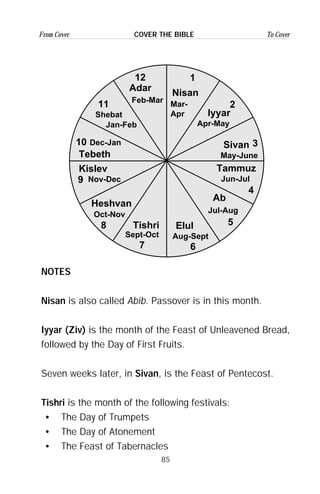
  • 308.
    300 From Cover ToCoverCOVER THE BIBLE 2 Suggestions for marking your Bible... 1. Copy the outline into your Bible. 2. Write beside Acts 15:20: The sacredness of the blood is because it is the source of life and the source of forgiveness for sin. Sanctity of blood remains for the Gentiles, too! 3. Write beside Acts 16:27: (Or put an asterisk beside it and write on the bottom of the page as a footnote...) In Roman law, if a prisoner escaped, the guard who was responsible for the prisoner was required to serve the sentence, even if it meant death. 4. Add any other notes from the explanations which you now wish to preserve in your Bible.
  • 309.
    301 From Cover ToCoverCOVER THE BIBLE Unit Thirty Four THE BOOK OF ROMANS OUTLINE NOTE:Forthispreciousbook,youwillbegiventhemajorheadings, but NOT the references showing the beginning and ending of each section. Dig it out for yourself, and grow another level in your Bible study. (Estimated time to do so: one hour or less!) PROLOGUE: 1:1-17 Salutation: ________ Personal Testimony: ________ Theme Introduced: ________ DOCTRINAL SECTION: 1:18-11:36 God’s Holiness in condemning sin: 1:18-3:20 The guilt of mankind: ________ The revelation of God to all men: ________ The steps of rebellion against His revelation:_____ To judge others is to condemn self: ________ God is no respecter of persons: ________ The Jew and the law: ________ What advantage has the Jew?: ________ There is none righteous: ________ God’s Grace in justifying sinners: 3:21-5:21 Righteousness through faith: ________ Abraham’s justification: ________ The promise realized through faith: ________ Results of justification: ________ Sin through Adam; salvation through Christ:_____
  • 310.
    302 From Cover ToCoverCOVER THE BIBLE God’s Power in sanctifying believers: 6:1-8:39 Freedom from sin’s power: ________ Christians are under grace, the Spirit’s “law:” _________ The law and sin: ________ The problem of indwelling sin: ________ The struggle of two natures: ________ Life in the Spirit: ________ More than conquerors: ________ God’s Sovereignty in saving Jew and Gentile— 9:1-11:36 The Jew and the Gospel: ________ Zeal but no righteousness: ________ Righteousness is by faith in Christ: ________ The remnant of Israel: ________ Salvation has come to the Gentiles: ________ The Gentiles are warned: ________ The restoration of Israel: ________ The almighty God: ________ PRACTICAL SECTION: 12:1-15:13 God’s Glory, the object of service: ________ Consecration of Christians: ________ Practical Christian Service: ________ Honor authority: ________ Walk in love: ________ Conduct and the weaker brother: ________ Christ, the only Judge: ________ Unity in Christ: ________ The Gospel to the Gentiles: ________ EPILOGUE: 15:14-16:27 Personal notes: ________ Benediction and Doxology: ________
  • 311.
    303 From Cover ToCoverCOVER THE BIBLE AUTHOR Paul, written during his third missionary journey. DATE 56 A.D., 11 years before his death by beheading in Rome. James Stalker in The Life Of St. Paul writes, THEME GOD’S SALVATION FOR SINNERS Paul was condemned and delivered over to the executioner. He was led out of the city with a crowd of the lowest rabble at his heels. The fatal spot was reached; he knelt beside the block; the headsman’s axe gleamed in the sun and fell; and the head of the apostle of the world rolled down in the dust. So sin did its uttermost and its worst. Yet how poor and empty was its triumph!...ten thousand times ten thousand welcomed him in the same hour at the gates of the city which is really eternal. Even on earth Paul could not die...in ten thousand churches every Sabbath ...his eloquent lips still teach that gospel of which he was never ashamed. (p. 143)
  • 312.
    304 From Cover ToCoverCOVER THE BIBLE FIRST FURLOUGH THE LETTERS OF PAUL SITUATION LETTERS WRITTEN DURING THIS PERIOD FIRST MISSIONARY TRIP NONE GALATIANS SECOND MISSIONARY TRIP 1 THESSALONIANS 2 THESSALONIANS THIRD MISSIONARY TRIP 1 CORINTHIANS 2 CORINTHIANS ROMANS HEBREWS (?) FIRST IMPRISONMENT EPHESIANS COLOSSIANS PHILEMON PHILIPPIANS RELEASE 1 TIMOTHY TITUS FINAL IMPRISONMENT 2 TIMOTHY If you would like more information about the life of Paul, see the extensive article in the ZONDERVAN PICTORIAL ENCYCLOPEDIA...
  • 313.
    305 From Cover ToCoverCOVER THE BIBLE PAUL’S CONTRAST OF ADAM AND CHRIST ADAM CHRIST BROUGHT SIN AND DEATH INTO THE WORLD BROUGHT RIGHTEOUSNESS AND ETERNAL LIFE INTO THE WORLD REASON: Desired to be like God REASON: God’s desire for men to be reconciled RESULTS: Condemnation— Upon himself Upon all men Eternal judgment upon all men RESULTS: Justification— immediate, imputed. Eternal life for all who believe THE LAW GIVEN TO REVEAL THE DEPRAVITY OF MAN’S HEART GRACE GIVEN TO REVEAL THE LIMITLESS LOVE OF GOD FOR MAN THE IMPACT OF ADAM’S ACT: Spread to all who would ever be born from his seed THE IMPACT OF JESUS’ ACT: Made salvation available to all who would ever confess “Jesus is Lord!”
  • 314.
    306 From Cover ToCoverCOVER THE BIBLE NOTES THE BOOK OF ROMANS, SUMMARIZED... The writer of Romans neatly summarizes this book in Galatians 3:22-29. It’s an interesting passage to read after you have digested this book. DO ALL MEN HAVE AN EQUAL OPPORTUNITY TO KNOW GOD? Yes! According to Paul (1:18ff), God has revealed all of his character and attributes through the creation He made. Indeed, the very purpose of creation is to reveal Him! Thus, all men in all generations have had equal access to the truth that there is a God. HAVE ALL MEN EQUALLY REJECTED THAT KNOWLEDGE? Yes! Paul says (1:21ff) men have equally recognized God’s presence, and have all rejected the obvious call to become His servants. Having “eliminated” God from their thinking, they began to create manufactured gods of their own (v.23). WHY DID GOD “GIVE THEM UP?” Because they gave Him up! The staircase of depravity is revealed for us (1:24ff), and we see the degrading of the dignity and worth of man taking place. WHO WILL WITNESS AGAINST EACH MAN? According to 2:1-16, each individual’s conscience will testify that the knowledge of God was deliberately scorned!
  • 315.
    307 From Cover ToCoverCOVER THE BIBLE WITHOUT EXCUSE! That’s what Paul’s conclusion is! The Jew had the Law to remind him how short he fell from God’s righteousness. The Gentile had the Law written in his heart, even though he had never read it with his eyes. Therefore, all men everywhere are without excuse. TESTIMONIES FROM TWO WHO EXPERIENCED JUSTIFICATION CENTURIES EARLIER… Abraham (4:1ff) was saved by faith. His faith caused righteousness to be “imputed” to him. ("Imputed” is to add something to someone’s account.) Paul indicates Abraham was saved before circumcision, not after it! (Compare Genesis 15:6 with 17:24.) David (4:6ff) was forgiven by God’s “imputing” righteousness without works (4:6). No sin offering in the Levitical system could forgive, or cover, the sins of adultery and murder—both of which David committed! By throwing himself upon the mercy of God, he bypassed the law and became the subject of God’s grace. JUSTIFICATION SUMMARIZED… In 5:1-21, we are told that we have peace with God through Jesus Christ. Note that there is no other way for man to have peace with God! It is not offered by any world religion. It is not available by living a good life. It is not available by joining a church. It is not available by being active in a church. It is only available through the activity of Jesus Christ! Has that truth clearly lodged in your heart and your mind?
  • 316.
    308 From Cover ToCoverCOVER THE BIBLE PEACE WITH GOD! In chapter 5, Paul begins verse 1 with the pronoun “we.” He is now writing to those who are believers, and will discuss details about our Christian walk. This is not a small fact for you to digest! There are those who seek to make chapter 7 a reference to unbelievers, and not to believers. This violates the very integrity of Paul’s letter. Back here in chapter 5, he begins to discuss details of the Christian walk for us. From now on, this book discusses our life in Christ. FIND AND UNDERLINE CHAPTER FIVE’S “MUCH MORE’S” As you do so, your heart will sing worship songs to your God! It’s one of the beautiful self-studies in this great book of Romans. THE MEANING OF BAPTISM... In 6:1, we discover that baptism is a means of identification of the believer with the death, burial, and resurrection of our Lord. Note that it does not bring salvation—the blood of Christ does that—but it does bring witness to that salvation. KING SIN AND KING JESUS AND YOUR THRONE ROOM In 6:12ff, we are told that we have one throne and two masters...the old “King Sin,” which reigned freely for so long, and the new “King Jesus,” now come to be Lord. This passage deserves careful study and meditation. Note that you are not free from the presence of that old nature. That comes later...at His coming or at your death.
  • 317.
    309 From Cover ToCoverCOVER THE BIBLE IT’S TIME NOW TO SET YOU FREE TO COMPLETE THE STUDY OF ROMANS ON YOUR OWN! In chapter 7, the war between the two natures is described. In chapter 8, the liberty that is ours in Christ is outlined. Then, in chapters 9-11, Paul deals with the Jew. In chapter 12, he speaks to us again, and tells us a little bit about the spiritual gifts which God has given to those in the church, the body of Christ. Beginning in chapter 13, he presents clear teaching about ethical issues we will face in our daily walk. Chapters 14 and 15 present a very important discussion about the responsibility of the “stronger” Christian toward the “weaker” one. Chapter 16 is not a chapter to “skip” because of all the names and the local greetings. In fact, it has much meat in it. HIGH DRAMA IN ROMANS 16:15... In 95 A.D., Rome was shocked when its two most out—standing citizens were condemned for becoming Christians. Flavius Clemens was the Consul of Rome; he was put to death for his faith. His wife, Domatilla, was of royal blood, a niece of the Emperor Domitian. She was, therefore, spared—but banished to the island of Pontia, where she lived her life in isolation. Their two sons were both in line as heirs to the throne of Rome! How did the Gospel penetrate their chambers, and enter their hearts? History tells us their chamber-slave was... NEREUS!
  • 318.
    310 From Cover ToCoverCOVER THE BIBLE 2 Suggestions for marking your Bible... 1. Copy the outline into your Bible. 2. Write beside Romans 1:16-17: Key verses of Romans 3. Write beside 16:11: “household”—such persons so designated were slaves of the person named. A large number of the names in this chapter refer to slaves who were believers. 4. Add any other notes from the explanations which you now wish to preserve in your Bible.
  • 319.
    311 From Cover ToCoverCOVER THE BIBLE Unit Thirty Five 1 CORINTHIANS 2 CORINTHIANS OUTLINE OF 1 CORINTHIANS INTRODUCTION Opening statement—1:1-9 DISORDERS REPORTED TO PAUL Division at Corinth—1:10-4:21 Church Discipline—5:1-13 Judicial Entanglements—6:1-8 Immorality—6:9-20 PROBLEMS RAISED BY THE CORINTHIANS Marriage—7:1-40 Meat Offered to Idols—8:1-10:33 MORE DISORDERS REPORTED TO PAUL The Woman’s Position and Covering—11:1-16 Factions Within The Church—11:17-19 Abuses related to the Lord’s Supper—11:23-34 The use of spiritual gifts—12:1-31 THE EXCELLENCE OF LOVE—13:1-13 THE IMPORTANCE OF EDIFICATION Prophecy a Superior Gift—14:1-11 Purpose of Cell Groups: Edification—14:12-19 Instructions to the Church—14:20-40 THE RESURRECTION OF CHRIST—15:1-58 THE OFFERING The collection for the saints—16:1-4 Personal plans—16:5-12 CONCLUSION Exhortations—16:13-24
  • 320.
    312 From Cover ToCoverCOVER THE BIBLE 2 CORINTHIANS INTRODUCTION Salutation—1:1-2 Paul’s affliction—1:3-14 THE CHANGE OF PLAN An explanation of the change of plan, Part 1—1:15-2:13 The Christian Ministry—2:14-6:10 Led in triumph—2:14-17 Ministry of the New Covenant—3:1-18 Encouragement in difficulty—4:1-5:10 The motive and the message—5:11-21 Appeal to the Corinthians—6:1-7:4 An explanation of the change of plan, Part 2—7:5-16 THE OFFERING FOR THE JERUSALEM CHURCH Presentation of need—8:1-8 Christ the example—8:9 Message on stewardship—8:10-24 God loves a cheerful giver—9:1-15 PAUL’S DEFENSE OF HIS AUTHORITY Spiritual warfare—10:1-6 Painful rebuke—10:7-15 Paul’s suffering as an Apostle—10:16-33 Paul’s “thorn in the flesh”—12:1-10 Paul’s Apostleship demonstrated—12:11-13 A third visit planned—12:14-18 Paul seeks repentance from the Corinthians— 12:19-21 CONCLUSION Paul speaks of his coming; warns of sin—13:1-10 Benediction—13:11-14
  • 321.
    313 From Cover ToCoverCOVER THE BIBLE AUTHOR Paul, as validated by 1:1 in each book. DATE 1 Corinthians Paul wrote this letter between 54 A.D. and before the Spring of 57 A.D. 2 Corinthians was written 6 months later. In 50 A.D., Paul reached Corinth on his second missionary journey, staying 18 months (Acts 18:1-8). The first letter Paul wrote them has been lost (5:9). In 5:9-11, Paul heard they had misunderstood some things he had said, and that there were divisions in the church (1:11). He had received three questions from them (7:1), and wrote the letter known as First Corinthians to answer them. At the time, Paul was in Ephesus (16:8), near the end of a three-year stay there (Acts 20:31), and before his departure for Macedonia (16:5, Acts 20:1). 2 Corinthians After writing 1 Corinthians, Paul visited Corinth (13:1), which was a painful experience involving discipline (2:1-6). Paul then wrote “The Sorrowful Letter” (2:4), which is lost. Titus carried this letter to Corinth, bringing good news to Paul when they regrouped in Macedonia (7:6-8). In relief, Paul wrote 2 Corinthians in October of 57 A.D., following the Macedonian and Jewish civil new year, which began in September (8:10).
  • 322.
    314 From Cover ToCoverCOVER THE BIBLE THEME 1 Corinthians— Various problems in the church, some moral, some doctrinal. The book is a treasure house of doctrinal teaching on practical subjects. 2 Corinthians— Paul had been criticized by some at Corinth for not visiting as promised. He explains why his plans changed, describing his ministry. He discusses the collection for the saints at Jerusalem. He defends his authority because some had opposed him in the church there. NOTES THE CITY OF CORINTH Located on an isthmus. Ships were unloaded on each side of the isthmus, goods transported across it, and reloaded on other ships. Meanwhile, sailors revelled in Corinth, filled with prostitutes who served the Goddess Aphrodite. A wild and wicked city! THE CORINTHIAN LETTERS Muchspeculationabouttheseletters,basedoninternalevidence, has been written. How many letters were there, and how were they written? Here is one view: (From The Criswell Study Bible:) • FIRST LETTER—Lost (1 Corinthians 5:9) • SECOND LETTER—1 Corinthians • THIRD LETTER— Called “The Painful Letter;” Lost (See 2 Corinthians 2:4) • FOURTH LETTER—2 Corinthians
  • 323.
    315 From Cover ToCoverCOVER THE BIBLE IMPORTANT THEMES IN THESE LETTERS Carnality Stewardship The Lord’s Supper The Gifts of the Spirit The Resurrection of the Dead Marriage Church Order The Kingdom of Christ
  • 324.
    316 From Cover ToCoverCOVER THE BIBLE Why God Permits Weaknesses The Ministry of the Spirit Adiaphora (Doubtful Things) Christian Liberty THE CORINTHIAN CHURCH Paul seemingly had nothing but headaches with this group of believers! To describe them, the one word “carnal” is used. The Greek word is sarkikos. As you pronounce it, it is a gutteral sounding word, isn’t it? The word originated from the description of a bird of prey finding and eating the rotted flesh of a dead animal! If you will scan the book of 1 Corinthians, the shocking problems of this church will become visible. Incest, pride, factions, class divisions, immorality, doctrinal errors, and more are revealed! In addition to all else, these Christians had taken spiritual powers (called “gifts”) and misused them. Their pride had caused them to use their gifts as private toys.
  • 325.
    317 From Cover ToCoverCOVER THE BIBLE SOME HELP WITH “SPIRITUAL GIFTS” IN THE BIBLE TWO TYPES: • SIGN GIFTS Miracles Healings Tongues Interpretation • SERVICE GIFTS Different levels: 1. Basic Gifts a. Serving b. Giving 2. Ministry Gifts a. Faith b. Helping Others In Distress c. Discerning True and False Spirits 3. Equipping Gifts a. Prophecy (Forth-telling, not “Fore-telling”) b. Teaching c. Putting Deepest Knowledge Into Words d. Paraclete (Counselor) e. Wisdom Our gifts are given to us. Most important of all, gifts are not for private enjoyment, but are rather spiritual capacities to be poured out in service. Therefore, if we are not serving, there is no reason to expect we will have any use of our gifts. They are not to be stored up, but poured out. Hebrews 5:12-14, along with Hebrews 6:11-12, indicate that our gifts may not develop at all because of carnal immaturity and spiritual sluggishness. According to 1 Corinthians 14, the primary purpose of gifts is for the edification of others in the Body. Thus, unless and until the church is a “Basic Christian Community” of 8-15 people (a “cell group”), gifts cannot be effectively used. (See my book Where Do We Go From Here?)
  • 326.
    318 From Cover ToCoverCOVER THE BIBLE THREE TYPES OF PEOPLE: 1 CORINTHIANS 2:14-3:3 There are three Greek words used in this section to describe three types of persons: PSUKIKOS PEOPLE The word PSUKIKOS is found in 2:14, translated “the man without the Spirit” in the NIV. Other translations simply call this person the “Natural” man. Here is described a person who is spiritually dead, rejecting truth about God. Note the person is deaf. This person has a heart problem, hates God, avoids Him, and is “far away” from interest in spiritual things. SARKIKOS PEOPLE The word SARKIKOS is found in 3:1, translated “worldly,” or “men of flesh.” This person is a believer, but living a disobedient, self-directed existence. Where the PSUKIKOS person rejects, the SARKIKOS person rebels against Christ’s Lordship. They have a value problem, and use God for their own ends. They are uncomfortable to be too intimate with Christ. Like the Hebrew people in Moses’ day, they feel most comfortable when someone else gets close to God and comes to tell them about it. These are Christians who live in the bondage of sin, and fight an inner war between their own desires and those of their rightful Lord and Master. PNEUMATIKOS PEOPLE The word PNEUMATIKOS occurs in 2:15, and is translated “spiritual.” These persons receive the word of God, are alive, open, listening, and used by God.
  • 327.
    319 From Cover ToCoverCOVER THE BIBLE SPIRITUAL GIFTS ARE GOING TO BE FOUND AMONG PNEUMATIKOS PEOPLE! They do not belong to unbelievers. They are given only to those who are the children of God. They will have no value or worth to those who are “carnal,” who are God’s disobedient children. What would they do with them? They would use them for personal enjoyment! They are not given for this purpose, but for the activity of God flowing through those who desire to do His will in all things. Thus, spiritual gifts—while latently endowed in all believers at the time of conversion—will not be significant until the “battle within” is settled, and the believer is ready to engage in God’s battles! Every single Christian is to receive and use spiritual gifts as a part of life in the cell group. Gifts will vary with the ministry to be performed. Christ will provide that spiritual power which is required for His work to be done. You are not to wait until you “feel” a gift coming on you. A gift is to be exercised, not felt. When you face a situation where you know Christ wants to use you, with boldness expect the gift to be present to do His work. For example, if someone needs healing, there is no reason why you cannot pray for this to be done. Let your gift of faith be strong enough to expect the healing to take place. After all, you know it doesn’t depend on you or your power, but His—so step out in faith and pray for the healing. God always gives His best to those who trust Him most!
  • 328.
    320 From Cover ToCoverCOVER THE BIBLE 2 Suggestions for marking your Bible... 1. Copy the outline into your Bible. 2. Write beside 1 Corinthians 13:1: The Greatest Thing In The World: Love! 3. Write beside 2 Corinthians 9:8: God’s Economy— Circulation of what He entrusts to us! 4. Add any other notes from the explanations which you now wish to preserve in your Bible.
  • 329.
    321 From Cover ToCoverCOVER THE BIBLE Unit Thirty Six THE BOOK OF GALATIANS OUTLINE OF GALATIANS: “PASSPORT TO FREEDOM” PROLOGUE Opening statement—1:1-4 GALATIAN PROBLEM DEFINED Paul labels them deserters—1:5a False gospel defined—1:5b-7 Curse on heretic preachers and adherents—1:8-10 PAUL DEFENDS HIS APOSTLESHIP Authority divinely received—1:11-12 Pharisaic background chronicled—1:13-14 Paul’s commission—1:15-16a Taught by the Spirit—1:16b-17a Early missionary history—1:17b-24 JERUSALEM APOSTLES APPROVE PAUL’S MESSAGE Divine Revelation—2:1-2 Titus compelled to be circumcised—2:3-5 Paul directed to the Gentiles—2:6-10 PAUL REBUKES PETER Peter’s problem reviewed—2:11-14a Peter openly criticized—2:14b-15 Paul champions faith—2:16-21
  • 330.
    322 From Cover ToCoverCOVER THE BIBLE GRACE VS. THE LAW Appeals to their experience—3:1-5 Appeals to Abraham’s experience—3:6-7 Abrahamic prophecy—3:8-9 The curse of the Law—3:10-13 The promise of the Spirit—3:14-16 The Law vs. the Covenant—3:17-23 The Law as a tutor—3:24-25 Spiritual seed of the covenant—3:26-29 THE FULNESS OF TIME (KAIROS) Heirs, yet slaves—4:1-4 Adoption as sons—4:5-7 Regression to slavery—4:8-11 PERSUASIONS AGAINST BONDAGE Appeals to their initial faith—4:12-16 Denounces Judaistic intentions—4:17-18 States his perplexity—4:19-20 Allegorical: Ishmael and Isaac—4:21-27 Allegory explanations—4:28-31 JUSTIFICATION BY FAITH The Law a slave yoke—5:1 They cannot have both!—5:2-3 Choice: Law or grace—5:4 Faith through the Spirit—5:5 Faith through love—5:6 A curse on Judaistic legalism—5:7-12 FREEDOM NOT A LICENSE TO SIN Rather serve one another—5:13 Love your neighbour—5:14 Consume not one another—5:15
  • 331.
    323 From Cover ToCoverCOVER THE BIBLE WALKING IN THE SPIRIT Precludes walking in the flesh—5:16 The Spirit/flesh wars—5:17,18 The deeds of the flesh—5:19-21 The fruit of the Spirit—5:22,23 Believers crucifying the flesh—5:24-26 HELPING THE SINNING MEMBER Restoring in gentleness—6:1 Bearing one another’s burdens—6:2 Objective self-examinations—6:3,4 Bearing and sharing burdens—6:5,6 SOWING AND REAPING God is not mocked—6:7a We reap what we sow—6:7b, 8 Steadfast laboring—6:9,10 CONCLUSION Written in Paul’s own hand—6:11 Final blast at Judaizers—6:12-15 Exhortation to walk as new creatures—6:16-18 AUTHOR Paul, as validated by 1:1 and other personal references. DATE Approximately 48 A.D.; certainly before the Jerusalem conference in 49 A.D. (Acts 15), which supported Paul’s position as detailed in this book.
  • 332.
    324 From Cover ToCoverCOVER THE BIBLE THEME Almost immediately behind Paul’s missionary journey to the Galatians had come Judaizers attempting to undermine both Paul’s apostleship and his message of Christian freedom. Paul writes this biting, yet compassionate letter to defend his apostleship (as divinely received) and to attack the very foundation of the Judaizers’ legalistic, bondage doctrine. Clearly he offered the Galatians and Christendom, for all time, a simple alternative: Law, or Christ. There could be no mixture, no compromise. Either live under the Law and obey every edict (which is impossible), or live under the grace of God through His son, Jesus Christ. The principle is: “No Jesus, No Grace!” Historically, he shows that the Law was not opposed to Christianity, but was a preparation for the Gospel. It kept the Jews under guardianship until “the fullness of time.” However, that “fullness” had arrived in the person of Jesus, and every person was now confronted with that fact. NOTES GALATIA The term “Galatia” was one used both geographically and politically. In this letter, it is most likely referring to South Galatia, the area covered in Paul’s first missionary journey (47-48 A.D.). This territory would have included Lycaonia, Phrygia, and a portion of Pisidia, in which existed Antioch, Iconium, Lystra, and Derbe.
  • 333.
    325 From Cover ToCoverCOVER THE BIBLE The Galatians were originally a torrent of barbaric peoples who poured into and across Asia Minor in the Third Century B. C. They were tough, aggressive, and extremely volatile. In no time they conquered the province, levying tribute on local kings and cities. Caesar Augustus conquered the province and it became a part of the Roman Empire. These people had little traditional religion. They apparently adopted the superstitions and pagan mythologies of the Greeks. Paul introduced the Gospel to this people and, true to their historic nature, they readily accepted the faith. Shortly thereafter, Jerusalem Judaizers followed Paul. They preached a false doctrine, which the Galatians again accepted readily. This prompted Paul’s amazement and perplexion (see 3:1). SETTING Push had come to shove! In the fifteen years since Jesus ascended, a fundamental issue had arisen. It threatened to permanently alter the form and content of Christianity: Would the church be a separate entity, or exist as a sect within Judaism?
  • 334.
    326 From Cover ToCoverCOVER THE BIBLE The early Christians, mostly Jewish converts, were beginning to approach church doctrinal matters through Jewish traditionalist perspectives. True, Jesus was the Messiah. True, he came to establish His church. Judaism was the religion from which Christianity and Christ Himself came. Both had been established by Jehovah. Could it be possible that a combination, a mixture of both, would be in order? Let Christ be the deity to be mixed with Judaistic worship. Why not mix a little freedom and a little Law? The welcome mat would thus be spread before the Gentiles by Israel—but it would be a conditional welcome. Circumcision and legal observation of existing Jewish feast days would be required. After all, were not all the Apostles circumcised, and Paul, too? Was there any Christian law against celebrating certain special Jewish occasions? Into this issue stepped an uncompromising, brilliantly logical Paul. He saw only too clearly what Jesus had warned His disciples about, time and time again: “A little leaven leavens the whole lump.” No easier could new wine be poured into old wineskins than could Jesus’ new teachings be poured into the old wineskins of Judaism. The doctrinal question was LIBERTY versus BONDAGE. The underlying issue was the structure and content of the Christian faith. Paul knew this as did no one else around him! He wrote this crucial letter not only to discredit the Judaizers, but also to set forth once and for all time what the Christian faith was, and what it was not! Today’s church struggles with much the same issue. Tradition within the church has smothered the “new wine” of God’s Spirit. Many who love the systems of “churchianity” are seeking to pour new wine in the old wineskins of churches which are rigid in their commitment to existing structures. Old wineskins never have held new wine!
  • 335.
    327 From Cover ToCoverCOVER THE BIBLE IMPACT Almost immediately following this letter, the Jerusalem Council convened to ratify Paul’s message. They decreed that Gentiles were not to be forced to become partial Jews. Peter was to later say that Paul wrote scripture. The Judaizers never forgave Paul. He had dealt them a death blow from which they never recovered. Ironically, years later, the issue of works was to again raise its legalistic head. Again and again the church would wrestle with this problem. Fifteen centuries later, Martin Luther wrote his commentary on Galatians as a battering ram against the Catholic Church. Today, over nineteen centuries later, the battle still goes on. It is hard for man to accept the fact that NOTHING he accomplishes or does can give him “merit” to deserve special treatment by God. KEY WORDS IN THIS LETTER (CAN YOU FIND AND UNDERLINE EACH ONE?) • LAW—31 times • FLESH—18 times • SPIRIT—15 times • FAITH—22 times • BONDAGE, or related words—11 times
  • 336.
    328 From Cover ToCoverCOVER THE BIBLE THE KEY WORD OF THE ENTIRE LETTER It is liberty, used eleven times. This word is used more in this one letter than in all his other letters combined! THE NATURE OF THE BOOK As you read through this document, notice that there is not a single word of praise, commendation, or thanksgiving. There is not a single request for prayer. There is no mention of their standing in Christ, as in Ephesians. Paul is upset! He has absolutely no tolerance for legalism, and he shows it in this writing. MARTIN LUTHER’S FAVORITE BOOK In 1517, Luther was fighting the legalistic system of the church. This book of Galatians became his favorite volume in the entire Bible. His Commentary on Galatians remains to this day as the best treatise in print. Luther realized that not only is a sinner saved by grace through faith, but that a saved sinner also lives by grace! Grace is not only the way we are saved; it is also our way of life from that time forward.
  • 337.
    329 From Cover ToCoverCOVER THE BIBLE WHAT WAS… PAUL’S SECRET?
  • 338.
    330 From Cover ToCoverCOVER THE BIBLE 2 Suggestions for marking your Bible... 1. Copy the outline into your Bible. 2. Write beside Galatians 2:20: Paul’s “great secret”— CHRIST IN ME! 3. Write beside Galatians 6:14: In that cross I receive all God has for me! 4. Add any other notes from the explanations which you now wish to preserve in your Bible.
  • 339.
    331 From Cover ToCoverCOVER THE BIBLE Unit Thirty Seven THE BOOK OF EPHESIANS OUTLINE OF EPHESIANS: “HIS VERY OWN” PROLOGUE: 1:1-2 PART 1: STANDING... ...As His CHILDREN Father chooses, adopts, will accept—1:3-6 Son purchases, enlightens, will inherit—1:7-12 Spirit saves, seals, will claim—1:13,14 (PRAYER: 1:15-21) ...As His BODY Christ the Head—1:22a Church the body—1:22b-23 Quickened by the grace of God—2:1-10 Made one by the blood of Christ—2:11-17 Given access by the one Spirit—2:18-19 ...As His BUILDING The foundation—2:20 Built together—2:21-22 The household of God—3:1-13 …As His MYSTERY OF THE AGES The temple in the Lord—3:6 …As He REMOVES ALL PARTITIONS Paul’s assignment to the Gentiles—3:7-10 Done according to an eternal plan—3:11-13 (PRAYER: 3:14-21)
  • 340.
    332 From Cover ToCoverCOVER THE BIBLE PART 2: WALKING... ...Worthily as a BODY One Body (inward), with stature of Christ—4:1-16 New Man (outward), with fruit of Spirit—4:17-32 In love (upward), imitators of God—5:1-20 ...Heavenward as a FAMILY Wives and husbands—5:21-33 Children and parents—6:1-4 Servants (slaves) and masters—6:5-9 PART 3: WARRING... ...Finally, FACING THE FOE Strength (inward) in Christ—6:10 Armor (outward) of God—6:11-17 Petition (upward) in the Spirit—6:18-20 EPILOGUE—6:21-24 AUTHOR Paul, as validated by 1:1, 3:1, etc. DATE This is one of Paul’s “Prison Epistles,” along with PHILIPPIANS, COLOSSIANS, and PHILEMON. The date of the letter would be about 60-61 A.D., written from Rome. His time in prison permitted him the time to develop the meticulous outline of this powerful letter.
  • 341.
    333 From Cover ToCoverCOVER THE BIBLE THEME Our position in Christ and our responsibilities in Christian living. NOTES • ROMANS is God’s message to the NATURAL man. • 1, 2 CORINTHIANS, GALATIANS are God’s messages to the CARNAL man. • EPHESIANS, PHILIPPIANS, and COLOSSIANS are messages from God to the SPIRITUAL man. DESTINATION OF LETTER “...at Ephesus” is omitted in some manuscripts. It has long been believed this was a circular letter, addressed to the churches of Asia Minor as a whole, and circulated from church to church. Each church would insert its own name in the salutation as it was read locally. Since Ephesus was the chief city in Asia Minor, it is not unusual that other manuscript copies would bear the name of this city. SEVEN SIGNIFICANT WORDS IN EPHESIANS GRACE Occurs 13 times. The key word in the book. (Can you find and underline each time the word is used?) SPIRITUAL Also occurs 13 times. It speaks of the sphere of life in which we are living.
  • 342.
    334 From Cover ToCoverCOVER THE BIBLE HEAVENLIES Occurs 5 times (1:3, 20; 2:6; 3:10; 6:12). It is a plural noun in the Greek. “Places” is not in the original: it is “In the Heavenlies.” It references the “fourth dimension” of life. In these realms called the Heavenlies dwells every spiritual blessing. There, Christ is seated at God’s right hand. Christians are seated there with Him. Angelic beings are there, learning the wisdom of God from the Church. It is also there that Christians war against spiritual hosts of wickedness! MYSTERY Occurs 5 times (1:9; 3:3, 4, 9; 5:32). It is a crucial word in Paul’s writings. It refers not to something “mysterious,” but rather a secret God reserved until it was time to reveal it. That time has now come. The mystery concerns the church and God’s eternal purposes centering in her. BODY Occurs 8 times. It refers to the fact that we who are the “church” are the literal body of Christ on this earth! In this fact is found our position in Christ (ch. 1-3), and from this fact flow the duties of Christian living (ch. 4-6). WALK Also occurs 8 times. If the BODY is what we are, WALK is what we must do—and always in a manner worthy of Him who is the Head.
  • 343.
    335 From Cover ToCoverCOVER THE BIBLE IN Occurs 93 times in English, 89 times in Greek. It is the most used word in the book! It parallels John 15. Our life is IN Christ, IN union with Him, to be lived IN the unity that this relationship implies. THE MANY “THREES” OF EPHESIANS • Father, Son, Holy Spirit • Past, Present, Future • Natural, Carnal, Spiritual Watchman Nee’s Classic Outline... SIT - WALK - STAND In his lovely commentary on this book, Nee points out that in the first three chapters of this book there is absolutely nothing for the believer to do! He is “seated” with Christ in the heavenlies. Our position is beautifully described. First, we were selected before the foundation of the world, predestined to be chosen in Christ. Note this selection was made before we merited it by performing some good deed! Next, we were given an inheritance in Christ, and provided with the indwelling Holy Spirit as the “down payment” on it. Then, God seated Christ at His right hand in the heavenly places, putting all things under His control. He then gave His Son a new body…the church. If you are a Christian, you are a part of the body of Christ. He lives in you, and your reason for being alive is to be a container for Him!
  • 344.
    336 From Cover ToCoverCOVER THE BIBLE Paul then reminds us what “life in the tomb” was like for us, when previously we were dead in trespasses and sins. It seems the stark contrast between what we are and what we were is provided as a setting for the next great truth: we, too, along with Christ, are seated in the heavenly places. In 2:10, we are described as His workmanship, with a special reason for our existence: the Godly activity He prepared for us before our existence. Again, he contrasts what we were as PSUKIKOS people with what we are as PNEUMATIKOS people. Paul is hammering home the point that we have been brought near by the blood of Christ, not by some deed of our own. Then, Paul adds another thought. Christ is our peace, and He has united both Jews and Gentiles into “one body” through the cross. There is no separation between us any more. We are all built together into a dwelling of God in the Spirit. That “dwelling” is a body—Christ’s body—the church. PAUL’S MYSTERY... In Galatians, we were introduced to Paul’s great secret— Christ is IN us, the hope of a glory which is still to come. Now, he adds to his secret a mystery. He points out in 3:5 this was a hidden truth until God revealed it to him. That marvelous mystery is that Gentiles are fellow-heirs, along with Jews, of the inheritance Christ purchased for mankind on the cross. Chapter 3 ends with one of the most beautiful prayers in the Bible—one many Christians have memorized.
  • 345.
    337 From Cover ToCoverCOVER THE BIBLE CHAPTERS 4 AND 5: “WALK” The fourth chapter begins with Paul’s reminder that he is writing to us as a “prisoner” of the Lord. Actually, you remember he wrote this while in Rome, incarcerated by the government. He discusses the walk of the believer. No longer “seated,” the activity of Christ’s body on earth is outlined. This chapter points out the unity which should exist among the members of the Body of Christ. Underline the number of times the word “one” appears. As a human body knows no competition or struggle among its members, so should the body of Christ flow with oneness and directed actions. As the bones of the hand perform different functions for the body than the bones of the foot, even so have each of us been given our “gifts” to operate effectively within the Body of Christ. Remember…these “gifts” have nothing to do with physical “talents.” They are the spiritual powers which exist within us for no better reason than that Christ Himself dwells in us, and we are His body. He fills all things, including us, and he gives these gifts to men by giving Himself to dwell within them. GIFTED MEN GIVEN TO EQUIP THE GIFTED… In our generation, the role of “prophets,” “evangelists,” and “pastor-teachers” has been severely distorted. We see the “prophet” as a special person who is to be heard. We see the “evangelist” as a special person who is to be heard. We view the “Pastor-teacher” as a special person who is to be heard, and who is to marry, bury, counsel, etc.
  • 346.
    338 From Cover ToCoverCOVER THE BIBLE Perhaps no passage reveals the drift of the church in this generation as does 4:11ff! The significance of these offices within the church is made very clear: their job assignment is “to prepare God’s people for works of service...” This is not understood or practiced by the church as we know it today. Instead, these men become “hired holy men” to do the work of God under the sponsorship of the “laymen” who assume lesser positions and too often become a “backup system” for the clergy. Note that the clergy are the equippers and all the members of the Body of Christ are the ministers! The work of the clergy is to equip the ministers, not to do the ministry for them. The reason verse 16 is virtually unknown today is because the body has not been properly cared for, and is unable to function in its separate parts. Today’s religious systems are simply not Biblical. They are encrusted with years of traditions, and many who wish to “protect their turf” continue to propagate the church as a campus with buildings, programs, and agendas that virtually end at the parking lot! To verify the tragedy of this, note that scores of surveys of Pastors and Church Staff members admit they have no unchurched friends. Rarely do they have close fellowship with anyone who is not in a position of church leadership. We have made the church a “closed society,” an island of religious activity within a secular society. How can we possibly excuse this default? The “church” is the “body of Christ!” Jesus spent practically no time in the Temple (except to use whips in it!). How dare we claim that a series of programs which occur on a church campus is the work of the “body of Christ?” Chapter 4 describes the place where the Body is to be ministering: among those who are “darkened in their understanding.” We are to “speak truth” in their midst.
  • 347.
    339 From Cover ToCoverCOVER THE BIBLE TO CORRECT A THIEF: 4:28 To correct a thief, let him work with his hands. A thief knows the price of things stolen (tin is never taken; gold is selected!), but does not know the value of anything. Working with the hands corrects the problem! MORE ABOUT THE WALK: CHAPTER 5 Paul contrasts the church with the relationship existing between a husband and a wife—and gives us the Christian view of marriage. CHAPTER 6: “STAND” Finally, Paul deals with the warfare of the Christian. Note that the armor which is worn is all defensive. We simply stand upon ground claimed by Christ’s act on the cross. Note also that “in the heavenly places” there are also battles, and conflict with the Devil. Do you believe in a personal devil? If you have not settled that issue, you may be sure the Evil One laughs every time your name is mentioned! While some have gone overboard into demonism, no one is more “overboard” than Christians who deny the reality of Satan and his demonic forces. Ephesians 6 refers to a real world—and you live in it.
  • 348.
    340 From Cover ToCoverCOVER THE BIBLE 2 Suggestions for marking your Bible... 1. Copy the outline into your Bible. 2. Write beside Ephesians 1:3: “In heavenly places”— The sphere of spiritual, not physical, activity. 3. Write beside Ephesians 4:12: We are ALL ministers! 4. Add any other notes from the explanations which you wish to preserve in your Bible.
  • 349.
    341 From Cover ToCoverCOVER THE BIBLE Unit Thirty Eight THE BOOK OF PHILIPPIANS OUTLINE OF PHILIPPIANS, “THE JOY WAY” INTRODUCTION: 1:1-2 PART 1: PAUL’S THANKSGIVING AND PRAYER Thanksgiving—1:3-7 Prayer—1:8-11 PART 2: PAUL’S SITUATION IN ROME Imprisonment and opposition—1:12-18 Expectation of deliverance—1:19-26 PART 3: PAUL’S EXHORTATIONS To steadfastness—1:27-30 To meekness and unity—2:1-4 PART 4: PAUL’S SUPREME EXAMPLE The humiliation of Christ—2:5-8 The exaltation of Christ—2:9-11 The “working out” of salvation—2:12-18 PART 5: PAUL’S MESSENGERS TO THE CHURCH Timothy—2:19-24 Epaphroditus—2:25-30 PART 6: PAUL’S WARNING AGAINST HERESIES Judaism—3:1-14 Carnality and lawlessness—3:15-19
  • 350.
    342 From Cover ToCoverCOVER THE BIBLE PART 7: PAUL’S ENCOURAGEMENTS TO THE BODY Our new bodies—3:20-21 Stand fast—4:1 Be of the same mind—4:2 Minister to the ministers—4:3 Rejoice—4:4 Moderation in all things—4:5 Promise that prayer brings peace—4:6-7 PART 8: PAUL’S LOOK INTO THE THOUGHT LIFE The thought patterns of joy—4:8 Follow Paul as a model—4:9 PART 9: APPRECIATION FOR THE GIFT Appreciation expressed—4:10 Contentment is a choice—4:11-14 Loving gratitude for missionary support—4:15-20 EPILOGUE—4:21-23 AUTHOR Paul, with Timothy in his company. DATE A “Prison Epistle.” The date of the letter would be about 61-62 A.D., written from Rome. Read Acts 28:16-31 for Luke’s report of those two years of imprisonment.
  • 351.
    343 From Cover ToCoverCOVER THE BIBLE THEME Paul had two themes in writing this book. One was PERSONAL; the other was to TEACH. The financial support received from this Body of Christ was gratefully received by Paul, and he wrote this letter to thank them for it. He dealt with the event of Christ’s coming to earth in the most powerful of terms as he added teaching to the thanks...and, along with it, expressed his own views toward death. Perhaps he knew how quickly the Caesar of those hours could decide to snuff out his life! NOTES A LOOK AT PHILIPPI Philippi was a city in the Province of Macedonia. It is about 10 miles inland from the coastal town of Neapolis (see Acts 16:11-12). Philippi was located on the Egnatian Way, a major overland route of Macedonia. Note that Epaphroditus was sent back to Philippi from Rome: he would have journeyed over the Appian Way across Italy, then 80 miles by boat across the Sea of Adria, and then the Egnatian Way to Philippi. This city became a Roman Colony in 42 B.C., and was a miniature Rome. It was exempt from taxation, because it was a military defense center. About 200,000 people lived there in Paul’s time, mostly Greeks. Note Acts 16:13, where Paul held his first evangelistic meeting in the city.
  • 352.
    344 From Cover ToCoverCOVER THE BIBLE THE CHURCH IN PHILIPPI When Paul wrote this letter, the church was about 10 years old. You may recall that the first converts included Lydia, a seller of purple dye, and the town jailer (Acts 16). This church is considered the birthplace of European Christianity. The church was made up of Greeks, with some converted Jews. Their organization included bishops and deacons (1:1). EPAPHRODITUS LIFE AFTER DEATH
  • 353.
    345 From Cover ToCoverCOVER THE BIBLE THE STEPS OF OUR LORD FROM HEAVEN TO EARTH AND BACK THE STEPS OF PAUL FROM SELF PRIDE TO REALITY
  • 354.
    346 From Cover ToCoverCOVER THE BIBLE NOTES THE THREE ASPECTS OF SALVATION: 1:6 There is a past tense to our salvation first mentioned in this verse. Christ “has begun” a good work in us...and that points us back to the cross, the beginning place of our salvation. There, we were released from the penalty of sin. There is a present tense to our salvation. Christ will “carry it on...” This continuing aspect of our salvation refers to the the daily activity of Christ within us, as He sets us free from the power of sin. There is a future tense to our salvation: “...to completion until the day of Christ Jesus.” (Do you remember our previous study about the term “the day of Christ?”) In the future, Christ will not only set us free from the penalty and the power of sin, but also will release us from the presence of sin. While there are those who seek to teach us we may, at this present time, attain sinlessness, the scriptures do not sustain this view. Such a teaching has skirted around the edges of Christian teaching for centuries. Don’t be deceived by this doctrine! You have an old nature and a new nature, and you will continue to have them both until that final day of our redemption. One teacher even goes so far as to say 1 John 1:9 is not for the Christian—that it is written for unbelievers. Such a distortion to prove a doctrine wrenches the verse totally out of its context! Foolish Galatian Christians and carnal Corinthian Christians help us realize sinless perfection is not verifiable.
  • 355.
    347 From Cover ToCoverCOVER THE BIBLE PAUL’S RESPONSE TO FACTIONS IN THE CHURCH IN ROME... Poor Paul! He had longed to visit Rome. His long letter to the church there has blessed centuries of Christians. But the church itself did not have the purity it should have had, and some within it were jealous of Paul. His reputation somehow clouded theirs, they thought, and when he finally arrived in the city, they delighted in his incarceration. In 1:12ff, Paul sees this group of people through loving eyes. He admits that some are preaching Christ from envy and strife. Nevertheless, he rejoices that Christ is being proclaimed! He seems to be saying to us, “The Lord can hit a pretty good lick with a crooked stick!” Those who demand perfection from others in ministry usually have a spiritually neurotic personality. Whatever God does with any of us, He must do in spite of us. Paul picks his fights carefully. One fight he avoids is with those not worth battling. He knew that “the main thing was to keep the main thing the main thing.” HAVEYOUNOTICEDTHECONTRASTSPAULINSERTSBETWEEN BELIEVERS AND UNBELIEVERS? In nearly all of his writings, Paul references the PSUKIKOS people, who live in rebellion against God, and reminds his readers that they used to be a part of that community. In Philippians 3:18ff, he again touches upon the condition of the unbelievers. Sin leaves a swollen place in every life it stings. It is that painful area we focus upon when we bring the Gospel to them. That’s why our message is “good news.”
  • 356.
    348 From Cover ToCoverCOVER THE BIBLE HAPPINESS IS A CHOICE! In Paul’s final chapter, he points out that happiness is not something we receive; it is something we choose. Note the eightfold path he outlines which will bring us happiness: 1. Have a gentle spirit—v. 5 Some folks get out of bed and put on boxing gloves. Letting the world know yours is a gentle spirit will create an inner peace. “You tell the size of a man by the size of what it takes to get his goat.” 2. Have no anxiety—v. 6 Anxiety is a very serious emotion, which has physical symptoms. These include hyperventilation, sweating, nervousness, weeping profusely, etc. It is the result of deep fear. Those who feel they are controlled by circumstances, and that they have no control of what will happen to them, are victims of anxiety. The solution is clearly given. It is prevailing prayer! When we realize our Lord is in charge of all there is, we can then relax in the assurance that He—not circumstances—will control what happens to us. 3. Let God guard your thought life—v. 7 Satan is no fool. He knows he can slip into your subconscious and plant fear within you! Letting God guard thoughts is crucial. 4. Meditate on positive thoughts—v. 8 This verse is well worth memorizing!
  • 357.
    349 From Cover ToCoverCOVER THE BIBLE 5. Focus on Godly behavior—v. 9 Each time we choose a certain form of behavior, we generate happiness or sorrow from it. Only fools believe they will find happiness in practicing behavior out of keeping with Christ’s Lordship. 6. Divert attention from yourself to others—v. 10 Instead of focusing upon himself, Paul speaks words of commendation to the Philippians. Folks who dwell on their own need, problems, or accomplishments don’t collect much joy from the experience, do they? 7. Make a job out of being content—v. 11 Enjoy the half of the glass that is full, rather than complaining about the half that is empty. 8. Remember the twofold activity in all I do—v. 13 When I do all things through Christ, how can I avoid being happy? How can I be anything else but happy?
  • 358.
    350 From Cover ToCoverCOVER THE BIBLE 2 Suggestions for marking your Bible... 1. Copy the outline into your Bible. 2. Write beside Philippians 1:3: All 3 aspects of Salvation are in this verse! 3. Write beside Philippians 4:13: Note: 2-fold responsibility: Mine and Christ’s 4. Add any other notes from the explanations which you wish to preserve in your Bible.
  • 359.
    351 From Cover ToCoverCOVER THE BIBLE Unit Thirty Nine THE BOOK OF COLOSSIANS OUTLINE OF COLOSSIANS: “CHRIST IS ALL, AND IN ALL” INTRODUCTION: 1:1-2 PART 1: PAUL’S THANKSGIVING AND PRAYER Thanksgiving—1:3-8 Prayer—1:9-14 PART 2: PAUL’S DOCTRINE OF THE PERSON OF CHRIST His divine person—1:15-20 His reconciling work—1:21-23 PART 3: PAUL’S PART IN GOD’S PLAN Rejoicing in suffering—1:24 Proclaiming the word—1:25-29 Concern for the saints—2:1-5 PART 4: PAUL’S WARNINGS AGAINST FALSE TEACHING Abide in the truth—2:6-7 Beware of man-made theories—2:8 The all-sufficiency of Christ—2:9-15 PART 5: PAUL EXPOSES A HERESY The fallacy of the teachings—2:16-19 The folly of returning to bondage—2:20-23 The superiority of the Christ-life—3:1-4
  • 360.
    352 From Cover ToCoverCOVER THE BIBLE PART 6: THE NEW MAN IN CHRIST Vices to be put off—3:5-11 Graces to be put on—3:12-17 Family relations—3:18-25 PART 7: PAUL’S COMMENDATIONS Commendation of his messengers—4:7-9 Greetings from friends—4:10-14 Greetings to friends—4:15-17 EPILOGUE—4:18 AUTHOR Paul, once again with Timothy in his company. DATE A “Prison Epistle.” The date of the letter would be about 62-63 A.D., written from Rome. THEME About 6 years after this church was founded, an unspecified but dangerous error crept into this congregation. Epaphras visits Paul near the end of his imprisonment in Rome, and shares the disturbing news that certain false doctrines and practices threaten the faith of the Colossian Christians. They are in danger of drifting from the truth (1:23, 2:8). Paul writes to counteract these false teachings about the Person of Christ, and to give encouragement to their walk.
  • 361.
    353 From Cover ToCoverCOVER THE BIBLE NOTES A LOOK AT COLOSSI Colossi was one of the “tri-cities” of the Lycus Valley. The area was about 100 miles inland from Ephesus. 500 years before Christ, it was called “The Great City of Phrygia.” But, by Paul’s time, it was a small town. When Paul wrote this book, there was a Christian congregation meeting in all three of the important regional “tri-cities”—Heirapolis, Laodicea, and Colossi. The inhabitants were mostly Greeks and Phrygians, with an unusually large Jewish community. The area was famous for its soft wool. THE CHURCH IN COLOSSI From Colossians 1:3-4, some have concluded that the members of the church were mostly strangers to Paul. Epaphras, who possibly was one of the converts of Paul in Ephesus, might have been the founder of the church (1:7), as well as the churches in the other nearby cities (4:13). He was a key member in the life of the congregation (4:12). Colossians 4:17 infers that Archippus was the church’s pastor when Paul wrote the epistle (see Philemon 2). The church met in the home of Philemon, who was deeply devoted to its life (4:9 and Philemon 1, 5, 7).
  • 362.
    354 From Cover ToCoverCOVER THE BIBLE LECTURE NOTES THE MAIN THEME OF THE BOOK THE HERESY IN THE CHURCH WHAT DOES “CHRIST IN YOU” MEAN?
  • 363.
    355 From Cover ToCoverCOVER THE BIBLE THE THREE ASPECTS OF SALVATION IN COLOSSIANS… • Salvation past: 1:13 • Salvation present: 1:10 • Salvation future: 1:12 THE “COLOSSIAN FORCE” In 1:16, we are told that all creation has occurred through Christ and for Christ. In 1:17, Paul goes on to say, “in Him all things hold together.” Within nuclear science, this has spawned the term “Colossian Force,” used to describe the unexplainable and mysterious force that keeps the atoms—and the very universe—from flying apart. THE DEITY OF CHRIST The powerful affirmations of Paul in this book about our Lord Jesus leave little to speculate about! Note 2:9-10. What more are we looking for? When God gives Himself and He has no more to give, some still wish for more proof from Him that He loves us, and that we can be joined to Him. MORE ABOUT OUR MINDS... In 3:2, we are reminded that if we set our minds on the things above, and not on the things that are on the earth, life will take a new direction.
  • 364.
    356 From Cover ToCoverCOVER THE BIBLE 2 Suggestions for marking your Bible... 1. Copy the outline into your Bible. 2. Write beside Colossians 3:11: This verse gives the main theme of the book 3. Write as a footnote to Colossians 3:11: Paul does not preach a system or a philosophy, but a person—Jesus Christ. 4. Add any other notes from the explanations which you wish to preserve in your Bible.
  • 365.
    357 From Cover ToCoverCOVER THE BIBLE Unit Forty THE BOOKS OF 1 THESSALONIANS 2 THESSALONIANS PHILEMON OUTLINE OF 1 THESSALONIANS INTRODUCTION: 1:1 PART 1: COMMENDATIONS TO THE THESSALONIANS For their faith and steadfast labor—1:2-4 Word received with full conviction—1:5 Became imitators of Apostles and the Lord—1:6 Lived as Christian examples—1:7-9a Turned from idols to God—1 :9b Waiting for the coming of Christ—1 :10 PART 2: PAUL DEFENDS HIS CONDUCT Coming was not in vain—2:1 Gospel proclaimed in boldness—2:2 Words were entrusted to Paul by God—2:3, 4 Delivered not with flattery or greed—2:5 Or from vain glory—2:6 But with gentleness and affection—2:7, 8 And hard labor—2:9 With devotion—2:10 Exhorting and encouraging as a father—2:11 So they might walk worthy of God—2:12
  • 366.
    358 From Cover ToCoverCOVER THE BIBLE PART 3: PAUL’S CONCERN FOR THE CHURCH Thanks God for the word received—2:13 Likens their sufferings to the Judeans—2:14a Condemns the unrepentant Jews—2:14b-16 Blames Satan and Jews for his absence—2:17, 18 The Church his crown, hope, and glory—2:19, 20 PART 4: TIMOTHY’S VISIT Timothy sent to strengthen and encourage—3:1, 2 Preparing them for afflictions—3:3-5 Timothy’s good report of faith and love—3:6 A real comfort to Paul in his afflictions—3:7 Stand firm in the Lord!—3:8 Prayer of intercession—3:9-13 PART 5: PAUL REJOICES and PRAYS FOR THEM To walk and please God—4:1 By the authority of Jesus—4:2 Abstain from sexual immorality—4:3-5 Not to defraud their brothers—4:6 God called them to sanctification—4:7 Rejecting this word is rejecting God—4:8 Increase your brotherly love—4:9,10 Tend to your own business—4:11,12 PART 6: THOSE ALREADY DEAD TO BE RESURRECTED Don’t grieve as those without hope—4:13 Belief in Jesus’ resurrection the key—4:14 Those alive at His coming—4:15 Those dead at His coming—4:16 Those alive “forcefully caught up”—4:17 Use this knowledge as comfort—4:18
  • 367.
    359 From Cover ToCoverCOVER THE BIBLE PART 7: THE “DAY OF THE LORD” Coming as a thief in the night—5:1,2 As the birth pangs of a pregnant woman—5:3 Brethren are not of the darkness—5:4,5 Stay alert, sober, faithful—5:6-8 God has destined you for salvation—5:9-10 Therefore, encourage one another—5:11 PART 8: PAUL EXHORTS THEM TO BROTHERLY LOVE Esteem your church leaders—5:12,13 Admonish the unruly, help the weak—5:14 Repay not evil for evil—5:15 Rejoice always—5:17 Pray continuously—5:18 Quench not the Spirit—5:19 Despise not prophecy—5:20 Examine everything carefully—5:21 Abstain from evil—5:22 PART 9: PAUL’S CONCLUDING REMARKS For their preservation at His coming—5:23 He is faithful and true—5:24 EPILOGUE—5:25-28 AUTHOR Paul—as validated by 1:1 and multiple personal references. DATE Approximately52A.D.Weknowtheyoungchurchwasestablished on his second missionary journey (A.D. 51), and that this first letter followed shortly after.
  • 368.
    360 From Cover ToCoverCOVER THE BIBLE SETTING Unbelieving Thessalonian Jews, angered by Paul’s many Jewish converts, forced Paul to flee the city after he had been there for about three weeks (Acts 17:2). Not content to just chase him from their city, these Jews pursued him to Berea, 50 miles west, and again forced him to leave town. He then went 200 miles south to Athens. FromAthens,aconcernedPaulsentTimothybacktoThessalonica to determine how the young church was faring. Timothy made the journey, catching up with Paul in Corinth with a most heartening report. This first letter was sent in response to that good report. THEME In many respects, this is a love letter. More than any of his other letters, it is characterized by simplicity, gentleness, affection, and intimacy. Paul is genuinely pleased with the new church’s growth and early maturity. Already they had become shining examples of faithfulness and steadfastness in the face of persecution. Gently, Paul admonishes them to remember how he came to them with affection, hard labor, and devotion, exhorting and encouraging them as a father. His earnest desire was that they might walk worthy of God. He reminds them that he had told them of their coming afflictions, and encourages them to remain steadfast in their faith when the persecution comes. He reminds them again that God will indeed deal with those who persecute His people.
  • 369.
    361 From Cover ToCoverCOVER THE BIBLE At that point, his letter takes a radical turn. He first pleads with them to walk with God, to abstain from sexual immorality, and not to be guilty of defrauding their brothers. He reminds them that God has called them to sanctification (being set apart as holy vessels), and that those who reject this word are rejecting God Himself, who gave these words to Paul. He encourages them to mind their own business, and to increase in brotherly love. Then, obviously responding to Timothy’s report of his stay with them, he becomes their teacher. Their questions about the return of Christ are answered. He tells them not to grieve over those who have departed: they will be raised up first when Christ returns. Those who are still alive will be “snatched forcefully” from the earth, to meet them with Christ in the air. Therefore, they are not to grieve as the pagans, who see death as the end of relationships with their loved ones. Christ’s return will come as a complete surprise to those who live in the darkness. Their prior knowledge should shape the way they will live out their lives. NOTES KEY VERSES IN 1 THESSALONIANS 4:16: Note 3 significant words: “SHOUT”—given by the Lord as His resurrection command to the church. “VOICE”—the voice of the archangel Michael; signals a gathering is taking place. “TRUMPET”—in scripture, always signifies judgment.
  • 370.
    362 From Cover ToCoverCOVER THE BIBLE 5:3: NOTE... “ ...Iike birth pangs upon a woman with child.” This powerful prophetical statement is, in the scripture, always used in conjunction with Jesus’ second coming and final judgment. It describes the travail of a pain-filled creation that is similar to childbirth pangs. That is, they start slowly, increasing steadily in intensity and rapidity until the actual moment of birth. Most Bible scholars agree this accurately depicts the final 3 1/2 years of the “Great Tribulation,” when the Lord permits the Antichrist to proclaim himself “god.” This momentous blasphemy is the signal for the final countdown to Jesus’ second coming. Then, like a woman’s birth pangs, the world scene gets continually more wicked. Sin spreads pain in all directions! Jesus appears to herald a new order, a new birth. His coming ushers in a thousand year reign, called the “Millennium.” THE “MEETING IN THE AIR” AND THE “RETURN OF CHRIST”
  • 371.
    363 From Cover ToCoverCOVER THE BIBLE OUTLINE OF 2 THESSALONIANS INTRODUCTION Thanksgiving and encouragement in their persecution and affliction—1:1-2 God will repay those afflicting you—1:3-5 PART 1: THE DAY OF RETRIBUTION When Jesus is revealed from Heaven—1:6-7 Delivering destruction to those who know not God —1:8 Those banished forever from His presence—1:9 When He comes to be glorified—1:10-12 PART 2: CORRECTIONS CONCERNING “THE DAY OF THE LORD” Don’t be deceived: it has not come—2:1-2 First must come the “Apostasy”—2:3 The Son of Destruction will be revealed—2:3b-4a Displays himself as God—2:4b, 5 The “Restrainer” removed—2:6-9 Perishing of the unbelievers—2:10 By delusion from God—2:11 For the unbeliever’s judgment—2:12 PART 3: SALVATION OF THE BELIEVERS Through sanctification and faith—2:13 Called through the Gospel—2:14 Stand firm: be comforted and strengthened—2:15-17 PART 4: EXHORTATION TO PRAYER AND STEADFASTNESS Pray for the rapid spread of the Gospel—3:1,2 The Lord is faithful and will direct you—3:3-5
  • 372.
    364 From Cover ToCoverCOVER THE BIBLE PART 5: EXHORTATIONS TO DISCIPLINE Keep aloof from unruly and undisciplined persons —3:6,7 As we taught, be an example—3:8, 9 No work, no eat!—3:10 Quit being busybodies—3:11, 12 Don’t weary in doing good—3:13 Disassociate yourselves from dissenters—3:14 Admonish them as brothers—3:15 EPILOGUE Peace and grace to you—in my own hand!—3:16-18 AUTHOR Paul, as validated by 1:1 and numerous other personal references throughout the book. DATE Approximately 53 A.D., certainly not too long after his first letter. SETTING Paul hears that the first letter’s teaching concerning Jesus’ second coming has been misinterpreted by some of the church members. Some, it appears, presumed that the “Day of the Lord” was immediately at hand. Believing this, they were leaving their employment, sitting around, doing little except becoming busybodies and a general financial burden to the members who were employed.
  • 373.
    365 From Cover ToCoverCOVER THE BIBLE Upon hearing this news, Paul writes the second letter. This time, the words are sterner and more urgent. Nevertheless, his overall approach is one of deep love and praise, with a generous portion of caution sprinkled in for appropriate preventative measures. Paul opens by thanking them for their increased faith and love towards one another. He again mentions their steadfastness in suffering, and reiterates that God will indeed repay their tormentors with affliction, dealing out retribution to those who knew Him not. He describes the awful price of eternal destruction, separation forever from God’s presence and glory. Paul then focuses on the theme of his second letter: corrections pertaining to their erroneous beliefs concerning the “Day of the Lord.” That day has NOT come, he says, and WILL NOT come until (1) the “apostasy” comes; and (2) the Son of Destruction takes his seat in God’s temple, declaring himself to be God. Further, he explains, the “restrainer” must be taken away so that the lawless one can be revealed—that is, the one who proceeds from Satan with power, signs, and false miracles. These false signs will be believed, Paul says, because God Himself will send upon those unbelieving people a deluding influence so that they might believe a lie, and be judged by their unbelief of the truth and constantly enjoying perverted pleasures.
  • 374.
    366 From Cover ToCoverCOVER THE BIBLE Paul insists that God has chosen them not for this awesome destruction, but rather for salvation through sanctification by the Spirit and faith in the truth. It was for this, he says, that they were called. They are to stand firm in the truth and the Lord will comfort and strengthen them. Paul then closes his letter, directing his flock to steer themselves away and remain aloof from any who lead unruly, undisciplined lives. He reminds them of his own disciplined walk while among them. He tells them that if any member of the flock will not work, they are not to eat! Further, he adds, they are to disassociate themselves from all who walk in this way, not to the point of making them an enemy, but for brotherly discipline. NOTES KEY VERSES IN 2 THESSALONIANS 1:10: “...when He comes to be glorified in His saints on that day, and to be marveled at among all who believe...” Paul here plainly teaches that Jesus’ glory is in His saints; that is, those who choose to follow Him and receive His Gospel. We, who are by His grace, redeemed and given eternal life are His glory. We, in turn, will absolutely marvel at Him “on that day.” Nothing we can now comprehend in the ripest fertility of our rich, God-given imaginations can prepare us for the awesome glory of His coming or His appearance.
  • 375.
    367 From Cover ToCoverCOVER THE BIBLE 2:7: “...only he who restrains will do so until he is taken out of the way.” Bible scholars have for years debated over the identity of the “Restrainer.” The earliest church fathers thought it was the Roman Empire, which had for so long maintained law and order. However, this was proven to not be so. Today, many scholars point to the Holy Spirit as the Restrainer. However, this teaching presents us with a dilemma: if the Holy Spirit be removed, how can any person be saved? Unless we be indwelled by the Holy Spirit, we plainly have no chance for sanctification. Yet we know that during the tribulation, multitudes will be saved. Today many are asking,“Why cannot the Restrainer be the Church?” It is a case of reverse leavening, where we who are the Church are the “yeast” in the “bread” of humanity. It is the influence and prayer of the Christians that keep the light in the midst of the darkness of unbelief. If the true Church be raptured, what Godly influence will remain? Satan will, at that point, have full reign. Still, the Holy Spirit will linger, waiting for those multitudes who, in the midst of the Great Tribulation, will see Satan and the “Lawless One” for who they truly are. Again, the Spirit will be waiting for the firm conviction of the Jewish remnant. They will be jolted by the unfolding prophecy that has come to pass in a most frightening fashion.
  • 376.
    368 From Cover ToCoverCOVER THE BIBLE 2:13: “...God has chosen you from the beginning for salvation through sanctification by the Spirit and faith in the truth.” Here Paul refers to predestination. It is important that we understand that when the Bible speaks of predestination it does so in an ultimate sense of God’s foreknowledge of events, choices, and decisions. It is crucial we understand the significance of time to God and to us. God knows no such thing as “time.” He Who has always been and always will be, the Alpha and the Omega, is of infinite existence. Therefore, the concept of time is to Him without meaning. It is we humans, trapped now inside the envelope of time, to whom this concept is meaningful. In a sense, Adam invented “time.” Without sin, he and we would live forever, and therefore would not be subject to such a limiting concept. But with sin came death, finite existence, and the entrance of “time.” Now, all mankind is of limited duration. A thrice Holy God, unable to even bear the sight of sin, has no such limitation. Therefore, He sees at a mere glance what was, what is, and what will be, because all are, to Him, all in the present. It is from this dual view of “time” that predestination is to be understood. It does not mean that ages ago, before man was created, God selected certain persons for salvation and others for destruction. He simply knows who will, and who won’t, be the “God Followers.” In that sense, predestination is part and parcel of our existence.
  • 377.
    369 From Cover ToCoverCOVER THE BIBLE Isn’t it amazing? Knowing that man would sin—knowing that He would ultimately have to send His Son—still God elected to create mankind! Doesn’t this fact fill you with wonder? Doesn’t His grace appear, in this light, to be more awesome than we can conceive? The very concept of predestination should make us more appreciative of Him, our love deeper, our wonder more intense. Is it any wonder that “in that day” we will behold Him, and marvel? OUTLINE OF THE BOOK OF PHILEMON INTRODUCTION AND GREETINGS From Paul and Timothy to Philemon—1:1 To Apphia and Archippus and the church in their house—1:2 The “Apostolic Benediction”—1:3 PART 1: PAUL PRAISES PHILEMON: 1:4-7 PART 2: PAUL PLEADS WITH PHILEMON By Christ’s authority speaks—1:8 For love’s sake pleads—1:9-12 Wanted to keep Onesimus—1:13 But not without consent—1:14 Onesimus’ parting providential—1:15-17 Charge any loss or wrong to Paul—1:18-19 Pleads for acceptance and obedience—1:20,21 PART 3: PERSONAL REQUESTS Prepare a lodging—1:22 Sends greetings from others—1:23,24 Sends grace from the Lord—1:25
  • 378.
    370 From Cover ToCoverCOVER THE BIBLE AUTHOR Paul, as verified in 1:1. DATE Approximately 62 A.D., from a Roman prison. SETTING Onesimus, one of millions of Roman slaves, had stolen from his master, Philemon, and had run away. Providentially, his flight took him to Rome, where he was eventually led to faith in Jesus Christ by Paul. Upon his conversion, he remained with Paul, serving him. Now he has faced his Christian responsibility of returning to Philemon and making restitution. What a dilemma! Here is Paul, confronted with a situation tailored for explosion or exaltation. A slave (as are we to sin) has stolen from his master (as we have from God), and has run away (as have we). The slave Onesimus has become a willing slave to Jesus, his new Master, and to Paul, his mentor. THEME Christian responsibility and restitution are clearly in order, and it is to this issue this letter is addressed.
  • 379.
    371 From Cover ToCoverCOVER THE BIBLE By Roman law, Philemon has the right to punish, even to put to death, his slave (the just punishment of sin). Would Philemon forgive the errant slave? Paul becomes the advocate (the Holy Spirit’s role for us), pleading and persuading on behalf of Onesimus. He writes to a man who is his close friend and who has also been led to Christ by Paul. Thus, Paul finds himself in the place of being an earthly redeemer, but with the added problem of a redeemer trying desperately to serve both this slave and his dear friend. Paul begins his case by addressing the letter to Philemon as a beloved brother and fellow worker. In addition, he also sends the letter to the local church. (A little peer pressure, perhaps!) There is no hammer in Paul’s words: he is pleading. He explains he could easily command Philemon, but wishes rather for his decision to come from his own free will. It is a letter filled with diplomacy and skill. Note that Paul does not command or advise Philemon to get out of the business of slavery. Slavery is not the issue. Receiving a Christian slave as a brother is the real issue. The brotherhood in Christ went beyond that of a slave/master relationship. Would Philemon forgive his slave? Would he accept him as a brother, even while he remained as a slave? The message is sensitive, yet important to the Kingdom! In Christ, there is neither bond nor free, rich or poor. Earthly position or status is of no importance in a Kingdom in which the greatest among us is the one who is a bondslave! With these facts in mind, Paul offers to pay the slave’s debt himself.
  • 380.
    372 From Cover ToCoverCOVER THE BIBLE ThisisPaul’smostpersonalsurvivingletter.Itshowshischaracter and personality more clearly than any other letter. It also shows his grasp of the eventual impact of such letters being distributed among the young churches. The impact of it would help countless others who face similar circumstances. KEY VERSE IN PHILEMON 1:14: “...without your consent I did not want to do anything, that your goodness should not be as it were by compulsion but of your own free will.” Ordering and commanding is easy, and there are times when safety or timeliness is of such importance that commanding or ordering is the only way to save a life, a soul, or someone from what is beyond his comprehension. God uses both commands and pleas. Clearly, He will always show us which is best. Just as clearly, He tells us that (if necessary) we are to jerk a brother out of the fire for the saving of his soul. God is first a God of love. Those who choose to obey Him because they love Him receive the greater rewards. NOTES
  • 381.
    373 From Cover ToCoverCOVER THE BIBLE IN RETROSPECT... Paul’s helpful explanations to the Thessalonians clear up many questions for us about the coming events of history. We are more prepared than ever to move shortly into the book of Revelation, which details the events of the end times. Let us not miss the important stress made by Paul again and again as he wrote these letters: the time is short, and this is a time to live each day in the light of His soon coming. In these times, we are observing world powers move in uncanny ways to take the positions predicted for them by the holy scriptures. Russia moves closer and closer to her final destiny as the dark force of Satan in the end times. China has come alive with international prominence after being a nonentity for millennia. Do you realize the importance of using this time of personal Bible study to become equipped for your own personal ministry? It’s an urgent time. We can ill afford to know more and more about the Bible, and be less and less involved in the redemption of our neighbors, our relatives, and our friends. If these Bible books in Unit 40 make any sense at all, we must realize that the shortness of the days requires longer and longer outreaches of love to the lost!
  • 382.
    374 From Cover ToCoverCOVER THE BIBLE 2 Suggestions for marking your Bible... 1. Copy the outline into your Bible. 2. Write beside 1 Thessalonians 4:14-17: This is another evidence that the early church knew no form of church life except the house church. 3. Write as a footnote to 1 Thessalonians 5:1-11: The Second Coming of Jesus Christ, separated from the Rapture by 7 years. 4. Add any other notes from the explanations which you wish to preserve in your Bible.
  • 383.
    375 From Cover ToCoverCOVER THE BIBLE Unit Forty One THE BOOKS OF 1 TIMOTHY 2 TIMOTHY TITUS GROUP SETTING EPISTLES DATE MAIN SUBJECTS PURPOSES Travel Epistles Prison Epistles Pastoral Epistles Between 1 & 2 Journey 2 Journey 3 Journey First Roman Imprison- ment Release 2 Roman Imprison- ment Galatians 1,2 Thess. 1,2 Corin. Romans Colossians Ephesians Philemon Philippians 1 Timothy Titus 2 Timothy 48 52 55 56 61 62 67 SALVATION PAST, PRESENT, FUTURE THE INDWELLING CHRIST AND THE LIFE OF THE CHRISTIAN THE CELL CHURCH AND ITS WORKERS Evangelizing Edifying Establishing Personal Farewell TO INDIVIDUALS TO CHURCHES OUTLINE OF 1 TIMOTHY PAUL GREETS TIMOTHY—1:1-2 PART 1: TRUE AND FALSE MINISTRY—1:3-20 Warning against false doctrine—1:3-7 The law and the Gospel—1:8-11 Paul’s thankfulness for mercy—1:12-20
  • 384.
    376 From Cover ToCoverCOVER THE BIBLE PART 2: INSTRUCTIONS FOR CHRISTIAN WORSHIP —2:1-15 Paul exhorts to prayer—2:1-8 The place and dress of women—2:9-15 PART 3: THE QUALIFICATIONS OF BISHOPS AND DEACONS—3:1-13 Qualifications of Bishops—3:1-7 Qualifications of Deacons—3:8-13 PART 4: THE REASON FOR WRITING—3:14-16 Paul hopes to see Timothy—3:14-16 PART 5: ERROR AND ITS ANTIDOTE— 4:1-16 Predictions of apostasy—4:1-5 A good minister of Jesus Christ—4:6-16 PART 6: THE TREATMENT OF WIDOWS, ELDERS, ETC. —5:1-6:2 Instructions concerning widows—5:1-16 Duty of elders—5:17-25 PART 7: THE TRUE and FALSE TEACHER CONTRASTED —6:1-21 Warning against false teachers—6:1-10 The good fight of faith—6:11-21 AUTHOR Paul, as validated by 1:1 and multiple personal references DATE Approximately 62 A.D.
  • 385.
    377 From Cover ToCoverCOVER THE BIBLE SETTING Paul, having been released from his first imprisonment in Rome, is instructing his beloved associate Timothy. The subject is how to deal with church problems in Ephesus. THEME Paul had left Timothy in Ephesus (1:3) to deal with problems, the greatest one being FALSE DOCTRINE (1:3). Note the attacks made by Paul in 1:4, 7, 19, and in 4:1-3, 7, along with 6:3-5. This is a deeply personal letter. His comments about church leadership and structures are vital to our understanding of how the church is to operate. NOTES TIMOTHY: A MAN AFTER GOD’S OWN HEART! Timothy was a native of Derbe (Acts 16:1, 20:4). His name means “Honoring God” or “Honored by God.” He was the son of a Gentile father and a Jewish mother (Acts 16:1,3). His mother was Eunice, his grandmother Lois (see 2 Tim. 1:5). Paul was 30-35 years old when Timothy was born, causing him to treat Timothy as he would a son (1 Tim. 4:12). From childhood, Timothy had been taught scripture by his mother (2 Tim. 1:5, 3:14-15). Timothy’s Gentile father evidently did not stand in the way of this training. Timothy and his mother probably were converted when Paul visited Derbe (Acts 14:6-7, 20-21). As we study 1 Corinthians 4:14-17 and 1 Timothy 1:2, we may surmise Paul led Timothy to Christ as a young man, evidently in his late teens.
  • 386.
    378 From Cover ToCoverCOVER THE BIBLE On the second missionary journey, Timothy was recommended to Paul as an associate (Acts 16:1-2). He was then circumcised. He was also set apart for ministry (see Acts 16:3-5, 1 Tim. 4:14). He served as Paul’s assistant, doing many tasks, both significant assignments and simple “housekeeping” tasks (Acts 19:22, 1 Thess. 3:1-2). He served Paul while he was in prison in Rome (Phil. 1:1, Col. 1:1, Philemon 1, Hebrews 13:23). Tradition (not the Bible) tells us Timothy was martyred under Emperor Domitian or Nerva. THE CHURCH AT EPHESUS The congregations at Ephesus were 5-8 years old when Paul wrote 1 Timothy. Timothy had a full-time job, helping leaders of the various congregations fulfill their ministry. Paul, anticipating a long delay before he could get back there (3:14-15), wrote this letter of instruction. KEY THEMES SOUND DOCTRINE PUBLIC WORSHIP • Prayer • Place of women CHURCH OFFICERS • Bishops • Deacons PASTOR/CONGREGATION RELATIONSHIPS • Church and widows • Church and elders • Slaves and masters
  • 387.
    379 From Cover ToCoverCOVER THE BIBLE OUTLINE OF THE BOOK OF TITUS Greeting—1:1-4 Qualifications of Elders (Bishops)—1:5-9 Warning against false teachers—1:10-16 Domestic relations—2:1-10 The Christian life—2:11-15 Christian citizenship—3:1-2 The basis of the Christian ethic—3:3-8 The disciplining of factious men—3:9-11 Personal plans and greetings—3:12-15 AUTHOR Paul, as verified in 1:1. DATE Approximately 62 A.D., from Rome SETTING Paul’s young associate, Titus, is the recipient. Unlike his fellow worker Timothy, he was all Gentile. He served at Corinth and Crete. He had a strong and stern personality. He is not mentioned in Acts. He accompanied Paul and Barnabas to the Jerusalem Council in Acts 15 (See Galatians 2:1-4). He was Paul’s representative in Corinth during Paul’s third missionary journey (2 Cor. 7:6, 13-14), and collected money for the poor (2 Cor. 8:6, 16, 23). He was also Paul’s representative to the churches in Crete after Paul was released from his first Roman imprisonment (1:4-5). He also had a ministry at Dalmatia (2 Tim. 4:10).
  • 388.
    380 From Cover ToCoverCOVER THE BIBLE THEME The theme of the book focuses upon proper relationships within the developing church. This “pastoral” letter speaks to pastors (1:5-9); the ethics of believers (2:1-10); the return of Christ (2:11-14); and, finally, the nature of salvation (3:3-7). NOTES ABOUT CRETE: The towns of Crete were heavily populated. Morally and socially, Cretans had a bad reputation, as evidenced by the comment of Epimenides quoted by Paul in 1:12. Leonides said, “The Cretans are always brigands and piratical, and unjust.” SIGNIFICANCE OF BOOK: 1 Timothy and Titus are sometimes called “Twin Epistles.” The book of Titus gives significant insights into the doctrine of God. He is shown as manifesting His word (1:3), revealing His grace (2:11) and His kindness (3:4).
  • 389.
    381 From Cover ToCoverCOVER THE BIBLE OUTLINE OF THE BOOK OF 2 TIMOTHY Personal Greeting—1:1-2 Thanksgiving for Timothy—1:3-5 Exhortation to endurance—1:6-18 A good soldier of Jesus Christ—2:1-13 Advice on personal conduct and relationships—2:14-15 People and situations to avoid—2:16-26 Difficult times to come—3:1-13 The central place of scripture—3:14-17 Exhortation to preach the word—4:1-5 Paul’s hope—4:6-8 Personal concerns—4:9-22 AUTHOR Paul, as validated by 1:1 and numerous other personal references scattered through the material. DATE Approximately 67 A.D., months or even weeks prior to his death. SETTING Paul was released from the imprisonment recorded in Acts 28:30. He then travelled to Ephesus (1 Tim. 1:3), Crete (Titus 1:5), Nicopolis (Titus 3:12), Miletus (4:20), and Troas (4:13). He returns to Rome as a prisoner (1:16-17). As he writes, he sees his death as very near (4:6-8). THEME This letter, Paul’s last, gives his final words of instruction and encouragement to Timothy, who had a tendency to be timid (1:7-8, 2:1). He again warns about false teachers.
  • 390.
    382 From Cover ToCoverCOVER THE BIBLE NOTES 1:6—Laying on of hands: Timothy is told to “stir up the charisma” (grace gift), a Spirit-given enablement for ministry. His usefulness began at the time he was set apart by Paul to be an equipper of the believers. This gift was bestowed by the laying on of hands. This was the symbolical act used by churches when setting apart (making holy) a person for ministry. In this way, the churches recognized the presence of the gifts of the pastor-teacher. 2:2—THE EQUIPPING PATTERN
  • 391.
    383 From Cover ToCoverCOVER THE BIBLE SOME THOUGHTS ABOUT MODERN DISCIPLESHIP... Do we grow to go, or do we go to grow? In today’s way of thinking, young Christians should be matured before they are sent to minister. Thus, we have cloistered discipleship groups. Folks learn to memorize a hundred verses, outline their Bible six ways, take sermon notes three ways, and pray five ways. After their “quiet time” is fully developed, some think it might be time to reach out to the unreached persons around them. The problem is that this form of discipleship has created a group of scholarly Christians who know more about discipleship methods than about people who hurt, and how to help them! Jesus never gave his disciples a notebook. He never had a classroom. He walked with them for miles, constantly showing them how to heal, how to pray, how to love, how to react to evil. Paul never gave his men a discipleship course. He took them to Cyprus, to Crete, to Athens, to riots, and to tough situations, but he never took them to a classroom. Our generation believes you grow to go. The New Testament pattern is to go to grow. Cell Group Churches follow that pattern. For that reason, a vital part of your cell group life is reaching out to others through visitation and through Share Groups. (For further information, see my book “Where Do We Go From Here?”)
  • 392.
    384 From Cover ToCoverCOVER THE BIBLE 2 Suggestions for marking your Bible... 1. Copy the Outline into your Bible. 2. Write beside 1 Timothy 3:16: These 6 phrases are a quotation from an early hymn. 3. Write as a footnote to 2 Timothy 3:16: Literally, “All scripture, because it is God-breathed, is profitable...” 4. Add any other notes from the explanations which you wish to preserve in your Bible.
  • 393.
    385 From Cover ToCoverCOVER THE BIBLE Unit Forty Two THE BOOK OF HEBREWS OUTLINE OF HEBREWS THEME ESTABLISHED: 1:1-3 FIRST SECTION: INSTRUCTION: 1:4-9:28 (WHAT HAVE WE?) Christ, greater than the Angels—1:4-14 FIRST WARNING SECTION: 2:1-4 How shall we escape, if we neglect so great salvation? Christ, our Redeemer—2:5-18 Christ, greater than Moses—3:1-6 SECOND WARNING SECTION: 3:7-4:13 Harden not your heart, as in the provocation... Christ, our High Priest—5:1-10 THIRD WARNING SECTION: 5:11-6:20 Leaving the principles, let us go on unto perfection... Christ, Priest after the order of Melchizedek—7:1-10 Christ, Priest superior to Aaron—7:11-28 Christ’s Priesthood summarized—8:1-5 Christ’s New Covenant—8:6-13 Old and New Covenants contrasted—9:1-14 Christ’s sacrifice establishes the New Covenant —9:15-28 The failure of the Old Covenant—10:1-18
  • 394.
    386 From Cover ToCoverCOVER THE BIBLE SECOND SECTION: EXHORTATION: 10:19-13:25 (HAVING THEREFORE...LET US) A plea to hold to the new faith—10:19-25 FOURTH WARNING SECTION: 10:26-31 It is a fearful thing to fall into the hands of the living God Remember the former days—10:32-39 What is Faith?—11:1-40 Run the race—12:1-2 God’s discipline necessary—12:3-11 Walking a straight path—12:12-17 FIFTH WARNING SECTION: 12:18-29 See that you refuse not Him that speaketh Workings of Faith—13:1-17 Benediction—13:18-25 AUTHOR The book of Hebrews is anonymous. Many believe its authorship is Paul (see Hebrews 13:19, 23-24). Because its authorship is so uncertain, Martin Luther placed it at the end of Paul’s writings and at the beginning of the General Epistles. Thus, it can “fall” into either category. It is not necessary to know its authorship to know its true writer is the Holy Spirit! It is one of the most profound of all New Testament books. DATE Since Clement quoted from it in 96 A.D., it cannot be later than that date. However, it seems the Jewish sacrificial system was still functioning (7:8, 8:4, 10:1, 2, 8, 11). If so, no date later than the time of the Destruction of Jerusalem will suffice (70 A.D.).
  • 395.
    387 From Cover ToCoverCOVER THE BIBLE Because the writer seemed to be presenting his materials to “second generation” Christians, a date of 85 A.D. is also possible. Those who see an earlier date would place it about 65-69 A.D. As with the authorship, its date is really unimportant to us as we glean truth from it. SETTING The earliest manuscripts have the title Pros Hebraious (“To Hebrews”) for the title. From the internal study of the book, we learn that it was written to a single congregation of Hebrew Christians, living in a segment of the Roman world (2:3, 5:11-12, 6:9-10, 13:23-24). Some think it was written to the church in Jerusalem. The readers were in a backslidden condition, in danger of apostasy and departure from the faith. Faith was waning (3:6-14); prayer, public worship, and even basic Bible study were being neglected (2:1, 10:25, 12:12-13). In 5:12, their infant-like state is described. One of the reasons for their condition was the threat of persecution. They had earlier withstood severe persecution (10:32-34), but now were beginning to weaken before it. THEME The purpose of the book is to rekindle embers which are burning low! Dullness of hearing was an alarming condition. The writer carefully alternates between TEACHING and WARNING sections (see outline). In a glorious declaration of truth, Jesus Christ is exalted as being greater than all, our only hope, our High Priest, and above all, the Son of God.
  • 396.
    388 From Cover ToCoverCOVER THE BIBLE NOTES HEBREWS IS A COMMENTARY ON THE PENTATEUCH Hebrews has been called the New Testament’s “Commentary on the Pentateuch,” especially the Book of Leviticus. There are 86 direct references to the Old Testament scriptures, traceable to at least 100 passages. This book explains the significance of Old Testament rituals in the light of Christ’s coming. The numerous ceremonial laws, the sacrifices, the Priesthood—all are explained as nothing more than “shadows” of Christ. He becomes, for the New Covenant, the Sacrifice, the Priest, and the true Mediator between God and man. All the TYPES of the Old Testament are revealed as foreshadowing the coming Christ. Hebrews has sometimes been called “The Fifth Gospel,” because it tells of Jesus’ finished work on earth and His continuing work in Heaven. KEY PHRASES TO THINK ABOUT AS YOU READ... “What have we...?” (1:1-7:28) Found in 8:1, this phrase helps us focus on what we have in our Lord Jesus Christ. “We have...” (8:1-10:18) Also found in 8:1, we have a High Priest! But the emphasis is on the word “such!” “Having, therefore, let us...” (10:19-13:25) This phrase is found in the section listed above.
  • 397.
    389 From Cover ToCoverCOVER THE BIBLE NOTE THESE CONTRASTS IN THE BOOK: • Son and Angels—1:4-2:4 • Son and Moses—3:1-6 • Canaan rest and God’s rest—3:12-4:13 • Christ and Aaron—4:14-5:10 • Spiritual infancy and maturity—5:11-14 • Apostasy and faithfulness—5:11-6:20 • Old and New Covenants—8:1-13 • Offerings of the Law and of Christ—9:1-10:18 • Faith and sight—11:1-40 • Mount Sinai and Mount Zion—12:18-29 CHRIST... • The Son of God—1:1-2:4 • The Son of Man—2:5-4:13 • The High Priest—4:14-10:18 LET’S WALK THROUGH “THE FIFTH GOSPEL...” Matthew, Mark, Luke, and John tell us all about the life of Jesus from the time of His birth until His resurrection. In Acts, we see Him ascending into Heaven. Paul has told us He is dwelling within us now, that we are literally His new body on this earth, and that He consequently carries on His work through us, flowing His power (spiritual gifts) into His activities. Now, Hebrews will focus upon the life of Jesus following His ascension. We discovered that He is “seated at the right hand of the Father” in Ephesians, and that He is not only in us, but we are also “in Him,” seated with Him in heavenly places.
  • 398.
    390 From Cover ToCoverCOVER THE BIBLE In Hebrews, we are going to dwell on the life and activity of Jesus in those heavenly places, and see our own situation there as well! First, we focus upon the character of Jesus... He is superior to all others! He is greater than the prophets (1:1-3) These verses give us the Father’s description of Him in the Heavenlies—appointed by God as heir of all things, the One through whom God made the ages, the total expression of God’s character, the One who holds all things together, the purifier of sins, and at God’s right hand. He is greater than the angels (1:4-2:18) He has, by inheritance as a son, a greater name than angels. He has a greater relationship to the Father. He reigns forever and ever. His righteousness is the sceptre of His Kingdom. We then are warned not to disregard God’s word Note the five warnings in this book, bracketed in the outline. The first one makes a point flowing from the position of Jesus in the Heavenlies. If Israel faced punishment in the Old Testament for disobeying the word of angels, how much greater will be the punishment for us if we disobey the word spoken by Jesus!
  • 399.
    391 From Cover ToCoverCOVER THE BIBLE The author then continues in 2:5-18 to show why Jesus is greater than the angels. The focus is upon the redemptive ministry of Jesus in His earthly life. Why did He have to come to earth? First, in order to recapture our lost destiny (2:5-9). Man was originally created to rule over all the earth. He was put into training, positioned a little lower than the angels. Because he sinned, he was unable to rule. Jesus came to make that rule possible again. Second, in order for us to regain our lost fellowship (2:10-13). Because of His suffering, Christ now unites us to the Father and is our “older Brother.” Third, to deliver us from bondage (2:14-18). The power of deathkeepsus“lockedin”toabondagethatlimitsourconfidence to function properly. He is greater than Moses (3:1-19) The reason is that Moses was a servant, while Christ is the beloved Son. The second warning relates to Moses’ not entering the promised land... Recall that Moses stopped short of entering Canaan because of his disobedience to God. Our writer extends his thoughts about Moses and further reminds us that an entire generation of Israelites died in the wilderness because of unbelief. Sin’s deceitfulness can generate unbelief within us. There is a “rest” to the people of God, and we are urged to enter into it.
  • 400.
    392 From Cover ToCoverCOVER THE BIBLE THE “REST” The “rest” of Hebrews is “His (God’s) rest.” He enjoys it, and He gives it! He enjoyed it when creation was finished, and He now has it because of the completed work of His Son’s redemption. It is intended for the People of God. See 4:10 for the great conclusion! There are three “rests” in the Bible: 1. The rest from creation (4:4) 2. The rest from salvation (4:10) 3. The rest from consecration (4:11) This “rest for the people of God” is a powerful truth. It means there is nothing left for us to do. Jesus has finished the activity required for us to be the children of God. By faith, the opposite of unbelief, we enter into that finished work. While others may seek to gain “significance” before God, gaining “merit” by their works, we need only rest with Christ in the Heavenlies. He has completed our salvation and there is absolutely nothing we can add to it by good works. He is greater than Joshua (4:1-16) Jesus’ rest is greater than the “rest” given to the Israelites by Joshua. The Israelites only had 25-40 years of “rest” in the land, while Jesus gives us a “rest” that is eternal. Note the power of God’s word (4:12-13) This is a classic statement about the power of God’s revealed truth. Think deeply about these verses...
  • 401.
    393 From Cover ToCoverCOVER THE BIBLE He is greater than Aaron (5:1-10) Have you noted the pattern used by the writer? He is comparing Jesus to all the “heroes” of the Jews. The comparison with Aaron is leading to a great truth... Jesus possesses perfectly what Aaron only possessed in part. Like Aaron, Jesus was taken from among men (5:1). He was also like Aaron in that he was chosen (5:4), compassionate (5:2), learned obedience (5:8 and 2:10), prayed (5:7), and suffered (5:8). But, unlike Aaron, Jesus is God’s unique Son, a priest like Melchizedek, and the author of eternal salvation. The third warning is not to remain undeveloped in your spiritual growth (5:11-6:20) Our great danger is that we might receive the precious salvation purchased by Christ’s blood on Calvary and then not enter into all the depths of that new relationship! Without any question, this is the warning needed most by the typical Christian in our generation. Slowly read 5:11-14. Here is a picture of stunted growth. Note that spiritual gifts do not develop (teaching, v. 11; discerning true and false spirits, v. 14). The lesson is powerful—it is not enough to accept Christ as your Savior; but you must also crown Him Lord of all you are. Only when we let Him be Lord, and we become His servants, will we mature in our faith. If you are among those who have received Christ into your heart through faith, and now have no appetite for Godly things, you are being described in this passage. The writer says (6:1), “GO ON! DON’T STOP HERE!”
  • 402.
    394 From Cover ToCoverCOVER THE BIBLE His explanation is very simple. Once you have passed certain milestones in the Christian life, there is no way to further develop at that point. For example, if you have already completed Algebra 1, why would you desire to take that class over and over? It would be logical for you to move on to Algebra 2, would it not? In the opening verses of chapter 6, we are given a list of the truths that babes in Christ need to know about. In verses 4-6, the writer says, “How many times can you go to the cross and be saved by Christ? How many times can you enter salvation?” Only once! Therefore, if you continue to stay at the cross, you are saying, “Jesus, climb back on your cross and die for me again and again. One time was not enough. I have already lost what you gained for me by my first trip to Calvary. I want my salvation back again. Die again for me!” The writer says, “Friend, if you do that, you put Christ to an open shame! You tell the world the work of Jesus was not a finished work! And, it is a finished work!” His illustration is in the next verses. How do you know that a piece of ground has been seeded? There is growth as a result. When the rains come, the seeds grow and show the plants. But, if the rains come and nothing has been planted in the ground, only weeds will grow. This is positive proof that no seed was planted. Now, if the readers have not had the “seed of Christ” implanted within them, then there might be good reason to continue to think about the basic salvation doctrines. But this is not true of them. In verses 9-12, they are told there are signs of spiritual life within them. Therefore, they have no reason to continue to dwell on basic truths.
  • 403.
    395 From Cover ToCoverCOVER THE BIBLE The writer continues in 6:13-20 by comparing the promise God made to Abraham with His promise to us that He would give us much more than just the salvation experience received at Calvary. All He has reserved for us is waiting for us! WhenGodmadeHiscovenantwithAbraham,itwasacommitment based upon the integrity of God’s own name. It could not be cancelled. Therefore, Abraham’s patient waiting was justified. He could not possibly miss receiving God’s promises. God could not swear by anything greater than Himself. God has made an even greater oath than the one He made to Abraham! He has promised us full maturity in His Son. We are to “go on” until we have received it. This hope of full maturity is sure and steadfast. Further, Jesus (v. 20) is seen as our “forerunner” in this guarantee of the maturity waiting for us. That is an interesting expression...“forerunner!” In ancient times, a large ship would throw its anchor, connected by a rope to its bow, into a smaller ship called the “forerunner.” That little tugboat would then draw the ship into the safety of the harbor, carefully pulling it around hidden rocks. Jesus is doing this for us. And, says the author, He is doing it as our everlasting “High Priest...according to the order of Melchizedek.” The Superior Priesthood of Christ (7:1-10:35) In chapter 7, His priesthood is a royal one. He is a King as well as a priest. Melchizedek was such a person. His priesthood is a timeless one. Melchizedek was such a person. His priesthood is an independent one. So also was the priesthood of Melchizedek.
  • 404.
    396 From Cover ToCoverCOVER THE BIBLE (On your own, continue to study the comparisons and contrasts of the High Priesthood of Jesus which follows...) Note the contrast of the COVENANTS of the old and the new priesthoods. Three views concerning the identity of those who are within the new covenant: 1. The church has replaced Israel as the sole participant in this new covenant. (Paul refutes this in Romans 9-11!) 2. The covenant is only with Israel. (Thus, it does not fit chapter 8.) 3. The new covenant includes Israel, with the church a full participant with them in it. In chapter 9, this new covenant is superior to the old one in the same way that the heavenly “temple” is superior to the earthly temple. In chapter 10, it is superior to the old one because the sacrifice of the heavenly “temple” is the Lamb of God, while the sacrifices of the earthly temple were endless animal lambs. The fourth warning is about despising God’s word (10:26-31) These verses clearly refer to disobedient Christians. “Papa will spank His rebellious, immature child!”
  • 405.
    397 From Cover ToCoverCOVER THE BIBLE The final section deals with the Faith Principle. Chapter 11 is one of the greatest chapters in all of your Bible. Verse 1 tells us that “faith is believing something IS SO because you KNOW God is going to MAKE IT SO!” In verse 39, we are told the justified will live by faith. Sandwiched between these verses are the heroes of faith in the Bible. Chapter 12 outlines the pattern of faith. He tells us we are now on the playing field, and all those mentioned in chapter 11 are sitting in the bleachers watching us. We are to lay aside all that would weight us down, and run our race through total faith in Christ. As every runner is disciplined to run more effectively by his coach, even so, our Father will discipline us. If we do not receive it, we are not His children! We can despise this discipline, as did Esau—who despised his birthright—or we can be stimulated by it. The fifth warning: disagreeing with God’s word (12:25) The teaching about faith concludes in chapter 13 with a description of the performance of faith. Note the powerful benediction which closes this letter in 13:20-21. Understanding Hebrews is not easy, but offers more “meat” than any book other than Romans in your Bible!
  • 406.
    398 From Cover ToCoverCOVER THE BIBLE 2 Suggestions for marking your Bible... 1. Copy the Outline into your Bible. 2. Write beside Hebrews 6:4-6: If one were to fall, reinstatement would be impossible. Falling itself is impossible! 3. Write beside Hebrews 11:1: Greatest definition of faith in Bible 4. Underline 4:16 in your Bible. This verse became the flag of Luther, Calvin, and Zwingli during the Reformation. In the margin, write: No sacrifice but Calvary; No priest but Christ; No confessional but the Throne of Grace. 4. Add any other notes from the explanations which you wish to preserve in your Bible.
  • 407.
    399 From Cover ToCoverCOVER THE BIBLE Unit Forty Three THE BOOK OF JAMES OUTLINE OF JAMES INTRODUCTION: 1:1 FIRST SECTION: GENUINE RELIGION Purpose of Trials—1:2-4 Asking in Faith—1:5-8 The Rich are Poor—1:9-11 Testings and Temptations Compared—1:12-18 Anger Discouraged—1:19-20 Doing the Word—1:21-25 Bridled Tongues—1:26 Pure Religion—1:27 SECOND SECTION: GENUINE FAITH Favoritism Attacked—2:1-13 Faith Without Works—2:14-26 THIRD SECTION: GENUINE WISDOM Teaching an Awesome Task—3:1-2 The Bridling of the Tongue—3:3-12 Bitter Jealousy and Selfish Ambition—3:13-18 FOURTH SECTION: GENUINE HUMILITY Source of Quarrels and Conflicts—4:1-3 Adulteresses Admonished—4:4-10 Critical Spirits—4:11-12 Life’s Length Unpredictable—4:13-17
  • 408.
    400 From Cover ToCoverCOVER THE BIBLE FIFTH SECTION: GENUINE BEHAVIOR AWAITING THE LORD’S RETURN The Ugly Rich—5:1-6 The Pricelessness of Patience—5:7-11 Oaths—5:12 Prayer for Healing—5:13-18 Restoration—5:19-20 AUTHOR The writer of this book is James, the half-brother of Jesus. He was one of four younger brothers of our Lord (see Matthew 13:55, Mark 6:3). He was slow to accept Christ (John 7:5), and was converted by the appearance of the risen Lord (1 Corinthians 15:7). After Peter’s activity in converting Cornelius the Gentile, the leadership of the Jerusalem church subtly shifts from him to James. (He never fully recovered from the suspicion left by his obedience to the Lord in that instance!). James then appears as the Bishop of the church in Jerusalem (see Acts 12:17, 15:13-29, 21:17-18, Galatians 1:19, 2:9,12). DATE The understanding of this book rests strongly on how we date it. The latest possible date for it must be 62 A.D., the year of his martyrdom. However, the letter does not refer at all to the Council in Jerusalem, held in 50 A.D. (Acts 15). The diaspora (dispersion) of the Jews mentioned in James 1:1 probably took place in 34 A.D. Thus, a dating between 34 and 50 A.D. seems to be in order.
  • 409.
    401 From Cover ToCoverCOVER THE BIBLE Since the book is almost devoid of doctrinal content, it must have appeared before the writings of Paul (48-50 A.D.). Thus, James must be the earliest book written in the New Testament. When we read 1 Corinthians and see the strife and immorality within that early church, we can understand the emotions in James’ heart as he hears of the “falling away” from a vital, true faith which is taking place in these scattered churches. Assuming that it would take a couple of years for the scattered churches to become so carnal, we may position a date as early as 36 A.D. THEME Filled with sadness over the lack of pure love’s expression, and concerned over the developing persecution by the Romans, James writes to the Jewish churches. If we assume Paul’s ministry has not yet begun and Gentiles are not yet being added in large numbers to the Christian community, the salutation in 1:1 makes sense. In a word, James says, FAITH WITHOUT WORKS? DEAD! NOTES TRIALS AND TEMPTATION (Chapter 1)
  • 410.
    402 From Cover ToCoverCOVER THE BIBLE HEARING AND DOING (James 1:19 ff) FAITH THAT WORKS (James 2:14ff) THE TONGUE (James 3:1-12)
  • 411.
    403 From Cover ToCoverCOVER THE BIBLE THE BREVITY OF LIFE (James 4:13 ff) HEALING IN THE BOOK OF JAMES (James 5:13ff)
  • 412.
    404 From Cover ToCoverCOVER THE BIBLE 2 Suggestions for marking your Bible... 1. Copy the Outline into your Bible. 2. Write beside James 1:22: Key to book 3. Write beside James 5:14: Note: the sick call for the ELDERS, not the ELDERS calling for the SICK! 4. Add any other notes to your Bible you want to preserve from this study.
  • 413.
    405 From Cover ToCoverCOVER THE BIBLE Unit Forty Four 1 PETER 2 PETER OUTLINE OF 1 PETER INTRODUCTION: 1:1-2 FIRST SECTION: OUR SALVATION Begotten by the Father—1:3 Provided as an Inheritance—1:4 Preserved by His power, not our works—1:5a Future salvation—1:5b Cause for rejoicing—1:6 Purpose of trials—1:7a Future salvation, ours at His appearing—1:7b-9 Prophesied by Old Testament authors—1:10 Wrote, but did not understand—1:11-12 Our response—1:13-16 Our judgment—1:17 Basis for redemption—1:18-21 Love of the brethren—1:22 Being “born again”—1:23 The authority of the Word—1:24-25 SECOND SECTION: OUR SANCTIFICATION Change your diet—2:1-3 The Church as “living stones”—2:4-8 The Church as “segullah”—2:9-10 Conduct as Christians—2:11-18 Suffering’s place—2:19-25
  • 414.
    406 From Cover ToCoverCOVER THE BIBLE THIRD SECTION: HUSBANDS AND WIVES IN CHRIST Words to wives with unsaved husbands—3:1-6 Words to husbands with unsaved wives—3:7 Words to husbands and wives alike—3:8-12 FOURTH SECTION: HOW TO SUFFER Suffering for well-doing—3:13-17 Christ’s suffering—3:18 His preaching unto the spirits in prison (the dead) —3:19-20 The meaning of baptism—3:21-22 Suffering without sinning—4:1-5 Commentary on 3:19—4:6 Love and hospitality—4:7-9 Using spiritual gifts—4:10-11 More suffering to come—4:12-13 Suffer for Christ, not because of sin—4:14-19 FIFTH SECTION: GENERAL WORDS TO THE CHURCHES To the elders—5:1-4 To the members—5:5-7 Resisting Satan—5:8-9 Apostolic Benediction—5:10-11 Final farewells—5:12-14
  • 415.
    407 From Cover ToCoverCOVER THE BIBLE OUTLINE OF 2 PETER OPENING BENEDICTION—1:1-4 FIRST SECTION: GROWING AND GROUNDING The steps of Christian growth—1:5-11 Peter’s awareness of his death—1:12-15 The ground for his teachings: his own eyewitness —1:16-18 BUT...the scriptures even more authoritative! —1:19-21 SECOND SECTION: ATTACK UPON FALSE TEACHERS Their danger described—2:1-2 The surety of their judgment: past judgments—2:3-10 The vileness of their inner character—2:11-22 THIRD SECTION: THE EVENTS SURROUNDING “THE DAY OF THE LORD” Remember Old Testament prophecies—3:1-2 Dealing with the scoffers—3:3-4 The “Word” that spoke creation…—3:5 …and caused the flood…—3:6 …is the “Word” which will act upon it again!—3:7 The time frame belongs to God—3:8 Reason for the delay—3:9 The earth to be burned up—3:10 How shall we then live?—3:11-12 After the fire, a renovation—3:13 Again: How shall we then live?—3:14 Refers to Paul’s writings—3:15-18
  • 416.
    408 From Cover ToCoverCOVER THE BIBLE AUTHOR Without any dispute, Peter wrote both letters, as evidenced by his many personal references. DATE The date for 1 Peter relates to his reference in 1 Peter 5:13, where he says he is writing from “Babylon.” Some think Peter was speaking literally, and that he spent his last days in that city. Little evidence exists to confirm this view. The clearer meaning is that this Old Testament city’s name has taken on a special meaning. It had always stood for a place of satanic power and deception. One of the earliest writers of the church, following the death of the Apostles, was Tertullian. He said, “Babylon, in [the writings of] John, is a figure of the city Rome, as being equally great and proud of her sway, and triumphant over the saints.” Thus, Peter is considered by some to have been in Rome when he wrote. If this is true, the date would be during the reign of Nero in 63 or 64 A.D. Nero was responsible for the death by martyrdom of Peter, as Jesus had prophesied (John 21:18-19). 2 Peter was written shortly thereafter, from the same place and possibly within months. It was a final word from Peter to his beloved brothers and sisters as he expected his execution. Considering the fact that Peter had a child at the time he followed Jesus, he probably was in his sixties when death came.
  • 417.
    409 From Cover ToCoverCOVER THE BIBLE THEME In 1 Peter, he seems to anticipate the terrible persecution which may be unleashed by Nero, who was literally insane at the time of his rule over the Roman empire. He seeks to strengthen the readers by helping them see there are future aspects to their salvation and that death brings the joy of experiencing them. Many practical “how to walk in Christ” comments are made. In 2 Peter, he is anticipating his own death, and is sharing three primary things. First, he wants the readers to know their authority is in the written Word of God, and that they should not follow the false teachings of contemporaries. Second, he wants them to face suffering for their faith in a different way than suffering for their own faults. Third, he wants them to recognize that the “Day of the Lord” will change every vestige of earth, and that a new Kingdom will be established here. THREE ASPECTS OF SALVATION PAST PRESENT FUTURE
  • 418.
    410 From Cover ToCoverCOVER THE BIBLE THE CHURCH AS LIVING STONES THE CHURCH AS “SEGULLAH” LIVING WITH AN UNBELIEVER
  • 419.
    411 From Cover ToCoverCOVER THE BIBLE THE USE OF SPIRITUAL GIFTS “PREACHING TO THE SPIRITS” PETER’S VIEW OF INSPIRATION THE “DAY OF THE LORD” AND THE RENOVATION OF THE EARTH
  • 420.
    412 From Cover ToCoverCOVER THE BIBLE 2 Suggestions for marking your Bible... 1. Copy the outline into your Bible. 2. Write beside 1 Peter 1:10-12, or as a footnote: Bible authors read their own writings to see what God had said through them! 3. Write beside 2 Peter 3:10-14: The climax of the Day of the Lord: complete renovation! 4. Add any other notes from the explanations which you wish to preserve in your Bible.
  • 421.
    413 From Cover ToCoverCOVER THE BIBLE Unit Forty Five 1 JOHN 2 JOHN 3 JOHN JUDE OUTLINE OF 1 JOHN INTRODUCTION: THE PERSONS OF THE FELLOWSHIP—1:1-4 Testimony to Christ—1:1-4 FIRST SECTION: THE LIGHT OF FELLOWSHIP—1:5-2:27 God is light—1:5-7 Sin, its reality and remedy—1:8-2:2 Tests of true knowledge—2:3-6 The first love—2:7-17 The danger of antichrists—2:18-27 SECOND SECTION: THE LOVE OF FELLOWSHIP—2:28-4:21 The children of God and righteousness—2:28-3:10 Love one another—3:11-24 Trying the spirits—4:1-6 God is love—4:7-21 THIRD SECTION: THE WAY TO FELLOWSHIP—5:1-12 The New Birth: its threefold proof—5:1-5 The witness concerning the son—5:6-12
  • 422.
    414 From Cover ToCoverCOVER THE BIBLE FOURTH SECTION: THE CERTAINTY OF FELLOWSHIP —5:13-21 The knowledge of eternal life—5:13-20 FIFTH SECTION: GENERAL WORDS TO THE CHURCHES —5:21 AUTHOR The disciple John is the author. There is a remarkable similarity in vocabulary and style between the Gospel of John and the three letters in this section. DATE Writing from Ephesus, the location of John in the later years of his ministry, this letter dates between 85-95 A.D. He wrote to the churches in the region around that city. THEME This is a pastoral letter, dealing with several themes: 1. The Gnostic heresy 2. Dealing with sin 3. The marks of the true Christian 4. The assurance of salvation
  • 423.
    415 From Cover ToCoverCOVER THE BIBLE OUTLINE OF 2 JOHN INTRODUCTION: 1:1-3 FIRST SECTION: A NEW REASON FOR REJOICING—4 SECOND SECTION: A NEW LEVEL OF LIFE—5-6 THIRD SECTION: A NEW SOURCE OF DANGER—7 FOURTH SECTION: A NEW BASIS OF APPEAL—8 FIFTH SECTION: A NEW NEED FOR WATCHFULNESS—9-11 CONCLUSION: 12-13 AUTHOR John, the beloved disciple, writing from Ephesus. He ministered to the people in Asia Minor after the destruction of Jerusalem (70 A.D.) until nearly the end of the century. DATE All three of these letters were written between 85-95 A.D. THEME A Pastoral Letter, written to encourage faithfulness to the truth of God.
  • 424.
    416 From Cover ToCoverCOVER THE BIBLE OUTLINE OF 3 JOHN SALUTATION—1-2 WITNESS OF THEIR WALK IN THE TRUTH—3-4 SERVICE TO THE BRETHREN—5-8 REBUKE TO DIOTREPHES—9-10 A GOOD TESTIMONY—11-12 CONCLUSION—13-14 AUTHOR John, the beloved disciple, writing from Ephesus. DATE All three of these letters were written between 85-95 A.D. THEME Working together in love. OUTLINE OF THE BOOK OF JUDE SALUTATION—1-2 JUDGMENT ON FALSE TEACHERS—3-16 EXHORTATIONS TO CHRISTIANS—17-23 BENEDICTION—24-25
  • 425.
    417 From Cover ToCoverCOVER THE BIBLE AUTHOR Jude identifies himself as the brother of James (v.1); thus, he is one of the Lord’s half-brothers. DATE Possibly between 80-90 A.D. THEME The threat of subversive teachers compelled Jude to write a strong letter contending for the faith. The entire letter is a warning against false teachers within the church, and contains strong words! SPECIAL STUDIES: ABIDING AND KNOWING THE HUMANITY OF JESUS CONFESSION
  • 426.
    418 From Cover ToCoverCOVER THE BIBLE COMMITTING SIN PROPITIATION UNCTION
  • 427.
    419 From Cover ToCoverCOVER THE BIBLE THE WITNESS CONCERNING THE SON THE ASSURANCE OF ETERNAL LIFE THE ELECT LADY ANGELS WHO KEPT NOT THEIR FIRST ESTATE FALSE TEACHERS
  • 428.
    420 From Cover ToCoverCOVER THE BIBLE 2 Suggestions for marking your Bible... 1. Copy the outline into your Bible. 2. Write beside 1 John 1:9 (or footnote if room is needed): Confess: “to agree with God.” It is viewing sin as God views it and to agree with His judgment against sin. 3. Write beside Jude 14: The return of Christ after the rapture: He comes with His saints. 4. Add any other notes from the explanations which you wish to preserve in your Bible.
  • 429.
    421 From Cover ToCoverCOVER THE BIBLE Unit Forty Six THE BOOK OF REVELATION—I OUTLINE OF THE BOOK OF REVELATION INTRODUCTION: CHAPTER 1 The Revelation of Jesus Christ—1:1-3 Destination: The 7 Churches—1:4 Description: The Bridegroom and the Bride—1:5-8 Author’s Explanation—1:9-18 Outline of Book—1:19 Symbolism Explained—1:20 PART 1: THE THINGS WHICH YOU HAVE SEEN: CHAPTERS 2-3 Message to Ephesus—2:1-7 Message to Smyrna—2:8-11 Message to Pergamum—2:12-17 Message to Thyatira—2:18-29 Message to Sardis—3:1-6 Message to Philadelphia—3:7-13 Message to Laodicea—3:14-22 PART 2: THE THINGS WHICH ARE: CHAPTERS: 4-5 The Throne of God—4:1-4 The Worship of the Creator—4:5-11 The Seven-Sealed Book—5:1-4 Christ, the “Slain Lamb,” worthy to open it—5:5-7 The Worship of the Lamb—5:8-14
  • 430.
    422 From Cover ToCoverCOVER THE BIBLE PART 3: THE THINGS WHICH SHALL TAKE PLACE: CHAPTERS 6-22 1. THE BOOK OPENED, SEAL BY SEAL 1. The first seal: False Christ—6:1-2 2. The second seal: War—6:3-4 3. The third seal: Famine—6:5-6 4. The fourth seal: Death—6:7-8 5. The fifth seal: Martyrdom—6:9-11 6. The sixth seal: Terror—6:12-17 FIRST INTERLUDE—7:1-17 2. THE SEVENTH SEAL: SEVEN TRUMPETS SOUND 7. The breaking of the seventh seal—8:1 Seven angels with seven trumpets—8:2 The prayers of the saints at the altar—8:3-5 The angels begin sounding the trumpets—8:6 1. First trumpet: 1/3 of earth burned up—8:7 2. Second trumpet: 1/3 of sea becomes blood, 1/3 of marine life and ships destroyed—8:8-9 3. Third trumpet: 1/3 of waters made bitter —8:10-11 4. Fourth trumpet: 1/3 of universe smitten—8:12 3. THE LAST 3 TRUMPETS: THE THREE “WOES” Announcing of the three woes—8:13 5. Fifth trumpet, First Woe: bottomless pit opened; locusts bring torment—9:1-12
  • 431.
    423 From Cover ToCoverCOVER THE BIBLE 6. Sixth trumpet, Second Woe: army from the East —9:13-21 SECOND INTERLUDE—10:1-11:14 The angel and the “Little Book”—10:1-11 The Two Witnesses—11:1-14 4. THE SEVENTH TRUMPET: SEVEN PERSONS 1. First person: Israel—12:1-2 2. Second person: Satan—12:3-4 3. Third person: Christ—12:5-6 4. Fourth person: Archangel Michael—12:7-12 Satan persecutes Israel—12:13-16 5. Fifth person: Jewish remnant—12:17 6. Sixth person: Beast out of the Sea—13:1-10 7. Seventh person: Beast out of the Earth —13:11-18 THIRD INTERLUDE: 14:1-15:8 Vision of the Lamb and the 144,000—14:1-5 Vision of the Angel with the Everlasting Gospel —14:6-7 Fall of Babylon announced—14:8 Doom of the Beast-worshippers announced—14:9-12 Blessedness of the holy dead—14:13 Vision of Armageddon—14:14-20 Before the Throne of God—15:1-8
  • 432.
    424 From Cover ToCoverCOVER THE BIBLE 5. THE SEVEN BOWLS OF WRATH Bowls released—16:1 1. First bowl: sores—16:2 2. Second bowl: Sea turns to blood—16:3 3. Third bowl: Rivers turn to blood—16:4-7 4. Fourth bowl: Sun scorches earth—16:8-9 5. Fifth bowl: Darkness and pain—16:10-11 6. Sixth bowl: Euphrates dries up—16:12 Armageddon—16:13-16 7. Seventh bowl: Hailstones—16:17-21 6. THE SEVEN DOOMS 1. The doom of “Babylon”—17:1-19:19 A divine view of Babylon—17:1-7 Interpretation of the symbolism—17:8-18 Warning to God’s people to get out—18:1-8 A human view of Babylon—18:9-19 An angelic view of Babylon—18:10-24 FOURTH INTERLUDE: 19:1-10 Fourfold Hallelujah—19:1-6 Marriage of the Lamb—19:7-10 Second Coming of Christ—19:11-19 2. The doom of the Beast—19:20 3. The doom of the False Prophet—19:20 4. The doom of the kings—19:21 Satan bound—20:1-3 First resurrection—20:4-6 5. The doom of Gog and Magog—20:7-9 6. The doom of Satan—20:10 7. The doom of the unbelieving dead—20:11-15
  • 433.
    425 From Cover ToCoverCOVER THE BIBLE 7. THE SEVEN NEW THINGS 1. New Heaven—21:1 2. New Earth—21:1-2 3. New Peoples—21:3-8 4. New Jerusalem—21:9-21 5. New Temple—21:22 6. New Light—21:23-27 7. New Paradise—22:1-7 FINAL INTERLUDE: 21:8-21 THE LAST MESSAGE OF THE BIBLE—21:8-19 THE LAST PROMISE AND PRAYER OF THE BIBLE—21:20-21 AUTHOR Five times the book is declared to be the writing of John, the beloved disciple: 1:1,4, 9; 21:2; 22:8. An attestation to John’s authorship also comes from these disciples: JOHN discipled POLYCARP, the pastor of the church in Smyrna; POLYCARP discipled IRENAEUS, who died in 190 A.D.; IRENAEUS of Lyons, in documents written by him which we possess today, attested to John’s authorship.
  • 434.
    426 From Cover ToCoverCOVER THE BIBLE DATE Revelation was written during the latter time of Domitian’s reign (95-96 A.D.). One of the characteristics of this Caesar’s determined attempt to destroy Christianity was the exiling of its leaders. Thus, John (the leader of Christianity at this time in Asia Minor) writes from the island of Patmos. It is a horseshoe-shaped rock island about 6 miles wide and 10 miles long. It is about 25 miles off the coast, due west of Miletus. He was a prisoner required to chip out rocks used for state buildings and pagan temples. John was a very old man, perhaps in his eighties, at the time of writing. THEME The Greek title is APOKALUPSIS: “Unveiling.” At the heart of this book is our Christ. It unveils the future in much the same way the book of Daniel did. We may attest to the accuracy of this book by noticing the precision in forecasting the future found in that Old Testament book! THE READERS The letter is to be cycled among seven churches in Asia Minor. These churches are in their third generation of life, and have faced the vileness of a pagan culture since their beginnings. Slavery, idolatry, sexual promiscuity, and delusions of the Mystery Religions have always surrounded them. In addition, the terrible persecution of the Roman government is now at its height. Emperor Worship had been set forth in earnest; any who refused to worship Domitian were considered subversive.
  • 435.
    427 From Cover ToCoverCOVER THE BIBLE APOCALYPTIC WRITING Apocalyptic writing has well-marked characteristics: • Figurative style Many of the phrases are drawn from Biblical writings. • Supernatural conveying of information The announcements are made by angels, visions, and other supernatural means. The unseen world that lies behind the action of this present world is highlighted. NUMERICAL SIGNIFICANCE The use of numbers in Revelation is obviously a part of the symbolisms which must be understood. In Scripture, the numbers which commonly contain symbolic value include: 1: Unity, oneness (Deuteronomy 6:4) 2: Strength (Ecclesiastes 4:9-12) 3: God, the Trinity (Matthew 28:19) 4: The World (Revelation 7:1) 5: Man (Leviticus 14:14-16) 6: Evil, Satanic (Revelation 13:18) 7: Perfection, completeness (Revelation 1:4) 10: Five doubled; hence, completeness (Revelation 2:10) 12: God’s perfection revealed to the created order (Revelation 21:12)
  • 436.
    428 From Cover ToCoverCOVER THE BIBLE HOW TO INTERPRET 1. Take everything literally unless there is an obvious symbolism intended. (Example: 1:1-3) 2. Look for an explanation of the meaning within the book itself. (Example: Revelation 1:20) 3. Look for a further explanation of the meaning within the Bible itself. (Example: Revelation 4:3 with Ezekiel 1:26,27) THE OLD TESTAMENT BACKGROUND OF REVELATION This book assumes a good understanding of the Old Testament by the reader. Three hundred and forty-eight references to it are to be found! Of these, 95 are repeated more than once, so the actual number of different Old Testament passages are two hundred and fifty—an average of more than TEN for EVERY CHAPTER in Revelation. Only a small number of these references include more than three or four words in sequence. One authority points out that of the 404 verses of the Apocalypse, 278 refer to the Old Testament.
  • 437.
    429 From Cover ToCoverCOVER THE BIBLE SOME FINAL THOUGHTS … Revelation is the only book of prophecy in the New Testament, in contrast to seventeen in the Old Testament! It is also the only one in the entire Bible that promises a special blessing on those who study it, and a judgment on those who add or take away from it. COMPARISONS WITH DANIEL ITEM DANIEL REVELATION ISRAEL 3:6 Chapter 12 ANTICHRIST 3:1-7 Chapter 13 7:7,8,24-25 9:27 11:36-45 LENGTH OF THE 9:24-27 11:2 TRIBULATION 12:6 13:5 Chapter 14
  • 438.
    430 From Cover ToCoverCOVER THE BIBLE 2 Suggestions for marking your Bible... 1. Copy the outline into your Bible. 2. Write beside Revelation 1:19: Key to outline of Revelation 3. Write beside Revelation 22:17: The final invitation of a loving Deity! 4. Add any other notes from the explanations which you wish to preserve in your Bible.
  • 439.
    431 From Cover ToCoverCOVER THE BIBLE Unit Forty Seven THE BOOK OF REVELATION—II CHAPTERS 1-5 OUTLINE OF REVELATION 1-5 INTRODUCTION TO REVELATION: CHAPTER 1 The Revelation of Jesus Christ—1:1-3 Destination: The 7 Churches—1:4 Description: The Bridegroom and the Bride—1:5-8 Author’s Explanation—1:9-18 Outline of Book—1:19 Symbolism Explained—1:20 PART 1: THE THINGS WHICH YOU HAVE SEEN: CHAPTERS 2—3 Message to Ephesus—2:1-6 Lost first love Message to Smyrna—2:8-11 Persecuted Message to Pergamum—2:12-17 Worldly Message to Thyatira—2:18-29 Paganized Message to Sardis—3:1-6 Lifeless Message to Philadelphia—3:7-13 Missionary Message to Laodicea—3:14-22 Lukewarm
  • 440.
    432 From Cover ToCoverCOVER THE BIBLE MEDITERRANEAN SEA CYPRUS PATMOS THE AREA WHERE THE SEVEN CHURCHES WERE LOCATED ASIA MINOR FROM PATMOS, John could see Asia Minor. In his heart, he could see the spiritual condition of the seven church bodies he had nurtured for so many years. He felt their future was threatened by their poor relationships with their Lord, and saw their future in a vision.
  • 441.
    433 From Cover ToCoverCOVER THE BIBLE PART 2: THE THINGS WHICH ARE: CHAPTERS: 4—5 The Throne of God—4:1-4 24 Elders: see 5:10. They are the Church, the Bride of Christ. The Worship of the Creator—4:5-11 4 Living Creatures: see Ezekiel 10:20. They are the Cherubim. Numerous eyes indicate spiritual perception. Both men and angels worship God! The Seven-Sealed Book—5:1-4 This is the record of history yet unrevealed. It is not under the power of any man! Christ, the “Slain Lamb,” worthy to open it—5:5-7 V. 6 in the Greek describes a lamb with its throat slit, the head hanging awkwardly. The Worship of the Lamb—5:8-14 Overwhelming! All creatures everywhere join in the mighty song of praise to the Lamb! NOTES
  • 442.
    434 From Cover ToCoverCOVER THE BIBLE THE FOUR MAIN SCHOOLS OF INTERPRETATION OF THE BOOK OF REVELATION SYMBOLIC, OR IDEALIST PREMISE: Revelation is seen as only a series of pictures teaching spiritual truths. It sees no prophecy of specific historical events. It is held by those who have a low view of inspiration of scripture. PRETERIST PREMISE: All of the prophecies in Revelation were fulfilled in the First Century, with eternal destiny taught only in the last two chapters. It also is held by those who have a low view of inspiration of scripture. CONTINUOUS-HISTORICAL PREMISE: All of Revelation up to 19:1 applies to the centuries since the time of Christ. Only chapters 19-22 foretell events after Christ’s second coming. Those who hold this view are widely scattered in their interpretations. For example, the Reformation is the mighty Angel in Chapter 10. Chapters 12-18 deal with the church internally, not chronologically. This view is typical of those who come to the book with prior decision to interpret it by personal projection, not by the direction of scripture itself. FUTURIST PREMISE: All of Revelation from chapter 4 speaks prophetically of “The Day of the Lord.” It is the only interpretation that truly perceives the prophetic nature of the Old and New Testaments, and the perfect harmony which exists between them where prophecy is concerned.
  • 443.
    435 From Cover ToCoverCOVER THE BIBLE Futurists divide into two camps in interpreting the Letters to the Seven Churches. One sees these churches representing seven periods of church history, leading up to the rapture in 4:1. The other sees these churches as describing literal churches in John’s day, but descriptive of churches in all ages of history, up to the end times. THE 3 VIEWS OF THE MILLENNIUM POSTMILLENNIAL PREMISE: Virtually extinct today, this view was popular among Heilsgeschichte scholars (do you remember what that means?) in the 1800’s. It held that the Millennium was an age of peace and enlightenment, followed by the return of Christ. “Bringing back the King” would be done by educating the illiterates of the earth: literate people would be civilized to the point that they would no longer follow their animal instincts. World War I popped this bubble! AMILLENNIAL PREMISE: Commonly held today among neo-orthodox scholars, this view says there is NO (A) Millennium. The Millennium is a spiritual thing, taking place as Christ reigns with His saints in heaven at the present time. Further, God has ended all covenant commitments with the Jew. The church has replaced Israel as the chosen people. There is only the “spiritual Jew” today.
  • 444.
    436 From Cover ToCoverCOVER THE BIBLE PREMILLENNIAL PREMISE: Christ will come to the earth BEFORE (PRE) the Millennium begins, to rule the world with His saints, for a literal 1,000 years. Satan is bound and powerless during this time. The period called The Great Tribulation precedes this Millennial reign. Its duration is 7 years, broken into two halves of 3 1/2 years (42 months). The rapture, or taking away of the Church, is usually seen as taking place at the start of The Great Tribulation. While some minor schools of Bible scholars see the rapture as taking place in the middle (Mid-Tribulation) or the end (Post-Tribulation) of the period, the vast majority hold to the first view. NOTES
  • 445.
    437 From Cover ToCoverCOVER THE BIBLE NOTES
  • 446.
    438 From Cover ToCoverCOVER THE BIBLE 2 Suggestions for marking your Bible... 1. Copy the outline into your Bible. 2. Write beside Revelation 1:6: See 4:4 and 5:10, along with 1 Peter 2:5 3. Write beside Revelation 1:18: HADES—lit., “GEHENNAH”— the place of eternal confinement for those who have rejected God. 4. Add any other notes from the explanations which you wish to preserve in your Bible.
  • 447.
    439 From Cover ToCoverCOVER THE BIBLE Unit Forty Eight THE BOOK OF REVELATION—III CHAPTERS 6—16 PART 3: THE THINGS WHICH SHALL TAKE PLACE: CHAPTERS 6—22 AN OVERVIEW OF CHAPTERS 6-16 In chapters 6 through 11, we read about the breaking of the Seven Seals on the Book of History. The broken seventh Seal introduces us to 7 Trumpets, which sound in turn. The sequence of these two series is uninterrupted. They flow out of chapters 4 and 5. THE SEALS deal with broad principles of judgment: war, poverty, pestilence, etc., true of all periods in history. THE TRUMPETS deal with specific, concrete judgments, set into a more narrow interval of time than the seals. The first 4 trumpet judgments are physical in character; the last 3 are produced by spiritual forces. BOTH deal with a real order of events. The seventh trumpet (10:7, 11:15-19) marks the establishment of the Kingdom of God over all lesser powers. With it, the period of the Great Tribulation comes to a conclusion.
  • 448.
    440 From Cover ToCoverCOVER THE BIBLE In chapters 12 through 16, we find a detailed treatment of “signs,” describing certain aspects of this period of Tribulation. In these signs “the wrath of God is finished” (15:1). There are three main “signs:” 1. The woman clothed with the sun, with the moon under her feet 2. The great red dragon (12:3) 3. The final judgments of the 7 bowls (15:1) Thus, chapters 12-16 are a more detailed presentation of the period generally described by the trumpets. We see a powerful dictatorship uniting politics, commerce, society, and cults. It deals with the conflict between the dictatorship of the Dragon and the first Beast, and the loyalty of God’s servants. In chapters 12-16, we are introduced to a period of time described as 1,260 days (12:6), “a time, times, and half a time” (12:14), or 42 months (13:5). This measures the final 3 1/2 year span of the 7-year Tribulation period, a period in which the Woman (Israel) is persecuted by the Dragon (Satan). THE DATING OF THIS PERIOD These chapters cover a 7 year period, The Great Tribulation. With the completion of chapter 3, we leave the age of the Church, the time period in which we now live. In 4:1 the removal of the church, described in 1 Thessalonians 4:16-17, takes place: “Come up here, and I will show you what must take place after these things.”
  • 449.
    441 From Cover ToCoverCOVER THE BIBLE 1. THE BOOK OPENED, SEAL BY SEAL 1. The first seal: False Christ—6:1-2 The Antichrist has appeared! He assumes the posture of the Christ, who is the true wearer of the Crown. 2. The second seal: War—6:3-4 He throws the world into war, taking peace “from the earth.” 3. The third seal: Famine—6:5-6 World famine follows... 4. The fourth seal: Death—6:7-8 In the Greek, this horse is the color of green, rotted flesh. A fourth of the population dies... (Four=partial). 5. The fifth seal: Martyrdom—6:9-11 This takes place in the middle of the Tribulation. These martyrs are also described in 20:4... 6. The sixth seal: Terror—6:12-17 This passage introduces a dramatic, natural upheaval in the trauma of the Tribulation. FIRST INTERLUDE—7:1-17 Back to the Throne (chapters 4-5) we go! Four angels are holding back the next holocaust. There we see 144,000 Israelites who have been martyred, along with a countless multitude of Gentiles. In this first period of Tribulation, Israel has recognized Jesus as the Messiah; the nation is sending Jewish missionaries to the ends of the earth. Finally, finally, the nations of the earthwillreceivethemessageofGod’slove,grace,andredeeming power through Israel.
  • 450.
    442 From Cover ToCoverCOVER THE BIBLE 2. THE SEVENTH SEAL INTRODUCES SEVEN TRUMPETS, SOUNDING JUDGMENT 7. The breaking of the seventh seal—8:1 “Silence”—awe because of what will take place! Seven angels with seven trumpets—8:2 Each angel’s trumpet will release judgment. The prayers of the saints at the altar—8:3-5 Do you recall our Tabernacle studies, and the fire taken from the altar where the lamb was slain? The Priest used it to ignite the incense, which burned inside the Tabernacle on the Altar of Incense (prayer). The angels begin to sound the trumpets—8:6 1. First trumpet: 1/3 of earth burned up—8:7 In the context of Ezekiel 38:22, we see God’s judgment falling through natural calamities upon the wickedness of those on earth. 2. Second trumpet: 1/3 of sea becomes blood, 1/3 of marine life and ships destroyed—8:8-9 The judgment spreads from land to sea... 3. Third trumpet: 1/3 of waters made bitter— 8:10-11 Could this polluted water result from atomic fission? 4. Fourth trumpet: 1/3 of universe smitten—8:12 This is unprecedented in history!
  • 451.
    443 From Cover ToCoverCOVER THE BIBLE 3. THE LAST 3 TRUMPETS: THE THREE “WOES” Announcing of the three woes—8:13 Into this awesome scene comes the warning that the worst is yet to come! 5. Fifth trumpet, First Woe: B o t t o m l e s s p i t o p e n e d , l o c u s t s b r i n g torment—9:1-12 These represent demonic angelic forces—(Jude 6, 2 Thessalonians 2:6-7)—which are released to infect the activity of men with their evil power. 6. Sixth trumpet, Second Woe: Army from the East—9:13-21 This army of 200 million comes from China. They currently possess the largest army of footsoldiers on the face of the earth. SECOND INTERLUDE—10:1-11:14 The angel and the “Little Book”—10:1-11 In Greek, a “scrap of paper,” not a “book” as we think of one. It is the Gospel: sweet to the mouth, bitter to the stomach, speaking of the judgment it brings to those who do not confess Jesus as Lord. The Two Witnesses—11:1-14 While some suggest these are Moses and Elijah, it is not necessary to identify them. Their death occurs in Jerusalem.
  • 452.
    444 From Cover ToCoverCOVER THE BIBLE 4. THE SEVENTH TRUMPET: SEVEN PERSONS—11:15-19 Once again, we start from the throne of God. In the introductory verses, we see the activity of the twenty-four elders. Then, in 12:1, we return to the earth’s trauma. Note the “signs” referred to earlier in this lesson. We are not continuing a chronology of the Tribulation in this section. Rather, we are returningtospecificpersonswhomustbeconsideredasimportant in the events already described. 1. First person: Israel—12:1-2 Israel, pictured as the “mother” of Jesus... 2. Second person: Satan—12:3-4 He awaits Christ’s coming, to destroy Him... 3. Third person: Christ—12:5-6 A panorama of messianic history is unfolding... 4. Fourth person: Archangel Michael—12:7-12 In the panorama, an explanation of how Satan was cast out of heaven. The method of “overcoming” is the atonement of Christ! Satan persecutes Israel—12:13-16 Worse than Hitler’s persecution by far, Satan is determined to exterminate Israel from the face of the earth! 5. Fifth person: Jewish remnant—12:17 These Jews remain faithful to Jesus in spite of the persecution.
  • 453.
    445 From Cover ToCoverCOVER THE BIBLE 6. Sixth person: Beast out of the Sea—13:1-10 We are now introduced to two “Beasts.” See Daniel 7:7, 24-27. This is a revival of the ancient Roman Empire, greatly expanded. In Revelation 17, a “scarlet woman” will ride this beast. This world power will be the tool of Satan. Verses 1-3 refer to the empire; 4-10 to the emperor. He will be called “The Beast” in Revelation 19:20. 7. Seventh person: Beast out of the Earth— 13:11-18 This deceitful beast is the False Prophet, the world leader of an apostate religion. He will align his evil powers to force allegiance to the Kingdom described in verses 1-3. He is the Antichrist. NOTE: The “Unholy Trinity” is made up of Satan, plus these two evil beings... THIRD INTERLUDE: 14:1-15:8 In the midst of this trauma, John is again transported to the Throne of God! No matter how bad things look here, there is always a heavenly side to it... Vision of the Lamb and the 144,000—14:1-5 These who have been martyred are lovingly portrayed in their purity, before the Throne of God. Vision of the Angel with the Everlasting Gospel— 14:6-7 There is a sense of excitement! We are now drawing close to the “invasion” of earth by God’s people...
  • 454.
    446 From Cover ToCoverCOVER THE BIBLE Fall of Babylon announced—14:8 “Babylon” is Rome, the seat of the Antichrist and the world government controlled by Satan. Doom of the Beast-worshipers announced—14:9-12 A judgment upon the wicked is coming! Blessedness of the holy dead—14:13 ...But precious are those in Christ. Vision of Armageddon—14:14-20 Here is our first vision of the battle of Armageddon. Before the Throne of God—15:1-8 This scene in heaven prepares us for the final “sign,” the bowls of wrath... 5. THE SEVEN BOWLS OF WRATH Bowls released—16:1 Direct judgment falls upon the evil of earth. We are reminded of the plagues which fell on Egypt! 1. First bowl: sores—16:2 Some interpreters see this as referring to serious emotional disorders… 2. Second bowl: Sea turns to blood—16:3 Note this is parallel to the Second Trumpet. 3. Third bowl: Rivers turn to blood—16:4-7 Note this is parallel to the Third Trumpet. 4. Fourth bowl: Sun scorches earth—16:8-9 The possibilities for explaining this are many! 5. Fifth bowl: Darkness and pain—16:10-11 Is “Aids” a harbinger of things to come?
  • 455.
    447 From Cover ToCoverCOVER THE BIBLE 6. Sixth bowl: Euphrates dries up—16:12 Preparatory for the marching of an army... Armageddon—16:13-16 Once again, we come to Armageddon. Three unclean spirits inject a spirit of unrest and reprisal in the kings of the earth. They come from the mouth of the Dragon (see 13:4). 7. Seventh bowl: Hailstones—16:17-21 To the very end, nothing deters evil men from cursing God and living in rebellion against Him! The heart of man is deceitful above all things, and desperately wicked... NOTES
  • 456.
    448 From Cover ToCoverCOVER THE BIBLE 2 Suggestions for marking your Bible... 1. Copy the outline into your Bible. 2. Write beside Revelation 7:17: The precious promise about life after death 3. Write beside Revelation 15:3: Note the use of “Bondservant” here, referring to Moses 4. Add any other notes from the explanations which you now wish to preserve in your Bible.
  • 457.
    449 From Cover ToCoverCOVER THE BIBLE Unit Forty Nine THE BOOK OF REVELATION—IV CHAPTERS 17—22 AN OVERVIEW OF CHAPTERS 17—22 Revelation 17:1-21:8 and 21:9-22:21—there are significant differences between these two sections of Revelation. In the FIRST section, we deal with the forces of evil; in the SECOND section, the Glory of God. The FIRST section focuses on Babylon, the evil center for the final world power of Satan. The SECOND section ends with the New Jerusalem, the glorious capitol of God’s eternal reign. Note these contrasts: SETTINGS: A Wilderness, 17:3; A High Mountain, 21:10 A WOMAN: A Harlot, 17:3; A Bride, 21:9 SUMMARY The figure of the great harlot occupies chapters 17 and 18. Chapter 19, verses 1-10 are transitional. The woman’s identity is clear: she is a city, a ruling center described as “Babylon,” the apocalyptic word for the city of Rome (17:18-19). But see also the spirit of rebellion connected to this city from the beginning of time, described in Genesis 11:4. It is revealed again in Daniel 4:30, where Nebuchadnezzar said Babylon existed to reveal his might, his great power, and “the glory of his majesty.”
  • 458.
    450 From Cover ToCoverCOVER THE BIBLE Harlotry in the Old Testament is used over and over to describe infidelity of man to God, especially in connection with idolatry (See Isaiah 1:21, Jeremiah 2:20). Thus, the description fits the world capitol of the Antichrist. The Beast of Revelation 17 is identical with the first Beast of chapter 13. He is the dominating figure of the final world empire, evil to the core. Chapter 18 deals at length with the overthrow of Babylon. A dual viewpoint of heaven and earth is shown. Note that the people of God are told to separate themselves from her. Chapter 19 presents a scene of joy! The Marriage Supper of the Lamb is presented. The Second Coming of Christ follows. Such a full description is found in no other place in the Bible. Chapter 20 shows the thousand year period known as the Millennium. Satan is bound in the “bottomless pit.” Believers reign with Christ. Unregenerate men live in this period, but with their evil restrained. The curse of sin is removed from the earth. All the unfulfilled prophecies in scripture are now completed. Isaiah’s vision of the Messianic period has come! The lion lies down with the lamb; men beat their swords into plowshares.
  • 459.
    451 From Cover ToCoverCOVER THE BIBLE Among other facts demonstrated within the Millennium is that a perfect environment will not produce a perfect heart. In 20:7, the basic spirit of rebellion among unregenerate men (which has been latent for the Millennium) again erupts. The Battle of Gog and Magog takes place, the last war of history. Christ ends, for all time, the spirit of rebellion on this earth. There follows the permanent abolition of Satan, along with the Beast and the False Prophet (Antichrist). They are thrown into the lake of fire. Then, all those from all time who lived in rebellion against God are brought to trial at the Great White Throne Judgment (20:11-15). Think of the Millennium as the “Kingdom of Christ” (read carefully 1 Corinthians 15:23-28), which is to be followed by the “Kingdom of God.” According to Paul’s explanation, Christ must reign until He has put all enemies under His feet. Then, the Son shall surrender Himself and all the earth, “that God may be all in all.” Thus, at the end of the Millennial period there follows the eternal Kingdom, with the total renovation of the earth. Chapter 21:8 ends this first section, and we are introduced to this final, eternal period. The earth is destroyed by fire and renovation begins. The eternal Kingdom of the Father will have its headquarters not in Babylon, but in the New Jerusalem, described in 22:9ff. This awesome city is hard to imagine! It is 1,500 miles long, wide, and high. Even the concluding verses (22:6-21) are charged with drama and power.
  • 460.
    452 From Cover ToCoverCOVER THE BIBLE 6. THE SEVEN DOOMS 1. The doom of “Babylon”—17:1-19:19 A divine view of Babylon—17:1-7 Babylon is pictured as a corrupt and immoral political system, godless and blasphemous. The “ten horns” send us back to Daniel. The awful persecution of believers is highlighted. Interpretation of the symbolism—17:8-18 The beast is identical with the one in 13:1. Read 13:14, 17:8 and 11...note its parallel to the One “who is, who was, and who is to come” (1:8). The beast is the dominating figure of the earth’s last empire. “Seven heads” are seven kings, one still to come. Various attempts have been made to identify these world empires. It is best to leave it to the future... The “waters” are people (17:15) Warning to God’s people to get out—18:1-8 Judgment “has” fallen in heaven upon Babylon before the fact! The people of God are told to separate themselves from the values of this society. Her culture originated in disobedience to God; she is doomed. The creation of a civilization pleasing to God must begin with a new life; it cannot ever be a revision of the old one!
  • 461.
    453 From Cover ToCoverCOVER THE BIBLE A human view of Babylon—18:9-19 Note the suddenness of her destruction: “one hour!” Those who sorrow at her parting are those who lived for the luxuries within her. An angelic view of Babylon—18:20-24 Six times the phrase “not be ....any longer” is used! While evil men weep, the angel says, “Rejoice!” FOURTH INTERLUDE: 19:1-10 Fourfold Hallelujah—19:1-6 This occurs after Babylon has been destroyed. We are again at the Throne. The first announcement (v. 1, 2) declares the bride of the Lamb is ready, and the wedding is to begin. From this point, God will bring to pass His purposes which have been so carefully developed from before the foundations of the earth. Marriage of the Lamb—19:7-10 “Bride” can scarcely mean anything other than “church” (see Ephesians 5:23-32). Note the awesome contrast between the previous stormy chapter and the peace of this one! Second Coming of Christ—19:11-19 He is followed by the armies of heaven. The next series of events hardly needs comment: it flows from the event of His return... 2. The doom of the Beast—19:20 3. The doom of the False Prophet—19:20 4. The doom of the kings—19:21
  • 462.
    454 From Cover ToCoverCOVER THE BIBLE Satan bound—20:1-3 Temporarily(1,000years),Satan’spresenceisremoved from the earth. The Kingdom of Christ will not involve conflict with this fallen angel! First resurrection—20:4-6 It would seem that those in the Church Age are resurrected from the dead at the time of the Rapture, and come with Christ. Now, those from the Tribulation Period who were martyred are brought to life, and reign alongside those from the Church Age for a thousand years. 5. The doom of Gog and Magog—20:7-9 Satan’s release proves that an unregenerate heart never changes. His attempt to rally another rebellion is permitted to develop only long enough to reveal those who will follow him. There is no “battle” between the saints and those in rebellion. God swiftly deals with it! 6. The doom of Satan—20:10 Note the fact that there is no slight hint of a termination to this torment! Beware of all who teach such. It is in direct conflict with Scripture. Prevalent among all cults is the belief that the dead are simply annihilated... 7. The doom of the unbelieving dead—20:11-15 This judgment closes all accounts, and brings ultimate responsibility to be faced by all who have lived in rebellion against God. Note the careful records of all deeds which are used, and the final destination of those whose names are not found written in the Lamb’s Book of Life.
  • 463.
    455 From Cover ToCoverCOVER THE BIBLE 7. THE SEVEN NEW THINGS 1. New Heaven—21:1 God’s eternal renovation includes the universe! By then, man’s clutter will be everywhere... 2. New Earth—21:1-2 This new city, Jerusalem, is built by God! 3. New Peoples—21:3-8 Once again, the promise of no more tears. The medical profession will have to be retrained for more suitable work! 4. New Jerusalem—21:9-21 Nothing in our experience can prepare us to take this in. Some may ask, “Is this figurative?” Why should it be so interpreted...certainly not because it would seem more “rational” for us to do so! 5. New Temple—21:22 God Himself is the Temple! 6. New Light—21:23-27 God Himself is the Light! (He always has been...) 7. New Paradise—22:1-7 The Bible began with a garden, and it ends with one.
  • 464.
    456 From Cover ToCoverCOVER THE BIBLE FINAL INTERLUDE— 22:8-21 THE LAST MESSAGE OF THE BIBLE— 22:8-19 Tenderly read these verses. Catch the spirit of our God, who is not willing that any should perish! THE LAST PROMISE AND PRAYER OF THE BIBLE—22:20-21 Oh, come, Lord Jesus! Our hearts long for you! NOTES
  • 465.
    457 From Cover ToCoverCOVER THE BIBLE THE END OF YOUR SURVEY IS THE BEGINNING OF YOUR LIFETIME OF STUDY! God’s Word is so very, very rich! The treasures in it are not exhaustible. Those who have spent the most time in the study of it are those who continue to study it the most. You are now equipped, through the deliberate survey you have completed, to begin a book by book study. As you close the book of Revelation, note the urgency of the final verses. Christ is coming soon! Even as we wait for His coming, we are told that the Spirit and the Bride say, “Come!” Are you a part of that Bride? Are you a child of God? Have you made that personal decision to confess with your lips that Jesus is Lord, and to entrust the ownership of your life to Him? If not, the study of this inspired book has not penetrated your eternity. You stand in need of the blood of the Lamb of God we have studied about, and that precious blood is ready to cleanse you and make you God’s child. You are lovingly encouraged to share with your cell group if there is any area of your personal walk with Christ which disturbs you. Your cell group is ready to listen with concern, ministering to meet your needs.
  • 466.
    458 From Cover ToCoverCOVER THE BIBLE 2 Suggestions for marking your Bible... 1. Copy the outline into your Bible. 2. Write beside Revelation 20:11: The Great White Throne Judgment 3. Write beside Revelation 22:19: A warning to those who might tamper with this book... 4. Add any other notes from the explanations which you now wish to preserve in your Bible.
  • 467.
    459 From Cover ToCoverCOVER THE BIBLE Unit Fifty THE FIRST 300 YEARS AFTER THE BIBLE PERSECUTION OF CHRISTIANS Nero, having burned Rome, made the Christians the scapegoats. Some were sewn inside the skins of animals and torn apart by dogs. Others were crucified or doused with oil and burned as torches. Peter and Paul are described as being martyred during this period. EARLY EVENTS The collection of the writings of the Apostles began in earnest with the deaths of these two men. Thomas went to India to preach the Gospel message. The IndianChurchofMarThoma,numberingseveralmillionadherents, exists today as the oldest continuing church in history. The earliest known Christian writing outside the books of the New Testament which we can date with certainty is 1 Clement, A.D. 96-97. It is a letter from the church in Rome to the one in Corinth, and describes a schism between the young men and the established presbyters. The rebels claimed special spiritual gifts and words of knowledge. Clement urges harmony among them.
  • 468.
    460 From Cover ToCoverCOVER THE BIBLE A.D. 98-180 Trajan was the Roman Emperor. Martyrdom of Christians was a common occurrence during this time. Intense persecution of Christians broke out in Asia Minor, where Pliny was Governor. He writes of his orders to kill all those who will not recant their faith: “in any case obstinacy and unbending perversity deserve to be punished.” Ignatius of Antioch was a Christian sent to Rome as a condemned gladiator. He wrote seven letters while being taken in chains from Syria to Troas. At this time, Polycarp was the bishop of Smyrna. He also wrote letters which are in existence today, including one to the Philippian Christians. He was burned at the stake in A.D. 155-156 because he would not deny the Lord and King, “who has never done me ill during eighty-six years.” The next emperor was Hadrian. A brilliant defense of the Christians was written to him by Quadratus about 125 A.D. He wrote, “Christians are in the world but not of the world...Do you not see how (Christians) are thrown to wild animals to make them deny the Lord, and how they are not vanquished? Do you not see that the more of them that are punished, the more do others join their ranks?” In 132, Hadrian decided to rebuild Jerusalem as a Roman city with temples to Roman gods. Jews in Judea revolted. Roman soldiers retreated from Jerusalem’s area, and the Jews took it over. This was a brief rebellion, crushed as the Romans destroyed 985 villages and killed more than a million people in Israel. Jews were banished from the entire area of Jerusalem. The rebuilt city was called Aelia. The church within it was composed only of Gentiles.
  • 469.
    461 From Cover ToCoverCOVER THE BIBLE JEWISH ANTI-CHRISTIAN SENTIMENT It is about this period of time that the Talmud begins to record anti-Christian sentiment. Jesus’ miracles were attributed to Egyptian magic; He was described as the illegitimate son of an adulteress. From this time forward, Christianity grew primarily among Gentiles, not Jews. MARCION HERESY About 139 A.D., a heretic named Marcion appeared within the church in Rome. He taught that the God of the New Testament was not the same God as in the Old Testament, and that Jesus was not born of a woman. He demanded that true Christians stop eating meat. He was excommunicated, gathered his followers in a separate church, and compiled a special “Bible.” Once when Marcion met Polycarp, he asked, “Do you know us?” Polycarp replied, “I know you, the firstborn of Satan.” JUSTIN MARTYR Emperor Antoninus reigned from 138-161 A.D. During his reign, Justin Martyr, about 155 A.D., stands out among the early apologists (a defender of the faith). He had been a philosopher, whose search for truth brought him through several Greek philosophical systems before he became a Christian. His First Apology rejected the current teaching that Christians practiced gross immoralities under the guise of religious rites. He tried to reconcile faith and reason for those who considered it to be irrational. He also wrote Dialogue with Trypho the Jew, which sets Christianity as flowing naturally out of Jewish religious thought.
  • 470.
    462 From Cover ToCoverCOVER THE BIBLE Marcus Aurelius reigned from 161-180. Justin tells of three Christians executed for nothing except their faith. He himself was beheaded in Rome about A.D. 165. In the period immediately following the New Testament, a “bishop” and a “presbyter” were terms used interchangeably. In the second century (100-180 A.D.), the term “bishop” was considered to be above the “presbyter,” who was, in turn, above the “deacon.” The supervision of the clergy in the area became one of the chief functions of the bishop’s duties. His territory was called a “diocese.” THEOPHILUS Theophilus was born of pagan parents, converted to Christianity, and became the bishop of the diocese of Antioch about 168 A.D. He was a prolific writer, loved the churches and sought to protect them from the heresies of Marcion and others. He was the founder of Biblical chronology, dating the time of the Biblical record from his own era backward 5,698 years to Genesis 1:1. By 180, the church was established in all parts of the Roman Empire and beyond its borders to the south and east. Missionary activities were carried out by the members and clergy of the local congregations through personal witness. In London, Peter-upon-Cornhill is claimed to have been the site of a Christian church since 179 A.D. Ancient Christian ruins abound in Scotland.
  • 471.
    463 From Cover ToCoverCOVER THE BIBLE IRENAEUS Irenaeus grew up in Smyrna, where he saw and heard “the blessed Polycarp.” Later, he moved to Lyons in Gaul (France), where there was a colony of Christians. He was ordained a Presbyter. He died about 200 A.D. He belongs among the outstanding theologians of the church’s history. MONTANISM Montanism was a movement in the early church similar to modern day Pentecostalism. It was launched by Montanus in Phrygia. Their teachings looked toward an outpouring of the Holy Spirit, the establishment of a heavenly Jerusalem. They claimed the gift of “prophecy,” involving continuing revelation beyond scripture. It was legalistic, commanded fasting, forbade remarriage. Penance was imposed on those who sinned, and those who lapsed from the faith would find no forgiveness. The movement was condemned by all of the Christian community. In one form or another, it continued as a submovement through the eighth century. Actually, all we know about this movement is from its foes. Some feel it was a sincere desire to correct the stagnant forms which began to smother New Testament life, and the movement should be treated with respect. TERTULLIAN, CLEMENT, AND ORIGEN Tertullian of Carthage was the son of a pagan centurion. He was trained as a lawyer. He returned from Rome to Carthage after his conversion to Christ in 195 A.D. He was a prolific writer, and converted to Montanism in 207 A.D.
  • 472.
    464 From Cover ToCoverCOVER THE BIBLE Clement of Alexandria (220 A.D.) and Origen (254), his pupil, are noted for their scholarship. They were the first “university men” of the early church. They were associated with the Catechetical School in Alexandria. This school combined philosophy, science, and theology, viewing all from a Christian perspective. Although Clement was a brilliant theologian, he was outdone by his pupil, Origen. Some regard him as the most profound mind in the history of the church. Because of persecution, he had to flee to Caesarea. He wrote many volumes which have been lost. His Principles is a systematic presentation of Christian beliefs about God, man, free will, and the scriptures. He defended the faith against Celsus, who was a true “theological liberal.” Celsus opposed the incarnation and criticized believers for looking to the cross for forgiveness. As a result of Gnosticism, Marcionism and Montanism, there was a growing desire to settle the limits of inspired writings, called the Canon (Rule). In addition, as the church grew, there was more and more need for organization. The educating of future leaders began to take place in special schools like the one in Alexandria. 180-313 A.D. With the death of Marcus Aurelius in 180, the Roman Empire entered 100 years of tempest. Corruption, pride, licentiousness, and cruelty marked the emperor’s life styles. Heavy taxation destroyed the middle class. Inflation soared.
  • 473.
    465 From Cover ToCoverCOVER THE BIBLE This same period among Christians was marked by the church becoming institutionalized. Marriages between Christians were solemnized by the church for the first time about 200 A.D. Veneration of martyrs and their remains became a cult. Penance was developed. Between 180-250, the bishop’s power was increased significantly. The chief bishoprics were in Rome, Alexandria, Carthage, Ephesus, and Antioch. Rome was first because it was the seat of the Empire, but the Roman papacy would not develop for two more centuries. Power-hungry bishops were nowon the scene—a far cry from the devoted men who had first led the churches. A distinctive clerical class developed, all subordinate to the bishops. In Asia Minor, groups of bishops and clergy first met in synods to discuss points of doctrine and coordinate activities. This quickly spread to the other parts of the Empire. Alexandria and Rome were further elevated to the status of “Patriarchates.” DECIAN PERSECUTIONS; CYPRIAN The time of the Decian persecutions began in 249. Many Christians were put to death. Many others denied the faith. Some Christians purchased certificates of participation in pagan sacrifices and did not actually participate in them. Cyprian was elected Bishop of Carthage just 2 years after his conversion (248 A.D.). He died in 258. Although he violently opposed the power of the Roman bishop, his contributions to the development of Roman Catholicism were very great.
  • 474.
    466 From Cover ToCoverCOVER THE BIBLE Due to the Decian persecutions, he fled from Carthage, only to give himself up later. He favored a lenient position toward Christians who had purchased the certificates of participation, suggesting a period of penance and probation. He was martyred in Carthage on September 14, 258 A.D. NOVATIAN AND THE ROMAN CHURCH Novation was elected as a rival bishop in Rome, and opposed Cyprian’s leniency. He demanded that purchasers of certificates should be subjected to lifelong excommunication from the church. His position was known as “Novationism.” He himself died as a martyr, and his followers continued in small groups for 200 years. Rome had the richest and largest Christian congregation from 200-313 A.D. Victor I, Bishop of Rome (189-198), demanded the bishops of Asia Minor surrender to him. Extensive church properties in Rome developed, along with a far-reaching ministry to the poor. The voluminous writings of Cyprian make it clear that the church was neither pure nor orthodox at this time. Schisms, heresies, arguments, and defections under persecution were frequent. Late in this century, there was a phenomenal mass conversion of Armenians. Gregory, an Arminian aristocrat, was converted in Caesarea. Upon returning home, he won the king to personal faith. Following his lead, much of the population converted to Christianity.
  • 475.
    467 From Cover ToCoverCOVER THE BIBLE The political situation of the Empire was crucial as 300 A.D. approached. Chaos in government and society ruled. It was considered necessary for religion to be unified in order to stabilize the state. It was this conviction that triggered the Decian persecutions. The demands for an outward agreement with paganism was pressed by the Emperor. Where Christians refused to conform, persecutions were terrible. UNPRECENDENTED PERSECUTIONS After Decius came Valerian (253-260 A.D.). He made it illegal for Christians to assemble. The deaths of church leaders were by torture. Following his death, 40 years passed without further persecution. Then came Diocletian! From 284-305, an unprecedented persecution of Christians took place. Diocletian was determined to restore the glory of Rome. In 303, all churches were ordered to be destroyed. All Christian books, including Bibles, were to be burned. All gatherings were banned. Church leaders were ordered to be put to death. These persecutions continued to 312 A.D. For a decade, Christians were under the constant fear of death for their faith. CONSTANTINE BRINGS PEACE In the struggle for the throne which followed Diocletian’s abdication, Constantine emerged as victor on October 28, 312. His first act was to issue the Edict of Milan, which made Christianity a legal religion alongside non-Christian cults.
  • 476.
    468 From Cover ToCoverCOVER THE BIBLE Perhaps 10% of the Empire was Christian at this time. He triggered the beginnings of what would eventually emerge as the “Holy Roman Empire.” (It was neither holy, nor did it remain Roman, nor was it long to be an empire.) As he began his reign, he merged Christian and pagan festivals and calendars, thus creating a syncretized Christianity which laid the foundations for the Catholic church to emerge 150 years later.
  • 477.
    469 From Cover ToCoverCOVER THE BIBLE Unit Fifty One HOW TO BUILD YOUR OWN REFERENCE LIBRARY 1. LIST THE BOOKS YOU NEED Study Bible A leather bound copy. Wide margins! References are helpful but not as important as plenty of space to write, to underline. Suggested text: New International Version Study Bible (NIV). Concordance Get one to match your NIV translation. You can purchase a King James Concordance cheaper, but it’s a problem using it with a modern translation. Bible Dictionary Many are on the market. The NIV Dictionary of the Bible is a good buy. Use mainly for quick references when the Encyclopedia will be too detailed for your question. Commentary (Build slowly!) You can purchase entire Commentaries. They will be heavy in spots, and thin in spots. Most Bible scholars prefer to purchase the best volume for each Bible book, instead of investing money in a full commentary. For example, Leupold’s commentary on Genesis is without peer for conservative, scholarly study of the book. Perhaps no one has ever written a better commentary on Galatians than Martin Luther. Get the best! How will you know what is the best? Ask a Pastor who is a scholar of the Word of God. His eyes will light up and he will share gladly! Or, find a Christian book store with a “bookworm” on the staff, and you will get more help than you need!
  • 478.
    470 From Cover ToCoverCOVER THE BIBLE Special Bibles You may wish to add to your basic study Bible one or more of the following: Nave’s Topical Bible The Bible, rearranged by topics. Great to follow themes through scripture. The Layman’s Parallel Bible Combines four of the best known and most used translations in a 4-column parallel format which allows for easy comparison. Paraphrases A “paraphrase” is not a direct translation of the Bible. It is good to use for comparison, but not for a study Bible. Examples are the Living Bible and the Phillips Translation. Amplified The Amplified Bible gives several parallel words for the text of the Bible. It is slow to read but rich in study value! It’s an excellent addition to your library. Bible Encyclopedia The best is, without question, the Zondervan Bible Encyclopedia. This five volume set has been written by over 200 of the most outstanding evangelical scholars. Photographs, illustrations, maps, and articles on practically any question you will ever ask when reading your Bible are all included. No library is complete until it includes this set! Dictionary of Old and New Testament Words Vine’s Dictionary of Old and New Testament Words and Wilson’s Old Testament Studies are most helpful. They will explain many of the words of the Hebrew and the Greek, and you can forgo the pain of learning those languages!
  • 479.
    471 From Cover ToCoverCOVER THE BIBLE Bible Handbook This is a small book that you can take to a group Bible study, containing many key facts about the books of the Bible. Two books here would be helpful: Unger’s Bible Handbook (better than the others!), and the more detailed Eerdmans Bible Handbook. You may eventually want to own both. Bible Atlas A Bible Atlas is a good choice. It gives lots of maps of Bible times, and is most helpful in learning your Bible geography. 2. SET A SCHEDULE FOR THEIR PURCHASE 1. Budget on a monthly basis for a year. 2. Buy a book at a time. 3. AVOID “IMPULSE BUYING” UNTIL YOU HAVE PURCHASED THE BASIC BOOKS 1. Get the basic books first! 2. Setting priorities will make it easier to get the full library sooner. 4. SET ASIDE A REGULAR TIME TO USE YOUR REFERENCE LIBRARY 1. It’s foolish to buy these books and not use them 2. How will you do it? Daily? Weekly? 3. Have a special place where they will be handy to take down and use. Avoid halls, living rooms, etc., where books are “stored.” Don’t “store” them...USE them!
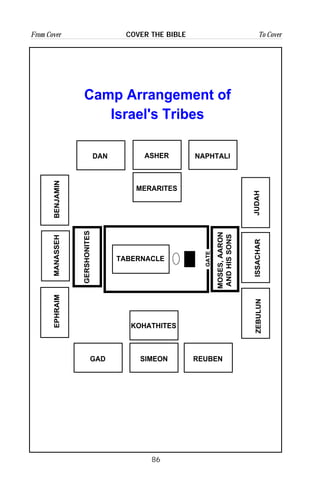
  • 480.
    472 From Cover ToCoverCOVER THE BIBLE 5. KEEP A NOTEBOOK OR A REFERENCE FILE 1. A file, with one folder for each Bible book, is great! You can throw notes, sermon outlines, etc. into it. 2. A loose leaf notebook with dividers can serve much the same purpose. 3. Preserve your study! 6. DON’T ASK FOR HELP UNTIL YOU HAVE SEARCHED BY YOURSELF 1. From now on, don’t “ask the preacher” until you have assured yourself you can’t find the answer In your own library of reference books. 2. When you DO ask, try to find out the source for the answer you have been given. Consider adding that particular book to your library. 7. ADD SPECIAL BOOKS AS YOU STUDY 1. When you are going to study one special book of the Bible, purchase at least one good commentary for your library. 2. When you find a special reference book, buy it on the spot! (If you don’t, it may be gone when you go back.) 8. MEDITATE AFTER EACH PERIOD OF STUDY ABOUT WHAT THE SPIRIT HAS TAUGHT YOU 1. You will appreciate the opportunity to simply sit and reflect on the new light you have gained by your study. Often the greatest value comes from these “Selah” periods! 2. Remember to write each reflection in your notes or file.
  • 481.
    473 From Cover ToCoverCOVER THE BIBLE 9. BECOME FAMILIAR WITH PUBLISHER’S DOCTRINAL POSITIONS 1. Avoid doctrinal type books which are published by presses which have a strong theological bias...at least in the beginning! 2. Learn which publishing houses you can trust, and which are unpredictable. NOTES
  • 482.
    474 From Cover ToCoverCOVER THE BIBLE TOUCH OUTREACH MINISTRIES PROVIDES ADDITIONAL DISCIPLESHIP TOOLS! Dr. Ralph W. Neighbour, Jr. is the author of the widely used TOUCH BASIC TRAINING materials, which equip persons like yourself to effectively share their faith with friends. Particular emphasis is placed in this equipping course in the most effective ways to share your faith with friends who have no interest in the church and who know little about the Bible. Your continuation of training through TOUCH BASIC will put you “light years” ahead of most of your Christian friends! Remember...it is simply not enough to know what is IN the Bible. It is crucial that each one of us go beyond knowledge to the practice of Bible truths. Therefore, you may desire to secure the special TOUCH BASIC TRAINING self-study course, and convert your knowledge to a personal ministry!
  • 483.
    475 From Cover ToCoverCOVER THE BIBLE Unit Fifty Two PRINCIPLES OF BIBLICAL INTERPRETATION Study your Bible in the same manner you would explore a magnificent mansion: 1. CAREFULLY SELECT YOUR GUIDE. We have discussed the books you should add to your library. These “guides” should be trustworthy. As you build your commentaries and dictionaries, be sure you get ones you can trust. 2. USE THE RIGHT KEY TO ENTER. Each book has a “key” which unlocks the theme or the outline for you. An example of this is in the book of Revelation, where we discovered the outline in 1:19. Sometimes there are several “keys” which unlock intertwining themes. An example of this is 1 John, where “know,” “love,” “abide,” etc., each present a new way to view the book. In your class notes, you will find many of these “keys” included for your use. Pay attention to them.
  • 484.
    476 From Cover ToCoverCOVER THE BIBLE 3. BE FAMILIAR WITH THE FLOOR PLAN. The divisions of each book are critical to understanding it. This is also true of the subdivisions, and frequently true of individual thoughts within a chapter. For example, our study of Revelation and Hebrews both required us to consider the “parentheses,” or “interludes,” inserted in the flow of the material. The Psalms are grouped into sections. On a broader basis, the books themselves fall into sections: “The Pentateuch,” “Minor Prophets,” “Pauline Epistles.” Knowing where you are in the outline of the book is important! Do you recall the divisions of Ephesians? • “Sit”—Chapters 1-3; • “Walk”—Chapters 4-5; • “Stand”—Chapter 6. What about Genesis? …Ten divisions, with each one introduced by the phrase “These are the generations of...” What are the two major divisions of Joshua? How many “Books” are there in the Psalms? What is the outline for Daniel? What are the four “Beholds” for the four Gospels? What chapters in Romans deal with the place of the Jew?
  • 485.
    477 From Cover ToCoverCOVER THE BIBLE 4. KNOW WHO LIVES IN EACH “ROOM.” The Bible is written to, or about, distinct classes of people. In 1 Corinthians 10:32, Paul refers to Jews, Gentiles, and the Church of God. Each passage in the Bible is written about or to one of these three classes of persons. Sometimes a passage will be addressed to all three, or have application to all of them. But there are books which belong to one class, rigidly excluding the others. Knowing the priority the writer has in mind as he writes is important! This does not mean, however, that some scriptures “are for the Jew, and have no meaning for me!” For example, if a Jewish friend of mine is sent a letter, the primary meaning is for him. But, as he hands the letter to me and I read it, I may find some segments of it that speak directly to my own situation. Failing to do this creates many of the problems found in different interpretations of the scriptures. For example, one of the basic errors of the Seventh Day Adventists results from their taking all the Jewish patterns of the Old Testament and applying them to Gentiles and the church! Most of the Amillennial positions are developed by ignoring this principle. Promises given to Israel are taught as though they belonged to the church.
  • 486.
    478 From Cover ToCoverCOVER THE BIBLE An example of this is to be found in treatments of Isaiah 60. This chapter speaks of the time when the Jew shall be the head and no longer the tail of the nations. Jerusalem will be exalted as the capitol of the whole earth, and the wealth of the Gentiles shall pour into it as a tide rises in the ocean. It is common to find teachers who will take all this and apply it to the church, and to Christians! There is no reason for this. The Jew is never called a Christian any more than he is known as a Gentile. Mount Zion is no more the “church” than Mount Rushmore symbolizes Westminster Abbey in London. When you enter a book or a section of a book, consider the people the book is written to or who are being talked about. For example, the book of Ecclesiastes is written by Solomon to describe a special kind of person: the man who tries to find meaning in life without recognizing the place of God. To develop theology about the Christian life from such teachings is deadly. The Jehovah’s Witnesses take you to Ecclesiastes to prove there is no hell, no life beyond the grave. They take you to Revelation and describe themselves as the Woman of chapter 12! Sad to say, it is not just cult groups who take such license with the texts. This is why it is important to know the credentials of your “guides” (commentaries).
  • 487.
    479 From Cover ToCoverCOVER THE BIBLE 5. CAREFULLY EXAMINE ALL THE “FURNISHINGS.” In each passage, phrases which may be similar to others should be prayerfully examined. An example of this is to be found in 2 scriptures: Luke 21:24—“...Jerusalem will be trampled under foot by the Gentiles until the times of the Gentiles be fulfilled.” Romans 11:25—“...a partial hardening has happened to Israel until the fulness of the Gentiles has come in...” The “times of the Gentiles” signifies the rule of the Gentile nations. That rule began with Nebuchadnezzar, as God set aside the Jews because of sin and evil, and brought in the Gentile governmentally. It will continue until Christ and His Church come to the Mount of Olives and overthrow it, bringing in “The Times of the Jew.” (Study Zechariah 14:1-11, Zechariah 8:23, Deuteronomy 28:13). On the other hand, the “fullness of the Gentiles” is referring to the filling up of God’s purposes in this age, as He takes out of the Gentiles a people for His name: “...God first concerned Himself about taking from among the Gentiles a people for His name.” (Acts 15:14) The passage in Acts goes on to say, “After these things I will return, and I will rebuild the Tabernacle of David which has fallen, and I will rebuild its ruins, and I will restore it, in order that the rest of mankind may seek the Lord, and all the Gentiles who are called by my name...” (verses 16-17).
  • 488.
    480 From Cover ToCoverCOVER THE BIBLE Thus, the Times of the Gentiles began centuries before the birth of Christ and will end only at His appearing to set up the Kingdom of Israel. The Fullness of the Gentiles began only after the resurrection of the Lord and may end at any moment, as the sudden secret rapture of the church takes place. NOTES
  • 489.
    481 From Cover ToCoverCOVER THE BIBLE 6. CARRY IN LIGHT FROM OTHER PLACES. In the study above, we have just seen how one section of the scripture (in Acts) sheds light on our study. If you have not yet discovered for yourself the thrill of suddenly getting insights into one passage of scripture through previous study, you will! As catching a 7-pound bass sends the fisherman back to the lake, so these insights send the Bible student back, again and again, for deeper looks at “familiar things.” NOTES
  • 490.
    482 From Cover ToCoverCOVER THE BIBLE BIBLE STUDY Passage: __________________________________________ 1. CAREFULLY SELECT YOUR GUIDE: Texts I will use in my study: 1.__________________________________________ 2.__________________________________________ 3.__________________________________________ 2. USE THE RIGHT KEY TO ENTER: The key scripture that unlocks this passage is... ____________________________________________ 3. BE FAMILIAR WITH THE FLOOR PLAN: The outline I will use is found: ___ In my Cover the Bible Notes _____________________________________________ 4. KNOW WHO LIVES IN EACH ROOM: This book/chapter/passage is written to or about: ___ The Jew ___ The Gentile ___ The Church ___ General; applies to all ___ Other: __________________________________ 5. CAREFULLY EXAMINE ALL THE FURNISHINGS: Word/phrase studies: 6. CARRY IN LIGHT FROM OTHER PLACES: Other scripture references I found to help me:
  • 491.
    483 From Cover ToCoverCOVER THE BIBLE BIBLE STUDY Passage: __________________________________________ 1. CAREFULLY SELECT YOUR GUIDE: Texts I will use in my study: 1.__________________________________________ 2.__________________________________________ 3.__________________________________________ 2. USE THE RIGHT KEY TO ENTER: The key scripture that unlocks this passage is... ____________________________________________ 3. BE FAMILIAR WITH THE FLOOR PLAN: The outline I will use is found: ___ In my Cover the Bible Notes _____________________________________________ 4. KNOW WHO LIVES IN EACH ROOM: This book/chapter/passage is written to or about: ___ The Jew ___ The Gentile ___ The Church ___ General; applies to all ___ Other: __________________________________ 5. CAREFULLY EXAMINE ALL THE FURNISHINGS: Word/phrase studies: 6. CARRY IN LIGHT FROM OTHER PLACES: Other scripture references I found to help me:
  • 492.
    484 From Cover ToCoverCOVER THE BIBLE BIBLE STUDY Passage: __________________________________________ 1. CAREFULLY SELECT YOUR GUIDE: Texts I will use in my study: 1.__________________________________________ 2.__________________________________________ 3.__________________________________________ 2. USE THE RIGHT KEY TO ENTER: The key scripture that unlocks this passage is... ____________________________________________ 3. BE FAMILIAR WITH THE FLOOR PLAN: The outline I will use is found: ___ In my Cover the Bible Notes _____________________________________________ 4. KNOW WHO LIVES IN EACH ROOM: This book/chapter/passage is written to or about: ___ The Jew ___ The Gentile ___ The Church ___ General; applies to all ___ Other: __________________________________ 5. CAREFULLY EXAMINE ALL THE FURNISHINGS: Word/phrase studies: 6. CARRY IN LIGHT FROM OTHER PLACES: Other scripture references I found to help me:
  • 493.
    485 From Cover ToCoverCOVER THE BIBLE BIBLE STUDY Passage: __________________________________________ 1. CAREFULLY SELECT YOUR GUIDE: Texts I will use in my study: 1.__________________________________________ 2.__________________________________________ 3.__________________________________________ 2. USE THE RIGHT KEY TO ENTER: The key scripture that unlocks this passage is... ____________________________________________ 3. BE FAMILIAR WITH THE FLOOR PLAN: The outline I will use is found: ___ In my Cover the Bible Notes _____________________________________________ 4. KNOW WHO LIVES IN EACH ROOM: This book/chapter/passage is written to or about: ___ The Jew ___ The Gentile ___ The Church ___ General; applies to all ___ Other: __________________________________ 5. CAREFULLY EXAMINE ALL THE FURNISHINGS: Word/phrase studies: 6. CARRY IN LIGHT FROM OTHER PLACES: Other scripture references I found to help me: