JESUS: HUMAN &
DIVINE
The Human Jesus Revealing the Divine
Person
Why Become Human?
 The human experiences of Jesus, of both joy and extreme sorrow, sanctify
= to make holy (whole) our own human experiences.
 Jesus reveals that every human experience can be a means of holiness
and spiritual growth. Our experiences and relationships allow us to grow as
persons (another way of saying this is that we become sanctified).
 Many people simplify Jesus’ life (He was born and then there was some
stuff in the middle but then He died and rose) … THE STUFF IN THE
MIDDLE (HIS EXPERIENCES) SHOW A JOYFUL JESUS! Don’t miss that!
His life events ought to be an example for us!
 This human Jesus, Who experienced everything that we experience, also
took onto Himself the faith of the Jewish people.
 Jesus subjected Himself under the Law of Moses and revealed the
importance of obedience.
 He does this in several ways:
 His parents have Him circumcised according to the Law of Moses (Lk. 2:21).
 He is consecrated to God in the Temple according to the Law, “Consecrate to Me
[the Lord] every first-born” (Ex. 13:22).
 He celebrates the Jewish religious holidays of Passover, Tabernacles, and
Hanukkah by fulfilling the Law and traveling to Jerusalem to properly celebrate by
visiting and offering prayers in the Temple. (See Jn.2:13, 7:2, 10:22)
Environme
nt
Ownershi
p
The Jewish Jesus
• We often forget that Jesus meant for
the Jewish faith to be the roots of
Catholicism.
• We cannot have a good
understanding of our faith without
also having a good understanding of
the Jewish faith.
• We also need to understand the
Jewish expectations of the Messiah
and how Jesus meets and exceeds
those expectations.
• The Jewish faith is built on two major
pillars: Monotheism & Scripture
(including the Law and the
Prophets).
• Jesus certainly preached
Monotheism, when asked about the
• Jesus also showed His love for Scripture
(Lk. 14:16-22) and His respect for the
Law/Torah, “I have come not to abolish
them (the Law and the Prophets) but to
fulfill them” (Mt. 5:17).
“Hear, O Israel, the Lord our God, the Lord is
One and you shall love the Lord your God …”
The Jewish Messiah
 If Christianity is built upon Judaism we need to ask what the Jews during
the time of Jesus were expecting the Messiah to be?
 There were three different expectations for the Messiah within Judaism in
the 1st century.
The New Moses
• Some among the Jews
were expecting the
Messiah to be a new
Moses for the people.
• They expected the
Messiah to renew and
keep the Law
• They thought it possible
that the Messiah may
lead them to a new
“Promised Land” where
they would regain the
freedom and blessings
of the 1st Promised
The King of the End
• Some Jews expected
the Messiah to usher in
the end of the world
and the establishment
of the new reign of God.
• Thus, the Jews
welcomed Jesus on
Palm Sunday, expecting
that He might be
ushering in God’s new
kingdom.
• His death on the Cross
brought an end to their
expectations., but the
Resurrection gave their
A Rebel King
• A minority party of the
Jews called the Zealots,
thought that the
Messiah was going to
be a political and
military leader who was
going to crush the
Romans and restore
the Kingdom of Israel to
the glory of the days of
David.
• Jesus rejects this
Messiahship because
He recognizes that to
change anything, one
must change hearts
Life in 1st Century Israel
• Israel in the 1st Century found itself
under Roman occupation.
• The Romans allowed local kings to
have some control over their territories
–the king of the Jews at this time was
Herod.
• The religious leaders of the Jews
during this time were split into two main
parties: the Pharisees and the
Sadducees.
• The Pharisees were a group of Jewish
leaders characterized by their strict
adherence to the Law.
• The Sadducees were characterized by
their commitment to the Temple.
• Jesus clashed with both groups: the
Pharisees over their hypocrisy and the
Tension Within
• During this time within the land of Israel
there existed a pluralistic society.
• Pluralism is characterized by the
presence of many different ethnic,
religious and cultural groups within a
country.
• This pluralism lead to tensions between
different groups and Jesus sought to
diffuse those tensions.
• There were obvious tensions between
the occupying Romans and the Jews –
so Jesus preaches “love your enemy”
(Mt. 5:44) and “blessed are the
peacemakers” (Mt. 5:9).
• There was also tension between the
Jews and the Samaritans, so Jesus goes
to Samaria and preaches salvation to the
“But the hour is coming, and now is, when the true
worshipers will worship the Father in Spirit and truth
…” Jn. 4:23.
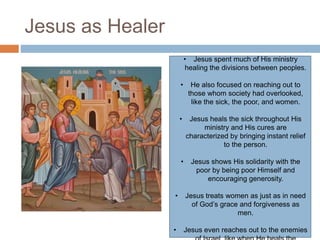
Jesus as Healer
• Jesus spent much of His ministry
healing the divisions between peoples.
• He also focused on reaching out to
those whom society had overlooked,
like the sick, the poor, and women.
• Jesus heals the sick throughout His
ministry and His cures are
characterized by bringing instant relief
to the person.
• Jesus shows His solidarity with the
poor by being poor Himself and
encouraging generosity.
• Jesus treats women as just as in need
of God’s grace and forgiveness as
men.
• Jesus even reaches out to the enemies
Jesus the Unifier
• Jesus’ miracles and conversations, His
teachings and His prayers were all
aimed at unifying people.
• Jesus taught that, “So, shall there be
one shepherd and one flock”
(Jn.10:16) – a main focus of His life
and ministry was to draw all peoples to
Himself.
• In this way Jesus serves as the
fulfillment of the Old Testament image
of David – the King and unifier of
Israel.
• The unity which Jesus desired led Him
ultimately to the Cross to defeat sin –
which was the greatest obstacle to
unity.
Redemption
• Throughout Church history there developed many
ways of discussing how we were saved by Christ:
• Recapitulation – this theology sees Christ’s
headship over a new creation as the pinnacle of
Jesus’ work. The first Adam is representative of
hostility and separation between God and man.
But Jesus, as the New Adam, brings about a
reconciliation and union between God and man.
• Restoration – Original sin and all human sin
made humanity the possession of the Devil;
Jesus buys us back from the Devil through His
sacrifice on the Cross.
• Debt and Satisfaction – the injustice of sin
required someone to pay the debt of sin. No
mere human being could satisfy the debt
because how could we settle an infinite debt?
God becomes man to satisfy our debt as God
The Mass
• The issue with the Cross is how do we, who live
2000 years after Christ, access the salvation
won for us on that Good Friday?
• We do so through the sacraments but most
centrally through the Mass.
• The Mass is the re-presentation of Christ’s
sacrifice on Calvary wherein we access and
receive the grace of the Cross in His Body and
Blood – His very Divine Life.
• But, how does this happen? We need to
remember that God and ourselves work on two
different planes of existence:
God
∞ ∞
†
2013
Grace of the
Cross
† 33AD Man
The Mass & Passover – The Jewish
Roots of the Eucharist
 The Mass is directly influenced by Old Testament Jewish Temple practice
and by the Jewish feast of Passover. Let’s look at the parallels:
• Passover was eaten the day before Israel was
delivered from slavery to freedom.
• The Israelites were saved from the angel of death
by sprinkling the blood of the lamb on their
doorposts.
• The Passover lamb was eaten without breaking
any of its bones.
• God commands that the Jews keep the Passover
• The Last Supper was eaten the day before
Christ died on the Cross to save us from the
slavery of sin and death.
• We were saved through the blood of the “Lamb
of God” which was shed upon the wood of the
Cross.
• While Christ was on the Cross not one of His
bones were broken.
• We have Holy Mass every day as a memorial
Hypostatic Union
 We have seen the real and dynamic results of the human/Divine
union of God and man in the Person of Christ. We have seen this
in: Jesus’ common human experience with us, His work of
overcome tension within Israel and the world, His passion and
death, His awesome gift of the Eucharist, etc.
 All of these “results” point to God’s deep desire to be one with
mankind – this is the hypostatic union. The hypostatic union
refers specifically to the union of the Divine and human natures of
Jesus within the one Person of Christ.
 But, everything that Jesus does affirms His desire to be with us! His
Incarnation was the “watershed” event but His life testifies to His
desire for unity with mankind, His death on the Cross certainly
showed His brotherhood with us, His rule in Heaven now in and
through the Church shows His desire for unity, and His promise of a
united New Heaven and New Earth (Rev. 21:1) is the ultimate
promise and goal of Christianity.
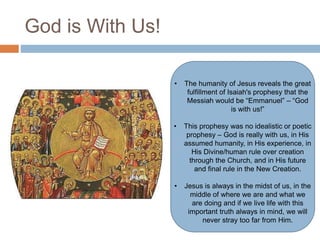
God is With Us!
• The humanity of Jesus reveals the great
fulfillment of Isaiah's prophesy that the
Messiah would be “Emmanuel” – “God
is with us!”
• This prophesy was no idealistic or poetic
prophesy – God is really with us, in His
assumed humanity, in His experience, in
His Divine/human rule over creation
through the Church, and in His future
and final rule in the New Creation.
• Jesus is always in the midst of us, in the
middle of where we are and what we
are doing and if we live life with this
important truth always in mind, we will
never stray too far from Him.

Jesus: Human & Divine

  • 1.
    JESUS: HUMAN & DIVINE TheHuman Jesus Revealing the Divine Person
  • 2.
    Why Become Human? The human experiences of Jesus, of both joy and extreme sorrow, sanctify = to make holy (whole) our own human experiences.  Jesus reveals that every human experience can be a means of holiness and spiritual growth. Our experiences and relationships allow us to grow as persons (another way of saying this is that we become sanctified).  Many people simplify Jesus’ life (He was born and then there was some stuff in the middle but then He died and rose) … THE STUFF IN THE MIDDLE (HIS EXPERIENCES) SHOW A JOYFUL JESUS! Don’t miss that! His life events ought to be an example for us!  This human Jesus, Who experienced everything that we experience, also took onto Himself the faith of the Jewish people.  Jesus subjected Himself under the Law of Moses and revealed the importance of obedience.  He does this in several ways:  His parents have Him circumcised according to the Law of Moses (Lk. 2:21).  He is consecrated to God in the Temple according to the Law, “Consecrate to Me [the Lord] every first-born” (Ex. 13:22).  He celebrates the Jewish religious holidays of Passover, Tabernacles, and Hanukkah by fulfilling the Law and traveling to Jerusalem to properly celebrate by visiting and offering prayers in the Temple. (See Jn.2:13, 7:2, 10:22) Environme nt Ownershi p
  • 3.
    The Jewish Jesus •We often forget that Jesus meant for the Jewish faith to be the roots of Catholicism. • We cannot have a good understanding of our faith without also having a good understanding of the Jewish faith. • We also need to understand the Jewish expectations of the Messiah and how Jesus meets and exceeds those expectations. • The Jewish faith is built on two major pillars: Monotheism & Scripture (including the Law and the Prophets). • Jesus certainly preached Monotheism, when asked about the • Jesus also showed His love for Scripture (Lk. 14:16-22) and His respect for the Law/Torah, “I have come not to abolish them (the Law and the Prophets) but to fulfill them” (Mt. 5:17). “Hear, O Israel, the Lord our God, the Lord is One and you shall love the Lord your God …”
  • 4.
    The Jewish Messiah If Christianity is built upon Judaism we need to ask what the Jews during the time of Jesus were expecting the Messiah to be?  There were three different expectations for the Messiah within Judaism in the 1st century. The New Moses • Some among the Jews were expecting the Messiah to be a new Moses for the people. • They expected the Messiah to renew and keep the Law • They thought it possible that the Messiah may lead them to a new “Promised Land” where they would regain the freedom and blessings of the 1st Promised The King of the End • Some Jews expected the Messiah to usher in the end of the world and the establishment of the new reign of God. • Thus, the Jews welcomed Jesus on Palm Sunday, expecting that He might be ushering in God’s new kingdom. • His death on the Cross brought an end to their expectations., but the Resurrection gave their A Rebel King • A minority party of the Jews called the Zealots, thought that the Messiah was going to be a political and military leader who was going to crush the Romans and restore the Kingdom of Israel to the glory of the days of David. • Jesus rejects this Messiahship because He recognizes that to change anything, one must change hearts
  • 5.
    Life in 1stCentury Israel • Israel in the 1st Century found itself under Roman occupation. • The Romans allowed local kings to have some control over their territories –the king of the Jews at this time was Herod. • The religious leaders of the Jews during this time were split into two main parties: the Pharisees and the Sadducees. • The Pharisees were a group of Jewish leaders characterized by their strict adherence to the Law. • The Sadducees were characterized by their commitment to the Temple. • Jesus clashed with both groups: the Pharisees over their hypocrisy and the
  • 6.
    Tension Within • Duringthis time within the land of Israel there existed a pluralistic society. • Pluralism is characterized by the presence of many different ethnic, religious and cultural groups within a country. • This pluralism lead to tensions between different groups and Jesus sought to diffuse those tensions. • There were obvious tensions between the occupying Romans and the Jews – so Jesus preaches “love your enemy” (Mt. 5:44) and “blessed are the peacemakers” (Mt. 5:9). • There was also tension between the Jews and the Samaritans, so Jesus goes to Samaria and preaches salvation to the “But the hour is coming, and now is, when the true worshipers will worship the Father in Spirit and truth …” Jn. 4:23.
  • 7.
    Jesus as Healer •Jesus spent much of His ministry healing the divisions between peoples. • He also focused on reaching out to those whom society had overlooked, like the sick, the poor, and women. • Jesus heals the sick throughout His ministry and His cures are characterized by bringing instant relief to the person. • Jesus shows His solidarity with the poor by being poor Himself and encouraging generosity. • Jesus treats women as just as in need of God’s grace and forgiveness as men. • Jesus even reaches out to the enemies
  • 8.
    Jesus the Unifier •Jesus’ miracles and conversations, His teachings and His prayers were all aimed at unifying people. • Jesus taught that, “So, shall there be one shepherd and one flock” (Jn.10:16) – a main focus of His life and ministry was to draw all peoples to Himself. • In this way Jesus serves as the fulfillment of the Old Testament image of David – the King and unifier of Israel. • The unity which Jesus desired led Him ultimately to the Cross to defeat sin – which was the greatest obstacle to unity.
  • 9.
    Redemption • Throughout Churchhistory there developed many ways of discussing how we were saved by Christ: • Recapitulation – this theology sees Christ’s headship over a new creation as the pinnacle of Jesus’ work. The first Adam is representative of hostility and separation between God and man. But Jesus, as the New Adam, brings about a reconciliation and union between God and man. • Restoration – Original sin and all human sin made humanity the possession of the Devil; Jesus buys us back from the Devil through His sacrifice on the Cross. • Debt and Satisfaction – the injustice of sin required someone to pay the debt of sin. No mere human being could satisfy the debt because how could we settle an infinite debt? God becomes man to satisfy our debt as God
  • 10.
    The Mass • Theissue with the Cross is how do we, who live 2000 years after Christ, access the salvation won for us on that Good Friday? • We do so through the sacraments but most centrally through the Mass. • The Mass is the re-presentation of Christ’s sacrifice on Calvary wherein we access and receive the grace of the Cross in His Body and Blood – His very Divine Life. • But, how does this happen? We need to remember that God and ourselves work on two different planes of existence: God ∞ ∞ † 2013 Grace of the Cross † 33AD Man
  • 11.
    The Mass &Passover – The Jewish Roots of the Eucharist  The Mass is directly influenced by Old Testament Jewish Temple practice and by the Jewish feast of Passover. Let’s look at the parallels: • Passover was eaten the day before Israel was delivered from slavery to freedom. • The Israelites were saved from the angel of death by sprinkling the blood of the lamb on their doorposts. • The Passover lamb was eaten without breaking any of its bones. • God commands that the Jews keep the Passover • The Last Supper was eaten the day before Christ died on the Cross to save us from the slavery of sin and death. • We were saved through the blood of the “Lamb of God” which was shed upon the wood of the Cross. • While Christ was on the Cross not one of His bones were broken. • We have Holy Mass every day as a memorial
  • 12.
    Hypostatic Union  Wehave seen the real and dynamic results of the human/Divine union of God and man in the Person of Christ. We have seen this in: Jesus’ common human experience with us, His work of overcome tension within Israel and the world, His passion and death, His awesome gift of the Eucharist, etc.  All of these “results” point to God’s deep desire to be one with mankind – this is the hypostatic union. The hypostatic union refers specifically to the union of the Divine and human natures of Jesus within the one Person of Christ.  But, everything that Jesus does affirms His desire to be with us! His Incarnation was the “watershed” event but His life testifies to His desire for unity with mankind, His death on the Cross certainly showed His brotherhood with us, His rule in Heaven now in and through the Church shows His desire for unity, and His promise of a united New Heaven and New Earth (Rev. 21:1) is the ultimate promise and goal of Christianity.
  • 13.
    God is WithUs! • The humanity of Jesus reveals the great fulfillment of Isaiah's prophesy that the Messiah would be “Emmanuel” – “God is with us!” • This prophesy was no idealistic or poetic prophesy – God is really with us, in His assumed humanity, in His experience, in His Divine/human rule over creation through the Church, and in His future and final rule in the New Creation. • Jesus is always in the midst of us, in the middle of where we are and what we are doing and if we live life with this important truth always in mind, we will never stray too far from Him.

Editor's Notes

  • #3 Remember the two terms we studied in Ch. 2 – relation and person. We learn about ourselves in relation to others; we become more of who we are meant to be through relationships. Jesus provides us the example of how to grow through relationships – it is through our relation to others that our person becomes whole (holy/sanctified).
  • #13 The hypostatic union was confirmed at the Council of Chalcedon in 451AD and expanded upon at the Council of Constantinople II in 553AD.