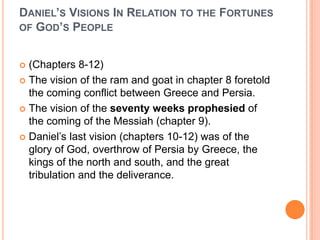
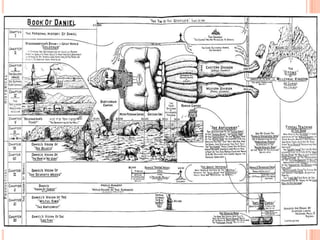
HistoryA prophetical history of Gentile world power from the reign of Nebuchadnezzar to the coming of Christ. Daniel emphasized God’s sovereignty in relation to the Gentile world empires and revealed Him as the One controlling and overruling in their affairs, until the time of their destruction at the coming of His Son.
The vision is that of the overruling God, in wisdom, knowing and, in might, working; of kings reigning and passing, of dynasties and empires rising and falling, while God, enthroned above, ruled their movements.Daniel revealed God as the One controlling the rise and fall of the kingdoms of this world until their final destruction and establishment of His own kingdom.
AUTHORProphet DanielHe was of the tribe of Judah and probably a member of the royal family (1:3-6). While yet a youth, he was carried captive to Babylon in the third year of King Jehoiakim (II Chronicles 36:4-7), eight years before Ezekiel. Together with three other young men, he was stationed at the court of Nebuchadnezzar for special training in the learning of the Chaldeans.
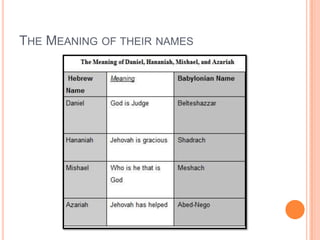
The Meaning of their names
There he attained one of the highest ranks in the kingdom, a position which he retained under the Persians rulers who succeeded the Babylonians. He prophesied during the whole of the captivity, his last prophecy being delivered in the reign of Cyrus, two years before the nation’s return to Palestine.
SCOPEThe historical elements in Daniel cover approximately seventy-three years, from Nebuchadnezzar to Cyrus, or 607 B.C. to 534 B.C.
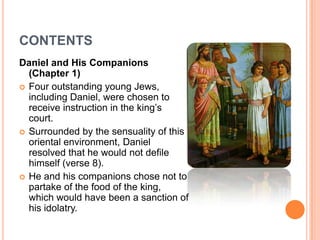
CONTENTSDaniel and His Companions (Chapter 1)Four outstanding young Jews, including Daniel, were chosen to receive instruction in the king’s court. Surrounded by the sensuality of this oriental environment, Daniel resolved that he would not defile himself (verse 8).He and his companions chose not to partake of the food of the king, which would have been a sanction of his idolatry.
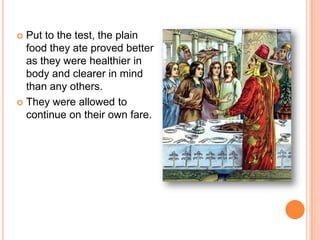
Put to the test, the plain food they ate proved better as they were healthier in body and clearer in mind than any others.They were allowed to continue on their own fare.
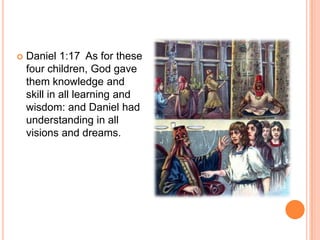
Daniel 1:17  As for these four children, God gave them knowledge and skill in all learning and wisdom: and Daniel had understanding in all visions and dreams.
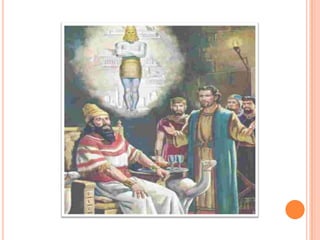
God’s Control of the Nations of the World (Chapters 2-7)In response to an unexpressed desire on the part of Nebuchadnezzar to know the future of his great empire, God gave him a dream, which, as interpreted by Daniel, gave the monarch a revelation of the rise, progress, and fall of Gentile world power during that period described by Christ as “the time of the Gentiles (Luke 21:24).”
“The time of the Gentiles” Refers to that period of time during which world dominion is in the hands of the Gentiles instead of the Jews.This period began with the captivity, 606 B.C., and will end with the second coming of Christ.
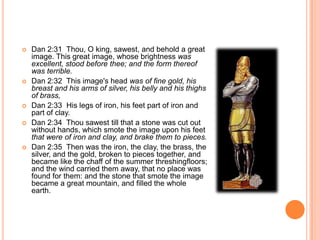
Dan 2:31  Thou, O king, sawest, and behold a great image. This great image, whose brightness was excellent, stood before thee; and the form thereof was terrible. Dan 2:32  This image's head was of fine gold, his breast and his arms of silver, his belly and his thighs of brass, Dan 2:33  His legs of iron, his feet part of iron and part of clay. Dan 2:34  Thou sawest till that a stone was cut out without hands, which smote the image upon his feet that were of iron and clay, and brake them to pieces. Dan 2:35  Then was the iron, the clay, the brass, the silver, and the gold, broken to pieces together, and became like the chaff of the summer threshingfloors; and the wind carried them away, that no place was found for them: and the stone that smote the image became a great mountain, and filled the whole earth.
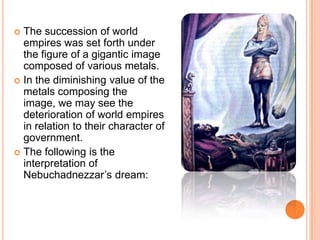
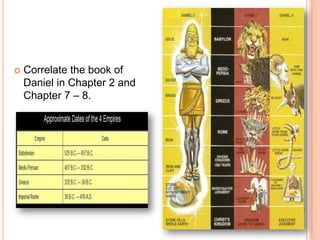
The succession of world empires was set forth under the figure of a gigantic image composed of various metals. In the diminishing value of the metals composing the image, we may see the deterioration of world empires in relation to their character of government.The following is the interpretation of Nebuchadnezzar’s dream:
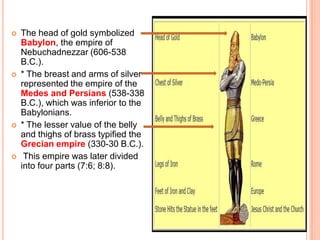
The head of gold symbolized Babylon, the empire of Nebuchadnezzar (606-538 B.C.).* The breast and arms of silver represented the empire of the Medes and Persians (538-338 B.C.), which was inferior to the Babylonians.* The lesser value of the belly and thighs of brass typified the Grecian empire (330-30 B.C.). This empire was later divided into four parts (7:6; 8:8).
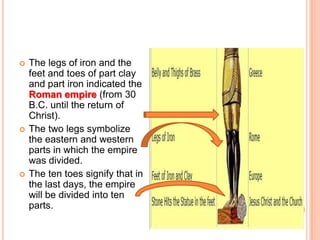
The legs of iron and the feet and toes of part clay and part iron indicated the Roman empire (from 30 B.C. until the return of Christ).The two legs symbolize the eastern and western parts in which the empire was divided. The ten toes signify that in the last days, the empire will be divided into ten parts.
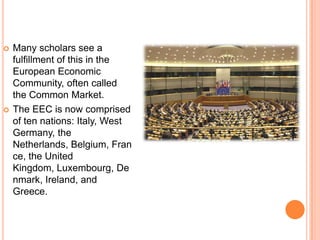
Many scholars see a fulfillment of this in the European Economic Community, often called the Common Market. The EEC is now comprised of ten nations: Italy, West Germany, the Netherlands, Belgium, France, the United Kingdom, Luxembourg, Denmark, Ireland, and Greece.
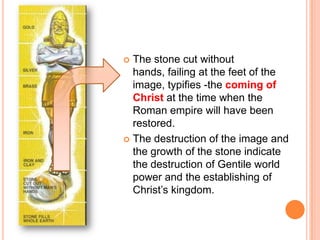
The stone cut without hands, failing at the feet of the image, typifies -the coming of Christ at the time when the Roman empire will have been restored. The destruction of the image and the growth of the stone indicate the destruction of Gentile world power and the establishing of Christ’s kingdom.
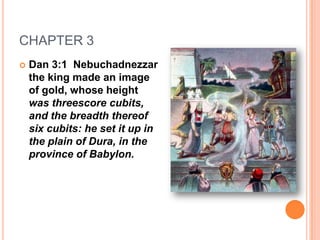
CHAPTER 3Dan 3:1  Nebuchadnezzar the king made an image of gold, whose height was threescore cubits, and the breadth thereof six cubits: he set it up in the plain of Dura, in the province of Babylon.
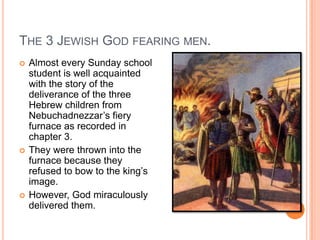
The 3 Jewish God fearing men.Almost every Sunday school student is well acquainted with the story of the deliverance of the three Hebrew children from  Nebuchadnezzar’s fiery furnace as recorded in chapter 3. They were thrown into the furnace because they refused to bow to the king’s image.However, God miraculously delivered them.
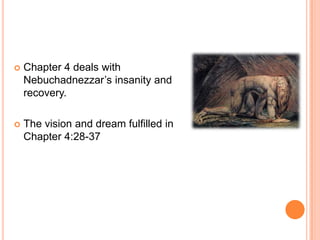
Chapter 4 deals with Nebuchadnezzar’s insanity and recovery.The vision and dream fulfilled in Chapter 4:28-37
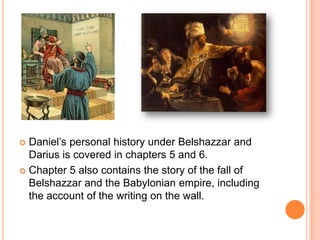
Daniel’s personal history under Belshazzar and Darius is covered in chapters 5 and 6. Chapter 5 also contains the story of the fall of Belshazzar and the Babylonian empire, including the account of the writing on the wall.
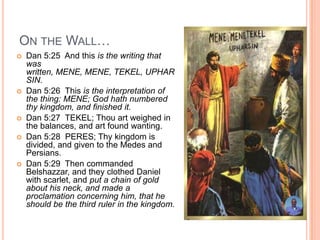
On the Wall…Dan 5:25  And this is the writing that was written, MENE, MENE, TEKEL, UPHARSIN. Dan 5:26  This is the interpretation of the thing: MENE; God hath numbered thy kingdom, and finished it. Dan 5:27  TEKEL; Thou art weighed in the balances, and art found wanting. Dan 5:28  PERES; Thy kingdom is divided, and given to the Medes and Persians. Dan 5:29  Then commanded Belshazzar, and they clothed Daniel with scarlet, and put a chain of gold about his neck, and made a proclamation concerning him, that he should be the third ruler in the kingdom.
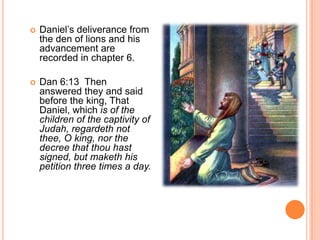
Daniel’s deliverance from the den of lions and his advancement are recorded in chapter 6.Dan 6:13  Then answered they and said before the king, That Daniel, which is of the children of the captivity of Judah, regardeth not thee, O king, nor the decree that thou hast signed, but maketh his petition three times a day.
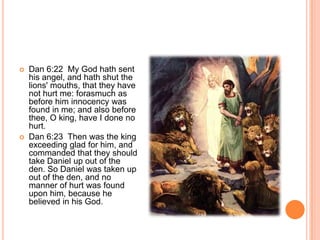
Dan 6:22  My God hath sent his angel, and hath shut the lions' mouths, that they have not hurt me: forasmuch as before him innocency was found in me; and also before thee, O king, have I done no hurt. Dan 6:23  Then was the king exceeding glad for him, and commanded that they should take Daniel up out of the den. So Daniel was taken up out of the den, and no manner of hurt was found upon him, because he believed in his God.
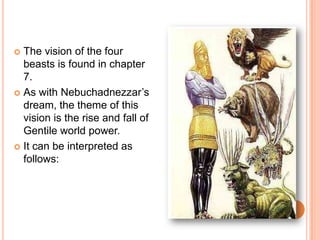
The vision of the four beasts is found in chapter 7. As with Nebuchadnezzar’s dream, the theme of this vision is the rise and fall of Gentile world power. It can be interpreted as follows:
Correlate the book of Daniel in Chapter 2 and Chapter 7 – 8.
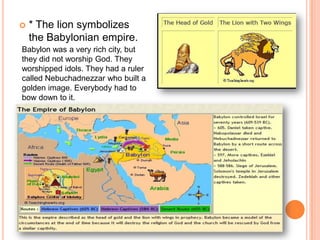
* The lion symbolizes the Babylonian empire.Babylon was a very rich city, but they did not worship God. They worshipped idols. They had a ruler called Nebuchadnezzar who built a golden image. Everybody had to bow down to it.
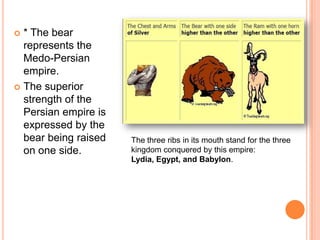
* The bear represents the Medo-Persian empire. The superior strength of the Persian empire is expressed by the bear being raised on one side. The three ribs in its mouth stand for the three kingdom conquered by this empire: Lydia, Egypt, and Babylon.
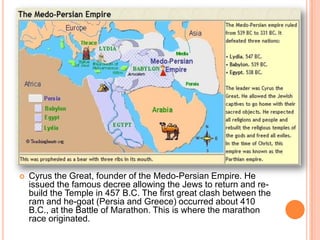
Cyrus the Great, founder of the Medo-Persian Empire. He issued the famous decree allowing the Jews to return and re-build the Temple in 457 B.C. The first great clash between the ram and he-goat (Persia and Greece) occurred about 410 B.C., at the Battle of Marathon. This is where the marathon race originated.
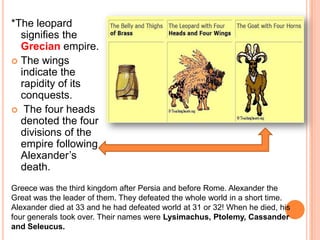
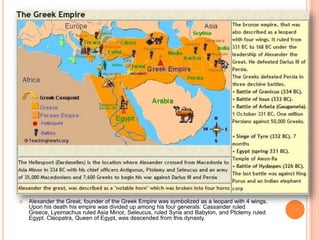
*The leopard signifies the Grecian empire. The wings indicate the rapidity of its conquests. The four heads denoted the four divisions of the empire following Alexander’s death.Greece was the third kingdom after Persia and before Rome. Alexander the Great was the leader of them. They defeated the whole world in a short time. Alexander died at 33 and he had defeated world at 31 or 32! When he died, his four generals took over. Their names were Lysimachus, Ptolemy, Cassander and Seleucus.
Alexander the Great, founder of the Greek Empire was symbolized as a leopard with 4 wings. Upon his death his empire was divided up among his four generals: Cassander ruled Greece, Lysimachus ruled Asia Minor, Seleucus, ruled Syria and Babylon, and Ptolemy ruled Egypt. Cleopatra, Queen of Egypt, was descended from this dynasty.
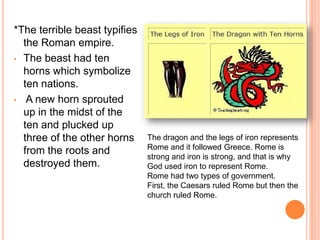
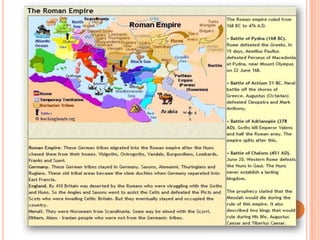
*The terrible beast typifies the Roman empire. The beast had ten horns which symbolize ten nations.
 A new horn sprouted up in the midst of the ten and plucked up three of the other horns from the roots and destroyed them.The dragon and the legs of iron represents Rome and it followed Greece. Rome is strong and iron is strong, and that is why God used iron to represent Rome. Rome had two types of government. First, the Caesars ruled Rome but then the church ruled Rome.
The ten horns symbolize ten kings, and the one horn was another king who will subdue three kings.
This horn will make war with the saints and prevail against them (7:21).

The Book of Daniel

  • 2.
    HistoryA prophetical historyof Gentile world power from the reign of Nebuchadnezzar to the coming of Christ. Daniel emphasized God’s sovereignty in relation to the Gentile world empires and revealed Him as the One controlling and overruling in their affairs, until the time of their destruction at the coming of His Son.
  • 3.
    The vision isthat of the overruling God, in wisdom, knowing and, in might, working; of kings reigning and passing, of dynasties and empires rising and falling, while God, enthroned above, ruled their movements.Daniel revealed God as the One controlling the rise and fall of the kingdoms of this world until their final destruction and establishment of His own kingdom.
  • 4.
    AUTHORProphet DanielHe wasof the tribe of Judah and probably a member of the royal family (1:3-6). While yet a youth, he was carried captive to Babylon in the third year of King Jehoiakim (II Chronicles 36:4-7), eight years before Ezekiel. Together with three other young men, he was stationed at the court of Nebuchadnezzar for special training in the learning of the Chaldeans.
  • 5.
    The Meaning oftheir names
  • 6.
    There he attainedone of the highest ranks in the kingdom, a position which he retained under the Persians rulers who succeeded the Babylonians. He prophesied during the whole of the captivity, his last prophecy being delivered in the reign of Cyrus, two years before the nation’s return to Palestine.
  • 7.
    SCOPEThe historical elementsin Daniel cover approximately seventy-three years, from Nebuchadnezzar to Cyrus, or 607 B.C. to 534 B.C.
  • 8.
    CONTENTSDaniel and HisCompanions (Chapter 1)Four outstanding young Jews, including Daniel, were chosen to receive instruction in the king’s court. Surrounded by the sensuality of this oriental environment, Daniel resolved that he would not defile himself (verse 8).He and his companions chose not to partake of the food of the king, which would have been a sanction of his idolatry.
  • 9.
    Put to thetest, the plain food they ate proved better as they were healthier in body and clearer in mind than any others.They were allowed to continue on their own fare.
  • 10.
    Daniel 1:17 As for these four children, God gave them knowledge and skill in all learning and wisdom: and Daniel had understanding in all visions and dreams.
  • 11.
    God’s Control ofthe Nations of the World (Chapters 2-7)In response to an unexpressed desire on the part of Nebuchadnezzar to know the future of his great empire, God gave him a dream, which, as interpreted by Daniel, gave the monarch a revelation of the rise, progress, and fall of Gentile world power during that period described by Christ as “the time of the Gentiles (Luke 21:24).”
  • 12.
    “The time ofthe Gentiles” Refers to that period of time during which world dominion is in the hands of the Gentiles instead of the Jews.This period began with the captivity, 606 B.C., and will end with the second coming of Christ.
  • 14.
    Dan 2:31 Thou, O king, sawest, and behold a great image. This great image, whose brightness was excellent, stood before thee; and the form thereof was terrible. Dan 2:32 This image's head was of fine gold, his breast and his arms of silver, his belly and his thighs of brass, Dan 2:33 His legs of iron, his feet part of iron and part of clay. Dan 2:34 Thou sawest till that a stone was cut out without hands, which smote the image upon his feet that were of iron and clay, and brake them to pieces. Dan 2:35 Then was the iron, the clay, the brass, the silver, and the gold, broken to pieces together, and became like the chaff of the summer threshingfloors; and the wind carried them away, that no place was found for them: and the stone that smote the image became a great mountain, and filled the whole earth.
  • 15.
    The succession ofworld empires was set forth under the figure of a gigantic image composed of various metals. In the diminishing value of the metals composing the image, we may see the deterioration of world empires in relation to their character of government.The following is the interpretation of Nebuchadnezzar’s dream:
  • 16.
    The head ofgold symbolized Babylon, the empire of Nebuchadnezzar (606-538 B.C.).* The breast and arms of silver represented the empire of the Medes and Persians (538-338 B.C.), which was inferior to the Babylonians.* The lesser value of the belly and thighs of brass typified the Grecian empire (330-30 B.C.). This empire was later divided into four parts (7:6; 8:8).
  • 17.
    The legs ofiron and the feet and toes of part clay and part iron indicated the Roman empire (from 30 B.C. until the return of Christ).The two legs symbolize the eastern and western parts in which the empire was divided. The ten toes signify that in the last days, the empire will be divided into ten parts.
  • 18.
    Many scholars seea fulfillment of this in the European Economic Community, often called the Common Market. The EEC is now comprised of ten nations: Italy, West Germany, the Netherlands, Belgium, France, the United Kingdom, Luxembourg, Denmark, Ireland, and Greece.
  • 19.
    The stone cutwithout hands, failing at the feet of the image, typifies -the coming of Christ at the time when the Roman empire will have been restored. The destruction of the image and the growth of the stone indicate the destruction of Gentile world power and the establishing of Christ’s kingdom.
  • 20.
    CHAPTER 3Dan 3:1 Nebuchadnezzar the king made an image of gold, whose height was threescore cubits, and the breadth thereof six cubits: he set it up in the plain of Dura, in the province of Babylon.
  • 21.
    The 3 JewishGod fearing men.Almost every Sunday school student is well acquainted with the story of the deliverance of the three Hebrew children from Nebuchadnezzar’s fiery furnace as recorded in chapter 3. They were thrown into the furnace because they refused to bow to the king’s image.However, God miraculously delivered them.
  • 22.
    Chapter 4 dealswith Nebuchadnezzar’s insanity and recovery.The vision and dream fulfilled in Chapter 4:28-37
  • 23.
    Daniel’s personal historyunder Belshazzar and Darius is covered in chapters 5 and 6. Chapter 5 also contains the story of the fall of Belshazzar and the Babylonian empire, including the account of the writing on the wall.
  • 24.
    On the Wall…Dan5:25 And this is the writing that was written, MENE, MENE, TEKEL, UPHARSIN. Dan 5:26 This is the interpretation of the thing: MENE; God hath numbered thy kingdom, and finished it. Dan 5:27 TEKEL; Thou art weighed in the balances, and art found wanting. Dan 5:28 PERES; Thy kingdom is divided, and given to the Medes and Persians. Dan 5:29 Then commanded Belshazzar, and they clothed Daniel with scarlet, and put a chain of gold about his neck, and made a proclamation concerning him, that he should be the third ruler in the kingdom.
  • 25.
    Daniel’s deliverance fromthe den of lions and his advancement are recorded in chapter 6.Dan 6:13 Then answered they and said before the king, That Daniel, which is of the children of the captivity of Judah, regardeth not thee, O king, nor the decree that thou hast signed, but maketh his petition three times a day.
  • 26.
    Dan 6:22 My God hath sent his angel, and hath shut the lions' mouths, that they have not hurt me: forasmuch as before him innocency was found in me; and also before thee, O king, have I done no hurt. Dan 6:23 Then was the king exceeding glad for him, and commanded that they should take Daniel up out of the den. So Daniel was taken up out of the den, and no manner of hurt was found upon him, because he believed in his God.
  • 27.
    The vision ofthe four beasts is found in chapter 7. As with Nebuchadnezzar’s dream, the theme of this vision is the rise and fall of Gentile world power. It can be interpreted as follows:
  • 28.
    Correlate the bookof Daniel in Chapter 2 and Chapter 7 – 8.
  • 29.
    * The lionsymbolizes the Babylonian empire.Babylon was a very rich city, but they did not worship God. They worshipped idols. They had a ruler called Nebuchadnezzar who built a golden image. Everybody had to bow down to it.
  • 30.
    * The bearrepresents the Medo-Persian empire. The superior strength of the Persian empire is expressed by the bear being raised on one side. The three ribs in its mouth stand for the three kingdom conquered by this empire: Lydia, Egypt, and Babylon.
  • 31.
    Cyrus the Great,founder of the Medo-Persian Empire. He issued the famous decree allowing the Jews to return and re-build the Temple in 457 B.C. The first great clash between the ram and he-goat (Persia and Greece) occurred about 410 B.C., at the Battle of Marathon. This is where the marathon race originated.
  • 32.
    *The leopard signifiesthe Grecian empire. The wings indicate the rapidity of its conquests. The four heads denoted the four divisions of the empire following Alexander’s death.Greece was the third kingdom after Persia and before Rome. Alexander the Great was the leader of them. They defeated the whole world in a short time. Alexander died at 33 and he had defeated world at 31 or 32! When he died, his four generals took over. Their names were Lysimachus, Ptolemy, Cassander and Seleucus.
  • 33.
    Alexander the Great,founder of the Greek Empire was symbolized as a leopard with 4 wings. Upon his death his empire was divided up among his four generals: Cassander ruled Greece, Lysimachus ruled Asia Minor, Seleucus, ruled Syria and Babylon, and Ptolemy ruled Egypt. Cleopatra, Queen of Egypt, was descended from this dynasty.
  • 34.
    *The terrible beasttypifies the Roman empire. The beast had ten horns which symbolize ten nations.
  • 35.
    A newhorn sprouted up in the midst of the ten and plucked up three of the other horns from the roots and destroyed them.The dragon and the legs of iron represents Rome and it followed Greece. Rome is strong and iron is strong, and that is why God used iron to represent Rome. Rome had two types of government. First, the Caesars ruled Rome but then the church ruled Rome.
  • 37.
    The ten hornssymbolize ten kings, and the one horn was another king who will subdue three kings.
  • 38.
    This horn willmake war with the saints and prevail against them (7:21).