The Epistles of JohnThe Epistles of John 11
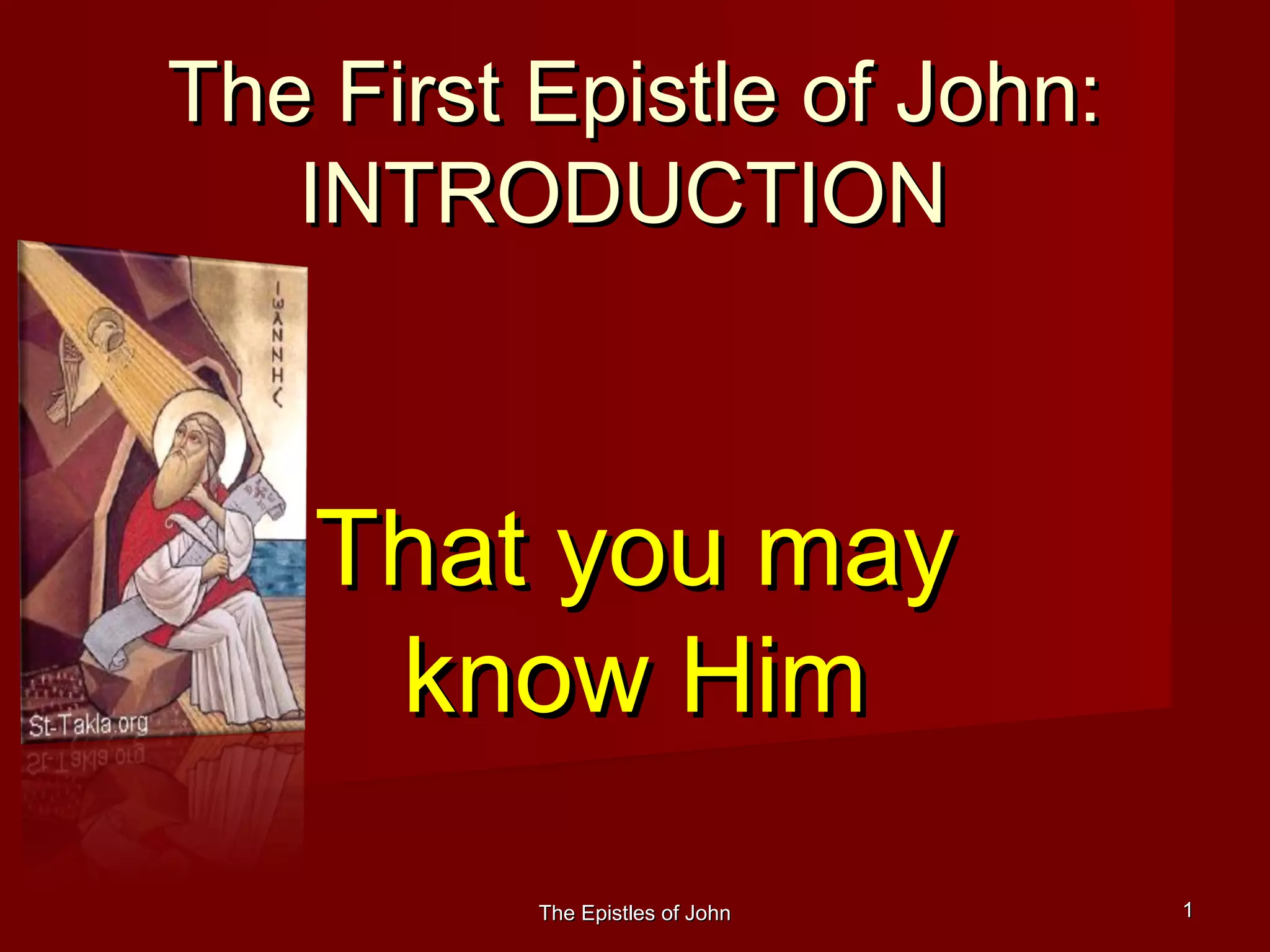
The First Epistle of John:The First Epistle of John:
INTRODUCTIONINTRODUCTION
That you mayThat you may
know Himknow Him
IntroductionIntroduction
 In 70 A.D., after several years of fighting, theIn 70 A.D., after several years of fighting, the
armies of Rome completely conquered thearmies of Rome completely conquered the
Holy Land destroying the city of Jerusalem –Holy Land destroying the city of Jerusalem –
and its temple – in the process.and its temple – in the process.
 Shortly prior to that, the Christian populationShortly prior to that, the Christian population
fled. Many went east across the Jordan.fled. Many went east across the Jordan.
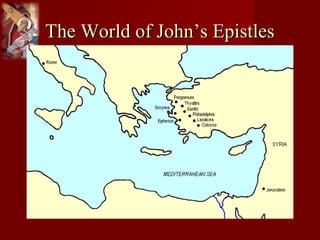
 John the Apostle was part of a group thatJohn the Apostle was part of a group that
eventually went to the Roman province ofeventually went to the Roman province of
Asia where he settled in Ephesus.Asia where he settled in Ephesus.
IntroductionIntroduction
 Ephesus was a large commercial city with aEphesus was a large commercial city with a
deep heritage of paganism and a reputationdeep heritage of paganism and a reputation
for being a center of magic and the occult.for being a center of magic and the occult.
 The church in Ephesus had been founded inThe church in Ephesus had been founded in
about A.D. 52 by the Apostle Paul.about A.D. 52 by the Apostle Paul.
 He served there for several years and had aHe served there for several years and had a
wide-reaching ministry.wide-reaching ministry.
 For a time in the 60s, Paul’s helper TimothyFor a time in the 60s, Paul’s helper Timothy
acted as his representative over the church.acted as his representative over the church.
IntroductionIntroduction
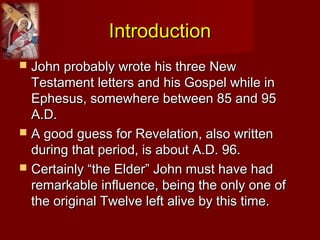
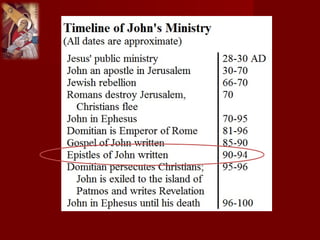
 John probably wrote his three NewJohn probably wrote his three New
Testament letters and his Gospel while inTestament letters and his Gospel while in
Ephesus, somewhere between 85 and 95Ephesus, somewhere between 85 and 95
A.D.A.D.
 A good guess for Revelation, also writtenA good guess for Revelation, also written
during that period, is about A.D. 96.during that period, is about A.D. 96.
 Certainly “the Elder” John must have hadCertainly “the Elder” John must have had
remarkable influence, being the only one ofremarkable influence, being the only one of
the original Twelve left alive by this time.the original Twelve left alive by this time.
The World of John’s EpistlesThe World of John’s Epistles
IntroductionIntroduction
 Nonetheless, it appears that there was atNonetheless, it appears that there was at
least one group who separated from the agedleast one group who separated from the aged
apostle and his teaching.apostle and his teaching.
 These were precursors of those who wouldThese were precursors of those who would
later be called thelater be called the GnosticsGnostics – a large and– a large and
diverse heretical movement that woulddiverse heretical movement that would
remain strong for the next several centuries.remain strong for the next several centuries.
 A group of these dissidents apparently splitA group of these dissidents apparently split
off from the main body of the Asian church.off from the main body of the Asian church.
1 John:1 John: IntroductionIntroduction
 In response, John wrote this letter to theIn response, John wrote this letter to the
believers who were still part of his circlebelievers who were still part of his circle
and remained faithful.and remained faithful.
 The tone of the letter indicates that theyThe tone of the letter indicates that they
had a personal connection with him.had a personal connection with him.
 His goal was to establish them in theirHis goal was to establish them in their
faith, encourage them to abide in it, andfaith, encourage them to abide in it, and
discourage them from buying into the falsediscourage them from buying into the false
beliefs of the rebels.beliefs of the rebels.
The Epistles of JohnThe Epistles of John 99
IntroductionIntroduction
 TheThe First Epistle of JohnFirst Epistle of John is the fourth of theis the fourth of the
catholic or "general"catholic or "general" epistlesepistles..
 It was written inIt was written in EphesusEphesus about 70-90 AD, by theabout 70-90 AD, by the
same author/authors who wrote thesame author/authors who wrote the GospelGospel andand
the two Epistles of John.the two Epistles of John.
 Not a letter, it is a sermon written to counter theNot a letter, it is a sermon written to counter the
heresy that Jesus did not come "in the flesh" butheresy that Jesus did not come "in the flesh" but
only as a spirit.only as a spirit.
 It also focuses on our fellowship with the SonIt also focuses on our fellowship with the Son
PurposesPurposes
 John himself stated several clearJohn himself stated several clear
purposes in writing the letter:purposes in writing the letter:
 1.1. FellowshipFellowship with God and believerswith God and believers
 2. Fill them with2. Fill them with joyjoy
 3. Departure from sin3. Departure from sin
 4. Correct false teaching4. Correct false teaching
PurposesPurposes
 John himself stated several clearJohn himself stated several clear
purposes in writing the letter:purposes in writing the letter:
 The firstThe first is inis in 1:31:3..
 John wanted to encourageJohn wanted to encourage fellowshipfellowship,,
– First between believers and God.First between believers and God.
– But also among believersBut also among believers
PurposesPurposes
 John himself stated several clear purposes inJohn himself stated several clear purposes in
writing the letter:writing the letter:
 The secondThe second is inis in 1:41:4..
 John wanted to fill them with joy.John wanted to fill them with joy.
 This wonderful fruit of the Spirit is generally inThis wonderful fruit of the Spirit is generally in
short supply among heretical movements.short supply among heretical movements.
PurposesPurposes
 John himself stated several clearJohn himself stated several clear
purposes in writing the letter:purposes in writing the letter:
 A thirdA third is inis in 2:12:1..
 Fellowship with Christ truly changes us.Fellowship with Christ truly changes us.
 Departure from sin is an integral part of aDeparture from sin is an integral part of a
thriving relationship with the Lord.thriving relationship with the Lord.
 Christ is our Advocate for those timesChrist is our Advocate for those times
when we do still fall short.when we do still fall short.
PurposesPurposes
 John himself stated several clear purposes inJohn himself stated several clear purposes in
writing the letter:writing the letter:
 A fourthA fourth is inis in 2:262:26..
 John was concerned that some of his “littleJohn was concerned that some of his “little
children” might be deceived.children” might be deceived.
 The dissident movement may not have beenThe dissident movement may not have been
biblically accurate, but it held wide popularbiblically accurate, but it held wide popular
appeal, being more in line with the prevailingappeal, being more in line with the prevailing
Greco-Roman culture and its beliefs.Greco-Roman culture and its beliefs.
False Heresies CounteredFalse Heresies Countered
 DocetismDocetism - (from a Greek word meaning "to seem"),- (from a Greek word meaning "to seem"),
held that Jesus was actually a spirit who only appearedheld that Jesus was actually a spirit who only appeared
to have a body. In reality he cast no shadow and left noto have a body. In reality he cast no shadow and left no
footprints; he was God but not man.footprints; he was God but not man.

GnosticismGnosticism - (from a Greek word meaning- (from a Greek word meaning
"knowledge"), held that all physical matter was evil, the"knowledge"), held that all physical matter was evil, the
spirit was good, and only the intellectually enlightenedspirit was good, and only the intellectually enlightened
could enjoy the benefits of religion.could enjoy the benefits of religion.
 ImperialismImperialism – Held belief that Cesar was a god and– Held belief that Cesar was a god and
proposed therefore that God was human .proposed therefore that God was human .
The Epistles of JohnThe Epistles of John 1616
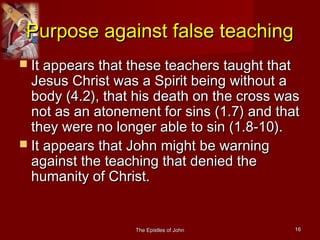
Purpose against false teachingPurpose against false teaching
 It appears that these teachers taught thatIt appears that these teachers taught that
Jesus Christ was a Spirit being without aJesus Christ was a Spirit being without a
body (4.2), that his death on the cross wasbody (4.2), that his death on the cross was
not as an atonement for sins (1.7) and thatnot as an atonement for sins (1.7) and that
they were no longer able to sin (1.8-10).they were no longer able to sin (1.8-10).
 It appears that John might be warningIt appears that John might be warning
against the teaching that denied theagainst the teaching that denied the
humanity of Christ.humanity of Christ.
The Epistles of JohnThe Epistles of John 1717
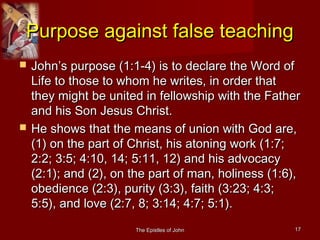
Purpose against false teachingPurpose against false teaching
 John’s purpose (1:1-4) is to declare the Word ofJohn’s purpose (1:1-4) is to declare the Word of
Life to those to whom he writes, in order thatLife to those to whom he writes, in order that
they might be united in fellowship with the Fatherthey might be united in fellowship with the Father
and his Son Jesus Christ.and his Son Jesus Christ.
 He shows that the means of union with God are,He shows that the means of union with God are,
(1) on the part of Christ, his atoning work (1:7;(1) on the part of Christ, his atoning work (1:7;
2:2; 3:5; 4:10, 14; 5:11, 12) and his advocacy2:2; 3:5; 4:10, 14; 5:11, 12) and his advocacy
(2:1); and (2), on the part of man, holiness (1:6),(2:1); and (2), on the part of man, holiness (1:6),
obedience (2:3), purity (3:3), faith (3:23; 4:3;obedience (2:3), purity (3:3), faith (3:23; 4:3;
5:5), and love (2:7, 8; 3:14; 4:7; 5:1).5:5), and love (2:7, 8; 3:14; 4:7; 5:1).
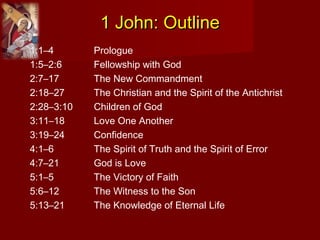
1 John: Outline1 John: Outline
1:1–4 Prologue
1:5–2:6 Fellowship with God
2:7–17 The New Commandment
2:18–27 The Christian and the Spirit of the Antichrist
2:28–3:10 Children of God
3:11–18 Love One Another
3:19–24 Confidence
4:1–6 The Spirit of Truth and the Spirit of Error
4:7–21 God is Love
5:1–5 The Victory of Faith
5:6–12 The Witness to the Son
5:13–21 The Knowledge of Eternal Life

The first epistle of John

  • 1.
    The Epistles ofJohnThe Epistles of John 11 The First Epistle of John:The First Epistle of John: INTRODUCTIONINTRODUCTION That you mayThat you may know Himknow Him
  • 2.
    IntroductionIntroduction  In 70A.D., after several years of fighting, theIn 70 A.D., after several years of fighting, the armies of Rome completely conquered thearmies of Rome completely conquered the Holy Land destroying the city of Jerusalem –Holy Land destroying the city of Jerusalem – and its temple – in the process.and its temple – in the process.  Shortly prior to that, the Christian populationShortly prior to that, the Christian population fled. Many went east across the Jordan.fled. Many went east across the Jordan.  John the Apostle was part of a group thatJohn the Apostle was part of a group that eventually went to the Roman province ofeventually went to the Roman province of Asia where he settled in Ephesus.Asia where he settled in Ephesus.
  • 3.
    IntroductionIntroduction  Ephesus wasa large commercial city with aEphesus was a large commercial city with a deep heritage of paganism and a reputationdeep heritage of paganism and a reputation for being a center of magic and the occult.for being a center of magic and the occult.  The church in Ephesus had been founded inThe church in Ephesus had been founded in about A.D. 52 by the Apostle Paul.about A.D. 52 by the Apostle Paul.  He served there for several years and had aHe served there for several years and had a wide-reaching ministry.wide-reaching ministry.  For a time in the 60s, Paul’s helper TimothyFor a time in the 60s, Paul’s helper Timothy acted as his representative over the church.acted as his representative over the church.
  • 4.
    IntroductionIntroduction  John probablywrote his three NewJohn probably wrote his three New Testament letters and his Gospel while inTestament letters and his Gospel while in Ephesus, somewhere between 85 and 95Ephesus, somewhere between 85 and 95 A.D.A.D.  A good guess for Revelation, also writtenA good guess for Revelation, also written during that period, is about A.D. 96.during that period, is about A.D. 96.  Certainly “the Elder” John must have hadCertainly “the Elder” John must have had remarkable influence, being the only one ofremarkable influence, being the only one of the original Twelve left alive by this time.the original Twelve left alive by this time.
  • 6.
    The World ofJohn’s EpistlesThe World of John’s Epistles
  • 7.
    IntroductionIntroduction  Nonetheless, itappears that there was atNonetheless, it appears that there was at least one group who separated from the agedleast one group who separated from the aged apostle and his teaching.apostle and his teaching.  These were precursors of those who wouldThese were precursors of those who would later be called thelater be called the GnosticsGnostics – a large and– a large and diverse heretical movement that woulddiverse heretical movement that would remain strong for the next several centuries.remain strong for the next several centuries.  A group of these dissidents apparently splitA group of these dissidents apparently split off from the main body of the Asian church.off from the main body of the Asian church.
  • 8.
    1 John:1 John:IntroductionIntroduction  In response, John wrote this letter to theIn response, John wrote this letter to the believers who were still part of his circlebelievers who were still part of his circle and remained faithful.and remained faithful.  The tone of the letter indicates that theyThe tone of the letter indicates that they had a personal connection with him.had a personal connection with him.  His goal was to establish them in theirHis goal was to establish them in their faith, encourage them to abide in it, andfaith, encourage them to abide in it, and discourage them from buying into the falsediscourage them from buying into the false beliefs of the rebels.beliefs of the rebels.
  • 9.
    The Epistles ofJohnThe Epistles of John 99 IntroductionIntroduction  TheThe First Epistle of JohnFirst Epistle of John is the fourth of theis the fourth of the catholic or "general"catholic or "general" epistlesepistles..  It was written inIt was written in EphesusEphesus about 70-90 AD, by theabout 70-90 AD, by the same author/authors who wrote thesame author/authors who wrote the GospelGospel andand the two Epistles of John.the two Epistles of John.  Not a letter, it is a sermon written to counter theNot a letter, it is a sermon written to counter the heresy that Jesus did not come "in the flesh" butheresy that Jesus did not come "in the flesh" but only as a spirit.only as a spirit.  It also focuses on our fellowship with the SonIt also focuses on our fellowship with the Son
  • 10.
    PurposesPurposes  John himselfstated several clearJohn himself stated several clear purposes in writing the letter:purposes in writing the letter:  1.1. FellowshipFellowship with God and believerswith God and believers  2. Fill them with2. Fill them with joyjoy  3. Departure from sin3. Departure from sin  4. Correct false teaching4. Correct false teaching
  • 11.
    PurposesPurposes  John himselfstated several clearJohn himself stated several clear purposes in writing the letter:purposes in writing the letter:  The firstThe first is inis in 1:31:3..  John wanted to encourageJohn wanted to encourage fellowshipfellowship,, – First between believers and God.First between believers and God. – But also among believersBut also among believers
  • 12.
    PurposesPurposes  John himselfstated several clear purposes inJohn himself stated several clear purposes in writing the letter:writing the letter:  The secondThe second is inis in 1:41:4..  John wanted to fill them with joy.John wanted to fill them with joy.  This wonderful fruit of the Spirit is generally inThis wonderful fruit of the Spirit is generally in short supply among heretical movements.short supply among heretical movements.
  • 13.
    PurposesPurposes  John himselfstated several clearJohn himself stated several clear purposes in writing the letter:purposes in writing the letter:  A thirdA third is inis in 2:12:1..  Fellowship with Christ truly changes us.Fellowship with Christ truly changes us.  Departure from sin is an integral part of aDeparture from sin is an integral part of a thriving relationship with the Lord.thriving relationship with the Lord.  Christ is our Advocate for those timesChrist is our Advocate for those times when we do still fall short.when we do still fall short.
  • 14.
    PurposesPurposes  John himselfstated several clear purposes inJohn himself stated several clear purposes in writing the letter:writing the letter:  A fourthA fourth is inis in 2:262:26..  John was concerned that some of his “littleJohn was concerned that some of his “little children” might be deceived.children” might be deceived.  The dissident movement may not have beenThe dissident movement may not have been biblically accurate, but it held wide popularbiblically accurate, but it held wide popular appeal, being more in line with the prevailingappeal, being more in line with the prevailing Greco-Roman culture and its beliefs.Greco-Roman culture and its beliefs.
  • 15.
    False Heresies CounteredFalseHeresies Countered  DocetismDocetism - (from a Greek word meaning "to seem"),- (from a Greek word meaning "to seem"), held that Jesus was actually a spirit who only appearedheld that Jesus was actually a spirit who only appeared to have a body. In reality he cast no shadow and left noto have a body. In reality he cast no shadow and left no footprints; he was God but not man.footprints; he was God but not man.  GnosticismGnosticism - (from a Greek word meaning- (from a Greek word meaning "knowledge"), held that all physical matter was evil, the"knowledge"), held that all physical matter was evil, the spirit was good, and only the intellectually enlightenedspirit was good, and only the intellectually enlightened could enjoy the benefits of religion.could enjoy the benefits of religion.  ImperialismImperialism – Held belief that Cesar was a god and– Held belief that Cesar was a god and proposed therefore that God was human .proposed therefore that God was human .
  • 16.
    The Epistles ofJohnThe Epistles of John 1616 Purpose against false teachingPurpose against false teaching  It appears that these teachers taught thatIt appears that these teachers taught that Jesus Christ was a Spirit being without aJesus Christ was a Spirit being without a body (4.2), that his death on the cross wasbody (4.2), that his death on the cross was not as an atonement for sins (1.7) and thatnot as an atonement for sins (1.7) and that they were no longer able to sin (1.8-10).they were no longer able to sin (1.8-10).  It appears that John might be warningIt appears that John might be warning against the teaching that denied theagainst the teaching that denied the humanity of Christ.humanity of Christ.
  • 17.
    The Epistles ofJohnThe Epistles of John 1717 Purpose against false teachingPurpose against false teaching  John’s purpose (1:1-4) is to declare the Word ofJohn’s purpose (1:1-4) is to declare the Word of Life to those to whom he writes, in order thatLife to those to whom he writes, in order that they might be united in fellowship with the Fatherthey might be united in fellowship with the Father and his Son Jesus Christ.and his Son Jesus Christ.  He shows that the means of union with God are,He shows that the means of union with God are, (1) on the part of Christ, his atoning work (1:7;(1) on the part of Christ, his atoning work (1:7; 2:2; 3:5; 4:10, 14; 5:11, 12) and his advocacy2:2; 3:5; 4:10, 14; 5:11, 12) and his advocacy (2:1); and (2), on the part of man, holiness (1:6),(2:1); and (2), on the part of man, holiness (1:6), obedience (2:3), purity (3:3), faith (3:23; 4:3;obedience (2:3), purity (3:3), faith (3:23; 4:3; 5:5), and love (2:7, 8; 3:14; 4:7; 5:1).5:5), and love (2:7, 8; 3:14; 4:7; 5:1).
  • 18.
    1 John: Outline1John: Outline 1:1–4 Prologue 1:5–2:6 Fellowship with God 2:7–17 The New Commandment 2:18–27 The Christian and the Spirit of the Antichrist 2:28–3:10 Children of God 3:11–18 Love One Another 3:19–24 Confidence 4:1–6 The Spirit of Truth and the Spirit of Error 4:7–21 God is Love 5:1–5 The Victory of Faith 5:6–12 The Witness to the Son 5:13–21 The Knowledge of Eternal Life