Living by the Book An Introduction to Bible Study Methods Week 1
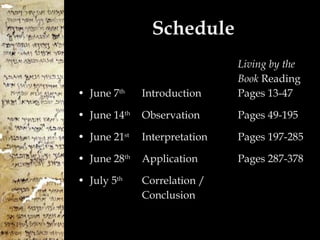
Schedule Living by the Book  Reading June 7 th   Introduction Pages 13-47 June 14 th   Observation  Pages 49-195 June 21 st   Interpretation Pages 197-285 June 28 th   Application Pages 287-378 July 5 th   Correlation / Conclusion
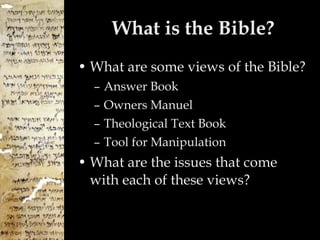
What is the Bible? What are some views of the Bible? Answer Book Owners Manuel Theological Text Book Tool for Manipulation What are the issues that come with each of these views?
What is the Bible? The Bible is not a book for the faint of heart - it is a book full of all the greed and glory and violence and tenderness and sex and betrayal that benefits mankind. It is not the collection of pretty little anecdotes mouthed by pious little church mice - it does not so much nibble at our shoe leather as it cuts to the heart and splits the morrow from the bone. It does not give us answers fitted to our small-minded questions, but truth that goes beyond what we can even know to ask. from  Thoughts and Reflections  by Rich Mullins
What is the Bible? A working definition: A collection of writings containing the record and revelation of God’s interaction with man.
A collection of writings… Old Testament Historical Pentateuch Genesis Exodus Leviticus  Numbers Deuteronomy
A collection of writings… Old Testament Historical Pentateuch Pre-Kings Joshua Judges Ruth
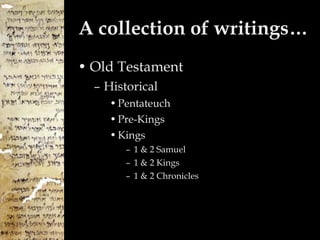
A collection of writings… Old Testament Historical Pentateuch Pre-Kings Kings 1 & 2 Samuel 1 & 2 Kings 1 & 2 Chronicles
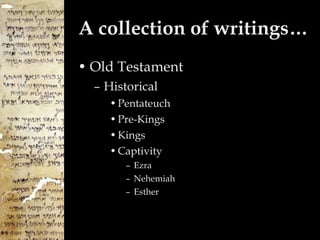
A collection of writings… Old Testament Historical Pentateuch Pre-Kings Kings Captivity Ezra Nehemiah Esther
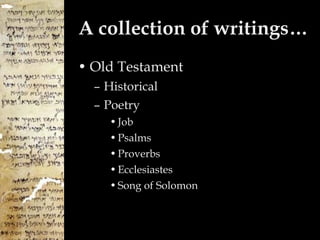
A collection of writings… Old Testament Historical Poetry Job Psalms Proverbs Ecclesiastes Song of Solomon
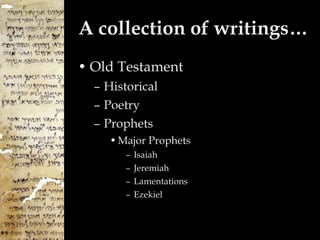
A collection of writings… Old Testament Historical Poetry Prophets Major Prophets Isaiah Jeremiah Lamentations Ezekiel
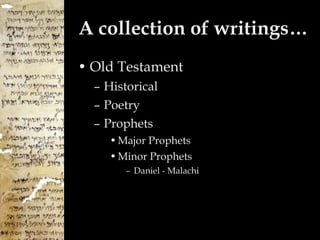
A collection of writings… Old Testament Historical Poetry Prophets Major Prophets Minor Prophets Daniel - Malachi
A collection of writings… Old Testament Historical Poetry Prophets
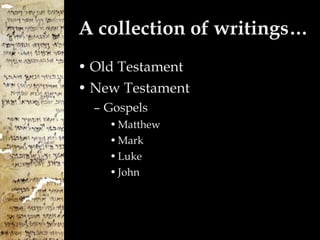
A collection of writings… Old Testament New Testament Gospels Matthew Mark Luke John
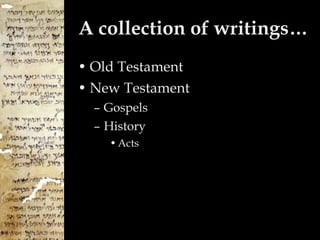
A collection of writings… Old Testament New Testament Gospels History Acts
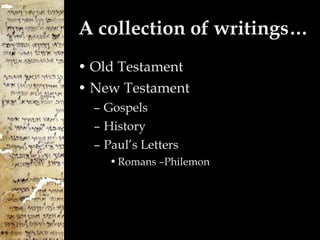
A collection of writings… Old Testament New Testament Gospels History Paul’s Letters Romans –Philemon
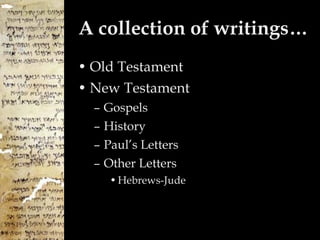
A collection of writings… Old Testament New Testament Gospels History Paul’s Letters Other Letters Hebrews-Jude
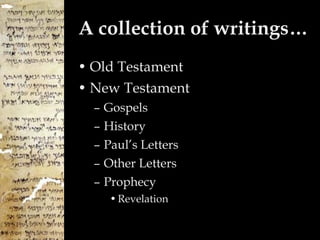
A collection of writings… Old Testament New Testament Gospels History Paul’s Letters Other Letters Prophecy Revelation
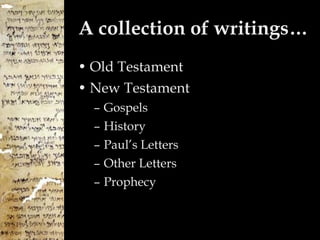
A collection of writings… Old Testament New Testament Gospels History Paul’s Letters Other Letters Prophecy
… containing the record and revelation…  Record Two extremes are to be avoided when describing the Bible: Either denying or diminishing its divine characteristics while affirming its humam traits, or else affirming its divine properties while denying or diminishing its human elements. Systematic Theology  by Norman Geisler
… containing the record and revelation…  Record Authors Literary styles and forms Reflects different human Perspectives  Thought patterns Emotions Interests Culture Sources
… containing the record and revelation…  Record Revelation Divine Authority But He answered and said,  “It is written, ‘Man shall not live on bread alone, but on every word that proceeds out of the mouth of God.’ ” Matthew 4:4
… containing the record and revelation…  Record Revelation Divine Authority Imperishability “ Do not think that I came to abolish the Law or the Prophets; I did not come to abolish but to fulfill.   For truly I say to you, until heaven and earth pass away, not the smallest letter or stroke shall pass from the Law until all is accomplished.” Matthew 5:17-18
… containing the record and revelation…  Record Revelation Divine Authority Imperishability Supremacy And He answered and said to them, “Why do you yourselves transgress the commandment of God for the sake of your tradition? ” Matthew 15:3
… containing the record and revelation…  Record Revelation Divine Authority Imperishability Supremacy True “ Sanctify them in the truth; Your word is truth.” John 17:17
… containing the record and revelation…  Record Revelation Divine Authority Imperishability Supremacy True Historical Reliability Matthew 12:40; cf. 16:4 Matthew 24:37-38
… containing the record and revelation…  Record Revelation Divine Authority Imperishability Supremacy True Historical Reliability Accuracy Matthew 19:4-5
… containing the record and revelation…  Record Revelation Divine Authority Imperishability Supremacy True Historical Reliability Accuracy
…  of God’s interaction with man. Actual people Actual places Actual problems Actual encounters Actually God
How did we get it? All transmissions of the Bible were handwritten until the invention of the printing press in 1450s by Johann Gutenberg.
How did we get it? Old Testament Hebrew Bible Law (Torah) – Genesis – Deuteronomy Prophets The Former Prophets – Joshua – Kings The Latter Prophets – Isaiah – The Book of the Twelve Writings Poetic Books – Psalms, Job, Proverbs Five Scrolls – Ruth, Song of Songs, Ecc, Lam, Esther Historical Books – Daniel, Ezra – Nehemiah, Chronicles Written in two related languages, Hebrew and Aramaic
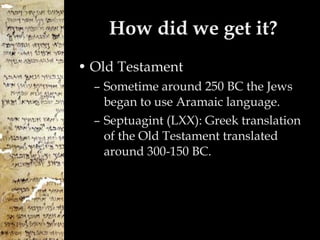
How did we get it? Old Testament Sometime around 250 BC the Jews began to use Aramaic language. Septuagint (LXX): Greek translation of the Old Testament translated around 300-150 BC.
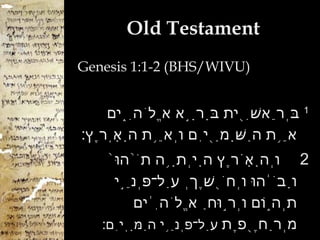
Old Testament Genesis 1:1-2 (BHS/WIVU) 1   בְּרֵאשִׁ֖ית בָּרָ֣א אֱלֹהִ֑ים אֵ֥ת הַשָּׁמַ֖יִם וְאֵ֥ת הָאָֽרֶץ׃ 2       וְהָאָ֗רֶץ הָיְתָ֥ה תֹ֨הוּ֙ וָבֹ֔הוּ וְחֹ֖שֶׁךְ עַל־פְּנֵ֣י תְה֑וֹם וְר֣וּחַ אֱלֹהִ֔ים מְרַחֶ֖פֶת  עַל־פְּנֵ֥י הַמָּֽיִם׃
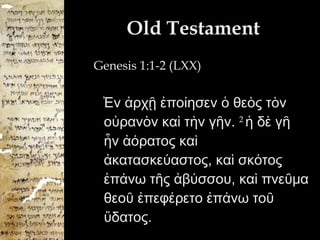
Old Testament Genesis 1:1-2 (LXX) Ἐν ἀρχῇ ἐποίησεν ὁ θεὸς τὸν οὐρανὸν καὶ τὴν γῆν.  2  ἡ δὲ γῆ ἦν ἀόρατος καὶ ἀκατασκεύαστος, καὶ σκότος ἐπάνω τῆς ἀβύσσου, καὶ πνεῦμα θεοῦ ἐπεφέρετο ἐπάνω τοῦ ὕδατος.
How did we get it? New Testament The New Testament was originally written in Koine Greek between the years 40-100 AD. 80% of the OT quotes in the NT are from the Septuagint.
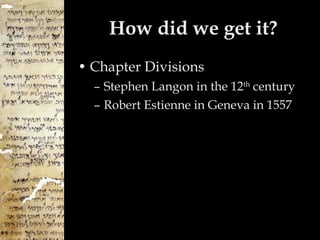
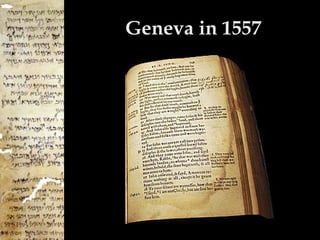
How did we get it? Chapter Divisions Stephen Langon in the 12 th  century Robert Estienne in Geneva in 1557
Geneva in 1557
How did we get it? Canonization A collection or list of books accepted as an authoritative rule of faith and practice.
Canonization Jesus ben Sirach’s grandson, writing about 132 BC, references scripture. Josephus (90-100 AD) Jewish tradition claimed that prophecy had ceased about 400 BC. Jesus in Luke 11:49-51
Luke 11:49-51 “ For this reason also the wisdom of God said, ‘I will send to them prophets and apostles, and  some  of them they will kill and  some  they will persecute,   so that the blood of all the prophets, shed since the foundation of the world, may be charged against this generation, from the blood of Abel to the blood of Zechariah, who was killed between the altar and the house  of God;  yes, I tell you, it shall be charged against this generation.’” Luke 11:49-51
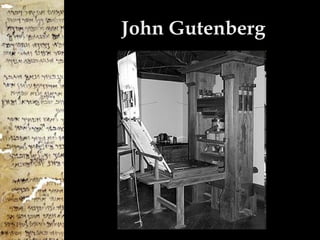
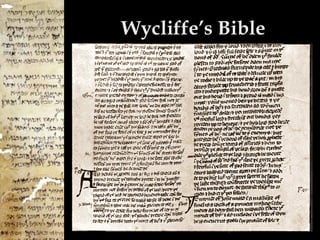
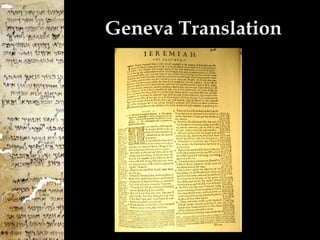
How did we get it? John Gutenberg (1398-1468) published the first Bible.  Wycliffe’s first version of the New Testament in Middle English appeared in 1380. Tyndale’s Bible was printed in 1526. went back to the original Hebrew and Greek.  printed in and used modern English. The Geneva Translation had marginal notes that were Calvinistic (1556).
John Gutenberg
Wycliffe’s Bible
Geneva Translation
How did we get it? King James I of England (1604) 54 biblical scholars Six groups 1611 the work was complete Used for over three centuries
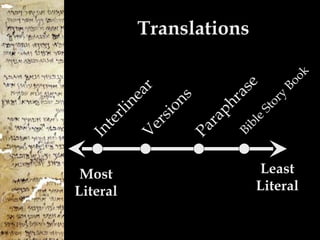
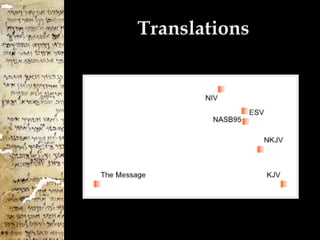
Translations Most Literal Least Literal Interlinear Versions Paraphrase Bible Story Book
Translations
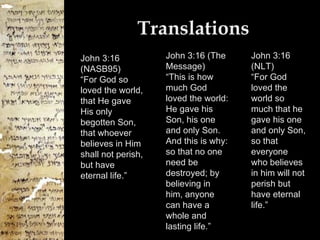
Translations John 3:16 (NASB95) “For God so loved the world, that He gave His only begotten Son, that whoever believes in Him shall not perish, but have eternal life.” John 3:16 (The Message) “This is how much God loved the world: He gave his Son, his one and only Son. And this is why: so that no one need be destroyed; by believing in him, anyone can have a whole and lasting life.” John 3:16 (NLT) “For God loved the world so much that he gave his one and only Son, so that everyone who believes in him will not perish but have eternal life.”
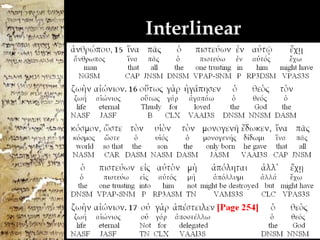
Interlinear
Why is it important to me? Considered authoritative  Used to determine beliefs and doctrines Claims to be the Word of God 3800 times the Bible declares “God said” or “Thus says the Lord” Paul’s confession (1 Corinthians 14:37) John’s confession ( 1 John 4:6)
Why is it important to me? 2 Timothy 3:16-17 All Scripture is inspired by God and profitable for teaching, for reproof, for correction, for training in righteousness;   so that the man of God may be adequate, equipped for every good work.
Why is it important to me? Teaching  Instructing believers in God’s truth Standard Reproof Changing behavior Behavior not matching standard Correction Changing thinking Thinking not matching standard Training Modeling behaviors Guiding toward standard
Summary God desires to be in relationship with us and the Bible is an important tool in the development of that relationship. It is important that we do not replace a love for the Bible for a love of God.
Next Week Observation Interpretation Application Correlation

Livingbythe Book Introduction

  • 1.
    Living by theBook An Introduction to Bible Study Methods Week 1
  • 2.
    Schedule Living bythe Book Reading June 7 th Introduction Pages 13-47 June 14 th Observation Pages 49-195 June 21 st Interpretation Pages 197-285 June 28 th Application Pages 287-378 July 5 th Correlation / Conclusion
  • 3.
    What is theBible? What are some views of the Bible? Answer Book Owners Manuel Theological Text Book Tool for Manipulation What are the issues that come with each of these views?
  • 4.
    What is theBible? The Bible is not a book for the faint of heart - it is a book full of all the greed and glory and violence and tenderness and sex and betrayal that benefits mankind. It is not the collection of pretty little anecdotes mouthed by pious little church mice - it does not so much nibble at our shoe leather as it cuts to the heart and splits the morrow from the bone. It does not give us answers fitted to our small-minded questions, but truth that goes beyond what we can even know to ask. from Thoughts and Reflections by Rich Mullins
  • 5.
    What is theBible? A working definition: A collection of writings containing the record and revelation of God’s interaction with man.
  • 6.
    A collection ofwritings… Old Testament Historical Pentateuch Genesis Exodus Leviticus Numbers Deuteronomy
  • 7.
    A collection ofwritings… Old Testament Historical Pentateuch Pre-Kings Joshua Judges Ruth
  • 8.
    A collection ofwritings… Old Testament Historical Pentateuch Pre-Kings Kings 1 & 2 Samuel 1 & 2 Kings 1 & 2 Chronicles
  • 9.
    A collection ofwritings… Old Testament Historical Pentateuch Pre-Kings Kings Captivity Ezra Nehemiah Esther
  • 10.
    A collection ofwritings… Old Testament Historical Poetry Job Psalms Proverbs Ecclesiastes Song of Solomon
  • 11.
    A collection ofwritings… Old Testament Historical Poetry Prophets Major Prophets Isaiah Jeremiah Lamentations Ezekiel
  • 12.
    A collection ofwritings… Old Testament Historical Poetry Prophets Major Prophets Minor Prophets Daniel - Malachi
  • 13.
    A collection ofwritings… Old Testament Historical Poetry Prophets
  • 14.
    A collection ofwritings… Old Testament New Testament Gospels Matthew Mark Luke John
  • 15.
    A collection ofwritings… Old Testament New Testament Gospels History Acts
  • 16.
    A collection ofwritings… Old Testament New Testament Gospels History Paul’s Letters Romans –Philemon
  • 17.
    A collection ofwritings… Old Testament New Testament Gospels History Paul’s Letters Other Letters Hebrews-Jude
  • 18.
    A collection ofwritings… Old Testament New Testament Gospels History Paul’s Letters Other Letters Prophecy Revelation
  • 19.
    A collection ofwritings… Old Testament New Testament Gospels History Paul’s Letters Other Letters Prophecy
  • 20.
    … containing therecord and revelation… Record Two extremes are to be avoided when describing the Bible: Either denying or diminishing its divine characteristics while affirming its humam traits, or else affirming its divine properties while denying or diminishing its human elements. Systematic Theology by Norman Geisler
  • 21.
    … containing therecord and revelation… Record Authors Literary styles and forms Reflects different human Perspectives Thought patterns Emotions Interests Culture Sources
  • 22.
    … containing therecord and revelation… Record Revelation Divine Authority But He answered and said, “It is written, ‘Man shall not live on bread alone, but on every word that proceeds out of the mouth of God.’ ” Matthew 4:4
  • 23.
    … containing therecord and revelation… Record Revelation Divine Authority Imperishability “ Do not think that I came to abolish the Law or the Prophets; I did not come to abolish but to fulfill. For truly I say to you, until heaven and earth pass away, not the smallest letter or stroke shall pass from the Law until all is accomplished.” Matthew 5:17-18
  • 24.
    … containing therecord and revelation… Record Revelation Divine Authority Imperishability Supremacy And He answered and said to them, “Why do you yourselves transgress the commandment of God for the sake of your tradition? ” Matthew 15:3
  • 25.
    … containing therecord and revelation… Record Revelation Divine Authority Imperishability Supremacy True “ Sanctify them in the truth; Your word is truth.” John 17:17
  • 26.
    … containing therecord and revelation… Record Revelation Divine Authority Imperishability Supremacy True Historical Reliability Matthew 12:40; cf. 16:4 Matthew 24:37-38
  • 27.
    … containing therecord and revelation… Record Revelation Divine Authority Imperishability Supremacy True Historical Reliability Accuracy Matthew 19:4-5
  • 28.
    … containing therecord and revelation… Record Revelation Divine Authority Imperishability Supremacy True Historical Reliability Accuracy
  • 29.
    … ofGod’s interaction with man. Actual people Actual places Actual problems Actual encounters Actually God
  • 30.
    How did weget it? All transmissions of the Bible were handwritten until the invention of the printing press in 1450s by Johann Gutenberg.
  • 31.
    How did weget it? Old Testament Hebrew Bible Law (Torah) – Genesis – Deuteronomy Prophets The Former Prophets – Joshua – Kings The Latter Prophets – Isaiah – The Book of the Twelve Writings Poetic Books – Psalms, Job, Proverbs Five Scrolls – Ruth, Song of Songs, Ecc, Lam, Esther Historical Books – Daniel, Ezra – Nehemiah, Chronicles Written in two related languages, Hebrew and Aramaic
  • 32.
    How did weget it? Old Testament Sometime around 250 BC the Jews began to use Aramaic language. Septuagint (LXX): Greek translation of the Old Testament translated around 300-150 BC.
  • 33.
    Old Testament Genesis1:1-2 (BHS/WIVU) 1 בְּרֵאשִׁ֖ית בָּרָ֣א אֱלֹהִ֑ים אֵ֥ת הַשָּׁמַ֖יִם וְאֵ֥ת הָאָֽרֶץ׃ 2       וְהָאָ֗רֶץ הָיְתָ֥ה תֹ֨הוּ֙ וָבֹ֔הוּ וְחֹ֖שֶׁךְ עַל־פְּנֵ֣י תְה֑וֹם וְר֣וּחַ אֱלֹהִ֔ים מְרַחֶ֖פֶת עַל־פְּנֵ֥י הַמָּֽיִם׃
  • 34.
    Old Testament Genesis1:1-2 (LXX) Ἐν ἀρχῇ ἐποίησεν ὁ θεὸς τὸν οὐρανὸν καὶ τὴν γῆν. 2 ἡ δὲ γῆ ἦν ἀόρατος καὶ ἀκατασκεύαστος, καὶ σκότος ἐπάνω τῆς ἀβύσσου, καὶ πνεῦμα θεοῦ ἐπεφέρετο ἐπάνω τοῦ ὕδατος.
  • 35.
    How did weget it? New Testament The New Testament was originally written in Koine Greek between the years 40-100 AD. 80% of the OT quotes in the NT are from the Septuagint.
  • 36.
    How did weget it? Chapter Divisions Stephen Langon in the 12 th century Robert Estienne in Geneva in 1557
  • 37.
  • 38.
    How did weget it? Canonization A collection or list of books accepted as an authoritative rule of faith and practice.
  • 39.
    Canonization Jesus benSirach’s grandson, writing about 132 BC, references scripture. Josephus (90-100 AD) Jewish tradition claimed that prophecy had ceased about 400 BC. Jesus in Luke 11:49-51
  • 40.
    Luke 11:49-51 “For this reason also the wisdom of God said, ‘I will send to them prophets and apostles, and some of them they will kill and some they will persecute, so that the blood of all the prophets, shed since the foundation of the world, may be charged against this generation, from the blood of Abel to the blood of Zechariah, who was killed between the altar and the house of God; yes, I tell you, it shall be charged against this generation.’” Luke 11:49-51
  • 41.
    How did weget it? John Gutenberg (1398-1468) published the first Bible. Wycliffe’s first version of the New Testament in Middle English appeared in 1380. Tyndale’s Bible was printed in 1526. went back to the original Hebrew and Greek. printed in and used modern English. The Geneva Translation had marginal notes that were Calvinistic (1556).
  • 42.
  • 43.
  • 44.
  • 45.
    How did weget it? King James I of England (1604) 54 biblical scholars Six groups 1611 the work was complete Used for over three centuries
  • 46.
    Translations Most LiteralLeast Literal Interlinear Versions Paraphrase Bible Story Book
  • 47.
  • 48.
    Translations John 3:16(NASB95) “For God so loved the world, that He gave His only begotten Son, that whoever believes in Him shall not perish, but have eternal life.” John 3:16 (The Message) “This is how much God loved the world: He gave his Son, his one and only Son. And this is why: so that no one need be destroyed; by believing in him, anyone can have a whole and lasting life.” John 3:16 (NLT) “For God loved the world so much that he gave his one and only Son, so that everyone who believes in him will not perish but have eternal life.”
  • 49.
  • 50.
    Why is itimportant to me? Considered authoritative Used to determine beliefs and doctrines Claims to be the Word of God 3800 times the Bible declares “God said” or “Thus says the Lord” Paul’s confession (1 Corinthians 14:37) John’s confession ( 1 John 4:6)
  • 51.
    Why is itimportant to me? 2 Timothy 3:16-17 All Scripture is inspired by God and profitable for teaching, for reproof, for correction, for training in righteousness; so that the man of God may be adequate, equipped for every good work.
  • 52.
    Why is itimportant to me? Teaching Instructing believers in God’s truth Standard Reproof Changing behavior Behavior not matching standard Correction Changing thinking Thinking not matching standard Training Modeling behaviors Guiding toward standard
  • 53.
    Summary God desiresto be in relationship with us and the Bible is an important tool in the development of that relationship. It is important that we do not replace a love for the Bible for a love of God.
  • 54.
    Next Week ObservationInterpretation Application Correlation