HOW TO STUDY THE
BIBLE FOR YOURSELF
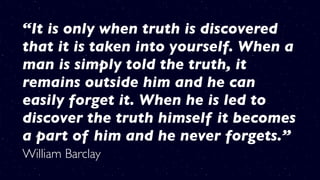
“It is only when truth is discovered
that it is taken into yourself. When a
man is simply told the truth, it
remains outside him and he can
easily forget it. When he is led to
discover the truth himself it becomes
a part of him and he never forgets.”
William Barclay
INDUCTIVE BIBLE STUDY
DO YOU READ SCRIPTURE LIKE DR.
WATSON OR SHERLOCK HOLMES?
DO YOU READ SCRIPTURE LIKE DR.
WATSON OR SHERLOCK HOLMES?
Holmes:“You see, but you do
not observe.The distinction is
clear…you have frequently seen
the steps which lead up to this
room.”
Watson:“Frequently.”
Holmes:“How often?”
Watson:“…hundreds of times.”
Holmes:“Then how many are there?”
Watson:“How many? I don’t know.”
Holmes:“Quite so! You have not observed.
And yet you have seen.That is just my
point. Now, I know that there are seventeen steps,
because I have both seen and observed”
A Scandal in Bohemia”
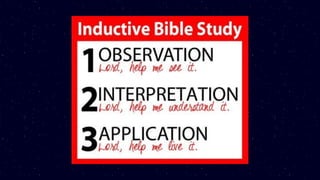
OBSERVATION
•What does the passage say?
•What happens?
•Who is involved?
•etc…
•Who
•What
•When
•Where
•Why
•How
•Who is involved?
•What does the passage say?
•What happens?
•When does it happen?
•Where does it happen?
•etc…
•Mark Important (key) Words.
•Look for Lists.
•Look for Contrasts (differences) and
Comparisons (similar).
•Identify terms of Conclusion.
TAKE A F.O.T.O.
"FOCUS ON THE OBVIOUS
•Looking for the easily observed, facts,
details, events or ideas: e.g. people,
places, events.
•Don’t focus on small details, things you don’t
understand or your favourite verses.
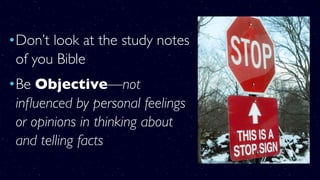
•Don’t look at the study notes
of you Bible
•Be Objective—not
influenced by personal feelings
or opinions in thinking about
and telling facts
OBSERVATION EXERCISE
Using the sheet provided read Luke
4:1-13 and mark questions etc. using
the 5 W’s and an H.
LUKE 4:1-13
LUKE 4:1-13
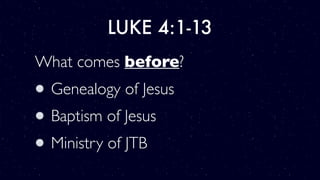
What comes before?
LUKE 4:1-13
What comes before?
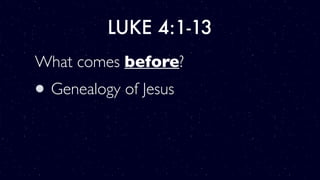
Genealogy of Jesus
LUKE 4:1-13
What comes before?
Genealogy of Jesus
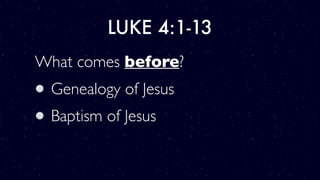
Baptism of Jesus
LUKE 4:1-13
What comes before?
Genealogy of Jesus
Baptism of Jesus
Ministry of JTB
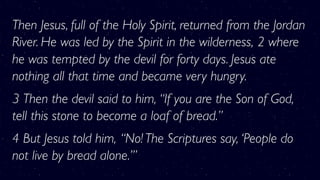
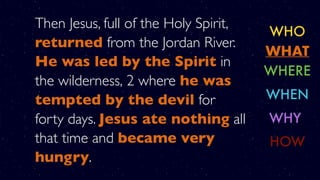
Then Jesus, full of the Holy Spirit, returned from the Jordan
River. He was led by the Spirit in the wilderness, 2 where
he was tempted by the devil for forty days. Jesus ate
nothing all that time and became very hungry.
3 Then the devil said to him, “If you are the Son of God,
tell this stone to become a loaf of bread.”
4 But Jesus told him, “No! The Scriptures say, ‘People do
not live by bread alone.’”
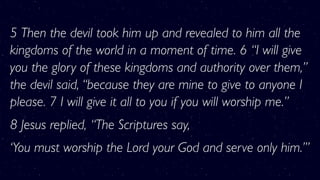
5 Then the devil took him up and revealed to him all the
kingdoms of the world in a moment of time. 6 “I will give
you the glory of these kingdoms and authority over them,”
the devil said, “because they are mine to give to anyone I
please. 7 I will give it all to you if you will worship me.”
8 Jesus replied, “The Scriptures say,
‘You must worship the Lord your God and serve only him.’”
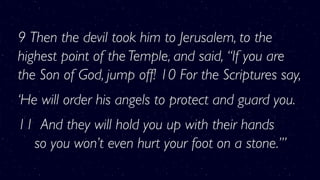
9 Then the devil took him to Jerusalem, to the
highest point of the Temple, and said, “If you are
the Son of God, jump off! 10 For the Scriptures say,
‘He will order his angels to protect and guard you.
11  And they will hold you up with their hands

    so you won’t even hurt your foot on a stone.’”
12 Jesus responded, “The Scriptures also say,
‘You must not test the Lord your God.’”
13 When the devil had finished tempting
Jesus, he left him until the next opportunity
came.
Now Read It AGAIN!
…and AGAIN!
12 Jesus responded, “The Scriptures also say,
‘You must not test the Lord your God.’”
13 When the devil had finished tempting
Jesus, he left him until the next opportunity
came.
12 Jesus responded, “The Scriptures also say,
‘You must not test the Lord your God.’”
13 When the devil had finished tempting
Jesus, he left him until the next opportunity
came.
Let’s do the first two
verses together
WHO
WHERE
WHY
WHAT
WHEN
HOW
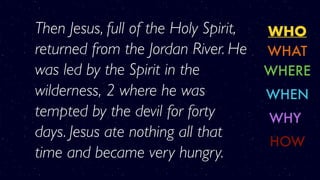
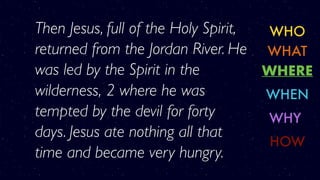
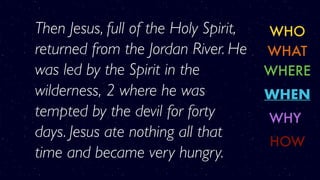
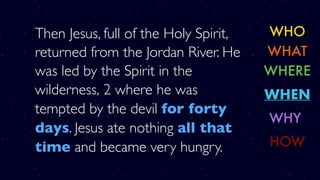
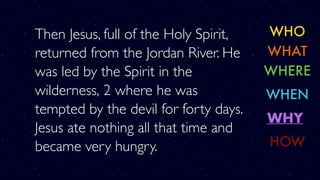
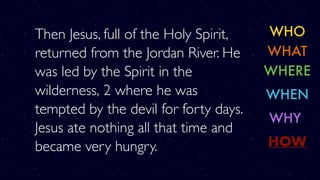
Then Jesus, full of the Holy Spirit,
returned from the Jordan River. He
was led by the Spirit in the
wilderness, 2 where he was
tempted by the devil for forty
days. Jesus ate nothing all that
time and became very hungry.
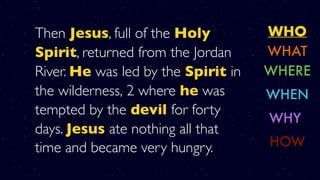
Then Jesus, full of the Holy
Spirit, returned from the Jordan
River. He was led by the Spirit in
the wilderness, 2 where he was
tempted by the devil for forty
days. Jesus ate nothing all that
time and became very hungry.
WHO
WHERE
WHY
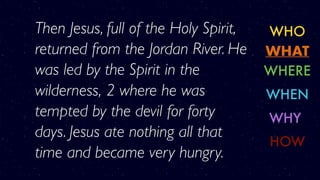
WHAT
WHEN
HOW
WHO
WHERE
WHY
WHAT
WHEN
HOW
Then Jesus, full of the Holy Spirit,
returned from the Jordan River. He
was led by the Spirit in the
wilderness, 2 where he was
tempted by the devil for forty
days. Jesus ate nothing all that
time and became very hungry.
Then Jesus, full of the Holy Spirit,
returned from the Jordan River.
He was led by the Spirit in
the wilderness, 2 where he was
tempted by the devil for
forty days. Jesus ate nothing all
that time and became very
hungry.
WHO
WHERE
WHY
WHAT
WHEN
HOW
WHO
WHERE
WHY
WHAT
WHEN
HOW
Then Jesus, full of the Holy Spirit,
returned from the Jordan River. He
was led by the Spirit in the
wilderness, 2 where he was
tempted by the devil for forty
days. Jesus ate nothing all that
time and became very hungry.
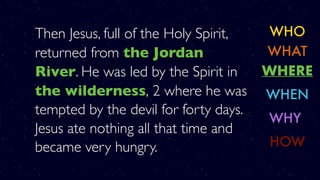
Then Jesus, full of the Holy Spirit,
returned from the Jordan
River. He was led by the Spirit in
the wilderness, 2 where he was
tempted by the devil for forty days.
Jesus ate nothing all that time and
became very hungry.
WHO
WHERE
WHY
WHAT
WHEN
HOW
WHO
WHERE
WHY
WHAT
WHEN
HOW
Then Jesus, full of the Holy Spirit,
returned from the Jordan River. He
was led by the Spirit in the
wilderness, 2 where he was
tempted by the devil for forty
days. Jesus ate nothing all that
time and became very hungry.
Then Jesus, full of the Holy Spirit,
returned from the Jordan River. He
was led by the Spirit in the
wilderness, 2 where he was
tempted by the devil for forty
days. Jesus ate nothing all that
time and became very hungry.
WHO
WHERE
WHY
WHAT
WHEN
HOW
Then Jesus, full of the Holy Spirit,
returned from the Jordan River. He
was led by the Spirit in the
wilderness, 2 where he was
tempted by the devil for forty days.
Jesus ate nothing all that time and
became very hungry.
WHO
WHERE
WHY
WHAT
WHEN
HOW
Then Jesus, full of the Holy Spirit,
returned from the Jordan River. He
was led by the Spirit in the
wilderness, 2 where he was
tempted by the devil for forty days.
Jesus ate nothing all that time and
became very hungry.
WHO
WHERE
WHY
WHAT
WHEN
HOW
Then Jesus, full of the Holy Spirit, returned from the Jordan
River. He was led by the Spirit in the wilderness, 2 where
he was tempted by the devil for forty days. Jesus ate
nothing all that time and became very hungry.
3 Then the devil said to him, “If you are the Son of God,
tell this stone to become a loaf of bread.”
4 But Jesus told him, “No! The Scriptures say, ‘People do
not live by bread alone.’”
•Who
•What
•When
•Where
•Why
•How
3 Then the devil said to him, “If you are the Son of God, tell this
stone to become a loaf of bread.”
4 But Jesus told him, “No! The Scriptures say, ‘People do not live
by bread alone.’”
5 Then the devil took him up and revealed to him all the
kingdoms of the world in a moment of time. 6 “I will give you
the glory of these kingdoms and authority over them,” the devil
said, “because they are mine to give to anyone I please. 7 I will
give it all to you if you will worship me.”
8 Jesus replied, “The Scriptures say, ‘You must worship
the Lord your God and serve only him.’”
9 Then the devil took him to Jerusalem, to the
highest point of the Temple, and said, “If you are
the Son of God, jump off! 10 For the Scriptures say,
‘He will order his angels to protect and guard you.
11  And they will hold you up with their hands

    so you won’t even hurt your foot on a stone.’”
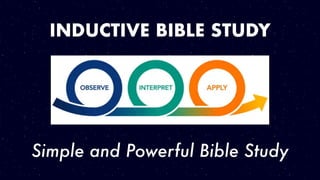
INDUCTIVE BIBLE STUDY
Simple and Powerful Bible Study
OBSERVATION
•What does the passage say?
•What happens?
•Who is involved?
•etc…
•Who
•What
•When
•Where
•Why
•How
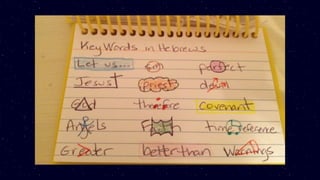
•Mark Important (key) Words.
•Look for Lists.
•Look for Contrasts (differences) and
Comparisons (similar).
•Identify terms of Conclusion.
TAKE A F.O.T.O.
"FOCUS ON THE OBVIOUS
•Looking for the easily observed, facts,
details, events or ideas, people,
places etc.
•Don’t focus on small details, things you don’t
understand or your favourite verses.
•Who is involved?
•What does the passage say?
•What happens?
•When does it happen?
•Where does it happen?
•etc…
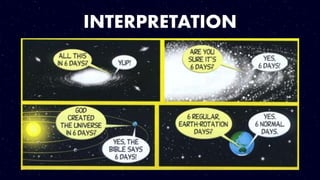
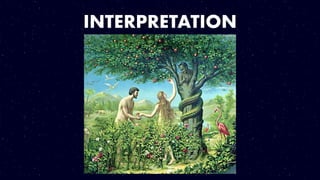
INTERPRETATION
INTERPRETATION
INTERPRETATION
•What does the passage mean?
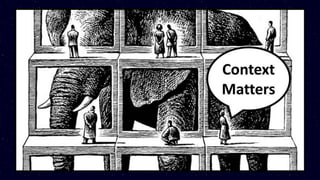
•Context is King—look at what comes
before and after…
•The surrounding verses
•The chapter
•The book in which it is found
•The entire Bible
•Context is King—look at what comes
before and after…
•The surrounding verses
•The chapter
•The book in which it is found
•The entire Bible
•Scripture never contradicts Scripture.
•Don’t base your convictions on a less
well known / understood passage of
Scripture
•Interpret in literary context e.g.
Historical, Prophetic, Poetry etc.
•What was the author’s original meaning?
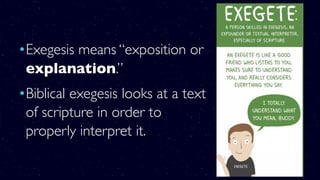
WHAT IS EXEGESIS?
•Exegesis means “exposition or
explanation.”
•Biblical exegesis looks at a text
of scripture in order to
properly interpret it.
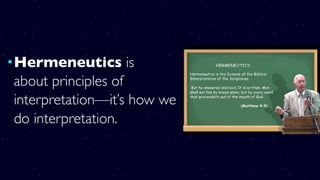
•Hermeneutics is
about principles of
interpretation—it’s how we
do interpretation.
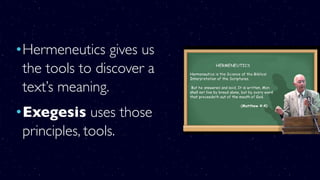
•Hermeneutics gives us
the tools to discover a
text’s meaning.
•Exegesis uses those
principles, tools.
•For example, you receive a
letter from the Government
of India, you read it carefully.
You want to understand
what the government is
saying.
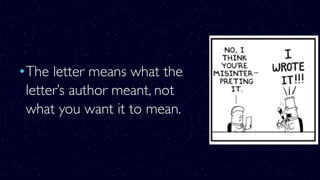
•The letter means what the
letter’s author meant, not
what you want it to mean.
Four Questions for Interpretation—
TGC
What do I learn about God? 
What do I learn about people? 
What do I learn about relating to God? 
What do I learn about relating to others?
APPLICATION
APPLICATION
APPLICATION
•How does the meaning of the
passage apply to me?
•What should I do?
APPLICATION
•Usually the thing we want to know when
we read the Bible!
•Application starts with belief which
then results in being and doing.
•When you know what a
passage means, you should
do it, and are accountable to
God if you don't!
•The goal of personal Bible
study is a transformed
life and a deep
relationship with
Jesus Christ.
2 Timothy 3:16-17 is the key verse:
All Scripture is inspired by God and is useful to
teach us what is true and to make us realize
what is wrong in our lives. It corrects us when we
are wrong and teaches us to do what is
right. God uses it to prepare and equip his
people to do every good work.
•Areas to watch out for:
•Being cultural rather than biblical
•A “cultural Christian” is called
“Christian,” but this is about his family
background and upbringing not
personal faith.
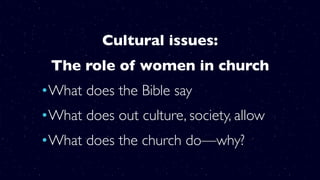
Cultural issues:
The role of women in church
•What does the Bible say
•What does out culture, society, allow
•What does the church do—why?
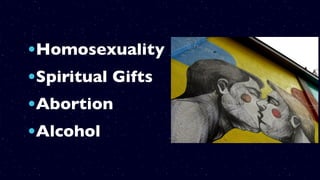
•Homosexuality
•Spiritual Gifts
•Abortion
•Alcohol
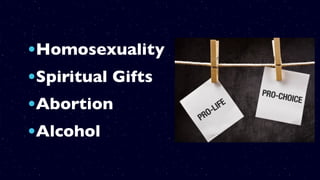
•Homosexuality
•Spiritual Gifts
•Abortion
•Alcohol
•Manipulating Scripture—making it
say what I want it to.
•Philippians 4:13…For I can do everything
through Christ, who gives me strength.
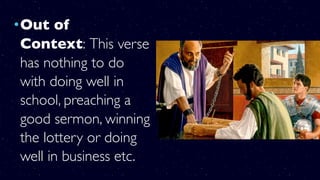
•Out of
Context: This verse
has nothing to do
with doing well in
school, preaching a
good sermon, winning
the lottery or doing
well in business etc.
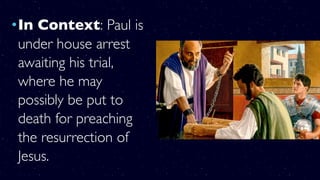
•In Context: Paul is
under house arrest
awaiting his trial,
where he may
possibly be put to
death for preaching
the resurrection of
Jesus.
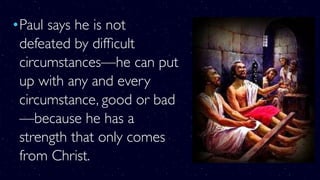
•Paul says he is not
defeated by difficult
circumstances—he can put
up with any and every
circumstance, good or bad
—because he has a
strength that only comes
from Christ.
•Matthew 18:20
•Out of Context— quoted as an
encouragement to one another when
there is poor attendance at a service or
given as a benediction at the end of a
meeting.
•In Context—church discipline and
helping wayward believers.
•Encouraging church leaders that God is
present as a witness during times of
loving confrontation and correction.
•Interpretations based on my existing
thoughts not on the text (prejudice)
•e.g. racial, social, economic, religious grounds
•Parable of the Good Samaritan Lk 10:30ff
•Acts 10:34-35
Some Simple Guiding Questions
•What does this passage actually teach?
•Does this section of Scripture show
error in my beliefs or behaviour?
•What is God’s instruction to me?
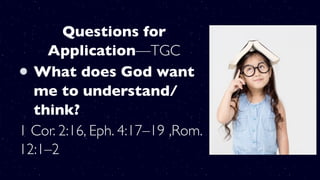
Questions for
Application—TGC
What does God want
me to understand/
think?
1 Cor. 2:16, Eph. 4:17–19 ,Rom.
12:1–2
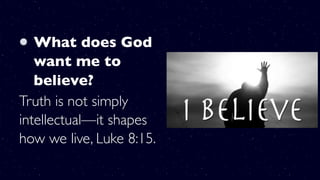
What does God
want me to
believe?
Truth is not simply
intellectual—it shapes
how we live, Luke 8:15.
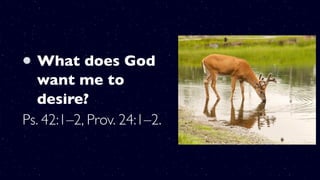
What does God
want me to
desire?
Ps. 42:1–2, Prov. 24:1–2.
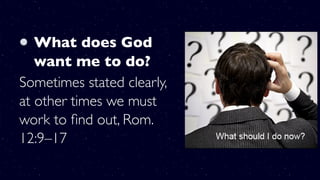
What does God
want me to do?
Sometimes stated clearly,
at other times we must
work to find out, Rom.
12:9–17
Good Observation,
Interpretation and Application
lead to TRANSFORMATION
USING 5 W’S AND
AN H
SOME MORE IDEAS TO
HELP YOU…
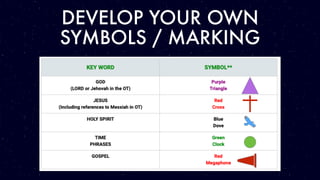
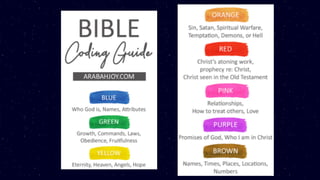
DEVELOP YOUR OWN
SYMBOLS / MARKING
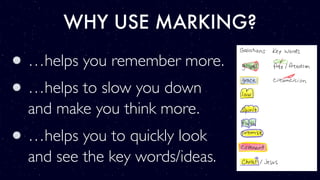
WHY USE MARKING?
…helps you remember more.
…helps to slow you down
and make you think more.
…helps you to quickly look
and see the key words/ideas.
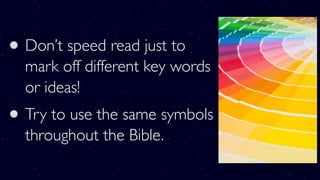
Don’t speed read just to
mark off different key words
or ideas!
Try to use the same symbols
throughout the Bible.
Lamberski and
Dwyer studied color coding
and concluding that color-
coding techniques improved
attention, increased learner
motivation and aided
remembrance.
“It is only when truth is discovered
that it is taken into yourself. When a
man is simply told the truth, it
remains outside him and he can
easily forget it. When he is led to
discover the truth himself it becomes
a part of him and he never forgets.”
William Barclay
Not all questions apply to
every passage you study.
You must decide which
questions are most helpful.
The following section gives a
general idea of how the 5 W’s
and an H can be used.
Use your imagination to think
of more!
WHO…
•…said/did something?
•…are the major characters?
•…are the other people mentioned?
•to whom and about whom is the
author speaking?
•…wrote it?
WHAT…
•HAPPENS, i.e. what are the main events?
•…are the major ideas and teachings?
•…is talked about most?
•…is his reason for saying that?
•…is the reason for the people being
there?
•…elements of culture / background do I
need to understand?
•…do the words / ideas mean?
WHEN
•…did he say or do it? (eg start of
ministry, end, before or after something
happened etc.)
•…will it happen (if a future event)?
•…was it written?
WHERE
•…did it happen?
•…was this said?
•…will it happen?
WHY…
WHY…
•…did he do or say that? (to challenge,
encourage etc.)
•…was this mentioned?
•…was so little/much space devoted to
this particular event or teaching?
•…was this biblical reference mentioned?
•…should they do what is commanded?
•…was there a need for this to be written?
HOW…
HOW…
•…is it done?
•…did it happen?
•…is this truth illustrated?
•…will this affect them (change hearts,
minds, actions etc.)
•…is it told—story, parable,
metaphor, poetry, parable, narrative,
prophecy, history, epistle, didactic,
argument…
•…does the one speaking expect people
to respond?
•…does this passage relate to the previous
passage?  Or to what comes next?
•…have the words changed meaning since
the author wrote them?

Inductive Bible Study—Using 5W's and an H

  • 2.
    HOW TO STUDYTHE BIBLE FOR YOURSELF
  • 3.
    “It is onlywhen truth is discovered that it is taken into yourself. When a man is simply told the truth, it remains outside him and he can easily forget it. When he is led to discover the truth himself it becomes a part of him and he never forgets.” William Barclay
  • 4.
  • 7.
    DO YOU READSCRIPTURE LIKE DR. WATSON OR SHERLOCK HOLMES?
  • 8.
    DO YOU READSCRIPTURE LIKE DR. WATSON OR SHERLOCK HOLMES?
  • 9.
    Holmes:“You see, but youdo not observe.The distinction is clear…you have frequently seen the steps which lead up to this room.” Watson:“Frequently.” Holmes:“How often?” Watson:“…hundreds of times.”
  • 10.
    Holmes:“Then how manyare there?” Watson:“How many? I don’t know.” Holmes:“Quite so! You have not observed. And yet you have seen.That is just my point. Now, I know that there are seventeen steps, because I have both seen and observed” A Scandal in Bohemia”
  • 11.
    OBSERVATION •What does thepassage say? •What happens? •Who is involved? •etc…
  • 12.
  • 13.
    •Who is involved? •Whatdoes the passage say? •What happens? •When does it happen? •Where does it happen? •etc…
  • 14.
    •Mark Important (key)Words. •Look for Lists. •Look for Contrasts (differences) and Comparisons (similar). •Identify terms of Conclusion.
  • 15.
    TAKE A F.O.T.O. "FOCUSON THE OBVIOUS
  • 16.
    •Looking for theeasily observed, facts, details, events or ideas: e.g. people, places, events. •Don’t focus on small details, things you don’t understand or your favourite verses.
  • 17.
    •Don’t look atthe study notes of you Bible •Be Objective—not influenced by personal feelings or opinions in thinking about and telling facts
  • 18.
    OBSERVATION EXERCISE Using thesheet provided read Luke 4:1-13 and mark questions etc. using the 5 W’s and an H.
  • 19.
  • 20.
  • 21.
    LUKE 4:1-13 What comesbefore? Genealogy of Jesus
  • 22.
    LUKE 4:1-13 What comesbefore? Genealogy of Jesus Baptism of Jesus
  • 23.
    LUKE 4:1-13 What comesbefore? Genealogy of Jesus Baptism of Jesus Ministry of JTB
  • 24.
    Then Jesus, fullof the Holy Spirit, returned from the Jordan River. He was led by the Spirit in the wilderness, 2 where he was tempted by the devil for forty days. Jesus ate nothing all that time and became very hungry. 3 Then the devil said to him, “If you are the Son of God, tell this stone to become a loaf of bread.” 4 But Jesus told him, “No! The Scriptures say, ‘People do not live by bread alone.’”
  • 25.
    5 Then the deviltook him up and revealed to him all the kingdoms of the world in a moment of time. 6 “I will give you the glory of these kingdoms and authority over them,” the devil said, “because they are mine to give to anyone I please. 7 I will give it all to you if you will worship me.” 8 Jesus replied, “The Scriptures say, ‘You must worship the Lord your God and serve only him.’”
  • 26.
    9 Then the deviltook him to Jerusalem, to the highest point of the Temple, and said, “If you are the Son of God, jump off! 10 For the Scriptures say, ‘He will order his angels to protect and guard you. 11  And they will hold you up with their hands
     so you won’t even hurt your foot on a stone.’”
  • 27.
    12 Jesus responded, “The Scripturesalso say, ‘You must not test the Lord your God.’” 13 When the devil had finished tempting Jesus, he left him until the next opportunity came. Now Read It AGAIN! …and AGAIN!
  • 28.
    12 Jesus responded, “The Scripturesalso say, ‘You must not test the Lord your God.’” 13 When the devil had finished tempting Jesus, he left him until the next opportunity came.
  • 29.
    12 Jesus responded, “The Scripturesalso say, ‘You must not test the Lord your God.’” 13 When the devil had finished tempting Jesus, he left him until the next opportunity came. Let’s do the first two verses together
  • 30.
    WHO WHERE WHY WHAT WHEN HOW Then Jesus, fullof the Holy Spirit, returned from the Jordan River. He was led by the Spirit in the wilderness, 2 where he was tempted by the devil for forty days. Jesus ate nothing all that time and became very hungry.
  • 31.
    Then Jesus, fullof the Holy Spirit, returned from the Jordan River. He was led by the Spirit in the wilderness, 2 where he was tempted by the devil for forty days. Jesus ate nothing all that time and became very hungry. WHO WHERE WHY WHAT WHEN HOW
  • 32.
    WHO WHERE WHY WHAT WHEN HOW Then Jesus, fullof the Holy Spirit, returned from the Jordan River. He was led by the Spirit in the wilderness, 2 where he was tempted by the devil for forty days. Jesus ate nothing all that time and became very hungry.
  • 33.
    Then Jesus, fullof the Holy Spirit, returned from the Jordan River. He was led by the Spirit in the wilderness, 2 where he was tempted by the devil for forty days. Jesus ate nothing all that time and became very hungry. WHO WHERE WHY WHAT WHEN HOW
  • 34.
    WHO WHERE WHY WHAT WHEN HOW Then Jesus, fullof the Holy Spirit, returned from the Jordan River. He was led by the Spirit in the wilderness, 2 where he was tempted by the devil for forty days. Jesus ate nothing all that time and became very hungry.
  • 35.
    Then Jesus, fullof the Holy Spirit, returned from the Jordan River. He was led by the Spirit in the wilderness, 2 where he was tempted by the devil for forty days. Jesus ate nothing all that time and became very hungry. WHO WHERE WHY WHAT WHEN HOW
  • 36.
    WHO WHERE WHY WHAT WHEN HOW Then Jesus, fullof the Holy Spirit, returned from the Jordan River. He was led by the Spirit in the wilderness, 2 where he was tempted by the devil for forty days. Jesus ate nothing all that time and became very hungry.
  • 37.
    Then Jesus, fullof the Holy Spirit, returned from the Jordan River. He was led by the Spirit in the wilderness, 2 where he was tempted by the devil for forty days. Jesus ate nothing all that time and became very hungry. WHO WHERE WHY WHAT WHEN HOW
  • 38.
    Then Jesus, fullof the Holy Spirit, returned from the Jordan River. He was led by the Spirit in the wilderness, 2 where he was tempted by the devil for forty days. Jesus ate nothing all that time and became very hungry. WHO WHERE WHY WHAT WHEN HOW
  • 39.
    Then Jesus, fullof the Holy Spirit, returned from the Jordan River. He was led by the Spirit in the wilderness, 2 where he was tempted by the devil for forty days. Jesus ate nothing all that time and became very hungry. WHO WHERE WHY WHAT WHEN HOW
  • 40.
    Then Jesus, fullof the Holy Spirit, returned from the Jordan River. He was led by the Spirit in the wilderness, 2 where he was tempted by the devil for forty days. Jesus ate nothing all that time and became very hungry. 3 Then the devil said to him, “If you are the Son of God, tell this stone to become a loaf of bread.” 4 But Jesus told him, “No! The Scriptures say, ‘People do not live by bread alone.’”
  • 41.
  • 42.
    3 Then the devilsaid to him, “If you are the Son of God, tell this stone to become a loaf of bread.” 4 But Jesus told him, “No! The Scriptures say, ‘People do not live by bread alone.’” 5 Then the devil took him up and revealed to him all the kingdoms of the world in a moment of time. 6 “I will give you the glory of these kingdoms and authority over them,” the devil said, “because they are mine to give to anyone I please. 7 I will give it all to you if you will worship me.” 8 Jesus replied, “The Scriptures say, ‘You must worship the Lord your God and serve only him.’”
  • 43.
    9 Then the deviltook him to Jerusalem, to the highest point of the Temple, and said, “If you are the Son of God, jump off! 10 For the Scriptures say, ‘He will order his angels to protect and guard you. 11  And they will hold you up with their hands
     so you won’t even hurt your foot on a stone.’”
  • 44.
    INDUCTIVE BIBLE STUDY Simpleand Powerful Bible Study
  • 45.
    OBSERVATION •What does thepassage say? •What happens? •Who is involved? •etc…
  • 46.
  • 47.
    •Mark Important (key)Words. •Look for Lists. •Look for Contrasts (differences) and Comparisons (similar). •Identify terms of Conclusion.
  • 48.
    TAKE A F.O.T.O. "FOCUSON THE OBVIOUS
  • 49.
    •Looking for theeasily observed, facts, details, events or ideas, people, places etc. •Don’t focus on small details, things you don’t understand or your favourite verses.
  • 50.
    •Who is involved? •Whatdoes the passage say? •What happens? •When does it happen? •Where does it happen? •etc…
  • 51.
  • 52.
  • 53.
  • 56.
    •Context is King—lookat what comes before and after… •The surrounding verses •The chapter •The book in which it is found •The entire Bible
  • 57.
    •Context is King—lookat what comes before and after… •The surrounding verses •The chapter •The book in which it is found •The entire Bible
  • 58.
    •Scripture never contradictsScripture. •Don’t base your convictions on a less well known / understood passage of Scripture
  • 59.
    •Interpret in literarycontext e.g. Historical, Prophetic, Poetry etc. •What was the author’s original meaning?
  • 60.
  • 61.
    •Exegesis means “exposition or explanation.” •Biblicalexegesis looks at a text of scripture in order to properly interpret it.
  • 62.
  • 63.
    •Hermeneutics gives us thetools to discover a text’s meaning. •Exegesis uses those principles, tools.
  • 64.
    •For example, youreceive a letter from the Government of India, you read it carefully. You want to understand what the government is saying.
  • 65.
    •The letter meanswhat the letter’s author meant, not what you want it to mean.
  • 66.
    Four Questions forInterpretation— TGC What do I learn about God?  What do I learn about people?  What do I learn about relating to God?  What do I learn about relating to others?
  • 67.
  • 68.
  • 69.
  • 70.
    •How does themeaning of the passage apply to me? •What should I do? APPLICATION
  • 71.
    •Usually the thingwe want to know when we read the Bible! •Application starts with belief which then results in being and doing.
  • 72.
    •When you knowwhat a passage means, you should do it, and are accountable to God if you don't!
  • 73.
    •The goal ofpersonal Bible study is a transformed life and a deep relationship with Jesus Christ.
  • 74.
    2 Timothy 3:16-17is the key verse: All Scripture is inspired by God and is useful to teach us what is true and to make us realize what is wrong in our lives. It corrects us when we are wrong and teaches us to do what is right. God uses it to prepare and equip his people to do every good work.
  • 75.
    •Areas to watchout for: •Being cultural rather than biblical •A “cultural Christian” is called “Christian,” but this is about his family background and upbringing not personal faith.
  • 76.
    Cultural issues: The roleof women in church •What does the Bible say •What does out culture, society, allow •What does the church do—why?
  • 77.
  • 78.
  • 79.
    •Manipulating Scripture—making it saywhat I want it to. •Philippians 4:13…For I can do everything through Christ, who gives me strength.
  • 80.
    •Out of Context: This verse hasnothing to do with doing well in school, preaching a good sermon, winning the lottery or doing well in business etc.
  • 81.
    •In Context: Paul is underhouse arrest awaiting his trial, where he may possibly be put to death for preaching the resurrection of Jesus.
  • 82.
    •Paul says heis not defeated by difficult circumstances—he can put up with any and every circumstance, good or bad —because he has a strength that only comes from Christ.
  • 83.
    •Matthew 18:20 •Out ofContext— quoted as an encouragement to one another when there is poor attendance at a service or given as a benediction at the end of a meeting.
  • 84.
    •In Context—church disciplineand helping wayward believers. •Encouraging church leaders that God is present as a witness during times of loving confrontation and correction.
  • 85.
    •Interpretations based onmy existing thoughts not on the text (prejudice) •e.g. racial, social, economic, religious grounds •Parable of the Good Samaritan Lk 10:30ff •Acts 10:34-35
  • 86.
    Some Simple GuidingQuestions •What does this passage actually teach? •Does this section of Scripture show error in my beliefs or behaviour? •What is God’s instruction to me?
  • 87.
    Questions for Application—TGC What doesGod want me to understand/ think? 1 Cor. 2:16, Eph. 4:17–19 ,Rom. 12:1–2
  • 88.
    What does God wantme to believe? Truth is not simply intellectual—it shapes how we live, Luke 8:15.
  • 89.
    What does God wantme to desire? Ps. 42:1–2, Prov. 24:1–2.
  • 90.
    What does God wantme to do? Sometimes stated clearly, at other times we must work to find out, Rom. 12:9–17
  • 91.
    Good Observation, Interpretation andApplication lead to TRANSFORMATION
  • 92.
    USING 5 W’SAND AN H
  • 93.
    SOME MORE IDEASTO HELP YOU…
  • 94.
  • 97.
    WHY USE MARKING? …helpsyou remember more. …helps to slow you down and make you think more. …helps you to quickly look and see the key words/ideas.
  • 98.
    Don’t speed readjust to mark off different key words or ideas! Try to use the same symbols throughout the Bible.
  • 99.
    Lamberski and Dwyer studied colorcoding and concluding that color- coding techniques improved attention, increased learner motivation and aided remembrance.
  • 100.
    “It is onlywhen truth is discovered that it is taken into yourself. When a man is simply told the truth, it remains outside him and he can easily forget it. When he is led to discover the truth himself it becomes a part of him and he never forgets.” William Barclay
  • 101.
    Not all questionsapply to every passage you study. You must decide which questions are most helpful.
  • 102.
    The following sectiongives a general idea of how the 5 W’s and an H can be used. Use your imagination to think of more!
  • 103.
    WHO… •…said/did something? •…are themajor characters? •…are the other people mentioned?
  • 104.
    •to whom andabout whom is the author speaking? •…wrote it?
  • 105.
    WHAT… •HAPPENS, i.e. whatare the main events? •…are the major ideas and teachings? •…is talked about most? •…is his reason for saying that?
  • 106.
    •…is the reasonfor the people being there? •…elements of culture / background do I need to understand? •…do the words / ideas mean?
  • 107.
    WHEN •…did he sayor do it? (eg start of ministry, end, before or after something happened etc.) •…will it happen (if a future event)? •…was it written?
  • 108.
    WHERE •…did it happen? •…wasthis said? •…will it happen?
  • 109.
  • 110.
    WHY… •…did he door say that? (to challenge, encourage etc.) •…was this mentioned? •…was so little/much space devoted to this particular event or teaching?
  • 112.
    •…was this biblicalreference mentioned? •…should they do what is commanded? •…was there a need for this to be written?
  • 113.
  • 114.
    HOW… •…is it done? •…didit happen? •…is this truth illustrated? •…will this affect them (change hearts, minds, actions etc.)
  • 116.
    •…is it told—story,parable, metaphor, poetry, parable, narrative, prophecy, history, epistle, didactic, argument… •…does the one speaking expect people to respond?
  • 118.
    •…does this passagerelate to the previous passage?  Or to what comes next? •…have the words changed meaning since the author wrote them?