Cover Crop Chart
V 3.0 February 2018
-------------------------------------------COOL------------------------------------------- ------------------------- WARM-------------------------
--GRASS-- -----------------------------------------------------BROADLEAF----------------------------------------------------- --GRASS--
ANNUAL
FESCUE
BROWNTOP
MILLET
BARLEY
------------------------------- LEGUME -------------------------------
AMARANTH
FOXTAIL
MILLET
OAT CAMELINA MUSTARD
BALANSA
CLOVER
CHICKPEA MEDIC COWPEA
CLUSTER
BEAN
BUCKWHEAT
PEARL
MILLET
SPELT PHACELIA CANOLA
BERSEEM
CLOVER
PEA LUPIN LABLAB
JACK
BEAN
QUINOA
PROSO
MILLET
WHEAT FLAX RADISH
CRIMSON
CLOVER
LENTIL
FABA
BEAN
FENUGREEK
VELVET
BEAN
CHICORY
GRAIN
SORGHUM
CEREAL
RYE
KALE TURNIP
RED
CLOVER
LESPEDEZA
SWEET
CLOVER
PIGEONPEA
MUNG
BEAN
CUCURBITA
SUDAN
GRASS
TRITICALE SPINACH BEET
WHITE
CLOVER
BIRDSFOOT
TREFOIL
ALFALFA
PARTRIDGE
PEA
SOYBEAN SAFFLOWER TEFF
SALINE
TOLERANT
CHARD CARROT
KURA
CLOVER
VETCH SAINFOIN SUNNHEMP PEANUT SUNFLOWER CORN
Additional Information














GROWTH CYCLE
A = Annual
B = Biennial
P = Perennial
PLANT ARCHITECTURE
= Upright
= Upright-Spreading
= Prostrate
RELATIVE WATER USE
= Low
= Medium
= High



























  








A/B
A
A/B
A
A
A
A
A
A
A
A
P
A
A
B
A/P
A
A/B
A/B
B
A/B
P
A/P
A
A
P
A
A/P
A/B
A
A
P
P
B/P
A
A
A
P
A
A
A/P
A/P
A/P
A
A
A
A
A/P
A/P
A
A
A
A
P
A
A
A
A
A
A
A
A
A
A
A




 
 





 





 
Cover Crop Chart
• Useful cover crop resources:
– Managing Cover Crops Profitably, 3rd Ed. Andy Clark (Ed.). Handbook Series Book 9, Sustainable Agriculture Network,
Beltsville, MD.
– Midwest Cover Crops Council, www.mccc.msu.edu
– Sustainable Agriculture Research and Education Program, University of California-Davis, www.sarep.ucdavis.edu
– USDA-NRCS, PLANTS Database, www.plants.usda.gov
Persons with disabilities who require alternative means for communication of program
information (Braille, large print, audiotape, etc.) should contact USDA's TARGET Center at 202-
720-2600 (voice and TDD). The United States Department of Agriculture prohibits
discrimination in all its programs and activities on the basis of race, color, national origin,
gender, religion, age, disability, political beliefs, sexual orientation, and marital and family
status. To file a complaint of discrimination, write USDA, Director, Office of Civil Rights, Room
326-W, Whitten Building, 14th and Independence, S.W., Washington, DC 20250-9410 or call
202-720-5964 (voice or TDD). USDA is an equal opportunity provider and employer. Mention
of trade or manufacturer names is provided for information only and does not constitute
endorsement by USDA-ARS.
The Cover Crop Chart represents a compendium of information from multiple sources. Primary sources of information included the
Midwest Cover Crops Council, USDA-SARE, USDA-NRCS PLANTS database, and relevant peer-reviewed journal articles. Designation of
warm/cool season crops is based on prevalent growth habits and not photosynthetic pathway. Ranges for seeding depth take into
consideration moisture conditions at planting and variation in soil texture. Values for crude protein and C:N ratio assume homogenous
samples of aboveground plant material unless stated otherwise. Information on specific crops is occasionally generalized, approximate,
and/or incomplete and may not reflect performance in on-farm conditions. USDA-ARS makes no guarantee to the performance of
specific crops based on information provided herein. Content and data for crops were assembled by Holly Johnson and Mark Liebig
with input from Dave Archer, V.C. Baligar, Heather Dose, Wayne Duckwitz, Marvin Hatzenbuhler, John Hendrickson, Naeem Kalwar,
Robert Kolberg, Nancy Jensen, Steve Merrill, Kristine Nichols, Delmer Schlenker, Marty Schmer, Eric Scholljegerdes, Don Tanaka, Cal
Thorson, and Dawn Wetch. Chart design by Mark Liebig, Holly Johnson, and Jill Gunderson. The Cover Crop Chart was originally
generated with input from producers and technicians in the Area IV Soil Conservation Districts of North Dakota and NRCS staff at the
Bismarck and Dickinson Field/Area Offices.
The Cover Crop Chart is produced and distributed by the staff of the Northern Great Plains Research Laboratory at Mandan, ND.
txtcvr
For further information please contact:
Cover Crop Chart
USDA-ARS Northern Great Plains Research Laboratory
P.O.Box 459 Mandan, ND 58554-0459
Voice: 701 667-3079 FAX: 701 667-3054
https://www.ars.usda.gov/plains-area/mandan-nd/ngprl/
 Back to Cover Crop Chart
Crop Sequence Effects
CROP RESIDUE - - - - - - - HIGH RISK CROPS (Crops with the worst performance following a particular residue) - - - - - - -
Barley Barley
Wheat Wheat
Canola Canola Mustard Pea Dry Bean Flax Safflower
Mustard Soybean Sunflower
Flax Flax
Pea Pea Flax
Lentil Lentil
Chickpea Buckwheat Lentil
Soybean Canola Wheat Barley
Buckwheat Chickpea Sunflower Grain Sorghum Sunflower
Safflower Safflower Sunflower Soybean Mustard Dry Bean
Sunflower Sunflower Canola Pea Lentil Buckwheat Grain Sorghum Corn Wheat Barley
Proso Millet Proso Millet Grain Sorghum Buckwheat
Grain Sorghum Grain Sorghum Proso Millet Pea Lenti Wheat
Corn Corn Wheat Buckwheat Grain Sorghum Proso Millet
Table adapted from Crop Sequence Calculator (v. 3.1).
Software available for download at https://www.ars.usda.gov/plains-area/mandan-nd/ngprl/
 Back to Cover Crop Chart
Annual fescue
(Vulpia myuros L.; Fetuca sp.)
• Cool Season, grass
• Annual
• Upright plant architecture
• Alternate names: Rattail fescue, Foxtail fescue
• Low water use
• Poor salinity tolerance
• Seeding depth: ¼ – 1 inch
• Crude protein: hay 8-10%
• Benefits from arbuscular mycorrhizal associations
Cool Season Grass
Photo by Bob Bugg, www.sarep.ucdavis.edu/
database/ covercrops
www.sarep.ucdavis.edu/
database/covercrops
 Back to Cover Crop Chart
Barley
(Hordeum vulgare L.)
• Cool Season, grass
• Annual
• Upright plant architecture
• Low water use
• Good salinity tolerance
• Seeding depth: ¾ – 2 inches
• Crude protein: hay 10-15%, grain 11-15%
• C:N ratio: 20
• Benefits from arbuscular mycorrhizal associations
• Self pollinator (wind)
• Rated ‘very good’ at scavenging nitrogen
from the soil
 View table for known crop sequence effects
USDA-ARS, NGPRL
Cool Season Grass
Photo by Bob Bugg,
www.sarep.ucdavis.edu/database/covercrops
 Back to Cover Crop Chart
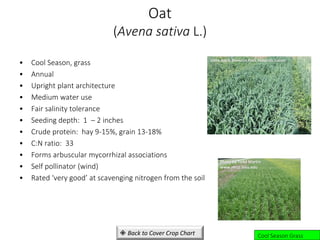
Oat
(Avena sativa L.)
• Cool Season, grass
• Annual
• Upright plant architecture
• Medium water use
• Fair salinity tolerance
• Seeding depth: 1 – 2 inches
• Crude protein: hay 9-15%, grain 13-18%
• C:N ratio: 33
• Forms arbuscular mycorrhizal associations
• Self pollinator (wind)
• Rated ‘very good’ at scavenging nitrogen from the soil
USDA-NRCS, Bismarck Plant Materials Center
Photo by Todd Martin
www.mccc.msu.edu
Cool Season Grass
 Back to Cover Crop Chart
Spelt
(Triticum spelta L.; Triticum aestivum var. spelta(L.) L.H. Bailey)
• Cool season, grass
• Annual
• Upright plant architecture
• Good to fair salinity tolerance
• Seeding depth: ½ – 1 ½ inches
• Crude protein: overall 11-14%, grain 13-16%
• Forms arbuscular mycorrhizal associations
• Self pollinator (wind)
• An efficient available nitrogen accumulator among cool
season grasses
• Spelt is an older cereal grain and is more prone to
lodging than wheat
Cool Season Grass
 Back to Cover Crop Chart
https:commons.Wikimedia.org
Photo by Åsmund Langeland
https:commons.Wikimedia.org
Wheat
(Triticum aestivum L.)
• Cool season, grass
• Annual
• Upright plant architecture
• Includes spring and winter wheat varieties
• Medium water use
• Good to fair salinity tolerance
• Seeding depth: ½ – 1 ½ inches
• Crude protein: straw 4-10%, grain 12-16%
• C:N ratio: leaf 15-29, stem 31-65, root 24-74 , straw
80-95 [end of season]
• Benefits from arbuscular mycorrhizal associations
• Self pollinator (wind)
• Rated ‘very good’ at scavenging nitrogen from the soil
 View table for known crop sequence effects
USDA-NRCS, PLANTS Database
USDA-ARS, NGPRL
Cool Season Grass
 Back to Cover Crop Chart
Photo: Practical Farmers of Iowa
Cereal rye
(Secale cereale L.)
• Cool Season, grass
• Annual
• Upright plant architecture
• High water use
• Good salinity tolerance
• Seeding depth: ¼ – 2 inches
• Crude protein: straw 4%, grain 14%
• C:N ratio: 40 – 50*
* This number can vary based on whether the plant was
grown in monoculture or a biculture and the stage the
plant was in when it was tested
• Forms arbuscular mycorrhizal associations
• Self pollinator (wind)
• Rated ‘very good’ at scavenging nitrogen from
the soil
Photo: Practical Farmers of Iowa
www.mccc.msu.edu
Photo: Practical Farmers of Iowa
www.mccc.msu.edu
Photo by Dale R. Mutch
www.mccc.msu.edu
Cool Season Grass
 Back to Cover Crop Chart
Triticale
(Triticale hexaploide Lart.;Triticosecale rimpaui Wittm.)
• Cool Season, grass
• Annual
• Upright plant architecture
• Fall and spring types available
• High water use
• Good salinity tolerance
• Seeding depth: 1 ½ – 2 inches
• Crude protein: hay 9-16%, grain 17%
• C:N ratio: 20
• Forms arbuscular mycorrhizal associations
• Self pollinator (wind)
Cool Season Grass
 Back to Cover Crop Chart
Photo by Matt Liebman, Iowa State
University www.mccc.msu.edu
Photo by Ken Miller, Rancher
Huff North Dakota
Saline Tolerant Grasses
• Cool Season, grass
• Perennial
• Upright plant architecture
• Low to moderate water use
• Moderate to high salinity tolerance
• Seeding depth: ¼ – 1 inch
• Crude Protein: 7 – 19%
• Forms arbuscular mycorrhizal associations
• Many species are available in this category;
each varies slightly in plant characteristics
See the next six slides for more detail
Cool Season Grass
Saline Tolerant
 Back to Cover Crop Chart
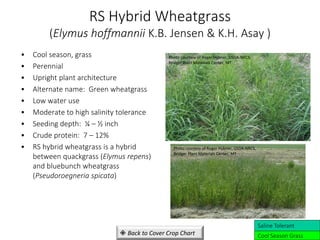
RS Hybrid Wheatgrass
(Elymus hoffmannii K.B. Jensen & K.H. Asay )
• Cool season, grass
• Perennial
• Upright plant architecture
• Alternate name: Green wheatgrass
• Low water use
• Moderate to high salinity tolerance
• Seeding depth: ¼ – ½ inch
• Crude protein: 7 – 12%
• RS hybrid wheatgrass is a hybrid
between quackgrass (Elymus repens)
and bluebunch wheatgrass
(Pseudoroegneria spicata)
Cool Season Grass
Saline Tolerant
 Back to Cover Crop Chart
Photo courtesy of Roger Hybner, USDA-NRCS,
Bridger Plant Materials Center, MT
Photo courtesy of Roger Hybner, USDA-NRCS,
Bridger Plant Materials Center, MT
Tall Wheatgrass
(Thinopyrum ponticum (Podp.))
• Cool season, grass
• Perennial (introduced)
• Upright plant architecture
• Alternate name: Rush wheatgrass
• Moderate water use
• Excellent salinity tolerance
• Seeding depth: ¼ – 1 inch
*shallower for finer textured soils
• Crude protein: 7 – 19%
– vegetative >10%
– late bloom 6%
– fully mature 2-3%
Cool Season Grass
Saline Tolerant
Photo by R.L. Hamblen, www.Bugwood.org
 Back to Cover Crop Chart
Intermediate Wheatgrass
(Thinopyrum intermedium (Host) Barkworth & D.R. Dewey)
• Cool season, grass
• Perennial (introduced)
• Upright plant architecture
• Alternate name: Pubescent wheatgrass
• Low to moderate water use; drought tolerant
• Good salinity tolerance
• Seeding depth: ½ – 1 inch
• Crude protein: 8 – 17%*
*Northern Plains: may fall below 4% at the end of
the season
• Cross-pollinates.
• Spreads vegetatively; under ideal conditions, it
can slowly spread into adjacent communities
• Persistence of stand is limited (typically < 5 yr)
Cool Season Grass
Saline Tolerant
Photo by Howard F. Schwartz,
Colorado State University, www.Bugwood.org
Photo by Howard F. Schwartz
Colorado State University,
www.Bugwood.org
 Back to Cover Crop Chart
Slender Wheatgrass
(Elymus trachycaulus (Link) Gould ex Shinners)
• Cool season, grass
• Perennial, short-lived (native)
• Upright plant architecture
• Low water use; will not tolerate water-logged soils
• Good salinity tolerance
• Seeding depth: ¼ – ¾ inch
• Crude protein: 22 – 25% (Spring); less than 10% (fall)
• May form arbuscular mycorrhizal associations
Cool Season Grass
Saline Tolerant
Photo by Dave Powell,
USDA Forest Service,
www.Bugwood.org
 Back to Cover Crop Chart
Russian Wildrye
(Psathyrostachys junceus (Fisch.) Nevski)
• Cool season, grass
• Perennial (introduced)
• Upright plant architecture
• Low water use
– drought tolerant
– does not tolerate flooding
• Good salinity tolerance
• Seeding depth: ¼ – ½ inch
– Sensitive to seeding depth – too deep will
inhibit seed germination
• Crude protein: 5 – 17 %
• Difficult to establish
Cool Season Grass
Saline Tolerant
Photo by Larry Holzworth
USDA-ARS, NRCS Idaho Plant Materials Program and
USDA-ARS, Forage and Range Research Laboratory
 Back to Cover Crop Chart
Alkaligrass
(Puccinellia sp. Parl.)
• Cool season, grass
• Perennial
• Upright plant architecture
• Nuttall’s alkaligrass, Puccinellia nuttalliana [Schult.] Hitch.
– Native to semi-arid, North American zones
• Weeping alkaligrass, Puccinellia distans [Jacq.] Parl.
– Introduced [Eurasia]
– Highest salinity tolerance of this genus
• Low to moderate water use
– Can survive arid areas as well as marsh, basin,
or wetland zones
• Excellent salinity tolerance
• Seeding depth: ¼ - ½ inch
• This slide completes the review of saline tolerant grasses
Cool Season Grass
Saline Tolerant
Photo by Howard F. Schwartz,
Colorado State University,
www.Bugwood.org
 Back to Cover Crop Chart
Camelina
(Camelina sativa (L.) Crantz)
• Cool Season, broadleaf
• Annual, Biennial
• Upright plant architecture
• Alternate names: False flax, gold-of-pleasure, linseed
dodder, largeseed falseflax, leindotter, Siberian oilseed
• Low water use
• Fair salinity tolerance
• Seeding depth: ⅛ – ¼ inch
• Crude Protein: 46%
• C:N Ratio: stems 40-95; pods 25-70; seed 12-16
• Does not form arbuscular mycorrhizal associations
• Mainly a self pollinator but benefits genetically from
exposure to high population of pollinators
• Sensitive to soil herbicide imidazolinones and
sulfentrazone
• Volunteer plants can become problematic
• Potentially allelopathic for flax
Cool Season Broadleaf
 Back to Cover Crop Chart
Photo by Robert Evans, ARS
USDA-ARS, NGPRL
USDA-ARS, NGPRL
Phacelia
(Phacelia tanacetifolia Benth.)
• Cool Season, broadleaf
• Annual
• Upright plant architecture
• Low water use
• Low salinity tolerance
• Seeding depth: ⅛ – ¼ inch
• C:N ratio: 10 – 15
• Forms arbuscular mycorrhizal associations
• Attracts beneficial insects
USDA-NRCS,
Bismarck Plant Materials Center
Cool Season Broadleaf
USDA-NRCS,
Bismarck Plant Materials Center
USDA-NRCS,
Bismarck Plant Materials Center
 Back to Cover Crop Chart
Flax
(Linum usitatissimum L. )
• Cool Season, broadleaf
• Annual
• Upright plant architecture
• Medium water use
• Fair salinity tolerance
• Seeding depth: ½ – 1 ½ inch
• Benefits from arbuscular mycorrhizal
associations
• Flowers attract pollinators
USDA-ARS, NGPRL
Cool Season Broadleaf
Howard F. Schwartz
Colorado State University, www.Bugwood.org
 Back to Cover Crop Chart
Kale
(Brassica napus L. var. pabularia)
• Cool Season, broadleaf
• Annual
• Alternate names: also found under
Brassica oleracea – Acephala group
• Upright and spreading plant architecture
• Major types:
– Siberian
– Russian
• Medium water use
• Fair salinity tolerance
• Seeding depth: ¼ – ½ inch
• Crude protein: ≈30%
• C:N ratio: 10 – 30
• Does not form arbuscular mycorrhizal associations
Photo by Rasbak
Wikimedia.com
Cool Season Broadleaf
 Back to Cover Crop Chart
Spinach
(Spinacia oleracea L.)
• Cool Season, broadleaf
• Annual
• Upright and spreading plant architecture
• Low to medium water use
• Poor salinity tolerance
• Seeding depth: ¼ – ½ inch
• Crude protein: ≈20%
• C:N ratio: 6 – 8
• Sensitive to acid soils
• Does not form arbuscular mycorrhizal
associations
Cool Season Broadleaf
Photo by Gerald Holmes
California Polytechnic State University, San Luis Obispo
www.Bugwood.org
Photo by R.A. Howard. ©Smithsonian Institution
 Back to Cover Crop Chart
Chard
(Beta vulgaris L. ssp. cicla (L.) W.D.J. Koch)
• Cool season, broadleaf
• Annual, Biennial
• Upright spreading plant architecture
• Alternate names: Swiss chard, silverbeet, perpetual
spinach, spinach beet, crab beet, bright lights, seakale
beet, and mangold
• High water use
• Poor salinity tolerance
• Seeding depth: ½ - 1 inch
• Crude Protein: 32%
• Does not form arbuscular mycorrhizal associations
• Self pollinator (wind)
Cool Season Broadleaf
Photo by Joseph LaForest
University of Georgia,
www.Bugwood.org
Photo by Joseph LaForest, University of Georgia,
www.Bugwood.org
 Back to Cover Crop Chart
Mustard
(Brassica sp. L.)
• Cool Season, broadleaf
• Annual,Perennial
• Upright and spreading plant architecture
• Major types: Indian, Oriental, brown, yellow
• Related to crambe
• Low water use
• Poor salinity tolerance
• Seeding depth: ¼ – ½ inch
• Crude protein: hay 10%, grain 24-35%
• C:N ratio: 10 – 30
• Does not form arbuscular mycorrhizal associations
• Rated ‘good’ at scavenging nitrogen from the soil
• Plants from the Brassica group have potential to release compounds or
metabolic by-products that work as bio-toxins against bacteria, fungi, insects,
nematodes, and weeds
• Flowers may attract pollinators
 View table for known crop sequence effects
USDA-NRCS,
Bismarck Plant Materials Center
Brown Mustard
Photo by John Hilty (Urbana, IL)
www.mccc.msu.edu
Cool Season Broadleaf
Photo by John Hilty (Urbana, IL)
www.mccc.msu.edu
John Hilty (Urbana, IL)
www.mccc.msu.edu
 Back to Cover Crop Chart
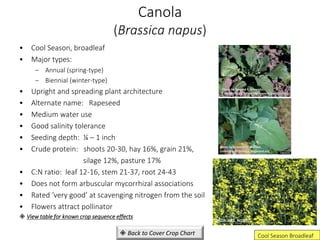
Canola
(Brassica napus)
• Cool Season, broadleaf
• Major types:
– Annual (spring-type)
– Biennial (winter-type)
• Upright and spreading plant architecture
• Alternate name: Rapeseed
• Medium water use
• Good salinity tolerance
• Seeding depth: ¼ – 1 inch
• Crude protein: shoots 20-30, hay 16%, grain 21%,
silage 12%, pasture 17%
• C:N ratio: leaf 12-16, stem 21-37, root 24-43
• Does not form arbuscular mycorrhizal associations
• Rated ‘very good’ at scavenging nitrogen from the soil
• Flowers attract pollinator
 View table for known crop sequence effects
USDA-ARS, NGPRL
Cool Season Broadleaf
Photo by Howard F. Schwartz,
Colorado State University, www.Bugwood.org
Photo by Rebekah D. Wallace
University of Georgia, Bugwood.org
 Back to Cover Crop Chart
Radish
(Raphanus sativus)
• Cool Season, broadleaf
• Annual
• Upright and spreading plant architecture
• Root crop
• Major types:
– Oilseed (var. oleiformis )
– Forage (var. niger): Daikon
• High water use
• Poor salinity tolerance
• Seeding depth: ¼ – ½ inch
• Crude protein: 26-30%
• C:N ratio: oilseed 19 – 20
• Does not form arbuscular mycorrhizal associations
• Rated ‘very good’ at scavenging nitrogen from the soil
• Flowers attract pollinators
USDA-NRCS,
Bismarck Plant Materials Center
FLOWER
USDA-NRCS,
Bismarck Plant Materials Center
Cool Season Broadleaf
University of Maryland Extension,
Fact Sheet 824
Oilseed Radish Forage Radish
 Back to Cover Crop Chart
Turnip
(Brassica rapa L. var. rapa)
• Cool Season, broadleaf
• Biennial
• Upright and spreading plant architecture
• Root crop
• High water use
• Poor salinity tolerance
• Seeding depth: ¼ – ½ inch
• Crude protein: tops 16%, root 12 – 14%
• C:N ratio: shoots 20 – 30, root 10 – 20
• Closely related to rutabaga
• Does not form arbuscular mycorrhizal associations
• Rated ‘good’ at scavenging nitrogen from the soil
• Flowers attract pollinators
USDA-NRCS,
Bismarck Plant Materials Center
Cool Season Broadleaf
GRAZED PURPLE TOP TUNIP
USDA-ARS, NGPRL
GRAZED PURPLE TOP TUNIP
USDA-ARS, NGPRL
USDA-NRCS,
BISMARCK PMC
 Back to Cover Crop Chart
• Cool Season, broadleaf
• Biennial
• Upright and spreading plant architecture
• Root crop
• High water use
• Variable salinity tolerance, depending on beet
type
• Seeding depth: ½ - ¾ inch
• Crude protein: tops 12-15%, root 7-10%
• C:N ratio: tops 11 – 14
• Does not form arbuscular mycorrhizal
associations
• Rated ‘good’ at scavenging nitrogen from the soil
• Self pollinator (wind)
• Multiple sub-species including garden beets and
sugar beets
Beet
(Beta vulgaris)
Cool Season Broadleaf
Photo by Howard F. Schwartz
Colorado State University,
www.Bugwood.org
Photo by Howard F. Schwartz
Colorado State University,
www.Bugwood.org
Photo by Howard F. Schwartz
Colorado State University,
www.Bugwood.org
Photo by Gerald Holmes
California Polytechnic State University at San Luis Obispo,
Bugwood.org
 Back to Cover Crop Chart
Carrot
(Daucus carota var. sativus L.)
• Cool Season, broadleaf
• Major types:
– Biennial (cultivated)
– Annual (wild)
• Upright and spreading plant architecture
• Root crop
• High water use
• Seeding depth: ⅛ - ¼ inch
• Crude protein: 10%
• Forms arbuscular mycorrhizal associations
• Plants may bolt and flower starting in second year
of growth
• Flowers may attract pollinators
Cool Season Broadleaf
Photo by Howard F. Schwartz
Colorado State University, www.Bugwood.org
Photo by Howard F. Schwartz
Colorado State University, www.Bugwood.org
 Back to Cover Crop Chart
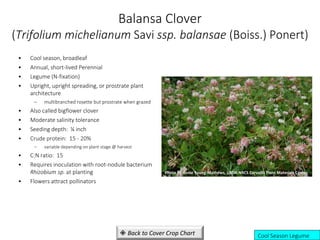
Balansa Clover
(Trifolium michelianum Savi ssp. balansae (Boiss.) Ponert)
• Cool season, broadleaf
• Annual, short-lived Perennial
• Legume (N-fixation)
• Upright, upright spreading, or prostrate plant
architecture
– multibranched rosette but prostrate when grazed
• Also called bigflower clover
• Moderate salinity tolerance
• Seeding depth: ¼ inch
• Crude protein: 15 - 20%
– variable depending on plant stage @ harvest
• C:N ratio: 15
• Requires inoculation with root-nodule bacterium
Rhizobium sp. at planting
• Flowers attract pollinators
Cool Season Legume
 Back to Cover Crop Chart
Photo by Annie Young-Mathews, USDA-NRCS Corvallis Plant Materials Center
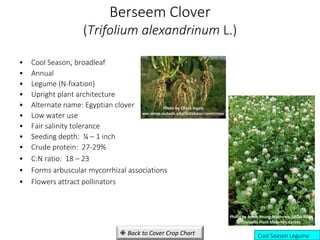
Berseem Clover
(Trifolium alexandrinum L.)
• Cool Season, broadleaf
• Annual
• Legume (N-fixation)
• Upright plant architecture
• Alternate name: Egyptian clover
• Low water use
• Fair salinity tolerance
• Seeding depth: ¼ – 1 inch
• Crude protein: 27-29%
• C:N ratio: 18 – 23
• Forms arbuscular mycorrhizal associations
• Flowers attract pollinators
Cool Season Legume
Photo by Chuck Ingels
ww.sarep.ucdavis.edu/database/covercrops
 Back to Cover Crop Chart
Photo by Annie Young-Mathews, USDA-NRCS
Corvallis Plant Materials Center
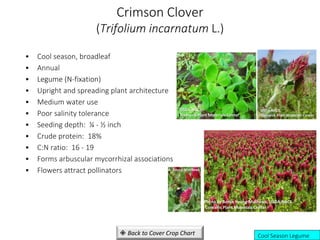
Crimson Clover
(Trifolium incarnatum L.)
• Cool season, broadleaf
• Annual
• Legume (N-fixation)
• Upright and spreading plant architecture
• Medium water use
• Poor salinity tolerance
• Seeding depth: ¼ - ½ inch
• Crude protein: 18%
• C:N ratio: 16 - 19
• Forms arbuscular mycorrhizal associations
• Flowers attract pollinators
Cool Season Legume
USDA-NRCS,
Bismarck Plant Materials Center
USDA-NRCS,
Bismarck Plant Materials Center
 Back to Cover Crop Chart
Photo by Annie Young-Mathews, USDA-NRCS
Corvallis Plant Materials Center
A. Young-Mathews
Photo by Jeremy Singer
www.mccc.msu.edu
Red Clover
(Trifolium pratense L.)
• Cool Season, broadleaf
• Biennial, short-lived Perennial
• Legume (N-fixation)
• Upright plant architecture
• Two types:
– medium, perennial or biennial; (2-3 cuts per season)
– mammoth (1 cut per season)
• Medium water use
• Poor salinity tolerance
• Seeding depth: ¼ – ½ inch
• Crude protein: 15%
• C:N ratio: 15 – 23
• Forms arbuscular mycorrhizal associations
• Flowers attract pollinators
Photo by Todd Martin (MSU-KBS)
www.mccc.msu.edu
Photo by John Wright (Mississauga )
www.mccc.msu.edu
Cool Season Legume
 Back to Cover Crop Chart
White Clover
(Trifolium repens L.)
• Cool Season, broadleaf
• Perennial
• Legume (N-fixation)
• Upright and spreading or prostrate plant architecture
• 3 Types grouped by size:
1. Large: tallest of the white clovers, upright architecture, high
forage quality but less durable [var. Ladino]
2. Intermediate: most common white clover, flowers earlier, and has
a higher heat tolerance, upright architecture [var. Dutch white,
New Zealand White]
3. Small: lowest growing type, prostrate; survives grazing [var. Wild
White]
• Medium water use
• Poor salinity tolerance
• Seeding depth: ¼ inch
• Crude protein: 24 – 30%
• C:N ratio: 13 – 23
• Forms arbuscular mycorrhizal associations
• Flowers attract pollinators
• Aggressive growth in some regions or habitats; may displace
desirable vegetation if not properly managed
Photo by Don Mutch
www.mccc.msu.edu
Cool Season Legume
www.mccc.msu.edu
www.mccc.msu.edu
Photo by Chris Evans
Illinois Wildlife Action Plan, Bugwood.org
 Back to Cover Crop Chart
www.mccc.msu.edu
Kura Clover
(Trifolium ambiguum M. Bieb.)
• Cool season, broadleaf
• Perennial
• Legume (N-fixation)
• Prostrate plant architecture
• Also called Caucasian, honey, and pellet clover
• Moderate water use
• Poor salinity tolerance
• Seeding depth: ¼ – ½ inch
• Crude protein: 23 – 25%
• Forms arbuscular mycorrhizal association
• Flowers attract pollinators
Cool Season Legume
 Back to Cover Crop Chart
Chickpea
(Cicer arietinum L.)
• Cool Season, broadleaf
• Annual
• Legume (N-fixation)
• Two types
– Desi
– Kabuli
• Upright and spreading plant architecture
• Alternate name: garbanzo bean
• Low water use
• Poor salinity tolerance
• Seeding depth: 1 ½ – 2 inches
• Crude protein: straw 6%, grain 22%
• C:N ratio: leaf 10-15, stem 26-56, root 16-27
• Forms arbuscular mycorrhizal associations
• Flowers attract pollinators
 View table for known crop sequence effects
Photo by Howard F. Schwartz, Colorado State University,
www.Bugwood.org
Photo by Howard F. Schwartz, Colorado State University,
www.Bugwood.org
 Back to Cover Crop Chart Cool Season Legume
Pea
(Pisum satuvum arvense L.)
• Cool Season, broadleaf
• Annual
• Legume (N fixation)
• Upright plant architecture (vine)
• Low water use
• Poor salinity tolerance
• Seeding depth: 1 – 3 inches
• Crude protein: hay 14%, grain 24%, silage 15%
• C:N ratio: leaf 13-25, stem 27-83, root 17-27
• Forms arbuscular mycorrhizal associations
• Flowers attract pollinators
 View table for known crop sequence effects
USDA-ARS, NGPRL
Photo by Hans Kandel
www.mccc.msu.edu
Cool Season Legume
 Back to Cover Crop Chart
Lentil
(Lens culinaris Medik.)
• Cool Season, broadleaf
• Annual
• Legume (N-fixation)
• Upright and spreading plant architecture
• Low water use
• Poor salinity tolerance
• Seeding depth: 1 – 1 ½ inch
• Crude protein: hay 14%, grain 28%, silage 15%
• C:N ratio: leaf 11-21, stem 25-49, root 22-30
• Forms arbuscular mycorrhizal associations
• Self-pollinated but flowers may attract pollinators
 View table for known crop sequence effects
USDA-NRCS,
Bismarck Plant Materials Center
Cool Season Legume
USDA-NRCS, Bismarck Plant Materials Center
 Back to Cover Crop Chart
Lespedeza
Cool Season Legume
 Back to Cover Crop Chart
• Cool Season, broadleaf
• Legume (N-fixation)
• Variable plant architecture
• Seeding depth: ¼ - ½ inch
• Forms arbuscular mycorrhizal associations
• Lespedeza species are considered useful for forage, wildlife
habitat, and reducing erosion
• Native & Introduced species
– Native (U.S.)
• Roundhead lespedeza, Lespedeza capitata (Michx.)
– Introduced
• Common lespedeza, Kummerowia striata (Thunb.) Schindl.
• Korean lespedeza, Kummerowia stipulacea (Maxim.) Makino
– Annuals
• Sericea lespedeza Lespedeza cuneata (Dum. Cours.) G. Don
– Perennial
• Introduces species are adapted for warmer climates but have
the potential to become weed-like (and are considered noxious
weeds in certain areas of the U.S.)
Roundhead lespedeza, Photos by Chris Evans
Illinois Wildlife Action Plan
www.Bugwood.org
Birdsfoot trefoil
(Lotus corniculatus L.)
• Cool Season, broadleaf
• Perennial, short lived
• Legume (N-fixation)
• Prostrate plant architecture
• Low to medium water use
• Fair salinity tolerance
• Seeding depth: ¼ – ½ inch
• Crude protein: hay 16 - 22%
• Forms arbuscular mycorrhizal associations
• Attracts pollinators
Cool Season Legume
Photo by Bob Bugg
www.sarep.ucdavis.edu/database/covercrops
Photo by Robert H. Molenbrock
USDA-NRCS, PLANTS database
Photo by Jim Stasz
USDA-NRCS, PLANTS database
 Back to Cover Crop Chart
Vetch
(Vicia sp.)
• Cool Season, broadleaf
• Annual, Biennial
• Legume (N-fixation)
• Prostrate plant architecture (vine)
• Common examples include hairy, purple,
common, and smooth vetch
• Low to medium water use
• Poor salinity tolerance
• Seeding depth: 1 ½ – 2 ½ inches
• Crude protein: 13-20%
• C:N ratio: 10 – 19
• Forms arbuscular mycorrhizal associations
• Attracts pollinators
Cool Season Legume
Hairy Vetch
Photo by Dale Mutch & Todd Martin (MSU)
www.mccc.msu.edu
USDA-NRCS,
Bismarck Plant Materials Center
 Back to Cover Crop Chart
Common Vetch, Photos by Annie Young-Mathews,
USDA-NRCS Corvallis Plant Materials Center
Photo by A. Young-Mathews
Medic
(Medicago spp.)
• Cool Season, broadleaf
• Annual, Perennial
• Legume (N-fixation)
• Upright and spreading plant architecture
• Over 35 known medic species exist. Common
examples include barrel, black, & burr.
• Low water use
• Poor to fair salinity tolerance
• Seeding depth: ¼ inch
• Crude protein: black medic 19-21%
• Forms arbuscular mycorrhizal associations
• Attracts pollinators
BLACK MEDIC
Photo by Mike Plumer
www.mccc.msu.edu
Cool Season Legume
BURR MEDIC
Photos by Bob Bugg
www.sarep.ucdavis.edu/database/covercrops
 Back to Cover Crop Chart
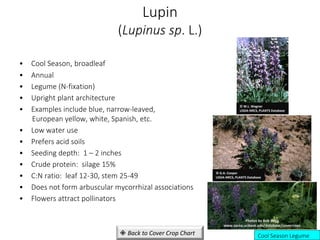
Lupin
(Lupinus sp. L.)
• Cool Season, broadleaf
• Annual
• Legume (N-fixation)
• Upright plant architecture
• Examples include blue, narrow-leaved,
European yellow, white, Spanish, etc.
• Low water use
• Prefers acid soils
• Seeding depth: 1 – 2 inches
• Crude protein: silage 15%
• C:N ratio: leaf 12-30, stem 25-49
• Does not form arbuscular mycorrhizal associations
• Flowers attract pollinators
Cool Season Legume
Photos by Bob Bugg
www.sarep.ucdavis.edu/database/covercrops
© G.A. Cooper
USDA-NRCS, PLANTS Database
© W.L. Wagner
USDA-NRCS, PLANTS Database
 Back to Cover Crop Chart
Faba Bean
(Vicia faba L.)
• Cool season, broadleaf
• Annual
• Legume (N-fixation)
• Upright plant architecture (vine)
• Alternate names: Bell bean, horse bean, Fava bean
• Medium water use; poor drought tolerance
• Moderate salinity tolerance (depending on variety)
• Seeding depth: 2-4 inches
• Crude protein: 17%
• Forms arbuscular mycorrhizal associations
• Flowers attract pollinators
www.Wikimedia.com
Photo by Honeyhuyue
www.Wikimedia.com
 Back to Cover Crop Chart Cool Season Legume
Sweetclover
(Melilotus sp. L)
• Cool Season, broadleaf
• Annual, Biennial
• Legume (N-fixation)
• Two types
– yellow Melilotus officinalis L.
– white Melilotus alba L.
• Upright plant architecture
• Moderate water use
• Fair salinity tolerance
• Seeding depth: ½ inch
• Crude protein: 11-18%
• C:N ratio: 12 – 23
• Forms arbuscular mycorrhizal associations
• Attracts pollinators
WHITE TYPE
Photo by John Wright (Mississauga Ontario)
www.mccc.msu.edu
Photo by Patrick J. Alexander , USDA-NRCS, PLANTS Database
Photo by John Wright (Mississauga Ontario)
www.mccc.msu.ed
Photo by John Wright (Mississauga Ontario)
www.mccc.msu.ed
YELLOW TYPE
Cool Season Legume
 Back to Cover Crop Chart
Alfalfa
(Medicago sativa L.)
• Cool Season, broadleaf
• Perennial
• Legume (N-fixation)
• Upright plant architecture
• Alternate name: lucerne
• High water use
• Poor salinity tolerance
• Seeding depth: ¼ – ½ inch
• Crude protein: 14-22%
• C:N ratio: 11 – 13
• Non-dormant cultivars can perform like an annual
• Forms arbuscular mycorrhizal associations
• Good at scavenging nitrogen from the soil
• Attracts pollinators
Cool Season Legume
Photo by Patrick J. Alexander
USDA-NRCS, PLANTS Database
Photo by John Hilty (Urbana, IL)
www.mccc.msu.edu
Photo by John Wright (Mississauga Ontario)
www.mccc.msu.edu
 Back to Cover Crop Chart
Sainfoin
(Onobrychis viciifolia Scop.)
• Cool Season, broadleaf
• Perennial
• Legume (N-fixation)
• Upright plant architecture
• Medium to high water use
• Fair to poor salinity tolerance
• Seeding depth: ¼ – ¾ inch
• Crude protein: 13-20%
• Forms arbuscular mycorrhizal associations
• Attracts pollinators
Cool Season Legume
Photo by Howard F. Schwartz
Colorado State University, www.Bugwood.org
 Back to Cover Crop Chart
Cowpea
(Vigna unguiculata L.)
• Warm Season, broadleaf
• Annual
• Legume (N-fixation)
• Upright and spreading plant architecture (vine)
• Alternate names: Southern pea, black-eye pea
• Low water use
• Fair salinity tolerance
• Seeding depth: ¾ – 1 inch
• Crude protein:
– grain and leaves 19-30%
– stems 13-17%
• C:N ratio: 18 – 22
• Forms arbuscular mycorrhizal associations
• Attracts pollinators
Warm Season Legume
USDA-NRCS,
Bismarck Plant Materials Center
Photo by Howard F. Schwartz
Colorado State University, www.Bugwood.org
 Back to Cover Crop Chart
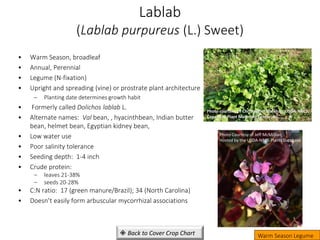
Lablab
(Lablab purpureus (L.) Sweet)
• Warm Season, broadleaf
• Annual, Perennial
• Legume (N-fixation)
• Upright and spreading (vine) or prostrate plant architecture
– Planting date determines growth habit
• Formerly called Dolichos lablab L.
• Alternate names: Val bean, , hyacinthbean, Indian butter
bean, helmet bean, Egyptian kidney bean,
• Low water use
• Poor salinity tolerance
• Seeding depth: 1-4 inch
• Crude protein:
– leaves 21-38%
– seeds 20-28%
• C:N ratio: 17 (green manure/Brazil); 34 (North Carolina)
• Doesn’t easily form arbuscular mycorrhizal associations
Warm Season Legume
 Back to Cover Crop Chart
Photo courtesy of Christopher Sheahan, USDA-NRCS,
Cape May Plant Materials Center, NJ
Photo Courtesy of Jeff McMillian,
Hosted by the USDA-NRCS Plants Database
Fenugreek
(Trigonella sp. L.)
• Warm Season, broadleaf
• Annual, Perennial
• Legume (N-fixation)
• Two types:
– cultivated [T. corniculata];
– forage or sickle fruit [T. foenum-graecum]
• Upright plant architecture
• Alternate name: Greek hay
• Low water use
• Poor salinity tolerance
• Seeding depth: 1 – 2 inches
• Crude protein: 16 – 25%
• Forms arbuscular mycorrhizal associations
• Self pollinator (wind)
• Used as a forage, spice, and for health benefits*
*contains nutraceuticals:
1. steroidal sapogenin
2. galactomannan
3. isoleucine
Warm Season Legume
http://whereplantsrule.blogspot.com/2011/01/sweet-sweat.html
 Back to Cover Crop Chart
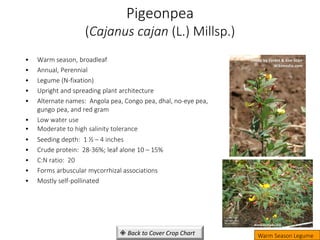
Pigeonpea
(Cajanus cajan (L.) Millsp.)
• Warm season, broadleaf
• Annual, Perennial
• Legume (N-fixation)
• Upright and spreading plant architecture
• Alternate names: Angola pea, Congo pea, dhal, no-eye pea,
gungo pea, and red gram
• Low water use
• Moderate to high salinity tolerance
• Seeding depth: 1 ½ – 4 inches
• Crude protein: 28-36%; leaf alone 10 – 15%
• C:N ratio: 20
• Forms arbuscular mycorrhizal associations
• Mostly self-pollinated
Warm Season Legume
Photo by Forest & Kim Starr
Wikimedia.com
www.prota4u.org
 Back to Cover Crop Chart
Partridge Pea
(Chamaecrista fasciculata (Michx.) Greene var. fasciculata ;
Cassia fasciculata Michx.; Cassia chamaecrista L.);
• Warm season, broadleaf
• Annual
• Legume (N-fixation)
• Upright plant architecture
• Alternate names: sleeping plant, prairie senna, large-
flowered sensitive-pea, locust weed, dwarf cassia, golden
cassia
• Low to moderate water use
• Seeding depth: ¼ ” – ¾ ” inch
• Forms arbuscular mycorrhizal associations
• Attracts pollinators, especially bees
• Used as a green manure, forage, or fiber crop
– Forage is nutritious but also contains cathartic
substance in fresh material or hay which can potentially
be dangerous to cattle. Check before feeding to
livestock
• Attractive to wildlife, particularly several game bird species
• Potential for phytoremediation (tolerance to cadmium)
Warm Season Legume
 Back to Cover Crop Chart
Photos by Alan Shadow
USDA-NRCS,
East Texas Plant Materials Center
Sunnhemp
(Crotalaria juncea L.)
• Warm season, broadleaf
• Annual
• Legume (N-fixation)
• Upright plant architecture
• Low to moderate water use
• Poor salinity tolerance
• Seeding depth: ½” – 2 ½” inches
• ‘Good’ N-fixation capacity
• Forms arbuscular mycorrhizal associations
• Self pollinates (wind) as well as cross-pollinates
(insects/birds)
• Rated ‘Excellent’ at controlling soil nematodes
• Used as a green manure, forage*, or fiber crop
* Certain cultivars contain alkaloids which are poisonous to
livestock; check before feeding to animals
Warm Season Legume
‘Tropic Sun’ Sunn hemp
Georgia Plant Materials Program
 Back to Cover Crop Chart
Cluster bean
(Cyamopsis tetragonoloba L. Taub)
• Warm Season, broadleaf
• Annual
• Legume (N-fixation)
• Upright and spreading plant architecture
• Alternate names: Guar, guar bean, c
• Low water use
• Good salinity tolerance
• Seeding depth: 1 – 1 ½ inch
• Crude protein:
– Straw 7 – 10%
• C:N ratio: 65 (residue)
• Forms arbuscular mycorrhizal associations
• Self-pollinated
• Can be used as a green manure or forage
• Plant extract (gum) has industrial uses
Warm Season Legume
Photo by Howard F. Schwartz
Colorado State University,
www.Bugwood.org
 Back to Cover Crop Chart
Jack bean
(Canavalia ensiformis (L.) DC.)
• Warm Season, broadleaf
• Annual, Perennial
• Legume (N-fixation)
• Upright and spreading plant architecture (vine)
• Alternate names: wonderbean, sword-bean,
• coffee bean, giant stock-bean, horse-bean
• Low water use
• Fair salinity tolerance
• Seeding depth: 1 – 3 inches
• Crude protein: ≈ 30%
• C:N ratio: 21 (green manure/Brazil)
 Special Note:
HUMAN: Although young pods/green seeds can be eaten,
mature beans can contain harmful compounds and must be
cooked prior to eating
LIVESTOCK: Because of the potential toxic compounds in the
seed, meal must be heat-treated to denature the enzymes or
limited to 30% of the ration
Warm Season Legume
 Back to Cover Crop Chart
Photo courtesy of Christopher Sheahan, USDA-NRCS,
Cape May Plant Materials Center, NJ
Photo courtesy of Christopher Sheahan, USDA-NRCS,
Cape May Plant Materials Center, NJ
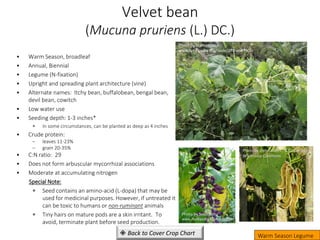
Velvet bean
(Mucuna pruriens (L.) DC.)
• Warm Season, broadleaf
• Annual, Biennial
• Legume (N-fixation)
• Upright and spreading plant architecture (vine)
• Alternate names: Itchy bean, buffalobean, bengal bean,
devil bean, cowitch
• Low water use
• Seeding depth: 1-3 inches*
 In some circumstances, can be planted as deep as 4 inches
• Crude protein:
– leaves 11-23%
– grain 20-35%
• C:N ratio: 29
• Does not form arbuscular mycorrhizal associations
• Moderate at accumulating nitrogen
Special Note:
 Seed contains an amino-acid (L-dopa) that may be
used for medicinal purposes. However, if untreated it
can be toxic to humans or non-ruminant animals
 Tiny hairs on mature pods are a skin irritant. To
avoid, terminate plant before seed production.
Warm Season Legume
 Back to Cover Crop Chart
Photo by Scamperdale,
www.feedipedia.org/node/270 and Flickr
Photo by Dick Culbert , B.C., Canada
Wikimedia Commons
Photo by Scott Zona
www.feedipedia.org/node/270
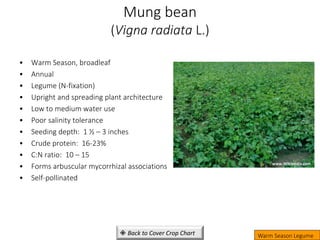
Mung bean
(Vigna radiata L.)
• Warm Season, broadleaf
• Annual
• Legume (N-fixation)
• Upright and spreading plant architecture
• Low to medium water use
• Poor salinity tolerance
• Seeding depth: 1 ½ – 3 inches
• Crude protein: 16-23%
• C:N ratio: 10 – 15
• Forms arbuscular mycorrhizal associations
• Self-pollinated
Warm Season Legume
www.Wikipedia.com
 Back to Cover Crop Chart
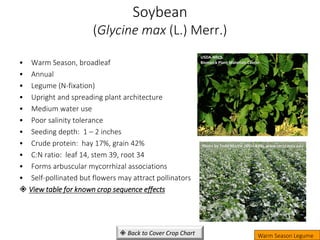
Soybean
(Glycine max (L.) Merr.)
• Warm Season, broadleaf
• Annual
• Legume (N-fixation)
• Upright and spreading plant architecture
• Medium water use
• Poor salinity tolerance
• Seeding depth: 1 – 2 inches
• Crude protein: hay 17%, grain 42%
• C:N ratio: leaf 14, stem 39, root 34
• Forms arbuscular mycorrhizal associations
• Self-pollinated but flowers may attract pollinators
 View table for known crop sequence effects
Photo by Todd Martin (MSU-KBS)
Photo by Todd Martin (MSU-KBS), www.mccc.msu.edu
Warm Season Legume
USDA-NRCS,
Bismarck Plant Materials Center
 Back to Cover Crop Chart
Peanut
(Annual - Arachis hypogaea L.; Perennial – Arachis glabrata L.)
• Warm season, broadleaf
• Annual, Perennial
• Legume (N-fixation)
• Upright and spreading (annual) or prostrate
(perennial) plant architecture
• Alternate name: Groundnut
• High water use
• Poor salinity tolerance
• Seeding depth: 1 – 4 inches
*Perennial peanuts are planted using rhizomes only
• Crude Protein: 13 – 20%
• Forms arbuscular mycorrhizal associations
• Mainly self-pollinate (wind); small % cross-pollinate
• Rated ‘Efficient’ at scavenging P & K from soil
• Perennial varieties used as cattle forage
Warm Season Legume
Photo by Rebekah D. Wallace
University of Georgia, Bugwood.org
Photo by William M. Brown Jr.
Bugwood.org
Annual Peanut - Arachis hypogaea
Perennial Peanut - Arachis glabrata
www.tropicalforages.info
 Back to Cover Crop Chart
Amaranth
(Amaranthus sp.)
• Warm Season, broadleaf
• Annual
• Upright plant architecture
• Over 50 species; some exhibiting glyphosate
resistance
• Low water use
• Tolerant of heat and drought
• Seeding depth: ½ – 2 inches
• Crude protein: ≈14%
• Does not form arbuscular mycorrhizal
associations
• Self-pollinated (wind)
• Flowers may attract pollinators
Warm Season Broadleaf
Photo by P.F. Byrne
Bugwood.org
Photo by Howard F. Schwartz
Colorado State University,
www.Bugwood.org
Photo by Howard F. Schwartz
Colorado State University, www.Bugwood.org
 Back to Cover Crop Chart
Buckwheat
(Fagopyrum esculentum Moench; Fagopyrum sagittatum Gilib)
• Cool Season, broadleaf
• Warm season growth characteristics
• Annual
• Upright plant architecture
• Medium water use
• Poor salinity tolerance
• Enhances soil P availability
• Seeding depth: ½ inch
• Crude protein: straw 5%, grain 13%
• C:N ratio: leaf 8-10, stem 12-32, root 28-47
• Does not form arbuscular mycorrhizal associations
• Attracts pollinators
 View table for known crop sequence effects
Warm Season Broadleaf
USDA-NRCS,
Bismarck Plant Materials Center
USDA-NRCS,
Bismarck Plant Materials Center
 Back to Cover Crop Chart
Quinoa
(Chenopodium quinoa Willd. )
• Warm season, broadleaf
• Annual
• Upright plant architecture
• Moderate water use
• Good salinity tolerance
• Seeding depth: ½ - 1 inch
• Crude protein: 14%
• C:N ratio: 14-25
• Does not form arbuscular mycorrhizal
associations
• Self pollinates (wind); up to 15% may cross-
pollinate
• Not susceptible to cereal diseases; slightly
vulnerable to soil nematodes
• No registered herbicides for quinoa at this time
Warm Season Broadleaf
Photo by Whitney Cranshaw
Colorado State University, Bugwood.org
Photo by Whitney Cranshaw
Colorado State University, Bugwood.org
 Back to Cover Crop Chart
Chicory
(Cichorium intybus L.)
• Warm Season, broadleaf
• Perennial
• Upright and spreading plant architecture
(vine)
• Alternate names: French endive, succory
• Medium water use
• Seeding depth: ⅛ – ½ inch
• Crude protein: 10-32%
• Forms arbuscular mycorrhizal associations
• Attracts pollinators
• Rated ‘very good’ at scavenging nitrogen from
the soil
• Highly invasive
Forestry Images
Warm Season Broadleaf
Photo by Joseph M. DiTomaso
University of California - Davis,
www.Bugwood.org
Photo by Howard F. Schwartz
Colorado State University, www.Bugwood.org
Photo by Robert Vidéki
Doronicum Kft.,
www.Bugwood.org
 Back to Cover Crop Chart
Cucurbita sp. [Family]
• This is a broad grouping including squash,
gourd, cucumber, melon, and pumpkin
• Warm Season, broadleaf
• Annual
• Prostrate plant architecture (vine)
• Seeding depth: ½ – 1 inch
• Forms arbuscular mycorrhizal associations
• Attracts pollinators
• Can be used for weed suppression as a
‘smother crop’
Warm Season Broadleaf
Photos by Howard F. Schwartz
Colorado State University,
www.Bugwood.org
 Back to Cover Crop Chart
Safflower
(Carthamus tinctorius L.)
• Warm Season, broadleaf
• Annual
• Upright plant architecture
• High water use
• Good salinity tolerance
• Deep rooted
• Effective at ‘mining’ mobile nutrients deep
in the soil profile
• Seeding depth: 1 – 1 ½ inch
• Crude protein: hay 10-13%, grain 18%
• C:N ratio: leaf 21, stem 56, root 73
• Forms arbuscular mycorrhizal associations
• Flowers attract pollinators
 View table for known crop sequence effects
Warm Season Broadleaf
USDA-ARS, NGPRL
 Back to Cover Crop Chart
Photo by Howard F. Schwartz
Colorado State University, www.Bugwood.org Photo by Howard F. Schwartz
Colorado State University, www.Bugwood.org
Sunflower
(Helianthus annuus L.)
• C3 plant with warm season growth
characteristics, broadleaf
• Annual
• Upright plant architecture
• High water use
• Fair salinity tolerance
• Deep rooted
• Effective at ‘mining’ mobile nutrients deep
in the soil profile
• Seeding depth: 1 – 3 ½ inches
• Crude protein: silage 11-12%, grain 20-28%
• C:N ratio: leaf 11-14, stem 41-46, root 50-
68, flower 14-19
• Forms arbuscular mycorrhizal associations
• Flowers attract pollinators
 View table for known crop sequence effects
Warm Season Broadleaf
USDA-NRCS,
Bismarck Plant Materials Center
USDA-ARS, NGPRL
 Back to Cover Crop Chart
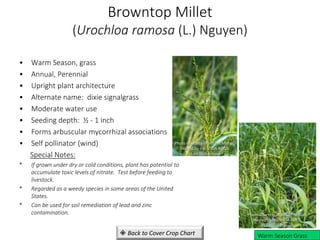
Browntop Millet
(Urochloa ramosa (L.) Nguyen)
• Warm Season, grass
• Annual, Perennial
• Upright plant architecture
• Alternate name: dixie signalgrass
• Moderate water use
• Seeding depth: ½ - 1 inch
• Forms arbuscular mycorrhizal associations
• Self pollinator (wind)
Special Notes:
* If grown under dry or cold conditions, plant has potential to
accumulate toxic levels of nitrate. Test before feeding to
livestock.
* Regarded as a weedy species in some areas of the United
States.
* Can be used for soil remediation of lead and zinc
contamination.
Warm Season Grass
 Back to Cover Crop Chart
Photo Courtesy of Jeff McMillian,
Hosted by the USDA-NRCS,
PLANTS Database
Photo Courtesy of Jeff McMillian,
Hosted by the USDA-NRCS,
PLANTS Database
Foxtail Millet
(Setaria italica L.)
• Warm Season, grass
• Annual
• Upright plant architecture
• Alternate name: Italian millet
• Low water use
• Poor salinity tolerance
• Seeding depth: 1 inch
• Crude protein: hay 15%
• C:N ratio: 44
• Forms arbuscular mycorrhizal associations
• Self pollinator (wind)
Warm Season Grass
Photo by Howard F. Schwartz
Colorado State University, www.Bugwood.org
Photo by Howard F. Schwartz
Colorado State University, www.Bugwood.org
 Back to Cover Crop Chart
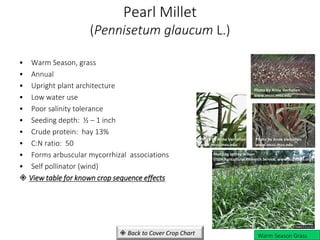
• Warm Season, grass
• Annual
• Upright plant architecture
• Low water use
• Poor salinity tolerance
• Seeding depth: ½ – 1 inch
• Crude protein: hay 13%
• C:N ratio: 50
• Forms arbuscular mycorrhizal associations
• Self pollinator (wind)
 View table for known crop sequence effects
Pearl Millet
(Pennisetum glaucum L.)
Warm Season Grass
Photo by Jeffrey Wilson
USDA Agricultural Research Service, www.Bugwood.org
Photo by Anne Verhallen
www.mccc.msu.edu
Photo by Anne Verhallen
www.mccc.msu.edu
Photo by Anne Verhallen
www.mccc.msu.edu
 Back to Cover Crop Chart
Proso Millet
(Panicum milaceum L.)
• Warm Season, grass
• Annual
• Upright plant architecture
• Medium water use
• Poor salinity tolerance
• Seeding depth: 1 inch
• Crude protein: hay 10%
• C:N ratio: leaf 12-16, stem 12-35, root 17-26
• Forms arbuscular mycorrhizal associations
• Self pollinator (wind)
 View table for known crop sequence effects
Warm Season Grass
USDA-ARS, NGPRL
 Back to Cover Crop Chart
Grain Sorghum
(Sorghum bicolor L. Moench)
• Warm Season, grass
• Annual
• Upright plant architecture
• Alternate name: Sorghum-sudan grass
*Grain sorghum and sudan grass were formerly separate species that
have been combined. They are separated in the chart due to different
plant attributes.
• Medium water use
• Fair salinity tolerance
• Seeding depth: 1 – 2 inches
• Crude protein: hay 7%, stover 5%, grain 10%
• C:N ratio: leaf 11-17, stem 10-27, root 22-30
• Forms arbuscular mycorrhizal associations
• Self pollinator (wind)
• Stress conditions that limit growth (e.g., drought, frost)
can contribute to prussic acid accumulation in leaves
 View table for known crop sequence effects
Warm Season Grass
USDA-NRCS,
Bismarck Plant Materials Center
 Back to Cover Crop Chart
Photo by Howard F. Schwartz
Colorado State University, www.Bugwood.org
Sudan grass
(Sorghum bicolor L. Moench)
• Warm Season, grass
• Annual
• Upright plant architecture
• Alternate name: Sorghum-sudan grass
*Grain sorghum and sudan grass were formerly separate species that
have been combined. They are separated in the chart due to different plant
attributes.
• Medium water use
• Fair salinity tolerance
• Seeding depth: 1 inch
• Crude protein: hay 7-11%, silage 6-17%
• C:N ratio: 48 - 63
• Forms arbuscular mycorrhizal associations
• Rated ‘Excellent’ at nutrient scavenging
• Self pollinator (wind)
• Stress conditions that limit growth (e.g., drought, frost) can
contribute to prussic acid accumulation in leaves
• Known alleopathic effects on annual ryegrass
Warm Season Grass
USDA-NRCS,
Bismarck Plant Materials Center
 Back to Cover Crop Chart
Photo by Howard F. Schwartz
Colorado State University, www.Bugwood.org
Teff
(Eragrostis tef (Zuccagni) Trotter)
• Warm Season, grass
• Annual
• Upright plant architecture
• Medium water use
• Poor salinity tolerance
• Seeding depth: ½ inch
• Crude protein: 10-18%
• Forms arbuscular mycorrhizal associations
• Self pollinator (wind)
Warm Season Grass
USDA-NRCS,
Bismarck Plant Materials Center
USDA-NRCS,
Bismarck Plant Materials Center
 Back to Cover Crop Chart
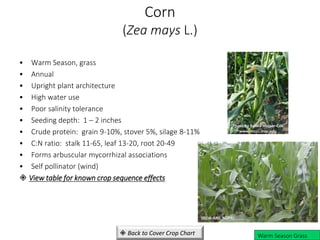
Corn
(Zea mays L.)
• Warm Season, grass
• Annual
• Upright plant architecture
• High water use
• Poor salinity tolerance
• Seeding depth: 1 – 2 inches
• Crude protein: grain 9-10%, stover 5%, silage 8-11%
• C:N ratio: stalk 11-65, leaf 13-20, root 20-49
• Forms arbuscular mycorrhizal associations
• Self pollinator (wind)
 View table for known crop sequence effects
USDA-ARS, NGPRL
Photo by Szilvia Hosser-Cox
www.mccc.msu.edu
Warm Season Grass
 Back to Cover Crop Chart

Cover Crops.pdf

  • 1.
    Cover Crop Chart V3.0 February 2018 -------------------------------------------COOL------------------------------------------- ------------------------- WARM------------------------- --GRASS-- -----------------------------------------------------BROADLEAF----------------------------------------------------- --GRASS-- ANNUAL FESCUE BROWNTOP MILLET BARLEY ------------------------------- LEGUME ------------------------------- AMARANTH FOXTAIL MILLET OAT CAMELINA MUSTARD BALANSA CLOVER CHICKPEA MEDIC COWPEA CLUSTER BEAN BUCKWHEAT PEARL MILLET SPELT PHACELIA CANOLA BERSEEM CLOVER PEA LUPIN LABLAB JACK BEAN QUINOA PROSO MILLET WHEAT FLAX RADISH CRIMSON CLOVER LENTIL FABA BEAN FENUGREEK VELVET BEAN CHICORY GRAIN SORGHUM CEREAL RYE KALE TURNIP RED CLOVER LESPEDEZA SWEET CLOVER PIGEONPEA MUNG BEAN CUCURBITA SUDAN GRASS TRITICALE SPINACH BEET WHITE CLOVER BIRDSFOOT TREFOIL ALFALFA PARTRIDGE PEA SOYBEAN SAFFLOWER TEFF SALINE TOLERANT CHARD CARROT KURA CLOVER VETCH SAINFOIN SUNNHEMP PEANUT SUNFLOWER CORN Additional Information               GROWTH CYCLE A = Annual B = Biennial P = Perennial PLANT ARCHITECTURE = Upright = Upright-Spreading = Prostrate RELATIVE WATER USE = Low = Medium = High                                       A/B A A/B A A A A A A A A P A A B A/P A A/B A/B B A/B P A/P A A P A A/P A/B A A P P B/P A A A P A A A/P A/P A/P A A A A A/P A/P A A A A P A A A A A A A A A A A                      
  • 2.
    Cover Crop Chart •Useful cover crop resources: – Managing Cover Crops Profitably, 3rd Ed. Andy Clark (Ed.). Handbook Series Book 9, Sustainable Agriculture Network, Beltsville, MD. – Midwest Cover Crops Council, www.mccc.msu.edu – Sustainable Agriculture Research and Education Program, University of California-Davis, www.sarep.ucdavis.edu – USDA-NRCS, PLANTS Database, www.plants.usda.gov Persons with disabilities who require alternative means for communication of program information (Braille, large print, audiotape, etc.) should contact USDA's TARGET Center at 202- 720-2600 (voice and TDD). The United States Department of Agriculture prohibits discrimination in all its programs and activities on the basis of race, color, national origin, gender, religion, age, disability, political beliefs, sexual orientation, and marital and family status. To file a complaint of discrimination, write USDA, Director, Office of Civil Rights, Room 326-W, Whitten Building, 14th and Independence, S.W., Washington, DC 20250-9410 or call 202-720-5964 (voice or TDD). USDA is an equal opportunity provider and employer. Mention of trade or manufacturer names is provided for information only and does not constitute endorsement by USDA-ARS. The Cover Crop Chart represents a compendium of information from multiple sources. Primary sources of information included the Midwest Cover Crops Council, USDA-SARE, USDA-NRCS PLANTS database, and relevant peer-reviewed journal articles. Designation of warm/cool season crops is based on prevalent growth habits and not photosynthetic pathway. Ranges for seeding depth take into consideration moisture conditions at planting and variation in soil texture. Values for crude protein and C:N ratio assume homogenous samples of aboveground plant material unless stated otherwise. Information on specific crops is occasionally generalized, approximate, and/or incomplete and may not reflect performance in on-farm conditions. USDA-ARS makes no guarantee to the performance of specific crops based on information provided herein. Content and data for crops were assembled by Holly Johnson and Mark Liebig with input from Dave Archer, V.C. Baligar, Heather Dose, Wayne Duckwitz, Marvin Hatzenbuhler, John Hendrickson, Naeem Kalwar, Robert Kolberg, Nancy Jensen, Steve Merrill, Kristine Nichols, Delmer Schlenker, Marty Schmer, Eric Scholljegerdes, Don Tanaka, Cal Thorson, and Dawn Wetch. Chart design by Mark Liebig, Holly Johnson, and Jill Gunderson. The Cover Crop Chart was originally generated with input from producers and technicians in the Area IV Soil Conservation Districts of North Dakota and NRCS staff at the Bismarck and Dickinson Field/Area Offices. The Cover Crop Chart is produced and distributed by the staff of the Northern Great Plains Research Laboratory at Mandan, ND. txtcvr For further information please contact: Cover Crop Chart USDA-ARS Northern Great Plains Research Laboratory P.O.Box 459 Mandan, ND 58554-0459 Voice: 701 667-3079 FAX: 701 667-3054 https://www.ars.usda.gov/plains-area/mandan-nd/ngprl/  Back to Cover Crop Chart
  • 3.
    Crop Sequence Effects CROPRESIDUE - - - - - - - HIGH RISK CROPS (Crops with the worst performance following a particular residue) - - - - - - - Barley Barley Wheat Wheat Canola Canola Mustard Pea Dry Bean Flax Safflower Mustard Soybean Sunflower Flax Flax Pea Pea Flax Lentil Lentil Chickpea Buckwheat Lentil Soybean Canola Wheat Barley Buckwheat Chickpea Sunflower Grain Sorghum Sunflower Safflower Safflower Sunflower Soybean Mustard Dry Bean Sunflower Sunflower Canola Pea Lentil Buckwheat Grain Sorghum Corn Wheat Barley Proso Millet Proso Millet Grain Sorghum Buckwheat Grain Sorghum Grain Sorghum Proso Millet Pea Lenti Wheat Corn Corn Wheat Buckwheat Grain Sorghum Proso Millet Table adapted from Crop Sequence Calculator (v. 3.1). Software available for download at https://www.ars.usda.gov/plains-area/mandan-nd/ngprl/  Back to Cover Crop Chart
  • 4.
    Annual fescue (Vulpia myurosL.; Fetuca sp.) • Cool Season, grass • Annual • Upright plant architecture • Alternate names: Rattail fescue, Foxtail fescue • Low water use • Poor salinity tolerance • Seeding depth: ¼ – 1 inch • Crude protein: hay 8-10% • Benefits from arbuscular mycorrhizal associations Cool Season Grass Photo by Bob Bugg, www.sarep.ucdavis.edu/ database/ covercrops www.sarep.ucdavis.edu/ database/covercrops  Back to Cover Crop Chart
  • 5.
    Barley (Hordeum vulgare L.) •Cool Season, grass • Annual • Upright plant architecture • Low water use • Good salinity tolerance • Seeding depth: ¾ – 2 inches • Crude protein: hay 10-15%, grain 11-15% • C:N ratio: 20 • Benefits from arbuscular mycorrhizal associations • Self pollinator (wind) • Rated ‘very good’ at scavenging nitrogen from the soil  View table for known crop sequence effects USDA-ARS, NGPRL Cool Season Grass Photo by Bob Bugg, www.sarep.ucdavis.edu/database/covercrops  Back to Cover Crop Chart
  • 6.
    Oat (Avena sativa L.) •Cool Season, grass • Annual • Upright plant architecture • Medium water use • Fair salinity tolerance • Seeding depth: 1 – 2 inches • Crude protein: hay 9-15%, grain 13-18% • C:N ratio: 33 • Forms arbuscular mycorrhizal associations • Self pollinator (wind) • Rated ‘very good’ at scavenging nitrogen from the soil USDA-NRCS, Bismarck Plant Materials Center Photo by Todd Martin www.mccc.msu.edu Cool Season Grass  Back to Cover Crop Chart
  • 7.
    Spelt (Triticum spelta L.;Triticum aestivum var. spelta(L.) L.H. Bailey) • Cool season, grass • Annual • Upright plant architecture • Good to fair salinity tolerance • Seeding depth: ½ – 1 ½ inches • Crude protein: overall 11-14%, grain 13-16% • Forms arbuscular mycorrhizal associations • Self pollinator (wind) • An efficient available nitrogen accumulator among cool season grasses • Spelt is an older cereal grain and is more prone to lodging than wheat Cool Season Grass  Back to Cover Crop Chart https:commons.Wikimedia.org Photo by Åsmund Langeland https:commons.Wikimedia.org
  • 8.
    Wheat (Triticum aestivum L.) •Cool season, grass • Annual • Upright plant architecture • Includes spring and winter wheat varieties • Medium water use • Good to fair salinity tolerance • Seeding depth: ½ – 1 ½ inches • Crude protein: straw 4-10%, grain 12-16% • C:N ratio: leaf 15-29, stem 31-65, root 24-74 , straw 80-95 [end of season] • Benefits from arbuscular mycorrhizal associations • Self pollinator (wind) • Rated ‘very good’ at scavenging nitrogen from the soil  View table for known crop sequence effects USDA-NRCS, PLANTS Database USDA-ARS, NGPRL Cool Season Grass  Back to Cover Crop Chart
  • 9.
    Photo: Practical Farmersof Iowa Cereal rye (Secale cereale L.) • Cool Season, grass • Annual • Upright plant architecture • High water use • Good salinity tolerance • Seeding depth: ¼ – 2 inches • Crude protein: straw 4%, grain 14% • C:N ratio: 40 – 50* * This number can vary based on whether the plant was grown in monoculture or a biculture and the stage the plant was in when it was tested • Forms arbuscular mycorrhizal associations • Self pollinator (wind) • Rated ‘very good’ at scavenging nitrogen from the soil Photo: Practical Farmers of Iowa www.mccc.msu.edu Photo: Practical Farmers of Iowa www.mccc.msu.edu Photo by Dale R. Mutch www.mccc.msu.edu Cool Season Grass  Back to Cover Crop Chart
  • 10.
    Triticale (Triticale hexaploide Lart.;Triticosecalerimpaui Wittm.) • Cool Season, grass • Annual • Upright plant architecture • Fall and spring types available • High water use • Good salinity tolerance • Seeding depth: 1 ½ – 2 inches • Crude protein: hay 9-16%, grain 17% • C:N ratio: 20 • Forms arbuscular mycorrhizal associations • Self pollinator (wind) Cool Season Grass  Back to Cover Crop Chart Photo by Matt Liebman, Iowa State University www.mccc.msu.edu Photo by Ken Miller, Rancher Huff North Dakota
  • 11.
    Saline Tolerant Grasses •Cool Season, grass • Perennial • Upright plant architecture • Low to moderate water use • Moderate to high salinity tolerance • Seeding depth: ¼ – 1 inch • Crude Protein: 7 – 19% • Forms arbuscular mycorrhizal associations • Many species are available in this category; each varies slightly in plant characteristics See the next six slides for more detail Cool Season Grass Saline Tolerant  Back to Cover Crop Chart
  • 12.
    RS Hybrid Wheatgrass (Elymushoffmannii K.B. Jensen & K.H. Asay ) • Cool season, grass • Perennial • Upright plant architecture • Alternate name: Green wheatgrass • Low water use • Moderate to high salinity tolerance • Seeding depth: ¼ – ½ inch • Crude protein: 7 – 12% • RS hybrid wheatgrass is a hybrid between quackgrass (Elymus repens) and bluebunch wheatgrass (Pseudoroegneria spicata) Cool Season Grass Saline Tolerant  Back to Cover Crop Chart Photo courtesy of Roger Hybner, USDA-NRCS, Bridger Plant Materials Center, MT Photo courtesy of Roger Hybner, USDA-NRCS, Bridger Plant Materials Center, MT
  • 13.
    Tall Wheatgrass (Thinopyrum ponticum(Podp.)) • Cool season, grass • Perennial (introduced) • Upright plant architecture • Alternate name: Rush wheatgrass • Moderate water use • Excellent salinity tolerance • Seeding depth: ¼ – 1 inch *shallower for finer textured soils • Crude protein: 7 – 19% – vegetative >10% – late bloom 6% – fully mature 2-3% Cool Season Grass Saline Tolerant Photo by R.L. Hamblen, www.Bugwood.org  Back to Cover Crop Chart
  • 14.
    Intermediate Wheatgrass (Thinopyrum intermedium(Host) Barkworth & D.R. Dewey) • Cool season, grass • Perennial (introduced) • Upright plant architecture • Alternate name: Pubescent wheatgrass • Low to moderate water use; drought tolerant • Good salinity tolerance • Seeding depth: ½ – 1 inch • Crude protein: 8 – 17%* *Northern Plains: may fall below 4% at the end of the season • Cross-pollinates. • Spreads vegetatively; under ideal conditions, it can slowly spread into adjacent communities • Persistence of stand is limited (typically < 5 yr) Cool Season Grass Saline Tolerant Photo by Howard F. Schwartz, Colorado State University, www.Bugwood.org Photo by Howard F. Schwartz Colorado State University, www.Bugwood.org  Back to Cover Crop Chart
  • 15.
    Slender Wheatgrass (Elymus trachycaulus(Link) Gould ex Shinners) • Cool season, grass • Perennial, short-lived (native) • Upright plant architecture • Low water use; will not tolerate water-logged soils • Good salinity tolerance • Seeding depth: ¼ – ¾ inch • Crude protein: 22 – 25% (Spring); less than 10% (fall) • May form arbuscular mycorrhizal associations Cool Season Grass Saline Tolerant Photo by Dave Powell, USDA Forest Service, www.Bugwood.org  Back to Cover Crop Chart
  • 16.
    Russian Wildrye (Psathyrostachys junceus(Fisch.) Nevski) • Cool season, grass • Perennial (introduced) • Upright plant architecture • Low water use – drought tolerant – does not tolerate flooding • Good salinity tolerance • Seeding depth: ¼ – ½ inch – Sensitive to seeding depth – too deep will inhibit seed germination • Crude protein: 5 – 17 % • Difficult to establish Cool Season Grass Saline Tolerant Photo by Larry Holzworth USDA-ARS, NRCS Idaho Plant Materials Program and USDA-ARS, Forage and Range Research Laboratory  Back to Cover Crop Chart
  • 17.
    Alkaligrass (Puccinellia sp. Parl.) •Cool season, grass • Perennial • Upright plant architecture • Nuttall’s alkaligrass, Puccinellia nuttalliana [Schult.] Hitch. – Native to semi-arid, North American zones • Weeping alkaligrass, Puccinellia distans [Jacq.] Parl. – Introduced [Eurasia] – Highest salinity tolerance of this genus • Low to moderate water use – Can survive arid areas as well as marsh, basin, or wetland zones • Excellent salinity tolerance • Seeding depth: ¼ - ½ inch • This slide completes the review of saline tolerant grasses Cool Season Grass Saline Tolerant Photo by Howard F. Schwartz, Colorado State University, www.Bugwood.org  Back to Cover Crop Chart
  • 18.
    Camelina (Camelina sativa (L.)Crantz) • Cool Season, broadleaf • Annual, Biennial • Upright plant architecture • Alternate names: False flax, gold-of-pleasure, linseed dodder, largeseed falseflax, leindotter, Siberian oilseed • Low water use • Fair salinity tolerance • Seeding depth: ⅛ – ¼ inch • Crude Protein: 46% • C:N Ratio: stems 40-95; pods 25-70; seed 12-16 • Does not form arbuscular mycorrhizal associations • Mainly a self pollinator but benefits genetically from exposure to high population of pollinators • Sensitive to soil herbicide imidazolinones and sulfentrazone • Volunteer plants can become problematic • Potentially allelopathic for flax Cool Season Broadleaf  Back to Cover Crop Chart Photo by Robert Evans, ARS USDA-ARS, NGPRL USDA-ARS, NGPRL
  • 19.
    Phacelia (Phacelia tanacetifolia Benth.) •Cool Season, broadleaf • Annual • Upright plant architecture • Low water use • Low salinity tolerance • Seeding depth: ⅛ – ¼ inch • C:N ratio: 10 – 15 • Forms arbuscular mycorrhizal associations • Attracts beneficial insects USDA-NRCS, Bismarck Plant Materials Center Cool Season Broadleaf USDA-NRCS, Bismarck Plant Materials Center USDA-NRCS, Bismarck Plant Materials Center  Back to Cover Crop Chart
  • 20.
    Flax (Linum usitatissimum L.) • Cool Season, broadleaf • Annual • Upright plant architecture • Medium water use • Fair salinity tolerance • Seeding depth: ½ – 1 ½ inch • Benefits from arbuscular mycorrhizal associations • Flowers attract pollinators USDA-ARS, NGPRL Cool Season Broadleaf Howard F. Schwartz Colorado State University, www.Bugwood.org  Back to Cover Crop Chart
  • 21.
    Kale (Brassica napus L.var. pabularia) • Cool Season, broadleaf • Annual • Alternate names: also found under Brassica oleracea – Acephala group • Upright and spreading plant architecture • Major types: – Siberian – Russian • Medium water use • Fair salinity tolerance • Seeding depth: ¼ – ½ inch • Crude protein: ≈30% • C:N ratio: 10 – 30 • Does not form arbuscular mycorrhizal associations Photo by Rasbak Wikimedia.com Cool Season Broadleaf  Back to Cover Crop Chart
  • 22.
    Spinach (Spinacia oleracea L.) •Cool Season, broadleaf • Annual • Upright and spreading plant architecture • Low to medium water use • Poor salinity tolerance • Seeding depth: ¼ – ½ inch • Crude protein: ≈20% • C:N ratio: 6 – 8 • Sensitive to acid soils • Does not form arbuscular mycorrhizal associations Cool Season Broadleaf Photo by Gerald Holmes California Polytechnic State University, San Luis Obispo www.Bugwood.org Photo by R.A. Howard. ©Smithsonian Institution  Back to Cover Crop Chart
  • 23.
    Chard (Beta vulgaris L.ssp. cicla (L.) W.D.J. Koch) • Cool season, broadleaf • Annual, Biennial • Upright spreading plant architecture • Alternate names: Swiss chard, silverbeet, perpetual spinach, spinach beet, crab beet, bright lights, seakale beet, and mangold • High water use • Poor salinity tolerance • Seeding depth: ½ - 1 inch • Crude Protein: 32% • Does not form arbuscular mycorrhizal associations • Self pollinator (wind) Cool Season Broadleaf Photo by Joseph LaForest University of Georgia, www.Bugwood.org Photo by Joseph LaForest, University of Georgia, www.Bugwood.org  Back to Cover Crop Chart
  • 24.
    Mustard (Brassica sp. L.) •Cool Season, broadleaf • Annual,Perennial • Upright and spreading plant architecture • Major types: Indian, Oriental, brown, yellow • Related to crambe • Low water use • Poor salinity tolerance • Seeding depth: ¼ – ½ inch • Crude protein: hay 10%, grain 24-35% • C:N ratio: 10 – 30 • Does not form arbuscular mycorrhizal associations • Rated ‘good’ at scavenging nitrogen from the soil • Plants from the Brassica group have potential to release compounds or metabolic by-products that work as bio-toxins against bacteria, fungi, insects, nematodes, and weeds • Flowers may attract pollinators  View table for known crop sequence effects USDA-NRCS, Bismarck Plant Materials Center Brown Mustard Photo by John Hilty (Urbana, IL) www.mccc.msu.edu Cool Season Broadleaf Photo by John Hilty (Urbana, IL) www.mccc.msu.edu John Hilty (Urbana, IL) www.mccc.msu.edu  Back to Cover Crop Chart
  • 25.
    Canola (Brassica napus) • CoolSeason, broadleaf • Major types: – Annual (spring-type) – Biennial (winter-type) • Upright and spreading plant architecture • Alternate name: Rapeseed • Medium water use • Good salinity tolerance • Seeding depth: ¼ – 1 inch • Crude protein: shoots 20-30, hay 16%, grain 21%, silage 12%, pasture 17% • C:N ratio: leaf 12-16, stem 21-37, root 24-43 • Does not form arbuscular mycorrhizal associations • Rated ‘very good’ at scavenging nitrogen from the soil • Flowers attract pollinator  View table for known crop sequence effects USDA-ARS, NGPRL Cool Season Broadleaf Photo by Howard F. Schwartz, Colorado State University, www.Bugwood.org Photo by Rebekah D. Wallace University of Georgia, Bugwood.org  Back to Cover Crop Chart
  • 26.
    Radish (Raphanus sativus) • CoolSeason, broadleaf • Annual • Upright and spreading plant architecture • Root crop • Major types: – Oilseed (var. oleiformis ) – Forage (var. niger): Daikon • High water use • Poor salinity tolerance • Seeding depth: ¼ – ½ inch • Crude protein: 26-30% • C:N ratio: oilseed 19 – 20 • Does not form arbuscular mycorrhizal associations • Rated ‘very good’ at scavenging nitrogen from the soil • Flowers attract pollinators USDA-NRCS, Bismarck Plant Materials Center FLOWER USDA-NRCS, Bismarck Plant Materials Center Cool Season Broadleaf University of Maryland Extension, Fact Sheet 824 Oilseed Radish Forage Radish  Back to Cover Crop Chart
  • 27.
    Turnip (Brassica rapa L.var. rapa) • Cool Season, broadleaf • Biennial • Upright and spreading plant architecture • Root crop • High water use • Poor salinity tolerance • Seeding depth: ¼ – ½ inch • Crude protein: tops 16%, root 12 – 14% • C:N ratio: shoots 20 – 30, root 10 – 20 • Closely related to rutabaga • Does not form arbuscular mycorrhizal associations • Rated ‘good’ at scavenging nitrogen from the soil • Flowers attract pollinators USDA-NRCS, Bismarck Plant Materials Center Cool Season Broadleaf GRAZED PURPLE TOP TUNIP USDA-ARS, NGPRL GRAZED PURPLE TOP TUNIP USDA-ARS, NGPRL USDA-NRCS, BISMARCK PMC  Back to Cover Crop Chart
  • 28.
    • Cool Season,broadleaf • Biennial • Upright and spreading plant architecture • Root crop • High water use • Variable salinity tolerance, depending on beet type • Seeding depth: ½ - ¾ inch • Crude protein: tops 12-15%, root 7-10% • C:N ratio: tops 11 – 14 • Does not form arbuscular mycorrhizal associations • Rated ‘good’ at scavenging nitrogen from the soil • Self pollinator (wind) • Multiple sub-species including garden beets and sugar beets Beet (Beta vulgaris) Cool Season Broadleaf Photo by Howard F. Schwartz Colorado State University, www.Bugwood.org Photo by Howard F. Schwartz Colorado State University, www.Bugwood.org Photo by Howard F. Schwartz Colorado State University, www.Bugwood.org Photo by Gerald Holmes California Polytechnic State University at San Luis Obispo, Bugwood.org  Back to Cover Crop Chart
  • 29.
    Carrot (Daucus carota var.sativus L.) • Cool Season, broadleaf • Major types: – Biennial (cultivated) – Annual (wild) • Upright and spreading plant architecture • Root crop • High water use • Seeding depth: ⅛ - ¼ inch • Crude protein: 10% • Forms arbuscular mycorrhizal associations • Plants may bolt and flower starting in second year of growth • Flowers may attract pollinators Cool Season Broadleaf Photo by Howard F. Schwartz Colorado State University, www.Bugwood.org Photo by Howard F. Schwartz Colorado State University, www.Bugwood.org  Back to Cover Crop Chart
  • 30.
    Balansa Clover (Trifolium michelianumSavi ssp. balansae (Boiss.) Ponert) • Cool season, broadleaf • Annual, short-lived Perennial • Legume (N-fixation) • Upright, upright spreading, or prostrate plant architecture – multibranched rosette but prostrate when grazed • Also called bigflower clover • Moderate salinity tolerance • Seeding depth: ¼ inch • Crude protein: 15 - 20% – variable depending on plant stage @ harvest • C:N ratio: 15 • Requires inoculation with root-nodule bacterium Rhizobium sp. at planting • Flowers attract pollinators Cool Season Legume  Back to Cover Crop Chart Photo by Annie Young-Mathews, USDA-NRCS Corvallis Plant Materials Center
  • 31.
    Berseem Clover (Trifolium alexandrinumL.) • Cool Season, broadleaf • Annual • Legume (N-fixation) • Upright plant architecture • Alternate name: Egyptian clover • Low water use • Fair salinity tolerance • Seeding depth: ¼ – 1 inch • Crude protein: 27-29% • C:N ratio: 18 – 23 • Forms arbuscular mycorrhizal associations • Flowers attract pollinators Cool Season Legume Photo by Chuck Ingels ww.sarep.ucdavis.edu/database/covercrops  Back to Cover Crop Chart Photo by Annie Young-Mathews, USDA-NRCS Corvallis Plant Materials Center
  • 32.
    Crimson Clover (Trifolium incarnatumL.) • Cool season, broadleaf • Annual • Legume (N-fixation) • Upright and spreading plant architecture • Medium water use • Poor salinity tolerance • Seeding depth: ¼ - ½ inch • Crude protein: 18% • C:N ratio: 16 - 19 • Forms arbuscular mycorrhizal associations • Flowers attract pollinators Cool Season Legume USDA-NRCS, Bismarck Plant Materials Center USDA-NRCS, Bismarck Plant Materials Center  Back to Cover Crop Chart Photo by Annie Young-Mathews, USDA-NRCS Corvallis Plant Materials Center A. Young-Mathews
  • 33.
    Photo by JeremySinger www.mccc.msu.edu Red Clover (Trifolium pratense L.) • Cool Season, broadleaf • Biennial, short-lived Perennial • Legume (N-fixation) • Upright plant architecture • Two types: – medium, perennial or biennial; (2-3 cuts per season) – mammoth (1 cut per season) • Medium water use • Poor salinity tolerance • Seeding depth: ¼ – ½ inch • Crude protein: 15% • C:N ratio: 15 – 23 • Forms arbuscular mycorrhizal associations • Flowers attract pollinators Photo by Todd Martin (MSU-KBS) www.mccc.msu.edu Photo by John Wright (Mississauga ) www.mccc.msu.edu Cool Season Legume  Back to Cover Crop Chart
  • 34.
    White Clover (Trifolium repensL.) • Cool Season, broadleaf • Perennial • Legume (N-fixation) • Upright and spreading or prostrate plant architecture • 3 Types grouped by size: 1. Large: tallest of the white clovers, upright architecture, high forage quality but less durable [var. Ladino] 2. Intermediate: most common white clover, flowers earlier, and has a higher heat tolerance, upright architecture [var. Dutch white, New Zealand White] 3. Small: lowest growing type, prostrate; survives grazing [var. Wild White] • Medium water use • Poor salinity tolerance • Seeding depth: ¼ inch • Crude protein: 24 – 30% • C:N ratio: 13 – 23 • Forms arbuscular mycorrhizal associations • Flowers attract pollinators • Aggressive growth in some regions or habitats; may displace desirable vegetation if not properly managed Photo by Don Mutch www.mccc.msu.edu Cool Season Legume www.mccc.msu.edu www.mccc.msu.edu Photo by Chris Evans Illinois Wildlife Action Plan, Bugwood.org  Back to Cover Crop Chart
  • 35.
    www.mccc.msu.edu Kura Clover (Trifolium ambiguumM. Bieb.) • Cool season, broadleaf • Perennial • Legume (N-fixation) • Prostrate plant architecture • Also called Caucasian, honey, and pellet clover • Moderate water use • Poor salinity tolerance • Seeding depth: ¼ – ½ inch • Crude protein: 23 – 25% • Forms arbuscular mycorrhizal association • Flowers attract pollinators Cool Season Legume  Back to Cover Crop Chart
  • 36.
    Chickpea (Cicer arietinum L.) •Cool Season, broadleaf • Annual • Legume (N-fixation) • Two types – Desi – Kabuli • Upright and spreading plant architecture • Alternate name: garbanzo bean • Low water use • Poor salinity tolerance • Seeding depth: 1 ½ – 2 inches • Crude protein: straw 6%, grain 22% • C:N ratio: leaf 10-15, stem 26-56, root 16-27 • Forms arbuscular mycorrhizal associations • Flowers attract pollinators  View table for known crop sequence effects Photo by Howard F. Schwartz, Colorado State University, www.Bugwood.org Photo by Howard F. Schwartz, Colorado State University, www.Bugwood.org  Back to Cover Crop Chart Cool Season Legume
  • 37.
    Pea (Pisum satuvum arvenseL.) • Cool Season, broadleaf • Annual • Legume (N fixation) • Upright plant architecture (vine) • Low water use • Poor salinity tolerance • Seeding depth: 1 – 3 inches • Crude protein: hay 14%, grain 24%, silage 15% • C:N ratio: leaf 13-25, stem 27-83, root 17-27 • Forms arbuscular mycorrhizal associations • Flowers attract pollinators  View table for known crop sequence effects USDA-ARS, NGPRL Photo by Hans Kandel www.mccc.msu.edu Cool Season Legume  Back to Cover Crop Chart
  • 38.
    Lentil (Lens culinaris Medik.) •Cool Season, broadleaf • Annual • Legume (N-fixation) • Upright and spreading plant architecture • Low water use • Poor salinity tolerance • Seeding depth: 1 – 1 ½ inch • Crude protein: hay 14%, grain 28%, silage 15% • C:N ratio: leaf 11-21, stem 25-49, root 22-30 • Forms arbuscular mycorrhizal associations • Self-pollinated but flowers may attract pollinators  View table for known crop sequence effects USDA-NRCS, Bismarck Plant Materials Center Cool Season Legume USDA-NRCS, Bismarck Plant Materials Center  Back to Cover Crop Chart
  • 39.
    Lespedeza Cool Season Legume Back to Cover Crop Chart • Cool Season, broadleaf • Legume (N-fixation) • Variable plant architecture • Seeding depth: ¼ - ½ inch • Forms arbuscular mycorrhizal associations • Lespedeza species are considered useful for forage, wildlife habitat, and reducing erosion • Native & Introduced species – Native (U.S.) • Roundhead lespedeza, Lespedeza capitata (Michx.) – Introduced • Common lespedeza, Kummerowia striata (Thunb.) Schindl. • Korean lespedeza, Kummerowia stipulacea (Maxim.) Makino – Annuals • Sericea lespedeza Lespedeza cuneata (Dum. Cours.) G. Don – Perennial • Introduces species are adapted for warmer climates but have the potential to become weed-like (and are considered noxious weeds in certain areas of the U.S.) Roundhead lespedeza, Photos by Chris Evans Illinois Wildlife Action Plan www.Bugwood.org
  • 40.
    Birdsfoot trefoil (Lotus corniculatusL.) • Cool Season, broadleaf • Perennial, short lived • Legume (N-fixation) • Prostrate plant architecture • Low to medium water use • Fair salinity tolerance • Seeding depth: ¼ – ½ inch • Crude protein: hay 16 - 22% • Forms arbuscular mycorrhizal associations • Attracts pollinators Cool Season Legume Photo by Bob Bugg www.sarep.ucdavis.edu/database/covercrops www.sarep.ucdavis.edu/database/covercrops Photo by Robert H. Molenbrock USDA-NRCS, PLANTS database Photo by Jim Stasz USDA-NRCS, PLANTS database  Back to Cover Crop Chart
  • 41.
    Vetch (Vicia sp.) • CoolSeason, broadleaf • Annual, Biennial • Legume (N-fixation) • Prostrate plant architecture (vine) • Common examples include hairy, purple, common, and smooth vetch • Low to medium water use • Poor salinity tolerance • Seeding depth: 1 ½ – 2 ½ inches • Crude protein: 13-20% • C:N ratio: 10 – 19 • Forms arbuscular mycorrhizal associations • Attracts pollinators Cool Season Legume Hairy Vetch Photo by Dale Mutch & Todd Martin (MSU) www.mccc.msu.edu USDA-NRCS, Bismarck Plant Materials Center  Back to Cover Crop Chart Common Vetch, Photos by Annie Young-Mathews, USDA-NRCS Corvallis Plant Materials Center Photo by A. Young-Mathews
  • 42.
    Medic (Medicago spp.) • CoolSeason, broadleaf • Annual, Perennial • Legume (N-fixation) • Upright and spreading plant architecture • Over 35 known medic species exist. Common examples include barrel, black, & burr. • Low water use • Poor to fair salinity tolerance • Seeding depth: ¼ inch • Crude protein: black medic 19-21% • Forms arbuscular mycorrhizal associations • Attracts pollinators BLACK MEDIC Photo by Mike Plumer www.mccc.msu.edu Cool Season Legume BURR MEDIC Photos by Bob Bugg www.sarep.ucdavis.edu/database/covercrops  Back to Cover Crop Chart
  • 43.
    Lupin (Lupinus sp. L.) •Cool Season, broadleaf • Annual • Legume (N-fixation) • Upright plant architecture • Examples include blue, narrow-leaved, European yellow, white, Spanish, etc. • Low water use • Prefers acid soils • Seeding depth: 1 – 2 inches • Crude protein: silage 15% • C:N ratio: leaf 12-30, stem 25-49 • Does not form arbuscular mycorrhizal associations • Flowers attract pollinators Cool Season Legume Photos by Bob Bugg www.sarep.ucdavis.edu/database/covercrops © G.A. Cooper USDA-NRCS, PLANTS Database © W.L. Wagner USDA-NRCS, PLANTS Database  Back to Cover Crop Chart
  • 44.
    Faba Bean (Vicia fabaL.) • Cool season, broadleaf • Annual • Legume (N-fixation) • Upright plant architecture (vine) • Alternate names: Bell bean, horse bean, Fava bean • Medium water use; poor drought tolerance • Moderate salinity tolerance (depending on variety) • Seeding depth: 2-4 inches • Crude protein: 17% • Forms arbuscular mycorrhizal associations • Flowers attract pollinators www.Wikimedia.com Photo by Honeyhuyue www.Wikimedia.com  Back to Cover Crop Chart Cool Season Legume
  • 45.
    Sweetclover (Melilotus sp. L) •Cool Season, broadleaf • Annual, Biennial • Legume (N-fixation) • Two types – yellow Melilotus officinalis L. – white Melilotus alba L. • Upright plant architecture • Moderate water use • Fair salinity tolerance • Seeding depth: ½ inch • Crude protein: 11-18% • C:N ratio: 12 – 23 • Forms arbuscular mycorrhizal associations • Attracts pollinators WHITE TYPE Photo by John Wright (Mississauga Ontario) www.mccc.msu.edu Photo by Patrick J. Alexander , USDA-NRCS, PLANTS Database Photo by John Wright (Mississauga Ontario) www.mccc.msu.ed Photo by John Wright (Mississauga Ontario) www.mccc.msu.ed YELLOW TYPE Cool Season Legume  Back to Cover Crop Chart
  • 46.
    Alfalfa (Medicago sativa L.) •Cool Season, broadleaf • Perennial • Legume (N-fixation) • Upright plant architecture • Alternate name: lucerne • High water use • Poor salinity tolerance • Seeding depth: ¼ – ½ inch • Crude protein: 14-22% • C:N ratio: 11 – 13 • Non-dormant cultivars can perform like an annual • Forms arbuscular mycorrhizal associations • Good at scavenging nitrogen from the soil • Attracts pollinators Cool Season Legume Photo by Patrick J. Alexander USDA-NRCS, PLANTS Database Photo by John Hilty (Urbana, IL) www.mccc.msu.edu Photo by John Wright (Mississauga Ontario) www.mccc.msu.edu  Back to Cover Crop Chart
  • 47.
    Sainfoin (Onobrychis viciifolia Scop.) •Cool Season, broadleaf • Perennial • Legume (N-fixation) • Upright plant architecture • Medium to high water use • Fair to poor salinity tolerance • Seeding depth: ¼ – ¾ inch • Crude protein: 13-20% • Forms arbuscular mycorrhizal associations • Attracts pollinators Cool Season Legume Photo by Howard F. Schwartz Colorado State University, www.Bugwood.org  Back to Cover Crop Chart
  • 48.
    Cowpea (Vigna unguiculata L.) •Warm Season, broadleaf • Annual • Legume (N-fixation) • Upright and spreading plant architecture (vine) • Alternate names: Southern pea, black-eye pea • Low water use • Fair salinity tolerance • Seeding depth: ¾ – 1 inch • Crude protein: – grain and leaves 19-30% – stems 13-17% • C:N ratio: 18 – 22 • Forms arbuscular mycorrhizal associations • Attracts pollinators Warm Season Legume USDA-NRCS, Bismarck Plant Materials Center Photo by Howard F. Schwartz Colorado State University, www.Bugwood.org  Back to Cover Crop Chart
  • 49.
    Lablab (Lablab purpureus (L.)Sweet) • Warm Season, broadleaf • Annual, Perennial • Legume (N-fixation) • Upright and spreading (vine) or prostrate plant architecture – Planting date determines growth habit • Formerly called Dolichos lablab L. • Alternate names: Val bean, , hyacinthbean, Indian butter bean, helmet bean, Egyptian kidney bean, • Low water use • Poor salinity tolerance • Seeding depth: 1-4 inch • Crude protein: – leaves 21-38% – seeds 20-28% • C:N ratio: 17 (green manure/Brazil); 34 (North Carolina) • Doesn’t easily form arbuscular mycorrhizal associations Warm Season Legume  Back to Cover Crop Chart Photo courtesy of Christopher Sheahan, USDA-NRCS, Cape May Plant Materials Center, NJ Photo Courtesy of Jeff McMillian, Hosted by the USDA-NRCS Plants Database
  • 50.
    Fenugreek (Trigonella sp. L.) •Warm Season, broadleaf • Annual, Perennial • Legume (N-fixation) • Two types: – cultivated [T. corniculata]; – forage or sickle fruit [T. foenum-graecum] • Upright plant architecture • Alternate name: Greek hay • Low water use • Poor salinity tolerance • Seeding depth: 1 – 2 inches • Crude protein: 16 – 25% • Forms arbuscular mycorrhizal associations • Self pollinator (wind) • Used as a forage, spice, and for health benefits* *contains nutraceuticals: 1. steroidal sapogenin 2. galactomannan 3. isoleucine Warm Season Legume http://whereplantsrule.blogspot.com/2011/01/sweet-sweat.html  Back to Cover Crop Chart
  • 51.
    Pigeonpea (Cajanus cajan (L.)Millsp.) • Warm season, broadleaf • Annual, Perennial • Legume (N-fixation) • Upright and spreading plant architecture • Alternate names: Angola pea, Congo pea, dhal, no-eye pea, gungo pea, and red gram • Low water use • Moderate to high salinity tolerance • Seeding depth: 1 ½ – 4 inches • Crude protein: 28-36%; leaf alone 10 – 15% • C:N ratio: 20 • Forms arbuscular mycorrhizal associations • Mostly self-pollinated Warm Season Legume Photo by Forest & Kim Starr Wikimedia.com www.prota4u.org  Back to Cover Crop Chart
  • 52.
    Partridge Pea (Chamaecrista fasciculata(Michx.) Greene var. fasciculata ; Cassia fasciculata Michx.; Cassia chamaecrista L.); • Warm season, broadleaf • Annual • Legume (N-fixation) • Upright plant architecture • Alternate names: sleeping plant, prairie senna, large- flowered sensitive-pea, locust weed, dwarf cassia, golden cassia • Low to moderate water use • Seeding depth: ¼ ” – ¾ ” inch • Forms arbuscular mycorrhizal associations • Attracts pollinators, especially bees • Used as a green manure, forage, or fiber crop – Forage is nutritious but also contains cathartic substance in fresh material or hay which can potentially be dangerous to cattle. Check before feeding to livestock • Attractive to wildlife, particularly several game bird species • Potential for phytoremediation (tolerance to cadmium) Warm Season Legume  Back to Cover Crop Chart Photos by Alan Shadow USDA-NRCS, East Texas Plant Materials Center
  • 53.
    Sunnhemp (Crotalaria juncea L.) •Warm season, broadleaf • Annual • Legume (N-fixation) • Upright plant architecture • Low to moderate water use • Poor salinity tolerance • Seeding depth: ½” – 2 ½” inches • ‘Good’ N-fixation capacity • Forms arbuscular mycorrhizal associations • Self pollinates (wind) as well as cross-pollinates (insects/birds) • Rated ‘Excellent’ at controlling soil nematodes • Used as a green manure, forage*, or fiber crop * Certain cultivars contain alkaloids which are poisonous to livestock; check before feeding to animals Warm Season Legume ‘Tropic Sun’ Sunn hemp Georgia Plant Materials Program  Back to Cover Crop Chart
  • 54.
    Cluster bean (Cyamopsis tetragonolobaL. Taub) • Warm Season, broadleaf • Annual • Legume (N-fixation) • Upright and spreading plant architecture • Alternate names: Guar, guar bean, c • Low water use • Good salinity tolerance • Seeding depth: 1 – 1 ½ inch • Crude protein: – Straw 7 – 10% • C:N ratio: 65 (residue) • Forms arbuscular mycorrhizal associations • Self-pollinated • Can be used as a green manure or forage • Plant extract (gum) has industrial uses Warm Season Legume Photo by Howard F. Schwartz Colorado State University, www.Bugwood.org  Back to Cover Crop Chart
  • 55.
    Jack bean (Canavalia ensiformis(L.) DC.) • Warm Season, broadleaf • Annual, Perennial • Legume (N-fixation) • Upright and spreading plant architecture (vine) • Alternate names: wonderbean, sword-bean, • coffee bean, giant stock-bean, horse-bean • Low water use • Fair salinity tolerance • Seeding depth: 1 – 3 inches • Crude protein: ≈ 30% • C:N ratio: 21 (green manure/Brazil)  Special Note: HUMAN: Although young pods/green seeds can be eaten, mature beans can contain harmful compounds and must be cooked prior to eating LIVESTOCK: Because of the potential toxic compounds in the seed, meal must be heat-treated to denature the enzymes or limited to 30% of the ration Warm Season Legume  Back to Cover Crop Chart Photo courtesy of Christopher Sheahan, USDA-NRCS, Cape May Plant Materials Center, NJ Photo courtesy of Christopher Sheahan, USDA-NRCS, Cape May Plant Materials Center, NJ
  • 56.
    Velvet bean (Mucuna pruriens(L.) DC.) • Warm Season, broadleaf • Annual, Biennial • Legume (N-fixation) • Upright and spreading plant architecture (vine) • Alternate names: Itchy bean, buffalobean, bengal bean, devil bean, cowitch • Low water use • Seeding depth: 1-3 inches*  In some circumstances, can be planted as deep as 4 inches • Crude protein: – leaves 11-23% – grain 20-35% • C:N ratio: 29 • Does not form arbuscular mycorrhizal associations • Moderate at accumulating nitrogen Special Note:  Seed contains an amino-acid (L-dopa) that may be used for medicinal purposes. However, if untreated it can be toxic to humans or non-ruminant animals  Tiny hairs on mature pods are a skin irritant. To avoid, terminate plant before seed production. Warm Season Legume  Back to Cover Crop Chart Photo by Scamperdale, www.feedipedia.org/node/270 and Flickr Photo by Dick Culbert , B.C., Canada Wikimedia Commons Photo by Scott Zona www.feedipedia.org/node/270
  • 57.
    Mung bean (Vigna radiataL.) • Warm Season, broadleaf • Annual • Legume (N-fixation) • Upright and spreading plant architecture • Low to medium water use • Poor salinity tolerance • Seeding depth: 1 ½ – 3 inches • Crude protein: 16-23% • C:N ratio: 10 – 15 • Forms arbuscular mycorrhizal associations • Self-pollinated Warm Season Legume www.Wikipedia.com  Back to Cover Crop Chart
  • 58.
    Soybean (Glycine max (L.)Merr.) • Warm Season, broadleaf • Annual • Legume (N-fixation) • Upright and spreading plant architecture • Medium water use • Poor salinity tolerance • Seeding depth: 1 – 2 inches • Crude protein: hay 17%, grain 42% • C:N ratio: leaf 14, stem 39, root 34 • Forms arbuscular mycorrhizal associations • Self-pollinated but flowers may attract pollinators  View table for known crop sequence effects Photo by Todd Martin (MSU-KBS) Photo by Todd Martin (MSU-KBS), www.mccc.msu.edu Warm Season Legume USDA-NRCS, Bismarck Plant Materials Center  Back to Cover Crop Chart
  • 59.
    Peanut (Annual - Arachishypogaea L.; Perennial – Arachis glabrata L.) • Warm season, broadleaf • Annual, Perennial • Legume (N-fixation) • Upright and spreading (annual) or prostrate (perennial) plant architecture • Alternate name: Groundnut • High water use • Poor salinity tolerance • Seeding depth: 1 – 4 inches *Perennial peanuts are planted using rhizomes only • Crude Protein: 13 – 20% • Forms arbuscular mycorrhizal associations • Mainly self-pollinate (wind); small % cross-pollinate • Rated ‘Efficient’ at scavenging P & K from soil • Perennial varieties used as cattle forage Warm Season Legume Photo by Rebekah D. Wallace University of Georgia, Bugwood.org Photo by William M. Brown Jr. Bugwood.org Annual Peanut - Arachis hypogaea Perennial Peanut - Arachis glabrata www.tropicalforages.info  Back to Cover Crop Chart
  • 60.
    Amaranth (Amaranthus sp.) • WarmSeason, broadleaf • Annual • Upright plant architecture • Over 50 species; some exhibiting glyphosate resistance • Low water use • Tolerant of heat and drought • Seeding depth: ½ – 2 inches • Crude protein: ≈14% • Does not form arbuscular mycorrhizal associations • Self-pollinated (wind) • Flowers may attract pollinators Warm Season Broadleaf Photo by P.F. Byrne Bugwood.org Photo by Howard F. Schwartz Colorado State University, www.Bugwood.org Photo by Howard F. Schwartz Colorado State University, www.Bugwood.org  Back to Cover Crop Chart
  • 61.
    Buckwheat (Fagopyrum esculentum Moench;Fagopyrum sagittatum Gilib) • Cool Season, broadleaf • Warm season growth characteristics • Annual • Upright plant architecture • Medium water use • Poor salinity tolerance • Enhances soil P availability • Seeding depth: ½ inch • Crude protein: straw 5%, grain 13% • C:N ratio: leaf 8-10, stem 12-32, root 28-47 • Does not form arbuscular mycorrhizal associations • Attracts pollinators  View table for known crop sequence effects Warm Season Broadleaf USDA-NRCS, Bismarck Plant Materials Center USDA-NRCS, Bismarck Plant Materials Center  Back to Cover Crop Chart
  • 62.
    Quinoa (Chenopodium quinoa Willd.) • Warm season, broadleaf • Annual • Upright plant architecture • Moderate water use • Good salinity tolerance • Seeding depth: ½ - 1 inch • Crude protein: 14% • C:N ratio: 14-25 • Does not form arbuscular mycorrhizal associations • Self pollinates (wind); up to 15% may cross- pollinate • Not susceptible to cereal diseases; slightly vulnerable to soil nematodes • No registered herbicides for quinoa at this time Warm Season Broadleaf Photo by Whitney Cranshaw Colorado State University, Bugwood.org Photo by Whitney Cranshaw Colorado State University, Bugwood.org  Back to Cover Crop Chart
  • 63.
    Chicory (Cichorium intybus L.) •Warm Season, broadleaf • Perennial • Upright and spreading plant architecture (vine) • Alternate names: French endive, succory • Medium water use • Seeding depth: ⅛ – ½ inch • Crude protein: 10-32% • Forms arbuscular mycorrhizal associations • Attracts pollinators • Rated ‘very good’ at scavenging nitrogen from the soil • Highly invasive Forestry Images Warm Season Broadleaf Photo by Joseph M. DiTomaso University of California - Davis, www.Bugwood.org Photo by Howard F. Schwartz Colorado State University, www.Bugwood.org Photo by Robert Vidéki Doronicum Kft., www.Bugwood.org  Back to Cover Crop Chart
  • 64.
    Cucurbita sp. [Family] •This is a broad grouping including squash, gourd, cucumber, melon, and pumpkin • Warm Season, broadleaf • Annual • Prostrate plant architecture (vine) • Seeding depth: ½ – 1 inch • Forms arbuscular mycorrhizal associations • Attracts pollinators • Can be used for weed suppression as a ‘smother crop’ Warm Season Broadleaf Photos by Howard F. Schwartz Colorado State University, www.Bugwood.org  Back to Cover Crop Chart
  • 65.
    Safflower (Carthamus tinctorius L.) •Warm Season, broadleaf • Annual • Upright plant architecture • High water use • Good salinity tolerance • Deep rooted • Effective at ‘mining’ mobile nutrients deep in the soil profile • Seeding depth: 1 – 1 ½ inch • Crude protein: hay 10-13%, grain 18% • C:N ratio: leaf 21, stem 56, root 73 • Forms arbuscular mycorrhizal associations • Flowers attract pollinators  View table for known crop sequence effects Warm Season Broadleaf USDA-ARS, NGPRL  Back to Cover Crop Chart Photo by Howard F. Schwartz Colorado State University, www.Bugwood.org Photo by Howard F. Schwartz Colorado State University, www.Bugwood.org
  • 66.
    Sunflower (Helianthus annuus L.) •C3 plant with warm season growth characteristics, broadleaf • Annual • Upright plant architecture • High water use • Fair salinity tolerance • Deep rooted • Effective at ‘mining’ mobile nutrients deep in the soil profile • Seeding depth: 1 – 3 ½ inches • Crude protein: silage 11-12%, grain 20-28% • C:N ratio: leaf 11-14, stem 41-46, root 50- 68, flower 14-19 • Forms arbuscular mycorrhizal associations • Flowers attract pollinators  View table for known crop sequence effects Warm Season Broadleaf USDA-NRCS, Bismarck Plant Materials Center USDA-ARS, NGPRL  Back to Cover Crop Chart
  • 67.
    Browntop Millet (Urochloa ramosa(L.) Nguyen) • Warm Season, grass • Annual, Perennial • Upright plant architecture • Alternate name: dixie signalgrass • Moderate water use • Seeding depth: ½ - 1 inch • Forms arbuscular mycorrhizal associations • Self pollinator (wind) Special Notes: * If grown under dry or cold conditions, plant has potential to accumulate toxic levels of nitrate. Test before feeding to livestock. * Regarded as a weedy species in some areas of the United States. * Can be used for soil remediation of lead and zinc contamination. Warm Season Grass  Back to Cover Crop Chart Photo Courtesy of Jeff McMillian, Hosted by the USDA-NRCS, PLANTS Database Photo Courtesy of Jeff McMillian, Hosted by the USDA-NRCS, PLANTS Database
  • 68.
    Foxtail Millet (Setaria italicaL.) • Warm Season, grass • Annual • Upright plant architecture • Alternate name: Italian millet • Low water use • Poor salinity tolerance • Seeding depth: 1 inch • Crude protein: hay 15% • C:N ratio: 44 • Forms arbuscular mycorrhizal associations • Self pollinator (wind) Warm Season Grass Photo by Howard F. Schwartz Colorado State University, www.Bugwood.org Photo by Howard F. Schwartz Colorado State University, www.Bugwood.org  Back to Cover Crop Chart
  • 69.
    • Warm Season,grass • Annual • Upright plant architecture • Low water use • Poor salinity tolerance • Seeding depth: ½ – 1 inch • Crude protein: hay 13% • C:N ratio: 50 • Forms arbuscular mycorrhizal associations • Self pollinator (wind)  View table for known crop sequence effects Pearl Millet (Pennisetum glaucum L.) Warm Season Grass Photo by Jeffrey Wilson USDA Agricultural Research Service, www.Bugwood.org Photo by Anne Verhallen www.mccc.msu.edu Photo by Anne Verhallen www.mccc.msu.edu Photo by Anne Verhallen www.mccc.msu.edu  Back to Cover Crop Chart
  • 70.
    Proso Millet (Panicum milaceumL.) • Warm Season, grass • Annual • Upright plant architecture • Medium water use • Poor salinity tolerance • Seeding depth: 1 inch • Crude protein: hay 10% • C:N ratio: leaf 12-16, stem 12-35, root 17-26 • Forms arbuscular mycorrhizal associations • Self pollinator (wind)  View table for known crop sequence effects Warm Season Grass USDA-ARS, NGPRL  Back to Cover Crop Chart
  • 71.
    Grain Sorghum (Sorghum bicolorL. Moench) • Warm Season, grass • Annual • Upright plant architecture • Alternate name: Sorghum-sudan grass *Grain sorghum and sudan grass were formerly separate species that have been combined. They are separated in the chart due to different plant attributes. • Medium water use • Fair salinity tolerance • Seeding depth: 1 – 2 inches • Crude protein: hay 7%, stover 5%, grain 10% • C:N ratio: leaf 11-17, stem 10-27, root 22-30 • Forms arbuscular mycorrhizal associations • Self pollinator (wind) • Stress conditions that limit growth (e.g., drought, frost) can contribute to prussic acid accumulation in leaves  View table for known crop sequence effects Warm Season Grass USDA-NRCS, Bismarck Plant Materials Center  Back to Cover Crop Chart Photo by Howard F. Schwartz Colorado State University, www.Bugwood.org
  • 72.
    Sudan grass (Sorghum bicolorL. Moench) • Warm Season, grass • Annual • Upright plant architecture • Alternate name: Sorghum-sudan grass *Grain sorghum and sudan grass were formerly separate species that have been combined. They are separated in the chart due to different plant attributes. • Medium water use • Fair salinity tolerance • Seeding depth: 1 inch • Crude protein: hay 7-11%, silage 6-17% • C:N ratio: 48 - 63 • Forms arbuscular mycorrhizal associations • Rated ‘Excellent’ at nutrient scavenging • Self pollinator (wind) • Stress conditions that limit growth (e.g., drought, frost) can contribute to prussic acid accumulation in leaves • Known alleopathic effects on annual ryegrass Warm Season Grass USDA-NRCS, Bismarck Plant Materials Center  Back to Cover Crop Chart Photo by Howard F. Schwartz Colorado State University, www.Bugwood.org
  • 73.
    Teff (Eragrostis tef (Zuccagni)Trotter) • Warm Season, grass • Annual • Upright plant architecture • Medium water use • Poor salinity tolerance • Seeding depth: ½ inch • Crude protein: 10-18% • Forms arbuscular mycorrhizal associations • Self pollinator (wind) Warm Season Grass USDA-NRCS, Bismarck Plant Materials Center USDA-NRCS, Bismarck Plant Materials Center  Back to Cover Crop Chart
  • 74.
    Corn (Zea mays L.) •Warm Season, grass • Annual • Upright plant architecture • High water use • Poor salinity tolerance • Seeding depth: 1 – 2 inches • Crude protein: grain 9-10%, stover 5%, silage 8-11% • C:N ratio: stalk 11-65, leaf 13-20, root 20-49 • Forms arbuscular mycorrhizal associations • Self pollinator (wind)  View table for known crop sequence effects USDA-ARS, NGPRL Photo by Szilvia Hosser-Cox www.mccc.msu.edu Warm Season Grass  Back to Cover Crop Chart