Country without borders 
Estonia’s strategy to become the first truly digitized 
administration in the world 
Andres Kütt 
Estonian Information System Authority / Architect 
! 
07th of October 2014
Estonia in perspective 
Population Labor force PPP gross national 
income per capita 
Estonia 1 690 391 23,280 
Latvia 2 1 046 220 21,820 
Russian 
Federation 144 76 872 229 22,800 
Singapore 5 3 021 715 71,900 
United States 314 158 666 072 52,610 
1 - In millions, rounded to 1 
Estonia is so tiny a quarter of our population can become a rounding error.
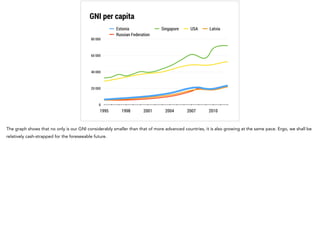
GNI per capita 
80 000 
60 000 
40 000 
20 000 
0 
Estonia Singapore USA Latvia 
Russian Federation 
1995 1998 2001 2004 2007 2010 
The graph shows that no only is our GNI considerably smaller than that of more advanced countries, it is also growing at the same pace. Ergo, we shall be 
relatively cash-strapped for the foreseeable future.
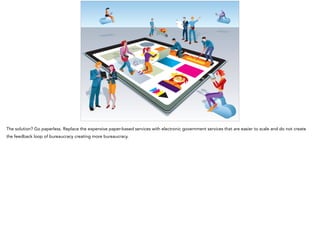
The solution? Go paperless. Replace the expensive paper-based services with electronic government services that are easier to scale and do not create 
the feedback loop of bureaucracy creating more bureaucracy.
Paperless is the only way to go 
" Otherwise it is hard to have a functional state 
" And we know the fate of non-functional states in these parts 
" It is also very hard to run a business 
" No scale effects to speak off 
" Overhead will reduce revenues per user 
" Business and state faced same problem 
" How to start up such a tiny country/economy? 
" E-Estonia was born in public-private partnership 
Going electronic has been and still is one of the very few viable options Estonia has. Alternatives would leave less resources to developing other aspects a 
state should have and this would be an immediate security concern. 
Businesses in Estonia have faced and still do face very similar problems, the market is very small for them. There is a real danger of turning into a small 
homogenized corner of some bigger market which would lead to identity loss and be thus contrary to our constitution. 
E-Estonia was largely started up because both parties realized this problem simultaneously and were able to support each other in going digital. Banks, 
telcos, software houses etc. have played a huge role in our road thus far.
Digital continuity becomes a problem 
" We cannot switch back to paper 
" For the reasons we went digital in the first place 
" Also because we no longer know how 
" Digital is built deep into all aspects of Estonia 
" Business processes shaped around requesting data, not 
delivering documents 
" This does not scale without digital 
In the digital world, this is certainly the case. The more digitized one is, the more dangerous digital risks become. Estonia can not go back to paperless 
simply because we no longer know how. This has been the case for so long, our business processes have adapted. 
For example, a common practice has companies supplying a certificate of tax status as part of public tender processes to make sure they do not owe 
taxes to the state. In Estonia one would execute a query against the tax board information system instead asking for the status of a particular company. 
Issuing a certificate would also be meaningless as companies can go and change their tax declarations at will altering their financial standing with the 
state.
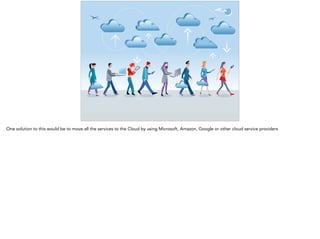
One solution to this would be to move all the services to the Cloud by using Microsoft, Amazon, Google or other cloud service providers
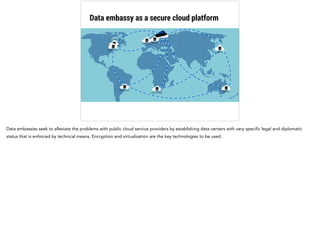
Data embassy as a secure cloud platform 
Data embassies seek to alleviate the problems with public cloud service providers by establishing data centers with very specific legal and diplomatic 
status that is enforced by technical means. Encryption and virtualization are the key technologies to be used.
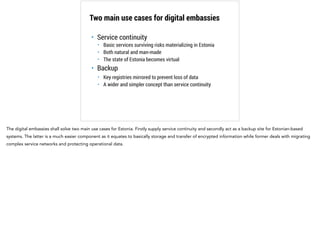
Two main use cases for digital embassies 
" Service continuity 
" Basic services surviving risks materializing in Estonia 
" Both natural and man-made 
" The state of Estonia becomes virtual 
" Backup 
" Key registries mirrored to prevent loss of data 
" A wider and simpler concept than service continuity 
The digital embassies shall solve two main use cases for Estonia. Firstly supply service continuity and secondly act as a backup site for Estonian-based 
systems. The latter is a much easier component as it equates to basically storage and transfer of encrypted information while former deals with migrating 
complex service networks and protecting operational data.
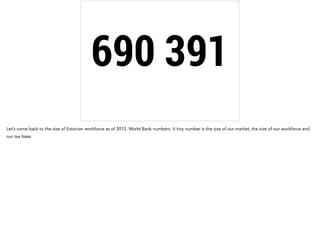
690 391 
Let’s come back to the size of Estonian workforce as of 2012. World Bank numbers. It tiny number is the size of our market, the size of our workforce and 
our tax base.
Estonian population is tiny and hard to grow 
" Demographic trends show decline, not growth 
" Immigration is not a large-scale solution 
" Low attraction to immigrants compared to neighbors 
" Already struggling with existing non-Estonian population 
" Low population density is seen as a virtue 
" More people bring more complexity 
" From number of tax men needed to road safety 
" A lean government is hard to scale up 
What little we could absorb in terms of immigration is offset by demographic trends of aging and decline in population numbers. Also, let’s face it, Estonia 
is much less attractive to immigrants than countries only a short ferry ride or flight away. 
! 
Even if we could bring more people in by natural or artificial growth, they would bring their issues with them. Starting from policemen and doctors to 
roads, we would need to provide infrastructure that will eat into the benefits rising population generates. And, as we have little resources, our relatively 
lean government structures would need to be re-shaped significantly to cope.
How to grow the 
number of Estonians? 
! 
So how do we grow the number of Estonians, then?
Electronic residency. We should offer some aspect of Estonian citizenship to every single person in the world. After having issued a digital identity card, 
everybody should be able to consume the services from our digital ecosystem from banks to telcos to government agencies.
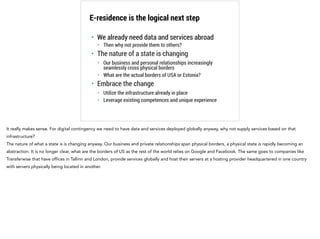
E-residence is the logical next step 
" We already need data and services abroad 
" Then why not provide them to others? 
" The nature of a state is changing 
" Our business and personal relationships increasingly 
seamlessly cross physical borders 
" What are the actual borders of USA or Estonia? 
" Embrace the change 
" Utilize the infrastructure already in place 
" Leverage existing competences and unique experience 
It really makes sense. For digital contingency we need to have data and services deployed globally anyway, why not supply services based on that 
infrastructure? 
The nature of what a state is is changing anyway. Our business and private relationships span physical borders, a physical state is rapidly becoming an 
abstraction. It is no longer clear, what are the borders of US as the rest of the world relies on Google and Facebook. The same goes to companies like 
Transferwise that have offices in Tallinn and London, provide services globally and host their servers at a hosting provider headquartered in one country 
with servers physically being located in another.
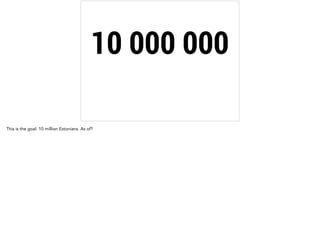
10 000 000 
This is the goal. 10 million Estonians. As of?
Thank you! 
Andres Kütt 
andres.kutt@ria.ee

Country without borders

  • 1.
    Country without borders Estonia’s strategy to become the first truly digitized administration in the world Andres Kütt Estonian Information System Authority / Architect ! 07th of October 2014
  • 2.
    Estonia in perspective Population Labor force PPP gross national income per capita Estonia 1 690 391 23,280 Latvia 2 1 046 220 21,820 Russian Federation 144 76 872 229 22,800 Singapore 5 3 021 715 71,900 United States 314 158 666 072 52,610 1 - In millions, rounded to 1 Estonia is so tiny a quarter of our population can become a rounding error.
  • 3.
    GNI per capita 80 000 60 000 40 000 20 000 0 Estonia Singapore USA Latvia Russian Federation 1995 1998 2001 2004 2007 2010 The graph shows that no only is our GNI considerably smaller than that of more advanced countries, it is also growing at the same pace. Ergo, we shall be relatively cash-strapped for the foreseeable future.
  • 4.
    The solution? Gopaperless. Replace the expensive paper-based services with electronic government services that are easier to scale and do not create the feedback loop of bureaucracy creating more bureaucracy.
  • 5.
    Paperless is theonly way to go " Otherwise it is hard to have a functional state " And we know the fate of non-functional states in these parts " It is also very hard to run a business " No scale effects to speak off " Overhead will reduce revenues per user " Business and state faced same problem " How to start up such a tiny country/economy? " E-Estonia was born in public-private partnership Going electronic has been and still is one of the very few viable options Estonia has. Alternatives would leave less resources to developing other aspects a state should have and this would be an immediate security concern. Businesses in Estonia have faced and still do face very similar problems, the market is very small for them. There is a real danger of turning into a small homogenized corner of some bigger market which would lead to identity loss and be thus contrary to our constitution. E-Estonia was largely started up because both parties realized this problem simultaneously and were able to support each other in going digital. Banks, telcos, software houses etc. have played a huge role in our road thus far.
  • 6.
    Digital continuity becomesa problem " We cannot switch back to paper " For the reasons we went digital in the first place " Also because we no longer know how " Digital is built deep into all aspects of Estonia " Business processes shaped around requesting data, not delivering documents " This does not scale without digital In the digital world, this is certainly the case. The more digitized one is, the more dangerous digital risks become. Estonia can not go back to paperless simply because we no longer know how. This has been the case for so long, our business processes have adapted. For example, a common practice has companies supplying a certificate of tax status as part of public tender processes to make sure they do not owe taxes to the state. In Estonia one would execute a query against the tax board information system instead asking for the status of a particular company. Issuing a certificate would also be meaningless as companies can go and change their tax declarations at will altering their financial standing with the state.
  • 7.
    One solution tothis would be to move all the services to the Cloud by using Microsoft, Amazon, Google or other cloud service providers
  • 9.
    Data embassy asa secure cloud platform Data embassies seek to alleviate the problems with public cloud service providers by establishing data centers with very specific legal and diplomatic status that is enforced by technical means. Encryption and virtualization are the key technologies to be used.
  • 10.
    Two main usecases for digital embassies " Service continuity " Basic services surviving risks materializing in Estonia " Both natural and man-made " The state of Estonia becomes virtual " Backup " Key registries mirrored to prevent loss of data " A wider and simpler concept than service continuity The digital embassies shall solve two main use cases for Estonia. Firstly supply service continuity and secondly act as a backup site for Estonian-based systems. The latter is a much easier component as it equates to basically storage and transfer of encrypted information while former deals with migrating complex service networks and protecting operational data.
  • 11.
    690 391 Let’scome back to the size of Estonian workforce as of 2012. World Bank numbers. It tiny number is the size of our market, the size of our workforce and our tax base.
  • 12.
    Estonian population istiny and hard to grow " Demographic trends show decline, not growth " Immigration is not a large-scale solution " Low attraction to immigrants compared to neighbors " Already struggling with existing non-Estonian population " Low population density is seen as a virtue " More people bring more complexity " From number of tax men needed to road safety " A lean government is hard to scale up What little we could absorb in terms of immigration is offset by demographic trends of aging and decline in population numbers. Also, let’s face it, Estonia is much less attractive to immigrants than countries only a short ferry ride or flight away. ! Even if we could bring more people in by natural or artificial growth, they would bring their issues with them. Starting from policemen and doctors to roads, we would need to provide infrastructure that will eat into the benefits rising population generates. And, as we have little resources, our relatively lean government structures would need to be re-shaped significantly to cope.
  • 13.
    How to growthe number of Estonians? ! So how do we grow the number of Estonians, then?
  • 14.
    Electronic residency. Weshould offer some aspect of Estonian citizenship to every single person in the world. After having issued a digital identity card, everybody should be able to consume the services from our digital ecosystem from banks to telcos to government agencies.
  • 15.
    E-residence is thelogical next step " We already need data and services abroad " Then why not provide them to others? " The nature of a state is changing " Our business and personal relationships increasingly seamlessly cross physical borders " What are the actual borders of USA or Estonia? " Embrace the change " Utilize the infrastructure already in place " Leverage existing competences and unique experience It really makes sense. For digital contingency we need to have data and services deployed globally anyway, why not supply services based on that infrastructure? The nature of what a state is is changing anyway. Our business and private relationships span physical borders, a physical state is rapidly becoming an abstraction. It is no longer clear, what are the borders of US as the rest of the world relies on Google and Facebook. The same goes to companies like Transferwise that have offices in Tallinn and London, provide services globally and host their servers at a hosting provider headquartered in one country with servers physically being located in another.
  • 16.
    10 000 000 This is the goal. 10 million Estonians. As of?
  • 17.
    Thank you! AndresKütt andres.kutt@ria.ee