What schools need to know
‐ legislation and statutory guidance
‐ the new Act
‐ ‘prevent duty’ statutory guidance
‐ duty to promote ‘British values’
‐ compliance with the new duty
‐ impact of non-compliance
‐ Ofsted
‐ six questions
• Trojan Horse affair
• “three missing London schoolgirls
'travelling to Syria to join Isil” –
February 2015
• “ISIS: two more teens feared to have
fled UK to join terror group in Syria” –
April 2015
• Counter-terrorism and Security Act
2015
• prevent duty guidance
• Education Acts 1996 and 2002 and
Independent School Standards
Regulations 2014
• promoting fundamental British values –
departmental advice (November 2014)
• keeping children safe in education
(March 2015)
• S.149 Equality Act 2010 – public sector
equality duty
• Royal assent 12 February 2015
• S.26 places a duty on specified
authorities to have “due regard to the
need to prevent people from being
drawn into terrorism”, and challenge
extremist ideas that support or are
shared by terrorist groups
• schedule 6 confirms that all schools
(whether maintained or independent)
are specified authorities for the
purpose of the Act
• S.26 duty comes into force on 1 July
2015
• meaning of ‘due regard’?
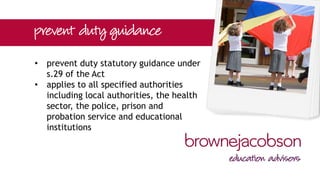
• prevent duty statutory guidance under
s.29 of the Act
• applies to all specified authorities
including local authorities, the health
sector, the police, prison and
probation service and educational
institutions
• sector-specific guidance for each
specified authority. Pages 10-13
relevant for schools (excluding higher
and further education)
• stems back to 2011 – not new
• part of overall counter-terrorism
strategy
• aim: to reduce the threat to the UK
from terrorism or stopping people
becoming terrorists or supporting
terrorism
• defines extremism
• risk-based approach
• being drawn into terrorism includes violent
extremism and non-violent extremism which
can create an atmosphere conducive to
terrorism and can popularise views which
terrorists exploit
• extremism is defined as: “vocal or active
opposition to fundamental British values,
including democracy, the rule of law,
individual liberty and mutual respect and
tolerance of different faiths and beliefs. We
also include in our definition of extremism
calls for the death of members of our armed
forces” – para 7 prevent guidance
“all specified authorities, as a starting
point, should demonstrate an awareness
and understanding of the risk of
radicalisation in their area, institution or
body. This risk will vary greatly and can
change rapidly; but no area, institution
or body is risk free” – para 14 prevent
guidance
1. leadership: understand the risk,
communicate and promote the duty,
monitor implementation
2. working in partnership: evidence of
productive co-operation with other
authorities e.g. local prevent co-ordinators,
police, LAs and existing multi-agency
forums
3. appropriate capabilities: ensure staff know
what measures are available to prevent
pupils from being drawn into terrorism, how
to challenge extremist ideology and obtain
support. Training is key
• assessed on a case-by-case basis
• necessity and proportionality
• consent
• Data Protection Act principles
• duty of confidentiality
• promoted through spiritual, moral,
social and cultural development
• self-knowledge, self-esteem and self-
confidence, distinguish right from
wrong, contributing to their locality
and society, further tolerance and
harmony, encourage respect for other
people and the rule of law
• understanding of democracy and
importance of identifying and
combatting discrimination
• how schools evidence compliance with
the pro-active duty is vague
‐ new/updated policies?
‐ staff training?
‐ pupil parliaments?
‐ surveys?
• how schools evidence compliance with
the pro-active duty is vague
‐ spy software? e.g. Impero, Future
Digital, Securus etc.
‐ workshops for parents?
‐ other?
• maintain appropriate records
• schools in areas of higher risk
expected to do more – regional
variations
• referral procedure (could include
Channel Panels or Children’s Social
Care)
• robust safeguarding policies reviewed
at least annually and when any new
guidance or legislation is published
• threshold for referrals?
• stand alone or incorporated in
safeguarding?
• what to include?
• clear protocols for visiting speakers
• safeguarding arrangements take into
account policies and procedures of
Local Safeguarding Children Board
• training for staff to give knowledge
and confidence to challenge extremist
ideas and to know where to refer
pupils for further help
• appropriate filtering levels to limit
access to specific web content
• Prevent Oversight Board may
recommend that the SoS use the
power of direction under s.30 of the
Act (soft sanction)
• this power is only used when other
options for engagement and
improvement have been exhausted and
only to ensure the implementation and
delivery of the prevent duty
• power of direction unlikely to be used
in context of schools
• intervention methods and threat of
Ofsted
• already must have regard to school’s
“approach to keeping pupils safe from
the dangers of radicalisation and
extremism, and what is done when it
is suspected that pupils are vulnerable
to these”
• when judging behaviour safety, “look
at the extent to which pupils are able
to understand, respond to and
calculate risk effectively, for example
risks associated with… radicalisation
and extremism and are aware of the
support available to them”
• regional variations
• will schools be expected to do
anything further?
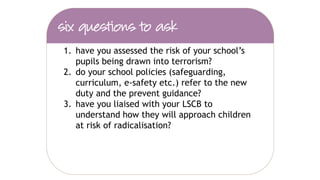
1. have you assessed the risk of your school’s
pupils being drawn into terrorism?
2. do your school policies (safeguarding,
curriculum, e-safety etc.) refer to the new
duty and the prevent guidance?
3. have you liaised with your LSCB to
understand how they will approach children
at risk of radicalisation?
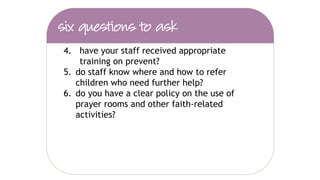
4. have your staff received appropriate
training on prevent?
5. do staff know where and how to refer
children who need further help?
6. do you have a clear policy on the use of
prayer rooms and other faith-related
activities?
a) guidance most reaffirms existing
requirements on schools
b) sanctions under the Act are limited
c) Ofsted’s role remains unchanged
• any real impact? On what schools
already do?
• check compliance and take
appropriate steps
Hayley Roberts | 0121 237 3994
hayley.roberts@brownejacobson.com
Please note
The information contained in these notes is based on the position at
June 2015. It does, of course, only represent a summary of the subject
matter covered and is not intended to be a substitute for detailed
advice. If you would like to discuss any of the matters covered in
further detail, our team would be happy to do so.
© Browne Jacobson LLP 2015. Browne Jacobson LLP is a limited
liability partnership.

Counter-terrorism and Security Act 2015: What schools need to know - Hayley Roberts - June 2015

  • 2.
  • 3.
    ‐ legislation andstatutory guidance ‐ the new Act ‐ ‘prevent duty’ statutory guidance ‐ duty to promote ‘British values’ ‐ compliance with the new duty ‐ impact of non-compliance ‐ Ofsted ‐ six questions
  • 4.
    • Trojan Horseaffair • “three missing London schoolgirls 'travelling to Syria to join Isil” – February 2015 • “ISIS: two more teens feared to have fled UK to join terror group in Syria” – April 2015
  • 5.
    • Counter-terrorism andSecurity Act 2015 • prevent duty guidance • Education Acts 1996 and 2002 and Independent School Standards Regulations 2014
  • 6.
    • promoting fundamentalBritish values – departmental advice (November 2014) • keeping children safe in education (March 2015) • S.149 Equality Act 2010 – public sector equality duty
  • 7.
    • Royal assent12 February 2015 • S.26 places a duty on specified authorities to have “due regard to the need to prevent people from being drawn into terrorism”, and challenge extremist ideas that support or are shared by terrorist groups
  • 8.
    • schedule 6confirms that all schools (whether maintained or independent) are specified authorities for the purpose of the Act • S.26 duty comes into force on 1 July 2015 • meaning of ‘due regard’?
  • 9.
    • prevent dutystatutory guidance under s.29 of the Act • applies to all specified authorities including local authorities, the health sector, the police, prison and probation service and educational institutions
  • 10.
    • sector-specific guidancefor each specified authority. Pages 10-13 relevant for schools (excluding higher and further education)
  • 11.
    • stems backto 2011 – not new • part of overall counter-terrorism strategy • aim: to reduce the threat to the UK from terrorism or stopping people becoming terrorists or supporting terrorism
  • 12.
    • defines extremism •risk-based approach
  • 13.
    • being drawninto terrorism includes violent extremism and non-violent extremism which can create an atmosphere conducive to terrorism and can popularise views which terrorists exploit
  • 14.
    • extremism isdefined as: “vocal or active opposition to fundamental British values, including democracy, the rule of law, individual liberty and mutual respect and tolerance of different faiths and beliefs. We also include in our definition of extremism calls for the death of members of our armed forces” – para 7 prevent guidance
  • 15.
    “all specified authorities,as a starting point, should demonstrate an awareness and understanding of the risk of radicalisation in their area, institution or body. This risk will vary greatly and can change rapidly; but no area, institution or body is risk free” – para 14 prevent guidance
  • 16.
    1. leadership: understandthe risk, communicate and promote the duty, monitor implementation
  • 17.
    2. working inpartnership: evidence of productive co-operation with other authorities e.g. local prevent co-ordinators, police, LAs and existing multi-agency forums
  • 18.
    3. appropriate capabilities:ensure staff know what measures are available to prevent pupils from being drawn into terrorism, how to challenge extremist ideology and obtain support. Training is key
  • 19.
    • assessed ona case-by-case basis • necessity and proportionality • consent • Data Protection Act principles • duty of confidentiality
  • 20.
    • promoted throughspiritual, moral, social and cultural development • self-knowledge, self-esteem and self- confidence, distinguish right from wrong, contributing to their locality and society, further tolerance and harmony, encourage respect for other people and the rule of law
  • 21.
    • understanding ofdemocracy and importance of identifying and combatting discrimination
  • 22.
    • how schoolsevidence compliance with the pro-active duty is vague ‐ new/updated policies? ‐ staff training? ‐ pupil parliaments? ‐ surveys?
  • 23.
    • how schoolsevidence compliance with the pro-active duty is vague ‐ spy software? e.g. Impero, Future Digital, Securus etc. ‐ workshops for parents? ‐ other?
  • 24.
    • maintain appropriaterecords • schools in areas of higher risk expected to do more – regional variations • referral procedure (could include Channel Panels or Children’s Social Care)
  • 25.
    • robust safeguardingpolicies reviewed at least annually and when any new guidance or legislation is published • threshold for referrals? • stand alone or incorporated in safeguarding? • what to include?
  • 26.
    • clear protocolsfor visiting speakers • safeguarding arrangements take into account policies and procedures of Local Safeguarding Children Board
  • 27.
    • training forstaff to give knowledge and confidence to challenge extremist ideas and to know where to refer pupils for further help • appropriate filtering levels to limit access to specific web content
  • 28.
    • Prevent OversightBoard may recommend that the SoS use the power of direction under s.30 of the Act (soft sanction)
  • 29.
    • this poweris only used when other options for engagement and improvement have been exhausted and only to ensure the implementation and delivery of the prevent duty
  • 30.
    • power ofdirection unlikely to be used in context of schools • intervention methods and threat of Ofsted
  • 31.
    • already musthave regard to school’s “approach to keeping pupils safe from the dangers of radicalisation and extremism, and what is done when it is suspected that pupils are vulnerable to these”
  • 32.
    • when judgingbehaviour safety, “look at the extent to which pupils are able to understand, respond to and calculate risk effectively, for example risks associated with… radicalisation and extremism and are aware of the support available to them”
  • 33.
    • regional variations •will schools be expected to do anything further?
  • 34.
    1. have youassessed the risk of your school’s pupils being drawn into terrorism? 2. do your school policies (safeguarding, curriculum, e-safety etc.) refer to the new duty and the prevent guidance? 3. have you liaised with your LSCB to understand how they will approach children at risk of radicalisation?
  • 35.
    4. have yourstaff received appropriate training on prevent? 5. do staff know where and how to refer children who need further help? 6. do you have a clear policy on the use of prayer rooms and other faith-related activities?
  • 36.
    a) guidance mostreaffirms existing requirements on schools b) sanctions under the Act are limited c) Ofsted’s role remains unchanged
  • 37.
    • any realimpact? On what schools already do? • check compliance and take appropriate steps
  • 38.
    Hayley Roberts |0121 237 3994 hayley.roberts@brownejacobson.com Please note The information contained in these notes is based on the position at June 2015. It does, of course, only represent a summary of the subject matter covered and is not intended to be a substitute for detailed advice. If you would like to discuss any of the matters covered in further detail, our team would be happy to do so. © Browne Jacobson LLP 2015. Browne Jacobson LLP is a limited liability partnership.