Don’t Risk IT: Managing & Mitigating Risk in Your Business Melinda Fieldus
Agenda Risk Landscape today Risks Scenarios (Whispir) Key Success Factors for Managing Risk How IBM can help (and why IBM)
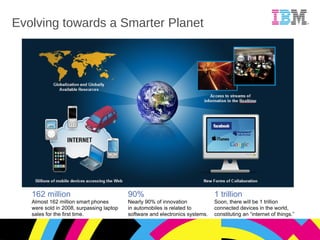
Evolving towards a Smarter Planet 162 million Almost 162 million smart phones were sold in 2008, surpassing laptop sales for the first time. 90% Nearly 90% of innovation  in automobiles is related to  software and electronics systems. 1 trillion Soon, there will be 1 trillion  connected devices in the world, constituting an “internet of things.”
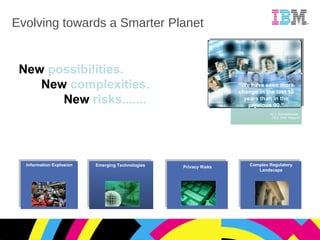
Evolving towards a Smarter Planet “ We have seen more change in the last 10 years than in the previous 90.” Ad J. Scheepbouwer, CEO, KPN Telecom New  possibilities. New  complexities. New  risks....... Information Explosion Emerging Technologies Privacy Risks Complex Regulatory Landscape
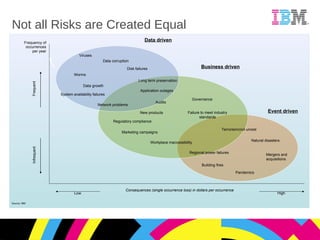
Not all Risks are Created Equal Frequency of occurrences per year Frequent Infrequent Consequences (single occurrence loss) in dollars per occurrence Low High Viruses Worms Disk failures System availability failures Pandemics Natural disasters Application outages Data corruption Network problems Building fires Terrorism/civil unrest Data driven Event driven Business driven Regulatory compliance Workplace inaccessibility Failure to meet industry standards Regional power failures Governance Source: IBM Data growth Long term preservation Mergers and  acquisitions New products Marketing campaigns Audits
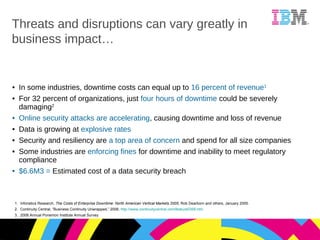
In some industries, downtime  costs can equal up to  16 percent of revenue 1 For 32 percent of organizations, just  four hours of downtime  could be severely damaging 2 Online security attacks are accelerating , causing downtime and loss of revenue Data is growing at  explosive rates  Security and resiliency are  a top area of concern  and spend for all size companies Some industries are  enforcing fines  for  downtime and inability to meet  regulatory compliance $6.6M3 =  Estimated cost of a data security breach Threats and disruptions can vary greatly in business impact… Infonetics Research,  The Costs of Enterprise Downtime: North American Vertical Markets 2005 , Rob Dearborn and others, January 2005. Continuity Central, “Business Continuity Unwrapped,” 2006,  http://www.continuitycentral.com/feature0358.htm 2008 Annual Ponemon Institute Annual Survey
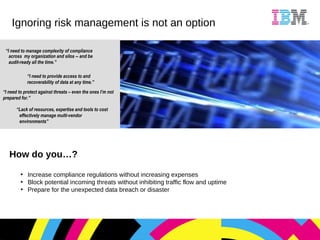
How do you…? Increase compliance regulations without increasing expenses Block potential incoming threats without inhibiting traffic flow and uptime Prepare for the unexpected data breach or disaster Ignoring risk management is not an option “ I need to manage complexity of compliance across  my organization and silos -- and be audit-ready all the time.”   “ Lack of resources, expertise and tools to cost effectively manage multi-vendor environments” “ I need to protect against threats – even the ones I’m not prepared for.”  “ I need to provide access to and recoverability of data at any time.”
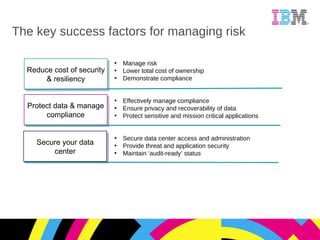
The key success factors for managing risk Manage risk Lower total cost of ownership Demonstrate compliance Effectively manage compliance Ensure privacy and recoverability of data  Protect sensitive and mission critical applications Secure data center access and administration Provide threat and application security Maintain ‘audit-ready’ status Reduce cost of security & resiliency Protect data & manage compliance Secure your data center
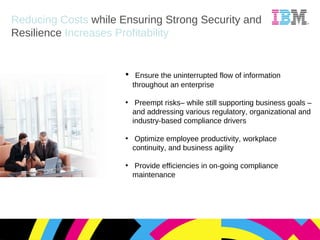
Ensure the uninterrupted flow of information throughout an enterprise Preempt risks– while still supporting business goals – and addressing various regulatory, organizational and industry-based compliance drivers Optimize employee productivity, workplace continuity, and business agility Provide efficiencies in on-going compliance maintenance Reducing Costs  while Ensuring Strong Security and Resilience  Increases Profitability
Fuel Innovation   by  Protecting Critical Data  while   Meeting  Regulatory Compliance  Mandates Prevent unauthorized deletion or modification of  company data Reduce risks related to non compliance to regulatory requirements Protect sensitive business processes and mission critical applications and information Leverage new technologies and innovations to achieve business goals
Secure the Datacentre   from Threats to Ensure Productivity, Profitability and   Reputation Management Control and monitor internal and external user access and modification to sensitive information, applications and infrastructure Gain visibility of organization security posture across heterogeneous datacenter assets Achieve comprehensive and proactive security control for protection across the threat landscape Avoid costs of downtime associated with protecting your data center from outages; simplify the recovery of data across the enterprise
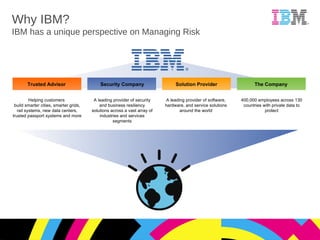
Why IBM? IBM has a unique perspective on Managing Risk 400,000 employees across 130 countries with private data to protect Helping customers  build smarter cities, smarter grids, rail systems, new data centers, trusted passport systems and more A leading provider of security and business resiliency solutions across a vast array of industries and services segments A leading provider of software, hardware, and service solutions around the world Trusted Advisor Security Company Solution Provider The Company
A smarter business needs smarter systems . Reduce the cost of security and resiliency. Protect data and manage compliance. Secure your data center . IBM can help you  manage risk .
Textit Live Polling Q: Is addressing RISK a key focus in your current IT Strategy? Y / N

Don't risk it presentation

  • 1.
    Don’t Risk IT:Managing & Mitigating Risk in Your Business Melinda Fieldus
  • 2.
    Agenda Risk Landscapetoday Risks Scenarios (Whispir) Key Success Factors for Managing Risk How IBM can help (and why IBM)
  • 3.
    Evolving towards aSmarter Planet 162 million Almost 162 million smart phones were sold in 2008, surpassing laptop sales for the first time. 90% Nearly 90% of innovation in automobiles is related to software and electronics systems. 1 trillion Soon, there will be 1 trillion connected devices in the world, constituting an “internet of things.”
  • 4.
    Evolving towards aSmarter Planet “ We have seen more change in the last 10 years than in the previous 90.” Ad J. Scheepbouwer, CEO, KPN Telecom New possibilities. New complexities. New risks....... Information Explosion Emerging Technologies Privacy Risks Complex Regulatory Landscape
  • 5.
    Not all Risksare Created Equal Frequency of occurrences per year Frequent Infrequent Consequences (single occurrence loss) in dollars per occurrence Low High Viruses Worms Disk failures System availability failures Pandemics Natural disasters Application outages Data corruption Network problems Building fires Terrorism/civil unrest Data driven Event driven Business driven Regulatory compliance Workplace inaccessibility Failure to meet industry standards Regional power failures Governance Source: IBM Data growth Long term preservation Mergers and acquisitions New products Marketing campaigns Audits
  • 6.
    In some industries,downtime costs can equal up to 16 percent of revenue 1 For 32 percent of organizations, just four hours of downtime could be severely damaging 2 Online security attacks are accelerating , causing downtime and loss of revenue Data is growing at explosive rates Security and resiliency are a top area of concern and spend for all size companies Some industries are enforcing fines for downtime and inability to meet regulatory compliance $6.6M3 = Estimated cost of a data security breach Threats and disruptions can vary greatly in business impact… Infonetics Research, The Costs of Enterprise Downtime: North American Vertical Markets 2005 , Rob Dearborn and others, January 2005. Continuity Central, “Business Continuity Unwrapped,” 2006, http://www.continuitycentral.com/feature0358.htm 2008 Annual Ponemon Institute Annual Survey
  • 7.
    How do you…?Increase compliance regulations without increasing expenses Block potential incoming threats without inhibiting traffic flow and uptime Prepare for the unexpected data breach or disaster Ignoring risk management is not an option “ I need to manage complexity of compliance across my organization and silos -- and be audit-ready all the time.” “ Lack of resources, expertise and tools to cost effectively manage multi-vendor environments” “ I need to protect against threats – even the ones I’m not prepared for.” “ I need to provide access to and recoverability of data at any time.”
  • 8.
    The key successfactors for managing risk Manage risk Lower total cost of ownership Demonstrate compliance Effectively manage compliance Ensure privacy and recoverability of data Protect sensitive and mission critical applications Secure data center access and administration Provide threat and application security Maintain ‘audit-ready’ status Reduce cost of security & resiliency Protect data & manage compliance Secure your data center
  • 9.
    Ensure the uninterruptedflow of information throughout an enterprise Preempt risks– while still supporting business goals – and addressing various regulatory, organizational and industry-based compliance drivers Optimize employee productivity, workplace continuity, and business agility Provide efficiencies in on-going compliance maintenance Reducing Costs while Ensuring Strong Security and Resilience Increases Profitability
  • 10.
    Fuel Innovation by Protecting Critical Data while Meeting Regulatory Compliance Mandates Prevent unauthorized deletion or modification of company data Reduce risks related to non compliance to regulatory requirements Protect sensitive business processes and mission critical applications and information Leverage new technologies and innovations to achieve business goals
  • 11.
    Secure the Datacentre from Threats to Ensure Productivity, Profitability and Reputation Management Control and monitor internal and external user access and modification to sensitive information, applications and infrastructure Gain visibility of organization security posture across heterogeneous datacenter assets Achieve comprehensive and proactive security control for protection across the threat landscape Avoid costs of downtime associated with protecting your data center from outages; simplify the recovery of data across the enterprise
  • 12.
    Why IBM? IBMhas a unique perspective on Managing Risk 400,000 employees across 130 countries with private data to protect Helping customers build smarter cities, smarter grids, rail systems, new data centers, trusted passport systems and more A leading provider of security and business resiliency solutions across a vast array of industries and services segments A leading provider of software, hardware, and service solutions around the world Trusted Advisor Security Company Solution Provider The Company
  • 13.
    A smarter businessneeds smarter systems . Reduce the cost of security and resiliency. Protect data and manage compliance. Secure your data center . IBM can help you manage risk .
  • 14.
    Textit Live PollingQ: Is addressing RISK a key focus in your current IT Strategy? Y / N

Editor's Notes

  • #2 Risk is an issue being addressed by almost every company in business today. My name is Melinda Fieldus, I am the Risk Marketing Manager for IBM’s Global Technology Services division and I will over the course of the next 25 minutes be taking you on a journey…. - The Risk Landscape companies are facing today The Key Success Factors for managing risk So, let’s define what we mean by risk. Risk is the threat a business faces if something were to happen to it that would affect its ability to generate revenue, to sell its product, to make a profit. Companies faces risk differently. And the implications of different types of risks can include: downtime, non-compliance, litigation, fines and even bankruptcy. So, risk is commonly on the agenda of the senior mgmt team. In fact, IBM’s Global CIO Study last year found that 71% of CIOs rank risk as 1 of their top 3 priorities.
  • #3 Risk is an issue being addressed by almost every company in business today. My name is Melinda Fieldus, I am the Risk Marketing Manager for IBM’s Global Technology Services division and I will over the course of the next 25 minutes be taking you on a journey…. - The Risk Landscape companies are facing today The Key Success Factors for managing risk So, to start with …let’s define what we mean by risk. Risk is the threat a business faces if something were to happen to it that would affect its ability to generate revenue, to sell its product, to make a profit. Companies faces risk differently. And the implications of different types of risks can include: downtime, non-compliance, litigation, fines and even bankruptcy. So, risk is commonly on the agenda of the senior mgmt team. In fact, IBM’s Global CIO Study last year found that 71% of CIOs rank risk as 1 of their top 3 priorities.
  • #4 The situation is is that the world is becoming smaller, flatter, and smarter. More and more people and machines are becoming digitally aware and connected. This year, it is estimated that 1 trillion devices will be connected to the net. While this new, digitally-connected planet is creating many exciting new opportunities and capabilities, it is also creating an explosion in the amount of data and the number of transactions and assets that must be managed and controlled. And from this we are seeing the introduction of a number of risks… The rapid growth in data and digitally aware devices is straining our systems and infrastructure. The exponential growth in communications subscribers and services is exposing limitations in bandwidth and storage capacity. And, the connection of more and more networks, to the internet is exposing businesses to cyber threats. In addition to addressing system and infrastructure deficiencies that threaten future growth, organizations must also address rising customer expectations for quality service and increasing competitive pressures.
  • #5 So, as you can see, with a smarter planet comes… The reality of living in a globally integrated world impacts us all
  • #6 Unfortunately, not all risks are created equal – they vary greatly by industry, macroeconomic factors, company size, geographic location and technology availability to name a few. But generally speaking the risk landscape can be discussed in the context three different types of threats or risks that a company must be protect itself against. When you look at how these risks are plotted…certain events such as computer viruses may occur frequently and have a lower impact on the corporation; whereas other less frequent events such as a natural disaster could have devastating impact. You only have to look at the recent Icelandic volcano activity just over a week ago which some analysts claim have cost airlines approximately $1million an hour. What’s clear is that companies today must be able to address a spectrum of risks that could potentially impact their business if they are to survive and grow.
  • #7 Our own research is backed up by analysts’ findings showing that our clients are no longer able to accept outages of any kind, from any cause, and that critical applications are not the only applications on the “need to be available 24/7” list. IT managers are being squeezed on all sides to reduce planned downtime for maintenance, upgrades, backups, etc.--all of which can create exposure from lack of preventative and necessary maintenance. Additionally IT is being asked to support security or compliance requirements and reporting as security attacks increase and unencrypted data is lost through a variety of sources – malicious or accidental. IT is also expected to provide an environment where new services or applications can be brought on line as fast as possible with minimal disruption to existing business processes and provide scalable hardware that allows for expansion when required. And we see the effects of downtime. It’s amazing that in some industries, downtime can equal 16 percent of revenue. That’s a staggering number. And for 32 percent of organizations, just four hours of downtime could destroy the company's revenue numbers for the year. We also know that some industries are facing fines from regulators if business is disrupted or if information and data are not available for a specified period of time – or recoverable within a designated time frame. Increasingly information, data, applications and systems availability are required 24x7. Consolidation and virtualization, global expansion, and the need to have systems geographically dispersed all increase the need to provide the highest levels of availability possible. It’s very important to understand the cost of outages or potential disruptions for any enterprise. The way to determine that, once you have completed the outage analysis, is to do a business impact analysis for your existing and planned applications and systems which support individual business units
  • #8 Our own research is backed up by analysts’ findings showing that our clients are no longer able to accept outages of any kind, from any cause, and that critical applications are not the only applications on the “need to be available 24/7” list. IT managers are being squeezed on all sides to reduce planned downtime for maintenance, upgrades, backups, etc.--all of which can create exposure from lack of preventative and necessary maintenance. Additionally IT is being asked to support security or compliance requirements and reporting as security attacks increase and unencrypted data is lost through a variety of sources – malicious or accidental. IT is also expected to provide an environment where new services or applications can be brought on line as fast as possible with minimal disruption to existing business processes and provide scalable hardware that allows for expansion when required. And we see the effects of downtime. It’s amazing that in some industries, downtime can equal 16 percent of revenue. That’s a staggering number. And for 32 percent of organizations, just four hours of downtime could destroy the company's revenue numbers for the year. We also know that some industries are facing fines from regulators if business is disrupted or if information and data are not available for a specified period of time – or recoverable within a designated time frame. Increasingly information, data, applications and systems availability are required 24x7. Consolidation and virtualization, global expansion, and the need to have systems geographically dispersed all increase the need to provide the highest levels of availability possible. It’s very important to understand the cost of outages or potential disruptions for any enterprise. The way to determine that, once you have completed the outage analysis, is to do a business impact analysis for your existing and planned applications and systems which support individual business units
  • #14 In short, managing risk matters -- now more than ever.
  • #15 In short, managing risk matters -- now more than ever.