Cost Planning, Cost Control
and Cost Analysis
Introduction
 Cost planning and cost control of
buildings is not a new technique,
which has been in use for many
years.
 Costing mean applying prices to
schedule of items of labour and
materials in order to obtain an
approximation of the cost of a
construction project.
 Cost planning and cost control is
not only to determine the probable
cost of a building but to control the
design development throughout the
project, and to provide the client
with value for money.
ss5
1
Cost Planning, Cost Control
and Cost Analysis
Introduction
it can also dictate the nature of
the most important characteristic
of the embryo design, the plan
shape, storey height, type of
finishes and so on.
Time must be spent in the early
stages of design sequence for
cost planning so that careful cost
control by monitoring of
variations can be operated during
construction stage to the
settlement of account to be
effective.
ABM
2
Cost Planning, Cost Control
and Cost Analysis
Introduction
clients’ requirements for an
accurate forecast of the overall
cost is due to:-
 resources such as land and
materials becoming scarce and
expensive.
 modern buildings becoming more
complex,
 fluctuation in labour and material
cost etc.
ss5
3
Cost Planning, Cost Control
and Cost Analysis
What is Cost Analysis?
 The analysis and presentation of
actual costs to facilitate cost
planning.
 It is a systematic breakdown of cost
data according to the element for
cost so as to facilitate examination.
 A cost analysis is a record of how
the cost has been distributed over
the elements of a building; it
includes a brief description of the
overall nature of the project and
specification notes on the general
level of finishes, and so on.
ss5
4
Cost Planning, Cost Control
and Cost Analysis
What is Cost Planning?
 Method of controlling the cost of a
project, within a predetermined
sum, during the design process and
includes the preparation of the cost
plan as well as the subsequent
stages of cost checking.
 Techniques for arriving a cost plan
or cost limit.
 Cost plan is a statement of the
intended cost to spend on each
element of a proposed building
within a total sum and in relation to
a defined standard of quality.
 The allowances set against each
element are cost targets.
5
Cost Planning, Cost Control
and Cost Analysis
What is Cost Planning?
 Cost plan is prepared by finding a
cost analysis of a similar project to
the one under consideration, and by
studying how the cost was
allocated in the old project, in order
to prepare an estimate for the new
scheme.
 The cost information cannot be
used directly from the cost analysis,
and some degree of modification
will have to be made.
 These modifications are usually for
differences in
price level
Quantity
Finishes and standards
ss
6
Cost Planning, Cost Control
and Cost Analysis
What is Cost Control?
Techniques for “protecting” the
cost plan.
Generic term embracing all
methods of controlling the cost of
a building throughout its various
stages from inception to
completion.
Process of cost checking
required the estimated cost of
each element to be checked
against the target set set in the
cost plan.
ss5
7
Cost Planning, Cost Control
and Cost Analysis
The Reasons for Cost Planning
and Cost Control.
To determine the probable cost of
a project development.
To provide a yardstick to control
the design of the development
throughout the project.
To provide the client with value
for money
ss5
8
Cost Planning, Cost Control
and Cost Analysis
The Project Sequence
(based on the RIBA Plan of Work).
 Inception
 Feasibility
 Outline Proposal
 Scheme Design
 Detail Design
 Production
 Information
 Bill of Quantities
 Construction
 Completion
ss5
9
Cost Planning, Cost Control
and Cost Analysis
Phases of Cost Planning.
Inception
At the initial stage, client wishes to
know:
 how much will the idea cost?
 How best might available capital be
spent?
Feasibility
Develop a brief indicating:
 location
 floor areas
 type of accommodation
 nature of the site
 indicative cost etc
Is the project feasible:
 Yes : proceed with the design
 No : review/cancel the project
ss5
10
Cost Planning, Cost Control
and Cost Analysis
Outline Proposal
 Develop the optimum design solution
to satisfy the brief.
 Indicates size, type, location,
number of storeys, plan shape etc.
Scheme Design
 Ensure the overall design is the most
cost effective.
 To establish the final cost plan (limit
of cost)
 indicates dimensioned sketch plans,
elevations, sections, early structural
information, early specification, site
layout etc.
 Preparing brief cost summary/the
elements of cost plan. ss5
11
Cost Planning, Cost Control
and Cost Analysis
Outline Proposal and Scheme
Design
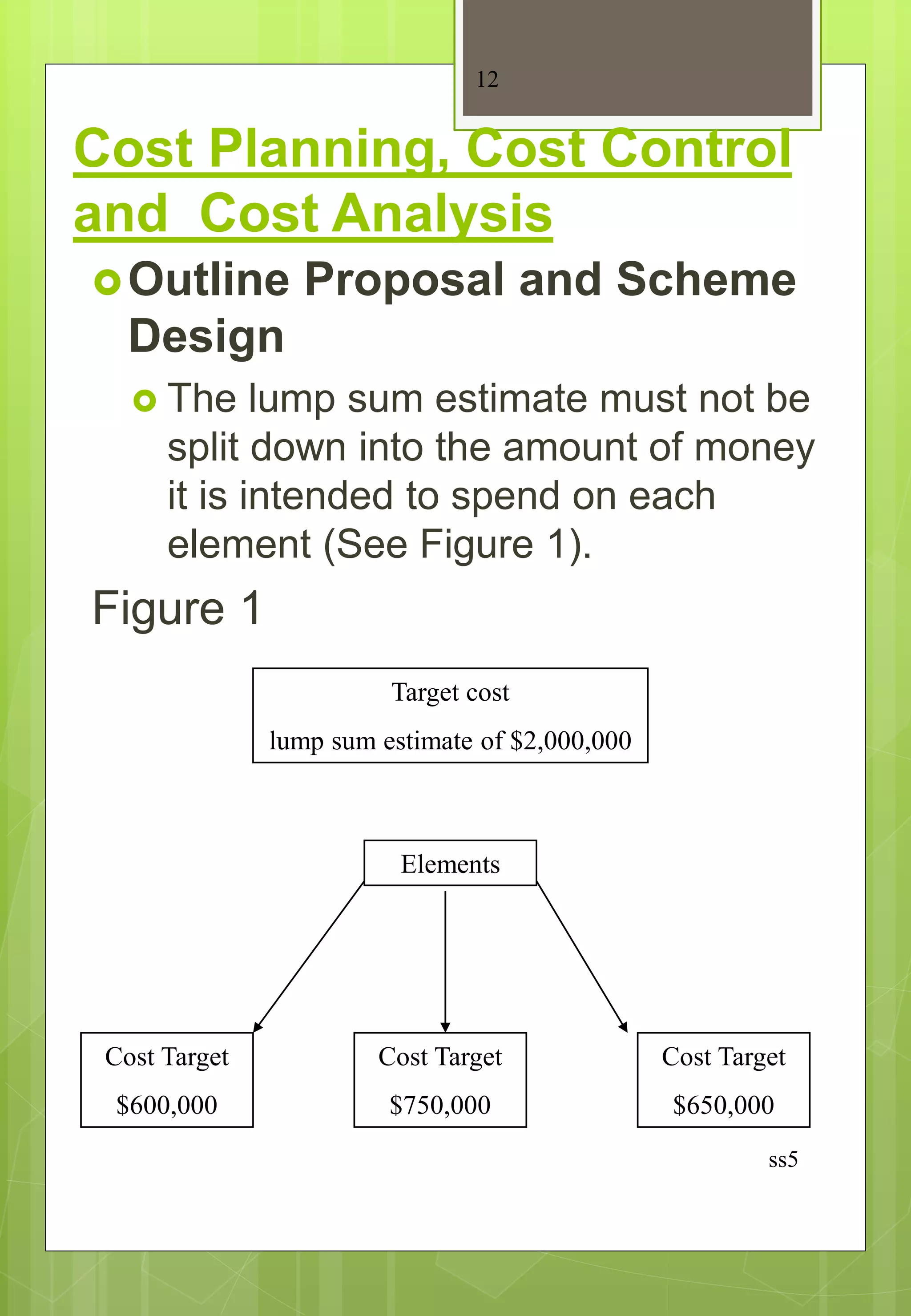
 The lump sum estimate must not be
split down into the amount of money
it is intended to spend on each
element (See Figure 1).
Figure 1
ss5
12
Target cost
lump sum estimate of $2,000,000
Cost Target
$600,000
Cost Target
$750,000
Cost Target
$650,000
Elements
Cost Planning, Cost Control
and Cost Analysis
Outline Proposal and Scheme
Design (Cont’d)
 As the project design develops, the
information available increases and
perhaps changed somewhat.
 After detail design stage the general
layout should not be radically
altered.
 The constituent parts of a cost
analysis are:
 a summary of project, contract and
design/shape information
 a summary of element costs
 an amplified analysis
ss5
13
Cost Planning, Cost Control
and Cost Analysis
Outline Proposal and Scheme
Design (Cont’d)
 A brief cost summary, which is a
statement of how the target cost has
been distributed over major groups
of elements, such as:
 useful in providing an outline proposals
stage a broad but accurate cost allocation
over these groups of elements.
 From these elements, the cost plan is
prepared.
 The designer with the Q.S.’s advice on
the cost implications of various alternative
forms of construction, finishes, and so on;
will also examine the alternatives to meet
the client’s requirements.
 It also enable the Q.S. to examine how
the cost is distributed and whether any
element may be overloaded with capital,
and it allows the Q.S. to alter the balance
of cost within the overall target cost.
ss5
14
Cost Planning, Cost Control
and Cost Analysis
Outline Proposal and Scheme
Design
 Consider this situation, remembering
all the time that the target cost must
not be altered.
Figure 2
ss5
15
Target cost
$300,000
Element No. 1
Frame
$150,000
Element No. 2
Roof
$50,000
Element No. 3
Services
$100,000
Cost Planning, Cost Control
and Cost Analysis
Outline Proposal and Scheme
Design
 After checking against the detail
design, it becomes obvious that
$150,000 for frame is an unrealistic
target and that at least an additional
$15,000 will be required for this
element.
 To prevent the target cost from
increasing to $315,000.
 Compensating reductions must be
made to other elements i.e. it is
found that element 3 or services can
be reduced, it is decided that the
installation to be substituted with a
cheaper alternative.
 Performing this ‘lending and
borrowing’ exercise, the Q.S. runs
the risk of tipping the balance of the
design. ss5
16
Cost Planning, Cost Control
and Cost Analysis
Outline Proposal and Scheme
Design
ss5
17
Target cost
$300,000
Element No. 1
Frame
$170,000
Element No. 2
Roof
$50,000
Element No. 3
Services
$80,000
Cost Planning, Cost Control
and Cost Analysis
Outline Proposal and Scheme
Design
 Care must be taken not to overload
one element at the expense of
another.
 It is also argued by some Q.S. that
client would much prefer to pay the
extra $15,000 than to have the
project’s overall standards reduced,
or the balanced design abolished.
 Sometimes, the substitution of a less
expensive alternative should not
necessarily result in a lowering of
standards, or an abolition of the
balanced design.
ss5
18
Cost Planning, Cost Control
and Cost Analysis
Detail Design Stage (Cost
Control)
 cost checks the Architect’s detailed
design against the cost target set (at
outline cost plan)
 to ensure that design does not
exceed the budgetary cost estimate
 During this stage, the Q.S. will
immediately performed cost check
using the approximate quantities on
each elements after being detailed
against the cost target set.
 This is to allow any necessary
redesign or reallocation of cost to be
carried out before the final drawings
are prepared for tender.
ss5
19
Cost Planning, Cost Control
and Cost Analysis
Construction Stage (Cost
Control)
 Cost updates in the form of financial
report provide control over variation
or deviation made to the contract.
 This tool is vital for monitoring
deviations or variations and ensuring
that the design team and client are
kept updated of changes made
without compromising the budget.
 For new requirements, the cost
updates on anticipated final cost will
also provide the client and/or
designer with an updated financial
commitment so that he can decide
whether to proceed or not.
ss5
20

Cost plan

  • 1.
    Cost Planning, CostControl and Cost Analysis Introduction  Cost planning and cost control of buildings is not a new technique, which has been in use for many years.  Costing mean applying prices to schedule of items of labour and materials in order to obtain an approximation of the cost of a construction project.  Cost planning and cost control is not only to determine the probable cost of a building but to control the design development throughout the project, and to provide the client with value for money. ss5 1
  • 2.
    Cost Planning, CostControl and Cost Analysis Introduction it can also dictate the nature of the most important characteristic of the embryo design, the plan shape, storey height, type of finishes and so on. Time must be spent in the early stages of design sequence for cost planning so that careful cost control by monitoring of variations can be operated during construction stage to the settlement of account to be effective. ABM 2
  • 3.
    Cost Planning, CostControl and Cost Analysis Introduction clients’ requirements for an accurate forecast of the overall cost is due to:-  resources such as land and materials becoming scarce and expensive.  modern buildings becoming more complex,  fluctuation in labour and material cost etc. ss5 3
  • 4.
    Cost Planning, CostControl and Cost Analysis What is Cost Analysis?  The analysis and presentation of actual costs to facilitate cost planning.  It is a systematic breakdown of cost data according to the element for cost so as to facilitate examination.  A cost analysis is a record of how the cost has been distributed over the elements of a building; it includes a brief description of the overall nature of the project and specification notes on the general level of finishes, and so on. ss5 4
  • 5.
    Cost Planning, CostControl and Cost Analysis What is Cost Planning?  Method of controlling the cost of a project, within a predetermined sum, during the design process and includes the preparation of the cost plan as well as the subsequent stages of cost checking.  Techniques for arriving a cost plan or cost limit.  Cost plan is a statement of the intended cost to spend on each element of a proposed building within a total sum and in relation to a defined standard of quality.  The allowances set against each element are cost targets. 5
  • 6.
    Cost Planning, CostControl and Cost Analysis What is Cost Planning?  Cost plan is prepared by finding a cost analysis of a similar project to the one under consideration, and by studying how the cost was allocated in the old project, in order to prepare an estimate for the new scheme.  The cost information cannot be used directly from the cost analysis, and some degree of modification will have to be made.  These modifications are usually for differences in price level Quantity Finishes and standards ss 6
  • 7.
    Cost Planning, CostControl and Cost Analysis What is Cost Control? Techniques for “protecting” the cost plan. Generic term embracing all methods of controlling the cost of a building throughout its various stages from inception to completion. Process of cost checking required the estimated cost of each element to be checked against the target set set in the cost plan. ss5 7
  • 8.
    Cost Planning, CostControl and Cost Analysis The Reasons for Cost Planning and Cost Control. To determine the probable cost of a project development. To provide a yardstick to control the design of the development throughout the project. To provide the client with value for money ss5 8
  • 9.
    Cost Planning, CostControl and Cost Analysis The Project Sequence (based on the RIBA Plan of Work).  Inception  Feasibility  Outline Proposal  Scheme Design  Detail Design  Production  Information  Bill of Quantities  Construction  Completion ss5 9
  • 10.
    Cost Planning, CostControl and Cost Analysis Phases of Cost Planning. Inception At the initial stage, client wishes to know:  how much will the idea cost?  How best might available capital be spent? Feasibility Develop a brief indicating:  location  floor areas  type of accommodation  nature of the site  indicative cost etc Is the project feasible:  Yes : proceed with the design  No : review/cancel the project ss5 10
  • 11.
    Cost Planning, CostControl and Cost Analysis Outline Proposal  Develop the optimum design solution to satisfy the brief.  Indicates size, type, location, number of storeys, plan shape etc. Scheme Design  Ensure the overall design is the most cost effective.  To establish the final cost plan (limit of cost)  indicates dimensioned sketch plans, elevations, sections, early structural information, early specification, site layout etc.  Preparing brief cost summary/the elements of cost plan. ss5 11
  • 12.
    Cost Planning, CostControl and Cost Analysis Outline Proposal and Scheme Design  The lump sum estimate must not be split down into the amount of money it is intended to spend on each element (See Figure 1). Figure 1 ss5 12 Target cost lump sum estimate of $2,000,000 Cost Target $600,000 Cost Target $750,000 Cost Target $650,000 Elements
  • 13.
    Cost Planning, CostControl and Cost Analysis Outline Proposal and Scheme Design (Cont’d)  As the project design develops, the information available increases and perhaps changed somewhat.  After detail design stage the general layout should not be radically altered.  The constituent parts of a cost analysis are:  a summary of project, contract and design/shape information  a summary of element costs  an amplified analysis ss5 13
  • 14.
    Cost Planning, CostControl and Cost Analysis Outline Proposal and Scheme Design (Cont’d)  A brief cost summary, which is a statement of how the target cost has been distributed over major groups of elements, such as:  useful in providing an outline proposals stage a broad but accurate cost allocation over these groups of elements.  From these elements, the cost plan is prepared.  The designer with the Q.S.’s advice on the cost implications of various alternative forms of construction, finishes, and so on; will also examine the alternatives to meet the client’s requirements.  It also enable the Q.S. to examine how the cost is distributed and whether any element may be overloaded with capital, and it allows the Q.S. to alter the balance of cost within the overall target cost. ss5 14
  • 15.
    Cost Planning, CostControl and Cost Analysis Outline Proposal and Scheme Design  Consider this situation, remembering all the time that the target cost must not be altered. Figure 2 ss5 15 Target cost $300,000 Element No. 1 Frame $150,000 Element No. 2 Roof $50,000 Element No. 3 Services $100,000
  • 16.
    Cost Planning, CostControl and Cost Analysis Outline Proposal and Scheme Design  After checking against the detail design, it becomes obvious that $150,000 for frame is an unrealistic target and that at least an additional $15,000 will be required for this element.  To prevent the target cost from increasing to $315,000.  Compensating reductions must be made to other elements i.e. it is found that element 3 or services can be reduced, it is decided that the installation to be substituted with a cheaper alternative.  Performing this ‘lending and borrowing’ exercise, the Q.S. runs the risk of tipping the balance of the design. ss5 16
  • 17.
    Cost Planning, CostControl and Cost Analysis Outline Proposal and Scheme Design ss5 17 Target cost $300,000 Element No. 1 Frame $170,000 Element No. 2 Roof $50,000 Element No. 3 Services $80,000
  • 18.
    Cost Planning, CostControl and Cost Analysis Outline Proposal and Scheme Design  Care must be taken not to overload one element at the expense of another.  It is also argued by some Q.S. that client would much prefer to pay the extra $15,000 than to have the project’s overall standards reduced, or the balanced design abolished.  Sometimes, the substitution of a less expensive alternative should not necessarily result in a lowering of standards, or an abolition of the balanced design. ss5 18
  • 19.
    Cost Planning, CostControl and Cost Analysis Detail Design Stage (Cost Control)  cost checks the Architect’s detailed design against the cost target set (at outline cost plan)  to ensure that design does not exceed the budgetary cost estimate  During this stage, the Q.S. will immediately performed cost check using the approximate quantities on each elements after being detailed against the cost target set.  This is to allow any necessary redesign or reallocation of cost to be carried out before the final drawings are prepared for tender. ss5 19
  • 20.
    Cost Planning, CostControl and Cost Analysis Construction Stage (Cost Control)  Cost updates in the form of financial report provide control over variation or deviation made to the contract.  This tool is vital for monitoring deviations or variations and ensuring that the design team and client are kept updated of changes made without compromising the budget.  For new requirements, the cost updates on anticipated final cost will also provide the client and/or designer with an updated financial commitment so that he can decide whether to proceed or not. ss5 20