9/27/2017
1
COST
ESTIMATION
Processes & Procedures
Eng. Ahmed Said Refaei
‫عليكم‬ ‫السﻼم‬
‫م‬
/
‫رفاعي‬ ‫سعيد‬ ‫أحمد‬
•
‫دفعة‬ ‫مدني‬ ‫مهندس‬
١٩٩٣
‫م‬
•
Planning & Project Control Manager
•
IPMA-Certified Level C
•
ASPMEXP-Member
•
MBA
‫اﻷعمال‬ ‫إدارة‬ ‫في‬ ‫ماجستير‬
-
‫كاليفورنيا‬ ‫جامعة‬
.
•
‫المشروعات‬ ‫ادارة‬ ‫ماجستير‬ ‫يدرس‬
"
‫التشييد‬ ‫مشروعات‬ ‫تمويل‬ ‫تخطيط‬
“
-
‫حلوان‬ ‫جامعة‬
.
•
‫السعودية‬ ‫و‬ ‫قطر‬ ‫و‬ ‫بمصر‬ ‫المقاوﻻت‬ ‫شركات‬ ‫في‬ ‫الهندسية‬ ‫المناصب‬ ‫من‬ ‫العديد‬ ‫في‬ ‫تدرج‬
•
)
‫تنفيذ‬ ‫مهندس‬
-
‫مشروع‬ ‫مدير‬
-
‫إحتياجات‬ ‫مدير‬
-
‫والمتابعة‬ ‫التخطيط‬ ‫مدير‬
(
•
‫صفحة‬ ‫مؤسس‬
/
‫موقع‬
Project Management Practices
•
‫فى‬ ‫العمل‬ ‫ورش‬ ‫من‬ ‫بالعديد‬ ‫قام‬
:
-
•
-
‫المشروع‬ ‫مخاطر‬ ‫إدارة‬
.
-
‫التشييد‬ ‫بناء‬ ‫عناصر‬ ‫تكلفة‬
.
•
-
Managing Profitable Projects.
•
- Critical Chain Management
Eng. Ahmed Said
9/27/2017 ٢
9/27/2017
2
TOPICS:
1. Introduction & Cost estimate types
2. ESTIMATING METHODS AND TOOLS
3. Estimator roles
4. The Cost Estimating Process
1. Part 1: Project Definition Tasks
2. Part 2: Cost Methodology Tasks
3. Part 3: Cost Estimate Tasks
5. Cost Classification (Direct Cost & Indirect Cost)
6. Cost Elements.
7. SUBMISSION OF PROJECT COST ESTIMATES
8. Case Study.
Eng. Ahmed Said
9/27/2017 ٣
INTRODUCTION
 A cost estimate is much more than just a single number. It is a
compilation of many lower-level cost element estimates that span
several years, based on the program schedule.
 Credible cost estimates are produced by following the rigorous 12
steps outlined (GAO).
9/27/2017 Eng. Ahmed Said 4
9/27/2017
3
PURPOSE
 The purpose of a cost estimate is determined by its intended use,
and its intended use determines its scope and detail.
 Cost estimates have two general purposes:
1. to help managers evaluate affordability and performance against plans, as well
as the selection of alternative systems and solutions, and
2. to support the budget process by providing estimates of the funding required to
efficiently execute a program.
9/27/2017 Eng. Ahmed Said 5
WHAT ARE THE DIFFICULTIES PRESENTED IN
COST ESTIMATION?
9/27/2017 Eng. Ahmed Said 6
1- Choice of work method.
2- Output of crew (given the firm’s unique efficiency).
3- Cost of labor
4- Cost of material
5- selection of an appropriate wastage allowance.
6- Addition of overheads and profit
9/27/2017
4
HOW DOES AN ESTIMATOR ESTIMATE THE COST
OF A CONSTRUCTION PROJECT?
 For those reader’s not familiar with cost estimating, the process
involved is complex.
 Learning about cost estimating will help non-cost-estimators
understand what is involved and what limitations exist when
reviewing cost data generated by cost estimators.
 Estimates attempting to hit the target, which is the actual cost.
9/27/2017 Eng. Ahmed Said 7
THE DETAILED ESTIMATE
 Identifies assembly elements.
 Detailed take-off of material quantities.
 The more detailed the estimate, the more accurate the estimate can be.
 As the documents increase in detail, the estimate increases in detail, and the included
contingency decreases.
 More accurate than the conceptual estimate Little or no contingency is added.
Eng. Ahmed Said
9/27/2017 ٨
9/27/2017
5
9/27/2017 Eng. Ahmed Said 9
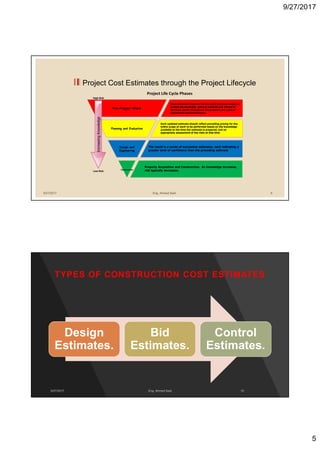
Project Cost Estimates through the Project Lifecycle
Construction
Design and
Engineering
Planning and Evaluation
Pre-Project Work
Property Acquisition and Construction. As knowledge increases,
risk typically decreases.
The result is a series of successive estimates, each indicating a
greater level of confidence than the preceding estimate
Each updated estimate should reflect prevailing pricing for the
entire scope of work to be performed based on the knowledge
available at the time the estimate is prepared, and an
appropriate assessment of the risks at that time
Cost estimates originate during early planning stages of
project development, and are updated and refined at
strategic points throughout the project’s life cycle as
information becomes known.
Increasing
Knowledge
Low Risk
High Risk
Project Life Cycle Phases
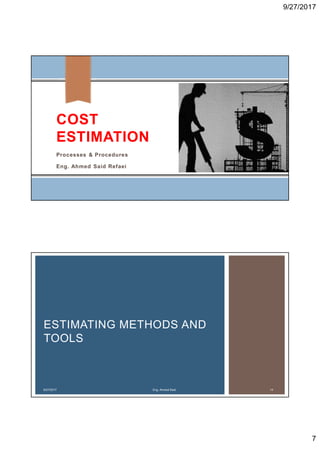
TYPES OF CONSTRUCTION COST ESTIMATES
Design
Estimates.
Bid
Estimates.
Control
Estimates.
9/27/2017
6
FACTORS AFFECT
ON ESTIMATION
FACTORS
THAT
INFLUENCE
ON
ESTIMATION
9/27/2017 Eng. Ahmed Said 12
1-Weather
2- Transportation Problems
4- Power and Water
6- Remoteness & Communication Problems.
3- Labor Availability
7- Location
11- Estimate Date and Shelf-Life
9- Confined Sites
5- Vandalism and Site Security
10- Quantities
8- Estimate Notes + Q&A
9/27/2017
7
COST
ESTIMATION
Processes & Procedures
Eng. Ahmed Said Refaei
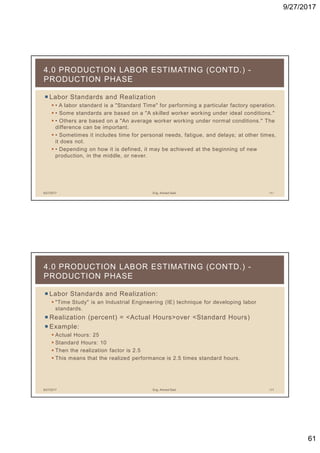
ESTIMATING METHODS AND
TOOLS
9/27/2017 Eng. Ahmed Said 14
9/27/2017
8
9/27/2017 Eng. Ahmed Said 15
ESTIMATING METHODS AND TOOLS
Pre Project
Work
Planning &
Evaluation
Design &
Engineering Procurement Construction
Constructability
Feasibility Study
Benchmarking
Life Cycle Costing
Operational
Estimating
Life Cycle Costing
Modularization
Contractor
Estimating
Owner-Contractor
Relationship
Evaluation
Criteria
Cost
Control
Constructability
Conflict Prevention Measures
Feasibility
Project Success Criteria
Order of Magnitude Estimating
Owner & A/E
Contract
Historical Data
TQM
VE
VEIC
Life Cycle
Costing
Close Out
VECP
TQM
Cost Comparison
Construction
Bidding & Awarding
Design Commissioning
Analogy Cost Estimating
Methodology
Parametric Cost
Estimating
Engineering Build-Up
Methodology
Lesson
Learned
Eng. Ahmed Said
Cost Estimation Level through projects life cycle
Top
Down
Bottom
Up
ANALOGY COST ESTIMATING METHODOLOGY
 The analogy method uses the cost of a similar system, adjusts for
differences, and estimates the cost of the new system. This technique
identifies a currently fielded system (comparable system) similar in
design and/or operation to the proposed system.
 Analogy estimates are based on a comparison and extrapolation to
similar items or efforts.
 Cost data from one past program that is technically representative of
the program to be estimated serves as the Basis of Estimate.
 Cost data is then subjectively adjusted upward or downward,
depending upon whether the subject system is more or less complex
than the analogous program.
9/27/2017 Eng. Ahmed Said 16
9/27/2017
9
9/27/2017 Eng. Ahmed Said 17
Analogy
Weaknesses
Strengths
In some cases, relies on single historical data point
Can be difficult to identify appropriate analog
Requires "normalization" to ensure accuracy
Relies on extrapolation and/or expert
judgment for "adjustment factors"
Based on actual historical data
Quick
Readily understood
Accurate for minor deviations from the analog
Applications
Early in the design process
When less data are available
In rough order-ofmagnitude estimate
Cross-checking
Long-range planning
Architectural studies
EstimatingMethodology
Analogy Cost
Estimating
Methodology
PARAMETRIC COST ESTIMATING
 Parametric cost estimates are a result of a cost estimating methodology
using statistical relationships between historical costs and other program
variables such as system physical or performance characteristics,
contractor output measures, or personnel loading.
 Generally, an estimator selects parametric cost estimating when only a few
key pieces of data are known, such as weight and volume.
 The implicit assumption in parametric cost estimating is that the same
forces that affected cost in the past will affect cost in the future.
 The data that relate to these estimates are weight characteristics and
design complexity, respectively.
 The major advantage of using a parametric methodology is that the
estimate can usually be conducted quickly and be easily replicated.
 Figure 6 shows the steps associated with parametric cost estimating.
9/27/2017 Eng. Ahmed Said 18
9/27/2017
10
PARAMETRIC
COST
MODELING
PROCESS
9/27/2017 Eng. Ahmed Said 19
Define Estimating
"Hypothesis"
Test
Relationships
Data Ok
Data not Comply
Select Estimating
Relationship
Top Down
Estimate (Macro
Estimate)
Parametric Estimation
Collect "relationship" Data
Evaluation & Normalize Data
Analyze Data For Candidate
Relationships
Perform Statistical
(Regression) Analysis
Data Ok
Data not Comply
Data Ok
Start
Data Ok
Data not Comply
PARAMET
RIC COST
ESTIMAT
ING
9/27/2017 Eng. Ahmed Said 20
Strengths, Weaknesses, and Applications of Parametric Cost Estimating
Methodology
Weaknesses
 Once developed, CERs are an excellent tool to answer many "what if"
questions rapidly
 Statistically sound predictors that provide information about the
estimator’s confidence of their predictive ability
 Eliminates reliance on opinion through the use of actual observations
 Defensibility rests on logical correlation, thorough and disciplined
research, defensibledata, and scientific method
• Design-to-cost trade studies
• Cross-checking
• Architectural studies
• Long-range planning
• Sensitivity analysis
• Data-driven risk analysis
• Software development
 Often difficult for others to understand the statistics associated
with the CERsMust fully describe and document the selection of raw
data, adjustments to data, development of equations, statistical
findings, and conclusions for validation and acceptance
 Collecting appropriate data and generating statistically correct CERs
is typically difficult, time consuming, and expensive
 Loses predictive ability/credibility outside its relevant data range
Applications
Strengths
9/27/2017
11
ENGINEERING BUILD-UP METHODOLOGY
 Sometimes referred to as “grassroots” or “bottom-up” estimating, the engineering build-up
methodology produces a detailed project cost estimate that is computed by estimating the
cost of every activity in a Work Breakdown Structure, summing these estimates, and adding
appropriate overheads.
 This costing methodology involves the computation of the cost of a WBS element by
estimating at the lowest level of
 detail (often referred to as the “work package” level) wherein the resources to accomplish the
work effort are readily distinguishable and discernable.
 This is often referred to as the Cost Breakdown Structure (CBS) or the Cost Estimating
Structure (CES). In most cases, the labor requirements are estimated separately from
material requirements.
 Overhead factors for cost elements such as Other Direct Costs (ODCs), General and
Administrative (G&A) expenses, materials burden, and fee are applied to the labor and
materials costs to complete the estimate.
9/27/2017 Eng. Ahmed Said 21
ENGINEERING BUILD-UP METHODOLOGY
 A technical person who is very experienced in the activity typically works with the cost analyst, who
prepares these engineering build-up estimates.
 The cost estimator’s role is to review the grassroots estimate for reasonableness, completeness, and
consistency
 with the project GR&A. It is also the cost estimator’s responsibility to test, understand, and validate the
knowledge base and data used to derive estimates.
 While this is a simple illustration of the engineering build-up methodology, it is important to remember
to conduct other detailed activities such as documenting the Basis of Estimates and schedules and
applying wage and overhead
 rates.
 There are also situations where the engineering community provides their “professional judgment,” but
only in the absence of empirical data.
 Experience and analysis of the environment and available data provide latitude in predicting costs for
the estimator. This method of engineering judgment and expert opinion is known as the Delphi method.
9/27/2017 Eng. Ahmed Said 22
9/27/2017
12
Strengths, Weaknesses, and Applications of Engineering Build-Up Methodology
 Production estimating
 Negotiations
 Mature projects
 Resource allocation
Applications
Strengths
 Intuitive
 Defensible
 Credibility provided by visibility into the Basis
Of Estimate for each cost element
 Severable; the entire estimate is not
compromised by the miscalculation of an
individual cost element
 Provides excellent insight into major cost
contributors (e.g., high dollar items).
 Reusable; easily transferable for use and
insight into individual project budgets and
performer schedules
Weaknesses
 Costly; significant effort (time and money)
required to create a build-up estimate
Susceptible to errors of omission/double
counting
 Not readily responsive to "what if" requirements
 New estimates must be "built up" for each
alternative scenario
 Cannot by itself provide "statistical" confidence
level
 Does not provide good insight into cost drivers
(i.e., parameters that, when increased, cause
significant increases in cost)
 Relationships/links among cost elements must
be "programmed" by the analyst
Eng. Ahmed Said
Segregate Into
CBS/WBS
Estimate
Individuale Packages
Normalize Data
Aggregate Work Packages
Test for Omissions & Duplicates
Update Info. Perform Sanity Check
Method for Developing Engineering Build-Up Estimate
Initiate Study
and Define
Scope
Tender Study
Customer Q & A
Build Up/Micro Estimation
Aggregate Into Total
Estimation
Decompose CBS/WBS
into Work Packages
Work Package
name:
Class
Attributes
Eng. Ahmed Said
Build Up
/Micro
Estimation
9/27/2017 Eng. Ahmed Said 24
9/27/2017
13
ESTIMATE TYPE AND ACCURACY
Close
Construction
Bid
Construction
Drawing
Design
Development
Schematic
Design
Study
Budget
Estimate Category
√
Order of Magnitude (Functional Unit Measure)
√
√
Square Meter and Cubic Meter Rates (Modeling)
√
√
Elemental Rates Level 1
√
√
Elemental Rates Level 2
√
√
Elemental Rates Level 3
√
√
√
√
CSI Item List and Rates
√
√
√
Schedule of Rates (BOQ)
√
Final Account
9/27/2017 Eng. Ahmed Said 25
RESPONSIBILITIES
 Analyze drawings and specifications.
 Understand contractual terms and conditions.
 Assemble accurate and well organized estimates and proposals in a timely manner
for Stipulated Price, Design-Build and Construction/Project Management formatted
projects.
 Provide clear detailed quantity take offs.
 Organize sub-contractors quotations, negotiate to insure quotes meet contract
documents and issue proper documented purchase orders.
 Complete Budgeting and Scheduling for projects and track same.
 Monitor progress, requisition change orders and identify any potential risks.
 Maintain relationships with sub-contractors and clients.
 Insure site personnel are provided with proper documentation related to project.
 Work with and deal with concerns of field personnel.
 Provide and maintain unit pricing and database for material and labor costing.
 Formulate cost break down from estimates and for project progress.
 Meet with potential clients to discuss options for proposed services
9/27/2017 Eng. Ahmed Said 26
9/27/2017
14
JOB
 Prepare detailed cost estimates by analyzing plans and specifications and
performing quantity take-offs for select trades. Be technically savvy. Utilizing on-
screen take off software is a positive.
 Develop and prepare conceptual estimates with minimal subcontractor assistance
using limited preliminary design documents/information.
 Develop subcontract interest in projects and manage the subcontractor RFP
process.
 Qualify and level subcontractors' proposals according to project specifics.
 Itemize trade specific scopes and prepare bid packages.
 Prepare detailed critical path job schedules.
 Continually Marketing the company and looking for future opportunities to grow
the business.
 Ability to maintain discretion and confidentiality at all times.
 Growth/compensation potential for the right candidate.
 Interact with clients, architects, engineers and Local Jurisdictions to understand
and incorporate project objectives, schedules, permits, costs, etc.
9/27/2017 Eng. Ahmed Said 27
SKILLS
 A leader that assumes total responsibility for their work.
 A Team Player that works well with others and can effectively direct and manage others.
 4 Year degree in Construction Management, Engineering, or 10+/- years of experience.
 Extensive knowledge of industry practices, procedures, and market trends.
 Dedicated, well organized, able to plan, prioritize, and manage multiple tasks.
 Detailed oriented with the ability to focus on quality, accuracy, and attention to detail.
 Proficient with commercial estimating software such as: MC2, Timberline/SageCRE, QuickBid,
On-Screen Takeoff, etc.
 Maintain professionalism when faced with aggressive deadlines.
 Excellent leadership, personable, communication, and written skills.
 Ability to interact, develop, and maintain a positive professional relationship with all levels of
personnel.
 Meet deadlines with minimal supervision.
 Demonstrate commitment to continuous learning.
 Review basic software generated estimates for completion and technical accuracy ensuring
quality and integrity.
9/27/2017 Eng. Ahmed Said 28
9/27/2017
15
SITE INVESTIGATION
 It is often required by the contract documents that the contractor visit the
site and attend a pre-bid conference.
 The importance of the visit and the items to be checked vary depending on
the type of the project and its location.
 As a contractor expands to relatively new and unfamiliar areas, the
importance of the preliminary site investigation increases, as does the list
of items that must be checked.
 Examples of the type of information that should be collected are as follows:
1. Site access
2. Availability of utilities (electric, water, telephone)
3. Site drainage
4. Transportation facilities
5. Any required protection or underpinning of adjacent property
6. A rough layout of the site locating the proposed storage trailer and equipment
locations
9/27/2017 Eng. Ahmed Said 29
SITE INVESTIGATION
 Examples of the type of information that should be collected are as follows:
7. Subsurface soil conditions (bring a post hole digger to check this)
8. Local ordinances and regulations, and note any special requirements (permits,
licenses, barricades, fences)
9. The local labor situation and local union rules
10. Availability of construction equipment rentals, the type and conditions of what is
available as well as the cost
11. Prices and delivery information from local material suppliers (request proposals for
the project)
12. The availability of local subcontractors (note their names, addresses, and what type
of work they usually handle)
13. The conditions of the roads leading to the project, low bridges, and load limits on
roads or bridges
14. Housing and feeding facilities if workers must be imported
15. Banking facilities
 estimating-in-building-construction
9/27/2017 Eng. Ahmed Said 30
9/27/2017
16
THE COST ESTIMATING
PROCESS
9/27/2017 Eng. Ahmed Said 31
Decision To BID
Start No
Takeoff Quantities
Notify Sub-contractorsand
Suppliers
Yes
Obtain Bid Documents
Review Bid Documents
Site Investigation
Cost Accepted Yes
Aggregate Dry Cost
Sheets
Summarize and Prepare
Bid
ManagementReview
Cost Estimation Of
Subcontracted Items
Cost Estimate Own
Work
Price General
Expenses
No
Yes
No
End
Suppliers Quotations
Cost Estimate Sub-
contractors
Obtain Bid Information
Cost Accepted
Submit Bid
Cmplete Bid Report
Evaluate OH & P
Biding & estimating Process
Eng. Ahmed Said
32
9/27/2017
17
COST ESTIMATION PROCESS
9/27/2017 Eng. Ahmed Said 33
THE COST ESTIMATING PROCESS
 This section presents the how-to, start-to-finish details of the cost
estimating process. As shown in Next Figure ,
 there are three main parts to the 12-step cost estimating process:
 Part 1—Project Definition,
 Part 2—Cost Methodology, and
 Part 3—Cost Estimate.
 This process is consistent with the cost estimating processes in Cost
Estimating Handbooks, and it is substantively consistent with the
GAO’s process 4 but tailored to fit common needs.
9/27/2017 Eng. Ahmed Said 34
9/27/2017
18
Cost
Estimate
Tasks
Project
Definition
Tasks
Task 6:
Select/Build
Cost
Model/Tool
Task 7:
Gather and
Normalize
Data
Task 8:
Develop the
Cost
Estimate
Task 9:
Develop
and
Incorporate
the Cost
Risk
Assessment
Task 10:
Document the
Cost Estimate
Task 11: Present
the Cost
Estimate Results
Task 12:
Update the
Cost Estimate
as Required
Task 1:
Receive
Customer
Request and
Understand
the Project
Task 2:
Build or
Obtain a
Work Break
down
Structure
(WBS)
Task 3:
Define or
Obtain the
Project
Technical
Description
Task 4:
Develop
Ground
Rules and
Assumptions
Task 5:
Select Cost
Estimating
Methodology
Cost
Estimation
Processes
Cost Estimation Process
9/27/2017
Eng.
Ahmed
Said
35
PART 1:
PROJECT DEFINITION TASKS
9/27/2017 Eng. Ahmed Said 36
9/27/2017
19
PART 1: PROJECT DEFINITION TASKS
 To properly estimate the cost of a project, it is vital that the project be
thoroughly defined and understood by the estimators.
 Therefore, the initial stage of the cost estimating process is
dedicated to:
1. Receive the customer’s request and understand the project;
2. Build or obtain a WBS; and
3. Obtain/participate in the development of the project’s technical description
9/27/2017 Eng. Ahmed Said 37
TASK 1: RECEIVE CUSTOMER REQUEST AND
UNDERSTAND THE PROJECT
 The goal of this task is to communicate sufficiently with the customer
to gather enough project information to generate a quality estimate.
 There are three major activities associated with understanding the
project:
1. Identify the customer(s) and stakeholder(s) who will use the results of the
estimate.
2. Document expectations for program/project by
A. identifying the purpose of the estimate;
B. specifying mission needs, objectives, and goals; and
C. assessing the operating environment and life-cycle phase.
9/27/2017 Eng. Ahmed Said 38
9/27/2017
20
TASK 1: RECEIVE CUSTOMER REQUEST AND
UNDERSTAND THE PROJECT
3. Gather and review all relevant project data for evaluation (e.g., an existing technical
baseline or Cost Analysis Data Requirement [CADRe], previous estimates, lessons
learned and customer feedback, budget data, and programmatic data such as
schedules). Discuss schedule, data, expectations, and resource requirements with
the requesting customer.
A. When a request for a cost estimate is received, the supervisor of the cost group must ascertain if there
are adequate resources to accept the assignment based on the understanding of the expectations of
the estimate.
B. The estimator then determines the magnitude of the workload required (i.e., the type of estimate, the
due date(s), and relative priority of the request). If the request is accepted, the supervisor will notify
the requester and assign an estimator (or estimators) to the task. If the supervisor has issues with the
request, it will be negotiated with the requestor.
 As illustrated in Next Figure , there are four critical elements to any
estimate that need to be understood and agreed upon between the cost
estimator and the decision maker before a methodology can be chosen and
an estimate developed. These four elements are resources, data,
schedule, and expectations.
9/27/2017 Eng. Ahmed Said 39
Four Critical Elements Related To Conducting Cost Estimates
1. What is your expectation of the estimate?
2. What is the expected outcome or usage of
the estimate? (based on estimate type)
3. What is the customer’s expectation of the
estimate?
4. What is the team expectation of the
estimate?
5. What is the Agency-wide expectations of the
estimate outcome and usage?
1. How long have you been given to complete
the estimate?
2. How long do you need to complete the
estimate, given the available resources and
data?
3. Do you have the resources needed to
conduct the estimate with the allotted
schedule?
4. Do you have the time to collect the required
data and analyze the data?
1. How many people are required to conduct the
estimate?
2. How many people are available to conduct the
estimate?
3. What is the budget required to conduct the
estimate?
4. What is the available budget to conduct the
estimate?
1. What data do you need?
2. Are the data readily available?
3. If the data are not readily available, what are
your alternatives?
4. Are the organizations you need to collect the
data from cooperative & accessible?
5. Are non-disclosure agreements required?
Resources
Data
Schedule
Expectations
9/27/2017
21
TASK 2: BUILD OR OBTAIN A WORK BREAKDOWN
STRUCTURE (WBS)
 The objective of this task is to provide a consistent structure that includes
all elements of the project that the cost estimate will cover.
 This structure becomes the cost estimator’s framework for ensuring full
coverage (without double counting) of the project’s objectives, including
the following:
 Project and technical planning and scheduling;
 Cost estimation and budget formulation (in particular, costs collected in a product-
oriented WBS can be compared to historical data collected for the same products);
 Definition of the scope of statements of work and specifications for contract efforts;
 Project status reporting, including schedule, cost, workforce, technical performance,
and integrated cost/schedule data (such as EVM and Estimate at Completion [EAC]);
and
 Creation of plans such as the Systems Engineering Management Plan (SEMP) and
other documentation products such as specifications and drawings.
9/27/2017 Eng. Ahmed Said 41
TASK 3: DEFINE OR OBTAIN THE PROJECT
TECHNICAL DESCRIPTION
 The objective of this task is to establish a common baseline document that thoroughly describes
the project to be used by the project team and project estimators to develop their estimate(s).
 There are several activities associated with understanding the complete program characteristics,
including:
1. Gather and review all relevant project data (e.g., existing technical baseline, previous estimates, lessons learned
and customer feedback, and budget data as well as other programmatic data such as schedules);
2. Collect system characteristics, configuration, quality factors, security, operational concept, and the risks associated
with the system; and
3. Obtain the system’s (or the project’s) milestones, schedule, management strategy, implementation/deployment plan,
including launch, test strategy, security considerations, and acquisition strategy.
 Every estimate, regardless of size, needs to define what is being estimated.
 The type of document used to record this project technical description depends on the following:
 The time available to conduct the estimate;
 The size of the project;
 The technical information available, including the requirements’ thresholds and goals (objectives); and
 The phase of the life cycle in which the project exists.
9/27/2017 Eng. Ahmed Said 42
9/27/2017
22
PART 2:
COST METHODOLOGY TASKS
The next four tasks of the cost estimating process relate to
selecting and administering the cost methodology, which will
guide the development of the cost estimate. These four tasks
are detailed below.
9/27/2017 Eng. Ahmed Said 43
TASK 4: DEVELOP GROUND RULES AND ASSUMPTIONS
 The Ground Rules and Assumptions (GR&A) are intended to
communicate the scope, context, and environment within which
the estimate is being developed.
 Below are four activities associated with developing the GR&A:
 1. Establish a set of programmatic, technical, and schedule
GR&A to define the scope of the estimate (i.e., what costs are
being included and what costs are excluded);
 2. Coordinate and gain agreement/approval from the Company
Program/project Manager (P/pM) (or other cost estimate point
of contact);
 3. Achieve consensus on the GR&A with stakeholders,
vendors, end users, etc., to ensure their applicability and to
avoid problems leading to inaccurate or misleading estimates;
and
 4. Document the GR&A as they evolve during the entire
estimate process.
9/27/2017 Eng. Ahmed Said 44
9/27/2017
23
GR&A COMMONLY ADDRESS, BUT ARE NOT
LIMITED TO, THE FOLLOWING TOPICS:
A. Scope.(WBS)
B. Make vs. buy decisions.
C. Government Furnished Equipment (GFE)/Government Furnished Information
(GFI).
D. Development philosophy.
E. Contractors, subcontractors, and their roles.
F. Amount of test hardware and key system tests.
G. Budget profile.
H. Schedule and key milestones.
I. Labor resources and rates.
J. Risks and associated risk reduction or mitigation activities.
K. Profit/Fee.
L. Design heritage/technology.
M. Management and acquisition approach.
9/27/2017 Eng. Ahmed Said 45
GR&A COMMONLY ADDRESS, BUT ARE NOT
LIMITED TO, THE FOLLOWING TOPICS:
N. Production unit quantities.
O. Description of Dollars and Inflation.
P. LCC (Life Cycle Cost) considerations.
Q. Implementation approach.
R. Facilities.
S. Operations Concept.
 The customer may provide cost estimators with some GR&A. More likely,
GR&A are identified during the review of baseline artifacts and during data
collection.
 Because GR&A can have a significant influence on the overall cost estimate,
a joint review of GR&A with the customer early in the estimating process can
help to eliminate surprises when initial results are presented.
 All GR&A should be documented, whether they are obtained from the
customer or generated by the estimator. GR&A may also be an important
consideration in conducting sensitivity analyses as outlined in Task 9.
9/27/2017 Eng. Ahmed Said 46
9/27/2017
24
TASK 5: SELECT COST ESTIMATING
METHODOLOGY
 The goal of this task is to select the most appropriate cost estimating
methodology (or combination of methodologies) for the data available
to develop a high-quality cost estimate (Next Figure).
9/27/2017 Eng. Ahmed Said 47
Project
Phases
Detailed Estimation
Estimation
Methodology
Analogy
Parametric
Engineering
Build-Up
(Bottom Up -
Micro
Estimation)
Extrapolation
From Actual
Lesson Learned &
Normalization +
Modularization
Evaluation + Design
Build & Awarding
Feasibility
Construction
Use Of Cost Estimating Methodology
Gross Estimation
48
9/27/2017
25
TASK 5: SELECT COST ESTIMATING
METHODOLOGY
 shows the three basic cost estimating methods that can be used during a
project’s life cycle: analogy, parametric, and engineering build-up (also
called “grassroots”), as well as extrapolation from actuals using Earned
Value Management (EVM). Figure 5 indicates that the prevalent cost
estimating methodology changes over the project life cycle.
 A primary reason for this is that the amount of data available to conduct
the project estimate typically changes over time.
 A basic explanation of each cost estimating methodology is provided here.
provided a detailed explanation of each cost methodology.
 Analogy Cost Estimating Methodology.
 Parametric Cost Estimating
 Engineering Build-Up Methodology
9/27/2017 Eng. Ahmed Said 49
TASK 6: SELECT/BUILD COST MODEL/TOOL
 The objective of this task is to select the most appropriate model/tool or to
create a model to estimate the cost. Factors that influence the selection process
include data and resource availability, schedule, and cost.
 Three Cost Model Best Practices
1. Before and after running the model, it is important to check and recheck data
entry and formulas to ensure accuracy and to document each input and formula
for the detailed Basis of Estimate (BOE).
2. Another important step to remember is to conduct a cross-check estimate, using
an alternative methodology on your point estimate. This is important to ensure a
“sanity check” on the original estimate and to show an alternative estimate view
of the data.
3. In addition, keeping the estimate up-to date helps to defend the estimate, reduce
updated estimate turn-around time, and gives the decision-maker a clearer
picture for “what if” drills to support major investment and budget decisions.
9/27/2017
26
DATA COLLECTION
9/27/2017 Eng. Ahmed Said 51
TASK 7: GATHER AND NORMALIZE DATA
 The objective of this task is to arm the
cost estimator with as much information
as possible so that the most accurate and
defendable cost estimate can be
developed.
 Data collection and data normalization are
two cost estimating activities that are
critical to the development of a credible
and defendable cost estimate.
 Sufficient time and resources should be
planned in advance for these efforts.
9/27/2017 Eng. Ahmed Said 52
9/27/2017
27
DATA COLLECTION
 Data collection is one of the most difficult, time-consuming, and costly activities in
cost estimating.
 Data needs are not always clear at the assignment’s beginning, and data
requirements often evolve during an estimate’s development.
 An estimator needs to recognize that data, once collected, may need to be normalized
to support a particular cost model or estimating method.
 Because uncertainty is the underlying driver in a cost-risk analysis, it is critical to
collect risk data at this time to support the cost-risk assessment.
 Many of the experts that will be interviewed and the data that will be reviewed in this
effort will not only support the cost estimate, but may assist in identifying risks early
and potentially save time by reducing data collection during the cost-risk assessment
later in the process.
 Therefore, it is imperative that the cost estimator meet with experts early and often
about uncertainty in technology, design, requirements, etc.
 As previously noted, data collection can occur in earlier steps, such as collecting data
for regression analysis to support a methodology or even earlier in the process when
the estimator is understanding the project.
9/27/2017 Eng. Ahmed Said 53
Mechanisms for identifying quantitative cost data
Mechanisms for
identifying quantitative
cost data
Questionnaires
Model
specific data
Interviews
Focus groups
Target
research
Documents
and Records
Consists of examining existing data in the
form of databases, meeting minutes,
reports, attendance logs, financial records,
newsletters, etc.
Model specific data collection/input forms
(public domain or otherwise), including reviews,
papers, and statistical analysis , Specific cost,
technical, and programmatic data from primary
and secondary sources (e.g., budget data, contract
cost data, labor rates, workforce estimates, etc.).
Face To Face
 Interviews can be conducted in person or over the telephone
 Questions should be focused, clear, and encourage open-ended
responses
Surveys and/or questionnaires
A facilitated group interview with individuals
that have something in common
The following are potential mechanisms available to the cost estimator for identifying
quantitative cost data:
54
9/27/2017
28
DATA COLLECTION
 Based upon the resources, the schedule, and the expectations, the estimator should use the
most appropriate data collection mechanisms as can be supported. The cost estimator will
work with the Client P/pM and members of the technical team to obtain the technical and
programmatic data required to complete the cost estimate.
 Typically, system requirements are contained in a document or set of documents such as a
technical baseline, CADRe, and/or the Cost Engineering Database.
 A well-documented set of project requirements ensures that the cost estimators are estimating
the same product being designed by the technical team. If some of the cost model inputs are
not explicitly contained in the requirements document, the cost estimator will have to
coordinate with the cognizant technical point of contacts to obtain the needed data by
interview techniques and/or by survey mechanisms.
 Often, the cost analyst is estimating conceptual designs, so a requirements document does
not exist. However, there is often conceptual design data such as master equipment lists,
functional block diagrams, etc.
 Collecting programmatic data, such as schedules, is also key to data collection efforts.
 Next Table provides a list of typical data types and sources that cost estimators use to collect
the data needed to develop an estimate.
9/27/2017 Eng. Ahmed Said 55
62
78
98
45
68
56
55
28
62
25% 25% 25%
Historical Costs
Data Category
Cost Data
Data Type
Labor Costs
Existing Case/ Cost
Estimating Requirements
Data Sources
Basic Accounting
Records
Cost Reports Historical
Databases and
Libraries
Contracts
(Secondary)
Cost Proposals
(Secondary)
Cost Analysis
Estimator
1. Physical Characteristics
2. Performance Characteristics
3. Performance Metrics
4. Technology Descriptors
5. Major Design Changes
6. Operational Environment
Functional
Specialist
Technical/Operational Data
Technical
Databases
Engineering
Specifications
Engineering
Drawings
End User and
Operators
Performance/ Functi
onal Specifications
Master Equipment
Lists
Project Data
1. Development and Production Schedules
2. Quantities Produced
3. Production Rates
4. Equivalent Units
5. Breaks in Production
6. Significant Design Changes
7. Anomalies (e.g., strikes, natural disasters, etc.)
Project
Database
Functional
Organizations
Project Management
Plan Major
Subcontractors
Three Principal Types of Data
9/27/2017
29
NORMALIZE DATA
 Normalizing data for cost includes adjusting for inflation, which makes the raw data set
consistent and fit for use in CERs, models, or estimates.
 Data may be adjusted for inflation again in Task 8 when it has been incorporated into the cost
estimate and the estimate as a whole is adjusted for inflation.
 The full estimate may be adjusted for inflation to show the results in Base Year (BY),
Constant Year (CY), or Real Year (RY) dollars. Table 6 defines some common terms used for
inflation and escalation.
 Normalized data should be reviewed and validated by the estimator to ensure that a
consistent data collection methodology, data collection formats, and procedures to identify
data anomalies are in place.
 Considerations such as data sufficiency to support the estimating methodology selected and
documentation to ensure the traceability of adjustments made to the data are also critical.
 These documented factors assist the estimator with the validation of the data, lead to data
reliability, and ultimately contribute to estimate credibility.
 If an estimator takes each of these elements into consideration when identifying and
collecting data, analyzing schedules, and normalizing data, the repeatability and credibility of
the data supporting the estimate will be improved.
9/27/2017 Eng. Ahmed Said 57
PART 3:
COST ESTIMATE TASKS
The last five tasks of the cost estimating process revolve around
the actual generation and documentation of the estimate. These
Cost Estimate tasks are detailed below.
9/27/2017 Eng. Ahmed Said 58
9/27/2017
30
TASK 8: DEVELOP THE COST ESTIMATE
 The goal of this task is to create an initial LCC point estimate.
 There are eight activities associated with developing a cost estimate:
 Verify the GR&A;
 Populate the model with the normalized data;
 Ensure that the estimate is full cost compliant;
 Run the model to calculate cost;
 Time-phase the estimate;
 Adjust the estimate for inflation;
 Conduct any cross-check estimate or estimate reconciliation; and
 Develop or update the cost track to previous or independent estimate.
 Once the model has been selected or constructed and the data have been gathered, the next
step is to populate the model with data according to the GR&A. The model is run and a point
estimate is calculated.
 Generating a point estimate is an important step, but it is just the beginning of the cost-risk
process.
 It is important to understand that when project costs are being estimated, the costs are
uncertain and the point estimate is not definitive and not the only possible estimate.
9/27/2017 Eng. Ahmed Said 59
TIME-PHASING THE ESTIMATE
 Next, the cost estimator must properly time-phase the data according to the
planned development schedule. This can be done using many techniques,
including Beta Curves historical spreads, engineering judgment, or budget
constraints. Just as the data needed to be normalized for inflation, the estimate
must also be adjusted for inflation over its life cycle.
 Baseline cost estimates that are generated in Square Meter (SM) dollars can be
phased by fiscal year prior to being converted into annual real-year dollars (also
known as then-year dollars).
 Once baseline estimates are adjusted for inflation over the project life cycle,
these RY dollars can be used as inputs for the annual budget for the project.
 There are two main methods to accomplish this, and these are briefly discussed
below and addressed in more detail in Next Lecture.
 The phasing of the cost estimate (which reflects when funds will be expended)
needs to be further adjusted to reflect the budget authority, if being used for
developing budgets by taking into account when budget authority is needed
relative to when those funds will be expended.
9/27/2017 Eng. Ahmed Said 60
9/27/2017
31
DEVELOP PROBABILISTIC COST ESTIMATE
 The cost team started implementing probabilistic analysis in the early 2000s. Management embraces probabilistic
cost and schedule analysis as a means of improving its delivery of projects and programs on time and within budget.
 Team leadership believes that all projects should submit budgets that are based upon a quantification of the risks
that could cause the project to take longer or cost more than initially anticipated. Identification and estimation of
risk and accommodation of uncertainty, for both cost and schedule, are keys to improving Company’s cost and
schedule performance, thereby helping to establish a more credible cost and schedule baseline.
 By making use of probabilistic techniques, Company is able to more effectively communicate the impact of changes
to planned or requested resources by providing quantified effects on the probability of meeting planned cost and
schedule baselines.
 The estimation and analysis community has, as a group, moved to the adoption of probabilistic cost estimates rather
than deterministic cost estimates. Management has been a supporter, proponent, and creator of probabilistic cost
estimates for more than 10 years.
 Probabilistic cost estimates attempt to quantify risk and uncertainty. A probabilistic cost estimate provides
management with significant insight into the key cost and schedule drivers of the program, allowing them to actively
manage and develop mitigation strategies to reduce cost. In addition to providing insight,
 probabilistic cost estimates are useful for reporting and analysis purposes, providing valuable information to
stakeholders, management, and partners.
 Estimators and analysts may choose to develop a Technical Baseline Estimate (TBE) or “point estimate” first before
conducting a probabilistic risk analysis. However, this is not a hard requirement. Many estimators and analysts will
not perform the activities in serial, but instead will perform them in parallel during the estimating process. Iteration
may also be required during the estimating process as data, models, and methodologies are refined.
9/27/2017 Eng. Ahmed Said 61
DEVELOP PROBABILISTIC COST ESTIMATE
 Why do Probabilistic Analysis?
 Team does probabilistic analysis to enable more informed management decisions
based on an understanding of risk and uncertainty.
 Team deals with complex, one-of-a-kind systems that have a lot of risk and
uncertainty associated with them.
 A probabilistic analysis process helps management understand the risk involved,
informing decisions on the appropriate amount of risk that the Agency is willing to
accept.
9/27/2017 Eng. Ahmed Said 62
9/27/2017
32
TASK 9: DEVELOP AND INCORPORATE THE COST
RISK ASSESSMENT
 The objective of this task is to produce a credible project cost cumulative
distribution function (CDF, or “S-curve”) for the range of costs of the project.
 Cost-Risk Assessment
 There are six activities associated with developing a cost risk assessment in order to understand the current
confidence level of the project and estimate the amount of unallocated future expense (UFE) necessary to
achieve a desired confidence level:
 Sensitivity Analysis
 It is recommended that a sensitivity analysis be performed to identify the major cost drivers (i.e., those design
parameters whose changes create the greatest changes in cost).
 Sensitivity analysis helps to determine how sensitive the estimate is to changes in assumptions, technology, or
system design.
 By relating model inputs back to such changes, sensitivity analysis provides the decision maker with added
insight into how program decisions can change estimates that cost models produce.
 Choosing the Level of Unallocated Future Expense
 For trade studies and formal analyses of alternatives, the cost analyst may choose to add UFE so as to hold the
level of confidence constant across all alternatives and report the resulting cost.
 Or the cost analyst may add UFE so as to hold the cost constant and report the resulting level of confidence.
9/27/2017 Eng. Ahmed Said 63
TASK 10: DOCUMENT THE COST ESTIMATE
 The objective of this task is to capture, concurrently, from project initiation
through completion, the LCC results of the cost estimating process, and all
of its byproducts (confidence levels, Basis of Estimate (BOE), risk, UFE,
etc.).
 The purpose of the cost documentation is to provide a written justification
for the program cost estimate.
 This documentation is typically referred to as a BOE. The BOE documents
the ground rules, assumptions, and drivers used in developing the cost and
schedule estimates, including applicable model inputs, rationale or
justification for analogies, and details supporting cost and schedule
estimates.
 Cross Checks
 To verify the reasonableness and credibility of the estimate, estimators are encouraged
to generate secondary estimates based on the same set of normalized data and inputs,
but using different models and techniques.
9/27/2017 Eng. Ahmed Said 64
9/27/2017
33
TASK 11: PRESENT THE COST ESTIMATE
RESULTS
 While it may not be realistic to standardize the content and format of the
cost estimating briefing charts across all Projects/Departments for all
estimate types, the objective of this task is to successfully create and
communicate a quality cost estimate to decision makers and stakeholders.
 There are three activities associated with presenting/briefing results:
 Create briefing materials and supporting documentation for internal and external
presentations, as appropriate.
 Present and defend the estimate.
 Gather and provide feedback to capture improvements for the next estimate.
 Consistency in presenting cost estimates across Centers facilitates
understanding during the management review process and promotes
completeness and quality of the cost estimating and analysis
documentation.
9/27/2017 Eng. Ahmed Said 65
TASK 12: UPDATE THE COST ESTIMATE AS
REQUIRED
 The purpose of updating the cost estimate is to improve the estimate as better information
becomes available. Doing so can help the estimator defend the estimate over time, reduce
updated estimate turnaround time, and give decision makers a clearer picture for major
decisions or “what if” drills.
 There are two activities associated with updating the cost estimate:
 Assess and utilize customer feedback along with lessons learned and incorporate this feedback into the next
version of the estimate.
 Update the estimate when project content changes and as the project moves through its life-cycle phases and
conducts milestone reviews.
 It is important to maintain a good project cost baseline as a forward indicator for cost
overruns.
 Cost estimates must be updated whenever project content changes and reconciled to the
estimate baseline.
 By accomplishing a cost estimate on proposed program alternatives, the Project Office can
determine the cost impact of the alternatives.
 One of the best ways a project team can update its schedule and cost estimates is to adjust
these according to its own performance.
 Earned Value Management is recognized as a best practice for making such cost and
schedule adjustments (e.g., on a monthly or quarterly basis).
9/27/2017 Eng. Ahmed Said 66
9/27/2017
34
COST ELEMENTS
CLASSIFICATION
9/27/2017 Eng. Ahmed Said 67
15% Markup
5% Equipment
39% Sub-Contractor
41% Amazon
Example
0 5 10 15 20
Site OverHead General OverHead Contengencies Profit
20
Markup
Example For Markup
Cost Component-Example
15% Markup
9% Equipment
22% Labor
53% Material
1 2 3 4 5 6 7 8 9
1
0
100%
90%
80%
70%
60%
50%
40%
30%
20%
10% 0%
8%
18%
34%
50%
58%
75% 78% 80%
85%
0%
5%
14%
30%
48%
65%
83%
91%
96%
100%
Cost Revenue
9/27/2017
Eng. Ahmed Said 68
9/27/2017
35
DIRECT
COSTS
1. Labor.
2. Material
3. Equipment.
4. Subcontractors
5. Other
9/27/2017 Eng. Ahmed Said 69
DIRECT COSTS
 From this web site https://web.nibs.org/ you can find more
information.
 A contractor’s main expenses are as follows:
I. Direct costs
 Labor, particularly hourly workers, for whom a labor expense can be
directly linked to a particular work item.
 Materials, such as concrete, rebar, bricks, nails, paint and installed
equipment, such as elevators, air-conditioning units, and kitchen
equipment.
 Equipment, mainly construction equipment (bulldozers, excavators,
cranes, concrete pumps, etc.)
 Subcontractors (even though subcontractors’ charges comprise labor,
materials, equipment, overhead, and possibly sub-subcontractors, the
general contractor treats these charges as a direct cost)
 Other costs, such as government permits and fees, and fees for
lawyers and consultants hired for a specific task in a project.
 (construction projects scheduling and control 3rd edition, Saleh Mubarak) .
9/27/2017 Eng. Ahmed Said 70
9/27/2017
36
DIRECT COSTS
 Costs that can be specifically identified with the completion of a task.
For example,
 for the task of installing windows the direct cost includes the material cost for the
windows (including sales tax and delivery),the labor cost (including labor burden),
and the cost of any equipment used to install the windows.
 When conducting project comparisons, it is useful and logical to
normalize the base of reference.
 One of the more convenient techniques is to use the direct cost as
the base of reference for the prospective projects.
9/27/2017 Eng. Ahmed Said 71
DIRECT COSTS
 It is important to remember that if personnel or equipment are shared
between projects, only a portion of the salary and purchase cost
should be included, to the extent that the resources are used for the
activities of a particular project.
 One popular way of testing the direct cost elements is to consider the
cost of those people and equipment that actually came in contact with
the project deliverable, and for the duration that they came in contact
with the deliverable.
 Project estimating and cost management
9/27/2017 Eng. Ahmed Said 72
9/27/2017
37
MATERIALS AND SUPPLIES
 GENERAL
 Materials and supplies are defined below and, for the
purpose of estimating, both can be considered
materials unless they need to be separated because of
different tax rates.
 Materials
 Those items which are physically incorporated into and
become part of the permanent structure.
 Supplies
 Those items which are used in construction but do not
become physically incorporated into the project such as
concrete forms.
 𝐶𝑜𝑠𝑡 𝑝𝑒𝑟 𝑈𝑛𝑖𝑡 = 𝐶𝑜𝑠𝑡/𝑄𝑢𝑎𝑛𝑡𝑖𝑡𝑦
9/27/2017 Eng. Ahmed Said 73
MATERIALS AND SUPPLIES
 SOURCES OF PRICING DATA
 Quotes from Manufacturers and Suppliers
 FORWARD PRICING
 Sometimes quotes are requested in advance of the expected purchase date.
However, suppliers are reluctant to guarantee future prices and often will only
quote current prices.
 FREIGHT (Incoterm)
 HANDLING AND STORAGE
 SALES TAX(AVT).
 ESCALATION
 Material pricing can be adjusted for escalation using the following
 𝐶𝑜𝑠𝑡𝐸𝑠𝑐𝑎𝑙𝑎𝑡𝑒𝑑 = 𝐶𝑜𝑠𝑡(1 + 𝑓 )
 where
 Cost Escalated = Escalated Material Cost
 Cost = Quoted Cost of Materials
 f = Expected Escalation or Inflation Rate (in decimal format)
9/27/2017 Eng. Ahmed Said 74
9/27/2017
38
LABOR
 Construction labor is one of the more difficult portions of a total
project cost estimate.
 In order to prepare a construction labor estimate that is
credible and has the desired level of accuracy, an organized
approach is required.
 CREWS
 Direct labor cost requirements are broken into tasks of work.
Since each task is usually performed by a labor crew including
equipment, the crew must be defined, costed, and a production
rate established for the task.
 Overtime
 Overtime should be included in the labor cost computation when
work in excess of regular time is required by the construction
schedule or is the custom of labor in the local vicinity.
 Overtime labor cost is normally calculated as a percentage of
the base wage rate.
 PAYROLL TAXES
 INSURANCE
9/27/2017
LABOR WAGES
9/27/2017 Eng. Ahmed Said 76
3000 2500 2000 1500 1000 ‫ي‬ ‫اﻷساس‬
(‫اف‬‫تض‬ ‫لم‬) ‫ة‬ ‫العمال‬ ‫وم‬ ‫رس‬
Iqama 650 650 650 650 650 650 ‫ة‬ ‫اﻹقام‬ ‫روفات‬ ‫مص‬
Labor License 2500 2500 2500 2500 2500 2500 ‫ل‬ ‫العم‬ ‫ارت‬ ‫ك‬
Midical Insurance 1000 1000 1000 1000 1000 1000 ‫بي‬‫الط‬ ‫تأمين‬
Visa For 2 years 2300 1150 1150 1150 1150 1150 ‫يرة‬ ‫التأش‬ ‫ل‬ ‫تحم‬ ‫بة‬ ‫نس‬
Ticket For 2 years 3000 1500 1500 1500 1500 1500 ‫فر‬ ‫الس‬ ‫ذاكر‬ ‫ت‬
Housing & Trans. 3000 3000 3000 3000 3000 3000 ‫اﻻت‬ ‫انتق‬ ‫و‬ ‫كن‬‫س‬
Vacation For 2 years 2100 1750 1400 1050 700 ‫ازة‬ ‫اﻷج‬
Indemnity 1500 1250 1000 750 500 ‫ة‬ ‫الخدم‬ ‫ة‬ ‫نهاي‬ ‫ة‬ ‫حص‬
OH 10% 1245 1245 1245 1245 1245 1245 ‫ة‬ ‫اﻹداري‬ ‫اريف‬ ‫المص‬ ‫ن‬ ‫م‬ ‫بة‬ ‫نس‬
Total Annual fees ‫الي‬ ‫اجم‬ 13695 14645.0 14045.0 13445.0 12845.0 12245.0
Total Monthly fees ‫الي‬ ‫اجم‬ 1220.4 1170.4 1120.4 1070.4 1020.4
Total Monthly 4220.4 3670.4 3120.4 2570.4 2020.4
Total Daily 162.3 141.2 120.0 98.9 77.7
Total Daily 160 140 120 100 80
Skilled Non-Skilled Working Days
Days/Year 364 Day
Weeks/Year (Fridays) 52 week
2 Week EID Vacation 14 Day
National Day 1
Ramadan Time (28x2/8) 7 Days
Working Days/year 290 Day
Working Days/month 24.16 Day
Working Hours/year 2320.00 hour
Working Hours/Month 193.33 hour
9/27/2017
39
LABOR PRODUCTIVITY AND HOURS
 FACTORS AFFECTING LABOR PRODUCTIVITY
 Project Size
 Overtime
 Size of Crew
 Interruptions
 Weather
 Safety
 Cycle Time
 LABOR PRODUCTIVITY Sources
 HISTORICAL DATA
 FIELD OBSERVATIONS
 NATIONAL STANDARDS
9/27/2017 Eng. Ahmed Said 77
EXAMPLE
 Project included 115 m2 of 6cm-thick sidewalk It took 11 labor hours to complete
the sidewalk.
 Determine
 the productivity in labor hours per M2 based on this historical data.
 Cost per M2 for crew 2 skilled + 1non-skilled.
 Solution:
 The number of labor hours per M2 is calculated using Eq. as follows:
 𝐿𝑎𝑏𝑜𝑟ℎ𝑜𝑢𝑟/𝑢𝑛𝑖𝑡 = = 0.096ℎ𝑜𝑢𝑟/𝑚2
 𝐶𝑟𝑒𝑤 𝑜𝑟 𝑐𝑟𝑎𝑓𝑡 𝑐𝑜𝑠𝑡 = 2 × 160 + 1 × 100 = 420𝑆𝑅 𝑝𝑒𝑟 𝑑𝑎𝑦 = 52.5𝑆𝑅/ℎ𝑟
 𝐶𝑜𝑠𝑡 𝑜𝑓 𝑀2 = 0.096 × 52.5 = 5.02 𝑆𝑅/𝑀2
 For historical data to be accurate, the actual labor hours must be accurately
tracked in the accounting system and an accurate record of the quantities of work
performed must be kept.
 Poor tracking of labor hours or failure to update changes in the quantities of work
performed will render the data useless.
9/27/2017 Eng. Ahmed Said 78
9/27/2017
40
EXAMPLE
 A crew needs to install 100 M2 of ceramic tile. The estimated
productivity is 0.3 hr/M2.
 Determine the number of labor hours required to install the ceramic tile.
 Cost per M2 for crew (3 skilled + 1 non-skilled)
 Solution:
 The number of labor hours per M2 is calculated using Eq. as follows:
 𝐿𝑎𝑏𝑜𝑟ℎ𝑜𝑢𝑟 = 100𝑀2 × 0.3 = 30ℎ𝑜𝑢𝑟
 𝐶𝑟𝑒𝑤 𝑜𝑟 𝑐𝑟𝑎𝑓𝑡 𝑐𝑜𝑠𝑡 = 3 × 160 + 1 × 100 = 580𝑆𝑅 𝑝𝑒𝑟 𝑑𝑎𝑦 = 75.5𝑆𝑅/ℎ𝑟
 𝑇𝑜𝑡𝑎𝑙 𝐶𝑜𝑠𝑡 = 72.5 × 30 = 2175 𝑆𝑅
 𝐶𝑜𝑠𝑡 𝑜𝑓 𝑀2 = 2175 /100 = 21.75 𝑆𝑅/𝑀2
9/27/2017 Eng. Ahmed Said 79
ESTIMATING AND CONSTRUCTION SAFETY
 safety in the construction industry is not just compliance with OSHA.
 There is a growing awareness among construction companies of the
cost of poor safety on the work site.
 Apart from the direct cost of construction accidents, which is
reflected in higher worker’s compensation insurance and property
insurance premiums, there is a large number of what are often hidden
costs including:
1. Tool and equipment repair and maintenance costs
2. Production interruptions and delay costs
3. Legal expenses
4. Expenditure on emergency supplies and equipment
5. Replacement equipment rentals
6. Investigative and administrative expenses
7. Cost of hiring and training replacement personnel
8. Overtime payments and other costs incurred trying to catch up
9. Decreased output of injured workers on return
10. Damage to company reputation and subsequent loss of business.
 Fundamentals of Construction Estimating
9/27/2017
9/27/2017
41
CONSTRUCTION EQUIPMENT AND PLANT
 The equipment used on construction projects can be divided into
three types of equipment: owned, leased, and rented.
 EQUIPMENT OWNERSHIP AND OPERATING EXPENSE COST
RATES.
 SMALL TOOLS
 MOBILIZATION AND DEMOBILIZATION
 𝐶𝑜𝑠𝑡 =
/
9/27/2017 Eng. Ahmed Said 81
EQUIPMENT CATEGORIES IN THE ESTIMATE:
1. Small tools and consumables:
 Hand tools up to a certain value together with blades, drill
bits, and other consumables used in the project are priced
as a percentage of the total labor price of the estimate.
2. Equipment usually shared by a number of work
activities:
 These kinds of equipment items are kept at the site over a
period of time and used in the work in progress.
9/27/2017 Eng. Ahmed Said 82
9/27/2017
42
EQUIPMENT CATEGORIES IN THE ESTIMATE:
9/27/2017 Eng. Ahmed Said 83
3. Equipment used for specific tasks:
 These are capital items and used in projects such as digging trench or hoisting material
into specified slots.
 This equipment is priced directly against the take-off quantities for the Project it is to be
used on.
 The equipment is not kept on-site for extended periods like those in the previous
classification, but the equipment is shipped to the site, used for its particular task, and
then immediately shipped back to its original location. Excavation equipment, cranes,
hoisting equipment, highly specialized, and costly items such as concrete saws fall into
this category.
84
I. Saving from depreciation
1. Purchase expense or Initial Capital Cost
2. Salvage value
II. Investment (or interest) cost
1. Cost of Capital
2. Property taxes
3. Insurance
4. Storage and miscellaneous
2-3-1 ELEMENTS OF OWNERSHIP:
Eng. Ahmed Said
9/27/2017
9/27/2017
43
3-1OPERATING COST ELEMENT
 Include:
1. Fuel
2. Lubricants, filters, and grease
(FOG)
3. Repairs
4. Tire&.
5. Replacement of high-wear
items
6. Wages (Operator)
٨٥
Eng. Ahmed Said
9/27/2017
Eng. Ahmed Said 86
2-C- MINIMUM ANNUAL SAVING
Treat it as a production unit
 Capital cost = 23% (Overhead & Profit)
 Equipment cost = 895’850.00 SR
 Useful time = 8 yr.
 𝑀𝑖𝑛𝑖𝑚𝑢𝑚 𝑠𝑎𝑓𝑖𝑛𝑔
 𝐴 = 𝑃 [ ]
𝑨 = 𝟖𝟗𝟓 𝟖𝟓𝟎 ×
𝟎.𝟐𝟑 𝟏 𝟎.𝟐𝟑 𝟖
𝟏 𝟎.𝟐𝟑 𝟖 𝟏
= 𝟐𝟓𝟒′𝟔𝟓𝟑. 𝟔𝟒 𝑺𝑹/𝒚𝒆𝒂𝒓
 This mean the minimum annual return from O&O machine equal A.
 The company management and project manager are required to operate the
equipment to achieve this figure annually and more. (Explained Later)
 Also avoid for inert equipment (Avoid love acquisition/Baby in hand).
9/27/2017
9/27/2017
44
I-1E UNITS OF PRODUCTION DEPRECIATION
 𝐷 = × (𝐵 − 𝑆𝑉)
 Example 1: A plant costing $110 million was purchased on April 1, 2010. The
salvage value was estimated to be $10 million. The expected production was 150
million units. The plant was used to produce 15 million units till the year ended
December 31, 2010. Calculate the depreciation on the plant for the year ended
December 31, 2011.
 Solution:
 Depreciation = (15/150) × ($110 million - $10 million) = $10 million
 Example 2: A truck that was purchased for $30,000 with a residual value $2,000
and a life of 100,000 km. during the period of June –sept, the truck recorded 5200
km of use what is the unit of depreciation of the truck during the period?
 Solution:
 Depreciation rate per unit = , ,
,
$ . /
 Depreciation = 0.28 X 5,200 = $1,456
٨٧
Eng. Ahmed Said
9/27/2017
LEASED EQUIPMENT
 With leased equipment the depreciation and interest costs are
replaced with the lease payment.
 With a typical lease, the company leasing the equipment is still
responsible for paying the cost of the taxes and licenses, insurance,
storage, tires and wear items, fuel, lubricants and filters, and repairs.
 These costs are calculated in the same manner as they are
calculated for owned equipment.
9/27/2017 Eng. Ahmed Said 88
9/27/2017
45
RENTED EQUIPMENT
 With most rented equipment the depreciation and interest, taxes and
licenses, insurance, storage, tires and wear items, lubricants and
filters, and repairs are covered by the company that rents the
equipment.
 This leaves the contractor to pay the rental cost and the cost of fuel.
 However, rental agreements may vary, and the estimator should
verify which costs are covered by the rental cost.
 The cost of the equipment equals the rental cost plus any costs not
covered by the rental agreement.
 The costs not covered by the rental agreement are calculated in the
same manner as they are calculated for owned equipment.
9/27/2017 Eng. Ahmed Said 89
SUBCONTRACT PRICING
 Subcontractors provide labor and often materials and equipment to
the project for a fixed price or fora unit price.
 The best source of subcontractor pricing is the subcontractor.
 When pricing from the subcontractor is not available, the
subcontractor pricing can be estimated from historical data.
 WRITING A SCOPE OF WORK
 For the RFQ to be useful it must clearly define the scope or limits of work to be
performed; it will become the basis of the contract.
 𝐶𝑜𝑠𝑡 𝑝𝑒𝑟 𝑈𝑛𝑖𝑡 = 𝐶𝑜𝑠𝑡/𝑄𝑢𝑎𝑛𝑡𝑖𝑡𝑦
 BID SELECTION
9/27/2017 Eng. Ahmed Said 90
9/27/2017
46
INDIRECT
COSTS
• Markup
1. Overhead
2. Profit
3. Surety Bonds
4. Building
Permits
5. Risk
6. Contingency
9/27/2017 Eng. Ahmed Said 91
MARKUP
 Markups are costs that are
added to the cost of the bid.
 The most common markups
include a
1. building permit,
2. payment and performance
bonds, and
3. profit and
4. overhead.
9/27/2017 Eng. Ahmed Said 92
9/27/2017
47
Margin Vs Markup
75%
25%
Cost Margin=Mark-on
67%
33%
Cost Markup
$200 – $150 = $50 gross OH & Profit
To write the markup as a percentage, divide the gross profit by the COGS.
$50 / $150 = 0.33 markup
To make the markup a percentage, multiply the result by 100.
0.33 X 100 = 33% markup
The markup is 33%. That means you sold the Car for 33% more than the amount
you paid for it.
$200 – $150 = $50 gross OH& Profit
To find the margin, divide gross OH & Profit by the revenue.
$50 / $200 = 0.25 margin
To make the margin a percentage, multiply the result by 100.
0.25 X 100 = 25% margin
The margin is 25%. That means you keep 25% of your total revenue. You spent
the other 75% of your revenue on buying the Car.
Forexample,yousellGoods(Car)for$200each. EachCar costsyou$150.
First,findyourgrossOH & Profit,orthedifferencebetweentherevenue($200)andthecost($150).
Cost
Revenue
25%
OH & Profit
75%
Cost
BUILDING PERMITS
 Building permits are required on many
construction projects.
 Highway do not require building
permits nor do many state and
municipal projects.
 Building permits are used to cover the
costs of inspections to verify that the
project is being built in accordance
with the applicable building codes.
 The cost of the building permit is
based on the valuation of the project,
which may be based on the actual bid
for the project or a standardized cost
per square meter established by the
code enforcement agency.
9/27/2017
Eng. Ahmed Said 94
9/27/2017
48
PAYMENT AND BONDS
 Many jobs require payment and performance bonds.
 The cost of the bond is based on the total bid.
 Also cost bond based on the duration:
 Performance Bond Cost:
 𝑃𝑏 𝑐𝑜𝑠𝑡 = 𝑡𝑜𝑡𝑎𝑙 𝑐𝑜𝑠𝑡 × 𝐵𝑎𝑛𝑘 𝑟𝑎𝑡𝑒𝑠 % × 𝑃𝑟𝑜𝑗𝑒𝑐𝑡 𝑑𝑢𝑟𝑎𝑡𝑖𝑜𝑛 𝑚𝑜𝑛𝑡ℎ𝑠 ÷ 12𝑚𝑜𝑛𝑡ℎ
 Bid Bond Cost
 𝐵𝑏 𝑐𝑜𝑠𝑡 = 𝑡𝑜𝑡𝑎𝑙 𝑐𝑜𝑠𝑡 × 𝐵𝑎𝑛𝑘 𝑟𝑎𝑡𝑒𝑠 % × 3 𝑚𝑜𝑛𝑡ℎ𝑠 ÷ 12𝑚𝑜𝑛𝑡ℎ
 Retainage Bond Cost
9/27/2017 Eng. Ahmed Said 95
RISK AND CONTRACT TYPE RELATIONSHIP
9/27/2017 Eng. Ahmed Said 96
9/27/2017
49
ESTIMATING CONTINGENCIES
New Construction
Restoration
Project Phase
15%
20%
Study Phase
10%
15%
Schematic Design Phase
5%
10%
Design Development Phase
0%
0%
Construction Documents Phase
9/27/2017 Eng. Ahmed Said 97
Contingency fees (an additional sum of money allocated for the unknown events
that will most likely occur during the life of the project; they are directly
proportional to the risk taken in the project).
ESTIMATING CONTINGENCIES
 To develop appropriate contingency allowances,
the Estimator must identify the uncertainty
associated with an item of work or task, forecast
the risk/cost relationship, and assign a value to
this task that will limit the cost risk to an
acceptable degree of confidence.
 Consideration must be given to the details
available at each stage of planning, design, or
construction for which a Cost Estimate is being
prepared.
 The following estimating contingency loadings
represent an initial guide for the ECC (Estimated
Construction Cost) at each phase.
 The Cost Estimator and Designers must assess the
appropriate percentages for each project.
9/27/2017
50
OVERHEAD
II. Indirect costs (UFC 3-740-05)
 GENERAL
 Overhead costs are those costs, which cannot be attributed to a single
task of construction work. Costs, which can be applied to a particular
item of work should be considered a direct cost to that item and are not
to be included in overhead costs. The overhead costs are customarily
divided into two categories:
 Job office overhead (JOOH) also referred to as General Conditions or Field Office
Overhead.
 General home office overhead commonly referred to as General and Administrative
(G&A) costs.
A. Project overhead (or job overhead), such as the following:
 Job overhead costs are those costs at the project site, which occur
specifically as a result of that particular project. Some examples of job
overhead costs are:
1. Job supervision and office personnel.
2. Engineering and shop drawings/surveys.
9/27/2017 Eng. Ahmed Said 99
OVERHEAD
II. Indirect costs (UFC 3-740-05)
A. Project overhead (or job overhead), such as the
following:
3. Site security.
4. Temporary facilities, project office.
5. Temporary material storage.
6. Temporary utilities.
7. Preparatory work and laboratory testing.
8. Transportation vehicles.
9. Supplies and maintenance facilities.
10. Temporary protection and Occupational Safety and Health
Administration (OSHA) requirements.
9/27/2017 Eng. Ahmed Said 100
9/27/2017
51
OVERHEAD
II. Indirect costs (UFC 3-740-05)
A. Project overhead (or job overhead), such as the
following:
6. (OSHA) requirements.
7. Telephone and communications.
8. Permits and licenses.
9. Insurance (project coverage).
10. Schedules & reports.
11. Quality control.
12. Cleanup.
13. Taxes.
14. Equipment costs not chargeable to a specific task.
15. Operation and maintenance of temporary job-site facilities.
9/27/2017 Eng. Ahmed Said 101
OVERHEAD
 II. Indirect costs (UFC 3-740-05)
B. Mobilization and Preparatory Work
 The costs of mobilization and preparatory work, including the setup and removal of construction
facilities and equipment are part of overhead costs unless there is a specific bid item.
C. General overhead, such as the following:
1. Main office building, furniture, equipment.
2. Management and office staff, salary and expense.
3. Utilities, office equipment and vehicles.
4. General communications and travel.
5. Supplies.
6. Corporate vehicles.
7. General business insurance.
8. Taxes.
9. Main office services, such as lawyers and accountants (not working exclusively for a specific
project)
10. Other main office expenses, such as advertising and charity contributions
9/27/2017 Eng. Ahmed Said 102
9/27/2017
52
OVERHEAD
 DURATION OF OVERHEAD ITEMS
 After the overhead items have been listed, a cost must be
determined for each. Each item should be evaluated
separately.
 Some items such as erection of the project office may occur
only once in the project.
 The cost engineer should utilize the developed job schedule
in estimating duration requirements.
 Costs reflective of each particular item during the scheduled
period should then be applied. The product of duration and
unit cost is the overhead cost for the item.
9/27/2017 Eng. Ahmed Said 103
OVERHEAD II. Indirect costs
For example
if you pay someone
to set up concrete
forms for a shear
wall, the expense is
direct.
If you pay a security
guard to look after
the project, the
expense is indirect.
9/27/2017 Eng. Ahmed Said 104
9/27/2017
53
PROFIT
 II. Indirect costs
D. Profit is defined as a return on investment. It is what provides the contractor with an
incentive to perform the work as efficiently as possible, but the preferred one is
‘‘return for taking risk,’’ thus profit amount (or percentage) is usually proportional to
the risk taken. A uniform profit rate should be avoided (UFC 3-740-05).
 Profit usually estimated by the contractor during bidding.
9/27/2017 Eng. Ahmed Said 105
PROFIT
9/27/2017 Eng. Ahmed Said 106
9/27/2017
54
COST ELEMENTS
9/27/2017 Eng. Ahmed Said 107
1- THE DETAILED ESTIMATE
The Detailed Estimate Includes:
 A break down of the work by categories of similar items or as required by the bid form.
 Quantification of similar elements of work for each category for costing.
 Determination of a construction plan.
 Determination of a construction schedule.
 An estimate of cost of labor, material, equipment, subcontractors and service providers for each
element of each item of work.
 The direct and indirect cost of the work which includes all the cost elements.
 Solicitation and receipt of quotes for materials, services by others and work to be subcontracted.
 A summary of all elements of costs (labor, material, equipment, subcontractors and service
providers) to determine the total estimated cost of work.
 Analysis of risk the project should bear.
 Determination of a markup to be added to the cost of work to produce a selling or bid price.
Eng. Ahmed Said
9/27/2017 ١٠٨
9/27/2017
55
2- FUNCTIONAL ESTIMATING METHODS
1. Engineering Staff Cost Estimating
2. Tooling Labor Cost Estimating
3. Manufacturing Planning Labor Cost Estimating
4. Production Labor Cost Estimating
5. Quality Assurance Labor Cost Estimating
6. Direct Material Cost Estimating
7. Equipment Cost Estimating
8. Subcontract Cost Estimating
9. Indirect Cost
Eng. Ahmed Said
9/27/2017 ١٠٩
1.0 ENGINEERING STAFF ESTIMATING
1. Design is difficult to estimate due to:
 The complex nature of engineering
work
 Technology changes
2. A master plan efforts might make the
problem manageable:
 Firm and realistic performance
specifications
 Defined interfaces and responsibilities
 Identification of risk areas
 Verified technical approaches
 Manpower requirement identification
 Firm and realistic schedules
Eng. Ahmed Said
9/27/2017 ١١٠
9/27/2017
56
1.0 ENGINEERING STAFF ESTIMATING (CONTD.)
 3. An engineering estimated can be quoted several ways:
 Hours per drawing by each discipline
 Relative hours by supporting engineering
 4. Some engineering work is highly creative, some is routine
 Creative engineering is required:
 New techniques, advancement of state-of-the-art can drastically increase engineering manhours
 Complexity of system drives level of engineering skills required
 Less creative is:
 Preparing, updating, and correcting drawings
 Planning and developing tooling and setting up production lines
 Planning plant layouts and quality procedures
Eng. Ahmed Said
9/27/2017 ١١١
1.0 ENGINEERING STAFF ESTIMATING (CONTD.)
- DEVELOPMENT PHASE
 1. Staffing or task estimate by task managers
 2. Historical design hours/LB times complexity factors:
 Weight/size
 Material type
 Prototype
 3. Cost Estimating Relationships (CERs) for
 Drawing Design Groups
 Engineering Supporting Groups
 Project Management
 Engineering Liaison
 4. Correlation to historical programs
 Ground Test
 Flight Test
Eng. Ahmed Said
9/27/2017 ١١٢
9/27/2017
57
1.0 ENGINEERING LABOR ESTIMATING (CONTD.)
- PRODUCTION PHASE
 1. Staffing or task estimate by task managers
 2. Historical trend data:
 Hours per month for fixed staff
 Hours per a/c for mfg. supporting groups
 3. Cost Estimating Relationships (CERs) for
 Drawing Design Groups
 Engineering Supporting Groups
 Project Management
 Engineering Liaison
 4. Correlation to historical programs
 Ground Test
 Flight Test
Eng. Ahmed Said
9/27/2017 ١١٣
2.0 TOOLING LABOR ESTIMATING
1. Production rate is a big driver of tooling cost
 What rate of production is planned and for what period of time?
 High rate/long time = "HARD" tooling
 Low rate/short time = "SOFT" tooling
 Sometimes excess tooling capacity is created in anticipation of future orders
2. Production labor hours vary inversely with the amount of tooling
 Tooling cost can be traded off against production labor cost
3. Tooling may require both engineering and manufacturing labor
4. Tooling often treated as direct charge to contract; may be amortized
against production contract Tooling Hour Estimating Methods
Eng. Ahmed Said
9/27/2017 ١١٤
9/27/2017
58
2.0 TOOLING LABOR ESTIMATING (CONTD.) -
DEVELOPMENT PHASE
 1. Staffing or task estimate by task Managers
 2. Historical tool design and fabrication hours per LB times
complexity factors:
 Weight
 Material type
 Prototype
 Technology
 Tool design as a percent of tool fabrication
Eng. Ahmed Said
9/27/2017 ١١٥
2.0 TOOLING LABOR COST ESTIMATING (CONTD.) -
PRODUCTION PHASE
1. Staffing or task estimate by task managers
2. Sustaining tooling based on current program trend of man-hours per
month
3. Tooling hours as a percent of production hours
Eng. Ahmed Said
9/27/2017 ١١٦
9/27/2017
59
3.0 MANUFACTURING PLANNING LABOR ESTIMATING
 Definition of Manufacturing Planning:
 The descriptive information to define the schedules, facilities, tooling,
fabrication, assembly, test, personnel, and capital item to conduct a
manufacturing operation for a program/project.
 The general activities include:
1. Develop/release plan manufacturing
2. Create assembly sequence and as planned Bill of Materials
3. Define fabrication requirements
4. Define manufacturing scheduling and resource requirement
 Develop and Implement
 Measure and status
5. Develop manufacturing work measurement standards
Eng. Ahmed Said
9/27/2017 ١١٧
4.0 PRODUCTION LABOR ESTIMATING
 Definition of Production Labor:
 • Production Labor (Touch Labor) : Associated directly with product
 Produces a change in the raw material
 Generally consists of "Fabrication" and "Assembly"
 1. Fabrication is fashioning parts from raw material, including:
 Sawing
 Perforating
 Punching
 Cutting
 Forming
 Layout
 2. Assembly is integration of parts or subassemblies into larger assemblies
Eng. Ahmed Said
9/27/2017 ١١٨
9/27/2017
60
4.0 PRODUCTION LABOR ESTIMATING (CONTD.) -
DEVELOPMENT PHASE
 1. Staffing or task estimate by project/task managers in Production
 2. Similar program history “ Hours/LB” adjusted complexity factors
 Weight
 Technology improvement
 3. Cost Estimating Relationships (CERs)
Eng. Ahmed Said
9/27/2017 ١١٩
4.0 PRODUCTION LABOR ESTIMATING (CONTD.) -
PRODUCTION PHASE
 1. Staffing or task estimate by project/task managers
 2. Current program history using “learning curve” projections for
 Metal fabrication hours
 Composite fabrication hours
 Major assembly hours
 Final assembly & checkout hours
 3. Manufacturing Planning as a ratio tooling & production hours based
on similar program
 4. Labor Standards and Realization factors
Eng. Ahmed Said
9/27/2017 ١٢٠
9/27/2017
61
4.0 PRODUCTION LABOR ESTIMATING (CONTD.) -
PRODUCTION PHASE
 Labor Standards and Realization
 • A labor standard is a "Standard Time" for performing a particular factory operation.
 • Some standards are based on a "A skilled worker working under ideal conditions."
 • Others are based on a "An average worker working under normal conditions." The
difference can be important.
 • Sometimes it includes time for personal needs, fatigue, and delays; at other times,
it does not.
 • Depending on how it is defined, it may be achieved at the beginning of new
production, in the middle, or never.
Eng. Ahmed Said
9/27/2017 ١٢١
4.0 PRODUCTION LABOR ESTIMATING (CONTD.) -
PRODUCTION PHASE
 Labor Standards and Realization:
 "Time Study" is an Industrial Engineering (IE) technique for developing labor
standards.
 Realization (percent) = <Actual Hours>over <Standard Hours)
 Example:
 Actual Hours: 25
 Standard Hours: 10
 Then the realization factor is 2.5
 This means that the realized performance is 2.5 times standard hours.
Eng. Ahmed Said
9/27/2017 ١٢٢
9/27/2017
62
5.0 QUALITY ASSURANCE LABOR ESTIMATING -
DEVELOPMENT PHASE
 Definition:
 • Quality control is setting up for and conduction of mechanical or
electrical tests to verify conformance to specifications.
 1. Staffing or task estimate by project/task managers in Quality Assurance (QA)
 2. Similar program history for (Factor Method)
 QA hours related to Engineering hours
 QA hours related to Production hours
 QA hours related to Tooling hours
Eng. Ahmed Said
9/27/2017 ١٢٣
5.0 QUALITY ASSURANCE LABOR ESTIMATING -
PRODUCTION PHASE
 1. Staffing or task estimate by project/task managers
 2. Current program history for (Factor Method)
 QA hours related to Engineering hours
 QA hours related to Production hours
 QA hours related to Tooling hours
Eng. Ahmed Said
9/27/2017 ١٢٤
9/27/2017
63
6.0 DIRECT MATERIAL ESTIMATING
 • Direct materials includes:
 Raw Materials
 Purchased Parts
 Subcontracted items
 • Definition of direct material cost
 1. Direct materials become a part of the product
 2. Quantity and price are significant
 3. Measurement of quantity and price should be easy and inexpensive.
 • If the above 3 conditions are not met, classify as Indirect materials
(see 10.0 Indirect Cost).
Eng. Ahmed Said
9/27/2017 ١٢٥
6.0 DIRECT MATERIAL ESTIMATING (CONTD.)
 Three Estimating Methods
 • Method used depends on the state of knowledge, desired accuracy of the
estimate, and time, and cost limitation of the estimate.
 1. Priced Bill of Materials, current items
 2. Priced Bill of Materials, modifications of preceding item
 3. Projection of average per unit based on preceding lot or contract
 4. Consider Other Considerations
Eng. Ahmed Said
9/27/2017 ١٢٦
9/27/2017
64
6.0 DIRECT MATERIAL ESTIMATING (CONTD.)
 1. Priced Bill of Materials, Current Items:
 • Should properly reflect quantity requirements
 • Should reflect most efficient use of materials (scrap, yield)
 • Scrap and yield factors should have a reasonable basis
 • Should reflect latest available price information
 Was the quote for the correct quantity?
 Is cost trend reasonably accounted for?
 Are prices negotiable downward?
Eng. Ahmed Said
9/27/2017 ١٢٧
6.0 DIRECT MATERIAL ESTIMATING (CONTD.)
 2. Priced Bill of Materials, Modifications of Preceding Items:
 • Same as for current items, plus:
 Review additions and deletions
 Review changes in manufacturing methods
 Review changes in tooling
 Review changes in Make or Buy program
 Review inflation adjustments
Eng. Ahmed Said
9/27/2017 ١٢٨
9/27/2017
65
6.0 DIRECT MATERIAL ESTIMATING (CONTD.)
 3. Projection of Average per Unit based on Preceding Lot or Contract:
 • Application of learning curve may be appropriate
 Develop curve for 'Make" items
 Develop separate curves for each major subcontract
 • Consider conditions which may have changes relative to previous item
 Scrap, spoilage,
 Tooling
 Make or Buy
Eng. Ahmed Said
9/27/2017 ١٢٩
6.0 DIRECT MATERIAL ESTIMATING (CONTD.)
 4. Other Considerations:
 • Inventory pricing methods
 First-in-First-Out (FIFO)
 Last-in-First-Out (LIFO)
 Weighted average
 • Material Overhead
 Material handling
 Subcontract administration
 Receiving inspection
 Storage
 In-transit insurance
 Freight (may be direct)
Eng. Ahmed Said
9/27/2017 ١٣٠
9/27/2017
66
7.0 EQUIPMENT COST ESTIMATING – DEVELOPMENT
PHASE
 Class 6 – High Value Equipment
 1. Models (Price)
 2. Similar equipment adjusted for
 • Weight
 • Test requirement
 • Technology
 • Schedule requirements
 3. Supplier quotes
Eng. Ahmed Said
9/27/2017 ١٣١
7.0 EQUIPMENT COST ESTIMATING – PRODUCTION
PHASE
 1. Firm purchase orders
 2. Cost analysis of supplier quotes
 3. Estimates based on current program history
 4. Historical bills of material for current program plotted on
improvement curve
Eng. Ahmed Said
9/27/2017 ١٣٢
9/27/2017
67
8.0 SUBCONTRACT COST ESTIMATING (CLASS 8 & 9)
 Development
 Major Subcontract Bill of Material (Class 8)
 • Supplier quote
 • Estimate based on in-plant build
 • Similar equipment cost adjusted program history
 Overload Subcontract (Class 9)
 • Estimate on in-plant basis using history from current program
Eng. Ahmed Said
9/27/2017 ١٣٣
8.0 SUBCONTRACT COST ESTIMATING (CLASS 8 & 9)
 Basic Production
 Major Subcontract Bill of Material (Class 8)
 • Firm purchase orders
 • Cost analysis of supplier quote
 • Estimate based on current or peculiarities program
 Overload Subcontract (Class 9)
 • Based on prior production manhour processes adjusted for:
 Increase/decrease based on in-plant capacity
 Improvement curve
Eng. Ahmed Said
9/27/2017 ١٣٤
9/27/2017
68
9.0 INDIRECT COST
 • Definition of Indirect Cost
 An indirect cost is a cost NOT directly identified with a single final cost objective
 Indirect = Overhead = Burden
 Generally, indirect costs are grouped into "Pool" which are allocated against the
most appropriate direct costs.
 • Analysis of Overhead Cost should consider:
 Recent overhead cost experience, reasonableness, and necessity to continue at
this level, or increase, or decrease
 The base to which the overhead has been applied
 The expected future trends in this base
Eng. Ahmed Said
9/27/2017 ١٣٥
9.0 INDIRECT COST (CONTD.)
 • Commonly seen overhead categories:
 Engineering
 Manufacturing
 Material
 General & Administration (G&A)
Eng. Ahmed Said
9/27/2017 ١٣٦
9/27/2017
69
SUBMISSION OF PROJECT
COST ESTIMATES
9/27/2017 Eng. Ahmed Said 137
FRAMEWORK FOR SUBMISSION OF PROJECT
COST ESTIMATES
 The project cost estimate submission package should essentially
include three (3) separate sections as follows:
1. Project Information
2. Assumptions (working papers)
3. Cost Elements (the actual breakdown of the estimate by major cost element)
The ‘project information worksheet’ and the ‘assumptions worksheet’ are an integral
part of the overall submission package, as they not only support the cost estimate but
more importantly they should provide the understanding and context upon which the
cost estimate is based.
Eng. Ahmed Said
9/27/2017 ١٣٨
9/27/2017
70
PROJECT INFORMATION
 This is the basic information about the project itself, including a clear,
descriptive scope statement as well as information on the origin and
basis of the cost estimate. The following is included:
 Project Information
 Project Number
 Project Description
 Project Location (city; Geo reference (Long and Lat)
 Scope Statement
 describes the specifics of the project
 project parameters (length of project, no. of lanes, bridge area etc.)
 any specific, noteworthy items that are not in scope
 the design criteria
 a statement on the terrain (mountainous, rolling, flat)
 a statement on the complexity of the project (urban, suburban, or rural)
Eng. Ahmed Said
9/27/2017 ١٣٩
PROJECT INFORMATION
 Key plan, map or sketch of the project site showing location
 Other pertinent information related to the overall scope of the work
 Estimate Information
 Date the estimate was prepared
 Name of the individual (and firm) who prepared the estimate
 Estimate Level (i.e. Conceptual Level, Planning Level etc.)
 the “Constant Year $” (i.e. 2012 dollars) that the estimate is based on
Eng. Ahmed Said
9/27/2017 ١٤٠
9/27/2017
71
ASSUMPTIONS
 The Assumptions are essentially the working papers and calculations made by the estimator
in support of the amounts derived for each Cost Element in the estimate.
 Documenting the assumptions is very important to ensure a clear understanding of the basis
and context upon which the estimate is developed. This is particularly relevant for Conceptual
and Planning Level Estimates since the estimator must make more assumptions.
 The following should be included:
 assumptions about the project itself (such as: design assumptions, construction methodology, and pricing)
 the basis for calculations in the estimate (such as: construction unit rate and quantity take-off calculations; or
construction rates for labour, material, equipment; traffic management allowances etc.)
 any percentages applied in determining the amounts for engineering, construction supervision, project
management or other cost elements and activities
 the approach for determining contingency
 identification of risks and uncertainty for the various cost elements and how they are accounted for in the estimate
(presumably in contingency)
 Inclusions and Exclusion: As a general rule, each cost estimate shall be inclusive of all the work required to
complete the project. If circumstances arise which require special explanation or a specific item is being excluded
(perhaps a request of the project sponsor), then the estimator shall clearly identify and explain such
circumstances. Any cost item intentionally excluded from or added to the cost estimate shall be listed and the
reason provided
 any other items associated with the project that the estimator feels warrant comment or may be impactful to project
cost
Eng. Ahmed Said
9/27/2017 ١٤١
COST ELEMENTS
 The Cost Elements are the major categories of work that make up the
project. The vast majority of MOTI capital and rehabilitation projects
generally entail the same fundamental cost elements regardless of
delivery method1.
 Cost Elements:
 Project Management
 Planning
 Engineering
 Environment
 Property Acquisition
 Construction (including site supervision)
 Contingency
Eng. Ahmed Said
9/27/2017 ١٤٢
9/27/2017
72
REFERENCES
 Modern Construction Management , FRANK HARRIS AND RONALD NCCAFFER
 www.google.com
 Construction projects scheduling and control 3rd edition, Saleh Mubarak
 UFC 03-740-05 HANDBOOK: CONSTRUCTION COST ESTIMATING.
Eng. Ahmed Said
9/27/2017 ١٤٣
THANK YOU
9/27/2017 Eng. Ahmed Said 144
9/27/2017
73
‫علي‬ ‫التواصل‬ ‫يرجى‬
:
‫صفحة‬
‫أو‬
‫واﻻستفسارات‬ ‫اﻻسئلة‬

Cost Estimation.pdf

  • 1.
    9/27/2017 1 COST ESTIMATION Processes & Procedures Eng.Ahmed Said Refaei ‫عليكم‬ ‫السﻼم‬ ‫م‬ / ‫رفاعي‬ ‫سعيد‬ ‫أحمد‬ • ‫دفعة‬ ‫مدني‬ ‫مهندس‬ ١٩٩٣ ‫م‬ • Planning & Project Control Manager • IPMA-Certified Level C • ASPMEXP-Member • MBA ‫اﻷعمال‬ ‫إدارة‬ ‫في‬ ‫ماجستير‬ - ‫كاليفورنيا‬ ‫جامعة‬ . • ‫المشروعات‬ ‫ادارة‬ ‫ماجستير‬ ‫يدرس‬ " ‫التشييد‬ ‫مشروعات‬ ‫تمويل‬ ‫تخطيط‬ “ - ‫حلوان‬ ‫جامعة‬ . • ‫السعودية‬ ‫و‬ ‫قطر‬ ‫و‬ ‫بمصر‬ ‫المقاوﻻت‬ ‫شركات‬ ‫في‬ ‫الهندسية‬ ‫المناصب‬ ‫من‬ ‫العديد‬ ‫في‬ ‫تدرج‬ • ) ‫تنفيذ‬ ‫مهندس‬ - ‫مشروع‬ ‫مدير‬ - ‫إحتياجات‬ ‫مدير‬ - ‫والمتابعة‬ ‫التخطيط‬ ‫مدير‬ ( • ‫صفحة‬ ‫مؤسس‬ / ‫موقع‬ Project Management Practices • ‫فى‬ ‫العمل‬ ‫ورش‬ ‫من‬ ‫بالعديد‬ ‫قام‬ : - • - ‫المشروع‬ ‫مخاطر‬ ‫إدارة‬ . - ‫التشييد‬ ‫بناء‬ ‫عناصر‬ ‫تكلفة‬ . • - Managing Profitable Projects. • - Critical Chain Management Eng. Ahmed Said 9/27/2017 ٢
  • 2.
    9/27/2017 2 TOPICS: 1. Introduction &Cost estimate types 2. ESTIMATING METHODS AND TOOLS 3. Estimator roles 4. The Cost Estimating Process 1. Part 1: Project Definition Tasks 2. Part 2: Cost Methodology Tasks 3. Part 3: Cost Estimate Tasks 5. Cost Classification (Direct Cost & Indirect Cost) 6. Cost Elements. 7. SUBMISSION OF PROJECT COST ESTIMATES 8. Case Study. Eng. Ahmed Said 9/27/2017 ٣ INTRODUCTION  A cost estimate is much more than just a single number. It is a compilation of many lower-level cost element estimates that span several years, based on the program schedule.  Credible cost estimates are produced by following the rigorous 12 steps outlined (GAO). 9/27/2017 Eng. Ahmed Said 4
  • 3.
    9/27/2017 3 PURPOSE  The purposeof a cost estimate is determined by its intended use, and its intended use determines its scope and detail.  Cost estimates have two general purposes: 1. to help managers evaluate affordability and performance against plans, as well as the selection of alternative systems and solutions, and 2. to support the budget process by providing estimates of the funding required to efficiently execute a program. 9/27/2017 Eng. Ahmed Said 5 WHAT ARE THE DIFFICULTIES PRESENTED IN COST ESTIMATION? 9/27/2017 Eng. Ahmed Said 6 1- Choice of work method. 2- Output of crew (given the firm’s unique efficiency). 3- Cost of labor 4- Cost of material 5- selection of an appropriate wastage allowance. 6- Addition of overheads and profit
  • 4.
    9/27/2017 4 HOW DOES ANESTIMATOR ESTIMATE THE COST OF A CONSTRUCTION PROJECT?  For those reader’s not familiar with cost estimating, the process involved is complex.  Learning about cost estimating will help non-cost-estimators understand what is involved and what limitations exist when reviewing cost data generated by cost estimators.  Estimates attempting to hit the target, which is the actual cost. 9/27/2017 Eng. Ahmed Said 7 THE DETAILED ESTIMATE  Identifies assembly elements.  Detailed take-off of material quantities.  The more detailed the estimate, the more accurate the estimate can be.  As the documents increase in detail, the estimate increases in detail, and the included contingency decreases.  More accurate than the conceptual estimate Little or no contingency is added. Eng. Ahmed Said 9/27/2017 ٨
  • 5.
    9/27/2017 5 9/27/2017 Eng. AhmedSaid 9 Project Cost Estimates through the Project Lifecycle Construction Design and Engineering Planning and Evaluation Pre-Project Work Property Acquisition and Construction. As knowledge increases, risk typically decreases. The result is a series of successive estimates, each indicating a greater level of confidence than the preceding estimate Each updated estimate should reflect prevailing pricing for the entire scope of work to be performed based on the knowledge available at the time the estimate is prepared, and an appropriate assessment of the risks at that time Cost estimates originate during early planning stages of project development, and are updated and refined at strategic points throughout the project’s life cycle as information becomes known. Increasing Knowledge Low Risk High Risk Project Life Cycle Phases TYPES OF CONSTRUCTION COST ESTIMATES Design Estimates. Bid Estimates. Control Estimates.
  • 6.
    9/27/2017 6 FACTORS AFFECT ON ESTIMATION FACTORS THAT INFLUENCE ON ESTIMATION 9/27/2017Eng. Ahmed Said 12 1-Weather 2- Transportation Problems 4- Power and Water 6- Remoteness & Communication Problems. 3- Labor Availability 7- Location 11- Estimate Date and Shelf-Life 9- Confined Sites 5- Vandalism and Site Security 10- Quantities 8- Estimate Notes + Q&A
  • 7.
    9/27/2017 7 COST ESTIMATION Processes & Procedures Eng.Ahmed Said Refaei ESTIMATING METHODS AND TOOLS 9/27/2017 Eng. Ahmed Said 14
  • 8.
    9/27/2017 8 9/27/2017 Eng. AhmedSaid 15 ESTIMATING METHODS AND TOOLS Pre Project Work Planning & Evaluation Design & Engineering Procurement Construction Constructability Feasibility Study Benchmarking Life Cycle Costing Operational Estimating Life Cycle Costing Modularization Contractor Estimating Owner-Contractor Relationship Evaluation Criteria Cost Control Constructability Conflict Prevention Measures Feasibility Project Success Criteria Order of Magnitude Estimating Owner & A/E Contract Historical Data TQM VE VEIC Life Cycle Costing Close Out VECP TQM Cost Comparison Construction Bidding & Awarding Design Commissioning Analogy Cost Estimating Methodology Parametric Cost Estimating Engineering Build-Up Methodology Lesson Learned Eng. Ahmed Said Cost Estimation Level through projects life cycle Top Down Bottom Up ANALOGY COST ESTIMATING METHODOLOGY  The analogy method uses the cost of a similar system, adjusts for differences, and estimates the cost of the new system. This technique identifies a currently fielded system (comparable system) similar in design and/or operation to the proposed system.  Analogy estimates are based on a comparison and extrapolation to similar items or efforts.  Cost data from one past program that is technically representative of the program to be estimated serves as the Basis of Estimate.  Cost data is then subjectively adjusted upward or downward, depending upon whether the subject system is more or less complex than the analogous program. 9/27/2017 Eng. Ahmed Said 16
  • 9.
    9/27/2017 9 9/27/2017 Eng. AhmedSaid 17 Analogy Weaknesses Strengths In some cases, relies on single historical data point Can be difficult to identify appropriate analog Requires "normalization" to ensure accuracy Relies on extrapolation and/or expert judgment for "adjustment factors" Based on actual historical data Quick Readily understood Accurate for minor deviations from the analog Applications Early in the design process When less data are available In rough order-ofmagnitude estimate Cross-checking Long-range planning Architectural studies EstimatingMethodology Analogy Cost Estimating Methodology PARAMETRIC COST ESTIMATING  Parametric cost estimates are a result of a cost estimating methodology using statistical relationships between historical costs and other program variables such as system physical or performance characteristics, contractor output measures, or personnel loading.  Generally, an estimator selects parametric cost estimating when only a few key pieces of data are known, such as weight and volume.  The implicit assumption in parametric cost estimating is that the same forces that affected cost in the past will affect cost in the future.  The data that relate to these estimates are weight characteristics and design complexity, respectively.  The major advantage of using a parametric methodology is that the estimate can usually be conducted quickly and be easily replicated.  Figure 6 shows the steps associated with parametric cost estimating. 9/27/2017 Eng. Ahmed Said 18
  • 10.
    9/27/2017 10 PARAMETRIC COST MODELING PROCESS 9/27/2017 Eng. AhmedSaid 19 Define Estimating "Hypothesis" Test Relationships Data Ok Data not Comply Select Estimating Relationship Top Down Estimate (Macro Estimate) Parametric Estimation Collect "relationship" Data Evaluation & Normalize Data Analyze Data For Candidate Relationships Perform Statistical (Regression) Analysis Data Ok Data not Comply Data Ok Start Data Ok Data not Comply PARAMET RIC COST ESTIMAT ING 9/27/2017 Eng. Ahmed Said 20 Strengths, Weaknesses, and Applications of Parametric Cost Estimating Methodology Weaknesses  Once developed, CERs are an excellent tool to answer many "what if" questions rapidly  Statistically sound predictors that provide information about the estimator’s confidence of their predictive ability  Eliminates reliance on opinion through the use of actual observations  Defensibility rests on logical correlation, thorough and disciplined research, defensibledata, and scientific method • Design-to-cost trade studies • Cross-checking • Architectural studies • Long-range planning • Sensitivity analysis • Data-driven risk analysis • Software development  Often difficult for others to understand the statistics associated with the CERsMust fully describe and document the selection of raw data, adjustments to data, development of equations, statistical findings, and conclusions for validation and acceptance  Collecting appropriate data and generating statistically correct CERs is typically difficult, time consuming, and expensive  Loses predictive ability/credibility outside its relevant data range Applications Strengths
  • 11.
    9/27/2017 11 ENGINEERING BUILD-UP METHODOLOGY Sometimes referred to as “grassroots” or “bottom-up” estimating, the engineering build-up methodology produces a detailed project cost estimate that is computed by estimating the cost of every activity in a Work Breakdown Structure, summing these estimates, and adding appropriate overheads.  This costing methodology involves the computation of the cost of a WBS element by estimating at the lowest level of  detail (often referred to as the “work package” level) wherein the resources to accomplish the work effort are readily distinguishable and discernable.  This is often referred to as the Cost Breakdown Structure (CBS) or the Cost Estimating Structure (CES). In most cases, the labor requirements are estimated separately from material requirements.  Overhead factors for cost elements such as Other Direct Costs (ODCs), General and Administrative (G&A) expenses, materials burden, and fee are applied to the labor and materials costs to complete the estimate. 9/27/2017 Eng. Ahmed Said 21 ENGINEERING BUILD-UP METHODOLOGY  A technical person who is very experienced in the activity typically works with the cost analyst, who prepares these engineering build-up estimates.  The cost estimator’s role is to review the grassroots estimate for reasonableness, completeness, and consistency  with the project GR&A. It is also the cost estimator’s responsibility to test, understand, and validate the knowledge base and data used to derive estimates.  While this is a simple illustration of the engineering build-up methodology, it is important to remember to conduct other detailed activities such as documenting the Basis of Estimates and schedules and applying wage and overhead  rates.  There are also situations where the engineering community provides their “professional judgment,” but only in the absence of empirical data.  Experience and analysis of the environment and available data provide latitude in predicting costs for the estimator. This method of engineering judgment and expert opinion is known as the Delphi method. 9/27/2017 Eng. Ahmed Said 22
  • 12.
    9/27/2017 12 Strengths, Weaknesses, andApplications of Engineering Build-Up Methodology  Production estimating  Negotiations  Mature projects  Resource allocation Applications Strengths  Intuitive  Defensible  Credibility provided by visibility into the Basis Of Estimate for each cost element  Severable; the entire estimate is not compromised by the miscalculation of an individual cost element  Provides excellent insight into major cost contributors (e.g., high dollar items).  Reusable; easily transferable for use and insight into individual project budgets and performer schedules Weaknesses  Costly; significant effort (time and money) required to create a build-up estimate Susceptible to errors of omission/double counting  Not readily responsive to "what if" requirements  New estimates must be "built up" for each alternative scenario  Cannot by itself provide "statistical" confidence level  Does not provide good insight into cost drivers (i.e., parameters that, when increased, cause significant increases in cost)  Relationships/links among cost elements must be "programmed" by the analyst Eng. Ahmed Said Segregate Into CBS/WBS Estimate Individuale Packages Normalize Data Aggregate Work Packages Test for Omissions & Duplicates Update Info. Perform Sanity Check Method for Developing Engineering Build-Up Estimate Initiate Study and Define Scope Tender Study Customer Q & A Build Up/Micro Estimation Aggregate Into Total Estimation Decompose CBS/WBS into Work Packages Work Package name: Class Attributes Eng. Ahmed Said Build Up /Micro Estimation 9/27/2017 Eng. Ahmed Said 24
  • 13.
    9/27/2017 13 ESTIMATE TYPE ANDACCURACY Close Construction Bid Construction Drawing Design Development Schematic Design Study Budget Estimate Category √ Order of Magnitude (Functional Unit Measure) √ √ Square Meter and Cubic Meter Rates (Modeling) √ √ Elemental Rates Level 1 √ √ Elemental Rates Level 2 √ √ Elemental Rates Level 3 √ √ √ √ CSI Item List and Rates √ √ √ Schedule of Rates (BOQ) √ Final Account 9/27/2017 Eng. Ahmed Said 25 RESPONSIBILITIES  Analyze drawings and specifications.  Understand contractual terms and conditions.  Assemble accurate and well organized estimates and proposals in a timely manner for Stipulated Price, Design-Build and Construction/Project Management formatted projects.  Provide clear detailed quantity take offs.  Organize sub-contractors quotations, negotiate to insure quotes meet contract documents and issue proper documented purchase orders.  Complete Budgeting and Scheduling for projects and track same.  Monitor progress, requisition change orders and identify any potential risks.  Maintain relationships with sub-contractors and clients.  Insure site personnel are provided with proper documentation related to project.  Work with and deal with concerns of field personnel.  Provide and maintain unit pricing and database for material and labor costing.  Formulate cost break down from estimates and for project progress.  Meet with potential clients to discuss options for proposed services 9/27/2017 Eng. Ahmed Said 26
  • 14.
    9/27/2017 14 JOB  Prepare detailedcost estimates by analyzing plans and specifications and performing quantity take-offs for select trades. Be technically savvy. Utilizing on- screen take off software is a positive.  Develop and prepare conceptual estimates with minimal subcontractor assistance using limited preliminary design documents/information.  Develop subcontract interest in projects and manage the subcontractor RFP process.  Qualify and level subcontractors' proposals according to project specifics.  Itemize trade specific scopes and prepare bid packages.  Prepare detailed critical path job schedules.  Continually Marketing the company and looking for future opportunities to grow the business.  Ability to maintain discretion and confidentiality at all times.  Growth/compensation potential for the right candidate.  Interact with clients, architects, engineers and Local Jurisdictions to understand and incorporate project objectives, schedules, permits, costs, etc. 9/27/2017 Eng. Ahmed Said 27 SKILLS  A leader that assumes total responsibility for their work.  A Team Player that works well with others and can effectively direct and manage others.  4 Year degree in Construction Management, Engineering, or 10+/- years of experience.  Extensive knowledge of industry practices, procedures, and market trends.  Dedicated, well organized, able to plan, prioritize, and manage multiple tasks.  Detailed oriented with the ability to focus on quality, accuracy, and attention to detail.  Proficient with commercial estimating software such as: MC2, Timberline/SageCRE, QuickBid, On-Screen Takeoff, etc.  Maintain professionalism when faced with aggressive deadlines.  Excellent leadership, personable, communication, and written skills.  Ability to interact, develop, and maintain a positive professional relationship with all levels of personnel.  Meet deadlines with minimal supervision.  Demonstrate commitment to continuous learning.  Review basic software generated estimates for completion and technical accuracy ensuring quality and integrity. 9/27/2017 Eng. Ahmed Said 28
  • 15.
    9/27/2017 15 SITE INVESTIGATION  Itis often required by the contract documents that the contractor visit the site and attend a pre-bid conference.  The importance of the visit and the items to be checked vary depending on the type of the project and its location.  As a contractor expands to relatively new and unfamiliar areas, the importance of the preliminary site investigation increases, as does the list of items that must be checked.  Examples of the type of information that should be collected are as follows: 1. Site access 2. Availability of utilities (electric, water, telephone) 3. Site drainage 4. Transportation facilities 5. Any required protection or underpinning of adjacent property 6. A rough layout of the site locating the proposed storage trailer and equipment locations 9/27/2017 Eng. Ahmed Said 29 SITE INVESTIGATION  Examples of the type of information that should be collected are as follows: 7. Subsurface soil conditions (bring a post hole digger to check this) 8. Local ordinances and regulations, and note any special requirements (permits, licenses, barricades, fences) 9. The local labor situation and local union rules 10. Availability of construction equipment rentals, the type and conditions of what is available as well as the cost 11. Prices and delivery information from local material suppliers (request proposals for the project) 12. The availability of local subcontractors (note their names, addresses, and what type of work they usually handle) 13. The conditions of the roads leading to the project, low bridges, and load limits on roads or bridges 14. Housing and feeding facilities if workers must be imported 15. Banking facilities  estimating-in-building-construction 9/27/2017 Eng. Ahmed Said 30
  • 16.
    9/27/2017 16 THE COST ESTIMATING PROCESS 9/27/2017Eng. Ahmed Said 31 Decision To BID Start No Takeoff Quantities Notify Sub-contractorsand Suppliers Yes Obtain Bid Documents Review Bid Documents Site Investigation Cost Accepted Yes Aggregate Dry Cost Sheets Summarize and Prepare Bid ManagementReview Cost Estimation Of Subcontracted Items Cost Estimate Own Work Price General Expenses No Yes No End Suppliers Quotations Cost Estimate Sub- contractors Obtain Bid Information Cost Accepted Submit Bid Cmplete Bid Report Evaluate OH & P Biding & estimating Process Eng. Ahmed Said 32
  • 17.
    9/27/2017 17 COST ESTIMATION PROCESS 9/27/2017Eng. Ahmed Said 33 THE COST ESTIMATING PROCESS  This section presents the how-to, start-to-finish details of the cost estimating process. As shown in Next Figure ,  there are three main parts to the 12-step cost estimating process:  Part 1—Project Definition,  Part 2—Cost Methodology, and  Part 3—Cost Estimate.  This process is consistent with the cost estimating processes in Cost Estimating Handbooks, and it is substantively consistent with the GAO’s process 4 but tailored to fit common needs. 9/27/2017 Eng. Ahmed Said 34
  • 18.
    9/27/2017 18 Cost Estimate Tasks Project Definition Tasks Task 6: Select/Build Cost Model/Tool Task 7: Gatherand Normalize Data Task 8: Develop the Cost Estimate Task 9: Develop and Incorporate the Cost Risk Assessment Task 10: Document the Cost Estimate Task 11: Present the Cost Estimate Results Task 12: Update the Cost Estimate as Required Task 1: Receive Customer Request and Understand the Project Task 2: Build or Obtain a Work Break down Structure (WBS) Task 3: Define or Obtain the Project Technical Description Task 4: Develop Ground Rules and Assumptions Task 5: Select Cost Estimating Methodology Cost Estimation Processes Cost Estimation Process 9/27/2017 Eng. Ahmed Said 35 PART 1: PROJECT DEFINITION TASKS 9/27/2017 Eng. Ahmed Said 36
  • 19.
    9/27/2017 19 PART 1: PROJECTDEFINITION TASKS  To properly estimate the cost of a project, it is vital that the project be thoroughly defined and understood by the estimators.  Therefore, the initial stage of the cost estimating process is dedicated to: 1. Receive the customer’s request and understand the project; 2. Build or obtain a WBS; and 3. Obtain/participate in the development of the project’s technical description 9/27/2017 Eng. Ahmed Said 37 TASK 1: RECEIVE CUSTOMER REQUEST AND UNDERSTAND THE PROJECT  The goal of this task is to communicate sufficiently with the customer to gather enough project information to generate a quality estimate.  There are three major activities associated with understanding the project: 1. Identify the customer(s) and stakeholder(s) who will use the results of the estimate. 2. Document expectations for program/project by A. identifying the purpose of the estimate; B. specifying mission needs, objectives, and goals; and C. assessing the operating environment and life-cycle phase. 9/27/2017 Eng. Ahmed Said 38
  • 20.
    9/27/2017 20 TASK 1: RECEIVECUSTOMER REQUEST AND UNDERSTAND THE PROJECT 3. Gather and review all relevant project data for evaluation (e.g., an existing technical baseline or Cost Analysis Data Requirement [CADRe], previous estimates, lessons learned and customer feedback, budget data, and programmatic data such as schedules). Discuss schedule, data, expectations, and resource requirements with the requesting customer. A. When a request for a cost estimate is received, the supervisor of the cost group must ascertain if there are adequate resources to accept the assignment based on the understanding of the expectations of the estimate. B. The estimator then determines the magnitude of the workload required (i.e., the type of estimate, the due date(s), and relative priority of the request). If the request is accepted, the supervisor will notify the requester and assign an estimator (or estimators) to the task. If the supervisor has issues with the request, it will be negotiated with the requestor.  As illustrated in Next Figure , there are four critical elements to any estimate that need to be understood and agreed upon between the cost estimator and the decision maker before a methodology can be chosen and an estimate developed. These four elements are resources, data, schedule, and expectations. 9/27/2017 Eng. Ahmed Said 39 Four Critical Elements Related To Conducting Cost Estimates 1. What is your expectation of the estimate? 2. What is the expected outcome or usage of the estimate? (based on estimate type) 3. What is the customer’s expectation of the estimate? 4. What is the team expectation of the estimate? 5. What is the Agency-wide expectations of the estimate outcome and usage? 1. How long have you been given to complete the estimate? 2. How long do you need to complete the estimate, given the available resources and data? 3. Do you have the resources needed to conduct the estimate with the allotted schedule? 4. Do you have the time to collect the required data and analyze the data? 1. How many people are required to conduct the estimate? 2. How many people are available to conduct the estimate? 3. What is the budget required to conduct the estimate? 4. What is the available budget to conduct the estimate? 1. What data do you need? 2. Are the data readily available? 3. If the data are not readily available, what are your alternatives? 4. Are the organizations you need to collect the data from cooperative & accessible? 5. Are non-disclosure agreements required? Resources Data Schedule Expectations
  • 21.
    9/27/2017 21 TASK 2: BUILDOR OBTAIN A WORK BREAKDOWN STRUCTURE (WBS)  The objective of this task is to provide a consistent structure that includes all elements of the project that the cost estimate will cover.  This structure becomes the cost estimator’s framework for ensuring full coverage (without double counting) of the project’s objectives, including the following:  Project and technical planning and scheduling;  Cost estimation and budget formulation (in particular, costs collected in a product- oriented WBS can be compared to historical data collected for the same products);  Definition of the scope of statements of work and specifications for contract efforts;  Project status reporting, including schedule, cost, workforce, technical performance, and integrated cost/schedule data (such as EVM and Estimate at Completion [EAC]); and  Creation of plans such as the Systems Engineering Management Plan (SEMP) and other documentation products such as specifications and drawings. 9/27/2017 Eng. Ahmed Said 41 TASK 3: DEFINE OR OBTAIN THE PROJECT TECHNICAL DESCRIPTION  The objective of this task is to establish a common baseline document that thoroughly describes the project to be used by the project team and project estimators to develop their estimate(s).  There are several activities associated with understanding the complete program characteristics, including: 1. Gather and review all relevant project data (e.g., existing technical baseline, previous estimates, lessons learned and customer feedback, and budget data as well as other programmatic data such as schedules); 2. Collect system characteristics, configuration, quality factors, security, operational concept, and the risks associated with the system; and 3. Obtain the system’s (or the project’s) milestones, schedule, management strategy, implementation/deployment plan, including launch, test strategy, security considerations, and acquisition strategy.  Every estimate, regardless of size, needs to define what is being estimated.  The type of document used to record this project technical description depends on the following:  The time available to conduct the estimate;  The size of the project;  The technical information available, including the requirements’ thresholds and goals (objectives); and  The phase of the life cycle in which the project exists. 9/27/2017 Eng. Ahmed Said 42
  • 22.
    9/27/2017 22 PART 2: COST METHODOLOGYTASKS The next four tasks of the cost estimating process relate to selecting and administering the cost methodology, which will guide the development of the cost estimate. These four tasks are detailed below. 9/27/2017 Eng. Ahmed Said 43 TASK 4: DEVELOP GROUND RULES AND ASSUMPTIONS  The Ground Rules and Assumptions (GR&A) are intended to communicate the scope, context, and environment within which the estimate is being developed.  Below are four activities associated with developing the GR&A:  1. Establish a set of programmatic, technical, and schedule GR&A to define the scope of the estimate (i.e., what costs are being included and what costs are excluded);  2. Coordinate and gain agreement/approval from the Company Program/project Manager (P/pM) (or other cost estimate point of contact);  3. Achieve consensus on the GR&A with stakeholders, vendors, end users, etc., to ensure their applicability and to avoid problems leading to inaccurate or misleading estimates; and  4. Document the GR&A as they evolve during the entire estimate process. 9/27/2017 Eng. Ahmed Said 44
  • 23.
    9/27/2017 23 GR&A COMMONLY ADDRESS,BUT ARE NOT LIMITED TO, THE FOLLOWING TOPICS: A. Scope.(WBS) B. Make vs. buy decisions. C. Government Furnished Equipment (GFE)/Government Furnished Information (GFI). D. Development philosophy. E. Contractors, subcontractors, and their roles. F. Amount of test hardware and key system tests. G. Budget profile. H. Schedule and key milestones. I. Labor resources and rates. J. Risks and associated risk reduction or mitigation activities. K. Profit/Fee. L. Design heritage/technology. M. Management and acquisition approach. 9/27/2017 Eng. Ahmed Said 45 GR&A COMMONLY ADDRESS, BUT ARE NOT LIMITED TO, THE FOLLOWING TOPICS: N. Production unit quantities. O. Description of Dollars and Inflation. P. LCC (Life Cycle Cost) considerations. Q. Implementation approach. R. Facilities. S. Operations Concept.  The customer may provide cost estimators with some GR&A. More likely, GR&A are identified during the review of baseline artifacts and during data collection.  Because GR&A can have a significant influence on the overall cost estimate, a joint review of GR&A with the customer early in the estimating process can help to eliminate surprises when initial results are presented.  All GR&A should be documented, whether they are obtained from the customer or generated by the estimator. GR&A may also be an important consideration in conducting sensitivity analyses as outlined in Task 9. 9/27/2017 Eng. Ahmed Said 46
  • 24.
    9/27/2017 24 TASK 5: SELECTCOST ESTIMATING METHODOLOGY  The goal of this task is to select the most appropriate cost estimating methodology (or combination of methodologies) for the data available to develop a high-quality cost estimate (Next Figure). 9/27/2017 Eng. Ahmed Said 47 Project Phases Detailed Estimation Estimation Methodology Analogy Parametric Engineering Build-Up (Bottom Up - Micro Estimation) Extrapolation From Actual Lesson Learned & Normalization + Modularization Evaluation + Design Build & Awarding Feasibility Construction Use Of Cost Estimating Methodology Use Of Cost Estimating Methodology Gross Estimation 48
  • 25.
    9/27/2017 25 TASK 5: SELECTCOST ESTIMATING METHODOLOGY  shows the three basic cost estimating methods that can be used during a project’s life cycle: analogy, parametric, and engineering build-up (also called “grassroots”), as well as extrapolation from actuals using Earned Value Management (EVM). Figure 5 indicates that the prevalent cost estimating methodology changes over the project life cycle.  A primary reason for this is that the amount of data available to conduct the project estimate typically changes over time.  A basic explanation of each cost estimating methodology is provided here. provided a detailed explanation of each cost methodology.  Analogy Cost Estimating Methodology.  Parametric Cost Estimating  Engineering Build-Up Methodology 9/27/2017 Eng. Ahmed Said 49 TASK 6: SELECT/BUILD COST MODEL/TOOL  The objective of this task is to select the most appropriate model/tool or to create a model to estimate the cost. Factors that influence the selection process include data and resource availability, schedule, and cost.  Three Cost Model Best Practices 1. Before and after running the model, it is important to check and recheck data entry and formulas to ensure accuracy and to document each input and formula for the detailed Basis of Estimate (BOE). 2. Another important step to remember is to conduct a cross-check estimate, using an alternative methodology on your point estimate. This is important to ensure a “sanity check” on the original estimate and to show an alternative estimate view of the data. 3. In addition, keeping the estimate up-to date helps to defend the estimate, reduce updated estimate turn-around time, and gives the decision-maker a clearer picture for “what if” drills to support major investment and budget decisions.
  • 26.
    9/27/2017 26 DATA COLLECTION 9/27/2017 Eng.Ahmed Said 51 TASK 7: GATHER AND NORMALIZE DATA  The objective of this task is to arm the cost estimator with as much information as possible so that the most accurate and defendable cost estimate can be developed.  Data collection and data normalization are two cost estimating activities that are critical to the development of a credible and defendable cost estimate.  Sufficient time and resources should be planned in advance for these efforts. 9/27/2017 Eng. Ahmed Said 52
  • 27.
    9/27/2017 27 DATA COLLECTION  Datacollection is one of the most difficult, time-consuming, and costly activities in cost estimating.  Data needs are not always clear at the assignment’s beginning, and data requirements often evolve during an estimate’s development.  An estimator needs to recognize that data, once collected, may need to be normalized to support a particular cost model or estimating method.  Because uncertainty is the underlying driver in a cost-risk analysis, it is critical to collect risk data at this time to support the cost-risk assessment.  Many of the experts that will be interviewed and the data that will be reviewed in this effort will not only support the cost estimate, but may assist in identifying risks early and potentially save time by reducing data collection during the cost-risk assessment later in the process.  Therefore, it is imperative that the cost estimator meet with experts early and often about uncertainty in technology, design, requirements, etc.  As previously noted, data collection can occur in earlier steps, such as collecting data for regression analysis to support a methodology or even earlier in the process when the estimator is understanding the project. 9/27/2017 Eng. Ahmed Said 53 Mechanisms for identifying quantitative cost data Mechanisms for identifying quantitative cost data Questionnaires Model specific data Interviews Focus groups Target research Documents and Records Consists of examining existing data in the form of databases, meeting minutes, reports, attendance logs, financial records, newsletters, etc. Model specific data collection/input forms (public domain or otherwise), including reviews, papers, and statistical analysis , Specific cost, technical, and programmatic data from primary and secondary sources (e.g., budget data, contract cost data, labor rates, workforce estimates, etc.). Face To Face  Interviews can be conducted in person or over the telephone  Questions should be focused, clear, and encourage open-ended responses Surveys and/or questionnaires A facilitated group interview with individuals that have something in common The following are potential mechanisms available to the cost estimator for identifying quantitative cost data: 54
  • 28.
    9/27/2017 28 DATA COLLECTION  Basedupon the resources, the schedule, and the expectations, the estimator should use the most appropriate data collection mechanisms as can be supported. The cost estimator will work with the Client P/pM and members of the technical team to obtain the technical and programmatic data required to complete the cost estimate.  Typically, system requirements are contained in a document or set of documents such as a technical baseline, CADRe, and/or the Cost Engineering Database.  A well-documented set of project requirements ensures that the cost estimators are estimating the same product being designed by the technical team. If some of the cost model inputs are not explicitly contained in the requirements document, the cost estimator will have to coordinate with the cognizant technical point of contacts to obtain the needed data by interview techniques and/or by survey mechanisms.  Often, the cost analyst is estimating conceptual designs, so a requirements document does not exist. However, there is often conceptual design data such as master equipment lists, functional block diagrams, etc.  Collecting programmatic data, such as schedules, is also key to data collection efforts.  Next Table provides a list of typical data types and sources that cost estimators use to collect the data needed to develop an estimate. 9/27/2017 Eng. Ahmed Said 55 62 78 98 45 68 56 55 28 62 25% 25% 25% Historical Costs Data Category Cost Data Data Type Labor Costs Existing Case/ Cost Estimating Requirements Data Sources Basic Accounting Records Cost Reports Historical Databases and Libraries Contracts (Secondary) Cost Proposals (Secondary) Cost Analysis Estimator 1. Physical Characteristics 2. Performance Characteristics 3. Performance Metrics 4. Technology Descriptors 5. Major Design Changes 6. Operational Environment Functional Specialist Technical/Operational Data Technical Databases Engineering Specifications Engineering Drawings End User and Operators Performance/ Functi onal Specifications Master Equipment Lists Project Data 1. Development and Production Schedules 2. Quantities Produced 3. Production Rates 4. Equivalent Units 5. Breaks in Production 6. Significant Design Changes 7. Anomalies (e.g., strikes, natural disasters, etc.) Project Database Functional Organizations Project Management Plan Major Subcontractors Three Principal Types of Data
  • 29.
    9/27/2017 29 NORMALIZE DATA  Normalizingdata for cost includes adjusting for inflation, which makes the raw data set consistent and fit for use in CERs, models, or estimates.  Data may be adjusted for inflation again in Task 8 when it has been incorporated into the cost estimate and the estimate as a whole is adjusted for inflation.  The full estimate may be adjusted for inflation to show the results in Base Year (BY), Constant Year (CY), or Real Year (RY) dollars. Table 6 defines some common terms used for inflation and escalation.  Normalized data should be reviewed and validated by the estimator to ensure that a consistent data collection methodology, data collection formats, and procedures to identify data anomalies are in place.  Considerations such as data sufficiency to support the estimating methodology selected and documentation to ensure the traceability of adjustments made to the data are also critical.  These documented factors assist the estimator with the validation of the data, lead to data reliability, and ultimately contribute to estimate credibility.  If an estimator takes each of these elements into consideration when identifying and collecting data, analyzing schedules, and normalizing data, the repeatability and credibility of the data supporting the estimate will be improved. 9/27/2017 Eng. Ahmed Said 57 PART 3: COST ESTIMATE TASKS The last five tasks of the cost estimating process revolve around the actual generation and documentation of the estimate. These Cost Estimate tasks are detailed below. 9/27/2017 Eng. Ahmed Said 58
  • 30.
    9/27/2017 30 TASK 8: DEVELOPTHE COST ESTIMATE  The goal of this task is to create an initial LCC point estimate.  There are eight activities associated with developing a cost estimate:  Verify the GR&A;  Populate the model with the normalized data;  Ensure that the estimate is full cost compliant;  Run the model to calculate cost;  Time-phase the estimate;  Adjust the estimate for inflation;  Conduct any cross-check estimate or estimate reconciliation; and  Develop or update the cost track to previous or independent estimate.  Once the model has been selected or constructed and the data have been gathered, the next step is to populate the model with data according to the GR&A. The model is run and a point estimate is calculated.  Generating a point estimate is an important step, but it is just the beginning of the cost-risk process.  It is important to understand that when project costs are being estimated, the costs are uncertain and the point estimate is not definitive and not the only possible estimate. 9/27/2017 Eng. Ahmed Said 59 TIME-PHASING THE ESTIMATE  Next, the cost estimator must properly time-phase the data according to the planned development schedule. This can be done using many techniques, including Beta Curves historical spreads, engineering judgment, or budget constraints. Just as the data needed to be normalized for inflation, the estimate must also be adjusted for inflation over its life cycle.  Baseline cost estimates that are generated in Square Meter (SM) dollars can be phased by fiscal year prior to being converted into annual real-year dollars (also known as then-year dollars).  Once baseline estimates are adjusted for inflation over the project life cycle, these RY dollars can be used as inputs for the annual budget for the project.  There are two main methods to accomplish this, and these are briefly discussed below and addressed in more detail in Next Lecture.  The phasing of the cost estimate (which reflects when funds will be expended) needs to be further adjusted to reflect the budget authority, if being used for developing budgets by taking into account when budget authority is needed relative to when those funds will be expended. 9/27/2017 Eng. Ahmed Said 60
  • 31.
    9/27/2017 31 DEVELOP PROBABILISTIC COSTESTIMATE  The cost team started implementing probabilistic analysis in the early 2000s. Management embraces probabilistic cost and schedule analysis as a means of improving its delivery of projects and programs on time and within budget.  Team leadership believes that all projects should submit budgets that are based upon a quantification of the risks that could cause the project to take longer or cost more than initially anticipated. Identification and estimation of risk and accommodation of uncertainty, for both cost and schedule, are keys to improving Company’s cost and schedule performance, thereby helping to establish a more credible cost and schedule baseline.  By making use of probabilistic techniques, Company is able to more effectively communicate the impact of changes to planned or requested resources by providing quantified effects on the probability of meeting planned cost and schedule baselines.  The estimation and analysis community has, as a group, moved to the adoption of probabilistic cost estimates rather than deterministic cost estimates. Management has been a supporter, proponent, and creator of probabilistic cost estimates for more than 10 years.  Probabilistic cost estimates attempt to quantify risk and uncertainty. A probabilistic cost estimate provides management with significant insight into the key cost and schedule drivers of the program, allowing them to actively manage and develop mitigation strategies to reduce cost. In addition to providing insight,  probabilistic cost estimates are useful for reporting and analysis purposes, providing valuable information to stakeholders, management, and partners.  Estimators and analysts may choose to develop a Technical Baseline Estimate (TBE) or “point estimate” first before conducting a probabilistic risk analysis. However, this is not a hard requirement. Many estimators and analysts will not perform the activities in serial, but instead will perform them in parallel during the estimating process. Iteration may also be required during the estimating process as data, models, and methodologies are refined. 9/27/2017 Eng. Ahmed Said 61 DEVELOP PROBABILISTIC COST ESTIMATE  Why do Probabilistic Analysis?  Team does probabilistic analysis to enable more informed management decisions based on an understanding of risk and uncertainty.  Team deals with complex, one-of-a-kind systems that have a lot of risk and uncertainty associated with them.  A probabilistic analysis process helps management understand the risk involved, informing decisions on the appropriate amount of risk that the Agency is willing to accept. 9/27/2017 Eng. Ahmed Said 62
  • 32.
    9/27/2017 32 TASK 9: DEVELOPAND INCORPORATE THE COST RISK ASSESSMENT  The objective of this task is to produce a credible project cost cumulative distribution function (CDF, or “S-curve”) for the range of costs of the project.  Cost-Risk Assessment  There are six activities associated with developing a cost risk assessment in order to understand the current confidence level of the project and estimate the amount of unallocated future expense (UFE) necessary to achieve a desired confidence level:  Sensitivity Analysis  It is recommended that a sensitivity analysis be performed to identify the major cost drivers (i.e., those design parameters whose changes create the greatest changes in cost).  Sensitivity analysis helps to determine how sensitive the estimate is to changes in assumptions, technology, or system design.  By relating model inputs back to such changes, sensitivity analysis provides the decision maker with added insight into how program decisions can change estimates that cost models produce.  Choosing the Level of Unallocated Future Expense  For trade studies and formal analyses of alternatives, the cost analyst may choose to add UFE so as to hold the level of confidence constant across all alternatives and report the resulting cost.  Or the cost analyst may add UFE so as to hold the cost constant and report the resulting level of confidence. 9/27/2017 Eng. Ahmed Said 63 TASK 10: DOCUMENT THE COST ESTIMATE  The objective of this task is to capture, concurrently, from project initiation through completion, the LCC results of the cost estimating process, and all of its byproducts (confidence levels, Basis of Estimate (BOE), risk, UFE, etc.).  The purpose of the cost documentation is to provide a written justification for the program cost estimate.  This documentation is typically referred to as a BOE. The BOE documents the ground rules, assumptions, and drivers used in developing the cost and schedule estimates, including applicable model inputs, rationale or justification for analogies, and details supporting cost and schedule estimates.  Cross Checks  To verify the reasonableness and credibility of the estimate, estimators are encouraged to generate secondary estimates based on the same set of normalized data and inputs, but using different models and techniques. 9/27/2017 Eng. Ahmed Said 64
  • 33.
    9/27/2017 33 TASK 11: PRESENTTHE COST ESTIMATE RESULTS  While it may not be realistic to standardize the content and format of the cost estimating briefing charts across all Projects/Departments for all estimate types, the objective of this task is to successfully create and communicate a quality cost estimate to decision makers and stakeholders.  There are three activities associated with presenting/briefing results:  Create briefing materials and supporting documentation for internal and external presentations, as appropriate.  Present and defend the estimate.  Gather and provide feedback to capture improvements for the next estimate.  Consistency in presenting cost estimates across Centers facilitates understanding during the management review process and promotes completeness and quality of the cost estimating and analysis documentation. 9/27/2017 Eng. Ahmed Said 65 TASK 12: UPDATE THE COST ESTIMATE AS REQUIRED  The purpose of updating the cost estimate is to improve the estimate as better information becomes available. Doing so can help the estimator defend the estimate over time, reduce updated estimate turnaround time, and give decision makers a clearer picture for major decisions or “what if” drills.  There are two activities associated with updating the cost estimate:  Assess and utilize customer feedback along with lessons learned and incorporate this feedback into the next version of the estimate.  Update the estimate when project content changes and as the project moves through its life-cycle phases and conducts milestone reviews.  It is important to maintain a good project cost baseline as a forward indicator for cost overruns.  Cost estimates must be updated whenever project content changes and reconciled to the estimate baseline.  By accomplishing a cost estimate on proposed program alternatives, the Project Office can determine the cost impact of the alternatives.  One of the best ways a project team can update its schedule and cost estimates is to adjust these according to its own performance.  Earned Value Management is recognized as a best practice for making such cost and schedule adjustments (e.g., on a monthly or quarterly basis). 9/27/2017 Eng. Ahmed Said 66
  • 34.
    9/27/2017 34 COST ELEMENTS CLASSIFICATION 9/27/2017 Eng.Ahmed Said 67 15% Markup 5% Equipment 39% Sub-Contractor 41% Amazon Example 0 5 10 15 20 Site OverHead General OverHead Contengencies Profit 20 Markup Example For Markup Cost Component-Example 15% Markup 9% Equipment 22% Labor 53% Material 1 2 3 4 5 6 7 8 9 1 0 100% 90% 80% 70% 60% 50% 40% 30% 20% 10% 0% 8% 18% 34% 50% 58% 75% 78% 80% 85% 0% 5% 14% 30% 48% 65% 83% 91% 96% 100% Cost Revenue 9/27/2017 Eng. Ahmed Said 68
  • 35.
    9/27/2017 35 DIRECT COSTS 1. Labor. 2. Material 3.Equipment. 4. Subcontractors 5. Other 9/27/2017 Eng. Ahmed Said 69 DIRECT COSTS  From this web site https://web.nibs.org/ you can find more information.  A contractor’s main expenses are as follows: I. Direct costs  Labor, particularly hourly workers, for whom a labor expense can be directly linked to a particular work item.  Materials, such as concrete, rebar, bricks, nails, paint and installed equipment, such as elevators, air-conditioning units, and kitchen equipment.  Equipment, mainly construction equipment (bulldozers, excavators, cranes, concrete pumps, etc.)  Subcontractors (even though subcontractors’ charges comprise labor, materials, equipment, overhead, and possibly sub-subcontractors, the general contractor treats these charges as a direct cost)  Other costs, such as government permits and fees, and fees for lawyers and consultants hired for a specific task in a project.  (construction projects scheduling and control 3rd edition, Saleh Mubarak) . 9/27/2017 Eng. Ahmed Said 70
  • 36.
    9/27/2017 36 DIRECT COSTS  Coststhat can be specifically identified with the completion of a task. For example,  for the task of installing windows the direct cost includes the material cost for the windows (including sales tax and delivery),the labor cost (including labor burden), and the cost of any equipment used to install the windows.  When conducting project comparisons, it is useful and logical to normalize the base of reference.  One of the more convenient techniques is to use the direct cost as the base of reference for the prospective projects. 9/27/2017 Eng. Ahmed Said 71 DIRECT COSTS  It is important to remember that if personnel or equipment are shared between projects, only a portion of the salary and purchase cost should be included, to the extent that the resources are used for the activities of a particular project.  One popular way of testing the direct cost elements is to consider the cost of those people and equipment that actually came in contact with the project deliverable, and for the duration that they came in contact with the deliverable.  Project estimating and cost management 9/27/2017 Eng. Ahmed Said 72
  • 37.
    9/27/2017 37 MATERIALS AND SUPPLIES GENERAL  Materials and supplies are defined below and, for the purpose of estimating, both can be considered materials unless they need to be separated because of different tax rates.  Materials  Those items which are physically incorporated into and become part of the permanent structure.  Supplies  Those items which are used in construction but do not become physically incorporated into the project such as concrete forms.  𝐶𝑜𝑠𝑡 𝑝𝑒𝑟 𝑈𝑛𝑖𝑡 = 𝐶𝑜𝑠𝑡/𝑄𝑢𝑎𝑛𝑡𝑖𝑡𝑦 9/27/2017 Eng. Ahmed Said 73 MATERIALS AND SUPPLIES  SOURCES OF PRICING DATA  Quotes from Manufacturers and Suppliers  FORWARD PRICING  Sometimes quotes are requested in advance of the expected purchase date. However, suppliers are reluctant to guarantee future prices and often will only quote current prices.  FREIGHT (Incoterm)  HANDLING AND STORAGE  SALES TAX(AVT).  ESCALATION  Material pricing can be adjusted for escalation using the following  𝐶𝑜𝑠𝑡𝐸𝑠𝑐𝑎𝑙𝑎𝑡𝑒𝑑 = 𝐶𝑜𝑠𝑡(1 + 𝑓 )  where  Cost Escalated = Escalated Material Cost  Cost = Quoted Cost of Materials  f = Expected Escalation or Inflation Rate (in decimal format) 9/27/2017 Eng. Ahmed Said 74
  • 38.
    9/27/2017 38 LABOR  Construction laboris one of the more difficult portions of a total project cost estimate.  In order to prepare a construction labor estimate that is credible and has the desired level of accuracy, an organized approach is required.  CREWS  Direct labor cost requirements are broken into tasks of work. Since each task is usually performed by a labor crew including equipment, the crew must be defined, costed, and a production rate established for the task.  Overtime  Overtime should be included in the labor cost computation when work in excess of regular time is required by the construction schedule or is the custom of labor in the local vicinity.  Overtime labor cost is normally calculated as a percentage of the base wage rate.  PAYROLL TAXES  INSURANCE 9/27/2017 LABOR WAGES 9/27/2017 Eng. Ahmed Said 76 3000 2500 2000 1500 1000 ‫ي‬ ‫اﻷساس‬ (‫اف‬‫تض‬ ‫لم‬) ‫ة‬ ‫العمال‬ ‫وم‬ ‫رس‬ Iqama 650 650 650 650 650 650 ‫ة‬ ‫اﻹقام‬ ‫روفات‬ ‫مص‬ Labor License 2500 2500 2500 2500 2500 2500 ‫ل‬ ‫العم‬ ‫ارت‬ ‫ك‬ Midical Insurance 1000 1000 1000 1000 1000 1000 ‫بي‬‫الط‬ ‫تأمين‬ Visa For 2 years 2300 1150 1150 1150 1150 1150 ‫يرة‬ ‫التأش‬ ‫ل‬ ‫تحم‬ ‫بة‬ ‫نس‬ Ticket For 2 years 3000 1500 1500 1500 1500 1500 ‫فر‬ ‫الس‬ ‫ذاكر‬ ‫ت‬ Housing & Trans. 3000 3000 3000 3000 3000 3000 ‫اﻻت‬ ‫انتق‬ ‫و‬ ‫كن‬‫س‬ Vacation For 2 years 2100 1750 1400 1050 700 ‫ازة‬ ‫اﻷج‬ Indemnity 1500 1250 1000 750 500 ‫ة‬ ‫الخدم‬ ‫ة‬ ‫نهاي‬ ‫ة‬ ‫حص‬ OH 10% 1245 1245 1245 1245 1245 1245 ‫ة‬ ‫اﻹداري‬ ‫اريف‬ ‫المص‬ ‫ن‬ ‫م‬ ‫بة‬ ‫نس‬ Total Annual fees ‫الي‬ ‫اجم‬ 13695 14645.0 14045.0 13445.0 12845.0 12245.0 Total Monthly fees ‫الي‬ ‫اجم‬ 1220.4 1170.4 1120.4 1070.4 1020.4 Total Monthly 4220.4 3670.4 3120.4 2570.4 2020.4 Total Daily 162.3 141.2 120.0 98.9 77.7 Total Daily 160 140 120 100 80 Skilled Non-Skilled Working Days Days/Year 364 Day Weeks/Year (Fridays) 52 week 2 Week EID Vacation 14 Day National Day 1 Ramadan Time (28x2/8) 7 Days Working Days/year 290 Day Working Days/month 24.16 Day Working Hours/year 2320.00 hour Working Hours/Month 193.33 hour
  • 39.
    9/27/2017 39 LABOR PRODUCTIVITY ANDHOURS  FACTORS AFFECTING LABOR PRODUCTIVITY  Project Size  Overtime  Size of Crew  Interruptions  Weather  Safety  Cycle Time  LABOR PRODUCTIVITY Sources  HISTORICAL DATA  FIELD OBSERVATIONS  NATIONAL STANDARDS 9/27/2017 Eng. Ahmed Said 77 EXAMPLE  Project included 115 m2 of 6cm-thick sidewalk It took 11 labor hours to complete the sidewalk.  Determine  the productivity in labor hours per M2 based on this historical data.  Cost per M2 for crew 2 skilled + 1non-skilled.  Solution:  The number of labor hours per M2 is calculated using Eq. as follows:  𝐿𝑎𝑏𝑜𝑟ℎ𝑜𝑢𝑟/𝑢𝑛𝑖𝑡 = = 0.096ℎ𝑜𝑢𝑟/𝑚2  𝐶𝑟𝑒𝑤 𝑜𝑟 𝑐𝑟𝑎𝑓𝑡 𝑐𝑜𝑠𝑡 = 2 × 160 + 1 × 100 = 420𝑆𝑅 𝑝𝑒𝑟 𝑑𝑎𝑦 = 52.5𝑆𝑅/ℎ𝑟  𝐶𝑜𝑠𝑡 𝑜𝑓 𝑀2 = 0.096 × 52.5 = 5.02 𝑆𝑅/𝑀2  For historical data to be accurate, the actual labor hours must be accurately tracked in the accounting system and an accurate record of the quantities of work performed must be kept.  Poor tracking of labor hours or failure to update changes in the quantities of work performed will render the data useless. 9/27/2017 Eng. Ahmed Said 78
  • 40.
    9/27/2017 40 EXAMPLE  A crewneeds to install 100 M2 of ceramic tile. The estimated productivity is 0.3 hr/M2.  Determine the number of labor hours required to install the ceramic tile.  Cost per M2 for crew (3 skilled + 1 non-skilled)  Solution:  The number of labor hours per M2 is calculated using Eq. as follows:  𝐿𝑎𝑏𝑜𝑟ℎ𝑜𝑢𝑟 = 100𝑀2 × 0.3 = 30ℎ𝑜𝑢𝑟  𝐶𝑟𝑒𝑤 𝑜𝑟 𝑐𝑟𝑎𝑓𝑡 𝑐𝑜𝑠𝑡 = 3 × 160 + 1 × 100 = 580𝑆𝑅 𝑝𝑒𝑟 𝑑𝑎𝑦 = 75.5𝑆𝑅/ℎ𝑟  𝑇𝑜𝑡𝑎𝑙 𝐶𝑜𝑠𝑡 = 72.5 × 30 = 2175 𝑆𝑅  𝐶𝑜𝑠𝑡 𝑜𝑓 𝑀2 = 2175 /100 = 21.75 𝑆𝑅/𝑀2 9/27/2017 Eng. Ahmed Said 79 ESTIMATING AND CONSTRUCTION SAFETY  safety in the construction industry is not just compliance with OSHA.  There is a growing awareness among construction companies of the cost of poor safety on the work site.  Apart from the direct cost of construction accidents, which is reflected in higher worker’s compensation insurance and property insurance premiums, there is a large number of what are often hidden costs including: 1. Tool and equipment repair and maintenance costs 2. Production interruptions and delay costs 3. Legal expenses 4. Expenditure on emergency supplies and equipment 5. Replacement equipment rentals 6. Investigative and administrative expenses 7. Cost of hiring and training replacement personnel 8. Overtime payments and other costs incurred trying to catch up 9. Decreased output of injured workers on return 10. Damage to company reputation and subsequent loss of business.  Fundamentals of Construction Estimating 9/27/2017
  • 41.
    9/27/2017 41 CONSTRUCTION EQUIPMENT ANDPLANT  The equipment used on construction projects can be divided into three types of equipment: owned, leased, and rented.  EQUIPMENT OWNERSHIP AND OPERATING EXPENSE COST RATES.  SMALL TOOLS  MOBILIZATION AND DEMOBILIZATION  𝐶𝑜𝑠𝑡 = / 9/27/2017 Eng. Ahmed Said 81 EQUIPMENT CATEGORIES IN THE ESTIMATE: 1. Small tools and consumables:  Hand tools up to a certain value together with blades, drill bits, and other consumables used in the project are priced as a percentage of the total labor price of the estimate. 2. Equipment usually shared by a number of work activities:  These kinds of equipment items are kept at the site over a period of time and used in the work in progress. 9/27/2017 Eng. Ahmed Said 82
  • 42.
    9/27/2017 42 EQUIPMENT CATEGORIES INTHE ESTIMATE: 9/27/2017 Eng. Ahmed Said 83 3. Equipment used for specific tasks:  These are capital items and used in projects such as digging trench or hoisting material into specified slots.  This equipment is priced directly against the take-off quantities for the Project it is to be used on.  The equipment is not kept on-site for extended periods like those in the previous classification, but the equipment is shipped to the site, used for its particular task, and then immediately shipped back to its original location. Excavation equipment, cranes, hoisting equipment, highly specialized, and costly items such as concrete saws fall into this category. 84 I. Saving from depreciation 1. Purchase expense or Initial Capital Cost 2. Salvage value II. Investment (or interest) cost 1. Cost of Capital 2. Property taxes 3. Insurance 4. Storage and miscellaneous 2-3-1 ELEMENTS OF OWNERSHIP: Eng. Ahmed Said 9/27/2017
  • 43.
    9/27/2017 43 3-1OPERATING COST ELEMENT Include: 1. Fuel 2. Lubricants, filters, and grease (FOG) 3. Repairs 4. Tire&. 5. Replacement of high-wear items 6. Wages (Operator) ٨٥ Eng. Ahmed Said 9/27/2017 Eng. Ahmed Said 86 2-C- MINIMUM ANNUAL SAVING Treat it as a production unit  Capital cost = 23% (Overhead & Profit)  Equipment cost = 895’850.00 SR  Useful time = 8 yr.  𝑀𝑖𝑛𝑖𝑚𝑢𝑚 𝑠𝑎𝑓𝑖𝑛𝑔  𝐴 = 𝑃 [ ] 𝑨 = 𝟖𝟗𝟓 𝟖𝟓𝟎 × 𝟎.𝟐𝟑 𝟏 𝟎.𝟐𝟑 𝟖 𝟏 𝟎.𝟐𝟑 𝟖 𝟏 = 𝟐𝟓𝟒′𝟔𝟓𝟑. 𝟔𝟒 𝑺𝑹/𝒚𝒆𝒂𝒓  This mean the minimum annual return from O&O machine equal A.  The company management and project manager are required to operate the equipment to achieve this figure annually and more. (Explained Later)  Also avoid for inert equipment (Avoid love acquisition/Baby in hand). 9/27/2017
  • 44.
    9/27/2017 44 I-1E UNITS OFPRODUCTION DEPRECIATION  𝐷 = × (𝐵 − 𝑆𝑉)  Example 1: A plant costing $110 million was purchased on April 1, 2010. The salvage value was estimated to be $10 million. The expected production was 150 million units. The plant was used to produce 15 million units till the year ended December 31, 2010. Calculate the depreciation on the plant for the year ended December 31, 2011.  Solution:  Depreciation = (15/150) × ($110 million - $10 million) = $10 million  Example 2: A truck that was purchased for $30,000 with a residual value $2,000 and a life of 100,000 km. during the period of June –sept, the truck recorded 5200 km of use what is the unit of depreciation of the truck during the period?  Solution:  Depreciation rate per unit = , , , $ . /  Depreciation = 0.28 X 5,200 = $1,456 ٨٧ Eng. Ahmed Said 9/27/2017 LEASED EQUIPMENT  With leased equipment the depreciation and interest costs are replaced with the lease payment.  With a typical lease, the company leasing the equipment is still responsible for paying the cost of the taxes and licenses, insurance, storage, tires and wear items, fuel, lubricants and filters, and repairs.  These costs are calculated in the same manner as they are calculated for owned equipment. 9/27/2017 Eng. Ahmed Said 88
  • 45.
    9/27/2017 45 RENTED EQUIPMENT  Withmost rented equipment the depreciation and interest, taxes and licenses, insurance, storage, tires and wear items, lubricants and filters, and repairs are covered by the company that rents the equipment.  This leaves the contractor to pay the rental cost and the cost of fuel.  However, rental agreements may vary, and the estimator should verify which costs are covered by the rental cost.  The cost of the equipment equals the rental cost plus any costs not covered by the rental agreement.  The costs not covered by the rental agreement are calculated in the same manner as they are calculated for owned equipment. 9/27/2017 Eng. Ahmed Said 89 SUBCONTRACT PRICING  Subcontractors provide labor and often materials and equipment to the project for a fixed price or fora unit price.  The best source of subcontractor pricing is the subcontractor.  When pricing from the subcontractor is not available, the subcontractor pricing can be estimated from historical data.  WRITING A SCOPE OF WORK  For the RFQ to be useful it must clearly define the scope or limits of work to be performed; it will become the basis of the contract.  𝐶𝑜𝑠𝑡 𝑝𝑒𝑟 𝑈𝑛𝑖𝑡 = 𝐶𝑜𝑠𝑡/𝑄𝑢𝑎𝑛𝑡𝑖𝑡𝑦  BID SELECTION 9/27/2017 Eng. Ahmed Said 90
  • 46.
    9/27/2017 46 INDIRECT COSTS • Markup 1. Overhead 2.Profit 3. Surety Bonds 4. Building Permits 5. Risk 6. Contingency 9/27/2017 Eng. Ahmed Said 91 MARKUP  Markups are costs that are added to the cost of the bid.  The most common markups include a 1. building permit, 2. payment and performance bonds, and 3. profit and 4. overhead. 9/27/2017 Eng. Ahmed Said 92
  • 47.
    9/27/2017 47 Margin Vs Markup 75% 25% CostMargin=Mark-on 67% 33% Cost Markup $200 – $150 = $50 gross OH & Profit To write the markup as a percentage, divide the gross profit by the COGS. $50 / $150 = 0.33 markup To make the markup a percentage, multiply the result by 100. 0.33 X 100 = 33% markup The markup is 33%. That means you sold the Car for 33% more than the amount you paid for it. $200 – $150 = $50 gross OH& Profit To find the margin, divide gross OH & Profit by the revenue. $50 / $200 = 0.25 margin To make the margin a percentage, multiply the result by 100. 0.25 X 100 = 25% margin The margin is 25%. That means you keep 25% of your total revenue. You spent the other 75% of your revenue on buying the Car. Forexample,yousellGoods(Car)for$200each. EachCar costsyou$150. First,findyourgrossOH & Profit,orthedifferencebetweentherevenue($200)andthecost($150). Cost Revenue 25% OH & Profit 75% Cost BUILDING PERMITS  Building permits are required on many construction projects.  Highway do not require building permits nor do many state and municipal projects.  Building permits are used to cover the costs of inspections to verify that the project is being built in accordance with the applicable building codes.  The cost of the building permit is based on the valuation of the project, which may be based on the actual bid for the project or a standardized cost per square meter established by the code enforcement agency. 9/27/2017 Eng. Ahmed Said 94
  • 48.
    9/27/2017 48 PAYMENT AND BONDS Many jobs require payment and performance bonds.  The cost of the bond is based on the total bid.  Also cost bond based on the duration:  Performance Bond Cost:  𝑃𝑏 𝑐𝑜𝑠𝑡 = 𝑡𝑜𝑡𝑎𝑙 𝑐𝑜𝑠𝑡 × 𝐵𝑎𝑛𝑘 𝑟𝑎𝑡𝑒𝑠 % × 𝑃𝑟𝑜𝑗𝑒𝑐𝑡 𝑑𝑢𝑟𝑎𝑡𝑖𝑜𝑛 𝑚𝑜𝑛𝑡ℎ𝑠 ÷ 12𝑚𝑜𝑛𝑡ℎ  Bid Bond Cost  𝐵𝑏 𝑐𝑜𝑠𝑡 = 𝑡𝑜𝑡𝑎𝑙 𝑐𝑜𝑠𝑡 × 𝐵𝑎𝑛𝑘 𝑟𝑎𝑡𝑒𝑠 % × 3 𝑚𝑜𝑛𝑡ℎ𝑠 ÷ 12𝑚𝑜𝑛𝑡ℎ  Retainage Bond Cost 9/27/2017 Eng. Ahmed Said 95 RISK AND CONTRACT TYPE RELATIONSHIP 9/27/2017 Eng. Ahmed Said 96
  • 49.
    9/27/2017 49 ESTIMATING CONTINGENCIES New Construction Restoration ProjectPhase 15% 20% Study Phase 10% 15% Schematic Design Phase 5% 10% Design Development Phase 0% 0% Construction Documents Phase 9/27/2017 Eng. Ahmed Said 97 Contingency fees (an additional sum of money allocated for the unknown events that will most likely occur during the life of the project; they are directly proportional to the risk taken in the project). ESTIMATING CONTINGENCIES  To develop appropriate contingency allowances, the Estimator must identify the uncertainty associated with an item of work or task, forecast the risk/cost relationship, and assign a value to this task that will limit the cost risk to an acceptable degree of confidence.  Consideration must be given to the details available at each stage of planning, design, or construction for which a Cost Estimate is being prepared.  The following estimating contingency loadings represent an initial guide for the ECC (Estimated Construction Cost) at each phase.  The Cost Estimator and Designers must assess the appropriate percentages for each project.
  • 50.
    9/27/2017 50 OVERHEAD II. Indirect costs(UFC 3-740-05)  GENERAL  Overhead costs are those costs, which cannot be attributed to a single task of construction work. Costs, which can be applied to a particular item of work should be considered a direct cost to that item and are not to be included in overhead costs. The overhead costs are customarily divided into two categories:  Job office overhead (JOOH) also referred to as General Conditions or Field Office Overhead.  General home office overhead commonly referred to as General and Administrative (G&A) costs. A. Project overhead (or job overhead), such as the following:  Job overhead costs are those costs at the project site, which occur specifically as a result of that particular project. Some examples of job overhead costs are: 1. Job supervision and office personnel. 2. Engineering and shop drawings/surveys. 9/27/2017 Eng. Ahmed Said 99 OVERHEAD II. Indirect costs (UFC 3-740-05) A. Project overhead (or job overhead), such as the following: 3. Site security. 4. Temporary facilities, project office. 5. Temporary material storage. 6. Temporary utilities. 7. Preparatory work and laboratory testing. 8. Transportation vehicles. 9. Supplies and maintenance facilities. 10. Temporary protection and Occupational Safety and Health Administration (OSHA) requirements. 9/27/2017 Eng. Ahmed Said 100
  • 51.
    9/27/2017 51 OVERHEAD II. Indirect costs(UFC 3-740-05) A. Project overhead (or job overhead), such as the following: 6. (OSHA) requirements. 7. Telephone and communications. 8. Permits and licenses. 9. Insurance (project coverage). 10. Schedules & reports. 11. Quality control. 12. Cleanup. 13. Taxes. 14. Equipment costs not chargeable to a specific task. 15. Operation and maintenance of temporary job-site facilities. 9/27/2017 Eng. Ahmed Said 101 OVERHEAD  II. Indirect costs (UFC 3-740-05) B. Mobilization and Preparatory Work  The costs of mobilization and preparatory work, including the setup and removal of construction facilities and equipment are part of overhead costs unless there is a specific bid item. C. General overhead, such as the following: 1. Main office building, furniture, equipment. 2. Management and office staff, salary and expense. 3. Utilities, office equipment and vehicles. 4. General communications and travel. 5. Supplies. 6. Corporate vehicles. 7. General business insurance. 8. Taxes. 9. Main office services, such as lawyers and accountants (not working exclusively for a specific project) 10. Other main office expenses, such as advertising and charity contributions 9/27/2017 Eng. Ahmed Said 102
  • 52.
    9/27/2017 52 OVERHEAD  DURATION OFOVERHEAD ITEMS  After the overhead items have been listed, a cost must be determined for each. Each item should be evaluated separately.  Some items such as erection of the project office may occur only once in the project.  The cost engineer should utilize the developed job schedule in estimating duration requirements.  Costs reflective of each particular item during the scheduled period should then be applied. The product of duration and unit cost is the overhead cost for the item. 9/27/2017 Eng. Ahmed Said 103 OVERHEAD II. Indirect costs For example if you pay someone to set up concrete forms for a shear wall, the expense is direct. If you pay a security guard to look after the project, the expense is indirect. 9/27/2017 Eng. Ahmed Said 104
  • 53.
    9/27/2017 53 PROFIT  II. Indirectcosts D. Profit is defined as a return on investment. It is what provides the contractor with an incentive to perform the work as efficiently as possible, but the preferred one is ‘‘return for taking risk,’’ thus profit amount (or percentage) is usually proportional to the risk taken. A uniform profit rate should be avoided (UFC 3-740-05).  Profit usually estimated by the contractor during bidding. 9/27/2017 Eng. Ahmed Said 105 PROFIT 9/27/2017 Eng. Ahmed Said 106
  • 54.
    9/27/2017 54 COST ELEMENTS 9/27/2017 Eng.Ahmed Said 107 1- THE DETAILED ESTIMATE The Detailed Estimate Includes:  A break down of the work by categories of similar items or as required by the bid form.  Quantification of similar elements of work for each category for costing.  Determination of a construction plan.  Determination of a construction schedule.  An estimate of cost of labor, material, equipment, subcontractors and service providers for each element of each item of work.  The direct and indirect cost of the work which includes all the cost elements.  Solicitation and receipt of quotes for materials, services by others and work to be subcontracted.  A summary of all elements of costs (labor, material, equipment, subcontractors and service providers) to determine the total estimated cost of work.  Analysis of risk the project should bear.  Determination of a markup to be added to the cost of work to produce a selling or bid price. Eng. Ahmed Said 9/27/2017 ١٠٨
  • 55.
    9/27/2017 55 2- FUNCTIONAL ESTIMATINGMETHODS 1. Engineering Staff Cost Estimating 2. Tooling Labor Cost Estimating 3. Manufacturing Planning Labor Cost Estimating 4. Production Labor Cost Estimating 5. Quality Assurance Labor Cost Estimating 6. Direct Material Cost Estimating 7. Equipment Cost Estimating 8. Subcontract Cost Estimating 9. Indirect Cost Eng. Ahmed Said 9/27/2017 ١٠٩ 1.0 ENGINEERING STAFF ESTIMATING 1. Design is difficult to estimate due to:  The complex nature of engineering work  Technology changes 2. A master plan efforts might make the problem manageable:  Firm and realistic performance specifications  Defined interfaces and responsibilities  Identification of risk areas  Verified technical approaches  Manpower requirement identification  Firm and realistic schedules Eng. Ahmed Said 9/27/2017 ١١٠
  • 56.
    9/27/2017 56 1.0 ENGINEERING STAFFESTIMATING (CONTD.)  3. An engineering estimated can be quoted several ways:  Hours per drawing by each discipline  Relative hours by supporting engineering  4. Some engineering work is highly creative, some is routine  Creative engineering is required:  New techniques, advancement of state-of-the-art can drastically increase engineering manhours  Complexity of system drives level of engineering skills required  Less creative is:  Preparing, updating, and correcting drawings  Planning and developing tooling and setting up production lines  Planning plant layouts and quality procedures Eng. Ahmed Said 9/27/2017 ١١١ 1.0 ENGINEERING STAFF ESTIMATING (CONTD.) - DEVELOPMENT PHASE  1. Staffing or task estimate by task managers  2. Historical design hours/LB times complexity factors:  Weight/size  Material type  Prototype  3. Cost Estimating Relationships (CERs) for  Drawing Design Groups  Engineering Supporting Groups  Project Management  Engineering Liaison  4. Correlation to historical programs  Ground Test  Flight Test Eng. Ahmed Said 9/27/2017 ١١٢
  • 57.
    9/27/2017 57 1.0 ENGINEERING LABORESTIMATING (CONTD.) - PRODUCTION PHASE  1. Staffing or task estimate by task managers  2. Historical trend data:  Hours per month for fixed staff  Hours per a/c for mfg. supporting groups  3. Cost Estimating Relationships (CERs) for  Drawing Design Groups  Engineering Supporting Groups  Project Management  Engineering Liaison  4. Correlation to historical programs  Ground Test  Flight Test Eng. Ahmed Said 9/27/2017 ١١٣ 2.0 TOOLING LABOR ESTIMATING 1. Production rate is a big driver of tooling cost  What rate of production is planned and for what period of time?  High rate/long time = "HARD" tooling  Low rate/short time = "SOFT" tooling  Sometimes excess tooling capacity is created in anticipation of future orders 2. Production labor hours vary inversely with the amount of tooling  Tooling cost can be traded off against production labor cost 3. Tooling may require both engineering and manufacturing labor 4. Tooling often treated as direct charge to contract; may be amortized against production contract Tooling Hour Estimating Methods Eng. Ahmed Said 9/27/2017 ١١٤
  • 58.
    9/27/2017 58 2.0 TOOLING LABORESTIMATING (CONTD.) - DEVELOPMENT PHASE  1. Staffing or task estimate by task Managers  2. Historical tool design and fabrication hours per LB times complexity factors:  Weight  Material type  Prototype  Technology  Tool design as a percent of tool fabrication Eng. Ahmed Said 9/27/2017 ١١٥ 2.0 TOOLING LABOR COST ESTIMATING (CONTD.) - PRODUCTION PHASE 1. Staffing or task estimate by task managers 2. Sustaining tooling based on current program trend of man-hours per month 3. Tooling hours as a percent of production hours Eng. Ahmed Said 9/27/2017 ١١٦
  • 59.
    9/27/2017 59 3.0 MANUFACTURING PLANNINGLABOR ESTIMATING  Definition of Manufacturing Planning:  The descriptive information to define the schedules, facilities, tooling, fabrication, assembly, test, personnel, and capital item to conduct a manufacturing operation for a program/project.  The general activities include: 1. Develop/release plan manufacturing 2. Create assembly sequence and as planned Bill of Materials 3. Define fabrication requirements 4. Define manufacturing scheduling and resource requirement  Develop and Implement  Measure and status 5. Develop manufacturing work measurement standards Eng. Ahmed Said 9/27/2017 ١١٧ 4.0 PRODUCTION LABOR ESTIMATING  Definition of Production Labor:  • Production Labor (Touch Labor) : Associated directly with product  Produces a change in the raw material  Generally consists of "Fabrication" and "Assembly"  1. Fabrication is fashioning parts from raw material, including:  Sawing  Perforating  Punching  Cutting  Forming  Layout  2. Assembly is integration of parts or subassemblies into larger assemblies Eng. Ahmed Said 9/27/2017 ١١٨
  • 60.
    9/27/2017 60 4.0 PRODUCTION LABORESTIMATING (CONTD.) - DEVELOPMENT PHASE  1. Staffing or task estimate by project/task managers in Production  2. Similar program history “ Hours/LB” adjusted complexity factors  Weight  Technology improvement  3. Cost Estimating Relationships (CERs) Eng. Ahmed Said 9/27/2017 ١١٩ 4.0 PRODUCTION LABOR ESTIMATING (CONTD.) - PRODUCTION PHASE  1. Staffing or task estimate by project/task managers  2. Current program history using “learning curve” projections for  Metal fabrication hours  Composite fabrication hours  Major assembly hours  Final assembly & checkout hours  3. Manufacturing Planning as a ratio tooling & production hours based on similar program  4. Labor Standards and Realization factors Eng. Ahmed Said 9/27/2017 ١٢٠
  • 61.
    9/27/2017 61 4.0 PRODUCTION LABORESTIMATING (CONTD.) - PRODUCTION PHASE  Labor Standards and Realization  • A labor standard is a "Standard Time" for performing a particular factory operation.  • Some standards are based on a "A skilled worker working under ideal conditions."  • Others are based on a "An average worker working under normal conditions." The difference can be important.  • Sometimes it includes time for personal needs, fatigue, and delays; at other times, it does not.  • Depending on how it is defined, it may be achieved at the beginning of new production, in the middle, or never. Eng. Ahmed Said 9/27/2017 ١٢١ 4.0 PRODUCTION LABOR ESTIMATING (CONTD.) - PRODUCTION PHASE  Labor Standards and Realization:  "Time Study" is an Industrial Engineering (IE) technique for developing labor standards.  Realization (percent) = <Actual Hours>over <Standard Hours)  Example:  Actual Hours: 25  Standard Hours: 10  Then the realization factor is 2.5  This means that the realized performance is 2.5 times standard hours. Eng. Ahmed Said 9/27/2017 ١٢٢
  • 62.
    9/27/2017 62 5.0 QUALITY ASSURANCELABOR ESTIMATING - DEVELOPMENT PHASE  Definition:  • Quality control is setting up for and conduction of mechanical or electrical tests to verify conformance to specifications.  1. Staffing or task estimate by project/task managers in Quality Assurance (QA)  2. Similar program history for (Factor Method)  QA hours related to Engineering hours  QA hours related to Production hours  QA hours related to Tooling hours Eng. Ahmed Said 9/27/2017 ١٢٣ 5.0 QUALITY ASSURANCE LABOR ESTIMATING - PRODUCTION PHASE  1. Staffing or task estimate by project/task managers  2. Current program history for (Factor Method)  QA hours related to Engineering hours  QA hours related to Production hours  QA hours related to Tooling hours Eng. Ahmed Said 9/27/2017 ١٢٤
  • 63.
    9/27/2017 63 6.0 DIRECT MATERIALESTIMATING  • Direct materials includes:  Raw Materials  Purchased Parts  Subcontracted items  • Definition of direct material cost  1. Direct materials become a part of the product  2. Quantity and price are significant  3. Measurement of quantity and price should be easy and inexpensive.  • If the above 3 conditions are not met, classify as Indirect materials (see 10.0 Indirect Cost). Eng. Ahmed Said 9/27/2017 ١٢٥ 6.0 DIRECT MATERIAL ESTIMATING (CONTD.)  Three Estimating Methods  • Method used depends on the state of knowledge, desired accuracy of the estimate, and time, and cost limitation of the estimate.  1. Priced Bill of Materials, current items  2. Priced Bill of Materials, modifications of preceding item  3. Projection of average per unit based on preceding lot or contract  4. Consider Other Considerations Eng. Ahmed Said 9/27/2017 ١٢٦
  • 64.
    9/27/2017 64 6.0 DIRECT MATERIALESTIMATING (CONTD.)  1. Priced Bill of Materials, Current Items:  • Should properly reflect quantity requirements  • Should reflect most efficient use of materials (scrap, yield)  • Scrap and yield factors should have a reasonable basis  • Should reflect latest available price information  Was the quote for the correct quantity?  Is cost trend reasonably accounted for?  Are prices negotiable downward? Eng. Ahmed Said 9/27/2017 ١٢٧ 6.0 DIRECT MATERIAL ESTIMATING (CONTD.)  2. Priced Bill of Materials, Modifications of Preceding Items:  • Same as for current items, plus:  Review additions and deletions  Review changes in manufacturing methods  Review changes in tooling  Review changes in Make or Buy program  Review inflation adjustments Eng. Ahmed Said 9/27/2017 ١٢٨
  • 65.
    9/27/2017 65 6.0 DIRECT MATERIALESTIMATING (CONTD.)  3. Projection of Average per Unit based on Preceding Lot or Contract:  • Application of learning curve may be appropriate  Develop curve for 'Make" items  Develop separate curves for each major subcontract  • Consider conditions which may have changes relative to previous item  Scrap, spoilage,  Tooling  Make or Buy Eng. Ahmed Said 9/27/2017 ١٢٩ 6.0 DIRECT MATERIAL ESTIMATING (CONTD.)  4. Other Considerations:  • Inventory pricing methods  First-in-First-Out (FIFO)  Last-in-First-Out (LIFO)  Weighted average  • Material Overhead  Material handling  Subcontract administration  Receiving inspection  Storage  In-transit insurance  Freight (may be direct) Eng. Ahmed Said 9/27/2017 ١٣٠
  • 66.
    9/27/2017 66 7.0 EQUIPMENT COSTESTIMATING – DEVELOPMENT PHASE  Class 6 – High Value Equipment  1. Models (Price)  2. Similar equipment adjusted for  • Weight  • Test requirement  • Technology  • Schedule requirements  3. Supplier quotes Eng. Ahmed Said 9/27/2017 ١٣١ 7.0 EQUIPMENT COST ESTIMATING – PRODUCTION PHASE  1. Firm purchase orders  2. Cost analysis of supplier quotes  3. Estimates based on current program history  4. Historical bills of material for current program plotted on improvement curve Eng. Ahmed Said 9/27/2017 ١٣٢
  • 67.
    9/27/2017 67 8.0 SUBCONTRACT COSTESTIMATING (CLASS 8 & 9)  Development  Major Subcontract Bill of Material (Class 8)  • Supplier quote  • Estimate based on in-plant build  • Similar equipment cost adjusted program history  Overload Subcontract (Class 9)  • Estimate on in-plant basis using history from current program Eng. Ahmed Said 9/27/2017 ١٣٣ 8.0 SUBCONTRACT COST ESTIMATING (CLASS 8 & 9)  Basic Production  Major Subcontract Bill of Material (Class 8)  • Firm purchase orders  • Cost analysis of supplier quote  • Estimate based on current or peculiarities program  Overload Subcontract (Class 9)  • Based on prior production manhour processes adjusted for:  Increase/decrease based on in-plant capacity  Improvement curve Eng. Ahmed Said 9/27/2017 ١٣٤
  • 68.
    9/27/2017 68 9.0 INDIRECT COST • Definition of Indirect Cost  An indirect cost is a cost NOT directly identified with a single final cost objective  Indirect = Overhead = Burden  Generally, indirect costs are grouped into "Pool" which are allocated against the most appropriate direct costs.  • Analysis of Overhead Cost should consider:  Recent overhead cost experience, reasonableness, and necessity to continue at this level, or increase, or decrease  The base to which the overhead has been applied  The expected future trends in this base Eng. Ahmed Said 9/27/2017 ١٣٥ 9.0 INDIRECT COST (CONTD.)  • Commonly seen overhead categories:  Engineering  Manufacturing  Material  General & Administration (G&A) Eng. Ahmed Said 9/27/2017 ١٣٦
  • 69.
    9/27/2017 69 SUBMISSION OF PROJECT COSTESTIMATES 9/27/2017 Eng. Ahmed Said 137 FRAMEWORK FOR SUBMISSION OF PROJECT COST ESTIMATES  The project cost estimate submission package should essentially include three (3) separate sections as follows: 1. Project Information 2. Assumptions (working papers) 3. Cost Elements (the actual breakdown of the estimate by major cost element) The ‘project information worksheet’ and the ‘assumptions worksheet’ are an integral part of the overall submission package, as they not only support the cost estimate but more importantly they should provide the understanding and context upon which the cost estimate is based. Eng. Ahmed Said 9/27/2017 ١٣٨
  • 70.
    9/27/2017 70 PROJECT INFORMATION  Thisis the basic information about the project itself, including a clear, descriptive scope statement as well as information on the origin and basis of the cost estimate. The following is included:  Project Information  Project Number  Project Description  Project Location (city; Geo reference (Long and Lat)  Scope Statement  describes the specifics of the project  project parameters (length of project, no. of lanes, bridge area etc.)  any specific, noteworthy items that are not in scope  the design criteria  a statement on the terrain (mountainous, rolling, flat)  a statement on the complexity of the project (urban, suburban, or rural) Eng. Ahmed Said 9/27/2017 ١٣٩ PROJECT INFORMATION  Key plan, map or sketch of the project site showing location  Other pertinent information related to the overall scope of the work  Estimate Information  Date the estimate was prepared  Name of the individual (and firm) who prepared the estimate  Estimate Level (i.e. Conceptual Level, Planning Level etc.)  the “Constant Year $” (i.e. 2012 dollars) that the estimate is based on Eng. Ahmed Said 9/27/2017 ١٤٠
  • 71.
    9/27/2017 71 ASSUMPTIONS  The Assumptionsare essentially the working papers and calculations made by the estimator in support of the amounts derived for each Cost Element in the estimate.  Documenting the assumptions is very important to ensure a clear understanding of the basis and context upon which the estimate is developed. This is particularly relevant for Conceptual and Planning Level Estimates since the estimator must make more assumptions.  The following should be included:  assumptions about the project itself (such as: design assumptions, construction methodology, and pricing)  the basis for calculations in the estimate (such as: construction unit rate and quantity take-off calculations; or construction rates for labour, material, equipment; traffic management allowances etc.)  any percentages applied in determining the amounts for engineering, construction supervision, project management or other cost elements and activities  the approach for determining contingency  identification of risks and uncertainty for the various cost elements and how they are accounted for in the estimate (presumably in contingency)  Inclusions and Exclusion: As a general rule, each cost estimate shall be inclusive of all the work required to complete the project. If circumstances arise which require special explanation or a specific item is being excluded (perhaps a request of the project sponsor), then the estimator shall clearly identify and explain such circumstances. Any cost item intentionally excluded from or added to the cost estimate shall be listed and the reason provided  any other items associated with the project that the estimator feels warrant comment or may be impactful to project cost Eng. Ahmed Said 9/27/2017 ١٤١ COST ELEMENTS  The Cost Elements are the major categories of work that make up the project. The vast majority of MOTI capital and rehabilitation projects generally entail the same fundamental cost elements regardless of delivery method1.  Cost Elements:  Project Management  Planning  Engineering  Environment  Property Acquisition  Construction (including site supervision)  Contingency Eng. Ahmed Said 9/27/2017 ١٤٢
  • 72.
    9/27/2017 72 REFERENCES  Modern ConstructionManagement , FRANK HARRIS AND RONALD NCCAFFER  www.google.com  Construction projects scheduling and control 3rd edition, Saleh Mubarak  UFC 03-740-05 HANDBOOK: CONSTRUCTION COST ESTIMATING. Eng. Ahmed Said 9/27/2017 ١٤٣ THANK YOU 9/27/2017 Eng. Ahmed Said 144
  • 73.