PRESENTER
FAHEEM ULLAH CHITRALI
PROGRAM:MBA (3.5)
UOP
Cost estimation method
Cost estimating is a valuable tool that is used in each of the
acquisition phases. There are a number of cost estimating techniques
that can be used in estimating the costs of a future and current weapon
system. The use on a specific approach will depend on how much
information is available and where weapon system is in its development
and lifecycle. Most programs will use multiple techniques to get a god
cross reference of the accuracy of their estimates.
Techniques of cost estimation
Parametric: The parametric technique uses regression or other statistical
methods to develop Cost Estimating Relationships (CERs). A CER is an
equation used to estimate a given cost element using an established
relationship with one or more independent variables. The relationship
may be mathematically simple or it may involve a complex equation
(often derived from regression analysis of historical systems or
subsystems). CERs should be current, applicable to the system or
subsystem in question, and appropriate for the range of data being
considered. [1]
Analogy: Ananalogy is a technique used to estimate a cost based on
historical data for an analogous system or subsystem. In this technique,
a currently fielded system, similar in design and operation to the
proposed system, is used as a basis for the analogy. The cost of the
proposed system is then estimated by adjusting the historical cost of the
current system to account for differences (between the proposed and
current systems). Such adjustments can be made through the use of
factors (sometimes called scaling parameters) that represent differences
in size, performance, technology, and/or complexity. Adjustment factors
based on quantitative data are usually preferable to adjustment factors
based on judgments from subject-matter experts.
Engineering Estimate:With this technique, the system being costed is
broken down into lower-level components (such as parts or assemblies),
each of which is costed separately for direct labor, direct material, and
other costs. Engineering estimates for direct labor hours may be based
on analyses of engineering drawings and contractor or industry-wide
standards. Engineering estimates for direct material may be based on
discrete raw material and purchase part requirements. The remaining
elements of cost (such as quality control or various overhead charges)
may be factored from the direct labor and material costs. The various
discrete cost estimates are aggregated by simple algebraic equations
(hence the common name “bottoms-up” estimate). The use of
engineering estimates requires extensive knowledge of a system’s (and
its components’) characteristics, and lots of detailed data. [1]
Actual Costs:With this technique, actual cost experience or trends (from
prototypes, engineering development models, and/or early production
items) are used to project estimates of future costs for the same system.
These projections may be made at various levels of detail, depending on
the availability of data. Cost estimates that support a full-rate
production milestone decision should be based on actual cost data to
the greatest extent possible. A common mistake is to use contract prices
as a substitute for actual cost experience. Contract prices should not be
used to project future costs (even when firm-fixed price) unless it is
known that the contract prices are associated with profitable ventures,
and that it is reasonable to assume that similar price experience will be
obtained for subsequent contracts.
Advantages & Disadvantages of the Cost Estimation
Cost estimation refers to analyzing the costs of projects, supplies and
updates in business; analytics are usually conducted via software or at
least a set process of research and reporting. Cost estimation models
are a well-known sector of data and process management systems, and
many types that companies can use based on their business models.
These models have inherent strengths but also come with weaknesses
that can make them difficult to use in some situations.
Flexible Areas of Calculation Cost estimation models interpret costs.
Some use an array of algorithmic models to assign values to certain
factors in order to compute costs. Other models include an expert
judgment model and an analogy estimation.
Efficiency and Cost Control Efficiency refers to the ability to do a task
quickly and accurately, saving the business both time and money. When
the right type of model is chosen, the business can realize gains from
efficiency by using cost estimation to quickly calculate expenses and
make choices on funding projects, choosing suppliers and other
activities
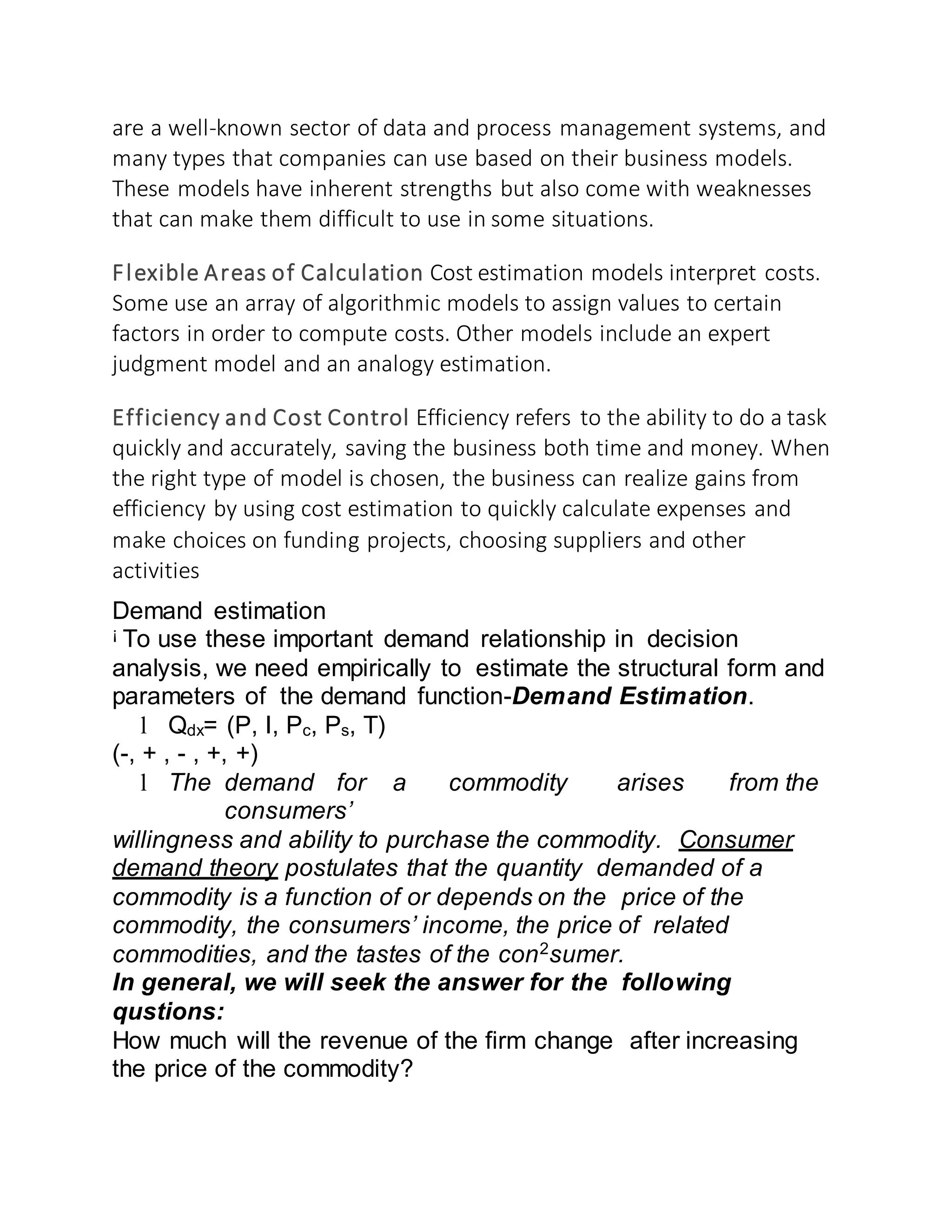
Demand estimation
¡
To use these important demand relationship in decision
analysis, we need empirically to estimate the structural form and
parameters of the demand function-Demand Estimation.
l Qdx= (P, I, Pc, Ps, T)
(-, + , - , +, +)
l The demand for a commodity arises from the
consumers’
willingness and ability to purchase the commodity. Consumer
demand theory postulates that the quantity demanded of a
commodity is a function of or depends on the price of the
commodity, the consumers’ income, the price of related
commodities, and the tastes of the con2sumer.
In general, we will seek the answer for the following
qustions:
How much will the revenue of the firm change after increasing
the price of the commodity?
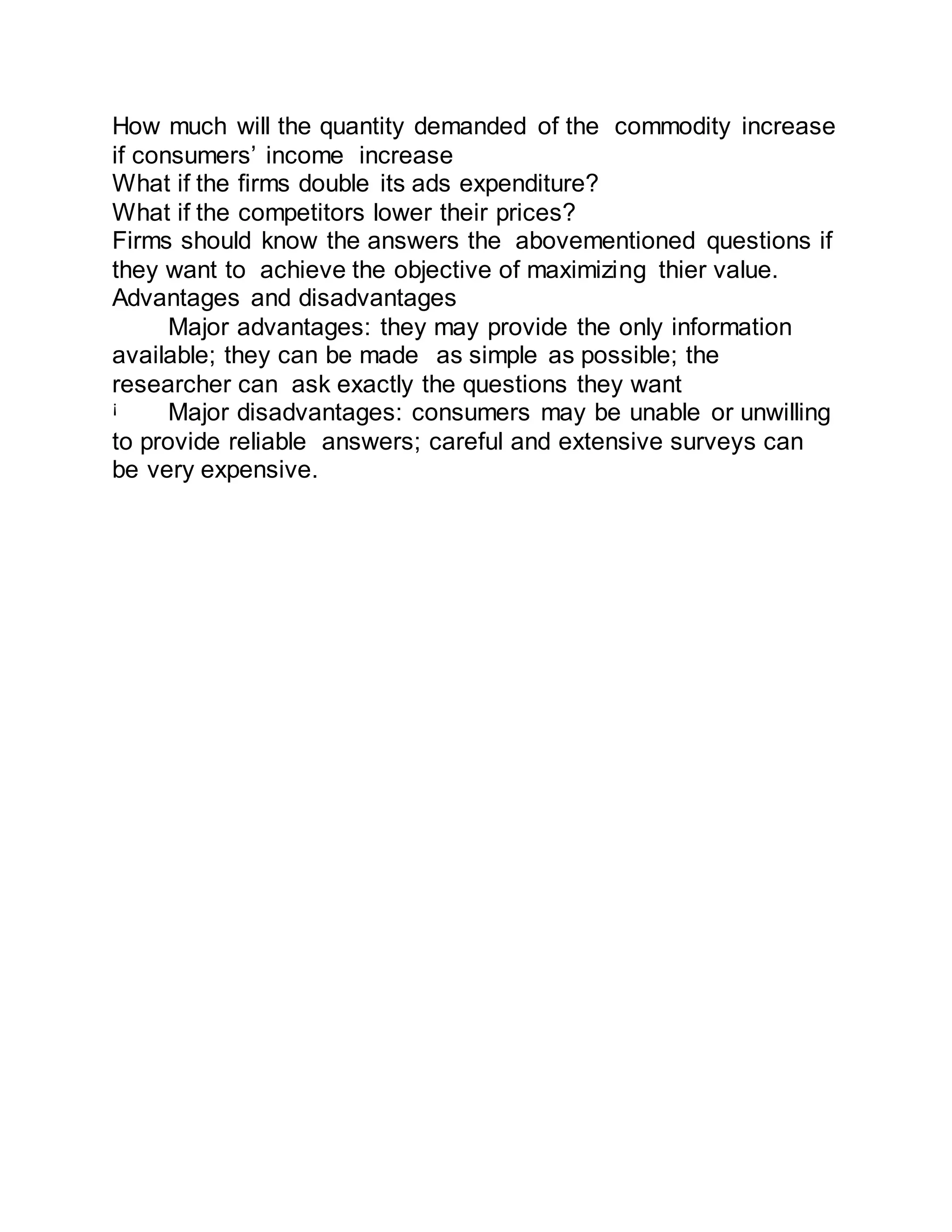
How much will the quantity demanded of the commodity increase
if consumers’ income increase
What if the firms double its ads expenditure?
What if the competitors lower their prices?
Firms should know the answers the abovementioned questions if
they want to achieve the objective of maximizing thier value.
Advantages and disadvantages
Major advantages: they may provide the only information
available; they can be made as simple as possible; the
researcher can ask exactly the questions they want
¡
Major disadvantages: consumers may be unable or unwilling
to provide reliable answers; careful and extensive surveys can
be very expensive.

Cost estimation method

  • 1.
    PRESENTER FAHEEM ULLAH CHITRALI PROGRAM:MBA(3.5) UOP Cost estimation method Cost estimating is a valuable tool that is used in each of the acquisition phases. There are a number of cost estimating techniques that can be used in estimating the costs of a future and current weapon system. The use on a specific approach will depend on how much information is available and where weapon system is in its development and lifecycle. Most programs will use multiple techniques to get a god cross reference of the accuracy of their estimates. Techniques of cost estimation Parametric: The parametric technique uses regression or other statistical methods to develop Cost Estimating Relationships (CERs). A CER is an equation used to estimate a given cost element using an established relationship with one or more independent variables. The relationship may be mathematically simple or it may involve a complex equation (often derived from regression analysis of historical systems or subsystems). CERs should be current, applicable to the system or subsystem in question, and appropriate for the range of data being considered. [1] Analogy: Ananalogy is a technique used to estimate a cost based on historical data for an analogous system or subsystem. In this technique, a currently fielded system, similar in design and operation to the proposed system, is used as a basis for the analogy. The cost of the proposed system is then estimated by adjusting the historical cost of the current system to account for differences (between the proposed and current systems). Such adjustments can be made through the use of factors (sometimes called scaling parameters) that represent differences in size, performance, technology, and/or complexity. Adjustment factors
  • 2.
    based on quantitativedata are usually preferable to adjustment factors based on judgments from subject-matter experts. Engineering Estimate:With this technique, the system being costed is broken down into lower-level components (such as parts or assemblies), each of which is costed separately for direct labor, direct material, and other costs. Engineering estimates for direct labor hours may be based on analyses of engineering drawings and contractor or industry-wide standards. Engineering estimates for direct material may be based on discrete raw material and purchase part requirements. The remaining elements of cost (such as quality control or various overhead charges) may be factored from the direct labor and material costs. The various discrete cost estimates are aggregated by simple algebraic equations (hence the common name “bottoms-up” estimate). The use of engineering estimates requires extensive knowledge of a system’s (and its components’) characteristics, and lots of detailed data. [1] Actual Costs:With this technique, actual cost experience or trends (from prototypes, engineering development models, and/or early production items) are used to project estimates of future costs for the same system. These projections may be made at various levels of detail, depending on the availability of data. Cost estimates that support a full-rate production milestone decision should be based on actual cost data to the greatest extent possible. A common mistake is to use contract prices as a substitute for actual cost experience. Contract prices should not be used to project future costs (even when firm-fixed price) unless it is known that the contract prices are associated with profitable ventures, and that it is reasonable to assume that similar price experience will be obtained for subsequent contracts. Advantages & Disadvantages of the Cost Estimation Cost estimation refers to analyzing the costs of projects, supplies and updates in business; analytics are usually conducted via software or at least a set process of research and reporting. Cost estimation models
  • 3.
    are a well-knownsector of data and process management systems, and many types that companies can use based on their business models. These models have inherent strengths but also come with weaknesses that can make them difficult to use in some situations. Flexible Areas of Calculation Cost estimation models interpret costs. Some use an array of algorithmic models to assign values to certain factors in order to compute costs. Other models include an expert judgment model and an analogy estimation. Efficiency and Cost Control Efficiency refers to the ability to do a task quickly and accurately, saving the business both time and money. When the right type of model is chosen, the business can realize gains from efficiency by using cost estimation to quickly calculate expenses and make choices on funding projects, choosing suppliers and other activities Demand estimation ¡ To use these important demand relationship in decision analysis, we need empirically to estimate the structural form and parameters of the demand function-Demand Estimation. l Qdx= (P, I, Pc, Ps, T) (-, + , - , +, +) l The demand for a commodity arises from the consumers’ willingness and ability to purchase the commodity. Consumer demand theory postulates that the quantity demanded of a commodity is a function of or depends on the price of the commodity, the consumers’ income, the price of related commodities, and the tastes of the con2sumer. In general, we will seek the answer for the following qustions: How much will the revenue of the firm change after increasing the price of the commodity?
  • 4.
    How much willthe quantity demanded of the commodity increase if consumers’ income increase What if the firms double its ads expenditure? What if the competitors lower their prices? Firms should know the answers the abovementioned questions if they want to achieve the objective of maximizing thier value. Advantages and disadvantages Major advantages: they may provide the only information available; they can be made as simple as possible; the researcher can ask exactly the questions they want ¡ Major disadvantages: consumers may be unable or unwilling to provide reliable answers; careful and extensive surveys can be very expensive.