Page 1 of 8
CORROCOAT
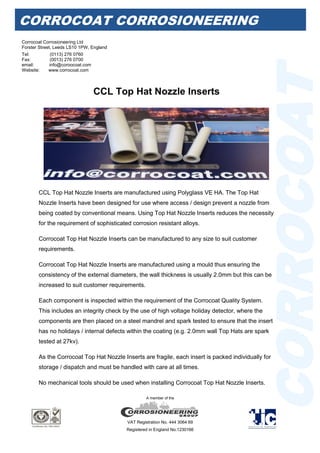
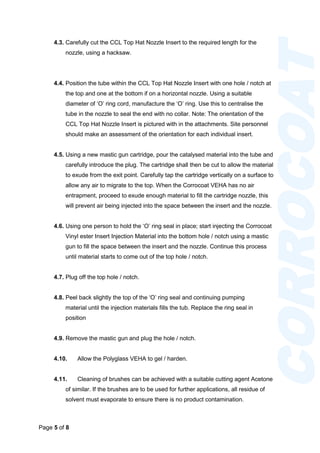
CCL Top Hat Nozzle Inserts
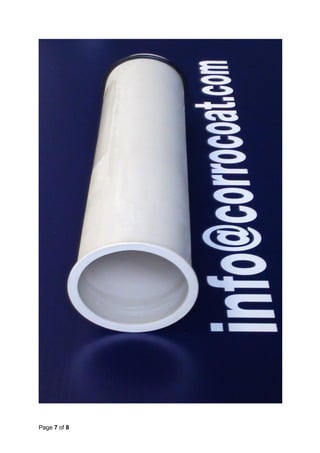
CCL Top Hat Nozzle Inserts are manufactured using Polyglass VE HA. The Top Hat
Nozzle Inserts have been designed for use where access / design prevent a nozzle from
being coated by conventional means. Using Top Hat Nozzle Inserts reduces the necessity
for the requirement of sophisticated corrosion resistant alloys.
Corrocoat Top Hat Nozzle Inserts can be manufactured to any size to suit customer
requirements.
Corrocoat Top Hat Nozzle Inserts are manufactured using a mould thus ensuring the
consistency of the external diameters, the wall thickness is usually 2.0mm but this can be
increased to suit customer requirements.
Each component is inspected within the requirement of the Corrocoat Quality System.
This includes an integrity check by the use of high voltage holiday detector, where the
components are then placed on a steel mandrel and spark tested to ensure that the insert
has no holidays / internal defects within the coating (e.g. 2.0mm wall Top Hats are spark
tested at 27kv).
As the Corrocoat Top Hat Nozzle Inserts are fragile, each insert is packed individually for
storage / dispatch and must be handled with care at all times.
No mechanical tools should be used when installing Corrocoat Top Hat Nozzle Inserts.
CORROCOAT CORROSIONEERING
Corrocoat Corrosioneering Ltd
Forster Street, Leeds LS10 1PW, England
Tel: (0113) 276 0760
Fax: (0013) 276 0700
email: info@coroocoat.com
Website: www.corrocoat.com
VAT Registration No. 444 3064 69
Registered in England No.1230166
A member of the
Page 2 of 8
CORROCOAT
Equipment List
(Including but not limited to)
1) Relevant PPE as outlined in the COSHH Assessment.
2) CCL Top Hat Nozzle Insert of the required diameter.
3) ‘O’ Ring Material to suit the size difference to meet the nozzle diameter
4) Super glue (cyanoacrylate adhesive)
5) P40 abrasive paper
6) Masking tape
7) Radiator brushes (if the pipe is accessible)
8) Mixing pots
9) Spatula / Mixer
10) Polyglass VEHA
11) P2 Peroxide Catalyst
12) Weighing scales
13) Catalyst measuring and dispensing bottles
14) Injection cartridge and nozzles
15) Nozzle plugs (Diameter of the notches)
16) Clean up rags / cloth’s
17) Solvent for equipment clean up
Page 3 of 8
CORROCOAT
1. SCOPE OF WORKS
1.1. The purpose of this document is to establish the method for the internal
lining of vessel nozzles using Corrocoat Top Hat Nozzle Inserts.
1.2. Corrocoat Work Instruction No 120
1.3. This document shall be read in conjunction with Corrocoat User Data Sheets:
Corrocoat Work Instruction No 120 Rev.2
SP1, Surface Preparation Specification, User Data Sheet # 6/30
SP4 Salts Contamination, User Data Sheet # 6/33 A
Polyglass HA / VEHA, Application Data # 2/25
Polyglass HA / VEHA Health and Safety Data Sheet # 2/27 A – D
2. SAFETY
2.1. All COSHH Assessments, Risk Assessments and Method Statements shall
be issued read and understood by the operatives assigned to the contract.
2.2. Warning notices shall be positioned at strategic locations and the work
areas cordoned off with an appropriate barrier.
2.3. Fire extinguishers shall be located particularly at the mixing area.
Page 4 of 8
CORROCOAT
3. SURFACE PREPARATION
3.1. Surface preparation shall be carried out to the required standard. Please refer
to the Corrocoat User Data SP1.
3.2. Environmental readings of temperature and humidity shall be recorded to
ensure conditions are suitable for subsequent coating operations. The steel
temperature shall be a minimum of 3 degrees centigrade above dew point; the
humidity shall be below 90%.
3.3. Prepare the nozzle by grinding off any uneven / high internal welds to a smooth
profile.
3.4. Providing the nozzle is free from debris and contaminates, dry fit the CCL Top
Hat Nozzle Insert to ensure that there is suitable clearance for the installation
procedure. The gap between the CCL Top Hat Nozzle Insert and pipe should
be approximately 2mm around the entire circumference.
3.5. The substrate will be grit blasted to BS EN ISO 8501-1, cleanliness standard
Sa2½ with a minimum surface profile of 50 microns in accordance with
Corrocoat User Data SP1. Following grit blasting, the prepared surfaces shall
be cleaned by a combination of sweeping and vacuuming to produce a dust
free surface.
4. Installation procedure
4.1. Where access allows, apply by brush, a thin coat of Polyglass VEHA onto the
nozzle to hold the blast and prime the surface. Ensure any subsequent injection
of material is carried out within the over-coating time for this primer layer.
Should the Nozzle be too small for a hand application prime layer, the insert
must be installed immediately after surface preparation to minimise oxidation of
the substrate.
4.2. Mechanically abrade the outside surface of the insert using P40 sandpaper to
create a mechanical key of the coating.
Page 5 of 8
CORROCOAT
4.3. Carefully cut the CCL Top Hat Nozzle Insert to the required length for the
nozzle, using a hacksaw.
4.4. Position the tube within the CCL Top Hat Nozzle Insert with one hole / notch at
the top and one at the bottom if on a horizontal nozzle. Using a suitable
diameter of ‘O’ ring cord, manufacture the ‘O’ ring. Use this to centralise the
tube in the nozzle to seal the end with no collar. Note: The orientation of the
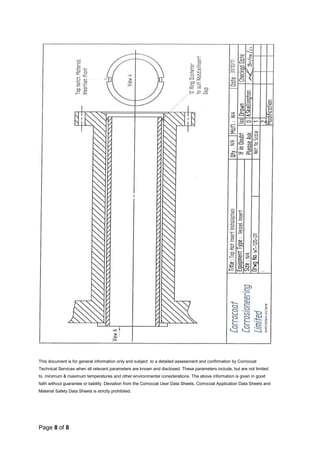
CCL Top Hat Nozzle Insert is pictured with in the attachments. Site personnel
should make an assessment of the orientation for each individual insert.
4.5. Using a new mastic gun cartridge, pour the catalysed material into the tube and
carefully introduce the plug. The cartridge shall then be cut to allow the material
to exude from the exit point. Carefully tap the cartridge vertically on a surface to
allow any air to migrate to the top. When the Corrocoat VEHA has no air
entrapment, proceed to exude enough material to fill the cartridge nozzle, this
will prevent air being injected into the space between the insert and the nozzle.
4.6. Using one person to hold the ‘O’ ring seal in place; start injecting the Corrocoat
Vinyl ester Insert Injection Material into the bottom hole / notch using a mastic
gun to fill the space between the insert and the nozzle. Continue this process
until material starts to come out of the top hole / notch.
4.7. Plug off the top hole / notch.
4.8. Peel back slightly the top of the ‘O’ ring seal and continuing pumping
material until the injection materials fills the tub. Replace the ring seal in
position
4.9. Remove the mastic gun and plug the hole / notch.
4.10. Allow the Polyglass VEHA to gel / harden.
4.11. Cleaning of brushes can be achieved with a suitable cutting agent Acetone
of similar. If the brushes are to be used for further applications, all residue of
solvent must evaporate to ensure there is no product contamination.
Page 6 of 8
CORROCOAT
Diagram of CCL Top Hat Nozzle Insert orientation is dependent on the curvature of
the vessel. These diagrams indicate the installation to which the CCL Top Hat Nozzle
is inserted.
Page 7 of 8
Page 8 of 8
This document is for general information only and subject to a detailed assessment and confirmation by Corrocoat
Technical Services when all relevant parameters are known and disclosed. These parameters include, but are not limited
to, minimum & maximum temperatures and other environmental considerations. The above information is given in good
faith without guarantee or liability. Deviation from the Corrocoat User Data Sheets, Corrocoat Application Data Sheets and
Material Safety Data Sheets is strictly prohibited.

Corrocoat Composite Nozzle Insert

  • 1.
    Page 1 of8 CORROCOAT CCL Top Hat Nozzle Inserts CCL Top Hat Nozzle Inserts are manufactured using Polyglass VE HA. The Top Hat Nozzle Inserts have been designed for use where access / design prevent a nozzle from being coated by conventional means. Using Top Hat Nozzle Inserts reduces the necessity for the requirement of sophisticated corrosion resistant alloys. Corrocoat Top Hat Nozzle Inserts can be manufactured to any size to suit customer requirements. Corrocoat Top Hat Nozzle Inserts are manufactured using a mould thus ensuring the consistency of the external diameters, the wall thickness is usually 2.0mm but this can be increased to suit customer requirements. Each component is inspected within the requirement of the Corrocoat Quality System. This includes an integrity check by the use of high voltage holiday detector, where the components are then placed on a steel mandrel and spark tested to ensure that the insert has no holidays / internal defects within the coating (e.g. 2.0mm wall Top Hats are spark tested at 27kv). As the Corrocoat Top Hat Nozzle Inserts are fragile, each insert is packed individually for storage / dispatch and must be handled with care at all times. No mechanical tools should be used when installing Corrocoat Top Hat Nozzle Inserts. CORROCOAT CORROSIONEERING Corrocoat Corrosioneering Ltd Forster Street, Leeds LS10 1PW, England Tel: (0113) 276 0760 Fax: (0013) 276 0700 email: info@coroocoat.com Website: www.corrocoat.com VAT Registration No. 444 3064 69 Registered in England No.1230166 A member of the
  • 2.
    Page 2 of8 CORROCOAT Equipment List (Including but not limited to) 1) Relevant PPE as outlined in the COSHH Assessment. 2) CCL Top Hat Nozzle Insert of the required diameter. 3) ‘O’ Ring Material to suit the size difference to meet the nozzle diameter 4) Super glue (cyanoacrylate adhesive) 5) P40 abrasive paper 6) Masking tape 7) Radiator brushes (if the pipe is accessible) 8) Mixing pots 9) Spatula / Mixer 10) Polyglass VEHA 11) P2 Peroxide Catalyst 12) Weighing scales 13) Catalyst measuring and dispensing bottles 14) Injection cartridge and nozzles 15) Nozzle plugs (Diameter of the notches) 16) Clean up rags / cloth’s 17) Solvent for equipment clean up
  • 3.
    Page 3 of8 CORROCOAT 1. SCOPE OF WORKS 1.1. The purpose of this document is to establish the method for the internal lining of vessel nozzles using Corrocoat Top Hat Nozzle Inserts. 1.2. Corrocoat Work Instruction No 120 1.3. This document shall be read in conjunction with Corrocoat User Data Sheets: Corrocoat Work Instruction No 120 Rev.2 SP1, Surface Preparation Specification, User Data Sheet # 6/30 SP4 Salts Contamination, User Data Sheet # 6/33 A Polyglass HA / VEHA, Application Data # 2/25 Polyglass HA / VEHA Health and Safety Data Sheet # 2/27 A – D 2. SAFETY 2.1. All COSHH Assessments, Risk Assessments and Method Statements shall be issued read and understood by the operatives assigned to the contract. 2.2. Warning notices shall be positioned at strategic locations and the work areas cordoned off with an appropriate barrier. 2.3. Fire extinguishers shall be located particularly at the mixing area.
  • 4.
    Page 4 of8 CORROCOAT 3. SURFACE PREPARATION 3.1. Surface preparation shall be carried out to the required standard. Please refer to the Corrocoat User Data SP1. 3.2. Environmental readings of temperature and humidity shall be recorded to ensure conditions are suitable for subsequent coating operations. The steel temperature shall be a minimum of 3 degrees centigrade above dew point; the humidity shall be below 90%. 3.3. Prepare the nozzle by grinding off any uneven / high internal welds to a smooth profile. 3.4. Providing the nozzle is free from debris and contaminates, dry fit the CCL Top Hat Nozzle Insert to ensure that there is suitable clearance for the installation procedure. The gap between the CCL Top Hat Nozzle Insert and pipe should be approximately 2mm around the entire circumference. 3.5. The substrate will be grit blasted to BS EN ISO 8501-1, cleanliness standard Sa2½ with a minimum surface profile of 50 microns in accordance with Corrocoat User Data SP1. Following grit blasting, the prepared surfaces shall be cleaned by a combination of sweeping and vacuuming to produce a dust free surface. 4. Installation procedure 4.1. Where access allows, apply by brush, a thin coat of Polyglass VEHA onto the nozzle to hold the blast and prime the surface. Ensure any subsequent injection of material is carried out within the over-coating time for this primer layer. Should the Nozzle be too small for a hand application prime layer, the insert must be installed immediately after surface preparation to minimise oxidation of the substrate. 4.2. Mechanically abrade the outside surface of the insert using P40 sandpaper to create a mechanical key of the coating.
  • 5.
    Page 5 of8 CORROCOAT 4.3. Carefully cut the CCL Top Hat Nozzle Insert to the required length for the nozzle, using a hacksaw. 4.4. Position the tube within the CCL Top Hat Nozzle Insert with one hole / notch at the top and one at the bottom if on a horizontal nozzle. Using a suitable diameter of ‘O’ ring cord, manufacture the ‘O’ ring. Use this to centralise the tube in the nozzle to seal the end with no collar. Note: The orientation of the CCL Top Hat Nozzle Insert is pictured with in the attachments. Site personnel should make an assessment of the orientation for each individual insert. 4.5. Using a new mastic gun cartridge, pour the catalysed material into the tube and carefully introduce the plug. The cartridge shall then be cut to allow the material to exude from the exit point. Carefully tap the cartridge vertically on a surface to allow any air to migrate to the top. When the Corrocoat VEHA has no air entrapment, proceed to exude enough material to fill the cartridge nozzle, this will prevent air being injected into the space between the insert and the nozzle. 4.6. Using one person to hold the ‘O’ ring seal in place; start injecting the Corrocoat Vinyl ester Insert Injection Material into the bottom hole / notch using a mastic gun to fill the space between the insert and the nozzle. Continue this process until material starts to come out of the top hole / notch. 4.7. Plug off the top hole / notch. 4.8. Peel back slightly the top of the ‘O’ ring seal and continuing pumping material until the injection materials fills the tub. Replace the ring seal in position 4.9. Remove the mastic gun and plug the hole / notch. 4.10. Allow the Polyglass VEHA to gel / harden. 4.11. Cleaning of brushes can be achieved with a suitable cutting agent Acetone of similar. If the brushes are to be used for further applications, all residue of solvent must evaporate to ensure there is no product contamination.
  • 6.
    Page 6 of8 CORROCOAT Diagram of CCL Top Hat Nozzle Insert orientation is dependent on the curvature of the vessel. These diagrams indicate the installation to which the CCL Top Hat Nozzle is inserted.
  • 7.
  • 8.
    Page 8 of8 This document is for general information only and subject to a detailed assessment and confirmation by Corrocoat Technical Services when all relevant parameters are known and disclosed. These parameters include, but are not limited to, minimum & maximum temperatures and other environmental considerations. The above information is given in good faith without guarantee or liability. Deviation from the Corrocoat User Data Sheets, Corrocoat Application Data Sheets and Material Safety Data Sheets is strictly prohibited.