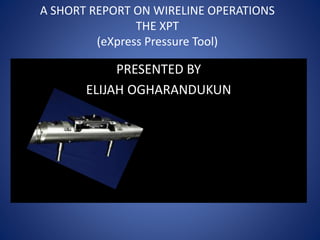
A SHORT REPORT ON WIRELINE OPERATIONS
THE XPT
(eXpress Pressure Tool)
PRESENTED BY
ELIJAH OGHARANDUKUN
CONTENT
o Introduction.
o Maintenance
o The Pressure Express Tool (XPT).
INTRODUCTION
Well logging also known as bore hole logging is the practice
of making detailed record(a well log) of the geologic
formations penetrated by a borehole. The log may be based
either on visual inspection of some samples brought to the
surface(geological log) or physical measurement made by
instruments lowered into the hole(geophysical).
The oil and gas industry uses wireline logging to obtain a
continuous record of a formation or rock properties. These
can be used to infer further properties such as, hydrocarbon
saturation and formation pressure and also to make a further
drilling and production decision.
Wireline logging is performed by lowering a logging tool on
the end of a wire line into an oil well(or borehole) and
recording petro physical properties using a variety of sensors
MAINTENANCE
o F.I.T
o T.R.I.M
o Q-CHECK
F.I.T (Fast Inspection of Tools)
F.I.T is carried out in three(3) stages:
F.I.T 1, F.I.T 2, F.I.T 3.
F.I.T 1
This is the mechanical inspection of tools, cleaning the head,
changing of external o-rings, lubricating etc. It is done before and
after every job.
F.I.T 2
This is the electrical check, it’s the continuity and insulation check
which helps us to determine if the wires are still continuous
through out the tool or they might have been damaged or broken.
It also helps us assert whether the cables still meet the required
resistance value for the tool to function properly.
F.I.T 3
This is an operational check carried out on the tool to ensure
that the tool is operational and fully functional under the
specified conditions.
T.R.I.M(Tool Review and Inspection Monthly)
T.R.I.M is a more in-depth and comprehensive form of the
F.I.T. It is carried out monthly(as the name implies) or
periodically depending on the nature of operations carried out
by the tools. It’s also in three stages:
T.R.I.M 1: Mechanical check.
T.R.I.M 2: Electrical check.
T.R.I.M 3: Shop calibration
Q-Check( Quality Check )
Q-Check is a detailed analysis of the tool it
comprises of all other maintenance procedures i.e.
the FIT and TRIM. It is carried out periodically
depending on the specification for the tool, it could
be monthly, quarterly or depending on the nature or
the amount of jobs the tool has performed. In all it is
done to determine the condition of the tool, to know
if the tool still meets manufacturers specifications or
is still within specified operational limits.
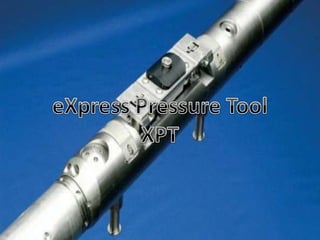
The XPT
The eXpress Pressure Tool (XPT) is a tool used
to determine the formation pressure at
different points or strata in a well. The data
gotten is used to generate a profile or survey
which is used to determine fluid mobility also
permeability data off the well. This helps us to
determine the points at which sampling of
fluids can be carried out.
The XPT is made up of the following modules:
• XPCC:- (eXpress Pressure Control Cartridge)
• XPMC:- (eXpress Pressure Measuring Cartridge)
• XPS:- (eXpress Pressure Sonde)
• XPAMS:- (eXpress Pressure Anchoring Measurement
Sonde)
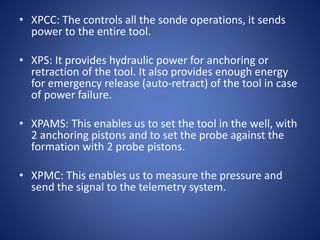
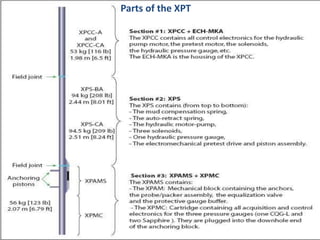
• XPCC: The controls all the sonde operations, it sends
power to the entire tool.
• XPS: It provides hydraulic power for anchoring or
retraction of the tool. It also provides enough energy
for emergency release (auto-retract) of the tool in case
of power failure.
• XPAMS: This enables us to set the tool in the well, with
2 anchoring pistons and to set the probe against the
formation with 2 probe pistons.
• XPMC: This enables us to measure the pressure and
send the signal to the telemetry system.
Parts of the XPT
Theory of Operation
The XPT uses the same pretest principle as other multifunctional testers
such as the MDT.
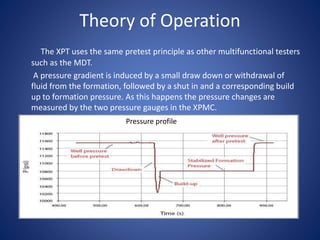
A pressure gradient is induced by a small draw down or withdrawal of
fluid from the formation, followed by a shut in and a corresponding build
up to formation pressure. As this happens the pressure changes are
measured by the two pressure gauges in the XPMC.
Pressure profile
The XPT has been designed to fit with other
wireline tools, and it has the ability to carry
out unlimited number of tests in just a single
run. This enables us to carry out lots of pretest
operations while logging with other wireline
tools
Conclusion
The eXpress Pressure tool brings new
efficiency to the formation testing process by
greatly reducing the time and risk associated
with the other multifunctional testers. The
XPT is a very fast and effective way of
measuring formation pressure, its adaptability
with other wireline tools make it very cost
effective and easy to use.
THANK YOU

A SHORT REPORT ON WIRELINE OPERATIONS

  • 1.
    A SHORT REPORTON WIRELINE OPERATIONS THE XPT (eXpress Pressure Tool) PRESENTED BY ELIJAH OGHARANDUKUN
  • 2.
    CONTENT o Introduction. o Maintenance oThe Pressure Express Tool (XPT).
  • 3.
    INTRODUCTION Well logging alsoknown as bore hole logging is the practice of making detailed record(a well log) of the geologic formations penetrated by a borehole. The log may be based either on visual inspection of some samples brought to the surface(geological log) or physical measurement made by instruments lowered into the hole(geophysical). The oil and gas industry uses wireline logging to obtain a continuous record of a formation or rock properties. These can be used to infer further properties such as, hydrocarbon saturation and formation pressure and also to make a further drilling and production decision. Wireline logging is performed by lowering a logging tool on the end of a wire line into an oil well(or borehole) and recording petro physical properties using a variety of sensors
  • 4.
    MAINTENANCE o F.I.T o T.R.I.M oQ-CHECK F.I.T (Fast Inspection of Tools) F.I.T is carried out in three(3) stages: F.I.T 1, F.I.T 2, F.I.T 3. F.I.T 1 This is the mechanical inspection of tools, cleaning the head, changing of external o-rings, lubricating etc. It is done before and after every job. F.I.T 2 This is the electrical check, it’s the continuity and insulation check which helps us to determine if the wires are still continuous through out the tool or they might have been damaged or broken. It also helps us assert whether the cables still meet the required resistance value for the tool to function properly.
  • 5.
    F.I.T 3 This isan operational check carried out on the tool to ensure that the tool is operational and fully functional under the specified conditions. T.R.I.M(Tool Review and Inspection Monthly) T.R.I.M is a more in-depth and comprehensive form of the F.I.T. It is carried out monthly(as the name implies) or periodically depending on the nature of operations carried out by the tools. It’s also in three stages: T.R.I.M 1: Mechanical check. T.R.I.M 2: Electrical check. T.R.I.M 3: Shop calibration
  • 6.
    Q-Check( Quality Check) Q-Check is a detailed analysis of the tool it comprises of all other maintenance procedures i.e. the FIT and TRIM. It is carried out periodically depending on the specification for the tool, it could be monthly, quarterly or depending on the nature or the amount of jobs the tool has performed. In all it is done to determine the condition of the tool, to know if the tool still meets manufacturers specifications or is still within specified operational limits.
  • 8.
    The XPT The eXpressPressure Tool (XPT) is a tool used to determine the formation pressure at different points or strata in a well. The data gotten is used to generate a profile or survey which is used to determine fluid mobility also permeability data off the well. This helps us to determine the points at which sampling of fluids can be carried out.
  • 9.
    The XPT ismade up of the following modules: • XPCC:- (eXpress Pressure Control Cartridge) • XPMC:- (eXpress Pressure Measuring Cartridge) • XPS:- (eXpress Pressure Sonde) • XPAMS:- (eXpress Pressure Anchoring Measurement Sonde)
  • 10.
    • XPCC: Thecontrols all the sonde operations, it sends power to the entire tool. • XPS: It provides hydraulic power for anchoring or retraction of the tool. It also provides enough energy for emergency release (auto-retract) of the tool in case of power failure. • XPAMS: This enables us to set the tool in the well, with 2 anchoring pistons and to set the probe against the formation with 2 probe pistons. • XPMC: This enables us to measure the pressure and send the signal to the telemetry system.
  • 11.
  • 12.
    Theory of Operation TheXPT uses the same pretest principle as other multifunctional testers such as the MDT. A pressure gradient is induced by a small draw down or withdrawal of fluid from the formation, followed by a shut in and a corresponding build up to formation pressure. As this happens the pressure changes are measured by the two pressure gauges in the XPMC. Pressure profile
  • 13.
    The XPT hasbeen designed to fit with other wireline tools, and it has the ability to carry out unlimited number of tests in just a single run. This enables us to carry out lots of pretest operations while logging with other wireline tools
  • 14.
    Conclusion The eXpress Pressuretool brings new efficiency to the formation testing process by greatly reducing the time and risk associated with the other multifunctional testers. The XPT is a very fast and effective way of measuring formation pressure, its adaptability with other wireline tools make it very cost effective and easy to use.
  • 15.