CORROGLASS
Corrocoat Limited, Forster Street, Leeds LS10 1PW. Tel: (0113) 276 0760. Fax: (0113) 2760700
This information is offered in good faith but without guarantee or liability
PAGE 1 OF 2
Valid From: 27 November 1997 © COPYRIGHT 1/17
AR VEILCOAT
TYPE: A two-pack cold cured modified vinyl ester/acrylic co-polymer
veilcoat.
SUGGESTED USE: Corroglass AR VEILCOAT has been specially formulated to
offer the best resistance to base environments, e.g. Sodium
Hydroxide and Sodium Hypochlorite, the resin and cure system
having been modified to impart the optimum resistance to these
environments. Corroglass AR Veilcoat is to be used as a surface
veil in certain applications where the glass present in the AR4
may be attacked by the environment.
HEALTH & SAFETY: Before commencing work, read the product Health & Safety data
sheet. Corroglass AR Veilcoat should only be used by
adequately trained personnel.
SURFACE PREPARATION: Apply over suitable Corroglass AR4.
APPLICATION EQUIPMENT: For spray application use a Graco King 45:1, or similar, airless
pump, 10mm diameter (3
/8”) nylon spray line. Large bore mastic
type gun with 30 to 60 thou reversible or titan adjustable tip.
May be hand applied using a brush, roller or trowel.
APPLICATION: Corroglass AR Veilcoat is normally applied at wet films between
250 and 500 microns.
MIXING RATIO: 98:2 Base to Hardener.
HARDENER TYPE: Catalyst type - Benzoyl Peroxide.
POT LIFE: Approximately 55-65 minutes at 20°C (may vary dependent upon
temperature and age of product).
THINNERS: The performance of Corroglass AR Veilcoat may be significantly
affected by the addition of styrene. DO NOT ADD SOLVENT
THINNERS.
PACKAGING: 20 Litre composite kits.
STORAGE LIFE: 6 Months if stored at temperatures below 20°C and away from
direct heat and sunlight.
CORROGLASS
Corrocoat Limited, Forster Street, Leeds LS10 1PW. Tel: (0113) 276 0760. Fax: (0113) 2760700
This information is offered in good faith but without guarantee or liability
PAGE 2 OF 2
Reverse/1/17
CORROGLASS AR VEILCOAT
COLOUR AVAILABILITY: Unpigmented or black.
RECOMMENDED DFT: 250 Microns minimum dependent upon service conditions.
THEORETICAL SPREADING RATE: 2.0m²/Litre at 500 microns.
VOLUME SOLIDS: This material contains volatile liquid convertible to solids. Volume solids
obtained will vary dependent upon polymerisation conditions. Nominally
99% of the contents are convertible to solid.
PRACTICAL SPREADING RATE: 3.0m²/Litre at 250 microns.
Note: This information is given in good faith but may increase dependent
upon environment conditions, the geometry and nature of work undertaken
and the skill and care of application. Corrocoat accept no responsibility for
any deviation from these values.
HARDNESS: 40 Barcol.
OVERCOATING: May take place as soon as the previous coat has gelled and whilst still tacky.
Maximum overcoating time 72 hours at 20°C.
Once the maximum overcoating time has been reached, the adhesion values
attained by any subsequent coat will reduce dramatically. It is important to
observe maximum overcoating times and note these will vary with climatic
conditions. Any further application of coating at this juncture should be
treated as a repair, with the surface flashed over to provide a physical key.
Styrene cannot be used to reactivate the surface and may in some cases
impair adhesion.
ELONGATION AT BREAK: 0.3%
DIELECTRIC STRENGTH: 18 - 25 x 10³ V/mm
TENSILE STRENGTH: 26.5 N mm-
² (3845 PSI)
TEMPERATURE LIMITS: 82°C Immersed
CURING TIME: Tack free after 24 hours at 20°C. Full cure after 4 days. A cure of 7 days at
a minimum temperature of 15°C prior to service is recommended for this
product.
CLEANING SOLVENT: Methyl Ethyl Ketone, Acetone and Methyl Iso Butyl Ketone prior to
gelation.
NOTE: The physical data contained on this sheet will vary dependent upon the effectiveness of cure which is variable
with application and environment conditions. The figures given are average values for well cured material.
For additional information contact Corrocoat Technical Services
Reviewed 05th
October 2001 – No changes
Reviewed 02/2014 (No changes)
Reviewed 05/2016 (No changes)

CORROGLASS AR VEILCOAT

  • 1.
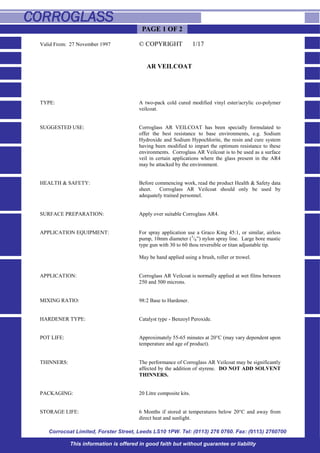
    CORROGLASS Corrocoat Limited, ForsterStreet, Leeds LS10 1PW. Tel: (0113) 276 0760. Fax: (0113) 2760700 This information is offered in good faith but without guarantee or liability PAGE 1 OF 2 Valid From: 27 November 1997 © COPYRIGHT 1/17 AR VEILCOAT TYPE: A two-pack cold cured modified vinyl ester/acrylic co-polymer veilcoat. SUGGESTED USE: Corroglass AR VEILCOAT has been specially formulated to offer the best resistance to base environments, e.g. Sodium Hydroxide and Sodium Hypochlorite, the resin and cure system having been modified to impart the optimum resistance to these environments. Corroglass AR Veilcoat is to be used as a surface veil in certain applications where the glass present in the AR4 may be attacked by the environment. HEALTH & SAFETY: Before commencing work, read the product Health & Safety data sheet. Corroglass AR Veilcoat should only be used by adequately trained personnel. SURFACE PREPARATION: Apply over suitable Corroglass AR4. APPLICATION EQUIPMENT: For spray application use a Graco King 45:1, or similar, airless pump, 10mm diameter (3 /8”) nylon spray line. Large bore mastic type gun with 30 to 60 thou reversible or titan adjustable tip. May be hand applied using a brush, roller or trowel. APPLICATION: Corroglass AR Veilcoat is normally applied at wet films between 250 and 500 microns. MIXING RATIO: 98:2 Base to Hardener. HARDENER TYPE: Catalyst type - Benzoyl Peroxide. POT LIFE: Approximately 55-65 minutes at 20°C (may vary dependent upon temperature and age of product). THINNERS: The performance of Corroglass AR Veilcoat may be significantly affected by the addition of styrene. DO NOT ADD SOLVENT THINNERS. PACKAGING: 20 Litre composite kits. STORAGE LIFE: 6 Months if stored at temperatures below 20°C and away from direct heat and sunlight.
  • 2.
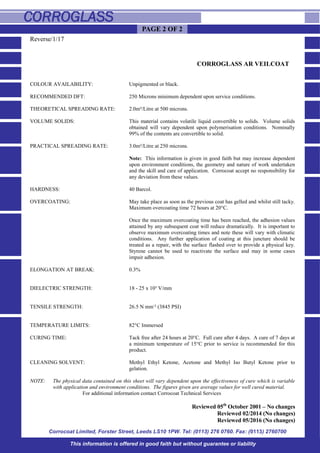
    CORROGLASS Corrocoat Limited, ForsterStreet, Leeds LS10 1PW. Tel: (0113) 276 0760. Fax: (0113) 2760700 This information is offered in good faith but without guarantee or liability PAGE 2 OF 2 Reverse/1/17 CORROGLASS AR VEILCOAT COLOUR AVAILABILITY: Unpigmented or black. RECOMMENDED DFT: 250 Microns minimum dependent upon service conditions. THEORETICAL SPREADING RATE: 2.0m²/Litre at 500 microns. VOLUME SOLIDS: This material contains volatile liquid convertible to solids. Volume solids obtained will vary dependent upon polymerisation conditions. Nominally 99% of the contents are convertible to solid. PRACTICAL SPREADING RATE: 3.0m²/Litre at 250 microns. Note: This information is given in good faith but may increase dependent upon environment conditions, the geometry and nature of work undertaken and the skill and care of application. Corrocoat accept no responsibility for any deviation from these values. HARDNESS: 40 Barcol. OVERCOATING: May take place as soon as the previous coat has gelled and whilst still tacky. Maximum overcoating time 72 hours at 20°C. Once the maximum overcoating time has been reached, the adhesion values attained by any subsequent coat will reduce dramatically. It is important to observe maximum overcoating times and note these will vary with climatic conditions. Any further application of coating at this juncture should be treated as a repair, with the surface flashed over to provide a physical key. Styrene cannot be used to reactivate the surface and may in some cases impair adhesion. ELONGATION AT BREAK: 0.3% DIELECTRIC STRENGTH: 18 - 25 x 10³ V/mm TENSILE STRENGTH: 26.5 N mm- ² (3845 PSI) TEMPERATURE LIMITS: 82°C Immersed CURING TIME: Tack free after 24 hours at 20°C. Full cure after 4 days. A cure of 7 days at a minimum temperature of 15°C prior to service is recommended for this product. CLEANING SOLVENT: Methyl Ethyl Ketone, Acetone and Methyl Iso Butyl Ketone prior to gelation. NOTE: The physical data contained on this sheet will vary dependent upon the effectiveness of cure which is variable with application and environment conditions. The figures given are average values for well cured material. For additional information contact Corrocoat Technical Services Reviewed 05th October 2001 – No changes Reviewed 02/2014 (No changes) Reviewed 05/2016 (No changes)