
r.r.a.ortiz
Managing Strategic Corporate
planning
 Involves how to lay the foundation for
tomorrows success while competing to win
in today’s marketplace Winning today is
never enough unless the seeds of
tomorrow’s success are planted and
cultivated today otherwise the organization
will not have a future
 Involves managing “The conflict between
the demands of the present and the
requirements of the future is at the heart of
strategic corporate planning “
Strategic Corporate planning
involves
 Managing the marketplace
 Managing the organization
 Practicing strategic corporate planning
management
next
Managing the marketplace
 designing, executing and refining
strategies that “win” in a changing
marketplace, strategy is the means by
which the organization creates and
leverages changes in and around the
marketplace
back
Managing the organization:
 configuring the organizations how it
thinks , how it operates. Without such
internal change the organization can not
hope to hone its capacity to identify,
adapt to and leverage environmental
change
back
Practicing corporate strategic
planning management
 continually enhancing linkages between
strategy ( what the company does in the
market place ) and the organization (
what takes place within the organization
)
back
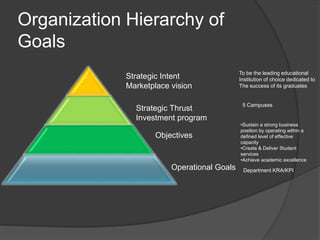
Organization Hierarchy of
Goals
Strategic Intent
Marketplace vision
Strategic Thrust
Investment program
Objectives
Operational Goals
To be the leading educational
Institution of choice dedicated to
The success of its graduates
5 Campuses
•Sustain a strong business
position by operating within a
defined level of effective
capacity
•Create & Deliver Student
services
•Achieve academic excellence
Department KRA/KPI
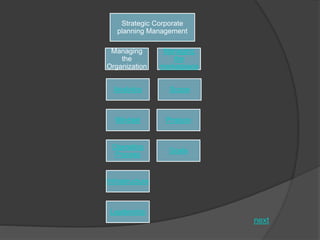
Strategic Corporate
planning Management
Managing
the
Organization
Analytics
Mindset
Operating
Process
Infrastructure
Leadership
Managing
the
marketplace
Scope
Posture
Goals
next
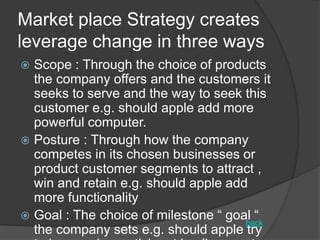
Market place Strategy creates
leverage change in three ways
 Scope : Through the choice of products
the company offers and the customers it
seeks to serve and the way to seek this
customer e.g. should apple add more
powerful computer.
 Posture : Through how the company
competes in its chosen businesses or
product customer segments to attract ,
win and retain e.g. should apple add
more functionality
 Goal : The choice of milestone “ goal “
the company sets e.g. should apple try
back
Scope
 Through the choice of products the
company offers and the customers it
seeks to serve and the way to seek this
customer
back
Posture :
 Through how the company competes in
its chosen businesses or product
customer segments to attract , win and
retain
back
Goal :
 The choice of milestone “ goal “ the
company sets
back
Managing the Organization
 Analytics : refers to all of the analysis
conducted by an organization/company in
strategy determination and execution
back
Managing the Organization
 Mindset :Is the sum of all vision(what
managers see the organization striving
to attain ), values (what they consider
important ), beliefs ( what they consider
to be cause-effect relationships), and
assumptions ( what they take for
granted )
back
Managing the Organization
 Operating process : Operating process
constitute how work gets done in and
around the organization
back
Managing the Organization
 Infrastructure : structure refers to how the
organization is organized internally as well
as to its relationship with external entities,
Systems are required to move information
through the structure oversee and control the
flow of resources, reward and motivate
organizational members, and this facilitate
decision making. Information, control,
remuneration and planning systems play
roles to ensure that an organization
anticipates, copes with and leverage change.
Decision processes are the organizational
back
Managing the Organization
 Leadership : “ Leaders must continually
guide the analytics, modify the mindset, and
integrate the operating processes and adjust
the infrastructure and all this leaders do to
anticipate change. Effective managers leads
adapts and sometimes radically alters
strategy scope, posture and goals. Simply
stated the purpose of leadership is to make a
difference by increasing the chances of
winning the marketplace “ the strategy
difference, Building and sustaining anback
The End

Corporate strategic management direction

  • 1.
  • 2.
    Managing Strategic Corporate planning Involves how to lay the foundation for tomorrows success while competing to win in today’s marketplace Winning today is never enough unless the seeds of tomorrow’s success are planted and cultivated today otherwise the organization will not have a future  Involves managing “The conflict between the demands of the present and the requirements of the future is at the heart of strategic corporate planning “
  • 3.
    Strategic Corporate planning involves Managing the marketplace  Managing the organization  Practicing strategic corporate planning management next
  • 4.
    Managing the marketplace designing, executing and refining strategies that “win” in a changing marketplace, strategy is the means by which the organization creates and leverages changes in and around the marketplace back
  • 5.
    Managing the organization: configuring the organizations how it thinks , how it operates. Without such internal change the organization can not hope to hone its capacity to identify, adapt to and leverage environmental change back
  • 6.
    Practicing corporate strategic planningmanagement  continually enhancing linkages between strategy ( what the company does in the market place ) and the organization ( what takes place within the organization ) back
  • 7.
    Organization Hierarchy of Goals StrategicIntent Marketplace vision Strategic Thrust Investment program Objectives Operational Goals To be the leading educational Institution of choice dedicated to The success of its graduates 5 Campuses •Sustain a strong business position by operating within a defined level of effective capacity •Create & Deliver Student services •Achieve academic excellence Department KRA/KPI
  • 8.
  • 9.
    Market place Strategycreates leverage change in three ways  Scope : Through the choice of products the company offers and the customers it seeks to serve and the way to seek this customer e.g. should apple add more powerful computer.  Posture : Through how the company competes in its chosen businesses or product customer segments to attract , win and retain e.g. should apple add more functionality  Goal : The choice of milestone “ goal “ the company sets e.g. should apple try back
  • 10.
    Scope  Through thechoice of products the company offers and the customers it seeks to serve and the way to seek this customer back
  • 11.
    Posture :  Throughhow the company competes in its chosen businesses or product customer segments to attract , win and retain back
  • 12.
    Goal :  Thechoice of milestone “ goal “ the company sets back
  • 13.
    Managing the Organization Analytics : refers to all of the analysis conducted by an organization/company in strategy determination and execution back
  • 14.
    Managing the Organization Mindset :Is the sum of all vision(what managers see the organization striving to attain ), values (what they consider important ), beliefs ( what they consider to be cause-effect relationships), and assumptions ( what they take for granted ) back
  • 15.
    Managing the Organization Operating process : Operating process constitute how work gets done in and around the organization back
  • 16.
    Managing the Organization Infrastructure : structure refers to how the organization is organized internally as well as to its relationship with external entities, Systems are required to move information through the structure oversee and control the flow of resources, reward and motivate organizational members, and this facilitate decision making. Information, control, remuneration and planning systems play roles to ensure that an organization anticipates, copes with and leverage change. Decision processes are the organizational back
  • 17.
    Managing the Organization Leadership : “ Leaders must continually guide the analytics, modify the mindset, and integrate the operating processes and adjust the infrastructure and all this leaders do to anticipate change. Effective managers leads adapts and sometimes radically alters strategy scope, posture and goals. Simply stated the purpose of leadership is to make a difference by increasing the chances of winning the marketplace “ the strategy difference, Building and sustaining anback
  • 18.