Corporate
Social
Responsibility
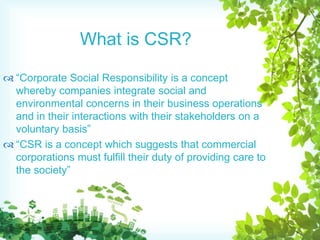
 “Corporate Social Responsibility is a concept
whereby companies integrate social and
environmental concerns in their business operations
and in their interactions with their stakeholders on a
voluntary basis”
 “CSR is a concept which suggests that commercial
corporations must fulfill their duty of providing care to
the society”
What is CSR?
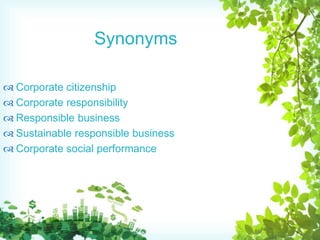
 Corporate citizenship
 Corporate responsibility
 Responsible business
 Sustainable responsible business
 Corporate social performance
Synonyms
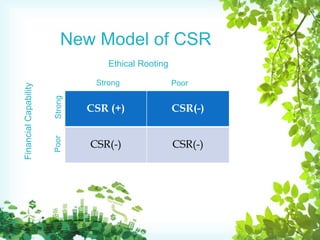
New Model of CSR
CSR (+) CSR(-)
CSR(-) CSR(-)
Ethical Rooting
FinancialCapability
Strong Poor
StrongPoor
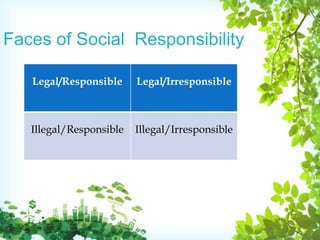
Faces of Social Responsibility
Legal/Responsible Legal/Irresponsible
Illegal/Responsible Illegal/Irresponsible
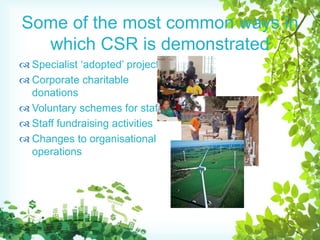
Some of the most common ways in
which CSR is demonstrated
 Specialist ‘adopted’ projects
 Corporate charitable
donations
 Voluntary schemes for staff
 Staff fundraising activities
 Changes to organisational
operations
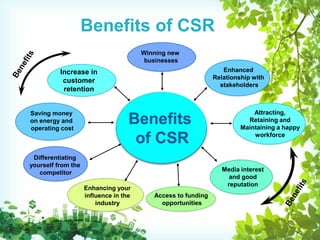
Benefits of CSR
Benefits
of CSR
Winning new
businesses
Enhancing your
influence in the
industry
Attracting,
Retaining and
Maintaining a happy
workforce
Increase in
customer
retention
Differentiating
yourself from the
competitor
Saving money
on energy and
operating cost
Access to funding
opportunities
Media interest
and good
reputation
Enhanced
Relationship with
stakeholders
Importance
 Improves public image
 Increases media coverage
 Boosts employee engagement
 Attracts and retains investors
 Showing a true commitment
 Government relations
 Reduces the social cost
The four components of
CSR
Economic
Legal
Ethical
Discretionary
Conclusion
 CSR is an integral part of the business
plan
 Improves the perceived image of the
company for the employees, clients,
investors and govt.
 CSR strategy has to be tailor-made for
the company
 Productivity and profit cannot be
compromised
 Giving back to the environment.
Corporate social responsibility

Corporate social responsibility

  • 1.
  • 2.
     “Corporate SocialResponsibility is a concept whereby companies integrate social and environmental concerns in their business operations and in their interactions with their stakeholders on a voluntary basis”  “CSR is a concept which suggests that commercial corporations must fulfill their duty of providing care to the society” What is CSR?
  • 3.
     Corporate citizenship Corporate responsibility  Responsible business  Sustainable responsible business  Corporate social performance Synonyms
  • 4.
    New Model ofCSR CSR (+) CSR(-) CSR(-) CSR(-) Ethical Rooting FinancialCapability Strong Poor StrongPoor
  • 5.
    Faces of SocialResponsibility Legal/Responsible Legal/Irresponsible Illegal/Responsible Illegal/Irresponsible
  • 6.
    Some of themost common ways in which CSR is demonstrated  Specialist ‘adopted’ projects  Corporate charitable donations  Voluntary schemes for staff  Staff fundraising activities  Changes to organisational operations
  • 7.
    Benefits of CSR Benefits ofCSR Winning new businesses Enhancing your influence in the industry Attracting, Retaining and Maintaining a happy workforce Increase in customer retention Differentiating yourself from the competitor Saving money on energy and operating cost Access to funding opportunities Media interest and good reputation Enhanced Relationship with stakeholders
  • 8.
    Importance  Improves publicimage  Increases media coverage  Boosts employee engagement  Attracts and retains investors  Showing a true commitment  Government relations  Reduces the social cost
  • 9.
    The four componentsof CSR Economic Legal Ethical Discretionary
  • 10.
    Conclusion  CSR isan integral part of the business plan  Improves the perceived image of the company for the employees, clients, investors and govt.  CSR strategy has to be tailor-made for the company  Productivity and profit cannot be compromised  Giving back to the environment.