Assignment
On
Commodity Market
Department of Commerce
Yogi Vemana University
Submitted by : Kethineni Venkatasiva
Subject : Organizational Behaviour
DOCKET
Meaning
Definition
Historic Background
Benefits
Commodity Trading Apps
Conclusion
Meaning
Commodity :
Any products that can be used for commerce
or an article of commerce which is traded on
an authorized commodity exchange is known
as commodity
Market :
Marketing is the activity, set of institutions,
and processes for creating, communicating,
delivering, and exchanging offerings that
have value for customers, clients, partners,
and society at large
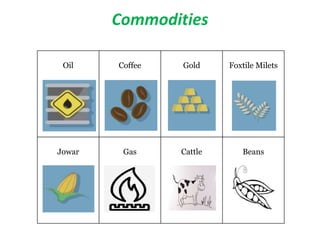
Commodities
Oil Coffee Gold Foxtile Milets
Jowar Gas Cattle Beans
Definiton
• A commodity market involves buying, selling,
or trading a raw product, such as oil, gold, or
coffee. There are hard commodities, which are
generally natural resources, and soft commodities,
which are livestock or agricultural goods.
Historic Background
Price
Discovery
Based on inputs regarding
specific market information,
the demand and supply
equilibrium, weather forecasts,
expert views and comments,
inflation rates, Government
policies, market dynamics,
hopes and fears, buyers and
sellers conduct trading at
futures exchanges. This
transforms in to continuous
price discovery mechanism.
The execution of trade between
buyers and sellers leads to
assessment of fair value of a
particular commodity that is
immediately disseminated on
the trading terminal.
Price Risk
Management
Hedging is the most common
method of price risk
management. It is strategy of
offering price risk that is
inherent in spot market by
taking an equal but opposite
position in the futures market.
Futures markets are used as a
mode by hedgers to protect
their business from adverse
price change. This could dent
the profitability of their
business. Hedging benefits
who are involved in trading of
commodities like farmers,
processors, merchandisers,
manufacturers, exporters,
importers etc.
Import- Export
competitiveness:
The exporters can hedge their price
risk and improve their
competitiveness by making use of
futures market. A majority of
traders which are involved in
physical trade internationally
intend to buy forwards. The
purchases made from the physical
market might expose them to the
risk of price risk resulting to losses.
The existence of futures market
would allow the exporters to hedge
their proposed purchase by
temporarily substituting for actual
purchase till the time is ripe to buy
in physical market. In the absence
of futures market it will be
meticulous, time consuming and
costly physical transactions.
Predictable
Pricing
The demand for certain
commodities is highly price elastic.
The manufacturers have to ensure
that the prices should be stable in
order to protect their market share
with the free entry of imports.
Futures contracts will enable
predictability in domestic prices.
The manufacturers can, as a result,
smooth out the influence of changes
in their input prices very easily.
With no futures market, the
manufacturer can be caught
between severe short-term price
movements of oils and necessity to
maintain price stability, which
could only be possible through
sufficient financial reserves that
could otherwise be utilized for
making other profitable
investments.
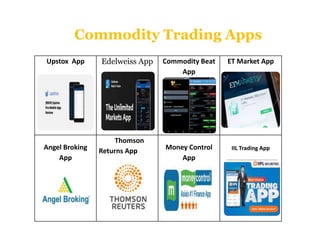
Upstox App Edelweiss App Commodity Beat
App
ET Market App
Angel Broking
App
Thomson
Returns App Money Control
App
IIL Trading App
Commodity Trading Apps
Conclusion
A combined approach to commodity research tends to offer optimal results.
The fundamental and technical analysis used together amounts to covering
many bases when it comes to understanding the present state of a market and
predicting future price behavior for that market. It is important to keep in
mind that knowledge of macroeconomic factors also plays an important role
in the direction of raw material prices.
As commodities tend to be highly volatile assets, unexpected events
can always throw a monkey wrench into even the most robust analysis. It is
that volatility that attracts speculators, traders, and investors alike. Price
volatility creates the opportunity for profits but at the same time, makes the
raw material markets dangerous from a risk perspective.
Commodity market power point presentation

Commodity market power point presentation

  • 2.
    Assignment On Commodity Market Department ofCommerce Yogi Vemana University Submitted by : Kethineni Venkatasiva Subject : Organizational Behaviour
  • 3.
  • 4.
    Meaning Commodity : Any productsthat can be used for commerce or an article of commerce which is traded on an authorized commodity exchange is known as commodity Market : Marketing is the activity, set of institutions, and processes for creating, communicating, delivering, and exchanging offerings that have value for customers, clients, partners, and society at large
  • 5.
    Commodities Oil Coffee GoldFoxtile Milets Jowar Gas Cattle Beans
  • 6.
    Definiton • A commoditymarket involves buying, selling, or trading a raw product, such as oil, gold, or coffee. There are hard commodities, which are generally natural resources, and soft commodities, which are livestock or agricultural goods.
  • 7.
  • 13.
    Price Discovery Based on inputsregarding specific market information, the demand and supply equilibrium, weather forecasts, expert views and comments, inflation rates, Government policies, market dynamics, hopes and fears, buyers and sellers conduct trading at futures exchanges. This transforms in to continuous price discovery mechanism. The execution of trade between buyers and sellers leads to assessment of fair value of a particular commodity that is immediately disseminated on the trading terminal.
  • 14.
    Price Risk Management Hedging isthe most common method of price risk management. It is strategy of offering price risk that is inherent in spot market by taking an equal but opposite position in the futures market. Futures markets are used as a mode by hedgers to protect their business from adverse price change. This could dent the profitability of their business. Hedging benefits who are involved in trading of commodities like farmers, processors, merchandisers, manufacturers, exporters, importers etc.
  • 15.
    Import- Export competitiveness: The exporterscan hedge their price risk and improve their competitiveness by making use of futures market. A majority of traders which are involved in physical trade internationally intend to buy forwards. The purchases made from the physical market might expose them to the risk of price risk resulting to losses. The existence of futures market would allow the exporters to hedge their proposed purchase by temporarily substituting for actual purchase till the time is ripe to buy in physical market. In the absence of futures market it will be meticulous, time consuming and costly physical transactions.
  • 16.
    Predictable Pricing The demand forcertain commodities is highly price elastic. The manufacturers have to ensure that the prices should be stable in order to protect their market share with the free entry of imports. Futures contracts will enable predictability in domestic prices. The manufacturers can, as a result, smooth out the influence of changes in their input prices very easily. With no futures market, the manufacturer can be caught between severe short-term price movements of oils and necessity to maintain price stability, which could only be possible through sufficient financial reserves that could otherwise be utilized for making other profitable investments.
  • 17.
    Upstox App EdelweissApp Commodity Beat App ET Market App Angel Broking App Thomson Returns App Money Control App IIL Trading App Commodity Trading Apps
  • 18.
    Conclusion A combined approachto commodity research tends to offer optimal results. The fundamental and technical analysis used together amounts to covering many bases when it comes to understanding the present state of a market and predicting future price behavior for that market. It is important to keep in mind that knowledge of macroeconomic factors also plays an important role in the direction of raw material prices. As commodities tend to be highly volatile assets, unexpected events can always throw a monkey wrench into even the most robust analysis. It is that volatility that attracts speculators, traders, and investors alike. Price volatility creates the opportunity for profits but at the same time, makes the raw material markets dangerous from a risk perspective.