
FED TAPERINGCOMMODITY HEDGING
Hedging in commodities markets
– By Prof. Simply Simple
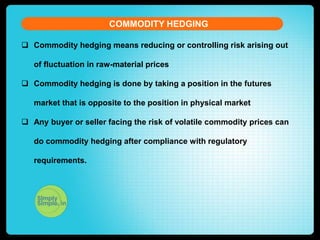
 Commodity hedging means reducing or controlling risk arising out
of fluctuation in raw-material prices
 Commodity hedging is done by taking a position in the futures
market that is opposite to the position in physical market
 Any buyer or seller facing the risk of volatile commodity prices can
do commodity hedging after compliance with regulatory
requirements.
COMMODITY HEDGING
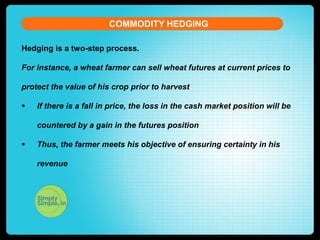
Hedging is a two-step process.
For instance, a wheat farmer can sell wheat futures at current prices to
protect the value of his crop prior to harvest
 If there is a fall in price, the loss in the cash market position will be
countered by a gain in the futures position
 Thus, the farmer meets his objective of ensuring certainty in his
revenue
COMMODITY HEDGING
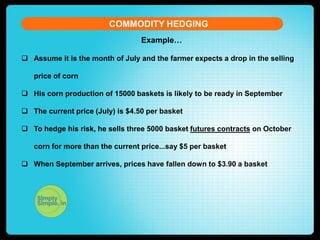
Example…
 Assume it is the month of July and the farmer expects a drop in the selling
price of corn
 His corn production of 15000 baskets is likely to be ready in September
 The current price (July) is $4.50 per basket
 To hedge his risk, he sells three 5000 basket futures contracts on October
corn for more than the current price...say $5 per basket
 When September arrives, prices have fallen down to $3.90 a basket
COMMODITY HEDGING
 So, he is now going to receive a much lower price on his corn
 To offset this potential loss, he buys corn futures for $4.60 per basket
 If you remember, he had sold corn futures at a price of $5 and he is buying
it back at the lower price of $4.60. This is because the price of corn
futures has also now come down with the fall in price of corn
 So, in the futures markets, he has earned a profit of $0.40 due to the
difference in his selling and buying prices ($5 sale price - $ 4.60
buying price = $0.40 gain)
COMMODITY HEDGING
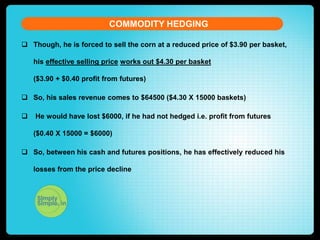
 Though, he is forced to sell the corn at a reduced price of $3.90 per basket,
his effective selling price works out $4.30 per basket
($3.90 + $0.40 profit from futures)
 So, his sales revenue comes to $64500 ($4.30 X 15000 baskets)
 He would have lost $6000, if he had not hedged i.e. profit from futures
($0.40 X 15000 = $6000)
 So, between his cash and futures positions, he has effectively reduced his
losses from the price decline
COMMODITY HEDGING
Hope you have now
understood the concept of
commodity hedging.
COMMODITY HEDGING
In case of any query
please email :
professor@tataamc.com
DISCLAIMER
The views expressed in this lesson are for information purposes only and do not construe
to be any investment, legal or taxation advice. The lesson is a conceptual representation
and may not include several nuances that are associated and vital. The purpose of this
lesson is to clarify the basics of the concept so that readers at large can relate and
thereby take more interest in the product / concept. In a nutshell, Professor Simply Simple
lessons should be seen from the perspective of it being a primer on financial concepts.
The contents are topical in nature and held true at the time of creation of the lesson. This
is not indicative of future market trends, nor is Tata Asset Management Ltd. attempting to
predict the same. Reprinting any part of this material will be at your own risk. Tata Asset
Management Ltd. will not be liable for the consequences of such action.
Mutual Fund investments are subject to market risks,
read all scheme related documents carefully.

Commodity hedging

  • 1.
  • 2.
    Hedging in commoditiesmarkets – By Prof. Simply Simple
  • 3.
     Commodity hedgingmeans reducing or controlling risk arising out of fluctuation in raw-material prices  Commodity hedging is done by taking a position in the futures market that is opposite to the position in physical market  Any buyer or seller facing the risk of volatile commodity prices can do commodity hedging after compliance with regulatory requirements. COMMODITY HEDGING
  • 4.
    Hedging is atwo-step process. For instance, a wheat farmer can sell wheat futures at current prices to protect the value of his crop prior to harvest  If there is a fall in price, the loss in the cash market position will be countered by a gain in the futures position  Thus, the farmer meets his objective of ensuring certainty in his revenue COMMODITY HEDGING
  • 5.
    Example…  Assume itis the month of July and the farmer expects a drop in the selling price of corn  His corn production of 15000 baskets is likely to be ready in September  The current price (July) is $4.50 per basket  To hedge his risk, he sells three 5000 basket futures contracts on October corn for more than the current price...say $5 per basket  When September arrives, prices have fallen down to $3.90 a basket COMMODITY HEDGING
  • 6.
     So, heis now going to receive a much lower price on his corn  To offset this potential loss, he buys corn futures for $4.60 per basket  If you remember, he had sold corn futures at a price of $5 and he is buying it back at the lower price of $4.60. This is because the price of corn futures has also now come down with the fall in price of corn  So, in the futures markets, he has earned a profit of $0.40 due to the difference in his selling and buying prices ($5 sale price - $ 4.60 buying price = $0.40 gain) COMMODITY HEDGING
  • 7.
     Though, heis forced to sell the corn at a reduced price of $3.90 per basket, his effective selling price works out $4.30 per basket ($3.90 + $0.40 profit from futures)  So, his sales revenue comes to $64500 ($4.30 X 15000 baskets)  He would have lost $6000, if he had not hedged i.e. profit from futures ($0.40 X 15000 = $6000)  So, between his cash and futures positions, he has effectively reduced his losses from the price decline COMMODITY HEDGING
  • 8.
    Hope you havenow understood the concept of commodity hedging. COMMODITY HEDGING
  • 9.
    In case ofany query please email : professor@tataamc.com
  • 10.
    DISCLAIMER The views expressedin this lesson are for information purposes only and do not construe to be any investment, legal or taxation advice. The lesson is a conceptual representation and may not include several nuances that are associated and vital. The purpose of this lesson is to clarify the basics of the concept so that readers at large can relate and thereby take more interest in the product / concept. In a nutshell, Professor Simply Simple lessons should be seen from the perspective of it being a primer on financial concepts. The contents are topical in nature and held true at the time of creation of the lesson. This is not indicative of future market trends, nor is Tata Asset Management Ltd. attempting to predict the same. Reprinting any part of this material will be at your own risk. Tata Asset Management Ltd. will not be liable for the consequences of such action. Mutual Fund investments are subject to market risks, read all scheme related documents carefully.