

Corporate Manslaughter
Andrew Swan
Short Richardson & Forth LLP
3rd December 2013
Andrew Swan - Solicitor
Specialist:
• Regulatory Breaches
• Business Crime
• Fraud

• Money Laundering
• Tax Evasion

• Trade Mark Infringements
History
• Common law offence of Gross Negligence
Manslaughter
• Very low prosecution rates!
• The identification principle

• Herald of Free Enterprise 1987
• Clapham Rail Disaster 1988

• Lyme Bay Tragedy 1993
Corporate Manslaughter and
Corporate Homicide Act 2007
• Came into force 6 April 2008

• Not retrospective
• Health & Safety offences continued

• Gross negligence manslaughter continued
against individuals
• Much excitement and expectation
Corporate Manslaughter
• Section 1 – The Offence
– An organisation is guilty of an offence if the
way in which its activities are managed or
organised:
• causes a person’s death; and
• amounts to a gross breach of a relevant duty of
care owed by the organisation to the deceased.

• NB – the breach must be directly attributable to
senior management failure
So what does all that mean?
• Elements of the offence:
–
–
–
–
–

defendant is a qualifying organisation,
the organisation causes a person’s death,
there was a relevant duty of care owed,
there was a gross breach of that duty,
directly attributable to senior management,
and
– the defendant does not fall into an
exemption.
Qualifying Organisation
• a corporation
• a partnership
• government departments/local authorities
• a police force
• a trade union/employer’s association
Causes a person’s death
• The prosecution must always show a causal link
between the act/omission and the death.
• The act or omission must be a substantial cause
of death, but it need not be the sole or main
cause of death. It must have "more than
minimally, negligibly or trivially contributed to
the death." - Lord Woolf
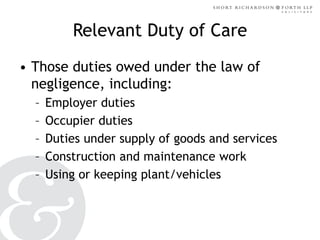
Relevant Duty of Care
• Those duties owed under the law of
negligence, including:
–
–
–
–
–

Employer duties
Occupier duties
Duties under supply of goods and services
Construction and maintenance work
Using or keeping plant/vehicles
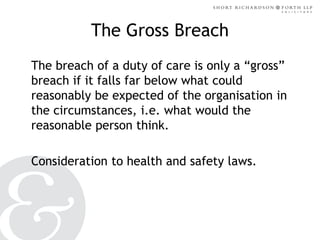
The Gross Breach
The breach of a duty of care is only a “gross”
breach if it falls far below what could
reasonably be expected of the organisation in
the circumstances, i.e. what would the
reasonable person think.
Consideration to health and safety laws.
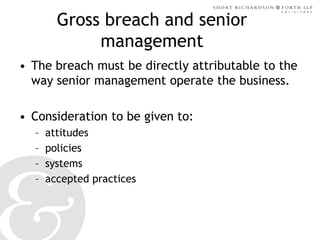
Gross breach and senior
management
• The breach must be directly attributable to the
way senior management operate the business.
• Consideration to be given to:
–
–
–
–

attitudes
policies
systems
accepted practices
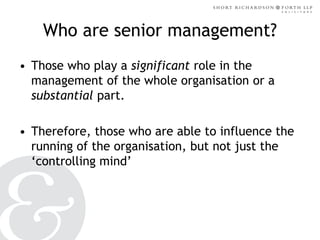
Who are senior management?
• Those who play a significant role in the
management of the whole organisation or a
substantial part.
• Therefore, those who are able to influence the
running of the organisation, but not just the
‘controlling mind’
The Exemptions
• Certain exemptions to prosecution exist:

• Comprehensive Exemptions (e.g.
military/police activities)
• Partial Exemptions (where duty still owed as
employer/occupier)
Penalties
• Unlimited fine (suggested starting point
£500,000)
• Publicity Order
• Remedial Order
So, 5 years on.
• Only 4 convictions to date:
– Cotswold Geotechnical Holding
– JMW Farms
– Lion Steel Equipment Limited
– Murray and Sons
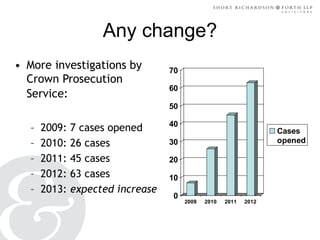
Any change?
• More investigations by
Crown Prosecution
Service:

70
60
50

–
–
–
–
–

2009:
2010:
2011:
2012:
2013:

7 cases opened
26 cases
45 cases
63 cases
expected increase

40

Cases
opened

30
20
10
0

2009

2010

2011

2012
Any Questions?
Andrew Swan
Partner for Short Richardson & Forth LLP
4 Mosley Street
Newcastle upon Tyne
NE1 1DE
DX: 61037 Newcastle upon Tyne
+44 (0) 191 232 0283 (Switchboard)
as@srflegal.co.uk

Thank you
Merry Christmas & all the best for the New Year

Corporate manslaughter - NESHEP 03 12 13

  • 1.
    Corporate Manslaughter Andrew Swan ShortRichardson & Forth LLP 3rd December 2013
  • 2.
    Andrew Swan -Solicitor Specialist: • Regulatory Breaches • Business Crime • Fraud • Money Laundering • Tax Evasion • Trade Mark Infringements
  • 3.
    History • Common lawoffence of Gross Negligence Manslaughter • Very low prosecution rates! • The identification principle • Herald of Free Enterprise 1987 • Clapham Rail Disaster 1988 • Lyme Bay Tragedy 1993
  • 4.
    Corporate Manslaughter and CorporateHomicide Act 2007 • Came into force 6 April 2008 • Not retrospective • Health & Safety offences continued • Gross negligence manslaughter continued against individuals • Much excitement and expectation
  • 5.
    Corporate Manslaughter • Section1 – The Offence – An organisation is guilty of an offence if the way in which its activities are managed or organised: • causes a person’s death; and • amounts to a gross breach of a relevant duty of care owed by the organisation to the deceased. • NB – the breach must be directly attributable to senior management failure
  • 6.
    So what doesall that mean? • Elements of the offence: – – – – – defendant is a qualifying organisation, the organisation causes a person’s death, there was a relevant duty of care owed, there was a gross breach of that duty, directly attributable to senior management, and – the defendant does not fall into an exemption.
  • 7.
    Qualifying Organisation • acorporation • a partnership • government departments/local authorities • a police force • a trade union/employer’s association
  • 8.
    Causes a person’sdeath • The prosecution must always show a causal link between the act/omission and the death. • The act or omission must be a substantial cause of death, but it need not be the sole or main cause of death. It must have "more than minimally, negligibly or trivially contributed to the death." - Lord Woolf
  • 9.
    Relevant Duty ofCare • Those duties owed under the law of negligence, including: – – – – – Employer duties Occupier duties Duties under supply of goods and services Construction and maintenance work Using or keeping plant/vehicles
  • 10.
    The Gross Breach Thebreach of a duty of care is only a “gross” breach if it falls far below what could reasonably be expected of the organisation in the circumstances, i.e. what would the reasonable person think. Consideration to health and safety laws.
  • 11.
    Gross breach andsenior management • The breach must be directly attributable to the way senior management operate the business. • Consideration to be given to: – – – – attitudes policies systems accepted practices
  • 12.
    Who are seniormanagement? • Those who play a significant role in the management of the whole organisation or a substantial part. • Therefore, those who are able to influence the running of the organisation, but not just the ‘controlling mind’
  • 13.
    The Exemptions • Certainexemptions to prosecution exist: • Comprehensive Exemptions (e.g. military/police activities) • Partial Exemptions (where duty still owed as employer/occupier)
  • 14.
    Penalties • Unlimited fine(suggested starting point £500,000) • Publicity Order • Remedial Order
  • 15.
    So, 5 yearson. • Only 4 convictions to date: – Cotswold Geotechnical Holding – JMW Farms – Lion Steel Equipment Limited – Murray and Sons
  • 16.
    Any change? • Moreinvestigations by Crown Prosecution Service: 70 60 50 – – – – – 2009: 2010: 2011: 2012: 2013: 7 cases opened 26 cases 45 cases 63 cases expected increase 40 Cases opened 30 20 10 0 2009 2010 2011 2012
  • 17.
  • 18.
    Andrew Swan Partner forShort Richardson & Forth LLP 4 Mosley Street Newcastle upon Tyne NE1 1DE DX: 61037 Newcastle upon Tyne +44 (0) 191 232 0283 (Switchboard) as@srflegal.co.uk Thank you Merry Christmas & all the best for the New Year