Coronary Blood Flow
 Normal resting CBF is 60-80ml/100 gm/min.
or 250ml/min.
 O2 consumption .
A – V O2 difference in myocardium is 19-6=13ml/dl
other parts of body 19-14=5ml/dl
Phasic Coronary Flow
 Phasic Coronary flow is 80% during diastole and 20%
during systole.
 All other parts of the body receives blood supply during
systole but heart receives blood supply during diastole.
Right coronary artery supplies right ventricle and atrium. Less
forceful contraction of right ventricle does not inhibit flow
from high pressure aorta.
systole
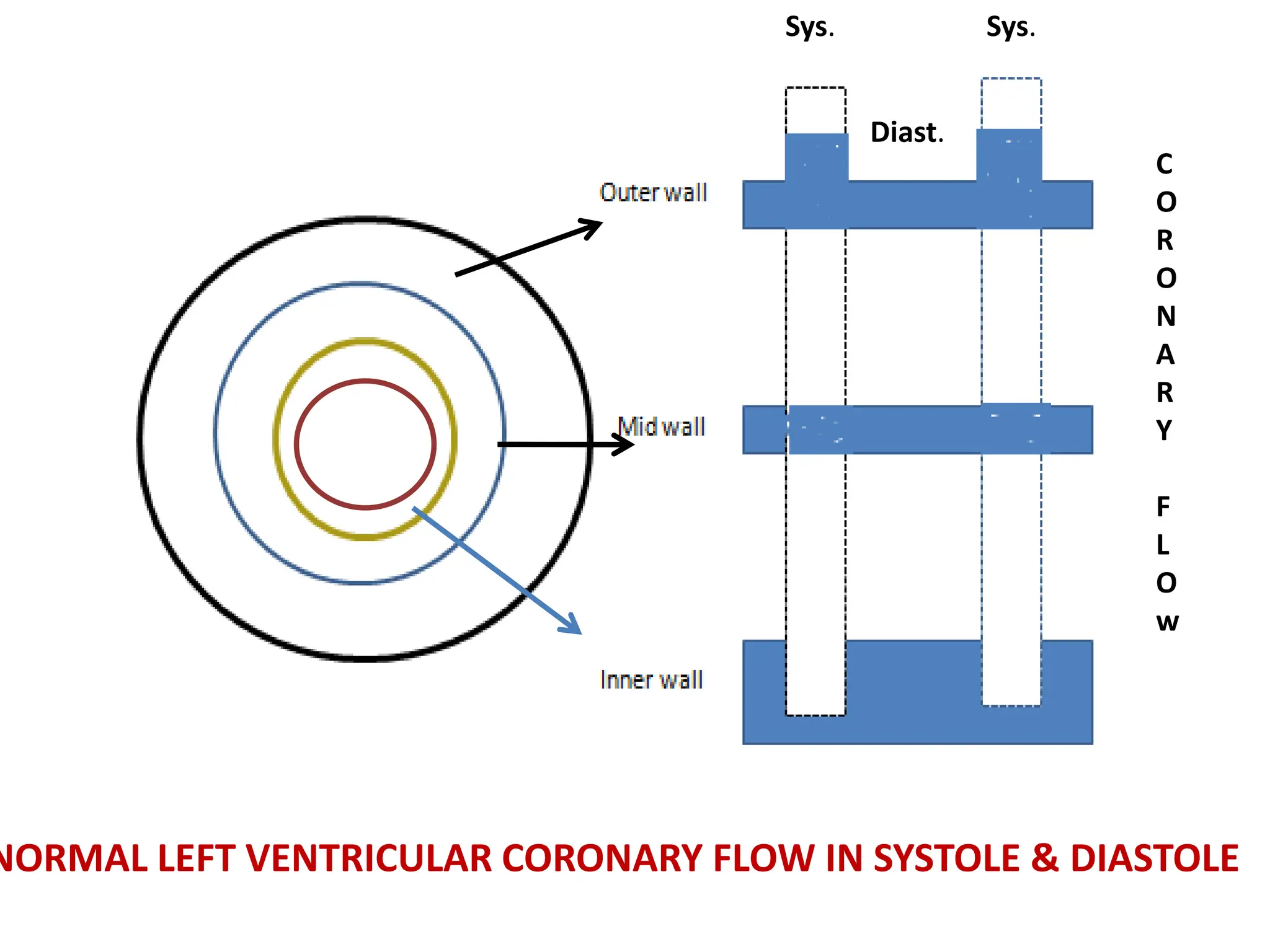
Sys. Sys.
Diast.
C
O
R
O
N
A
R
Y
F
L
O
w
NORMAL LEFT VENTRICULAR CORONARY FLOW IN SYSTOLE & DIASTOLE
L
Coronary
blood
flow
(ml/min)
Systole Diastole
0
100
200
300
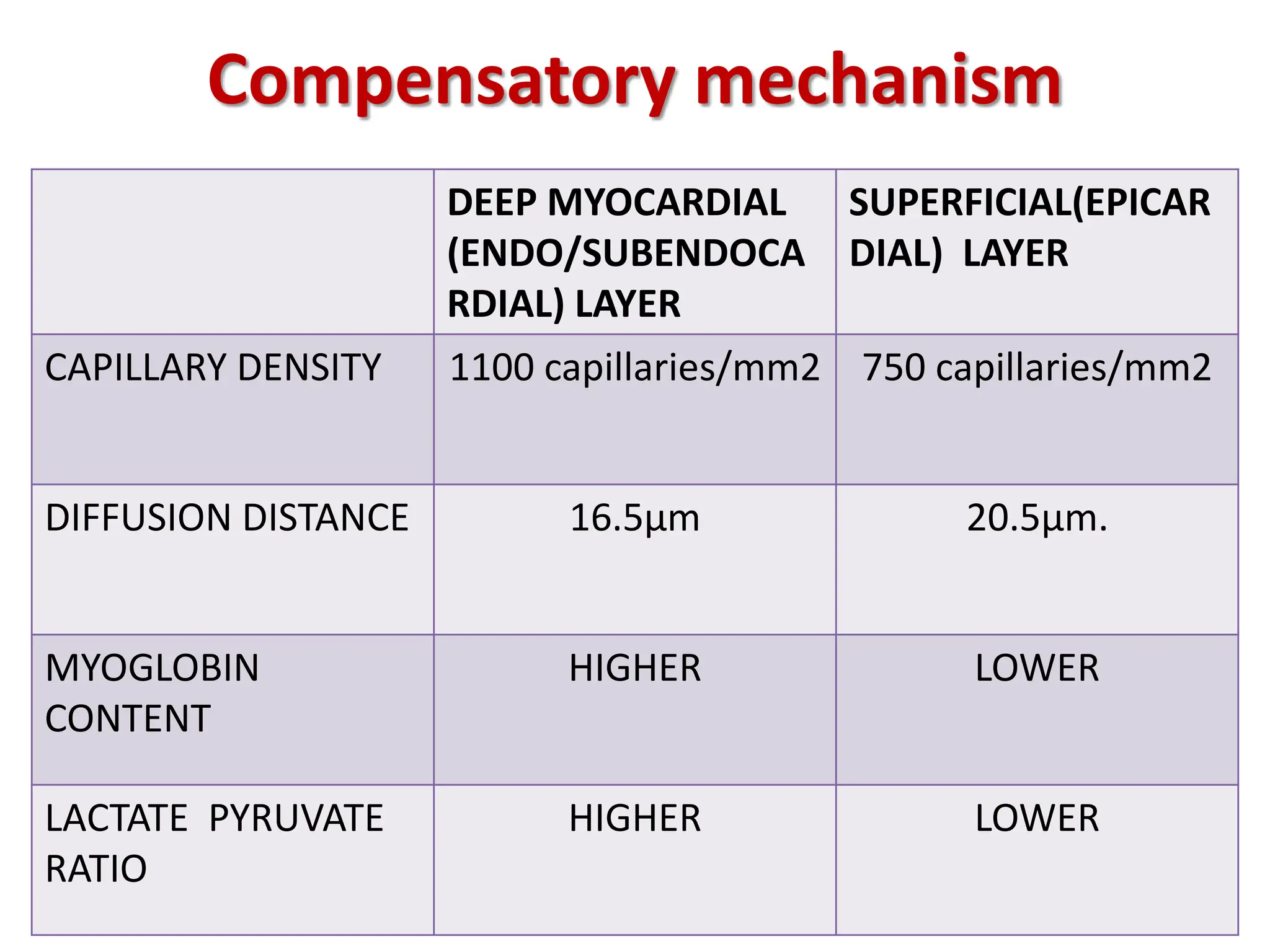
Compensatory mechanism
DEEP MYOCARDIAL
(ENDO/SUBENDOCA
RDIAL) LAYER
SUPERFICIAL(EPICAR
DIAL) LAYER
CAPILLARY DENSITY 1100 capillaries/mm2 750 capillaries/mm2
DIFFUSION DISTANCE 16.5µm 20.5µm.
MYOGLOBIN
CONTENT
HIGHER LOWER
LACTATE PYRUVATE
RATIO
HIGHER LOWER
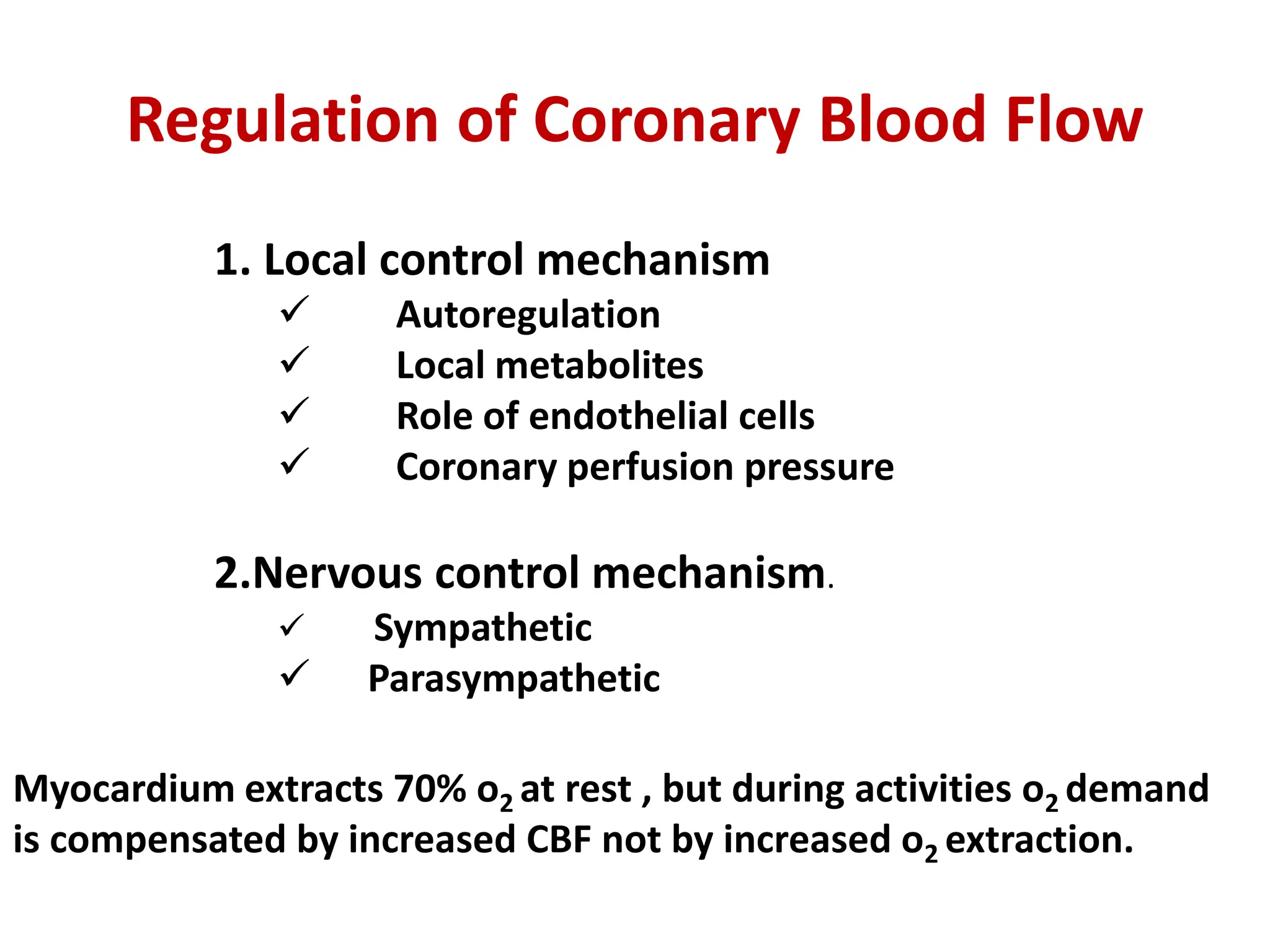
Regulation of Coronary Blood Flow
1. Local control mechanism
 Autoregulation
 Local metabolites
 Role of endothelial cells
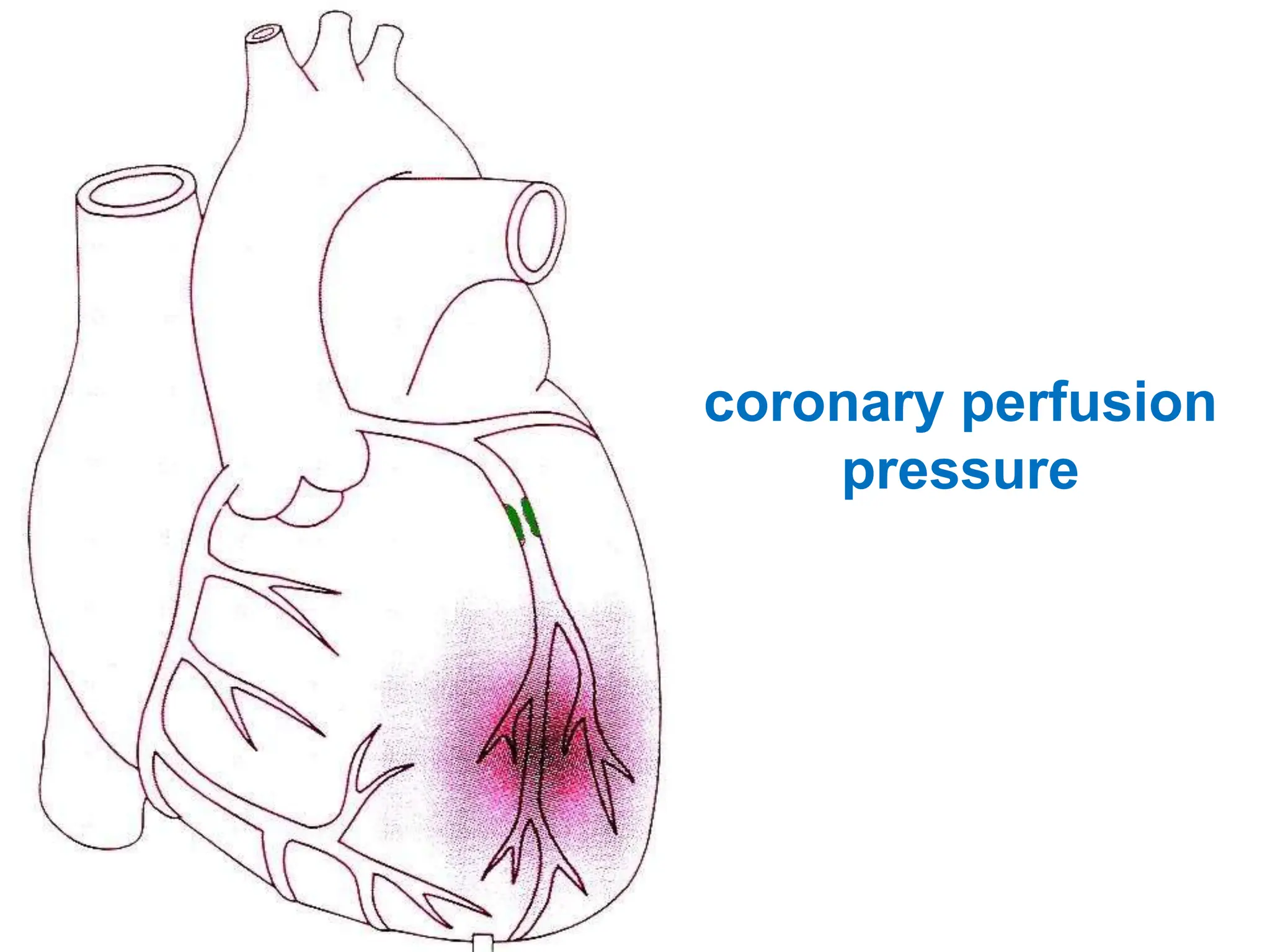
 Coronary perfusion pressure
2.Nervous control mechanism.
 Sympathetic
 Parasympathetic
Myocardium extracts 70% o2 at rest , but during activities o2 demand
is compensated by increased CBF not by increased o2 extraction.
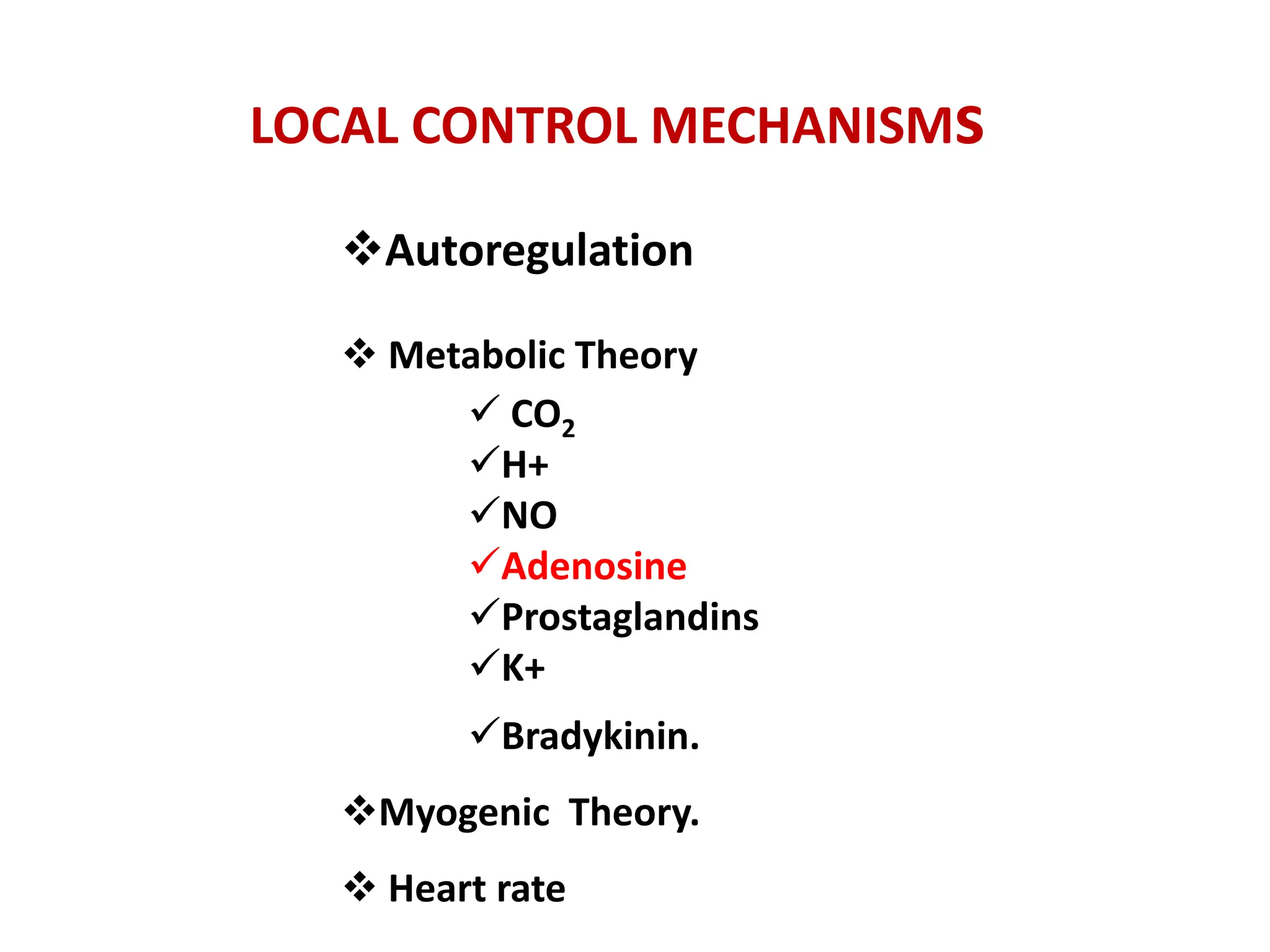
 Metabolic Theory
 CO2
H+
NO
Adenosine
Prostaglandins
K+
Bradykinin.
Myogenic Theory.
 Heart rate
Autoregulation
LOCAL CONTROL MECHANISMs
BERNE HYPOTHESIS
(ADENOSINE)
FALL IN ART.PO2 ↑MYOCARDIAL METABOLISM
ISCHEMIA/HYPOXIA
INTRACELLULAR
ADENOSINE
NUCLEOTIDE
ADENOSINE
CORONARY
VASODILATOR
↑ CORONARY BLOOD FLOW
coronary perfusion
pressure
HR-
75/min
HR-
200/min
%
CHANGE
DURATION OF
CARDIAC CYCLE
0.80 sec 0.30 sec 62.50
DURATION OF
SYSTOLE
0.27 sec 0.16 sec 40.70
DURATION OF
DIASTOLE
0.53 sec 0.14 sec 73.58
CORONARY BLOOD FLOW WILL BE MORE COMPROMISED AT
HIGHER HEART RATES DUE TO FALL IN DURATION OF DIASTOLE.
NEUROGENIC CONTROL OF CORONARY PERFUSION
Stimulation of Sympathetic
(Epinephrine & Norepinephrine)
 HR
 Cardiac metabolism
 Coronary vasodilatation
 CBF
Neural Regulation
SYMPATHETIC STIMULATION
METABOLIC
ADENOSINE,
H+, K+, PGE2, PGI2
ALPHA ACTIVITY
↑CONTRACTILITY-↑O2 DEMAND
VASOCONSTRICTION-↓O2 SUPPLY
BETA ACTIVITY
↑HEART RATE-↑O2 DEMAND
VASODILATATION-↑O2 SUPPLY
MVO2
Neural Regulation contd…
Stimulation of parasympathetic
 cardiac metabolism
coronary vasoconstriction
↓CBF
 HR
Factors affecting CBF
 Mean aortic pressure .
 Muscular exercise.
 Hypotension.
 Hormones
 Heart rate.
 Effect of ions.
 Temperature.
Rest
Exercise
O2 Supply O2 Demand
CAD
O2 Supply
O2 Demand
&
NORMAL
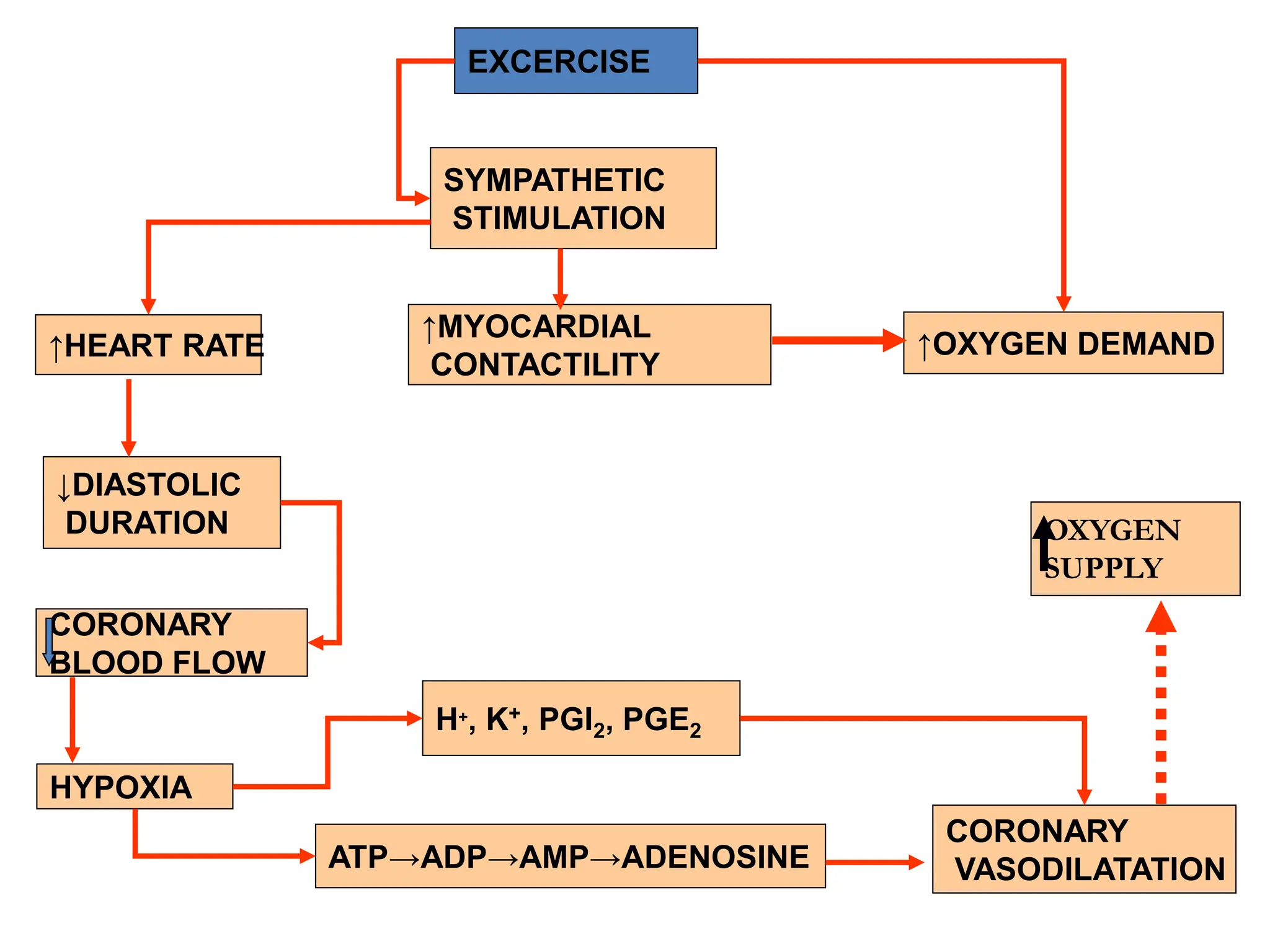
↑OXYGEN DEMAND
CORONARY
BLOOD FLOW
↓DIASTOLIC
DURATION
EXCERCISE
SYMPATHETIC
STIMULATION
↑MYOCARDIAL
CONTACTILITY
HYPOXIA
↑HEART RATE
H+, K+, PGI2, PGE2
CORONARY
VASODILATATION
ATP→ADP→AMP→ADENOSINE
OXYGEN
SUPPLY
Measurement of CBF
1.Nitrous oxide method(kety method)
2.Radio nuclide utilization technique.
3.Coronary angiography
4.Electromagnetic flowmeter technique
CLINICAL ANALYSIS OF CBF
•ECG
•Stress ECG
•Ambulatory ECG (Holter monitor)
•Echocardiography.
• 2D
• Doppler
• Transoesophageal
•CT imaging
•MRI imaging
•Cardiac catheterization.
•Radionuclide imaging
•Myocardial perfusion imaging
Applied physiology
 Ischemic Heart Disease
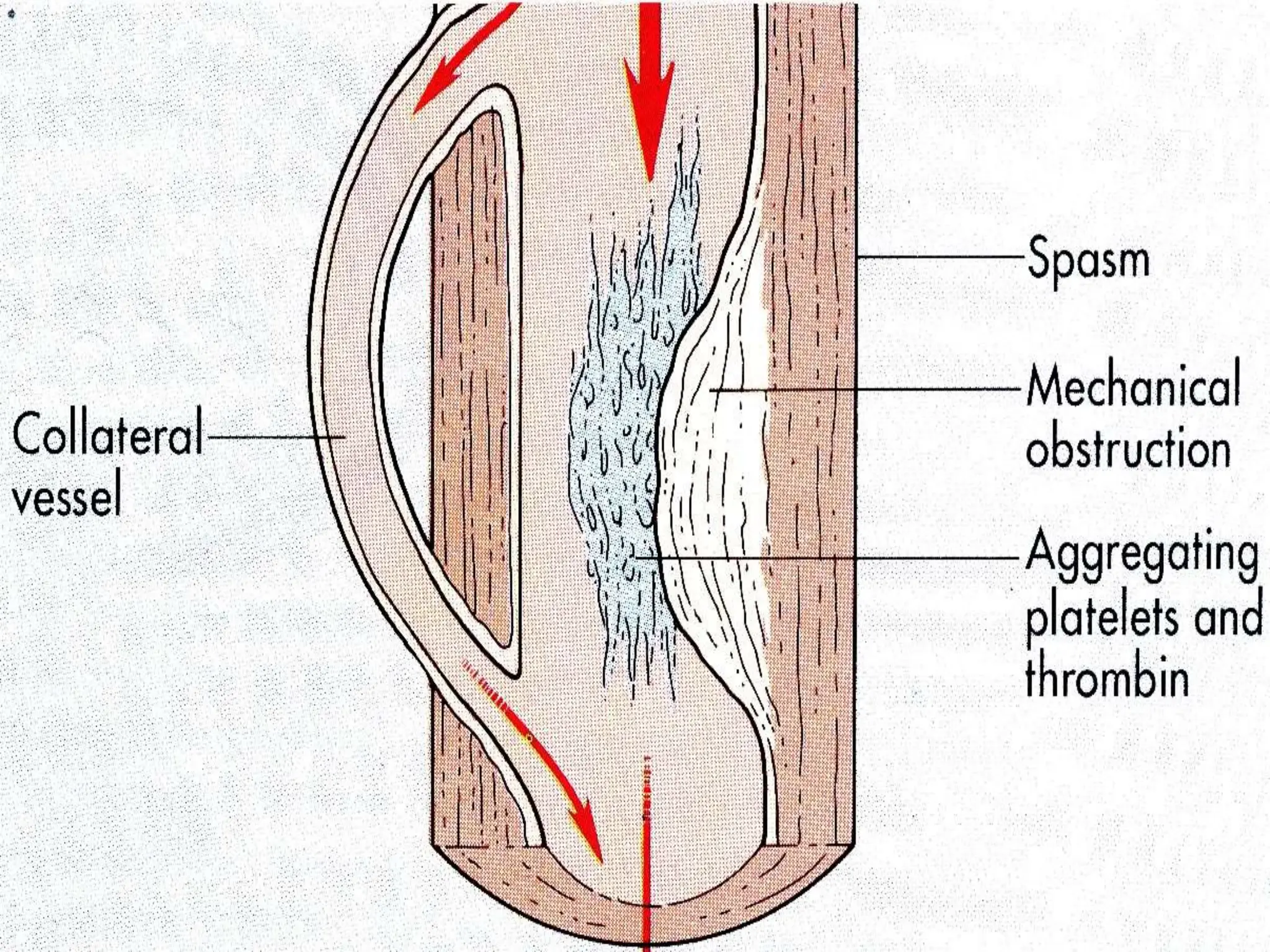
 Atherosclerosis of coronary arteries
 Thrombus formation
 Embolus from other areas
 Spasm of coronary arteries
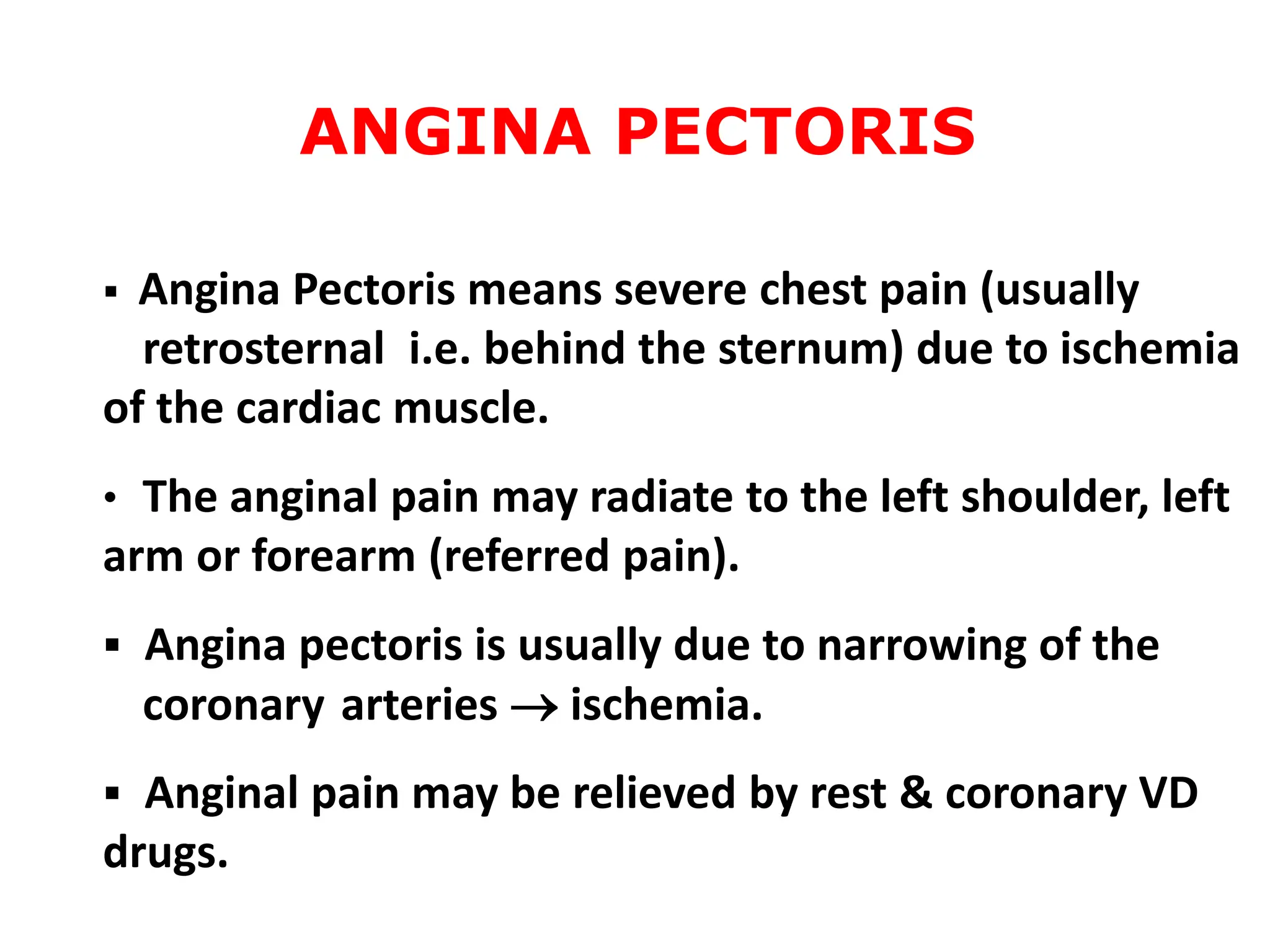
 Angina Pectoris means severe chest pain (usually
retrosternal i.e. behind the sternum) due to ischemia
of the cardiac muscle.
• The anginal pain may radiate to the left shoulder, left
arm or forearm (referred pain).
 Angina pectoris is usually due to narrowing of the
coronary arteries  ischemia.
 Anginal pain may be relieved by rest & coronary VD
drugs.
ANGINA PECTORIS
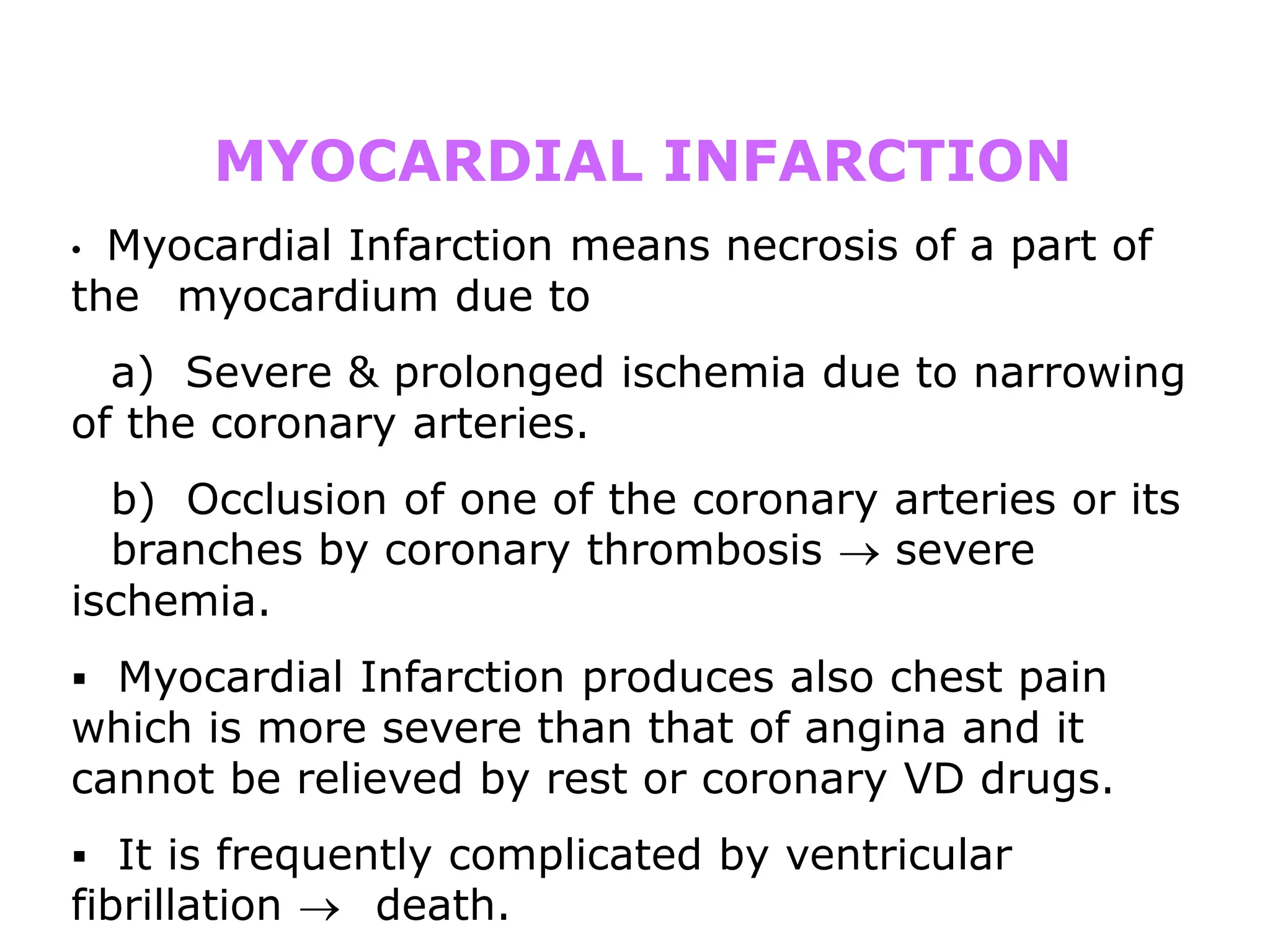
MYOCARDIAL INFARCTION
• Myocardial Infarction means necrosis of a part of
the myocardium due to
a) Severe & prolonged ischemia due to narrowing
of the coronary arteries.
b) Occlusion of one of the coronary arteries or its
branches by coronary thrombosis  severe
ischemia.
 Myocardial Infarction produces also chest pain
which is more severe than that of angina and it
cannot be relieved by rest or coronary VD drugs.
 It is frequently complicated by ventricular
fibrillation  death.
COMPLETE
OCCLUSION

Coronary circulation..ppt

  • 1.
    Coronary Blood Flow Normal resting CBF is 60-80ml/100 gm/min. or 250ml/min.  O2 consumption . A – V O2 difference in myocardium is 19-6=13ml/dl other parts of body 19-14=5ml/dl
  • 2.
    Phasic Coronary Flow Phasic Coronary flow is 80% during diastole and 20% during systole.  All other parts of the body receives blood supply during systole but heart receives blood supply during diastole. Right coronary artery supplies right ventricle and atrium. Less forceful contraction of right ventricle does not inhibit flow from high pressure aorta.
  • 3.
  • 4.
    Sys. Sys. Diast. C O R O N A R Y F L O w NORMAL LEFTVENTRICULAR CORONARY FLOW IN SYSTOLE & DIASTOLE
  • 5.
  • 6.
    Compensatory mechanism DEEP MYOCARDIAL (ENDO/SUBENDOCA RDIAL)LAYER SUPERFICIAL(EPICAR DIAL) LAYER CAPILLARY DENSITY 1100 capillaries/mm2 750 capillaries/mm2 DIFFUSION DISTANCE 16.5µm 20.5µm. MYOGLOBIN CONTENT HIGHER LOWER LACTATE PYRUVATE RATIO HIGHER LOWER
  • 7.
    Regulation of CoronaryBlood Flow 1. Local control mechanism  Autoregulation  Local metabolites  Role of endothelial cells  Coronary perfusion pressure 2.Nervous control mechanism.  Sympathetic  Parasympathetic Myocardium extracts 70% o2 at rest , but during activities o2 demand is compensated by increased CBF not by increased o2 extraction.
  • 8.
     Metabolic Theory CO2 H+ NO Adenosine Prostaglandins K+ Bradykinin. Myogenic Theory.  Heart rate Autoregulation LOCAL CONTROL MECHANISMs
  • 9.
    BERNE HYPOTHESIS (ADENOSINE) FALL INART.PO2 ↑MYOCARDIAL METABOLISM ISCHEMIA/HYPOXIA INTRACELLULAR ADENOSINE NUCLEOTIDE ADENOSINE CORONARY VASODILATOR ↑ CORONARY BLOOD FLOW
  • 10.
  • 11.
    HR- 75/min HR- 200/min % CHANGE DURATION OF CARDIAC CYCLE 0.80sec 0.30 sec 62.50 DURATION OF SYSTOLE 0.27 sec 0.16 sec 40.70 DURATION OF DIASTOLE 0.53 sec 0.14 sec 73.58 CORONARY BLOOD FLOW WILL BE MORE COMPROMISED AT HIGHER HEART RATES DUE TO FALL IN DURATION OF DIASTOLE. NEUROGENIC CONTROL OF CORONARY PERFUSION
  • 12.
    Stimulation of Sympathetic (Epinephrine& Norepinephrine)  HR  Cardiac metabolism  Coronary vasodilatation  CBF Neural Regulation
  • 13.
    SYMPATHETIC STIMULATION METABOLIC ADENOSINE, H+, K+,PGE2, PGI2 ALPHA ACTIVITY ↑CONTRACTILITY-↑O2 DEMAND VASOCONSTRICTION-↓O2 SUPPLY BETA ACTIVITY ↑HEART RATE-↑O2 DEMAND VASODILATATION-↑O2 SUPPLY MVO2
  • 14.
    Neural Regulation contd… Stimulationof parasympathetic  cardiac metabolism coronary vasoconstriction ↓CBF  HR
  • 15.
    Factors affecting CBF Mean aortic pressure .  Muscular exercise.  Hypotension.  Hormones  Heart rate.  Effect of ions.  Temperature.
  • 16.
    Rest Exercise O2 Supply O2Demand CAD O2 Supply O2 Demand & NORMAL
  • 17.
  • 19.
    Measurement of CBF 1.Nitrousoxide method(kety method) 2.Radio nuclide utilization technique. 3.Coronary angiography 4.Electromagnetic flowmeter technique
  • 20.
    CLINICAL ANALYSIS OFCBF •ECG •Stress ECG •Ambulatory ECG (Holter monitor) •Echocardiography. • 2D • Doppler • Transoesophageal •CT imaging •MRI imaging •Cardiac catheterization. •Radionuclide imaging •Myocardial perfusion imaging
  • 21.
    Applied physiology  IschemicHeart Disease  Atherosclerosis of coronary arteries  Thrombus formation  Embolus from other areas  Spasm of coronary arteries
  • 22.
     Angina Pectorismeans severe chest pain (usually retrosternal i.e. behind the sternum) due to ischemia of the cardiac muscle. • The anginal pain may radiate to the left shoulder, left arm or forearm (referred pain).  Angina pectoris is usually due to narrowing of the coronary arteries  ischemia.  Anginal pain may be relieved by rest & coronary VD drugs. ANGINA PECTORIS
  • 23.
    MYOCARDIAL INFARCTION • MyocardialInfarction means necrosis of a part of the myocardium due to a) Severe & prolonged ischemia due to narrowing of the coronary arteries. b) Occlusion of one of the coronary arteries or its branches by coronary thrombosis  severe ischemia.  Myocardial Infarction produces also chest pain which is more severe than that of angina and it cannot be relieved by rest or coronary VD drugs.  It is frequently complicated by ventricular fibrillation  death.
  • 25.