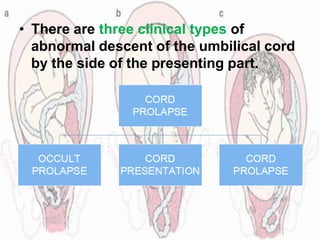
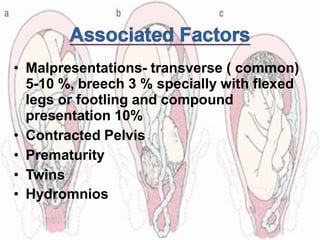
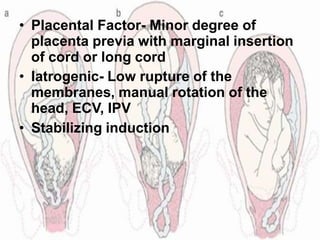
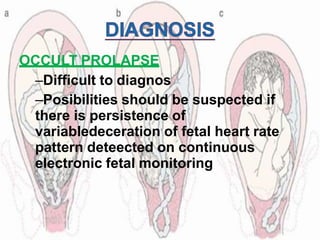
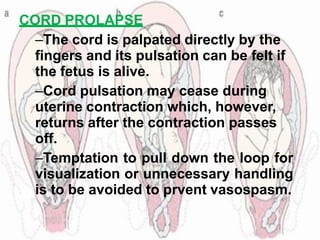
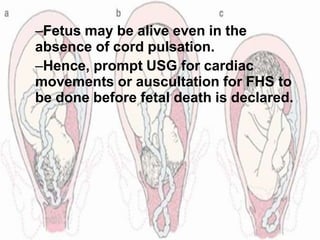
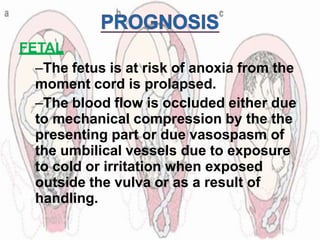
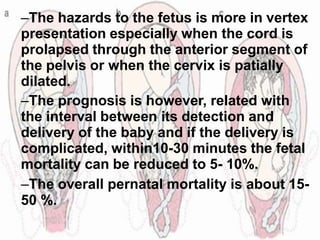
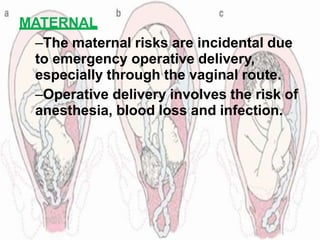
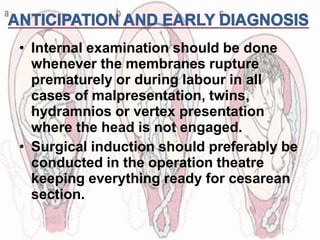
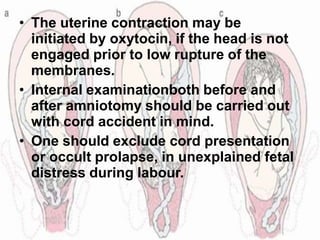
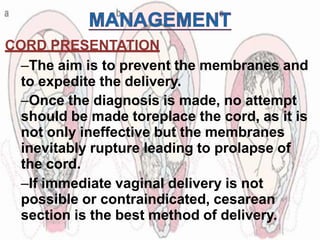
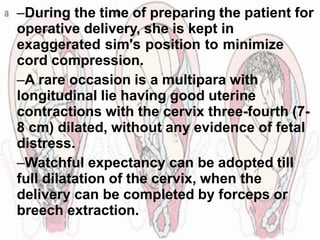
• There are three clinical types of
abnormal descent of the umbilical cord
by the side of the presenting part.
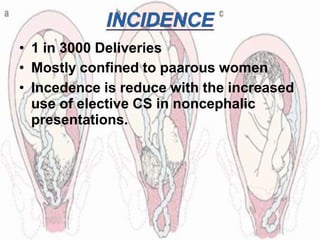
• 1 in 3000 Deliveries
• Mostly confined to paarous women
• Incedence is reduce with the increased
use of elective CS in noncephalic
presentations.
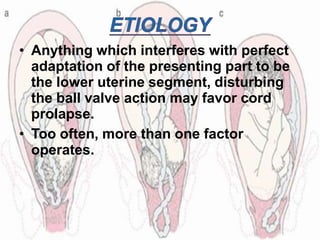
• Anything which interferes with perfect
adaptation of the presenting part to be
the lower uterine segment, disturbing
the ball valve action may favor cord
prolapse.
• Too often, more than one factor
operates.
• Malpresentations- transverse ( common)
5-10 %, breech 3 % specially with flexed
legs or footling and compound
presentation 10%
• Contracted Pelvis
• Prematurity
• Twins
• Hydromnios
• Placental Factor- Minor degree of
placenta previa with marginal insertion
of cord or long cord
• Iatrogenic- Low rupture of the
membranes, manual rotation of the
head, ECV, IPV
• Stabilizing induction
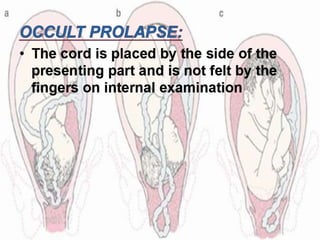
OCCULT PROLAPSE
–Difficult to diagnos
–Posibilities should be suspected if
there is persistence of
variabledeceration of fetal heart rate
pattern deteected on continuous
electronic fetal monitoring
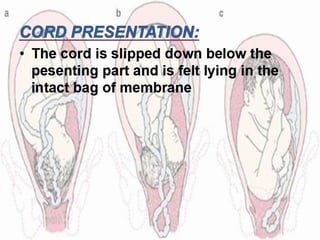
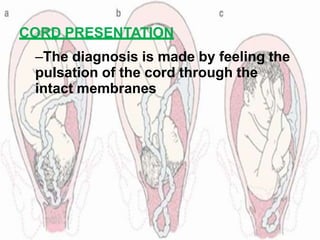
CORD PRESENTATION
–The diagnosis is made by feeling the
pulsation of the cord through the
intact membranes
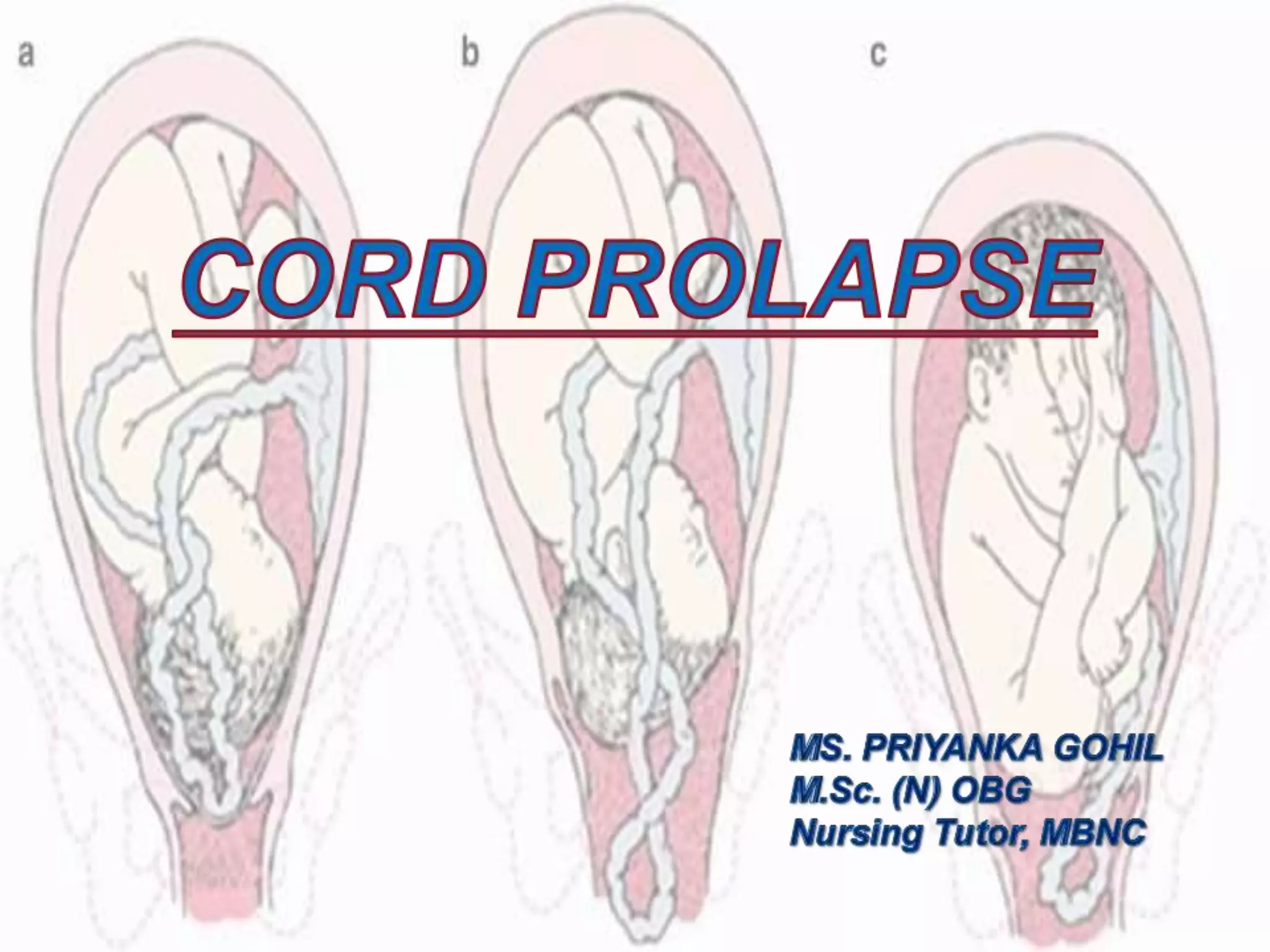
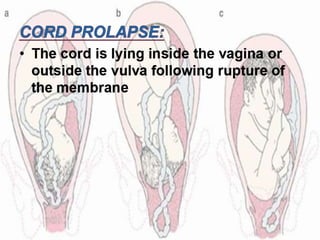
CORD PROLAPSE
–The cord is palpated directly by the
fingers and its pulsation can be felt if
the fetus is alive.
–Cord pulsation may cease during
uterine contraction which, however,
returns after the contraction passes
off.
–Temptation to pull down the loop for
visualization or unnecessary handling
is to be avoided to prvent vasospasm.
–Fetus may be alive even in the
absence of cord pulsation.
–Hence, prompt USG for cardiac
movements or auscultation for FHS to
be done before fetal death is declared.
FETAL
–The fetus is at risk of anoxia from the
moment cord is prolapsed.
–The blood flow is occluded either due
to mechanical compression by the the
presenting part or due vasospasm of
the umbilical vessels due to exposure
to cold or irritation when exposed
outside the vulva or as a result of
handling.
–The hazards to the fetus is more in vertex
presentation especially when the cord is
prolapsed through the anterior segment of
the pelvis or when the cervix is patially
dilated.
–The prognosis is however, related with
the interval between its detection and
delivery of the baby and if the delivery is
complicated, within10-30 minutes the fetal
mortality can be reduced to 5- 10%.
–The overall pernatal mortality is about 15-
50 %.
MATERNAL
–The maternal risks are incidental due
to emergency operative delivery,
especially through the vaginal route.
–Operative delivery involves the risk of
anesthesia, blood loss and infection.
• Internal examination should be done
whenever the membranes rupture
prematurely or during labour in all
cases of malpresentation, twins,
hydramnios or vertex presentation
where the head is not engaged.
• Surgical induction should preferably be
conducted in the operation theatre
keeping everything ready for cesarean
section.
• The uterine contraction may be
initiated by oxytocin, if the head is not
engaged prior to low rupture of the
membranes.
• Internal examinationboth before and
after amniotomy should be carried out
with cord accident in mind.
• One should exclude cord presentation
or occult prolapse, in unexplained fetal
distress during labour.
CORD PRESENTATION
–The aim is to prevent the membranes and
to expedite the delivery.
–Once the diagnosis is made, no attempt
should be made toreplace the cord, as it is
not only ineffective but the membranes
inevitably rupture leading to prolapse of
the cord.
–If immediate vaginal delivery is not
possible or contraindicated, cesarean
section is the best method of delivery.
–During the time of preparing the patient for
operative delivery, she is kept in
exaggerated sim's position to minimize
cord compression.
–A rare occasion is a multipara with
longitudinal lie having good uterine
contractions with the cervix three-fourth (7-
8 cm) dilated, without any evidence of fetal
distress.
–Watchful expectancy can be adopted till
full dilatation of the cervix, when the
delivery can be completed by forceps or
breech extraction.
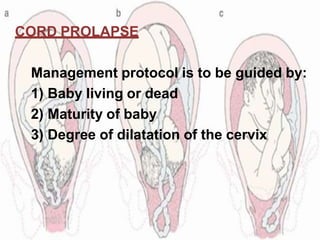
CORD PROLAPSE
Management protocol is to be guided by:
1) Baby living or dead
2) Maturity of baby
3) Degree of dilatation of the cervix
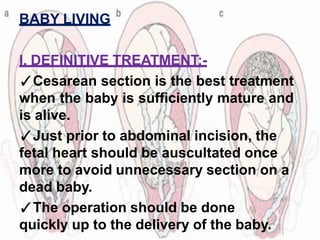
BABY LIVING
I. DEFINITIVE TREATMENT:-
✓Cesarean section is the best treatment
when the baby is sufficiently mature and
is alive.
✓Just prior to abdominal incision, the
fetal heart should be auscultated once
more to avoid unnecessary section on a
dead baby.
✓The operation should be done
quickly up to the delivery of the baby.
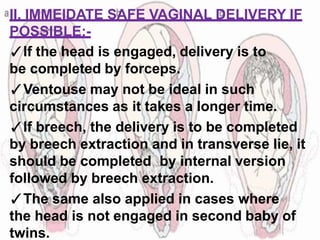
II. IMMEIDATE SAFE VAGINAL DELIVERY IF
POSSIBLE:-
✓If the head is engaged, delivery is to
be completed by forceps.
✓Ventouse may not be ideal in such
circumstances as it takes a longer time.
✓If breech, the delivery is to be completed
by breech extraction and in transverse lie, it
should be completed by internal version
followed by breech extraction.
✓The same also applied in cases where
the head is not engaged in second baby of
twins.
III. IMMEIDATE SAFE VAGINAL DELIVERY
IS NOT POSSIBLE:-
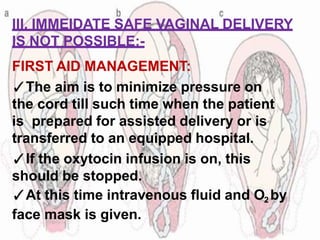
FIRST AID MANAGEMENT:
✓The aim is to minimize pressure on
the cord till such time when the patient
is prepared for assisted delivery or is
transferred to an equipped hospital.
✓If the oxytocin infusion is on, this
should be stopped.
✓At this time intravenous fluid and O2 by
face mask is given.
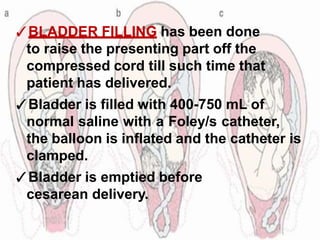
✓BLADDER FILLING has been done
to raise the presenting part off the
compressed cord till such time that
patient has delivered.
✓Bladder is filled with 400-750 mL of
normal saline with a Foley/s catheter,
the balloon is inflated and the catheter is
clamped.
✓Bladder is emptied before
cesarean delivery.
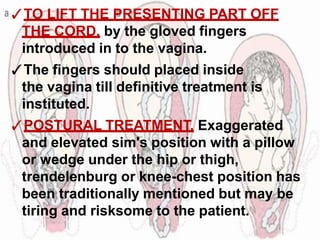
✓TO LIFT THE PRESENTING PART OFF
THE CORD, by the gloved fingers
introduced in to the vagina.
✓The fingers should placed inside
the vagina till definitive treatment is
instituted.
✓POSTURAL TREATMENT, Exaggerated
and elevated sim's position with a pillow
or wedge under the hip or thigh,
trendelenburg or knee-chest position has
been traditionally mentioned but may be
tiring and risksome to the patient.
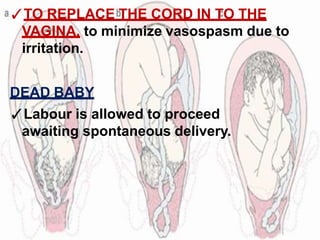
✓TO REPLACE THE CORD IN TO THE
VAGINA, to minimize vasospasm due to
irritation.
DEAD BABY
✓Labour is allowed to proceed
awaiting spontaneous delivery.

cordprolapse-190701165943 (1).pptx

  • 2.
    • There arethree clinical types of abnormal descent of the umbilical cord by the side of the presenting part.
  • 7.
    • 1 in3000 Deliveries • Mostly confined to paarous women • Incedence is reduce with the increased use of elective CS in noncephalic presentations.
  • 8.
    • Anything whichinterferes with perfect adaptation of the presenting part to be the lower uterine segment, disturbing the ball valve action may favor cord prolapse. • Too often, more than one factor operates.
  • 9.
    • Malpresentations- transverse( common) 5-10 %, breech 3 % specially with flexed legs or footling and compound presentation 10% • Contracted Pelvis • Prematurity • Twins • Hydromnios
  • 10.
    • Placental Factor-Minor degree of placenta previa with marginal insertion of cord or long cord • Iatrogenic- Low rupture of the membranes, manual rotation of the head, ECV, IPV • Stabilizing induction
  • 11.
    OCCULT PROLAPSE –Difficult todiagnos –Posibilities should be suspected if there is persistence of variabledeceration of fetal heart rate pattern deteected on continuous electronic fetal monitoring
  • 12.
    CORD PRESENTATION –The diagnosisis made by feeling the pulsation of the cord through the intact membranes
  • 13.
    CORD PROLAPSE –The cordis palpated directly by the fingers and its pulsation can be felt if the fetus is alive. –Cord pulsation may cease during uterine contraction which, however, returns after the contraction passes off. –Temptation to pull down the loop for visualization or unnecessary handling is to be avoided to prvent vasospasm.
  • 14.
    –Fetus may bealive even in the absence of cord pulsation. –Hence, prompt USG for cardiac movements or auscultation for FHS to be done before fetal death is declared.
  • 15.
    FETAL –The fetus isat risk of anoxia from the moment cord is prolapsed. –The blood flow is occluded either due to mechanical compression by the the presenting part or due vasospasm of the umbilical vessels due to exposure to cold or irritation when exposed outside the vulva or as a result of handling.
  • 16.
    –The hazards tothe fetus is more in vertex presentation especially when the cord is prolapsed through the anterior segment of the pelvis or when the cervix is patially dilated. –The prognosis is however, related with the interval between its detection and delivery of the baby and if the delivery is complicated, within10-30 minutes the fetal mortality can be reduced to 5- 10%. –The overall pernatal mortality is about 15- 50 %.
  • 17.
    MATERNAL –The maternal risksare incidental due to emergency operative delivery, especially through the vaginal route. –Operative delivery involves the risk of anesthesia, blood loss and infection.
  • 18.
    • Internal examinationshould be done whenever the membranes rupture prematurely or during labour in all cases of malpresentation, twins, hydramnios or vertex presentation where the head is not engaged. • Surgical induction should preferably be conducted in the operation theatre keeping everything ready for cesarean section.
  • 19.
    • The uterinecontraction may be initiated by oxytocin, if the head is not engaged prior to low rupture of the membranes. • Internal examinationboth before and after amniotomy should be carried out with cord accident in mind. • One should exclude cord presentation or occult prolapse, in unexplained fetal distress during labour.
  • 20.
    CORD PRESENTATION –The aimis to prevent the membranes and to expedite the delivery. –Once the diagnosis is made, no attempt should be made toreplace the cord, as it is not only ineffective but the membranes inevitably rupture leading to prolapse of the cord. –If immediate vaginal delivery is not possible or contraindicated, cesarean section is the best method of delivery.
  • 21.
    –During the timeof preparing the patient for operative delivery, she is kept in exaggerated sim's position to minimize cord compression. –A rare occasion is a multipara with longitudinal lie having good uterine contractions with the cervix three-fourth (7- 8 cm) dilated, without any evidence of fetal distress. –Watchful expectancy can be adopted till full dilatation of the cervix, when the delivery can be completed by forceps or breech extraction.
  • 22.
    CORD PROLAPSE Management protocolis to be guided by: 1) Baby living or dead 2) Maturity of baby 3) Degree of dilatation of the cervix
  • 23.
    BABY LIVING I. DEFINITIVETREATMENT:- ✓Cesarean section is the best treatment when the baby is sufficiently mature and is alive. ✓Just prior to abdominal incision, the fetal heart should be auscultated once more to avoid unnecessary section on a dead baby. ✓The operation should be done quickly up to the delivery of the baby.
  • 24.
    II. IMMEIDATE SAFEVAGINAL DELIVERY IF POSSIBLE:- ✓If the head is engaged, delivery is to be completed by forceps. ✓Ventouse may not be ideal in such circumstances as it takes a longer time. ✓If breech, the delivery is to be completed by breech extraction and in transverse lie, it should be completed by internal version followed by breech extraction. ✓The same also applied in cases where the head is not engaged in second baby of twins.
  • 25.
    III. IMMEIDATE SAFEVAGINAL DELIVERY IS NOT POSSIBLE:- FIRST AID MANAGEMENT: ✓The aim is to minimize pressure on the cord till such time when the patient is prepared for assisted delivery or is transferred to an equipped hospital. ✓If the oxytocin infusion is on, this should be stopped. ✓At this time intravenous fluid and O2 by face mask is given.
  • 26.
    ✓BLADDER FILLING hasbeen done to raise the presenting part off the compressed cord till such time that patient has delivered. ✓Bladder is filled with 400-750 mL of normal saline with a Foley/s catheter, the balloon is inflated and the catheter is clamped. ✓Bladder is emptied before cesarean delivery.
  • 27.
    ✓TO LIFT THEPRESENTING PART OFF THE CORD, by the gloved fingers introduced in to the vagina. ✓The fingers should placed inside the vagina till definitive treatment is instituted. ✓POSTURAL TREATMENT, Exaggerated and elevated sim's position with a pillow or wedge under the hip or thigh, trendelenburg or knee-chest position has been traditionally mentioned but may be tiring and risksome to the patient.
  • 28.
    ✓TO REPLACE THECORD IN TO THE VAGINA, to minimize vasospasm due to irritation. DEAD BABY ✓Labour is allowed to proceed awaiting spontaneous delivery.