“Building on others’ Creative Expression”

                              By Felipe O. Reyes


EDTC 6340, Fall 2012
*
                       *Today’s Environment
                       *Intellectual Property
                       *Infringement
                       *Public Domain
                       *Fair Use
                       *The TEACH ACT
                       *Getting Permission
                       *References
EDTC 6340, Fall 2012
*
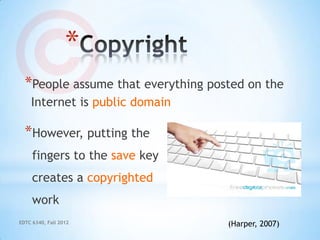
  *People assume that everything posted on the
    Internet is public domain

  *However, putting the
     fingers to the save key
     creates a copyrighted
     work
EDTC 6340, Fall 2012                (Harper, 2007)
*
    *Technology Neutral
    *Digital Copying and Distribution
    *Legal "obstacles” seem inconvenient
       and archaic


EDTC 6340, Fall 2012              (Wasoff, 2011)
*
     *Creations of the mind for which
       exclusive rights are recognized in
       law


EDTC 6340, Fall 2012                (Wikipedia)
*
         *Reproduced, distributed,
           performed, publicly displayed, or
           made into a derivative work
           without the permission of the
           copyright owner

EDTC 6340, Fall 2012   (http://www.copyright.gov/help/faq/faq-definitions.html)
*

    *Creative work that is not protected
      by copyright and which may be
      freely used by everyone


EDTC 6340, Fall 2012       Gasaway, 2003)
*
    *Is the use you want to make of
      another's work transformative?
    *Is the amount of material you want
      to use appropriate to achieve your
      transformative purpose?

EDTC 6340, Fall 2012          (Harper, 2007)
*
   *Where “re-purpose” is not the intent:
           * Does copyright owner makes licenses to
              use his/her work available on the open
              market?
           *Is an efficient and effective way to get a
              license that lets us do what we want to do?
   * If not, it is considered fair use
EDTC 6340, Fall 2012                          (Harper, 2007)
*
   *Educator may show or perform any work
   related to the curriculum, regardless of the
   medium, face-to-face in the classroom - still
   images, music of every kind, even movies.
   *There are no limits and no permission
     required

                                     (Harper, 2007
EDTC 6340, Fall 2012
*
     *If the work is part of a book or a
       journal article, check the Copyright
       Clearance Center (CCC)
     *If you know who the author and the
       publisher are, you can contact them
       directly
EDTC 6340, Fall 2012           (Harper, 2007)
*
* Harper, G. K., The Copyright Crash Course, 2007, retrieved from
  http://copyright.lib.utexas.edu/index.html#build
* Gasaway, L., WHEN U.S. WORKS PASS INTO THE PUBLIC DOMAIN,
  University of North Carolina, 2003, retrieved from
  http://www.unc.edu/~unclng/public-d.htm
* Wasoff, L. F., Symposium: Collective Management of Copyright:
  Solution or Sacrifice?: If Mass Digitization Is the Problem, Is
  Legislation the Solution? Some Practical Considerations Related to
  Copyright, Summer, 2011, Columbia Journal of Law & the Arts, 34
  Colum. J.L. & Arts 731, Abstract retrieved from
  http://www.nclis.gov/digitalization/MassDigitalizationSymposium-
  Report.pdf

EDTC 6340, Fall 2012

Copyright presentation 3

  • 1.
    “Building on others’Creative Expression” By Felipe O. Reyes EDTC 6340, Fall 2012
  • 2.
    * *Today’s Environment *Intellectual Property *Infringement *Public Domain *Fair Use *The TEACH ACT *Getting Permission *References EDTC 6340, Fall 2012
  • 3.
    * *Peopleassume that everything posted on the Internet is public domain *However, putting the fingers to the save key creates a copyrighted work EDTC 6340, Fall 2012 (Harper, 2007)
  • 4.
    * *Technology Neutral *Digital Copying and Distribution *Legal "obstacles” seem inconvenient and archaic EDTC 6340, Fall 2012 (Wasoff, 2011)
  • 5.
    * *Creations of the mind for which exclusive rights are recognized in law EDTC 6340, Fall 2012 (Wikipedia)
  • 6.
    * *Reproduced, distributed, performed, publicly displayed, or made into a derivative work without the permission of the copyright owner EDTC 6340, Fall 2012 (http://www.copyright.gov/help/faq/faq-definitions.html)
  • 7.
    * *Creative work that is not protected by copyright and which may be freely used by everyone EDTC 6340, Fall 2012 Gasaway, 2003)
  • 8.
    * *Is the use you want to make of another's work transformative? *Is the amount of material you want to use appropriate to achieve your transformative purpose? EDTC 6340, Fall 2012 (Harper, 2007)
  • 9.
    * *Where “re-purpose” is not the intent: * Does copyright owner makes licenses to use his/her work available on the open market? *Is an efficient and effective way to get a license that lets us do what we want to do? * If not, it is considered fair use EDTC 6340, Fall 2012 (Harper, 2007)
  • 10.
    * *Educator may show or perform any work related to the curriculum, regardless of the medium, face-to-face in the classroom - still images, music of every kind, even movies. *There are no limits and no permission required (Harper, 2007 EDTC 6340, Fall 2012
  • 11.
    * *If the work is part of a book or a journal article, check the Copyright Clearance Center (CCC) *If you know who the author and the publisher are, you can contact them directly EDTC 6340, Fall 2012 (Harper, 2007)
  • 12.
    * * Harper, G.K., The Copyright Crash Course, 2007, retrieved from http://copyright.lib.utexas.edu/index.html#build * Gasaway, L., WHEN U.S. WORKS PASS INTO THE PUBLIC DOMAIN, University of North Carolina, 2003, retrieved from http://www.unc.edu/~unclng/public-d.htm * Wasoff, L. F., Symposium: Collective Management of Copyright: Solution or Sacrifice?: If Mass Digitization Is the Problem, Is Legislation the Solution? Some Practical Considerations Related to Copyright, Summer, 2011, Columbia Journal of Law & the Arts, 34 Colum. J.L. & Arts 731, Abstract retrieved from http://www.nclis.gov/digitalization/MassDigitalizationSymposium- Report.pdf EDTC 6340, Fall 2012