©opyright or Wrong? How changing digital copyright laws affect our schools Choate Summer Programs June 26, 2009
Pretty much everything carries a copyright © Joel Backon - Choate Rosemary Hall Including: http://www.copyrighthistory.com/anne.html
Concept of Fair Use (4 criteria) I. Purpose and character of the use © Joel Backon - Choate Rosemary Hall
Concept of Fair Use II. Nature of the work being used © Joel Backon - Choate Rosemary Hall
Concept of Fair Use III. Amount and substantiality in relation to the whole © Joel Backon - Choate Rosemary Hall
Concept of Fair Use IV. Effect on the market for the original © Joel Backon - Choate Rosemary Hall
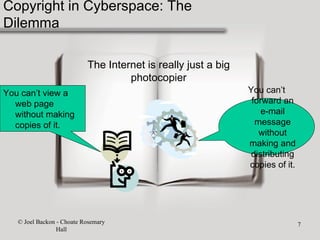
Copyright in Cyberspace: The Dilemma The Internet is really just a big photocopier © Joel Backon - Choate Rosemary Hall You can’t view a web page without making copies of it. You can’t forward an e-mail message without making and distributing copies of it.
Enter the DMCA – 1998 Individual Liability “ The subpoena shall authorize and order the service provider… to expeditiously disclose to the copyright owner… information sufficient to identify the alleged infringer of the material… to the extent such information is available to the service provider.”  [DMCA – Section 512] © Joel Backon - Choate Rosemary Hall
TEACH Act – 2002 Technology, Education, And Copyright Harmonization Act Became law November 2, 2002 Amended DMCA 110 to facilitate use of copyrighted materials, without permission, in web-based education © Joel Backon - Choate Rosemary Hall
What does it mean? Kenneth Crews (Indiana University): “Be Careful.” Posting copyrighted digital materials on a public web site is illegal! Posting to a protected site is also illegal if the materials are not used for a course (links are okay). Materials can only be posted for the “duration of the lesson.” © Joel Backon - Choate Rosemary Hall http://www.cnn.com/TECH/computing/9810/30/digcopyright.idg/

Copyright Or Wrong Summer09

  • 1.
    ©opyright or Wrong?How changing digital copyright laws affect our schools Choate Summer Programs June 26, 2009
  • 2.
    Pretty much everythingcarries a copyright © Joel Backon - Choate Rosemary Hall Including: http://www.copyrighthistory.com/anne.html
  • 3.
    Concept of FairUse (4 criteria) I. Purpose and character of the use © Joel Backon - Choate Rosemary Hall
  • 4.
    Concept of FairUse II. Nature of the work being used © Joel Backon - Choate Rosemary Hall
  • 5.
    Concept of FairUse III. Amount and substantiality in relation to the whole © Joel Backon - Choate Rosemary Hall
  • 6.
    Concept of FairUse IV. Effect on the market for the original © Joel Backon - Choate Rosemary Hall
  • 7.
    Copyright in Cyberspace:The Dilemma The Internet is really just a big photocopier © Joel Backon - Choate Rosemary Hall You can’t view a web page without making copies of it. You can’t forward an e-mail message without making and distributing copies of it.
  • 8.
    Enter the DMCA– 1998 Individual Liability “ The subpoena shall authorize and order the service provider… to expeditiously disclose to the copyright owner… information sufficient to identify the alleged infringer of the material… to the extent such information is available to the service provider.” [DMCA – Section 512] © Joel Backon - Choate Rosemary Hall
  • 9.
    TEACH Act –2002 Technology, Education, And Copyright Harmonization Act Became law November 2, 2002 Amended DMCA 110 to facilitate use of copyrighted materials, without permission, in web-based education © Joel Backon - Choate Rosemary Hall
  • 10.
    What does itmean? Kenneth Crews (Indiana University): “Be Careful.” Posting copyrighted digital materials on a public web site is illegal! Posting to a protected site is also illegal if the materials are not used for a course (links are okay). Materials can only be posted for the “duration of the lesson.” © Joel Backon - Choate Rosemary Hall http://www.cnn.com/TECH/computing/9810/30/digcopyright.idg/

Editor's Notes

  • #3 Exclusive rights of copyright owners: Reproduction of the work in whole or in part Preparation of derivative works E.g., translations, musical arrangements, dramatizations, sound recordings, and second editions. Distribution of copies of the work to the public by sale, gift, rental, loan, or other transfer Limited by the “First Sale” doctrine Public performance of the work Public display of the work Also limited by the “First Sale Doctrine” Goes back to Statute of Anne, 1710
  • #11 School must be accredited and nonprofit Must have an internal policy in place Must provide printed or online resources for faculty members that describes their rights and responsibilities Material must not have been originally intended for educational use. Must have been lawfully acquired Must be an integral part of the class session Reasonable precautions to restrict access to the copyrighted content to students enrolled in the course. Other reasonable controls used to prevent students from disseminating material after viewing it. If a digital version of the material is readily available for use at the institution, then the instructor cannot convert an analog version to digital form for use in an online course. Must inform students that the material may be protected by copyright law. What about printing?