Web 2.0 and Copyright
The education technological revolutionThe 70’sThe photocopierMoorehouse v UNSW 1974Part VB license for education purposes (1980)
The education technological revolutionThe 80’sThe video recorderThe ‘Betamax’ case 1984Part VA license off air broadcast (1989)
The education technological revolutionThe90’sThe Internet & World Wide WebA&M Records v Napster 2001Copyright Amendment (Digital Agenda) Act 2000
Early 21st Century developments2001Web 2.0, P2P, Facebook, TwitterWireless, Bluetooth, iPhone, KindleFuture technological developments?2005
The 2010’sAustralian internet use 80%18-25 year olds 96%University Students 100%YouTube 2nd largest search engine in the world70% of 18-34 years olds watched TV online.By 2010 Gen Y will outnumber baby bombers
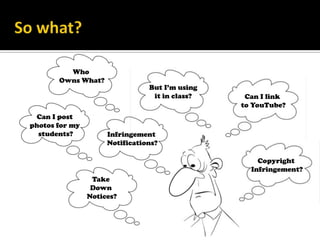
Can I post photos for my students?So what?Take Down Notices?Can I link to YouTube?But I’m usingit in class?Copyright Infringement?Infringement Notifications?Who Owns What?
Legal Use of Electronic MaterialYou may copy10% of the words of an electronic workThe whole of an artistic work (i.e. photographs)But ONLY for use in class or on a password protected intranet!(smartcopying.com.au)
Legal risksMany misconceptions about Copyright law and the spectrum of the ‘Education Licence’Copyright material incorporated into media is not covered under the education licence.Material is licensed for classroom or the library but not podcasts and YouTube.
Copyright myths Internet is Public Domain, can use anything.Using material for teaching is Fair Dealing.If you’re not charging for it, it’s alright. We’re using the material for the public good.They won’t sue a school.I won’t be personally liable.
Copyright FactsCopying small portion may still be a copyright infringement. ‘Quality’ of the work taken, not just ‘Quantity’. ‘Works’ on the internet are copyright by their owner.Material licensed for education use in classes may not be licensed for the Internet (YouTube and iTunesU).
What to do?
SolutionsCheck the copyright restrictions on ANY resource you wish to copy/modify and publish to a public site Ask for permission from the copyright holder to reproduce their work on your siteUse CREATIVE COMMONS licenced material
LicenceShare/ remix/ spread… and attribute.licence elements: 	Attribution – attribute the authorNoncommercial – no commercial useShareAlike – changes allowed, but only if you put the new work under the same licence
Original Slideshow ‘Web 2.0 and Copyright Legal Issues for Universities’  by Aaron Magner, available at http://www.slideshare.net/AaronMagner/web-20-and-copyright-legal-issues-for-universitiesImages from Istockphoto.com and flickr.comAttribution

Copyright & Web 2.0 for Teachers

  • 1.
    Web 2.0 andCopyright
  • 2.
    The education technologicalrevolutionThe 70’sThe photocopierMoorehouse v UNSW 1974Part VB license for education purposes (1980)
  • 3.
    The education technologicalrevolutionThe 80’sThe video recorderThe ‘Betamax’ case 1984Part VA license off air broadcast (1989)
  • 4.
    The education technologicalrevolutionThe90’sThe Internet & World Wide WebA&M Records v Napster 2001Copyright Amendment (Digital Agenda) Act 2000
  • 5.
    Early 21st Centurydevelopments2001Web 2.0, P2P, Facebook, TwitterWireless, Bluetooth, iPhone, KindleFuture technological developments?2005
  • 6.
    The 2010’sAustralian internetuse 80%18-25 year olds 96%University Students 100%YouTube 2nd largest search engine in the world70% of 18-34 years olds watched TV online.By 2010 Gen Y will outnumber baby bombers
  • 7.
    Can I postphotos for my students?So what?Take Down Notices?Can I link to YouTube?But I’m usingit in class?Copyright Infringement?Infringement Notifications?Who Owns What?
  • 8.
    Legal Use ofElectronic MaterialYou may copy10% of the words of an electronic workThe whole of an artistic work (i.e. photographs)But ONLY for use in class or on a password protected intranet!(smartcopying.com.au)
  • 9.
    Legal risksMany misconceptionsabout Copyright law and the spectrum of the ‘Education Licence’Copyright material incorporated into media is not covered under the education licence.Material is licensed for classroom or the library but not podcasts and YouTube.
  • 10.
    Copyright myths Internetis Public Domain, can use anything.Using material for teaching is Fair Dealing.If you’re not charging for it, it’s alright. We’re using the material for the public good.They won’t sue a school.I won’t be personally liable.
  • 11.
    Copyright FactsCopying smallportion may still be a copyright infringement. ‘Quality’ of the work taken, not just ‘Quantity’. ‘Works’ on the internet are copyright by their owner.Material licensed for education use in classes may not be licensed for the Internet (YouTube and iTunesU).
  • 12.
  • 13.
    SolutionsCheck the copyrightrestrictions on ANY resource you wish to copy/modify and publish to a public site Ask for permission from the copyright holder to reproduce their work on your siteUse CREATIVE COMMONS licenced material
  • 14.
    LicenceShare/ remix/ spread…and attribute.licence elements: Attribution – attribute the authorNoncommercial – no commercial useShareAlike – changes allowed, but only if you put the new work under the same licence
  • 15.
    Original Slideshow ‘Web2.0 and Copyright Legal Issues for Universities’ by Aaron Magner, available at http://www.slideshare.net/AaronMagner/web-20-and-copyright-legal-issues-for-universitiesImages from Istockphoto.com and flickr.comAttribution