Intellectual Property Rights Law-II
LL.B. V Term (2022)
Unit: III Authorship/Ownership of Copyright
Dr. Amrendra Kumar
Assistant Professor
Law Centre- II, Faculty of Law
University of Delhi, Delhi
INTRODUCTION
 The Copyright Act, 1957 protects the rights of authors, i.e. creators of literary,
musical, dramatic and artistic works and cinematograph films and sound recordings.
Herein, ‘Author’ is the person who actually writes, compiles, composes, draws and
makes the work giving it particular from or expression to be read, heard, seen and
enjoyed by other.
 Generally, the author is the first owner of copyright in a work. Herein, the ownership
of the copyright in a work is quite different to the ownership of the work in physical
form created/made/delivered. For example, a person who owns/buys the book does
not mean that he is the owner of the copyright of the book also.
 The author may also create a work on his own behalf with the help of another person
or in course of employment by another person. In other words, an author may create
a work independently or he may create a work under ‘joint authorship’, ‘contract of
service’ or ‘contract for service’.
 Copyright Protection gives exclusive rights to the authors/owners of the work to
exploit the work to derive economic/commercial benefits. If any person without
authorization from the author/owner exercises any of the exclusive rights in respect
of the work which has copyright protection, it constitutes an infringement of the
copyright.
AUTHORSHIP :[SECTION 2(d)]
 Section 2(d) of the Act defines the term ‘author’ means in
relation to:
a literary [Section 2(o)] or dramatic work[Section 2(h)], the
author of the work;
a musical work[Section 2(p)], the composer [Section 2(ffa)];
an artistic work other than a photograph[Section 2(c)], the
artist;
a photograph[Section 2(s)], the person taking the
photograph;
a cinematograph film [Section 2(f)] or sound
recording[Section 2(xx)], the producer[Section 2(uu)];
any literary, dramatic, musical or artistic work which is
computer-generated, the person who causes the work to be
created.
OWNERSHIP :[SECTION 17]
 Herein, the author of a work shall be the first owner of copyright in the work. Though,
there are certain exceptions to it provided under Section 17 of the Act. For example:
 a literary, dramatic or artistic work made by the author: [Section 17, Proviso(a)]
in the course of his employment by the proprietor of a newspaper, magazine or similar
periodical under a contract of service or apprenticeship, for the purpose of publication in a
newspaper, magazine or similar periodical, the said proprietor shall be the first owner of
the copyright in the work in so far as the copyright relates to the publication of work, but
in all other respects the author shall be the first owner of the copyright in the work.
 For photograph taken, or a painting, or an engraving or a cinematograph film made:
[Section 17, Proviso(b)]
for valuable consideration at the instance of any person (Commissioned Work), such
person shall be the first owner of the copyright.
 For a work made in the course of the author’s employment under a contract of service
or apprenticeship, to which clause (a) or clause (b) does not apply: [Section 17,
Proviso(c)]
The employer shall, in the absence of any agreement to the contrary, be the first owner of
the copyright.
CONTD..
 For address or speech delivered in public: [Section 17, Proviso(cc)]
the person who has delivered such address or speech or;
if any person has delivered such address or speech on behalf of any other person,
such other person shall be the first owner of the copyright,
notwithstanding that the person who delivers such address or speech, or, as the case
may be, the person on whose behalf such address or speech is delivered, is
employed by any other person who arranges such address or speech or on whose
behalf or premises such address or speech is delivered.
 For the Government work: [Section 17, Proviso(d)]
Government shall, in the absence of any agreement to the contrary, be the first owner
of the copyright.
 For the work made or first published by or under the direction of any public
undertaking: [Section 17, Proviso(dd)]
such public undertaking shall, in the absence of any agreement to the contrary, be
the first owner of the copyright.
 For the work of International Organizations: [Section 17, Proviso(e)]
The international organization concerned shall be the first owner of the copyright.
JOINT AUTHORSHIP
 Copyright subsists also in works of joint authorship. Herein, the joint
authors hold the copyright in work on collaboration or cooperation of each
other as tenants in common rather than as joint tenants. All the authors in
the work joint authorship owns equal undivided share in the copyright in
absence of agreement to the contrary.
 The Act defines the term ‘work of joint authorship’ as means a work
produced by the collaboration of two or more authors in which the
contribution of one author is not distinct from the contribution of the other
author or authors. [Section 2(z)] In case of work in joint authorship, the
conditions and term prescribed for copyright under the Act shall be same
for all the authors. [Section 13 (2) Explanation]
 To make work in joint authorship, there is required common design and
collaboration between or among the authors to create/make/produce the
work. Besides, each of the authors should also make contribution with his
creation irrespective of the proportions in the final outcome of the work.
The contribution of each author however should not be distinct from the
contribution of other author or authors. All the contribution should be
merged to an integrated from or material as final outcome.
WORKS CREATED FOR OTHERS:
 Commissioned Work: The author of certain works may not be the first owner of
the copyright in certain situations. In other words, when a photographer, painter,
engraver and producer creates or commissions the work on valuable
consideration on behalf of another person, such other person would be the first
owner of the work. For example, when a film producer commissions a composer
of music for reward or valuable consideration for the purpose of making his film
or recording music or sound, he becomes the first owner of the copyright
therein. No copyright subsists in the composer unless there is an agreement to
the contrary between them. (Gee Pee Film Pvt. Ltd. Vs. Pratik Chowdhary,
[2002 (24) PTC 392]
 Contract of Service: When a person employs another person to create the work
for him for valuable consideration (wages, salaries, or fixed amount) under his
control or direction such duration, process, means or method for the final
outcome at his place or resources, then this would be considered under a
‘contract of service’. Herein, the level or degree of the control exercised by the
employer becomes significant to decide the status and nature of the work
created. Like, creating or preparing the work for any person, entity,
organization, corporations, and Government.
CONTD..
 Contract for Service: When a person employs another person to create
or make the work, but not his direction or control and just leave it to
that person to decide the duration, process, means or method through
which the final outcome of work could be arrived, then this would be the
‘contract for service’.
 Here, the other person is not in the command of the employers as to the
manner in which he will work or the work would be created for his
purpose.
 Besides, the employer would be quite different to the ‘independent
contractor’also for the work created or made on instance of other.
 The Independent Contractor makes or creates the work on the instance
of another person, but he himself decides or uses the means, measures,
resources and places to give final result of the work. Hence, he would be
the first owner of the work created.
EXPLOITATION OF COPYRIGHT
 Copyright is an intellectual property or private property which could be
transferred or exploited by the author/owner by way of
instrument/agreement, testamentary disposition and statuary provision i.e.
by operation of law. The Copyright Act provides the provisions for
exploitation of copyright with others through assignment and license.
 Copyright is basically enjoyed/used by the author/owner themselves or
shared/transferred/exploited with others also for mutual benefits/interests
through assignment or license for commercial/economic utilization. Since
copyright is bundle of rights, the owner herein may share whole of these
rights or only some of them.
 To transfer or share the rights with other through assignment and license, the
author/owner must have the actual and lawful title, interest and rights on
any existing or future work. With the consent/permission/direction, the
dependents, successors and legal representatives of the author/owner may
also be capable to make assignment and license.
ASSIGNMENT: SECTIONS 18-19A
 The author/owner of a work can assign copyright through agreement either
wholly or partially for whole or any part of such copyright to any person or
entity which would serve the purpose of both. One will enjoy the right to
exploit rights in the work for specific period and territory and, the other will
have the right to receive the royalty/commercial benefits.
 The author/owner of the copyright who assigns the copyright to other
person thereon is called ‘Assignor’. ‘Assignee’ is the person to whom the
author/owner of copyright assigns the copyright in the work. The
instrument, through which the assignment is done between them, is called
‘Assignment Agreement’.
 Copyright may also be assigned by prospective author/owner of the
copyright in a ‘future work’ subject to the condition that the assignment will
be effective only when the work comes in to existence. The terms and
conditions for the copyright protection would have to be satisfied for the
‘future work’by the prospective author/owner.
CONTD..
 Nature of Assignment: The owner of the copyright in an existing work or the
prospective owner of the copyright in a future work may assign to any person the
copyright either wholly or partially and either generally or subject to limitations and
either for the whole term of the copyright or any part thereof; Provided that in the
case of the assignment of copyright in any future work, the assignment shall take
effect only when the work comes into existence. In case of death, the legal
representative will do the same. [Section 18(1)]
 Where the assignee of a copyright becomes entitled to any right comprised in the
copyright, the assignee as respects the rights so assigned, and the assignor as
respects the rights not assigned, shall be treated for the purposes of this Act as the
owner of copyright and the provisions of this Act shall have effect accordingly.
[Section 18(2)]
 Mode of Assignment: The mode of assignment could only be in writing through
agreement(s). No assignment of the copyright in any work shall be legally valid
unless it is in writing signed by the assignor or by his duly authorized agent. For the
assignment of copyright in any work, the parties have to first identify the work and
specify the rights to be assigned as well as the duration and territorial extent of such
assignment. [Section 19 (1) & (2)]
CONTD..
 Where the assignee does not exercise the rights assigned to him within a period of
one year from the date of assignment, the assignment in respect of such rights shall
be deemed to have lapsed after the expiry of such period unless otherwise specified
in the assignment. If the period of assignment is not stated, it shall be deemed to be
five years from the date of assignment. If the territorial extent of assignment of the
rights is not specified, it shall be presumed to extend within India. [Section 19 (3)-
(6)]
 No assignment of copyright in any work to make a cinematograph film/sound
recording shall affect the right of the author of the work to claim an equal share of
royalties and consideration payable in case of utilization of the work otherwise
consented/considered. [Section 19 (9) & (10)] Even if the copyright has been
assigned by the author/owner to other, his special/moral rights still remain intact.
 Disputes on Assignment: If any dispute arises with respect to the assignment of any
copyright, the ‘Appellate Board’ may, on receipt of a complaint from the aggrieved
party and after holding the inquiry as it considers necessary, pass the order as it may
deem fit. Every complaint shall be dealt by the ‘Appellate Board’as soon as possible.
The efforts shall be made to pass the final order in the matter within a period of six
months from the date of receipt of complaint. [Section 19A (2) & (13)]
CONTD..
 Revocation of Assignment: If an ‘assignee’ fails to make sufficient exercise
of the rights assigned to him, the ‘Appellate Board’ may, on receipt of a
complaint from the assignor and after holding the inquiry as it may deem
necessary, revoke such assignment. However, no order of revocation shall
be made within a period of five years from the date of such assignment.
[Section 19A (1)]
 The ‘author/owner/assignor’ of copyright may also relinquish all or any of
the right including the right to make assignment for his work. But, he is
obliged to give notice in prescribed from to ‘Registrar of Copyright’ or by
way of public notice about it. This right shall cease to exist from the date of
notice. [Section 21(1)]
 Above all, an assignment is complete transfer of the ownership of the work
wherein the owner/assignor assigns absolute and complete rights to the
assignee. The assignee can also re-assign the copyright given further.
Hence, the agreement of assignment should be carefully drafted and signed
by the parties concerned for any class of work.
License: Section 30-31D
 Another mode of exploitation of copyright as intellectual property is the
licensing. The owner of copyright may grant a license to do any of the act in
respect of which he has an exclusive right provided on existing work or future
work. Herein, there is merely transfer of interest or authorization to do certain
act with the work/property for commercial benefits. After completion of period
specified, any act done thereafter shall be called the act of infringement.
 The owner of the copyright in any existing work or the prospective owner of the
copyright in any future work may grant any interest in the right by license in
writing by him or by his duly authorized agent. In the case of a license relating
to copyright in any future work, the license shall take effect only when the work
comes into existence. If he dies in between, his legal representatives shall be
entitled to the benefit of the license. [Section 30]
 The mode of license would be through agreement/deed with necessary
adaptations and modifications as provided in Section 19. Therefore, a ‘license
deed’ between ‘licensor’ and ‘licensee’ in relation to work should comprise of
following particulars: identification of work; the rights to be licensed; duration
of license; territorial extent; quantum of royalty payable; terms regarding
revision; extension and termination. [Section 30A]
CONTD..
 Such license could be ‘exclusive’ or ‘non-exclusive’ in nature. Herein, the term
‘exclusive license’ has been defined in the Act as ‘a license which confers on the
licensee and persons authorized by him, to the exclusion of all other persons,
any right comprised in the copyright work.’ [Section 2(j)] But, the term ‘non-
exclusive license’ has not been defined but, it could be recognized as ‘license
without exclusion of other persons’for limited or indefinite period.
 The licenses provided under this Act could be classified as: ‘Voluntary’ and
‘Compulsory Licensing’. Voluntary licensing is the common license that is
granted by the owner of copyright voluntarily to any person certain right to use
the work exclusively. Compulsory licensing is a statutory license that gives the
liberty to use the copyrighted work without permission from the owner of the
copyright on fixed amount of royalty set by Govt. authorities.
 The Copyright Act specifically provides the provisions for compulsory licensing
prescribing the situations/instances evolved with the time in public interest.
Sections 31 and 32 along with added provisions through amendments provided
for the compulsory licensing of particular work through amicable negotiations
with owner of copyrighted work.
Compulsory License
 Compulsory license in works withheld from public: (Section 31)
During the term of copyright in any work which has been published or
performed in public, if the complaint is made to Appellate Board that the
owner of copyright in a work: (a) has refused to allow the republication of
the work or has refused to allow the performance in public of the work, and
by reason of such refusal the work is withheld from the public, or (b) has
refused to allow communication to public by broadcast of the work.
Then, Appellate Board after holding such inquiry as it may deem necessary,
may, if it is satisfied that the grounds for such refusal are not reasonable,
direct the Registrar of Copyrights to grant to the complainant a license to
republish the work, perform the work in public or communicate the work to
the public by broadcast, as the case may be, subject to payment to the
owner of the copyright of such compensation subject to such other terms
and conditions determined.
Thereupon, the Registrar of Copyrights shall grant the license to such
person or persons who, in the opinion of the Appellate Board, is or are
qualified to do so in accordance with the directions of the Appellate Board
on payment of such fee as may be prescribed.
CONTD..
 Compulsory License in Unpublished or Published Work: (Section 31-A)
Where the author is dead or unknown or cannot be traced , or the owner of
the copyright in such work cannot be found, any person may apply to the
‘Copyright Board’for a license to publish such work or translation thereof in
any language.
Before making such an application, the applicant should publish his proposal
in one issue of a daily newspaper in that language. The application to the
copyright board should be in the prescribed form and accompanied by the
prescribed fee and with the copy of advertisement issued.
The ‘Copyright Board’ after making the certain prescribed enquires direct
the Registrar of Copyright to grant license to the applicant to publish the
work or its translation subject to the payment of royalty and other conditions.
CONTD..
 Compulsory License for the Benefit of Disabled Persons: (Section 31-B)
Any person working for the benefit of persons with disability on a profit
basis or for business may apply to the Appellate Board, in such form and
manner and accompanied by such fee as may be prescribed, for a
compulsory license to publish any work in which copyright subsists for the
benefit of such persons.
The ‘Appellate Board’, after giving to the owners of rights in the work a
reasonable opportunity of being heard and after holding such inquiry as it
may deem necessary, that a compulsory license needs to be issued to make
the work available to the disabled, it may direct the Registrar of Copyrights
to grant to the applicant such a license to publish the work.
Every compulsory license issued herein shall specify the means and format
of publication, the period during which the compulsory license may be
exercised and, in the case of issue of copies, the number of copies that may
be issued including the rate or royalty. Besides, the Appellate Board may
also extend the period of such compulsory license further and allow the
issue of more copies as it may deem fit.
CONTD..
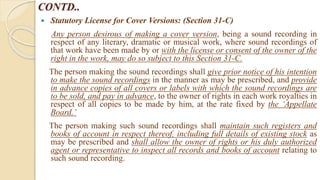
 Statutory License for Cover Versions: (Section 31-C)
Any person desirous of making a cover version, being a sound recording in
respect of any literary, dramatic or musical work, where sound recordings of
that work have been made by or with the license or consent of the owner of the
right in the work, may do so subject to this Section 31-C.
The person making the sound recordings shall give prior notice of his intention
to make the sound recordings in the manner as may be prescribed, and provide
in advance copies of all covers or labels with which the sound recordings are
to be sold, and pay in advance, to the owner of rights in each work royalties in
respect of all copies to be made by him, at the rate fixed by the ‘Appellate
Board.’
The person making such sound recordings shall maintain such registers and
books of account in respect thereof, including full details of existing stock as
may be prescribed and shall allow the owner of rights or his duly authorized
agent or representative to inspect all records and books of account relating to
such sound recording.
CONTD..
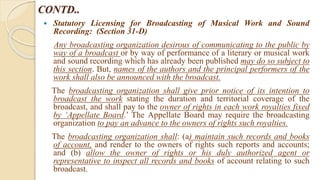
 Statutory Licensing for Broadcasting of Musical Work and Sound
Recording: (Section 31-D)
Any broadcasting organization desirous of communicating to the public by
way of a broadcast or by way of performance of a literary or musical work
and sound recording which has already been published may do so subject to
this section. But, names of the authors and the principal performers of the
work shall also be announced with the broadcast.
The broadcasting organization shall give prior notice of its intention to
broadcast the work stating the duration and territorial coverage of the
broadcast, and shall pay to the owner of rights in each work royalties fixed
by ‘Appellate Board.’ The Appellate Board may require the broadcasting
organization to pay an advance to the owners of rights such royalties.
The broadcasting organization shall: (a) maintain such records and books
of account, and render to the owners of rights such reports and accounts;
and (b) allow the owner of rights or his duly authorized agent or
representative to inspect all records and books of account relating to such
broadcast.
Cancellation/Termination of License:
 The Appellate Board after giving an opportunity of being heard, cancel the
license on any of the following grounds: (a) that licensee has filed to re-
publish the work or perform the work in public within duration specified in
license; (b) that the licensee has obtained it on fraud or misrepresentation as
to any essential facts; (c) that the licensee has contravened any of the terms
and conditions of the license. [Rule 10, Copyright Rules, 2013]
 Certain compulsory licenses could also be terminated: if the copyright
owner or any person authorized by him publishes the work in India at a
price reasonably related to the price normally charged in India for similar
works and serve the notice on the person holding the license for termination
taking effect after three months from the date of serving the notice. [Section
32B]
 The ‘author/owner/licensor’ of copyright may also relinquish all or any of
the right including the right to license his work. But, he is obliged to give
notice in prescribed from to ‘Registrar of Copyright’ or by way of public
notice about it. This right shall cease to exist from the date of notice.
[Section 21(1)/Rule 4]
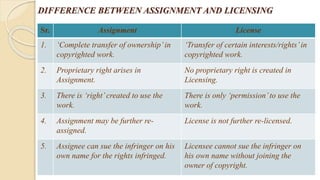
DIFFERENCE BETWEEN ASSIGNMENT AND LICENSING
Sr. Assignment License
1. ‘Complete transfer of ownership’in
copyrighted work.
‘Transfer of certain interests/rights’in
copyrighted work.
2. Proprietary right arises in
Assignment.
No proprietary right is created in
Licensing.
3. There is ‘right’created to use the
work.
There is only ‘permission’to use the
work.
4. Assignment may be further re-
assigned.
License is not further re-licensed.
5. Assignee can sue the infringer on his
own name for the rights infringed.
Licensee cannot sue the infringer on
his own name without joining the
owner of copyright.
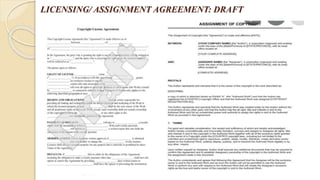
LICENSING/ ASSIGNMENT AGREEMENT: DRAFT
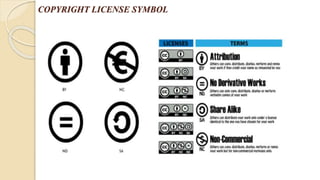
COPYRIGHT LICENSE SYMBOL
COLLECTIVE MANAGEMENT OF COPYRIGHT
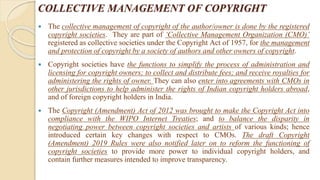
 The collective management of copyright of the author/owner is done by the registered
copyright societies. They are part of ‘Collective Management Organization (CMO)’
registered as collective societies under the Copyright Act of 1957, for the management
and protection of copyright by a society of authors and other owners of copyright.
 Copyright societies have the functions to simplify the process of administration and
licensing for copyright owners; to collect and distribute fees; and receive royalties for
administering the rights of owner. They can also enter into agreements with CMOs in
other jurisdictions to help administer the rights of Indian copyright holders abroad,
and of foreign copyright holders in India.
 The Copyright (Amendment) Act of 2012 was brought to make the Copyright Act into
compliance with the WIPO Internet Treaties; and to balance the disparity in
negotiating power between copyright societies and artists of various kinds; hence
introduced certain key changes with respect to CMOs. The draft Copyright
(Amendment) 2019 Rules were also notified later on to reform the functioning of
copyright societies to provide more power to individual copyright holders, and
contain further measures intended to improve transparency.
Registration of Copyright Societies: [Section 33]
 A copyright society is a registered collective administration society under
Section 33 of the Copyright Act, 1957. Such a society is formed by authors
and other owners. The minimum membership required for registration of a
society is seven. Ordinarily, only one society is registered to do business in
respect of the same class of work.
 The registration granted to a copyright society shall be for a period of five
years and may be renewed from time to time before the end of every five
years on a request in the prescribed form and the Central Government may
renew the registration after considering the report of Registrar of Copyrights
on the working of the copyright society.
 The renewal of the registration of a copyright society shall be subject to the
continued collective control of the copyright society being shared with the
authors of works in their capacity as owners of copyright or of the right to
receive royalty. Every copyright society already registered before the
Copyright (Amendment) Act, 2012 came into existence shall get itself
registered under this Chapter within a period of one year.
Function of Copyright Societies: [Section 33A]
 A copyright society may issue licenses and collect fees in accordance with its
‘Scheme of Tariff’ in relation to only such works as it has been authorized to
administer in writing by the authors/owners of rights and for the period for
which it has been so authorized. The distribution of fees collected shall be
subject to a deduction not exceeding fifteen per cent for administrative expenses.
 Every copyright society shall publish its tariff scheme in such manner as
prescribed in the Copyright Rules, 2013. Any person who is aggrieved by the
tariff scheme may appeal to the Intellectual Property Appellate Board (IPAB)
and the Board may, if satisfied after holding such inquiry, make such orders to
remove any unreasonable element, anomaly or inconsistency therein.
 A copyright society shall frame a scheme to be called the ‘Distribution Scheme’
setting out the procedure for distribution of royalties specified in the Tariff
Scheme among the members whose names are entered in the Register of
Authors and Owners. The Distribution Scheme shall aim to ensure that all
royalty distributions are fair, accurate, cost effective and without any unknown
or hidden cross‐subsidies.
Administration of Rights by Copyright Societies: [Section 34]
 The copyright society may accept from an author and other owner of rights
exclusive authorization to administer any right in any work by issue of
licenses or collection of license fees or both; and (b) an author and other
owner of rights shall have the right to withdraw such authorization without
prejudice to the rights of the copyright society under any contract.
 The copyright society shall also be competent to enter into agreement with
any foreign society or organization administering rights corresponding to
rights under this Act, to entrust to such foreign society or organization the
administration in any foreign country of rights administered by the said
copyright society in India, or for administering in India the rights
administered in a foreign country by such foreign society or organization.
 However, no such society or organization shall permit any discrimination
with regard to the terms and conditions of license or the distribution of
royalties so collected, between the Indian Copyright Holders as well as other
right holders.
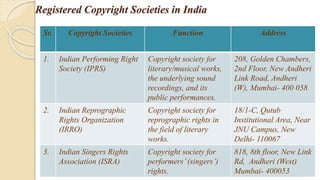
Registered Copyright Societies in India
Sr. Copyright Societies Function Address
1. Indian Performing Right
Society (IPRS)
Copyright society for
literary/musical works,
the underlying sound
recordings, and its
public performances.
208, Golden Chambers,
2nd Floor, New Andheri
Link Road, Andheri
(W), Mumbai‐ 400 058
2. Indian Reprographic
Rights Organization
(IRRO)
Copyright society for
reprographic rights in
the field of literary
works.
18/1‐C, Qutub
Institutional Area, Near
JNU Campus, New
Delhi- 110067
3. Indian Singers Rights
Association (ISRA)
Copyright society for
performers’(singers’)
rights.
818, 8th floor, New Link
Rd, Andheri (West)
Mumbai- 400053
THANKS..

IPR-II_Copyright Ownership.pptx

  • 1.
    Intellectual Property RightsLaw-II LL.B. V Term (2022) Unit: III Authorship/Ownership of Copyright Dr. Amrendra Kumar Assistant Professor Law Centre- II, Faculty of Law University of Delhi, Delhi
  • 2.
    INTRODUCTION  The CopyrightAct, 1957 protects the rights of authors, i.e. creators of literary, musical, dramatic and artistic works and cinematograph films and sound recordings. Herein, ‘Author’ is the person who actually writes, compiles, composes, draws and makes the work giving it particular from or expression to be read, heard, seen and enjoyed by other.  Generally, the author is the first owner of copyright in a work. Herein, the ownership of the copyright in a work is quite different to the ownership of the work in physical form created/made/delivered. For example, a person who owns/buys the book does not mean that he is the owner of the copyright of the book also.  The author may also create a work on his own behalf with the help of another person or in course of employment by another person. In other words, an author may create a work independently or he may create a work under ‘joint authorship’, ‘contract of service’ or ‘contract for service’.  Copyright Protection gives exclusive rights to the authors/owners of the work to exploit the work to derive economic/commercial benefits. If any person without authorization from the author/owner exercises any of the exclusive rights in respect of the work which has copyright protection, it constitutes an infringement of the copyright.
  • 3.
    AUTHORSHIP :[SECTION 2(d)] Section 2(d) of the Act defines the term ‘author’ means in relation to: a literary [Section 2(o)] or dramatic work[Section 2(h)], the author of the work; a musical work[Section 2(p)], the composer [Section 2(ffa)]; an artistic work other than a photograph[Section 2(c)], the artist; a photograph[Section 2(s)], the person taking the photograph; a cinematograph film [Section 2(f)] or sound recording[Section 2(xx)], the producer[Section 2(uu)]; any literary, dramatic, musical or artistic work which is computer-generated, the person who causes the work to be created.
  • 4.
    OWNERSHIP :[SECTION 17] Herein, the author of a work shall be the first owner of copyright in the work. Though, there are certain exceptions to it provided under Section 17 of the Act. For example:  a literary, dramatic or artistic work made by the author: [Section 17, Proviso(a)] in the course of his employment by the proprietor of a newspaper, magazine or similar periodical under a contract of service or apprenticeship, for the purpose of publication in a newspaper, magazine or similar periodical, the said proprietor shall be the first owner of the copyright in the work in so far as the copyright relates to the publication of work, but in all other respects the author shall be the first owner of the copyright in the work.  For photograph taken, or a painting, or an engraving or a cinematograph film made: [Section 17, Proviso(b)] for valuable consideration at the instance of any person (Commissioned Work), such person shall be the first owner of the copyright.  For a work made in the course of the author’s employment under a contract of service or apprenticeship, to which clause (a) or clause (b) does not apply: [Section 17, Proviso(c)] The employer shall, in the absence of any agreement to the contrary, be the first owner of the copyright.
  • 5.
    CONTD..  For addressor speech delivered in public: [Section 17, Proviso(cc)] the person who has delivered such address or speech or; if any person has delivered such address or speech on behalf of any other person, such other person shall be the first owner of the copyright, notwithstanding that the person who delivers such address or speech, or, as the case may be, the person on whose behalf such address or speech is delivered, is employed by any other person who arranges such address or speech or on whose behalf or premises such address or speech is delivered.  For the Government work: [Section 17, Proviso(d)] Government shall, in the absence of any agreement to the contrary, be the first owner of the copyright.  For the work made or first published by or under the direction of any public undertaking: [Section 17, Proviso(dd)] such public undertaking shall, in the absence of any agreement to the contrary, be the first owner of the copyright.  For the work of International Organizations: [Section 17, Proviso(e)] The international organization concerned shall be the first owner of the copyright.
  • 6.
    JOINT AUTHORSHIP  Copyrightsubsists also in works of joint authorship. Herein, the joint authors hold the copyright in work on collaboration or cooperation of each other as tenants in common rather than as joint tenants. All the authors in the work joint authorship owns equal undivided share in the copyright in absence of agreement to the contrary.  The Act defines the term ‘work of joint authorship’ as means a work produced by the collaboration of two or more authors in which the contribution of one author is not distinct from the contribution of the other author or authors. [Section 2(z)] In case of work in joint authorship, the conditions and term prescribed for copyright under the Act shall be same for all the authors. [Section 13 (2) Explanation]  To make work in joint authorship, there is required common design and collaboration between or among the authors to create/make/produce the work. Besides, each of the authors should also make contribution with his creation irrespective of the proportions in the final outcome of the work. The contribution of each author however should not be distinct from the contribution of other author or authors. All the contribution should be merged to an integrated from or material as final outcome.
  • 7.
    WORKS CREATED FOROTHERS:  Commissioned Work: The author of certain works may not be the first owner of the copyright in certain situations. In other words, when a photographer, painter, engraver and producer creates or commissions the work on valuable consideration on behalf of another person, such other person would be the first owner of the work. For example, when a film producer commissions a composer of music for reward or valuable consideration for the purpose of making his film or recording music or sound, he becomes the first owner of the copyright therein. No copyright subsists in the composer unless there is an agreement to the contrary between them. (Gee Pee Film Pvt. Ltd. Vs. Pratik Chowdhary, [2002 (24) PTC 392]  Contract of Service: When a person employs another person to create the work for him for valuable consideration (wages, salaries, or fixed amount) under his control or direction such duration, process, means or method for the final outcome at his place or resources, then this would be considered under a ‘contract of service’. Herein, the level or degree of the control exercised by the employer becomes significant to decide the status and nature of the work created. Like, creating or preparing the work for any person, entity, organization, corporations, and Government.
  • 8.
    CONTD..  Contract forService: When a person employs another person to create or make the work, but not his direction or control and just leave it to that person to decide the duration, process, means or method through which the final outcome of work could be arrived, then this would be the ‘contract for service’.  Here, the other person is not in the command of the employers as to the manner in which he will work or the work would be created for his purpose.  Besides, the employer would be quite different to the ‘independent contractor’also for the work created or made on instance of other.  The Independent Contractor makes or creates the work on the instance of another person, but he himself decides or uses the means, measures, resources and places to give final result of the work. Hence, he would be the first owner of the work created.
  • 9.
    EXPLOITATION OF COPYRIGHT Copyright is an intellectual property or private property which could be transferred or exploited by the author/owner by way of instrument/agreement, testamentary disposition and statuary provision i.e. by operation of law. The Copyright Act provides the provisions for exploitation of copyright with others through assignment and license.  Copyright is basically enjoyed/used by the author/owner themselves or shared/transferred/exploited with others also for mutual benefits/interests through assignment or license for commercial/economic utilization. Since copyright is bundle of rights, the owner herein may share whole of these rights or only some of them.  To transfer or share the rights with other through assignment and license, the author/owner must have the actual and lawful title, interest and rights on any existing or future work. With the consent/permission/direction, the dependents, successors and legal representatives of the author/owner may also be capable to make assignment and license.
  • 10.
    ASSIGNMENT: SECTIONS 18-19A The author/owner of a work can assign copyright through agreement either wholly or partially for whole or any part of such copyright to any person or entity which would serve the purpose of both. One will enjoy the right to exploit rights in the work for specific period and territory and, the other will have the right to receive the royalty/commercial benefits.  The author/owner of the copyright who assigns the copyright to other person thereon is called ‘Assignor’. ‘Assignee’ is the person to whom the author/owner of copyright assigns the copyright in the work. The instrument, through which the assignment is done between them, is called ‘Assignment Agreement’.  Copyright may also be assigned by prospective author/owner of the copyright in a ‘future work’ subject to the condition that the assignment will be effective only when the work comes in to existence. The terms and conditions for the copyright protection would have to be satisfied for the ‘future work’by the prospective author/owner.
  • 11.
    CONTD..  Nature ofAssignment: The owner of the copyright in an existing work or the prospective owner of the copyright in a future work may assign to any person the copyright either wholly or partially and either generally or subject to limitations and either for the whole term of the copyright or any part thereof; Provided that in the case of the assignment of copyright in any future work, the assignment shall take effect only when the work comes into existence. In case of death, the legal representative will do the same. [Section 18(1)]  Where the assignee of a copyright becomes entitled to any right comprised in the copyright, the assignee as respects the rights so assigned, and the assignor as respects the rights not assigned, shall be treated for the purposes of this Act as the owner of copyright and the provisions of this Act shall have effect accordingly. [Section 18(2)]  Mode of Assignment: The mode of assignment could only be in writing through agreement(s). No assignment of the copyright in any work shall be legally valid unless it is in writing signed by the assignor or by his duly authorized agent. For the assignment of copyright in any work, the parties have to first identify the work and specify the rights to be assigned as well as the duration and territorial extent of such assignment. [Section 19 (1) & (2)]
  • 12.
    CONTD..  Where theassignee does not exercise the rights assigned to him within a period of one year from the date of assignment, the assignment in respect of such rights shall be deemed to have lapsed after the expiry of such period unless otherwise specified in the assignment. If the period of assignment is not stated, it shall be deemed to be five years from the date of assignment. If the territorial extent of assignment of the rights is not specified, it shall be presumed to extend within India. [Section 19 (3)- (6)]  No assignment of copyright in any work to make a cinematograph film/sound recording shall affect the right of the author of the work to claim an equal share of royalties and consideration payable in case of utilization of the work otherwise consented/considered. [Section 19 (9) & (10)] Even if the copyright has been assigned by the author/owner to other, his special/moral rights still remain intact.  Disputes on Assignment: If any dispute arises with respect to the assignment of any copyright, the ‘Appellate Board’ may, on receipt of a complaint from the aggrieved party and after holding the inquiry as it considers necessary, pass the order as it may deem fit. Every complaint shall be dealt by the ‘Appellate Board’as soon as possible. The efforts shall be made to pass the final order in the matter within a period of six months from the date of receipt of complaint. [Section 19A (2) & (13)]
  • 13.
    CONTD..  Revocation ofAssignment: If an ‘assignee’ fails to make sufficient exercise of the rights assigned to him, the ‘Appellate Board’ may, on receipt of a complaint from the assignor and after holding the inquiry as it may deem necessary, revoke such assignment. However, no order of revocation shall be made within a period of five years from the date of such assignment. [Section 19A (1)]  The ‘author/owner/assignor’ of copyright may also relinquish all or any of the right including the right to make assignment for his work. But, he is obliged to give notice in prescribed from to ‘Registrar of Copyright’ or by way of public notice about it. This right shall cease to exist from the date of notice. [Section 21(1)]  Above all, an assignment is complete transfer of the ownership of the work wherein the owner/assignor assigns absolute and complete rights to the assignee. The assignee can also re-assign the copyright given further. Hence, the agreement of assignment should be carefully drafted and signed by the parties concerned for any class of work.
  • 14.
    License: Section 30-31D Another mode of exploitation of copyright as intellectual property is the licensing. The owner of copyright may grant a license to do any of the act in respect of which he has an exclusive right provided on existing work or future work. Herein, there is merely transfer of interest or authorization to do certain act with the work/property for commercial benefits. After completion of period specified, any act done thereafter shall be called the act of infringement.  The owner of the copyright in any existing work or the prospective owner of the copyright in any future work may grant any interest in the right by license in writing by him or by his duly authorized agent. In the case of a license relating to copyright in any future work, the license shall take effect only when the work comes into existence. If he dies in between, his legal representatives shall be entitled to the benefit of the license. [Section 30]  The mode of license would be through agreement/deed with necessary adaptations and modifications as provided in Section 19. Therefore, a ‘license deed’ between ‘licensor’ and ‘licensee’ in relation to work should comprise of following particulars: identification of work; the rights to be licensed; duration of license; territorial extent; quantum of royalty payable; terms regarding revision; extension and termination. [Section 30A]
  • 15.
    CONTD..  Such licensecould be ‘exclusive’ or ‘non-exclusive’ in nature. Herein, the term ‘exclusive license’ has been defined in the Act as ‘a license which confers on the licensee and persons authorized by him, to the exclusion of all other persons, any right comprised in the copyright work.’ [Section 2(j)] But, the term ‘non- exclusive license’ has not been defined but, it could be recognized as ‘license without exclusion of other persons’for limited or indefinite period.  The licenses provided under this Act could be classified as: ‘Voluntary’ and ‘Compulsory Licensing’. Voluntary licensing is the common license that is granted by the owner of copyright voluntarily to any person certain right to use the work exclusively. Compulsory licensing is a statutory license that gives the liberty to use the copyrighted work without permission from the owner of the copyright on fixed amount of royalty set by Govt. authorities.  The Copyright Act specifically provides the provisions for compulsory licensing prescribing the situations/instances evolved with the time in public interest. Sections 31 and 32 along with added provisions through amendments provided for the compulsory licensing of particular work through amicable negotiations with owner of copyrighted work.
  • 16.
    Compulsory License  Compulsorylicense in works withheld from public: (Section 31) During the term of copyright in any work which has been published or performed in public, if the complaint is made to Appellate Board that the owner of copyright in a work: (a) has refused to allow the republication of the work or has refused to allow the performance in public of the work, and by reason of such refusal the work is withheld from the public, or (b) has refused to allow communication to public by broadcast of the work. Then, Appellate Board after holding such inquiry as it may deem necessary, may, if it is satisfied that the grounds for such refusal are not reasonable, direct the Registrar of Copyrights to grant to the complainant a license to republish the work, perform the work in public or communicate the work to the public by broadcast, as the case may be, subject to payment to the owner of the copyright of such compensation subject to such other terms and conditions determined. Thereupon, the Registrar of Copyrights shall grant the license to such person or persons who, in the opinion of the Appellate Board, is or are qualified to do so in accordance with the directions of the Appellate Board on payment of such fee as may be prescribed.
  • 17.
    CONTD..  Compulsory Licensein Unpublished or Published Work: (Section 31-A) Where the author is dead or unknown or cannot be traced , or the owner of the copyright in such work cannot be found, any person may apply to the ‘Copyright Board’for a license to publish such work or translation thereof in any language. Before making such an application, the applicant should publish his proposal in one issue of a daily newspaper in that language. The application to the copyright board should be in the prescribed form and accompanied by the prescribed fee and with the copy of advertisement issued. The ‘Copyright Board’ after making the certain prescribed enquires direct the Registrar of Copyright to grant license to the applicant to publish the work or its translation subject to the payment of royalty and other conditions.
  • 18.
    CONTD..  Compulsory Licensefor the Benefit of Disabled Persons: (Section 31-B) Any person working for the benefit of persons with disability on a profit basis or for business may apply to the Appellate Board, in such form and manner and accompanied by such fee as may be prescribed, for a compulsory license to publish any work in which copyright subsists for the benefit of such persons. The ‘Appellate Board’, after giving to the owners of rights in the work a reasonable opportunity of being heard and after holding such inquiry as it may deem necessary, that a compulsory license needs to be issued to make the work available to the disabled, it may direct the Registrar of Copyrights to grant to the applicant such a license to publish the work. Every compulsory license issued herein shall specify the means and format of publication, the period during which the compulsory license may be exercised and, in the case of issue of copies, the number of copies that may be issued including the rate or royalty. Besides, the Appellate Board may also extend the period of such compulsory license further and allow the issue of more copies as it may deem fit.
  • 19.
    CONTD..  Statutory Licensefor Cover Versions: (Section 31-C) Any person desirous of making a cover version, being a sound recording in respect of any literary, dramatic or musical work, where sound recordings of that work have been made by or with the license or consent of the owner of the right in the work, may do so subject to this Section 31-C. The person making the sound recordings shall give prior notice of his intention to make the sound recordings in the manner as may be prescribed, and provide in advance copies of all covers or labels with which the sound recordings are to be sold, and pay in advance, to the owner of rights in each work royalties in respect of all copies to be made by him, at the rate fixed by the ‘Appellate Board.’ The person making such sound recordings shall maintain such registers and books of account in respect thereof, including full details of existing stock as may be prescribed and shall allow the owner of rights or his duly authorized agent or representative to inspect all records and books of account relating to such sound recording.
  • 20.
    CONTD..  Statutory Licensingfor Broadcasting of Musical Work and Sound Recording: (Section 31-D) Any broadcasting organization desirous of communicating to the public by way of a broadcast or by way of performance of a literary or musical work and sound recording which has already been published may do so subject to this section. But, names of the authors and the principal performers of the work shall also be announced with the broadcast. The broadcasting organization shall give prior notice of its intention to broadcast the work stating the duration and territorial coverage of the broadcast, and shall pay to the owner of rights in each work royalties fixed by ‘Appellate Board.’ The Appellate Board may require the broadcasting organization to pay an advance to the owners of rights such royalties. The broadcasting organization shall: (a) maintain such records and books of account, and render to the owners of rights such reports and accounts; and (b) allow the owner of rights or his duly authorized agent or representative to inspect all records and books of account relating to such broadcast.
  • 21.
    Cancellation/Termination of License: The Appellate Board after giving an opportunity of being heard, cancel the license on any of the following grounds: (a) that licensee has filed to re- publish the work or perform the work in public within duration specified in license; (b) that the licensee has obtained it on fraud or misrepresentation as to any essential facts; (c) that the licensee has contravened any of the terms and conditions of the license. [Rule 10, Copyright Rules, 2013]  Certain compulsory licenses could also be terminated: if the copyright owner or any person authorized by him publishes the work in India at a price reasonably related to the price normally charged in India for similar works and serve the notice on the person holding the license for termination taking effect after three months from the date of serving the notice. [Section 32B]  The ‘author/owner/licensor’ of copyright may also relinquish all or any of the right including the right to license his work. But, he is obliged to give notice in prescribed from to ‘Registrar of Copyright’ or by way of public notice about it. This right shall cease to exist from the date of notice. [Section 21(1)/Rule 4]
  • 22.
    DIFFERENCE BETWEEN ASSIGNMENTAND LICENSING Sr. Assignment License 1. ‘Complete transfer of ownership’in copyrighted work. ‘Transfer of certain interests/rights’in copyrighted work. 2. Proprietary right arises in Assignment. No proprietary right is created in Licensing. 3. There is ‘right’created to use the work. There is only ‘permission’to use the work. 4. Assignment may be further re- assigned. License is not further re-licensed. 5. Assignee can sue the infringer on his own name for the rights infringed. Licensee cannot sue the infringer on his own name without joining the owner of copyright.
  • 23.
  • 24.
  • 25.
    COLLECTIVE MANAGEMENT OFCOPYRIGHT  The collective management of copyright of the author/owner is done by the registered copyright societies. They are part of ‘Collective Management Organization (CMO)’ registered as collective societies under the Copyright Act of 1957, for the management and protection of copyright by a society of authors and other owners of copyright.  Copyright societies have the functions to simplify the process of administration and licensing for copyright owners; to collect and distribute fees; and receive royalties for administering the rights of owner. They can also enter into agreements with CMOs in other jurisdictions to help administer the rights of Indian copyright holders abroad, and of foreign copyright holders in India.  The Copyright (Amendment) Act of 2012 was brought to make the Copyright Act into compliance with the WIPO Internet Treaties; and to balance the disparity in negotiating power between copyright societies and artists of various kinds; hence introduced certain key changes with respect to CMOs. The draft Copyright (Amendment) 2019 Rules were also notified later on to reform the functioning of copyright societies to provide more power to individual copyright holders, and contain further measures intended to improve transparency.
  • 26.
    Registration of CopyrightSocieties: [Section 33]  A copyright society is a registered collective administration society under Section 33 of the Copyright Act, 1957. Such a society is formed by authors and other owners. The minimum membership required for registration of a society is seven. Ordinarily, only one society is registered to do business in respect of the same class of work.  The registration granted to a copyright society shall be for a period of five years and may be renewed from time to time before the end of every five years on a request in the prescribed form and the Central Government may renew the registration after considering the report of Registrar of Copyrights on the working of the copyright society.  The renewal of the registration of a copyright society shall be subject to the continued collective control of the copyright society being shared with the authors of works in their capacity as owners of copyright or of the right to receive royalty. Every copyright society already registered before the Copyright (Amendment) Act, 2012 came into existence shall get itself registered under this Chapter within a period of one year.
  • 27.
    Function of CopyrightSocieties: [Section 33A]  A copyright society may issue licenses and collect fees in accordance with its ‘Scheme of Tariff’ in relation to only such works as it has been authorized to administer in writing by the authors/owners of rights and for the period for which it has been so authorized. The distribution of fees collected shall be subject to a deduction not exceeding fifteen per cent for administrative expenses.  Every copyright society shall publish its tariff scheme in such manner as prescribed in the Copyright Rules, 2013. Any person who is aggrieved by the tariff scheme may appeal to the Intellectual Property Appellate Board (IPAB) and the Board may, if satisfied after holding such inquiry, make such orders to remove any unreasonable element, anomaly or inconsistency therein.  A copyright society shall frame a scheme to be called the ‘Distribution Scheme’ setting out the procedure for distribution of royalties specified in the Tariff Scheme among the members whose names are entered in the Register of Authors and Owners. The Distribution Scheme shall aim to ensure that all royalty distributions are fair, accurate, cost effective and without any unknown or hidden cross‐subsidies.
  • 28.
    Administration of Rightsby Copyright Societies: [Section 34]  The copyright society may accept from an author and other owner of rights exclusive authorization to administer any right in any work by issue of licenses or collection of license fees or both; and (b) an author and other owner of rights shall have the right to withdraw such authorization without prejudice to the rights of the copyright society under any contract.  The copyright society shall also be competent to enter into agreement with any foreign society or organization administering rights corresponding to rights under this Act, to entrust to such foreign society or organization the administration in any foreign country of rights administered by the said copyright society in India, or for administering in India the rights administered in a foreign country by such foreign society or organization.  However, no such society or organization shall permit any discrimination with regard to the terms and conditions of license or the distribution of royalties so collected, between the Indian Copyright Holders as well as other right holders.
  • 29.
    Registered Copyright Societiesin India Sr. Copyright Societies Function Address 1. Indian Performing Right Society (IPRS) Copyright society for literary/musical works, the underlying sound recordings, and its public performances. 208, Golden Chambers, 2nd Floor, New Andheri Link Road, Andheri (W), Mumbai‐ 400 058 2. Indian Reprographic Rights Organization (IRRO) Copyright society for reprographic rights in the field of literary works. 18/1‐C, Qutub Institutional Area, Near JNU Campus, New Delhi- 110067 3. Indian Singers Rights Association (ISRA) Copyright society for performers’(singers’) rights. 818, 8th floor, New Link Rd, Andheri (West) Mumbai- 400053
  • 30.